kam ailio 
sip servers everywhere 
Daniel-Constantin Mierla 
@miconda 
www.asipto.com 
www.kamailio.org 
AstriCon 2014 - Las Vegas, USA
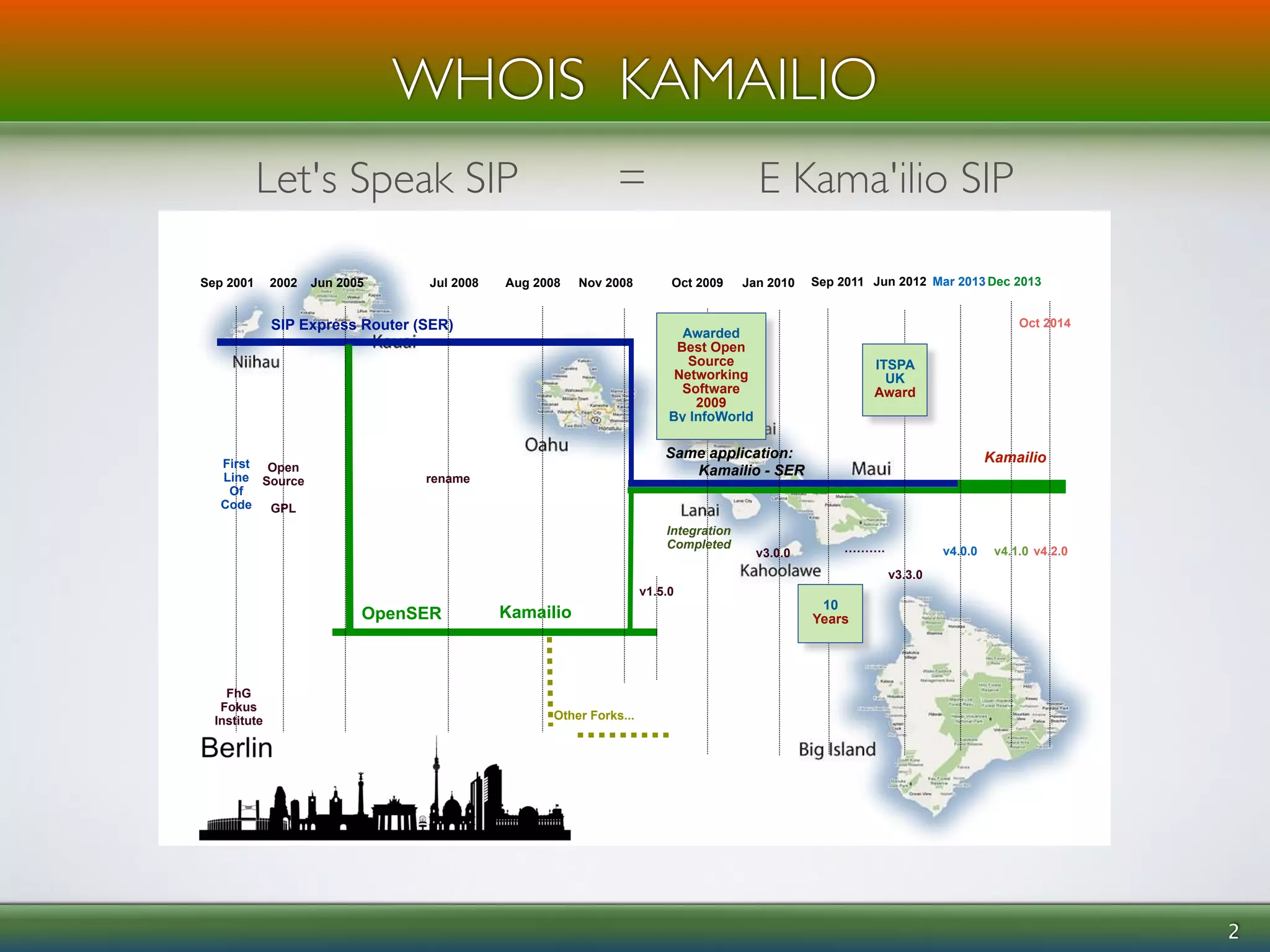
WHOIS KAMAILIO 
2 
Let's Speak SIP = E Kama'ilio SIP 
Sep 2001 2002 Jun 2005 Jul 2008 Aug 2008 Nov 2008 
Sep 2011 
SIP Express Router (SER) 
OpenSER Kamailio 
Other Forks... 
Oct 2009 Jan 2010 
Same application: 
Kamailio - SER 
v3.0.0 
Integration 
Completed 
v1.5.0 
First 
Line 
Of 
Code 
Open 
Source ! 
GPL 
FhG 
Fokus 
Institute 
rename 
Awarded 
Best Open 
Source 
Networking 
Software 
2009 
By InfoWorld 
Oct 2014 
………. v4.2.0 
10 
Years 
Jun 2012 
ITSPA 
UK 
Award 
v3.3.0 
Mar 2013 
v4.0.0 
Dec 2013 
Kamailio 
v4.1.0
credits to @voicegal - theivrvoice.com 
3
! 
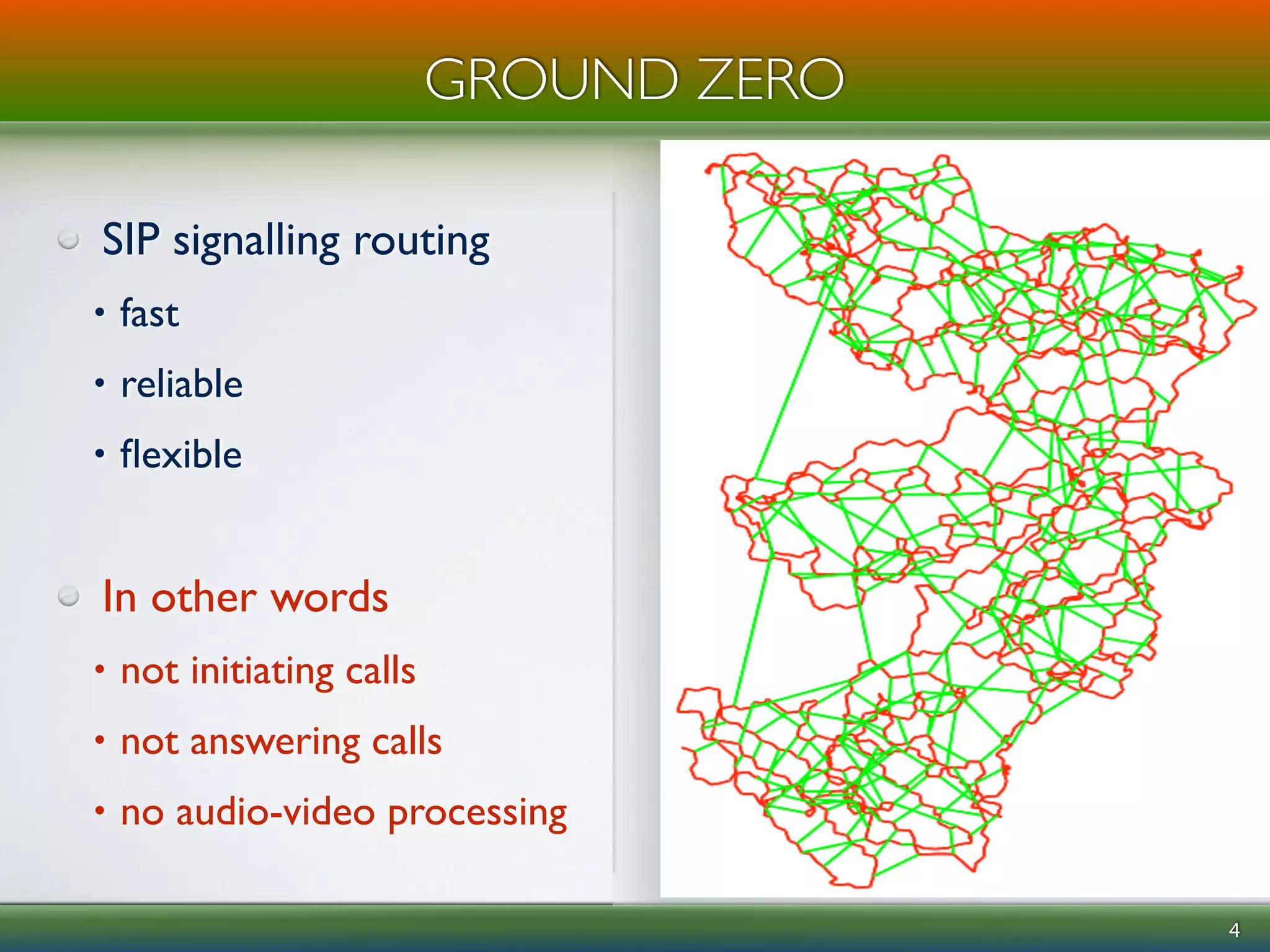
SIP signalling routing 
• fast 
• reliable 
• flexible 
4 
GROUND ZERO 
In other words 
• not initiating calls 
• not answering calls 
• no audio-video processing
DON’T PANIC 
! 
5 
Real Time Communications 
multimedia notifications 
telephony 
video conferences 
file transfer 
desktop sharing 
gaming 
instant messaging 
presence 
alerts 
monitoring 
mobility
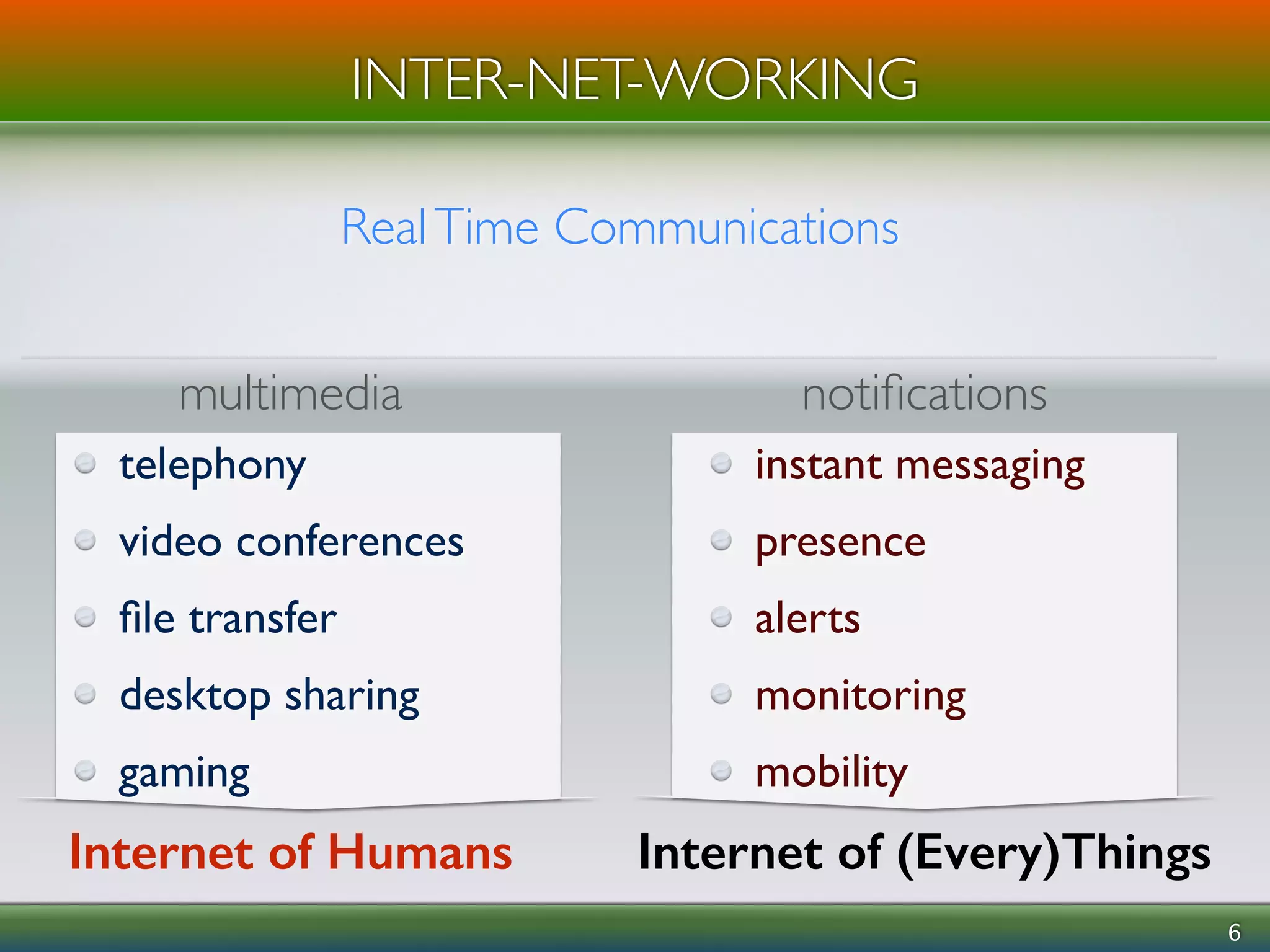
INTER-NET-WORKING 
! 
6 
Real Time Communications 
multimedia notifications 
telephony 
video conferences 
file transfer 
desktop sharing 
gaming 
instant messaging 
presence 
alerts 
monitoring 
mobility 
Internet of Humans Internet of (Every)Things
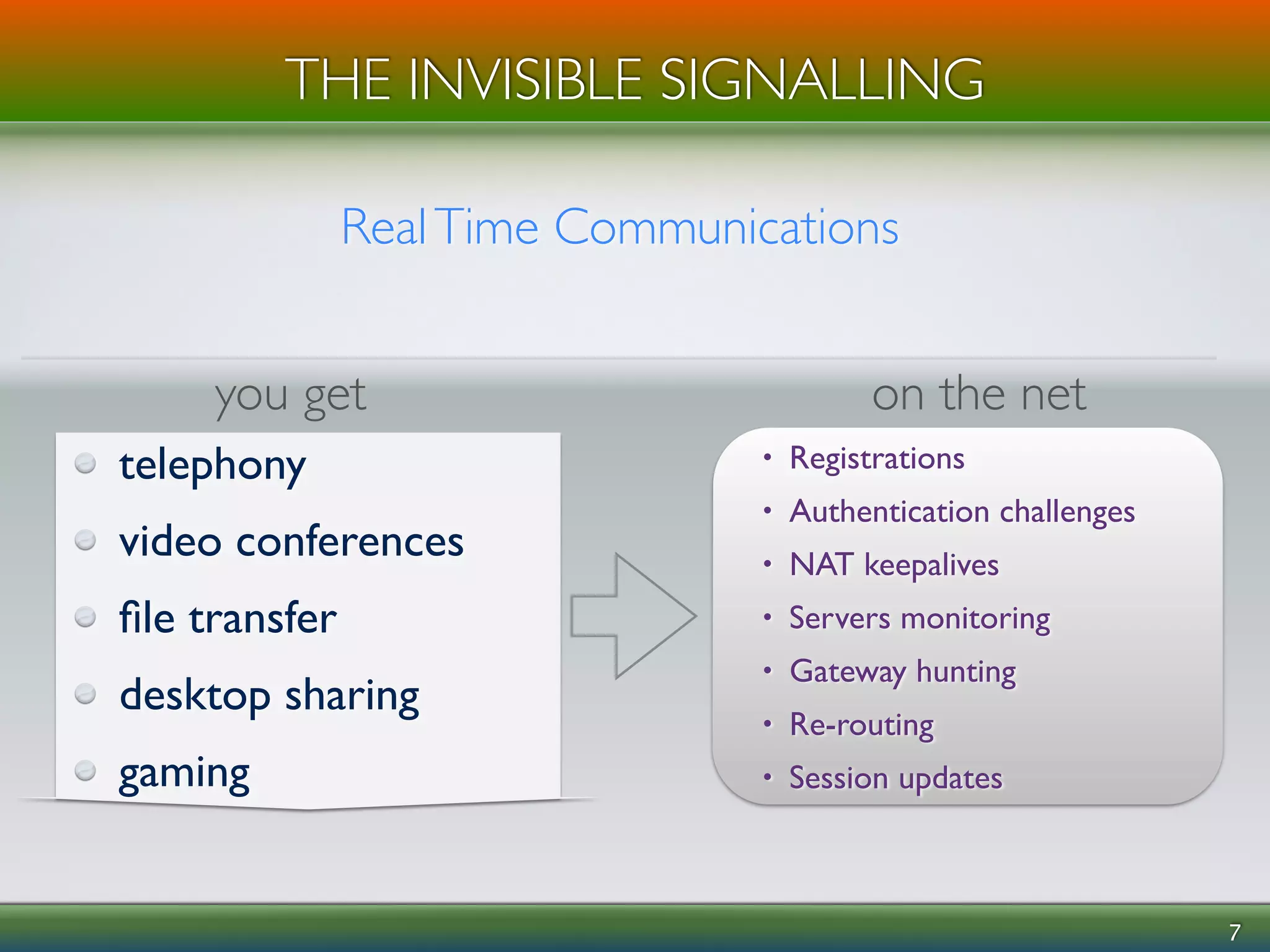
THE INVISIBLE SIGNALLING 
! 
7 
Real Time Communications 
you get on the net 
telephony 
video conferences 
file transfer 
desktop sharing 
gaming 
• Registrations 
• Authentication challenges 
• NAT keepalives 
• Servers monitoring 
• Gateway hunting 
• Re-routing 
• Session updates
! 
8 
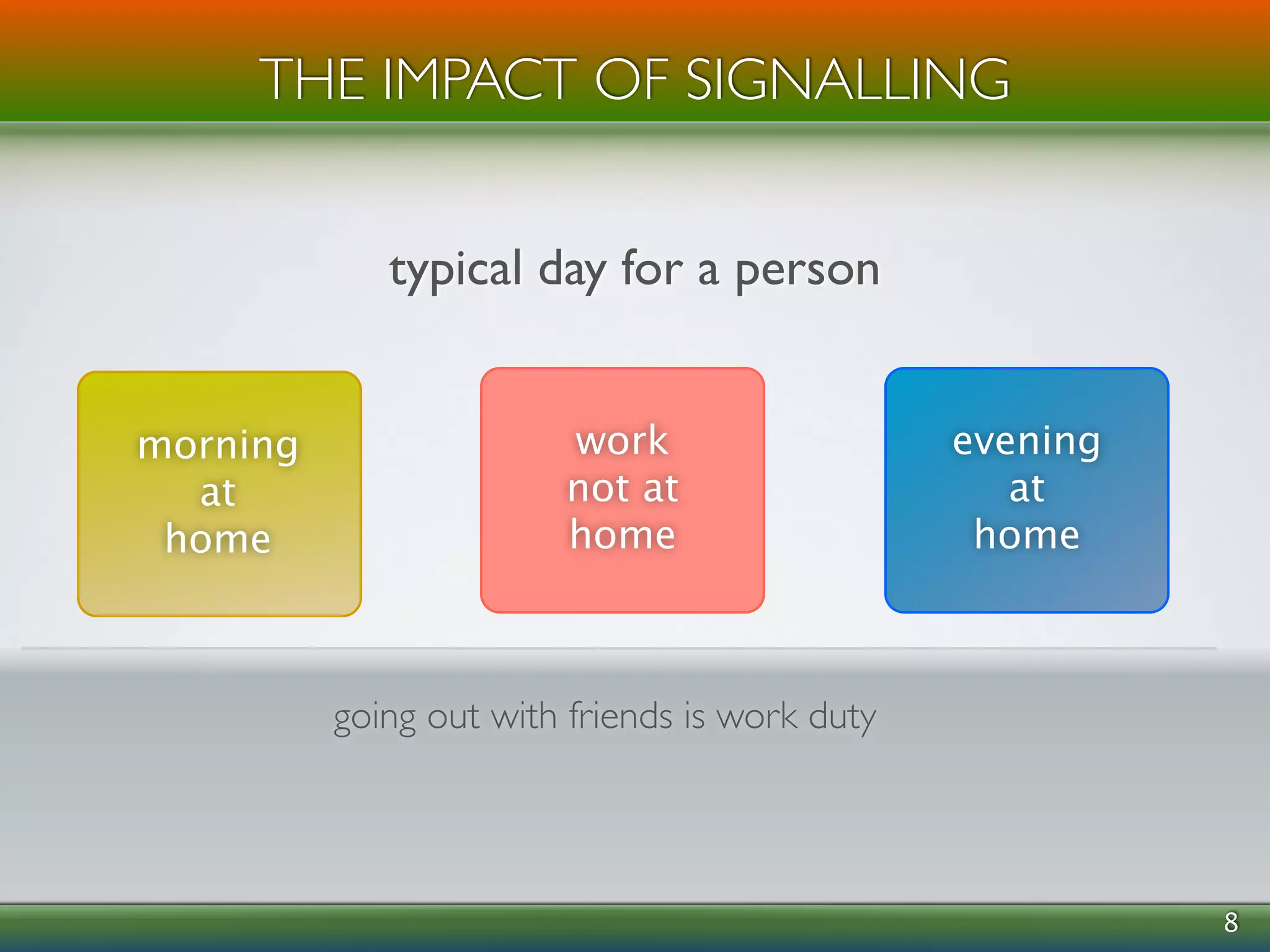
THE IMPACT OF SIGNALLING 
typical day for a person 
morning 
at 
home 
work 
not at 
home 
evening 
at 
home 
going out with friends is work duty
! 
9 
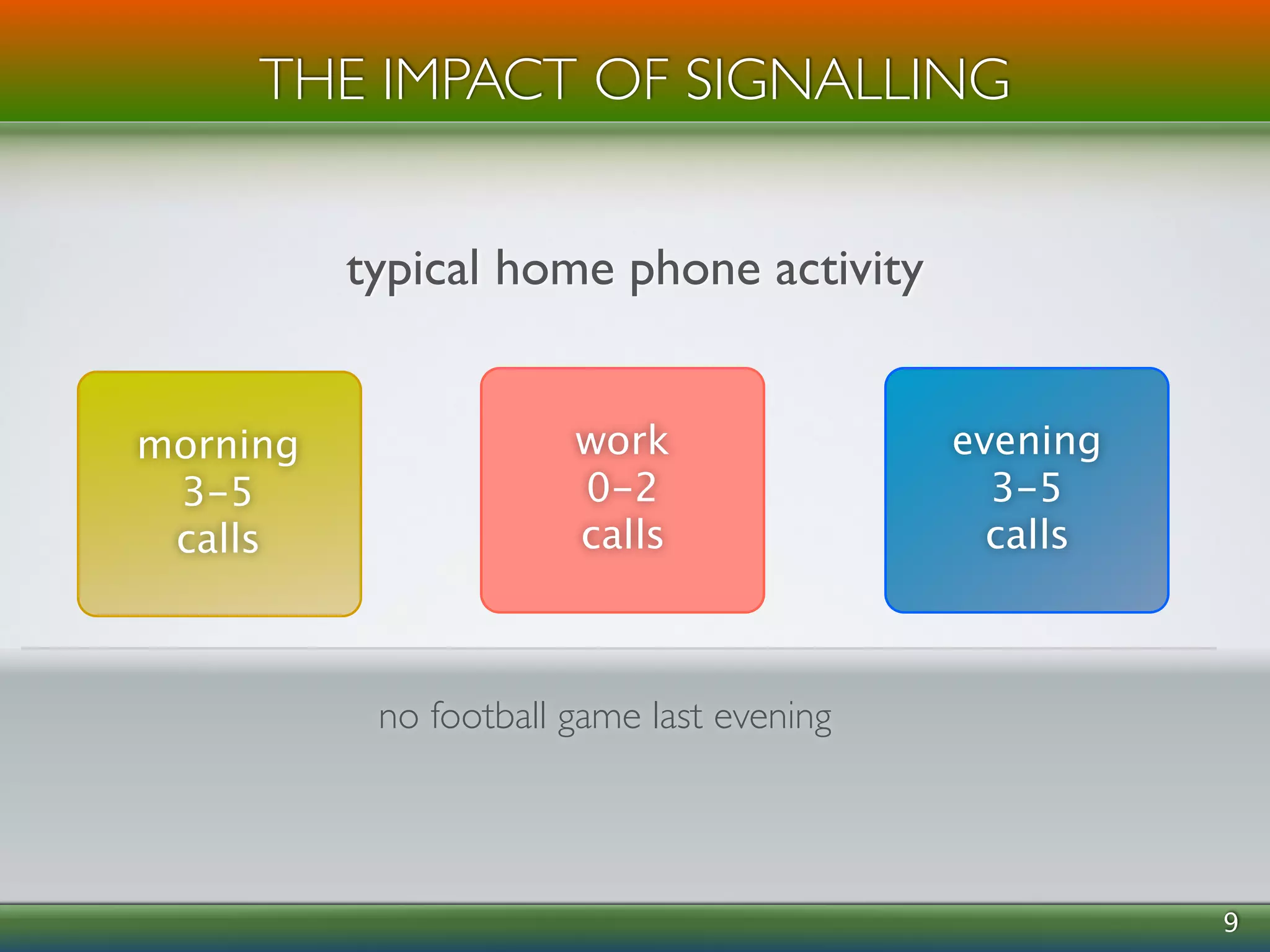
THE IMPACT OF SIGNALLING 
typical home phone activity 
morning 
3-5 
calls 
work 
0-2 
calls 
evening 
3-5 
calls 
no football game last evening
10 
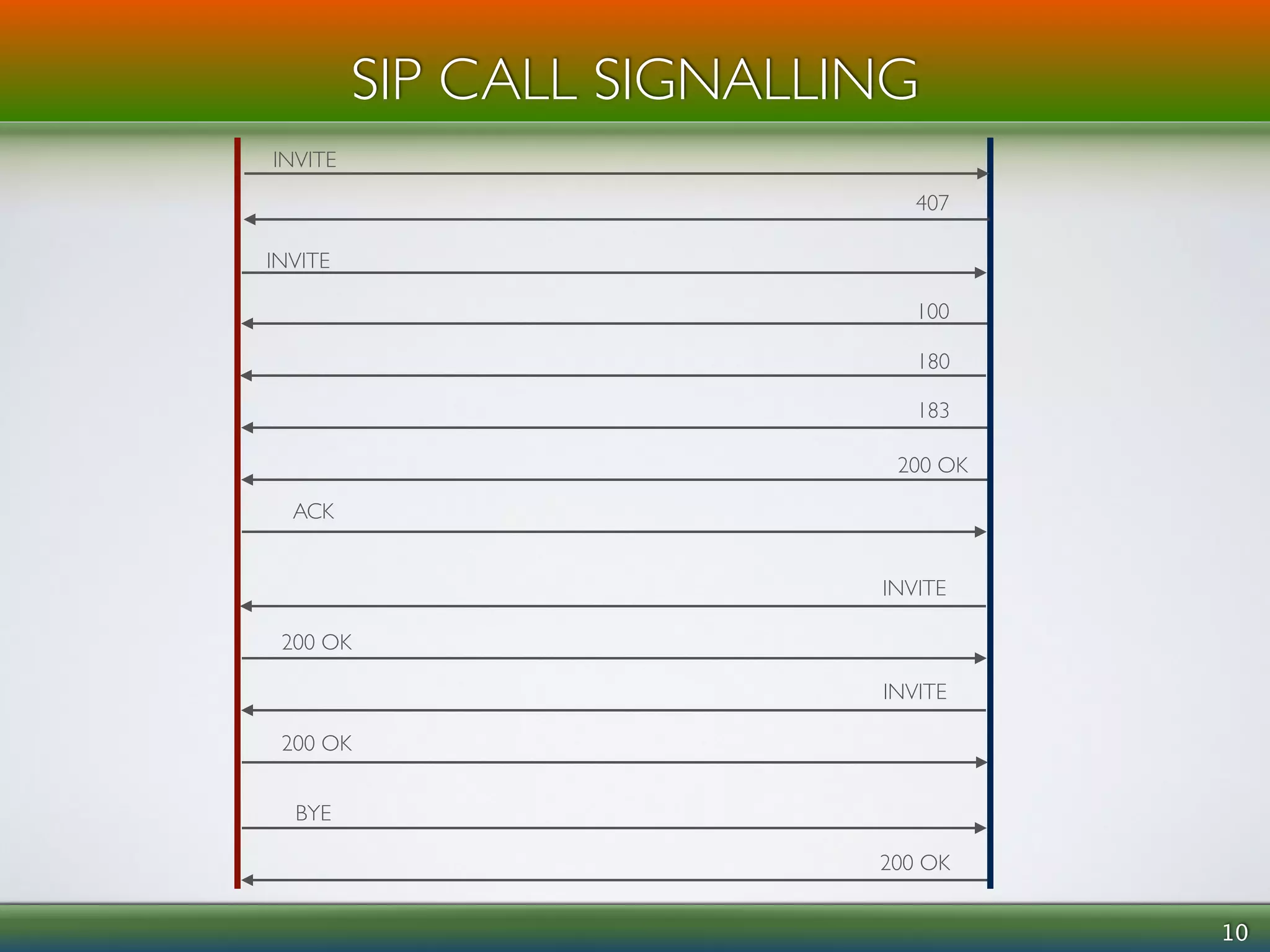
SIP CALL SIGNALLING 
INVITE 
100 
180 
183 
INVITE 
INVITE 
ACK 
BYE 
200 OK 
200 OK 
200 OK 
200 OK 
INVITE 
407
11 
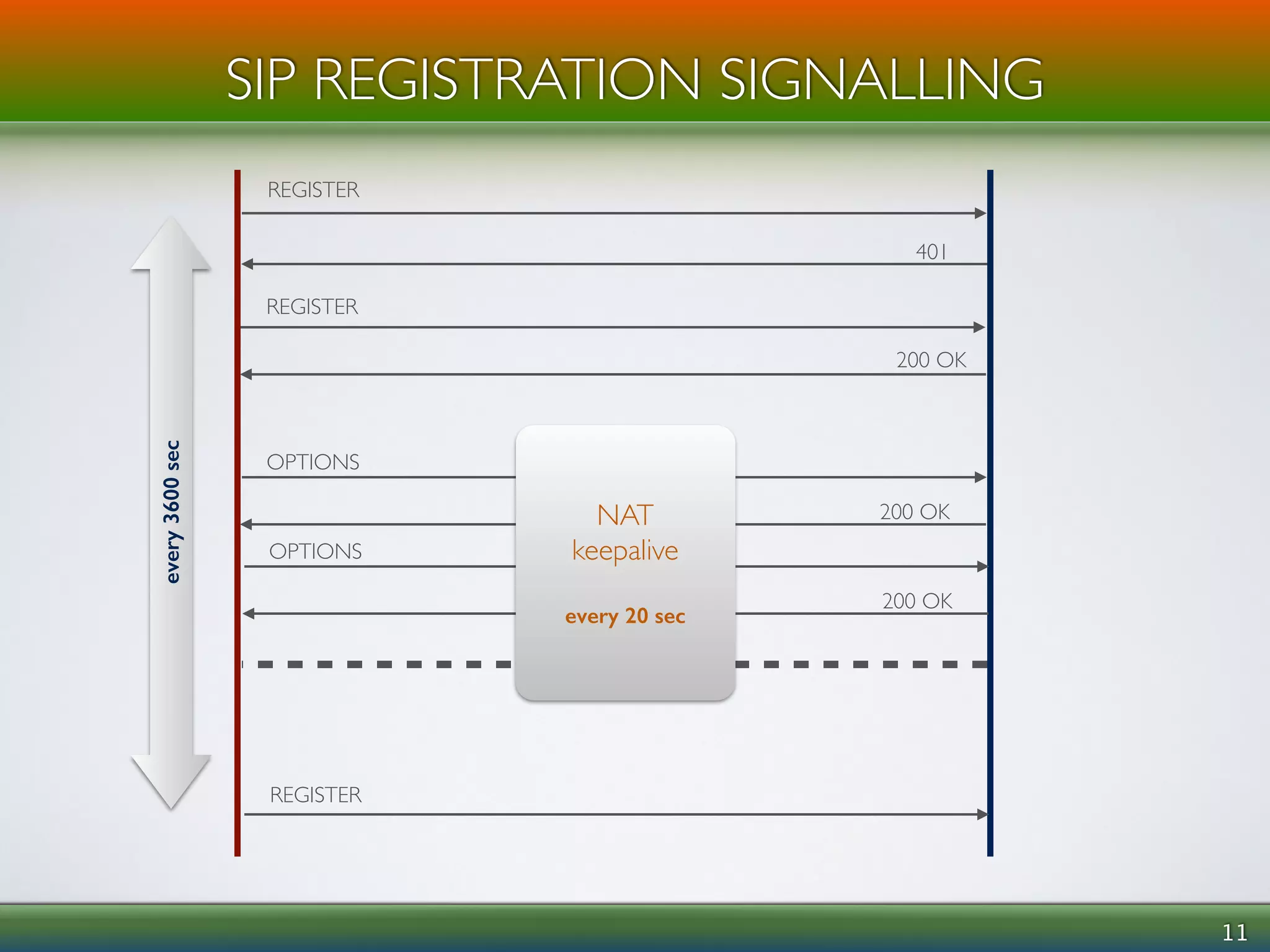
SIP REGISTRATION SIGNALLING 
REGISTER 
REGISTER 
OPTIONS 
401 
200 OK 
200 OK 
OPTIONS 
200 OK 
REGISTER 
NAT 
keepalive 
! 
every 20 sec 
every 3600 sec
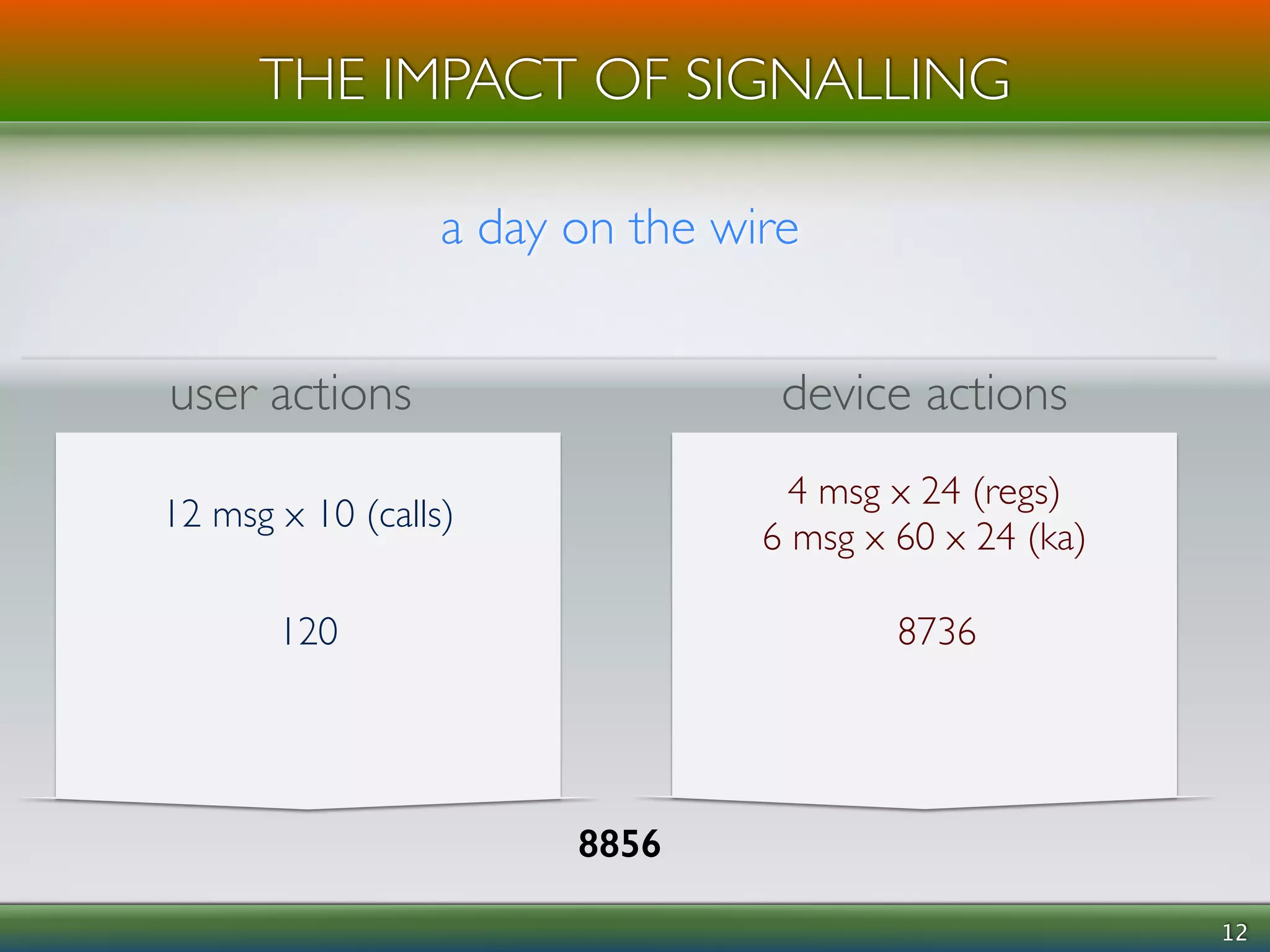
THE IMPACT OF SIGNALLING 
! 
12 
a day on the wire 
user actions device actions 
12 msg x 10 (calls) 4 msg x 24 (regs) 
6 msg x 60 x 24 (ka) 
120 8736 
8856
13 
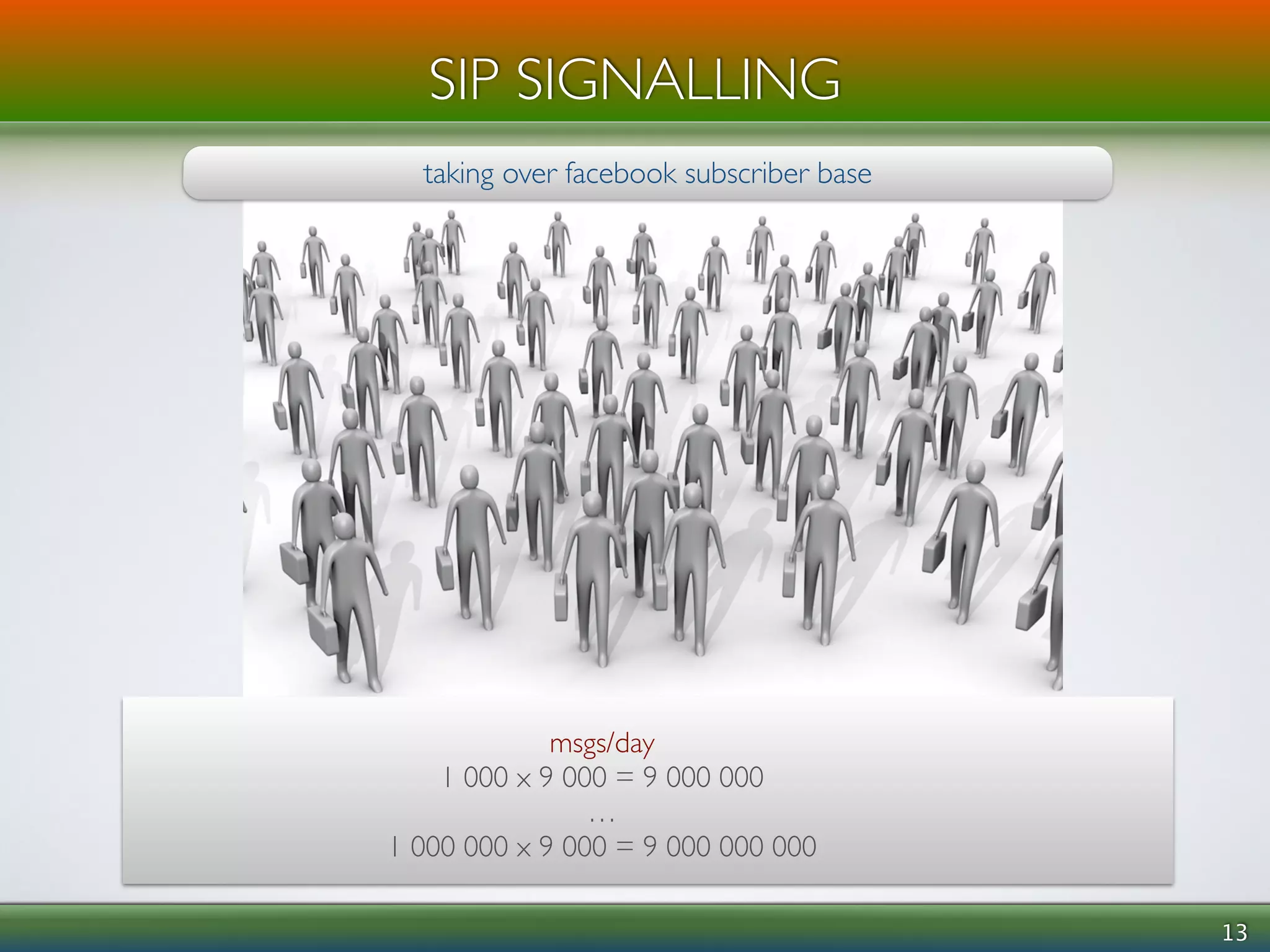
SIP SIGNALLING 
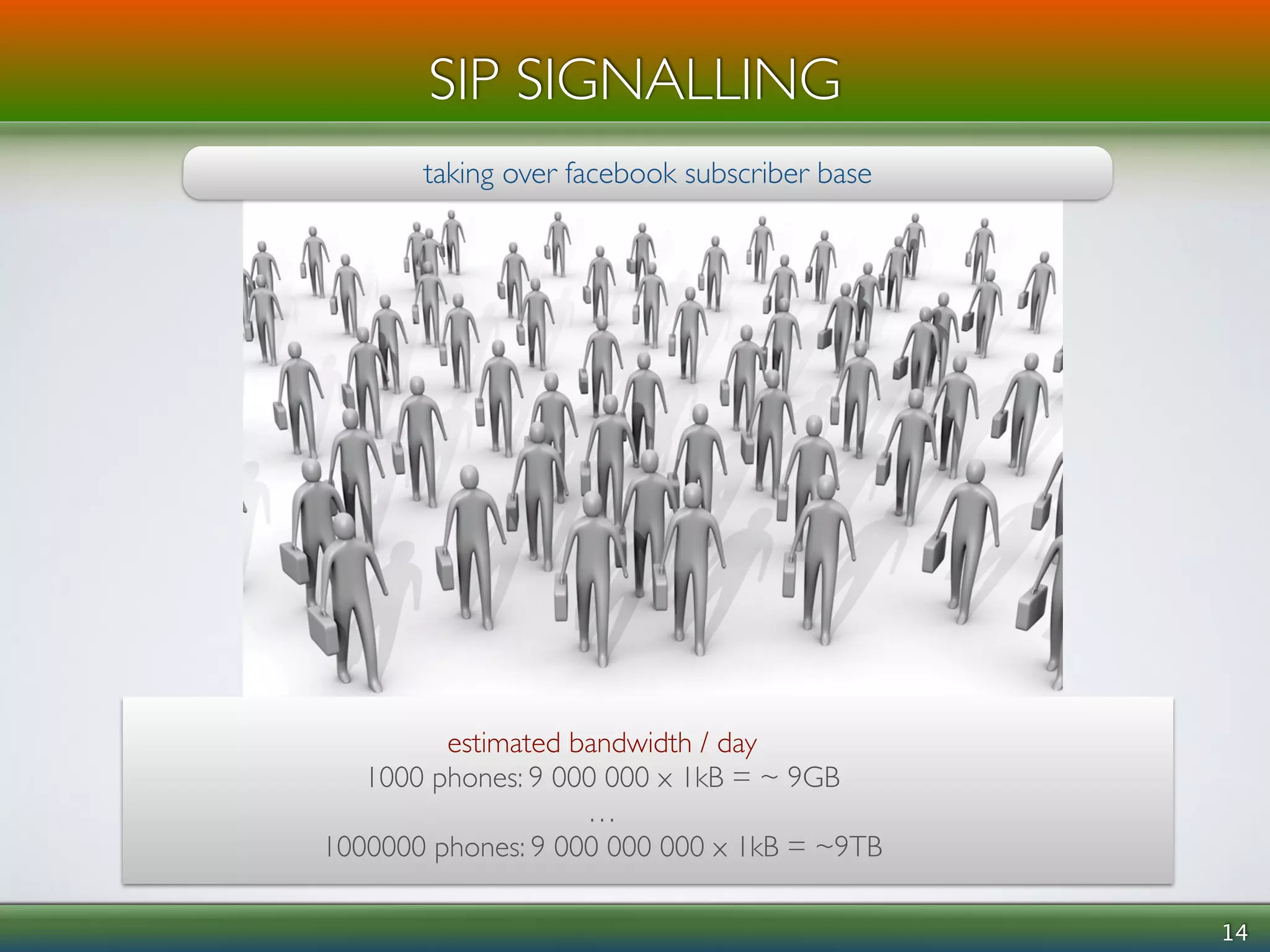
taking over facebook subscriber base 
msgs/day 
1 000 x 9 000 = 9 000 000 
… 
1 000 000 x 9 000 = 9 000 000 000
14 
SIP SIGNALLING 
taking over facebook subscriber base 
estimated bandwidth / day 
1000 phones: 9 000 000 x 1kB = ~ 9GB 
… 
1000000 phones: 9 000 000 000 x 1kB = ~9TB
FORGETTING ANYONE? 
15
16 
SIP SIGNALLING 
your friendly scanners 
extra traffic 
100 requests/seconds => 200 messages/second 
200 x 60 x 60 x 24 = 17 280 000 msgs/day 
17GB/day
17 
SIGNALLING REMARKS 
can be a significant source of processing 
(both network and application layer) 
! 
can be a lot even with small subscriber base 
(your online friends don’t let you rest) 
! 
numbers estimated for very basic usage model 
(imagine instant messaging, presence, mwi, blf, …)
SIP SERVERS EVERYWHERE 
18
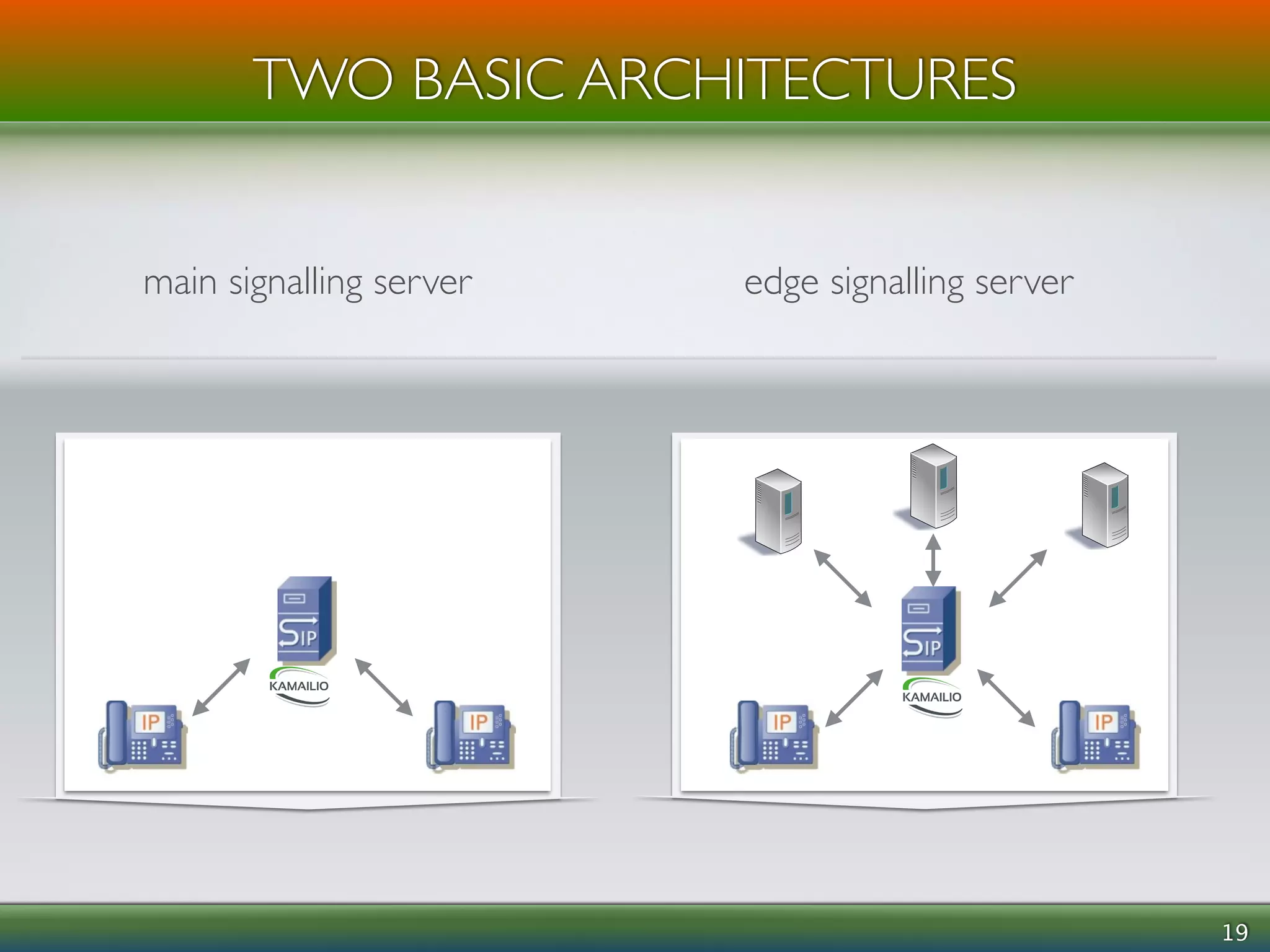
TWO BASIC ARCHITECTURES 
! 
19 
main signalling server edge signalling server
! 
dispatcher module 
• list of balancing nodes from file or database 
• monitoring of nodes (activate/inactivate 
automatically) 
• re-route in case of failure 
• various algorithms: hashing, weight distribution, round 
robin, call load distribution, priority routing 
• reload list of nodes without restart 
20 
LOAD BALANCER 
# Dispatch requests 
route[DISPATCH] { 
# round robin dispatching on gateways group '1' 
if(!ds_select_dst("1", “4")) { 
send_reply("404", "No destination"); 
exit; 
} 
xdbg("--- SCRIPT: going to <$ru> via <$du>n"); 
t_on_failure("RTF_DISPATCH"); 
route(RELAY); 
exit; 
} 
# Re-route in case of failure 
failure_route[RTF_DISPATCH] { 
if (t_is_canceled()) { 
exit; 
} 
# next node - only for 500 or local timeout 
if (t_check_status(“500") || (t_branch_timeout() && !t_branch_replied())) { 
if(ds_next_dst()) { 
t_on_failure("RTF_DISPATCH"); 
route(RELAY); 
exit; 
} 
} 
}
! 
LEAST COST OR DID ROUTING 
plenty of options 
• lcr module 
• carrierroute module 
• prefix_route module 
• drouting module 
• combinations: mtree + dispatcher 
21 
route[LCR] { 
if (!load_gws("1")) { 
send_reply("503", "Error loading gateways"); 
exit; 
} 
if (!next_gw()) { 
send_reply("503", "No available gateways"); 
exit; 
} 
t_on_failure(“RTF_LCR"); 
route(RELAY); 
exit; 
} 
# Re-route in case of failure 
failure_route[RTF_LCR] { 
if (t_is_canceled()) { 
exit; 
} 
# next node - only for 500 or local timeout 
if (t_check_status(“500") || (t_branch_timeout() && !t_branch_replied())) { 
if(next_gw()) { 
t_on_failure("RTF_LCR"); 
route(RELAY); 
exit; 
} 
} 
} 
pstn 
provider 
pstn 
provider 
pstn 
provider 
lcr DID 
routing
! 
block DOS or dictionary attacks 
part of default kamailio.cfg 
• htable module 
• pike module 
• detect high volume of traffic from same source and 
block it for a specific interval of itme 
22 
SIP FIREWALL 
# ip ban htable with autoexpire after 5 minutes 
modparam("htable", "htable", “ipban=>size=8;autoexpire=300;") 
… 
route[SAFEGUARD] { 
# flood detection from same IP and traffic ban for a specific interval 
# be sure you exclude checking trusted peers, such as pstn gateways 
# - local host excluded (e.g., loop to self) 
if(src_ip!=myself) { 
if($sht(ipban=>$si)!=$null) { 
# ip is already blocked 
xdbg("request from blocked IP - $rm from $fu (IP:$si:$sp)n"); 
exit; 
} 
if (!pike_check_req()) { 
xlog("ALERT: pike blocking $rm from $fu (IP:$si:$sp)n"); 
$sht(ipban=>$si) = 1; 
exit; 
} 
} 
if($ua =~ "friendly-scanner") { 
sl_send_reply("200", "OK"); 
exit; 
} 
}
core and tm module 
• set transport in R-URI or outbound proxy address 
• force transport via dedicated function 
! 
23 
TRANSPORT LAYER GATEWAY 
# Force UDP 
route[TOUDP] { 
# round robin dispatching on gateways group '1' 
record_route(); 
$du = “sip:nexthop.com:5060;transport=udp”; 
force_send_socket(“udp:10.1.1.10:5080”); 
route(RELAY); 
exit; 
} 
tls 
web socket 
udp 
udp udp 
IPv6 
bridging networks 
• public to private networks and back 
• IPv4 to IPv6 and back 
• any transport layer to another one and back
! 
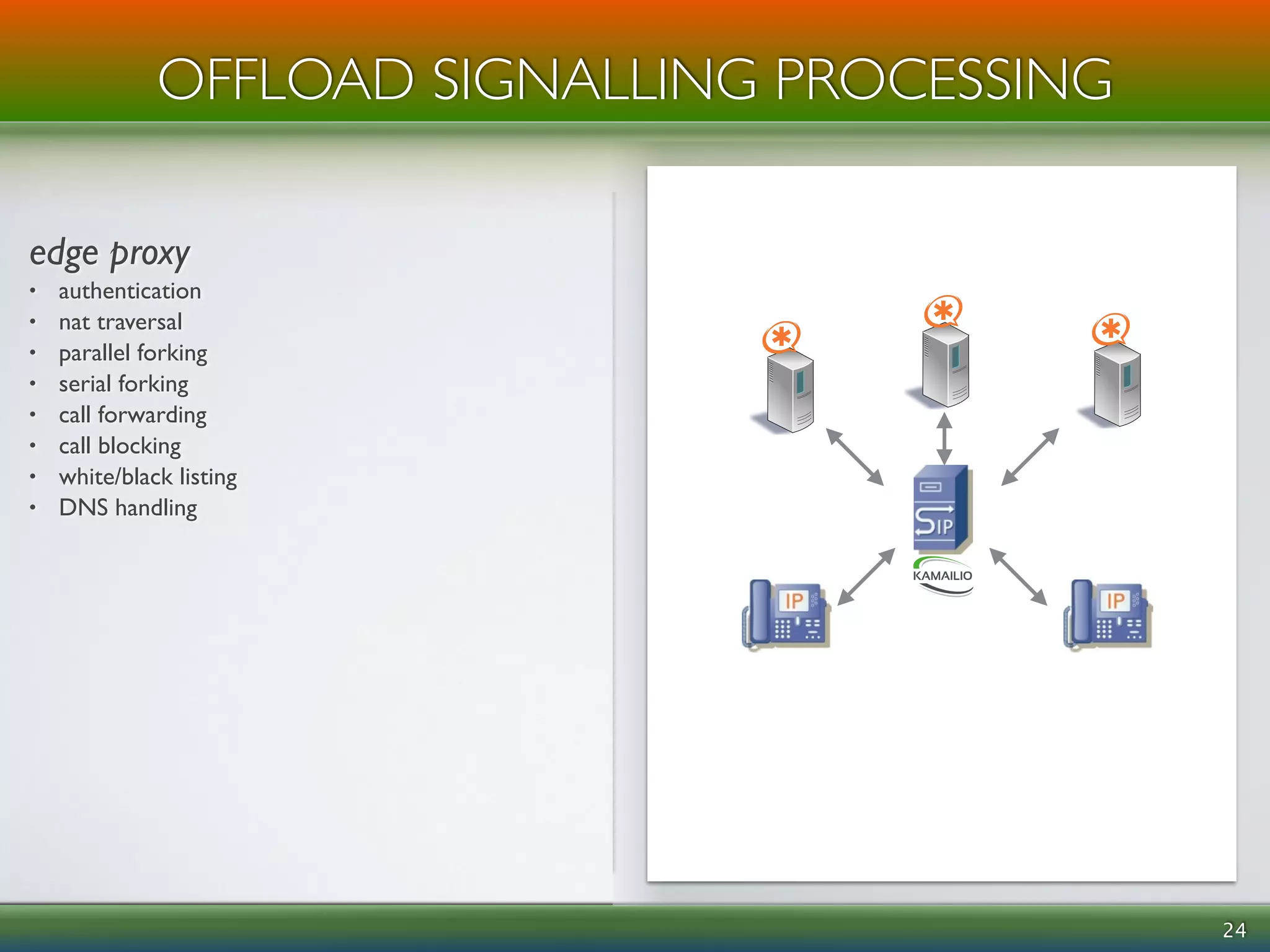
edge proxy 
• authentication 
• nat traversal 
• parallel forking 
• serial forking 
• call forwarding 
• call blocking 
• white/black listing 
• DNS handling 
24 
OFFLOAD SIGNALLING PROCESSING
25 
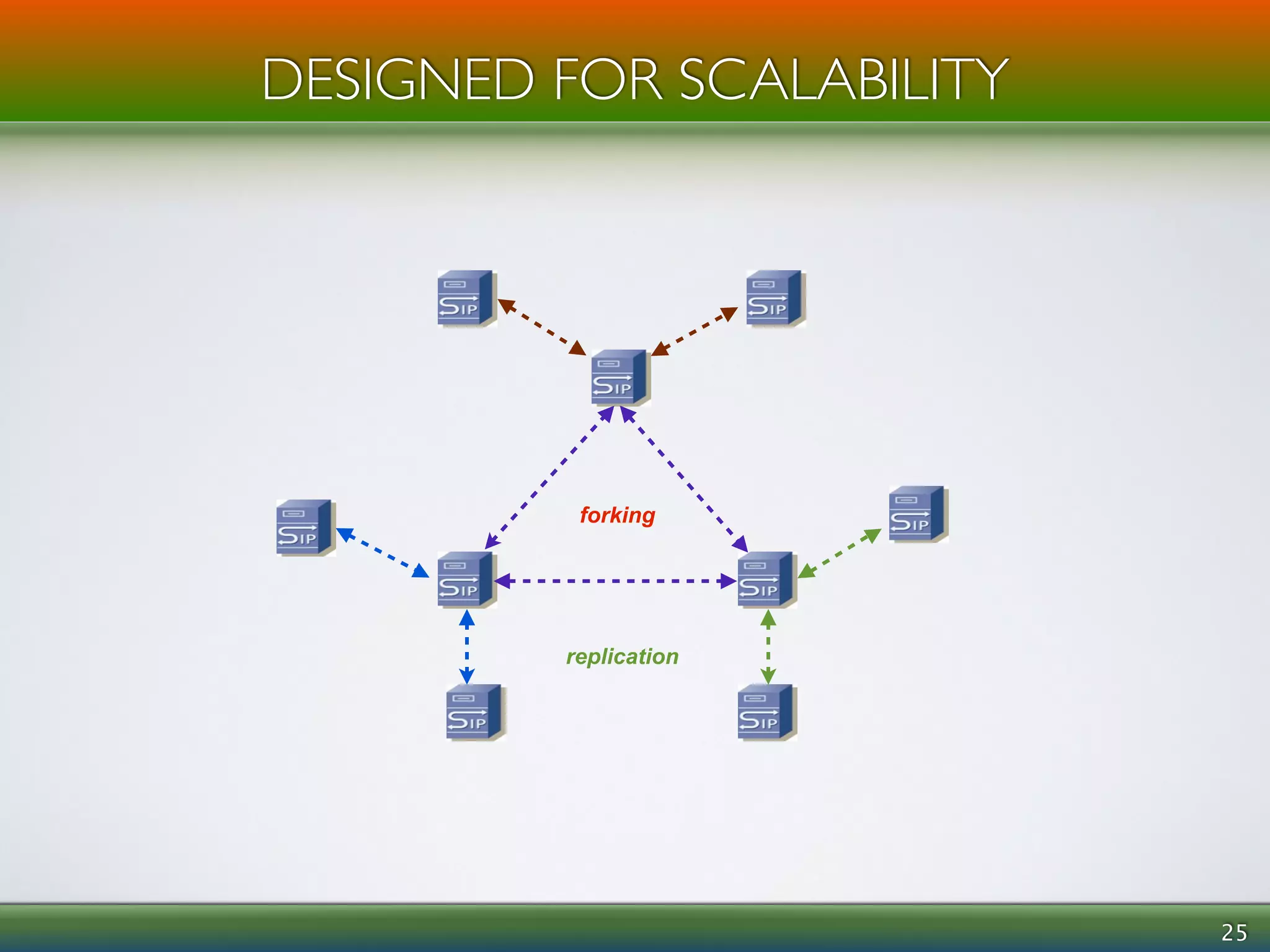
DESIGNED FOR SCALABILITY 
forking 
replication
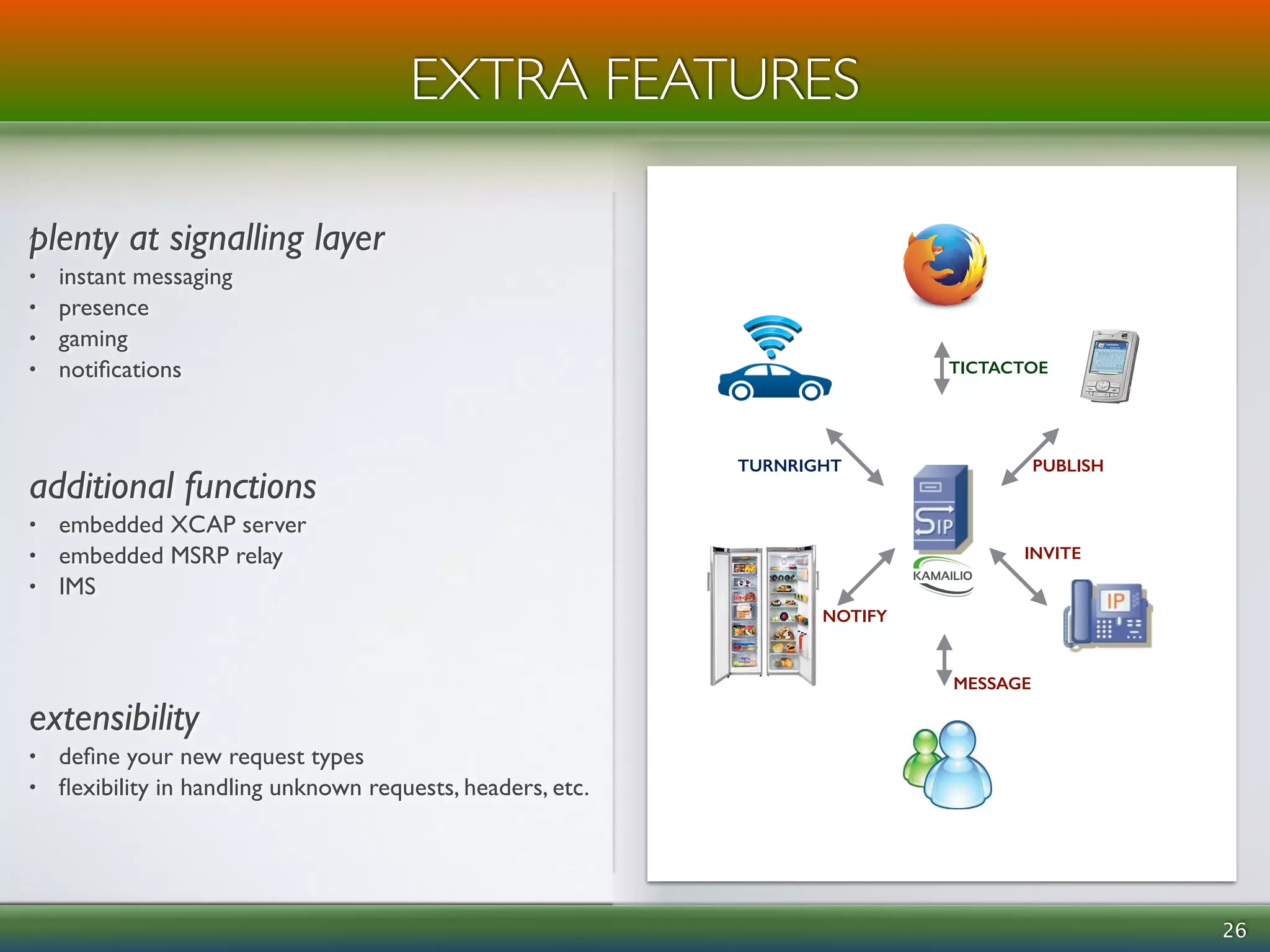
TICTACTOE 
TURNRIGHT PUBLISH 
! 
plenty at signalling layer 
• instant messaging 
• presence 
• gaming 
• notifications 
26 
EXTRA FEATURES 
additional functions 
• embedded XCAP server 
• embedded MSRP relay 
• IMS 
extensibility 
• define your new request types 
• flexibility in handling unknown requests, headers, etc. 
INVITE 
NOTIFY 
MESSAGE
TO CONCLUDE 
27
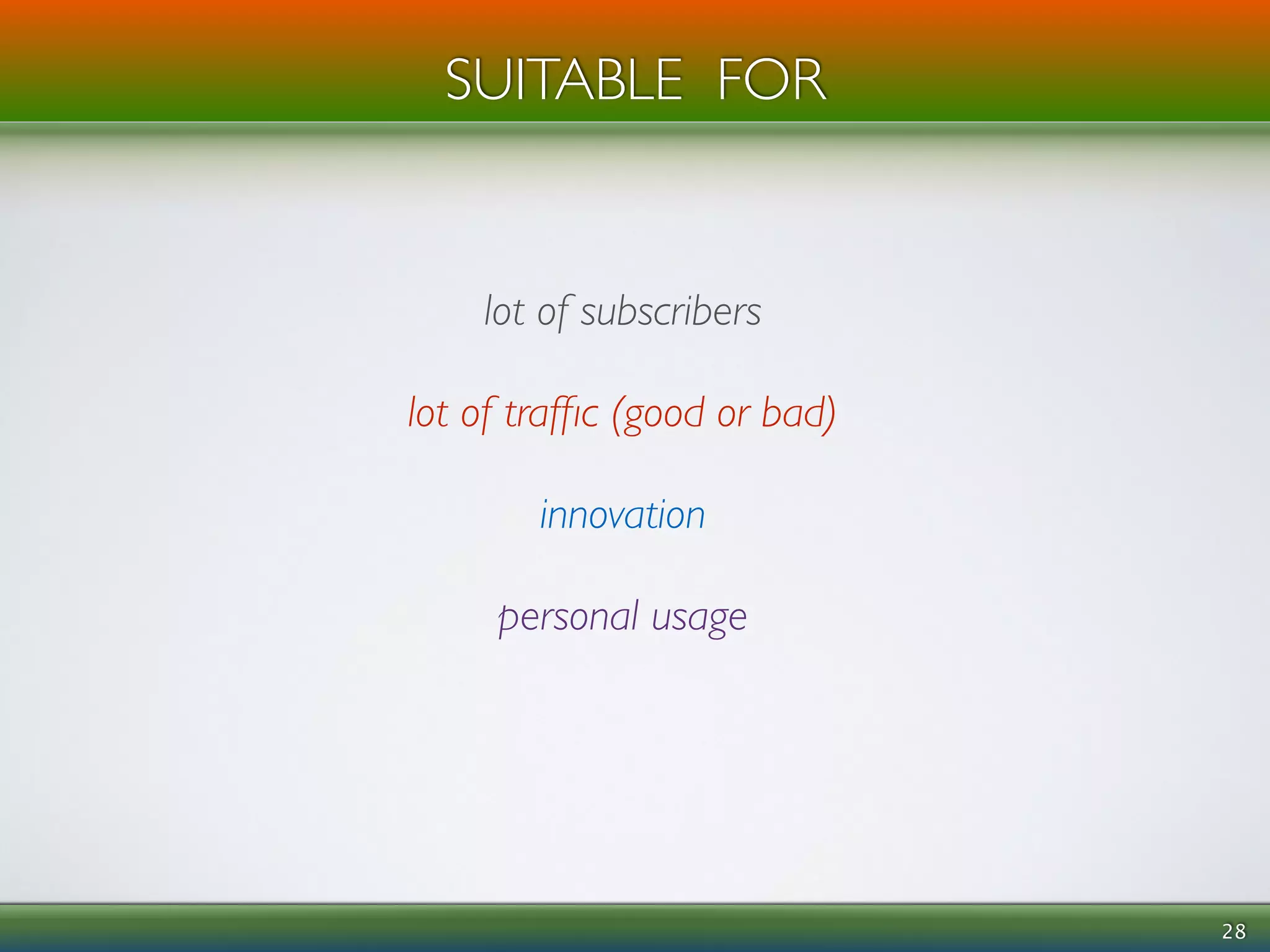
SUITABLE FOR 
28 
lot of subscribers 
! 
lot of traffic (good or bad) 
! 
innovation 
! 
personal usage
29 
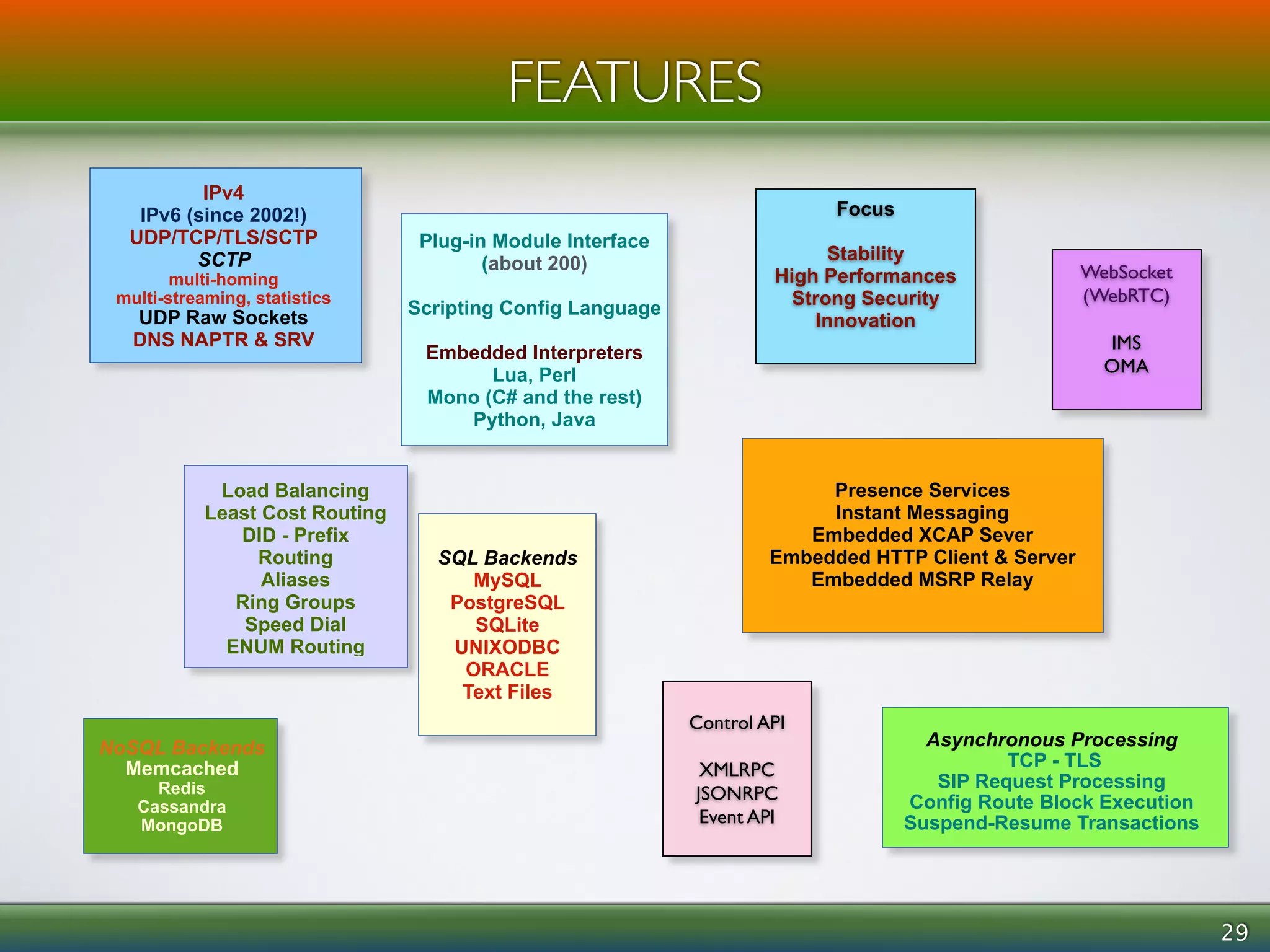
FEATURES 
IPv4 
IPv6 (since 2002!) 
UDP/TCP/TLS/SCTP 
SCTP 
multi-homing 
multi-streaming, statistics 
UDP Raw Sockets 
DNS NAPTR & SRV 
Plug-in Module Interface 
(about 200) 
! 
Scripting Config Language 
! 
Embedded Interpreters 
Lua, Perl 
Mono (C# and the rest) 
Python, Java 
Load Balancing 
Least Cost Routing 
DID - Prefix 
Routing 
Aliases 
Ring Groups 
Speed Dial 
ENUM Routing 
Presence Services 
Instant Messaging 
Embedded XCAP Sever 
Embedded HTTP Client & Server 
Embedded MSRP Relay 
Asynchronous Processing 
TCP - TLS 
SIP Request Processing 
Config Route Block Execution 
Suspend-Resume Transactions 
NoSQL Backends 
Memcached 
Redis 
Cassandra 
MongoDB 
SQL Backends 
MySQL 
PostgreSQL 
SQLite 
UNIXODBC 
ORACLE 
Text Files 
WebSocket 
(WebRTC) 
! 
IMS 
OMA 
Control API 
! 
XMLRPC 
JSONRPC 
Event API 
Focus 
! 
Stability 
High Performances 
Strong Security 
Innovation
30 
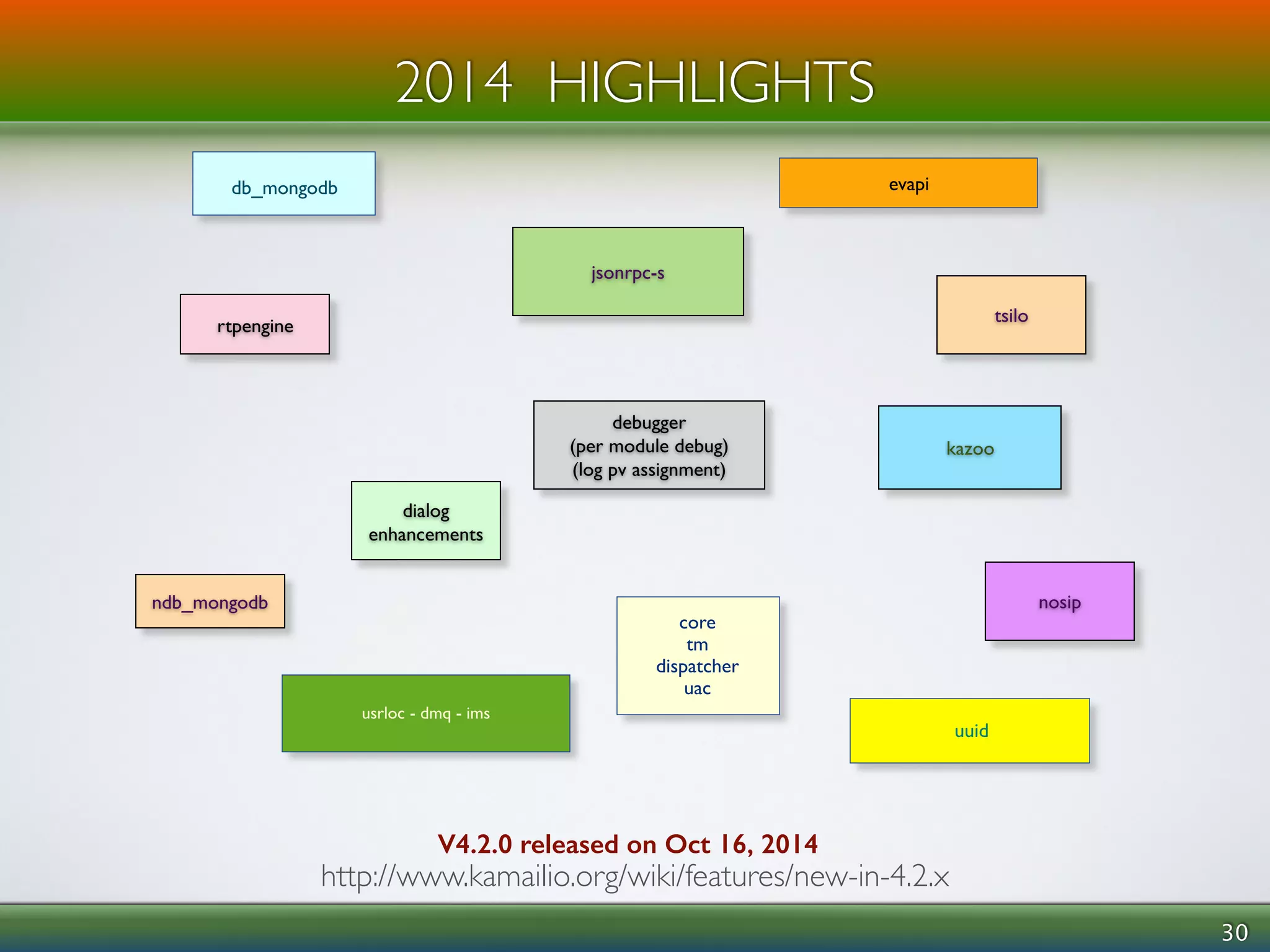
2014 HIGHLIGHTS 
db_mongodb evapi 
ndb_mongodb nosip 
core 
tm 
dispatcher 
uac 
rtpengine 
dialog 
enhancements 
tsilo 
kazoo 
jsonrpc-s 
debugger 
(per module debug) 
(log pv assignment) 
usrloc - dmq - ims 
uuid 
V4.2.0 released on Oct 16, 2014 
http://www.kamailio.org/wiki/features/new-in-4.2.x
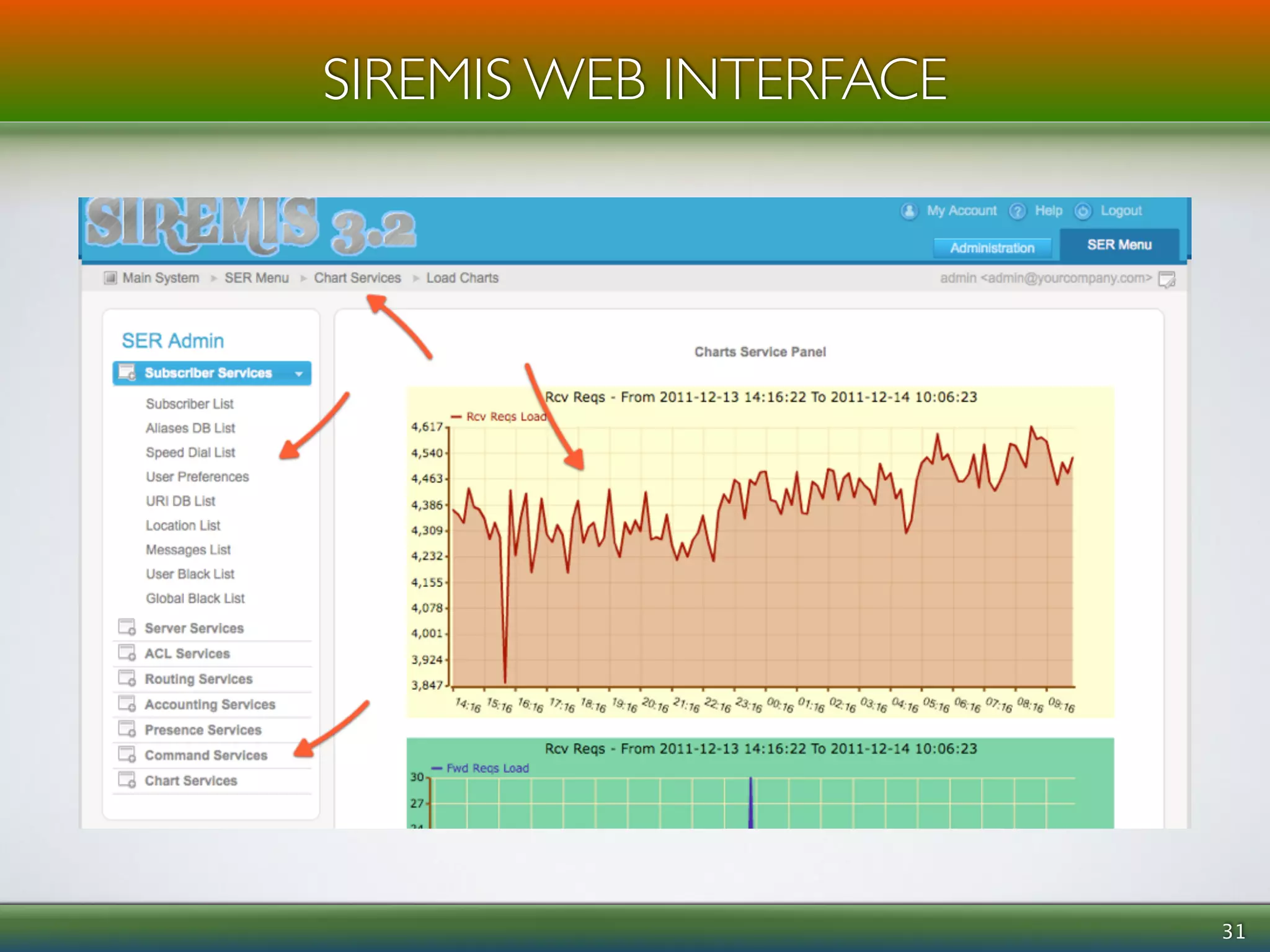
SIREMIS WEB INTERFACE 
31
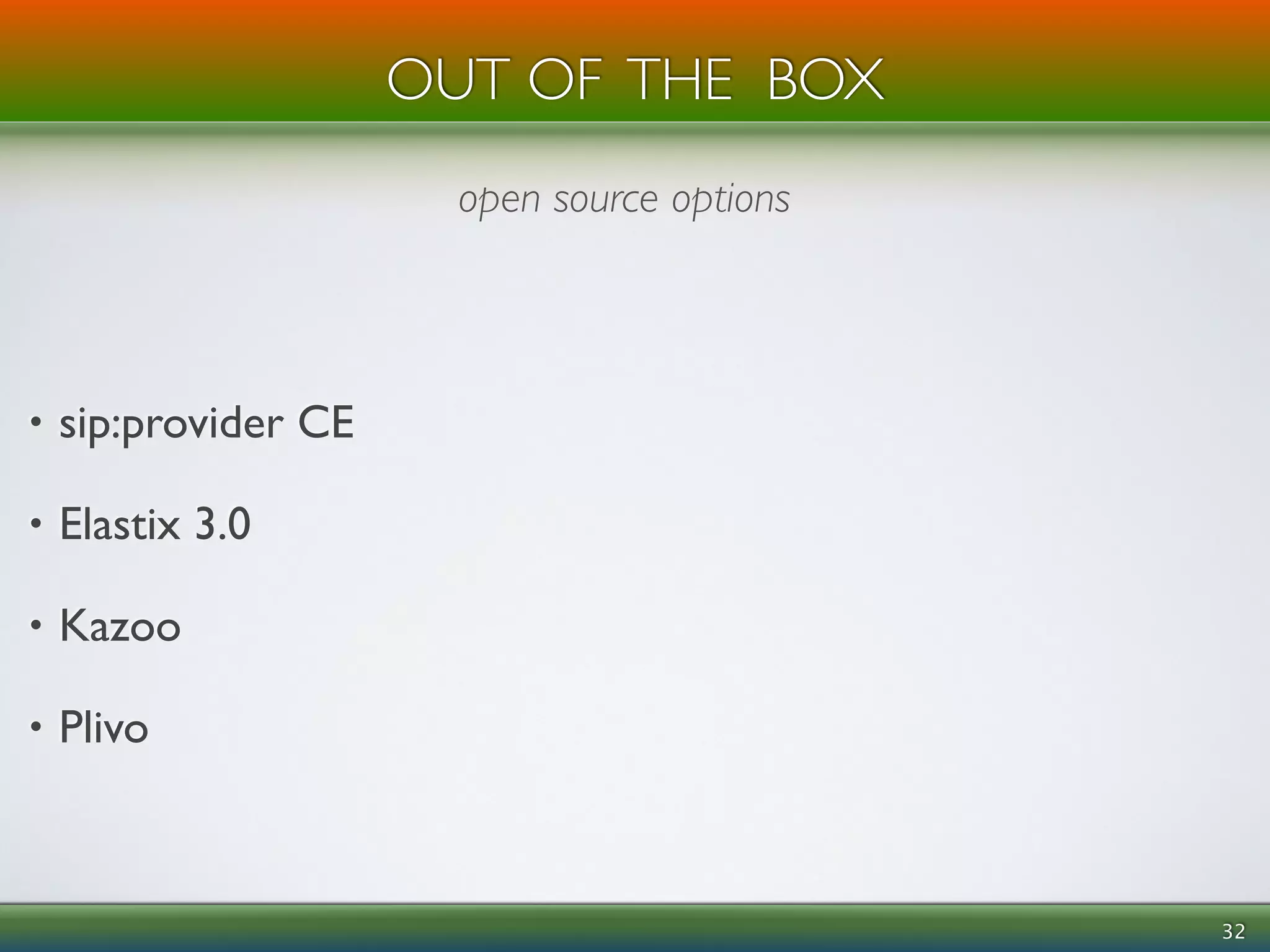
OUT OF THE BOX 
• sip:provider CE 
• Elastix 3.0 
• Kazoo 
• Plivo 
32 
open source options
www.kamailioworld.com 
33
Thank You! 
! 
Questions? 
Daniel-Constantin Mierla 
@miconda 
www.asipto.com 
www.kamailio.org 
34

Kamailio - SIP Servers Everywhere

  • 1.
    kam ailio sipservers everywhere Daniel-Constantin Mierla @miconda www.asipto.com www.kamailio.org AstriCon 2014 - Las Vegas, USA
  • 2.
    WHOIS KAMAILIO 2 Let's Speak SIP = E Kama'ilio SIP Sep 2001 2002 Jun 2005 Jul 2008 Aug 2008 Nov 2008 Sep 2011 SIP Express Router (SER) OpenSER Kamailio Other Forks... Oct 2009 Jan 2010 Same application: Kamailio - SER v3.0.0 Integration Completed v1.5.0 First Line Of Code Open Source ! GPL FhG Fokus Institute rename Awarded Best Open Source Networking Software 2009 By InfoWorld Oct 2014 ………. v4.2.0 10 Years Jun 2012 ITSPA UK Award v3.3.0 Mar 2013 v4.0.0 Dec 2013 Kamailio v4.1.0
  • 3.
    credits to @voicegal- theivrvoice.com 3
  • 4.
    ! SIP signallingrouting • fast • reliable • flexible 4 GROUND ZERO In other words • not initiating calls • not answering calls • no audio-video processing
  • 5.
    DON’T PANIC ! 5 Real Time Communications multimedia notifications telephony video conferences file transfer desktop sharing gaming instant messaging presence alerts monitoring mobility
  • 6.
    INTER-NET-WORKING ! 6 Real Time Communications multimedia notifications telephony video conferences file transfer desktop sharing gaming instant messaging presence alerts monitoring mobility Internet of Humans Internet of (Every)Things
  • 7.
    THE INVISIBLE SIGNALLING ! 7 Real Time Communications you get on the net telephony video conferences file transfer desktop sharing gaming • Registrations • Authentication challenges • NAT keepalives • Servers monitoring • Gateway hunting • Re-routing • Session updates
  • 8.
    ! 8 THEIMPACT OF SIGNALLING typical day for a person morning at home work not at home evening at home going out with friends is work duty
  • 9.
    ! 9 THEIMPACT OF SIGNALLING typical home phone activity morning 3-5 calls work 0-2 calls evening 3-5 calls no football game last evening
  • 10.
    10 SIP CALLSIGNALLING INVITE 100 180 183 INVITE INVITE ACK BYE 200 OK 200 OK 200 OK 200 OK INVITE 407
  • 11.
    11 SIP REGISTRATIONSIGNALLING REGISTER REGISTER OPTIONS 401 200 OK 200 OK OPTIONS 200 OK REGISTER NAT keepalive ! every 20 sec every 3600 sec
  • 12.
    THE IMPACT OFSIGNALLING ! 12 a day on the wire user actions device actions 12 msg x 10 (calls) 4 msg x 24 (regs) 6 msg x 60 x 24 (ka) 120 8736 8856
  • 13.
    13 SIP SIGNALLING taking over facebook subscriber base msgs/day 1 000 x 9 000 = 9 000 000 … 1 000 000 x 9 000 = 9 000 000 000
  • 14.
    14 SIP SIGNALLING taking over facebook subscriber base estimated bandwidth / day 1000 phones: 9 000 000 x 1kB = ~ 9GB … 1000000 phones: 9 000 000 000 x 1kB = ~9TB
  • 15.
  • 16.
    16 SIP SIGNALLING your friendly scanners extra traffic 100 requests/seconds => 200 messages/second 200 x 60 x 60 x 24 = 17 280 000 msgs/day 17GB/day
  • 17.
    17 SIGNALLING REMARKS can be a significant source of processing (both network and application layer) ! can be a lot even with small subscriber base (your online friends don’t let you rest) ! numbers estimated for very basic usage model (imagine instant messaging, presence, mwi, blf, …)
  • 18.
  • 19.
    TWO BASIC ARCHITECTURES ! 19 main signalling server edge signalling server
  • 20.
    ! dispatcher module • list of balancing nodes from file or database • monitoring of nodes (activate/inactivate automatically) • re-route in case of failure • various algorithms: hashing, weight distribution, round robin, call load distribution, priority routing • reload list of nodes without restart 20 LOAD BALANCER # Dispatch requests route[DISPATCH] { # round robin dispatching on gateways group '1' if(!ds_select_dst("1", “4")) { send_reply("404", "No destination"); exit; } xdbg("--- SCRIPT: going to <$ru> via <$du>n"); t_on_failure("RTF_DISPATCH"); route(RELAY); exit; } # Re-route in case of failure failure_route[RTF_DISPATCH] { if (t_is_canceled()) { exit; } # next node - only for 500 or local timeout if (t_check_status(“500") || (t_branch_timeout() && !t_branch_replied())) { if(ds_next_dst()) { t_on_failure("RTF_DISPATCH"); route(RELAY); exit; } } }
  • 21.
    ! LEAST COSTOR DID ROUTING plenty of options • lcr module • carrierroute module • prefix_route module • drouting module • combinations: mtree + dispatcher 21 route[LCR] { if (!load_gws("1")) { send_reply("503", "Error loading gateways"); exit; } if (!next_gw()) { send_reply("503", "No available gateways"); exit; } t_on_failure(“RTF_LCR"); route(RELAY); exit; } # Re-route in case of failure failure_route[RTF_LCR] { if (t_is_canceled()) { exit; } # next node - only for 500 or local timeout if (t_check_status(“500") || (t_branch_timeout() && !t_branch_replied())) { if(next_gw()) { t_on_failure("RTF_LCR"); route(RELAY); exit; } } } pstn provider pstn provider pstn provider lcr DID routing
  • 22.
    ! block DOSor dictionary attacks part of default kamailio.cfg • htable module • pike module • detect high volume of traffic from same source and block it for a specific interval of itme 22 SIP FIREWALL # ip ban htable with autoexpire after 5 minutes modparam("htable", "htable", “ipban=>size=8;autoexpire=300;") … route[SAFEGUARD] { # flood detection from same IP and traffic ban for a specific interval # be sure you exclude checking trusted peers, such as pstn gateways # - local host excluded (e.g., loop to self) if(src_ip!=myself) { if($sht(ipban=>$si)!=$null) { # ip is already blocked xdbg("request from blocked IP - $rm from $fu (IP:$si:$sp)n"); exit; } if (!pike_check_req()) { xlog("ALERT: pike blocking $rm from $fu (IP:$si:$sp)n"); $sht(ipban=>$si) = 1; exit; } } if($ua =~ "friendly-scanner") { sl_send_reply("200", "OK"); exit; } }
  • 23.
    core and tmmodule • set transport in R-URI or outbound proxy address • force transport via dedicated function ! 23 TRANSPORT LAYER GATEWAY # Force UDP route[TOUDP] { # round robin dispatching on gateways group '1' record_route(); $du = “sip:nexthop.com:5060;transport=udp”; force_send_socket(“udp:10.1.1.10:5080”); route(RELAY); exit; } tls web socket udp udp udp IPv6 bridging networks • public to private networks and back • IPv4 to IPv6 and back • any transport layer to another one and back
  • 24.
    ! edge proxy • authentication • nat traversal • parallel forking • serial forking • call forwarding • call blocking • white/black listing • DNS handling 24 OFFLOAD SIGNALLING PROCESSING
  • 25.
    25 DESIGNED FORSCALABILITY forking replication
  • 26.
    TICTACTOE TURNRIGHT PUBLISH ! plenty at signalling layer • instant messaging • presence • gaming • notifications 26 EXTRA FEATURES additional functions • embedded XCAP server • embedded MSRP relay • IMS extensibility • define your new request types • flexibility in handling unknown requests, headers, etc. INVITE NOTIFY MESSAGE
  • 27.
  • 28.
    SUITABLE FOR 28 lot of subscribers ! lot of traffic (good or bad) ! innovation ! personal usage
  • 29.
    29 FEATURES IPv4 IPv6 (since 2002!) UDP/TCP/TLS/SCTP SCTP multi-homing multi-streaming, statistics UDP Raw Sockets DNS NAPTR & SRV Plug-in Module Interface (about 200) ! Scripting Config Language ! Embedded Interpreters Lua, Perl Mono (C# and the rest) Python, Java Load Balancing Least Cost Routing DID - Prefix Routing Aliases Ring Groups Speed Dial ENUM Routing Presence Services Instant Messaging Embedded XCAP Sever Embedded HTTP Client & Server Embedded MSRP Relay Asynchronous Processing TCP - TLS SIP Request Processing Config Route Block Execution Suspend-Resume Transactions NoSQL Backends Memcached Redis Cassandra MongoDB SQL Backends MySQL PostgreSQL SQLite UNIXODBC ORACLE Text Files WebSocket (WebRTC) ! IMS OMA Control API ! XMLRPC JSONRPC Event API Focus ! Stability High Performances Strong Security Innovation
  • 30.
    30 2014 HIGHLIGHTS db_mongodb evapi ndb_mongodb nosip core tm dispatcher uac rtpengine dialog enhancements tsilo kazoo jsonrpc-s debugger (per module debug) (log pv assignment) usrloc - dmq - ims uuid V4.2.0 released on Oct 16, 2014 http://www.kamailio.org/wiki/features/new-in-4.2.x
  • 31.
  • 32.
    OUT OF THEBOX • sip:provider CE • Elastix 3.0 • Kazoo • Plivo 32 open source options
  • 33.
  • 34.
    Thank You! ! Questions? Daniel-Constantin Mierla @miconda www.asipto.com www.kamailio.org 34