Anass Ait Laachir et al Int. Journal of Engineering Research and Applications www.ijera.com
ISSN : 2248-9622, Vol. 5, Issue 1( Part 2), January 2015, pp.65-70
www.ijera.com 65 | P a g e
Maximum Power Point Tracking Using Adaptive Fuzzy Logic
control for Photovoltaic System
Anass Ait Laachir*, Abderrahmane El Kachani*, Abdelhamid Niaaniaa*,
Moulay Brahim Sedra*, El Mahjoub CHAKIR*, Tarik Jarou*
*(LHESIR: Laboratory of High Energy, Engineering Sciences and Reactors, Ibn Tofail University, Morocco)
ABSTRACT
This work presents an intelligent approach to the improvement and optimization of control performance of a
photovoltaic system with maximum power point tracking based on fuzzy logic control. This control was
compared with the conventional control based on Perturb &Observe algorithm. The results obtained in
Matlab/Simulink under different conditions show a marked improvement in the performance of fuzzy control
MPPT of the PV system.
Keywords - DC-DC converter, fuzzy logic, MPPT, perturb and observe, Photovoltaic.
I. INTRODUCTION
Solar energy is one of the renewable energy that
has the greatest potential for development. Our work
is part of the commitment of our country to exploit
these renewable and non-polluting natural resources
for the development of photovoltaic plants. The PV
array consists of photovoltaic panels, a power
interface and a load. A DC /DC converter (boost)
ordered to pursue the maximum power point tracking
(MPPT) and photovoltaic modules were developed in
Matlab/ Simulink.
Many conventional methods have been widely
developed and implemented to track the maximum
power point as incrementing the conductance and
Perturb & Observe... [1] That exhibit oscillations
around the MPP (maximum power point) at search of
maximum power point.
The proposed fuzzy control gave a very good
performance. He improved the responses of the
photovoltaic system, it not only reduces the response
time for the continuation of the maximum power
point but it also eliminated the fluctuations around
this point. This shows the effectiveness of the fuzzy
control for photovoltaic systems in stable
environmental conditions and changing (where the
light vary over time). The results for the energy
conversion show that with the fuzzy logic control,
there is a compromise between speed and stability in
transient steady state.
II. DESCRIPTION ON THE SYSTEM
The block diagram of a PV system that feeds a
resistive load (RS) is shown in Figure 1.
Figure 1: Block diagram of the PV system with a
MPPT Control
The PV array consists of 5 PV modules
connected in parallel and 5 connected in series, the
characteristics ofCS5P-220M PV module used are
shown in table 1.
Boost converter for generating a variable DC
voltage source from a source of fixed voltage, it
consists of capacitors, inductors and switches. All
these devices ideally consume no power that is why
the boost converter has a good performance. Usually
the switch is a MOSFET transistor which is a
semiconductor device which operates in (locked-
saturated) [2].
The MPPT algorithm for searching the optimal
operating point of the PV generator according to the
climatic conditions (temperature, irradiation).
Parameters Values
Maximum power at acceptable
insolation level 1000 W/m2
219.72 W
Maximum power voltage 48.3159 V
Maximum power current 4.54758 A
Short circuit current 5.09261 A
Series resistance of PV model 0.24807 ohm
Parallel resistance of PV model 235.76 ohm
Diode saturation current 5.3103e-07 A
Diode quality factor 1.5
Table1: Simulation parameters and values.
RESEARCH ARTICLE OPEN ACCESS
Anass Ait Laachir et al Int. Journal of Engineering Research and Applications www.ijera.com
ISSN : 2248-9622, Vol. 5, Issue 1( Part 2), January 2015, pp.65-70
www.ijera.com 66 | P a g e
III. BOOST CONVERTER MODEL
For a PV system connected to a resistive load
there is a necessity to insert a boost type converter
[3], presented in Figure.2, that will use a certain
controller in order to maintain the maximum power.
The system is written in two sets of state equation
that are depending on the position of switch SW. If it
is in position ON (SW=0), the differential equation
is:
1
( )
1
( )
in out
out
out
i t v v
L
v
v i
C Rload

 

  



(1)
If the switch SW is in position “1”2), SW=1, the
differential equation is expressed as:
1
( )
1
( )
in
out
out
load
i t v dt
L
v
v t
C R



  



(2)
Figure 2: The boost DC/DC converter
IV. MAXIMUM POWER POINT TRACKING
A PV array is generator whose characteristic I =
f (U) is highly nonlinear. Accordingly, for a same
illumination, the power delivered will be different
depending on the load. MPPT controller makes it
possible to control the power converter connecting
the charge (a battery, for example) and solar panel to
continuously provide maximum power to the load.
From this rule and the type of controller, there are
several and different methods to extract the
maximum power [4] [5].
V. FUZZY LOGIC CONTROL
Fuzzy logic is an extension of Boolean logic
which offers a very valuable contribution to the
reasoning that uses flexibility, making it possible to
take account of inaccuracies and uncertainties. Its
main advantages are its linguistic description and
independence of mathematical model. A fuzzy logic
control consists of four steps: fuzzification,
knowledge base, inference mechanism and
defuzzification [6] [7]. The fuzzification corresponds
to the linguistic variables. The knowledge base is
composed of a database and a base of rules designed
to achieve good dynamic response function of
external perturbations of the PV system.
• The inference mechanism uses a collection of
linguistic rules to convert the input into an output
conditions fuzzified.
• The defuzzification is used to convert the fuzzy
output control signals.
For this work, triangular shaped membership
function has been chosen. The range of the signal has
been selected by checking the oscillation of each
signal. Figure.3 represents the graphical view of the
membership function for error, change of error, and
duty cycle of the fuzzy logic control. Figure 4 shows
the block view of the fuzzy logic algorithm in
Simulink window. Five linguistic variables (NB, NS,
ZE, PS, PB) are adopted for each of the three
input/output variables. Where NB stands for Negative
Big and NS: Negative Small, ZE: Zero, PS: Positive
Small, PB: Positive Big, The fuzzy rules are
summarized in Table.2.
Figure 3: Membership functions for inputs and output
of Fuzzy Logic Control
Figure 4 Model of fuzzy logic control
e  Δe NB NS Z PS PB
NB NB NB NB NS Z
NS NB NS NS Z PS
Z NB NS Z PS PB
PS NB Z PS PB PB
PB Z PS PB PB PB
Table 2: Table of fuzzy logic control rules
The fuzzy control algorithm is implemented to
control the load phase current based on processing of
the:
     *pv pv pvP K V K I K (3)
 
   
   
1
e
1
pv pv
pv pv
P K P K
K
I K I K
 

 
(4)
Anass Ait Laachir et al Int. Journal of Engineering Research and Applications www.ijera.com
ISSN : 2248-9622, Vol. 5, Issue 1( Part 2), January 2015, pp.65-70
www.ijera.com 67 | P a g e
   Δ ( 1)e K e K e K   (5)
 
 
1
1
n
j jj
n
jj
D D
dD
D








(6)
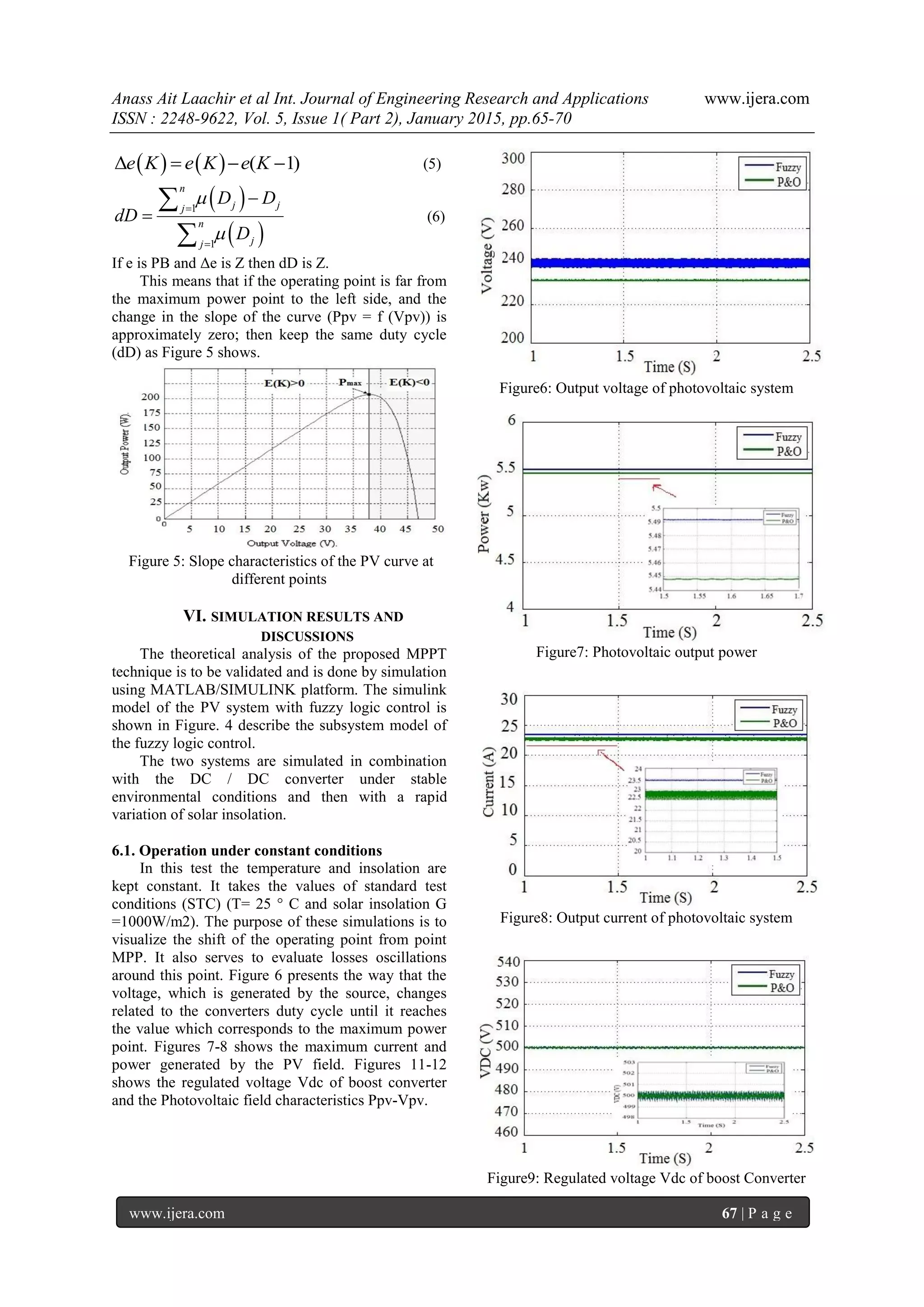
If e is PB and Δe is Z then dD is Z.
This means that if the operating point is far from
the maximum power point to the left side, and the
change in the slope of the curve (Ppv = f (Vpv)) is
approximately zero; then keep the same duty cycle
(dD) as Figure 5 shows.
Figure 5: Slope characteristics of the PV curve at
different points
VI. SIMULATION RESULTS AND
DISCUSSIONS
The theoretical analysis of the proposed MPPT
technique is to be validated and is done by simulation
using MATLAB/SIMULINK platform. The simulink
model of the PV system with fuzzy logic control is
shown in Figure. 4 describe the subsystem model of
the fuzzy logic control.
The two systems are simulated in combination
with the DC / DC converter under stable
environmental conditions and then with a rapid
variation of solar insolation.
6.1. Operation under constant conditions
In this test the temperature and insolation are
kept constant. It takes the values of standard test
conditions (STC) (T= 25 ° C and solar insolation G
=1000W/m2). The purpose of these simulations is to
visualize the shift of the operating point from point
MPP. It also serves to evaluate losses oscillations
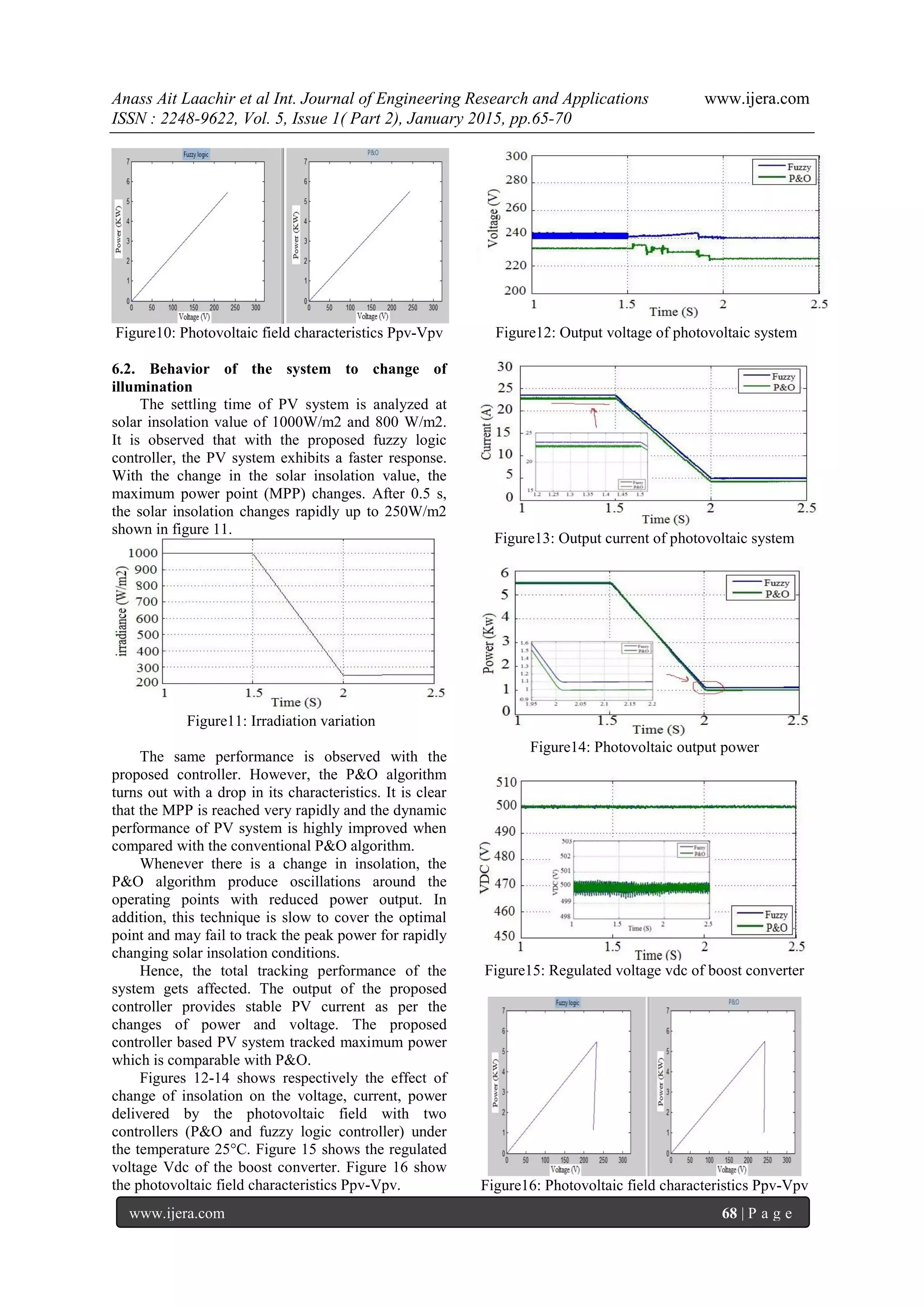
around this point. Figure 6 presents the way that the
voltage, which is generated by the source, changes
related to the converters duty cycle until it reaches
the value which corresponds to the maximum power
point. Figures 7-8 shows the maximum current and
power generated by the PV field. Figures 11-12
shows the regulated voltage Vdc of boost converter
and the Photovoltaic field characteristics Ppv-Vpv.
Figure6: Output voltage of photovoltaic system
Figure7: Photovoltaic output power
Figure8: Output current of photovoltaic system
Figure9: Regulated voltage Vdc of boost Converter
Anass Ait Laachir et al Int. Journal of Engineering Research and Applications www.ijera.com
ISSN : 2248-9622, Vol. 5, Issue 1( Part 2), January 2015, pp.65-70
www.ijera.com 68 | P a g e
Figure10: Photovoltaic field characteristics Ppv-Vpv
6.2. Behavior of the system to change of
illumination
The settling time of PV system is analyzed at
solar insolation value of 1000W/m2 and 800 W/m2.
It is observed that with the proposed fuzzy logic
controller, the PV system exhibits a faster response.
With the change in the solar insolation value, the
maximum power point (MPP) changes. After 0.5 s,
the solar insolation changes rapidly up to 250W/m2
shown in figure 11.
Figure11: Irradiation variation
The same performance is observed with the
proposed controller. However, the P&O algorithm
turns out with a drop in its characteristics. It is clear
that the MPP is reached very rapidly and the dynamic
performance of PV system is highly improved when
compared with the conventional P&O algorithm.
Whenever there is a change in insolation, the
P&O algorithm produce oscillations around the
operating points with reduced power output. In
addition, this technique is slow to cover the optimal
point and may fail to track the peak power for rapidly
changing solar insolation conditions.
Hence, the total tracking performance of the
system gets affected. The output of the proposed
controller provides stable PV current as per the
changes of power and voltage. The proposed
controller based PV system tracked maximum power
which is comparable with P&O.
Figures 12-14 shows respectively the effect of
change of insolation on the voltage, current, power
delivered by the photovoltaic field with two
controllers (P&O and fuzzy logic controller) under
the temperature 25°C. Figure 15 shows the regulated
voltage Vdc of the boost converter. Figure 16 show
the photovoltaic field characteristics Ppv-Vpv.
Figure12: Output voltage of photovoltaic system
Figure13: Output current of photovoltaic system
Figure14: Photovoltaic output power
Figure15: Regulated voltage vdc of boost converter
Figure16: Photovoltaic field characteristics Ppv-Vpv
Anass Ait Laachir et al Int. Journal of Engineering Research and Applications www.ijera.com
ISSN : 2248-9622, Vol. 5, Issue 1( Part 2), January 2015, pp.65-70
www.ijera.com 69 | P a g e
VII. CONCLUSION
This paper presents an algorithm of the
photovoltaic array maximum power point tracking
which is based on fuzzy logic.The different results
with different robustness test confirms the proper
operation of fuzzy control with good performance in
the atmospheric variations of illumination and
temperature there by reducing power losses, with
better dynamics results. The fuzzy control pursues
with satisfaction at the sharp variations of irradiations
with a fast response time. This eliminates the
fluctuations in the power, voltage and duty ratio in
steady state. The fuzzy logic control is more effective
for the nonlinear systems because it is more
flexibility.
A fast and stable fuzzy logic controller MPPT
has been obtained, the latter has proved that it
guaranties better performance, faster response time;
moreover, it has proved its robustness to different
climatic variations.
REFERENCES
[1] [R. R. Hernandez, S. B. Easter, M. L.
Murphy- Mariscal, F. T. Maestre, M.
Tavassoli, E. B. Allen, C. W. Barrows, J.
Belnap, R. Ochoa-Hueso, S. Ravi, et M. F.
Allen, « Environmental impacts of utility-
scale solar energy », Renew. Sustain.
EnergyRev., vol. 29, p. 766‑779, janv. 2014.
[2] Chemanedji et A. Sadoud, "Conception d’un
Hacheur à deux Thyristors Auxiliaires
Destiné à la Poursuite du Point de
Puissance Maximale d’un Générateur
Photovoltaïque", Rev. Energ. Ren. :
Valorisation (1999) 109-112.
[3] H. De Battista et R. J. Mantz, « Variable
structure control of a photovoltaic energy
converter », Control Theory Appl. IEE Proc.
-, vol. 149, no 4, p. 303‑310, 2002.
[4] M.F. Yaden, M. El Ouariachi, T. Mrabti , Ka.
Kassmi, B. Tidhaf, E. Chadli et K. Kassmi
"Conception et réalisation d’un système
photovoltaïque muni d’une commande
MPPT numérique" Revue des Energies
Renouvelables Vol. 14 N°1 (2011) 171 – 186
[5] BEN HAMED M., SBITA L., FLAH A.,
ABID A. and GARRAOUI R., "A real time
implementation of an improved MPPT
controller for photovoltaic systems ",
Renewable Energy and Vehicular
Technology (REVET), 2012 First
International Conference on, Hammamet,
Tunisia, pp. 173 – 178, March 2012.
[6] E. Koutroulis, K. Kalaitzakis, et N. C.
Voulgaris, « Development of a
microcontroller-based, photovoltaic
maximum power point tracking control
system », IEEE Trans. Power Electron.,
vol.16, no 1, p. 46‑54, 2001.
[7] H. Buhler, Réglage Par Logique Floue,
Presses Poly-techniques et Universitaires
Romandes CH-1015 Lau-sanne. 1994.
Anass AIT LAACHIR was born in Beni Mellal,
Morocco, on 2th June 1988. He received Master
degree in Microelectronics from IBN TOFAIL
University Kenitra, in July 2011. He is currently
pursuing Ph.D degree in Electrical Engineering at
laboratory LHESIR of IBN TOFAIL University
Kenitra, Morocco. His main area of research includes
quality of electrical energy, Active Power filters and
the electric power sources based on renewable
energy.
Abderrahmane El Kachani Was born in Kenitra,
Morocco, on 14th August 1986. He received Master
of Science and Technology in Automatic and
Industrial Informatics from Faculty of Science and
Technology Settat, in July 2011. He is currently
pursuing PhD degree in Electrical Engineering at
laboratory LHESIR of IBN TOFAIL University,
Kenitra, Morocco. His main area of research includes
quality of electrical energy, Active Power filters and
the electric power sources based on renewable
energy.
Abdelhamid NIAANIAA was born in Mechraa
Belksiri, Sidi Kacem, Morocco, on April 18th 1986.
He received his diploma a State Engineer Diploma in
Electrical Engineering option Microelectronics at the
National School of Applied Sciences in 2011 from
the University Mohamed Premier (Oujda). He
currently holds the position uploaded Engineer &
Technical Sales business in CIETEC (Crossroads
Industrial and technological) Ex Leroy Somer
Morocco - Casablanca. And a Ph.D. in electrical
engineering at the University Ibn Tofail in Kenitra,
Morocco His main research focuses on Hybrid
Systems Renewable Energy Sources with the aim and
achieves optimal supervision of these sources.
Moulay Brahim Sedra is a Professor of
Mathematical and theoretical Physics and assistant
Director of the National School of Applied Sciences
Al Hoceima (ENSAH) and head of the Laboratory of
High Energy, Engineering Sciences and Reactors
(LHESIR) Univ. Ibn Tofail, Faculty of Sciences,
Kenitra. He is Supervisor of several PhD Thesis.
Author of several scientific publications.
Rammal Award Winner, 2008.
El Mahjoub CHAKIR is a Professor of nuclear
physics and member of the Laboratory of High
Energy, Engineering Sciences and Reactors
(LHESIR) Univ. Ibn Tofail, Faculty of Sciences,
Anass Ait Laachir et al Int. Journal of Engineering Research and Applications www.ijera.com
ISSN : 2248-9622, Vol. 5, Issue 1( Part 2), January 2015, pp.65-70
www.ijera.com 70 | P a g e
Kenitra. He is Supervisor of several PhD Thesis.
Author of several scientific publications.
Tarik JAROU was born in Rabat, on 24th April
1973. He is University professor at the National
School of the Sciences Applied of the University Ibn
Tofail, Kenitra, Morocco. He received his Doctorate
degree in Electric Engineering from the Engineer
School Mohammedia of the University Mohamed V,
Rabat, Morocco. He is member of the research
laboratory LHESIR of the University Ibn Tofail. His
main area of research include the modelling and the
control for electric systems control, the supervision
of electric power sources with renewable energy and
the implementation of the algorithms on the
embedded systems.

Maximum Power Point Tracking Using Adaptive Fuzzy Logic control for Photovoltaic System

  • 1.
    Anass Ait Laachiret al Int. Journal of Engineering Research and Applications www.ijera.com ISSN : 2248-9622, Vol. 5, Issue 1( Part 2), January 2015, pp.65-70 www.ijera.com 65 | P a g e Maximum Power Point Tracking Using Adaptive Fuzzy Logic control for Photovoltaic System Anass Ait Laachir*, Abderrahmane El Kachani*, Abdelhamid Niaaniaa*, Moulay Brahim Sedra*, El Mahjoub CHAKIR*, Tarik Jarou* *(LHESIR: Laboratory of High Energy, Engineering Sciences and Reactors, Ibn Tofail University, Morocco) ABSTRACT This work presents an intelligent approach to the improvement and optimization of control performance of a photovoltaic system with maximum power point tracking based on fuzzy logic control. This control was compared with the conventional control based on Perturb &Observe algorithm. The results obtained in Matlab/Simulink under different conditions show a marked improvement in the performance of fuzzy control MPPT of the PV system. Keywords - DC-DC converter, fuzzy logic, MPPT, perturb and observe, Photovoltaic. I. INTRODUCTION Solar energy is one of the renewable energy that has the greatest potential for development. Our work is part of the commitment of our country to exploit these renewable and non-polluting natural resources for the development of photovoltaic plants. The PV array consists of photovoltaic panels, a power interface and a load. A DC /DC converter (boost) ordered to pursue the maximum power point tracking (MPPT) and photovoltaic modules were developed in Matlab/ Simulink. Many conventional methods have been widely developed and implemented to track the maximum power point as incrementing the conductance and Perturb & Observe... [1] That exhibit oscillations around the MPP (maximum power point) at search of maximum power point. The proposed fuzzy control gave a very good performance. He improved the responses of the photovoltaic system, it not only reduces the response time for the continuation of the maximum power point but it also eliminated the fluctuations around this point. This shows the effectiveness of the fuzzy control for photovoltaic systems in stable environmental conditions and changing (where the light vary over time). The results for the energy conversion show that with the fuzzy logic control, there is a compromise between speed and stability in transient steady state. II. DESCRIPTION ON THE SYSTEM The block diagram of a PV system that feeds a resistive load (RS) is shown in Figure 1. Figure 1: Block diagram of the PV system with a MPPT Control The PV array consists of 5 PV modules connected in parallel and 5 connected in series, the characteristics ofCS5P-220M PV module used are shown in table 1. Boost converter for generating a variable DC voltage source from a source of fixed voltage, it consists of capacitors, inductors and switches. All these devices ideally consume no power that is why the boost converter has a good performance. Usually the switch is a MOSFET transistor which is a semiconductor device which operates in (locked- saturated) [2]. The MPPT algorithm for searching the optimal operating point of the PV generator according to the climatic conditions (temperature, irradiation). Parameters Values Maximum power at acceptable insolation level 1000 W/m2 219.72 W Maximum power voltage 48.3159 V Maximum power current 4.54758 A Short circuit current 5.09261 A Series resistance of PV model 0.24807 ohm Parallel resistance of PV model 235.76 ohm Diode saturation current 5.3103e-07 A Diode quality factor 1.5 Table1: Simulation parameters and values. RESEARCH ARTICLE OPEN ACCESS
  • 2.
    Anass Ait Laachiret al Int. Journal of Engineering Research and Applications www.ijera.com ISSN : 2248-9622, Vol. 5, Issue 1( Part 2), January 2015, pp.65-70 www.ijera.com 66 | P a g e III. BOOST CONVERTER MODEL For a PV system connected to a resistive load there is a necessity to insert a boost type converter [3], presented in Figure.2, that will use a certain controller in order to maintain the maximum power. The system is written in two sets of state equation that are depending on the position of switch SW. If it is in position ON (SW=0), the differential equation is: 1 ( ) 1 ( ) in out out out i t v v L v v i C Rload           (1) If the switch SW is in position “1”2), SW=1, the differential equation is expressed as: 1 ( ) 1 ( ) in out out load i t v dt L v v t C R          (2) Figure 2: The boost DC/DC converter IV. MAXIMUM POWER POINT TRACKING A PV array is generator whose characteristic I = f (U) is highly nonlinear. Accordingly, for a same illumination, the power delivered will be different depending on the load. MPPT controller makes it possible to control the power converter connecting the charge (a battery, for example) and solar panel to continuously provide maximum power to the load. From this rule and the type of controller, there are several and different methods to extract the maximum power [4] [5]. V. FUZZY LOGIC CONTROL Fuzzy logic is an extension of Boolean logic which offers a very valuable contribution to the reasoning that uses flexibility, making it possible to take account of inaccuracies and uncertainties. Its main advantages are its linguistic description and independence of mathematical model. A fuzzy logic control consists of four steps: fuzzification, knowledge base, inference mechanism and defuzzification [6] [7]. The fuzzification corresponds to the linguistic variables. The knowledge base is composed of a database and a base of rules designed to achieve good dynamic response function of external perturbations of the PV system. • The inference mechanism uses a collection of linguistic rules to convert the input into an output conditions fuzzified. • The defuzzification is used to convert the fuzzy output control signals. For this work, triangular shaped membership function has been chosen. The range of the signal has been selected by checking the oscillation of each signal. Figure.3 represents the graphical view of the membership function for error, change of error, and duty cycle of the fuzzy logic control. Figure 4 shows the block view of the fuzzy logic algorithm in Simulink window. Five linguistic variables (NB, NS, ZE, PS, PB) are adopted for each of the three input/output variables. Where NB stands for Negative Big and NS: Negative Small, ZE: Zero, PS: Positive Small, PB: Positive Big, The fuzzy rules are summarized in Table.2. Figure 3: Membership functions for inputs and output of Fuzzy Logic Control Figure 4 Model of fuzzy logic control e Δe NB NS Z PS PB NB NB NB NB NS Z NS NB NS NS Z PS Z NB NS Z PS PB PS NB Z PS PB PB PB Z PS PB PB PB Table 2: Table of fuzzy logic control rules The fuzzy control algorithm is implemented to control the load phase current based on processing of the:      *pv pv pvP K V K I K (3)           1 e 1 pv pv pv pv P K P K K I K I K      (4)
  • 3.
    Anass Ait Laachiret al Int. Journal of Engineering Research and Applications www.ijera.com ISSN : 2248-9622, Vol. 5, Issue 1( Part 2), January 2015, pp.65-70 www.ijera.com 67 | P a g e    Δ ( 1)e K e K e K   (5)     1 1 n j jj n jj D D dD D         (6) If e is PB and Δe is Z then dD is Z. This means that if the operating point is far from the maximum power point to the left side, and the change in the slope of the curve (Ppv = f (Vpv)) is approximately zero; then keep the same duty cycle (dD) as Figure 5 shows. Figure 5: Slope characteristics of the PV curve at different points VI. SIMULATION RESULTS AND DISCUSSIONS The theoretical analysis of the proposed MPPT technique is to be validated and is done by simulation using MATLAB/SIMULINK platform. The simulink model of the PV system with fuzzy logic control is shown in Figure. 4 describe the subsystem model of the fuzzy logic control. The two systems are simulated in combination with the DC / DC converter under stable environmental conditions and then with a rapid variation of solar insolation. 6.1. Operation under constant conditions In this test the temperature and insolation are kept constant. It takes the values of standard test conditions (STC) (T= 25 ° C and solar insolation G =1000W/m2). The purpose of these simulations is to visualize the shift of the operating point from point MPP. It also serves to evaluate losses oscillations around this point. Figure 6 presents the way that the voltage, which is generated by the source, changes related to the converters duty cycle until it reaches the value which corresponds to the maximum power point. Figures 7-8 shows the maximum current and power generated by the PV field. Figures 11-12 shows the regulated voltage Vdc of boost converter and the Photovoltaic field characteristics Ppv-Vpv. Figure6: Output voltage of photovoltaic system Figure7: Photovoltaic output power Figure8: Output current of photovoltaic system Figure9: Regulated voltage Vdc of boost Converter
  • 4.
    Anass Ait Laachiret al Int. Journal of Engineering Research and Applications www.ijera.com ISSN : 2248-9622, Vol. 5, Issue 1( Part 2), January 2015, pp.65-70 www.ijera.com 68 | P a g e Figure10: Photovoltaic field characteristics Ppv-Vpv 6.2. Behavior of the system to change of illumination The settling time of PV system is analyzed at solar insolation value of 1000W/m2 and 800 W/m2. It is observed that with the proposed fuzzy logic controller, the PV system exhibits a faster response. With the change in the solar insolation value, the maximum power point (MPP) changes. After 0.5 s, the solar insolation changes rapidly up to 250W/m2 shown in figure 11. Figure11: Irradiation variation The same performance is observed with the proposed controller. However, the P&O algorithm turns out with a drop in its characteristics. It is clear that the MPP is reached very rapidly and the dynamic performance of PV system is highly improved when compared with the conventional P&O algorithm. Whenever there is a change in insolation, the P&O algorithm produce oscillations around the operating points with reduced power output. In addition, this technique is slow to cover the optimal point and may fail to track the peak power for rapidly changing solar insolation conditions. Hence, the total tracking performance of the system gets affected. The output of the proposed controller provides stable PV current as per the changes of power and voltage. The proposed controller based PV system tracked maximum power which is comparable with P&O. Figures 12-14 shows respectively the effect of change of insolation on the voltage, current, power delivered by the photovoltaic field with two controllers (P&O and fuzzy logic controller) under the temperature 25°C. Figure 15 shows the regulated voltage Vdc of the boost converter. Figure 16 show the photovoltaic field characteristics Ppv-Vpv. Figure12: Output voltage of photovoltaic system Figure13: Output current of photovoltaic system Figure14: Photovoltaic output power Figure15: Regulated voltage vdc of boost converter Figure16: Photovoltaic field characteristics Ppv-Vpv
  • 5.
    Anass Ait Laachiret al Int. Journal of Engineering Research and Applications www.ijera.com ISSN : 2248-9622, Vol. 5, Issue 1( Part 2), January 2015, pp.65-70 www.ijera.com 69 | P a g e VII. CONCLUSION This paper presents an algorithm of the photovoltaic array maximum power point tracking which is based on fuzzy logic.The different results with different robustness test confirms the proper operation of fuzzy control with good performance in the atmospheric variations of illumination and temperature there by reducing power losses, with better dynamics results. The fuzzy control pursues with satisfaction at the sharp variations of irradiations with a fast response time. This eliminates the fluctuations in the power, voltage and duty ratio in steady state. The fuzzy logic control is more effective for the nonlinear systems because it is more flexibility. A fast and stable fuzzy logic controller MPPT has been obtained, the latter has proved that it guaranties better performance, faster response time; moreover, it has proved its robustness to different climatic variations. REFERENCES [1] [R. R. Hernandez, S. B. Easter, M. L. Murphy- Mariscal, F. T. Maestre, M. Tavassoli, E. B. Allen, C. W. Barrows, J. Belnap, R. Ochoa-Hueso, S. Ravi, et M. F. Allen, « Environmental impacts of utility- scale solar energy », Renew. Sustain. EnergyRev., vol. 29, p. 766‑779, janv. 2014. [2] Chemanedji et A. Sadoud, "Conception d’un Hacheur à deux Thyristors Auxiliaires Destiné à la Poursuite du Point de Puissance Maximale d’un Générateur Photovoltaïque", Rev. Energ. Ren. : Valorisation (1999) 109-112. [3] H. De Battista et R. J. Mantz, « Variable structure control of a photovoltaic energy converter », Control Theory Appl. IEE Proc. -, vol. 149, no 4, p. 303‑310, 2002. [4] M.F. Yaden, M. El Ouariachi, T. Mrabti , Ka. Kassmi, B. Tidhaf, E. Chadli et K. Kassmi "Conception et réalisation d’un système photovoltaïque muni d’une commande MPPT numérique" Revue des Energies Renouvelables Vol. 14 N°1 (2011) 171 – 186 [5] BEN HAMED M., SBITA L., FLAH A., ABID A. and GARRAOUI R., "A real time implementation of an improved MPPT controller for photovoltaic systems ", Renewable Energy and Vehicular Technology (REVET), 2012 First International Conference on, Hammamet, Tunisia, pp. 173 – 178, March 2012. [6] E. Koutroulis, K. Kalaitzakis, et N. C. Voulgaris, « Development of a microcontroller-based, photovoltaic maximum power point tracking control system », IEEE Trans. Power Electron., vol.16, no 1, p. 46‑54, 2001. [7] H. Buhler, Réglage Par Logique Floue, Presses Poly-techniques et Universitaires Romandes CH-1015 Lau-sanne. 1994. Anass AIT LAACHIR was born in Beni Mellal, Morocco, on 2th June 1988. He received Master degree in Microelectronics from IBN TOFAIL University Kenitra, in July 2011. He is currently pursuing Ph.D degree in Electrical Engineering at laboratory LHESIR of IBN TOFAIL University Kenitra, Morocco. His main area of research includes quality of electrical energy, Active Power filters and the electric power sources based on renewable energy. Abderrahmane El Kachani Was born in Kenitra, Morocco, on 14th August 1986. He received Master of Science and Technology in Automatic and Industrial Informatics from Faculty of Science and Technology Settat, in July 2011. He is currently pursuing PhD degree in Electrical Engineering at laboratory LHESIR of IBN TOFAIL University, Kenitra, Morocco. His main area of research includes quality of electrical energy, Active Power filters and the electric power sources based on renewable energy. Abdelhamid NIAANIAA was born in Mechraa Belksiri, Sidi Kacem, Morocco, on April 18th 1986. He received his diploma a State Engineer Diploma in Electrical Engineering option Microelectronics at the National School of Applied Sciences in 2011 from the University Mohamed Premier (Oujda). He currently holds the position uploaded Engineer & Technical Sales business in CIETEC (Crossroads Industrial and technological) Ex Leroy Somer Morocco - Casablanca. And a Ph.D. in electrical engineering at the University Ibn Tofail in Kenitra, Morocco His main research focuses on Hybrid Systems Renewable Energy Sources with the aim and achieves optimal supervision of these sources. Moulay Brahim Sedra is a Professor of Mathematical and theoretical Physics and assistant Director of the National School of Applied Sciences Al Hoceima (ENSAH) and head of the Laboratory of High Energy, Engineering Sciences and Reactors (LHESIR) Univ. Ibn Tofail, Faculty of Sciences, Kenitra. He is Supervisor of several PhD Thesis. Author of several scientific publications. Rammal Award Winner, 2008. El Mahjoub CHAKIR is a Professor of nuclear physics and member of the Laboratory of High Energy, Engineering Sciences and Reactors (LHESIR) Univ. Ibn Tofail, Faculty of Sciences,
  • 6.
    Anass Ait Laachiret al Int. Journal of Engineering Research and Applications www.ijera.com ISSN : 2248-9622, Vol. 5, Issue 1( Part 2), January 2015, pp.65-70 www.ijera.com 70 | P a g e Kenitra. He is Supervisor of several PhD Thesis. Author of several scientific publications. Tarik JAROU was born in Rabat, on 24th April 1973. He is University professor at the National School of the Sciences Applied of the University Ibn Tofail, Kenitra, Morocco. He received his Doctorate degree in Electric Engineering from the Engineer School Mohammedia of the University Mohamed V, Rabat, Morocco. He is member of the research laboratory LHESIR of the University Ibn Tofail. His main area of research include the modelling and the control for electric systems control, the supervision of electric power sources with renewable energy and the implementation of the algorithms on the embedded systems.