Importance of toxicokinetics
in understanding and
interpreting biological
monitoring results
Michèle Bouchard
Associate professor
Head of the Chair in Toxicological Risk Analysis and
Management
Head of the Biomarker Unit of the Xenobiotics and
Nanoparticles CFI plateform
University of Montreal, Canada
Biomonitoring, a recognized tool to
assess exposure to environmental
contaminants
– Biomonitoring of worker exposure is routinely conducted
in several industries
– National baseline concentration data (in blood and urine)
of contaminants considered as a priority are being
gathered in the general population:
– In Germany (GerES)
– In Canada (CHMS, MIREC)
– In the U.S. (NHANES)….
Importance of kinetics to help
interpret biomonitoring data
– Concentrations of biomarkers of exposure vary in time
following an exposure period
– in exposed populations
– in workers in particular (during a workday and
workweek)
– Concentration-time course also varies according to the
exposure route and scenario and is subject to interindividual variations
Knowledge of exposure biomarker time courses and
modeling allows to help interpret kinetic behavior
Kinetic examples with short-lived
biomarkers of exposure
• Pyrethroid metabolites
• PAH metabolites
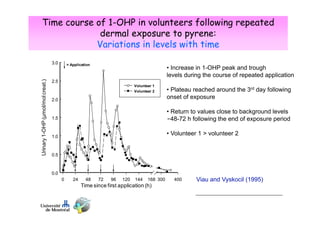
Time course of 1-OHP in volunteers following repeated
dermal exposure to pyrene:
Variations in levels with time

Urinary 1-OHP (µmol/mol creat.)

3.0

= Application

• Increase in 1-OHP peak and trough
levels during the course of repeated application

2.5
Volunteer 1
Volunteer 2

2.0

• Plateau reached around the 3rd day following
onset of exposure

1.5

• Return to values close to background levels
~48-72 h following the end of exposure period
• Volunteer 1 > volunteer 2

1.0

0.5

0.0
0

24

48

72

96

120

144

168 300

400

Viau and Vyskocil (1995)

Time since first application (h)
5
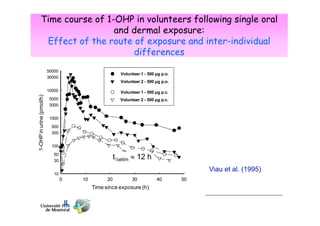
Time course of 1-OHP in volunteers following single oral
and dermal exposure:
Effect of the route of exposure and inter-individual
differences
50000
30000

Volunteer 1 - 500 µg p.o.
Volunteer 2 - 500 µg p.o.

1-OHP in urine (pmol/h)

10000

Volunteer 1 - 500 µg p.c.

5000
3000

Volunteer 2 - 500 µg p.c.

1000
500
300
100

t½elim ≈ 12 h
t½elim ≈ 12 h

50
30

Viau et al. (1995)

10

0

10

20

30

Time since exposure (h)

40

50
Usefulness of kinetic models to
interpret biomonitoring data
– Toxicokinetic models are increasingly used to reproduce
the time course of a biomarker of exposure in the
biological matrix of interest
– Links can be made with time-dependent variations in
body burdens and dose per unit of time
– Simulations can help infer on main exposure routes
– provided some data are still available on the type of exposure
(oral, respiratory, dermal)
– and in case of workers, ideally airborne concentrations and
working hours.
Two types of kinetic models to simulate
the kinetics
• Toxicokinetic model
• PBPK model
Main modeling steps of the
toxicokinetic model
• Model development
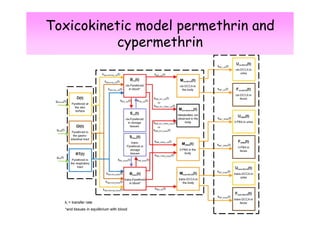
– Model conceptual and functional representation based on available
in vivo time course data
– Each compartment represents a tissue or group of tissues or an
excreta
– Mass balance is described
– Transfers from one compartment to the other are represented by
rate constants
– The rate of change in the amounts in a compartment is determined
by the difference between incoming and outgoing amounts per unit
of time
– Saturable processes can also be described
Development of a toxicokinetic model
based on human data
The case of pyrethroids and their
metabolites
Toxicokinetic model permethrin and
cypermethrin
Main modeling steps of the
toxicokinetic model
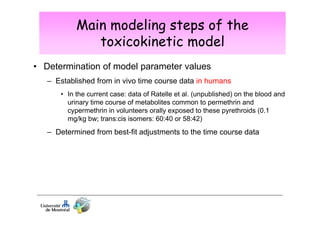
• Determination of model parameter values
– Established from in vivo time course data in humans
• In the current case: data of Ratelle et al. (unpublished) on the blood and
urinary time course of metabolites common to permethrin and
cypermethrin in volunteers orally exposed to these pyrethroids (0.1
mg/kg bw; trans:cis isomers: 60:40 or 58:42)

– Determined from best-fit adjustments to the time course data
Urinary excretion rate of metabolites (%)

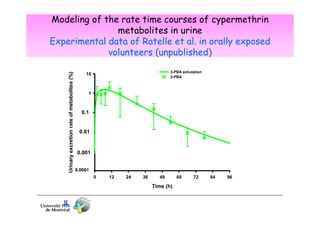
Modeling of the rate time courses of cypermethrin
metabolites in urine
Experimental data of Ratelle et al. in orally exposed
volunteers (unpublished)
3-PBA simulation
cis-DCCA simulation
trans-DCCA simulation
3-PBA
cis-DCCA
trans-DCCA

10
10

1
1

0.1
0.1
0,1
0,1

0.01
0.01
0,01
0,01

0,001
0,001
0.001
0.001

0.0001
0.0001
0,0001
0,0001

0
0

12
12

24
24

36
36

48
48

Time (h)
Time (h)

60
60

72
72

84
84

96
96
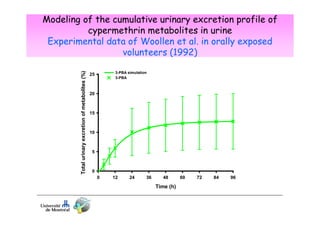
Total urinary excretion of metabolites (%)

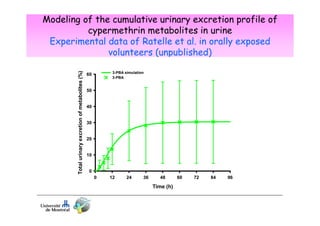
Modeling of the cumulative urinary excretion profile of
cypermethrin metabolites in urine
Experimental data of Ratelle et al. in orally exposed
volunteers (unpublished)
40
18
60

cis-DCCA simulation
trans-DCCA simulation
3-PBA simulation
cis-DCCA
trans-DCCA
3-PBA

16
50
14
30
12
40
10
20
30
8
6
20
10
4
10
2
0
0
0
0
0
0

12
12
12

24
24
24

36
36
36

48
48
48

Time (h)
Time (h)
Time (h)

60
60
60

72
72
72

84
84
84

96
96
96
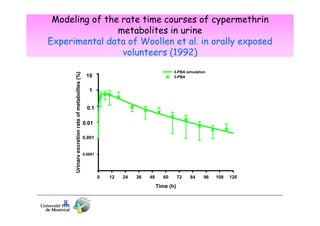
Urinary excretion rate of metabolites (%)

Modeling of the rate time courses of cypermethrin
metabolites in urine
Experimental data of Woollen et al. in orally exposed
volunteers (1992)
3-PBA simulation
cis-DCCA simulation
trans-DCCA simulation
3-PBA
cis-DCCA
trans-DCCA

1e+1
1e+1
10
10 10

1
1e+0
1e+0
1

1

1e-1
1e-1
0.1
0.1
0.1
0,1

0.01
1e-2
1e-2
0.01
0.01
0,01
0.001
0.001
1e-3
1e-3

0,001
0.001
0.0001
0.0001
1e-4
1e-4
0.0001
1e-5
0,0001
1e-5
00
0

12
12
12

24
24
24

36
36
36

48
48
48

60
60
60

72
72
72

Time (h)
Time (h)
Time (h)

84
84
84

96
96 108 120
96 108 120
108 120
Total urinary excretion ofof metabolites (%)
Total urinary excretion metabolites (%)

Modeling of the cumulative urinary excretion profile of
cypermethrin metabolites in urine
Experimental data of Woollen et al. in orally exposed
volunteers (1992)
30
14
25

trans-DCCA simulation
3-PBA simulation
cis-DCCA simulation
trans-DCCA
3-PBA
cis-DCCA

25
12
20
10
20
15
8
15
6
10
10
4
5
5
2
0
0 0
0

12
12

24
24

36
36

48
48

Time (h)
Time (h)

60
60

72
72

84
84

96
96
Development of a toxicokinetic model
based on rat data
The case of BaP and 3-OHBaP
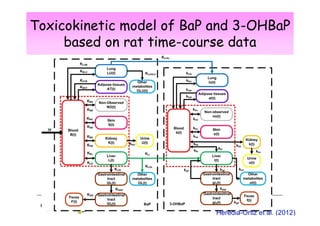
Toxicokinetic model of BaP and 3-OHBaP
based on rat time-course data

Heredia-Ortiz et al. (2012)
Main modeling steps of the
toxicokinetic model
• Determination of model parameter values
– Established from in vivo time course data in animals
• In the current case: data of Marie et al. (2010) on the time course of
BaP and 3-OHBaP in blood, tissues and excreta of rats intravenously
injected with BaP (40 µmol/kg bw)

– Determined from best-fit adjustments to the time course data
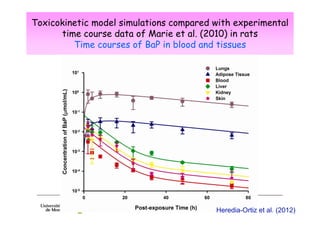
Toxicokinetic model simulations compared with experimental
time course data of Marie et al. (2010) in rats
Time courses of BaP in blood and tissues

Heredia-Ortiz et al. (2012)
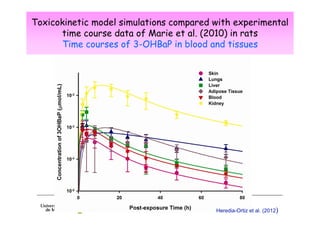
Toxicokinetic model simulations compared with experimental
time course data of Marie et al. (2010) in rats
Time courses of 3-OHBaP in blood and tissues

Heredia-Ortiz et al. (2012)
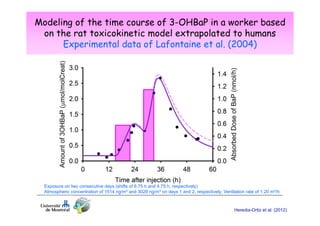
Modeling of the time course of 3-OHBaP in a worker based
on the rat toxicokinetic model extrapolated to humans
Experimental data of Lafontaine et al. (2004)

Exposure on two consecutive days (shifts of 6.75 h and 4.75 h, respectively)
Atmospheric concentration of 1514 ng/m3 and 3028 ng/m3 on days 1 and 2, respectively; Ventilation rate of 1.20 m3/h

Heredia-Ortiz et al. (2012)
Advantages and limits of this
toxicokinetic modeling approach
• Advantages
– Model is based on observed time course data
– Only main biological determinants need to be represented such that
the model may be simplified

• Limits
– Lack of physiological representation is often criticized
– As with other models, uncertainty in model structure and parameter
values, when insufficient available data
– As with other models, validity is dependent on available independent
sets of time course data to evaluate the model
Development of a PBPK model based on
rat data
The case of BaP and 3-OHBaP
Main modeling steps of the PBPK
model
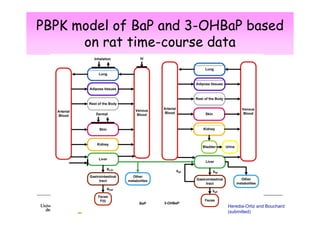
• Model development
– Model conceptual and functional representation based on animal and
human physiology
– Each compartment represents a tissue, or group of tissues, or excreta
– Mass balance is described
– Transfers from one compartment to the other are represented by
tissue blood flow rates (% of cardiac output)
– taken from the medical literature

– Transfers between tissues and blood are represented by tissue-blood
partition coefficients
– usually determined from in vitro studies
– may however be determined from in vivo time courses (as in the
following example)
PBPK model of BaP and 3-OHBaP based
on rat time-course data

Heredia-Ortiz and Bouchard
(submitted)
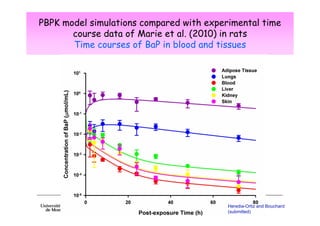
PBPK model simulations compared with experimental time
course data of Marie et al. (2010) in rats
Time courses of BaP in blood and tissues

Heredia-Ortiz and Bouchard
(submitted)
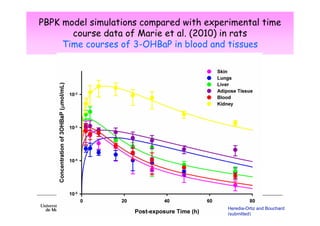
PBPK model simulations compared with experimental time
course data of Marie et al. (2010) in rats
Time courses of 3-OHBaP in blood and tissues

Heredia-Ortiz and Bouchard
(submitted)
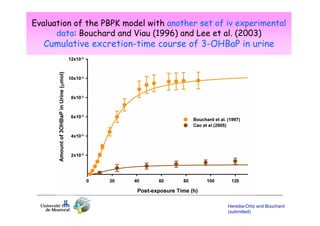
Evaluation of the PBPK model with another set of iv experimental
data: Bouchard and Viau (1996) and Lee et al. (2003)

Cumulative excretion-time course of 3-OHBaP in urine

Heredia-Ortiz and Bouchard
(submitted)
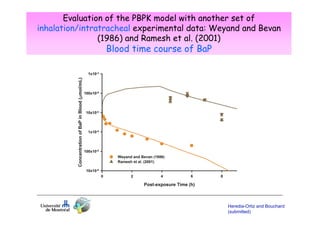
Evaluation of the PBPK model with another set of
inhalation/intratracheal experimental data: Weyand and Bevan
(1986) and Ramesh et al. (2001)

Blood time course of BaP

Heredia-Ortiz and Bouchard
(submitted)
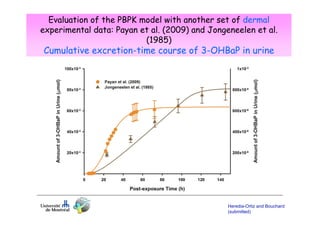
Evaluation of the PBPK model with another set of dermal
experimental data: Payan et al. (2009) and Jongeneelen et al.
(1985)

Cumulative excretion-time course of 3-OHBaP in urine

Heredia-Ortiz and Bouchard
(submitted)
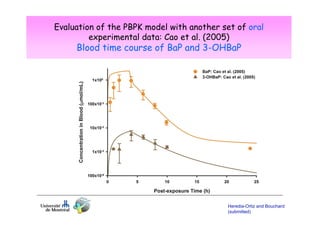
Evaluation of the PBPK model with another set of oral
experimental data: Cao et al. (2005)

Blood time course of BaP and 3-OHBaP

Heredia-Ortiz and Bouchard
(submitted)
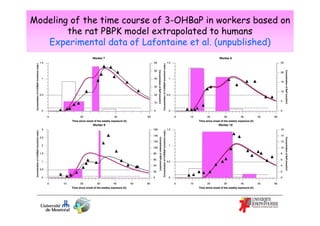
Modeling of the time course of 3-OHBaP in workers based on
the rat PBPK model extrapolated to humans
Experimental data of Lafontaine et al. (unpublished)
Limits of this PBPK modeling
approach
• Limits
– Model is often based on in vitro data
• As presented, this limit may be overcome by determining parameter values such
as tissue:blood partition coefficients from in vivo time course data

– Many parameters to be determined
– Lumping of tissues into highly and poorly perfused tissues increases
uncertainty in model structure and parameter values for these
compartments
– As with other models, uncertainty in model structure and parameter
values, when insufficient available data
– As with other models, validity is dependent on available independent
sets of time course data to evaluate the model
Kinetic models adapted to humans
• The models adapted to humans allows:
– Reconstruction of daily absorbed doses in workers
– Good predictive value from cumulative amounts in
urine over the longest feasible time periods
– Uncertainties based on creatinine-corrected urinary
values
Kinetic models adapted to humans
• The models adapted to humans allows:
– Predictions of main exposure route in workers
• Provided there is sufficient data on the urinary excretion profile
during the course of a workday

– Proposing biological reference values
• For example, a biological limit of 3-OHBaP in the urine of a
worker corresponding to an airborne BaP concentration limit
Acknowledgements
This work was funded by ANSES
and Health Canada

K.2 Bouchard

  • 1.
    Importance of toxicokinetics inunderstanding and interpreting biological monitoring results Michèle Bouchard Associate professor Head of the Chair in Toxicological Risk Analysis and Management Head of the Biomarker Unit of the Xenobiotics and Nanoparticles CFI plateform University of Montreal, Canada
  • 2.
    Biomonitoring, a recognizedtool to assess exposure to environmental contaminants – Biomonitoring of worker exposure is routinely conducted in several industries – National baseline concentration data (in blood and urine) of contaminants considered as a priority are being gathered in the general population: – In Germany (GerES) – In Canada (CHMS, MIREC) – In the U.S. (NHANES)….
  • 3.
    Importance of kineticsto help interpret biomonitoring data – Concentrations of biomarkers of exposure vary in time following an exposure period – in exposed populations – in workers in particular (during a workday and workweek) – Concentration-time course also varies according to the exposure route and scenario and is subject to interindividual variations Knowledge of exposure biomarker time courses and modeling allows to help interpret kinetic behavior
  • 4.
    Kinetic examples withshort-lived biomarkers of exposure • Pyrethroid metabolites • PAH metabolites
  • 5.
    Time course of1-OHP in volunteers following repeated dermal exposure to pyrene: Variations in levels with time Urinary 1-OHP (µmol/mol creat.) 3.0 = Application • Increase in 1-OHP peak and trough levels during the course of repeated application 2.5 Volunteer 1 Volunteer 2 2.0 • Plateau reached around the 3rd day following onset of exposure 1.5 • Return to values close to background levels ~48-72 h following the end of exposure period • Volunteer 1 > volunteer 2 1.0 0.5 0.0 0 24 48 72 96 120 144 168 300 400 Viau and Vyskocil (1995) Time since first application (h) 5
  • 6.
    Time course of1-OHP in volunteers following single oral and dermal exposure: Effect of the route of exposure and inter-individual differences 50000 30000 Volunteer 1 - 500 µg p.o. Volunteer 2 - 500 µg p.o. 1-OHP in urine (pmol/h) 10000 Volunteer 1 - 500 µg p.c. 5000 3000 Volunteer 2 - 500 µg p.c. 1000 500 300 100 t½elim ≈ 12 h t½elim ≈ 12 h 50 30 Viau et al. (1995) 10 0 10 20 30 Time since exposure (h) 40 50
  • 7.
    Usefulness of kineticmodels to interpret biomonitoring data – Toxicokinetic models are increasingly used to reproduce the time course of a biomarker of exposure in the biological matrix of interest – Links can be made with time-dependent variations in body burdens and dose per unit of time – Simulations can help infer on main exposure routes – provided some data are still available on the type of exposure (oral, respiratory, dermal) – and in case of workers, ideally airborne concentrations and working hours.
  • 8.
    Two types ofkinetic models to simulate the kinetics • Toxicokinetic model • PBPK model
  • 9.
    Main modeling stepsof the toxicokinetic model • Model development – Model conceptual and functional representation based on available in vivo time course data – Each compartment represents a tissue or group of tissues or an excreta – Mass balance is described – Transfers from one compartment to the other are represented by rate constants – The rate of change in the amounts in a compartment is determined by the difference between incoming and outgoing amounts per unit of time – Saturable processes can also be described
  • 10.
    Development of atoxicokinetic model based on human data The case of pyrethroids and their metabolites
  • 11.
  • 12.
    Main modeling stepsof the toxicokinetic model • Determination of model parameter values – Established from in vivo time course data in humans • In the current case: data of Ratelle et al. (unpublished) on the blood and urinary time course of metabolites common to permethrin and cypermethrin in volunteers orally exposed to these pyrethroids (0.1 mg/kg bw; trans:cis isomers: 60:40 or 58:42) – Determined from best-fit adjustments to the time course data
  • 13.
    Urinary excretion rateof metabolites (%) Modeling of the rate time courses of cypermethrin metabolites in urine Experimental data of Ratelle et al. in orally exposed volunteers (unpublished) 3-PBA simulation cis-DCCA simulation trans-DCCA simulation 3-PBA cis-DCCA trans-DCCA 10 10 1 1 0.1 0.1 0,1 0,1 0.01 0.01 0,01 0,01 0,001 0,001 0.001 0.001 0.0001 0.0001 0,0001 0,0001 0 0 12 12 24 24 36 36 48 48 Time (h) Time (h) 60 60 72 72 84 84 96 96
  • 14.
    Total urinary excretionof metabolites (%) Total urinary excretion of metabolites (%) Modeling of the cumulative urinary excretion profile of cypermethrin metabolites in urine Experimental data of Ratelle et al. in orally exposed volunteers (unpublished) 40 18 60 cis-DCCA simulation trans-DCCA simulation 3-PBA simulation cis-DCCA trans-DCCA 3-PBA 16 50 14 30 12 40 10 20 30 8 6 20 10 4 10 2 0 0 0 0 0 0 12 12 12 24 24 24 36 36 36 48 48 48 Time (h) Time (h) Time (h) 60 60 60 72 72 72 84 84 84 96 96 96
  • 15.
    Urinary excretion rateof metabolites (%) Modeling of the rate time courses of cypermethrin metabolites in urine Experimental data of Woollen et al. in orally exposed volunteers (1992) 3-PBA simulation cis-DCCA simulation trans-DCCA simulation 3-PBA cis-DCCA trans-DCCA 1e+1 1e+1 10 10 10 1 1e+0 1e+0 1 1 1e-1 1e-1 0.1 0.1 0.1 0,1 0.01 1e-2 1e-2 0.01 0.01 0,01 0.001 0.001 1e-3 1e-3 0,001 0.001 0.0001 0.0001 1e-4 1e-4 0.0001 1e-5 0,0001 1e-5 00 0 12 12 12 24 24 24 36 36 36 48 48 48 60 60 60 72 72 72 Time (h) Time (h) Time (h) 84 84 84 96 96 108 120 96 108 120 108 120
  • 16.
    Total urinary excretionofof metabolites (%) Total urinary excretion metabolites (%) Modeling of the cumulative urinary excretion profile of cypermethrin metabolites in urine Experimental data of Woollen et al. in orally exposed volunteers (1992) 30 14 25 trans-DCCA simulation 3-PBA simulation cis-DCCA simulation trans-DCCA 3-PBA cis-DCCA 25 12 20 10 20 15 8 15 6 10 10 4 5 5 2 0 0 0 0 12 12 24 24 36 36 48 48 Time (h) Time (h) 60 60 72 72 84 84 96 96
  • 17.
    Development of atoxicokinetic model based on rat data The case of BaP and 3-OHBaP
  • 18.
    Toxicokinetic model ofBaP and 3-OHBaP based on rat time-course data Heredia-Ortiz et al. (2012)
  • 19.
    Main modeling stepsof the toxicokinetic model • Determination of model parameter values – Established from in vivo time course data in animals • In the current case: data of Marie et al. (2010) on the time course of BaP and 3-OHBaP in blood, tissues and excreta of rats intravenously injected with BaP (40 µmol/kg bw) – Determined from best-fit adjustments to the time course data
  • 20.
    Toxicokinetic model simulationscompared with experimental time course data of Marie et al. (2010) in rats Time courses of BaP in blood and tissues Heredia-Ortiz et al. (2012)
  • 21.
    Toxicokinetic model simulationscompared with experimental time course data of Marie et al. (2010) in rats Time courses of 3-OHBaP in blood and tissues Heredia-Ortiz et al. (2012)
  • 22.
    Modeling of thetime course of 3-OHBaP in a worker based on the rat toxicokinetic model extrapolated to humans Experimental data of Lafontaine et al. (2004) Exposure on two consecutive days (shifts of 6.75 h and 4.75 h, respectively) Atmospheric concentration of 1514 ng/m3 and 3028 ng/m3 on days 1 and 2, respectively; Ventilation rate of 1.20 m3/h Heredia-Ortiz et al. (2012)
  • 23.
    Advantages and limitsof this toxicokinetic modeling approach • Advantages – Model is based on observed time course data – Only main biological determinants need to be represented such that the model may be simplified • Limits – Lack of physiological representation is often criticized – As with other models, uncertainty in model structure and parameter values, when insufficient available data – As with other models, validity is dependent on available independent sets of time course data to evaluate the model
  • 24.
    Development of aPBPK model based on rat data The case of BaP and 3-OHBaP
  • 25.
    Main modeling stepsof the PBPK model • Model development – Model conceptual and functional representation based on animal and human physiology – Each compartment represents a tissue, or group of tissues, or excreta – Mass balance is described – Transfers from one compartment to the other are represented by tissue blood flow rates (% of cardiac output) – taken from the medical literature – Transfers between tissues and blood are represented by tissue-blood partition coefficients – usually determined from in vitro studies – may however be determined from in vivo time courses (as in the following example)
  • 26.
    PBPK model ofBaP and 3-OHBaP based on rat time-course data Heredia-Ortiz and Bouchard (submitted)
  • 27.
    PBPK model simulationscompared with experimental time course data of Marie et al. (2010) in rats Time courses of BaP in blood and tissues Heredia-Ortiz and Bouchard (submitted)
  • 28.
    PBPK model simulationscompared with experimental time course data of Marie et al. (2010) in rats Time courses of 3-OHBaP in blood and tissues Heredia-Ortiz and Bouchard (submitted)
  • 29.
    Evaluation of thePBPK model with another set of iv experimental data: Bouchard and Viau (1996) and Lee et al. (2003) Cumulative excretion-time course of 3-OHBaP in urine Heredia-Ortiz and Bouchard (submitted)
  • 30.
    Evaluation of thePBPK model with another set of inhalation/intratracheal experimental data: Weyand and Bevan (1986) and Ramesh et al. (2001) Blood time course of BaP Heredia-Ortiz and Bouchard (submitted)
  • 31.
    Evaluation of thePBPK model with another set of dermal experimental data: Payan et al. (2009) and Jongeneelen et al. (1985) Cumulative excretion-time course of 3-OHBaP in urine Heredia-Ortiz and Bouchard (submitted)
  • 32.
    Evaluation of thePBPK model with another set of oral experimental data: Cao et al. (2005) Blood time course of BaP and 3-OHBaP Heredia-Ortiz and Bouchard (submitted)
  • 33.
    Modeling of thetime course of 3-OHBaP in workers based on the rat PBPK model extrapolated to humans Experimental data of Lafontaine et al. (unpublished)
  • 34.
    Limits of thisPBPK modeling approach • Limits – Model is often based on in vitro data • As presented, this limit may be overcome by determining parameter values such as tissue:blood partition coefficients from in vivo time course data – Many parameters to be determined – Lumping of tissues into highly and poorly perfused tissues increases uncertainty in model structure and parameter values for these compartments – As with other models, uncertainty in model structure and parameter values, when insufficient available data – As with other models, validity is dependent on available independent sets of time course data to evaluate the model
  • 35.
    Kinetic models adaptedto humans • The models adapted to humans allows: – Reconstruction of daily absorbed doses in workers – Good predictive value from cumulative amounts in urine over the longest feasible time periods – Uncertainties based on creatinine-corrected urinary values
  • 36.
    Kinetic models adaptedto humans • The models adapted to humans allows: – Predictions of main exposure route in workers • Provided there is sufficient data on the urinary excretion profile during the course of a workday – Proposing biological reference values • For example, a biological limit of 3-OHBaP in the urine of a worker corresponding to an airborne BaP concentration limit
  • 37.
    Acknowledgements This work wasfunded by ANSES and Health Canada