
For use with section 16.3
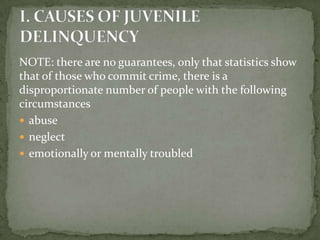
NOTE: there are no guarantees, only that statistics show
that of those who commit crime, there is a
disproportionate number of people with the following
circumstances
 abuse
 neglect
 emotionally or mentally troubled
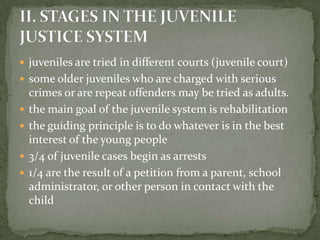
 juveniles are tried in different courts (juvenile court)
 some older juveniles who are charged with serious
    crimes or are repeat offenders may be tried as adults.
   the main goal of the juvenile system is rehabilitation
   the guiding principle is to do whatever is in the best
    interest of the young people
   3/4 of juvenile cases begin as arrests
   1/4 are the result of a petition from a parent, school
    administrator, or other person in contact with the
    child
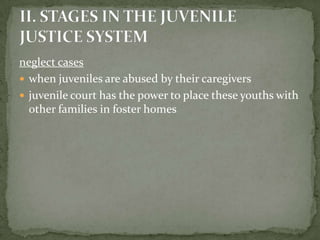
neglect cases
 when juveniles are abused by their caregivers
 juvenile court has the power to place these youths with
  other families in foster homes
delinquency cases
 when a juvenile commits a crime or an act considered
  illegal for a juvenile (though not for an adult)
A. Diversion or Detention
   once arrested and parents notified, the juvenile may be
    sent home or kept in a juvenile detention center until it
    is time to appear in court
   special officers specifically for juvenile cases will try to
    divert non-violent youngsters away from the court and
    into rehabilitation programs:
      counseling
      job-training
      drug-treatment
   some diverted juveniles will be detained at first while
    the court decides what to do
B. The Trial
  1)   Preliminary Hearing
          to determine if there is probable cause to believe the young
           person committed the crime as charged
B. The Trial
  2)    Trial
        juveniles do not have the right to a jury trial
        the identity of the juvenile is kept secret (a sealed record)
        consists of the juvenile, parents/caregiver, lawyer, judge,
         arresting officer, probation officer (who investigated the case)
        if a juvenile is found to be delinquent, the court holds
         another hearing to decide the sentence
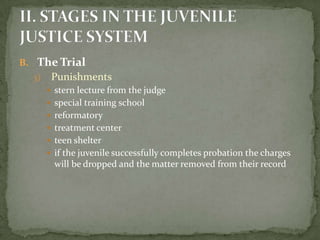
B. The Trial
  3)    Punishments
        stern lecture from the judge
        special training school
        reformatory
        treatment center
        teen shelter
        if the juvenile successfully completes probation the charges
         will be dropped and the matter removed from their record
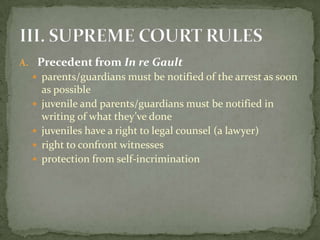
A. Precedent from In re Gault
   parents/guardians must be notified of the arrest as soon
      as possible
     juvenile and parents/guardians must be notified in
      writing of what they’ve done
     juveniles have a right to legal counsel (a lawyer)
     right to confront witnesses
     protection from self-incrimination

Juvenile Law (16.3)

  • 1.
    For use withsection 16.3
  • 2.
    NOTE: there areno guarantees, only that statistics show that of those who commit crime, there is a disproportionate number of people with the following circumstances  abuse  neglect  emotionally or mentally troubled
  • 3.
     juveniles aretried in different courts (juvenile court)  some older juveniles who are charged with serious crimes or are repeat offenders may be tried as adults.  the main goal of the juvenile system is rehabilitation  the guiding principle is to do whatever is in the best interest of the young people  3/4 of juvenile cases begin as arrests  1/4 are the result of a petition from a parent, school administrator, or other person in contact with the child
  • 4.
    neglect cases  whenjuveniles are abused by their caregivers  juvenile court has the power to place these youths with other families in foster homes
  • 5.
    delinquency cases  whena juvenile commits a crime or an act considered illegal for a juvenile (though not for an adult)
  • 6.
    A. Diversion orDetention  once arrested and parents notified, the juvenile may be sent home or kept in a juvenile detention center until it is time to appear in court  special officers specifically for juvenile cases will try to divert non-violent youngsters away from the court and into rehabilitation programs:  counseling  job-training  drug-treatment  some diverted juveniles will be detained at first while the court decides what to do
  • 7.
    B. The Trial 1) Preliminary Hearing  to determine if there is probable cause to believe the young person committed the crime as charged
  • 8.
    B. The Trial 2) Trial  juveniles do not have the right to a jury trial  the identity of the juvenile is kept secret (a sealed record)  consists of the juvenile, parents/caregiver, lawyer, judge, arresting officer, probation officer (who investigated the case)  if a juvenile is found to be delinquent, the court holds another hearing to decide the sentence
  • 9.
    B. The Trial 3) Punishments  stern lecture from the judge  special training school  reformatory  treatment center  teen shelter  if the juvenile successfully completes probation the charges will be dropped and the matter removed from their record
  • 10.
    A. Precedent fromIn re Gault  parents/guardians must be notified of the arrest as soon as possible  juvenile and parents/guardians must be notified in writing of what they’ve done  juveniles have a right to legal counsel (a lawyer)  right to confront witnesses  protection from self-incrimination