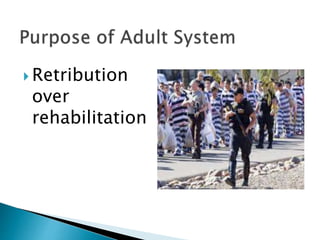
 Retribution
over
rehabilitation
“This title shall be construed to effectuate the
following public purposes: to provide for the
care, the protection, and the wholesome
moral, mental, and physical development of
children coming within its provisions and to
protect the welfare of the community and to
control the commission of unlawful acts by
children.”
 17 yrs. age or older
 Charged by Indictment
 Found “guilty”
 Bond hearing
 Criminal in nature
 Arrested
 Beyond a Reasonable
Doubt
 10yrs. – 16 yrs. of age
 Charged by Petition
 Found delinquent
 Detention Hearing
 Mainly Civil
 Detained
 Beyond a Reasonable
Doubt
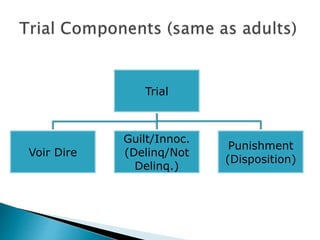
Trial
Voir Dire
Guilt/Innoc.
(Delinq/Not
Delinq.)
Punishment
(Disposition)
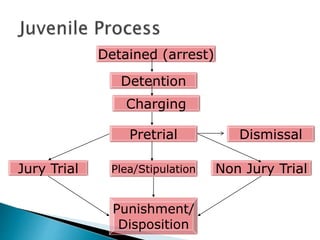
Detained (arrest)
Detention
Pretrial
Plea/StipulationJury Trial Non Jury Trial
Punishment/
Disposition
Charging
Dismissal
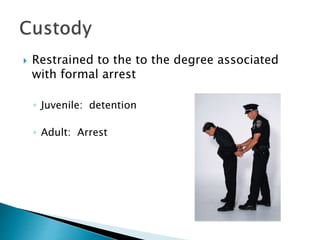
 Restrained to the to the degree associated
with formal arrest
◦ Juvenile: detention
◦ Adult: Arrest
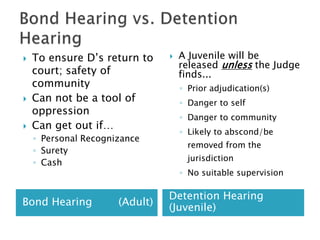
Bond Hearing (Adult)
Detention Hearing
(Juvenile)
 To ensure D’s return to
court; safety of
community
 Can not be a tool of
oppression
 Can get out if…
◦ Personal Recognizance
◦ Surety
◦ Cash
 A Juvenile will be
released unless the Judge
finds...
◦ Prior adjudication(s)
◦ Danger to self
◦ Danger to community
◦ Likely to abscond/be
removed from the
jurisdiction
◦ No suitable supervision
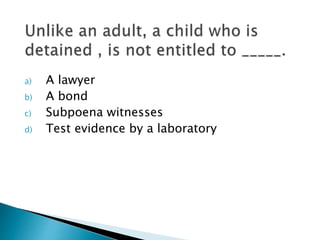
a) A lawyer
b) A bond
c) Subpoena witnesses
d) Test evidence by a laboratory
 Volunteered Statements
 Voluntary Statements
 Confession (Adult)
 Magistrated Statements (Juvenile)
 Volunteered statements are not covered by Miranda and
are allowed into evidence.
 Res Gestae
◦ Defined: statement made close in time to the event that is
spontaneous, not induced.
◦ Same as with an adult.
◦ Example: You approach a juvenile smoking a joint outside
Walmart, and he blurts out, “It’s not mine. I’m just holding it
for a friend.”
 Any oral statements made that are found to be true,
which tend to establish the adult’s/child’s guilt, such as
finding of secreted or stolen property, or the instrument
with which the offense was committed.
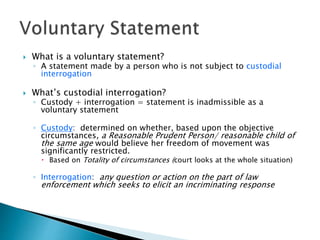
 What is a voluntary statement?
◦ A statement made by a person who is not subject to custodial
interrogation
 What’s custodial interrogation?
◦ Custody + interrogation = statement is inadmissible as a
voluntary statement
◦ Custody: determined on whether, based upon the objective
circumstances, a Reasonable Prudent Person/ reasonable child of
the same age would believe her freedom of movement was
significantly restricted.
 Based on Totality of circumstances (court looks at the whole situation)
◦ Interrogation: any question or action on the part of law
enforcement which seeks to elicit an incriminating response
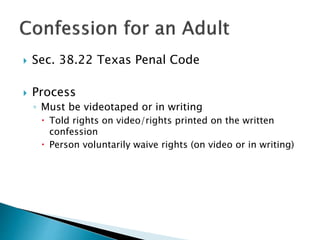
 Sec. 38.22 Texas Penal Code
 Process
◦ Must be videotaped or in writing
 Told rights on video/rights printed on the written
confession
 Person voluntarily waive rights (on video or in writing)
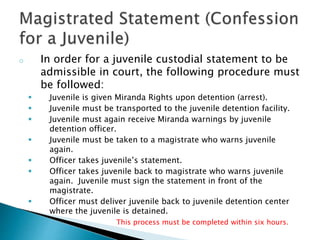
o In order for a juvenile custodial statement to be
admissible in court, the following procedure must
be followed:
 Juvenile is given Miranda Rights upon detention (arrest).
 Juvenile must be transported to the juvenile detention facility.
 Juvenile must again receive Miranda warnings by juvenile
detention officer.
 Juvenile must be taken to a magistrate who warns juvenile
again.
 Officer takes juvenile’s statement.
 Officer takes juvenile back to magistrate who warns juvenile
again. Juvenile must sign the statement in front of the
magistrate.
 Officer must deliver juvenile back to juvenile detention center
where the juvenile is detained.
This process must be completed within six hours.
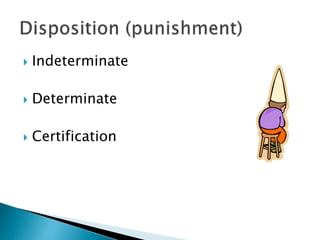
 Indeterminate
 Determinate
 Certification
 Lowest level of punishment in the juvenile system.
It allows the juvenile to be released from probation
if he completes it successfully.
 Includes probation where the child lives at home,
probation out of the home such as a boot camp or
treatment facility, and placement in the Texas
Juvenile Justice Department (TJJD) formerly known
as Texas Youth Commission (TYC).
 Probation terminates automatically when the
juvenile reaches his eighteenth birthday or when
the juvenile reaches his nineteenth birthday and is
in TJJD.
 This is the intermediate level of juvenile
punishment.
 Determinate punishments must be approved by a
grand jury because it allows the prosecutor to seek
punishment that extends into the adult system.
 The juvenile begins punishment in the juvenile
system and that punishment can be transferred to
the adult system for the juvenile to finish the
punishment as an adult offender.
 Prosecutor can ask for up to 10 years for a third
degree felony, up to 20 years for a second degree
felony, and up to 40 years for a first degree felony.
 Certification is the transferring of a juvenile’s
case to the adult court for the juvenile to be
tried as an adult and receive adult
punishment.
 Reserved for serious felonies.
 Before transfer, juvenile is entitled to a
hearing.
 (Juveniles are not eligible for the death
penalty regardless of the crime).
Texas juvenile law

Texas juvenile law

  • 2.
  • 3.
    “This title shallbe construed to effectuate the following public purposes: to provide for the care, the protection, and the wholesome moral, mental, and physical development of children coming within its provisions and to protect the welfare of the community and to control the commission of unlawful acts by children.”
  • 4.
     17 yrs.age or older  Charged by Indictment  Found “guilty”  Bond hearing  Criminal in nature  Arrested  Beyond a Reasonable Doubt  10yrs. – 16 yrs. of age  Charged by Petition  Found delinquent  Detention Hearing  Mainly Civil  Detained  Beyond a Reasonable Doubt
  • 5.
  • 6.
    Detained (arrest) Detention Pretrial Plea/StipulationJury TrialNon Jury Trial Punishment/ Disposition Charging Dismissal
  • 7.
     Restrained tothe to the degree associated with formal arrest ◦ Juvenile: detention ◦ Adult: Arrest
  • 8.
    Bond Hearing (Adult) DetentionHearing (Juvenile)  To ensure D’s return to court; safety of community  Can not be a tool of oppression  Can get out if… ◦ Personal Recognizance ◦ Surety ◦ Cash  A Juvenile will be released unless the Judge finds... ◦ Prior adjudication(s) ◦ Danger to self ◦ Danger to community ◦ Likely to abscond/be removed from the jurisdiction ◦ No suitable supervision
  • 9.
    a) A lawyer b)A bond c) Subpoena witnesses d) Test evidence by a laboratory
  • 11.
     Volunteered Statements Voluntary Statements  Confession (Adult)  Magistrated Statements (Juvenile)
  • 12.
     Volunteered statementsare not covered by Miranda and are allowed into evidence.  Res Gestae ◦ Defined: statement made close in time to the event that is spontaneous, not induced. ◦ Same as with an adult. ◦ Example: You approach a juvenile smoking a joint outside Walmart, and he blurts out, “It’s not mine. I’m just holding it for a friend.”  Any oral statements made that are found to be true, which tend to establish the adult’s/child’s guilt, such as finding of secreted or stolen property, or the instrument with which the offense was committed.
  • 13.
     What isa voluntary statement? ◦ A statement made by a person who is not subject to custodial interrogation  What’s custodial interrogation? ◦ Custody + interrogation = statement is inadmissible as a voluntary statement ◦ Custody: determined on whether, based upon the objective circumstances, a Reasonable Prudent Person/ reasonable child of the same age would believe her freedom of movement was significantly restricted.  Based on Totality of circumstances (court looks at the whole situation) ◦ Interrogation: any question or action on the part of law enforcement which seeks to elicit an incriminating response
  • 14.
     Sec. 38.22Texas Penal Code  Process ◦ Must be videotaped or in writing  Told rights on video/rights printed on the written confession  Person voluntarily waive rights (on video or in writing)
  • 15.
    o In orderfor a juvenile custodial statement to be admissible in court, the following procedure must be followed:  Juvenile is given Miranda Rights upon detention (arrest).  Juvenile must be transported to the juvenile detention facility.  Juvenile must again receive Miranda warnings by juvenile detention officer.  Juvenile must be taken to a magistrate who warns juvenile again.  Officer takes juvenile’s statement.  Officer takes juvenile back to magistrate who warns juvenile again. Juvenile must sign the statement in front of the magistrate.  Officer must deliver juvenile back to juvenile detention center where the juvenile is detained. This process must be completed within six hours.
  • 16.
  • 17.
     Lowest levelof punishment in the juvenile system. It allows the juvenile to be released from probation if he completes it successfully.  Includes probation where the child lives at home, probation out of the home such as a boot camp or treatment facility, and placement in the Texas Juvenile Justice Department (TJJD) formerly known as Texas Youth Commission (TYC).  Probation terminates automatically when the juvenile reaches his eighteenth birthday or when the juvenile reaches his nineteenth birthday and is in TJJD.
  • 18.
     This isthe intermediate level of juvenile punishment.  Determinate punishments must be approved by a grand jury because it allows the prosecutor to seek punishment that extends into the adult system.  The juvenile begins punishment in the juvenile system and that punishment can be transferred to the adult system for the juvenile to finish the punishment as an adult offender.  Prosecutor can ask for up to 10 years for a third degree felony, up to 20 years for a second degree felony, and up to 40 years for a first degree felony.
  • 19.
     Certification isthe transferring of a juvenile’s case to the adult court for the juvenile to be tried as an adult and receive adult punishment.  Reserved for serious felonies.  Before transfer, juvenile is entitled to a hearing.  (Juveniles are not eligible for the death penalty regardless of the crime).