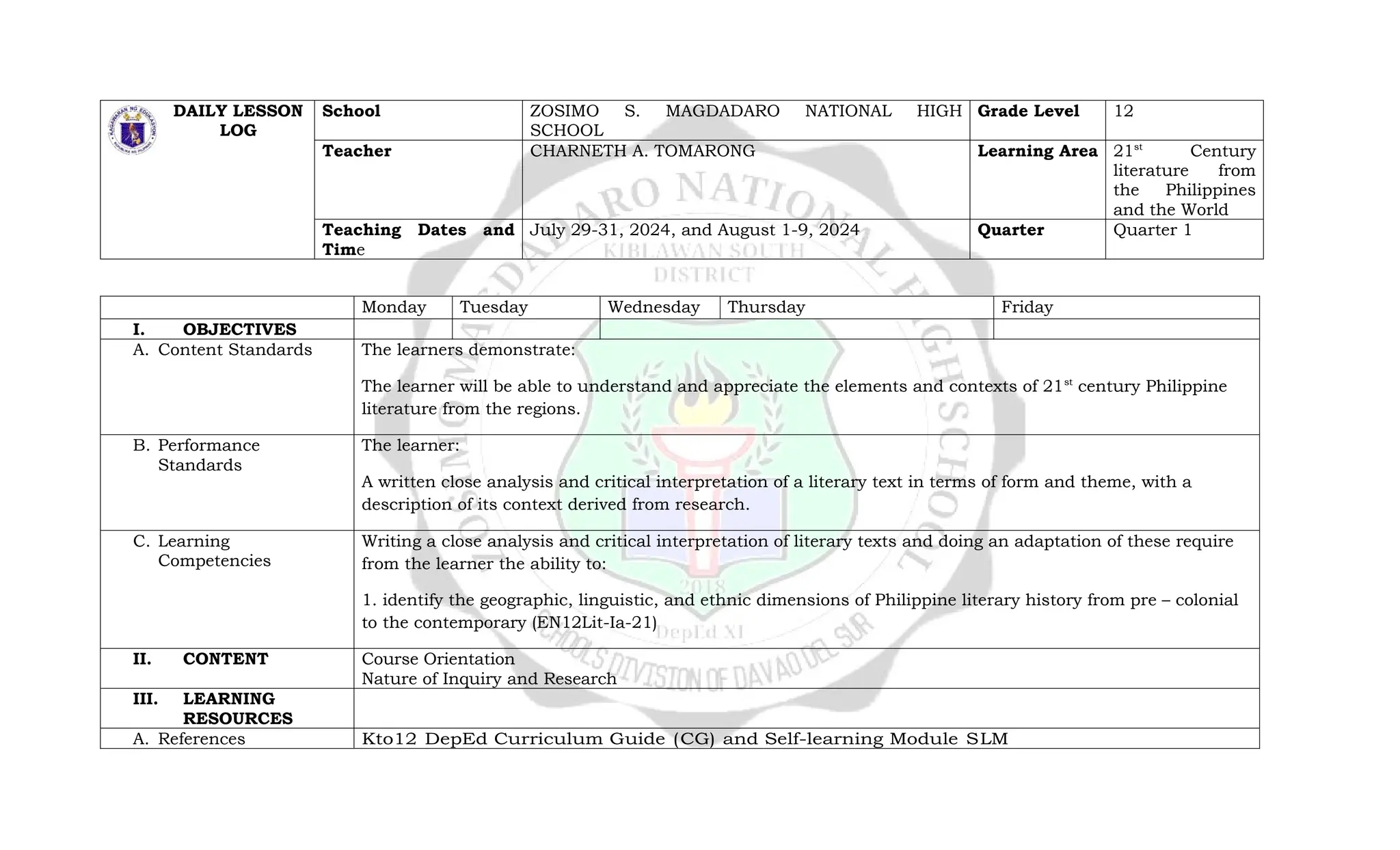
DAILY LESSON
LOG
School ZOSIMO S. MAGDADARO NATIONAL HIGH
SCHOOL
Grade Level 12
Teacher CHARNETH A. TOMARONG Learning Area 21st
Century
literature from
the Philippines
and the World
Teaching Dates and
Time
July 29-31, 2024, and August 1-9, 2024 Quarter Quarter 1
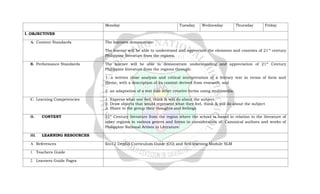
Monday Tuesday Wednesday Thursday Friday
I. OBJECTIVES
A. Content Standards The learners demonstrate:
The learner will be able to understand and appreciate the elements and contexts of 21st
century Philippine
literature from the regions.
B. Performance
Standards
The learner:
A written close analysis and critical interpretation of a literary text in terms of form and theme, with a
description of its context derived from research.
C. Learning
Competencies
Writing a close analysis and critical interpretation of literary texts and doing an adaptation of these require
from the learner the ability to:
1. identify the geographic, linguistic, and ethnic dimensions of Philippine literary history from pre – colonial
to the contemporary (EN12Lit-Ia-21)
II. CONTENT Course Orientation
Nature of Inquiry and Research
III. LEARNING
RESOURCES
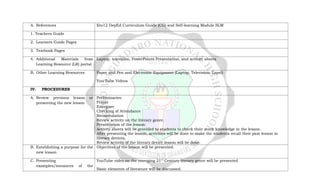
A. References Kto12 DepEd Curriculum Guide (CG) and Self-learning Module SLM
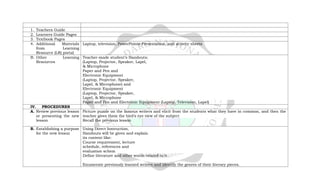
1. Teachers Guide
2. Learners Guide Pages
3. Textbook Pages
4. Additional Materials
from Learning
Resource (LR) portal
Laptop, television, PowerPoints Presentation, and activity sheets
B. Other Learning
Resources
Teacher-made student’s Handouts;
(Laptop, Projector, Speaker, Lapel,
& Microphone
Paper and Pen and
Electronic Equipment
(Laptop, Projector, Speaker,
Lapel, & Microphone) and
Electronic Equipment
(Laptop, Projector, Speaker,
Lapel, & Microphone
Paper and Pen and Electronic Equipment (Laptop, Television, Lapel)
IV. PROCEDURES
A. Review previous lesson
or presenting the new
lesson
Picture puzzle on the famous writers and elicit from the students what they have in common, and then the
teacher gives them the bird’s eye view of the subject
Recall the previous lesson
B. Establishing a purpose
for the new lesson
Using Direct Instruction,
Handouts will be given and explain
its content like:
Course requirement, lecture
schedule, references and
evaluation schem
Define literature and other words related to it.
Enumerate previously learned writers and identify the genres of their literary pieces.
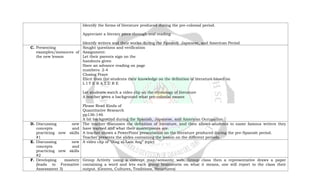
Identify the forms of literature produced during the pre-colonial period.
Appreciate a literary piece through oral reading
Identify writers and their works during the Spanish, Japanese, and American Period
C. Presenting
examples/instances of
the new lesson
Sought questions and verification
Assignment:
Let their parents sign on the
handouts given
Have an advance reading on page
numbers: 2-4
Closing Praye
Elicit from the students their knowledge on the definition of literature based on
L I T E R A T U R E
Let students watch a video clip on the etymology of literature
A teacher gives a background what pre-colonial means
Please Read Kinds of
Quantitative Research
pp136-146
A bit background during the Spanish, Japanese, and American Occupation
D. Discussing new
concepts and
practicing new skills
#1
The teacher discusses the definition of literature, and then allows students to name famous writers they
have learned and what their masterpieces are.
A teacher shows a PowerPoint presentation on the literature produced during the pre-Spanish period.
Teacher presents the slides containing the lesson on the different periods.
E. Discussing new
concepts and
practicing new skills
#2
A video clip of “Biag ni Lam Ang” (epic)
F. Developing mastery
(leads to Formative
Assessment 3)
Group Activity using a concept map/semantic web. Group class then a representative draws a paper
containing a word and lets each group brainstorm on what it means, one will report to the class their
output. (Genres, Cultures, Traditions, Structures)
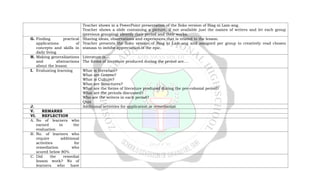
Teacher shows in a PowerPoint presentation of the Iloko version of Biag ni Lam-ang.
Teacher shows a slide containing a picture, if not available just the names of writers and let each group
(previous grouping) identify their period and their works.
G. Finding practical
applications of
concepts and skills in
daily living
Sharing ideas, observations and experiences that is related to the lesson.
Teacher presents the Iloko version of Biag ni Lam-ang and assigned per group to creatively read chosen
stanzas to imbibe appreciation of the epic.
H. Making generalizations
and abstractions
about the lesson
Literature is….
The forms of literature produced during the period are….
I. Evaluating learning What is literature?
What are Genres?
What is Culture?
What are Structures?
What are the forms of literature produced during the pre-colonial period?
What are the periods discussed?
Who are the writers in each period?
Quiz
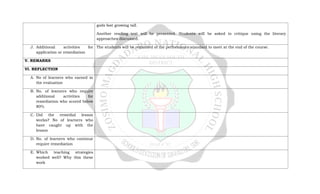
J. Additional activities for application or remediation
V. REMARKS
VI. REFLECTION
A. No of learners who
earned in the
evaluation
B. No. of learners who
require additional
activities for
remediation who
scored below 80%
C. Did the remedial
lesson work? No of
learners who have
caught up with the
lesson
D. No. of learners who
continue require
remediation
E. Which teaching
strategies worked
well? Why this these
work
F. What difficulties did I
encounter which my
principal or supervisor
can help me solve?
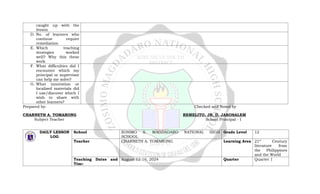
G. What innovation or
localized materials did
I use/discover which I
wish to share with
other learners?
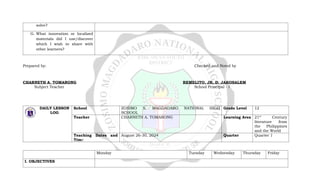
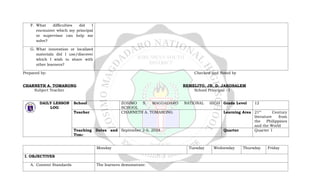
Prepared by: Checked and Noted by
CHARNETH A. TOMARONG REMELITO, JR. D. JAKOSALEM
Subject Teacher School Principal - I
DAILY LESSON
LOG
School ZOSIMO S. MAGDADARO NATIONAL HIGH
SCHOOL
Grade Level 12
Teacher CHARNETH A. TOMARONG Learning Area 21st
Century
literature from
the Philippines
and the World
Teaching Dates and
Time
August 12-16, 2024 Quarter Quarter 1
Monday Tuesday Wednesday Thursday Friday
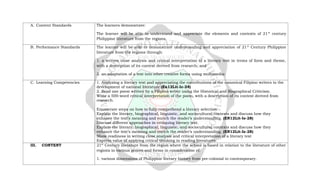
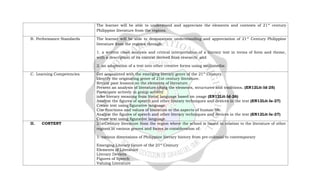
I. OBJECTIVES
A. Content Standards The learners demonstrate:
The learner will be able to understand and appreciate the elements and contexts of 21st
century
Philippine literature from the regions.
B. Performance Standards The learner will be able to demonstrate understanding and appreciation of 21st
Century
Philippine literature from the regions through:
1. a written close analysis and critical interpretation of a literary text in terms of form and
theme, with a description of its context derived from research; and
2. an adaptation of a text into other creative forms using multimedia:
C. Learning Competencies 1. Express what one feel, think & will do about the subject
2. Draw objects that would represent what they feel, think & will do about the subject
3. Share to the group their thoughts and feelings
II. CONTENT 21st
Century literature from the region where the school is based in relation to the literature of
other regions in various genres and forms in consideration of: Canonical authors and works of
Philippine National Artists in Literature.
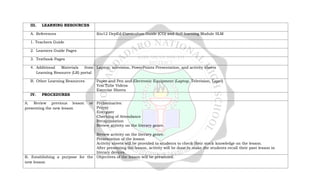
III. LEARNING RESOURCES
A. References Kto12 DepEd Curriculum Guide (CG) and Self-learning Module SLM
1. Teachers Guide
2. Learners Guide Pages
3. Textbook Pages
4. Additional Materials from Learning
Resource (LR) portal
Laptop, television, PowerPoints Presentation, and activity sheets
B. Other Learning Resources Paper and Pen and Electronic Equipment (Laptop, Television, Lapel)
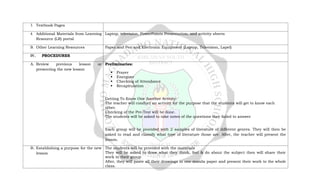
IV. PROCEDURES
A. Review previous lesson or
presenting the new lesson
Preliminaries:
 Prayer
 Energizer
 Checking of Attendance
 Recapitulation
Getting To Know One Another Activity:
The teacher will conduct an activity for the purpose that the students will get to know each
other.
Checking of the Pre-Test will be done.
The students will be asked to take notes of the questions they failed to answer
Each group will be provided with 2 samples of literature of different genres. They will then be
asked to read and classify what type of literature those are. After, the teacher will present the
lesson.
B. Establishing a purpose for the new
lesson
The students will be provided with the materials
They will be asked to draw what they think, feel & do about the subject then will share their
work in their group
After, they will paste all their drawings in one manila paper and present their work to the whole
class.
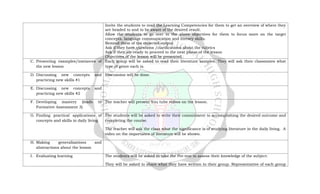
Invite the students to read the Learning Competencies for them to get an overview of where they
are headed to and to be aware of the desired result.
Allow the students to go over to the above objectives for them to focus more on the target
concepts, language communication and literary skills.
Remind them of the expected output.
Ask if they have questions /clarifications about the rubrics
Ask if they are ready to proceed to the next phase of the lesson
Objectives of the lesson will be presented.
C. Presenting examples/instances of
the new lesson
Each group will be asked to read their literature samples. They will ask their classmates what
type of genre each is.
D. Discussing new concepts and
practicing new skills #1
Discussion will be done.
E. Discussing new concepts and
practicing new skills #2
F. Developing mastery (leads to
Formative Assessment 3)
The teacher will present You tube videos on the lesson.
G. Finding practical applications of
concepts and skills in daily living
The students will be asked to write their commitment to accomplishing the desired outcome and
completing the course.
The teacher will ask the class what the significance is of studying literature in the daily living. A
video on the importance of literature will be shown.
H. Making generalizations and
abstractions about the lesson
I. Evaluating learning The students will be asked to take the Pre-test to assess their knowledge of the subject.
They will be asked to share what they have written to their group. Representative of each group
will be asked to share in the class.
Exercises on classifying literature will be given.
J. Additional activities for application
or remediation
The teacher will orient the students of the routine activities of the class including the
Management of Learning (MOL), checking of attendance, etc.
The teacher will also group students and let them choose leaders for the future group tasks.
Rules will be set.
V. REMARKS
VI. REFLECTION
A. No of learners who earned in the
evaluation
B. No. of learners who require
additional activities for
remediation who scored below 80%
C. Did the remedial lesson works? No
of learners who have caught up
with the lesson
D. No. of learners who continue
require remediation
E. Which teaching strategies worked
well? Why this these work
F. What difficulties did I encounter
which my principal or supervisor
can help me solve?
G. What innovation or localized
materials did I use/discover which
I wish to share with other
learners?
Prepared by: Checked and Noted by
CHARNETH A. TOMARONG REMELITO, JR. D. JAKOSALEM
Subject Teacher School Principal - I
DAILY LESSON
LOG
School ZOSIMO S. MAGDADARO NATIONAL HIGH
SCHOOL
Grade Level 12
Teacher CHARNETH A. TOMARONG Learning Area 21st
Century
literature from
the Philippines
and the World
Teaching Dates and
Time
August 19-23, 2024 Quarter Quarter 1
Monday Tuesday Wednesday Thursday Friday
I. OBJECTIVES
A. Content Standards The learners demonstrate:
The learner will be able to understand and appreciate the elements and contexts of 21st
century
Philippine literature from the regions.
B. Performance Standards The learner will be able to demonstrate understanding and appreciation of 21st
Century Philippine
literature from the regions through:
1. a written close analysis and critical interpretation of a literary text in terms of form and theme,
with a description of its context derived from research; and
2. an adaptation of a text into other creative forms using multimedia:
C. Learning Competencies Get acquainted with the emerging literary genre of the 21st Century.
Identify the originating genre of the 21st century literatures.
Review past lessons on the elements of literature.
Present an analysis of literature citing the elements, structures and traditions. (EN12Lit-Id-25)
Participate actively in group activity.
infer literary meaning from literal language based on usage (EN12Lit-Id-26)
Analyze the figures of speech and other literary techniques and devices in the text (EN12Lit-Ie-27)
Create text using figurative language.
Cite functions and values of literature to the aspects of human life.
Analyze the figures of speech and other literary techniques and devices in the text (EN12Lit-Ie-27)
Create text using figurative language.
II. CONTENT 21st
Century literature from the region where the school is based in relation to the literature of other
regions in various genres and forms in consideration of:
1. various dimensions of Philippine literary history from pre-colonial to contemporary;
III. LEARNING RESOURCES
A. References Kto12 DepEd Curriculum Guide (CG) and Self-learning Module SLM
1. Teachers Guide
2. Learners Guide Pages
3. Textbook Pages
4. Additional Materials from
Learning Resource (LR) portal
Laptop, television, PowerPoints Presentation, and activity sheets
B. Other Learning Resources Paper and Pen and Electronic Equipment (Laptop, Television, Lapel)
You Tube Videos
IV. PROCEDURES
A. Review previous lesson or
presenting the new lesson
Preliminaries:
Prayer
Energizer
Checking of Attendance
Recapitulation
Review activity on the literary genre.
Presentation of the lesson:
Activity sheets will be provided to students to check their stock knowledge in the lesson.
After presenting the lesson, activities will be done to make the students recall their past lesson in
literary devices.
Review activity of the literary device lesson will be done.
B. Establishing a purpose for the
new lesson
Objectives of the lesson will be presented.
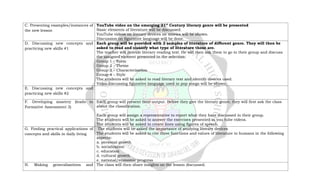
C. Presenting
examples/instances of the
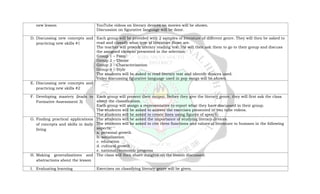
YouTube video on the emerging 21st
Century literary genre will be presented
Basic elements of literature will be discussed.
new lesson YouTube videos on literary devices on movies will be shown.
Discussion on figurative language will be done.
D. Discussing new concepts and
practicing new skills #1
Each group will be provided with 2 samples of literature of different genre. They will then be asked to
read and classify what type of literature those are.
The teacher will provide literary reading text. He will then ask them to go to their group and discuss
the assigned element presented in the selection:
Group 1 – Form
Group 2 – Theme
Group 3 – Characterization
Group 4 – Style
The students will be asked to read literary text and identify devices used.
Video discussing figurative language used in pop songs will be shown.
E. Discussing new concepts and
practicing new skills #2
F. Developing mastery (leads to
Formative Assessment 3)
Each group will present their output. Before they give the literary genre, they will first ask the class
about the classification.
Each group will assign a representative to report what they have discussed in their group.
The students will be asked to answer the exercises presented in you tube videos.
The students will be asked to create lines using figures of speech.
G. Finding practical applications
of concepts and skills in daily
living
The students will be asked the importance of studying literary devices.
The students will be asked to cite three functions and values of literature to humans in the following
aspects:
a. personal growth
b. socialization
c. education
d. cultural growth
e. national/economic progress
H. Making generalizations and
abstractions about the lesson
The class will then share insights on the lesson discussed.
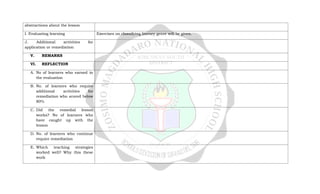
I. Evaluating learning Exercises on classifying literary genre will be given.
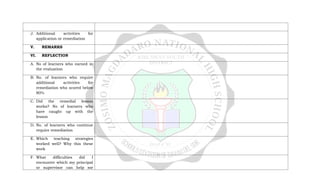
J. Additional activities for
application or remediation
V. REMARKS
VI. REFLECTION
A. No of learners who earned in
the evaluation
B. No. of learners who require
additional activities for
remediation who scored below
80%
C. Did the remedial lesson
works? No of learners who
have caught up with the
lesson
D. No. of learners who continue
require remediation
E. Which teaching strategies
worked well? Why this these
work
F. What difficulties did I
encounter which my principal
or supervisor can help me
solve?
G. What innovation or localized
materials did I use/discover
which I wish to share with
other learners?
Prepared by: Checked and Noted by
CHARNETH A. TOMARONG REMELITO, JR. D. JAKOSALEM
Subject Teacher School Principal - I
DAILY LESSON
LOG
School ZOSIMO S. MAGDADARO NATIONAL HIGH
SCHOOL
Grade Level 12
Teacher CHARNETH A. TOMARONG Learning Area 21st
Century
literature from
the Philippines
and the World
Teaching Dates and
Time
August 26-30, 2024 Quarter Quarter 1
Monday Tuesday Wednesday Thursday Friday
I. OBJECTIVES
A. Content Standards The learners demonstrate:
The learner will be able to understand and appreciate the elements and contexts of 21st
century
Philippine literature from the regions.
B. Performance Standards The learner will be able to demonstrate understanding and appreciation of 21st
Century Philippine
literature from the regions through:
1. a written close analysis and critical interpretation of a literary text in terms of form and theme,
with a description of its context derived from research; and
2. an adaptation of a text into other creative forms using multimedia:
C. Learning Competencies 1. Analyzing a literary text and appreciating the contributions of the canonical Filipino writers to the
development of national literature (En12Lit-Ic-24)
2. Read one poem written by a Filipino writer using the Historical and Biographical Criticism.
Write a 500-word critical interpretation of the poem, with a description of its context derived from
research.
Enumerate steps on how to fully comprehend a literary selection
Explain the literary, biographical, linguistic, and sociocultural contexts and discuss how they
enhance the text’s meaning and enrich the reader’s understanding. (EN12Lit-Ie-28)
Discuss different approaches in critiquing literary text.
Explain the literary, biographical, linguistic, and sociocultural contexts and discuss how they
enhance the text’s meaning and enrich the reader’s understanding. (EN12Lit-Ie-28)
Show readiness in writing close analysis and critical interpretation of a literary text
Express value of applying critical thinking in reading literatures.
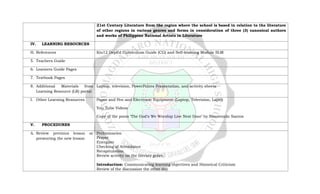
III. CONTENT 21st
Century literature from the region where the school is based in relation to the literature of other
regions in various genres and forms in consideration of:
1. various dimensions of Philippine literary history from pre-colonial to contemporary.
21st Century Literature from the region where the school is based in relation to the literature
of other regions in various genres and forms in consideration of three (3) canonical authors
and works of Philippine National Artists in Literature
IV. LEARNING RESOURCES
H. References Kto12 DepEd Curriculum Guide (CG) and Self-learning Module SLM
5. Teachers Guide
6. Learners Guide Pages
7. Textbook Pages
8. Additional Materials from
Learning Resource (LR) portal
Laptop, television, PowerPoints Presentation, and activity sheets
I. Other Learning Resources Paper and Pen and Electronic Equipment (Laptop, Television, Lapel)
You Tube Videos
Copy of the poem ‘The God’s We Worship Live Next Door’ by Bienvenido Santos
V. PROCEDURES
A. Review previous lesson or
presenting the new lesson
Preliminaries:
Prayer
Energizer
Checking of Attendance
Recapitulation
Review activity on the literary genre.
Introduction: Communicating learning objectives and Historical Criticism
Review of the discussion the other day
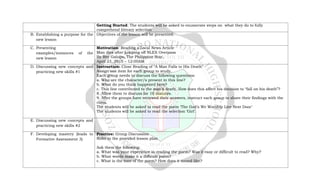
Getting Started: The students will be asked to enumerate steps on what they do to fully
comprehend literary selection
B. Establishing a purpose for the
new lesson
Objectives of the lesson will be presented.
C. Presenting
examples/instances of the
new lesson
Motivation: Reading a Local News Article
Man dies after jumping off NLEX Overpass
By Rey Galupo, The Philippine Star,
April 23, 2015 – 12:00AM
D. Discussing new concepts and
practicing new skills #1
Instruction: Close Reading of “A Man Falls to His Death”
Assign one item for each group to study.
Each group needs to discuss the following questions:
a. Who are the character/s present in this line?
b. What do you think happened here?
c. This line contributed to the man’s death. How does this affect his decision to “fall on his death”?
8. Allow them to discuss for 10 minutes.
9. After the groups have reviewed their answers, instruct each group to share their findings with the
class.
The students will be asked to read the poem ‘The God’s We Worship Live Next Door’
The students will be asked to read the selection ‘Girl’.
E. Discussing new concepts and
practicing new skills #2
F. Developing mastery (leads to
Formative Assessment 3)
Practice: Group Discussion
Refer to the provided lesson plan
Ask them the following:
a. What was your experience in reading the poem? Was it easy or difficult to read? Why?
b. What words make it a difficult poem?
c. What is the tone of the poem? How does it sound like?
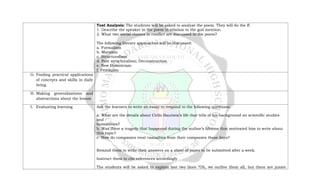
Text Analysis: The students will be asked to analyze the poem. They will do the ff.
1. Describe the speaker in the poem in relation to the god mention.
2. What two social classes in conflict are discussed in the poem?
The following literary approaches will be discussed:
a. Formalism
b. Marxism
c. Structuralism
d. Post structuralism; Deconstruction
e. New Historicism
f. Feminism
G. Finding practical applications
of concepts and skills in daily
living
H. Making generalizations and
abstractions about the lesson
I. Evaluating learning Ask the learners to write an essay to respond to the following questions:
a. What are the details about Cirilo Bautista’s life that tells of his background on scientific studies
and
humanities?
b. Was there a tragedy that happened during the author’s lifetime that motivated him to write about
this topic?
c. How do companies treat casualties from their companies these days?
Remind them to write their answers on a sheet of paper to be submitted after a week.
Instruct them to cite references accordingly
The students will be asked to explain last two lines “Oh, we outlive them all, but there are junior
gods fast growing tall.
Another reading text will be presented. Students will be asked to critique using the literary
approaches discussed.
J. Additional activities for
application or remediation
The students will be reminded of the performance standard to meet at the end of the course.
V. REMARKS
VI. REFLECTION
A. No of learners who earned in
the evaluation
B. No. of learners who require
additional activities for
remediation who scored below
80%
C. Did the remedial lesson
works? No of learners who
have caught up with the
lesson
D. No. of learners who continue
require remediation
E. Which teaching strategies
worked well? Why this these
work
F. What difficulties did I
encounter which my principal
or supervisor can help me
solve?
G. What innovation or localized
materials did I use/discover
which I wish to share with
other learners?
Prepared by: Checked and Noted by
CHARNETH A. TOMARONG REMELITO, JR. D. JAKOSALEM
Subject Teacher School Principal - I
DAILY LESSON
LOG
School ZOSIMO S. MAGDADARO NATIONAL HIGH
SCHOOL
Grade Level 12
Teacher CHARNETH A. TOMARONG Learning Area 21st
Century
literature from
the Philippines
and the World
Teaching Dates and
Time
September 2-6, 2024 Quarter Quarter 1
Monday Tuesday Wednesday Thursday Friday
I. OBJECTIVES
A. Content Standards The learners demonstrate:
The learner will be able to understand and appreciate the elements and contexts of 21st
century
Philippine literature from the regions.
B. Performance Standards The learner will be able to demonstrate understanding and appreciation of 21st
Century Philippine
literature from the regions through:
1. a written close analysis and critical interpretation of a literary text in terms of form and theme,
with a description of its context derived from research; and
2. an adaptation of a text into other creative forms using multimedia:
C. Learning Competencies Get acquainted with the emerging literary genre of the 21st
Century.
Identify the originating genre of 21st century literature.
Review past lessons on the elements of literature.
Present an analysis of literature citing the elements, structures and traditions. (EN12Lit-Id-25)
Participate actively in group activity.
infer literary meaning from literal language based on usage (EN12Lit-Id-26)
Analyze the figures of speech and other literary techniques and devices in the text (EN12Lit-Ie-27)
Create text using figurative language.
Cite functions and values of literature to the aspects of human life.
Analyze the figures of speech and other literary techniques and devices in the text (EN12Lit-Ie-27)
Create text using figurative language.
II. CONTENT 21stCentury literature from the region where the school is based in relation to the literature of other
regions in various genres and forms in consideration of:
1. various dimensions of Philippine literary history from pre-colonial to contemporary
Emerging Literary Genre of the 21st
Century
Elements of Literature
Literary Devices
Figures of Speech
Valuing Literature
III. LEARNING RESOURCES
A. References Kto12 DepEd Curriculum Guide (CG) and Self-learning Module SLM
1. Teachers Guide
2. Learners Guide Pages
3. Textbook Pages
4. Additional Materials from
Learning Resource (LR) portal
Laptop, television, PowerPoints Presentation, and activity sheets
B. Other Learning Resources Paper and Pen and Electronic Equipment (Laptop, Television, Lapel)
You Tube Videos
Exercise Sheets
IV. PROCEDURES
A. Review previous lesson or
presenting the new lesson
Preliminaries:
Prayer
Energizer
Checking of Attendance
Recapitulation
Review activity on the literary genre.
Presentation of the lesson
Activity sheets will be provided to students to check their stock knowledge on the lesson.
After presenting the lesson, activity will be done to make the students recall their past lesson in
literary devices.
B. Establishing a purpose for the
new lesson
Objectives of the lesson will be presented.
C. Presenting examples/instances of
the new lesson
YouTube video on the emerging 21st
Century literary genre will be presented
Basic elements of literature will be discussed.
YouTube videos on literary devices on movies will be shown.
Discussion on figurative language will be done.
D. Discussing new concepts and
practicing new skills #1
Each group will be provided with 2 samples of literature of different genre. They will then be
asked to read and classify what type of literature those are.
The teacher will provide literary reading text. He will then ask them to go to their group and discuss
the assigned element presented in the selection:
Group 1 – Form
Group 2 – Theme
Group 3 – Characterization
Group 4 – Style
The students will be asked to read literary text and identify devices used.
Video discussing figurative language used in pop songs will be shown.
E. Discussing new concepts and
practicing new skills #2
F. Developing mastery (leads to
Formative Assessment 3)
Each group will present their output. Before they give the literary genre, they will first ask the class
about the classification.
Each group will assign a representative to report what they have discussed in their group.
The students will be asked to answer the exercises presented in you tube videos.
The students will be asked to create lines using figures of speech.
G. Finding practical applications of
concepts and skills in daily living
The students will be asked the importance of studying literary devices
The students will be asked to cite three functions and values of literature to humans in the following
aspects:
a. personal growth
b. socialization
c. education
d. cultural growth
e. national/economic progress
H. Making generalizations and The class will then share insights on the lesson discussed.
abstractions about the lesson
I. Evaluating learning Exercises on classifying literary genre will be given.
J. Additional activities for
application or remediation
V. REMARKS
VI. REFLECTION
A. No of learners who earned in
the evaluation
B. No. of learners who require
additional activities for
remediation who scored below
80%
C. Did the remedial lesson
works? No of learners who
have caught up with the
lesson
D. No. of learners who continue
require remediation
E. Which teaching strategies
worked well? Why this these
work
F. What difficulties did I
encounter which my principal
or supervisor can help me
solve?
G. What innovation or localized
materials did I use/discover
which I wish to share with
other learners?
Prepared by: Checked and Noted by
CHARNETH A. TOMARONG REMELITO, JR. D. JAKOSALEM
Subject Teacher School Principal - I

DAILY LESSOM LOG LITERATURE SUBJECT.docx

  • 1.
    DAILY LESSON LOG School ZOSIMOS. MAGDADARO NATIONAL HIGH SCHOOL Grade Level 12 Teacher CHARNETH A. TOMARONG Learning Area 21st Century literature from the Philippines and the World Teaching Dates and Time July 29-31, 2024, and August 1-9, 2024 Quarter Quarter 1 Monday Tuesday Wednesday Thursday Friday I. OBJECTIVES A. Content Standards The learners demonstrate: The learner will be able to understand and appreciate the elements and contexts of 21st century Philippine literature from the regions. B. Performance Standards The learner: A written close analysis and critical interpretation of a literary text in terms of form and theme, with a description of its context derived from research. C. Learning Competencies Writing a close analysis and critical interpretation of literary texts and doing an adaptation of these require from the learner the ability to: 1. identify the geographic, linguistic, and ethnic dimensions of Philippine literary history from pre – colonial to the contemporary (EN12Lit-Ia-21) II. CONTENT Course Orientation Nature of Inquiry and Research III. LEARNING RESOURCES A. References Kto12 DepEd Curriculum Guide (CG) and Self-learning Module SLM
  • 2.
    1. Teachers Guide 2.Learners Guide Pages 3. Textbook Pages 4. Additional Materials from Learning Resource (LR) portal Laptop, television, PowerPoints Presentation, and activity sheets B. Other Learning Resources Teacher-made student’s Handouts; (Laptop, Projector, Speaker, Lapel, & Microphone Paper and Pen and Electronic Equipment (Laptop, Projector, Speaker, Lapel, & Microphone) and Electronic Equipment (Laptop, Projector, Speaker, Lapel, & Microphone Paper and Pen and Electronic Equipment (Laptop, Television, Lapel) IV. PROCEDURES A. Review previous lesson or presenting the new lesson Picture puzzle on the famous writers and elicit from the students what they have in common, and then the teacher gives them the bird’s eye view of the subject Recall the previous lesson B. Establishing a purpose for the new lesson Using Direct Instruction, Handouts will be given and explain its content like: Course requirement, lecture schedule, references and evaluation schem Define literature and other words related to it. Enumerate previously learned writers and identify the genres of their literary pieces.
  • 3.
    Identify the formsof literature produced during the pre-colonial period. Appreciate a literary piece through oral reading Identify writers and their works during the Spanish, Japanese, and American Period C. Presenting examples/instances of the new lesson Sought questions and verification Assignment: Let their parents sign on the handouts given Have an advance reading on page numbers: 2-4 Closing Praye Elicit from the students their knowledge on the definition of literature based on L I T E R A T U R E Let students watch a video clip on the etymology of literature A teacher gives a background what pre-colonial means Please Read Kinds of Quantitative Research pp136-146 A bit background during the Spanish, Japanese, and American Occupation D. Discussing new concepts and practicing new skills #1 The teacher discusses the definition of literature, and then allows students to name famous writers they have learned and what their masterpieces are. A teacher shows a PowerPoint presentation on the literature produced during the pre-Spanish period. Teacher presents the slides containing the lesson on the different periods. E. Discussing new concepts and practicing new skills #2 A video clip of “Biag ni Lam Ang” (epic) F. Developing mastery (leads to Formative Assessment 3) Group Activity using a concept map/semantic web. Group class then a representative draws a paper containing a word and lets each group brainstorm on what it means, one will report to the class their output. (Genres, Cultures, Traditions, Structures)
  • 4.
    Teacher shows ina PowerPoint presentation of the Iloko version of Biag ni Lam-ang. Teacher shows a slide containing a picture, if not available just the names of writers and let each group (previous grouping) identify their period and their works. G. Finding practical applications of concepts and skills in daily living Sharing ideas, observations and experiences that is related to the lesson. Teacher presents the Iloko version of Biag ni Lam-ang and assigned per group to creatively read chosen stanzas to imbibe appreciation of the epic. H. Making generalizations and abstractions about the lesson Literature is…. The forms of literature produced during the period are…. I. Evaluating learning What is literature? What are Genres? What is Culture? What are Structures? What are the forms of literature produced during the pre-colonial period? What are the periods discussed? Who are the writers in each period? Quiz J. Additional activities for application or remediation V. REMARKS VI. REFLECTION A. No of learners who earned in the evaluation B. No. of learners who require additional activities for remediation who scored below 80% C. Did the remedial lesson work? No of learners who have
  • 5.
    caught up withthe lesson D. No. of learners who continue require remediation E. Which teaching strategies worked well? Why this these work F. What difficulties did I encounter which my principal or supervisor can help me solve? G. What innovation or localized materials did I use/discover which I wish to share with other learners? Prepared by: Checked and Noted by CHARNETH A. TOMARONG REMELITO, JR. D. JAKOSALEM Subject Teacher School Principal - I DAILY LESSON LOG School ZOSIMO S. MAGDADARO NATIONAL HIGH SCHOOL Grade Level 12 Teacher CHARNETH A. TOMARONG Learning Area 21st Century literature from the Philippines and the World Teaching Dates and Time August 12-16, 2024 Quarter Quarter 1
  • 6.
    Monday Tuesday WednesdayThursday Friday I. OBJECTIVES A. Content Standards The learners demonstrate: The learner will be able to understand and appreciate the elements and contexts of 21st century Philippine literature from the regions. B. Performance Standards The learner will be able to demonstrate understanding and appreciation of 21st Century Philippine literature from the regions through: 1. a written close analysis and critical interpretation of a literary text in terms of form and theme, with a description of its context derived from research; and 2. an adaptation of a text into other creative forms using multimedia: C. Learning Competencies 1. Express what one feel, think & will do about the subject 2. Draw objects that would represent what they feel, think & will do about the subject 3. Share to the group their thoughts and feelings II. CONTENT 21st Century literature from the region where the school is based in relation to the literature of other regions in various genres and forms in consideration of: Canonical authors and works of Philippine National Artists in Literature. III. LEARNING RESOURCES A. References Kto12 DepEd Curriculum Guide (CG) and Self-learning Module SLM 1. Teachers Guide 2. Learners Guide Pages
  • 7.
    3. Textbook Pages 4.Additional Materials from Learning Resource (LR) portal Laptop, television, PowerPoints Presentation, and activity sheets B. Other Learning Resources Paper and Pen and Electronic Equipment (Laptop, Television, Lapel) IV. PROCEDURES A. Review previous lesson or presenting the new lesson Preliminaries:  Prayer  Energizer  Checking of Attendance  Recapitulation Getting To Know One Another Activity: The teacher will conduct an activity for the purpose that the students will get to know each other. Checking of the Pre-Test will be done. The students will be asked to take notes of the questions they failed to answer Each group will be provided with 2 samples of literature of different genres. They will then be asked to read and classify what type of literature those are. After, the teacher will present the lesson. B. Establishing a purpose for the new lesson The students will be provided with the materials They will be asked to draw what they think, feel & do about the subject then will share their work in their group After, they will paste all their drawings in one manila paper and present their work to the whole class.
  • 8.
    Invite the studentsto read the Learning Competencies for them to get an overview of where they are headed to and to be aware of the desired result. Allow the students to go over to the above objectives for them to focus more on the target concepts, language communication and literary skills. Remind them of the expected output. Ask if they have questions /clarifications about the rubrics Ask if they are ready to proceed to the next phase of the lesson Objectives of the lesson will be presented. C. Presenting examples/instances of the new lesson Each group will be asked to read their literature samples. They will ask their classmates what type of genre each is. D. Discussing new concepts and practicing new skills #1 Discussion will be done. E. Discussing new concepts and practicing new skills #2 F. Developing mastery (leads to Formative Assessment 3) The teacher will present You tube videos on the lesson. G. Finding practical applications of concepts and skills in daily living The students will be asked to write their commitment to accomplishing the desired outcome and completing the course. The teacher will ask the class what the significance is of studying literature in the daily living. A video on the importance of literature will be shown. H. Making generalizations and abstractions about the lesson I. Evaluating learning The students will be asked to take the Pre-test to assess their knowledge of the subject. They will be asked to share what they have written to their group. Representative of each group
  • 9.
    will be askedto share in the class. Exercises on classifying literature will be given. J. Additional activities for application or remediation The teacher will orient the students of the routine activities of the class including the Management of Learning (MOL), checking of attendance, etc. The teacher will also group students and let them choose leaders for the future group tasks. Rules will be set. V. REMARKS VI. REFLECTION A. No of learners who earned in the evaluation B. No. of learners who require additional activities for remediation who scored below 80% C. Did the remedial lesson works? No of learners who have caught up with the lesson D. No. of learners who continue require remediation E. Which teaching strategies worked well? Why this these work
  • 10.
    F. What difficultiesdid I encounter which my principal or supervisor can help me solve? G. What innovation or localized materials did I use/discover which I wish to share with other learners? Prepared by: Checked and Noted by CHARNETH A. TOMARONG REMELITO, JR. D. JAKOSALEM Subject Teacher School Principal - I DAILY LESSON LOG School ZOSIMO S. MAGDADARO NATIONAL HIGH SCHOOL Grade Level 12 Teacher CHARNETH A. TOMARONG Learning Area 21st Century literature from the Philippines and the World Teaching Dates and Time August 19-23, 2024 Quarter Quarter 1
  • 11.
    Monday Tuesday WednesdayThursday Friday
  • 12.
    I. OBJECTIVES A. ContentStandards The learners demonstrate: The learner will be able to understand and appreciate the elements and contexts of 21st century Philippine literature from the regions. B. Performance Standards The learner will be able to demonstrate understanding and appreciation of 21st Century Philippine literature from the regions through: 1. a written close analysis and critical interpretation of a literary text in terms of form and theme, with a description of its context derived from research; and 2. an adaptation of a text into other creative forms using multimedia: C. Learning Competencies Get acquainted with the emerging literary genre of the 21st Century. Identify the originating genre of the 21st century literatures. Review past lessons on the elements of literature. Present an analysis of literature citing the elements, structures and traditions. (EN12Lit-Id-25) Participate actively in group activity. infer literary meaning from literal language based on usage (EN12Lit-Id-26) Analyze the figures of speech and other literary techniques and devices in the text (EN12Lit-Ie-27) Create text using figurative language. Cite functions and values of literature to the aspects of human life. Analyze the figures of speech and other literary techniques and devices in the text (EN12Lit-Ie-27) Create text using figurative language. II. CONTENT 21st Century literature from the region where the school is based in relation to the literature of other regions in various genres and forms in consideration of: 1. various dimensions of Philippine literary history from pre-colonial to contemporary; III. LEARNING RESOURCES
  • 13.
    A. References Kto12DepEd Curriculum Guide (CG) and Self-learning Module SLM 1. Teachers Guide 2. Learners Guide Pages 3. Textbook Pages 4. Additional Materials from Learning Resource (LR) portal Laptop, television, PowerPoints Presentation, and activity sheets B. Other Learning Resources Paper and Pen and Electronic Equipment (Laptop, Television, Lapel) You Tube Videos IV. PROCEDURES A. Review previous lesson or presenting the new lesson Preliminaries: Prayer Energizer Checking of Attendance Recapitulation Review activity on the literary genre. Presentation of the lesson: Activity sheets will be provided to students to check their stock knowledge in the lesson. After presenting the lesson, activities will be done to make the students recall their past lesson in literary devices. Review activity of the literary device lesson will be done. B. Establishing a purpose for the new lesson Objectives of the lesson will be presented. C. Presenting examples/instances of the YouTube video on the emerging 21st Century literary genre will be presented Basic elements of literature will be discussed.
  • 14.
    new lesson YouTubevideos on literary devices on movies will be shown. Discussion on figurative language will be done. D. Discussing new concepts and practicing new skills #1 Each group will be provided with 2 samples of literature of different genre. They will then be asked to read and classify what type of literature those are. The teacher will provide literary reading text. He will then ask them to go to their group and discuss the assigned element presented in the selection: Group 1 – Form Group 2 – Theme Group 3 – Characterization Group 4 – Style The students will be asked to read literary text and identify devices used. Video discussing figurative language used in pop songs will be shown. E. Discussing new concepts and practicing new skills #2 F. Developing mastery (leads to Formative Assessment 3) Each group will present their output. Before they give the literary genre, they will first ask the class about the classification. Each group will assign a representative to report what they have discussed in their group. The students will be asked to answer the exercises presented in you tube videos. The students will be asked to create lines using figures of speech. G. Finding practical applications of concepts and skills in daily living The students will be asked the importance of studying literary devices. The students will be asked to cite three functions and values of literature to humans in the following aspects: a. personal growth b. socialization c. education d. cultural growth e. national/economic progress H. Making generalizations and abstractions about the lesson The class will then share insights on the lesson discussed. I. Evaluating learning Exercises on classifying literary genre will be given.
  • 15.
    J. Additional activitiesfor application or remediation V. REMARKS VI. REFLECTION A. No of learners who earned in the evaluation B. No. of learners who require additional activities for remediation who scored below 80% C. Did the remedial lesson works? No of learners who have caught up with the lesson D. No. of learners who continue require remediation E. Which teaching strategies worked well? Why this these work F. What difficulties did I encounter which my principal or supervisor can help me
  • 16.
    solve? G. What innovationor localized materials did I use/discover which I wish to share with other learners? Prepared by: Checked and Noted by CHARNETH A. TOMARONG REMELITO, JR. D. JAKOSALEM Subject Teacher School Principal - I DAILY LESSON LOG School ZOSIMO S. MAGDADARO NATIONAL HIGH SCHOOL Grade Level 12 Teacher CHARNETH A. TOMARONG Learning Area 21st Century literature from the Philippines and the World Teaching Dates and Time August 26-30, 2024 Quarter Quarter 1 Monday Tuesday Wednesday Thursday Friday I. OBJECTIVES
  • 17.
    A. Content StandardsThe learners demonstrate: The learner will be able to understand and appreciate the elements and contexts of 21st century Philippine literature from the regions. B. Performance Standards The learner will be able to demonstrate understanding and appreciation of 21st Century Philippine literature from the regions through: 1. a written close analysis and critical interpretation of a literary text in terms of form and theme, with a description of its context derived from research; and 2. an adaptation of a text into other creative forms using multimedia: C. Learning Competencies 1. Analyzing a literary text and appreciating the contributions of the canonical Filipino writers to the development of national literature (En12Lit-Ic-24) 2. Read one poem written by a Filipino writer using the Historical and Biographical Criticism. Write a 500-word critical interpretation of the poem, with a description of its context derived from research. Enumerate steps on how to fully comprehend a literary selection Explain the literary, biographical, linguistic, and sociocultural contexts and discuss how they enhance the text’s meaning and enrich the reader’s understanding. (EN12Lit-Ie-28) Discuss different approaches in critiquing literary text. Explain the literary, biographical, linguistic, and sociocultural contexts and discuss how they enhance the text’s meaning and enrich the reader’s understanding. (EN12Lit-Ie-28) Show readiness in writing close analysis and critical interpretation of a literary text Express value of applying critical thinking in reading literatures. III. CONTENT 21st Century literature from the region where the school is based in relation to the literature of other regions in various genres and forms in consideration of: 1. various dimensions of Philippine literary history from pre-colonial to contemporary.
  • 18.
    21st Century Literaturefrom the region where the school is based in relation to the literature of other regions in various genres and forms in consideration of three (3) canonical authors and works of Philippine National Artists in Literature IV. LEARNING RESOURCES H. References Kto12 DepEd Curriculum Guide (CG) and Self-learning Module SLM 5. Teachers Guide 6. Learners Guide Pages 7. Textbook Pages 8. Additional Materials from Learning Resource (LR) portal Laptop, television, PowerPoints Presentation, and activity sheets I. Other Learning Resources Paper and Pen and Electronic Equipment (Laptop, Television, Lapel) You Tube Videos Copy of the poem ‘The God’s We Worship Live Next Door’ by Bienvenido Santos V. PROCEDURES A. Review previous lesson or presenting the new lesson Preliminaries: Prayer Energizer Checking of Attendance Recapitulation Review activity on the literary genre. Introduction: Communicating learning objectives and Historical Criticism Review of the discussion the other day
  • 19.
    Getting Started: Thestudents will be asked to enumerate steps on what they do to fully comprehend literary selection B. Establishing a purpose for the new lesson Objectives of the lesson will be presented. C. Presenting examples/instances of the new lesson Motivation: Reading a Local News Article Man dies after jumping off NLEX Overpass By Rey Galupo, The Philippine Star, April 23, 2015 – 12:00AM D. Discussing new concepts and practicing new skills #1 Instruction: Close Reading of “A Man Falls to His Death” Assign one item for each group to study. Each group needs to discuss the following questions: a. Who are the character/s present in this line? b. What do you think happened here? c. This line contributed to the man’s death. How does this affect his decision to “fall on his death”? 8. Allow them to discuss for 10 minutes. 9. After the groups have reviewed their answers, instruct each group to share their findings with the class. The students will be asked to read the poem ‘The God’s We Worship Live Next Door’ The students will be asked to read the selection ‘Girl’. E. Discussing new concepts and practicing new skills #2 F. Developing mastery (leads to Formative Assessment 3) Practice: Group Discussion Refer to the provided lesson plan Ask them the following: a. What was your experience in reading the poem? Was it easy or difficult to read? Why? b. What words make it a difficult poem? c. What is the tone of the poem? How does it sound like?
  • 20.
    Text Analysis: Thestudents will be asked to analyze the poem. They will do the ff. 1. Describe the speaker in the poem in relation to the god mention. 2. What two social classes in conflict are discussed in the poem? The following literary approaches will be discussed: a. Formalism b. Marxism c. Structuralism d. Post structuralism; Deconstruction e. New Historicism f. Feminism G. Finding practical applications of concepts and skills in daily living H. Making generalizations and abstractions about the lesson I. Evaluating learning Ask the learners to write an essay to respond to the following questions: a. What are the details about Cirilo Bautista’s life that tells of his background on scientific studies and humanities? b. Was there a tragedy that happened during the author’s lifetime that motivated him to write about this topic? c. How do companies treat casualties from their companies these days? Remind them to write their answers on a sheet of paper to be submitted after a week. Instruct them to cite references accordingly The students will be asked to explain last two lines “Oh, we outlive them all, but there are junior
  • 21.
    gods fast growingtall. Another reading text will be presented. Students will be asked to critique using the literary approaches discussed. J. Additional activities for application or remediation The students will be reminded of the performance standard to meet at the end of the course. V. REMARKS VI. REFLECTION A. No of learners who earned in the evaluation B. No. of learners who require additional activities for remediation who scored below 80% C. Did the remedial lesson works? No of learners who have caught up with the lesson D. No. of learners who continue require remediation E. Which teaching strategies worked well? Why this these work
  • 22.
    F. What difficultiesdid I encounter which my principal or supervisor can help me solve? G. What innovation or localized materials did I use/discover which I wish to share with other learners? Prepared by: Checked and Noted by CHARNETH A. TOMARONG REMELITO, JR. D. JAKOSALEM Subject Teacher School Principal - I DAILY LESSON LOG School ZOSIMO S. MAGDADARO NATIONAL HIGH SCHOOL Grade Level 12 Teacher CHARNETH A. TOMARONG Learning Area 21st Century literature from the Philippines and the World Teaching Dates and Time September 2-6, 2024 Quarter Quarter 1 Monday Tuesday Wednesday Thursday Friday I. OBJECTIVES A. Content Standards The learners demonstrate:
  • 23.
    The learner willbe able to understand and appreciate the elements and contexts of 21st century Philippine literature from the regions. B. Performance Standards The learner will be able to demonstrate understanding and appreciation of 21st Century Philippine literature from the regions through: 1. a written close analysis and critical interpretation of a literary text in terms of form and theme, with a description of its context derived from research; and 2. an adaptation of a text into other creative forms using multimedia: C. Learning Competencies Get acquainted with the emerging literary genre of the 21st Century. Identify the originating genre of 21st century literature. Review past lessons on the elements of literature. Present an analysis of literature citing the elements, structures and traditions. (EN12Lit-Id-25) Participate actively in group activity. infer literary meaning from literal language based on usage (EN12Lit-Id-26) Analyze the figures of speech and other literary techniques and devices in the text (EN12Lit-Ie-27) Create text using figurative language. Cite functions and values of literature to the aspects of human life. Analyze the figures of speech and other literary techniques and devices in the text (EN12Lit-Ie-27) Create text using figurative language. II. CONTENT 21stCentury literature from the region where the school is based in relation to the literature of other regions in various genres and forms in consideration of: 1. various dimensions of Philippine literary history from pre-colonial to contemporary Emerging Literary Genre of the 21st Century Elements of Literature Literary Devices Figures of Speech Valuing Literature
  • 24.
    III. LEARNING RESOURCES A.References Kto12 DepEd Curriculum Guide (CG) and Self-learning Module SLM 1. Teachers Guide 2. Learners Guide Pages 3. Textbook Pages 4. Additional Materials from Learning Resource (LR) portal Laptop, television, PowerPoints Presentation, and activity sheets B. Other Learning Resources Paper and Pen and Electronic Equipment (Laptop, Television, Lapel) You Tube Videos Exercise Sheets IV. PROCEDURES A. Review previous lesson or presenting the new lesson Preliminaries: Prayer Energizer Checking of Attendance Recapitulation Review activity on the literary genre. Review activity on the literary genre. Presentation of the lesson Activity sheets will be provided to students to check their stock knowledge on the lesson. After presenting the lesson, activity will be done to make the students recall their past lesson in literary devices. B. Establishing a purpose for the new lesson Objectives of the lesson will be presented.
  • 25.
    C. Presenting examples/instancesof the new lesson YouTube video on the emerging 21st Century literary genre will be presented Basic elements of literature will be discussed. YouTube videos on literary devices on movies will be shown. Discussion on figurative language will be done. D. Discussing new concepts and practicing new skills #1 Each group will be provided with 2 samples of literature of different genre. They will then be asked to read and classify what type of literature those are. The teacher will provide literary reading text. He will then ask them to go to their group and discuss the assigned element presented in the selection: Group 1 – Form Group 2 – Theme Group 3 – Characterization Group 4 – Style The students will be asked to read literary text and identify devices used. Video discussing figurative language used in pop songs will be shown. E. Discussing new concepts and practicing new skills #2 F. Developing mastery (leads to Formative Assessment 3) Each group will present their output. Before they give the literary genre, they will first ask the class about the classification. Each group will assign a representative to report what they have discussed in their group. The students will be asked to answer the exercises presented in you tube videos. The students will be asked to create lines using figures of speech. G. Finding practical applications of concepts and skills in daily living The students will be asked the importance of studying literary devices The students will be asked to cite three functions and values of literature to humans in the following aspects: a. personal growth b. socialization c. education d. cultural growth e. national/economic progress H. Making generalizations and The class will then share insights on the lesson discussed.
  • 26.
    abstractions about thelesson I. Evaluating learning Exercises on classifying literary genre will be given. J. Additional activities for application or remediation V. REMARKS VI. REFLECTION A. No of learners who earned in the evaluation B. No. of learners who require additional activities for remediation who scored below 80% C. Did the remedial lesson works? No of learners who have caught up with the lesson D. No. of learners who continue require remediation E. Which teaching strategies worked well? Why this these work
  • 27.
    F. What difficultiesdid I encounter which my principal or supervisor can help me solve? G. What innovation or localized materials did I use/discover which I wish to share with other learners? Prepared by: Checked and Noted by CHARNETH A. TOMARONG REMELITO, JR. D. JAKOSALEM Subject Teacher School Principal - I