

MAHNOOR NISAR
Local Arbitration and conflict
deferment
Presented By:Arosa Hajira
Bibi Sumeria
Marhiam
MAHNOOR NISAR
Introduction
 The relationship between landlord and peasant are exploitative
and unfair.
 Landlord impede(stop) development and intentionally keep
the rural area backward in oder to maintain control.
 Dispute settlement systems are said “to be biased in favor of
landlords which leaves peasants without legal representation.
contii...
 At the time of independence Pakistan has land tenure system
in Punjab and Sindh dominated by jirga and
zamindar.Zamindar and jirga possed large trace of land
practice and exploitative system. (Husain 1999)
 For landlord agriculture development is less a matter of
economic need than of social obligation.
 Rural elicts act as arbiters in local disputes
 Arbitration take place in formal indagenious structure and at
other time it is informal.
Differnce between local arbitration and state court
 Local Arbitration
 It seeks above all to
defuse(to stop) and defer(to
delay) conflict rather than
actuallybring about
definative(clear) resolution
 State Court System
 State court are unable to
deal with parties that may
not seem formally involved
with a particular case
Conflict Resolution
 Conflict resolution is a way for two or more parties to find a
peaceful solution to a disagreement among them. The
disagreement may be personal, financial, political, or
emotional
o Anthropologist have recongnised that analysing conflict is a
useful way of making sense of society.
(Malinowski 1926)
 Studying a society's methods for dealing with conflict is a
useful way to understand social norms and values.
(Llewellyn and Hoeble 1941)
Contii...
• Ways of Mediation
 Al-Krenawi and Graham, argue that mediation occurs in two
ways.
1. 'sense of mutuallyagreed upon justice'
2. 'stability, order, and harmony to social relations'
Legal System
 The formal legal system of Pakistan came out of the islamic
legal tradition and the Biritish legal tradition
 Pakistani courts remain confusing because of chaotic
background from which they were created
 The Pakistani state's adoption of the shari'at and Biritish legal
systems has left little room for cutomary law in the formal
court system of Pakistan today
 Chaudhary[1999] suggested that the role of traditional justice
in the punjab has undergone dramatic change with
modernisation.
contiii

Decisions in Punjabi arbitration, have a very different goal
that is similar to the origins of the shari'at in Arabia and its
application during the expansion of Islam.
 The only decisions that based on customs are those of the
arbitration councils in the rural areas
 Decisions based on customary law become problematic in
urban situations where population come from different sub-
cultures.
 Each with its own customary law
 Lack of uniformity
Role of traditional Arbitration
 The role of arbitration is to defuse the present situation.
 It always served to defer conflict and to resolve disputes.
 To provide definitive solutions.
Role of traditional Arbitration
 The role of arbitration is to defuse the present situation.
 It always served to defer conflict and to resolve disputes.
 To provide definitive solutions.
Case study 1 child custody

The first case study illustrates one of the most shortcomings of
arbitration.
The failure of this case is due in part to a possible miscalculation in
the jirga council selection.
In islam children are considered to belong to their father's family and
religion.
contii
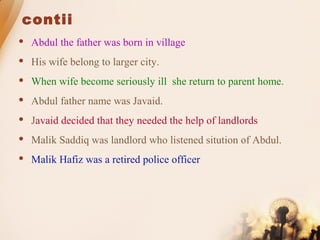
 Abdul the father was born in village
 His wife belong to larger city.
 When wife become seriously ill she return to parent home.
 Abdul father name was Javaid.
 Javaid decided that they needed the help of landlords
 Malik Saddiq was landlord who listened sitution of Abdul.
 Malik Hafiz was a retired police officer
contiii

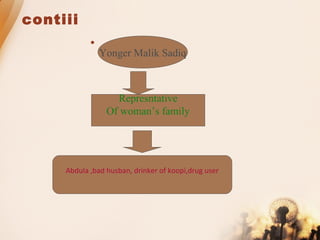
Yonger Malik Sadiq
Represntative
Of woman’s family
Abdula ,bad husban, drinker of koopi,drug user
Case study two :Land Dispute
 The second case also involved a formal Jirga council
The dispute was between paternal cousins over three generations and
multiple Jirga session
 There are two real landlords in one of the villages
Malik Ali Khan
Malik Shafiq Khan
contiii
 Malik Khalid Khan and Malik Munar Khan both legitimate to
claim plot of 25 kanal
 Malik Khalid,s claim was greater since his father had
actually use the land during the lifetime for grazing animals
 Malik Munawar,s argue that land had actually belong to his
mother,s grand father family.
 The land was uncultivated and use for grazing animals
 Malik Nadeeem was Malik Munawar grandson
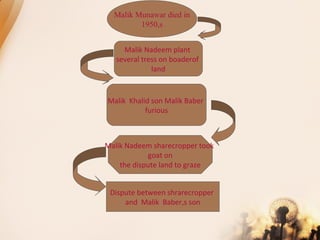
Malik Munawar died in
1950,s
Malik Nadeem plant
several tress on boaderof
land
Malik Khalid son Malik Baber
furious
Malik Nadeem sharecropper took
goat on
the dispute land to graze
Dispute between shrarecropper
and Malik Baber,s son
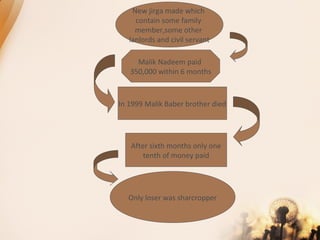
New jirga made which
contain some family
member,some other
lanlords and civil servant
Malik Nadeem paid
350,000 within 6 months
In 1999 Malik Baber brother died
After sixth months only one
tenth of money paid
Only loser was sharcropper
Case study three(Semi-Formal Arbitration Kidnapped Animals)
 The final case demonstrate how arbitration is only as useful
the position of the arbiter
 A pathan sharecropper .Gul Khan. had been told by his
landlord Malik Nawab to protect the crops from grazing
animal
 A Punjabi sharecropper Manzar had grazed his animal near
there for many years
 Issue between two sharecroppers
 Gul khan captured Manzar’s cow to get Manzar's attention
 But Manzar insult Gul Khan's wife and Pathans
contii
 Gul Khan sent his brother to their landlord
 Malik Shafiq younger brother of Malik Nawab heard the case
 Manzar reminds Malik Shafiq that they both are punjabi
 Malik Shafiq listen carefully but told him to forget about
being a punjabi in punjabi in this situation.
 Malik Sahfiq argue Manzar to apologize.
 Malik Nawab and Malik Shafiq take differnt decisions.
Conclusion.
 The result of each disputes may be successful if the objective
of arbitrator is to creat group harmony
 It may be faliure if the objective is the application of justics in
a manner which may be use to establishe rule and justics in
future
 Pakistani corurt at the present do not serve the role
maintaining group harmony.
Local Arbitration and conflict deferment

Local Arbitration and conflict deferment

  • 1.
  • 2.
    Local Arbitration andconflict deferment Presented By:Arosa Hajira Bibi Sumeria Marhiam MAHNOOR NISAR
  • 3.
    Introduction  The relationshipbetween landlord and peasant are exploitative and unfair.  Landlord impede(stop) development and intentionally keep the rural area backward in oder to maintain control.  Dispute settlement systems are said “to be biased in favor of landlords which leaves peasants without legal representation.
  • 4.
    contii...  At thetime of independence Pakistan has land tenure system in Punjab and Sindh dominated by jirga and zamindar.Zamindar and jirga possed large trace of land practice and exploitative system. (Husain 1999)  For landlord agriculture development is less a matter of economic need than of social obligation.  Rural elicts act as arbiters in local disputes  Arbitration take place in formal indagenious structure and at other time it is informal.
  • 5.
    Differnce between localarbitration and state court  Local Arbitration  It seeks above all to defuse(to stop) and defer(to delay) conflict rather than actuallybring about definative(clear) resolution  State Court System  State court are unable to deal with parties that may not seem formally involved with a particular case
  • 6.
    Conflict Resolution  Conflictresolution is a way for two or more parties to find a peaceful solution to a disagreement among them. The disagreement may be personal, financial, political, or emotional o Anthropologist have recongnised that analysing conflict is a useful way of making sense of society. (Malinowski 1926)  Studying a society's methods for dealing with conflict is a useful way to understand social norms and values. (Llewellyn and Hoeble 1941)
  • 7.
    Contii... • Ways ofMediation  Al-Krenawi and Graham, argue that mediation occurs in two ways. 1. 'sense of mutuallyagreed upon justice' 2. 'stability, order, and harmony to social relations'
  • 8.
    Legal System  Theformal legal system of Pakistan came out of the islamic legal tradition and the Biritish legal tradition  Pakistani courts remain confusing because of chaotic background from which they were created  The Pakistani state's adoption of the shari'at and Biritish legal systems has left little room for cutomary law in the formal court system of Pakistan today  Chaudhary[1999] suggested that the role of traditional justice in the punjab has undergone dramatic change with modernisation.
  • 9.
    contiii  Decisions in Punjabiarbitration, have a very different goal that is similar to the origins of the shari'at in Arabia and its application during the expansion of Islam.  The only decisions that based on customs are those of the arbitration councils in the rural areas  Decisions based on customary law become problematic in urban situations where population come from different sub- cultures.  Each with its own customary law  Lack of uniformity
  • 10.
    Role of traditionalArbitration  The role of arbitration is to defuse the present situation.  It always served to defer conflict and to resolve disputes.  To provide definitive solutions.
  • 11.
    Role of traditionalArbitration  The role of arbitration is to defuse the present situation.  It always served to defer conflict and to resolve disputes.  To provide definitive solutions.
  • 12.
    Case study 1child custody  The first case study illustrates one of the most shortcomings of arbitration. The failure of this case is due in part to a possible miscalculation in the jirga council selection. In islam children are considered to belong to their father's family and religion.
  • 13.
    contii  Abdul thefather was born in village  His wife belong to larger city.  When wife become seriously ill she return to parent home.  Abdul father name was Javaid.  Javaid decided that they needed the help of landlords  Malik Saddiq was landlord who listened sitution of Abdul.  Malik Hafiz was a retired police officer
  • 14.
    contiii  Yonger Malik Sadiq Represntative Ofwoman’s family Abdula ,bad husban, drinker of koopi,drug user
  • 15.
    Case study two:Land Dispute  The second case also involved a formal Jirga council The dispute was between paternal cousins over three generations and multiple Jirga session  There are two real landlords in one of the villages Malik Ali Khan Malik Shafiq Khan
  • 16.
    contiii  Malik KhalidKhan and Malik Munar Khan both legitimate to claim plot of 25 kanal  Malik Khalid,s claim was greater since his father had actually use the land during the lifetime for grazing animals  Malik Munawar,s argue that land had actually belong to his mother,s grand father family.  The land was uncultivated and use for grazing animals  Malik Nadeeem was Malik Munawar grandson
  • 17.
    Malik Munawar diedin 1950,s Malik Nadeem plant several tress on boaderof land Malik Khalid son Malik Baber furious Malik Nadeem sharecropper took goat on the dispute land to graze Dispute between shrarecropper and Malik Baber,s son
  • 18.
    New jirga madewhich contain some family member,some other lanlords and civil servant Malik Nadeem paid 350,000 within 6 months In 1999 Malik Baber brother died After sixth months only one tenth of money paid Only loser was sharcropper
  • 19.
    Case study three(Semi-FormalArbitration Kidnapped Animals)  The final case demonstrate how arbitration is only as useful the position of the arbiter  A pathan sharecropper .Gul Khan. had been told by his landlord Malik Nawab to protect the crops from grazing animal  A Punjabi sharecropper Manzar had grazed his animal near there for many years  Issue between two sharecroppers  Gul khan captured Manzar’s cow to get Manzar's attention  But Manzar insult Gul Khan's wife and Pathans
  • 20.
    contii  Gul Khansent his brother to their landlord  Malik Shafiq younger brother of Malik Nawab heard the case  Manzar reminds Malik Shafiq that they both are punjabi  Malik Shafiq listen carefully but told him to forget about being a punjabi in punjabi in this situation.  Malik Sahfiq argue Manzar to apologize.  Malik Nawab and Malik Shafiq take differnt decisions.
  • 21.
    Conclusion.  The resultof each disputes may be successful if the objective of arbitrator is to creat group harmony  It may be faliure if the objective is the application of justics in a manner which may be use to establishe rule and justics in future  Pakistani corurt at the present do not serve the role maintaining group harmony.