


By
Amulya Nigam
(Ballb 5th sem)
Writ
 General Meaning - a formal order in Writing issued
under seal, in the name of a sovereign, government,
Court or other authority, commanding an officer or
other person to whom it is issued, to do or refrain from
doing some act specified therein.
The supreme court of India is alert guardian of
fundamental rights of citizens.It is supreme
custodian.Article 32 of constitution provides for writs
for the enforcement of fundamental rights.Similar
jurisdiction is available to high court under Article
226. Actually , the jurisdiction of high court to issue
writ is more wide than that of supreme court . High
court can issue writ for 'other purposes' alongwith
fundamental rights , whereas supreme court can only
issue writ for the enforcement of fundamental rights
TYPES OF WRITS
 As per Article 32(2) and Article 226(1) of the
constitution,the supreme court and high court can
issue five types of writs-
 1.Habeas corpus
 2.Mandamus
 3.Prohibition
 4.Certiorari
 5.Quo-Warrant
Writ of Habeas corpus
 Habeas Corpus means, “you may have the body."
 A person, when arrested, can move the Court for
the issue of Habeas Corpus. It is an order by a
Court to the detaining authority to produce the
arrested person before it so that it may examine
whether the person has been detained lawfully or
otherwise. If the Court is convinced that the
person is illegally detained, it can issue orders for
his release.
Who can apply?
 General rule is that an application can be made by a
person who is illegally detained. But in certain cases,
an application of habeas corpus can be made by any
person on behalf of the prisoner, i.e., a friend or a
relation.
“SUNIL BATRA V. DELHI
ADMINISTRATION’’(AIR 1980 SC
1579)
 The Supreme Court enlarged the scope of habeas
corpus, making available the fundamental rights of the
prisoners .
“P.S SADASHIV SWAMI V.STATE OF
TAMIL NADU”(AIR 1974 SC 2271) -
 The Supreme Court gave the meaning of the writ
Habeas Corpus in this case-
 1.Court can ask the causes of detention of the detained
person.
 2.Can order to produce the detained person before the
court.
 3.If the detained person is illegally detained , the
court will order that he be released.
Writ of Mandamus
 Mandamus is a Latin word, which means "We
Command".
 Mandamus is an order from a superior court to a
lower court or tribunal or public authority to
perform an act, which falls within its duty.
 Simply, it is a writ issued to a public official to do a
thing which is a part of his official duty, but,
which, he has failed to do, so far. This writ cannot
be claimed as a matter of right. It is the
discretionary power of a court to issue such writs.
“MANI SHOBHREJ JAIN V. STATE
OF HARYANA” [(1977)1 SCC 486]-
 Requirement of mandamus writ are described in this
case.According to it,following condition for issue of
mandamus are required to be fulfilled-
 Existence of legal right,
 Such legal right shall be enforceable by court,
 The enforcement of such right imposes responsibility
of performance of any duty over any person , public
authority, corporation or government.
 Such duty is of public nature.
Writ of Prohibition
 Writ of prohibition means to forbid or to stop and
it is popularly known as 'Stay Order'.
 This writ is issued when a lower court or a body
tries to transgress the limits or powers vested in it.
 It is a writ issued by a superior court to lower court
or a tribunal forbidding it to perform an act
outside its jurisdiction. After the issue of this writ,
proceedings in the lower court etc. come to a stop.
“GOVIND MENON V. UNION OF
INDIA"(AIR 1967 SC 1893)
 It was held that prohibition writ may be issued under
the followiing conditions-
 Where there is excess of jurisdiction.
 Where there is absence of jurisdiction.
Writ of Certiorari
 Literally, Certiorari means to be certified.
 The writ of certiorari is issued by the Supreme Court to
some inferior court or tribunal to transfer the matter to
it or to some other superior authority for proper
consideration.
“STATE OF UP V. MOHAMMED
NOOR "(AIR 1958 SC 86)
 Supreme court said that certiorarri is maiinly issued to
reform the mistakes related to jurisdiction of
subordinate courts or quasi-judicial bodies.In other
woords,it can be said that the writ is isuued when the
subordinate court or tribunal acys in absence of
jurisdiction or beyond jurisdiction or fails to use its
jurisdiction.
“HARI VISHNU KAMATH V.AHMED
ISHAQ”(AIR 1955 SC 233)
 The writ is issued for correcting an error of law
apparent on the face of records. It cannot be issued to
correct an error of fact.
 The word Quo-Warrant literally means “on what
authority one is holding the public office"
 It is a writ issued with a view to restraining a
person from acting in a public office to which he is
not entitled.
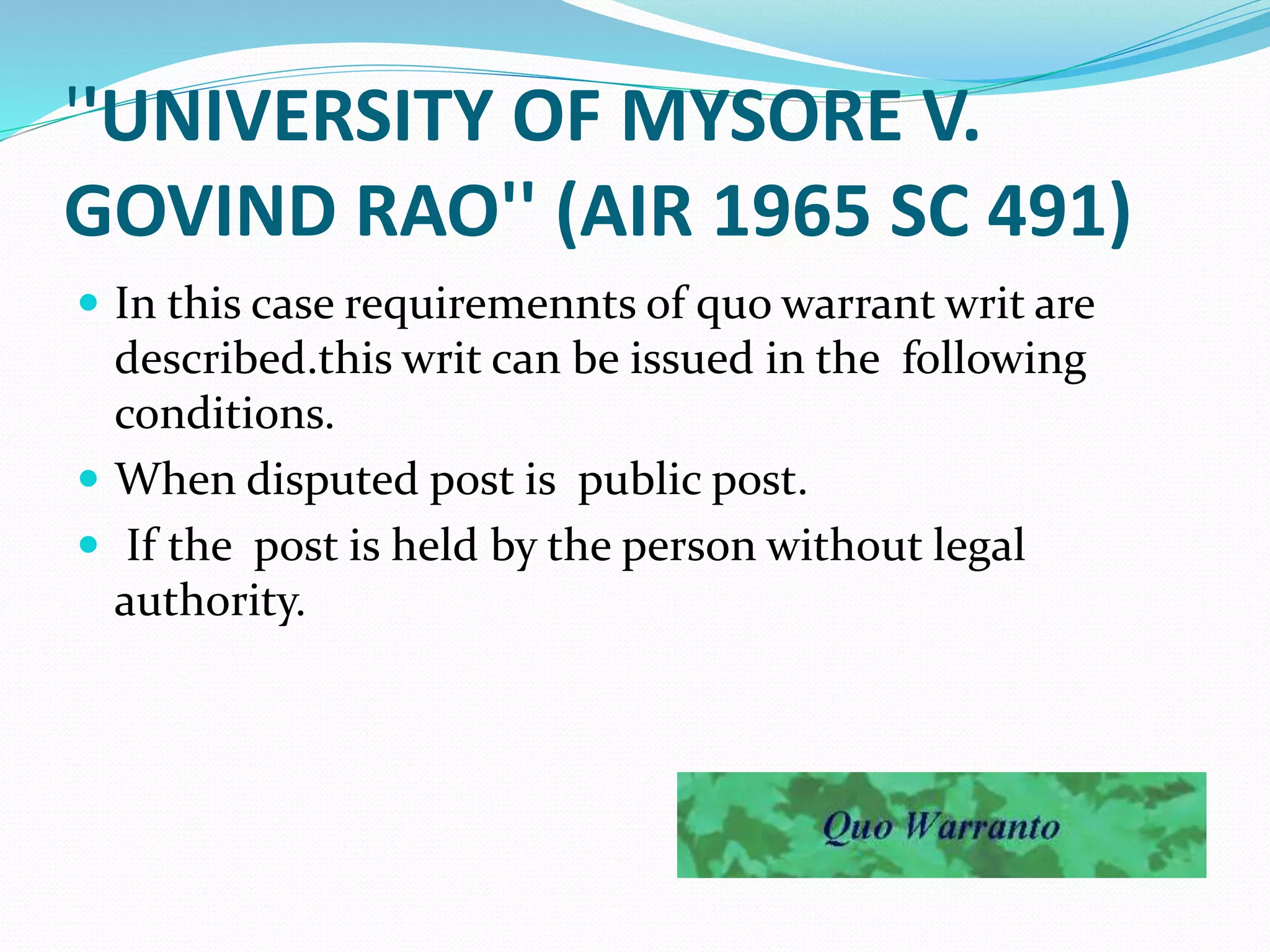
''UNIVERSITY OF MYSORE V.
GOVIND RAO'' (AIR 1965 SC 491)
 In this case requiremennts of quo warrant writ are
described.this writ can be issued in the following
conditions.
 When disputed post is public post.
 If the post is held by the person without legal
authority.
DIFFERENCE
BETWEEN PUBLIC
INTEREST LITIGATION
AND PRIVATE
INTEREST LITIGATION
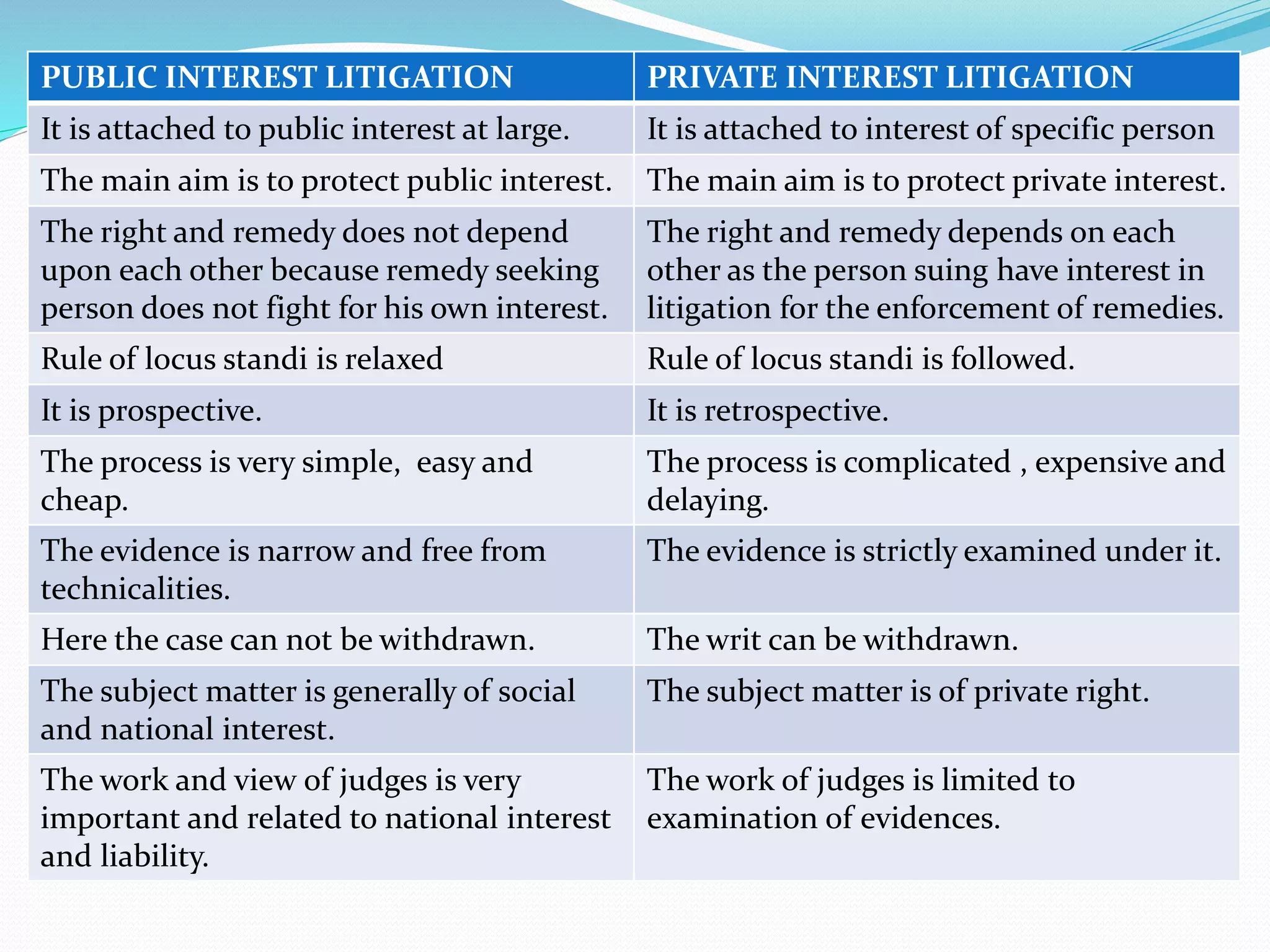
PUBLIC INTEREST LITIGATION PRIVATE INTEREST LITIGATION
It is attached to public interest at large. It is attached to interest of specific person
The main aim is to protect public interest. The main aim is to protect private interest.
The right and remedy does not depend
upon each other because remedy seeking
person does not fight for his own interest.
The right and remedy depends on each
other as the person suing have interest in
litigation for the enforcement of remedies.
Rule of locus standi is relaxed Rule of locus standi is followed.
It is prospective. It is retrospective.
The process is very simple, easy and
cheap.
The process is complicated , expensive and
delaying.
The evidence is narrow and free from
technicalities.
The evidence is strictly examined under it.
Here the case can not be withdrawn. The writ can be withdrawn.
The subject matter is generally of social
and national interest.
The subject matter is of private right.
The work and view of judges is very
important and related to national interest
and liability.
The work of judges is limited to
examination of evidences.
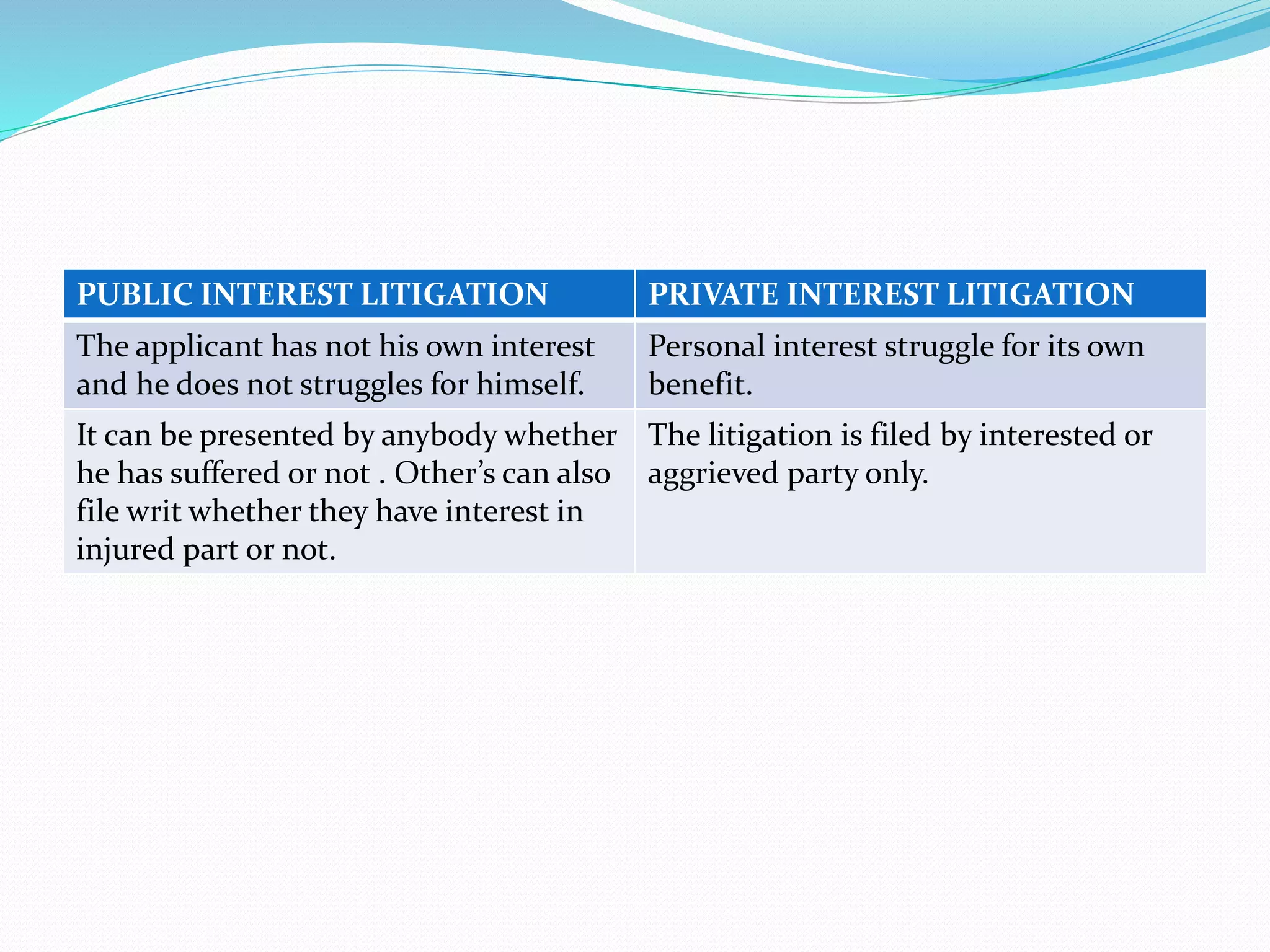
PUBLIC INTEREST LITIGATION PRIVATE INTEREST LITIGATION
The applicant has not his own interest
and he does not struggles for himself.
Personal interest struggle for its own
benefit.
It can be presented by anybody whether
he has suffered or not . Other’s can also
file writ whether they have interest in
injured part or not.
The litigation is filed by interested or
aggrieved party only.
Thank you

Types of writ and difference between public interest litigation and private inte(0)

  • 1.
  • 2.
    Writ  General Meaning- a formal order in Writing issued under seal, in the name of a sovereign, government, Court or other authority, commanding an officer or other person to whom it is issued, to do or refrain from doing some act specified therein.
  • 4.
    The supreme courtof India is alert guardian of fundamental rights of citizens.It is supreme custodian.Article 32 of constitution provides for writs for the enforcement of fundamental rights.Similar jurisdiction is available to high court under Article 226. Actually , the jurisdiction of high court to issue writ is more wide than that of supreme court . High court can issue writ for 'other purposes' alongwith fundamental rights , whereas supreme court can only issue writ for the enforcement of fundamental rights
  • 5.
    TYPES OF WRITS As per Article 32(2) and Article 226(1) of the constitution,the supreme court and high court can issue five types of writs-  1.Habeas corpus  2.Mandamus  3.Prohibition  4.Certiorari  5.Quo-Warrant
  • 7.
    Writ of Habeascorpus  Habeas Corpus means, “you may have the body."  A person, when arrested, can move the Court for the issue of Habeas Corpus. It is an order by a Court to the detaining authority to produce the arrested person before it so that it may examine whether the person has been detained lawfully or otherwise. If the Court is convinced that the person is illegally detained, it can issue orders for his release.
  • 8.
    Who can apply? General rule is that an application can be made by a person who is illegally detained. But in certain cases, an application of habeas corpus can be made by any person on behalf of the prisoner, i.e., a friend or a relation.
  • 9.
    “SUNIL BATRA V.DELHI ADMINISTRATION’’(AIR 1980 SC 1579)  The Supreme Court enlarged the scope of habeas corpus, making available the fundamental rights of the prisoners .
  • 10.
    “P.S SADASHIV SWAMIV.STATE OF TAMIL NADU”(AIR 1974 SC 2271) -  The Supreme Court gave the meaning of the writ Habeas Corpus in this case-  1.Court can ask the causes of detention of the detained person.  2.Can order to produce the detained person before the court.  3.If the detained person is illegally detained , the court will order that he be released.
  • 12.
    Writ of Mandamus Mandamus is a Latin word, which means "We Command".  Mandamus is an order from a superior court to a lower court or tribunal or public authority to perform an act, which falls within its duty.  Simply, it is a writ issued to a public official to do a thing which is a part of his official duty, but, which, he has failed to do, so far. This writ cannot be claimed as a matter of right. It is the discretionary power of a court to issue such writs.
  • 13.
    “MANI SHOBHREJ JAINV. STATE OF HARYANA” [(1977)1 SCC 486]-  Requirement of mandamus writ are described in this case.According to it,following condition for issue of mandamus are required to be fulfilled-  Existence of legal right,  Such legal right shall be enforceable by court,  The enforcement of such right imposes responsibility of performance of any duty over any person , public authority, corporation or government.  Such duty is of public nature.
  • 15.
    Writ of Prohibition Writ of prohibition means to forbid or to stop and it is popularly known as 'Stay Order'.  This writ is issued when a lower court or a body tries to transgress the limits or powers vested in it.  It is a writ issued by a superior court to lower court or a tribunal forbidding it to perform an act outside its jurisdiction. After the issue of this writ, proceedings in the lower court etc. come to a stop.
  • 16.
    “GOVIND MENON V.UNION OF INDIA"(AIR 1967 SC 1893)  It was held that prohibition writ may be issued under the followiing conditions-  Where there is excess of jurisdiction.  Where there is absence of jurisdiction.
  • 17.
    Writ of Certiorari Literally, Certiorari means to be certified.  The writ of certiorari is issued by the Supreme Court to some inferior court or tribunal to transfer the matter to it or to some other superior authority for proper consideration.
  • 18.
    “STATE OF UPV. MOHAMMED NOOR "(AIR 1958 SC 86)  Supreme court said that certiorarri is maiinly issued to reform the mistakes related to jurisdiction of subordinate courts or quasi-judicial bodies.In other woords,it can be said that the writ is isuued when the subordinate court or tribunal acys in absence of jurisdiction or beyond jurisdiction or fails to use its jurisdiction.
  • 19.
    “HARI VISHNU KAMATHV.AHMED ISHAQ”(AIR 1955 SC 233)  The writ is issued for correcting an error of law apparent on the face of records. It cannot be issued to correct an error of fact.
  • 21.
     The wordQuo-Warrant literally means “on what authority one is holding the public office"  It is a writ issued with a view to restraining a person from acting in a public office to which he is not entitled.
  • 22.
    ''UNIVERSITY OF MYSOREV. GOVIND RAO'' (AIR 1965 SC 491)  In this case requiremennts of quo warrant writ are described.this writ can be issued in the following conditions.  When disputed post is public post.  If the post is held by the person without legal authority.
  • 23.
  • 24.
    PUBLIC INTEREST LITIGATIONPRIVATE INTEREST LITIGATION It is attached to public interest at large. It is attached to interest of specific person The main aim is to protect public interest. The main aim is to protect private interest. The right and remedy does not depend upon each other because remedy seeking person does not fight for his own interest. The right and remedy depends on each other as the person suing have interest in litigation for the enforcement of remedies. Rule of locus standi is relaxed Rule of locus standi is followed. It is prospective. It is retrospective. The process is very simple, easy and cheap. The process is complicated , expensive and delaying. The evidence is narrow and free from technicalities. The evidence is strictly examined under it. Here the case can not be withdrawn. The writ can be withdrawn. The subject matter is generally of social and national interest. The subject matter is of private right. The work and view of judges is very important and related to national interest and liability. The work of judges is limited to examination of evidences.
  • 25.
    PUBLIC INTEREST LITIGATIONPRIVATE INTEREST LITIGATION The applicant has not his own interest and he does not struggles for himself. Personal interest struggle for its own benefit. It can be presented by anybody whether he has suffered or not . Other’s can also file writ whether they have interest in injured part or not. The litigation is filed by interested or aggrieved party only.
  • 26.