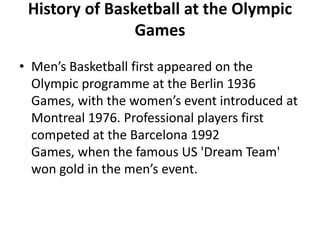
From humble beginnings in North America, Basketball
has grown into one of the most popular team sports in
    the world. It's a truly global game: the National
  Basketball Association (NBA) in the UK, the world's
  leading professional league, features players from
                more than 30 countries.
Number of competitions
• 144 men and 144 women
• Twelve teams compete in both the men’s and
  women’s competitions, with 12 athletes (five
  players and seven substitutes) on each team.
• Each country is limited to one men’s and one
  women’s team.
Field of play

• The basketball court is 28m long and 15m
  wide. The baskets at either end are 3.05m
  above the ground. The court is divided into
  two halves, with a free-throw line 5.8m inside
  either end, and the three-point line a 6.75m
  radius from each basket.
History of Basketball at the Olympic
                Games
• Men’s Basketball first appeared on the
  Olympic programme at the Berlin 1936
  Games, with the women’s event introduced at
  Montreal 1976. Professional players first
  competed at the Barcelona 1992
  Games, when the famous US 'Dream Team'
  won gold in the men’s event.
The basics

• In Basketball points are scored by shooting the ball into your
  opponents’ net (or basket). The ball is moved up the court either by
  dribbling (bouncing) or passing to another team member. A player
  may not take more than two steps with the ball without dribbling.
• Two points are awarded for a regular shot from open play, with one
  point for each successful free throw (following an opposition
  infringement) and three points for a shot from distance (beyond the
  three-point line).
• Once in possession of the ball, a team has only 24 seconds to make
  an attempt on goal or they lose possession.
• Games last for 40 minutes, split into four 10-minute quarters. The
  clock stops for every break in play and teams can call time-
  outs, which last one minute.
Competition format

• At London 2012, both the men’s and women’s Basketball
  competitions will begin with a preliminary stage. The 12
  teams will be divided into two groups of six and each team
  will play every other in their group. Teams receive two
  points for a win, and one for a loss (although they receive
  no points for losing by forfeiting the game.
• The best four teams from each group during the
  preliminaries will qualify for the knockout stage, with the
  winners of the semi-finals going head-to-head in the gold
  medal game.
• In the event of a tie at the end of any game, teams play
  extra periods of five minutes until the tie is broken.
Officials
• A referee oversees each game, assisted by two
  umpires. There are also table officials who are
  timers and scorers, and statisticians who
  record all the action. A game commissioner
  also sits with the table officials next to the
  court.
Keys to success

• Basketball is a fast and physically demanding
  game. Height is a distinct advantage, but
  players also need to have speed, strength and
  stamina. They need excellent ball skills and
  the ability to think on their feet and play
  tactically as a team.
Breaking the rules
• Referees will be looking out for rule infringements including
  violations and fouls. Violations are not committed against another
  player, but include offences such as taking more than two steps
  with the ball, having a hand underneath the ball (carrying) or
  bouncing the ball with both hands. Violations result in the ball
  being awarded to the opposition.
• Fouls are offences that are committed against an opposition player.
  These include more contact than is reasonable, blocking, pushing or
  striking another player. In the case of fouls the opposition team is
  awarded a throw-in close to where the infringement took place. If
  the player who was fouled was trying to shoot a basket at the
  time, then one or more free throws will be awarded, depending on
  where the foul took place.
Jargon buster
• Assist – a pass that leads directly to a basket scored by
  a teammate
• Downtown – the area outside the three-point line
• Dunk – a one- or two-handed slam directly into the net
• Lay-up – a one-handed shot from close range off the
  backboard
• Shot clock – a timer measuring the length of time since
  the last shot. If the ball doesn’t touch the rim or pass
  through the net within 24 seconds, possession passes
  to the opposition.

Jose luis

  • 1.
    From humble beginningsin North America, Basketball has grown into one of the most popular team sports in the world. It's a truly global game: the National Basketball Association (NBA) in the UK, the world's leading professional league, features players from more than 30 countries.
  • 2.
    Number of competitions •144 men and 144 women • Twelve teams compete in both the men’s and women’s competitions, with 12 athletes (five players and seven substitutes) on each team. • Each country is limited to one men’s and one women’s team.
  • 3.
    Field of play •The basketball court is 28m long and 15m wide. The baskets at either end are 3.05m above the ground. The court is divided into two halves, with a free-throw line 5.8m inside either end, and the three-point line a 6.75m radius from each basket.
  • 4.
    History of Basketballat the Olympic Games • Men’s Basketball first appeared on the Olympic programme at the Berlin 1936 Games, with the women’s event introduced at Montreal 1976. Professional players first competed at the Barcelona 1992 Games, when the famous US 'Dream Team' won gold in the men’s event.
  • 5.
    The basics • InBasketball points are scored by shooting the ball into your opponents’ net (or basket). The ball is moved up the court either by dribbling (bouncing) or passing to another team member. A player may not take more than two steps with the ball without dribbling. • Two points are awarded for a regular shot from open play, with one point for each successful free throw (following an opposition infringement) and three points for a shot from distance (beyond the three-point line). • Once in possession of the ball, a team has only 24 seconds to make an attempt on goal or they lose possession. • Games last for 40 minutes, split into four 10-minute quarters. The clock stops for every break in play and teams can call time- outs, which last one minute.
  • 6.
    Competition format • AtLondon 2012, both the men’s and women’s Basketball competitions will begin with a preliminary stage. The 12 teams will be divided into two groups of six and each team will play every other in their group. Teams receive two points for a win, and one for a loss (although they receive no points for losing by forfeiting the game. • The best four teams from each group during the preliminaries will qualify for the knockout stage, with the winners of the semi-finals going head-to-head in the gold medal game. • In the event of a tie at the end of any game, teams play extra periods of five minutes until the tie is broken.
  • 7.
    Officials • A refereeoversees each game, assisted by two umpires. There are also table officials who are timers and scorers, and statisticians who record all the action. A game commissioner also sits with the table officials next to the court.
  • 8.
    Keys to success •Basketball is a fast and physically demanding game. Height is a distinct advantage, but players also need to have speed, strength and stamina. They need excellent ball skills and the ability to think on their feet and play tactically as a team.
  • 9.
    Breaking the rules •Referees will be looking out for rule infringements including violations and fouls. Violations are not committed against another player, but include offences such as taking more than two steps with the ball, having a hand underneath the ball (carrying) or bouncing the ball with both hands. Violations result in the ball being awarded to the opposition. • Fouls are offences that are committed against an opposition player. These include more contact than is reasonable, blocking, pushing or striking another player. In the case of fouls the opposition team is awarded a throw-in close to where the infringement took place. If the player who was fouled was trying to shoot a basket at the time, then one or more free throws will be awarded, depending on where the foul took place.
  • 10.
    Jargon buster • Assist– a pass that leads directly to a basket scored by a teammate • Downtown – the area outside the three-point line • Dunk – a one- or two-handed slam directly into the net • Lay-up – a one-handed shot from close range off the backboard • Shot clock – a timer measuring the length of time since the last shot. If the ball doesn’t touch the rim or pass through the net within 24 seconds, possession passes to the opposition.