User’s Guide
for JOPES
1 May 1995
(Joint Operation Planning and Execution System)
To successfully fight and win
wars, war planning must be our
central focus. We will develop the
best possible plans using the collec-
tive wisdom available among all mili-
tary planning staffs.
As forces are downsized, we must ef-
ficiently plan to use the resources en-
trusted us by the American people.
While the new world security environ-
ment evolves, diverse threats to our
national interests frequently require
large and complex operations. The
larger and more complex the operation,
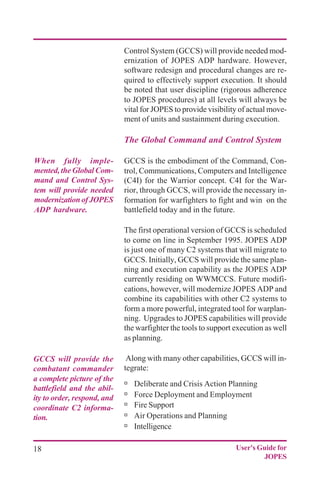
the more it critically depends on a com-
prehensive planning system to ensure any measure of success.
Future plans must incorporate, to the maximum extent possible, the warfighting employ-
ment principles outlined in joint doctrine; Joint Pubs 3-0 and 5-0 (Joint Operationsand
Planning for Joint Operations,respectively). In addition, future plans must be prudent
and relevant to current and projected threats. Plans must clearly explain how and why
forces are employed, in addition to what forces are to be deployed and when.
The products of our planning efforts must be able to stand up to the strongest scrutiny,
including the ultimate test--execution.
I strongly recommend reading this guide--it encapsulates fundamental JOPES planning
principles and procedures for both deliberate and crisis action planners.
JOHNM.SHALIKASHVILI
Chairman
of the Joint Chiefs of Staff
Table of Contents
EXECUTIVE SUMMARY ................................................. i
INTRODUCTION .............................................................1
JOPES PUBLICATIONS AND DOCUMENTS............5
THE JOPES PROCESS ...................................................6
Campaign Planning ........................................................................... 7
Deliberate Planning ........................................................................... 8
Crisis Action Planning ....................................................................... 9
Deliberate Plans .............................................................................. 10
JOPES ADP SUPPORT SYSTEM................................13
Time-Phased Force and Deployment Data ..................................... 14
The Global Command and Control System..................................... 18
CONCLUSION.................................................................20
GLOSSARY .................................................................GL-1
(INTENTIONALLY BLANK)
User's Guide for
JOPES
i
EXECUTIVE SUMMARY
Joint warfare is essential to our Nation's
capability to fight and win. Thenature
of modern warfare demands we plan
and fight as a team. For joint forces to
win in battle they must have a single,
unified planning and execution frame-
work capable of translating individual
Service terminology and operational
policies into a commonly understood
language and standard operating pro-
cedures.
The Joint Operation Planning and Ex-
ecution System (JOPES) combines in-
dividual Service terminology and op-
erating procedures into one standard
multifaceted system. It provides stan-
dardization to the joint planning system
used for the execution of complex
multi-Serviceexercises,campaignsand
operations. JOPES uses a set of com-
mand and control techniques and pro-
cesses, supported by a computerized
information system, to ensure the right
amount of timely support gets to the
warfighter to ensure a decisive victory.
This primer will explain what JOPES
is — and what it is not. It is written
for commanders and war planners,
new and novice users of JOPES, and
those who have only a peripheral rela-
tionship with the system. If understood
and used properly, JOPES becomes a
combat multiplier, increasing our effi-
ciency in joint planning and execution.
JOPES is the Chairman of the Joint
Chiefs of Staff’s (Chairman’s) joint
planning system. It covers the plan-
ning spectrum from the National Com-
mand Authorities (NCA) through the
Chairman, to the combatant com-
manders (the CINCs) and the joint
task force commanders. JOPES gov-
erns all aspects of conventional joint
militaryoperationsplanningandexecu-
tion. It is the tool used by all echelons
of planners and operators to speak a
commonly understood language.
JOPES furnishes joint commanders
and war planners atall levels standard-
ized policies, procedures, and formats
to produce and execute a variety of
required tasks to include:
ú planning—writingoperationplans
(OPLANs), operation plans in con-
cept format (CONPLANs), func-
tional plans, campaign plans, and
operation orders (OPORDs); and
ú execution and deployment
(time-phased force and deployment
data [TPFDD]) management —
defining requirements for, and gain-
ing visibility of, the movement of
forces into the combatant com-
manders' area of responsibility
(AOR).
User's Guide for
JOPES
ii
ú prioritize, replan, and track deploy-
ment status during execution, and
ú refine deployment requirements and
monitor the deployment.
JOPES deliberate and crisis action
planning is described in detail in JOPES
Volumes I and II, and in the Chairman
of the Joint Chiefs of Staff Manual
(CJCSM), TPFDD Development and
Deployment Execution.
JOPES is, in the truest sense of the
word, a System. It isnotmerely a com-
puter! It is not a series of computer
software programs! It isnotjust a stan-
dardized set of policies, procedures, and
formats for conducting planning and
execution! It is the sum of all these
parts! The goal of this primer is to pro-
vide the reader a fundamental under-
standing of this system and the inter-
action of its parts.
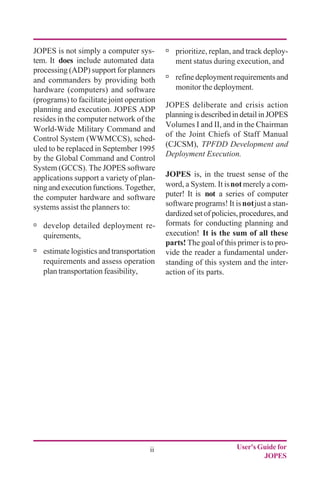
JOPES is not simply a computer sys-
tem. It does include automated data
processing (ADP) support for planners
and commanders by providing both
hardware (computers) and software
(programs) to facilitate joint operation
planning and execution. JOPES ADP
resides in the computer network of the
World-Wide Military Command and
Control System (WWMCCS), sched-
uled to be replaced in September 1995
by the Global Command and Control
System (GCCS). The JOPES software
applications support a variety of plan-
ningandexecutionfunctions.Together,
the computer hardware and software
systems assist the planners to:
ú develop detailed deployment re-
quirements,
ú estimate logistics and transportation
requirements and assess operation
plan transportation feasibility,
1
INTRODUCTION
JOPES is a combination of joint policies and proce-
dures (guidance), and automated data processing
(ADP) support used to plan and execute joint mili-
tary operations. Although JOPES (and its related
systems) has been used for over 20 years to sup-
port the development of operation plans and time-
phased force and deployment data (TPFDD), the
current automated system was given its first real
baptism of fire in Operation Desert Shield to assist
in managing a real world operational deployment.
Since then, JOPES ADP has been used in virtually
every deployment. Even though its performance is
far from ideal, it has become an integral part of our
ability to deploy forces.
This primer provides a general overview of JOPES.
Its purpose is to correct the common misconcep-
tion that JOPES is only an ADP system by explain-
ing in clear and succinct terms what JOPES truly
is. This document is intended to be used as a com-
panion piece to the User's Guide to Joint Opera-
tion Planning, dated 11 September 1994. That
document provides a more detailed overview of joint
planning principles.
JOPES is a combination
of joint policies and pro-
cedures, supported by
automated data process-
ing (ADP), designed to
provide joint command-
ers and planners with a
capability to plan and
conduct joint military
operations.
In war, nothing is achieved except by calculation. Everything
that is not soundly planned in its detail yields no result.
The Maxims of Napoleon
The Joint Operation
Planning and Execution
System (JOPES) is the
integrated system used
to plan and execute joint
military operations.
2 User's Guide for
JOPES
Joint
Warfighting
Operations
Joint Operation Planning
O PO RD or
Campaign Plan
campaign planning
The Joint Operation Planning and Execution System
JOPES
ADP
Support
JOPES
Publications
& Documents
NCA
Policy
Decisions
Deliberate
Planning
OPLANOPLANOPLANOPLANOPLANOPLANOPLAN
Crisis
Action
Planning
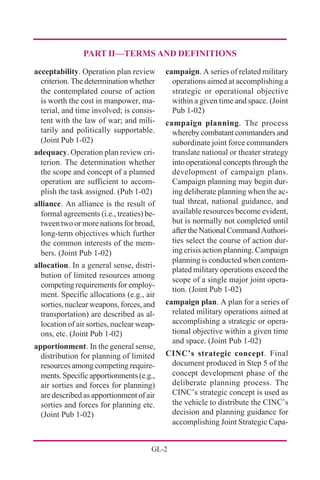
figure 1
JOPES provides a stan-
dardized framework for
joint military planning
and execution. The
scope of JOPES is far
broader than is gener-
ally understood.
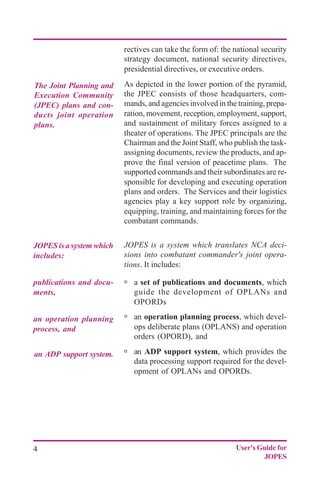
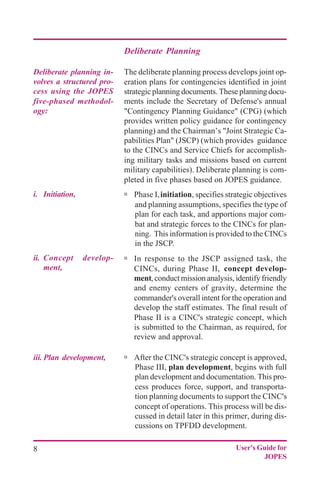
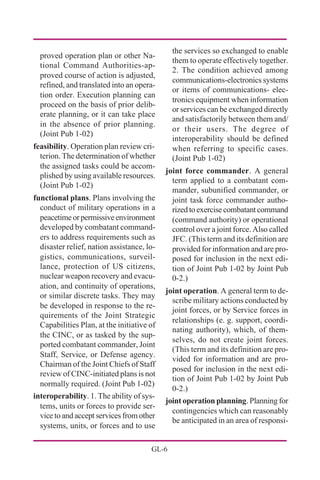
Figure 1 depicts the various parts of JOPES. JOPES
is the principal system within the Department of
Defense (DOD) to translate NCA policy decisions
into the joint combatant commander’s air, land and
sea operations. It does this by precisely defining
DOD war planning and execution policies, desig-
nating specific procedures and formats, and pro-
viding ADP support to convert NCA decisions into
joint operation plans. Joint operation plans are the
blueprints for joint operations.
3
NCA
NSC CIA
STATE DEPT DOD
COMBAT SUPPORT AGENCIES
CJCS
SUPPORTED
COMMAND
SERVICES
SUBORDINATE COMMANDS
COMPONENT COMMANDS
SUBORDINATE
UNIFIED
COMMANDS
USTRANSCOM
SUPPORTING
COMMANDS
JOPES
U
S
A
U
S
A
F
U
S
N
U
S
M
C
M
T
M
C
A
M
C
M
S
C
LOGISTICS AGENCIES
F
U
N
C
T
I
O
N
A
L
J
T
F
S
O
F
N
A
V
F
O
R
A
F
F
O
R
A
R
F
O
R
M
A
R
F
O
R
U
S
C
G
THE JOINT PLANNING AND
EXECUTION COMMUNITY (JPEC)
The Joint Planning and Execution Community (JPEC)
THE NATIONAL
SECURITY COUNCIL (NSC)
THE PRESIDENT AND SECDEF (NCA)
figure 2
The National Command
Authorities (NCA) set
national policy and stra-
tegic direction.
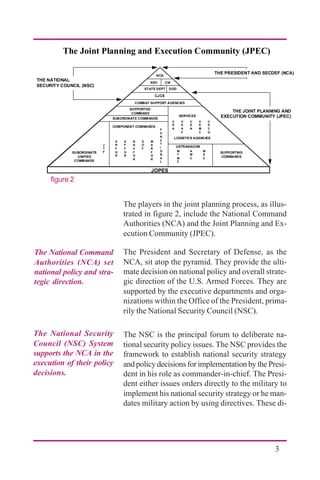
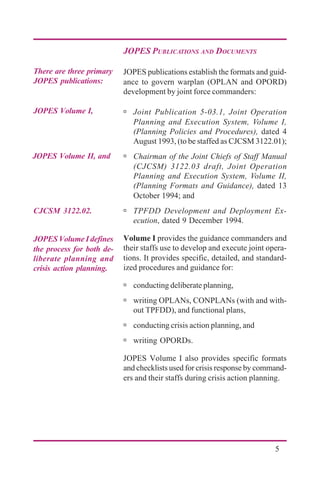
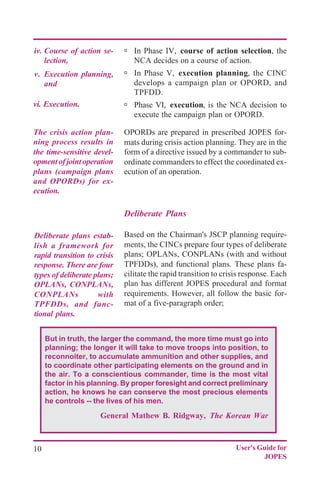
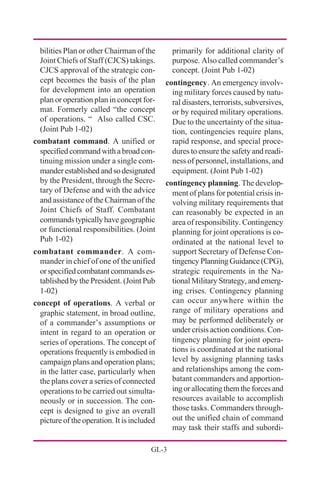
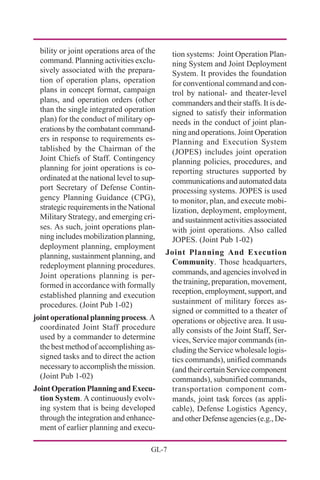
The players in the joint planning process, as illus-
trated in figure 2, include the National Command
Authorities (NCA) and the Joint Planning and Ex-
ecution Community (JPEC).
The President and Secretary of Defense, as the
NCA, sit atop the pyramid. They provide the ulti-
mate decision on national policy and overall strate-
gic direction of the U.S. Armed Forces. They are
supported by the executive departments and orga-
nizations within the Office of the President, prima-
rily the National Security Council (NSC).
The NSC is the principal forum to deliberate na-
tional security policy issues. The NSC provides the
framework to establish national security strategy
and policy decisions for implementation by the Presi-
dent in his role as commander-in-chief. The Presi-
dent either issues orders directly to the military to
implement his national security strategy or he man-
dates military action by using directives. These di-
The National Security
Council (NSC) System
supports the NCA in the
execution of their policy
decisions.
4 User's Guide for
JOPES
The Joint Planning and
Execution Community
(JPEC) plans and con-
ducts joint operation
plans.
publications and docu-
ments,
JOPES is a system which
includes:
an operation planning
process, and
an ADP support system.
rectives can take the form of: the national security
strategy document, national security directives,
presidential directives, or executive orders.
As depicted in the lower portion of the pyramid,
the JPEC consists of those headquarters, com-
mands, and agencies involved in the training, prepa-
ration, movement, reception, employment, support,
and sustainment of military forces assigned to a
theater of operations. The JPEC principals are the
Chairman and the Joint Staff, who publish the task-
assigning documents, review the products, and ap-
prove the final version of peacetime plans. The
supported commands and their subordinates are re-
sponsible for developing and executing operation
plans and orders. The Services and their logistics
agencies play a key support role by organizing,
equipping, training, and maintaining forces for the
combatant commands.
JOPES is a system which translates NCA deci-
sions into combatant commander's joint opera-
tions. It includes:
ú a set of publications and documents, which
guide the development of OPLANs and
OPORDs
ú an operation planning process, which devel-
ops deliberate plans (OPLANS) and operation
orders (OPORD), and
ú an ADP support system, which provides the
data processing support required for the devel-
opment of OPLANs and OPORDs.
5
JOPES PUBLICATIONS AND DOCUMENTS
JOPES publications establish the formats and guid-
ance to govern warplan (OPLAN and OPORD)
development by joint force commanders:
ú Joint Publication 5-03.1, Joint Operation
Planning and Execution System, Volume I,
(Planning Policies and Procedures), dated 4
August 1993, (to be staffed as CJCSM 3122.01);
ú Chairman of the Joint Chiefs of Staff Manual
(CJCSM) 3122.03 draft, Joint Operation
Planning and Execution System, Volume II,
(Planning Formats and Guidance), dated 13
October 1994; and
ú TPFDD Development and Deployment Ex-
ecution, dated 9 December 1994.
Volume I provides the guidance commanders and
their staffs use to develop and execute joint opera-
tions. It provides specific, detailed, and standard-
ized procedures and guidance for:
ú conducting deliberate planning,
ú writing OPLANs, CONPLANs (with and with-
out TPFDD), and functional plans,
ú conducting crisis action planning, and
ú writing OPORDs.
JOPES Volume I also provides specific formats
and checklists used for crisis response by command-
ers and their staffs during crisis action planning.
There are three primary
JOPES publications:
JOPES Volume I,
JOPES Volume II, and
CJCSM 3122.02.
JOPES Volume I defines
the process for both de-
liberate planning and
crisis action planning.
6 User's Guide for
JOPES
JOPES Volume II pro-
vides the administrative
instructions and formats
for developing joint op-
eration plans.
Volume II is a set of instructions (standardized
procedures) used by commanders and their staffs
to write OPLANs, CONPLANs, and functional
plans.
CJCSM 3122.02 provides guidance for the ex-
ecution and management of real world deploy-
ments.
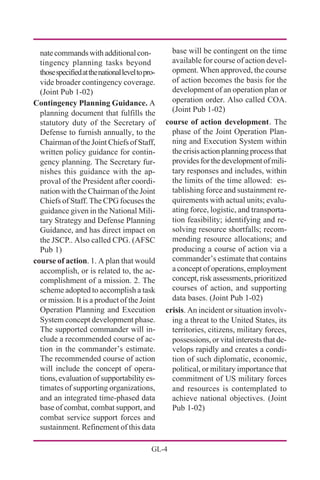
figure 3
CONPLAN
w/o TPFDD
Joint Operation Planning
Deliberate
Planning
Crisis Action
Planning
campaign planning
Functional
Plan
OPORDOPLAN Campaign
Plan
CONPLAN
w/TPFDD
Three planning catego-
ries fall within the scope
of joint operation plan-
ning:
• campaign planning,
• deliberate planning,
and
• crisis action plan-
ning.
THE JOPES PROCESS
CJCSM 3122.02 pro-
vides policies and proce-
dures for deployment ex-
ecution.
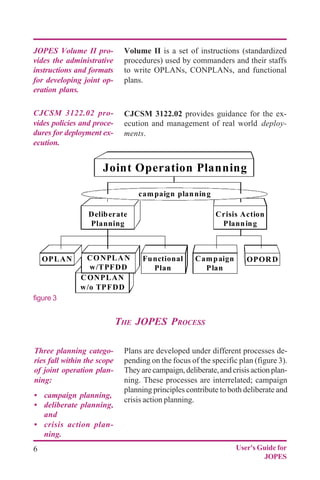
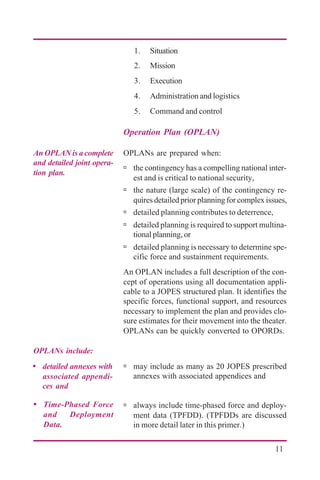
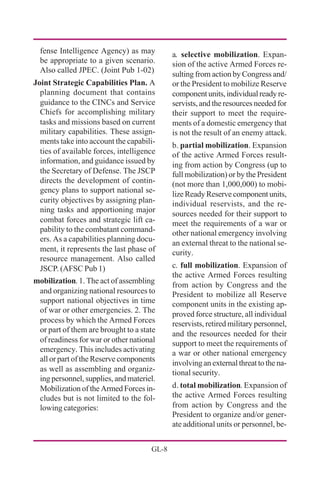
Plans are developed under different processes de-
pending on the focus of the specific plan (figure 3).
They are campaign, deliberate, and crisis action plan-
ning. These processes are interrelated; campaign
planning principles contribute to both deliberate and
crisis action planning.
7
Campaign Planning
Campaign planning allows CINCs to translate na-
tional strategy and objectives into unified plans for
military action by specifying how operations and
logistics will be used to achieve success within a
given space and time. It embodies the combatant
commander’s strategic vision of the related opera-
tions necessary to attain theater strategic objec-
tives.
If the scope of contemplated operations requires it,
campaign planning begins with deliberate planning.
It continues through crisis action planning, thus uni-
fying both planning processes. The degree to which
the deliberate plan may serve as the core for a cam-
paign plan is dependent on the plan assumptions,
commander's intent, and available resources. Cam-
paignplanninganditsrelationtojointoperationplan-
ning is discussed in detail in Joint Pub 5-0 Doctrine
for Planning Joint Operations, dated 15 August
1994.
Campaign planning is
the responsibility of the
combatant commander.
Though it is not a struc-
tured formal process
like deliberate and cri-
sisactionplanning,cam-
paign planning prin-
ciples apply to both.
Campaign planning
helps facilitate a transi-
tion from deliberate to
crisis action planning.
War plans cover every aspect of a war, and weave them all into a
single operation that must have a single, ultimate objective in which
all particular aims are reconciled.
Clausewitz, On War
8 User's Guide for
JOPES
Deliberate Planning
The deliberate planning process develops joint op-
eration plans for contingencies identified in joint
strategic planning documents. These planning docu-
ments include the Secretary of Defense's annual
"Contingency Planning Guidance" (CPG) (which
provides written policy guidance for contingency
planning) and the Chairman’s "Joint Strategic Ca-
pabilities Plan" (JSCP) (which provides guidance
to the CINCs and Service Chiefs for accomplish-
ing military tasks and missions based on current
military capabilities). Deliberate planning is com-
pleted in five phases based on JOPES guidance.
ú Phase I,initiation, specifies strategic objectives
and planning assumptions, specifies the type of
plan for each task, and apportions major com-
bat and strategic forces to the CINCs for plan-
ning. This information is provided to the CINCs
in the JSCP.
ú In response to the JSCP assigned task, the
CINCs, during Phase II, concept develop-
ment, conduct mission analysis, identify friendly
and enemy centers of gravity, determine the
commander's overall intent for the operation and
develop the staff estimates. The final result of
Phase II is a CINC's strategic concept, which
is submitted to the Chairman, as required, for
review and approval.
ú After the CINC's strategic concept is approved,
Phase III, plan development, begins with full
plan development and documentation. This pro-
cess produces force, support, and transporta-
tion planning documents to support the CINC's
concept of operations. This process will be dis-
cussed in detail later in this primer, during dis-
cussions on TPFDD development.
Deliberate planning in-
volves a structured pro-
cess using the JOPES
five-phased methodol-
ogy:
i. Initiation,
iii. Plan development,
ii. Concept develop-
ment,
9
iv. Plan review, and
v. Supporting plans de-
velopment.
Crisis Action Planning
(CAP) is conducted for
the actual commitment
of allocated forces,
basedonanexistingsitu-
ation.
CAP follows a JOPES
prescribed six-phased
development process:
i. Situation develop-
ment,
ii. Crisis assessment,
ú In Phase IV, plan review, the plan is reviewed
for adequacy, feasibility, acceptability, and com-
pliance with joint doctrine. Those plans requir-
ing approval by the Chairman will be reviewed
by the Joint Staff, Services, and combat support
agencies (CIO, DIA, DISA, DLA, DMA, and
NSA).
ú During Phase V, supporting plans develop-
ment, emphasis shifts to subordinate and sup-
porting commanders as they complete their plans
to augment the CINC's plan.
Crisis Action Planning (CAP)
Crisis action planning, like deliberate planning, in-
volves a structured process following the guidance
established in JOPES publications. This planning
process results in the time-sensitive development
of campaign plans and operation orders (OPORDs)
for execution.
ú Phase I,situation development, is initiated with
the perception or recognition of a crisis and re-
sults in the development of the CINC's assess-
ment.
ú Phase II, crisis assessment, is the NCA and
Chairman's evaluation of the CINC's assessment
and determination whether a crisis is imminent.
ú During Phase III, course of action develop-
ment, the NCA or the CINC develops one or
more courses of action. The CINC submits the
commander's estimate and recommendation to
the Chairman.
iii. Course of action de-
velopment,
10 User's Guide for
JOPES
ú In Phase IV, course of action selection, the
NCA decides on a course of action.
ú In Phase V, execution planning, the CINC
develops a campaign plan or OPORD, and
TPFDD.
ú Phase VI, execution, is the NCA decision to
execute the campaign plan or OPORD.
OPORDs are prepared in prescribed JOPES for-
mats during crisis action planning. They are in the
form of a directive issued by a commander to sub-
ordinate commanders to effect the coordinated ex-
ecution of an operation.
Deliberate Plans
Based on the Chairman's JSCP planning require-
ments, the CINCs prepare four types of deliberate
plans; OPLANs, CONPLANs (with and without
TPFDDs), and functional plans. These plans fa-
cilitate the rapid transition to crisis response. Each
plan has different JOPES procedural and format
requirements. However, all follow the basic for-
mat of a five-paragraph order;
The crisis action plan-
ning process results in
the time-sensitive devel-
opmentofjointoperation
plans (campaign plans
and OPORDs) for ex-
ecution.
iv. Course of action se-
lection,
v. Execution planning,
and
vi. Execution.
But in truth, the larger the command, the more time must go into
planning; the longer it will take to move troops into position, to
reconnoiter, to accumulate ammunition and other supplies, and
to coordinate other participating elements on the ground and in
the air. To a conscientious commander, time is the most vital
factor in his planning. By proper foresight and correct preliminary
action, he knows he can conserve the most precious elements
he controls -- the lives of his men.
General Mathew B. Ridgway, The Korean War
Deliberate plans estab-
lish a framework for
rapid transition to crisis
response. There are four
types of deliberate plans;
OPLANs, CONPLANs,
CONPLANs with
TPFDDs, and func-
tional plans.
11
1. Situation
2. Mission
3. Execution
4. Administration and logistics
5. Command and control
Operation Plan (OPLAN)
OPLANs are prepared when:
ú the contingency has a compelling national inter-
est and is critical to national security,
ú the nature (large scale) of the contingency re-
quires detailed prior planning for complex issues,
ú detailed planning contributes to deterrence,
ú detailed planning is required to support multina-
tional planning, or
ú detailed planning is necessary to determine spe-
cific force and sustainment requirements.
An OPLAN includes a full description of the con-
cept of operations using all documentation appli-
cable to a JOPES structured plan. It identifies the
specific forces, functional support, and resources
necessary to implement the plan and provides clo-
sure estimates for their movement into the theater.
OPLANs can be quickly converted to OPORDs.
ú may include as many as 20 JOPES prescribed
annexes with associated appendices and
ú always include time-phased force and deploy-
ment data (TPFDD). (TPFDDs are discussed
in more detail later in this primer.)
An OPLAN is a complete
and detailed joint opera-
tion plan.
OPLANs include:
• detailed annexes with
associated appendi-
ces and
• Time-Phased Force
and Deployment
Data.
12 User's Guide for
JOPES
Because of the detailed nature of an OPLAN,
JOPES guidance requires a thorough presenta-
tion of the commander’s operational concept.
JOPES requires all annexes and appendices to con-
tain detailed information on the CINC’s concept
of operations, combat support, and combat ser-
vice support activities.
Operation Plan in Concept Format
(CONPLAN)
A CONPLAN requires considerable expansion
or alteration to convert into an OPLAN, campaign
plan, or OPORD. In a CONPLAN, all the ele-
ments of the basic OPLAN are included in sum-
mary form except mission, situation, assumptions,
and concept of operations. These elements are
fully developed. The full complement of annexes
and appendices are not required in a CONPLAN.
CONPLANs contain a summary of logistics re-
quirements and major constraints regarding forces,
movement, or logistic support that significantly
affect implementation of the plan.
A CONPLAN (without a TPFDD) is normally
required when:
ú the contingency has a less compelling interest
but is important to national security;
ú binational alliance or treaty arrangement re-
quires contingency planning by the signatory
countries;
ú the contingency is smaller in scale, requires less
detailed planning, and can be handled in the
near term with more general capabilities-based
concepts; or
ú no specific threat has been identified.
A CONPLAN is a joint
operation plan in an ab-
breviated,"concept"for-
mat. There are two
types of CONPLANs:
A CONPLAN without a
TPFDD and
13
A CONPLAN with TPFDD is a CONPLAN that
requires more detailed planning for the phased
deployment of forces. Like an OPLAN, it is pre-
pared when the contingency has a compelling na-
tional interest and is critical to national security—
however, it isnot as likely to occur in the near term.
The larger scale of the possible contingency re-
quires more detailed planning than would normally
be conducted for a CONPLAN. Preparing a
CONPLAN with TPFDD follows the same JOPES
procedures as developing an OPLAN.
Functional Plans
Functional plans may also be developed by com-
batant commanders to address “functional peace-
time operations” such as disaster relief, humanitar-
ian assistance, or peace operations. They may be
developed in response to JSCP tasks, as a CINC
initiative, or as tasked by a Service or defense
agency acting as an executive agent for the Secre-
tary of Defense (for example, military support to
civil authorities).
Functional plans are structured as CONPLANs
(without a TPFDD), following published JOPES for-
mats. Annexes and appendices are developed as
required.
A CONPLAN with a
TPFDD.
Functional plans are de-
veloped for specific mili-
tary operations in a per-
missive or non-hostile
environment (for ex-
ample, intratheater lo-
gistics, communications,
and continuity of opera-
tions).
In crisis action planning, JOPES ADP support is
used to refine existing TPFDDs or develop new
ones. At execution, JOPES ADP manages the de-
ployment of forces and their equipment into the Area
of Operations.
Except for TPFDD de-
velopment, JOPES de-
liberate and crisis action
planning is essentially a
manual process.
JOPES ADP SUPPORT SYSTEM
14 User's Guide for
JOPES
The World-Wide Military Command and Control
System (WWMCCS) family of computers provides
the hardware supporting JOPES. It is an aging sys-
tem, currently scheduled to be replaced by the Glo-
bal Command and Control System (GCCS) in Sep-
tember 1995.
The JOPES ADP software is made up of hundreds
of individual computer programs. The current soft-
ware is designed to support deployment planning.
While this is crucial to deliberate planning, it can
not adequately support deployment/redeployment
during mobilization, employment, and sustainment.
Time-Phased Force and Deployment Data
(TPFDD)
A TPFDD is a computer database used to identify
types of forces and actual units required to support
an OPLAN or OPORD. In addition, TPFDDs con-
tain estimates of logistics support and designate
ports for loading (embarkation) and unloading (de-
barkation). Finally, the TPFDD, based on planner
input, establishes the sequence for moving the
forces and their support (time phasing) into the Area
of Operations. The time-phased forces, and their
associated cargo and passenger movement require-
ments, are used as the basis for actual transporta-
tion scheduling. JOPES ADP depends on Service
planning systems for these force and support re-
quirements. The JOPES data base is distributed
worldwide and provides a single information source
for movement status.
JOPES ADP is the larg-
est of several software
programs operating on
the WWMCCS inter-
computer network
(WIN), a secure, world-
wide system of comput-
ers.
JOPES ADP helps plan-
ners build and maintain
TPFDDs.
15
JOPES [ADP] was the single tool which enabled this command
to oversee and coordinate the movement in record time of
over 400,000 personnel and six million tons of cargo.
General H. Norman Schwarzkopf, CINCCENT
We could not have conducted this enormous deployment
without JOPES [ADP].
General H.T. Johnson, CINCTRANS
JOPES ADP helpsplannersbuildtheforcelistduring
force planning. Force planning begins when the
combatant commander identifies the major appor-
tioned forces needed to support his concept of op-
erations, and continues with the identification of
combat support and combat service support force
requirements. Initially, for gross planning estimates,
notional (generic) units may be designated. As the
process continues, however, actual units must be
identified.
TPFDD development then shifts to support plan-
ning. Various software programs use the force list
to estimate time-phased lift requirements for sup-
plies, equipment, and replacement personnel needed
to sustain the forces specified during force plan-
ning. The quantities are determined using planning
models to derive gross quantities (weight and vol-
ume). Unique computer programs provide support
for specialized planning models such as civil engi-
neering and medical support.
Developing a TPFDD
involves four main pro-
cesses:
Force planning,
Support planning,
16 User's Guide for
JOPES
Transport
Planning
Force
Planning
Support
Planning
JOPES ADP
fail
fail
pass
pass
feasibility
test ?
feasibility
test ?
feasibility
test ?
pass
fail
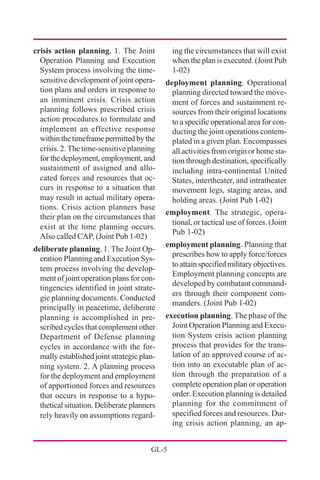
The Current TPFDD Development Process
figure 4
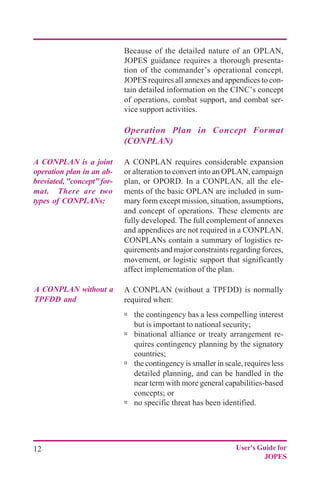
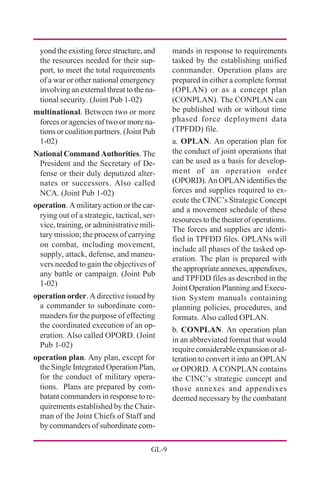
During transportation planning, all of the forces
are time-phased into the Area of Operations.
JOPES software compares apportioned transpor-
tation assets to the forces to be moved, factors in
their sustainment requirements and time-phasing,
and determines if the planned forces can be moved
to the Area of Operations to meet the CINC's
needs. The product of this process is a capabili-
ties- based, transportation-feasible database con-
taining all the forces, materiel, and personnel needed
to execute the CINC’s concept of operations. This
transportation-feasible database is the TPFDD.
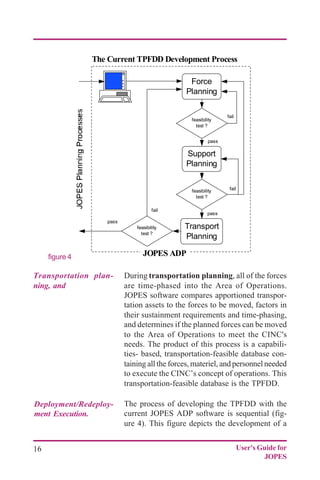
The process of developing the TPFDD with the
current JOPES ADP software is sequential (fig-
ure 4). This figure depicts the development of a
Transportation plan-
ning, and
Deployment/Redeploy-
ment Execution.
17
TPFDD based on three of the main processes; force
planning, support planning, and transportation plan-
ning. Each process must be completed before pro-
ceeding to the next one. For example, force plan-
ning must be completed before support planning
begins, and support planning must be finished be-
fore starting transportation planning. Also, it may
be necessary to drop back to revisit previous steps,
or in the worst case start over. Each step is the
responsibility of one or more separate agencies or
commands located around the world. This complex
operation was acceptable for a multi-year deploy-
ment-based deliberate planning cycle. Today, how-
ever, emphasis has shifted to an execution-based
crisis action planning procedure. A crisis action plan-
ning cycle anddeployment/redeployment execu-
tion require immediate data access, and a response
time measured in hours, not days.
At execution, the TPFDD developed during delib-
erate planning (or a new one developed during cri-
sis action planning) is refined and movement re-
quirements are validated. This validated TPFDD
becomes the basis for actual transportation sched-
uling for force deployment, and subsequent rede-
ployment. Supply and replacement personnel esti-
mates developed during planning are used as a
source for establishing transportation channels for
sustainment movement. In short, the JOPES data
base is a single source for force deployment move-
ment requirements and status.
JOPES ADP support for execution evolved from a
deliberate planning tool not originally designed to
support movement. However, without JOPES ADP
support, as limited as it is, execution of any sizable
deployment would be virtually unmanageable. New
tools are being developed to correct deficiencies.
When fully implemented, the Global Command and
The TPFDD becomes
thebasisforactualtrans-
portation scheduling for
force deployment and re-
deployment.
JOPES ADP support at
execution is currently
only marginally effec-
tive.
18 User's Guide for
JOPES
Control System (GCCS) will provide needed mod-
ernization of JOPES ADP hardware. However,
software redesign and procedural changes are re-
quired to effectively support execution. It should
be noted that user discipline (rigorous adherence
to JOPES procedures) at all levels will always be
vital for JOPES to provide visibility of actual move-
ment of units and sustainment during execution.
The Global Command and Control System
GCCS is the embodiment of the Command, Con-
trol, Communications, Computers and Intelligence
(C4I) for the Warrior concept. C4I for the War-
rior, through GCCS, will provide the necessary in-
formation for warfighters to fight and win on the
battlefield today and in the future.
The first operational version of GCCS is scheduled
to come on line in September 1995. JOPES ADP
is just one of many C2 systems that will migrate to
GCCS. Initially, GCCS will provide the same plan-
ning and execution capability as the JOPES ADP
currently residing on WWMCCS. Future modifi-
cations, however, will modernize JOPES ADP and
combine its capabilities with other C2 systems to
form a more powerful, integrated tool for warplan-
ning. Upgrades to JOPES capabilities will provide
the warfighter the tools to support execution as well
as planning.
Along with many other capabilities, GCCS will in-
tegrate:
ú Deliberate and Crisis Action Planning
ú Force Deployment and Employment
ú Fire Support
ú Air Operations and Planning
ú Intelligence
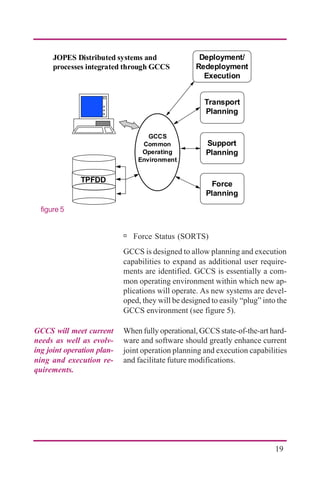
When fully imple-
mented,theGlobalCom-
mand and Control Sys-
tem will provide needed
modernizationofJOPES
ADP hardware.
GCCS will provide the
combatant commander
a complete picture of the
battlefield and the abil-
ity to order, respond, and
coordinate C2 informa-
tion.
19
JOPES Distributed systems and
processes integrated through GCCS
GCCS
Common
Operating
Environment
Transport
Planning
Support
Planning
Force
Planning
TPFDD
Deployment/
Redeployment
Execution
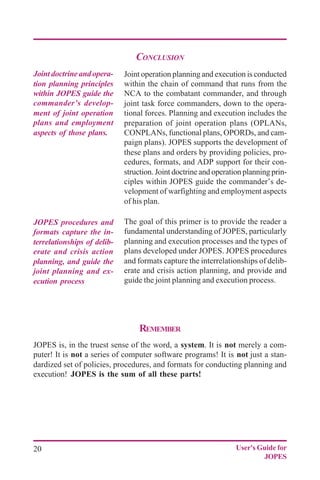
figure 5
ú Force Status (SORTS)
GCCS is designed to allow planning and execution
capabilities to expand as additional user require-
ments are identified. GCCS is essentially a com-
mon operating environment within which new ap-
plications will operate. As new systems are devel-
oped, they will be designed to easily “plug” into the
GCCS environment (see figure 5).
When fully operational, GCCS state-of-the-art hard-
ware and software should greatly enhance current
joint operation planning and execution capabilities
and facilitate future modifications.
GCCS will meet current
needs as well as evolv-
ing joint operation plan-
ning and execution re-
quirements.
20 User's Guide for
JOPES
CONCLUSION
Joint operation planning and execution is conducted
within the chain of command that runs from the
NCA to the combatant commander, and through
joint task force commanders, down to the opera-
tional forces. Planning and execution includes the
preparation of joint operation plans (OPLANs,
CONPLANs, functional plans, OPORDs, and cam-
paign plans). JOPES supports the development of
these plans and orders by providing policies, pro-
cedures, formats, and ADP support for their con-
struction. Joint doctrine and operation planning prin-
ciples within JOPES guide the commander’s de-
velopment of warfighting and employment aspects
of his plan.
The goal of this primer is to provide the reader a
fundamental understanding of JOPES, particularly
planning and execution processes and the types of
plans developed under JOPES. JOPES procedures
and formats capture the interrelationships of delib-
erate and crisis action planning, and provide and
guide the joint planning and execution process.
Jointdoctrineandopera-
tion planning principles
within JOPES guide the
commander’s develop-
ment of joint operation
plans and employment
aspects of those plans.
JOPES procedures and
formats capture the in-
terrelationships of delib-
erate and crisis action
planning, and guide the
joint planning and ex-
ecution process
REMEMBER
JOPES is, in the truest sense of the word, a system. It is not merely a com-
puter! It is not a series of computer software programs! It is not just a stan-
dardized set of policies, procedures, and formats for conducting planning and
execution! JOPES is the sum of all these parts!
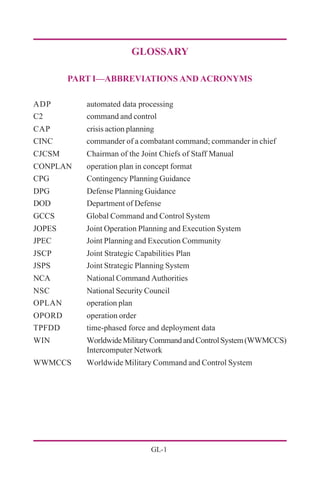
GL-1
GLOSSARY
PART I—ABBREVIATIONS AND ACRONYMS
ADP automated data processing
C2 command and control
CAP crisis action planning
CINC commander of a combatant command; commander in chief
CJCSM Chairman of the Joint Chiefs of Staff Manual
CONPLAN operation plan in concept format
CPG Contingency Planning Guidance
DPG Defense Planning Guidance
DOD Department of Defense
GCCS Global Command and Control System
JOPES Joint Operation Planning and Execution System
JPEC Joint Planning and Execution Community
JSCP Joint Strategic Capabilities Plan
JSPS Joint Strategic Planning System
NCA National Command Authorities
NSC National Security Council
OPLAN operation plan
OPORD operation order
TPFDD time-phased force and deployment data
WIN WorldwideMilitaryCommandandControlSystem(WWMCCS)
Intercomputer Network
WWMCCS Worldwide Military Command and Control System
GL-2
campaign. A series of related military
operations aimed at accomplishing a
strategic or operational objective
within a given time and space. (Joint
Pub 1-02)
campaign planning. The process
whereby combatant commanders and
subordinate joint force commanders
translate national or theater strategy
into operational concepts through the
development of campaign plans.
Campaign planning may begin dur-
ing deliberate planning when the ac-
tual threat, national guidance, and
available resources become evident,
but is normally not completed until
aftertheNationalCommandAuthori-
ties select the course of action dur-
ing crisis action planning. Campaign
planning is conducted when contem-
plated military operations exceed the
scope of a single major joint opera-
tion. (Joint Pub 1-02)
campaign plan. A plan for a series of
related military operations aimed at
accomplishing a strategic or opera-
tional objective within a given time
and space. (Joint Pub 1-02)
CINC’s strategic concept. Final
document produced in Step 5 of the
concept development phase of the
deliberate planning process. The
CINC’s strategic concept is used as
the vehicle to distribute the CINC’s
decision and planning guidance for
accomplishing Joint Strategic Capa-
PART II—TERMS AND DEFINITIONS
acceptability. Operation plan review
criterion. The determination whether
the contemplated course of action
is worth the cost in manpower, ma-
terial, and time involved; is consis-
tent with the law of war; and mili-
tarily and politically supportable.
(Joint Pub 1-02)
adequacy. Operation plan review cri-
terion. The determination whether
the scope and concept of a planned
operation are sufficient to accom-
plish the task assigned. (Pub 1-02)
alliance. An alliance is the result of
formal agreements (i.e., treaties) be-
tween two or more nations for broad,
long-term objectives which further
the common interests of the mem-
bers. (Joint Pub 1-02)
allocation. In a general sense, distri-
bution of limited resources among
competing requirements for employ-
ment. Specific allocations (e.g., air
sorties, nuclear weapons, forces, and
transportation) are described as al-
location of air sorties, nuclear weap-
ons, etc. (Joint Pub 1-02)
apportionment. In the general sense,
distribution for planning of limited
resources among competing require-
ments.Specificapportionments(e.g.,
air sorties and forces for planning)
are described as apportionment of air
sorties and forces for planning etc.
(Joint Pub 1-02)
GL-3
bilities Plan or other Chairman of the
Joint Chiefs of Staff (CJCS) takings.
CJCS approval of the strategic con-
cept becomes the basis of the plan
for development into an operation
plan or operation plan in concept for-
mat. Formerly called “the concept
of operations. “ Also called CSC.
(Joint Pub 1-02)
combatant command. A unified or
specifiedcommandwitha broadcon-
tinuing mission under a single com-
manderestablishedandsodesignated
by the President, through the Secre-
tary of Defense and with the advice
and assistance of the Chairman of the
Joint Chiefs of Staff. Combatant
commands typically have geographic
or functional responsibilities. (Joint
Pub 1-02)
combatant commander. A com-
mander in chief of one of the unified
orspecifiedcombatantcommandses-
tablished by the President. (Joint Pub
1-02)
concept of operations. A verbal or
graphic statement, in broad outline,
of a commander’s assumptions or
intent in regard to an operation or
series of operations. The concept of
operations frequently is embodied in
campaign plans and operation plans;
in the latter case, particularly when
the plans cover a series of connected
operations to be carried out simulta-
neously or in succession. The con-
cept is designed to give an overall
picture of the operation. It is included
primarily for additional clarity of
purpose. Also called commander’s
concept. (Joint Pub 1-02)
contingency. An emergency involv-
ing military forces caused by natu-
ral disasters, terrorists, subversives,
or by required military operations.
Due to the uncertainty of the situa-
tion, contingencies require plans,
rapid response, and special proce-
dures to ensure the safety and readi-
ness of personnel, installations, and
equipment. (Joint Pub 1-02)
contingency planning. The develop-
ment of plans for potential crisis in-
volving military requirements that
can reasonably be expected in an
area of responsibility. Contingency
planning for joint operations is co-
ordinated at the national level to
support Secretary of Defense Con-
tingencyPlanningGuidance(CPG),
strategic requirements in the Na-
tional Military Strategy, and emerg-
ing crises. Contingency planning
can occur anywhere within the
range of military operations and
may be performed deliberately or
under crisis action conditions. Con-
tingency planning for joint opera-
tions is coordinated at the national
level by assigning planning tasks
and relationships among the com-
batant commanders and apportion-
ing or allocating them the forces and
resources available to accomplish
those tasks. Commanders through-
out the unified chain of command
may task their staffs and subordi-
GL-4
base will be contingent on the time
available for course of action devel-
opment. When approved, the course
of action becomes the basis for the
development of an operation plan or
operation order. Also called COA.
(Joint Pub 1-02)
course of action development. The
phase of the Joint Operation Plan-
ning and Execution System within
the crisis action planning process that
providesforthedevelopmentofmili-
tary responses and includes, within
the limits of the time allowed: es-
tablishing force and sustainment re-
quirements with actual units; evalu-
ating force, logistic, and transporta-
tion feasibility; identifying and re-
solving resource shortfalls; recom-
mending resource allocations; and
producing a course of action via a
commander’s estimate that contains
a concept of operations, employment
concept, risk assessments, prioritized
courses of action, and supporting
data bases. (Joint Pub 1-02)
crisis. An incident or situation involv-
ing a threat to the United States, its
territories, citizens, military forces,
possessions, or vital interests that de-
velops rapidly and creates a condi-
tion of such diplomatic, economic,
political, or military importance that
commitment of US military forces
and resources is contemplated to
achieve national objectives. (Joint
Pub 1-02)
natecommandswithadditionalcon-
tingency planning tasks beyond
thosespecifiedatthenationalleveltopro-
vide broader contingency coverage.
(Joint Pub 1-02)
Contingency Planning Guidance. A
planning document that fulfills the
statutory duty of the Secretary of
Defense to furnish annually, to the
Chairman of the Joint Chiefs of Staff,
written policy guidance for contin-
gency planning. The Secretary fur-
nishes this guidance with the ap-
proval of the President after coordi-
nation with the Chairman of the Joint
Chiefs of Staff. The CPG focuses the
guidance given in the National Mili-
tary Strategy and Defense Planning
Guidance, and has direct impact on
the JSCP.. Also called CPG. (AFSC
Pub 1)
course of action. 1. A plan that would
accomplish, or is related to, the ac-
complishment of a mission. 2. The
scheme adopted to accomplish a task
or mission. It is a product of the Joint
Operation Planning and Execution
System concept development phase.
The supported commander will in-
clude a recommended course of ac-
tion in the commander’s estimate.
The recommended course of action
will include the concept of opera-
tions, evaluation of supportability es-
timates of supporting organizations,
and an integrated time-phased data
base of combat, combat support, and
combat service support forces and
sustainment. Refinement of this data
GL-5
crisis action planning. 1. The Joint
Operation Planning and Execution
System process involving the time-
sensitive development of joint opera-
tion plans and orders in response to
an imminent crisis. Crisis action
planning follows prescribed crisis
action procedures to formulate and
implement an effective response
withinthetimeframepermittedbythe
crisis. 2. The time-sensitive planning
forthedeployment,employment,and
sustainment of assigned and allo-
cated forces and resources that oc-
curs in response to a situation that
may result in actual military opera-
tions. Crisis action planners base
their plan on the circumstances that
exist at the time planning occurs.
Also called CAP. (Joint Pub 1-02)
deliberate planning. 1. The Joint Op-
eration Planning and Execution Sys-
tem process involving the develop-
ment of joint operation plans for con-
tingencies identified in joint strate-
gic planning documents. Conducted
principally in peacetime, deliberate
planning is accomplished in pre-
scribed cycles that complement other
Department of Defense planning
cycles in accordance with the for-
mally established joint strategic plan-
ning system. 2. A planning process
for the deployment and employment
of apportioned forces and resources
that occurs in response to a hypo-
thetical situation. Deliberate planners
rely heavily on assumptions regard-
ing the circumstances that will exist
when the plan is executed. (Joint Pub
1-02)
deployment planning. Operational
planning directed toward the move-
ment of forces and sustainment re-
sources from their original locations
to a specific operational area for con-
ducting the joint operations contem-
plated in a given plan. Encompasses
all activities from origin or home sta-
tion through destination, specifically
including intra-continental United
States, intertheater, and intratheater
movement legs, staging areas, and
holding areas. (Joint Pub 1-02)
employment. The strategic, opera-
tional, or tactical use of forces. (Joint
Pub 1-02)
employment planning. Planning that
prescribes how to apply force/forces
toattainspecifiedmilitaryobjectives.
Employment planning concepts are
developed by combatant command-
ers through their component com-
manders. (Joint Pub 1-02)
execution planning. The phase of the
Joint Operation Planning and Execu-
tion System crisis action planning
process that provides for the trans-
lation of an approved course of ac-
tion into an executable plan of ac-
tion through the preparation of a
complete operation plan or operation
order. Execution planning is detailed
planning for the commitment of
specified forces and resources. Dur-
ing crisis action planning, an ap-
GL-6
proved operation plan or other Na-
tional Command Authorities-ap-
proved course of action is adjusted,
refined, and translated into an opera-
tion order. Execution planning can
proceed on the basis of prior delib-
erate planning, or it can take place
in the absence of prior planning.
(Joint Pub 1-02)
feasibility. Operation plan review cri-
terion. The determination of whether
the assigned tasks could be accom-
plished by using available resources.
(Joint Pub 1-02)
functional plans. Plans involving the
conduct of military operations in a
peacetimeorpermissiveenvironment
developed by combatant command-
ers to address requirements such as
disaster relief, nation assistance, lo-
gistics, communications, surveil-
lance, protection of US citizens,
nuclear weapon recovery and evacu-
ation, and continuity of operations,
or similar discrete tasks. They may
be developed in response to the re-
quirements of the Joint Strategic
Capabilities Plan, at the initiative of
the CINC, or as tasked by the sup-
ported combatant commander, Joint
Staff, Service, or Defense agency.
Chairman of the Joint Chiefs of Staff
review of CINC-initiated plans is not
normally required. (Joint Pub 1-02)
interoperability. 1. The ability of sys-
tems, units or forces to provide ser-
vice to and accept services from other
systems, units, or forces and to use
the services so exchanged to enable
them to operate effectively together.
2. The condition achieved among
communications-electronics systems
or items of communications- elec-
tronics equipment when information
or services can be exchanged directly
and satisfactorily between them and/
or their users. The degree of
interoperability should be defined
when referring to specific cases.
(Joint Pub 1-02)
joint force commander. A general
term applied to a combatant com-
mander, subunified commander, or
joint task force commander autho-
rizedtoexercisecombatantcommand
(command authority) or operational
control over a joint force. Also called
JFC. (This term and its definition are
provided for information and are pro-
posed for inclusion in the next edi-
tion of Joint Pub 1-02 by Joint Pub
0-2.)
joint operation. A general term to de-
scribe military actions conducted by
joint forces, or by Service forces in
relationships (e. g. support, coordi-
nating authority), which, of them-
selves, do not create joint forces.
(This term and its definition are pro-
vided for information and are pro-
posed for inclusion in the next edi-
tion of Joint Pub 1-02 by Joint Pub
0-2.)
joint operation planning. Planning for
contingencies which can reasonably
be anticipated in an area of responsi-
GL-7
bility or joint operations area of the
command. Planning activities exclu-
sively associated with the prepara-
tion of operation plans, operation
plans in concept format, campaign
plans, and operation orders (other
than the single integrated operation
plan) for the conduct of military op-
erations by the combatant command-
ers in response to requirements es-
tablished by the Chairman of the
Joint Chiefs of Staff. Contingency
planning for joint operations is co-
ordinated at the national level to sup-
port Secretary of Defense Contin-
gency Planning Guidance (CPG),
strategic requirements in the National
Military Strategy, and emerging cri-
ses. As such, joint operations plan-
ning includes mobilization planning,
deployment planning, employment
planning, sustainment planning, and
redeployment planning procedures.
Joint operations planning is per-
formed in accordance with formally
established planning and execution
procedures. (Joint Pub 1-02)
joint operational planning process. A
coordinated Joint Staff procedure
used by a commander to determine
the best method of accomplishing as-
signed tasks and to direct the action
necessary to accomplish the mission.
(Joint Pub 1-02)
JointOperationPlanningandExecu-
tion System. A continuously evolv-
ing system that is being developed
through the integration and enhance-
ment of earlier planning and execu-
tion systems: Joint Operation Plan-
ning System and Joint Deployment
System. It provides the foundation
for conventional command and con-
trol by national- and theater-level
commanders and their staffs. It is de-
signed to satisfy their information
needs in the conduct of joint plan-
ning and operations. Joint Operation
Planning and Execution System
(JOPES) includes joint operation
planning policies, procedures, and
reporting structures supported by
communications and automated data
processing systems. JOPES is used
to monitor, plan, and execute mobi-
lization, deployment, employment,
and sustainment activities associated
with joint operations. Also called
JOPES. (Joint Pub 1-02)
Joint Planning And Execution
Community. Those headquarters,
commands, and agencies involved in
the training, preparation, movement,
reception, employment, support, and
sustainment of military forces as-
signed or committed to a theater of
operations or objective area. It usu-
ally consists of the Joint Staff, Ser-
vices, Service major commands (in-
cluding the Service wholesale logis-
tics commands), unified commands
(and their certain Service component
commands), subunified commands,
transportation component com-
mands, joint task forces (as appli-
cable), Defense Logistics Agency,
and other Defense agencies (e.g., De-
GL-8
a. selective mobilization. Expan-
sion of the active Armed Forces re-
sulting from action by Congress and/
or the President to mobilize Reserve
componentunits,individualreadyre-
servists, and the resources needed for
their support to meet the require-
ments of a domestic emergency that
is not the result of an enemy attack.
b. partial mobilization. Expansion
of the active Armed Forces result-
ing from action by Congress (up to
full mobilization) or by the President
(not more than 1,000,000) to mobi-
lize Ready Reserve component units,
individual reservists, and the re-
sources needed for their support to
meet the requirements of a war or
other national emergency involving
an external threat to the national se-
curity.
c. full mobilization. Expansion of
the active Armed Forces resulting
from action by Congress and the
President to mobilize all Reserve
component units in the existing ap-
proved force structure, all individual
reservists, retired military personnel,
and the resources needed for their
support to meet the requirements of
a war or other national emergency
involving an external threat to the na-
tional security.
d. total mobilization. Expansion of
the active Armed Forces resulting
from action by Congress and the
President to organize and/or gener-
ate additional units or personnel, be-
fense Intelligence Agency) as may
be appropriate to a given scenario.
Also called JPEC. (Joint Pub 1-02)
Joint Strategic Capabilities Plan. A
planning document that contains
guidance to the CINCs and Service
Chiefs for accomplishing military
tasks and missions based on current
military capabilities. These assign-
ments take into account the capabili-
ties of available forces, intelligence
information, and guidance issued by
the Secretary of Defense. The JSCP
directs the development of contin-
gency plans to support national se-
curity objectives by assigning plan-
ning tasks and apportioning major
combat forces and strategic lift ca-
pability to the combatant command-
ers. As a capabilities planning docu-
ment, it represents the last phase of
resource management. Also called
JSCP. (AFSC Pub 1)
mobilization. 1. The act of assembling
and organizing national resources to
support national objectives in time
of war or other emergencies. 2. The
process by which the Armed Forces
or part of them are brought to a state
of readiness for war or other national
emergency. This includes activating
all or part of the Reserve components
as well as assembling and organiz-
ing personnel, supplies, and materiel.
Mobilization of the Armed Forces in-
cludes but is not limited to the fol-
lowing categories:
GL-9
yond the existing force structure, and
the resources needed for their sup-
port, to meet the total requirements
of a war or other national emergency
involving an external threat to the na-
tional security. (Joint Pub 1-02)
multinational. Between two or more
forces or agencies of two or more na-
tions or coalition partners. (Joint Pub
1-02)
National Command Authorities. The
President and the Secretary of De-
fense or their duly deputized alter-
nates or successors. Also called
NCA. (Joint Pub 1-02)
operation. A military action or the car-
rying out of a strategic, tactical, ser-
vice, training, or administrative mili-
tary mission; the process of carrying
on combat, including movement,
supply, attack, defense, and maneu-
vers needed to gain the objectives of
any battle or campaign. (Joint Pub
1-02)
operation order. A directive issued by
a commander to subordinate com-
manders for the purpose of effecting
the coordinated execution of an op-
eration. Also called OPORD. (Joint
Pub 1-02)
operation plan. Any plan, except for
the Single Integrated Operation Plan,
for the conduct of military opera-
tions. Plans are prepared by com-
batant commanders in response to re-
quirements established by the Chair-
man of the Joint Chiefs of Staff and
by commanders of subordinate com-
mands in response to requirements
tasked by the establishing unified
commander. Operation plans are
prepared in either a complete format
(OPLAN) or as a concept plan
(CONPLAN). The CONPLAN can
be published with or without time
phased force deployment data
(TPFDD) file.
a. OPLAN. An operation plan for
the conduct of joint operations that
can be used as a basis for develop-
ment of an operation order
(OPORD). An OPLAN identifies the
forces and supplies required to ex-
ecute the CINC’s Strategic Concept
and a movement schedule of these
resources to the theater of operations.
The forces and supplies are identi-
fied in TPFDD files. OPLANs will
include all phases of the tasked op-
eration. The plan is prepared with
the appropriate annexes, appendixes,
and TPFDD files as described in the
Joint Operation Planning and Execu-
tion System manuals containing
planning policies, procedures, and
formats. Also called OPLAN.
b. CONPLAN. An operation plan
in an abbreviated format that would
require considerable expansion or al-
teration to convert it into an OPLAN
or OPORD. A CONPLAN contains
the CINC’s strategic concept and
those annexes and appendixes
deemed necessary by the combatant
GL-10
tion of an operation plan; it contains
time-phased force data, non-unit-re-
lated cargo and personnel data, and
movement data for the operation
plan,including:
a. In-place units.
b. Units to be deployed to support
the operation plan with a priority in-
dicating the desired sequence for
their arrival at the port of debarka-
tion.
c. Routing of forces to be deployed.
d. Movement data associated with
deploying forces.
e. Estimates of non-unit-related
cargo and personnel movements to
be conducted concurrently with the
deployment of forces.
f. Estimate of transportation re-
quirements that must be fulfilled by
common-user lift resources, as well
as those requirements that can be
fulfilled by assigned or attached
transportation resources. Also called
TPFDD. (Joint Pub 1-02)
commander to complete planning.
Generally, detailed support require-
ments are not calculated and TPFDD
files are not prepared. Also called
CONPLAN.
c. CONPLAN With TPFDD. A
CONPLAN with TPFDD is the same
as a CONPLAN except that it re-
quires more detailed planning for
phased deployment of forces. (Joint
Pub 1-02)
supporting plan. An operation plan
prepared by a supporting commander
or a subordinate commander to sat-
isfy the requests or requirements of
the supported commander’s plan.
(Joint Pub 1-02)
sustainment. The provision of person-
nel, logistic, and other support re-
quired to maintain and prolong op-
erations or combat until successful
accomplishment or revision of the
mission or of the national objective.
(Joint Pub 1-02)
time-phased force and deployment
data. The Joint Operation Planning
and Execution System data base por-

jopes

  • 1.
    User’s Guide for JOPES 1May 1995 (Joint Operation Planning and Execution System)
  • 2.
    To successfully fightand win wars, war planning must be our central focus. We will develop the best possible plans using the collec- tive wisdom available among all mili- tary planning staffs. As forces are downsized, we must ef- ficiently plan to use the resources en- trusted us by the American people. While the new world security environ- ment evolves, diverse threats to our national interests frequently require large and complex operations. The larger and more complex the operation, the more it critically depends on a com- prehensive planning system to ensure any measure of success. Future plans must incorporate, to the maximum extent possible, the warfighting employ- ment principles outlined in joint doctrine; Joint Pubs 3-0 and 5-0 (Joint Operationsand Planning for Joint Operations,respectively). In addition, future plans must be prudent and relevant to current and projected threats. Plans must clearly explain how and why forces are employed, in addition to what forces are to be deployed and when. The products of our planning efforts must be able to stand up to the strongest scrutiny, including the ultimate test--execution. I strongly recommend reading this guide--it encapsulates fundamental JOPES planning principles and procedures for both deliberate and crisis action planners. JOHNM.SHALIKASHVILI Chairman of the Joint Chiefs of Staff
  • 3.
    Table of Contents EXECUTIVESUMMARY ................................................. i INTRODUCTION .............................................................1 JOPES PUBLICATIONS AND DOCUMENTS............5 THE JOPES PROCESS ...................................................6 Campaign Planning ........................................................................... 7 Deliberate Planning ........................................................................... 8 Crisis Action Planning ....................................................................... 9 Deliberate Plans .............................................................................. 10 JOPES ADP SUPPORT SYSTEM................................13 Time-Phased Force and Deployment Data ..................................... 14 The Global Command and Control System..................................... 18 CONCLUSION.................................................................20 GLOSSARY .................................................................GL-1
  • 4.
  • 5.
    User's Guide for JOPES i EXECUTIVESUMMARY Joint warfare is essential to our Nation's capability to fight and win. Thenature of modern warfare demands we plan and fight as a team. For joint forces to win in battle they must have a single, unified planning and execution frame- work capable of translating individual Service terminology and operational policies into a commonly understood language and standard operating pro- cedures. The Joint Operation Planning and Ex- ecution System (JOPES) combines in- dividual Service terminology and op- erating procedures into one standard multifaceted system. It provides stan- dardization to the joint planning system used for the execution of complex multi-Serviceexercises,campaignsand operations. JOPES uses a set of com- mand and control techniques and pro- cesses, supported by a computerized information system, to ensure the right amount of timely support gets to the warfighter to ensure a decisive victory. This primer will explain what JOPES is — and what it is not. It is written for commanders and war planners, new and novice users of JOPES, and those who have only a peripheral rela- tionship with the system. If understood and used properly, JOPES becomes a combat multiplier, increasing our effi- ciency in joint planning and execution. JOPES is the Chairman of the Joint Chiefs of Staff’s (Chairman’s) joint planning system. It covers the plan- ning spectrum from the National Com- mand Authorities (NCA) through the Chairman, to the combatant com- manders (the CINCs) and the joint task force commanders. JOPES gov- erns all aspects of conventional joint militaryoperationsplanningandexecu- tion. It is the tool used by all echelons of planners and operators to speak a commonly understood language. JOPES furnishes joint commanders and war planners atall levels standard- ized policies, procedures, and formats to produce and execute a variety of required tasks to include: ú planning—writingoperationplans (OPLANs), operation plans in con- cept format (CONPLANs), func- tional plans, campaign plans, and operation orders (OPORDs); and ú execution and deployment (time-phased force and deployment data [TPFDD]) management — defining requirements for, and gain- ing visibility of, the movement of forces into the combatant com- manders' area of responsibility (AOR).
  • 6.
    User's Guide for JOPES ii úprioritize, replan, and track deploy- ment status during execution, and ú refine deployment requirements and monitor the deployment. JOPES deliberate and crisis action planning is described in detail in JOPES Volumes I and II, and in the Chairman of the Joint Chiefs of Staff Manual (CJCSM), TPFDD Development and Deployment Execution. JOPES is, in the truest sense of the word, a System. It isnotmerely a com- puter! It is not a series of computer software programs! It isnotjust a stan- dardized set of policies, procedures, and formats for conducting planning and execution! It is the sum of all these parts! The goal of this primer is to pro- vide the reader a fundamental under- standing of this system and the inter- action of its parts. JOPES is not simply a computer sys- tem. It does include automated data processing (ADP) support for planners and commanders by providing both hardware (computers) and software (programs) to facilitate joint operation planning and execution. JOPES ADP resides in the computer network of the World-Wide Military Command and Control System (WWMCCS), sched- uled to be replaced in September 1995 by the Global Command and Control System (GCCS). The JOPES software applications support a variety of plan- ningandexecutionfunctions.Together, the computer hardware and software systems assist the planners to: ú develop detailed deployment re- quirements, ú estimate logistics and transportation requirements and assess operation plan transportation feasibility,
  • 7.
    1 INTRODUCTION JOPES is acombination of joint policies and proce- dures (guidance), and automated data processing (ADP) support used to plan and execute joint mili- tary operations. Although JOPES (and its related systems) has been used for over 20 years to sup- port the development of operation plans and time- phased force and deployment data (TPFDD), the current automated system was given its first real baptism of fire in Operation Desert Shield to assist in managing a real world operational deployment. Since then, JOPES ADP has been used in virtually every deployment. Even though its performance is far from ideal, it has become an integral part of our ability to deploy forces. This primer provides a general overview of JOPES. Its purpose is to correct the common misconcep- tion that JOPES is only an ADP system by explain- ing in clear and succinct terms what JOPES truly is. This document is intended to be used as a com- panion piece to the User's Guide to Joint Opera- tion Planning, dated 11 September 1994. That document provides a more detailed overview of joint planning principles. JOPES is a combination of joint policies and pro- cedures, supported by automated data process- ing (ADP), designed to provide joint command- ers and planners with a capability to plan and conduct joint military operations. In war, nothing is achieved except by calculation. Everything that is not soundly planned in its detail yields no result. The Maxims of Napoleon The Joint Operation Planning and Execution System (JOPES) is the integrated system used to plan and execute joint military operations.
  • 8.
    2 User's Guidefor JOPES Joint Warfighting Operations Joint Operation Planning O PO RD or Campaign Plan campaign planning The Joint Operation Planning and Execution System JOPES ADP Support JOPES Publications & Documents NCA Policy Decisions Deliberate Planning OPLANOPLANOPLANOPLANOPLANOPLANOPLAN Crisis Action Planning figure 1 JOPES provides a stan- dardized framework for joint military planning and execution. The scope of JOPES is far broader than is gener- ally understood. Figure 1 depicts the various parts of JOPES. JOPES is the principal system within the Department of Defense (DOD) to translate NCA policy decisions into the joint combatant commander’s air, land and sea operations. It does this by precisely defining DOD war planning and execution policies, desig- nating specific procedures and formats, and pro- viding ADP support to convert NCA decisions into joint operation plans. Joint operation plans are the blueprints for joint operations.
  • 9.
    3 NCA NSC CIA STATE DEPTDOD COMBAT SUPPORT AGENCIES CJCS SUPPORTED COMMAND SERVICES SUBORDINATE COMMANDS COMPONENT COMMANDS SUBORDINATE UNIFIED COMMANDS USTRANSCOM SUPPORTING COMMANDS JOPES U S A U S A F U S N U S M C M T M C A M C M S C LOGISTICS AGENCIES F U N C T I O N A L J T F S O F N A V F O R A F F O R A R F O R M A R F O R U S C G THE JOINT PLANNING AND EXECUTION COMMUNITY (JPEC) The Joint Planning and Execution Community (JPEC) THE NATIONAL SECURITY COUNCIL (NSC) THE PRESIDENT AND SECDEF (NCA) figure 2 The National Command Authorities (NCA) set national policy and stra- tegic direction. The players in the joint planning process, as illus- trated in figure 2, include the National Command Authorities (NCA) and the Joint Planning and Ex- ecution Community (JPEC). The President and Secretary of Defense, as the NCA, sit atop the pyramid. They provide the ulti- mate decision on national policy and overall strate- gic direction of the U.S. Armed Forces. They are supported by the executive departments and orga- nizations within the Office of the President, prima- rily the National Security Council (NSC). The NSC is the principal forum to deliberate na- tional security policy issues. The NSC provides the framework to establish national security strategy and policy decisions for implementation by the Presi- dent in his role as commander-in-chief. The Presi- dent either issues orders directly to the military to implement his national security strategy or he man- dates military action by using directives. These di- The National Security Council (NSC) System supports the NCA in the execution of their policy decisions.
  • 10.
    4 User's Guidefor JOPES The Joint Planning and Execution Community (JPEC) plans and con- ducts joint operation plans. publications and docu- ments, JOPES is a system which includes: an operation planning process, and an ADP support system. rectives can take the form of: the national security strategy document, national security directives, presidential directives, or executive orders. As depicted in the lower portion of the pyramid, the JPEC consists of those headquarters, com- mands, and agencies involved in the training, prepa- ration, movement, reception, employment, support, and sustainment of military forces assigned to a theater of operations. The JPEC principals are the Chairman and the Joint Staff, who publish the task- assigning documents, review the products, and ap- prove the final version of peacetime plans. The supported commands and their subordinates are re- sponsible for developing and executing operation plans and orders. The Services and their logistics agencies play a key support role by organizing, equipping, training, and maintaining forces for the combatant commands. JOPES is a system which translates NCA deci- sions into combatant commander's joint opera- tions. It includes: ú a set of publications and documents, which guide the development of OPLANs and OPORDs ú an operation planning process, which devel- ops deliberate plans (OPLANS) and operation orders (OPORD), and ú an ADP support system, which provides the data processing support required for the devel- opment of OPLANs and OPORDs.
  • 11.
    5 JOPES PUBLICATIONS ANDDOCUMENTS JOPES publications establish the formats and guid- ance to govern warplan (OPLAN and OPORD) development by joint force commanders: ú Joint Publication 5-03.1, Joint Operation Planning and Execution System, Volume I, (Planning Policies and Procedures), dated 4 August 1993, (to be staffed as CJCSM 3122.01); ú Chairman of the Joint Chiefs of Staff Manual (CJCSM) 3122.03 draft, Joint Operation Planning and Execution System, Volume II, (Planning Formats and Guidance), dated 13 October 1994; and ú TPFDD Development and Deployment Ex- ecution, dated 9 December 1994. Volume I provides the guidance commanders and their staffs use to develop and execute joint opera- tions. It provides specific, detailed, and standard- ized procedures and guidance for: ú conducting deliberate planning, ú writing OPLANs, CONPLANs (with and with- out TPFDD), and functional plans, ú conducting crisis action planning, and ú writing OPORDs. JOPES Volume I also provides specific formats and checklists used for crisis response by command- ers and their staffs during crisis action planning. There are three primary JOPES publications: JOPES Volume I, JOPES Volume II, and CJCSM 3122.02. JOPES Volume I defines the process for both de- liberate planning and crisis action planning.
  • 12.
    6 User's Guidefor JOPES JOPES Volume II pro- vides the administrative instructions and formats for developing joint op- eration plans. Volume II is a set of instructions (standardized procedures) used by commanders and their staffs to write OPLANs, CONPLANs, and functional plans. CJCSM 3122.02 provides guidance for the ex- ecution and management of real world deploy- ments. figure 3 CONPLAN w/o TPFDD Joint Operation Planning Deliberate Planning Crisis Action Planning campaign planning Functional Plan OPORDOPLAN Campaign Plan CONPLAN w/TPFDD Three planning catego- ries fall within the scope of joint operation plan- ning: • campaign planning, • deliberate planning, and • crisis action plan- ning. THE JOPES PROCESS CJCSM 3122.02 pro- vides policies and proce- dures for deployment ex- ecution. Plans are developed under different processes de- pending on the focus of the specific plan (figure 3). They are campaign, deliberate, and crisis action plan- ning. These processes are interrelated; campaign planning principles contribute to both deliberate and crisis action planning.
  • 13.
    7 Campaign Planning Campaign planningallows CINCs to translate na- tional strategy and objectives into unified plans for military action by specifying how operations and logistics will be used to achieve success within a given space and time. It embodies the combatant commander’s strategic vision of the related opera- tions necessary to attain theater strategic objec- tives. If the scope of contemplated operations requires it, campaign planning begins with deliberate planning. It continues through crisis action planning, thus uni- fying both planning processes. The degree to which the deliberate plan may serve as the core for a cam- paign plan is dependent on the plan assumptions, commander's intent, and available resources. Cam- paignplanninganditsrelationtojointoperationplan- ning is discussed in detail in Joint Pub 5-0 Doctrine for Planning Joint Operations, dated 15 August 1994. Campaign planning is the responsibility of the combatant commander. Though it is not a struc- tured formal process like deliberate and cri- sisactionplanning,cam- paign planning prin- ciples apply to both. Campaign planning helps facilitate a transi- tion from deliberate to crisis action planning. War plans cover every aspect of a war, and weave them all into a single operation that must have a single, ultimate objective in which all particular aims are reconciled. Clausewitz, On War
  • 14.
    8 User's Guidefor JOPES Deliberate Planning The deliberate planning process develops joint op- eration plans for contingencies identified in joint strategic planning documents. These planning docu- ments include the Secretary of Defense's annual "Contingency Planning Guidance" (CPG) (which provides written policy guidance for contingency planning) and the Chairman’s "Joint Strategic Ca- pabilities Plan" (JSCP) (which provides guidance to the CINCs and Service Chiefs for accomplish- ing military tasks and missions based on current military capabilities). Deliberate planning is com- pleted in five phases based on JOPES guidance. ú Phase I,initiation, specifies strategic objectives and planning assumptions, specifies the type of plan for each task, and apportions major com- bat and strategic forces to the CINCs for plan- ning. This information is provided to the CINCs in the JSCP. ú In response to the JSCP assigned task, the CINCs, during Phase II, concept develop- ment, conduct mission analysis, identify friendly and enemy centers of gravity, determine the commander's overall intent for the operation and develop the staff estimates. The final result of Phase II is a CINC's strategic concept, which is submitted to the Chairman, as required, for review and approval. ú After the CINC's strategic concept is approved, Phase III, plan development, begins with full plan development and documentation. This pro- cess produces force, support, and transporta- tion planning documents to support the CINC's concept of operations. This process will be dis- cussed in detail later in this primer, during dis- cussions on TPFDD development. Deliberate planning in- volves a structured pro- cess using the JOPES five-phased methodol- ogy: i. Initiation, iii. Plan development, ii. Concept develop- ment,
  • 15.
    9 iv. Plan review,and v. Supporting plans de- velopment. Crisis Action Planning (CAP) is conducted for the actual commitment of allocated forces, basedonanexistingsitu- ation. CAP follows a JOPES prescribed six-phased development process: i. Situation develop- ment, ii. Crisis assessment, ú In Phase IV, plan review, the plan is reviewed for adequacy, feasibility, acceptability, and com- pliance with joint doctrine. Those plans requir- ing approval by the Chairman will be reviewed by the Joint Staff, Services, and combat support agencies (CIO, DIA, DISA, DLA, DMA, and NSA). ú During Phase V, supporting plans develop- ment, emphasis shifts to subordinate and sup- porting commanders as they complete their plans to augment the CINC's plan. Crisis Action Planning (CAP) Crisis action planning, like deliberate planning, in- volves a structured process following the guidance established in JOPES publications. This planning process results in the time-sensitive development of campaign plans and operation orders (OPORDs) for execution. ú Phase I,situation development, is initiated with the perception or recognition of a crisis and re- sults in the development of the CINC's assess- ment. ú Phase II, crisis assessment, is the NCA and Chairman's evaluation of the CINC's assessment and determination whether a crisis is imminent. ú During Phase III, course of action develop- ment, the NCA or the CINC develops one or more courses of action. The CINC submits the commander's estimate and recommendation to the Chairman. iii. Course of action de- velopment,
  • 16.
    10 User's Guidefor JOPES ú In Phase IV, course of action selection, the NCA decides on a course of action. ú In Phase V, execution planning, the CINC develops a campaign plan or OPORD, and TPFDD. ú Phase VI, execution, is the NCA decision to execute the campaign plan or OPORD. OPORDs are prepared in prescribed JOPES for- mats during crisis action planning. They are in the form of a directive issued by a commander to sub- ordinate commanders to effect the coordinated ex- ecution of an operation. Deliberate Plans Based on the Chairman's JSCP planning require- ments, the CINCs prepare four types of deliberate plans; OPLANs, CONPLANs (with and without TPFDDs), and functional plans. These plans fa- cilitate the rapid transition to crisis response. Each plan has different JOPES procedural and format requirements. However, all follow the basic for- mat of a five-paragraph order; The crisis action plan- ning process results in the time-sensitive devel- opmentofjointoperation plans (campaign plans and OPORDs) for ex- ecution. iv. Course of action se- lection, v. Execution planning, and vi. Execution. But in truth, the larger the command, the more time must go into planning; the longer it will take to move troops into position, to reconnoiter, to accumulate ammunition and other supplies, and to coordinate other participating elements on the ground and in the air. To a conscientious commander, time is the most vital factor in his planning. By proper foresight and correct preliminary action, he knows he can conserve the most precious elements he controls -- the lives of his men. General Mathew B. Ridgway, The Korean War Deliberate plans estab- lish a framework for rapid transition to crisis response. There are four types of deliberate plans; OPLANs, CONPLANs, CONPLANs with TPFDDs, and func- tional plans.
  • 17.
    11 1. Situation 2. Mission 3.Execution 4. Administration and logistics 5. Command and control Operation Plan (OPLAN) OPLANs are prepared when: ú the contingency has a compelling national inter- est and is critical to national security, ú the nature (large scale) of the contingency re- quires detailed prior planning for complex issues, ú detailed planning contributes to deterrence, ú detailed planning is required to support multina- tional planning, or ú detailed planning is necessary to determine spe- cific force and sustainment requirements. An OPLAN includes a full description of the con- cept of operations using all documentation appli- cable to a JOPES structured plan. It identifies the specific forces, functional support, and resources necessary to implement the plan and provides clo- sure estimates for their movement into the theater. OPLANs can be quickly converted to OPORDs. ú may include as many as 20 JOPES prescribed annexes with associated appendices and ú always include time-phased force and deploy- ment data (TPFDD). (TPFDDs are discussed in more detail later in this primer.) An OPLAN is a complete and detailed joint opera- tion plan. OPLANs include: • detailed annexes with associated appendi- ces and • Time-Phased Force and Deployment Data.
  • 18.
    12 User's Guidefor JOPES Because of the detailed nature of an OPLAN, JOPES guidance requires a thorough presenta- tion of the commander’s operational concept. JOPES requires all annexes and appendices to con- tain detailed information on the CINC’s concept of operations, combat support, and combat ser- vice support activities. Operation Plan in Concept Format (CONPLAN) A CONPLAN requires considerable expansion or alteration to convert into an OPLAN, campaign plan, or OPORD. In a CONPLAN, all the ele- ments of the basic OPLAN are included in sum- mary form except mission, situation, assumptions, and concept of operations. These elements are fully developed. The full complement of annexes and appendices are not required in a CONPLAN. CONPLANs contain a summary of logistics re- quirements and major constraints regarding forces, movement, or logistic support that significantly affect implementation of the plan. A CONPLAN (without a TPFDD) is normally required when: ú the contingency has a less compelling interest but is important to national security; ú binational alliance or treaty arrangement re- quires contingency planning by the signatory countries; ú the contingency is smaller in scale, requires less detailed planning, and can be handled in the near term with more general capabilities-based concepts; or ú no specific threat has been identified. A CONPLAN is a joint operation plan in an ab- breviated,"concept"for- mat. There are two types of CONPLANs: A CONPLAN without a TPFDD and
  • 19.
    13 A CONPLAN withTPFDD is a CONPLAN that requires more detailed planning for the phased deployment of forces. Like an OPLAN, it is pre- pared when the contingency has a compelling na- tional interest and is critical to national security— however, it isnot as likely to occur in the near term. The larger scale of the possible contingency re- quires more detailed planning than would normally be conducted for a CONPLAN. Preparing a CONPLAN with TPFDD follows the same JOPES procedures as developing an OPLAN. Functional Plans Functional plans may also be developed by com- batant commanders to address “functional peace- time operations” such as disaster relief, humanitar- ian assistance, or peace operations. They may be developed in response to JSCP tasks, as a CINC initiative, or as tasked by a Service or defense agency acting as an executive agent for the Secre- tary of Defense (for example, military support to civil authorities). Functional plans are structured as CONPLANs (without a TPFDD), following published JOPES for- mats. Annexes and appendices are developed as required. A CONPLAN with a TPFDD. Functional plans are de- veloped for specific mili- tary operations in a per- missive or non-hostile environment (for ex- ample, intratheater lo- gistics, communications, and continuity of opera- tions). In crisis action planning, JOPES ADP support is used to refine existing TPFDDs or develop new ones. At execution, JOPES ADP manages the de- ployment of forces and their equipment into the Area of Operations. Except for TPFDD de- velopment, JOPES de- liberate and crisis action planning is essentially a manual process. JOPES ADP SUPPORT SYSTEM
  • 20.
    14 User's Guidefor JOPES The World-Wide Military Command and Control System (WWMCCS) family of computers provides the hardware supporting JOPES. It is an aging sys- tem, currently scheduled to be replaced by the Glo- bal Command and Control System (GCCS) in Sep- tember 1995. The JOPES ADP software is made up of hundreds of individual computer programs. The current soft- ware is designed to support deployment planning. While this is crucial to deliberate planning, it can not adequately support deployment/redeployment during mobilization, employment, and sustainment. Time-Phased Force and Deployment Data (TPFDD) A TPFDD is a computer database used to identify types of forces and actual units required to support an OPLAN or OPORD. In addition, TPFDDs con- tain estimates of logistics support and designate ports for loading (embarkation) and unloading (de- barkation). Finally, the TPFDD, based on planner input, establishes the sequence for moving the forces and their support (time phasing) into the Area of Operations. The time-phased forces, and their associated cargo and passenger movement require- ments, are used as the basis for actual transporta- tion scheduling. JOPES ADP depends on Service planning systems for these force and support re- quirements. The JOPES data base is distributed worldwide and provides a single information source for movement status. JOPES ADP is the larg- est of several software programs operating on the WWMCCS inter- computer network (WIN), a secure, world- wide system of comput- ers. JOPES ADP helps plan- ners build and maintain TPFDDs.
  • 21.
    15 JOPES [ADP] wasthe single tool which enabled this command to oversee and coordinate the movement in record time of over 400,000 personnel and six million tons of cargo. General H. Norman Schwarzkopf, CINCCENT We could not have conducted this enormous deployment without JOPES [ADP]. General H.T. Johnson, CINCTRANS JOPES ADP helpsplannersbuildtheforcelistduring force planning. Force planning begins when the combatant commander identifies the major appor- tioned forces needed to support his concept of op- erations, and continues with the identification of combat support and combat service support force requirements. Initially, for gross planning estimates, notional (generic) units may be designated. As the process continues, however, actual units must be identified. TPFDD development then shifts to support plan- ning. Various software programs use the force list to estimate time-phased lift requirements for sup- plies, equipment, and replacement personnel needed to sustain the forces specified during force plan- ning. The quantities are determined using planning models to derive gross quantities (weight and vol- ume). Unique computer programs provide support for specialized planning models such as civil engi- neering and medical support. Developing a TPFDD involves four main pro- cesses: Force planning, Support planning,
  • 22.
    16 User's Guidefor JOPES Transport Planning Force Planning Support Planning JOPES ADP fail fail pass pass feasibility test ? feasibility test ? feasibility test ? pass fail The Current TPFDD Development Process figure 4 During transportation planning, all of the forces are time-phased into the Area of Operations. JOPES software compares apportioned transpor- tation assets to the forces to be moved, factors in their sustainment requirements and time-phasing, and determines if the planned forces can be moved to the Area of Operations to meet the CINC's needs. The product of this process is a capabili- ties- based, transportation-feasible database con- taining all the forces, materiel, and personnel needed to execute the CINC’s concept of operations. This transportation-feasible database is the TPFDD. The process of developing the TPFDD with the current JOPES ADP software is sequential (fig- ure 4). This figure depicts the development of a Transportation plan- ning, and Deployment/Redeploy- ment Execution.
  • 23.
    17 TPFDD based onthree of the main processes; force planning, support planning, and transportation plan- ning. Each process must be completed before pro- ceeding to the next one. For example, force plan- ning must be completed before support planning begins, and support planning must be finished be- fore starting transportation planning. Also, it may be necessary to drop back to revisit previous steps, or in the worst case start over. Each step is the responsibility of one or more separate agencies or commands located around the world. This complex operation was acceptable for a multi-year deploy- ment-based deliberate planning cycle. Today, how- ever, emphasis has shifted to an execution-based crisis action planning procedure. A crisis action plan- ning cycle anddeployment/redeployment execu- tion require immediate data access, and a response time measured in hours, not days. At execution, the TPFDD developed during delib- erate planning (or a new one developed during cri- sis action planning) is refined and movement re- quirements are validated. This validated TPFDD becomes the basis for actual transportation sched- uling for force deployment, and subsequent rede- ployment. Supply and replacement personnel esti- mates developed during planning are used as a source for establishing transportation channels for sustainment movement. In short, the JOPES data base is a single source for force deployment move- ment requirements and status. JOPES ADP support for execution evolved from a deliberate planning tool not originally designed to support movement. However, without JOPES ADP support, as limited as it is, execution of any sizable deployment would be virtually unmanageable. New tools are being developed to correct deficiencies. When fully implemented, the Global Command and The TPFDD becomes thebasisforactualtrans- portation scheduling for force deployment and re- deployment. JOPES ADP support at execution is currently only marginally effec- tive.
  • 24.
    18 User's Guidefor JOPES Control System (GCCS) will provide needed mod- ernization of JOPES ADP hardware. However, software redesign and procedural changes are re- quired to effectively support execution. It should be noted that user discipline (rigorous adherence to JOPES procedures) at all levels will always be vital for JOPES to provide visibility of actual move- ment of units and sustainment during execution. The Global Command and Control System GCCS is the embodiment of the Command, Con- trol, Communications, Computers and Intelligence (C4I) for the Warrior concept. C4I for the War- rior, through GCCS, will provide the necessary in- formation for warfighters to fight and win on the battlefield today and in the future. The first operational version of GCCS is scheduled to come on line in September 1995. JOPES ADP is just one of many C2 systems that will migrate to GCCS. Initially, GCCS will provide the same plan- ning and execution capability as the JOPES ADP currently residing on WWMCCS. Future modifi- cations, however, will modernize JOPES ADP and combine its capabilities with other C2 systems to form a more powerful, integrated tool for warplan- ning. Upgrades to JOPES capabilities will provide the warfighter the tools to support execution as well as planning. Along with many other capabilities, GCCS will in- tegrate: ú Deliberate and Crisis Action Planning ú Force Deployment and Employment ú Fire Support ú Air Operations and Planning ú Intelligence When fully imple- mented,theGlobalCom- mand and Control Sys- tem will provide needed modernizationofJOPES ADP hardware. GCCS will provide the combatant commander a complete picture of the battlefield and the abil- ity to order, respond, and coordinate C2 informa- tion.
  • 25.
    19 JOPES Distributed systemsand processes integrated through GCCS GCCS Common Operating Environment Transport Planning Support Planning Force Planning TPFDD Deployment/ Redeployment Execution figure 5 ú Force Status (SORTS) GCCS is designed to allow planning and execution capabilities to expand as additional user require- ments are identified. GCCS is essentially a com- mon operating environment within which new ap- plications will operate. As new systems are devel- oped, they will be designed to easily “plug” into the GCCS environment (see figure 5). When fully operational, GCCS state-of-the-art hard- ware and software should greatly enhance current joint operation planning and execution capabilities and facilitate future modifications. GCCS will meet current needs as well as evolv- ing joint operation plan- ning and execution re- quirements.
  • 26.
    20 User's Guidefor JOPES CONCLUSION Joint operation planning and execution is conducted within the chain of command that runs from the NCA to the combatant commander, and through joint task force commanders, down to the opera- tional forces. Planning and execution includes the preparation of joint operation plans (OPLANs, CONPLANs, functional plans, OPORDs, and cam- paign plans). JOPES supports the development of these plans and orders by providing policies, pro- cedures, formats, and ADP support for their con- struction. Joint doctrine and operation planning prin- ciples within JOPES guide the commander’s de- velopment of warfighting and employment aspects of his plan. The goal of this primer is to provide the reader a fundamental understanding of JOPES, particularly planning and execution processes and the types of plans developed under JOPES. JOPES procedures and formats capture the interrelationships of delib- erate and crisis action planning, and provide and guide the joint planning and execution process. Jointdoctrineandopera- tion planning principles within JOPES guide the commander’s develop- ment of joint operation plans and employment aspects of those plans. JOPES procedures and formats capture the in- terrelationships of delib- erate and crisis action planning, and guide the joint planning and ex- ecution process REMEMBER JOPES is, in the truest sense of the word, a system. It is not merely a com- puter! It is not a series of computer software programs! It is not just a stan- dardized set of policies, procedures, and formats for conducting planning and execution! JOPES is the sum of all these parts!
  • 27.
    GL-1 GLOSSARY PART I—ABBREVIATIONS ANDACRONYMS ADP automated data processing C2 command and control CAP crisis action planning CINC commander of a combatant command; commander in chief CJCSM Chairman of the Joint Chiefs of Staff Manual CONPLAN operation plan in concept format CPG Contingency Planning Guidance DPG Defense Planning Guidance DOD Department of Defense GCCS Global Command and Control System JOPES Joint Operation Planning and Execution System JPEC Joint Planning and Execution Community JSCP Joint Strategic Capabilities Plan JSPS Joint Strategic Planning System NCA National Command Authorities NSC National Security Council OPLAN operation plan OPORD operation order TPFDD time-phased force and deployment data WIN WorldwideMilitaryCommandandControlSystem(WWMCCS) Intercomputer Network WWMCCS Worldwide Military Command and Control System
  • 28.
    GL-2 campaign. A seriesof related military operations aimed at accomplishing a strategic or operational objective within a given time and space. (Joint Pub 1-02) campaign planning. The process whereby combatant commanders and subordinate joint force commanders translate national or theater strategy into operational concepts through the development of campaign plans. Campaign planning may begin dur- ing deliberate planning when the ac- tual threat, national guidance, and available resources become evident, but is normally not completed until aftertheNationalCommandAuthori- ties select the course of action dur- ing crisis action planning. Campaign planning is conducted when contem- plated military operations exceed the scope of a single major joint opera- tion. (Joint Pub 1-02) campaign plan. A plan for a series of related military operations aimed at accomplishing a strategic or opera- tional objective within a given time and space. (Joint Pub 1-02) CINC’s strategic concept. Final document produced in Step 5 of the concept development phase of the deliberate planning process. The CINC’s strategic concept is used as the vehicle to distribute the CINC’s decision and planning guidance for accomplishing Joint Strategic Capa- PART II—TERMS AND DEFINITIONS acceptability. Operation plan review criterion. The determination whether the contemplated course of action is worth the cost in manpower, ma- terial, and time involved; is consis- tent with the law of war; and mili- tarily and politically supportable. (Joint Pub 1-02) adequacy. Operation plan review cri- terion. The determination whether the scope and concept of a planned operation are sufficient to accom- plish the task assigned. (Pub 1-02) alliance. An alliance is the result of formal agreements (i.e., treaties) be- tween two or more nations for broad, long-term objectives which further the common interests of the mem- bers. (Joint Pub 1-02) allocation. In a general sense, distri- bution of limited resources among competing requirements for employ- ment. Specific allocations (e.g., air sorties, nuclear weapons, forces, and transportation) are described as al- location of air sorties, nuclear weap- ons, etc. (Joint Pub 1-02) apportionment. In the general sense, distribution for planning of limited resources among competing require- ments.Specificapportionments(e.g., air sorties and forces for planning) are described as apportionment of air sorties and forces for planning etc. (Joint Pub 1-02)
  • 29.
    GL-3 bilities Plan orother Chairman of the Joint Chiefs of Staff (CJCS) takings. CJCS approval of the strategic con- cept becomes the basis of the plan for development into an operation plan or operation plan in concept for- mat. Formerly called “the concept of operations. “ Also called CSC. (Joint Pub 1-02) combatant command. A unified or specifiedcommandwitha broadcon- tinuing mission under a single com- manderestablishedandsodesignated by the President, through the Secre- tary of Defense and with the advice and assistance of the Chairman of the Joint Chiefs of Staff. Combatant commands typically have geographic or functional responsibilities. (Joint Pub 1-02) combatant commander. A com- mander in chief of one of the unified orspecifiedcombatantcommandses- tablished by the President. (Joint Pub 1-02) concept of operations. A verbal or graphic statement, in broad outline, of a commander’s assumptions or intent in regard to an operation or series of operations. The concept of operations frequently is embodied in campaign plans and operation plans; in the latter case, particularly when the plans cover a series of connected operations to be carried out simulta- neously or in succession. The con- cept is designed to give an overall picture of the operation. It is included primarily for additional clarity of purpose. Also called commander’s concept. (Joint Pub 1-02) contingency. An emergency involv- ing military forces caused by natu- ral disasters, terrorists, subversives, or by required military operations. Due to the uncertainty of the situa- tion, contingencies require plans, rapid response, and special proce- dures to ensure the safety and readi- ness of personnel, installations, and equipment. (Joint Pub 1-02) contingency planning. The develop- ment of plans for potential crisis in- volving military requirements that can reasonably be expected in an area of responsibility. Contingency planning for joint operations is co- ordinated at the national level to support Secretary of Defense Con- tingencyPlanningGuidance(CPG), strategic requirements in the Na- tional Military Strategy, and emerg- ing crises. Contingency planning can occur anywhere within the range of military operations and may be performed deliberately or under crisis action conditions. Con- tingency planning for joint opera- tions is coordinated at the national level by assigning planning tasks and relationships among the com- batant commanders and apportion- ing or allocating them the forces and resources available to accomplish those tasks. Commanders through- out the unified chain of command may task their staffs and subordi-
  • 30.
    GL-4 base will becontingent on the time available for course of action devel- opment. When approved, the course of action becomes the basis for the development of an operation plan or operation order. Also called COA. (Joint Pub 1-02) course of action development. The phase of the Joint Operation Plan- ning and Execution System within the crisis action planning process that providesforthedevelopmentofmili- tary responses and includes, within the limits of the time allowed: es- tablishing force and sustainment re- quirements with actual units; evalu- ating force, logistic, and transporta- tion feasibility; identifying and re- solving resource shortfalls; recom- mending resource allocations; and producing a course of action via a commander’s estimate that contains a concept of operations, employment concept, risk assessments, prioritized courses of action, and supporting data bases. (Joint Pub 1-02) crisis. An incident or situation involv- ing a threat to the United States, its territories, citizens, military forces, possessions, or vital interests that de- velops rapidly and creates a condi- tion of such diplomatic, economic, political, or military importance that commitment of US military forces and resources is contemplated to achieve national objectives. (Joint Pub 1-02) natecommandswithadditionalcon- tingency planning tasks beyond thosespecifiedatthenationalleveltopro- vide broader contingency coverage. (Joint Pub 1-02) Contingency Planning Guidance. A planning document that fulfills the statutory duty of the Secretary of Defense to furnish annually, to the Chairman of the Joint Chiefs of Staff, written policy guidance for contin- gency planning. The Secretary fur- nishes this guidance with the ap- proval of the President after coordi- nation with the Chairman of the Joint Chiefs of Staff. The CPG focuses the guidance given in the National Mili- tary Strategy and Defense Planning Guidance, and has direct impact on the JSCP.. Also called CPG. (AFSC Pub 1) course of action. 1. A plan that would accomplish, or is related to, the ac- complishment of a mission. 2. The scheme adopted to accomplish a task or mission. It is a product of the Joint Operation Planning and Execution System concept development phase. The supported commander will in- clude a recommended course of ac- tion in the commander’s estimate. The recommended course of action will include the concept of opera- tions, evaluation of supportability es- timates of supporting organizations, and an integrated time-phased data base of combat, combat support, and combat service support forces and sustainment. Refinement of this data
  • 31.
    GL-5 crisis action planning.1. The Joint Operation Planning and Execution System process involving the time- sensitive development of joint opera- tion plans and orders in response to an imminent crisis. Crisis action planning follows prescribed crisis action procedures to formulate and implement an effective response withinthetimeframepermittedbythe crisis. 2. The time-sensitive planning forthedeployment,employment,and sustainment of assigned and allo- cated forces and resources that oc- curs in response to a situation that may result in actual military opera- tions. Crisis action planners base their plan on the circumstances that exist at the time planning occurs. Also called CAP. (Joint Pub 1-02) deliberate planning. 1. The Joint Op- eration Planning and Execution Sys- tem process involving the develop- ment of joint operation plans for con- tingencies identified in joint strate- gic planning documents. Conducted principally in peacetime, deliberate planning is accomplished in pre- scribed cycles that complement other Department of Defense planning cycles in accordance with the for- mally established joint strategic plan- ning system. 2. A planning process for the deployment and employment of apportioned forces and resources that occurs in response to a hypo- thetical situation. Deliberate planners rely heavily on assumptions regard- ing the circumstances that will exist when the plan is executed. (Joint Pub 1-02) deployment planning. Operational planning directed toward the move- ment of forces and sustainment re- sources from their original locations to a specific operational area for con- ducting the joint operations contem- plated in a given plan. Encompasses all activities from origin or home sta- tion through destination, specifically including intra-continental United States, intertheater, and intratheater movement legs, staging areas, and holding areas. (Joint Pub 1-02) employment. The strategic, opera- tional, or tactical use of forces. (Joint Pub 1-02) employment planning. Planning that prescribes how to apply force/forces toattainspecifiedmilitaryobjectives. Employment planning concepts are developed by combatant command- ers through their component com- manders. (Joint Pub 1-02) execution planning. The phase of the Joint Operation Planning and Execu- tion System crisis action planning process that provides for the trans- lation of an approved course of ac- tion into an executable plan of ac- tion through the preparation of a complete operation plan or operation order. Execution planning is detailed planning for the commitment of specified forces and resources. Dur- ing crisis action planning, an ap-
  • 32.
    GL-6 proved operation planor other Na- tional Command Authorities-ap- proved course of action is adjusted, refined, and translated into an opera- tion order. Execution planning can proceed on the basis of prior delib- erate planning, or it can take place in the absence of prior planning. (Joint Pub 1-02) feasibility. Operation plan review cri- terion. The determination of whether the assigned tasks could be accom- plished by using available resources. (Joint Pub 1-02) functional plans. Plans involving the conduct of military operations in a peacetimeorpermissiveenvironment developed by combatant command- ers to address requirements such as disaster relief, nation assistance, lo- gistics, communications, surveil- lance, protection of US citizens, nuclear weapon recovery and evacu- ation, and continuity of operations, or similar discrete tasks. They may be developed in response to the re- quirements of the Joint Strategic Capabilities Plan, at the initiative of the CINC, or as tasked by the sup- ported combatant commander, Joint Staff, Service, or Defense agency. Chairman of the Joint Chiefs of Staff review of CINC-initiated plans is not normally required. (Joint Pub 1-02) interoperability. 1. The ability of sys- tems, units or forces to provide ser- vice to and accept services from other systems, units, or forces and to use the services so exchanged to enable them to operate effectively together. 2. The condition achieved among communications-electronics systems or items of communications- elec- tronics equipment when information or services can be exchanged directly and satisfactorily between them and/ or their users. The degree of interoperability should be defined when referring to specific cases. (Joint Pub 1-02) joint force commander. A general term applied to a combatant com- mander, subunified commander, or joint task force commander autho- rizedtoexercisecombatantcommand (command authority) or operational control over a joint force. Also called JFC. (This term and its definition are provided for information and are pro- posed for inclusion in the next edi- tion of Joint Pub 1-02 by Joint Pub 0-2.) joint operation. A general term to de- scribe military actions conducted by joint forces, or by Service forces in relationships (e. g. support, coordi- nating authority), which, of them- selves, do not create joint forces. (This term and its definition are pro- vided for information and are pro- posed for inclusion in the next edi- tion of Joint Pub 1-02 by Joint Pub 0-2.) joint operation planning. Planning for contingencies which can reasonably be anticipated in an area of responsi-
  • 33.
    GL-7 bility or jointoperations area of the command. Planning activities exclu- sively associated with the prepara- tion of operation plans, operation plans in concept format, campaign plans, and operation orders (other than the single integrated operation plan) for the conduct of military op- erations by the combatant command- ers in response to requirements es- tablished by the Chairman of the Joint Chiefs of Staff. Contingency planning for joint operations is co- ordinated at the national level to sup- port Secretary of Defense Contin- gency Planning Guidance (CPG), strategic requirements in the National Military Strategy, and emerging cri- ses. As such, joint operations plan- ning includes mobilization planning, deployment planning, employment planning, sustainment planning, and redeployment planning procedures. Joint operations planning is per- formed in accordance with formally established planning and execution procedures. (Joint Pub 1-02) joint operational planning process. A coordinated Joint Staff procedure used by a commander to determine the best method of accomplishing as- signed tasks and to direct the action necessary to accomplish the mission. (Joint Pub 1-02) JointOperationPlanningandExecu- tion System. A continuously evolv- ing system that is being developed through the integration and enhance- ment of earlier planning and execu- tion systems: Joint Operation Plan- ning System and Joint Deployment System. It provides the foundation for conventional command and con- trol by national- and theater-level commanders and their staffs. It is de- signed to satisfy their information needs in the conduct of joint plan- ning and operations. Joint Operation Planning and Execution System (JOPES) includes joint operation planning policies, procedures, and reporting structures supported by communications and automated data processing systems. JOPES is used to monitor, plan, and execute mobi- lization, deployment, employment, and sustainment activities associated with joint operations. Also called JOPES. (Joint Pub 1-02) Joint Planning And Execution Community. Those headquarters, commands, and agencies involved in the training, preparation, movement, reception, employment, support, and sustainment of military forces as- signed or committed to a theater of operations or objective area. It usu- ally consists of the Joint Staff, Ser- vices, Service major commands (in- cluding the Service wholesale logis- tics commands), unified commands (and their certain Service component commands), subunified commands, transportation component com- mands, joint task forces (as appli- cable), Defense Logistics Agency, and other Defense agencies (e.g., De-
  • 34.
    GL-8 a. selective mobilization.Expan- sion of the active Armed Forces re- sulting from action by Congress and/ or the President to mobilize Reserve componentunits,individualreadyre- servists, and the resources needed for their support to meet the require- ments of a domestic emergency that is not the result of an enemy attack. b. partial mobilization. Expansion of the active Armed Forces result- ing from action by Congress (up to full mobilization) or by the President (not more than 1,000,000) to mobi- lize Ready Reserve component units, individual reservists, and the re- sources needed for their support to meet the requirements of a war or other national emergency involving an external threat to the national se- curity. c. full mobilization. Expansion of the active Armed Forces resulting from action by Congress and the President to mobilize all Reserve component units in the existing ap- proved force structure, all individual reservists, retired military personnel, and the resources needed for their support to meet the requirements of a war or other national emergency involving an external threat to the na- tional security. d. total mobilization. Expansion of the active Armed Forces resulting from action by Congress and the President to organize and/or gener- ate additional units or personnel, be- fense Intelligence Agency) as may be appropriate to a given scenario. Also called JPEC. (Joint Pub 1-02) Joint Strategic Capabilities Plan. A planning document that contains guidance to the CINCs and Service Chiefs for accomplishing military tasks and missions based on current military capabilities. These assign- ments take into account the capabili- ties of available forces, intelligence information, and guidance issued by the Secretary of Defense. The JSCP directs the development of contin- gency plans to support national se- curity objectives by assigning plan- ning tasks and apportioning major combat forces and strategic lift ca- pability to the combatant command- ers. As a capabilities planning docu- ment, it represents the last phase of resource management. Also called JSCP. (AFSC Pub 1) mobilization. 1. The act of assembling and organizing national resources to support national objectives in time of war or other emergencies. 2. The process by which the Armed Forces or part of them are brought to a state of readiness for war or other national emergency. This includes activating all or part of the Reserve components as well as assembling and organiz- ing personnel, supplies, and materiel. Mobilization of the Armed Forces in- cludes but is not limited to the fol- lowing categories:
  • 35.
    GL-9 yond the existingforce structure, and the resources needed for their sup- port, to meet the total requirements of a war or other national emergency involving an external threat to the na- tional security. (Joint Pub 1-02) multinational. Between two or more forces or agencies of two or more na- tions or coalition partners. (Joint Pub 1-02) National Command Authorities. The President and the Secretary of De- fense or their duly deputized alter- nates or successors. Also called NCA. (Joint Pub 1-02) operation. A military action or the car- rying out of a strategic, tactical, ser- vice, training, or administrative mili- tary mission; the process of carrying on combat, including movement, supply, attack, defense, and maneu- vers needed to gain the objectives of any battle or campaign. (Joint Pub 1-02) operation order. A directive issued by a commander to subordinate com- manders for the purpose of effecting the coordinated execution of an op- eration. Also called OPORD. (Joint Pub 1-02) operation plan. Any plan, except for the Single Integrated Operation Plan, for the conduct of military opera- tions. Plans are prepared by com- batant commanders in response to re- quirements established by the Chair- man of the Joint Chiefs of Staff and by commanders of subordinate com- mands in response to requirements tasked by the establishing unified commander. Operation plans are prepared in either a complete format (OPLAN) or as a concept plan (CONPLAN). The CONPLAN can be published with or without time phased force deployment data (TPFDD) file. a. OPLAN. An operation plan for the conduct of joint operations that can be used as a basis for develop- ment of an operation order (OPORD). An OPLAN identifies the forces and supplies required to ex- ecute the CINC’s Strategic Concept and a movement schedule of these resources to the theater of operations. The forces and supplies are identi- fied in TPFDD files. OPLANs will include all phases of the tasked op- eration. The plan is prepared with the appropriate annexes, appendixes, and TPFDD files as described in the Joint Operation Planning and Execu- tion System manuals containing planning policies, procedures, and formats. Also called OPLAN. b. CONPLAN. An operation plan in an abbreviated format that would require considerable expansion or al- teration to convert it into an OPLAN or OPORD. A CONPLAN contains the CINC’s strategic concept and those annexes and appendixes deemed necessary by the combatant
  • 36.
    GL-10 tion of anoperation plan; it contains time-phased force data, non-unit-re- lated cargo and personnel data, and movement data for the operation plan,including: a. In-place units. b. Units to be deployed to support the operation plan with a priority in- dicating the desired sequence for their arrival at the port of debarka- tion. c. Routing of forces to be deployed. d. Movement data associated with deploying forces. e. Estimates of non-unit-related cargo and personnel movements to be conducted concurrently with the deployment of forces. f. Estimate of transportation re- quirements that must be fulfilled by common-user lift resources, as well as those requirements that can be fulfilled by assigned or attached transportation resources. Also called TPFDD. (Joint Pub 1-02) commander to complete planning. Generally, detailed support require- ments are not calculated and TPFDD files are not prepared. Also called CONPLAN. c. CONPLAN With TPFDD. A CONPLAN with TPFDD is the same as a CONPLAN except that it re- quires more detailed planning for phased deployment of forces. (Joint Pub 1-02) supporting plan. An operation plan prepared by a supporting commander or a subordinate commander to sat- isfy the requests or requirements of the supported commander’s plan. (Joint Pub 1-02) sustainment. The provision of person- nel, logistic, and other support re- quired to maintain and prolong op- erations or combat until successful accomplishment or revision of the mission or of the national objective. (Joint Pub 1-02) time-phased force and deployment data. The Joint Operation Planning and Execution System data base por-