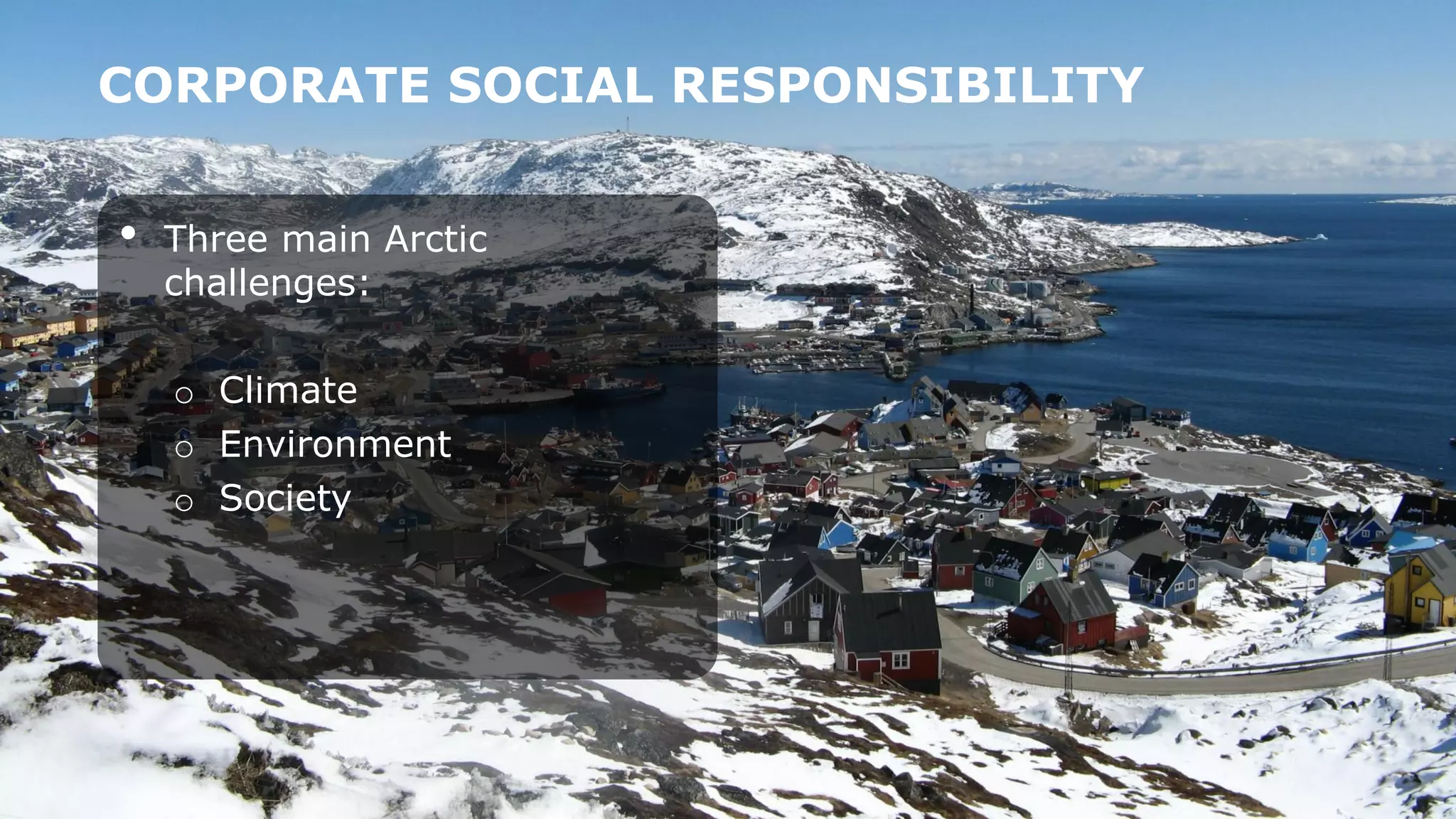
CORPORATE SOCIAL RESPONSIBILITY 
• Three main Arctic 
challenges: 
o Climate 
o Environment 
o Society
NILS ARNE JOHNSEN, ARCTIC DIRECOR, RAMBOLL GROUP 
• Buildings, transport, environment, 
oil & gas, energy, management 
consulting 
• Leading consultancy in the European 
Arctic 
• 470 employees in the Arctic regions 
of Finland, Sweden, Norway and 
Greenland 
• 11 000 employees worldwide 
• 20 countries worldwide
THE ADVANTAGES OF CITIES 
Social hubs 
Engines of economic 
prosperity and 
development 
Efficient resource 
and energy use e.g. 
district heating 
Efficient 
transportation and 
high connectivity 
Drivers of education 
and knowledge 
development 
Waste problems
• Liveable city developments 
necessitate a holistic, 
integrated and balanced 
approach to economic, social, 
environmental and spatial 
developments. 
• These driving forces reinforce 
each other and allow people 
and society to develop 
prosperously. 
WHAT IS LIVEABILITY?
FROM SILO-THINKING TO A HOLISTIC APPROACH
LIVEABLE CITIES 
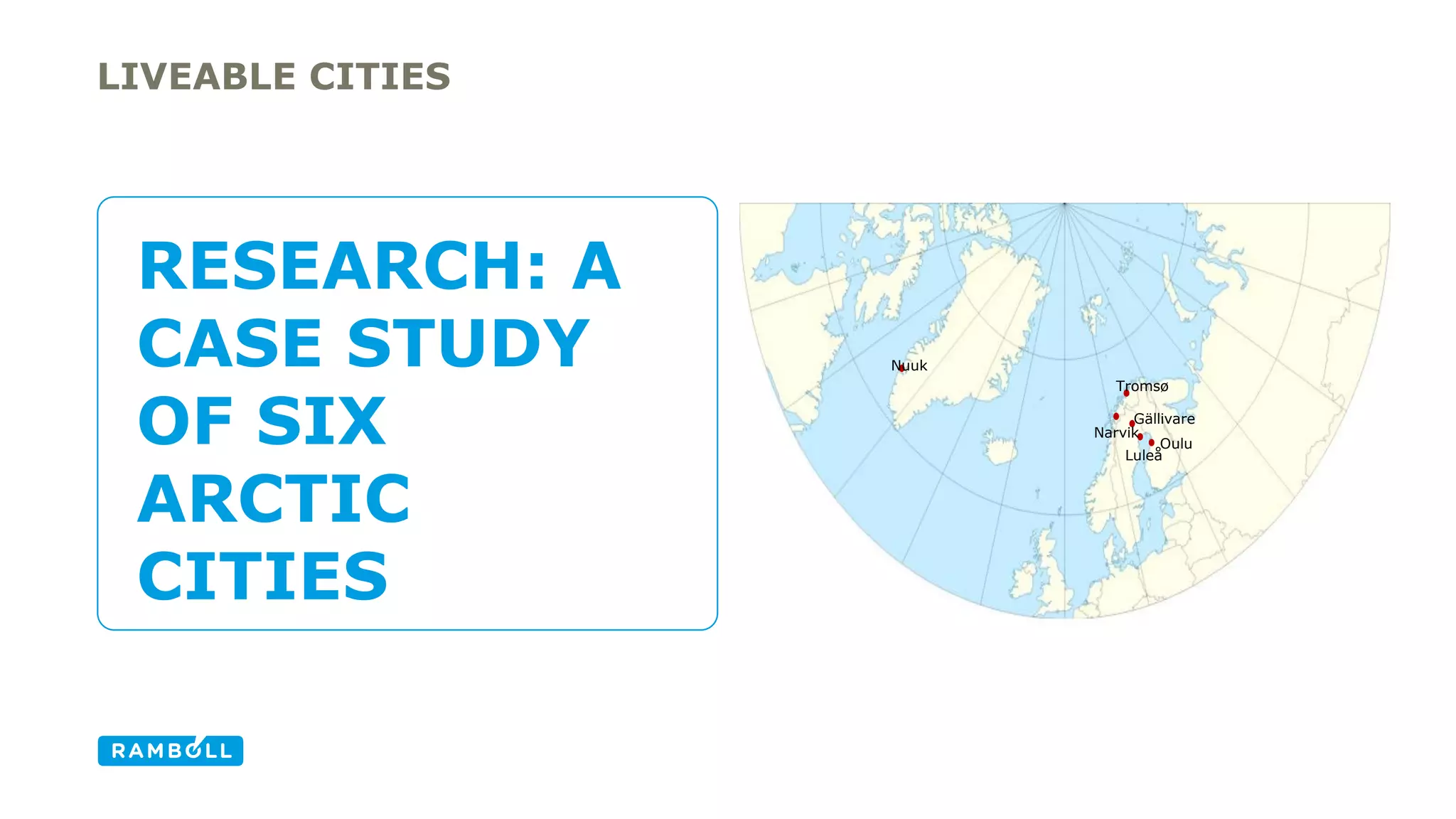
RESEARCH: A 
CASE STUDY 
OF SIX 
ARCTIC 
CITIES 
Nuuk 
Tromsø 
Narvik 
Gällivare 
Oulu 
Luleå
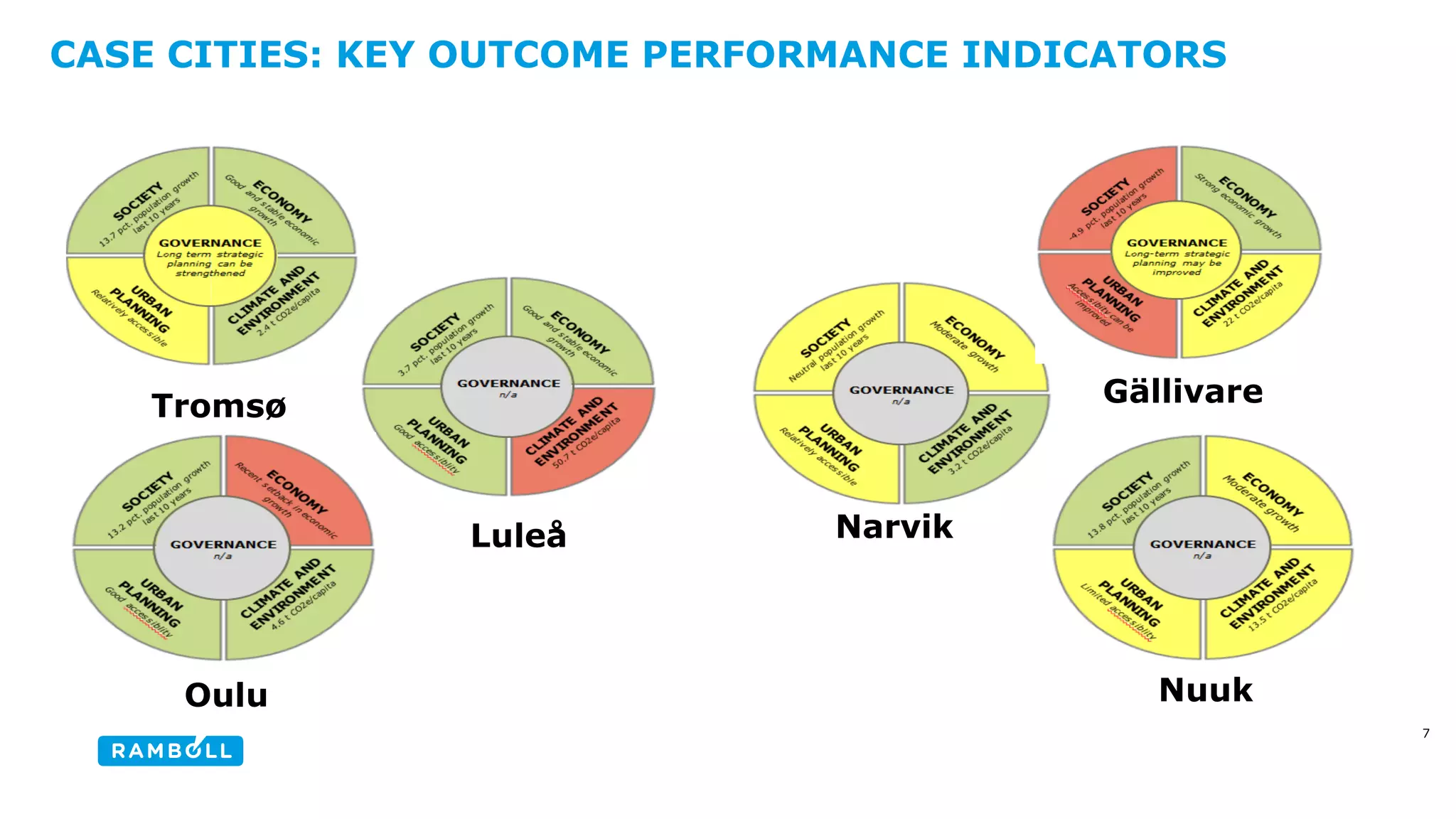
CASE CITIES: KEY OUTCOME PERFORMANCE INDICATORS 
Tromsø Gällivare 
Luleå Narvik 
Oulu Nuuk 
7
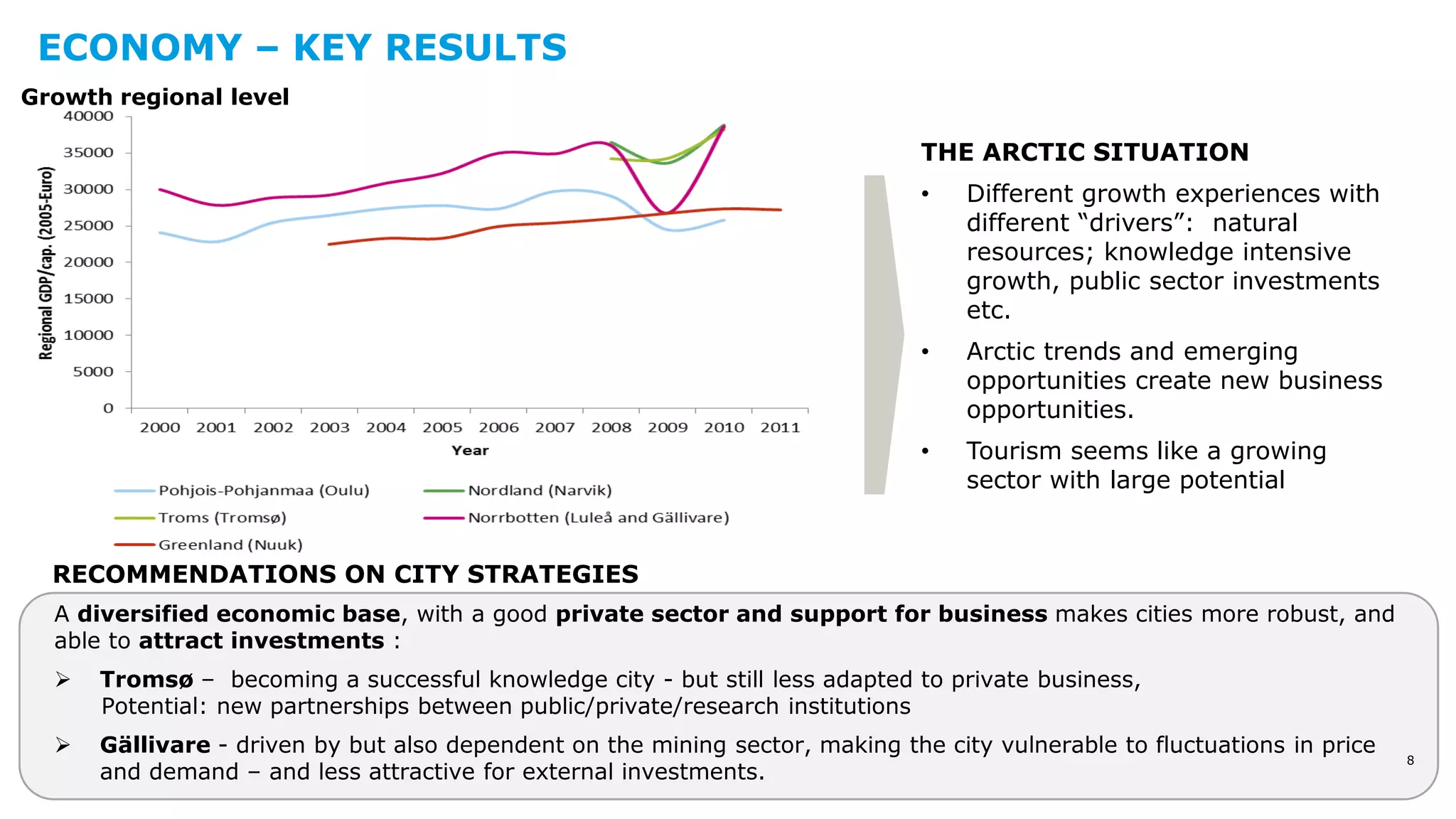
ECONOMY – KEY RESULTS 
THE ARCTIC SITUATION 
• Different growth experiences with 
different “drivers”: natural 
resources; knowledge intensive 
growth, public sector investments 
etc. 
• Arctic trends and emerging 
opportunities create new business 
opportunities. 
• Tourism seems like a growing 
sector with large potential 
A diversified economic base, with a good private sector and support for business makes cities more robust, and 
able to attract investments : 
 Tromsø – becoming a successful knowledge city - but still less adapted to private business, 
Potential: new partnerships between public/private/research institutions 
 Gällivare - driven by but also dependent on the mining sector, making the city vulnerable to fluctuations in price 
and demand – and less attractive for external investments. 
RECOMMENDATIONS ON CITY STRATEGIES 
Growth regional level 
8
SOCIETY – KEY RESULTS 
THE ARCTIC SITUATION 
• Population growth varies among 
cities. Different centre/periphery 
dynamics and availability of jobs 
and education. 
• Population outflow is a serious 
challenge – in particular for youth 
and women. 
• Rate of higher education levels is 
also an issue. 
• Indigenous communities / 
increasing diversity 
Tromsø Narvik Gällivare 
Luleå Oulu Nuuk 
Strategies for retaining population is key for sustainable societies 
 Education is key to knowledge intensive cities (Tromsø, Luleå and Oulu). But also to peripheral cities 
(education partnerships of Gällivare). A future potential in the use of ICT 
Effectively branding the city to attract residents and business 
 Tromsø: cultural vibe and nature possibilities – Gällivare:The Arctic world class city 
Seeing and working with indigenous groups and diversity as a resource for the city 
 Tromsø experiences - and a recent partnership with Sami community 
-4,9% 
3,7% 
13,7% 0,2% 
13,2% 13,8% 
Pyramid: Age distribution 
Population growth (%) 
RECOMMENDATIONS ON CITY STRATEGIES 
9
URBAN PLANNING 
THE ARCTIC SITUATION 
• Marked by the long distances in 
the Arctic, some cities are more 
challenged than others. For many 
cities this is a focus area 
• ICT infrastructure is well 
developed - Nuuk is the most 
challenged 
• Urban planning is a focus for 
Tromsø and Gällivare –both are 
challenged in terms of housing and 
long-term planning 
URBAN PLANNING 
Flight 
Train 
Sea 
Major international 
airline hub 
Low frequency 
Medium frequency 
High frequency 
Long term urban planning that aims to ensure cohesive , liveable cities that are well connected externally and 
internally. At its best, urban planning involves citizens and meets their needs. ICT is also key to connecting cities 
externally 
 Gällivare: Although challenged - now in a defining moment with new city plan - relocation of citizens and development 
of city centre. 
 Tromsø: In recent decades, a strategic focus on condensing the city around a centre. In other aspects, city planning is 
more ad hoc and presently city is facing a housing challenge. 
RECOMMENDATIONS ON CITY STRATEGIES 
10
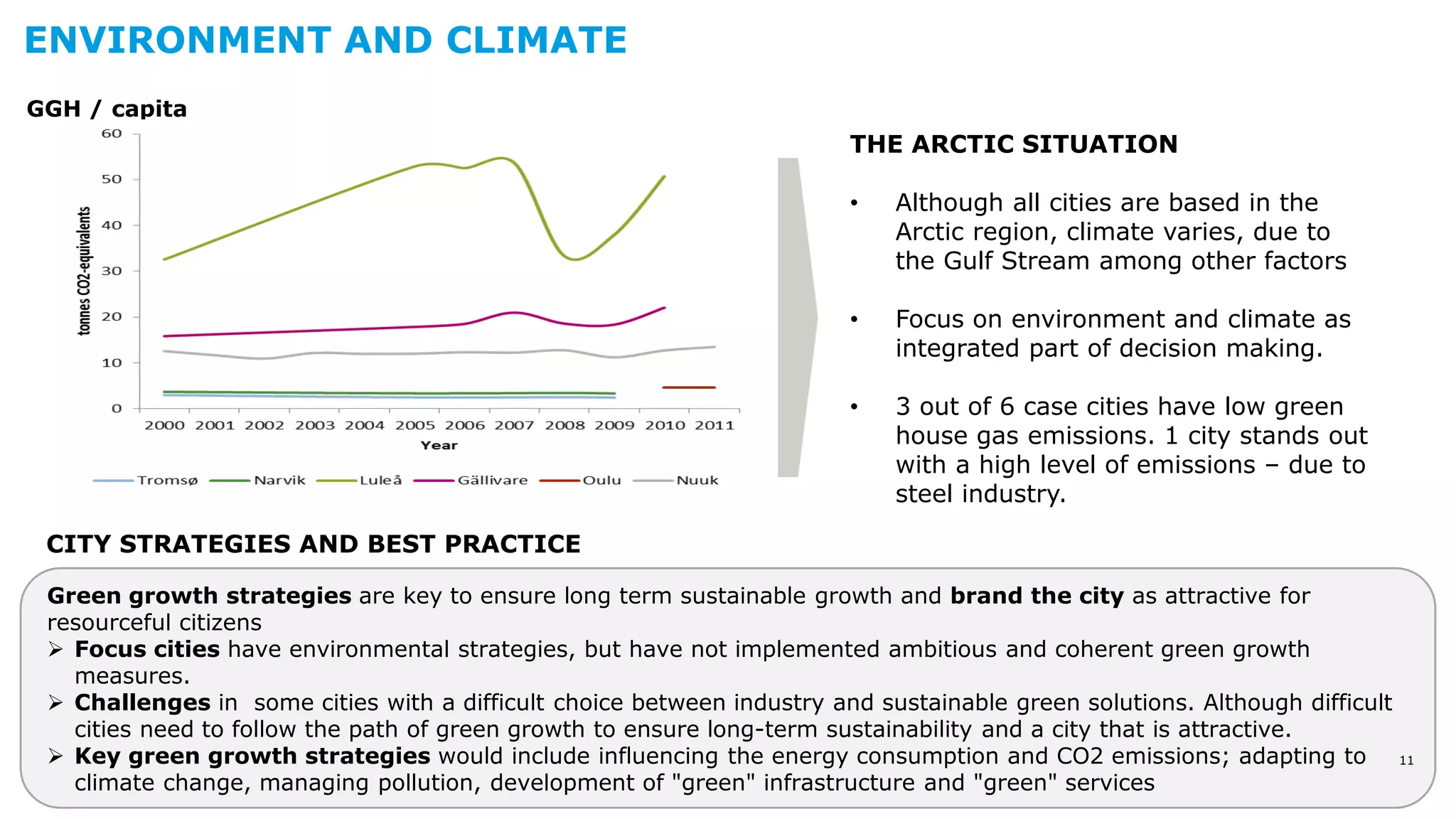
ENVIRONMENT AND CLIMATE 
GGH / capita 
THE ARCTIC SITUATION 
• Although all cities are based in the 
Arctic region, climate varies, due to 
the Gulf Stream among other factors 
• Focus on environment and climate as 
integrated part of decision making. 
• 3 out of 6 case cities have low green 
house gas emissions. 1 city stands out 
with a high level of emissions – due to 
steel industry. 
Green growth strategies are key to ensure long term sustainable growth and brand the city as attractive for 
resourceful citizens 
 Focus cities have environmental strategies, but have not implemented ambitious and coherent green growth 
measures. 
 Challenges in some cities with a difficult choice between industry and sustainable green solutions. Although difficult 
cities need to follow the path of green growth to ensure long-term sustainability and a city that is attractive. 
 Key green growth strategies would include influencing the energy consumption and CO2 emissions; adapting to 
climate change, managing pollution, development of "green" infrastructure and "green" services 
CITY STRATEGIES AND BEST PRACTICE 
11
GOVERNANCE 
THE ARCTIC SITUATION 
• Cities are all governed by City councils. 
Compared to other cities globally the 
governance models are mature and 
professional. 
• Tromsø recently introduced a parliamentary 
system as part of involving citizens mores. 
• Cities part of a larger institutional set-up at 
regional, national and supra-national level 
Long term strategic decision making and strong leadership is vital for long term sustainable growth: 
 challenges not well solved. For Gällivare, the challenge of promoting a secondary economic sector. 
 In Tromsø, a recent change towards a parliamentary system is hoped to improve long term planning and 
political vision 
 Engaging citizens in decisions and development of services is highly recommendable: E.g. Gällivare carried 
out a consultation among youngsters in connection with the new city planning 
RECOMMENDATIONS ON CITY STRATEGIES 
12
LOOKING FORWARD: RESEARCH RECOMMENDATIONS 
•Exploring new opportunities – for business, innovation and partnerships arising from global shifts in climate and power. 
•Developing tourism – an opportunity not sufficiently explored 
•City branding: Arctic world class cities – finding the right city brand to make cities attractive for new residents and business 
•Extending infrastructure, ICT and communication – to further connect Arctic cities with the outside world 
•Engaging and motivating Arctic citizens in developing their cities 
•Arctic indigenous communities and diversity: a resource 
•Encouraging learning between cities: E.g. Arctic city networks 
13
• Understand the Arctic 
• Analyze the society 
• Most “company towns” are not sustainable in the long term 
• Because of the Arctic being sparsely populated this goes for most 
of the settlements, town and cities 
• Be present locally and use local services in all phases of the 
project 
• Define stakeholders and collaborate at the earliest possible time 
CORPORATE SOCIAL RESPONSIBILITY
• Investment in infrastructure for your own business purpose 
• Facilitation of this infrastructure for other purposes 
• Contribute to local business development - not only for your own 
business sector 
• Contribute to educational initiatives - not only in your own 
business sector 
COUNTERACTING THE DISADVANTAGES OF 
COMPANY TOWNS
NORWAY 
MINING IN THE NORTH: 
BIEDJOVAGGI CASE
• Previously mining in 1970ies and 1990ies, last by Outokumpu 
• Copper and gold 
• Kautokeino municipality, geographically the largest in Norway 
• Population 2 900 
• Unemployment rate is among highest in Norway: 3,9 % 
• Municipality politicians votet NO to assessment programs three 
times 
BIEDJOVAGGI
THANK YOU! NILS.ARNE.JOHNSEN@RAMBOLL.NO

ArcticCircle2014_Johnsen_breakout_35

  • 1.
    CORPORATE SOCIAL RESPONSIBILITY • Three main Arctic challenges: o Climate o Environment o Society
  • 2.
    NILS ARNE JOHNSEN,ARCTIC DIRECOR, RAMBOLL GROUP • Buildings, transport, environment, oil & gas, energy, management consulting • Leading consultancy in the European Arctic • 470 employees in the Arctic regions of Finland, Sweden, Norway and Greenland • 11 000 employees worldwide • 20 countries worldwide
  • 3.
    THE ADVANTAGES OFCITIES Social hubs Engines of economic prosperity and development Efficient resource and energy use e.g. district heating Efficient transportation and high connectivity Drivers of education and knowledge development Waste problems
  • 4.
    • Liveable citydevelopments necessitate a holistic, integrated and balanced approach to economic, social, environmental and spatial developments. • These driving forces reinforce each other and allow people and society to develop prosperously. WHAT IS LIVEABILITY?
  • 5.
    FROM SILO-THINKING TOA HOLISTIC APPROACH
  • 6.
    LIVEABLE CITIES RESEARCH:A CASE STUDY OF SIX ARCTIC CITIES Nuuk Tromsø Narvik Gällivare Oulu Luleå
  • 7.
    CASE CITIES: KEYOUTCOME PERFORMANCE INDICATORS Tromsø Gällivare Luleå Narvik Oulu Nuuk 7
  • 8.
    ECONOMY – KEYRESULTS THE ARCTIC SITUATION • Different growth experiences with different “drivers”: natural resources; knowledge intensive growth, public sector investments etc. • Arctic trends and emerging opportunities create new business opportunities. • Tourism seems like a growing sector with large potential A diversified economic base, with a good private sector and support for business makes cities more robust, and able to attract investments :  Tromsø – becoming a successful knowledge city - but still less adapted to private business, Potential: new partnerships between public/private/research institutions  Gällivare - driven by but also dependent on the mining sector, making the city vulnerable to fluctuations in price and demand – and less attractive for external investments. RECOMMENDATIONS ON CITY STRATEGIES Growth regional level 8
  • 9.
    SOCIETY – KEYRESULTS THE ARCTIC SITUATION • Population growth varies among cities. Different centre/periphery dynamics and availability of jobs and education. • Population outflow is a serious challenge – in particular for youth and women. • Rate of higher education levels is also an issue. • Indigenous communities / increasing diversity Tromsø Narvik Gällivare Luleå Oulu Nuuk Strategies for retaining population is key for sustainable societies  Education is key to knowledge intensive cities (Tromsø, Luleå and Oulu). But also to peripheral cities (education partnerships of Gällivare). A future potential in the use of ICT Effectively branding the city to attract residents and business  Tromsø: cultural vibe and nature possibilities – Gällivare:The Arctic world class city Seeing and working with indigenous groups and diversity as a resource for the city  Tromsø experiences - and a recent partnership with Sami community -4,9% 3,7% 13,7% 0,2% 13,2% 13,8% Pyramid: Age distribution Population growth (%) RECOMMENDATIONS ON CITY STRATEGIES 9
  • 10.
    URBAN PLANNING THEARCTIC SITUATION • Marked by the long distances in the Arctic, some cities are more challenged than others. For many cities this is a focus area • ICT infrastructure is well developed - Nuuk is the most challenged • Urban planning is a focus for Tromsø and Gällivare –both are challenged in terms of housing and long-term planning URBAN PLANNING Flight Train Sea Major international airline hub Low frequency Medium frequency High frequency Long term urban planning that aims to ensure cohesive , liveable cities that are well connected externally and internally. At its best, urban planning involves citizens and meets their needs. ICT is also key to connecting cities externally  Gällivare: Although challenged - now in a defining moment with new city plan - relocation of citizens and development of city centre.  Tromsø: In recent decades, a strategic focus on condensing the city around a centre. In other aspects, city planning is more ad hoc and presently city is facing a housing challenge. RECOMMENDATIONS ON CITY STRATEGIES 10
  • 11.
    ENVIRONMENT AND CLIMATE GGH / capita THE ARCTIC SITUATION • Although all cities are based in the Arctic region, climate varies, due to the Gulf Stream among other factors • Focus on environment and climate as integrated part of decision making. • 3 out of 6 case cities have low green house gas emissions. 1 city stands out with a high level of emissions – due to steel industry. Green growth strategies are key to ensure long term sustainable growth and brand the city as attractive for resourceful citizens  Focus cities have environmental strategies, but have not implemented ambitious and coherent green growth measures.  Challenges in some cities with a difficult choice between industry and sustainable green solutions. Although difficult cities need to follow the path of green growth to ensure long-term sustainability and a city that is attractive.  Key green growth strategies would include influencing the energy consumption and CO2 emissions; adapting to climate change, managing pollution, development of "green" infrastructure and "green" services CITY STRATEGIES AND BEST PRACTICE 11
  • 12.
    GOVERNANCE THE ARCTICSITUATION • Cities are all governed by City councils. Compared to other cities globally the governance models are mature and professional. • Tromsø recently introduced a parliamentary system as part of involving citizens mores. • Cities part of a larger institutional set-up at regional, national and supra-national level Long term strategic decision making and strong leadership is vital for long term sustainable growth:  challenges not well solved. For Gällivare, the challenge of promoting a secondary economic sector.  In Tromsø, a recent change towards a parliamentary system is hoped to improve long term planning and political vision  Engaging citizens in decisions and development of services is highly recommendable: E.g. Gällivare carried out a consultation among youngsters in connection with the new city planning RECOMMENDATIONS ON CITY STRATEGIES 12
  • 13.
    LOOKING FORWARD: RESEARCHRECOMMENDATIONS •Exploring new opportunities – for business, innovation and partnerships arising from global shifts in climate and power. •Developing tourism – an opportunity not sufficiently explored •City branding: Arctic world class cities – finding the right city brand to make cities attractive for new residents and business •Extending infrastructure, ICT and communication – to further connect Arctic cities with the outside world •Engaging and motivating Arctic citizens in developing their cities •Arctic indigenous communities and diversity: a resource •Encouraging learning between cities: E.g. Arctic city networks 13
  • 14.
    • Understand theArctic • Analyze the society • Most “company towns” are not sustainable in the long term • Because of the Arctic being sparsely populated this goes for most of the settlements, town and cities • Be present locally and use local services in all phases of the project • Define stakeholders and collaborate at the earliest possible time CORPORATE SOCIAL RESPONSIBILITY
  • 15.
    • Investment ininfrastructure for your own business purpose • Facilitation of this infrastructure for other purposes • Contribute to local business development - not only for your own business sector • Contribute to educational initiatives - not only in your own business sector COUNTERACTING THE DISADVANTAGES OF COMPANY TOWNS
  • 16.
    NORWAY MINING INTHE NORTH: BIEDJOVAGGI CASE
  • 17.
    • Previously miningin 1970ies and 1990ies, last by Outokumpu • Copper and gold • Kautokeino municipality, geographically the largest in Norway • Population 2 900 • Unemployment rate is among highest in Norway: 3,9 % • Municipality politicians votet NO to assessment programs three times BIEDJOVAGGI
  • 18.