www.postersession.com
Controls and predictors of soil organic matter content in mountainous floodplains
John A. Harrisa,, email: harrisjoh94@gmail.com and Nicholas A. Sutfinb, email: nsutfin@lanl.gov
a Department of Geosciences, Colorado State University, b Earth and Environmental Sciences Division, Los Alamos National Laboratory
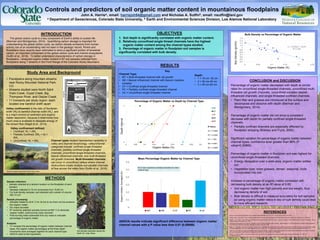
1. Soil depth is significantly correlated with organic matter content.
2. Relatively unconfined single thread channels have the highest
organic matter content among the channel types studied.
3. Percentage of organic matter in floodplain soil samples is
significantly correlated with bulk density.
OBJECTIVES
The global carbon cycle is a key component of Earth’s ability to sustain life
(Bierman and Montgomery, 2014). Quantifying carbon storage is important for
understanding the global carbon cycle, as carbon dioxide emissions from human
activity rise at an accelerating rate not seen in the geologic record. Rivers and
floodplains have recently been estimated to store a significant portion of terrestrial
carbon, an important component of the global carbon cycle and riverine ecosystems
(Sutfin et al., 2016). To better understand characteristics of carbon storage in
floodplains, I analyzed organic matter content in 67 soil samples collected from
floodplains along 7 streams in the Front Range of the Colorado Rocky Mountains.
INTRODUCTION
Valley confinement is the ratio of floodplain
width (Wf) to bankfull channel width (Wc) and
is a major control on sediment and organic
matter deposition, because it determines how
much area is available to dissipate energy of
the stream flow (Nagel et al., 2014).
Valley confinement defined:
• Confined: Wf < 2Wc
• Partially Confined: 2Wc < Wf <
6Wc
• Unconfined: Wf > 6Wc Channel types studied represented variability in
valley and channel morphology; valley/channel
categories include confined single-threaded
channels, partially confined single-threaded
channels, unconfined single-threaded channels,
beaver influenced channels, and multi-threaded
old growth channels. Multi-threaded channels
can occur in unconfined valleys where channel
obstructions create multiple sub-parallel channels
of flow across the valley floor (Sutfin et al., 2016).
METHODS
Sample collection:
• Sample collected at a random location on the floodplain of each
transect
• Samples collected in 15 cm increments from 15-60 cm
• For bulk density samples, soil collected with cylinder of volume
293.15 cm3
Sample processing:
• Samples heated to 40.6° C for 24 hrs to dry them out but preserve
the organic matter
• Dry mass recorded
• 67 randomly selected samples burned at 550° C to eliminate
organic matter, post-burning mass recorded
• Post-burning mass subtracted from dry mass to calculate
percentage of organic matter
Analysis:
• To compare the percentage of organic matter between channel
types, the organic matter percentages at the three depth
increments were averaged together for each channel type
• ANOVA used to test hypothesis
Soil sample collection along the
North St. Vrain River.
RESULTS
Depth:
• 1 = 15 cm- 30 cm
• 2 = 30 cm-45 cm
• 3 = 45 cm-60 cm
Channel Type:
• MT = Multi-threaded channel with old growth
• AB = Beaver-influenced channel with beaver meadow
complex
• CF = Confined single-threaded channel
• PC = Partially confined single-threaded channel
• UC = Unconfined single-threaded channel
Key
0
0.1
0.2
0.3
0.4
0.5
0.6
OrganicMatter,Averaged(%)
Mean Percentage Organic Matter by Channel Type
MT AB CF PC UC
1
2
3
0 0.05 0.1 0.15 0.2 0.25 0.3 0.35 0.4
Depthinterval
Organic Matter (%)
Percentage of Organic Matter vs Depth by Channel Type
UC
PC
CF
AB
MT
R2 Values
UC = 0.9969
PC = 0.0085
CF = 1.000
AB = 0.6861
MT = 0.9569
y = -3.3125x + 1.2219
R² = 0.64
0.4
0.5
0.6
0.7
0.8
0.9
1
1.1
1.2
1.3
1.4
0 0.05 0.1 0.15 0.2 0.25
BukDensity(g/cm3)
Organic Matter (%)
Bulk Density vs Percentage of Organic Matter
CONCLUSION and DISCUSSION
Percentage of organic matter decreased with depth at similar
rates for unconfined single-threaded channels, unconfined multi-
threaded old growth channels, unconfined complex beaver-
influenced channels, and single-threaded confined channels.
• Plant litter and grasses are introduced at the surface and
decompose and dissolve with depth (Bierman and
Montgomery, 2014).
Percentage of organic matter did not show a consistent
decrease with depth for partially confined single-threaded
channels.
• Partially confined channels are especially affected by
floodplain stripping (Brierley and Fryirs, 2005).
Significant variation for percentage of organic matter between
channel types, confidence level greater than 99% (P
value=0.00866)
Percentage of organic matter in floodplain soil was highest for
unconfined single-threaded channels.
• Energy dissipation over a wide area, organic matter settles
out.
• Vegetation type: more grasses, denser, seasonal, roots
incorporated into soil.
Increase in percentage of organic matter correlated with
decreasing bulk density at an R2 value of 0.65.
• Soil organic matter has high porosity and low weight, thus
decreasing density of soil.
• Bulk density is difficult to measure accurately for soil samples,
so using organic matter ratios in lieu of bulk density could lead
to more efficient research.
Bierman, Paul and Montgomery, David. Key Concepts in Geomorphology. New York: W.H. Freeman and Company, 2014. Print.
Brierley, Gary J., and Kirstie A. Fryirs. Geomorphology and River Management: Applications of the River Styles Framework. Malden, MA: Blackwell Pub., 2005. Print.
Bryden, A., E.E. Wohl, G. David. “Channel Morphology of Glaciated Partially Confined Channels.” Historical Variability of Valley Bottoms in the Colorado Front Range. Warner
College of Natural Resources, 2016. Web.
Information Services Branch, BC Fisheries. "Chapter 4. Stream Inventory Standards and Procedures." Reconnaissance (1:20 000) Fish and Fish Habitat Inventory Standards
and Procedures. Resources Information Standards Committee, April, 2011. Web.
Nagel, D., J. Buffington, S. Parkes, S. Wenger, J. Goode, 2014. A landscape scale valley confinement algorithm: Delineating unconfined valley bottoms for geomorphic, aquatic,
and riparian applications. Gen. Tech. Rep. RMRSGTR-321. Fort Collins, CO: U.S. Department of Agriculture, Forest Service, Rocky Mountain Research Station. 42 p.
Sutfin, N.A., E.E. Wohl, K.A. Dwire, 2016. State of Science: Banking Carbon: A review of organic carbon storage and physical factors influences carbon retention in floodplains
and riparian ecosystems. Earth Surface Processes and Landforms 41 (1), 38-46. DOI: 10.1002/esp.3857
Wohl, E., K. Dwire, N. Sutfin, L. Polvi and R. Bazan, 2012. Mechanisms of C storage in mountainous headwater rivers. Nature Communications. 3: 1263. DOI:
10.1038/ncomms2274
REFERENCES
Error bars represent a standard deviation for each
channel type
Study Area and Background
• Floodplains along mountain streams
near Rocky Mountain National Park,
CO
• Streams studied were North Saint
Vrain Creek, Ouzel Creek, Big
Thompson River, and Glacier Creek.
• 11 transects per study region, each
located one bankfull width apart
Beaver meadow along North Saint Vrain Creek.
ANOVA results indicate significant difference between organic matter
channel values with a P value less than 0.01 (0.00866).

John Harris - 2016 Independent Study Presentation Poster

  • 1.
    www.postersession.com Controls and predictorsof soil organic matter content in mountainous floodplains John A. Harrisa,, email: harrisjoh94@gmail.com and Nicholas A. Sutfinb, email: nsutfin@lanl.gov a Department of Geosciences, Colorado State University, b Earth and Environmental Sciences Division, Los Alamos National Laboratory 1. Soil depth is significantly correlated with organic matter content. 2. Relatively unconfined single thread channels have the highest organic matter content among the channel types studied. 3. Percentage of organic matter in floodplain soil samples is significantly correlated with bulk density. OBJECTIVES The global carbon cycle is a key component of Earth’s ability to sustain life (Bierman and Montgomery, 2014). Quantifying carbon storage is important for understanding the global carbon cycle, as carbon dioxide emissions from human activity rise at an accelerating rate not seen in the geologic record. Rivers and floodplains have recently been estimated to store a significant portion of terrestrial carbon, an important component of the global carbon cycle and riverine ecosystems (Sutfin et al., 2016). To better understand characteristics of carbon storage in floodplains, I analyzed organic matter content in 67 soil samples collected from floodplains along 7 streams in the Front Range of the Colorado Rocky Mountains. INTRODUCTION Valley confinement is the ratio of floodplain width (Wf) to bankfull channel width (Wc) and is a major control on sediment and organic matter deposition, because it determines how much area is available to dissipate energy of the stream flow (Nagel et al., 2014). Valley confinement defined: • Confined: Wf < 2Wc • Partially Confined: 2Wc < Wf < 6Wc • Unconfined: Wf > 6Wc Channel types studied represented variability in valley and channel morphology; valley/channel categories include confined single-threaded channels, partially confined single-threaded channels, unconfined single-threaded channels, beaver influenced channels, and multi-threaded old growth channels. Multi-threaded channels can occur in unconfined valleys where channel obstructions create multiple sub-parallel channels of flow across the valley floor (Sutfin et al., 2016). METHODS Sample collection: • Sample collected at a random location on the floodplain of each transect • Samples collected in 15 cm increments from 15-60 cm • For bulk density samples, soil collected with cylinder of volume 293.15 cm3 Sample processing: • Samples heated to 40.6° C for 24 hrs to dry them out but preserve the organic matter • Dry mass recorded • 67 randomly selected samples burned at 550° C to eliminate organic matter, post-burning mass recorded • Post-burning mass subtracted from dry mass to calculate percentage of organic matter Analysis: • To compare the percentage of organic matter between channel types, the organic matter percentages at the three depth increments were averaged together for each channel type • ANOVA used to test hypothesis Soil sample collection along the North St. Vrain River. RESULTS Depth: • 1 = 15 cm- 30 cm • 2 = 30 cm-45 cm • 3 = 45 cm-60 cm Channel Type: • MT = Multi-threaded channel with old growth • AB = Beaver-influenced channel with beaver meadow complex • CF = Confined single-threaded channel • PC = Partially confined single-threaded channel • UC = Unconfined single-threaded channel Key 0 0.1 0.2 0.3 0.4 0.5 0.6 OrganicMatter,Averaged(%) Mean Percentage Organic Matter by Channel Type MT AB CF PC UC 1 2 3 0 0.05 0.1 0.15 0.2 0.25 0.3 0.35 0.4 Depthinterval Organic Matter (%) Percentage of Organic Matter vs Depth by Channel Type UC PC CF AB MT R2 Values UC = 0.9969 PC = 0.0085 CF = 1.000 AB = 0.6861 MT = 0.9569 y = -3.3125x + 1.2219 R² = 0.64 0.4 0.5 0.6 0.7 0.8 0.9 1 1.1 1.2 1.3 1.4 0 0.05 0.1 0.15 0.2 0.25 BukDensity(g/cm3) Organic Matter (%) Bulk Density vs Percentage of Organic Matter CONCLUSION and DISCUSSION Percentage of organic matter decreased with depth at similar rates for unconfined single-threaded channels, unconfined multi- threaded old growth channels, unconfined complex beaver- influenced channels, and single-threaded confined channels. • Plant litter and grasses are introduced at the surface and decompose and dissolve with depth (Bierman and Montgomery, 2014). Percentage of organic matter did not show a consistent decrease with depth for partially confined single-threaded channels. • Partially confined channels are especially affected by floodplain stripping (Brierley and Fryirs, 2005). Significant variation for percentage of organic matter between channel types, confidence level greater than 99% (P value=0.00866) Percentage of organic matter in floodplain soil was highest for unconfined single-threaded channels. • Energy dissipation over a wide area, organic matter settles out. • Vegetation type: more grasses, denser, seasonal, roots incorporated into soil. Increase in percentage of organic matter correlated with decreasing bulk density at an R2 value of 0.65. • Soil organic matter has high porosity and low weight, thus decreasing density of soil. • Bulk density is difficult to measure accurately for soil samples, so using organic matter ratios in lieu of bulk density could lead to more efficient research. Bierman, Paul and Montgomery, David. Key Concepts in Geomorphology. New York: W.H. Freeman and Company, 2014. Print. Brierley, Gary J., and Kirstie A. Fryirs. Geomorphology and River Management: Applications of the River Styles Framework. Malden, MA: Blackwell Pub., 2005. Print. Bryden, A., E.E. Wohl, G. David. “Channel Morphology of Glaciated Partially Confined Channels.” Historical Variability of Valley Bottoms in the Colorado Front Range. Warner College of Natural Resources, 2016. Web. Information Services Branch, BC Fisheries. "Chapter 4. Stream Inventory Standards and Procedures." Reconnaissance (1:20 000) Fish and Fish Habitat Inventory Standards and Procedures. Resources Information Standards Committee, April, 2011. Web. Nagel, D., J. Buffington, S. Parkes, S. Wenger, J. Goode, 2014. A landscape scale valley confinement algorithm: Delineating unconfined valley bottoms for geomorphic, aquatic, and riparian applications. Gen. Tech. Rep. RMRSGTR-321. Fort Collins, CO: U.S. Department of Agriculture, Forest Service, Rocky Mountain Research Station. 42 p. Sutfin, N.A., E.E. Wohl, K.A. Dwire, 2016. State of Science: Banking Carbon: A review of organic carbon storage and physical factors influences carbon retention in floodplains and riparian ecosystems. Earth Surface Processes and Landforms 41 (1), 38-46. DOI: 10.1002/esp.3857 Wohl, E., K. Dwire, N. Sutfin, L. Polvi and R. Bazan, 2012. Mechanisms of C storage in mountainous headwater rivers. Nature Communications. 3: 1263. DOI: 10.1038/ncomms2274 REFERENCES Error bars represent a standard deviation for each channel type Study Area and Background • Floodplains along mountain streams near Rocky Mountain National Park, CO • Streams studied were North Saint Vrain Creek, Ouzel Creek, Big Thompson River, and Glacier Creek. • 11 transects per study region, each located one bankfull width apart Beaver meadow along North Saint Vrain Creek. ANOVA results indicate significant difference between organic matter channel values with a P value less than 0.01 (0.00866).