Industrial Psychology
(BAS-12/ BHM-05)
Unit 3 Lecture 2
Job Analysis
• It is not unusual for us to find people in various
organizations: -
1. quarrelling over who is responsible for a
particular job in question;
2. claiming that it is not their job; and
3. who are not clear about their limits of authority.
• However, if there were clear statements of
specific requirements for the various jobs, this
problem would be eliminated.
• Ideal solution to both these and many other
organizational issues is to have a Job Analysis
done for each of the profiles.
“Job Analysis is the process of gathering, analyzing and
structuring information about a job’s components,
characteristics, and requirements.”
• JA is the accurate, in depth study of various aspects
of a job.
• JA is concerned with analysis of (a) duties and
conditions of work; (b) knowledge, skills and abilities
(KSA) the candidate should possess in order to
perform the job effectively; (c) Information about
the place where the job is to be discharged and
performance standards.
WHAT IS JOB ANALYSIS
• A thorough job analysis is the foundation stone of all
human resource planning.
• Job analysis should not be regarded as technique
merely suitable for large organizations.
• A good job analysis is equally important for
organizations employing smaller number of
employees.
WHAT IS JOB ANALYSIS
The process of job analysis results in two sets of data: -
WHAT IS JOB ANALYSIS
JOB DESCRIPTION JOB SPECIFICATION
It indicates what all a job
involves i.e.
1. job title
2. duties/ tasks
/responsibilities
3. financial compensation
4. machines/ tools/
equipment
5. working conditions and
hazards
The capabilities that the
job-holder should possess
are part of job specification.
It includes: -
1. Knowledge
2. Skill
3. Abilities
4. Other attributes
• Job analysis helps us in following ways: -
Writing job description and job specification- JA
helps in preparing job description and specification.
Job description and job specification are typically, two
to five page written summaries containing
information about various aspects/components of the
job as well as competencies required for it. They are
important because they serve a basis for various HR
activities.
WHY JOB ANALYSIS SHOULD BE CONDUCTED
Employee selection- JA provides us a clear
understanding of the tasks performed in a job and the
competencies needed to perform those tasks. By
identifying such requirements, it is possible to select
tests or develop interview questions that will determine
whether a particular candidate/applicant possesses the
necessary KSAOs to carry out the requirements of that
job.
Training- As JA provides us a clear understanding of the
job, it is also helpful in training employees. Job analyses
yield lists of job activities that can be systematically
used to create training programs.
WHY JOB ANALYSIS SHOULD BE CONDUCTED
Performance appraisal- JA helps us in construction
or decision of a performance appraisal instrument.
When properly administered and utilized, job-
related performance appraisals can serve as an
excellent source of employee training and
counseling.
Job classification- JA helps a human resources
professional to classify jobs into groups based on
similarities in requirements and duties. Job
classification is useful for determining pay levels,
transfers, and promotions.
WHY JOB ANALYSIS SHOULD BE CONDUCTED
Job evaluation- Job analysis information can also
be used to determine the worth of a job i.e. whether
it is really required or not.
Job design- Job analysis information can be used to
determine the optimal way in which a job should be
performed. By analyzing a job, wasted and unsafe
motions can be eliminated, resulting in higher
productivity and reduced numbers of job injuries.
WHY JOB ANALYSIS SHOULD BE CONDUCTED
• Before it is decided to go for JA, several decisions
must be made that will influence how it is
conducted.
• Specifically, following questions need to be kept in
mind: -
1. Who will conduct analysis? (HR, Outside Consultant)
2. Which employees should participate? (Few, all,
particular group)
3. What type of information should be obtained? (how
much detailed information would be asked)
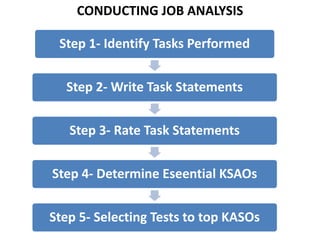
CONDUCTING JOB ANALYSIS
Step 1- Identify Tasks Performed
Step 2- Write Task Statements
Step 3- Rate Task Statements
Step 4- Determine Eseential KSAOs
Step 5- Selecting Tests to top KASOs
• Though the method discussed previously provides
great information, it can be lengthy and
unstructured.
• To save time, increase structure, or supplement
information, other ready to use structured
questionnaires/inventories are available.
For obtaining information about worker activities
1. Position Analysis Questionnaire (PAQ)
2. Job Structure Profile (JSP)
3. Job Elements Inventory (JLI)
4. Functional Job Analysis (FJA)
CONDUCTING JOB ANALYSIS
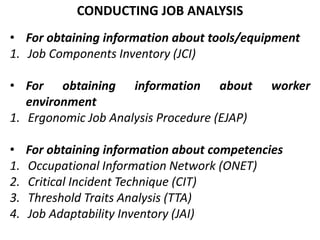
• For obtaining information about tools/equipment
1. Job Components Inventory (JCI)
• For obtaining information about worker
environment
1. Ergonomic Job Analysis Procedure (EJAP)
• For obtaining information about competencies
1. Occupational Information Network (ONET)
2. Critical Incident Technique (CIT)
3. Threshold Traits Analysis (TTA)
4. Job Adaptability Inventory (JAI)
CONDUCTING JOB ANALYSIS
THIS PRESENTATION IS BASED ON FOLLOWING SOURCES
• Robins, S.P., Judge, T.A., & Vohra, N. (2016). Organizational
Behaviour. New Delhi: Pearson.
• Luthans, F. (2017). Organizational Behaviour: An evidence
based approach. New York: McGraw Hill.
• Aamodt, M.G. (2007). Industrial/ Organizational Psychology:
An Applied Approach. Pacific Grove, CA: Wadsworth/Thomson.
• Schermehorn, J.R., Hunt, J.G., & Osborn, R. (2005).
Organizational Behavior. New York: Wiley.
• Deshpandey, A. (2010). Industrial Psychology. New Delhi: Sun
India Publications.
• Bisen, V., & Priya (2010). Industrial Psychology. New Delhi:
New Age International Publishers.

IP Unit 3 (2).pptx

  • 1.
  • 5.
    • It isnot unusual for us to find people in various organizations: - 1. quarrelling over who is responsible for a particular job in question; 2. claiming that it is not their job; and 3. who are not clear about their limits of authority.
  • 6.
    • However, ifthere were clear statements of specific requirements for the various jobs, this problem would be eliminated. • Ideal solution to both these and many other organizational issues is to have a Job Analysis done for each of the profiles.
  • 7.
    “Job Analysis isthe process of gathering, analyzing and structuring information about a job’s components, characteristics, and requirements.” • JA is the accurate, in depth study of various aspects of a job. • JA is concerned with analysis of (a) duties and conditions of work; (b) knowledge, skills and abilities (KSA) the candidate should possess in order to perform the job effectively; (c) Information about the place where the job is to be discharged and performance standards. WHAT IS JOB ANALYSIS
  • 8.
    • A thoroughjob analysis is the foundation stone of all human resource planning. • Job analysis should not be regarded as technique merely suitable for large organizations. • A good job analysis is equally important for organizations employing smaller number of employees. WHAT IS JOB ANALYSIS
  • 9.
    The process ofjob analysis results in two sets of data: - WHAT IS JOB ANALYSIS JOB DESCRIPTION JOB SPECIFICATION It indicates what all a job involves i.e. 1. job title 2. duties/ tasks /responsibilities 3. financial compensation 4. machines/ tools/ equipment 5. working conditions and hazards The capabilities that the job-holder should possess are part of job specification. It includes: - 1. Knowledge 2. Skill 3. Abilities 4. Other attributes
  • 10.
    • Job analysishelps us in following ways: - Writing job description and job specification- JA helps in preparing job description and specification. Job description and job specification are typically, two to five page written summaries containing information about various aspects/components of the job as well as competencies required for it. They are important because they serve a basis for various HR activities. WHY JOB ANALYSIS SHOULD BE CONDUCTED
  • 11.
    Employee selection- JAprovides us a clear understanding of the tasks performed in a job and the competencies needed to perform those tasks. By identifying such requirements, it is possible to select tests or develop interview questions that will determine whether a particular candidate/applicant possesses the necessary KSAOs to carry out the requirements of that job. Training- As JA provides us a clear understanding of the job, it is also helpful in training employees. Job analyses yield lists of job activities that can be systematically used to create training programs. WHY JOB ANALYSIS SHOULD BE CONDUCTED
  • 12.
    Performance appraisal- JAhelps us in construction or decision of a performance appraisal instrument. When properly administered and utilized, job- related performance appraisals can serve as an excellent source of employee training and counseling. Job classification- JA helps a human resources professional to classify jobs into groups based on similarities in requirements and duties. Job classification is useful for determining pay levels, transfers, and promotions. WHY JOB ANALYSIS SHOULD BE CONDUCTED
  • 13.
    Job evaluation- Jobanalysis information can also be used to determine the worth of a job i.e. whether it is really required or not. Job design- Job analysis information can be used to determine the optimal way in which a job should be performed. By analyzing a job, wasted and unsafe motions can be eliminated, resulting in higher productivity and reduced numbers of job injuries. WHY JOB ANALYSIS SHOULD BE CONDUCTED
  • 14.
    • Before itis decided to go for JA, several decisions must be made that will influence how it is conducted. • Specifically, following questions need to be kept in mind: - 1. Who will conduct analysis? (HR, Outside Consultant) 2. Which employees should participate? (Few, all, particular group) 3. What type of information should be obtained? (how much detailed information would be asked) CONDUCTING JOB ANALYSIS
  • 15.
    CONDUCTING JOB ANALYSIS Step1- Identify Tasks Performed Step 2- Write Task Statements Step 3- Rate Task Statements Step 4- Determine Eseential KSAOs Step 5- Selecting Tests to top KASOs
  • 16.
    • Though themethod discussed previously provides great information, it can be lengthy and unstructured. • To save time, increase structure, or supplement information, other ready to use structured questionnaires/inventories are available. For obtaining information about worker activities 1. Position Analysis Questionnaire (PAQ) 2. Job Structure Profile (JSP) 3. Job Elements Inventory (JLI) 4. Functional Job Analysis (FJA) CONDUCTING JOB ANALYSIS
  • 17.
    • For obtaininginformation about tools/equipment 1. Job Components Inventory (JCI) • For obtaining information about worker environment 1. Ergonomic Job Analysis Procedure (EJAP) • For obtaining information about competencies 1. Occupational Information Network (ONET) 2. Critical Incident Technique (CIT) 3. Threshold Traits Analysis (TTA) 4. Job Adaptability Inventory (JAI) CONDUCTING JOB ANALYSIS
  • 18.
    THIS PRESENTATION ISBASED ON FOLLOWING SOURCES • Robins, S.P., Judge, T.A., & Vohra, N. (2016). Organizational Behaviour. New Delhi: Pearson. • Luthans, F. (2017). Organizational Behaviour: An evidence based approach. New York: McGraw Hill. • Aamodt, M.G. (2007). Industrial/ Organizational Psychology: An Applied Approach. Pacific Grove, CA: Wadsworth/Thomson. • Schermehorn, J.R., Hunt, J.G., & Osborn, R. (2005). Organizational Behavior. New York: Wiley. • Deshpandey, A. (2010). Industrial Psychology. New Delhi: Sun India Publications. • Bisen, V., & Priya (2010). Industrial Psychology. New Delhi: New Age International Publishers.