Java Message ServiceSecond Edition Mark Richards
download pdf
https://ebookfinal.com/download/java-message-service-second-edition-
mark-richards/
Visit ebookfinal.com today to download the complete set of
ebook or textbook!
2.
Here are somerecommended products that we believe you will be
interested in. You can click the link to download.
New Labour and the Civil Service D. Richards
https://ebookfinal.com/download/new-labour-and-the-civil-service-d-
richards/
Java Performance Tuning Second Edition Jack Shirazi
https://ebookfinal.com/download/java-performance-tuning-second-
edition-jack-shirazi/
Java Servlet Programming Second Edition Jason Hunter
https://ebookfinal.com/download/java-servlet-programming-second-
edition-jason-hunter/
The Ultimate Marketing Plan Find Your Hook Communicate
Your Message Make Your Mark 3rd Edition Dan S. Kennedy
https://ebookfinal.com/download/the-ultimate-marketing-plan-find-your-
hook-communicate-your-message-make-your-mark-3rd-edition-dan-s-
kennedy/
3.
Object Oriented Programmingand Java Second Edition Danny
Poo
https://ebookfinal.com/download/object-oriented-programming-and-java-
second-edition-danny-poo/
Data Structures and Algorithm Analysis in Java 3rd Edition
Edition Mark A. Weiss
https://ebookfinal.com/download/data-structures-and-algorithm-
analysis-in-java-3rd-edition-edition-mark-a-weiss/
Network service investment guide maximizing ROI in
uncertain times 1st Edition Mark Gaynor
https://ebookfinal.com/download/network-service-investment-guide-
maximizing-roi-in-uncertain-times-1st-edition-mark-gaynor/
English Through Pictures Book 2 and A Second Workbook of
English I. A. Richards
https://ebookfinal.com/download/english-through-pictures-book-2-and-a-
second-workbook-of-english-i-a-richards/
This Is Our Message Emily S. Johnson
https://ebookfinal.com/download/this-is-our-message-emily-s-johnson/
5.
Java Message ServiceSecond Edition Mark Richards
Digital Instant Download
Author(s): Mark Richards, Richard Monson-Haefel, David AChappell
ISBN(s): 9780596522049, 0596522045
Edition: Second Edition
File Details: PDF, 1.94 MB
Year: 2009
Language: english
6.
SECOND EDITION
Java MessageService
Mark Richards, Richard Monson-Haefel, and
David A. Chappell
Beijing • Cambridge • Farnham • Köln • Sebastopol • Taipei • Tokyo
Foreword
For close toa decade now, I’ve been a fan of messaging-based systems. They offer a
degree of reliability, flexibility, extensibility, and modularity that a traditional RPC or
distributed object system simply cannot. Working with them takes a bit of adjustment,
because they don’t quite behave the same way that an architect or designer expects a
traditional n-tier system to behave. This is not to say that they’re better or worse; they’re
just different. Instead of invoking methods on objects directly, where the object can
hold conversational state or context, now the message itself has to be self-contained
and state-complete.
Which raises an important point.
For any given developer with respect to any given technology, there are four distinct
stages.
The first is the Ignorant. We may know the technology exists, or not, but beyond that
we remain entirely ignorant about its capabilities. It’s a collection of letters, at best,
often mentioned in conjunction with other technologies that may or may not matter
to what we’re doing on a daily basis.
The second is the Explorer. Something piques our curiosity, voluntarily or not. We
begin some initial forays into the jungle, perhaps downloading an implementation or
reading a few articles. We begin to understand the basic framing of where this thing
sits in the broad scheme of things and maybe how it’s supposed to work, but our hands-
on experience is generally limited to the moral equivalent of “Hello World” and a few
other samples.
The third is the Journeyman. After running many of the samples and reading a few
articles, we realize that we understand it at a basic level and begin to branch out to
writing code with it. We feel reasonably comfortable introducing it into production
code and reasonably comfortable debugging the stupid mistakes we’ll make with it.
We’re not experts, by any means, but we can at least get the stuff to compile and run
most of the time.
The last, of course, is the Master. After building a few systems and seeing how they
react under real-world conditions, we have a deep gestalt with it and can often predict
how the tool or technology will react without even running the code. We can see how
xi
14.
this thing willinteract with other, complementary technologies, and understand how
to achieve some truly miraculous results, such as systems that resist network outages
or machine failures. When the Java Message Service (JMS) API was first released, back
in 1999, before any noncommercial/open-source implementations were available, I
distinctly remember looking at it, thinking, “Well, it seems interesting, but it’s not
something I can use without a real implementation,” and setting my printed copy of
the specification off to one side for later perusal. My transition to Explorer and
Journeyman came a few years later, as I came to understand the power of messaging
systems, partly thanks to the few implementations out, partly thanks to my own ex-
ploration of other messaging systems (most notably MSMQ and Tibco), but mostly
due to the person who wrote this second edition of Java Message Service.
I’m still well shy of Master status. Fortunately, both you and I know somebody who is
not.
Mark Richards has spent the last several years living the messaging lifestyle, both as an
architect and implementor as well as a leader and luminary: the first in his capacity as
a consultant, the second in his capacity as a speaker on the No Fluff Just Stuff (NFJS)
tour. He has a great “take” on the reasons for and the implications of building message-
based systems, and he brings that forth in this nearly complete rewrite of Richard
Monson-Haefel and Dave Chappell’s first edition. Even if you’re in the Ignorant stage
of JMS, Mark’s careful walkthrough of the basics, through implementation and then
the design pros and cons of messaging will bring you to the Journeyman stage fast and
leave you with the necessary structure in place to let you reach that Master stage in no
time at all.
And that, my friend, is the best anybody can ask of a book.
Happy messaging.
—Ted Neward
Principal Consultant,ThoughtWorks
December 10, 2008, Antwerp, Belgium
xii | Foreword
15.
Preface
When I waspresented with the opportunity to revise Java Message Service, I jumped
at the chance. The first edition, published by O’Reilly in 2000, was a bestseller and
without a doubt the definitive source for JMS and messaging in general at that time.
Writing the second edition was an exciting chance to breath new life into an already
great book and add new content that was relevant to how we use messaging today.
What I failed to fully realize when I took on the project was just how much messaging
(or, more precisely, how we use messaging) has changed in the past 10 years. New
messaging techniques and technologies have been developed, including message-
driven beans (as part of the EJB specification), the Spring messaging framework, Event-
Driven Architecture, Service-Oriented Architecture, RESTful JMS interfaces, and the
Enterprise Service Bus (ESB), to name a few. The somewhat minor book project that I
originally planned quickly turned into a major book project.
My original intent was to preserve as much of the original content as possible in this
new edition. However, based on changes to the JMS specification since the first edition
was written, as well as the development of new messaging techniques and technologies,
the original content quickly shrank. As a result, you will find that roughly 75% of this
second edition is new or revised content.
The JMS specification was updated to version 1.1 a couple of years after the printing
of the first edition of this book. While not a major change to the JMS specification, the
JMS 1.1 specification was nevertheless a significant step toward fixing some of the
deficiencies with the original JMS specification. One of the biggest changes in the spec-
ification was the joining of the queue and topic API under a unified general API,
allowing queues and topics to share the same transactional unit of work. However, the
specification change alone was not the only factor that warranted a second edition of
the book. As the Java platform has matured, so has the way we think about messaging.
From new messaging technologies and frameworks to complex integration and
throughput requirements, messaging has changed the way we think about and design
systems, particularly over the past 10 years. These factors, combined with the specifi-
cation changes, are the reasons for the second edition.
xiii
16.
With the exceptionof the Chat application found in Chapter 2, all of the sample code
has been changed to reflect more up-to-date messaging use cases and to illustrate some
additional features of JMS that were not included in the first edition.
I added several new chapters that were not included in the first edition, for obvious
reasons. You will find new sections in the first chapter on the JMS API, updated
messaging use cases, and a discussion of how messaging has changed how we design
systems. You will also find new chapters on message filtering, Java EE and message-
driven beans, Spring JMS and message-driven POJOs, and messaging design.
In addition to adding new chapters, I significantly revised the existing chapters. Because
I updated the sample code used to illustrate various points throughout the book, I was
in turn forced to rewrite much of the corresponding text. This provided me with the
opportunity to add additional sections and topics, particularly in Chapter 4, Point-to-
Point Messaging, and Chapter 5, Publish-and-Subscribe Messaging. I also reversed these
chapters from the first edition with the belief that it is easier to jump into messaging
with the point-to-point messaging model using queues rather than the publish-and-
subscribe messaging model using topics and subscribers.
I hope you find the new edition of this book helpful in terms of understanding the Java
Message Service and messaging in general.
—Mark Richards
Who Should Read This Book?
This book explains and demonstrates the fundamentals of Java Message Service. It
provides a straightforward, no-nonsense explanation of the underlying technology,
Java classes and interfaces, programming models, and various implementations of the
JMS specification.
Although this book focuses on the fundamentals, it’s no “dummy’s” book. While the
JMS API is easy to learn, the API abstracts fairly complex enterprise technology. Before
reading this book, you should be fluent with the Java language and have some practical
experience developing business solutions. Experience with messaging systems is not
required, but you must have a working knowledge of the Java language.
Organization
The book is organized into 11 chapters and 4 appendixes. Chapter 1 explains messaging
systems, messaging use cases, centralized and distributed architectures, and why JMS
is important. Chapters 2 through 6 go into detail about developing JMS clients using
the two messaging models, point-to-point and publish-and-subscribe, including how
to filter messages using message selectors. Chapters 7 and 10 should be considered
“advanced topics,” covering deployment and administration of messaging systems.
Chapter 8 provides an overview of the Java 2, Enterprise Edition (Java EE) with regard
xiv | Preface
17.
to JMS, includingcoverage of message-driven beans as part of the Enterprise JavaBeans
3.0 specification. Chapter 9 covers the Spring Framework as it relates to messaging.
Finally, Chapter 11 provides some insight into many of the design considerations and
anti-patterns associated with messaging.
Chapter 1, Messaging Basics
Defines enterprise messaging and common architectures used by messaging ven-
dors. JMS is defined and explained, as are its two programming models, publish-
and-subscribe and point-to-point. Many of the use cases and real-world scenarios
for messaging are described in this chapter, as are the basics of the JMS API.
Chapter 2, Developing a Simple Example
Walks the reader through the development of a simple publish-and-subscribe JMS
client.
Chapter 3, Anatomy of a JMS Message
Provides a detailed examination of the JMS message, the most important part of
the JMS API.
Chapter 4, Point-to-Point Messaging
Examines the point-to-point messaging model through the development of a sim-
ple borrower and lender JMS application. Also covers some of the finer points of
the point-to-point messaging model, including message correlation, dynamic
queues, load balancing, and queue browsing.
Chapter 5, Publish-and-Subscribe Messaging
Examines the publish-and-subscribe messaging model through the enhancement
of the borrower and lender application developed in Chapter 4. This chapter also
covers durable subscribers, nondurable subscribers, dynamic durable subscribers,
and temporary topics.
Chapter 6, Message Filtering
Provides a detailed explanation of message filtering using message selectors.
Chapter 7, Guaranteed Messaging and Transactions
Provides an in-depth explanation of advanced topics, including guaranteed mes-
saging, transactions, acknowledgments, message grouping, and failures.
Chapter 8, Java EE and Message-Driven Beans
Provides an overview of the Java 2, Enterprise Edition (Java EE) version 3.0 with
regard to JMS and includes coverage of message-driven beans (MDBs).
Chapter 9, Spring and JMS
Provides a detailed explanation of the Spring Framework with regards to JMS,
including the Spring JMS Template and message-driven POJOs (MDPs).
Chapter 10, Deployment Considerations
Provides an in-depth examination of features and issues that should be considered
when choosing vendors and deploying JMS applications.
Preface | xv
18.
Chapter 11, MessagingDesign Considerations
Provides insight into and explanation of several design considerations, including
the use of internal versus external destinations, request/reply processing, and a
discussion of some of the more common messaging anti-patterns.
Appendix A, The Java Message Service API
Provides a quick reference to the classes and interfaces defined in the JMS package.
Appendix B, Message Headers
Provides detailed information about message headers.
Appendix C, Message Properties
Provides detailed information about message properties.
Appendix D, Installing and Configuring ActiveMQ
Provides detailed information about installing and configuring ActiveMQ to run
the examples in this book.
Software and Versions
This book covers Java Message Service version 1.1. It uses Java language features from
the Java 6 platform. Because the focus of this book is to develop vendor-independent
JMS clients and applications, I have stayed away from proprietary extensions and
vendor-dependent idioms. Any JMS-compliant provider can be used with this book;
you should be familiar with that provider’s specific installation, deployment, and run-
time management procedures to work with the examples. To find out the details of
installing and running JMS clients for a specific JMS provider, consult your JMS ven-
dor’s documentation; these details aren’t covered by the JMS specification. We have
provided the details for running the examples with ActiveMQ, a popular open source
JMS provider, in Appendix D.
The source code examples and explanation in Chapter 8 refer to the Enterprise Java-
Beans 3.0 (EJB 3) specification. The source code examples and explanation in Chap-
ter 9 refer to version 2.5 of the Spring Framework
The examples developed in this book are available through the book’s catalog page at
http://oreilly.com/catalog/9780596522049/examples. These examples are organized by
chapter. Special source code modified for specific vendors is also provided. These
vendor-specific examples include a readme.txt file that points to documentation for
downloading and installing the JMS provider, as well as specific instructions for setting
up the provider for each example.
Conventions Used in This Book
The following typographical conventions are used in this book:
xvi | Preface
19.
Italic
Used for filenames,pathnames, hostnames, domain names, URLs, email ad-
dresses, and new terms when they are defined.
Constant width
Used for code examples and fragments, class, variable, and method names, Java
keywords used within the text, SQL commands, table names, column names, and
XML elements and tags.
Constant width bold
Used for emphasis in some code examples.
Constant width italic
Used to indicate text that is replaceable.
This icon signifies a tip, suggestion, or general note.
The term JMS provider is used to refer to a vendor that implements the JMS API to
provide connectivity to its enterprise messaging service. The term JMS client refers to
Java components or applications that use the JMS API and a JMS provider to send and
receive messages. JMS application refers to any combination of JMS clients that work
together to provide a software solution.
Using Code Examples
This book is here to help you get your job done. In general, you may use the code in
this book in your programs and documentation. You do not need to contact us for
permission unless you’re reproducing a significant portion of the code. For example,
writing a program that uses several chunks of code from this book does not require
permission. Selling or distributing a CD-ROM of examples from O’Reilly books does
require permission. Answering a question by citing this book and quoting example
code does not require permission. Incorporating a significant amount of example code
from this book into your product’s documentation does require permission.
We appreciate, but do not require, attribution. An attribution usually includes the title,
author, publisher, and ISBN. For example, “Java Message Service, Second Edition, by
MarkRichards,RichardMonson-Haefel,andDavidA.Chappell.Copyright2009Mark
Richards, 978-0-596-52204-9.”
If you feel your use of code examples falls outside fair use or the permission given above,
feel free to contact us at permissions@oreilly.com.
Preface | xvii
20.
Safari® Books Online
Whenyou see a Safari® Books Online icon on the cover of your favorite
technology book, that means the book is available online through the
O’Reilly Network Safari Bookshelf.
Safari offers a solution that’s better than e-books. It’s a virtual library that lets you easily
search thousands of top tech books, cut and paste code samples, download chapters,
and find quick answers when you need the most accurate, current information. Try it
for free at http://my.safaribooksonline.com/.
How to Contact Us
We have tested and verified the information in this book to the best of our ability, but
you may find that features have changed (or even that we have made mistakes!). Please
let us know about any errors you find, as well as your suggestions for future editions,
by writing to:
O’Reilly Media, Inc.
1005 Gravenstein Highway North
Sebastopol, CA 95472
800-998-9938 (in the United States or Canada)
707-829-0515 (international or local)
707-829-0104 (fax)
We have a web page for this book, where we list errata, examples, or any additional
information. You can access this page at:
http://www.oreilly.com/catalog/9780596522049/
To comment or ask technical questions about this book, send email to:
bookquestions@oreilly.com
For more information about our books, conferences, software, Resource Centers, and
the O’Reilly Network, see our website at:
http://www.oreilly.com
Acknowledgments
These acknowledgments are from Mark Richards and refer to the second edition of this
book.
No one ever writes a book alone; rather, it is the hard work of many people working
together that produces the final result. There are many people I would like to acknowl-
edge and thank for the hard work and support they provided during the project.
xviii | Preface
21.
First, I wouldlike to recognize and thank my editor, Julie Steele, for putting up with
me during the project and doing such a fantastic job editing, coordinating, and every-
thing else involved with getting this book to print. I would also like to thank Richard
Monson-Haefel for doing such a great job writing the first edition of this book (along
with David Chappell), and for providing me with the opportunity to write the second
edition.
To my good friend and colleague, Ted Neward, I want to thank you for writing the
Foreword to this book during your very busy travel schedule and for providing me with
insight and guidance throughout the project. Your suggestions and guidance helped
bring this new edition together. I also want to thank my friends, Neal Ford, Scott Davis,
Venkat Subramaniam, Brian Sletten, David Bock, Nate Shutta, Stuart Halloway, Jeff
Brown, Ken Sipe, and all the other No Fluff Just Stuff (NFJS) gang, for your continued
support, lively discussions, and camaraderie both during and outside the NFJS con-
ferences. You guys are the greatest.
I also want to thank the many expert technical reviewers who helped ensure that the
material was technically accurate, including Ben Messer, a super software engineer and
technical expert; Tim Berglund, principle software developer and owner of the August
Technology Group, LLC; Christian Kenyeres, principle technical architect at Collab-
orative Consulting, LLC; and last (but certainly not least), Ken Yu and Igor Polevoy. I
know it wasn’t easy editing and reviewing the manuscript during the holiday season
(bad timing on my part, I’m afraid), but your real-world experience, advice, comments,
suggestions, and technical editing helped make this a great book.
To the folks at the Macallan Distillery in Scotland, thank you for making the best single
malt Scotch in the world. It helped ease the pain during those long nights of writing,
especially during the winter months.
Finally, I would like to acknowledge and thank my lovely wife, Rebecca, for her con-
tinued support throughout this book project. You mean the world to me, Rebecca, and
always will.
Acknowledgments from the First Edition
These acknowledgments are carried over from the first edition of this book and are from
the original authors, Richard Monson-Haefel and David A. Chappell.
While there are only two names on the cover of this book, the credit for its development
and delivery is shared by many individuals. Michael Loukides, our editor, was pivotal
to the success of this book. Without his experience, craft, and guidance, this book
would not have been possible.
Many expert technical reviewers helped ensure that the material was technically accu-
rate and true to the spirit of the Java Message Service. Of special note are Joseph Fialli,
Anne Thomas Manes, and Chris Kasso of Sun Microsystems; Andrew Neumann and
Preface | xix
22.
Giovanni Boschi ofProgress; Thomas Haas of Softwired; Mikhail Rizkin of Interna-
tional Systems Group; and Jim Alateras of ExoLab. The contributions of these technical
experts are critical to the technical and conceptual accuracy of this book. They brought
a combination of industry and real-world experience to bear and helped to make this
the best book on JMS published today.
Thanks also to Mark Hapner of Sun Microsystems, the primary architect of Java 2,
Enterprise Edition, who answered several of our most complex questions. Thanks to
all the participants in the JMS-INTEREST mailing list hosted by Sun Microsystems for
their interesting and informative postings.
Special appreciation goes to George St. Maurice of the SonicMQ tech writing team for
his participation in organizing the examples for the O’Reilly website.
Finally, the most sincere gratitude must be extended to our families. Richard Monson-
Haefel thanks his wife, Hollie, for supporting and assisting him through yet another
book. Her love makes everything possible. David Chappell thanks his wife, Wendy,
and their children, Dave, Amy, and Chris, for putting up with him during this endeavor.
David Chappell would also like to thank some of the members of the Progress SonicMQ
team—Bill Wood, Andy Neumann, Giovanni Boschi, Christine Semeniuk, David
Grigglestone, Bill Cullen, Perry Yin, Kathy Guo, Mitchell Horowitz, Greg O’Connor,
Mike Theroux, Ron Rudis, Charlie Nuzzolo, Jeanne Abmayr, Oriana Merlo, and
George St. Maurice—for helping to ensure that the appropriate topics were addressed,
and addressed accurately. And special thanks to George Chappell for helping him with
“split infinitives.”
xx | Preface
23.
CHAPTER 1
Messaging Basics
Overthe years, systems have grown significantly in terms of complexity and sophisti-
cation. The need to have systems with better reliability, increased scalability, and more
flexibility than in the past has given rise to more complex and sophisticated architec-
tures. In response to this increased demand for better and faster systems, architects,
designers, and developers have been leveraging messaging as a way of solving these
complex problems.
Messaging has come a long way since the first edition of this book was published in
2000, particularly with respect to the Java platform. Although the Java Message Service
(JMS) API hasn’t changed significantly since its introduction in 1999, the way messag-
ing is used has. Messaging is widely used to solve reliability and scalability issues, but
it is also used to solve a host of other problems encountered with many business and
nonbusiness applications.
Heterogeneous integration is one primary area where messaging plays a key role.
Whetheritbethroughmergers,acquisitions,businessrequirements,orsimplyachange
in technology direction, more and more companies are faced with the problem of in-
tegrating heterogeneous systems and applications within and across the enterprise. It
is not unusual to encounter a myriad of technologies and platforms within a single
company or division consisting of Java EE, Microsoft .NET, Tuxedo, and yes, even
CICS on the mainframe.
Messaging also offers the ability to process requests asynchronously, providing archi-
tects and developers with solutions for reducing or eliminating system bottlenecks, and
increasing end user productivity and overall system scalability. Since messaging pro-
vides a high degree of decoupling between components, systems that utilize messaging
also provide a high degree of architectural flexibility and agility.
Application-to-application messaging systems, when used in business systems, are
generically referred to as enterprise messaging systems, or Message-Oriented Middle-
ware (MOM). Enterprise messaging systems allow two or more applications to ex-
change information in the form of messages. A message, in this case, is a self-contained
package of business data and network routing headers. The business data contained in
1
24.
a message canbe anything—depending on the business scenario—and usually contains
information about some business transaction. In enterprise messaging systems, mes-
sages inform an application of some event or occurrence in another system.
Using Message-Oriented Middleware, messages are transmitted from one application
to another across a network. Enterprise middleware products ensure that messages are
properly distributed among applications. In addition, these products usually provide
fault tolerance, load balancing, scalability, and transactional support for enterprises
that need to reliably exchange large quantities of messages.
Enterprise messaging vendors use different message formats and network protocols for
exchanging messages, but the basic semantics are the same. An API is used to create a
message, load the application data (message payload), assign routing information, and
send the message. The same API is used to receive messages produced by other
applications.
In all modern enterprise messaging systems, applications exchange messages through
virtual channels called destinations. When a message is sent, it’s addressed to a desti-
nation (i.e., queue or topic), not a specific application. Any application that subscribes
or registers an interest in that destination may receive the message. In this way, the
applications that receive messages and those that send messages are decoupled. Senders
andreceiversarenotboundtoeachotherinanywayandmaysendandreceivemessages
as they see fit.
All enterprise messaging vendors provide application developers with an API for send-
ing and receiving messages. While a messaging vendor implements its own networking
protocols, routing, and administration facilities, the basic semantics of the developer
API provided by different vendors are the same. This similarity in APIs makes the Java
Message Service possible.
JMS is a vendor-agnostic Java API that can be used with many different enterprise
messaging vendors. JMS is analogous to JDBC in that application developers reuse the
same API to access many different systems. If a vendor provides a compliant service
provider for JMS, the JMS API can be used to send and receive messages to that vendor.
For example, you can use the same JMS API to send messages using SonicMQ that you
would using IBM’s WebSphere MQ. It is the purpose of this book to explain how
enterprise messaging systems work and, in particular, how JMS is used with these sys-
tems. The second edition of this book focuses on JMS 1.1, the latest version of the
specification, which was introduced in March 2002.
The rest of this chapter explores enterprise messaging and JMS in more detail, so that
you have a solid foundation with which to learn about the JMS API and messaging
concepts in later chapters. The only assumption we make in this book is that you are
already familiar with the Java programming language.
2 | Chapter 1: Messaging Basics
25.
The Advantages ofMessaging
As stated at the beginning of this chapter, messaging solves many architectural chal-
lenges such as heterogeneous integration, scalability, system bottlenecks, concurrent
processing, and overall architecture flexibility and agility. This section describes the
more common advantages and uses for JMS and messaging in general.
Heterogeneous Integration
The communication and integration of heterogeneous platforms is perhaps the most
classic use case for messaging. Using messaging you can invoke services from applica-
tions and systems that are implemented in completely different platforms. Many open
source and commercial messaging systems provide seamless connectivity between Java
and other languages and platforms by leveraging an integrated message bridge that
converts a message sent using JMS to a common internal message format. Examples of
these messaging systems include ActiveMQ (open source) and IBM WebSphere MQ
(commercial). Both of these messaging systems support JMS, but they also expose a
native API for use by non-Java messaging clients (such as C and C++). The key point
here is that, depending on the vendor, it is possible to use JMS to communicate to non-
Java or non-JMS messaging clients.
Historically, there have been many ways of tackling the issue of heterogeneous systems
integration. Some earlier solutions involved the transfer of information through FTP
or some other file transfer means, including the classic “sneakernet” method of carrying
a diskette or tape from one machine to another. Using a database to share information
between two heterogeneous systems or applications is another common approach that
is still widely used today. Remote Procedure Call, or RPC, is yet another way of sharing
both data and functionality between disparate systems. While each of these solutions
have their advantages and disadvantages, only messaging provides a truly decoupled
solution allowing both data and functionality to be shared across applications or sub-
systems. More recently, Web Services has emerged as another possible solution for
integrating heterogeneous systems. However, lack of reliability for web services make
messaging a better integration choice.
Reduce System Bottlenecks
System and application bottlenecks occur whenever you have a process that cannot
keep up with the rate of requests made to that process. A classic example of a system
bottleneck is a poorly tuned database where applications and processes wait until
database connections are available or database locks free up. At some point the system
backs up, response time gets worse, and eventually requests start timing out.
A good analogy of a system bottleneck is pouring water into a funnel. The funnel be-
comes a bottleneck because it can only allow a certain amount of water to pass through.
As the amount of water entering the funnel increases, the funnel eventually overflows
The Advantages of Messaging | 3
T
10
HE same eveningwas for Mrs. Tolliver one of rare peace and happiness
—an evening when, warmed by the glow from the open fire, she sat
surrounded by her family while the blizzard howled and tore at the
eaves, setting the limbs of the gnarled old apple tree to scratch against the
frozen panes. At such times there was in her appearance something grand
and majestic; she sat in her ample chair like a triumphant Niobe, a sort of
enthroned maternity the borders of whose narrow kingdom ended with the
walls of the Tolliver living room.
It was a large square room, infinitely clean, although shabby and worn,
for the dominant rules of the Tolliver household were cleanliness and
comfort. It was this room which was the core of the Tolliver existence, the
shrine of the sacred Lares and Penates, such a room as has existed rarely in
each generation of the world since the beginning of time. With her family
assembled about her, the cares and worries of the day slipped from her
shoulders softly, beautifully into oblivion. She rested herself by darning the
family stockings.
Near her Ellen sat at the piano playing, playing endlessly, in the wild and
passionate fashion which sometimes overwhelmed them all, causing the
mother to cease her darning for an instant, young Fergus to look up from his
book, and even Charles Tolliver to stir himself sleepily and forget in the
surge of her music the cares which he sought to drown each evening in
sleep. The great shabby sofa was his. There it was that he lay for hours
every night, until at length and after much effort, he was shepherded off to
bed by his energetic wife. Perhaps he slept because in sleep he found a
solace for the complacent failure of his life.
Robert, the younger brother, lay on his stomach beside the fire, his short
nose wrinkled in an effort to decipher the mysteries of a picture puzzle. He
had a passion for problems, and a persistence which had come to him from
his mother.
Ah! They were a family in which to take pride! What was money
compared to such a good husband and such fine children? So ran the
thoughts of Mrs. Tolliver; and presently her face became wreathed in
smiles, but she did not know she was smiling. If she had looked at that
28.
moment into amirror, she would have been astounded. Her happiness at
such moments ceased to be a conscious emotion.
Outside the windows the wind howled and the snow, falling in the first
real blizzard of the winter, whished against the rattling panes.
The fire crackled and presently beneath the great blanket her husband
stirred slowly and murmured, “Ellen, play the one I like so much.... I don’t
know the name but you know what I mean.”
And slowly Ellen turned into the melodies of one of Liebesträume—the
one which is written about the lovers lost on a lake during a black storm.
In her strange way the girl loved her father best, perhaps because in his
gentle impersonal way he made upon her none of those savage demands
which her mother, in all the ferocity of her affection, constantly exacted.
With Mrs. Tolliver love implied endearments, constant manifestations of
affection. To her love between people separated by hundreds of miles was
inconceivable. It was a thing to be touched, to be fondled and treasured.
Those whom she loved must always be at hand, under her eye, full of
protesting affection. Perhaps in this she was right; she was, after all, a
primitive woman who trusted her instincts. There was no reason in her.
Perhaps love is only fanned into life by close and breathless contacts.
Mr. Tolliver was so different. There was in him something of his father, a
touch of the terrible philosophic aloofness of the gaunt old man who lived
above the kitchen in another part of the house. But he lacked Gramp
Tolliver’s strength, as well as that implacable resistance of the old man to
all the assaults of emotion. Where the old man was aloof, powerful, and
independent through the very quality of his indifference, the son had failed
by some weakness of character. There was in him too much of humanity.
People liked him. Farmers in their fields stopped their horses and
abandoned their plows to talk with Charlie Tolliver. At the elections they
had supported him to a man; but there were not enough of them. The Town
was too powerful.
In the world Charles Tolliver failed because of his very gentleness. He
had a way of regarding life with a fine sense of proportion, of seeing things
in their proper relation. It was as if he stood already at the end of his own
existence and looked back through it as through a long tunnel, seeing that
those things which others labeled as mountains were after all but mole-hills,
and those things which others would have called trivial possessed the most
29.
uncanny importance. Andthis was a weakness, for it led one into the paths
of philosophic acceptance; and it was a weakness which none recognized
more shrewdly than his own direct and vigorous wife.
Ah (she thought) if only he would see things in the proper light. If only I
could make him fight as I would fight in his place! He’s innocent, like a
little child; but it’s not his fault. That old man abovestairs is to blame; that
old devil who never cared for his own children. And, goaded by these
thoughts, a kind of baffled rage at Gramp Tolliver swept the honest woman.
She had no subtle way of combating his deviltries, because to a woman of
so violent a nature, indifference was an unconquerable barrier. Gramp
Tolliver lived, in his sinister fashion, in a world which she not only failed to
understand but even to imagine.
Suddenly Ellen ceased her music; it died away in a faint, diminishing
breath, disappearing slowly into silence beneath the strong beautiful fingers.
The girl leaned forward on the piano and buried her face silently in her
hands. She did not sob, and yet one could be sure that she was miserable. In
her silence there was something far more terrible than weeping. It rose up
and filled all the room, so that Mrs. Tolliver, lost in her angry thoughts of
the old man in the lonely room overhead, sensed it suddenly and ceased her
darning. This thing had come so often of late to break in upon the happiness
of their lives. It was a monster, savage, insatiable. Something more
powerful than all of them.
For a time she watched her daughter and slowly there spread over her
face a look of trouble and bewilderment. It was an expression which of late
had come to Mrs. Tolliver so often that it had begun already to leave its
mark in the fine lines about her eyes and at the corners of her mouth. It was
at times like this that her heart ceased all at once to beat and a coldness
swept through her body; for love with her was really an intense and
physical thing.
On the sofa her husband slept peacefully, quieted at last by the
Liebestraum; and again she resented his indifference, all his willingness to
accept life, his refusal to struggle against fate. “Things come out right in the
end,” he always said when she assailed him. “There is no use in struggling.”
Ah, she thought bitterly, but there is use in struggling. There is a
satisfaction to the spirit. But this, of course, her husband could never have
known.
30.
“Ellen,” she murmured,“Ellen.” And the girl raised her head with a look
in her eyes so terrible that it appalled her mother. “Are you tired?”
“No.”
Again a little pause. “Why are you unhappy?”
For an instant the face of the girl softened. There were signs of a sudden
collapse, of sobbing, of yielding utterly. Perhaps if it had come in that
moment—a sudden abrupt bursting of all restraint—the lives of all the
people in that warm and comfortable room would have been changed. But it
did not come, for one so young does not yield so easily. The girl sighed,
stiffened her body and sat upright.
“I don’t know,” she answered dully. And yet she lied, because she did
know, perfectly. In that moment life for her was an awful thing, baffling,
suffocating, overwhelming. It was impossible to say so, because her mother
would not have understood. It would have been the same as when Mrs.
Tolliver said, “It is beautiful, your music ... lovely,” when she did not
understand it at all, when she said such things simply because she loved her
daughter and was proud of her cleverness.
Outside the storm persisted, increasing steadily in fury. And presently,
Ellen said, “To-night Cousin Lily arrives, doesn’t she?”
At which her mother regarded her sharply and paused in her darning to
say, “Yes. But why do you ask? You talk of nothing but Lily.”
And again Ellen answered, “I don’t know. I simply want to see her.”
Into the proud reflections of Mrs. Tolliver there entered from time to
time thoughts of the most profound satisfaction over the part she had played
in the existence of her children. In the beginning, even before they were
born, she had determined for them careers which were to follow clearly
demarcated lines. As a bride, after she had brought up her eight brothers and
sisters and married at last the patient Charles Tolliver, she went, driven by
eager duty, to a lecture given by a bearded man upon the things every
mother should know. This doctor had told her that it was possible to begin
even before birth to influence the characters of one’s children, and so she
had begun on that very night to plan their lives.
31.
The first, shehad decided, was to be a musician. It was a story which
went back a long way into the days of Hattie Tolliver’s own youth when she
had longed in her passionate way to be a musician. But always there had
been something to intervene—an invalid mother; and after her death the
cares of a family of brothers and sisters and the management of her father’s
household, no easy task in those early days of great farms and broad lands.
Yet in spite of these things she had managed to learn by sheer persistence
something of the mysteries of the keyboard, and out of these she had woven
on the melodeon of the old farmhouse the tunes of a few hymns, the Ninety
and Nine, and snatches of The Blue Danube. So before Ellen was born,
these fragments were revived and brought into service once more to be
played over and over again on the upright piano purchased in the early
years of her husband’s prosperity. Thus, with the support of a vast energy
and an overwhelming optimism, she had begun to plan the future of Ellen
long before the girl was born.
Long before midnight the two boys, under the gentle urgence of their
mother, had drifted sleepily to bed. Ellen remained, still playing, almost
mournfully now with a kind of moving and tragic despair. Beyond the
frozen windows the wind howled wildly and the snow piled against the wall
of the house. Mrs. Tolliver darned savagely, with short, passionate stitches,
because the thing of which she lived in constant terror had returned to come
between her soul and that of Ellen.
On the great sofa, her husband snored gently.
At midnight she rose and, poking the ashes of the fire, she said to Ellen,
“It’s time we were all asleep. Lock up and I’ll get papa to bed.”
The transference of Mr. Tolliver from the sofa to his bed was nightly an
operation lasting many minutes. When Ellen returned, her mother still stood
by the sofa urging her husband gently to stir himself.
“Please, papa,” she said, “come along to bed. It’s after midnight.”
There was a series of final plaints and slowly the gentle Mr. Tolliver sat
up, placed his feet on the floor, yawned and made his way sleepily to the
stairway. The mother turned off the gas and the room suddenly was bathed
in the warm, mellow glow of the dying fire. Ellen, breathing against the
frozen window pane, cleared a tiny space to look out upon the world. It
stretched before her, white and mysterious, beckoning and inscrutable. And
32.
suddenly she sawfar down the street the figure of a cab drawn by a skinny
horse which leaned black against the slanting snow within the halo of a
distant street lamp.
The mother joined her, watching the cab for an instant and murmuring at
length, “I wonder who it could be at this time of night.”
“I know,” said Ellen softly. “It’s Mr. Murdock. He was coming to-night
on the express to stay with the Setons. He must have come on the same
train with Lily.”
At the mention of Lily, her mother turned away. Ellen followed her and
in the doorway Mrs. Tolliver halted abruptly and embraced her child,
fiercely as if she would hold her thus forever. For an instant they clung
together in the warm darkness and presently Mrs. Tolliver murmured, “Tell
me, darling.... If you have any secrets, tell them to me. I’m your mother.
Whatever happens to you happens to me.”
Ellen did not reply at once. For an instant she was silent, thoughtful.
When at last she spoke, it was to say dully, “I haven’t any.” But the tears
came suddenly into her blue eyes. She was lying, for she had her secrets.
They were the secrets which youth finds it impossible to reveal because
they are too precious. All the evening she had not been in the comfortable,
firelit room. She had been far away in some vague and gigantic concert hall
where people listened breathlessly while she made music that was moving
and exquisite. The faces stretched out before her dimly in a half-light until
in the farthest rows they were blurred and no longer distinguishable. And
when she finished they cheered her and she had gone proudly off to return
again and again as they crowded nearer to the great stage.
After the mother and daughter had climbed the creaking stairs, both lay
awake for a long time, the one entangled in her wild and glowing dreams,
the other terrified by the unseen thing which in her primitive way she
divined with such certainty. It was not to be seen; she could not understand
it, yet it was there menacing, impregnable.
And in a distant part of the house, a light was put out suddenly and
Gramp Tolliver thrust his skinny legs between the blankets. All this time he
had remained awake listening to the beauty of the music which came to him
distantly above the wild howling of the storm. He was sure now of his
33.
secret. He couldhave told Hattie Tolliver what it was that shut her out from
the soul of her precious daughter. It was something that would keep the girl
lonely so long as she lived. Gramp Tolliver knew about such things.
So at last all the house fell into sleep. Outside there lay a vast desert of
white which, it seemed, began at the very walls of the warm shabby house
and extended thence to the very ends of the world. Even the tracks, left a
little while before by the passing of the cab which brought Clarence
Murdock through the blizzard, were obliterated now. One might have said
that he had not passed that way at all.
34.
W
11
HEN the cabbearing Clarence drew up at length before the heavy
portals of the Seton house, there was a light still burning in the room
with the filigreed wall-paper. Leaving the bony horse and the smelly
vehicle behind him, Clarence stumbled through the storm and pulled the
bell. Far away, deep inside the house, it tinkled dismally in response, and
presently there arose from within the sound of bodies sleepily setting
themselves in motion to prepare a welcome. Mr. Seton himself opened the
door, tall, bony, forbidding behind his thin whiskers, cold as the storm yet
not so fresh or so dry. There was always a distinct dampness hanging about
him, even in the touch of his hand.
“Well, well,” he said in his hollow voice, “you’re almost a stranger.”
Behind him in a row stood Mrs. Seton, fat and obviously sleepy, and
May who interspersed her giggles with yawns which she attempted to
conceal with a refined hand. And last of all there was the anemic Jimmy,
not at all sleepy, and fidgeting as usual, this time with the cord of the red
plush portières which he kept pulling to and fro until halted in this pastime
by his mother, who said, “Come, dear, you mustn’t do that just when Mr.
Murdock is arriving. Step forward and shake Mr. Murdock’s hand like a
little gentleman.”
So Jimmy shook hands in a fashion which he had been taught was the
very peak of gentility.
As for Clarence, the whole scene proved much less warm, much less
vivid than he had pictured it. Somehow those dreams with which his day
had begun were now dissipated, indeed almost lost in all that had happened
since then. In the greeting there was a certain barrenness, intangible yet
apparent. It may have been the dimness of the hall that depressed him, for
Mr. Seton never permitted more than a faint flicker of gas in the red glass
chalice which hung suspended by Moorish chains from the ceiling.
“Yes,” said Mrs. Seton, “you’re almost one of the family with us. May
has talked of nothing else but your coming.”
May wriggled a little and added, “Yes, we’re glad you’ve come.”
35.
And Clarence, droppinghis bag, shook the snow from his coat. He could
find no answer that seemed appropriate. How could one answer such
greetings? Somehow he had expected, after his journey through the wild
storm, something of warmth; and there was only this strange, damp
confusion, strained and inexplicable. In the room with the filigreed wall-
paper there burned the remnants of a fire; it was clear that Mr. Seton had
permitted it to die down for the night.
They asked him about his trip, whether the train had been delayed by the
blizzard, which of the cab drivers he had engaged. He did not know the
name of his driver, yet he was able to identify him because he had heard the
name of the other one. (“I’ve known Jerry all my life.... He has driven me
ever since I was a little girl.”)
“Jerry.... Jerry was the name of the other driver,” Clarence announced
suddenly, as if, not having heard their talk, he had brought his mind by
some heroic effort back from a great distance.
Mrs. Seton said, “I can see Mr. Murdock is very tired. We mustn’t keep
him up.... Mr. Seton will show you your room.”
So Clarence bade them good night and, led by his soft-footed host, made
his way through the dark halls until the corset manufacturer opened a door
and admitted him to a room that was damp with the chill of a tomb. The
sudden flicker of the gas revealed an enormous bed with the cotton sheets
turned back.
“Here,” said Mr. Seton, with a contracted gesture of the hand intended
clearly to be hospitable. “You will find it a little chilly in the spare room,
but it is a cold night. Once you’re in bed it’ll be warm enough.”
Clarence murmured polite protests and Mr. Seton withdrew, closing the
door behind him. The sound of its closing had a curious effect upon
Clarence. For a moment he was tempted to turn suddenly, fling it open and
run for his life. Why he should have experienced this impulse he did not
know. The whole sensation was confused, disturbing, a part of the
wretchedness which had overcome him as he saw the stranger enter her cab
and drive off in the direction of the great black house among the flaming
mills. He had visited this house before ... many times. He knew the habits of
its owners. They had not changed. It was clear that the trouble lay hidden in
himself. Something had happened to him, something quite outside his neat
and pigeon-holed calculations. He had come prepared to win success and a
36.
comfortable wife, andnow ... instead of that there was fear of something
vague and indefinable, a curious instinct to escape from some dreadful trap.
For a time he sat quietly on a stiff chair, his overcoat thrown across his
knees, trying to discover the cause of his uneasiness. It was entangled in
some strange way with the woman of the veil. The Setons.... I know who
they are although I don’t know them. And then, I’m careful who I speak to....
I knew I should be safe with you.
Certainly he was not in love with her. Such a thing had never occurred to
him. She was too remote, too far beyond even the wildest flights of his
rarely erratic imagination.
And presently, shivering, he began to undress. With the routine of this
daily act, he began at once to grow more calm and more assured. One by
one, as he took each article from his pocket—a pen, a pencil, a pocketknife,
the watch Uncle Henry had given him on his twenty-first birthday for never
having touched tobacco, a few coins—the disturbing sensations seemed to
loose their subtle hold. As he laid these things in turn on the mantelpiece
beneath the chromo of Watts’ Hope, it seemed that he deposited with each
of them a fear, an uneasiness, a premonition; the breath-taking sense of
grand adventure oozed out of his finger tips.
At length he hung his coat and waistcoat over the back of the chair,
placed his shoes beneath the bed and his trousers, carefully folded (to
preserve the neat creases that meant so much in the world of himself and
Mr. Bruce) beneath the mattress. In the flickering gaslight his body looked
pinched and cold, as if he suffered from a lack of warm blood. He was a
muscular little man, but his muscles were hard and tight and knotty, the
muscles of a man whose only exercise was taken each morning beside the
bath tub.
At last after turning out the flickering gas flame, he slipped, shivering
and gasping, into his nightshirt and sprang courageously into the
monumental bed. Seldom used, it was like the room, dampish and chilly,
but before long the warmth of his body permeated the cotton sheets and,
coupled with the sound of the wild storm outside, it filled him with a certain
comfort which lulled him presently to sleep. In the air-tight room he slept
with his mouth opened a little, his teeth exposed, so that in breathing he
made a faint wheezing noise.
37.
T
12
HE snow lingeredfor days, blackening slowly under a downpour of
soot from the Mills that penetrated even the distant reaches of the old
Town where the Tollivers and the Setons had their houses. Throughout
the Flats where the aliens lived and in the park of Shane’s Castle it lay soft
and thick as if a great and infernal blizzard had passed that way in a thick
downfall of sable flakes. With the return of Lily, the old house set in the
midst of the furnaces took on a new aspect. Lights glowed once more
behind the diamond-shaped panes and the sound of music sometimes
penetrated the tottering walls of the filthy houses where the steel workers
dwelt. It was gay, triumphant music, for Lily was one whom the Town had
never conquered. Any passer-by could have told that she had returned....
The days passed slowly and meanwhile Ellen made no effort to see her
cousin. This Mrs. Tolliver observed with astonishment, setting it down in
her hopeful way as proof that the restlessness was passing out of her stormy
Ellen; but she did not remark upon it because she feared the mere sound of
Lily’s name. There was something about Lily which made even Mrs.
Tolliver uneasy; it was impossible to understand this woman who denied
the existence of the Town, who could return to it when she chose out of a
life which it was whispered was none too respectable, to dominate the
townspeople again and again in her own disarming, pleasant fashion. In a
vague way Lily stood for that vast land beyond the Mills which held such
terror for the soul of the simple woman. It was as if Lily were a menace, as
if there could be no peace, no contentment until she had gone back again
into that vague and distant world from which she came. And here once
more Mrs. Tolliver failed to understand. She did not see that Ellen, for all
her stiff-necked pride, was shy and held by the same uncertain fear. It was a
fear that Clarence Murdock knew. Somehow it had touched him and
changed alike himself and the world about him. It was the fear of naïve
souls for one that was perhaps not good but one that was experienced, that
moved through life with a sure step, without fear for those things which
would have terrified the less courageous. The soul of Mrs. Tolliver was
simple. The soul of Clarence was small, and that of Ellen had not begun to
38.
grow; until now,save as a bundle of wild desires and feverish unrest, it had
not been born.
At length came Christmas day when it was no longer possible for Ellen
to avoid her cousin. For seventy years this day had been set aside in the clan
composed of the Barrs, the Tollivers and the Shanes as a day given over to
feasting, an occasion which brought the most remote members of the great
family from every part of the county to the black house among the Mills.
But the seventy years had wrought changes. The great house that once
raised its bulk, proud and aloof on its hill amid the marsh land, now stood
surrounded and blackened by the great mills and factories. Of the family
only nine gathered about a table which once had seated forty. The old ones
were dying off, slowly; the younger ones had gone away, all save Hattie
Tolliver and her children, Irene Shane, and a spinster cousin, the daughter
of the Samuel Barr who died after inventing the celebrated and useless
perpetual motion machine.
Of the older generation only two remained ... the proud old Julia Shane
and her brother-in-law Jacob Barr, the father of Mrs. Tolliver. This old man
was an extraordinary character who at eighty still had a powerful stalwart
figure and a great rosy face framed in white hair and a white beard which
once had been red. In his youth the people of the county had called him The
Red Scot and marveled at the superb strength of his great body. There were
tales of his having moved his log barn alone and unaided when the men
who were to have helped him failed to arrive at the appointed time. When at
last they came, so the story ran, they found Jacob Barr mopping his great,
handsome face by the side of the windlass and the barn moved a full
hundred yards from the spot it once occupied. At eighty he still managed his
farm and scorned his daughter’s offer of care. He was the last of the
pioneers.
There were times when this grandfather seemed even more remote to
Ellen than old Gramp Tolliver in his cell lined with musty books; for the
remoteness of Grandpa Barr was the remoteness of one who dwelt in a
tower of unbending virtue. In the county he had been the first abolitionist,
the first prohibitionist, the first advocate of woman suffrage. He had
organized the Underground Railroad which aided slaves to escape to
Canada. He was a Presbyterian without sympathy for those who were weak.
39.
His wife haddied in bearing him child after child. For Gramp Tolliver his
scorn was so profound that it was beyond all expression in words. He never
spoke of Gramp Tolliver at all.
Jacob Barr was a citizen. He had what people called “backbone,” and
Ellen was not his granddaughter for nothing.
There was in this annual dinner a pomp, a circumstance that approached
the medieval; it was a rite which symbolized the pride, the greatness of a
family which admitted no weakness, no failure, no poverty; the persistence
of a family which, because it lived sometimes in dreams when the reality
became insupportable, knew no such thing as failure. What one does not
admit, does not exist. This one sentence might indeed have stood above the
crest of the clan. If Hattie Tolliver knew in her heart that Lily was a feeble
reed, she ignored it. In her presence none would have dared to hint at such
frailty; for Lily existed within the sacred barrier of the family.
On Christmas day, the guests arrived in a procession ... first Grandpa
Barr, rugged, handsome, defiant of his years, yet yielding through bitter
necessity to the stout stick of cherry wood which he carried; Mrs. Tolliver,
large, powerful, vigorous in a shabby astrakhan jacket, a beaver tippet and a
small hat covered with ostrich plumes slightly frayed by age; Charles
Tolliver, gentle, handsome, pleasant in his neat and faintly threadbare
clothes; Ellen, stiff-necked, awkward, yet somehow handsome and
overpowering and, last of all, the two brothers, Fergus, gentle, charming
like his father and Robert, stocky and for all the world like the fierce, blue-
eyed old Scot with his cherry stick. A vigorous family. And in the midst
marched Mrs. Tolliver, erect and with a strange dignity, her plumes nodding
a little as if she were a field marshal surrounded by a glorious army.
But Gramp Tolliver was nowhere to be seen. He had been left behind to
have his Christmas meal alone in the room walled in by books. Gramp
Tolliver, who never worked, who had wrought nothing in this world, was a
disgrace which one did not air in public. He took his place among the things
which one did not admit.
Before the wrought iron portico of Shane’s Castle, the little family
defiled across the blackened snow to the heavy door. Mrs. Tolliver pulled
the bell as Hennery, the black servant, drove off the sleigh drawn by horses
which the Tollivers had for their keep since the latest débâcle in family
40.
fortunes. Ellen, tremblinga little, perhaps at the thought of the cousin who
awaited her inside the long, beautiful drawing-room, perhaps at the fear of
the thing she had to ask of Lily, stood leaning against the iron railing,
gazing out across the furnaces that flamed even on Christmas day below the
eminence of the dying park.
Inside the house there was a distant tinkle and the door swung open
presently to reveal Sarah, the mulatto housekeeper, and behind her a long
hallway, hung with silver mounted mirrors and a chandelier of crystal that
reflected its dull light against the long, polished stairway. For in the Flats,
where the Mills reigned, the darkness was so great that lights burned even
at midday in Shane’s Castle.
Once inside, there was the rustle of descending coats. Before the mirror
Mrs. Tolliver frizzed her hair and Ellen patted the newborn pompadour.
Beneath her coat she wore a starched white shirtwaist and a skirt of blue
voile, with a tight belt and a contrivance known as a chatelaine dangling
and jingling at one side. The Town called her well-dressed. It marveled that
she could afford such clothes, although it knew well enough that they came
from Hattie Tolliver’s sewing machine. Yet she was ridiculous and in the
next moment she knew it.
For as she turned there moved toward her out of the old drawing-room,
that glittered softly in the reflected light of the candles upon mirror and bits
of crystal and silver, the figure of Lily, whom she had not seen in seven
years. Her cousin wore a gown of black stuff, exquisitely cut by the hand of
some artist in the establishment of Worth, a gown which came from the
other side of the earth, from a street known to every corner of the world.
Her fine bronze hair she wore drawn back over her ears in a knot at the
back of her beautiful head; about her throat close against the soft skin hung
a string of pearls. As she moved there came from her the faint scent of
mimosa, which smote the quivering nostrils of Ellen as some force strange
and exotic yet almost recognizable. It was a perfume which she was never
able to forget and one which so long as she lived exerted upon her a curious
softening power. Years afterward as she passed the flower carts behind the
Madeleine or moved along the Corniche above the unreal terraces of Nice
the faint scent of mimosa still had the power of making her suddenly sad,
even wistful ... and those were the years when she had conquered the world,
when she was hard.
41.
Now she onlytrembled a little and offered her hand awkwardly to the
smiling cousin.
“Well,” said Lily, “and now, Ellen, you’re a woman. To think of it! When
I last saw you, you were a little girl with pigtails.”
Her voice carried that thin trace of accent which Clarence had noticed.
Somehow it made her strangeness, her glamour, overpowering; and thus it
strengthened the very barrier which to Ellen seemed so impossible ever to
pass. In that moment there rushed through the confused brain of the
awkward girl a multitude of thoughts, but out of them only one emerged
clearly defined. “Ah, if I could be like that, I would not care what people
thought of me! To be so free, so certain, so gracious, to overcome every one
so easily!”
For all Lily’s warmth the talk was not easy between them. Yet for the
first time it seemed to Ellen that the door stood open a little way. It was as if
already she looked out upon the world.
And then Lily turned away to speak to the others, smiling, disarming
them, even Grandpa Barr, who in the isolation of his virtue glared secretly
at her from beneath his shaggy brows, suspecting her as that which was too
pleasant to be good.
And Ellen, with a wildly beating heart, turned to gaunt Aunt Julia Shane,
who, leaning on her ebony stick and dressed all in black with amethysts,
shook her hand harshly and disapproved of her pompadour.
“It is a silly thing the way girls disfigure themselves nowadays,” she
said. But Ellen did not mind.
The old woman was handsome in a fierce, cold fashion and had the Barr
nose, slightly curved, and intolerably proud, which had appeared again in
this awkward great-niece of hers.
Then there was Irene to greet.... Aunt Julia Shane’s other daughter, given
to charity and good works, thin, anemic, slightly withered, so different from
the radiant, selfish Lily. Irene Ellen ignored, because Irene stood for a life
which, it seemed to Ellen, it was best to forget. And beyond Irene there was
the horse-faced Eva Barr, daughter of the perpetual motion machine, a
terrifying spinster of forty-five who regarded Lily as obscene and spoke of
Ellen as a “chit.” Both of them she hated passionately for their freedom,
42.
because to herit was a thing forever lost. She, like Miss Ogilvie, had been
trapped by another tradition. It was too late now....
In the dark lovely room, all these figures passed before Ellen, but of
them all, she saw only Lily who stood now before the fire of cannel coal
beneath the glowing Venice painted by Mr. Turner. She was like the picture,
and shared its warmth, its graciousness, its unreal, extravagant beauty.
Ellen in her dark corner savagely bit her lip. She would escape some day
and herself see Venice. Lily should help her. Every one should help her. And
into her handsome young face, beneath the absurd, ratted pompadour, there
stole a look of determination so fierce that Irene, seeing it, was frightened,
and old Julia Shane, seeing it, exulted in the spirit of this great-niece of
hers.
43.
I
13
N another partof the Town far on the Hill above the Flats, the Setons and
their guest sat down to Christmas dinner at an hour somewhat earlier than
that kept at Shane’s Castle, for Harvey Seton, in the manner of many men
who have made their own success, created social laws for himself, as if in
some way he could thus place himself above the rules. Certainly he could
not have brought himself to follow the fashions set by Shane’s Castle. He
was, he said, a simple man and hoped to remain so until he died.
The shadow of this unspoken defiance appeared to cloud the cheer of
Christmas Day at the Setons. There was in the air a certain conscious
tension, a vague uneasiness which manifested itself in a dozen ways ... in
the unflinching frown of the father, in the extreme politeness of the mother,
in the nervous and concentrated giggles of May herself. The most uneasy of
them all was the guest himself. Alone of all the group the simian Jimmy
appeared to enjoy himself; and in this there was nothing strange or unusual,
for it was an atmosphere in which he flourished and one to which he was
highly sensitized. With the sharpness of a sickly, precocious nature, he
understood that the air about him was heavy with foreboding. He knew that
it required but a spark to precipitate a crisis with all the suddenness of an
explosion. He waited now, joyful, expectant, watching the others with an
impish satisfaction.
There was in the dampish atmosphere of the room an odor of unwonted
richness ... the smell of a roast goose, strange and exotic in this household.
But Christmas was a season which caused even Harvey Seton to unbend a
little. It was the only occasion when the Christianity of the man was
tempered even for an instant by anything faintly suggestive of warmth. His
manner as he carved was touched, despite the thinness of the slices which
fell from the breast of the bird, by a majestic air, which suggested more than
ever his likeness to a grotesque Gothic saint; (he might have been one of
those early fathers who battled and gave up their lives for some minute
point of dogma.)
As he stood whetting the knife coldly against the steel, a sense of awe
penetrated slowly one by one the hearts of those about the table ... all save
Jimmy. With his small pointed head barely visible above the table’s edge,
44.
he waited. Andpresently, as if he could restrain his impatience no longer, he
banged his knife sharply against the edge of his plate.
The effect was instantaneous. It brought from the harassed mother a
sharp scream and a violent slap on the wrist.
“Don’t do that again or you’ll be sent to bed without any goose!”
But Jimmy, knowing his safety, only grinned and varied the method of
torture by scratching the fork against the cold surface of the plate so that it
produced a dreadful whining sound.
There were, to be sure, reasons for this strange condition of nerves.
Since the night when Clarence arrived out of the blizzard, things had not
progressed. Indeed, it appeared that, on the contrary, they were moving
backwards. By now, everything should have been settled, and yet nothing
was done; there had been no declaration, no hint. The wooer remained
wary, suspicious; and the consciousness of his failure penetrated even the
sluggish workings of May’s brain and hurt her pride. Mrs. Seton it baffled.
She was conscious that some event, some obstacle, some peril which she
was unable to divine had raised itself during these past few days full in the
middle of her path.
“My,” said May presently, “it’s much warmer. I expect it’s the January
thaw.”
Then the silence descended and again there was only the whine of
Jimmy’s fork and the metallic click of the carving knife against the plated
dish which bore the goose.
As for Clarence, he managed to conceal that wavering sense of
uncertainty and terror which had assailed him with increasing force as the
visit progressed. It was a terror which, strangely enough, centered itself in
the father, for Clarence, in his chivalrous fashion, regarded women as
creatures whom one could put aside. Never having been assailed, he had no
fear of them. But the face of the Methodist elder, slightly green and
intensely forbidding, filled him with uneasiness. When the corset
manufacturer turned to address him, the fishy eyes accused him of
unspeakable things.
In all those days in the dampish house there had been no mention of the
encounter aboard the transcontinental express. If Lily Shane had been a
light woman with whom (Heaven forbid!) Clarence had spent the night, he
45.
could have beenno more silent concerning the adventure. Somehow he
understood that the very name of Lily Shane had no place in the household
of the Setons. And the longer he kept silent, the more glamorous and
wicked the secret had become, until now it had attained the proportions of a
monstrous thing. Each time the Elder looked at him the offense increased a
degree or two in magnitude.
Yet in the end he betrayed himself. Perhaps it was the strained silence,
perhaps the unbearable whine of Jimmy’s fork against the cold plate. In any
case there came a moment when even Clarence could bear the strained
silence no longer. He knew that something must be said. What he chose to
say was calamitous and no sooner had the words passed his lips than he
knew his error.
He said, “Do you know a woman called Lily Shane? I met her on the
train.”
It was purely an effort at conversation; he knew well enough that they
knew her, but the effect was terrific. Mr. Seton’s carving halted in mid-air.
The mouth of Mrs. Seton went down at the corners. May giggled nervously
and Jimmy, sensing triumph, raised himself until he displayed several
inches of skinny neck above the table’s edge.
“Yes,” said Mr. Seton in a hollow voice, “we know about her. She is not
a good woman.” What he said was mild enough, yet it carried overtones of
the unspeakable, of bacchanalian orgies, of debauchery. And the mother,
seeing her chance, took it.
“She is not nice, you know. There are things about her....” She would
have gone on but a look from her husband halted her. It was a look which
said, “We do not discuss such women before May and Mr. Murdock.” So
Mrs. Seton coughed and suppressed her revelations. Instead she made a
conversational step aside. “I suppose she looks old and worn now. A woman
leading that sort of life always pays in the end.”
At this point Clarence, like a plumed knight, went to the defense of the
damozel. “No, I wouldn’t say that. She seemed quite young and beautiful.”
And then as if he had gone too far, he added mildly, “Of course, I don’t
know her well.”
“It’s better to avoid women like her,” rejoined the father. “Take a word
of advice from an older man. Women like that can ruin men ... just by
talking to them. They are creatures of the Devil.”
46.
Somewhere within themind of Clarence a great light broke, and he saw
everything clearly. He understood then that all the visit differed from his
expectations not because the Setons had changed but because he had
encountered Lily Shane.... She lay at the root of the trouble. Yes, women
like her were powerful. There was no denying it.
The talk came easily enough now. Mrs. Seton, following her instincts,
saw an opportunity to destroy the single menace which she fancied stood
between her and her success. “She is a cousin, you know, of Ellen ... that
Tolliver girl. They all have bad blood in ’em.”
But she had taken a false turning and, though she never knew it, her
implications were in their effect fatal. Without understanding it she brought
into the room both Ellen and her cousin Lily Shane, and Clarence saw them
there, aloof and proud, more clearly than he had ever seen them in the flesh.
He saw in them the same qualities, the assurance, the subtle, bedeviling
recklessness, the outward indifference that concealed beneath it things
undreamed of.
And then May giggled, nervously, as if she were smirking at the veiled
improprieties which her mother kept concealed. The sound was more
terrible than the scraping of the fork against the cold plate, for suddenly
May stood revealed, and Clarence, in the nicety of his soul, was horrified.
“I couldn’t tell you the whole story,” continued Mrs. Seton. “Perhaps Mr.
Seton could. I think you ought to know.”
But the thoughts of Clarence had wandered away from the little group,
away from the goose and cranberry sauce on his plate. Indeed they had
wandered a long way, for they were centered now on the great black house
he had seen for an instant high above the flames of the furnaces, so distant,
so unattainable. In his mind he had created a picture of the house, of what
sort of a dinner must be in progress within its sooty, decaying walls. It was
a picture, to be sure, far more magnificent than the reality and therefore
more fatal to his happiness. The old ambitions began to stir once more,
ponderously and terribly.
And far away he heard May saying, “She doesn’t stay much in the Town.
She thinks it isn’t good enough for her.” And then following the cue of so
bad a campaigner as her mother, “Neither does Ellen. They’re both stuck
up. They think there’s nothing good enough for them in the Town.”
47.
“You’d think,” rejoinedMrs. Seton, “to see Ellen in her homemade
clothes that she was a princess!”
A fierce resentment, bordering upon savagery, colored her voice. In the
course of the conversation the fat, complacent woman became transformed
into a spiteful, witch-like creature. And in the brain of Clarence there
echoed a soft voice which said, “Ah, the Setons! To be sure, I know who
they are but I don’t know them,” dismissing them all quite easily, without
resentment, without savagery, even without thought, forgetting in the next
moment their very existence.
And then the lightning struck.
The shrill voice of Jimmy, impatient of results, suddenly cut the dampish
air like a knife. “I know what it is! She’s had a baby and she was never
married!... She’s had a baby and she was never married!”
48.
D
14
USK had alreadyfallen and the black servants had placed silver
candlesticks among the wreckage of the Christmas feast before the first
chair was drawn back with a scraping sound in the paneled dining room
of Shane’s Castle.
Throughout the long dinner, Ellen sat silent and somewhat abashed,
eating little, hearing nothing, not even the family talk which each year
followed the same course, rambling backward into reminiscences of the
Civil War and of Grandpa Barr’s adventure to the Gold Coast in the Forties.
Even when the old man, lost in a torrent of sweeping memories, described
with flashing blue eyes and the resonant voice of youth the jungle tapestries
of Panama and a terrible shipwreck off the Cocos Islands, Ellen did not
raise her head. It was not these things which interested her; they were too
far away and she was still too young, too egoistic, to understand the burning
romance that lay in them.
It was only Lily who interested her, and with Lily she had been able to
make no progress. Her cousin was placed opposite her, between Charles
Tolliver and his son Fergus; and between these two Lily divided her
attention, save in those moments when the stentorian tones of the Red Old
Scot drowned all conversation. Even the boy she addressed with as much
charm and as much interest as if he had been the most fascinating of men;
and Fergus, young though he was, had been affected. His clear blue eyes,
half-hidden by dark lashes, glowed with a naïve pleasure. Ellen, watching
the pair, understood suddenly that this brother, so fascinated by the woman
beside him, would one day escape as Lily had escaped. It was easy for him;
it was easy for any man. For a girl to escape was a different matter. Yet,
sitting there wrapped in despair, she planned how she might help him if she
were the first to make her way into the world.
For Fergus exerted upon her a strange effect of softening. His fanciful
mind she alone understood, and there were times in the long winter
evenings when it was to him alone that she played her savage music. His
shyness, which, unlike hers, lacked all the quality of savagery, aroused in
her a fierce instinct of protection. There were times when the sight of his
49.
clear eyes, hisblond curly head and snub nose filled her with an
unaccountable melancholy and foreboding.
Sometimes during the dinner Ellen turned at the sound of a loud, rasping
voice to regard her cousin Eva Barr, who sat by the side of Irene discussing
harshly their work among the poor. Something about the horse-faced
spinster filled her with a vague terror. It was as if Eva Barr stood as a
symbol of that which a courageous, strong-minded woman might become if
kept too long imprisoned. To Ellen, turning these things over secretly in her
mind, it seemed that the way of her own destiny lay before her, branching
now into two paths. At the end of the one stood the glowing Lily and at the
end of the other Eva Barr, baffled, sour, dogmatic, driving herself with a
fierce energy into good works.
In a sudden access of pity and sorrow, for herself as much as for Eva
Barr and old Miss Ogilvie, the tears welled in her eyes and dropped to the
starched front of her shirtwaist. But she dried them, quickly and proudly,
before they were seen, with the handkerchief she kept in the jangling
chatelaine at her waist.
Ah, she saw everything very clearly ... even the tragedy of her mother, so
contented at this moment, in the midst of all her family, talking in her rich,
vigorous voice to bitter old Julia Shane. Yet there was no way of saving any
one, of changing anything. By some profound and feminine instinct, the girl
knew this and it made her weep silently.... Ellen, who people said was so
proud and had no heart.
Thus all her plans for seeking help from Lily were dissipated. If she had
been less proud, she might, by an heroic effort, have approached her cousin
saying, “You must give me money ... lend it to me. Some day I will pay you
back, for I will be rich, powerful. You must help me to do what I know I
must do.” But she found herself incapable of speaking the words, because
the pride of a poverty which has been trained to show an indifferent face
was too deeply planted in her. She would ask anything else ... anything. She
could not ask for money.
It was Lily herself who, all unconsciously, closed the matter once and for
all. As the family, much wrapped in coats and furs against the cold, stood in
the dark hallway making their farewells, she drew Ellen aside and, placing a
friendly arm about the waist of the girl, said, “You play superbly, Ellen. If
50.
you can playalways as you have played to-day, you will be a great artist.”
And then in a whisper, almost furtive, she said, “You must not throw it
away. It is too great a gift. And don’t let them make you settle into the
pattern of the Town. It’s what they’ll try to do, but don’t let them. We only
live once, Ellen. Don’t waste your life.... And when the time comes, if you
want to come and study in Paris with the great Philippe, you can live with
me.” For a moment, the girl blushed and regarded the floor silently. “I
won’t let them,” she managed to murmur presently. “Thank you, cousin
Lily.” It was all that she was able to say.
And when she stepped through the doorway into the cold air, the flames
above the furnaces were blurred before her glistening eyes. Lily had
promised Paris. That was something; but Paris was a long way off and the
road between was certain to be hard.
51.
T
15
HE heavy snowlasted until the day before the New Year when the
weather, turning suddenly, sent it slithering away down the gutters of
the Town in streams of black water to swell the volume of the Black
Fork so that in the Flats, where the stream meandered a tortuous course, it
overflowed its banks and filled the cellars of the hovels with stinking damp.
It was through this malodorous area that the fastidious carriages of the
Town made their way on New Year’s Eve to the eminence crowned by
Shane’s Castle, aglow now with the lights that had flashed into existence
upon the arrival of Lily. Kentucky thoroughbreds picked their way daintily
through the streaming gutters, drawing behind them the old families of the
Town and one or two of the new, for the Shanes, the Barrs and the Tollivers
did not, save in cases of rare distinction, admit the existence of the new.
Consequently there was no carriage bearing a member of the Seton family.
It was this circumstance, far more perhaps than any other, which had
precipitated the dinner table crisis of Christmas Day. And its consequences
had not ended there; they were destined once more to enter into the
existence of Clarence Murdock.
On the same New Year’s Eve at about the hour when the gaiety in the
house among the mills, centering itself about the returned prodigal, had
reached its height, Mrs. Seton, with a rustling of her voile skirts, drew May
off to bed. Even the persistent Jimmy was swept with them, so that
Clarence, left conspicuously alone with the father, understood that some
event of grave importance had been arranged. Indeed, the manner of the
corset manufacturer made his divination doubly sure. The man poked the
remnants of the fire to make certain that it was entirely consumed before he
retired, and then faced his guest.
Clarence, opposite him in a stiff backed chair of mahogany veneer,
stirred with a sense of impending doom. The green eyes of his host fastened
upon him with the old implication of guilt. From one corner of his narrow
mouth there hung, limply, an unlighted and rather worn cigar which had
done service all the day.
“I’ve been thinking it over,” he said presently in his cold, deliberate
voice. “I thought perhaps we’d better talk over a few things before you go
52.
away for good.”A cinder slipping in the grate disturbed the stillness of the
room and he continued. “I don’t want to hurry you about anything, but it’s
best to come to an understanding.”
In his uncomfortable chair, Clarence, swayed by the cold deliberate
manner of the Elder, shifted his position as if he were sitting on a bag of
rocks.
“Yes,” he managed to articulate, as if he knew what was coming. “It’s
always better.”
“First of all,” began his host, “there is this matter of the Shane woman....
Lily Shane.” He coughed and looked into the fire for a long time. And then,
“It’s a matter I don’t care to discuss before May.... She’s innocent, you
know, like a flower.... The way girls should be.”
“Yes,” said Clarence agreeably; but there rang in his ears the horrid
memory of May’s knowing giggle.
“I don’t understand how Jimmy could have found out unless he
overheard his mother discussing it,” continued the father. “We’ve always
kept such things from the children. My wife and I are great believers in
innocence ... and purity. It’s a fine protection.”
A month ago, Clarence would have agreed. Now he murmured, “Yes,”
politely, but in his heart he felt stirring a faint desire to protest, to deny this
assertion. Lately there had come into his mind a certainty that the greatest
of all protections lay in knowledge. One could not know too much. Each bit
of knowledge was a link in the armor.
“It’s true ... what Jimmy said.”
And again there was a silence in which Clarence flushed slowly a deep
red.
“We can speak of such things ... man to man,” continued the torturer and
slowly there swept over Clarence a terrible sense of becoming involved.
Life in the Babylon Arms in the midst of a great and teeming city was
simple compared to the complications of these last few days.
“But it doesn’t seem to make any difference,” he said presently. “All the
Town has gone to the ball.... I saw the carriages going there ... a whole
stream of them, and it’s Lily Shane who is giving it.”
For an instant, Harvey Seton remained silent, turning the worn cigar
round and round in his thin lips, as if it might be the very thought he was
53.
turning over inmuch the same fashion in his own devious mind. “Yes,” he
replied, after a long time. “That’s true. But it’s because nobody really
knows.”
At this speech Clarence, moved perhaps by the memory of Lily leaning
from the window of the cab as she drove off through the storm, asked, “But
do you know?”
Slowly his host eyed him with suspicion. It was as if the veiled
accusations contained in their depths had suddenly become defined,
specific; as if he accused this model young man opposite him of being the
father of the vague and suppositious child.
“I have no proofs ... to be sure,” he said. “But a woman, like that.... Well,
to look at her is enough. To look at her in her fine Paris clothes. A woman
has no right to make herself a lure to men. It’s like the women of the
streets.” Then he added gruffly with a sudden glance at the dying fire,
“She’s always been bad. They’re a bad lot ... the whole family, unstable, not
to be relied upon. They go their crazy way ... all of ’em. Why there was
Sam Barr, Lily Shane’s uncle, who spent his whole life inventing useless
things ... never making a cent out of ’em. His daughter lives in a cheap
boarding house now.... If he’d made an honest living instead of mooning
about.” He laughed scornfully. “Why, he even thought he could invent a
perpetual motion machine.” Then he halted abruptly as if he realized that he
had protested too much, and returned to the main stream of his discourse.
“As for the Town going to the ball, all the Town knows just what I know,
and they talk about it, only they see fit to ignore it to-night because there is
music and good food and champagne punch at Shane’s Castle.”
In the silence that followed Clarence bent his neatly brushed head and
slipped away into a world of philosophy new and strange to him. “Yes,” he
found himself thinking, “the world is like that and nobody can change it
much. If Lily Shane had asked you, you would have gone.”
But in this he was unfair to his enemy; Skinflint Seton would not have
gone, because he would have taken too great a satisfaction in refusing. It
was this satisfaction, undoubtedly, which he now missed so bitterly.
But the turn things had taken exerted upon Clarence a curious effect. It
was as if he found himself for the first time on the offensive, as if he were
placed now within the ranks of all the others who were at the ball, laughing,
54.
dancing, forgetful (asLily Shane had been) that Harvey Seton even existed.
He had begun to lose the feeling of isolation, of being trapped. There
appeared in the offing a gleam of hope.
He knew vaguely that it was difficult to deal with this man who sat
opposite him; but he did not understand the reason—that it lay in the very
positiveness of his opponent, in the fact that the world of Harvey Seton
consisted entirely of blacks and whites. There were in between no soft,
warm shades of gray. May was (despite that fatal giggle) innocent as a
flower, just as Lily Shane was the apotheosis of sin; and they were so
because he willed them to be so. Thus he had created them, knowing his
own daughter perhaps no better than he knew Lily Shane.
Clarence looked at him and blushed slowly. The walls began once more
to close about him; he was frozen into silence.
“It was about May,” Seton repeated slowly.... “She’s unhappy.... At least
her mother says she is, and it’s on account of you.”
In response to this Clarence found nothing to say. He would have
protested but there were no words with which to frame a protest. The corset
manufacturer bore down upon his victim like a Juggernaut. Clarence could
neither speak, nor scream, nor rise from its path.
“I’ve guessed for a long time that there was something between you
two.” And here he permitted himself to smirk suddenly with a frigid
sentimentality. “I’m not sorry, you understand.... Nothing could please me
more. I’ll need some one to help me in the factory ... until Jimmy’s old
enough to take hold.”
In his chair before the chilly, dying fire Clarence sat motionless;
betraying no sign of the tortured soul that writhed within him.
“But I don’t ...” he began. “I mean....”
The Juggernaut rolled on. “I understand your bashfulness,” continued his
host. “I once had the honor of speaking myself ... to the fine woman who is
now my wife. My boy, there is nothing like a wife. It’s the finest step a man
can take ... to settle himself into honorable matrimony.” Here he bit a piece
from the badly worn cigar and spat it into the ashes of the fire. “I am only
speaking to you because I wanted to know if your intentions are honorable.
After all, you have been close to us now ... for a long time, living as one of
the family, and under such conditions it is not surprising that a young girl
should ... should have her interest aroused.”
55.
By now Clarencemanaged to speak. He sat upright and with
superhuman effort turned upon his torturer.
“My intentions ...” he began. “My intentions....” And then he ended
weakly. “Of course they’re honorable, sir. What did you think?” It was as if
he were in some terrible nightmare in which there was no faint gleam of
reality.
“Then,” continued the Elder, “a declaration would clear up everything ...
everything. I wouldn’t have hurried you except on the girl’s account.”
It was impossible to believe that this was happening to him—Clarence
Murdock—that he was being forced slowly into a life of slavery, of horror,
a world of damp cotton sheets and reinforced corsets, of cold piety and
stewed mutton. He must fight for time, somehow.
“You know, sir,” he heard himself saying from a great distance, “I am
bashful.... I’ve meant to propose, but I can’t screw up my courage.... I’ve ...
I’ve meant to all along ... and then I thought I’d leave it until I went away.”
“I have no intention,” replied the Elder firmly, “of hurrying things. I only
thought that it would make every one easier ... yourself included.”
“I’m going away to-morrow ... for three days,” said Clarence. “When I
come back we’re going on a skating party if it’s cold enough.... I’ll ... I’ll
ask May then if she’ll have me.”
Harvey Seton rose and came over to him, placing one hand on his
shoulder. “That’s fine,” he said. “May’s a fine girl. She’ll make you a fine
wife.” Then he withdrew his hand for an instant and regarded Clarence with
his accusing green eyes. “I suppose,” he began, “there’s no reason why you
shouldn’t marry her?” And at the look of astonishment in the eyes of his
guest he continued, “I mean, there’s been no other woman ... you’ve led a
clean, pure life. You are fit to marry such a pure, innocent girl.”
By now Clarence had became quite still, with the stillness of one who
cannot believe the sensations conveyed by his own nerves. His mouth
opened. It closed. At last he stammered, “Why.... Why ... of course there’s
been no other woman.... I don’t know anything about women.” (And in the
back of his mind a still small voice said, “But I’m learning.... I’m
learning.”)
Harvey Seton backed away and stood with his lean legs between
Clarence and the dead fire. He shook himself suddenly as if the chill had
penetrated even his spare frame. “Well, I’m glad to hear that.... I’m glad to
56.
hear that.... Ididn’t know. Things are different in a city like New York....
And then you talked to Lily Shane....”
“But she spoke to me first....”
“I know ... I know. I’ve encountered temptations.” And he squared his
thin shoulders with the air of St. Anthony resisting all the forces of the
Devil. “I know.” Then he turned suddenly and raised his arm toward the
flickering gas. “It’s gettin’ chilly in here.... We’d best go to bed.”
On the way to the door, the father turned in the darkness. “Of course,” he
said, “you can leave your things here if you’re only going to be gone three
days.... There’s no use in lugging all that stuff away with you.... You can get
it when you come back....” There was a little pause, during which Clarence
shuddered silently. “When you come back to propose to May. My, it’ll
make her happy. You know, she’s one of the marryin’ kind.”
In the mind of Clarence there lingered the memory of that obscene
giggle. With this new turn of affairs, it filled him with actual terror.
After he had gone to his room, he stood for a time looking out of the
window far across to the other side of the Town. The house stood on a hill
so that it overlooked all the wide and flooded expanse of the Flats. It was
impossible to have seen Shane’s Castle but above the spot where it raised its
gloomy pile there was a great glow that filled all the sky. To be sure, it was
a glow caused by the flames from the furnaces but it might have come from
a great house where there was a ball in progress with music and good food
and champagne punch.... The glow appeared at length to spread over all the
Town and penetrate the very blood of Clarence as he stood there silhouetted
against the light. His bony legs shivered beneath his cotton nightshirt; it
may have been the cold, or it may have been fright. Clarence himself could
not have said which it was.
Presently he lifted the window a little way. Unmistakably it was growing
colder. There would be skating in three days. Nothing could alter the course
of nature.
57.
Welcome to ourwebsite – the ideal destination for book lovers and
knowledge seekers. With a mission to inspire endlessly, we offer a
vast collection of books, ranging from classic literary works to
specialized publications, self-development books, and children's
literature. Each book is a new journey of discovery, expanding
knowledge and enriching the soul of the reade
Our website is not just a platform for buying books, but a bridge
connecting readers to the timeless values of culture and wisdom. With
an elegant, user-friendly interface and an intelligent search system,
we are committed to providing a quick and convenient shopping
experience. Additionally, our special promotions and home delivery
services ensure that you save time and fully enjoy the joy of reading.
Let us accompany you on the journey of exploring knowledge and
personal growth!
ebookfinal.com
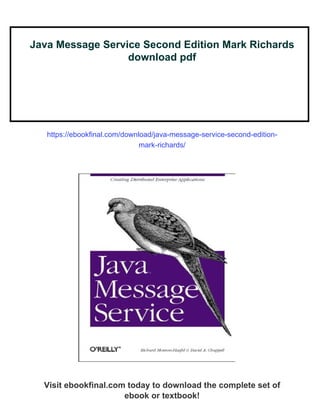



![Java Message Service, Second Edition
by Mark Richards, Richard Monson-Haefel, and David A. Chappell
Copyright © 2009 Mark Richards. All rights reserved.
Printed in the United States of America.
Published by O’Reilly Media, Inc., 1005 Gravenstein Highway North, Sebastopol, CA 95472.
O’Reilly books may be purchased for educational, business, or sales promotional use. Online editions
are also available for most titles (http://my.safaribooksonline.com). For more information, contact our
corporate/institutional sales department: 800-998-9938 or corporate@oreilly.com.
Editors: Mike Loukides and Julie Steele
Production Editor: Sarah Schneider
Production Services: Appingo, Inc.
Cover Designer: Karen Montgomery
Interior Designer: David Futato
Illustrator: Robert Romano
Printing History:
May 2009: Second Edition.
O’Reilly and the O’Reilly logo are registered trademarks of O’Reilly Media, Inc. Java Message Service,
Second Edition, the image of a passenger pigeon, and related trade dress are trademarks of O’Reilly
Media, Inc.
Many of the designations used by manufacturers and sellers to distinguish their products are claimed as
trademarks. Where those designations appear in this book, and O’Reilly Media, Inc. was aware of a
trademark claim, the designations have been printed in caps or initial caps.
While every precaution has been taken in the preparation of this book, the publisher and authors assume
no responsibility for errors or omissions, or for damages resulting from the use of the information con-
tained herein.
ISBN: 978-0-596-52204-9
[C]
1242320347](https://image.slidesharecdn.com/41470-250622225157-e2b958fd/85/Java-Message-Service-Second-Edition-Mark-Richards-7-320.jpg)