22-10-2008


                          This Presentation Courtesy of the
                          International SOA Symposium
                          October 7-8, 2008 Amsterdam Arena
                          www.soasymposium.com
                          info@soasymposium.com


                                          Founding Sponsors


Platinum Sponsors


Gold Sponsors       Silver Sponsors


                         GET /Connected
                      Web Integration the Starbucks Way


                                 Dr. Jim Webber
                            http://jim.webber.name


                                                                      1
22-10-2008


              Roadmap
• A little Swedish
• Some home truths
  – About Web Services and the Web
• Implementing Workflows
  – The Starbuck’s example
• Q&A


Jag heter Jim und kommer du
           England
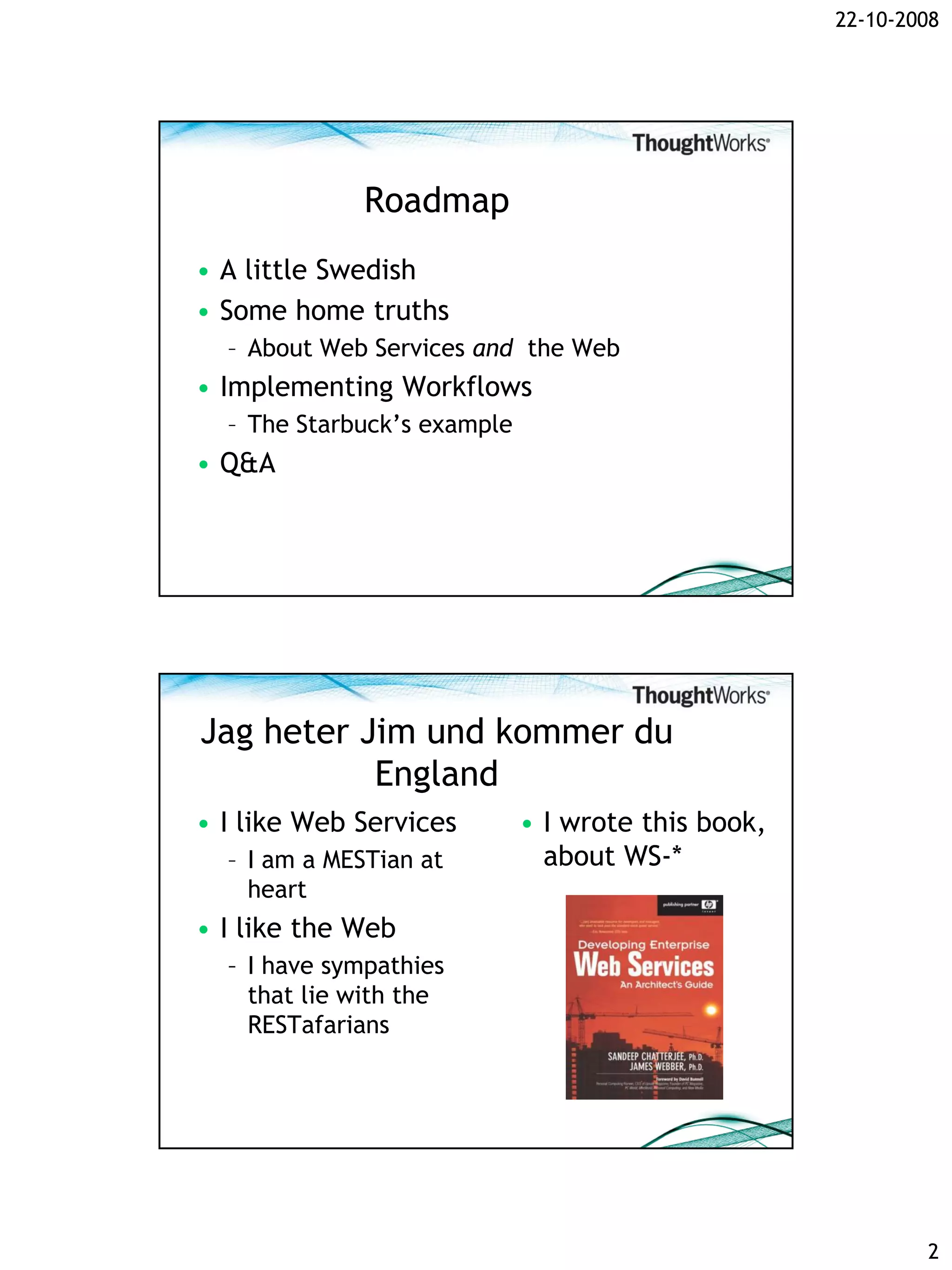
• I like Web Services        • I wrote this book,
  – I am a MESTian at          about WS-*
    heart
• I like the Web
  – I have sympathies
    that lie with the
    RESTafarians


                                                            2
22-10-2008


 Jag heter Jim und kommer du
            England
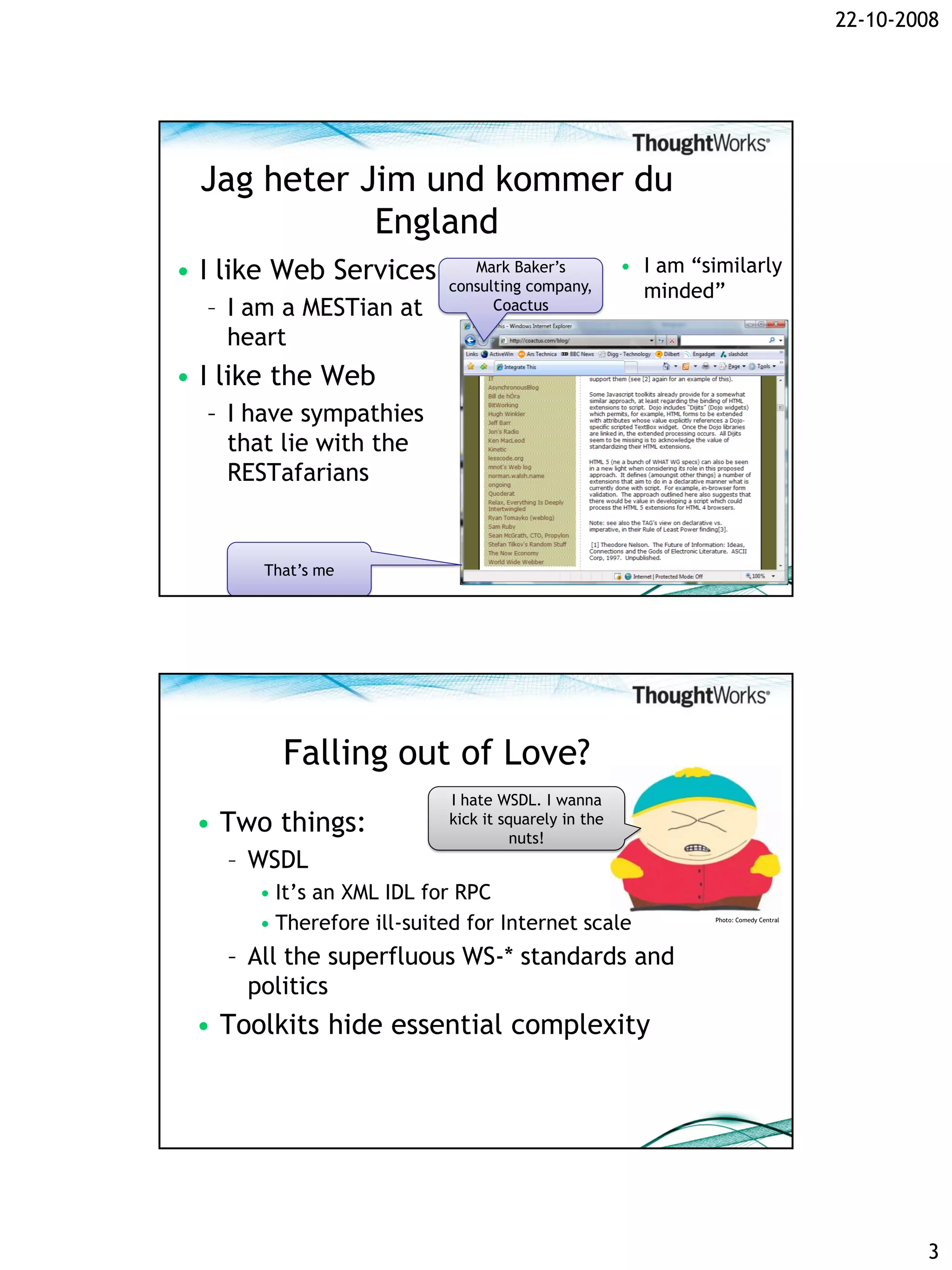
• I like Web Services        Mark Baker’s           • I am “similarly
                          consulting company,         minded”
  – I am a MESTian at           Coactus

    heart
• I like the Web
  – I have sympathies
    that lie with the
    RESTafarians


       That’s me


         Falling out of Love?
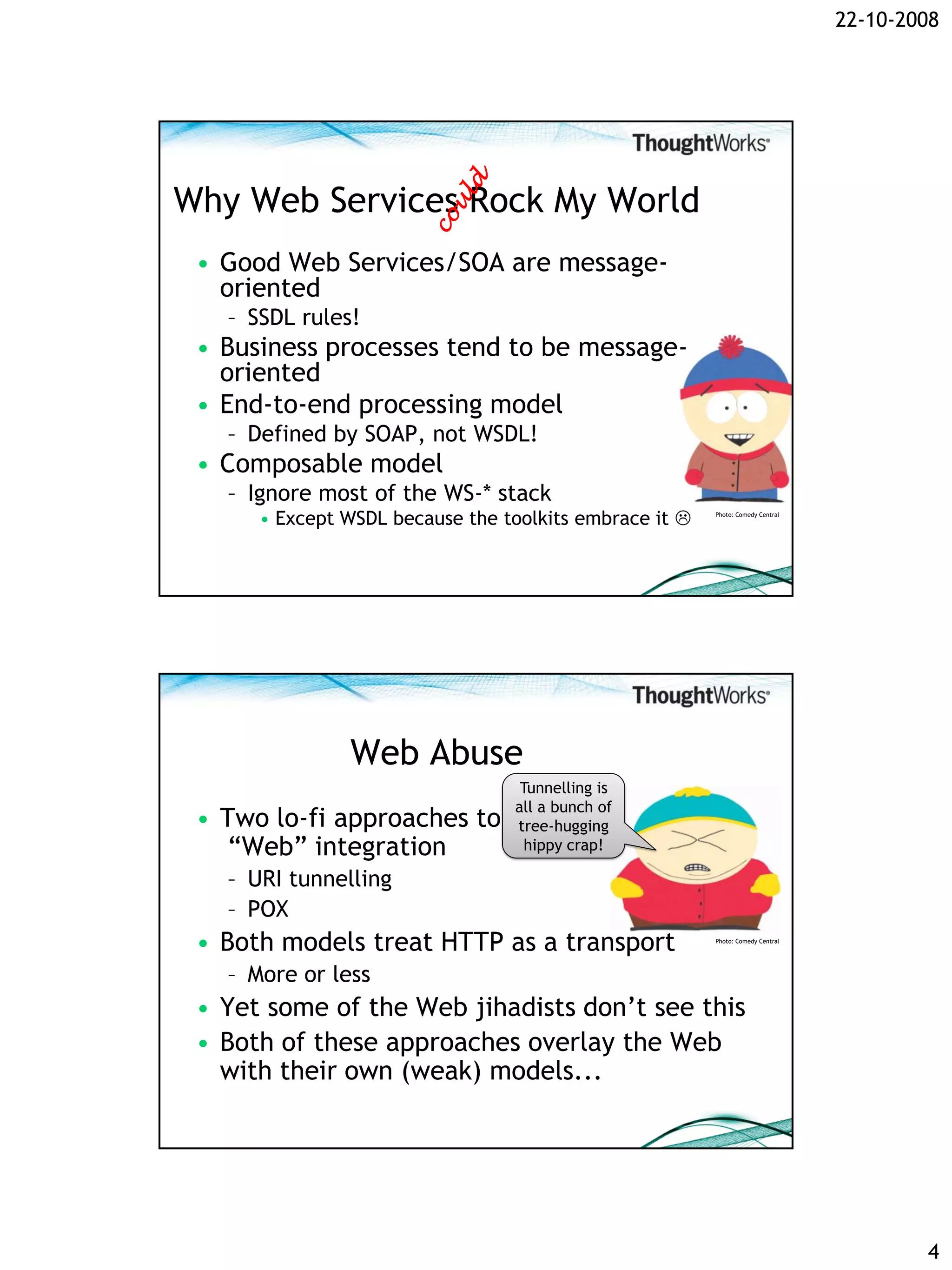
                          I hate WSDL. I wanna
 • Two things:            kick it squarely in the
                                    nuts!
    – WSDL
      • It’s an XML IDL for RPC
      • Therefore ill-suited for Internet scale               Photo: Comedy Central


    – All the superfluous WS-* standards and
      politics
 • Toolkits hide essential complexity


                                                                                              3
22-10-2008


Why Web Services Rock My World
 • Good Web Services/SOA are message-
   oriented
   – SSDL rules!
 • Business processes tend to be message-
   oriented
 • End-to-end processing model
   – Defined by SOAP, not WSDL!
 • Composable model
   – Ignore most of the WS-* stack
      • Except WSDL because the toolkits embrace it    Photo: Comedy Central


               Web Abuse
                                  Tunnelling is
                                 all a bunch of
 • Two lo-fi approaches to       tree-hugging
    “Web” integration              hippy crap!

   – URI tunnelling
   – POX
 • Both models treat HTTP as a transport                Photo: Comedy Central


   – More or less
 • Yet some of the Web jihadists don’t see this
 • Both of these approaches overlay the Web
   with their own (weak) models...


                                                                                        4
22-10-2008


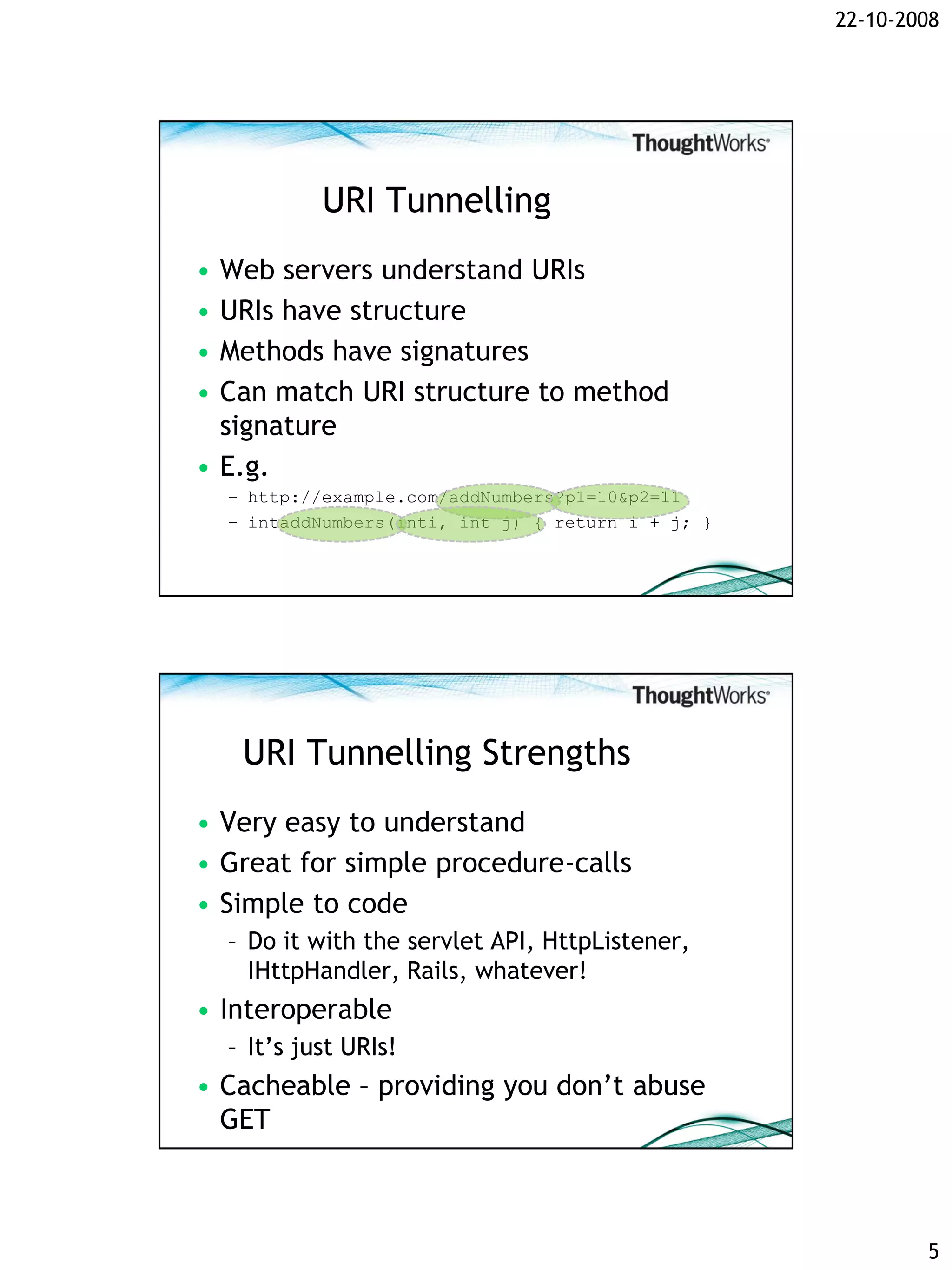
             URI Tunnelling
• Web servers understand URIs
• URIs have structure
• Methods have signatures
• Can match URI structure to method
  signature
• E.g.
    – http://example.com/addNumbers?p1=10&p2=11
    – intaddNumbers(inti, int j) { return i + j; }


     URI Tunnelling Strengths
• Very easy to understand
• Great for simple procedure-calls
• Simple to code
    – Do it with the servlet API, HttpListener,
      IHttpHandler, Rails, whatever!
• Interoperable
    – It’s just URIs!
• Cacheable – providing you don’t abuse
  GET


                                                             5
22-10-2008


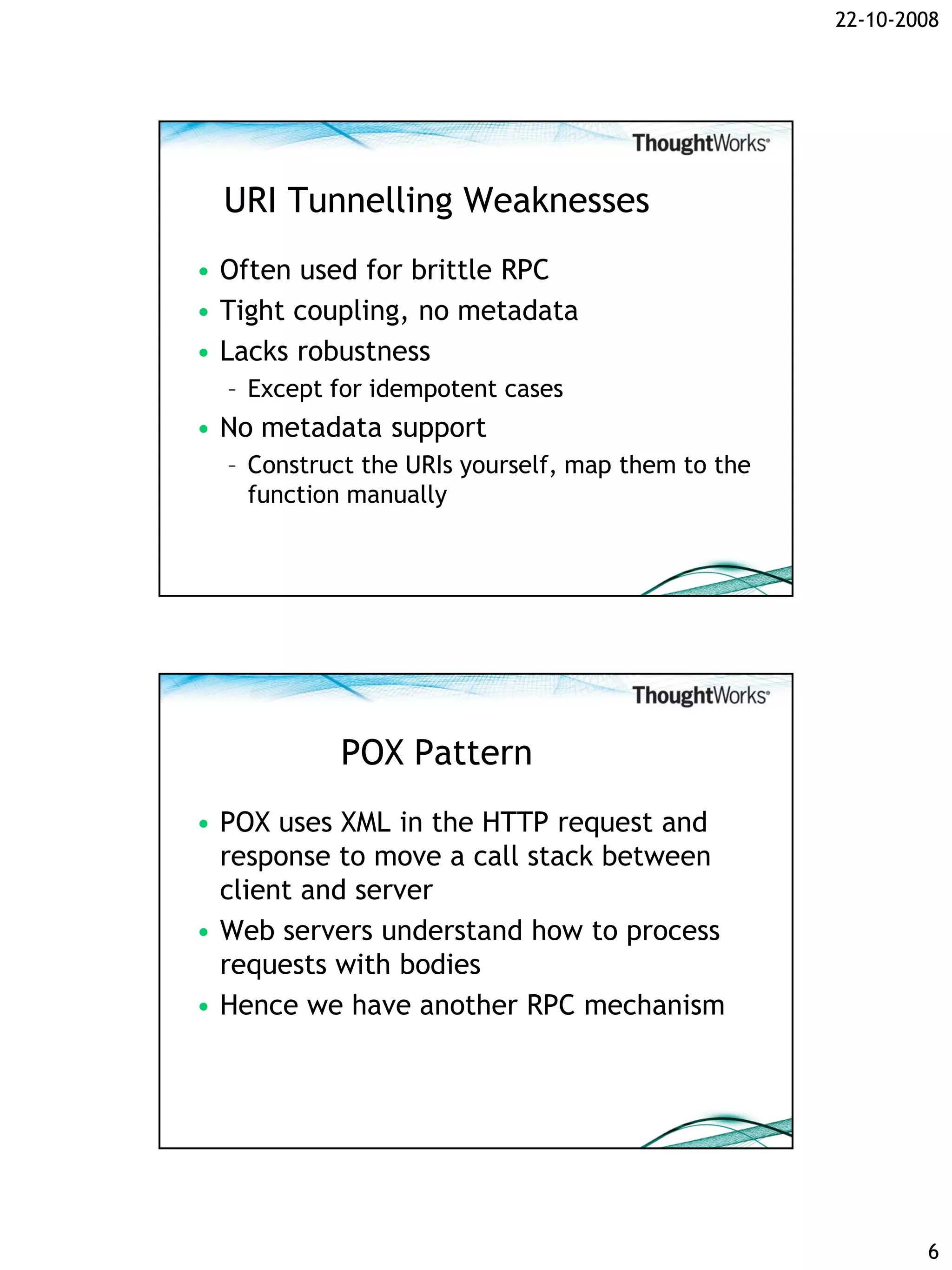
  URI Tunnelling Weaknesses
• Often used for brittle RPC
• Tight coupling, no metadata
• Lacks robustness
  – Except for idempotent cases
• No metadata support
  – Construct the URIs yourself, map them to the
    function manually


           POX Pattern
• POX uses XML in the HTTP request and
  response to move a call stack between
  client and server
• Web servers understand how to process
  requests with bodies
• Hence we have another RPC mechanism


                                                           6
22-10-2008


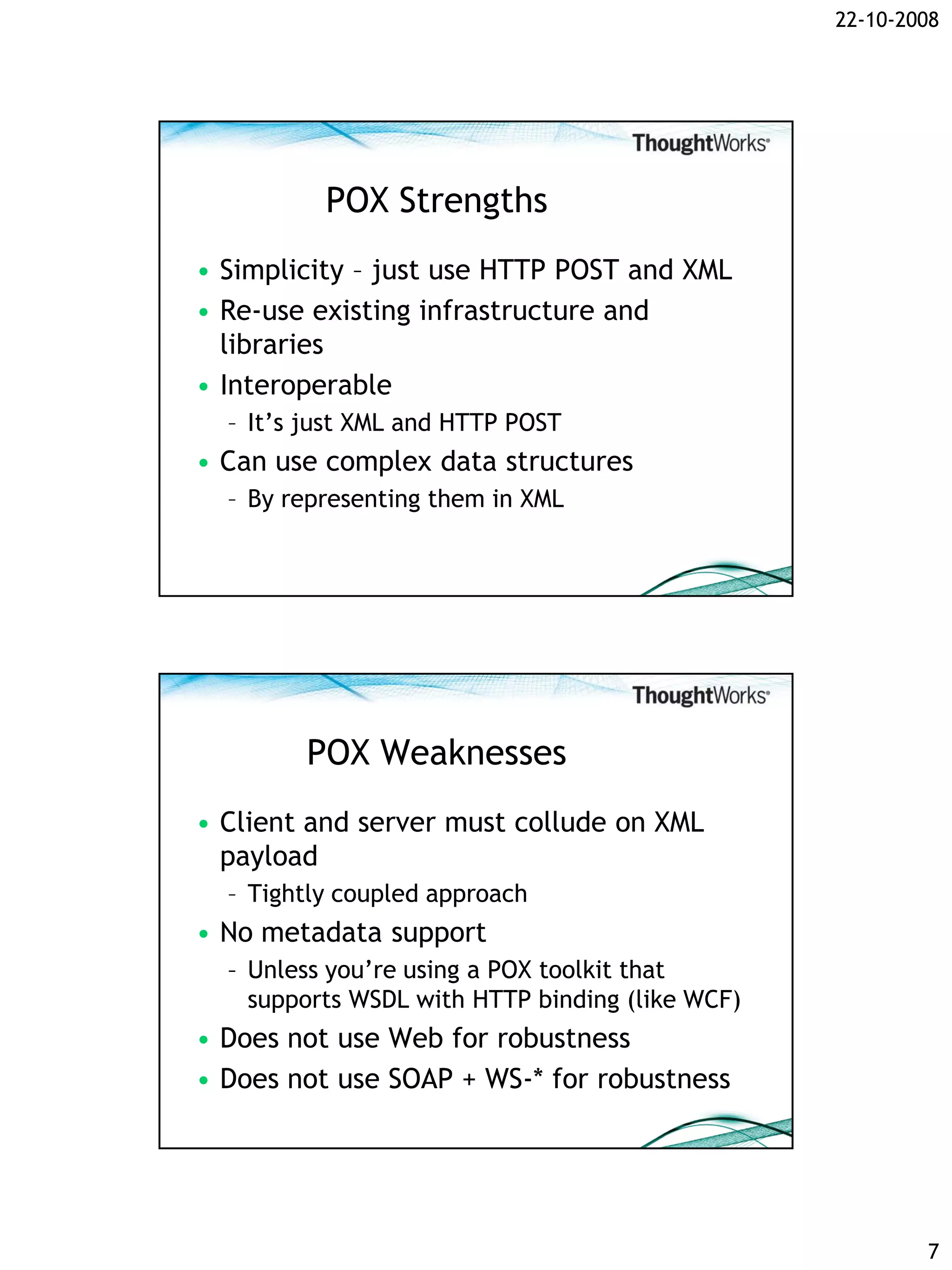
          POX Strengths
• Simplicity – just use HTTP POST and XML
• Re-use existing infrastructure and
  libraries
• Interoperable
  – It’s just XML and HTTP POST
• Can use complex data structures
  – By representing them in XML


        POX Weaknesses
• Client and server must collude on XML
  payload
  – Tightly coupled approach
• No metadata support
  – Unless you’re using a POX toolkit that
    supports WSDL with HTTP binding (like WCF)
• Does not use Web for robustness
• Does not use SOAP + WS-* for robustness


                                                         7
22-10-2008


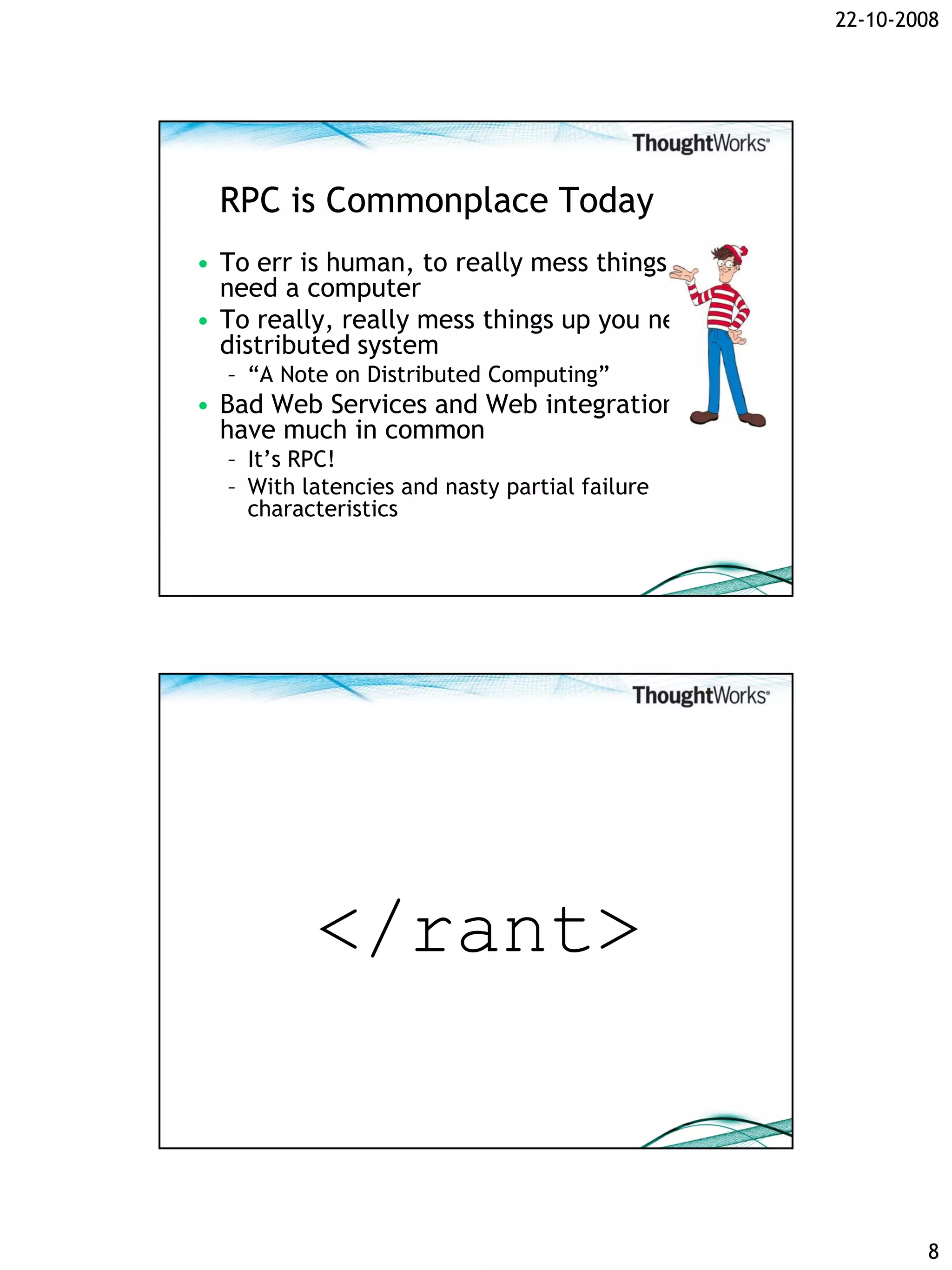
 RPC is Commonplace Today
• To err is human, to really mess things up you
  need a computer
• To really, really mess things up you need a
  distributed system
  – “A Note on Distributed Computing”
• Bad Web Services and Web integration
  have much in common
  – It’s RPC!
  – With latencies and nasty partial failure
    characteristics


          </rant>


                                                          8
22-10-2008


        Web Fundamentals
• To embrace the Web, we need to
  understand how it works
• The Web is a distributed hypermedia
  model
   – It doesn’t try to hide that distribution from
     you!
• Our challenge:
   – Figure out the mapping between our problem
     domain and the underlying Web platform


  Why the Web was Inevitable
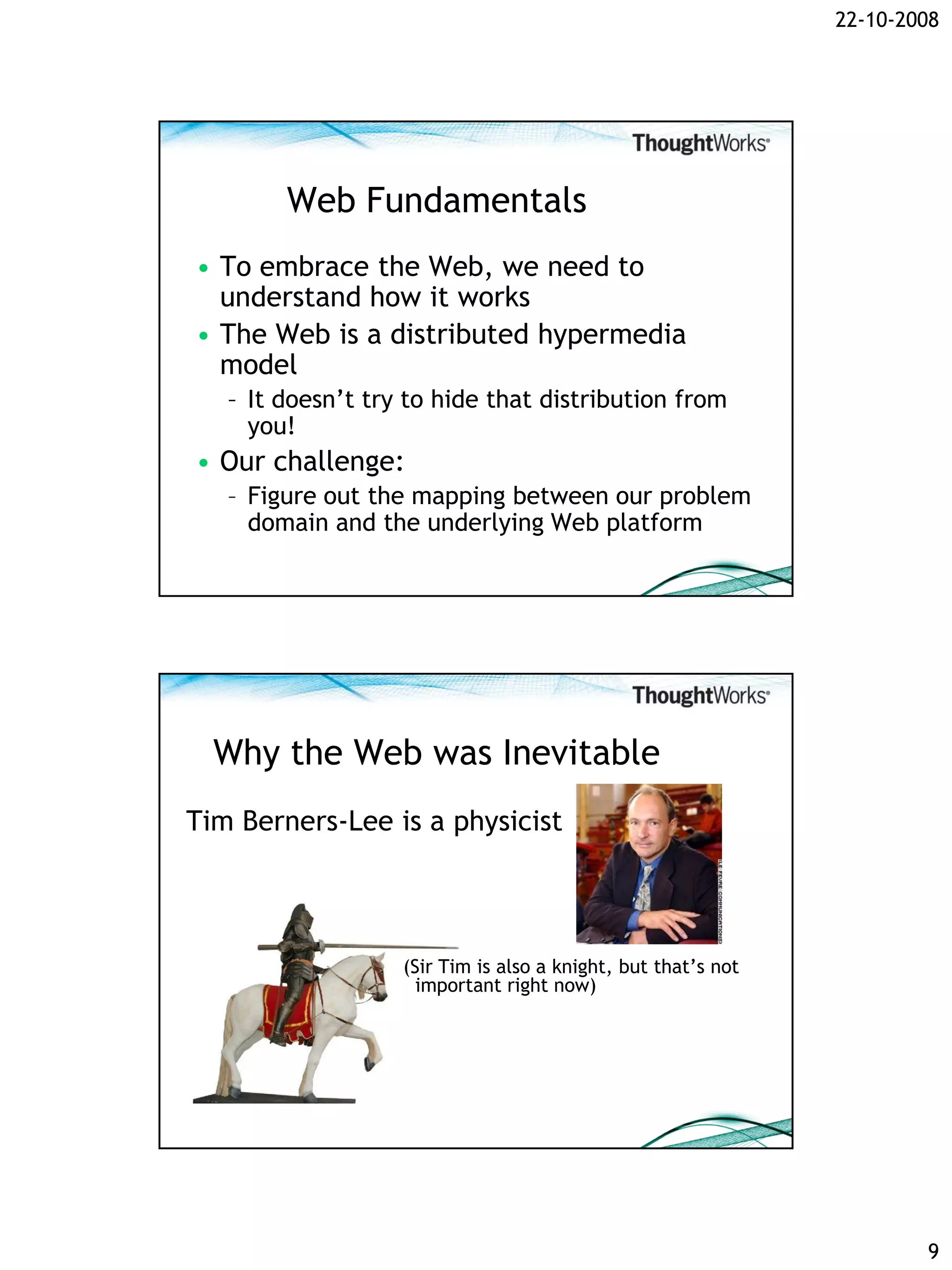
Tim Berners-Lee is a physicist


                   (Sir Tim is also a knight, but that’s not
                     important right now)


                                                                       9
22-10-2008


Why the Web was Inevitable
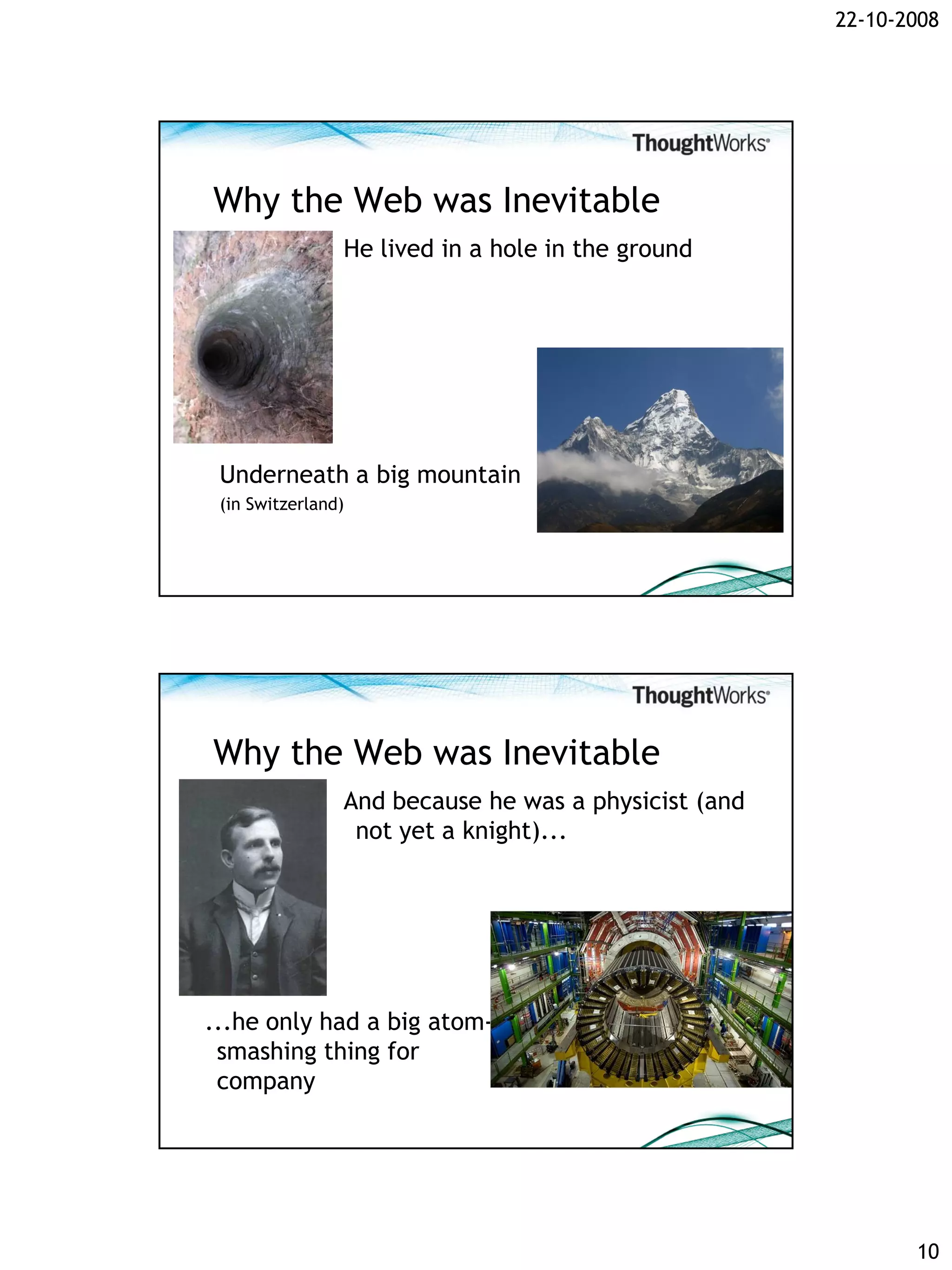
                He lived in a hole in the ground


 Underneath a big mountain
 (in Switzerland)


Why the Web was Inevitable
                And because he was a physicist (and
                 not yet a knight)...


...he only had a big atom-
 smashing thing for
 company


                                                             10
22-10-2008


Why the Web was Inevitable
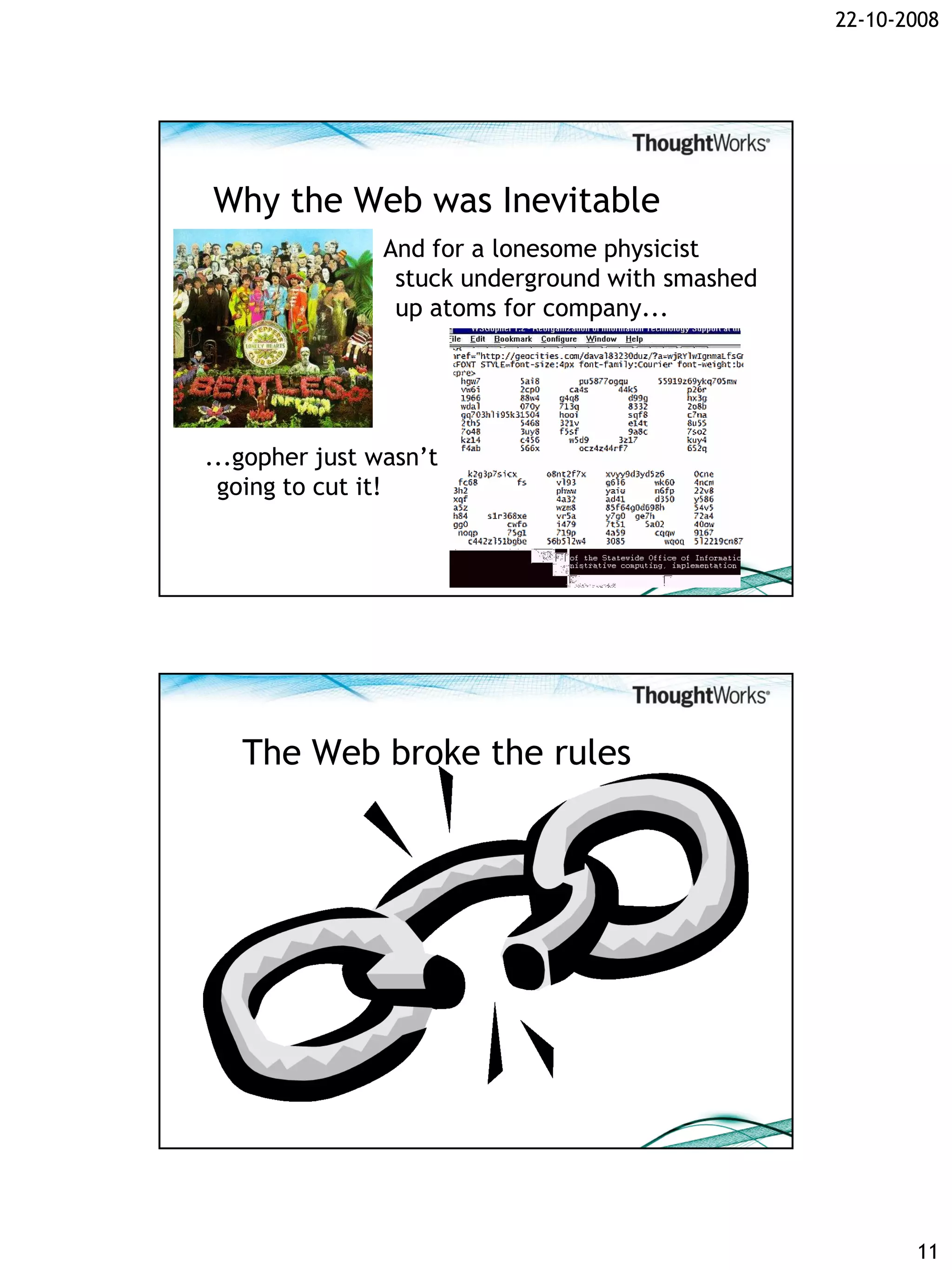
                And for a lonesome physicist
                 stuck underground with smashed
                 up atoms for company...


...gopher just wasn’t
 going to cut it!


   The Web broke the rules


                                                         11
22-10-2008


          Web Characteristics
•   Scalable
•   Fault-tolerant
•   Recoverable
•   Secure
•   Loosely coupled

• Precisely the same characteristics we
  want in business software systems!


Tenets for Web-based Services
• Resource-based
    – Rather than service-oriented (the Web is not MOM!)
• Addressability
    – Interesting things should have names
• Statelessness
    – No stateful conversations with a resource
• Representations
    – Resources can be serialised into representations
• Links
    – Resources
• Uniform Interface
    – No plumbing surprises!


                                                                  12
22-10-2008


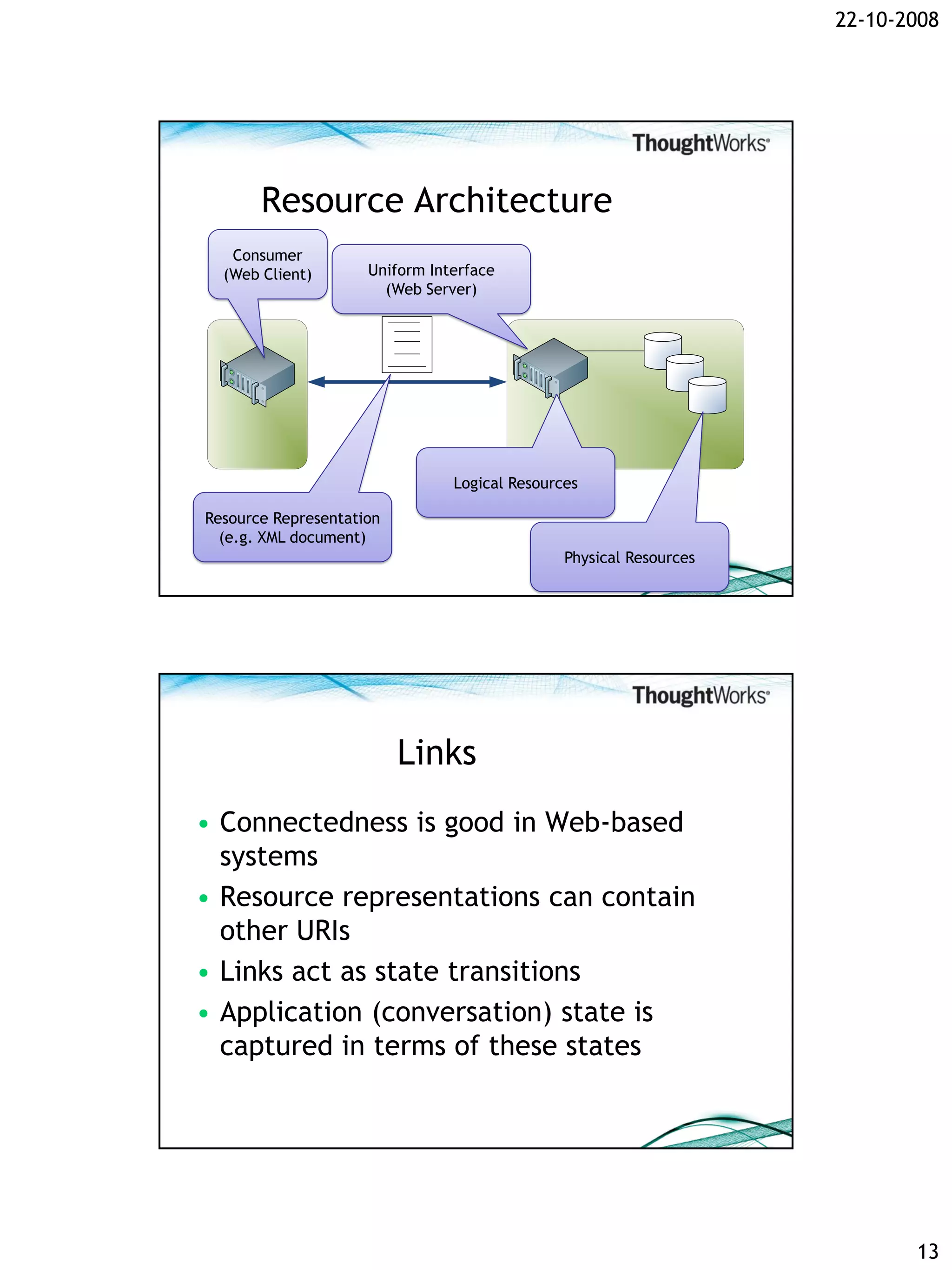
       Resource Architecture
   Consumer
  (Web Client)       Uniform Interface
                       (Web Server)


                                Logical Resources

Resource Representation
  (e.g. XML document)
                                               Physical Resources


                          Links
• Connectedness is good in Web-based
  systems
• Resource representations can contain
  other URIs
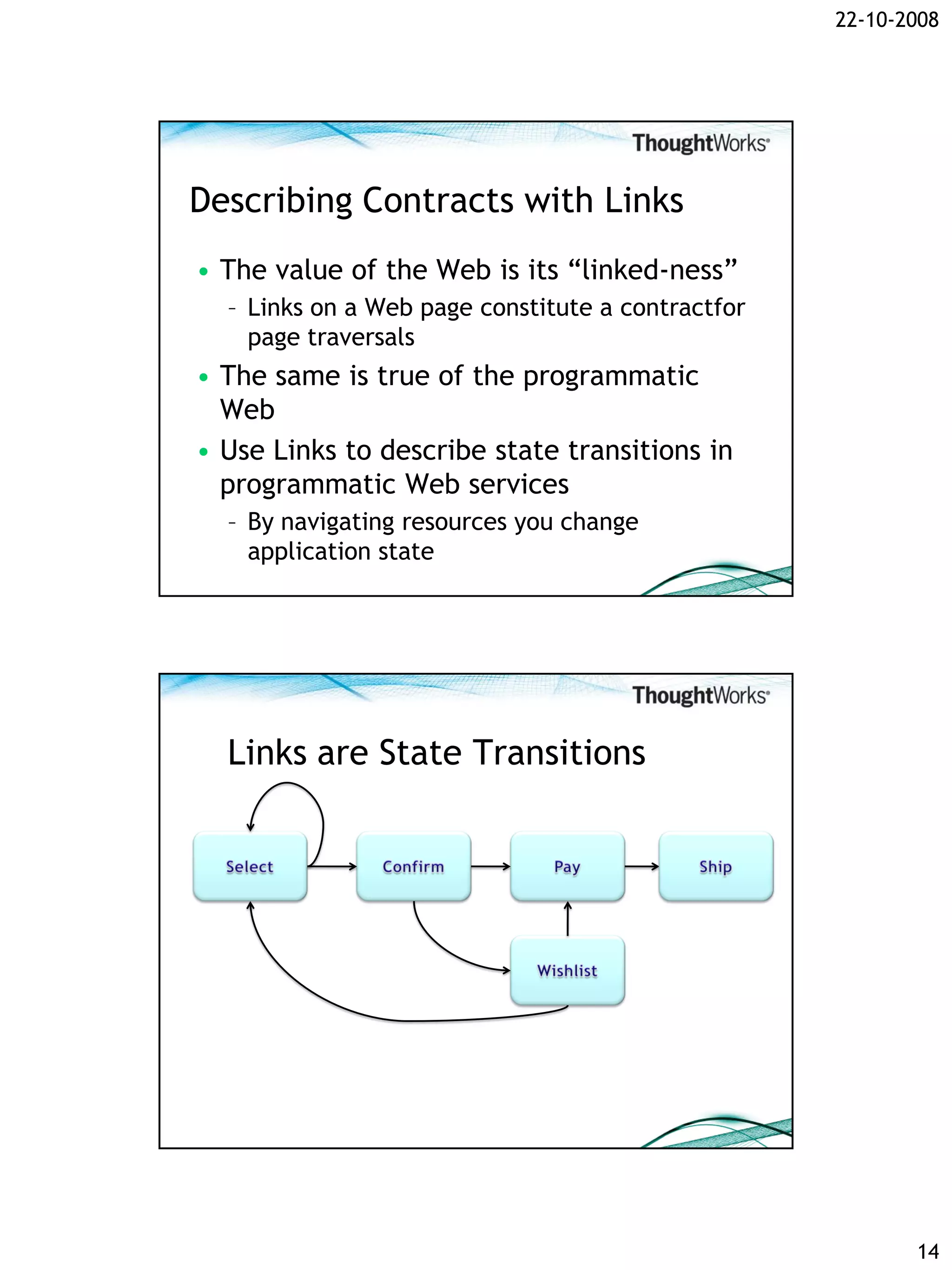
• Links act as state transitions
• Application (conversation) state is
  captured in terms of these states


                                                                           13
22-10-2008


Describing Contracts with Links
• The value of the Web is its “linked-ness”
  – Links on a Web page constitute a contractfor
    page traversals
• The same is true of the programmatic
  Web
• Use Links to describe state transitions in
  programmatic Web services
  – By navigating resources you change
    application state


  Links are State Transitions


                                                          14
22-10-2008


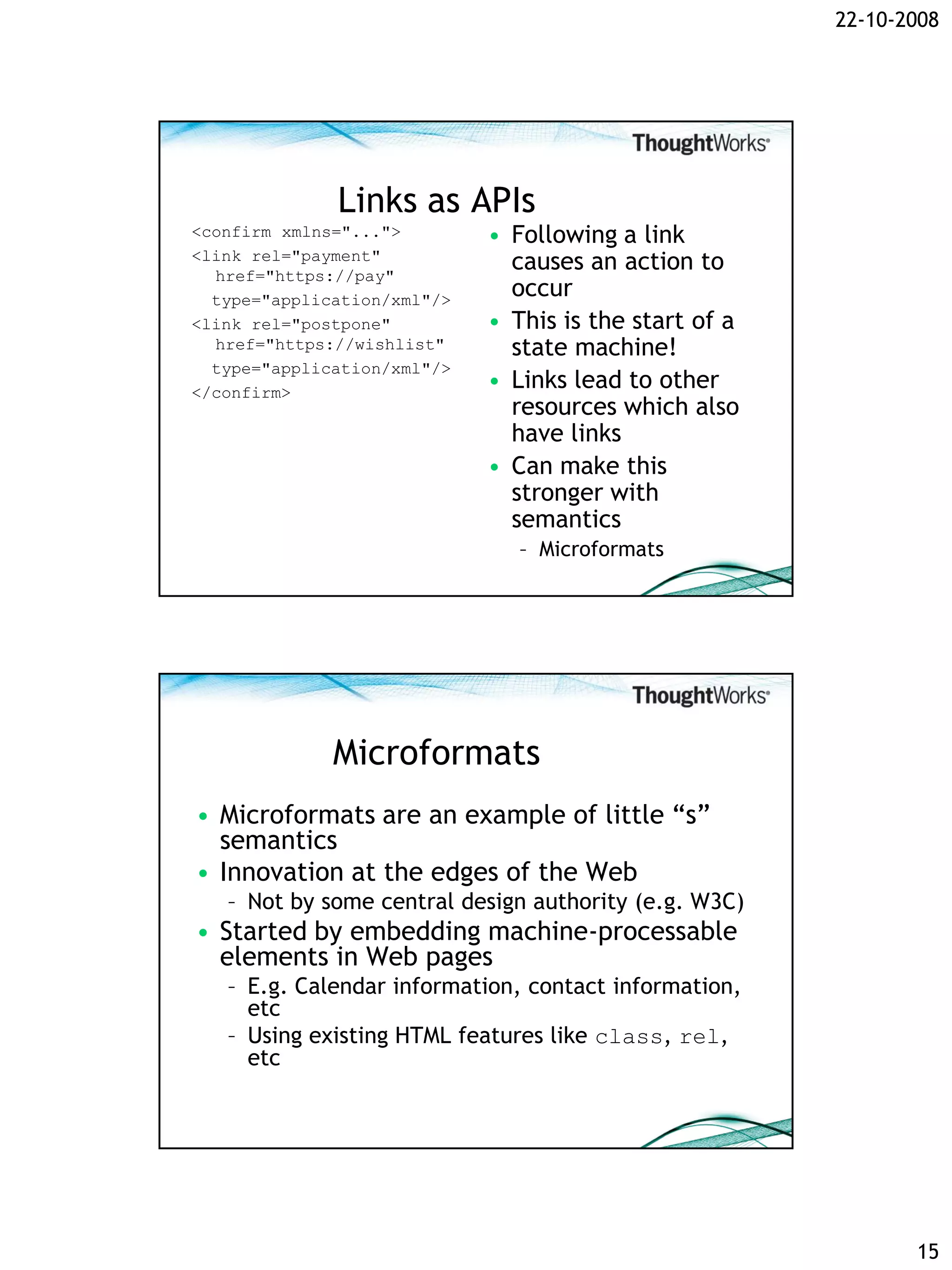
              Links as APIs
<confirm xmlns="...">        • Following a link
<link rel="payment"
  href="https://pay"
                               causes an action to
  type="application/xml"/>
                               occur
<link rel="postpone"         • This is the start of a
  href="https://wishlist"      state machine!
  type="application/xml"/>
</confirm>
                             • Links lead to other
                               resources which also
                               have links
                             • Can make this
                               stronger with
                               semantics
                                – Microformats


              Microformats
• Microformats are an example of little “s”
  semantics
• Innovation at the edges of the Web
   – Not by some central design authority (e.g. W3C)
• Started by embedding machine-processable
  elements in Web pages
   – E.g. Calendar information, contact information,
     etc
   – Using existing HTML features like class, rel,
     etc


                                                               15
22-10-2008


 Microformats and Resources
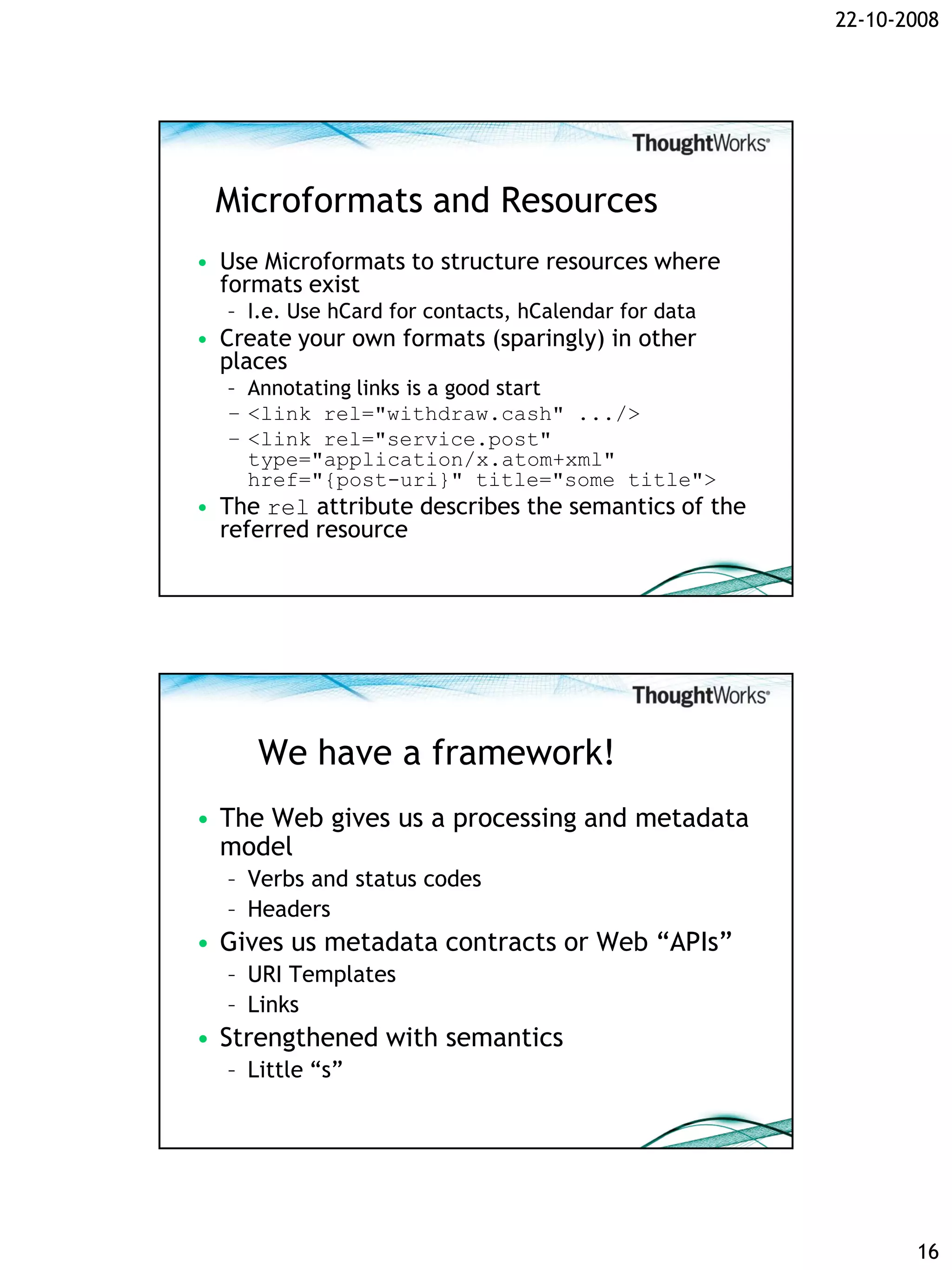
• Use Microformats to structure resources where
  formats exist
  – I.e. Use hCard for contacts, hCalendar for data
• Create your own formats (sparingly) in other
  places
  – Annotating links is a good start
  – <link rel="withdraw.cash" .../>
  – <link rel="service.post"
    type="application/x.atom+xml"
    href="{post-uri}" title="some title">
• The rel attribute describes the semantics of the
  referred resource


     We have a framework!
• The Web gives us a processing and metadata
  model
  – Verbs and status codes
  – Headers
• Gives us metadata contracts or Web “APIs”
  – URI Templates
  – Links
• Strengthened with semantics
  – Little “s”


                                                             16
22-10-2008


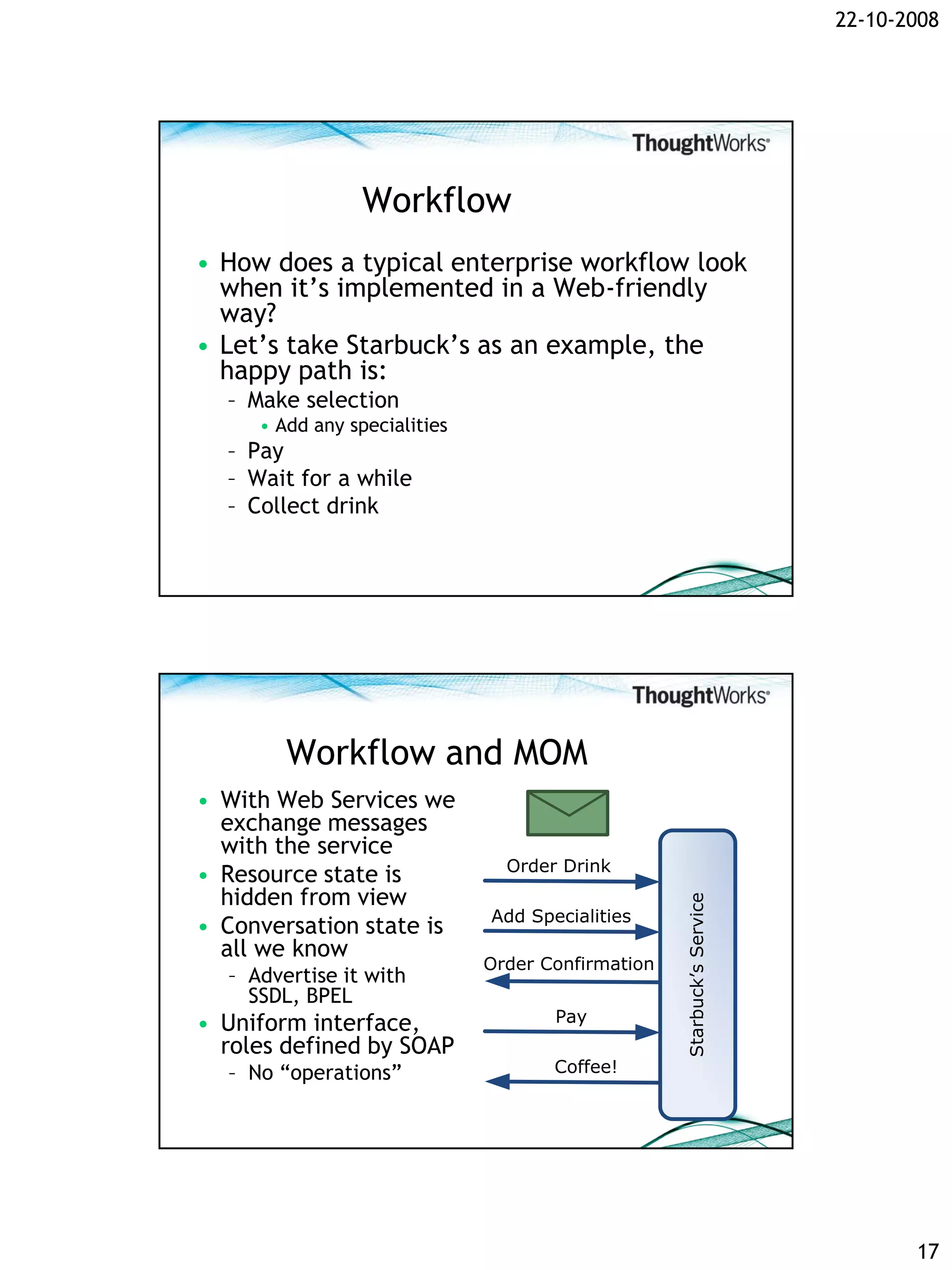
                 Workflow
• How does a typical enterprise workflow look
  when it’s implemented in a Web-friendly
  way?
• Let’s take Starbuck’s as an example, the
  happy path is:
  – Make selection
     • Add any specialities
  – Pay
  – Wait for a while
  – Collect drink


        Workflow and MOM
• With Web Services we
  exchange messages
  with the service
                                Order Drink
• Resource state is
  hidden from view
                                                   Starbuck’s Service


                              Add Specialities
• Conversation state is
  all we know
                              Order Confirmation
  – Advertise it with
    SSDL, BPEL
• Uniform interface,                 Pay
  roles defined by SOAP
  – No “operations”                  Coffee!


                                                                               17
22-10-2008


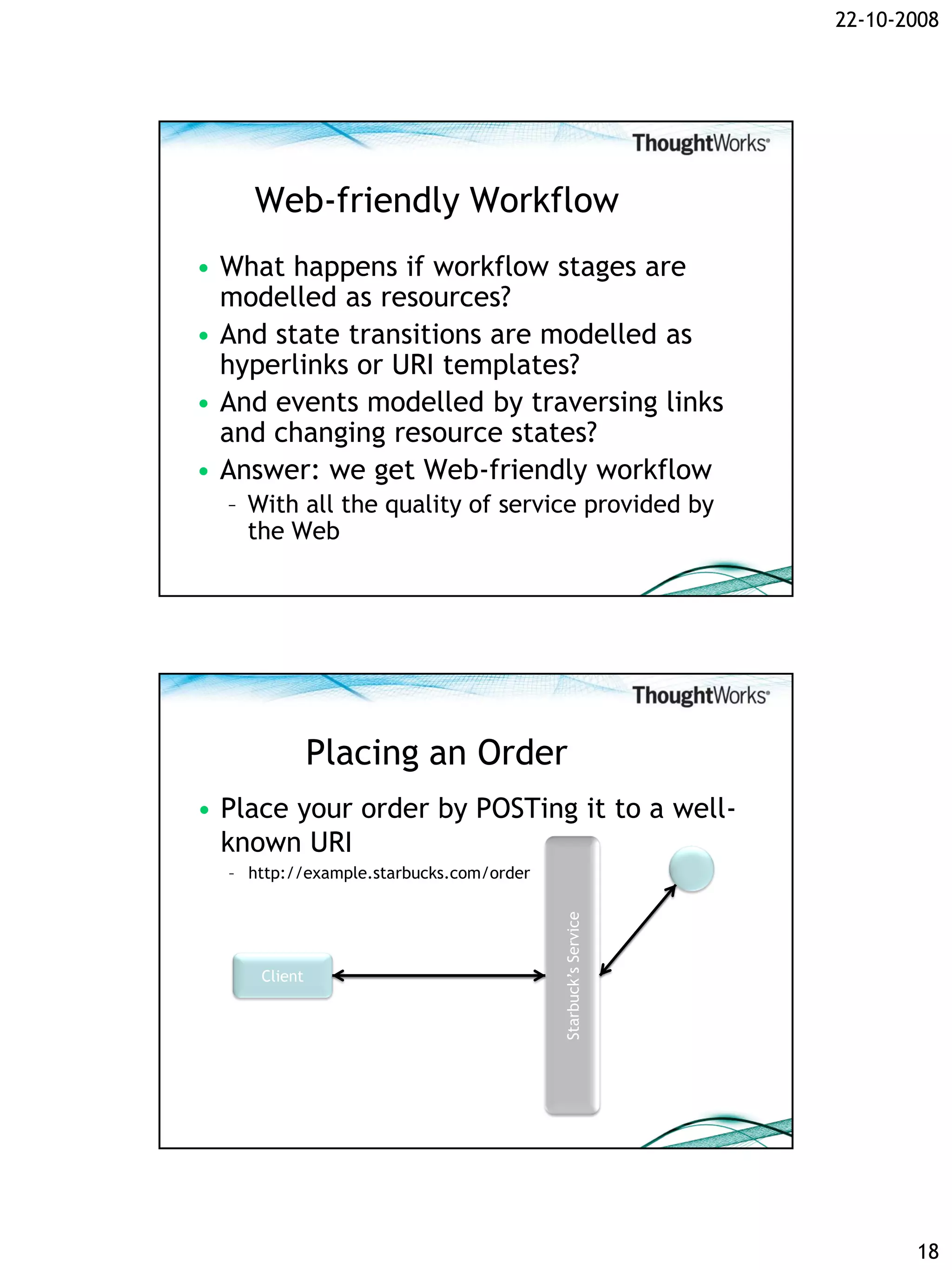
     Web-friendly Workflow
• What happens if workflow stages are
  modelled as resources?
• And state transitions are modelled as
  hyperlinks or URI templates?
• And events modelled by traversing links
  and changing resource states?
• Answer: we get Web-friendly workflow
  – With all the quality of service provided by
    the Web


              Placing an Order
• Place your order by POSTing it to a well-
  known URI
  – http://example.starbucks.com/order
                                         Starbuck’s Service


     Client


                                                                     18
22-10-2008


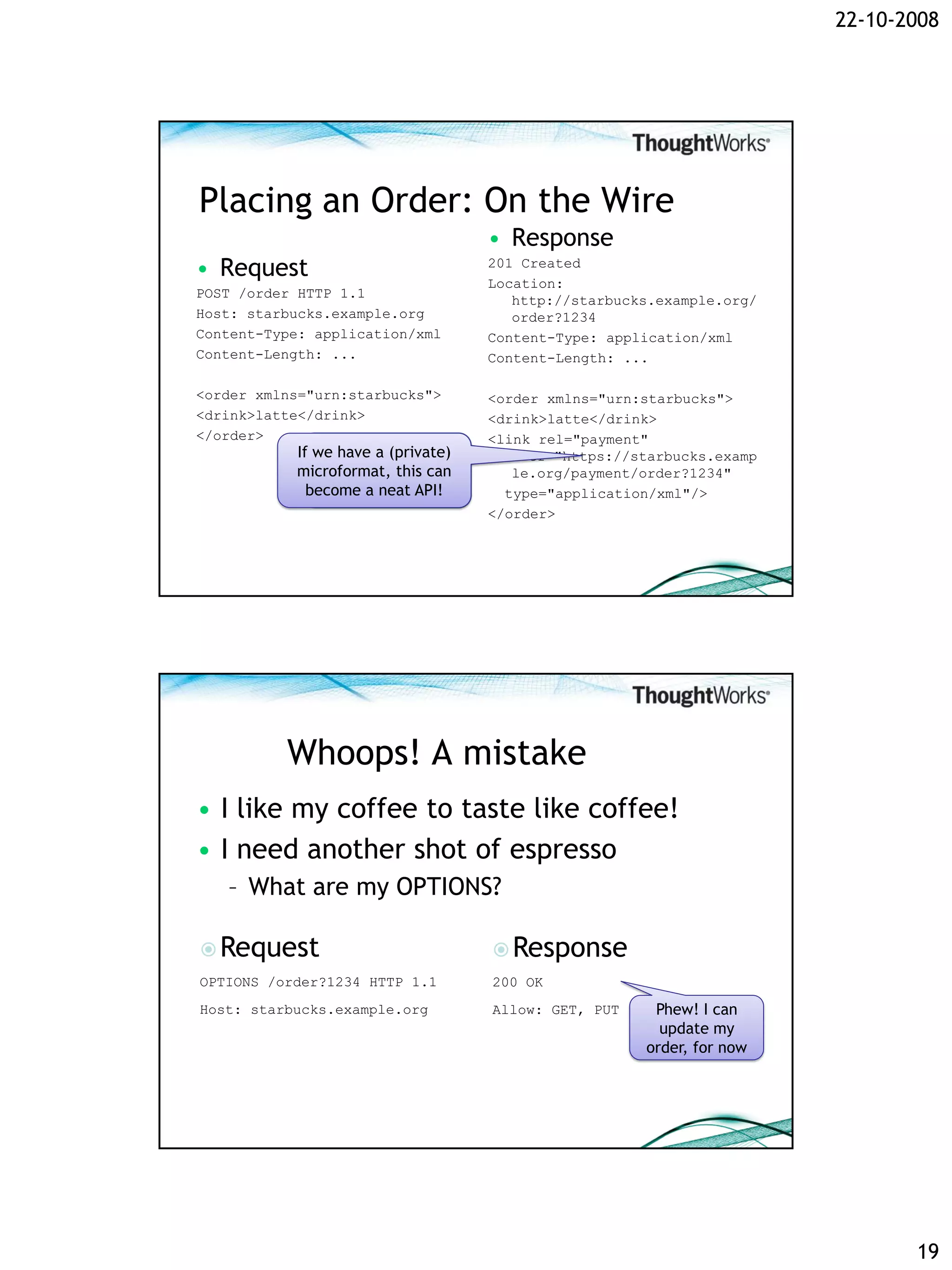
Placing an Order: On the Wire
                                      • Response
• Request                             201 Created
                                      Location:
POST /order HTTP 1.1
                                         http://starbucks.example.org/
Host: starbucks.example.org              order?1234
Content-Type: application/xml         Content-Type: application/xml
Content-Length: ...                   Content-Length: ...

<order xmlns="urn:starbucks">         <order xmlns="urn:starbucks">
<drink>latte</drink>                  <drink>latte</drink>
</order>                              <link rel="payment"
           If we have a (private)        href="https://starbucks.examp
                A link! Is this the
           microformat, this can         le.org/payment/order?1234"
                 start of an API?
             become a neat API!         type="application/xml"/>
                                      </order>


          Whoops! A mistake
• I like my coffee to taste like coffee!
• I need another shot of espresso
   – What are my OPTIONS?

 Request                              Response
OPTIONS /order?1234 HTTP 1.1          200 OK
Host: starbucks.example.org           Allow: GET, PUT    Phew! I can
                                                          update my
                                                        order, for now


                                                                                19
22-10-2008


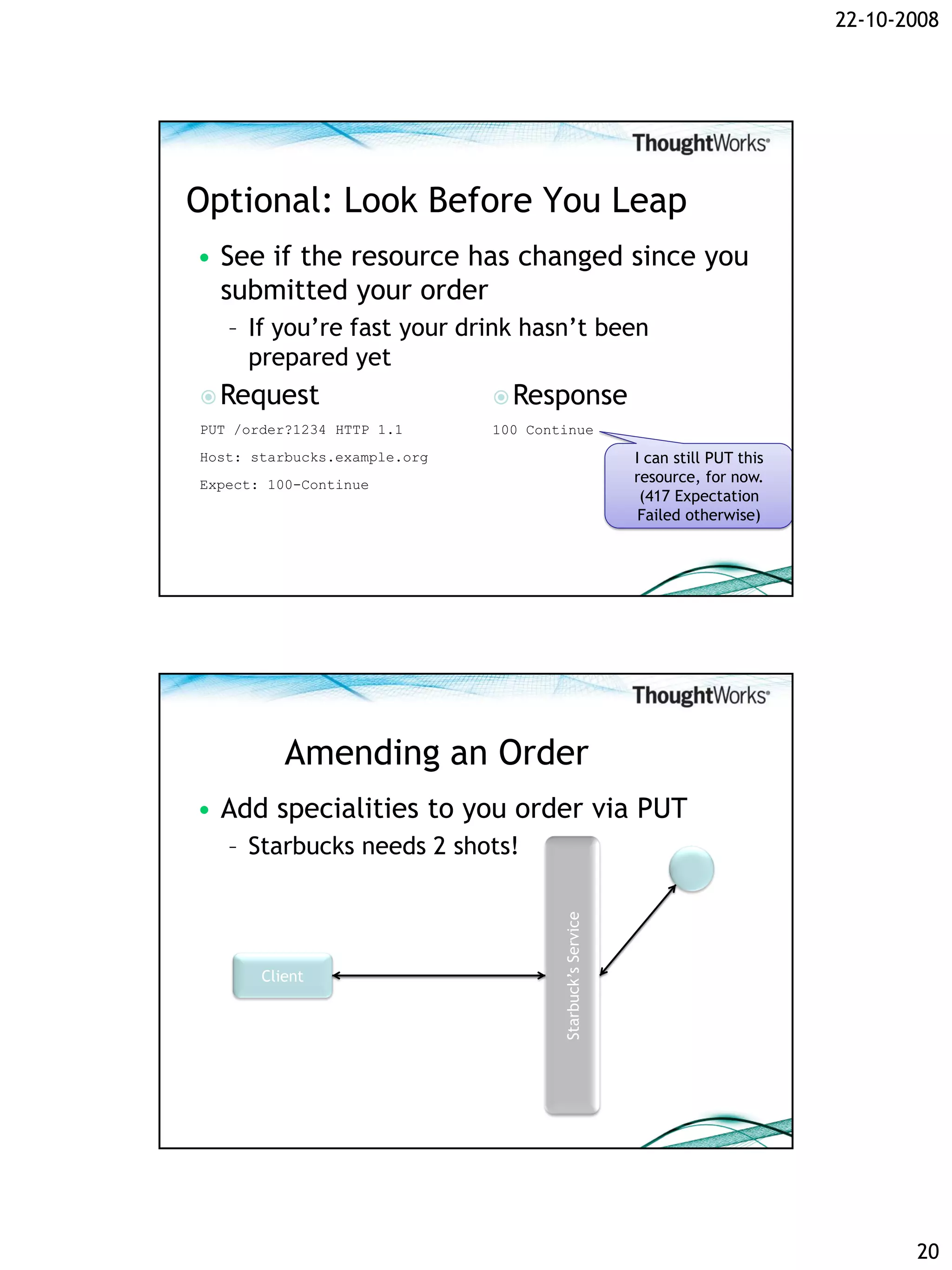
Optional: Look Before You Leap
• See if the resource has changed since you
  submitted your order
   – If you’re fast your drink hasn’t been
     prepared yet
 Request                      Response
PUT /order?1234 HTTP 1.1      100 Continue
Host: starbucks.example.org                                I can still PUT this
Expect: 100-Continue                                       resource, for now.
                                                            (417 Expectation
                                                            Failed otherwise)


          Amending an Order
• Add specialities to you order via PUT
   – Starbucks needs 2 shots!
                                      Starbuck’s Service


       Client


                                                                                         20
22-10-2008


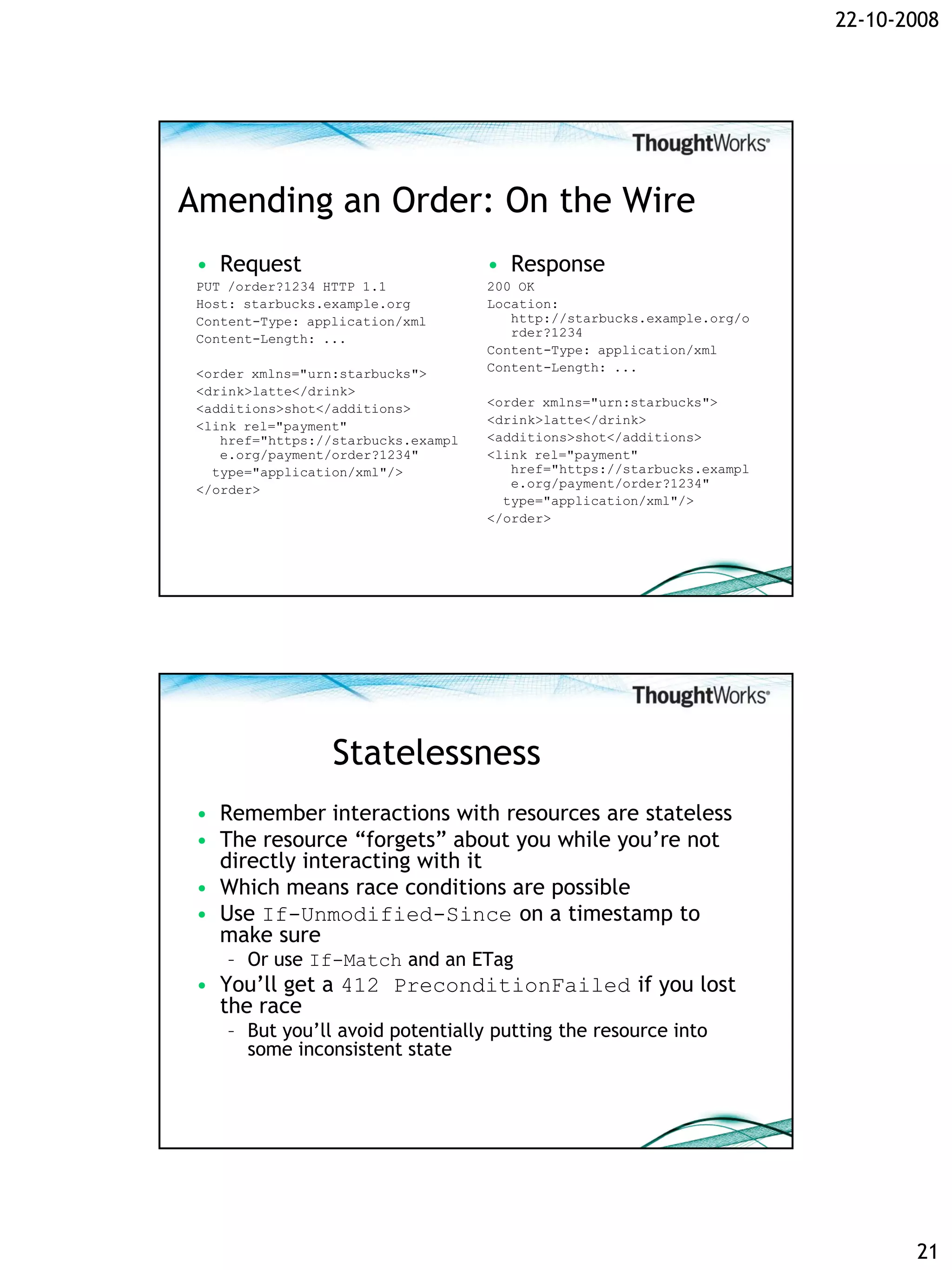
Amending an Order: On the Wire
 • Request                           • Response
 PUT /order?1234 HTTP 1.1            200 OK
 Host: starbucks.example.org         Location:
 Content-Type: application/xml          http://starbucks.example.org/o
 Content-Length: ...                    rder?1234
                                     Content-Type: application/xml
 <order xmlns="urn:starbucks">       Content-Length: ...
 <drink>latte</drink>
 <additions>shot</additions>         <order xmlns="urn:starbucks">
 <link rel="payment"                 <drink>latte</drink>
    href="https://starbucks.exampl   <additions>shot</additions>
    e.org/payment/order?1234"        <link rel="payment"
   type="application/xml"/>             href="https://starbucks.exampl
 </order>                               e.org/payment/order?1234"
                                       type="application/xml"/>
                                     </order>


                  Statelessness
 • Remember interactions with resources are stateless
 • The resource “forgets” about you while you’re not
   directly interacting with it
 • Which means race conditions are possible
 • Use If-Unmodified-Since on a timestamp to
   make sure
    – Or use If-Match and an ETag
 • You’ll get a 412 PreconditionFailed if you lost
   the race
    – But you’ll avoid potentially putting the resource into
      some inconsistent state


                                                                                21
22-10-2008


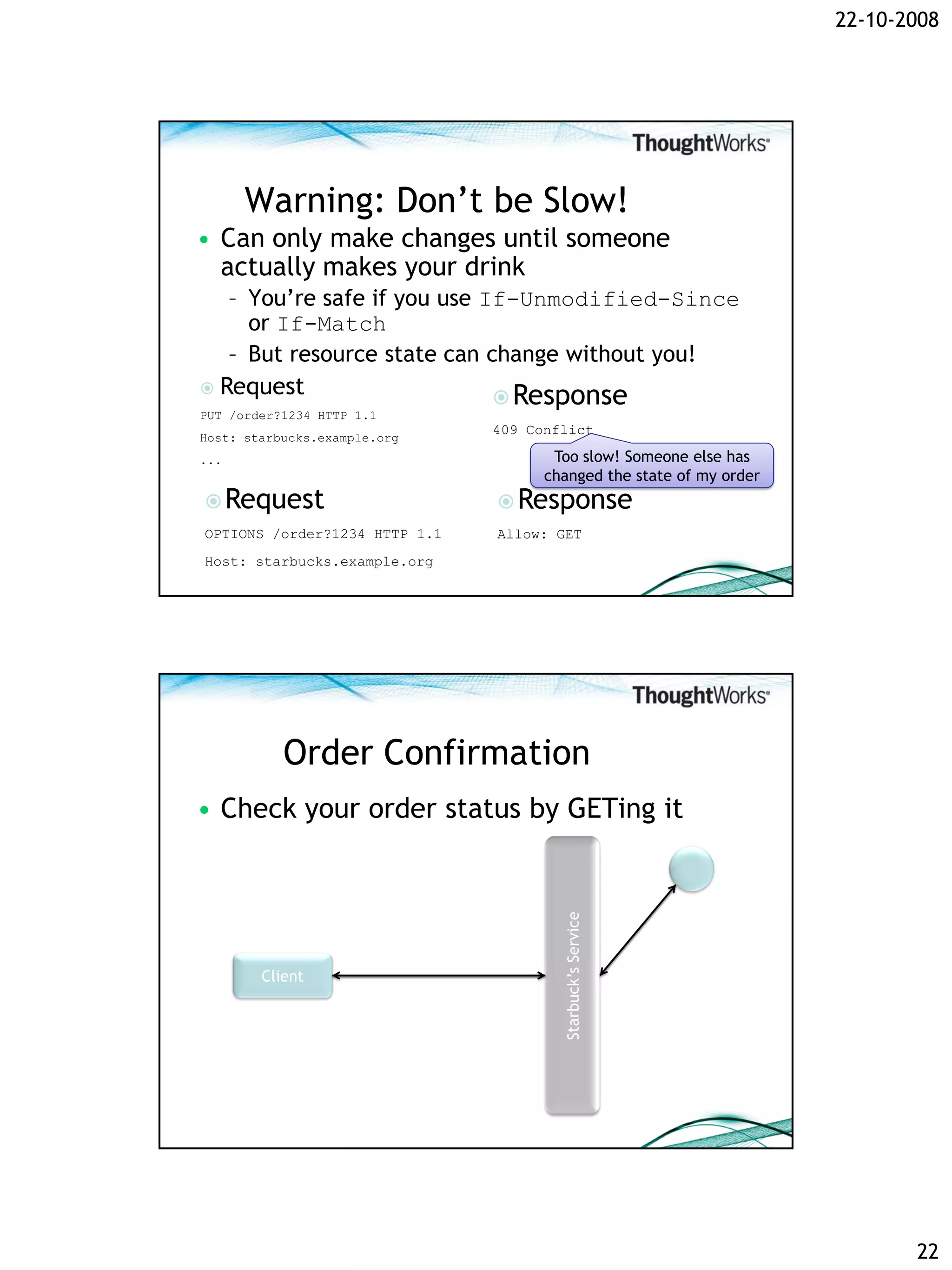
      Warning: Don’t be Slow!
• Can only make changes until someone
  actually makes your drink
   – You’re safe if you use If-Unmodified-Since
     or If-Match
   – But resource state can change without you!
 Request
                              Response
PUT /order?1234 HTTP 1.1
                               409 Conflict
Host: starbucks.example.org
...                                   Too slow! Someone else has
                                     changed the state of my order
 Request                       Response
OPTIONS /order?1234 HTTP 1.1   Allow: GET
Host: starbucks.example.org


           Order Confirmation
• Check your order status by GETing it
                                       Starbuck’s Service


        Client


                                                                            22
22-10-2008


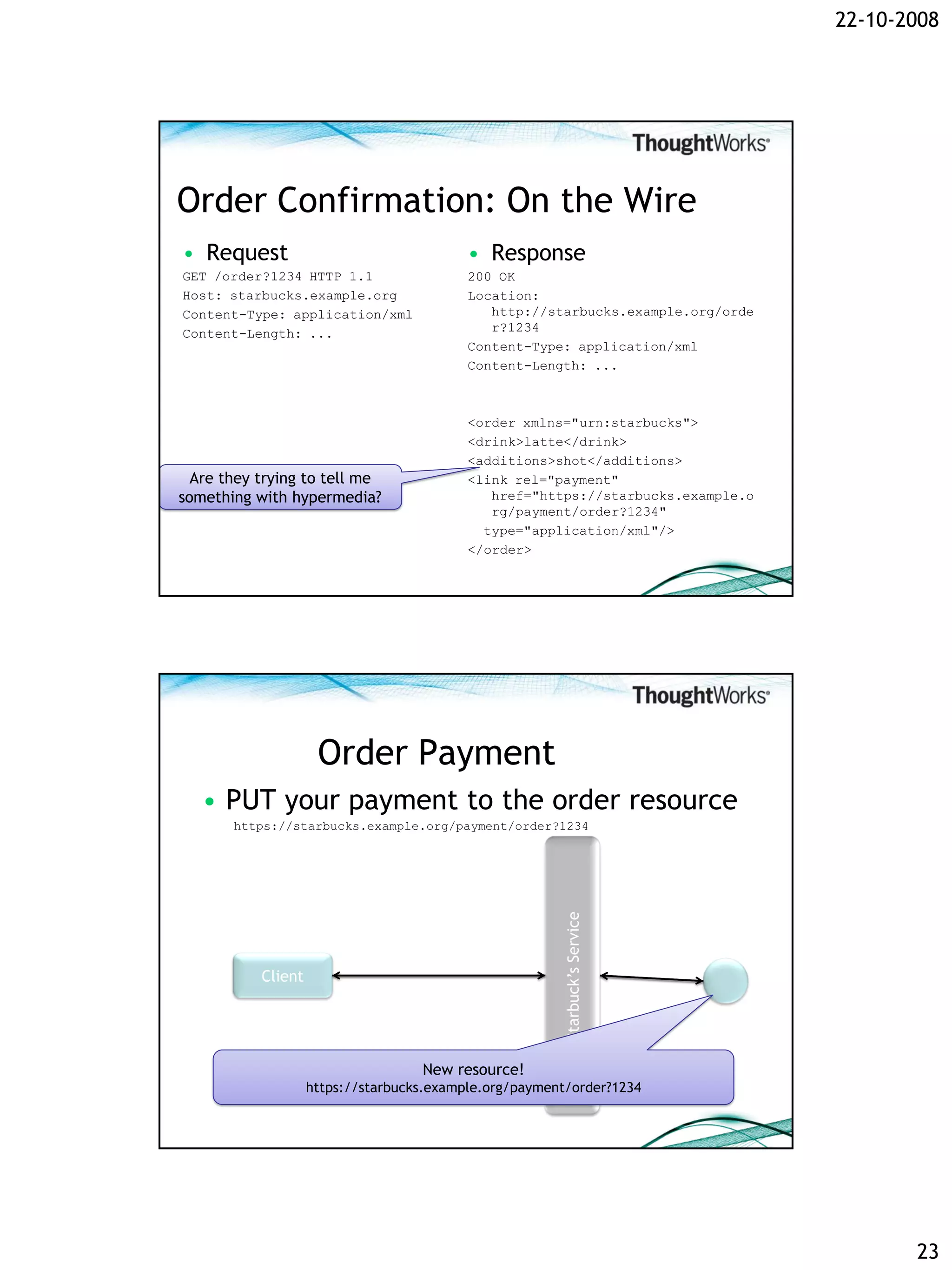
Order Confirmation: On the Wire
• Request                                  • Response
GET /order?1234 HTTP 1.1                   200 OK
Host: starbucks.example.org                Location:
Content-Type: application/xml                 http://starbucks.example.org/orde
Content-Length: ...                           r?1234
                                           Content-Type: application/xml
                                           Content-Length: ...


                                           <order xmlns="urn:starbucks">
                                           <drink>latte</drink>
                                           <additions>shot</additions>
  Are they trying to tell me               <link rel="payment"
something with hypermedia?                    href="https://starbucks.example.o
                                              rg/payment/order?1234"
                                             type="application/xml"/>
                                           </order>


                     Order Payment
   • PUT your payment to the order resource
       https://starbucks.example.org/payment/order?1234
                                                        Starbuck’s Service


           Client


                                    New resource!
                    https://starbucks.example.org/payment/order?1234


                                                                                         23
22-10-2008


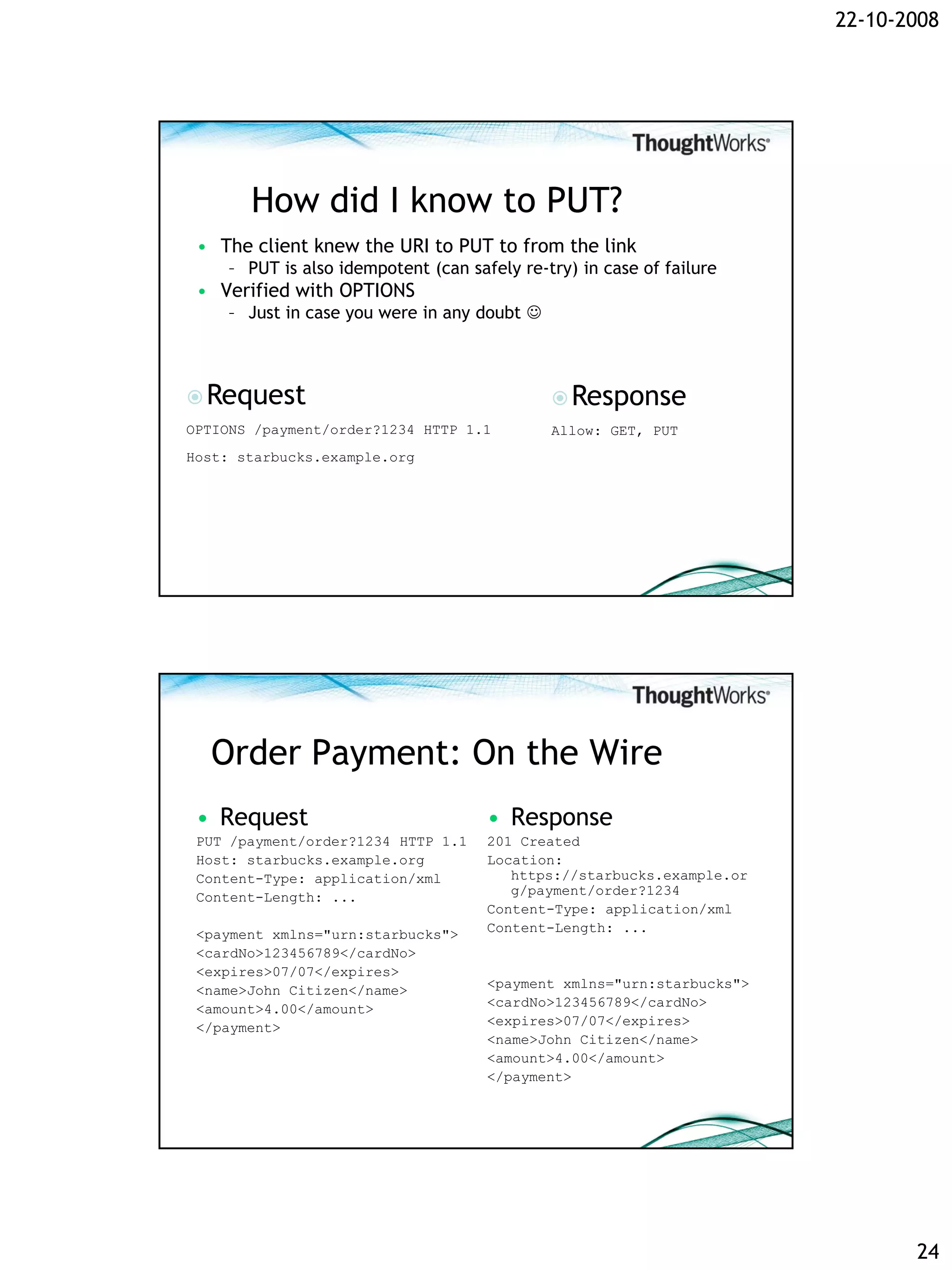
       How did I know to PUT?
 • The client knew the URI to PUT to from the link
    – PUT is also idempotent (can safely re-try) in case of failure
 • Verified with OPTIONS
    – Just in case you were in any doubt 


 Request                                     Response
OPTIONS /payment/order?1234 HTTP 1.1         Allow: GET, PUT
Host: starbucks.example.org


  Order Payment: On the Wire
 • Request                           • Response
 PUT /payment/order?1234 HTTP 1.1    201 Created
 Host: starbucks.example.org         Location:
 Content-Type: application/xml          https://starbucks.example.or
 Content-Length: ...                    g/payment/order?1234
                                     Content-Type: application/xml
 <payment xmlns="urn:starbucks">     Content-Length: ...
 <cardNo>123456789</cardNo>
 <expires>07/07</expires>
 <name>John Citizen</name>           <payment xmlns="urn:starbucks">
 <amount>4.00</amount>               <cardNo>123456789</cardNo>
 </payment>                          <expires>07/07</expires>
                                     <name>John Citizen</name>
                                     <amount>4.00</amount>
                                     </payment>


                                                                              24
22-10-2008


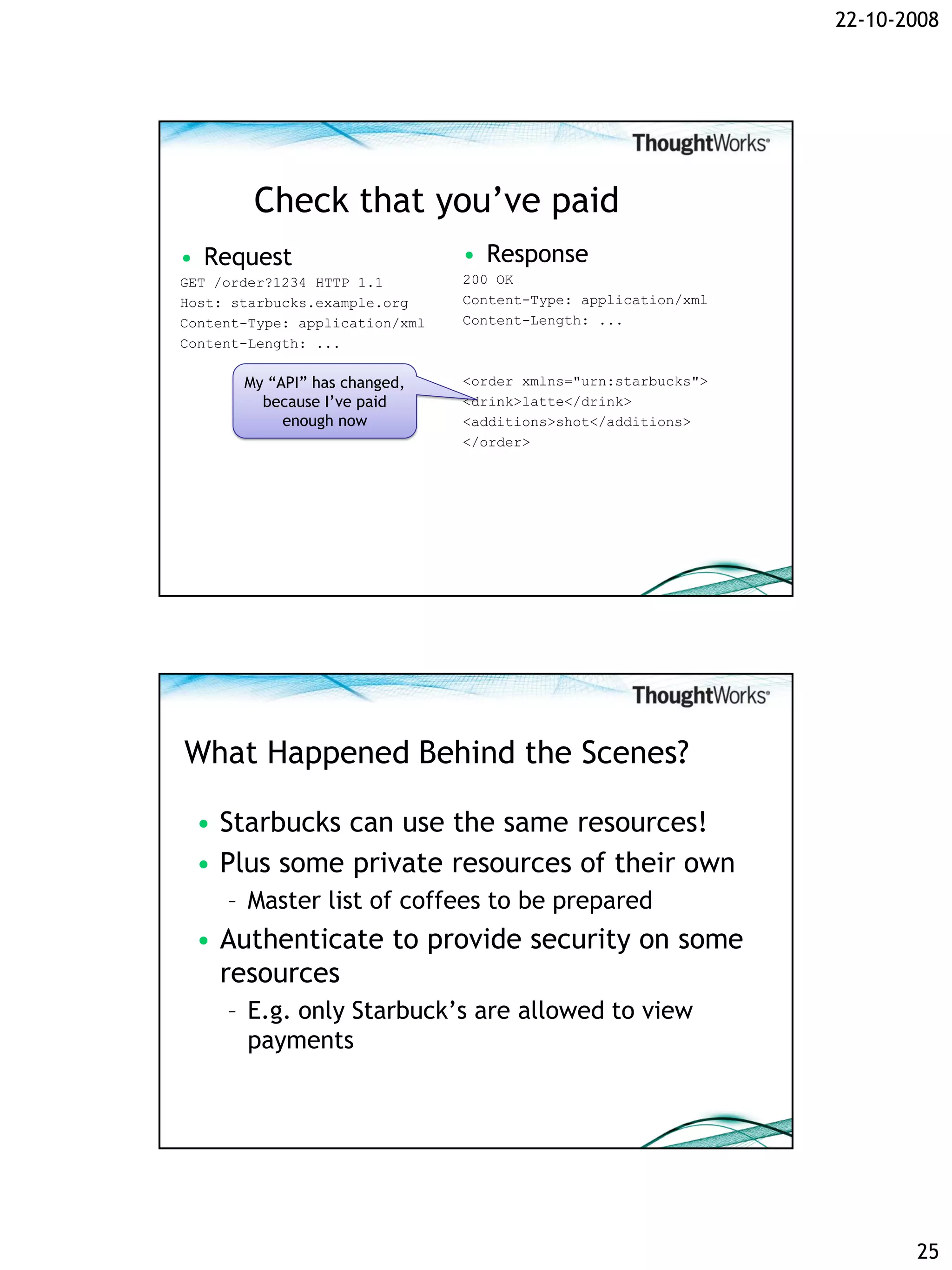
        Check that you’ve paid
• Request                       • Response
GET /order?1234 HTTP 1.1        200 OK
Host: starbucks.example.org     Content-Type: application/xml
Content-Type: application/xml   Content-Length: ...
Content-Length: ...

       My “API” has changed,    <order xmlns="urn:starbucks">
         because I’ve paid      <drink>latte</drink>
            enough now          <additions>shot</additions>
                                </order>


What Happened Behind the Scenes?

 • Starbucks can use the same resources!
 • Plus some private resources of their own
     – Master list of coffees to be prepared
 • Authenticate to provide security on some
   resources
     – E.g. only Starbuck’s are allowed to view
       payments


                                                                       25
22-10-2008


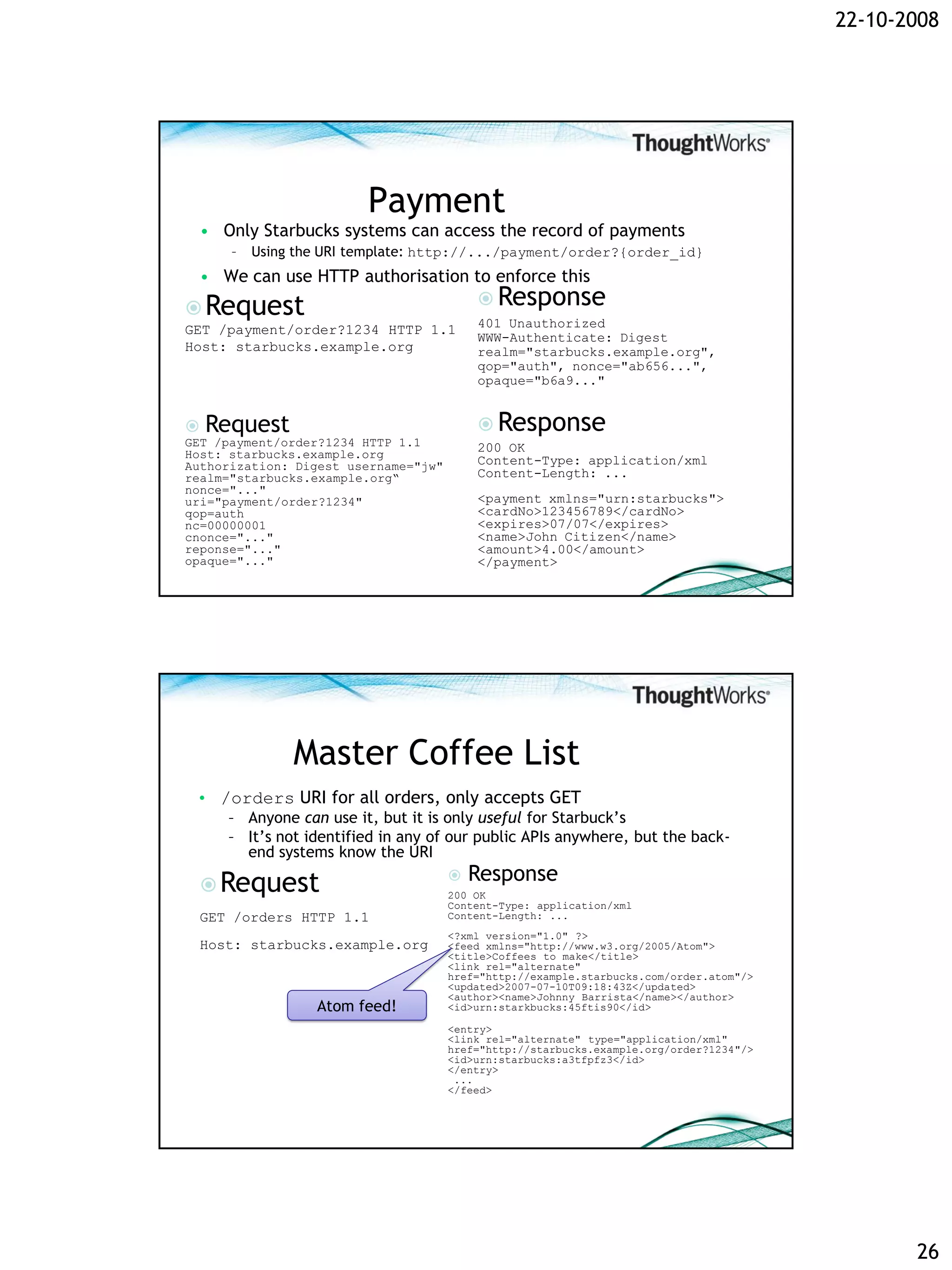
                         Payment
  • Only Starbucks systems can access the record of payments
      –   Using the URI template: http://.../payment/order?{order_id}
  • We can use HTTP authorisation to enforce this
                                           Response
 Request
GET /payment/order?1234 HTTP 1.1          401 Unauthorized
                                          WWW-Authenticate: Digest
Host: starbucks.example.org               realm="starbucks.example.org",
                                          qop="auth", nonce="ab656...",
                                          opaque="b6a9..."


   Request                                Response
GET /payment/order?1234 HTTP 1.1          200 OK
Host: starbucks.example.org
Authorization: Digest username="jw"       Content-Type: application/xml
realm="starbucks.example.org“             Content-Length: ...
nonce="..."
uri="payment/order?1234"                  <payment xmlns="urn:starbucks">
qop=auth                                  <cardNo>123456789</cardNo>
nc=00000001                               <expires>07/07</expires>
cnonce="..."                              <name>John Citizen</name>
reponse="..."                             <amount>4.00</amount>
opaque="..."                              </payment>


               Master Coffee List
 • /orders URI for all orders, only accepts GET
     – Anyone can use it, but it is only useful for Starbuck’s
     – It’s not identified in any of our public APIs anywhere, but the back-
       end systems know the URI
                                      Response
   Request                           200 OK
                                      Content-Type: application/xml
  GET /orders HTTP 1.1                Content-Length: ...
                                      <?xml version="1.0" ?>
  Host: starbucks.example.org         <feed xmlns="http://www.w3.org/2005/Atom">
                                      <title>Coffees to make</title>
                                      <link rel="alternate"
                                      href="http://example.starbucks.com/order.atom"/>
                                      <updated>2007-07-10T09:18:43Z</updated>
                                      <author><name>Johnny Barrista</name></author>
                  Atom feed!          <id>urn:starkbucks:45ftis90</id>

                                      <entry>
                                      <link rel="alternate" type="application/xml"
                                      href="http://starbucks.example.org/order?1234"/>
                                      <id>urn:starbucks:a3tfpfz3</id>
                                      </entry>
                                       ...
                                      </feed>


                                                                                                26
22-10-2008


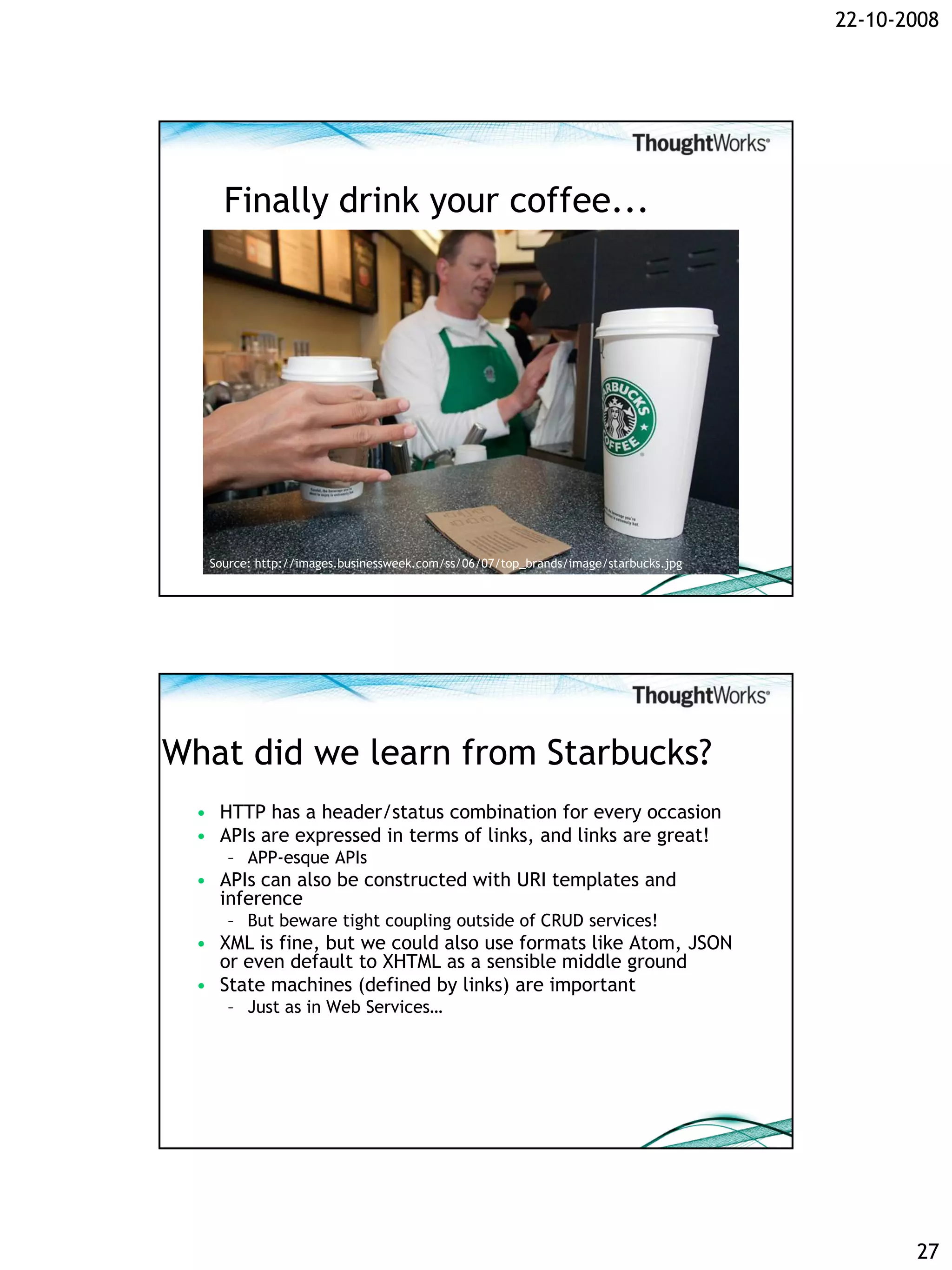
     Finally drink your coffee...


   Source: http://images.businessweek.com/ss/06/07/top_brands/image/starbucks.jpg


What did we learn from Starbucks?
  • HTTP has a header/status combination for every occasion
  • APIs are expressed in terms of links, and links are great!
     – APP-esque APIs
  • APIs can also be constructed with URI templates and
    inference
     – But beware tight coupling outside of CRUD services!
  • XML is fine, but we could also use formats like Atom, JSON
    or even default to XHTML as a sensible middle ground
  • State machines (defined by links) are important
     – Just as in Web Services…


                                                                                           27
22-10-2008


                    Summary
• Web-based services are about state
  machines
   – The HATEOAS constraint from REST
• Use Web for massive scalability, fault
  tolerance
   – If you can tolerate higher latencies
• The Web is now starting to feel the love
  from middleware vendors too – beware!


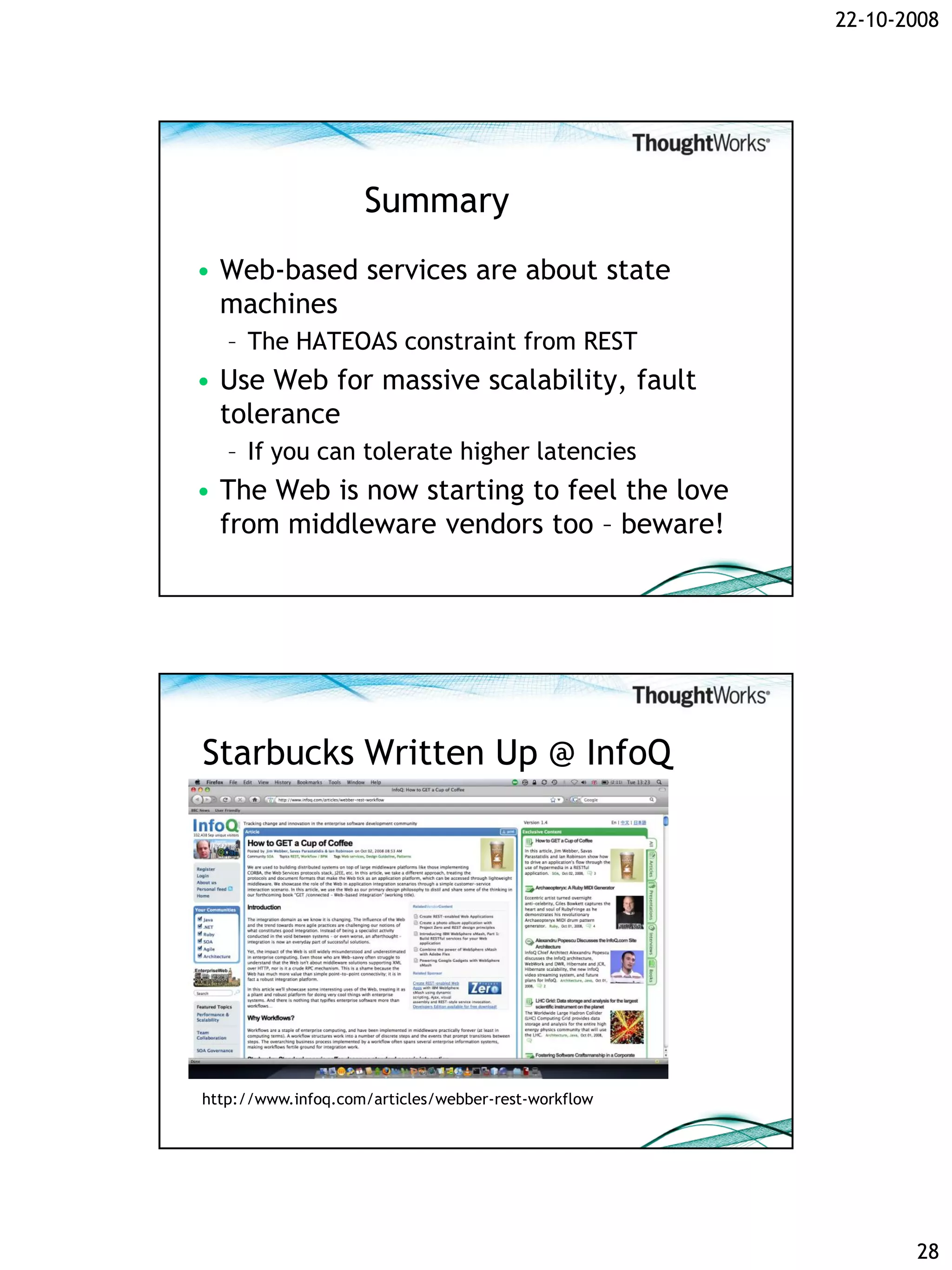
Starbucks Written Up @ InfoQ


http://www.infoq.com/articles/webber-rest-workflow


                                                            28
22-10-2008


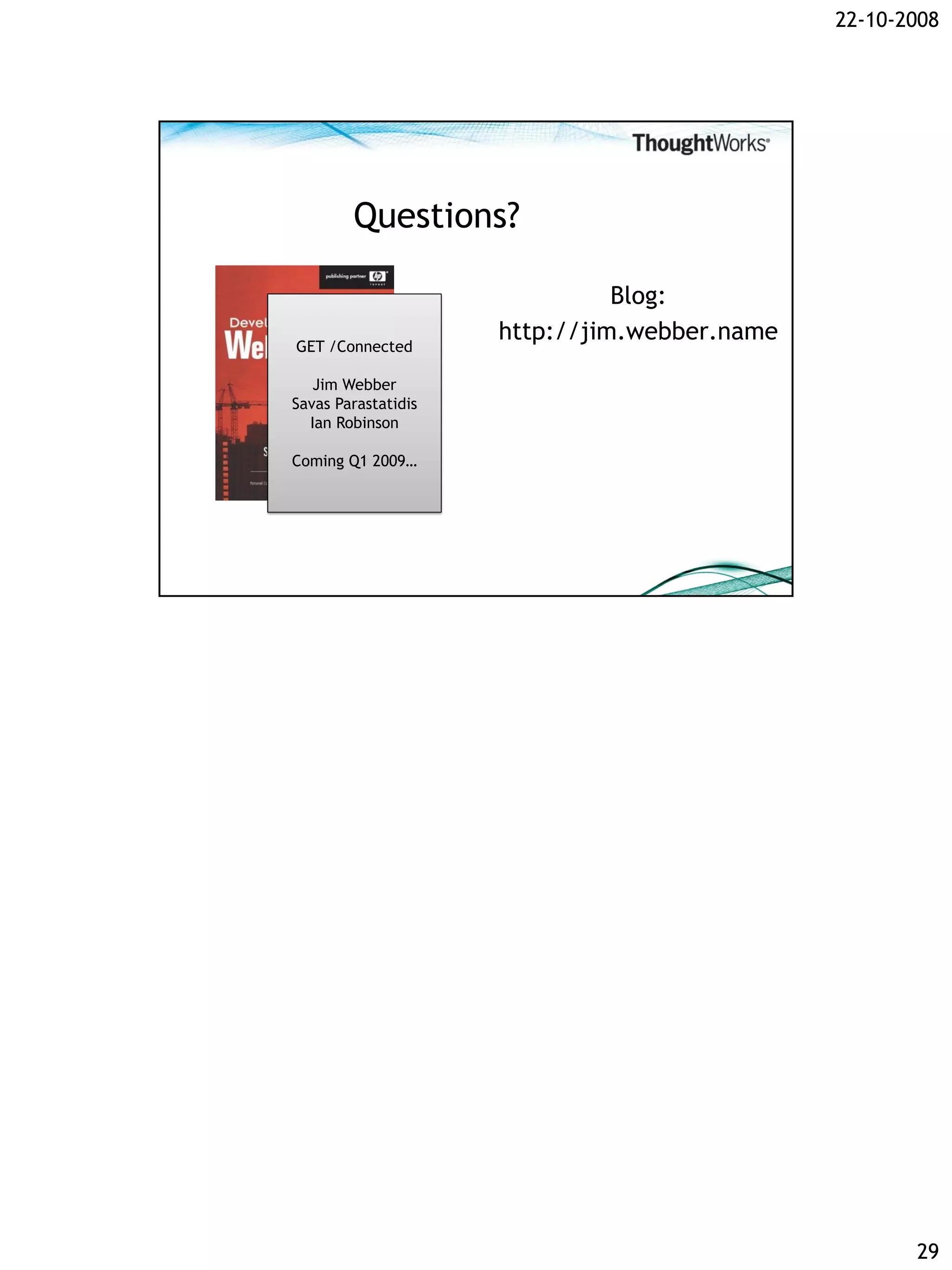
        Questions?

                               Blog:
                     http://jim.webber.name
GET /Connected

   Jim Webber
Savas Parastatidis
  Ian Robinson

Coming Q1 2009…


                                                     29

Jim Webber R E S Tful Services

  • 1.
    22-10-2008 This Presentation Courtesy of the International SOA Symposium October 7-8, 2008 Amsterdam Arena www.soasymposium.com info@soasymposium.com Founding Sponsors Platinum Sponsors Gold Sponsors Silver Sponsors GET /Connected Web Integration the Starbucks Way Dr. Jim Webber http://jim.webber.name 1
  • 2.
    22-10-2008 Roadmap • A little Swedish • Some home truths – About Web Services and the Web • Implementing Workflows – The Starbuck’s example • Q&A Jag heter Jim und kommer du England • I like Web Services • I wrote this book, – I am a MESTian at about WS-* heart • I like the Web – I have sympathies that lie with the RESTafarians 2
  • 3.
    22-10-2008 Jag heterJim und kommer du England • I like Web Services Mark Baker’s • I am “similarly consulting company, minded” – I am a MESTian at Coactus heart • I like the Web – I have sympathies that lie with the RESTafarians That’s me Falling out of Love? I hate WSDL. I wanna • Two things: kick it squarely in the nuts! – WSDL • It’s an XML IDL for RPC • Therefore ill-suited for Internet scale Photo: Comedy Central – All the superfluous WS-* standards and politics • Toolkits hide essential complexity 3
  • 4.
    22-10-2008 Why Web ServicesRock My World • Good Web Services/SOA are message- oriented – SSDL rules! • Business processes tend to be message- oriented • End-to-end processing model – Defined by SOAP, not WSDL! • Composable model – Ignore most of the WS-* stack • Except WSDL because the toolkits embrace it  Photo: Comedy Central Web Abuse Tunnelling is all a bunch of • Two lo-fi approaches to tree-hugging “Web” integration hippy crap! – URI tunnelling – POX • Both models treat HTTP as a transport Photo: Comedy Central – More or less • Yet some of the Web jihadists don’t see this • Both of these approaches overlay the Web with their own (weak) models... 4
  • 5.
    22-10-2008 URI Tunnelling • Web servers understand URIs • URIs have structure • Methods have signatures • Can match URI structure to method signature • E.g. – http://example.com/addNumbers?p1=10&p2=11 – intaddNumbers(inti, int j) { return i + j; } URI Tunnelling Strengths • Very easy to understand • Great for simple procedure-calls • Simple to code – Do it with the servlet API, HttpListener, IHttpHandler, Rails, whatever! • Interoperable – It’s just URIs! • Cacheable – providing you don’t abuse GET 5
  • 6.
    22-10-2008 URITunnelling Weaknesses • Often used for brittle RPC • Tight coupling, no metadata • Lacks robustness – Except for idempotent cases • No metadata support – Construct the URIs yourself, map them to the function manually POX Pattern • POX uses XML in the HTTP request and response to move a call stack between client and server • Web servers understand how to process requests with bodies • Hence we have another RPC mechanism 6
  • 7.
    22-10-2008 POX Strengths • Simplicity – just use HTTP POST and XML • Re-use existing infrastructure and libraries • Interoperable – It’s just XML and HTTP POST • Can use complex data structures – By representing them in XML POX Weaknesses • Client and server must collude on XML payload – Tightly coupled approach • No metadata support – Unless you’re using a POX toolkit that supports WSDL with HTTP binding (like WCF) • Does not use Web for robustness • Does not use SOAP + WS-* for robustness 7
  • 8.
    22-10-2008 RPC isCommonplace Today • To err is human, to really mess things up you need a computer • To really, really mess things up you need a distributed system – “A Note on Distributed Computing” • Bad Web Services and Web integration have much in common – It’s RPC! – With latencies and nasty partial failure characteristics </rant> 8
  • 9.
    22-10-2008 Web Fundamentals • To embrace the Web, we need to understand how it works • The Web is a distributed hypermedia model – It doesn’t try to hide that distribution from you! • Our challenge: – Figure out the mapping between our problem domain and the underlying Web platform Why the Web was Inevitable Tim Berners-Lee is a physicist (Sir Tim is also a knight, but that’s not important right now) 9
  • 10.
    22-10-2008 Why the Webwas Inevitable He lived in a hole in the ground Underneath a big mountain (in Switzerland) Why the Web was Inevitable And because he was a physicist (and not yet a knight)... ...he only had a big atom- smashing thing for company 10
  • 11.
    22-10-2008 Why the Webwas Inevitable And for a lonesome physicist stuck underground with smashed up atoms for company... ...gopher just wasn’t going to cut it! The Web broke the rules 11
  • 12.
    22-10-2008 Web Characteristics • Scalable • Fault-tolerant • Recoverable • Secure • Loosely coupled • Precisely the same characteristics we want in business software systems! Tenets for Web-based Services • Resource-based – Rather than service-oriented (the Web is not MOM!) • Addressability – Interesting things should have names • Statelessness – No stateful conversations with a resource • Representations – Resources can be serialised into representations • Links – Resources • Uniform Interface – No plumbing surprises! 12
  • 13.
    22-10-2008 Resource Architecture Consumer (Web Client) Uniform Interface (Web Server) Logical Resources Resource Representation (e.g. XML document) Physical Resources Links • Connectedness is good in Web-based systems • Resource representations can contain other URIs • Links act as state transitions • Application (conversation) state is captured in terms of these states 13
  • 14.
    22-10-2008 Describing Contracts withLinks • The value of the Web is its “linked-ness” – Links on a Web page constitute a contractfor page traversals • The same is true of the programmatic Web • Use Links to describe state transitions in programmatic Web services – By navigating resources you change application state Links are State Transitions 14
  • 15.
    22-10-2008 Links as APIs <confirm xmlns="..."> • Following a link <link rel="payment" href="https://pay" causes an action to type="application/xml"/> occur <link rel="postpone" • This is the start of a href="https://wishlist" state machine! type="application/xml"/> </confirm> • Links lead to other resources which also have links • Can make this stronger with semantics – Microformats Microformats • Microformats are an example of little “s” semantics • Innovation at the edges of the Web – Not by some central design authority (e.g. W3C) • Started by embedding machine-processable elements in Web pages – E.g. Calendar information, contact information, etc – Using existing HTML features like class, rel, etc 15
  • 16.
    22-10-2008 Microformats andResources • Use Microformats to structure resources where formats exist – I.e. Use hCard for contacts, hCalendar for data • Create your own formats (sparingly) in other places – Annotating links is a good start – <link rel="withdraw.cash" .../> – <link rel="service.post" type="application/x.atom+xml" href="{post-uri}" title="some title"> • The rel attribute describes the semantics of the referred resource We have a framework! • The Web gives us a processing and metadata model – Verbs and status codes – Headers • Gives us metadata contracts or Web “APIs” – URI Templates – Links • Strengthened with semantics – Little “s” 16
  • 17.
    22-10-2008 Workflow • How does a typical enterprise workflow look when it’s implemented in a Web-friendly way? • Let’s take Starbuck’s as an example, the happy path is: – Make selection • Add any specialities – Pay – Wait for a while – Collect drink Workflow and MOM • With Web Services we exchange messages with the service Order Drink • Resource state is hidden from view Starbuck’s Service Add Specialities • Conversation state is all we know Order Confirmation – Advertise it with SSDL, BPEL • Uniform interface, Pay roles defined by SOAP – No “operations” Coffee! 17
  • 18.
    22-10-2008 Web-friendly Workflow • What happens if workflow stages are modelled as resources? • And state transitions are modelled as hyperlinks or URI templates? • And events modelled by traversing links and changing resource states? • Answer: we get Web-friendly workflow – With all the quality of service provided by the Web Placing an Order • Place your order by POSTing it to a well- known URI – http://example.starbucks.com/order Starbuck’s Service Client 18
  • 19.
    22-10-2008 Placing an Order:On the Wire • Response • Request 201 Created Location: POST /order HTTP 1.1 http://starbucks.example.org/ Host: starbucks.example.org order?1234 Content-Type: application/xml Content-Type: application/xml Content-Length: ... Content-Length: ... <order xmlns="urn:starbucks"> <order xmlns="urn:starbucks"> <drink>latte</drink> <drink>latte</drink> </order> <link rel="payment" If we have a (private) href="https://starbucks.examp A link! Is this the microformat, this can le.org/payment/order?1234" start of an API? become a neat API! type="application/xml"/> </order> Whoops! A mistake • I like my coffee to taste like coffee! • I need another shot of espresso – What are my OPTIONS?  Request  Response OPTIONS /order?1234 HTTP 1.1 200 OK Host: starbucks.example.org Allow: GET, PUT Phew! I can update my order, for now 19
  • 20.
    22-10-2008 Optional: Look BeforeYou Leap • See if the resource has changed since you submitted your order – If you’re fast your drink hasn’t been prepared yet  Request  Response PUT /order?1234 HTTP 1.1 100 Continue Host: starbucks.example.org I can still PUT this Expect: 100-Continue resource, for now. (417 Expectation Failed otherwise) Amending an Order • Add specialities to you order via PUT – Starbucks needs 2 shots! Starbuck’s Service Client 20
  • 21.
    22-10-2008 Amending an Order:On the Wire • Request • Response PUT /order?1234 HTTP 1.1 200 OK Host: starbucks.example.org Location: Content-Type: application/xml http://starbucks.example.org/o Content-Length: ... rder?1234 Content-Type: application/xml <order xmlns="urn:starbucks"> Content-Length: ... <drink>latte</drink> <additions>shot</additions> <order xmlns="urn:starbucks"> <link rel="payment" <drink>latte</drink> href="https://starbucks.exampl <additions>shot</additions> e.org/payment/order?1234" <link rel="payment" type="application/xml"/> href="https://starbucks.exampl </order> e.org/payment/order?1234" type="application/xml"/> </order> Statelessness • Remember interactions with resources are stateless • The resource “forgets” about you while you’re not directly interacting with it • Which means race conditions are possible • Use If-Unmodified-Since on a timestamp to make sure – Or use If-Match and an ETag • You’ll get a 412 PreconditionFailed if you lost the race – But you’ll avoid potentially putting the resource into some inconsistent state 21
  • 22.
    22-10-2008 Warning: Don’t be Slow! • Can only make changes until someone actually makes your drink – You’re safe if you use If-Unmodified-Since or If-Match – But resource state can change without you!  Request  Response PUT /order?1234 HTTP 1.1 409 Conflict Host: starbucks.example.org ... Too slow! Someone else has changed the state of my order  Request  Response OPTIONS /order?1234 HTTP 1.1 Allow: GET Host: starbucks.example.org Order Confirmation • Check your order status by GETing it Starbuck’s Service Client 22
  • 23.
    22-10-2008 Order Confirmation: Onthe Wire • Request • Response GET /order?1234 HTTP 1.1 200 OK Host: starbucks.example.org Location: Content-Type: application/xml http://starbucks.example.org/orde Content-Length: ... r?1234 Content-Type: application/xml Content-Length: ... <order xmlns="urn:starbucks"> <drink>latte</drink> <additions>shot</additions> Are they trying to tell me <link rel="payment" something with hypermedia? href="https://starbucks.example.o rg/payment/order?1234" type="application/xml"/> </order> Order Payment • PUT your payment to the order resource https://starbucks.example.org/payment/order?1234 Starbuck’s Service Client New resource! https://starbucks.example.org/payment/order?1234 23
  • 24.
    22-10-2008 How did I know to PUT? • The client knew the URI to PUT to from the link – PUT is also idempotent (can safely re-try) in case of failure • Verified with OPTIONS – Just in case you were in any doubt   Request  Response OPTIONS /payment/order?1234 HTTP 1.1 Allow: GET, PUT Host: starbucks.example.org Order Payment: On the Wire • Request • Response PUT /payment/order?1234 HTTP 1.1 201 Created Host: starbucks.example.org Location: Content-Type: application/xml https://starbucks.example.or Content-Length: ... g/payment/order?1234 Content-Type: application/xml <payment xmlns="urn:starbucks"> Content-Length: ... <cardNo>123456789</cardNo> <expires>07/07</expires> <name>John Citizen</name> <payment xmlns="urn:starbucks"> <amount>4.00</amount> <cardNo>123456789</cardNo> </payment> <expires>07/07</expires> <name>John Citizen</name> <amount>4.00</amount> </payment> 24
  • 25.
    22-10-2008 Check that you’ve paid • Request • Response GET /order?1234 HTTP 1.1 200 OK Host: starbucks.example.org Content-Type: application/xml Content-Type: application/xml Content-Length: ... Content-Length: ... My “API” has changed, <order xmlns="urn:starbucks"> because I’ve paid <drink>latte</drink> enough now <additions>shot</additions> </order> What Happened Behind the Scenes? • Starbucks can use the same resources! • Plus some private resources of their own – Master list of coffees to be prepared • Authenticate to provide security on some resources – E.g. only Starbuck’s are allowed to view payments 25
  • 26.
    22-10-2008 Payment • Only Starbucks systems can access the record of payments – Using the URI template: http://.../payment/order?{order_id} • We can use HTTP authorisation to enforce this  Response  Request GET /payment/order?1234 HTTP 1.1 401 Unauthorized WWW-Authenticate: Digest Host: starbucks.example.org realm="starbucks.example.org", qop="auth", nonce="ab656...", opaque="b6a9..."  Request  Response GET /payment/order?1234 HTTP 1.1 200 OK Host: starbucks.example.org Authorization: Digest username="jw" Content-Type: application/xml realm="starbucks.example.org“ Content-Length: ... nonce="..." uri="payment/order?1234" <payment xmlns="urn:starbucks"> qop=auth <cardNo>123456789</cardNo> nc=00000001 <expires>07/07</expires> cnonce="..." <name>John Citizen</name> reponse="..." <amount>4.00</amount> opaque="..." </payment> Master Coffee List • /orders URI for all orders, only accepts GET – Anyone can use it, but it is only useful for Starbuck’s – It’s not identified in any of our public APIs anywhere, but the back- end systems know the URI  Response  Request 200 OK Content-Type: application/xml GET /orders HTTP 1.1 Content-Length: ... <?xml version="1.0" ?> Host: starbucks.example.org <feed xmlns="http://www.w3.org/2005/Atom"> <title>Coffees to make</title> <link rel="alternate" href="http://example.starbucks.com/order.atom"/> <updated>2007-07-10T09:18:43Z</updated> <author><name>Johnny Barrista</name></author> Atom feed! <id>urn:starkbucks:45ftis90</id> <entry> <link rel="alternate" type="application/xml" href="http://starbucks.example.org/order?1234"/> <id>urn:starbucks:a3tfpfz3</id> </entry> ... </feed> 26
  • 27.
    22-10-2008 Finally drink your coffee... Source: http://images.businessweek.com/ss/06/07/top_brands/image/starbucks.jpg What did we learn from Starbucks? • HTTP has a header/status combination for every occasion • APIs are expressed in terms of links, and links are great! – APP-esque APIs • APIs can also be constructed with URI templates and inference – But beware tight coupling outside of CRUD services! • XML is fine, but we could also use formats like Atom, JSON or even default to XHTML as a sensible middle ground • State machines (defined by links) are important – Just as in Web Services… 27
  • 28.
    22-10-2008 Summary • Web-based services are about state machines – The HATEOAS constraint from REST • Use Web for massive scalability, fault tolerance – If you can tolerate higher latencies • The Web is now starting to feel the love from middleware vendors too – beware! Starbucks Written Up @ InfoQ http://www.infoq.com/articles/webber-rest-workflow 28
  • 29.
    22-10-2008 Questions? Blog: http://jim.webber.name GET /Connected Jim Webber Savas Parastatidis Ian Robinson Coming Q1 2009… 29