
SOA in 2013
 SOA has changed. Have you?
 March 13, 2013


       Confidential
SOA is Dead. Long Live Services.

  Popularized in 2003, the SOA movement took enterprise by
   storm.
  In the last decade, many things have changed including
   approaches, tools, platforms and goals.

  Unfortunately, many organizations have failed to update their
   SOA program and are now losing productivity and opportunity.


March 13, 2013          Confidential
Next-Gen SOA

 1. API’s Rule
 2. Light-Weight Envelopes Won
 3. Open Source Dominates
 4. From Service Management to API Management
 5. ESB is Minimized
 6. New Services Exist in PaaS and IaaS
 7. New SOA Resides on PaaS and IaaS
 8. A Renewed Focus on SLA’s
 9. Resilience is Your Friend
 10. It’s About the Business


March 13, 2013       Confidential
API’s Rule

  With the move to ‘simple services’, the ‘remote API’ was born.

  Less emphasis service registries (UDDI)
  More emphasis on publishing developer documentation for API

  “If you make it easy, developers will come.”


March 13, 2013          Confidential
Light-Weight Envelopes Won

  Despite all of the work to create SOAP and the WS-*
   specifications, they lost the battle.

  Light-weight services won because they’re simple.
       They ride on HTTP.
       They usually use JSON.
       They’re usually RESTful, but not always.


March 13, 2013                 Confidential
Open Source Dominates

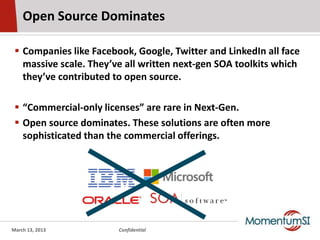
  Companies like Facebook, Google, Twitter and LinkedIn all face
   massive scale. They’ve all written next-gen SOA toolkits which
   they’ve contributed to open source.

  “Commercial-only licenses” are rare in Next-Gen.
  Open source dominates. These solutions are often more
   sophisticated than the commercial offerings.


March 13, 2013          Confidential
From Service Management to API Management

  Developers still need to instrument their services, define
   SLA’s, throttle traffic, set quotas, etc.

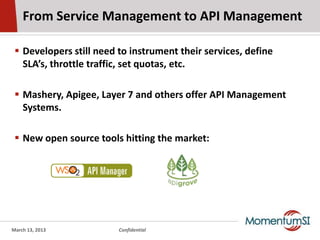
  Mashery, Apigee, Layer 7 and others offer API Management
   Systems.

  New open source tools hitting the market:


March 13, 2013           Confidential
The use ESB is minimized

  The Enterprise Service Bus (ESB) is still used in enterprise shops
   for hairy integration problems, especially where adapters to
   legacy systems are required.

  There’s less emphasis on the ESB. When needed, open source
   solutions like Mule and Fuse are used even in massively
   scalable, highly available scenarios.

  New services are put in a light-weight container like Apache
   TomCat.


March 13, 2013           Confidential
New Services exist in PaaS and IaaS

  Many SOA programs have failed to release platform and
   infrastructure services!
     Compute-as-a-Service                  BI-as-a-Service
     Storage-as-a-Service                  Archive-as-a-Service
     Network-as-a-Service                  Scheduling-as-a-Service
     Load Balancer-as-a-Service            Reporting-as-a-Service
     DNS-as-a-Service                      Queue-as-a-Service
     Identity-as-a-Service                 PubSub-as-a-Service
     Cache-as-a-Service                    Logging-as-a-Service
     Database-as-a-Service                 Monitoring-as-a-Service


March 13, 2013            Confidential
New SOA resides on PaaS and IaaS

  The “as-a-Service” model is now in full swing with Platform-as-
   a-Service and Infrastructure-as-a-Service.

  Last generation application servers are no longer the preferred
   model for building and running services.
  Light-weight containers running on an elastic infrastructure
   where SLA’s are tied to monitors and auto-scale are the new
   model.


March 13, 2013          Confidential
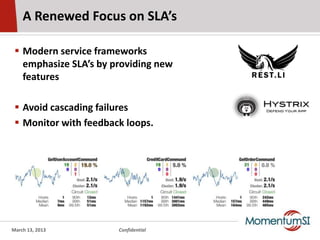
A Renewed Focus on SLA’s

  Modern service frameworks
   emphasize SLA’s by providing new
   features

  Avoid cascading failures
  Monitor with feedback loops.


March 13, 2013         Confidential
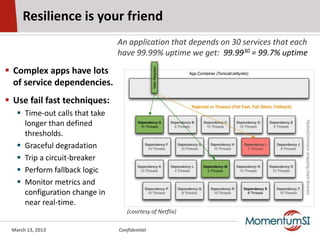
Resilience is your friend
                                An application that depends on 30 services that each
                                have 99.99% uptime we get: 99.9930 = 99.7% uptime

 Complex apps have lots
  of service dependencies.
 Use fail fast techniques:
    Time-out calls that take
     longer than defined
     thresholds.
    Graceful degradation
    Trip a circuit-breaker
    Perform fallback logic
    Monitor metrics and
     configuration change in
     near real-time.
                                   (courtesy of Netflix)

 March 13, 2013                 Confidential
It’s about the Business

  API’s have moved beyond I.T. and are now a business asset

  Enable partners and affiliates to do “self-service integration”
  Find new, unanticipated channel opportunities

  “The API is the new BizDev”


March 13, 2013           Confidential
MomentumSI on Next-Gen SOA

  MomentumSI works with our customers to
   revitalize their SOA programs by:
       Designing API’s developers will love
       Using next generation frameworks to ensure services meet
        SLA’s
       Save money by replacing out-of-date commercial products
        with next-gen open source software
       Integrate the API with cloud capabilities


        For a briefing on our Next-Gen SOA/API offerings, email: Jeff Schneider
        jschneider@MomentumSI.com


March 13, 2013                    Confidential
A MomentumSI Briefing: SOA in 2013

A MomentumSI Briefing: SOA in 2013

  • 1.
    SOA in 2013 SOA has changed. Have you? March 13, 2013 Confidential
  • 2.
    SOA is Dead.Long Live Services.  Popularized in 2003, the SOA movement took enterprise by storm.  In the last decade, many things have changed including approaches, tools, platforms and goals.  Unfortunately, many organizations have failed to update their SOA program and are now losing productivity and opportunity. March 13, 2013 Confidential
  • 3.
    Next-Gen SOA 1.API’s Rule 2. Light-Weight Envelopes Won 3. Open Source Dominates 4. From Service Management to API Management 5. ESB is Minimized 6. New Services Exist in PaaS and IaaS 7. New SOA Resides on PaaS and IaaS 8. A Renewed Focus on SLA’s 9. Resilience is Your Friend 10. It’s About the Business March 13, 2013 Confidential
  • 4.
    API’s Rule With the move to ‘simple services’, the ‘remote API’ was born.  Less emphasis service registries (UDDI)  More emphasis on publishing developer documentation for API  “If you make it easy, developers will come.” March 13, 2013 Confidential
  • 5.
    Light-Weight Envelopes Won  Despite all of the work to create SOAP and the WS-* specifications, they lost the battle.  Light-weight services won because they’re simple.  They ride on HTTP.  They usually use JSON.  They’re usually RESTful, but not always. March 13, 2013 Confidential
  • 6.
    Open Source Dominates  Companies like Facebook, Google, Twitter and LinkedIn all face massive scale. They’ve all written next-gen SOA toolkits which they’ve contributed to open source.  “Commercial-only licenses” are rare in Next-Gen.  Open source dominates. These solutions are often more sophisticated than the commercial offerings. March 13, 2013 Confidential
  • 7.
    From Service Managementto API Management  Developers still need to instrument their services, define SLA’s, throttle traffic, set quotas, etc.  Mashery, Apigee, Layer 7 and others offer API Management Systems.  New open source tools hitting the market: March 13, 2013 Confidential
  • 8.
    The use ESBis minimized  The Enterprise Service Bus (ESB) is still used in enterprise shops for hairy integration problems, especially where adapters to legacy systems are required.  There’s less emphasis on the ESB. When needed, open source solutions like Mule and Fuse are used even in massively scalable, highly available scenarios.  New services are put in a light-weight container like Apache TomCat. March 13, 2013 Confidential
  • 9.
    New Services existin PaaS and IaaS  Many SOA programs have failed to release platform and infrastructure services!  Compute-as-a-Service  BI-as-a-Service  Storage-as-a-Service  Archive-as-a-Service  Network-as-a-Service  Scheduling-as-a-Service  Load Balancer-as-a-Service  Reporting-as-a-Service  DNS-as-a-Service  Queue-as-a-Service  Identity-as-a-Service  PubSub-as-a-Service  Cache-as-a-Service  Logging-as-a-Service  Database-as-a-Service  Monitoring-as-a-Service March 13, 2013 Confidential
  • 10.
    New SOA resideson PaaS and IaaS  The “as-a-Service” model is now in full swing with Platform-as- a-Service and Infrastructure-as-a-Service.  Last generation application servers are no longer the preferred model for building and running services.  Light-weight containers running on an elastic infrastructure where SLA’s are tied to monitors and auto-scale are the new model. March 13, 2013 Confidential
  • 11.
    A Renewed Focuson SLA’s  Modern service frameworks emphasize SLA’s by providing new features  Avoid cascading failures  Monitor with feedback loops. March 13, 2013 Confidential
  • 12.
    Resilience is yourfriend An application that depends on 30 services that each have 99.99% uptime we get: 99.9930 = 99.7% uptime  Complex apps have lots of service dependencies.  Use fail fast techniques:  Time-out calls that take longer than defined thresholds.  Graceful degradation  Trip a circuit-breaker  Perform fallback logic  Monitor metrics and configuration change in near real-time. (courtesy of Netflix) March 13, 2013 Confidential
  • 13.
    It’s about theBusiness  API’s have moved beyond I.T. and are now a business asset  Enable partners and affiliates to do “self-service integration”  Find new, unanticipated channel opportunities  “The API is the new BizDev” March 13, 2013 Confidential
  • 14.
    MomentumSI on Next-GenSOA  MomentumSI works with our customers to revitalize their SOA programs by:  Designing API’s developers will love  Using next generation frameworks to ensure services meet SLA’s  Save money by replacing out-of-date commercial products with next-gen open source software  Integrate the API with cloud capabilities For a briefing on our Next-Gen SOA/API offerings, email: Jeff Schneider jschneider@MomentumSI.com March 13, 2013 Confidential