Extreme Computing cooperation, standpoint of an industrial


JF Lavignon, Strategy & Cooperation, Innovative Products
Introduction

                  Sorry not to be present, hope to meet you soon


                  Agenda :


                  - HPC challenges as seen by a HPC supplier
                  - Cooperation example and idea for
                   Latin America – Europe cooperation


©Bull, 2011   2                      Cooperation in extreme computing
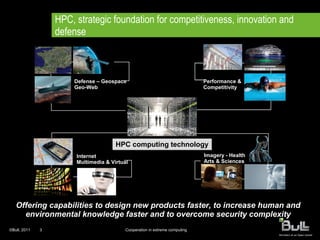
HPC, strategic foundation for competitiveness, innovation and
                  defense


                      Defense – Geospace                                     Performance &
                      Geo-Web                                                Competitivity


                                      HPC computing technology
                       Internet                                              Imagery - Health
                       Multimedia & Virtual                                  Arts & Sciences


   Offering capabilities to design new products faster, to increase human and
     environmental knowledge faster and to overcome security complexity
©Bull, 2011   3                           Cooperation in extreme computing
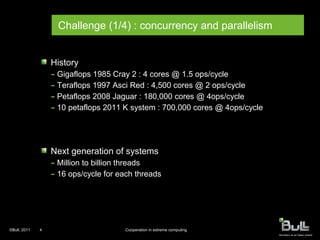
Challenge (1/4) : concurrency and parallelism


                  History
                  - Gigaflops 1985 Cray 2 : 4 cores @ 1.5 ops/cycle
                  - Teraflops 1997 Asci Red : 4,500 cores @ 2 ops/cycle
                  - Petaflops 2008 Jaguar : 180,000 cores @ 4ops/cycle
                  - 10 petaflops 2011 K system : 700,000 cores @ 4ops/cycle


                  Next generation of systems
                  - Million to billion threads
                  - 16 ops/cycle for each threads


©Bull, 2011   4                       Cooperation in extreme computing
Challenge (2/4) energy and power

                  Today general purpose computer
                  - 200 Mflops/W
                  - Petaflops 5MW
                  - 10 Petaflops in 2011 : 12,5 MW

                  Trend
                  - Use of accelerators (GPU, MIC) with better ratio flops/W than
                   standard processor but more difficult to program
                  - Use of low frequency standard processors
                  - Reduction of the amount of memory per core

                  Most the large centers do not plan more than 20MW for a
                  HPC system
©Bull, 2011   5                        Cooperation in extreme computing
Challenge (3/4) data in HPC
                  Data inside the HPC system
                  - Memory access time
                  - Amount of memory
                  - Power cost of moving data

                  Storage of data (disk)
                  - Capacity still growing
                  - Bandwidth and seek time not progressing at the same pace
                  - Increasing parallelism

                  Data for scientists
                  - pre and post processing of huge volume of data
                  - Quality of data produced by large simulation (uncertainty
                    quantification)
                  - Semantic attached to data
©Bull, 2011   6                         Cooperation in extreme computing
Challenge (4/4) : Resiliency

              Next generation system
              - Huge number of components : 10 to 10 memory chips
                                                         6           8


              - Interface at high clock rate increasing bit error rates

              MTBF will be low
              - 10,000 components with a MTBF of > 10 years leads to a combined
                  MTBF of 10 hours


              Robustness must be addressed at different levels
              - System hardware
              - System software
              - Application


©Bull, 2011   7                       Cooperation in extreme computing
Conclusion technological challenges

                  Important challenges for next generations of HPC systems


                  No one has the complete solution


                  Cooperation is a must


©Bull, 2011   8                     Cooperation in extreme computing
Bull’s experience in R&D cooperation

     Common laboratory

     Technology partners                                          Intel, Xyratex, Caps Entreprise…

     One-to-one cooperation

     Development of large infrastructures

     Research institutions / campus

     Project with local ecosystem

     Projects at European level

     International vision sharing


©Bull, 2011   9                     Cooperation in extreme computing
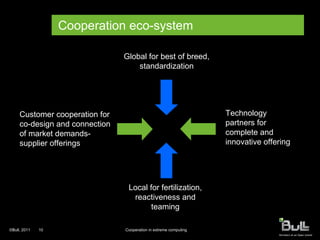
Cooperation eco-system

                                Global for best of breed,
                                    standardization


     Customer cooperation for                                      Technology
     co-design and connection                                      partners for
     of market demands-                                            complete and
     supplier offerings                                            innovative offering


                                 Local for fertilization,
                                  reactiveness and
                                        teaming

©Bull, 2011   10                Cooperation in extreme computing
Example of instruments in Europe Systematic, Eureka, FP7


                   Systematic
                   - “World class” French Cluster, 142 enterprises, 311 SMB 92 research
                       centers & universities.
                   -   Cooperation between SMEs, Large Companies, Research Centres and
National               higher educational establishments
level              -   Supported by local authorities, economic development agencies, the
                       French Government and its partners.
                   -   Leverage on Teratec for HPC
                   EUREKA
                   - 39 member countries plus the European Union.
European           - The EUREKA label gives participants a competitive edge in their
                       dealings with financial, technical and commercial partners.
level
                   FP7
                   - EU's main instrument for funding research in Europe
                   - Grants are determined on the basis of calls for proposals
                   - Activities funded from FP7 must have a “European added value”.
©Bull, 2011   11                         Cooperation in extreme computing
Systematic, FP7 & ITEA figures


                                     Systematic                                 FP7           ITEA

                                                                                           Eureka R&D
                   Type           Cluster                              R&D program
                                                                                          program for IT
                   Time scale                                            2007-2013          2006-2012
                   Projects       € 200 m / year                                            20,000 PY
                                                                  € 54 B
                   o/w fundings   € 60 m / year                                         € 600 m
                                                                  o/w € 9 B for IT

                   Area                 France                                 Europe        Europe


©Bull, 2011   12                            Cooperation in extreme computing
Example of a project : ParMa, Itea Gold Award 2010
                   Parallel Programming for Multi-core Architectures


                    A European project that gathers                  Facilitate the emergence of
                    users, software providers, HPC                   power-intensive innovative
                    system supplier                                  applications by:
                    Objective: help the HPC                          - Developing advanced
                    community take full advantage                         technologies for exploiting
                    of multi-core architectures                           parallel computing
                    Deliver substantial performance                  -    Exploring commonalities between
                                                                          HPC, Multi-Core and MPSoC
                    improvements for:                                     programming environments
                    - conventional HPC applications                  -    Leveraging relevant technology
                    - mainstream applications                             and methodology between these
                    - embedded systems                                    domains
                                                                     Blast-furnace: €125,000
                                                                     savings plus 16,000 tons of
                                                                     CO2 emission/year


©Bull, 2011   13                       Cooperation in extreme computing
To conclude

                   Latin America – Europe cooperation is
                   what I call “a global cooperation”
                   - Need to focus on global topics
                     -   Ie programming models
                     -   Scientific methods…
                   - Need to find mutual interest
                     -   Economic system
                     -   Educational system
                   - Need to involve “regional champions”

                   Cooperation at International level could
                   be boosted by new instruments
                   - Why not a "Eureka-like" program at
                     International level


©Bull, 2011   14                               Cooperation in extreme computing
©Bull, 2011   15   Cooperation in extreme computing

Jf lavignon

  • 1.
    Extreme Computing cooperation,standpoint of an industrial JF Lavignon, Strategy & Cooperation, Innovative Products
  • 2.
    Introduction Sorry not to be present, hope to meet you soon Agenda : - HPC challenges as seen by a HPC supplier - Cooperation example and idea for Latin America – Europe cooperation ©Bull, 2011 2 Cooperation in extreme computing
  • 3.
    HPC, strategic foundationfor competitiveness, innovation and defense Defense – Geospace Performance & Geo-Web Competitivity HPC computing technology Internet Imagery - Health Multimedia & Virtual Arts & Sciences Offering capabilities to design new products faster, to increase human and environmental knowledge faster and to overcome security complexity ©Bull, 2011 3 Cooperation in extreme computing
  • 4.
    Challenge (1/4) :concurrency and parallelism History - Gigaflops 1985 Cray 2 : 4 cores @ 1.5 ops/cycle - Teraflops 1997 Asci Red : 4,500 cores @ 2 ops/cycle - Petaflops 2008 Jaguar : 180,000 cores @ 4ops/cycle - 10 petaflops 2011 K system : 700,000 cores @ 4ops/cycle Next generation of systems - Million to billion threads - 16 ops/cycle for each threads ©Bull, 2011 4 Cooperation in extreme computing
  • 5.
    Challenge (2/4) energyand power Today general purpose computer - 200 Mflops/W - Petaflops 5MW - 10 Petaflops in 2011 : 12,5 MW Trend - Use of accelerators (GPU, MIC) with better ratio flops/W than standard processor but more difficult to program - Use of low frequency standard processors - Reduction of the amount of memory per core Most the large centers do not plan more than 20MW for a HPC system ©Bull, 2011 5 Cooperation in extreme computing
  • 6.
    Challenge (3/4) datain HPC Data inside the HPC system - Memory access time - Amount of memory - Power cost of moving data Storage of data (disk) - Capacity still growing - Bandwidth and seek time not progressing at the same pace - Increasing parallelism Data for scientists - pre and post processing of huge volume of data - Quality of data produced by large simulation (uncertainty quantification) - Semantic attached to data ©Bull, 2011 6 Cooperation in extreme computing
  • 7.
    Challenge (4/4) :Resiliency Next generation system - Huge number of components : 10 to 10 memory chips 6 8 - Interface at high clock rate increasing bit error rates MTBF will be low - 10,000 components with a MTBF of > 10 years leads to a combined MTBF of 10 hours Robustness must be addressed at different levels - System hardware - System software - Application ©Bull, 2011 7 Cooperation in extreme computing
  • 8.
    Conclusion technological challenges Important challenges for next generations of HPC systems No one has the complete solution Cooperation is a must ©Bull, 2011 8 Cooperation in extreme computing
  • 9.
    Bull’s experience inR&D cooperation Common laboratory Technology partners Intel, Xyratex, Caps Entreprise… One-to-one cooperation Development of large infrastructures Research institutions / campus Project with local ecosystem Projects at European level International vision sharing ©Bull, 2011 9 Cooperation in extreme computing
  • 10.
    Cooperation eco-system Global for best of breed, standardization Customer cooperation for Technology co-design and connection partners for of market demands- complete and supplier offerings innovative offering Local for fertilization, reactiveness and teaming ©Bull, 2011 10 Cooperation in extreme computing
  • 11.
    Example of instrumentsin Europe Systematic, Eureka, FP7 Systematic - “World class” French Cluster, 142 enterprises, 311 SMB 92 research centers & universities. - Cooperation between SMEs, Large Companies, Research Centres and National higher educational establishments level - Supported by local authorities, economic development agencies, the French Government and its partners. - Leverage on Teratec for HPC EUREKA - 39 member countries plus the European Union. European - The EUREKA label gives participants a competitive edge in their dealings with financial, technical and commercial partners. level FP7 - EU's main instrument for funding research in Europe - Grants are determined on the basis of calls for proposals - Activities funded from FP7 must have a “European added value”. ©Bull, 2011 11 Cooperation in extreme computing
  • 12.
    Systematic, FP7 &ITEA figures Systematic FP7 ITEA Eureka R&D Type Cluster R&D program program for IT Time scale 2007-2013 2006-2012 Projects € 200 m / year 20,000 PY € 54 B o/w fundings € 60 m / year € 600 m o/w € 9 B for IT Area France Europe Europe ©Bull, 2011 12 Cooperation in extreme computing
  • 13.
    Example of aproject : ParMa, Itea Gold Award 2010 Parallel Programming for Multi-core Architectures A European project that gathers Facilitate the emergence of users, software providers, HPC power-intensive innovative system supplier applications by: Objective: help the HPC - Developing advanced community take full advantage technologies for exploiting of multi-core architectures parallel computing Deliver substantial performance - Exploring commonalities between HPC, Multi-Core and MPSoC improvements for: programming environments - conventional HPC applications - Leveraging relevant technology - mainstream applications and methodology between these - embedded systems domains Blast-furnace: €125,000 savings plus 16,000 tons of CO2 emission/year ©Bull, 2011 13 Cooperation in extreme computing
  • 14.
    To conclude Latin America – Europe cooperation is what I call “a global cooperation” - Need to focus on global topics - Ie programming models - Scientific methods… - Need to find mutual interest - Economic system - Educational system - Need to involve “regional champions” Cooperation at International level could be boosted by new instruments - Why not a "Eureka-like" program at International level ©Bull, 2011 14 Cooperation in extreme computing
  • 15.
    ©Bull, 2011 15 Cooperation in extreme computing