Biodiversity  and Ecosystem Investments  November 11 th , 2009
CI Overview Ecosystem Finance Verde Ventures Carbon Fund New Horizons Summary
CI has field offices in over 40 countries  spanning four continents.  Our staff of over 1000 employees is supported by a network of over 1,500 local partners around the globe. about CI
vision We imagine a healthy prosperous world in which societies are forever committed to caring for and valuing nature for the long-term benefit of people and all life on Earth. mission Building upon a strong foundation of science, partnership and field demonstration, CI empowers societies to responsibly and sustainably care for nature for the well-being of humanity.
Ecosystem Finance Division (EFD)
Our Funds Critical Ecosystem Partnership Fund (CEPF) Global Conservation Fund (GCF) Conservation Stewards Program (CSP) Verde Ventures Conservation and Community Carbon Fund (CCCF)
Our Focus Protected Areas Rural Livelihoods Long-term Financing Financial management PES Financing
Summary Results Total granted/invested to date: USD $211 million   1,500 partners supported in over 60 countries >89 million hectares of globally significant land protected benefitting critical ecosystems and communities > $254 M in funding leveraged > 140,000 people directly impacted Significant policy impacts in 11 countries
EFD Investors Total Capital:   $338M (Grants (G), Loans (L), Loan Guarantees (LG)) Multilateral/Bilateral World Bank (G) International Finance Corporation (L&G) Global Environment Facility (G) Overseas Private Investment Facility (L) Government of Japan (G) French Aid Development Agency (L,G&LG) Foundations -  Gordon and Betty Moore Foundation (G) -  MacArthur Foundation (G) Mulago Foundation  (G) United Nations Foundation (G&LG) Conservation International (G-CEPF) Private Sector Starbucks (LG, L & G) - Daiwa (G) Disney (G) Dell (G)
Investors’ Interest Historical Philanthropic Marketing Benefit Focus on non-CI partners  Investment Infrastructure  High Leverage (Debt Swap) Increasingly Supply Chain Benefit SRI/TBL (with $ return) Carbon Credits
Verde Ventures (VV)
Verde Ventures Verde Ventures  invests  in  small businesses  that contribute to conservation and communities in Conservation International's global priority areas.
Why Verde Ventures? Conservation-based  employment  is essential to provide economic incentives for conservation The  small business sector  is a key partner in the intersection between human welfare and conservation Lack of available,  affordable capital  to ensure the sustainability of the sector
Core Products Loans: US$30,000 to $500,000 (average: $125,000) Use of Loan funds: Infrastructure, working capital, trade finance Typical Deal Structure: Senior or subordinated secured debt for 3-5 years. Increasingly debt + quasi-equity. Financial IRR fund target: 8% Strategic grants for technical assistance and environmental and socio-economic monitoring
Current Investors International Finance Corporation Overseas Private Investment Corporation  Starbucks Coffee Company French Aid Development Agency
VV Summary Results $13.4 million in 73 loans,13 countries > 400,000 hectares directly impacted 42,000 people employed and/or benefiting $32 million in new sales generated by invested companies 95% repayment rate
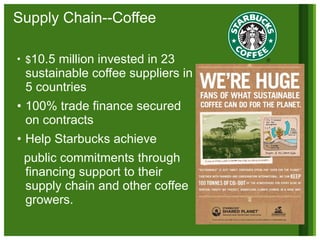
Supply Chain--Coffee  $ 10.5 million invested in 23 sustainable coffee suppliers in 5 countries 100% trade finance secured on contracts Help Starbucks achieve  public commitments through financing support to their supply chain and other coffee growers.
VV Risk Management Thorough due diligence and oversight Use of CI local networks in 40 countries Invest with other lenders (also reduces costs) Invest only in US$ and work with companies receiving hard currency revenues  Repayment terms of not more than 6 years At least 1:1 collateral secured under local law Loan Loss Reserve Requirement averaging 15% of outstanding capital
Conservation and Community Carbon Fund (CCCF)
25  Current high biodiversity forest-carbon projects producing estimated > 100 million tCO 2  over 30 years. Project development and community capacity are needed to scale-up 5-10X over the next 5 years Pro jects in implementation Projects in development
CCCF Overview The CCCF supports the design, start-up and implementation of  forest-based carbon projects  that counteract global warming and  deliver biodiversity and local community benefits .
CCCF Core Products Carbon project development funding  Technical assistance for project development (carbon baseline, PDDs) Voluntary carbon credit agreements Support to indigenous peoples and forest dependent communities to increase their access to carbon markets.
Progress  6 REDD projects funded or in pipeline ( Madagascar, Ecuador, Brazil, Guatemala, Peru, DRC ) October 2009: Signed significant REDD deal with Disney for $7 million in pre-financing CI project in Peru, DRC and third country tbd.  Benefits:  Disney gets excellent marketing benefit and eventual retirement of 900,000 tons CI gets much needed carbon project financing for 3 projects.
Challenges Pre-financing  may create low-pricing scenario for project principals. Without flexible pooled funding, project risk is higher as funds are raised for specific projects. Real market growth in REDD dependent on policy arena.  Significant up-front capital needed for PDD development and capacity building.  Loan/equity financing structures for REDD would help to ensure sufficient financing for building the REDD asset class.
Expanding Opportunities Expand forest-carbon financing 10x Replicate PES-market models- with a focus on freshwater VV expansion with initial $10 million in new capital- focus on Africa Support monetization of biodiversity assets for local and global benefit.
Thank You!  Jennifer Morris [email_address]

Jennifer morris

  • 1.
    Biodiversity andEcosystem Investments November 11 th , 2009
  • 2.
    CI Overview EcosystemFinance Verde Ventures Carbon Fund New Horizons Summary
  • 3.
    CI has fieldoffices in over 40 countries spanning four continents. Our staff of over 1000 employees is supported by a network of over 1,500 local partners around the globe. about CI
  • 4.
    vision We imaginea healthy prosperous world in which societies are forever committed to caring for and valuing nature for the long-term benefit of people and all life on Earth. mission Building upon a strong foundation of science, partnership and field demonstration, CI empowers societies to responsibly and sustainably care for nature for the well-being of humanity.
  • 5.
  • 6.
    Our Funds CriticalEcosystem Partnership Fund (CEPF) Global Conservation Fund (GCF) Conservation Stewards Program (CSP) Verde Ventures Conservation and Community Carbon Fund (CCCF)
  • 7.
    Our Focus ProtectedAreas Rural Livelihoods Long-term Financing Financial management PES Financing
  • 8.
    Summary Results Totalgranted/invested to date: USD $211 million 1,500 partners supported in over 60 countries >89 million hectares of globally significant land protected benefitting critical ecosystems and communities > $254 M in funding leveraged > 140,000 people directly impacted Significant policy impacts in 11 countries
  • 9.
    EFD Investors TotalCapital: $338M (Grants (G), Loans (L), Loan Guarantees (LG)) Multilateral/Bilateral World Bank (G) International Finance Corporation (L&G) Global Environment Facility (G) Overseas Private Investment Facility (L) Government of Japan (G) French Aid Development Agency (L,G&LG) Foundations - Gordon and Betty Moore Foundation (G) - MacArthur Foundation (G) Mulago Foundation (G) United Nations Foundation (G&LG) Conservation International (G-CEPF) Private Sector Starbucks (LG, L & G) - Daiwa (G) Disney (G) Dell (G)
  • 10.
    Investors’ Interest HistoricalPhilanthropic Marketing Benefit Focus on non-CI partners Investment Infrastructure High Leverage (Debt Swap) Increasingly Supply Chain Benefit SRI/TBL (with $ return) Carbon Credits
  • 11.
  • 12.
    Verde Ventures VerdeVentures invests in small businesses that contribute to conservation and communities in Conservation International's global priority areas.
  • 13.
    Why Verde Ventures?Conservation-based employment is essential to provide economic incentives for conservation The small business sector is a key partner in the intersection between human welfare and conservation Lack of available, affordable capital to ensure the sustainability of the sector
  • 14.
    Core Products Loans:US$30,000 to $500,000 (average: $125,000) Use of Loan funds: Infrastructure, working capital, trade finance Typical Deal Structure: Senior or subordinated secured debt for 3-5 years. Increasingly debt + quasi-equity. Financial IRR fund target: 8% Strategic grants for technical assistance and environmental and socio-economic monitoring
  • 15.
    Current Investors InternationalFinance Corporation Overseas Private Investment Corporation Starbucks Coffee Company French Aid Development Agency
  • 16.
    VV Summary Results$13.4 million in 73 loans,13 countries > 400,000 hectares directly impacted 42,000 people employed and/or benefiting $32 million in new sales generated by invested companies 95% repayment rate
  • 17.
    Supply Chain--Coffee $ 10.5 million invested in 23 sustainable coffee suppliers in 5 countries 100% trade finance secured on contracts Help Starbucks achieve public commitments through financing support to their supply chain and other coffee growers.
  • 18.
    VV Risk ManagementThorough due diligence and oversight Use of CI local networks in 40 countries Invest with other lenders (also reduces costs) Invest only in US$ and work with companies receiving hard currency revenues Repayment terms of not more than 6 years At least 1:1 collateral secured under local law Loan Loss Reserve Requirement averaging 15% of outstanding capital
  • 19.
    Conservation and CommunityCarbon Fund (CCCF)
  • 20.
    25 Currenthigh biodiversity forest-carbon projects producing estimated > 100 million tCO 2 over 30 years. Project development and community capacity are needed to scale-up 5-10X over the next 5 years Pro jects in implementation Projects in development
  • 21.
    CCCF Overview TheCCCF supports the design, start-up and implementation of forest-based carbon projects that counteract global warming and deliver biodiversity and local community benefits .
  • 22.
    CCCF Core ProductsCarbon project development funding Technical assistance for project development (carbon baseline, PDDs) Voluntary carbon credit agreements Support to indigenous peoples and forest dependent communities to increase their access to carbon markets.
  • 23.
    Progress 6REDD projects funded or in pipeline ( Madagascar, Ecuador, Brazil, Guatemala, Peru, DRC ) October 2009: Signed significant REDD deal with Disney for $7 million in pre-financing CI project in Peru, DRC and third country tbd. Benefits: Disney gets excellent marketing benefit and eventual retirement of 900,000 tons CI gets much needed carbon project financing for 3 projects.
  • 24.
    Challenges Pre-financing may create low-pricing scenario for project principals. Without flexible pooled funding, project risk is higher as funds are raised for specific projects. Real market growth in REDD dependent on policy arena. Significant up-front capital needed for PDD development and capacity building. Loan/equity financing structures for REDD would help to ensure sufficient financing for building the REDD asset class.
  • 25.
    Expanding Opportunities Expandforest-carbon financing 10x Replicate PES-market models- with a focus on freshwater VV expansion with initial $10 million in new capital- focus on Africa Support monetization of biodiversity assets for local and global benefit.
  • 26.
    Thank You! Jennifer Morris [email_address]

Editor's Notes

  • #9 CELB Strategy & Key Highlights
  • #10 14 investors-
  • #16 CELB Strategy & Key Highlights
  • #17 $2 million repaid to investors.
  • #21 So, CI has been pursuing these opportunities over the past 7 years, and the portfolio of 25 projects in 14 countries will deliver over 100M tons of carbon credits. The question is how can the group gathered here work with CI to expand the global portfolio of forest related carbon projects by 5 to 10 times? What are some of the lessons learned? What is the scale of financing required? What have companies done already that are blazing the paths like Dell, Marriott, BofA/Merrill Lynch and others? What innovations must be pursued to meet the immediate timing objectives particularly as policy is on a fasttrack?
  • #25 CELB Strategy & Key Highlights
  • #26 CELB Strategy & Key Highlights Experience in advance of regulation + Lower compliance costs in regulated markets Meet multiple corporate objectives (climate, supporting communities, sust devel, biod) Early actors & differentiate  Demonstrate leadership (+ set emerging rules of game) Enhance reputation and build brand capital & goodwill (compelling message – multiple-benefits (social & environ) Strengthen govt relations (local govts are very supportive of activities that bring sust devel benefits + Seat at policy table  regulators seek input from progressive biz leaders)