Hancock Natural Resource Group (Australia)Institutional Investment in Forests in AustraliaDavid G. Brand, Ph.D.Director, New Forests ProgramHancock Natural Resource GroupLevel 19, 821 Pacific HwyChatswood 2067(02) 9884-8202(tel)		(02) 9411-1315 (fax)dbrand@hnrg.com.au6 May 2004
2Important NoteThe material in this presentation is provided for information purposes only.  While the information comes from sources believed to be reliable, Hancock Natural Resource Group (Australia) does not warrant the accuracy or completeness of the information provided. Any projections, forecasts or forward looking statements in this presentation are a function of many assumptions and may in fact be wrong.  This presentation is not an offer of investment advice or an offer to sell securities
Hancock Natural Resource Group (Australia)Australian arm of HNRG Inc., a subsidiary of Toronto-based Manulife Financial Services (NYSE/TSE:MFC).  HNRG is part of the Global Investment Management Group, which manages approx. $200 billion for both in-house and third party clientsHNRG currently manages $US 3 billion in assets on behalf of over 50 institutional clients (1.2 million ha of forest in USA, Australia and Canada)HNRGA established in 1998 with acquisition of Hancock Victorian Plantations (HVP) from Victorian Gov’t. Further acquisition of plantations from Paperlinx in 2000.HNRGA awarded first Forest Stewardship Council Certification for HVP in February 2004HNRGA received AFSL licence in March 2004Our business model is to provide excellent risk adjusted returns from the forestry asset class to our institutional investor base
The New Forests ProgramEstablished in 2001, based in SydneyAim is to extend the forestry investment model to encompass emerging opportunities to commercialise environmental services and support reforestation-based investmentNeed to establish a ‘made in Australia’ business model for investment in the forestry sectorTax system and government policies are oriented to support expansion of plantation forestry baseLimited deal flow in mature plantation estates (only 3 or 4 government assets) that are analogous to US Timberland Investment ModelCritical national issues of climate change, dryland salinity and biodiversity loss need systematic commercial solutions—forests can contribute to these issuesWe are beginning to find investment structures that can support growth in institutional forestry investment in Australia
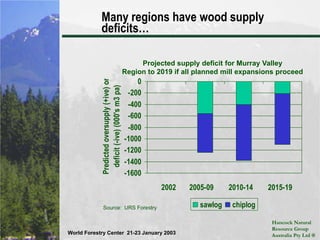
Many regions have wood supply deficits…Projected supply deficit for Murray ValleyRegion to 2019 if all planned mill expansions proceedSource:  URS Forestry
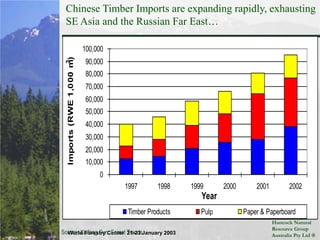
Chinese Timber Imports are expanding rapidly, exhausting SE Asia and the Russian Far East…Source: Xiufang Sun, Forest Trends
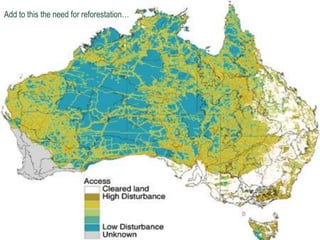
Add to this the need for reforestation…
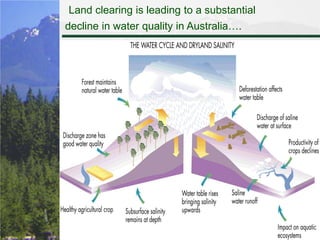
Land clearing is leading to a substantial decline in water quality in Australia….
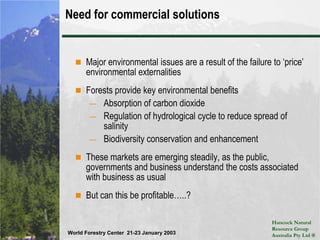
Need for commercial solutionsMajor environmental issues are a result of the failure to ‘price’ environmental externalitiesForests provide key environmental benefitsAbsorption of carbon dioxideRegulation of hydrological cycle to reduce spread of salinityBiodiversity conservation and enhancementThese markets are emerging steadily, as the public, governments and business understand the costs associated with business as usualBut can this be profitable…..?
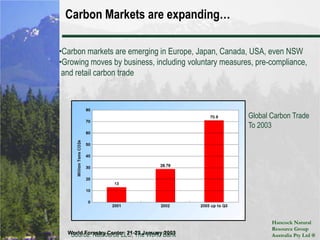
Carbon Markets are expanding…Carbon markets are emerging in Europe, Japan, Canada, USA, even NSW
Growing moves by business, including voluntary measures, pre-compliance,  and retail carbon tradeGlobal Carbon TradeTo 2003Source: Natsource LLC, The World Bank
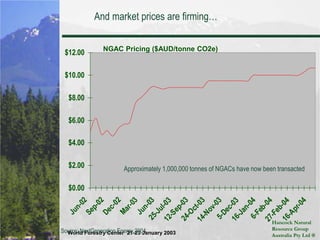
And market prices are firming…NGAC Pricing ($AUD/tonne CO2e)Approximately 1,000,000 tonnes of NGACs have now been transactedSource: NextGeneration Energy 2004
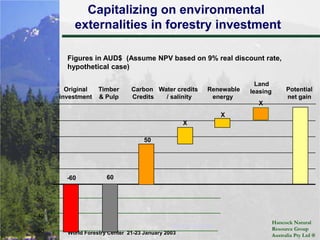
Capitalizing on environmental externalities in forestry investmentFigures in AUD$  (Assume NPV based on 9% real discount rate, hypothetical case)Landleasing OriginalinvestmentRenewableenergy Carbon CreditsTimber& PulpWater credits / salinityPotentialnet gain X100X80X6050402060-600-20--40Source: Swiss Re--60
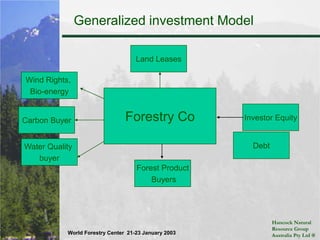
Generalized investment ModelLand LeasesWind Rights, Bio-energyForestry CoInvestor EquityCarbon BuyerDebtWater Quality buyerForest Product Buyers
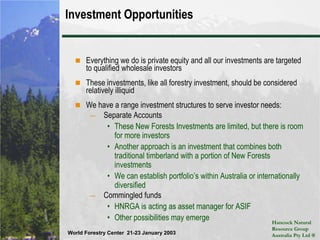
Investment OpportunitiesEverything we do is private equity and all our investments are targeted to qualified wholesale investorsThese investments, like all forestry investment, should be considered relatively illiquidWe have a range investment structures to serve investor needs:Separate AccountsThese New Forests Investments are limited, but there is room for more investorsAnother approach is an investment that combines both traditional timberland with a portion of New Forests investmentsWe can establish portfolio’s within Australia or internationally diversifiedCommingled fundsHNRGA is acting as asset manager for ASIFOther possibilities may emerge

David brandtalksabouthancocknaturalresourcegroup

  • 1.
    Hancock Natural ResourceGroup (Australia)Institutional Investment in Forests in AustraliaDavid G. Brand, Ph.D.Director, New Forests ProgramHancock Natural Resource GroupLevel 19, 821 Pacific HwyChatswood 2067(02) 9884-8202(tel) (02) 9411-1315 (fax)dbrand@hnrg.com.au6 May 2004
  • 2.
    2Important NoteThe materialin this presentation is provided for information purposes only. While the information comes from sources believed to be reliable, Hancock Natural Resource Group (Australia) does not warrant the accuracy or completeness of the information provided. Any projections, forecasts or forward looking statements in this presentation are a function of many assumptions and may in fact be wrong. This presentation is not an offer of investment advice or an offer to sell securities
  • 3.
    Hancock Natural ResourceGroup (Australia)Australian arm of HNRG Inc., a subsidiary of Toronto-based Manulife Financial Services (NYSE/TSE:MFC). HNRG is part of the Global Investment Management Group, which manages approx. $200 billion for both in-house and third party clientsHNRG currently manages $US 3 billion in assets on behalf of over 50 institutional clients (1.2 million ha of forest in USA, Australia and Canada)HNRGA established in 1998 with acquisition of Hancock Victorian Plantations (HVP) from Victorian Gov’t. Further acquisition of plantations from Paperlinx in 2000.HNRGA awarded first Forest Stewardship Council Certification for HVP in February 2004HNRGA received AFSL licence in March 2004Our business model is to provide excellent risk adjusted returns from the forestry asset class to our institutional investor base
  • 4.
    The New ForestsProgramEstablished in 2001, based in SydneyAim is to extend the forestry investment model to encompass emerging opportunities to commercialise environmental services and support reforestation-based investmentNeed to establish a ‘made in Australia’ business model for investment in the forestry sectorTax system and government policies are oriented to support expansion of plantation forestry baseLimited deal flow in mature plantation estates (only 3 or 4 government assets) that are analogous to US Timberland Investment ModelCritical national issues of climate change, dryland salinity and biodiversity loss need systematic commercial solutions—forests can contribute to these issuesWe are beginning to find investment structures that can support growth in institutional forestry investment in Australia
  • 5.
    Many regions havewood supply deficits…Projected supply deficit for Murray ValleyRegion to 2019 if all planned mill expansions proceedSource: URS Forestry
  • 6.
    Chinese Timber Importsare expanding rapidly, exhausting SE Asia and the Russian Far East…Source: Xiufang Sun, Forest Trends
  • 7.
    Add to thisthe need for reforestation…
  • 8.
    Land clearing isleading to a substantial decline in water quality in Australia….
  • 9.
    Need for commercialsolutionsMajor environmental issues are a result of the failure to ‘price’ environmental externalitiesForests provide key environmental benefitsAbsorption of carbon dioxideRegulation of hydrological cycle to reduce spread of salinityBiodiversity conservation and enhancementThese markets are emerging steadily, as the public, governments and business understand the costs associated with business as usualBut can this be profitable…..?
  • 10.
    Carbon Markets areexpanding…Carbon markets are emerging in Europe, Japan, Canada, USA, even NSW
  • 11.
    Growing moves bybusiness, including voluntary measures, pre-compliance, and retail carbon tradeGlobal Carbon TradeTo 2003Source: Natsource LLC, The World Bank
  • 12.
    And market pricesare firming…NGAC Pricing ($AUD/tonne CO2e)Approximately 1,000,000 tonnes of NGACs have now been transactedSource: NextGeneration Energy 2004
  • 13.
    Capitalizing on environmentalexternalities in forestry investmentFigures in AUD$ (Assume NPV based on 9% real discount rate, hypothetical case)Landleasing OriginalinvestmentRenewableenergy Carbon CreditsTimber& PulpWater credits / salinityPotentialnet gain X100X80X6050402060-600-20--40Source: Swiss Re--60
  • 14.
    Generalized investment ModelLandLeasesWind Rights, Bio-energyForestry CoInvestor EquityCarbon BuyerDebtWater Quality buyerForest Product Buyers
  • 15.
    Investment OpportunitiesEverything wedo is private equity and all our investments are targeted to qualified wholesale investorsThese investments, like all forestry investment, should be considered relatively illiquidWe have a range investment structures to serve investor needs:Separate AccountsThese New Forests Investments are limited, but there is room for more investorsAnother approach is an investment that combines both traditional timberland with a portion of New Forests investmentsWe can establish portfolio’s within Australia or internationally diversifiedCommingled fundsHNRGA is acting as asset manager for ASIFOther possibilities may emerge