How to edit and proofread like
a pro
Charity Writing and Publications Training Day
24 October 2013
What we’ll cover
1. The difference between editing and proofreading
2. A step-by-step guide to editing
3. How to do an effective proofread
Editing vs proofreading
• Proofreading: happens at the end of the publication

process, when you’re totally happy with all copy and
design. It’s a final check for basic errors. Happens in
PDF/on web page.
• Editing: all other tweaking of copy, in Word.
Editing: a step-by-step guide
Step 1: What should the final
product look like?
• Who is your audience?
• What do you want them to do when they’ve

read the piece you’re editing?
Editing: a step-by-step guide
Get a brief
• Who is the audience for the piece?
• What do you want the audience to do when they’ve
read it? What is the call to action?
• What are your key messages?
• What tone do you want the piece to strike?
• How deeply do you think the piece needs to be
edited?
• Do you think the structure of the piece needs to
change?
Editing: a step-by-step guide
Step 2: Get missing information
• Who, what, when, where, why?
• Build into timetable
• Check the facts
Editing: a step-by-step guide
Step 3: Order and introduction
• Your introduction is the most important part: make

sure it’s attention-grabbing
• What is your key message? Start with it!
• Put the most exciting information first, then the rest
in order of importance/logic
Twenty years ago this month, we had our public launch, on
24 October 1993, the first World Child Poverty Day. Next
month, we will hold our AGM on 21 October, during the
20th World Child Poverty Day. Our AGM will be held at the
King James Building, where our office is based, and will
start at 11am.
This year we will be changing the format of our AGM and
offering a number of facilitated workshops for attendees.
As well as providing an opportunity to meet other
members socially, we hope our AGM will inform, empower
and inspire our members to get more involved with The
Child Poverty Society. For more information or to let us
know you are attending, please contact the office or email
info@childpoverty.org.
Would you like to find out more about the Child Poverty
Society’s work and meet other members?
Come along to our annual general meeting (AGM) on 21
October. It’s free, and you can go to interesting talks
from experts on everything from the future of Somalia’s
orphanages to how to set up your own campaign group.
The AGM, which marks our 20th anniversary, starts at
11am at the King James Building, where our office is. For
more information or to let us know you’re coming, email
info@childpoverty.org
Editing: a step-by-step guide
Step 4: Make your sentences, paragraphs and
whole text flow well
Sentences
• Use sentence length and structure
• Repeat sentence structure
• Vary sentence length
• Use ‘but’, ‘and’ and dashes for drama
Dementia is devastating.
Right now, it’s robbing 820,000 people in the UK of their
capacity to think, reason and remember. It’s leaving families
caring for loved ones who don’t know who they are. And it’s
costing this country a staggering £23 billion a year, more than
heart disease and cancer combined. With a rapidly ageing
population, that is only going to increase – unless we take
action now.

Research is the answer. If we can understand dementia’s
causes, improve diagnosis, find new treatments and learn
how to prevent it, we can improve and save lives, and money.
We can stop dementia affecting your family in the future.
There is hope. Dementia is treatable. But we must invest now
to find solutions to stop dementia becoming an epidemic.
Editing: a step-by-step guide
• Don’t repeat the same words in consecutive sentences

Youth clubs make a massive difference to young people. From
giving young people skills that are immensely valuable for school
and beyond to building their confidence and improving their job
prospects, going to a youth club can change young people’s lives.
Youth clubs make a massive difference to teenagers. From giving
them skills that are immensely valuable for school and beyond to
building their confidence and improving their job prospects, going
to a youth club can change young people’s lives.
Editing: a step-by-step guide
Paragraphs
• Use transition words and phrases

Transitions signal relationships between ideas, such as
‘Another example coming up—stay alert!’ or ‘Here’s an
exception to my previous statement’ or ‘Although this idea
appears to be true, here’s the real story’. Transitions give your
reader directions to piece your ideas into a logically coherent
argument.
Editing: a step-by-step guide
Effects/results: so, as a result, due to
Addition: also, in addition, too, and
Emphasis: indeed, obviously, undoubtedly, clearly
Elaboration/qualification: frequently, occasionally, in
particular
Concede a point: of course, no doubt, it’s true that
Build towards climax: most importantly, above all
Comparison: likewise, similarly
Contrast: however, nonetheless, although, yet, but
Editing: a step-by-step guide
• Don’t start consecutive paragraphs in the same way

Indonesia and Malaysia produce 92% of all palm oil.
Their fields as far as the eye can see are covered in oil
palm trees.
Indonesia and Malaysia depend heavily on palm oil for
jobs…
Editing: a step-by-step guide
Indonesia and Malaysia produce 92% of all palm oil.
Their fields as far as the eye can see are covered in oil
palm trees.
These countries depend heavily on palm oil for jobs…
Editing: a step-by-step guide
Whole text
• Good headers, subheads

• Bullet points
• Box outs
• Pull stats
• Read out loud
Editing: a step-by-step guide
Step 5: Work on the language
• 8 simple things to eliminate from any piece you edit...
Eliminate...
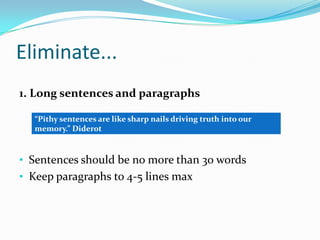
1. Long sentences and paragraphs
“Pithy sentences are like sharp nails driving truth into our
memory.” Diderot

• Sentences should be no more than 30 words
• Keep paragraphs to 4-5 lines max
Every 30 seconds, a fire station in the UK gets a call
because a fire’s broken out in a home and children are
inside, there’s been a pile up on the motorway and
seriously injured people are trapped or perhaps
hazardous chemicals have spilled, and they need to be
cleared before catching fire.
No matter how dangerous the situation, brave fire
fighters will spring into action, putting their own lives
on the line to save others, every minute of every day.
Every 30 seconds, a fire station in the UK gets a call.
A fire’s broken out in a home, children are inside.
There’s a pile up on the motorway, seriously injured
people are trapped. Hazardous chemicals have
spilled, they need to be cleared before catching fire.
No matter how dangerous the situation, brave fire
fighters will spring into action. They put their own
lives on the line to save others. Every minute of every
day.
Eliminate...
2. Long words
“I never write 'metropolis' for seven cents when I can write 'city'
and get paid the same.” Mark Twain

• Myriad

• Many

• Procure

• Buy

• Terminate

• End

• Assistance

• Help

• Implement

• Carry out

• Commence

• Begin

• Assistance

• Help
Eliminate...
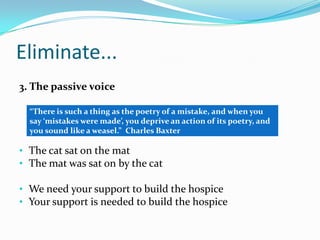
3. The passive voice
“There is such a thing as the poetry of a mistake, and when you
say ‘mistakes were made’, you deprive an action of its poetry, and
you sound like a weasel.” Charles Baxter

• The cat sat on the mat
• The mat was sat on by the cat

• We need your support to build the hospice
• Your support is needed to build the hospice
• The event was run by our Manchester office
• Our Manchester office ran the event

• Sarah was helped hugely by coming to our youth club
• Coming to our youth club helped Sarah hugely
Eliminate...
4. Redundant words and phrases
• Every word you use should have meaning – look out

for those that don’t
1. The financial crisis seriously affects many different parts of the UK.
2. The shop is located in the north of the city.

3. In order to support these desperate families, we need your help.
4. Our programme is the most unique in the world.
5. It goes without saying that your donation is vital.
6. We help children between the ages of six and seven years old.
7. We think that there’s a lack of government funding.
8. The reason why we do this is because there are children suffering.
1. The financial crisis seriously affects many different parts of the UK.
2. The shop is located in the north of the city.
3. In order to support these desperate families, we need your help.
4. Our programme is the most unique in the world.
5. It goes without saying that your donation is vital.
6. We help children between the ages of six and seven years old.
We help six- and seven-year olds.
7. We think that there’s a lack of government funding.
8. The reason why we do this is because there are children suffering.
Eliminate...
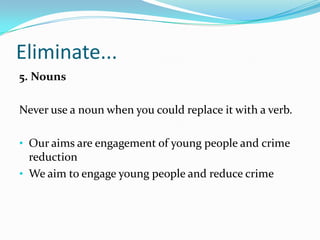
5. Nouns
Never use a noun when you could replace it with a verb.
• Our aims are engagement of young people and crime

reduction
• We aim to engage young people and reduce crime
Eliminate...
6. Adjectives and adverbs
“The road to hell is paved with adverbs.” Stephen King

Too many adjectives/adverbs weaken the impact of your writing.
• Leading doctors have issued a dire warning that the nation’s

massive obesity crisis will have very serious consequences for
essential medical services.
• Doctors have warned that obesity will have serious consequences

for public services.
Eliminate...
7. Jargon
Jargon: The specialised vocabulary of a particular
trade, profession, group or activity.
(Chambers 21st Century Dictionary)
Plain English: Writing that the intended audience can
read, understand and act upon the first time they read it.
(The Plain English Campaign)
• Going forward, high quality learning environments are

an obligatory precondition for the enhancement of the
continuing learning process
• Good schools help children to learn
Eliminate...
8. Clichés
If you hear it all the time, don’t use it.
• He was happy as Larry
• She felt as sick as a dog
Editing: in summary

“It is with words as with sunbeams. The more they are
condensed, the deeper they burn.” Robert Southey
Editing your own work
Everyone’s work benefits from an edit from someone
else.
• Step away and come back
• Print out
• Read aloud
Exercise 1
• Flow
• Long sentences and words

• Passive
• Nouns
• Adjectives and adverbs

• Jargon
• Clichés
What is proofreading?
In an ideal world...

•

The final stage in the process of producing a
publication
• Dotting the ‘i’s, crossing the ‘t’s
• When you are happy with all copy and design
• Checking for consistency and accuracy in
spellings, meaning, layout and style
Why does proofreading matter?
• ‘Prostitutes appeal to Pope’
• ‘Juvenile court to try shooting defendant’
• ‘Red tape holds up new bridges’
Why does proofreading matter?
‘If you don't understand the basic rules of written
English…readers are entitled to wonder what else you
don't understand, and with what authority you
purport to write something you think they ought to
read.’
David Marsh, The Guardian
Proofreading process
Do final, thorough check yourself
Sign off for proofreading
Send to first proofreader, with clear instructions
Check first proofreader’s work, send on to designer
Send on to second proofreader. Ask second
proofreader to check first proofreader’s changes
6. Check second proofreader’s work, send on to
designer
7. Check changes
8. Do final, thorough check yourself
1.
2.
3.
4.
5.
How to proofread
Step 1: Get in the right mindset, find the right
environment

Step 2: Print out your document. It’s easier to read on
paper and you are much more likely to pick up errors.
It’s also easier to navigate through long documents.
How to proofread
Step 3: Decide how you’re going to mark up your
document
• On paper, using proofing marks?
• Using PDF Sticky Notes?
• Writing a list of changes?

Step 4: Start your proofread!
How to proofread
What to look for in a proofread: the obvious

•
•
•
•
•
•
•
•

Typos
Errors in spelling, grammar and punctuation
House style mistakes
Inconsistencies in copy
(abbreviations, titles, spellings, capitalisation)
Inconsistencies in design (headings, captions, word
spacing)
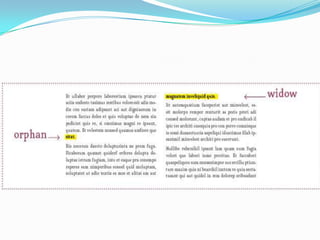
Widows and orphans
Factual errors
Awkward sentences or confusing copy
How to proofread
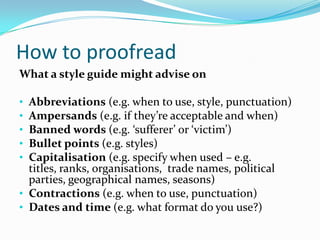
What a style guide might advise on
•
•
•
•
•

Abbreviations (e.g. when to use, style, punctuation)
Ampersands (e.g. if they’re acceptable and when)
Banned words (e.g. ‘sufferer’ or ‘victim’)
Bullet points (e.g. styles)
Capitalisation (e.g. specify when used – e.g.
titles, ranks, organisations, trade names, political
parties, geographical names, seasons)
• Contractions (e.g. when to use, punctuation)
• Dates and time (e.g. what format do you use?)
•
•
•
•
•
•
•
•

Layout (e.g. widows/orphans, heading sizes)
Measurements (e.g. do you use abbreviations?)
Money (e.g. what format do you use?)
Numbers
Other languages (e.g. are any words italicised?)
Per cent (e.g. per cent/percent/%)
Publications (e.g. italicised?)
Punctuation (e.g. when to use en
dashes, hyphens, brackets, apostrophes, commas, ellipsis)
• Quotations (e.g. double or single quote marks?)
• Spellings (e.g. list any unusual spellings –
multinational/multi-national, PowerPoint)
• Default publication(s) to refer to for rules and/or
spellings not specified in your style guide.
How to proofread
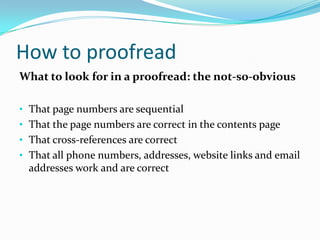
What to look for in a proofread: the not-so-obvious
• That page numbers are sequential
• That the page numbers are correct in the contents page

• That cross-references are correct
• That all phone numbers, addresses, website links and email

addresses work and are correct
How to proofread: top tips
Tip 1: Read a paragraph once for sense and flow, then
read it again for errors
Tip 2: Read it out loud
Tip 3: Read it backwards
Tip 4: Use a ruler or piece of paper
How to proofread: top tips
Tip 5: Use search and replace to check consistency
Tip 6: Do a final check of design and layout

Jennifer campbelleditingandproofreading

  • 1.
    How to editand proofread like a pro Charity Writing and Publications Training Day 24 October 2013
  • 2.
    What we’ll cover 1.The difference between editing and proofreading 2. A step-by-step guide to editing 3. How to do an effective proofread
  • 3.
    Editing vs proofreading •Proofreading: happens at the end of the publication process, when you’re totally happy with all copy and design. It’s a final check for basic errors. Happens in PDF/on web page. • Editing: all other tweaking of copy, in Word.
  • 4.
    Editing: a step-by-stepguide Step 1: What should the final product look like? • Who is your audience? • What do you want them to do when they’ve read the piece you’re editing?
  • 5.
    Editing: a step-by-stepguide Get a brief • Who is the audience for the piece? • What do you want the audience to do when they’ve read it? What is the call to action? • What are your key messages? • What tone do you want the piece to strike? • How deeply do you think the piece needs to be edited? • Do you think the structure of the piece needs to change?
  • 6.
    Editing: a step-by-stepguide Step 2: Get missing information • Who, what, when, where, why? • Build into timetable • Check the facts
  • 7.
    Editing: a step-by-stepguide Step 3: Order and introduction • Your introduction is the most important part: make sure it’s attention-grabbing • What is your key message? Start with it! • Put the most exciting information first, then the rest in order of importance/logic
  • 8.
    Twenty years agothis month, we had our public launch, on 24 October 1993, the first World Child Poverty Day. Next month, we will hold our AGM on 21 October, during the 20th World Child Poverty Day. Our AGM will be held at the King James Building, where our office is based, and will start at 11am. This year we will be changing the format of our AGM and offering a number of facilitated workshops for attendees. As well as providing an opportunity to meet other members socially, we hope our AGM will inform, empower and inspire our members to get more involved with The Child Poverty Society. For more information or to let us know you are attending, please contact the office or email info@childpoverty.org.
  • 9.
    Would you liketo find out more about the Child Poverty Society’s work and meet other members? Come along to our annual general meeting (AGM) on 21 October. It’s free, and you can go to interesting talks from experts on everything from the future of Somalia’s orphanages to how to set up your own campaign group. The AGM, which marks our 20th anniversary, starts at 11am at the King James Building, where our office is. For more information or to let us know you’re coming, email info@childpoverty.org
  • 11.
    Editing: a step-by-stepguide Step 4: Make your sentences, paragraphs and whole text flow well Sentences • Use sentence length and structure • Repeat sentence structure • Vary sentence length • Use ‘but’, ‘and’ and dashes for drama
  • 12.
    Dementia is devastating. Rightnow, it’s robbing 820,000 people in the UK of their capacity to think, reason and remember. It’s leaving families caring for loved ones who don’t know who they are. And it’s costing this country a staggering £23 billion a year, more than heart disease and cancer combined. With a rapidly ageing population, that is only going to increase – unless we take action now. Research is the answer. If we can understand dementia’s causes, improve diagnosis, find new treatments and learn how to prevent it, we can improve and save lives, and money. We can stop dementia affecting your family in the future. There is hope. Dementia is treatable. But we must invest now to find solutions to stop dementia becoming an epidemic.
  • 13.
    Editing: a step-by-stepguide • Don’t repeat the same words in consecutive sentences Youth clubs make a massive difference to young people. From giving young people skills that are immensely valuable for school and beyond to building their confidence and improving their job prospects, going to a youth club can change young people’s lives. Youth clubs make a massive difference to teenagers. From giving them skills that are immensely valuable for school and beyond to building their confidence and improving their job prospects, going to a youth club can change young people’s lives.
  • 14.
    Editing: a step-by-stepguide Paragraphs • Use transition words and phrases Transitions signal relationships between ideas, such as ‘Another example coming up—stay alert!’ or ‘Here’s an exception to my previous statement’ or ‘Although this idea appears to be true, here’s the real story’. Transitions give your reader directions to piece your ideas into a logically coherent argument.
  • 15.
    Editing: a step-by-stepguide Effects/results: so, as a result, due to Addition: also, in addition, too, and Emphasis: indeed, obviously, undoubtedly, clearly Elaboration/qualification: frequently, occasionally, in particular Concede a point: of course, no doubt, it’s true that Build towards climax: most importantly, above all Comparison: likewise, similarly Contrast: however, nonetheless, although, yet, but
  • 16.
    Editing: a step-by-stepguide • Don’t start consecutive paragraphs in the same way Indonesia and Malaysia produce 92% of all palm oil. Their fields as far as the eye can see are covered in oil palm trees. Indonesia and Malaysia depend heavily on palm oil for jobs…
  • 17.
    Editing: a step-by-stepguide Indonesia and Malaysia produce 92% of all palm oil. Their fields as far as the eye can see are covered in oil palm trees. These countries depend heavily on palm oil for jobs…
  • 18.
    Editing: a step-by-stepguide Whole text • Good headers, subheads • Bullet points • Box outs • Pull stats • Read out loud
  • 19.
    Editing: a step-by-stepguide Step 5: Work on the language • 8 simple things to eliminate from any piece you edit...
  • 20.
    Eliminate... 1. Long sentencesand paragraphs “Pithy sentences are like sharp nails driving truth into our memory.” Diderot • Sentences should be no more than 30 words • Keep paragraphs to 4-5 lines max
  • 21.
    Every 30 seconds,a fire station in the UK gets a call because a fire’s broken out in a home and children are inside, there’s been a pile up on the motorway and seriously injured people are trapped or perhaps hazardous chemicals have spilled, and they need to be cleared before catching fire. No matter how dangerous the situation, brave fire fighters will spring into action, putting their own lives on the line to save others, every minute of every day.
  • 22.
    Every 30 seconds,a fire station in the UK gets a call. A fire’s broken out in a home, children are inside. There’s a pile up on the motorway, seriously injured people are trapped. Hazardous chemicals have spilled, they need to be cleared before catching fire. No matter how dangerous the situation, brave fire fighters will spring into action. They put their own lives on the line to save others. Every minute of every day.
  • 23.
    Eliminate... 2. Long words “Inever write 'metropolis' for seven cents when I can write 'city' and get paid the same.” Mark Twain • Myriad • Many • Procure • Buy • Terminate • End • Assistance • Help • Implement • Carry out • Commence • Begin • Assistance • Help
  • 24.
    Eliminate... 3. The passivevoice “There is such a thing as the poetry of a mistake, and when you say ‘mistakes were made’, you deprive an action of its poetry, and you sound like a weasel.” Charles Baxter • The cat sat on the mat • The mat was sat on by the cat • We need your support to build the hospice • Your support is needed to build the hospice
  • 25.
    • The eventwas run by our Manchester office • Our Manchester office ran the event • Sarah was helped hugely by coming to our youth club • Coming to our youth club helped Sarah hugely
  • 26.
    Eliminate... 4. Redundant wordsand phrases • Every word you use should have meaning – look out for those that don’t
  • 27.
    1. The financialcrisis seriously affects many different parts of the UK. 2. The shop is located in the north of the city. 3. In order to support these desperate families, we need your help. 4. Our programme is the most unique in the world. 5. It goes without saying that your donation is vital. 6. We help children between the ages of six and seven years old. 7. We think that there’s a lack of government funding. 8. The reason why we do this is because there are children suffering.
  • 28.
    1. The financialcrisis seriously affects many different parts of the UK. 2. The shop is located in the north of the city. 3. In order to support these desperate families, we need your help. 4. Our programme is the most unique in the world. 5. It goes without saying that your donation is vital. 6. We help children between the ages of six and seven years old. We help six- and seven-year olds. 7. We think that there’s a lack of government funding. 8. The reason why we do this is because there are children suffering.
  • 29.
    Eliminate... 5. Nouns Never usea noun when you could replace it with a verb. • Our aims are engagement of young people and crime reduction • We aim to engage young people and reduce crime
  • 30.
    Eliminate... 6. Adjectives andadverbs “The road to hell is paved with adverbs.” Stephen King Too many adjectives/adverbs weaken the impact of your writing. • Leading doctors have issued a dire warning that the nation’s massive obesity crisis will have very serious consequences for essential medical services. • Doctors have warned that obesity will have serious consequences for public services.
  • 31.
    Eliminate... 7. Jargon Jargon: Thespecialised vocabulary of a particular trade, profession, group or activity. (Chambers 21st Century Dictionary) Plain English: Writing that the intended audience can read, understand and act upon the first time they read it. (The Plain English Campaign)
  • 32.
    • Going forward,high quality learning environments are an obligatory precondition for the enhancement of the continuing learning process • Good schools help children to learn
  • 33.
    Eliminate... 8. Clichés If youhear it all the time, don’t use it. • He was happy as Larry • She felt as sick as a dog
  • 34.
    Editing: in summary “Itis with words as with sunbeams. The more they are condensed, the deeper they burn.” Robert Southey
  • 35.
    Editing your ownwork Everyone’s work benefits from an edit from someone else. • Step away and come back • Print out • Read aloud
  • 36.
    Exercise 1 • Flow •Long sentences and words • Passive • Nouns • Adjectives and adverbs • Jargon • Clichés
  • 37.
    What is proofreading? Inan ideal world... • The final stage in the process of producing a publication • Dotting the ‘i’s, crossing the ‘t’s • When you are happy with all copy and design • Checking for consistency and accuracy in spellings, meaning, layout and style
  • 38.
    Why does proofreadingmatter? • ‘Prostitutes appeal to Pope’ • ‘Juvenile court to try shooting defendant’ • ‘Red tape holds up new bridges’
  • 39.
    Why does proofreadingmatter? ‘If you don't understand the basic rules of written English…readers are entitled to wonder what else you don't understand, and with what authority you purport to write something you think they ought to read.’ David Marsh, The Guardian
  • 40.
    Proofreading process Do final,thorough check yourself Sign off for proofreading Send to first proofreader, with clear instructions Check first proofreader’s work, send on to designer Send on to second proofreader. Ask second proofreader to check first proofreader’s changes 6. Check second proofreader’s work, send on to designer 7. Check changes 8. Do final, thorough check yourself 1. 2. 3. 4. 5.
  • 41.
    How to proofread Step1: Get in the right mindset, find the right environment Step 2: Print out your document. It’s easier to read on paper and you are much more likely to pick up errors. It’s also easier to navigate through long documents.
  • 42.
    How to proofread Step3: Decide how you’re going to mark up your document • On paper, using proofing marks? • Using PDF Sticky Notes? • Writing a list of changes? Step 4: Start your proofread!
  • 43.
    How to proofread Whatto look for in a proofread: the obvious • • • • • • • • Typos Errors in spelling, grammar and punctuation House style mistakes Inconsistencies in copy (abbreviations, titles, spellings, capitalisation) Inconsistencies in design (headings, captions, word spacing) Widows and orphans Factual errors Awkward sentences or confusing copy
  • 45.
    How to proofread Whata style guide might advise on • • • • • Abbreviations (e.g. when to use, style, punctuation) Ampersands (e.g. if they’re acceptable and when) Banned words (e.g. ‘sufferer’ or ‘victim’) Bullet points (e.g. styles) Capitalisation (e.g. specify when used – e.g. titles, ranks, organisations, trade names, political parties, geographical names, seasons) • Contractions (e.g. when to use, punctuation) • Dates and time (e.g. what format do you use?)
  • 46.
    • • • • • • • • Layout (e.g. widows/orphans,heading sizes) Measurements (e.g. do you use abbreviations?) Money (e.g. what format do you use?) Numbers Other languages (e.g. are any words italicised?) Per cent (e.g. per cent/percent/%) Publications (e.g. italicised?) Punctuation (e.g. when to use en dashes, hyphens, brackets, apostrophes, commas, ellipsis) • Quotations (e.g. double or single quote marks?) • Spellings (e.g. list any unusual spellings – multinational/multi-national, PowerPoint) • Default publication(s) to refer to for rules and/or spellings not specified in your style guide.
  • 47.
    How to proofread Whatto look for in a proofread: the not-so-obvious • That page numbers are sequential • That the page numbers are correct in the contents page • That cross-references are correct • That all phone numbers, addresses, website links and email addresses work and are correct
  • 48.
    How to proofread:top tips Tip 1: Read a paragraph once for sense and flow, then read it again for errors Tip 2: Read it out loud Tip 3: Read it backwards Tip 4: Use a ruler or piece of paper
  • 49.
    How to proofread:top tips Tip 5: Use search and replace to check consistency Tip 6: Do a final check of design and layout