EARLY LIFE
• Born in Florence, Italy, November 29,
   1632
  • Originally named Giovanni Battista
• Learned guitar and violin
  • Likely from Franciscan friars
• Left for Paris, France in 1646 at the age
   of 14
PARIS
•    Appointed “garçon de chambre” to Anne-Marie-Louise d'Orléans
    • Cousin of Louis XIV
    • Known as the ‘Grande Mademoiselle’
•    Completed his musical education while in this post
    • Studied harpsichord, composition, and dance
•    Dance
    • Jean Regnault
       • Lully’s instructor
    • Became acquainted with dancers of the royal ballet
    • Collaborated with Du Moustier in composing the music for Mascarade de la
      Foire Saint-Germain
       • Only the libretto survives
LOUIS XIV
•    Lully entered Louis XIV’s service in 1651
    • Jean Regnault became mâitre à danser du roi
       • Dancing master of the King
•    Ballet royal de la nuit
    • Lully was 20 years old
    • March 16, 1653
       • Appointed to post of compositeur de la musique instrumentale
         • Composer of instrumental music
•    Lully’s talent for dance attracted Louis’ attention
    • Lully was several years Louis’ senior
    • Quickly gained a privileged relationship with Louis
THE 1660’S
•    May 16, 1661
    • Louis XIV begins personal reign of France
    • Lully appointed surintendant de la musique de la chambre du roi
       • Superintendent of the music of the king’s chamber
•    December 1661
    • Became naturalized citizen of France
•    July 24, 1662
    • Married Madeleine, daughter of composer Michel Lambert
•    From the time of his appointment under King Louis XIV, Lully’s
     reputation as a composer spread throughout Europe
OPERA
•    Initially, Lully was not optimistic about the chances of French
     opera
    • The success of several operas in 1671 changed Lully’s opinion
•    Used leverage with Louis XIV
    • Became director of the Académie Royale de Musique
    • April 28, 1673, was authorized to use the Palais Royal theatre for
      free
    • Lully prohibited the use of more than two voices and six violins;
      rivals were not permitted to use dancers at all
    • Louis XIV decided to have Lully’s works produced at court and
      financed by the royal treasury
INNOVATIONS IN OPERA…
•    Created a new French form of opera
    • Tragédie en musique/tragédie lyrique
       • Combination of drama, music, and ballet
•    Each opera began with an ouverture (overture)
    • Intended to mark the entry of the king and welcome him to the performance
    • Comprised of two sections, each played twice
    • The first is homophonic and majestic, the second is faster and occasionally employs
      fugal imitation
•    Divertissement
    • Appeared at the center or end of each act
    • Extended episodes that included choruses, dancing, and elaborate costumes and
      choreography
    • Direct continuation from French ballet tradition
•    Adapted Italian recitative to French language
•    Airs
    • Lyrical moments
    • Songs with rhyming text and regular meter
    • Syllabic, tuneful melody, little text repetition
…AND ORCHESTRA
• Dictator-like control over orchestra
  • Conducted with staff instead of baton
• Enforced uniform bowing and coordinated
   ornaments
  • Became the typical practice of modern orchestras
REFERENCES
Burkholder, J. P., Grout, D. J., & Palisca, C. V. (2010). France, England,
   Spain, and the new world in the seventeenth century. A history of
   western music (8th Edition ed., pp. 359-365). New York: W. W. Norton &
   Company.
Jean-Baptiste Lully. (n.d.). Oxford Music Online. Retrieved October 18, 2011,
   from
   http://www.oxfordmusiconline.com/subscriber/article/grove/music/4247
   7pg1?q=Jean-
   Baptiste+Lully&hbutton_search.x=0&hbutton_search.y=0&hbutton_sear
   ch=search&source=omo_t237&source=omo_gmo&source=omo_t114&s
   earch=quick&pos=1&_start=1#firsthit

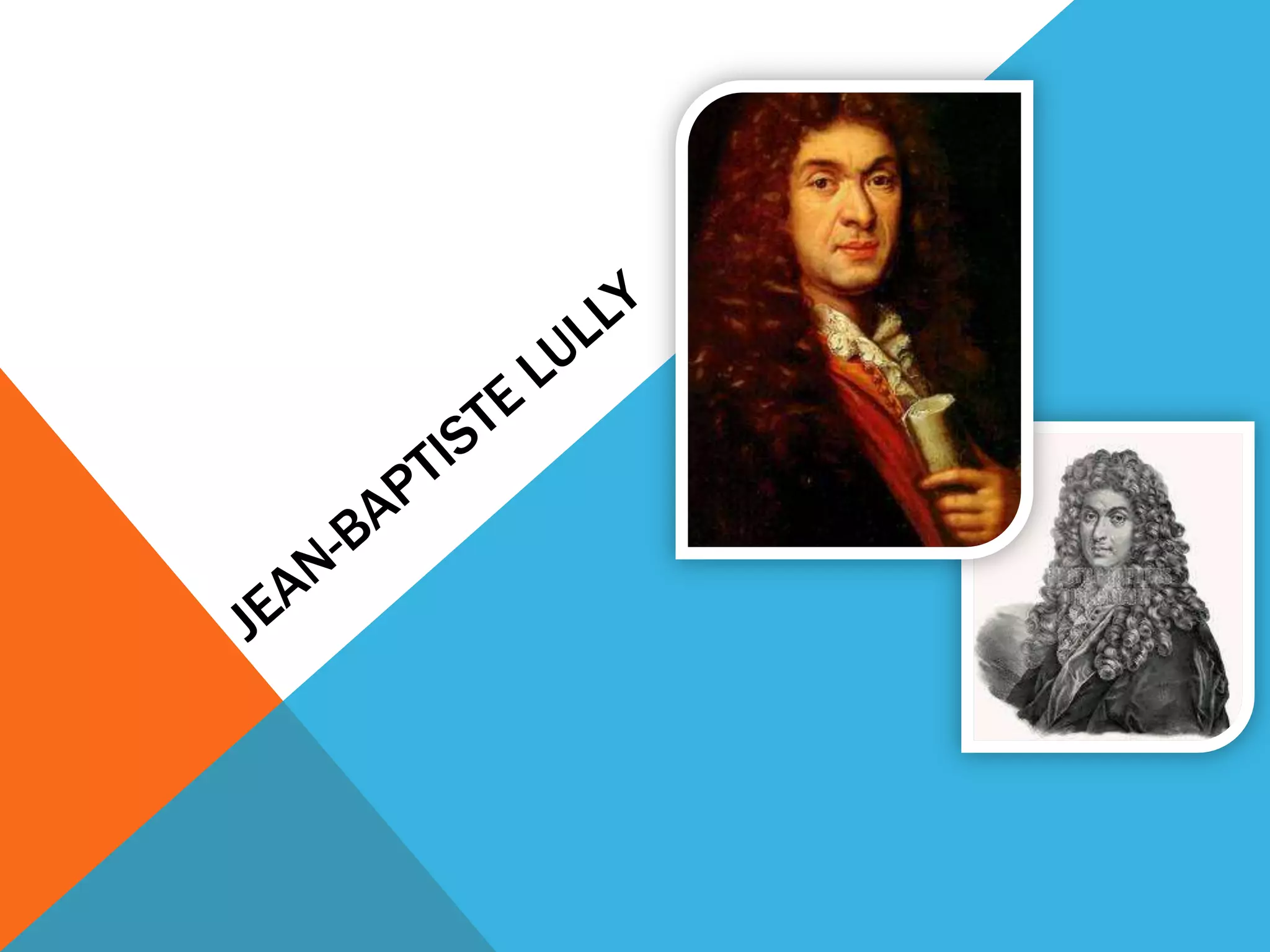
Jean-Baptiste Lully

  • 2.
    EARLY LIFE • Bornin Florence, Italy, November 29, 1632 • Originally named Giovanni Battista • Learned guitar and violin • Likely from Franciscan friars • Left for Paris, France in 1646 at the age of 14
  • 3.
    PARIS • Appointed “garçon de chambre” to Anne-Marie-Louise d'Orléans • Cousin of Louis XIV • Known as the ‘Grande Mademoiselle’ • Completed his musical education while in this post • Studied harpsichord, composition, and dance • Dance • Jean Regnault • Lully’s instructor • Became acquainted with dancers of the royal ballet • Collaborated with Du Moustier in composing the music for Mascarade de la Foire Saint-Germain • Only the libretto survives
  • 4.
    LOUIS XIV • Lully entered Louis XIV’s service in 1651 • Jean Regnault became mâitre à danser du roi • Dancing master of the King • Ballet royal de la nuit • Lully was 20 years old • March 16, 1653 • Appointed to post of compositeur de la musique instrumentale • Composer of instrumental music • Lully’s talent for dance attracted Louis’ attention • Lully was several years Louis’ senior • Quickly gained a privileged relationship with Louis
  • 5.
    THE 1660’S • May 16, 1661 • Louis XIV begins personal reign of France • Lully appointed surintendant de la musique de la chambre du roi • Superintendent of the music of the king’s chamber • December 1661 • Became naturalized citizen of France • July 24, 1662 • Married Madeleine, daughter of composer Michel Lambert • From the time of his appointment under King Louis XIV, Lully’s reputation as a composer spread throughout Europe
  • 6.
    OPERA • Initially, Lully was not optimistic about the chances of French opera • The success of several operas in 1671 changed Lully’s opinion • Used leverage with Louis XIV • Became director of the Académie Royale de Musique • April 28, 1673, was authorized to use the Palais Royal theatre for free • Lully prohibited the use of more than two voices and six violins; rivals were not permitted to use dancers at all • Louis XIV decided to have Lully’s works produced at court and financed by the royal treasury
  • 7.
    INNOVATIONS IN OPERA… • Created a new French form of opera • Tragédie en musique/tragédie lyrique • Combination of drama, music, and ballet • Each opera began with an ouverture (overture) • Intended to mark the entry of the king and welcome him to the performance • Comprised of two sections, each played twice • The first is homophonic and majestic, the second is faster and occasionally employs fugal imitation • Divertissement • Appeared at the center or end of each act • Extended episodes that included choruses, dancing, and elaborate costumes and choreography • Direct continuation from French ballet tradition • Adapted Italian recitative to French language • Airs • Lyrical moments • Songs with rhyming text and regular meter • Syllabic, tuneful melody, little text repetition
  • 8.
    …AND ORCHESTRA • Dictator-likecontrol over orchestra • Conducted with staff instead of baton • Enforced uniform bowing and coordinated ornaments • Became the typical practice of modern orchestras
  • 9.
    REFERENCES Burkholder, J. P.,Grout, D. J., & Palisca, C. V. (2010). France, England, Spain, and the new world in the seventeenth century. A history of western music (8th Edition ed., pp. 359-365). New York: W. W. Norton & Company. Jean-Baptiste Lully. (n.d.). Oxford Music Online. Retrieved October 18, 2011, from http://www.oxfordmusiconline.com/subscriber/article/grove/music/4247 7pg1?q=Jean- Baptiste+Lully&hbutton_search.x=0&hbutton_search.y=0&hbutton_sear ch=search&source=omo_t237&source=omo_gmo&source=omo_t114&s earch=quick&pos=1&_start=1#firsthit