George Gershwin: A Life and Times Created by MaryEllen Saatzer Period 2 FIRE
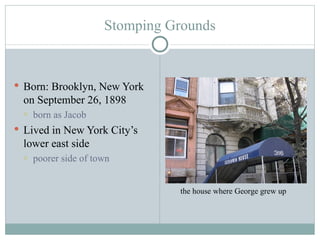
Stomping Grounds Born: Brooklyn, New York on September 26, 1898 born as Jacob Lived in New York City’s lower east side poorer side of town the house where George grew up
Family and Relations Mother: Rose Bruskin Father: Morris Gershovitz changed the surname from Gershovitz to Gershwin to make it “sound more American” (Older) Brother: Ira  born as Israel born in New York City on December 6, 1896 Had two other siblings
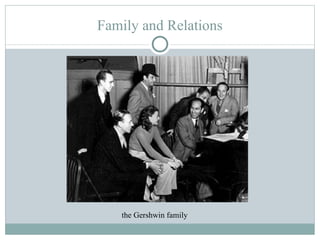
Family and Relations the Gershwin family
Adolescence Began studying piano at age 12 piano teacher: Charles Hambitzer theory teacher: Edward Kilenyi Quit high school when he was 16 to become a “song-plugger” at Remick’s (music publisher/distributor) mother was worried; “no college education, no success” Missed a “brilliant child violinist’s” concert could hear the music from a distance very inspirational spent most of his time at a keyboard after the experience parents signed him up for piano lessons
Charles Hambitzer Edward Kilenyi Very generous Fond of George and his talent Taught George proper techniques George began writing songs with styles similar to that of Jerome Kern and Irving Berlin Referred George to Edward Kilenyi George’s Teachers Published a book that contained lessons he had with George Taught George theory
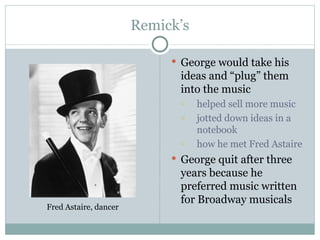
Remick’s George would take his ideas and “plug” them into the music  helped sell more music jotted down ideas in a notebook how he met Fred Astaire George quit after three years because he preferred music written for Broadway musicals Fred Astaire, dancer
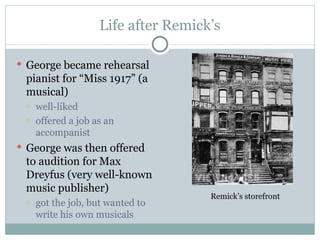
Life after Remick’s George became rehearsal pianist for “Miss 1917” (a musical) well-liked offered a job as an accompanist  George was then offered to audition for Max Dreyfus (very well-known music publisher) got the job, but wanted to write his own musicals  Remick’s storefront
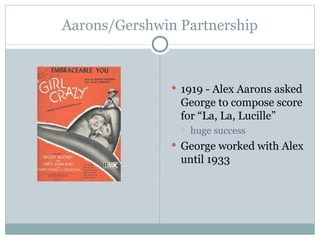
Aarons/Gershwin Partnership 1919 - Alex Aarons asked George to compose score for “La, La, Lucille” huge success George worked with Alex until 1933
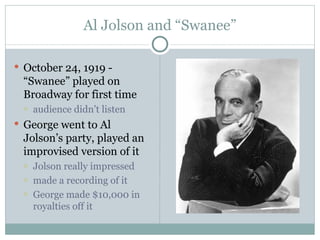
Al Jolson and “Swanee” October 24, 1919 - “Swanee” played on Broadway for first time audience didn’t listen George went to Al Jolson’s party, played an improvised version of it Jolson really impressed made a recording of it George made $10,000 in royalties off it
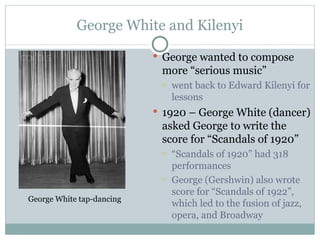
George White and Kilenyi George wanted to compose more “serious music” went back to Edward Kilenyi for lessons 1920 – George White (dancer) asked George to write the score for “Scandals of 1920”  “ Scandals of 1920” had 318 performances George (Gershwin) also wrote score for “Scandals of 1922”, which led to the fusion of jazz, opera, and Broadway George White tap-dancing
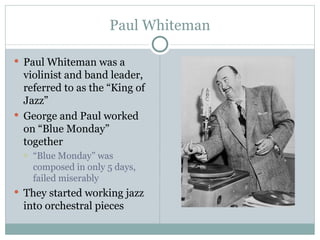
Paul Whiteman Paul Whiteman was a violinist and band leader, referred to as the “King of Jazz” George and Paul worked on “Blue Monday” together “ Blue Monday” was composed in only 5 days, failed miserably They started working jazz into orchestral pieces
Back to America! After arriving in America, George was asked to play for Eva Gauthier (Canadian soprano) was one of the first times jazz was included in a formal concert audience was impressed (so was Paul Whiteman) Whiteman asked George to compose a piece for piano and orchestra led to “Rhapsody in Blue” Also worked on “Lady Be Good” with Ira  first collaboration of the two brothers “ Lady Be Good” was written for Fred Astaire
“ Rhapsody in Blue” Set George’s career Took only 10 days to compose George described it as “a musical kaleidoscope of America” Earned George $250,000 in it’s first 10 years This is a beautiful recording of George playing “Rhapsody in Blue” (on piano). It’s pretty long, so you don’t have to listen to the entire thing, but I highly recommend it.   The recording takes 10-15 seconds to start.
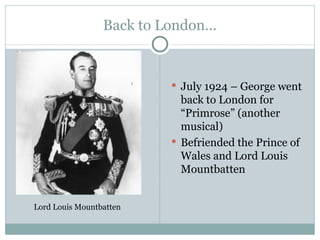
Back to London… July 1924 – George went back to London for “Primrose” (another musical) Befriended the Prince of Wales and Lord Louis Mountbatten Lord Louis Mountbatten
1925 - 1927 1925 – George writes a piano concert for the New York Symphony Orchestra audiences loved it, but critics thought George should stick with jazz 1926 – George writes “Oh, Kay!” so popular during its first 3 months that it sold 57230 copies of sheet music 1927 – “Funny Face” and “Strike Up the Band” both fail miserably “ Funny Face” was a hit after being reworked, starred Fred Astaire “ Strike Up the Band” closed after it’s first 2 weeks
1928 George met Maurice Ravel for lessons, but was denied (Ravel did not want to spoil George’s natural talent) March – George left NY for Europe because he still wanted to compose “serious” music and find a teacher had no success with either due to all the parties/concerts Alban Berg (Austrian composer) and Sergei Prokofiev wanted to meet George
“ An American in Paris” George began writing it after his failed search for a teacher Written to show the feelings of a tourist  Street noises in the musical seemed strange to the audience  they loved it anyway Critics still thought  that George’s concert music “lacked discipline and structure” This is a recording of “An American in Paris”, played by the New York Philharmonic. It’s almost ten minutes long, but totally worth it.   Remember to listen for the “car horns”.
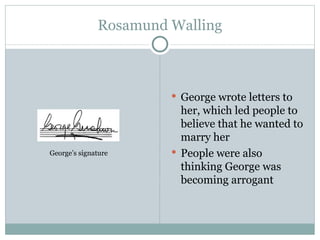
Rosamund Walling George wrote letters to her, which led people to believe that he wanted to marry her People were also thinking George was becoming arrogant George’s signature
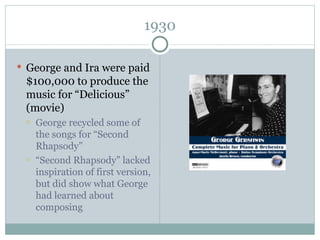
1930 George and Ira were paid $100,000 to produce the music for “Delicious” (movie) George recycled some of the songs for “Second Rhapsody” “ Second Rhapsody” lacked inspiration of first version, but did show what George had learned about composing
1931 1932 “ Of Thee I Sing” runs 441 performances  George worries that he will never be taken seriously wanted to make his musical mark in history George decides to look for a teacher (again) Bill Daly (theater director): “a rather worried and anxious young man” (speaking of George) “ Of Thee I Sing” wins the Pulitzer Prize 1931 - 1932
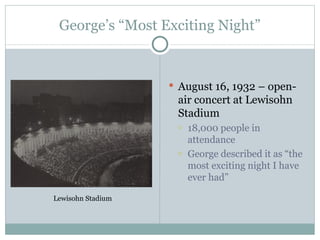
George’s “Most Exciting Night” August 16, 1932 – open-air concert at Lewisohn Stadium  18,000 people in attendance George described it as “the most exciting night I have ever had” Lewisohn Stadium
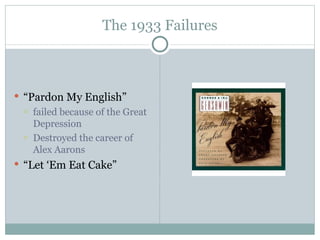
The 1933 Failures “ Pardon My English” failed because of the Great Depression Destroyed the career of Alex Aarons “ Let ‘Em Eat Cake”
1934 George decided to start “Porgy and Bess” because he read “Porgy” (story) eight years earlier enjoyed writing it traveled to Charleston for its first performance (October 10, 1935) critics thought it was “clumsy” only had 124 performances lost lots of George’s money which made him heartbroken
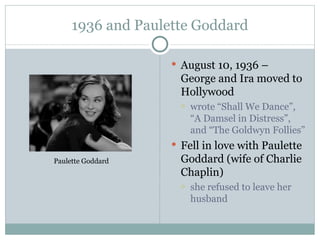
1936 and Paulette Goddard August 10, 1936 – George and Ira moved to Hollywood wrote “Shall We Dance”, “A Damsel in Distress”, and “The Goldwyn Follies” Fell in love with Paulette Goddard (wife of Charlie Chaplin) she refused to leave her husband Paulette Goddard
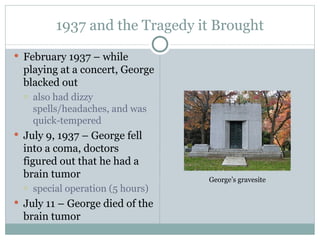
1937 and the Tragedy it Brought February 1937 – while playing at a concert, George blacked out also had dizzy spells/headaches, and was quick-tempered July 9, 1937 – George fell into a coma, doctors figured out that he had a brain tumor special operation (5 hours) July 11 – George died of the brain tumor George’s gravesite
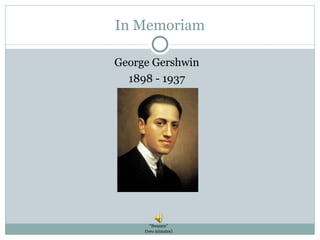
In Memoriam George Gershwin 1898 - 1937 “ Swanee” (two minutes)

George Gershwin

  • 1.
    George Gershwin: ALife and Times Created by MaryEllen Saatzer Period 2 FIRE
  • 2.
    Stomping Grounds Born:Brooklyn, New York on September 26, 1898 born as Jacob Lived in New York City’s lower east side poorer side of town the house where George grew up
  • 3.
    Family and RelationsMother: Rose Bruskin Father: Morris Gershovitz changed the surname from Gershovitz to Gershwin to make it “sound more American” (Older) Brother: Ira born as Israel born in New York City on December 6, 1896 Had two other siblings
  • 4.
    Family and Relationsthe Gershwin family
  • 5.
    Adolescence Began studyingpiano at age 12 piano teacher: Charles Hambitzer theory teacher: Edward Kilenyi Quit high school when he was 16 to become a “song-plugger” at Remick’s (music publisher/distributor) mother was worried; “no college education, no success” Missed a “brilliant child violinist’s” concert could hear the music from a distance very inspirational spent most of his time at a keyboard after the experience parents signed him up for piano lessons
  • 6.
    Charles Hambitzer EdwardKilenyi Very generous Fond of George and his talent Taught George proper techniques George began writing songs with styles similar to that of Jerome Kern and Irving Berlin Referred George to Edward Kilenyi George’s Teachers Published a book that contained lessons he had with George Taught George theory
  • 7.
    Remick’s George wouldtake his ideas and “plug” them into the music helped sell more music jotted down ideas in a notebook how he met Fred Astaire George quit after three years because he preferred music written for Broadway musicals Fred Astaire, dancer
  • 8.
    Life after Remick’sGeorge became rehearsal pianist for “Miss 1917” (a musical) well-liked offered a job as an accompanist George was then offered to audition for Max Dreyfus (very well-known music publisher) got the job, but wanted to write his own musicals Remick’s storefront
  • 9.
    Aarons/Gershwin Partnership 1919- Alex Aarons asked George to compose score for “La, La, Lucille” huge success George worked with Alex until 1933
  • 10.
    Al Jolson and“Swanee” October 24, 1919 - “Swanee” played on Broadway for first time audience didn’t listen George went to Al Jolson’s party, played an improvised version of it Jolson really impressed made a recording of it George made $10,000 in royalties off it
  • 11.
    George White andKilenyi George wanted to compose more “serious music” went back to Edward Kilenyi for lessons 1920 – George White (dancer) asked George to write the score for “Scandals of 1920” “ Scandals of 1920” had 318 performances George (Gershwin) also wrote score for “Scandals of 1922”, which led to the fusion of jazz, opera, and Broadway George White tap-dancing
  • 12.
    Paul Whiteman PaulWhiteman was a violinist and band leader, referred to as the “King of Jazz” George and Paul worked on “Blue Monday” together “ Blue Monday” was composed in only 5 days, failed miserably They started working jazz into orchestral pieces
  • 13.
    Back to America!After arriving in America, George was asked to play for Eva Gauthier (Canadian soprano) was one of the first times jazz was included in a formal concert audience was impressed (so was Paul Whiteman) Whiteman asked George to compose a piece for piano and orchestra led to “Rhapsody in Blue” Also worked on “Lady Be Good” with Ira first collaboration of the two brothers “ Lady Be Good” was written for Fred Astaire
  • 14.
    “ Rhapsody inBlue” Set George’s career Took only 10 days to compose George described it as “a musical kaleidoscope of America” Earned George $250,000 in it’s first 10 years This is a beautiful recording of George playing “Rhapsody in Blue” (on piano). It’s pretty long, so you don’t have to listen to the entire thing, but I highly recommend it.  The recording takes 10-15 seconds to start.
  • 15.
    Back to London…July 1924 – George went back to London for “Primrose” (another musical) Befriended the Prince of Wales and Lord Louis Mountbatten Lord Louis Mountbatten
  • 16.
    1925 - 19271925 – George writes a piano concert for the New York Symphony Orchestra audiences loved it, but critics thought George should stick with jazz 1926 – George writes “Oh, Kay!” so popular during its first 3 months that it sold 57230 copies of sheet music 1927 – “Funny Face” and “Strike Up the Band” both fail miserably “ Funny Face” was a hit after being reworked, starred Fred Astaire “ Strike Up the Band” closed after it’s first 2 weeks
  • 17.
    1928 George metMaurice Ravel for lessons, but was denied (Ravel did not want to spoil George’s natural talent) March – George left NY for Europe because he still wanted to compose “serious” music and find a teacher had no success with either due to all the parties/concerts Alban Berg (Austrian composer) and Sergei Prokofiev wanted to meet George
  • 18.
    “ An Americanin Paris” George began writing it after his failed search for a teacher Written to show the feelings of a tourist Street noises in the musical seemed strange to the audience they loved it anyway Critics still thought that George’s concert music “lacked discipline and structure” This is a recording of “An American in Paris”, played by the New York Philharmonic. It’s almost ten minutes long, but totally worth it.  Remember to listen for the “car horns”.
  • 19.
    Rosamund Walling Georgewrote letters to her, which led people to believe that he wanted to marry her People were also thinking George was becoming arrogant George’s signature
  • 20.
    1930 George andIra were paid $100,000 to produce the music for “Delicious” (movie) George recycled some of the songs for “Second Rhapsody” “ Second Rhapsody” lacked inspiration of first version, but did show what George had learned about composing
  • 21.
    1931 1932 “Of Thee I Sing” runs 441 performances George worries that he will never be taken seriously wanted to make his musical mark in history George decides to look for a teacher (again) Bill Daly (theater director): “a rather worried and anxious young man” (speaking of George) “ Of Thee I Sing” wins the Pulitzer Prize 1931 - 1932
  • 22.
    George’s “Most ExcitingNight” August 16, 1932 – open-air concert at Lewisohn Stadium 18,000 people in attendance George described it as “the most exciting night I have ever had” Lewisohn Stadium
  • 23.
    The 1933 Failures“ Pardon My English” failed because of the Great Depression Destroyed the career of Alex Aarons “ Let ‘Em Eat Cake”
  • 24.
    1934 George decidedto start “Porgy and Bess” because he read “Porgy” (story) eight years earlier enjoyed writing it traveled to Charleston for its first performance (October 10, 1935) critics thought it was “clumsy” only had 124 performances lost lots of George’s money which made him heartbroken
  • 25.
    1936 and PauletteGoddard August 10, 1936 – George and Ira moved to Hollywood wrote “Shall We Dance”, “A Damsel in Distress”, and “The Goldwyn Follies” Fell in love with Paulette Goddard (wife of Charlie Chaplin) she refused to leave her husband Paulette Goddard
  • 26.
    1937 and theTragedy it Brought February 1937 – while playing at a concert, George blacked out also had dizzy spells/headaches, and was quick-tempered July 9, 1937 – George fell into a coma, doctors figured out that he had a brain tumor special operation (5 hours) July 11 – George died of the brain tumor George’s gravesite
  • 27.
    In Memoriam GeorgeGershwin 1898 - 1937 “ Swanee” (two minutes)