Jazz Chants for
Young Learners
Deborah Farley
English Language Specialist
Egypt
February 2020
What is a Jazz Chant?
A jazz chant is a rhythmic presentation of
natural language.
“A Jazz Chant is really just spoken American
English with an awareness of the
natural rhythm.”
Carolyn Graham, Creator of Jazz Chants
Jazz Chants ……
• Use natural spoken American English.
• Use real and useful language.
• Can be used in classes of any size.
• Don’t require any special materials.
• Can be used with all age groups.
• Can be done in groups as an interactive activity.
Musical Talent Is Not Necessary!
Teachers and students don’t have to be
musicians or know how to play an
instrument to chant.
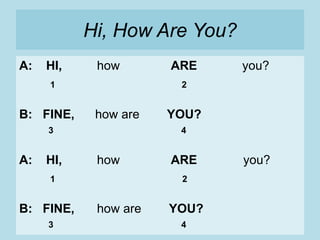
Hi, How Are You?
A: HI, how ARE you?
1 2
B: FINE, how are YOU?
3 4
A: HI, how ARE you?
1 2
B: FINE, how are YOU?
3 4
• All languages have their own sound systems with
their own rhythmic stress and intonation
patterns.
• In English, stress is not given equally to every
word in a phrase or sentence.
• Some words are shortened in order to fit
between the stressed words and keep the rhythm
of the language.
Stress Patterns and Rhythm
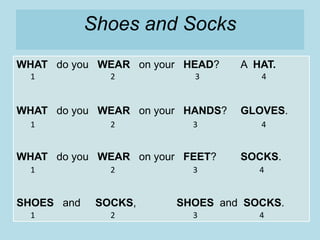
Shoes and Socks
WHAT do you WEAR on your HEAD? A HAT.
WHAT do you WEAR on your HANDS? GLOVES.
WHAT do you WEAR on your FEET? SOCKS.
SHOES and SOCKS, SHOES and SOCKS.
1 2 3 4
1 2 3 4
1 2 3 4
1 2 3 4
Keeping the Beat
• Keeping the rhythm is very important.
• It must have a 1 – 2 – 3 – 4 beat.
Sometimes there is no word spoken on a beat, but a clap will
indicate the beat.
• When students recite the chants –
Ask them to listen carefully to where they are placing the stress.
Have them always clap or tap the beats.
• The first beat is the first stressed word, which is not
always the first word on a line……….
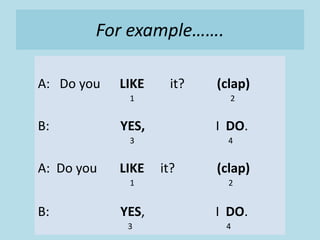
For example…….
A: Do you LIKE it? (clap)
1 2
B: YES, I DO.
3 4
A: Do you LIKE it? (clap)
1 2
B: YES, I DO.
3 4
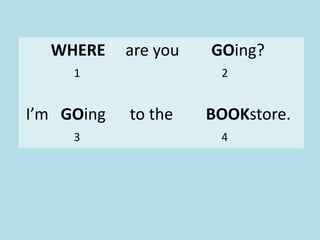
WHERE are you GOing?
1 2
I’m GOing to the BOOKstore.
3 4
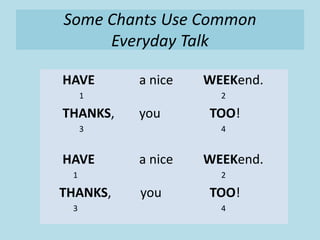
Some Chants Use Common
Everyday Talk
HAVE a nice WEEKend.
1 2
THANKS, you TOO!
3 4
HAVE a nice WEEKend.
1 2
THANKS, you TOO!
3 4
Creating Your Own Jazz Chants
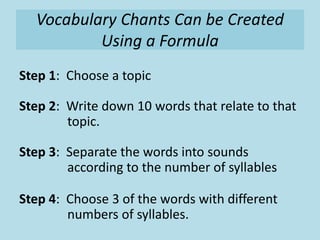
Vocabulary Chants Can be Created
Using a Formula
Step 1: Choose a topic
Step 2: Write down 10 words that relate to that
topic.
Step 3: Separate the words into sounds
according to the number of syllables
Step 4: Choose 3 of the words with different
numbers of syllables.
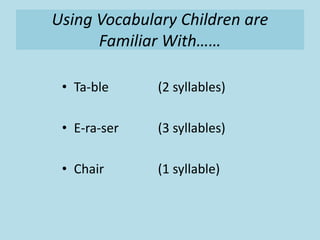
Using Vocabulary Children are
Familiar With……
• Ta-ble (2 syllables)
• E-ra-ser (3 syllables)
• Chair (1 syllable)
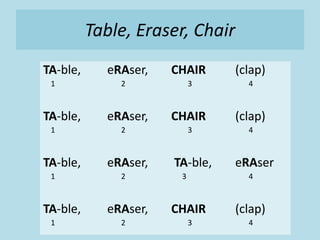
Table, Eraser, Chair
TA-ble, eRAser, CHAIR (clap)
1 2 3 4
TA-ble, eRAser, CHAIR (clap)
1 2 3 4
TA-ble, eRAser, TA-ble, eRAser
1 2 3 4
TA-ble, eRAser, CHAIR (clap)
1 2 3 4
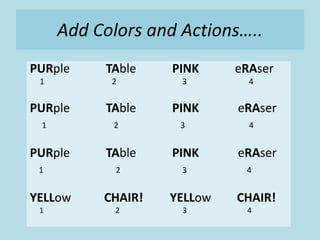
Add Colors and Actions…..
PURple TAble PINK eRAser
1 2 3 4
PURple TAble PINK eRAser
1 2 3 4
PURple TAble PINK eRAser
1 2 3 4
YELLow CHAIR! YELLow CHAIR!
1 2 3 4
When vocabulary is presented to
students with a beat, it can be easier to
remember the words.
Rhythm is a Powerful Tool for Memory
Tips and Reminders
• Beat 1 is not always the first word of a line.
• The rhythm of the 4 beats remains constant.
• Students should clap or tap the beats when
chanting.
• The best chants use a minimal number of words.
More Tips and Reminders
• Physical movement can be added, if desired.
• Begin by tapping or clapping the four beats before
starting a chant. This gives the tempo so that
everyone begins and chants together.
• You can also involve your students in creating
chants. They can create their own list of vocabulary
words and practice them in a chant.
References
Graham, C. (2006) Teaching Jazz Chants to Young
Learners. Washington, D.C.: Office of English
Language Programs, U. S. Department of
State.
One Stop English Website – for MP3 and lyric
files - www.onestopenglish.com

Jazz Chants for Young Learners.pptx

  • 1.
    Jazz Chants for YoungLearners Deborah Farley English Language Specialist Egypt February 2020
  • 2.
    What is aJazz Chant? A jazz chant is a rhythmic presentation of natural language. “A Jazz Chant is really just spoken American English with an awareness of the natural rhythm.” Carolyn Graham, Creator of Jazz Chants
  • 3.
    Jazz Chants …… •Use natural spoken American English. • Use real and useful language. • Can be used in classes of any size. • Don’t require any special materials. • Can be used with all age groups. • Can be done in groups as an interactive activity.
  • 4.
    Musical Talent IsNot Necessary! Teachers and students don’t have to be musicians or know how to play an instrument to chant.
  • 5.
    Hi, How AreYou? A: HI, how ARE you? 1 2 B: FINE, how are YOU? 3 4 A: HI, how ARE you? 1 2 B: FINE, how are YOU? 3 4
  • 6.
    • All languageshave their own sound systems with their own rhythmic stress and intonation patterns. • In English, stress is not given equally to every word in a phrase or sentence. • Some words are shortened in order to fit between the stressed words and keep the rhythm of the language. Stress Patterns and Rhythm
  • 7.
    Shoes and Socks WHATdo you WEAR on your HEAD? A HAT. WHAT do you WEAR on your HANDS? GLOVES. WHAT do you WEAR on your FEET? SOCKS. SHOES and SOCKS, SHOES and SOCKS. 1 2 3 4 1 2 3 4 1 2 3 4 1 2 3 4
  • 8.
    Keeping the Beat •Keeping the rhythm is very important. • It must have a 1 – 2 – 3 – 4 beat. Sometimes there is no word spoken on a beat, but a clap will indicate the beat. • When students recite the chants – Ask them to listen carefully to where they are placing the stress. Have them always clap or tap the beats. • The first beat is the first stressed word, which is not always the first word on a line……….
  • 9.
    For example……. A: Doyou LIKE it? (clap) 1 2 B: YES, I DO. 3 4 A: Do you LIKE it? (clap) 1 2 B: YES, I DO. 3 4
  • 10.
    WHERE are youGOing? 1 2 I’m GOing to the BOOKstore. 3 4
  • 11.
    Some Chants UseCommon Everyday Talk HAVE a nice WEEKend. 1 2 THANKS, you TOO! 3 4 HAVE a nice WEEKend. 1 2 THANKS, you TOO! 3 4
  • 12.
    Creating Your OwnJazz Chants
  • 13.
    Vocabulary Chants Canbe Created Using a Formula Step 1: Choose a topic Step 2: Write down 10 words that relate to that topic. Step 3: Separate the words into sounds according to the number of syllables Step 4: Choose 3 of the words with different numbers of syllables.
  • 14.
    Using Vocabulary Childrenare Familiar With…… • Ta-ble (2 syllables) • E-ra-ser (3 syllables) • Chair (1 syllable)
  • 15.
    Table, Eraser, Chair TA-ble,eRAser, CHAIR (clap) 1 2 3 4 TA-ble, eRAser, CHAIR (clap) 1 2 3 4 TA-ble, eRAser, TA-ble, eRAser 1 2 3 4 TA-ble, eRAser, CHAIR (clap) 1 2 3 4
  • 16.
    Add Colors andActions….. PURple TAble PINK eRAser 1 2 3 4 PURple TAble PINK eRAser 1 2 3 4 PURple TAble PINK eRAser 1 2 3 4 YELLow CHAIR! YELLow CHAIR! 1 2 3 4
  • 17.
    When vocabulary ispresented to students with a beat, it can be easier to remember the words. Rhythm is a Powerful Tool for Memory
  • 18.
    Tips and Reminders •Beat 1 is not always the first word of a line. • The rhythm of the 4 beats remains constant. • Students should clap or tap the beats when chanting. • The best chants use a minimal number of words.
  • 19.
    More Tips andReminders • Physical movement can be added, if desired. • Begin by tapping or clapping the four beats before starting a chant. This gives the tempo so that everyone begins and chants together. • You can also involve your students in creating chants. They can create their own list of vocabulary words and practice them in a chant.
  • 20.
    References Graham, C. (2006)Teaching Jazz Chants to Young Learners. Washington, D.C.: Office of English Language Programs, U. S. Department of State. One Stop English Website – for MP3 and lyric files - www.onestopenglish.com

Editor's Notes

  • #8 Shorten “do you” = “doya” “Oh your” = “onyer” “and” shortened