









JavaScript Best Practices
@GregWeng
NCU 2015/10/02
About me
@GregWeng
I'm
Working for Mozilla as a Software Engineer; 2yr+
Responsible for FirefoxOS screen locker (LockScreen)
ECMAScript experience: 6yr+
Free Software and Open Source are important to me
And I'm also a language enthusiast
Like to research programming language themselves
Haskell, Ruby, JavaScript
Java, PHP, Erlang, Python, C/C++
Find me at
Mail: gweng@mozilla.com
IRC: snowmantw
Twitter: @GregWeng
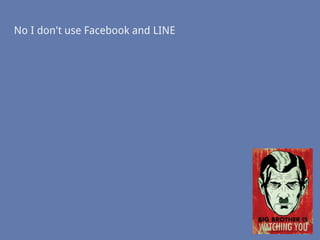
No I don't use Facebook and LINE
The Lesson
Some best practices from our daily work
In this lesson you shall learn how to...
Bind this in Event handlers in the proper way
Deal with object properties w/ constructor & prototype
Extend instantiable object properly
Manage asynchronous flows with Promise
Write your first test case for a pure function
In this lesson you may also try to...
Avoid using closure when it shouldn't appear
Implement functions with closure when it's necessary
Write meaningful comments in JSDoc format
Make your code more expressive with map/forEach
About quizzes and the homework
We will refactor an example from scratch
Quizzes help you to think and learn things
They require you to add comments on several PR pages
Or, raise your hand
If you fail at homework they may save you, too
Homework will be marked strictly according to the public
marking criteria
That means, you either get passed or failed, no other
adjustments except the quizzes
Since I suppose you know this
class is not JavaScript tutorial
Questionnaire
Before the class begins, I would like to ask you if you know:
How to write constructor + prototype (instantiable object)
How to extend an object to add new methods
How to receive and dispatch events
What the 'this' may refer to?
What's a 'closure'?
What's the better way to control asynchronous flow
Let's start from the
embarrassing past...
Some anti-patterns
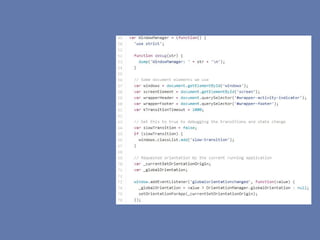
You put all states in local variables
And then bind events with anonymous callbacks
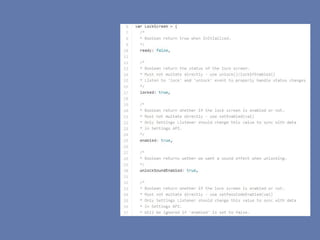
And then encapsulate them as a 1K+ lines closure
And then try to create a "singleton" via a function that will be
invoked automatically when bootstrapping
And then make it as a Window Manager as Metacity of
Gnome or KWin of KDE
And then you shoot yourself in the foot
Alarm!
Beware of these terms
You put all states in local variables
And then bind events with anonymous callbacks
And then encapsulate them as a 1K+ lines closure
And then try to create a "singleton" via a function that will be
invoked automatically when bootstrapping
And then make it as a Window Manager as Metacity of
Gnome or KWin of KDE
And then you shoot yourself in the foot
class, private, flags, global objects, temporary variables
Usually, bad things happen
when they appear
Example #1
http://bit.
ly/1LeY5lv
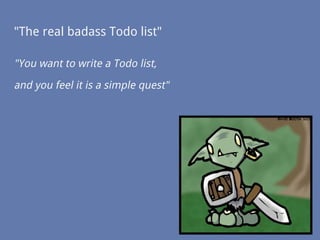
"The real badass Todo list"
"You want to write a Todo list,
and you feel it is a simple quest"
"The real badass Todo list"
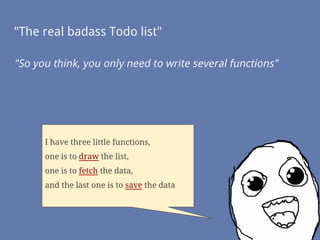
"So you think, you only need to write several functions"
"The real badass Todo list"
"So you think, you only need to write several functions"
I have three little functions,
one is to draw the list,
one is to fetch the data,
and the last one is to save the data
"The real badass Todo list"
"So you think, you only need to write several functions"
http://bit.ly/1LeY5lv
Quiz#1
(5 minutes)http://bit.ly/1NVdc2y
Things become worse when
the project grows up
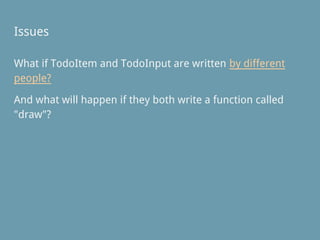
Issues
What if TodoItem and TodoInput are written by different
people?
And what will happen if they both write a function called
"draw"?
Name collisions
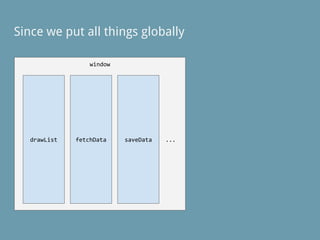
Since we put all things globally
window
drawList fetchData saveData ...
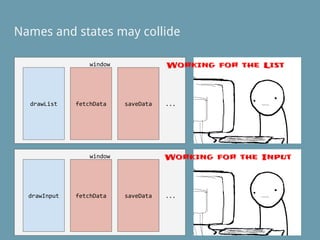
Names and states may collide
window
drawList fetchData saveData ...
window
drawInput fetchData saveData ...
Working for the List
Working for the Input
En.capsulation
Encapsulation
"Why don't we solve collisions with closure, which is the
most natural mechanism to do that in JavaScript?"
Closure
It's about capture
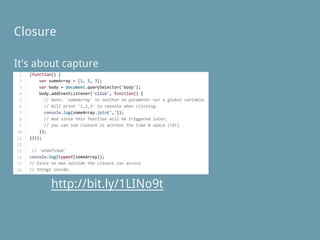
Closure
It's about capture
http://bit.ly/1LINo9t
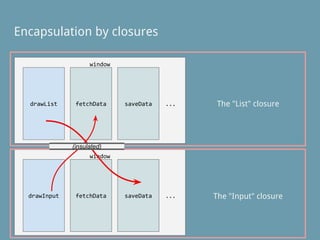
Encapsulation by closures
window
drawList fetchData saveData ...
window
drawInput fetchData saveData ...
The "List" closure
The "Input" closure
(insulated)
Example #2
It seems a successful solution to the issues...
Now we have two isolated parts of the program
People can work on that individually
There are no more tangled names and states
To those things like "singletons", closure looks a good
solution to disallow others create the instance twice
It seems a successful solution to the issues...
Now we have two isolated parts of the program
People can work on that individually
There are no more tangled names and states
To those things like "singletons", closure looks a good
solution to disallow others create the instance twice
Really?
Always think about these when you are coding
How do I test the function or instance?
Are these duplicated code necessary?
Could people reuse my code later on?
Is my solution the most expressive one?
Did I express the intention clearly?
Quiz#2
(5 minutes)http://bit.ly/1FCwhF9
Don't be intrigued by closure in such cases
You don't have any references for unit tests
If you really have some re-usable data or functions across
different parts, closures can't use them
That means, it's uneviable to write lots of duplicated
functions do the almost same thing
Don't be intrigued by closure in such cases
You don't have any references for unit tests
If you really have some re-usable data or functions across
different parts, closures can't use them
That means, it's uneviable to write lots of duplicated
functions do the almost same thing
However...
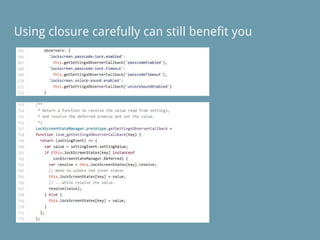
Using closure carefully can still benefit you
"Managers"
"Managers"
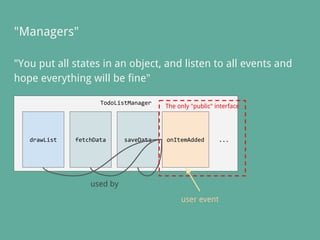
"You put all states in an object, and listen to all events and
hope everything will be fine"
TodoListManager
drawList fetchData saveData ...onItemAdded
user event
used by
The only "public" interface
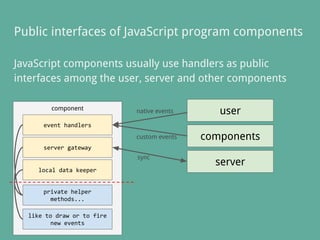
Public interfaces of JavaScript program components
JavaScript components usually use handlers as public
interfaces among the user, server and other components
like to draw or to fire
new events
private helper
methods...
event handlers
server gateway
local data keeper
component
usernative events
server
sync
componentscustom events
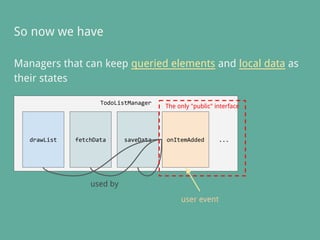
So now we have
Managers that can keep queried elements and local data as
their states
TodoListManager
drawList fetchData saveData ...onItemAdded
user event
used by
The only "public" interface
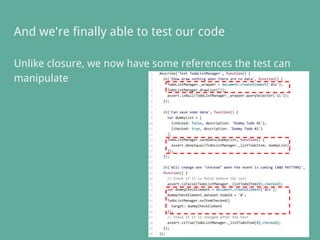
And we're finally able to test our code
Unlike closure, we now have some references the test can
manipulate
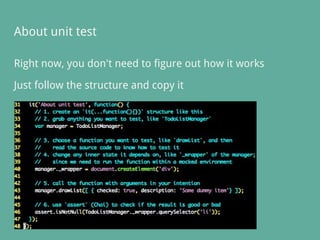
About unit test
Right now, you don't need to figure out how it works
Just follow the structure and copy it
Example #3
However, to test them
could be painful soon
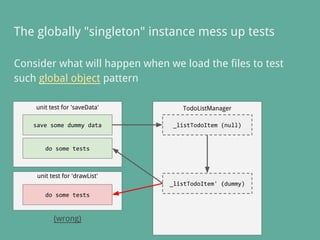
The globally "singleton" instance mess up tests
Consider what will happen when we load the files to test
such global object pattern
unit test for 'saveData'
save some dummy data
TodoListManager
do some tests
_listTodoItem (null)
_listTodoItem' (dummy)
unit test for 'drawList'
do some tests
(wrong)
Quiz #3
(5 minutes)http://bit.ly/1FM4KkF
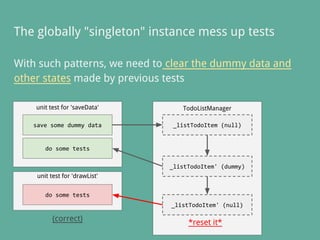
The globally "singleton" instance mess up tests
With such patterns, we need to clear the dummy data and
other states made by previous tests
unit test for 'saveData'
save some dummy data
TodoListManager
do some tests
_listTodoItem (null)
_listTodoItem' (dummy)
unit test for 'drawList'
do some tests
(correct)
_listTodoItem' (null)
*reset it*
The globally "singleton" instance mess up tests
With such patterns, we need to clear the dummy data and
other states made by previous tests
And you barely know how to reset them properly if the
component is 1K+ lines long, and written by lots of people
In Gaia, this has happened countless times
And worse, people sometimes wrote tests rely on that: they
do some changes at the first test, and then use the
contaminated data to perform the next test
"What's the
matter?
I don't write
any test"
Test is good to you because...
There are lots of commits may change your code
Test is good to you because...
There are lots of commits may change your code
People will always screw you and your
code if you don't test them
Test is good to you because...
There are lots of commits may change your code
People will always screw you and your
code if you don't test them
We call these issues regressions
Regressions
To test your code and kill possible regressions
Instantiable Objects
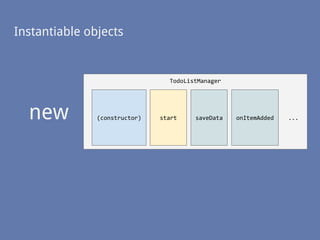
Instantiable objects
TodoListManager
(constructor) start saveData ...onItemAddednew
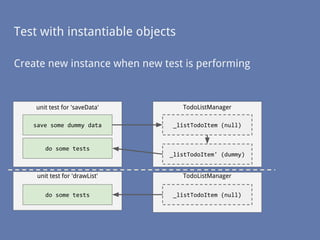
Test with instantiable objects
Create new instance when new test is performing
unit test for 'saveData'
save some dummy data
TodoListManager
do some tests
_listTodoItem (null)
_listTodoItem' (dummy)
unit test for 'drawList'
do some tests
TodoListManager
_listTodoItem (null)
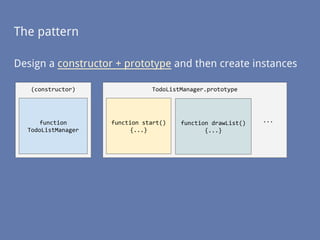
The pattern
Design a constructor + prototype and then create instances
(constructor)
function
TodoListManager
TodoListManager.prototype
function start()
{...}
function drawList()
{...}
...
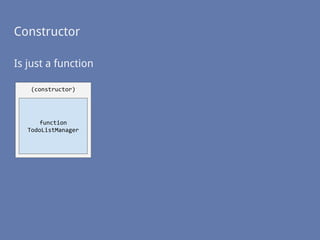
Constructor
(constructor)
function
TodoListManager
Is just a function
Constructor
(constructor)
function
TodoListManager
It should set up all data members and do nothing
(constructor)
function TodoListManager() {
this._wrapper = document.query...
this._listTodoItems = []
...
}
!Caveat!
Don't do anything with effects
inside the constructor
Constructor with effects
(constructor)
function
TodoListManager
We prefer to hold the instance before use it
(constructor)
function TodoListManager() {
this._wrapper = document.query...
this._listTodoItems = []
this.fetchData(...);
}
(create the instance & test it)
var instance = new TodoListManager();
// It will do fetching immediately,
// which is BAD
instance.drawList(...)
// Although we only want to test this
Constructor
(constructor)
function
TodoListManager
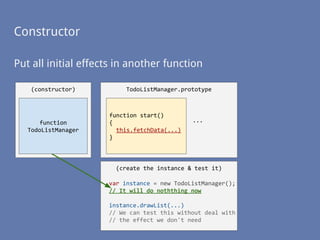
Put all initial effects in another function
TodoListManager.prototype
function start()
{
this.fetchData(...)
}
...
(create the instance & test it)
var instance = new TodoListManager();
// It will do noththing now
instance.drawList(...)
// We can test this without deal with
// the effect we don't need
It means the shareable methods and data among instances
Prototype
(constructor)
function
TodoListManager(){
this.foo = [];
}
TodoListManager.prototype
function start()
{
this.fetchData(...)
}
foo: [ ]
start() {}
foo: [ ]
start() {}
foo: [ ]
start() {}
foo: [ ]
start() {}
foo: [ ]
start() {}
(new instances)
So it's better to put data ONLY IN SETUP FUNCTIONS
Prototype
(constructor)
function
TodoListManager(){
}
TodoListManager.prototype
function start()
{
this.fetchData(...)
}
start() {} start() {} start() {} start() {}
(wrong!)
foo: [ ]
foo: [ ]
start() {}
Every test can now modify the instance by their own needs
For tests
(constructor)
function
TodoListManager(){
this.foo = [];
}
TodoListManager.prototype
function start()
{
this.fetchData(...)
}
foo: [1]
start() {}
foo: [ ]
start() {}
foo: [3,2]
start() {}
foo: null
start() {}
foo: {}
start() {}
(new instances)test #1 test #2 test #3 test #4
Example #4
"this"
"this"
the necessary evil to be instantiable
Trolls you when you are not
familiar with it
Quiz#4
5 mins
discuss & search it freely
comment it on the page please
http://bit.ly/1iQdb3V
this
the owner
the window
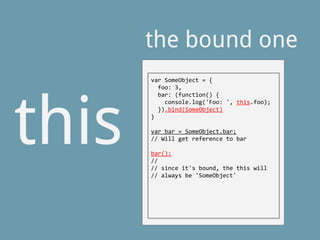
the bound one
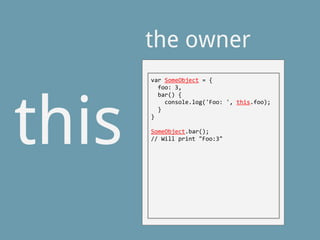
this
the owner
var SomeObject = {
foo: 3,
bar() {
console.log('Foo: ', this.foo);
}
}
SomeObject.bar();
// Will print "Foo:3"
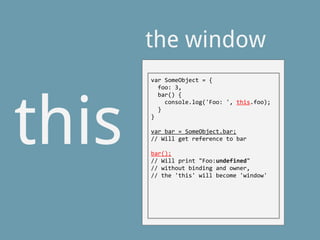
this
the window
var SomeObject = {
foo: 3,
bar() {
console.log('Foo: ', this.foo);
}
}
var bar = SomeObject.bar;
// Will get reference to bar
bar();
// Will print "Foo:undefined"
// without binding and owner,
// the 'this' will become 'window'
this
the bound one
var SomeObject = {
foo: 3,
bar: (function() {
console.log('Foo: ', this.foo);
}).bind(SomeObject)
}
var bar = SomeObject.bar;
// Will get reference to bar
bar();
//
// since it's bound, the this will
// always be 'SomeObject'
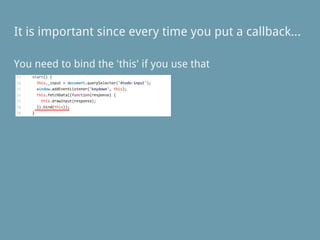
You need to bind the 'this' if you use that
It is important since every time you put a callback...
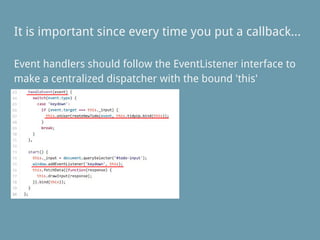
Event handlers should follow the EventListener interface to
make a centralized dispatcher with the bound 'this'
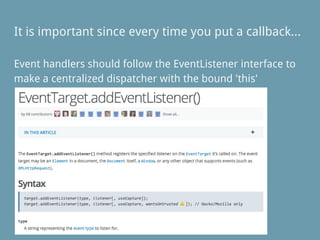
It is important since every time you put a callback...
Event handlers should follow the EventListener interface to
make a centralized dispatcher with the bound 'this'
It is important since every time you put a callback...
Example #4
That's why there are lots of
binding code in the
Using Promise
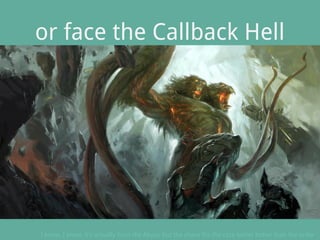
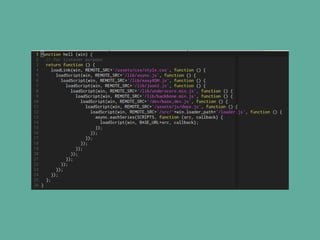
or face the Callback Hell
I know, I know, it's actually from the Abyss, but the chaos fits the case better better than the order
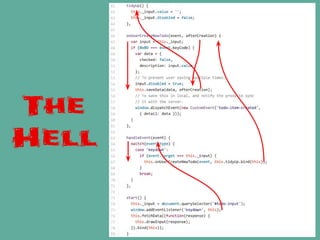
The
Hell
If you think it's tolerable,
think about this
That's why Promise is so
important
Example #5
new Promise(function(resolve, reject) {
// Do some async things.
// Then resolve it after done.
resolve();
// Or reject it due to the error.
reject();
}).then(function() {
// This function only executes after the
// previous step.
return [1,2,3];
}).then(function() {
// If return another Promise,
// the flow will stop here and only
// continue when the promise is resolved
return new Promise(function(r, c) {
setTimeout(r, 1000);
});
}).then(function() {
// This will not execute within the second
}).catch(function(error) {
// !IMPORTANT!
// Remember to catch Promise error in a
// function like this.
});
The Flow
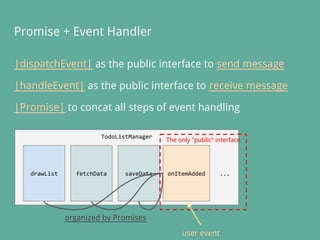
Promise + Event Handler
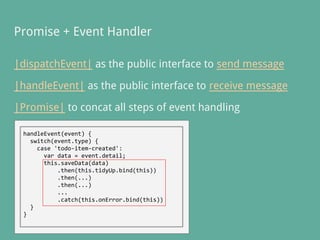
|dispatchEvent| as the public interface to send message
|handleEvent| as the public interface to receive message
|Promise| to concat all steps of event handling
TodoListManager
drawList fetchData saveData ...onItemAdded
user event
organized by Promises
The only "public" interface
Promise + Event Handler
|dispatchEvent| as the public interface to send message
|handleEvent| as the public interface to receive message
|Promise| to concat all steps of event handling
handleEvent(event) {
switch(event.type) {
case 'todo-item-created':
var data = event.detail;
this.saveData(data)
.then(this.tidyUp.bind(this))
.then(...)
.then(...)
...
.catch(this.onError.bind(this))
}
}
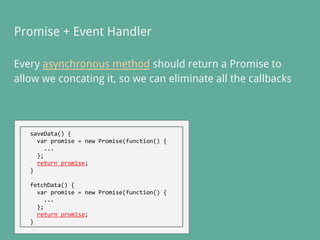
Promise + Event Handler
Every asynchronous method should return a Promise to
allow we concating it, so we can eliminate all the callbacks
saveData() {
var promise = new Promise(function() {
...
};
return promise;
}
fetchData() {
var promise = new Promise(function() {
...
};
return promise;
}
Conclusion
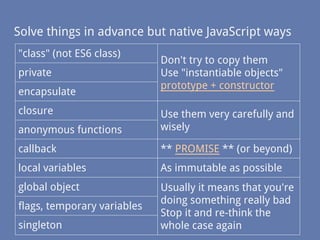
Solve things in advance but native JavaScript ways
"class" (not ES6 class)
Don't try to copy them
Use "instantiable objects"
prototype + constructor
private
encapsulate
closure Use them very carefully and
wiselyanonymous functions
callback ** PROMISE ** (or beyond)
local variables As immutable as possible
global object Usually it means that you're
doing something really bad
Stop it and re-think the
whole case again
flags, temporary variables
singleton
Homework
1. Fork the Homework repo here
2. Fix all the issues in the code to refactor it
3. After that, make a git branch, commit, and then push it
4. Fire a Pull Request and set review to TAs and me
Remember: you can always ask any question at anytime
Don't struggle with any part you don't really understand
Homework: How to get points
You need at least address all the Tier 1 issues to get 4 points
You will get the extra 3 points from addressing Tier 2 issues
However, you will NOT get any points from the Tier 2,
if you fail to address ANY single issue of Tier 1
You need at least the 4 points from Tier 1 to pass this class
The extra points will benefit you in the following lessons
You can add or remove some code from the example.
However, make sure every change you make is with clear
intentions
Homework: Requirements (Tier 1)
Bind this in Event handlers
Deal with object properties w/ constructor & prototype
Deal with asynchronous flows with Promise
Write your first test case for a pure function (as the last test
of |test-list.js| file shows; for example, to test if |Math.sin|
works well as your assumption)
Homework: Requirements (Tier 2)
Implement functions with closure when it's necessary
Avoid using closure when it shouldn't appear (follow what
we taught in the class)
Write meaningful comments in JSDoc format
(reference: https://en.wikipedia.org/wiki/JSDoc#Example)
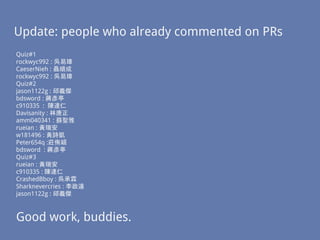
Update: people who already commented on PRs
Quiz#1
rockwyc992 : 吳易璋
CaeserNieh : 聶順成
rockwyc992 : 吳易璋
Quiz#2
jason1122g : 邱義傑
bdsword : 蔣彥亭
c910335 : 陳達仁
Davisanity : 林唐正
amm040341 : 蘇聖雅
rueian : 黃瑞安
w181496 : 黃詩凱
Peter654q :莊侑穎
bdsword : 蔣彥亭
Quiz#3
rueian : 黃瑞安
c910335 : 陳達仁
CrashedBboy : 吳承霖
Sharknevercries : 李政遠
jason1122g : 邱義傑
Good work, buddies.

JavaScript Best Pratices

  • 1.
  • 2.
  • 3.
    I'm Working for Mozillaas a Software Engineer; 2yr+ Responsible for FirefoxOS screen locker (LockScreen) ECMAScript experience: 6yr+ Free Software and Open Source are important to me And I'm also a language enthusiast Like to research programming language themselves Haskell, Ruby, JavaScript Java, PHP, Erlang, Python, C/C++
  • 4.
    Find me at Mail:gweng@mozilla.com IRC: snowmantw Twitter: @GregWeng
  • 5.
    No I don'tuse Facebook and LINE
  • 6.
    The Lesson Some bestpractices from our daily work
  • 7.
    In this lessonyou shall learn how to... Bind this in Event handlers in the proper way Deal with object properties w/ constructor & prototype Extend instantiable object properly Manage asynchronous flows with Promise Write your first test case for a pure function
  • 8.
    In this lessonyou may also try to... Avoid using closure when it shouldn't appear Implement functions with closure when it's necessary Write meaningful comments in JSDoc format Make your code more expressive with map/forEach
  • 9.
    About quizzes andthe homework We will refactor an example from scratch Quizzes help you to think and learn things They require you to add comments on several PR pages Or, raise your hand If you fail at homework they may save you, too Homework will be marked strictly according to the public marking criteria That means, you either get passed or failed, no other adjustments except the quizzes
  • 10.
    Since I supposeyou know this class is not JavaScript tutorial
  • 11.
    Questionnaire Before the classbegins, I would like to ask you if you know: How to write constructor + prototype (instantiable object) How to extend an object to add new methods How to receive and dispatch events What the 'this' may refer to? What's a 'closure'? What's the better way to control asynchronous flow
  • 12.
    Let's start fromthe embarrassing past...
  • 15.
    Some anti-patterns You putall states in local variables And then bind events with anonymous callbacks And then encapsulate them as a 1K+ lines closure And then try to create a "singleton" via a function that will be invoked automatically when bootstrapping And then make it as a Window Manager as Metacity of Gnome or KWin of KDE And then you shoot yourself in the foot
  • 16.
  • 17.
    Beware of theseterms You put all states in local variables And then bind events with anonymous callbacks And then encapsulate them as a 1K+ lines closure And then try to create a "singleton" via a function that will be invoked automatically when bootstrapping And then make it as a Window Manager as Metacity of Gnome or KWin of KDE And then you shoot yourself in the foot class, private, flags, global objects, temporary variables
  • 18.
    Usually, bad thingshappen when they appear
  • 19.
  • 20.
    "The real badassTodo list" "You want to write a Todo list, and you feel it is a simple quest"
  • 21.
    "The real badassTodo list" "So you think, you only need to write several functions"
  • 22.
    "The real badassTodo list" "So you think, you only need to write several functions" I have three little functions, one is to draw the list, one is to fetch the data, and the last one is to save the data
  • 23.
    "The real badassTodo list" "So you think, you only need to write several functions" http://bit.ly/1LeY5lv
  • 24.
  • 25.
    Things become worsewhen the project grows up
  • 26.
    Issues What if TodoItemand TodoInput are written by different people? And what will happen if they both write a function called "draw"?
  • 27.
  • 28.
    Since we putall things globally window drawList fetchData saveData ...
  • 29.
    Names and statesmay collide window drawList fetchData saveData ... window drawInput fetchData saveData ... Working for the List Working for the Input
  • 30.
  • 31.
    Encapsulation "Why don't wesolve collisions with closure, which is the most natural mechanism to do that in JavaScript?"
  • 32.
  • 33.
  • 34.
    Encapsulation by closures window drawListfetchData saveData ... window drawInput fetchData saveData ... The "List" closure The "Input" closure (insulated)
  • 35.
  • 36.
    It seems asuccessful solution to the issues... Now we have two isolated parts of the program People can work on that individually There are no more tangled names and states To those things like "singletons", closure looks a good solution to disallow others create the instance twice
  • 37.
    It seems asuccessful solution to the issues... Now we have two isolated parts of the program People can work on that individually There are no more tangled names and states To those things like "singletons", closure looks a good solution to disallow others create the instance twice Really?
  • 38.
    Always think aboutthese when you are coding How do I test the function or instance? Are these duplicated code necessary? Could people reuse my code later on? Is my solution the most expressive one? Did I express the intention clearly?
  • 39.
  • 40.
    Don't be intriguedby closure in such cases You don't have any references for unit tests If you really have some re-usable data or functions across different parts, closures can't use them That means, it's uneviable to write lots of duplicated functions do the almost same thing
  • 41.
    Don't be intriguedby closure in such cases You don't have any references for unit tests If you really have some re-usable data or functions across different parts, closures can't use them That means, it's uneviable to write lots of duplicated functions do the almost same thing However...
  • 42.
    Using closure carefullycan still benefit you
  • 43.
  • 44.
    "Managers" "You put allstates in an object, and listen to all events and hope everything will be fine" TodoListManager drawList fetchData saveData ...onItemAdded user event used by The only "public" interface
  • 45.
    Public interfaces ofJavaScript program components JavaScript components usually use handlers as public interfaces among the user, server and other components like to draw or to fire new events private helper methods... event handlers server gateway local data keeper component usernative events server sync componentscustom events
  • 46.
    So now wehave Managers that can keep queried elements and local data as their states TodoListManager drawList fetchData saveData ...onItemAdded user event used by The only "public" interface
  • 47.
    And we're finallyable to test our code Unlike closure, we now have some references the test can manipulate
  • 48.
    About unit test Rightnow, you don't need to figure out how it works Just follow the structure and copy it
  • 49.
  • 50.
    However, to testthem could be painful soon
  • 51.
    The globally "singleton"instance mess up tests Consider what will happen when we load the files to test such global object pattern unit test for 'saveData' save some dummy data TodoListManager do some tests _listTodoItem (null) _listTodoItem' (dummy) unit test for 'drawList' do some tests (wrong)
  • 52.
  • 53.
    The globally "singleton"instance mess up tests With such patterns, we need to clear the dummy data and other states made by previous tests unit test for 'saveData' save some dummy data TodoListManager do some tests _listTodoItem (null) _listTodoItem' (dummy) unit test for 'drawList' do some tests (correct) _listTodoItem' (null) *reset it*
  • 54.
    The globally "singleton"instance mess up tests With such patterns, we need to clear the dummy data and other states made by previous tests And you barely know how to reset them properly if the component is 1K+ lines long, and written by lots of people In Gaia, this has happened countless times And worse, people sometimes wrote tests rely on that: they do some changes at the first test, and then use the contaminated data to perform the next test
  • 55.
  • 56.
    Test is goodto you because... There are lots of commits may change your code
  • 57.
    Test is goodto you because... There are lots of commits may change your code People will always screw you and your code if you don't test them
  • 58.
    Test is goodto you because... There are lots of commits may change your code People will always screw you and your code if you don't test them We call these issues regressions
  • 59.
  • 60.
    To test yourcode and kill possible regressions Instantiable Objects
  • 61.
  • 62.
    Test with instantiableobjects Create new instance when new test is performing unit test for 'saveData' save some dummy data TodoListManager do some tests _listTodoItem (null) _listTodoItem' (dummy) unit test for 'drawList' do some tests TodoListManager _listTodoItem (null)
  • 63.
    The pattern Design aconstructor + prototype and then create instances (constructor) function TodoListManager TodoListManager.prototype function start() {...} function drawList() {...} ...
  • 64.
  • 65.
    Constructor (constructor) function TodoListManager It should setup all data members and do nothing (constructor) function TodoListManager() { this._wrapper = document.query... this._listTodoItems = [] ... }
  • 66.
  • 67.
    Don't do anythingwith effects inside the constructor
  • 68.
    Constructor with effects (constructor) function TodoListManager Weprefer to hold the instance before use it (constructor) function TodoListManager() { this._wrapper = document.query... this._listTodoItems = [] this.fetchData(...); } (create the instance & test it) var instance = new TodoListManager(); // It will do fetching immediately, // which is BAD instance.drawList(...) // Although we only want to test this
  • 69.
    Constructor (constructor) function TodoListManager Put all initialeffects in another function TodoListManager.prototype function start() { this.fetchData(...) } ... (create the instance & test it) var instance = new TodoListManager(); // It will do noththing now instance.drawList(...) // We can test this without deal with // the effect we don't need
  • 70.
    It means theshareable methods and data among instances Prototype (constructor) function TodoListManager(){ this.foo = []; } TodoListManager.prototype function start() { this.fetchData(...) } foo: [ ] start() {} foo: [ ] start() {} foo: [ ] start() {} foo: [ ] start() {} foo: [ ] start() {} (new instances)
  • 71.
    So it's betterto put data ONLY IN SETUP FUNCTIONS Prototype (constructor) function TodoListManager(){ } TodoListManager.prototype function start() { this.fetchData(...) } start() {} start() {} start() {} start() {} (wrong!) foo: [ ] foo: [ ] start() {}
  • 72.
    Every test cannow modify the instance by their own needs For tests (constructor) function TodoListManager(){ this.foo = []; } TodoListManager.prototype function start() { this.fetchData(...) } foo: [1] start() {} foo: [ ] start() {} foo: [3,2] start() {} foo: null start() {} foo: {} start() {} (new instances)test #1 test #2 test #3 test #4
  • 73.
  • 74.
  • 75.
    "this" the necessary evilto be instantiable
  • 76.
    Trolls you whenyou are not familiar with it
  • 77.
    Quiz#4 5 mins discuss &search it freely comment it on the page please http://bit.ly/1iQdb3V
  • 78.
  • 79.
    this the owner var SomeObject= { foo: 3, bar() { console.log('Foo: ', this.foo); } } SomeObject.bar(); // Will print "Foo:3"
  • 80.
    this the window var SomeObject= { foo: 3, bar() { console.log('Foo: ', this.foo); } } var bar = SomeObject.bar; // Will get reference to bar bar(); // Will print "Foo:undefined" // without binding and owner, // the 'this' will become 'window'
  • 81.
    this the bound one varSomeObject = { foo: 3, bar: (function() { console.log('Foo: ', this.foo); }).bind(SomeObject) } var bar = SomeObject.bar; // Will get reference to bar bar(); // // since it's bound, the this will // always be 'SomeObject'
  • 82.
    You need tobind the 'this' if you use that It is important since every time you put a callback...
  • 83.
    Event handlers shouldfollow the EventListener interface to make a centralized dispatcher with the bound 'this' It is important since every time you put a callback...
  • 84.
    Event handlers shouldfollow the EventListener interface to make a centralized dispatcher with the bound 'this' It is important since every time you put a callback...
  • 85.
    Example #4 That's whythere are lots of binding code in the
  • 86.
  • 87.
    or face theCallback Hell I know, I know, it's actually from the Abyss, but the chaos fits the case better better than the order
  • 88.
  • 89.
    If you thinkit's tolerable, think about this
  • 91.
    That's why Promiseis so important
  • 92.
  • 93.
    new Promise(function(resolve, reject){ // Do some async things. // Then resolve it after done. resolve(); // Or reject it due to the error. reject(); }).then(function() { // This function only executes after the // previous step. return [1,2,3]; }).then(function() { // If return another Promise, // the flow will stop here and only // continue when the promise is resolved return new Promise(function(r, c) { setTimeout(r, 1000); }); }).then(function() { // This will not execute within the second }).catch(function(error) { // !IMPORTANT! // Remember to catch Promise error in a // function like this. }); The Flow
  • 94.
    Promise + EventHandler |dispatchEvent| as the public interface to send message |handleEvent| as the public interface to receive message |Promise| to concat all steps of event handling TodoListManager drawList fetchData saveData ...onItemAdded user event organized by Promises The only "public" interface
  • 95.
    Promise + EventHandler |dispatchEvent| as the public interface to send message |handleEvent| as the public interface to receive message |Promise| to concat all steps of event handling handleEvent(event) { switch(event.type) { case 'todo-item-created': var data = event.detail; this.saveData(data) .then(this.tidyUp.bind(this)) .then(...) .then(...) ... .catch(this.onError.bind(this)) } }
  • 96.
    Promise + EventHandler Every asynchronous method should return a Promise to allow we concating it, so we can eliminate all the callbacks saveData() { var promise = new Promise(function() { ... }; return promise; } fetchData() { var promise = new Promise(function() { ... }; return promise; }
  • 97.
  • 98.
    Solve things inadvance but native JavaScript ways "class" (not ES6 class) Don't try to copy them Use "instantiable objects" prototype + constructor private encapsulate closure Use them very carefully and wiselyanonymous functions callback ** PROMISE ** (or beyond) local variables As immutable as possible global object Usually it means that you're doing something really bad Stop it and re-think the whole case again flags, temporary variables singleton
  • 99.
    Homework 1. Fork theHomework repo here 2. Fix all the issues in the code to refactor it 3. After that, make a git branch, commit, and then push it 4. Fire a Pull Request and set review to TAs and me Remember: you can always ask any question at anytime Don't struggle with any part you don't really understand
  • 100.
    Homework: How toget points You need at least address all the Tier 1 issues to get 4 points You will get the extra 3 points from addressing Tier 2 issues However, you will NOT get any points from the Tier 2, if you fail to address ANY single issue of Tier 1 You need at least the 4 points from Tier 1 to pass this class The extra points will benefit you in the following lessons You can add or remove some code from the example. However, make sure every change you make is with clear intentions
  • 101.
    Homework: Requirements (Tier1) Bind this in Event handlers Deal with object properties w/ constructor & prototype Deal with asynchronous flows with Promise Write your first test case for a pure function (as the last test of |test-list.js| file shows; for example, to test if |Math.sin| works well as your assumption)
  • 102.
    Homework: Requirements (Tier2) Implement functions with closure when it's necessary Avoid using closure when it shouldn't appear (follow what we taught in the class) Write meaningful comments in JSDoc format (reference: https://en.wikipedia.org/wiki/JSDoc#Example)
  • 103.
    Update: people whoalready commented on PRs Quiz#1 rockwyc992 : 吳易璋 CaeserNieh : 聶順成 rockwyc992 : 吳易璋 Quiz#2 jason1122g : 邱義傑 bdsword : 蔣彥亭 c910335 : 陳達仁 Davisanity : 林唐正 amm040341 : 蘇聖雅 rueian : 黃瑞安 w181496 : 黃詩凱 Peter654q :莊侑穎 bdsword : 蔣彥亭 Quiz#3 rueian : 黃瑞安 c910335 : 陳達仁 CrashedBboy : 吳承霖 Sharknevercries : 李政遠 jason1122g : 邱義傑 Good work, buddies.