Rust + Python
Lessons from building a FUSE toy filesystem
2018/9/10
@GregWeng
Rust + Python
Rust: system programming language
Easy to adapt C and keep code safe
Primitive type, low-level structure
Python: fast prototyping and easy to extend
Easy to adapt C as native module
GC, dynamic types
Rust + Python
Rust: system programming language
Easy to adapt C and keep code safe
Primitive type, low-level structure
Python: fast prototyping and easy to extend
Easy to adapt C as native module
GC, dynamic types
Rust module
Python library Python programPython module
...
System API
RestFS
Rust adapts FUSE API
PyO3 builds this Rust as native python module
Python extend the RestFS.rs to adapt real site
By urllib to define what file operations to what
site operations (ex: GET -> create new file)
RestFS.rs
YourSite.py Python programPython module
...
FUSE API
PyO3
urllib
https://github.com/snowmantw/restfs
Not really makes sense
File system is persistent storage, while RESTful API is designed to be stateless
GET /item -> File makes sense doesn't mean GET /items -> Directory makes sense
(response of an HTTP request has no definition of it is a single resource or a list)
Not really makes sense, but...
Everything is a file! cat "hello" > pastebin.com/hello looks so right (isn't it?)
C is a sharp knife with greasy handle that may cut your hand easily
Python is good but it lives too high to let us know the details (sure that's why it is so nice)
Therefore:
Find a topic related to system programming (so file system)
that I can have a look at Python native details (so PyO3)
and practice Rust for fun ("摻在一起做成撒尿牛丸就好啦 ")
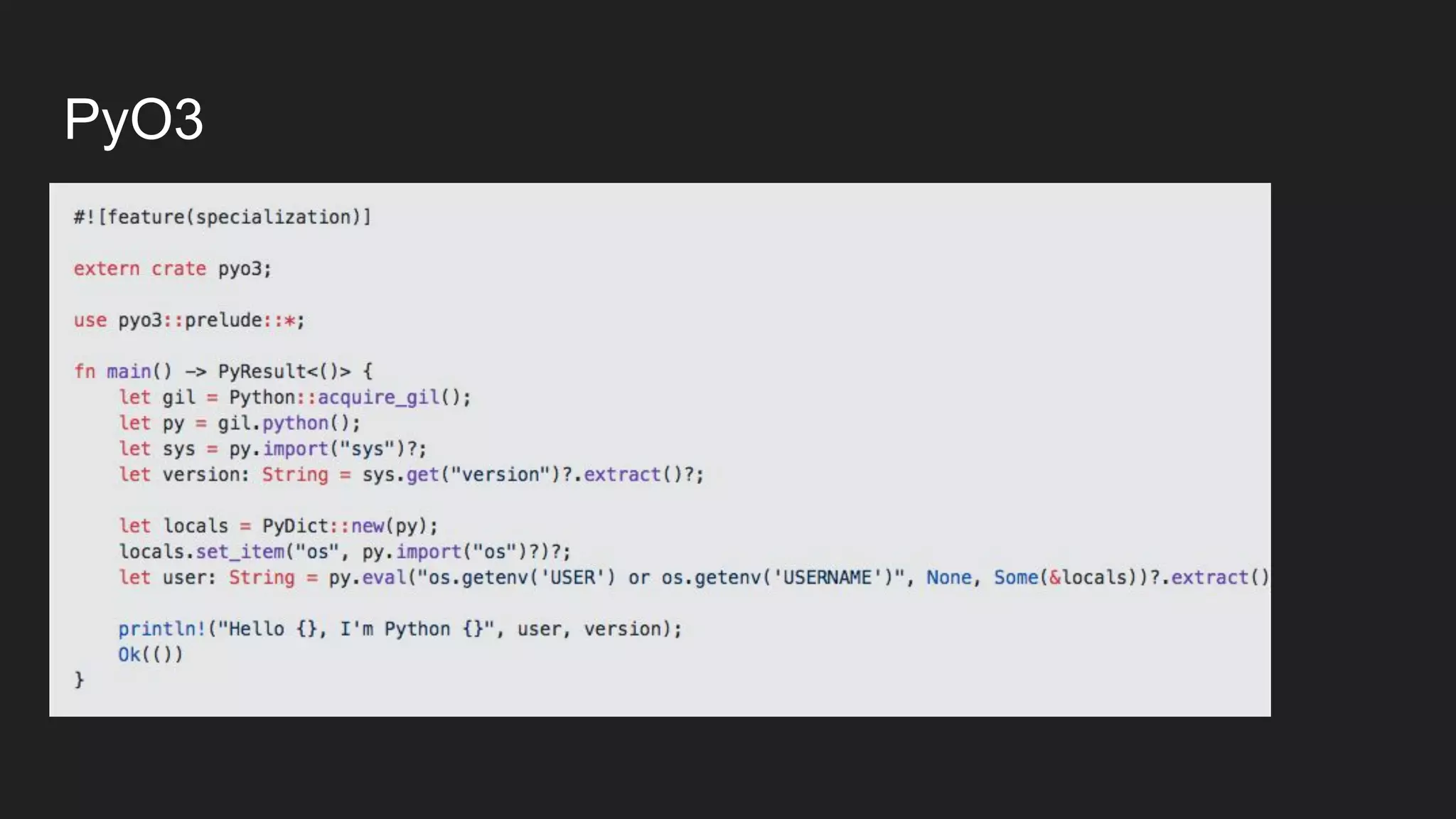
PyO3
PyO3
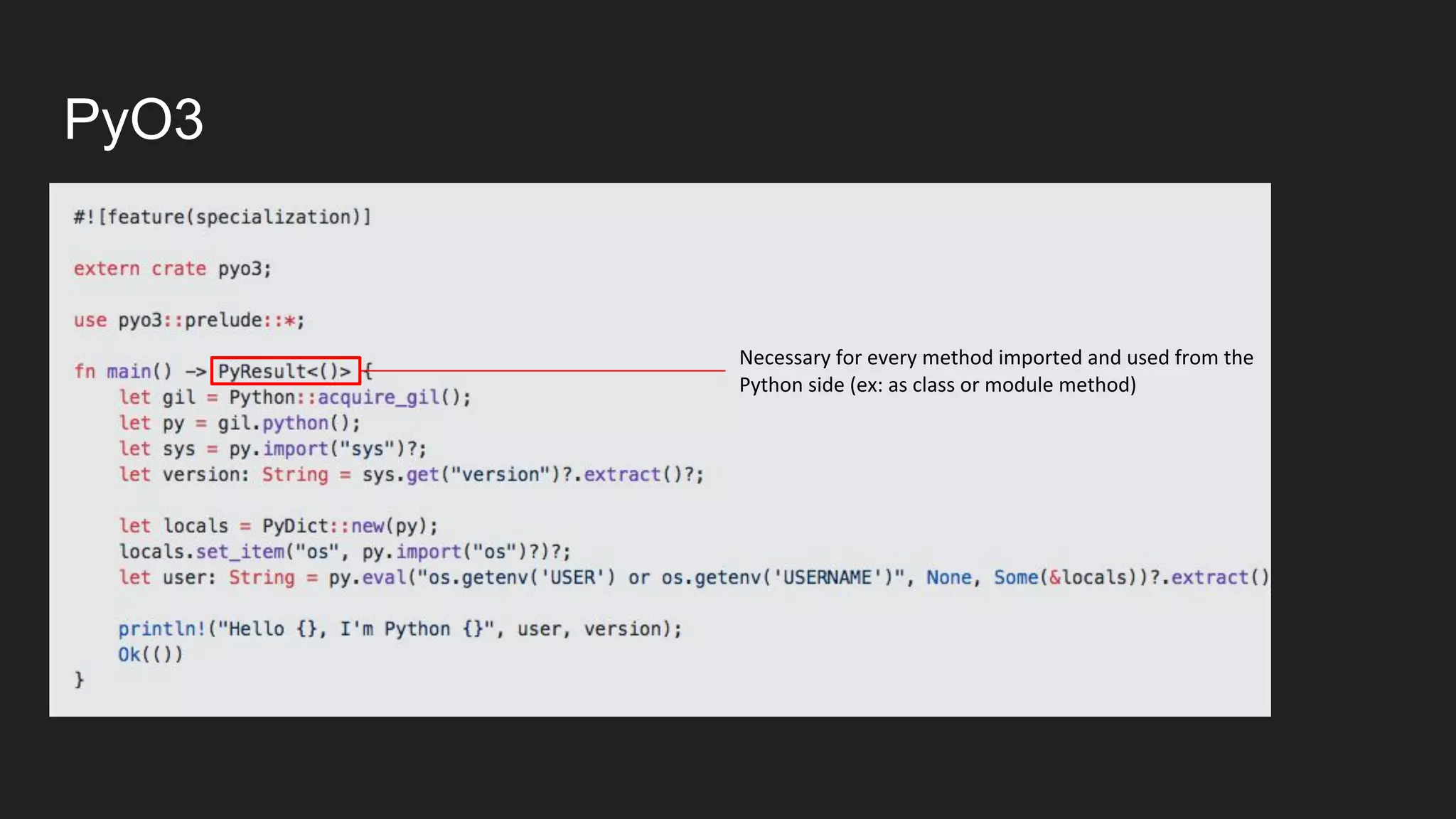
Necessary for every method imported and used from the
Python side (ex: as class or module method)
PyO3
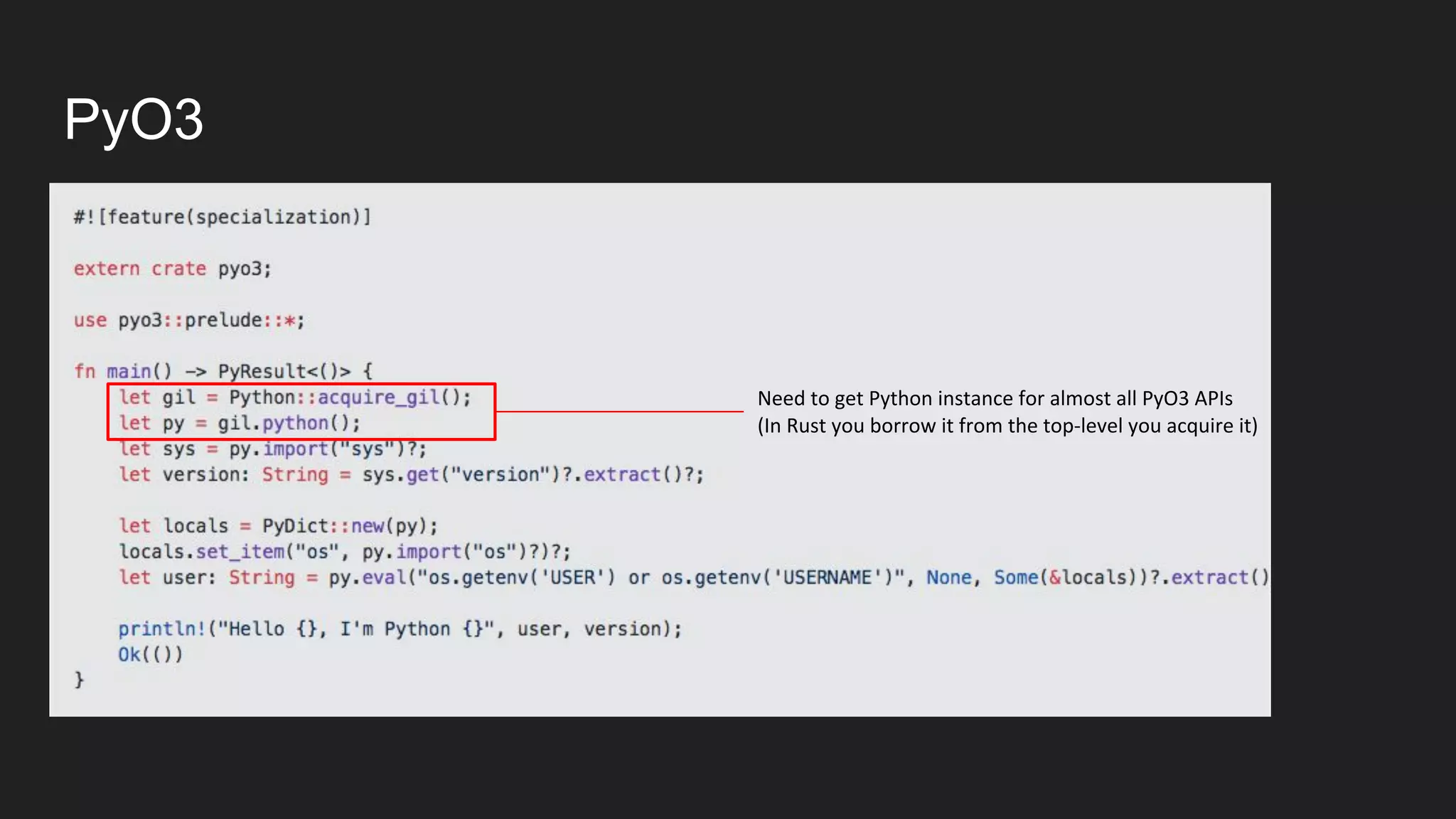
Need to get Python instance for almost all PyO3 APIs
(In Rust you borrow it from the top-level you acquire it)
PyO3
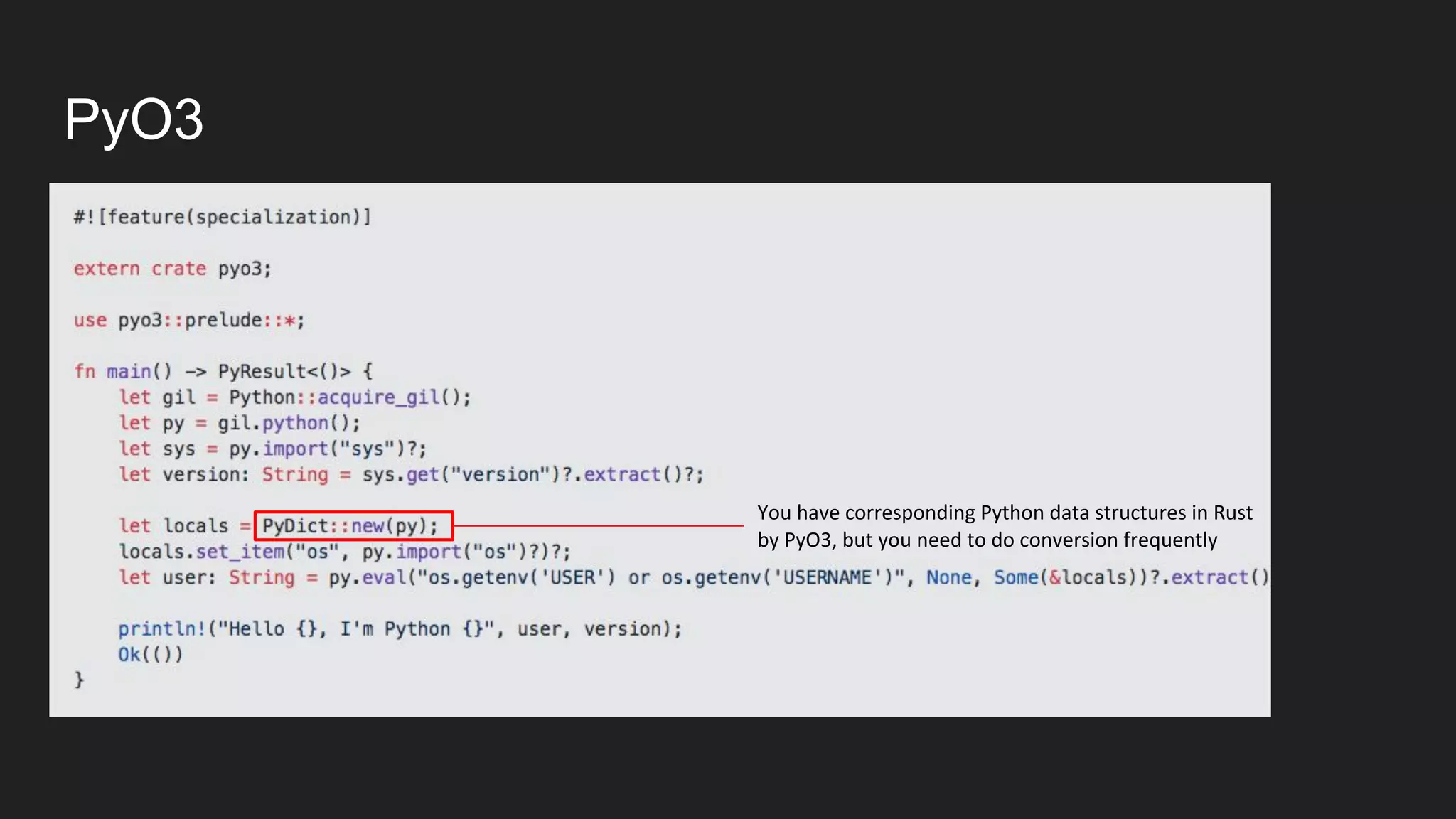
You have corresponding Python data structures in Rust
by PyO3, but you need to do conversion frequently
PyO3
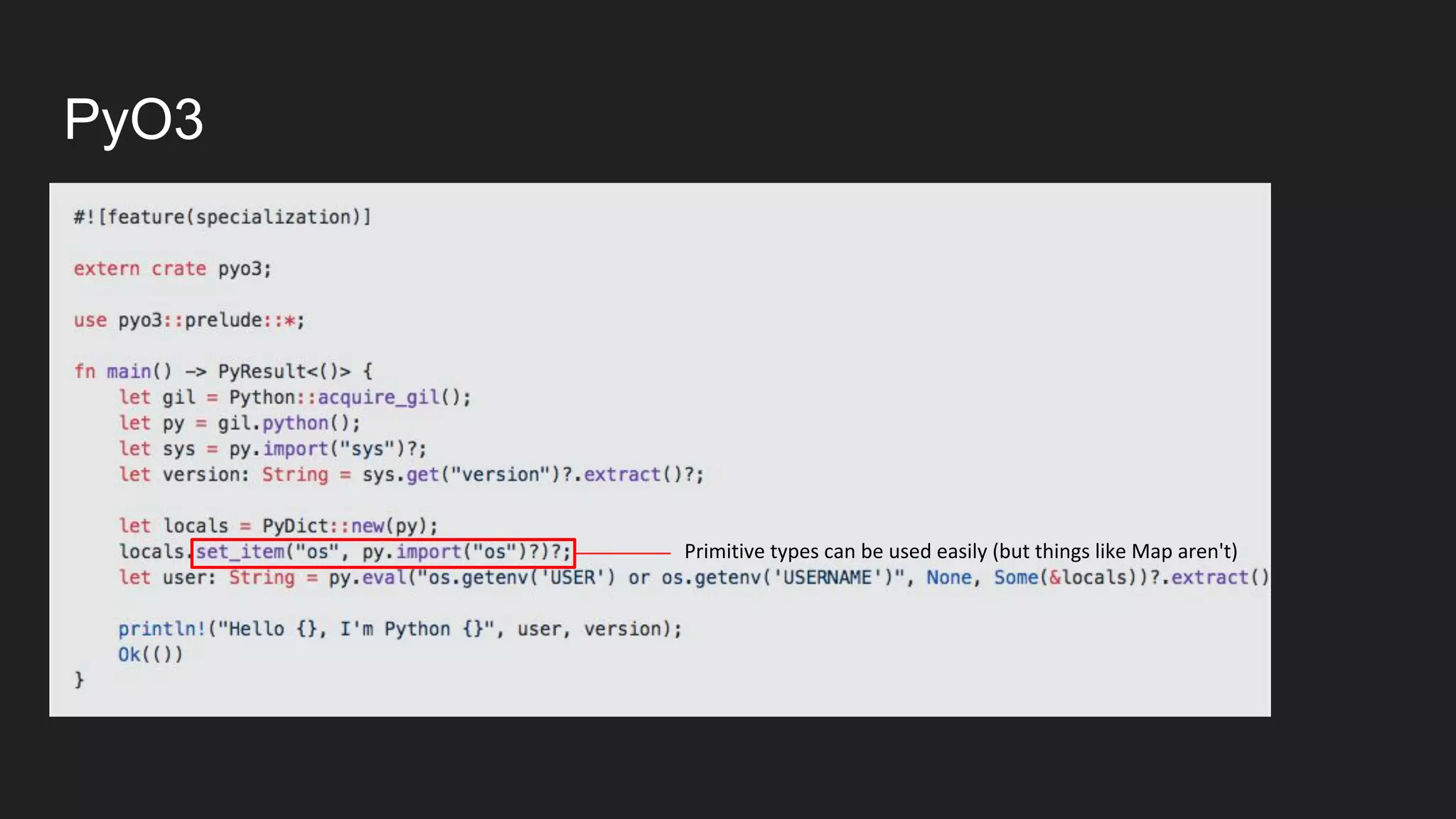
Primitive types can be used easily (but things like Map aren't)
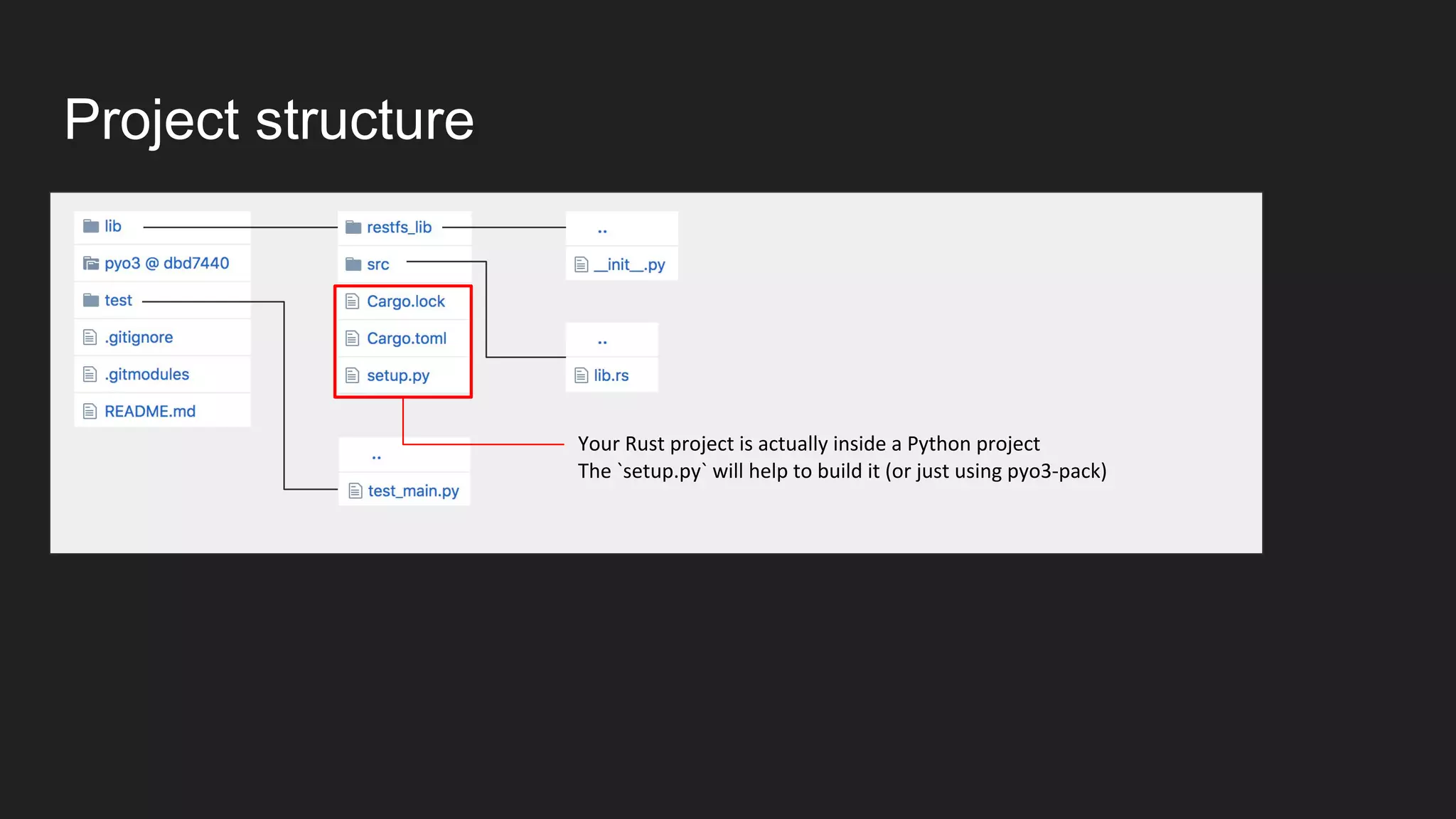
Project structure
Project structure
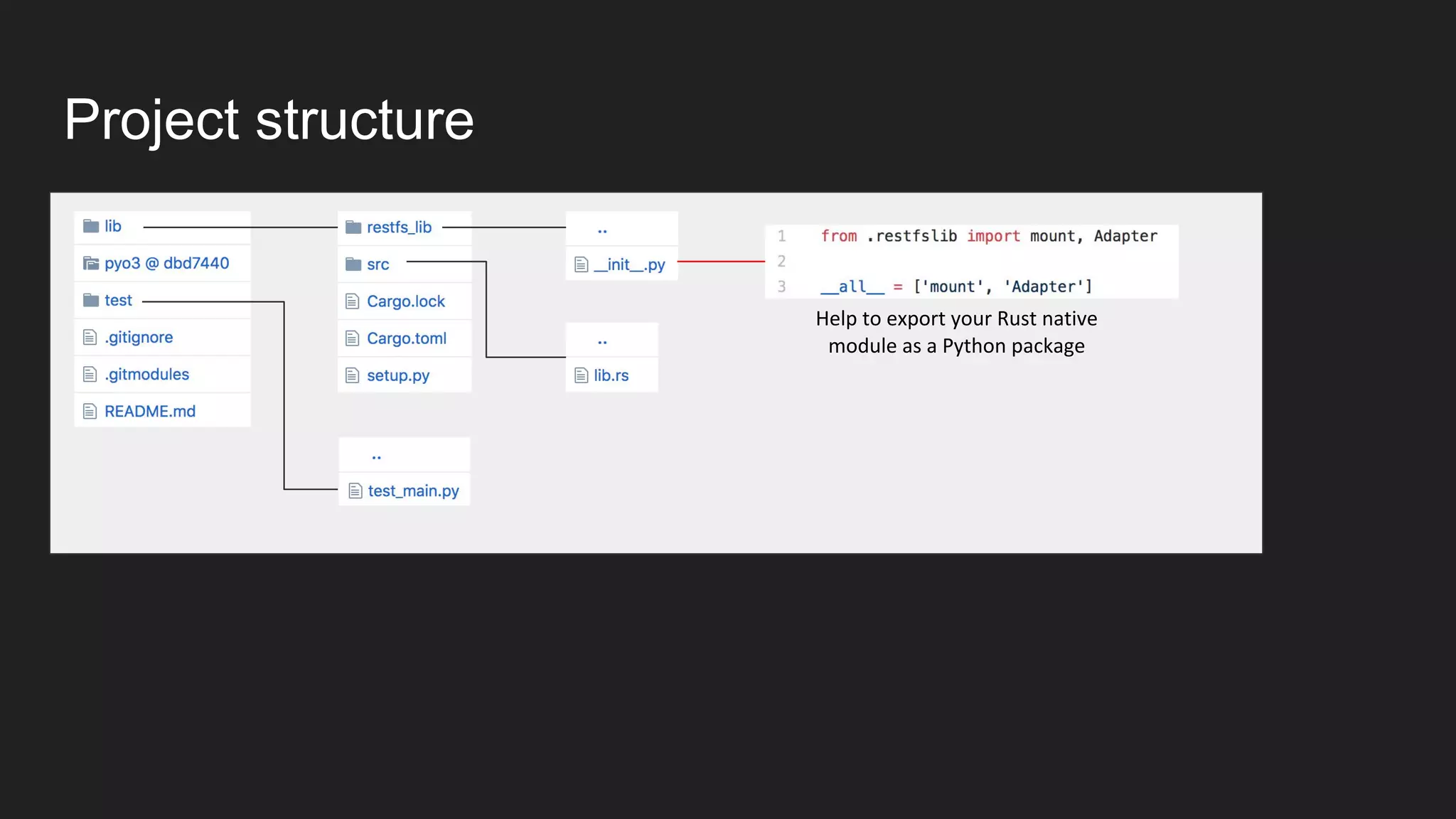
Help to export your Rust native
module as a Python package
Project structure
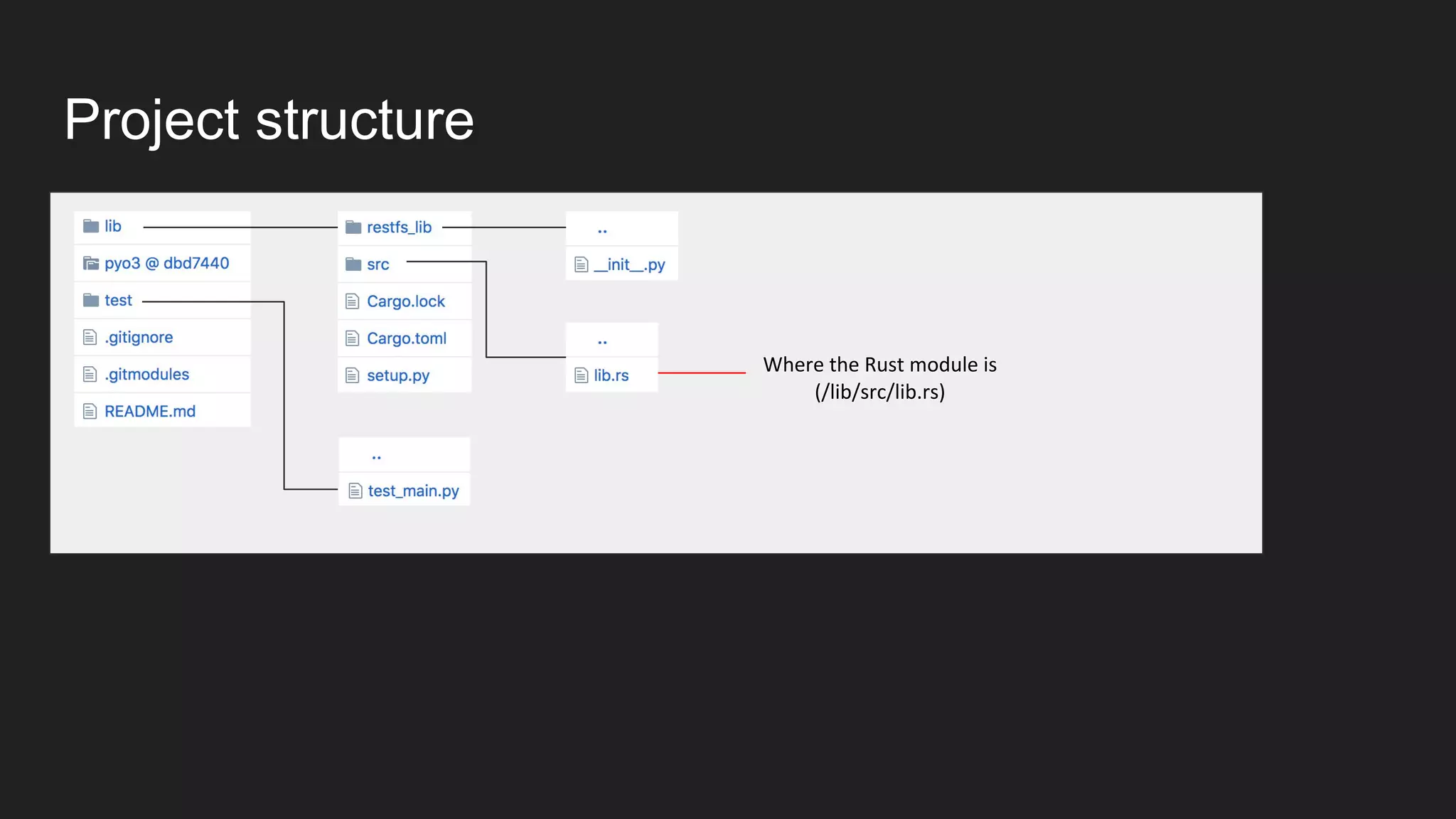
Where the Rust module is
(/lib/src/lib.rs)
Project structure
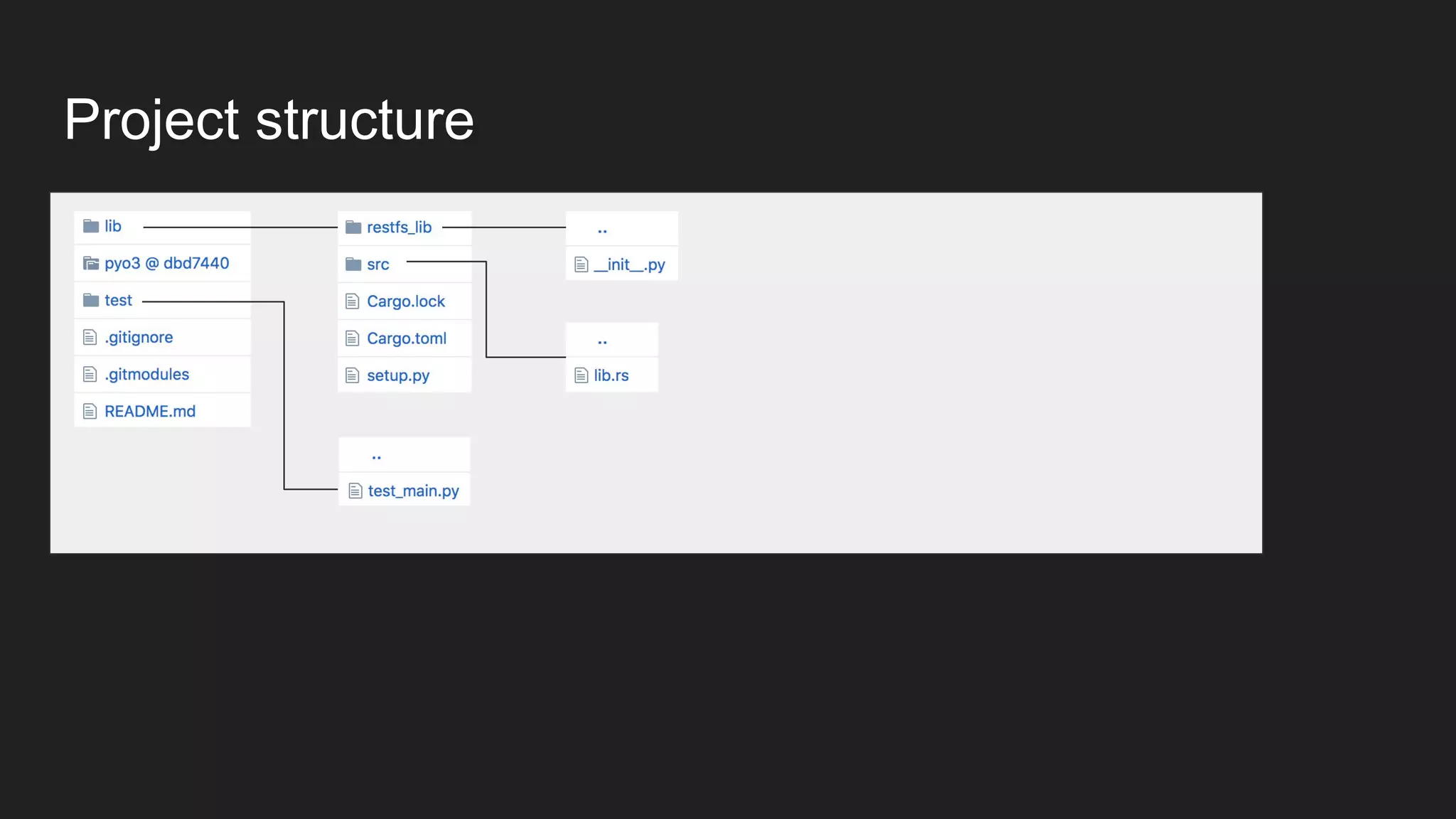
Your Rust project is actually inside a Python project
The `setup.py` will help to build it (or just using pyo3-pack)
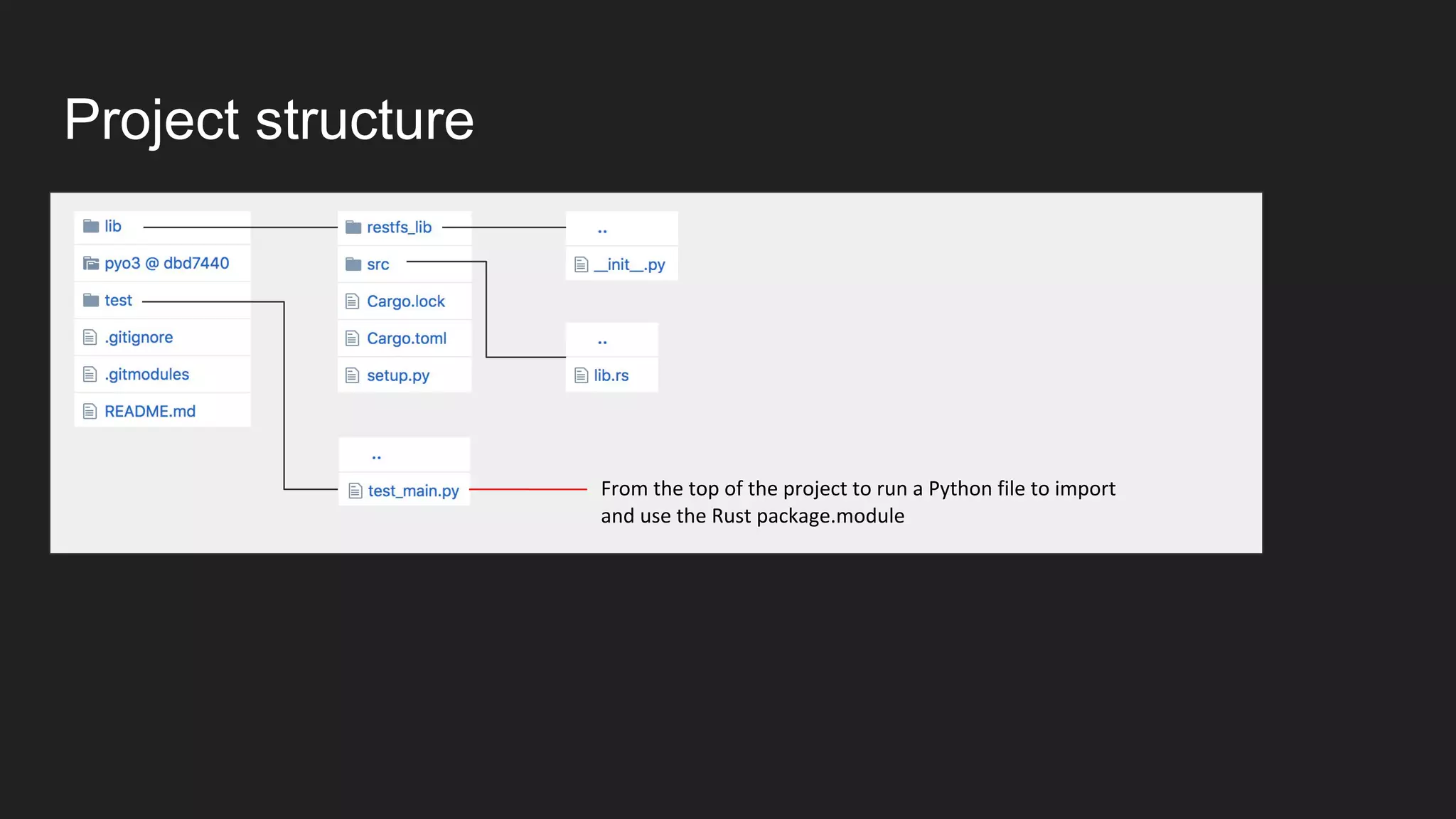
Project structure
From the top of the project to run a Python file to import
and use the Rust package.module
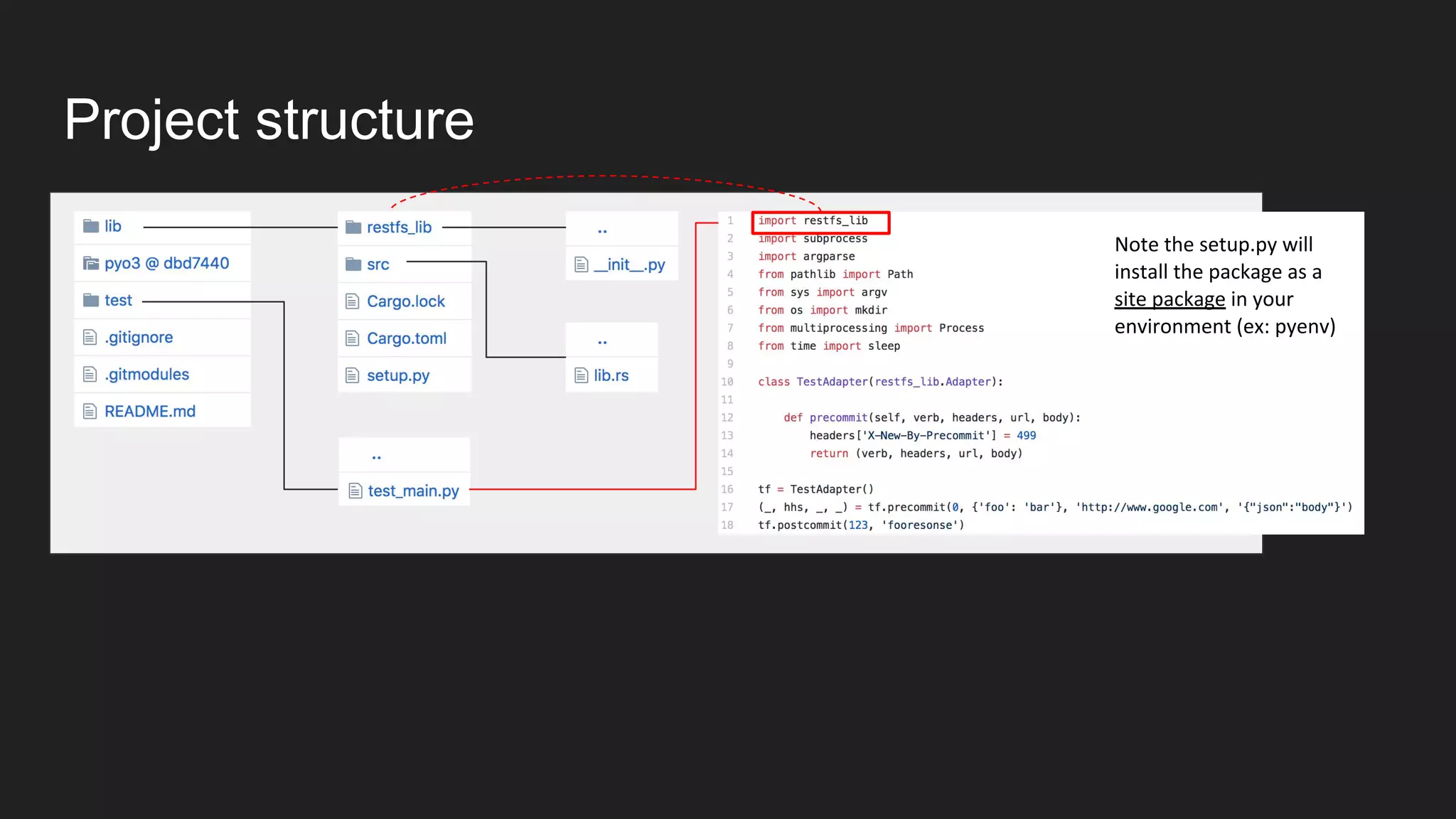
Project structure
Note the setup.py will
install the package as a
site package in your
environment (ex: pyenv)
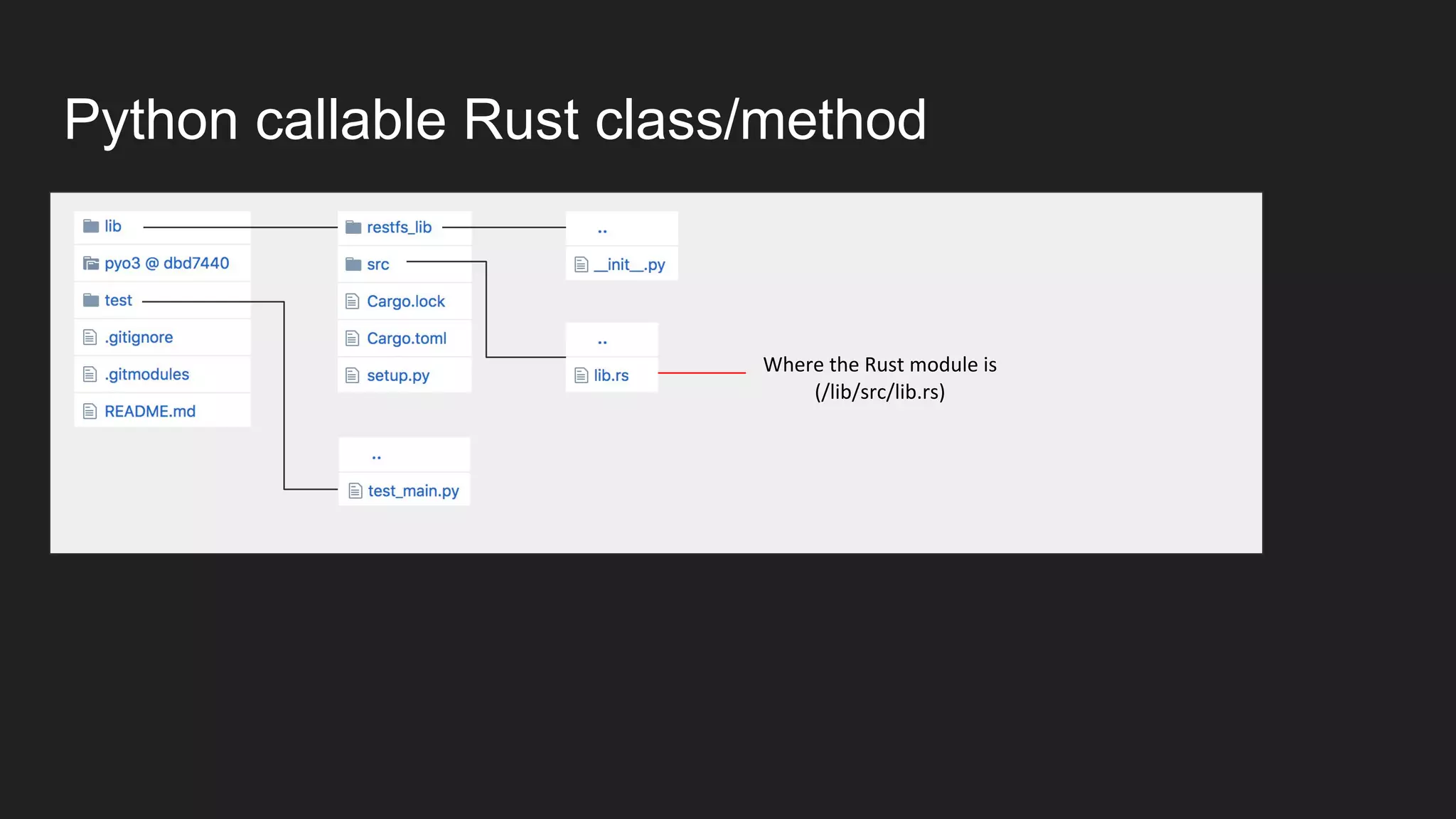
Python callable Rust class/method
Where the Rust module is
(/lib/src/lib.rs)
Python callable Rust class/method
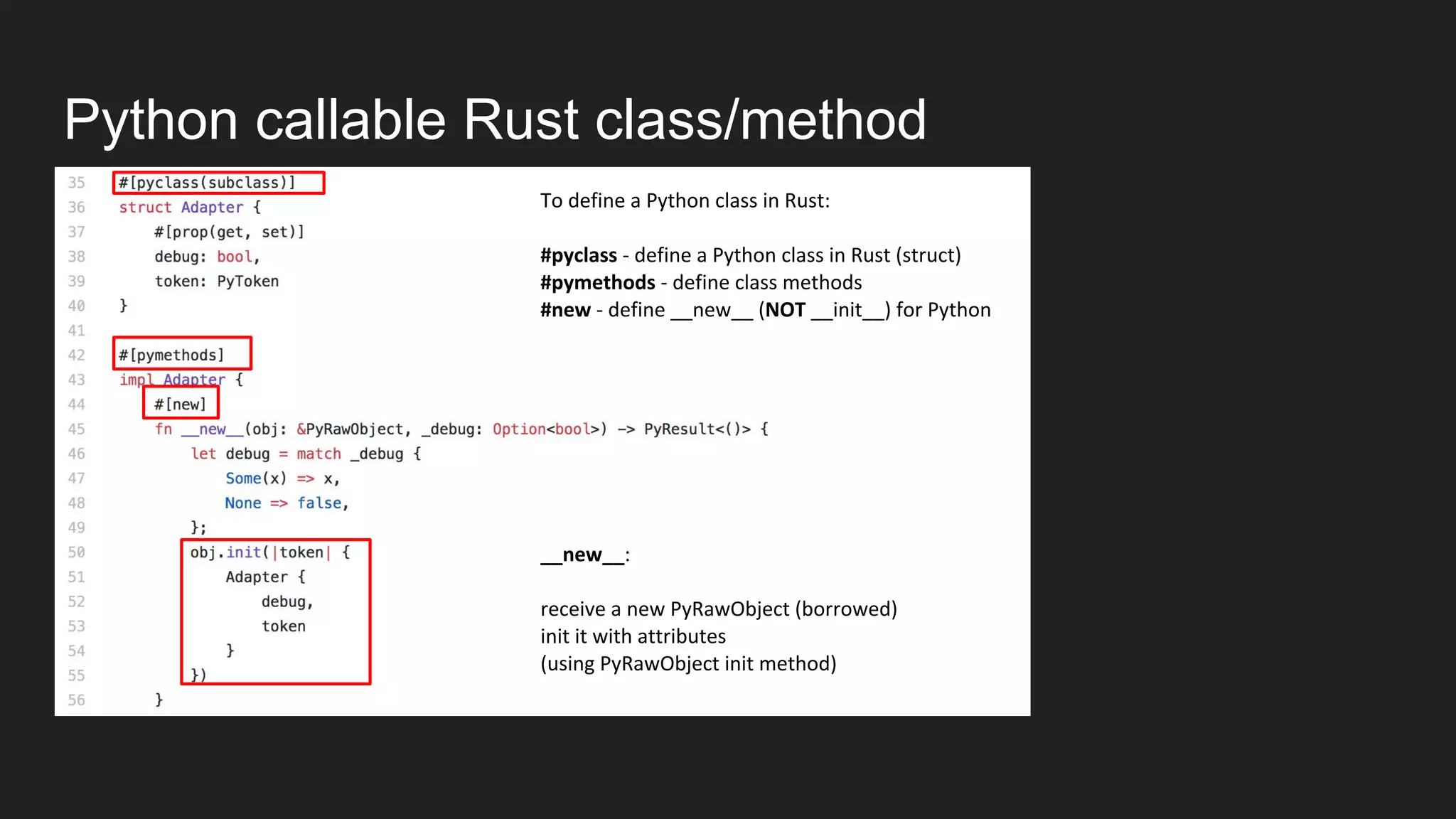
To define a Python class in Rust:
#pyclass - define a Python class in Rust (struct)
#pymethods - define class methods
#new - define __new__ (NOT __init__) for Python
__new__:
receive a new PyRawObject (borrowed)
init it with attributes
(using PyRawObject init method)
Python callable Rust class/method
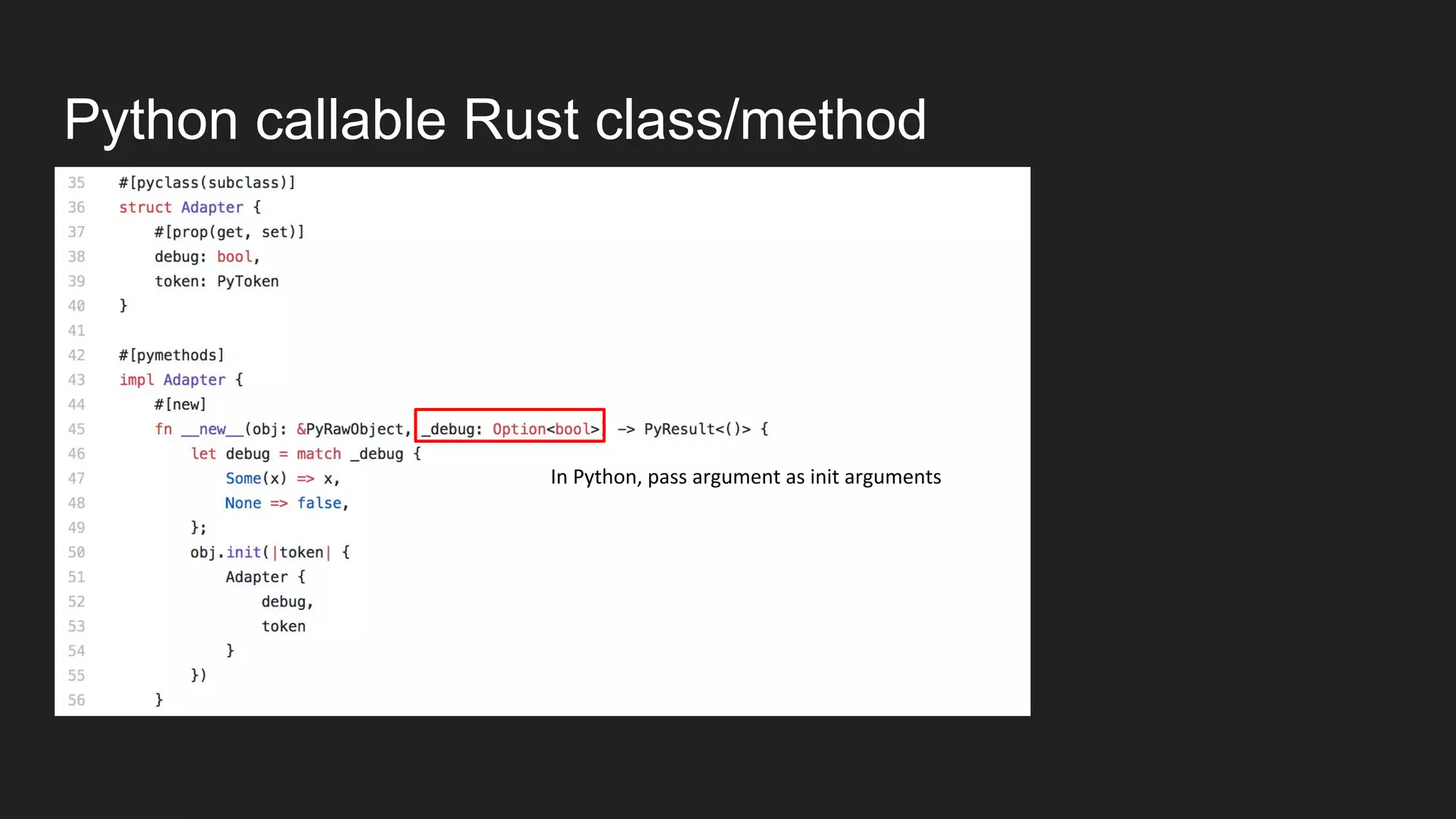
In Python, pass argument as init arguments
Python callable Rust class/method
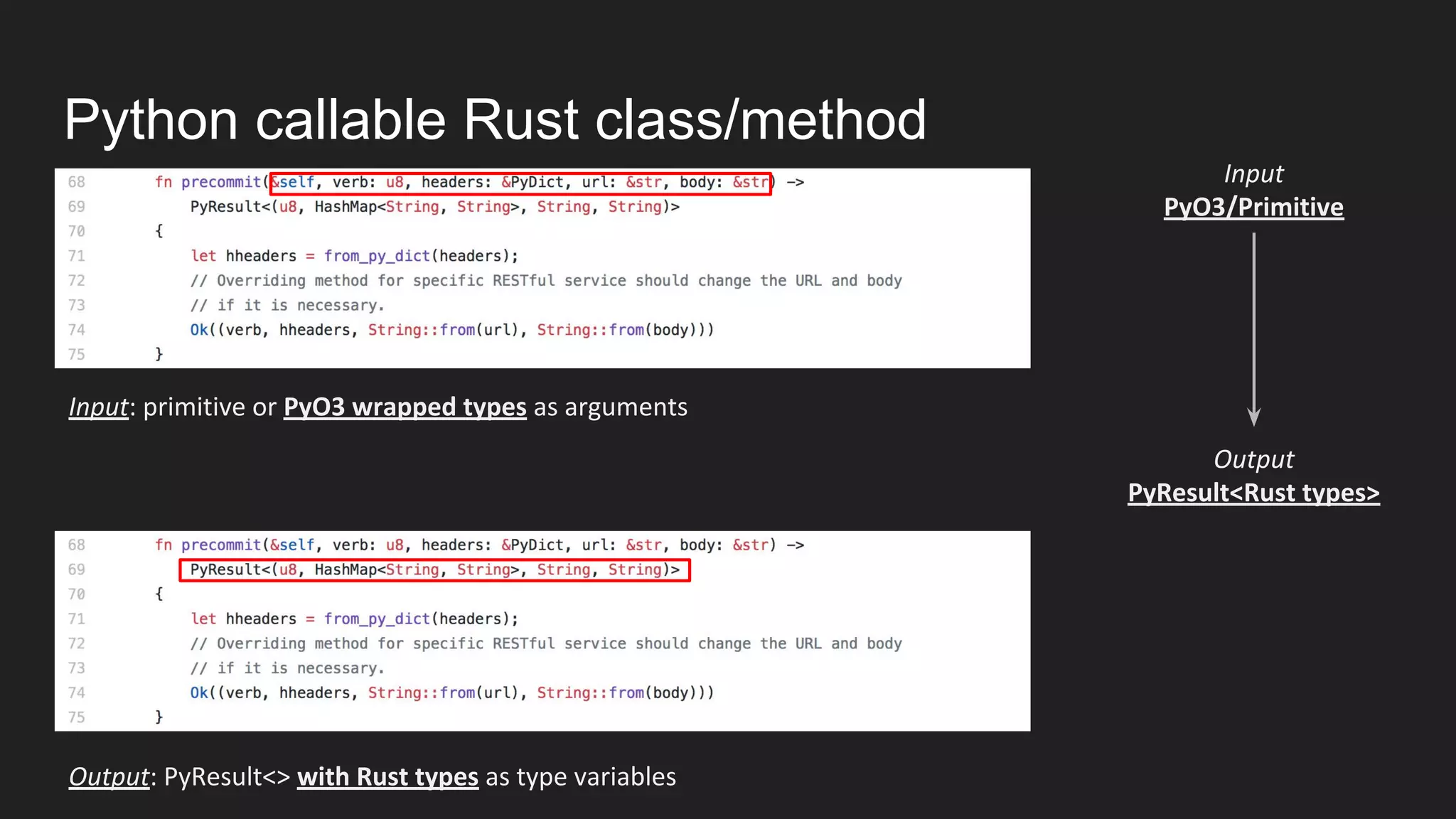
Output: PyResult<> with Rust types as type variables
Input: primitive or PyO3 wrapped types as arguments
Input
PyO3/Primitive
Output
PyResult<Rust types>
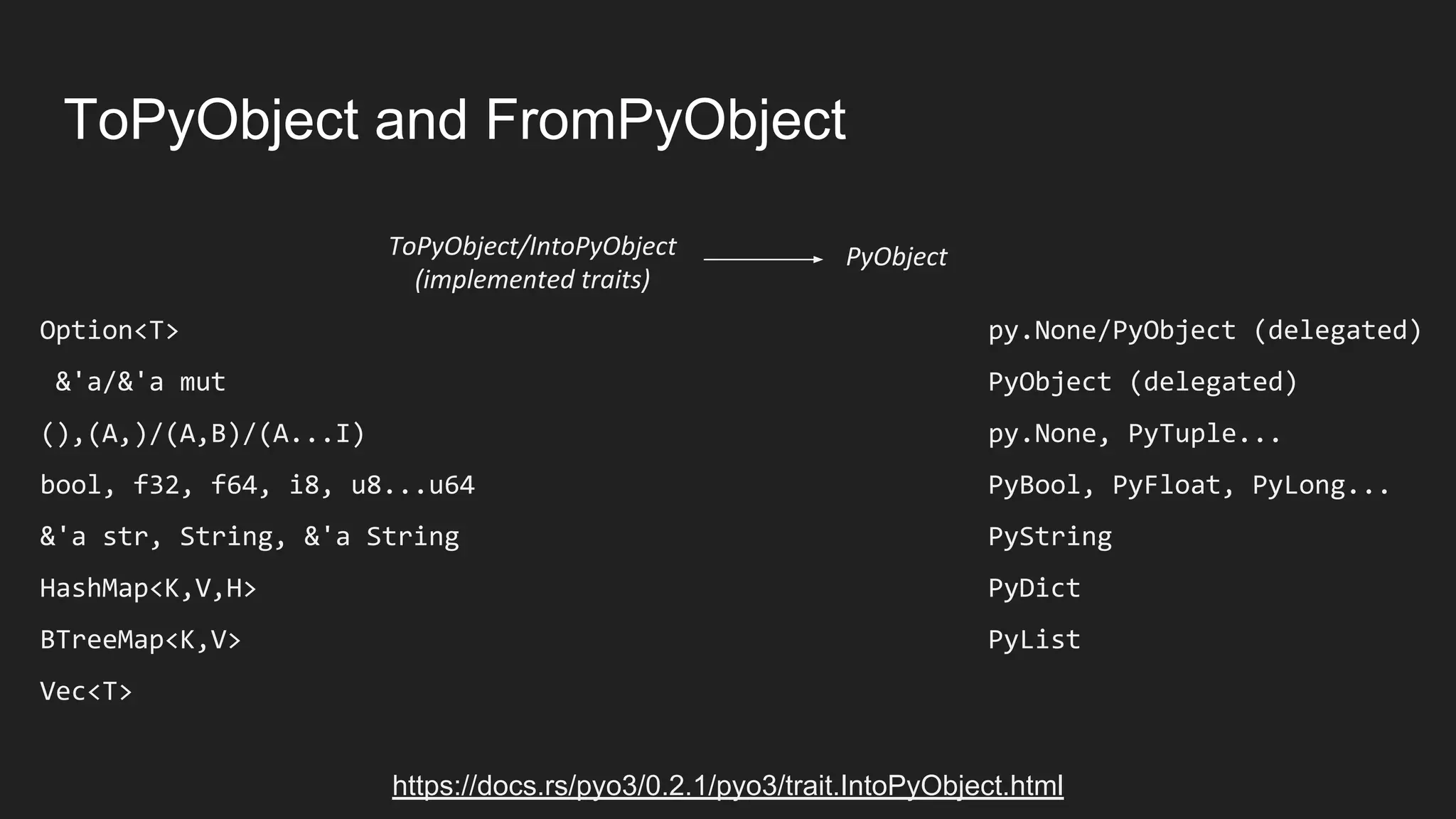
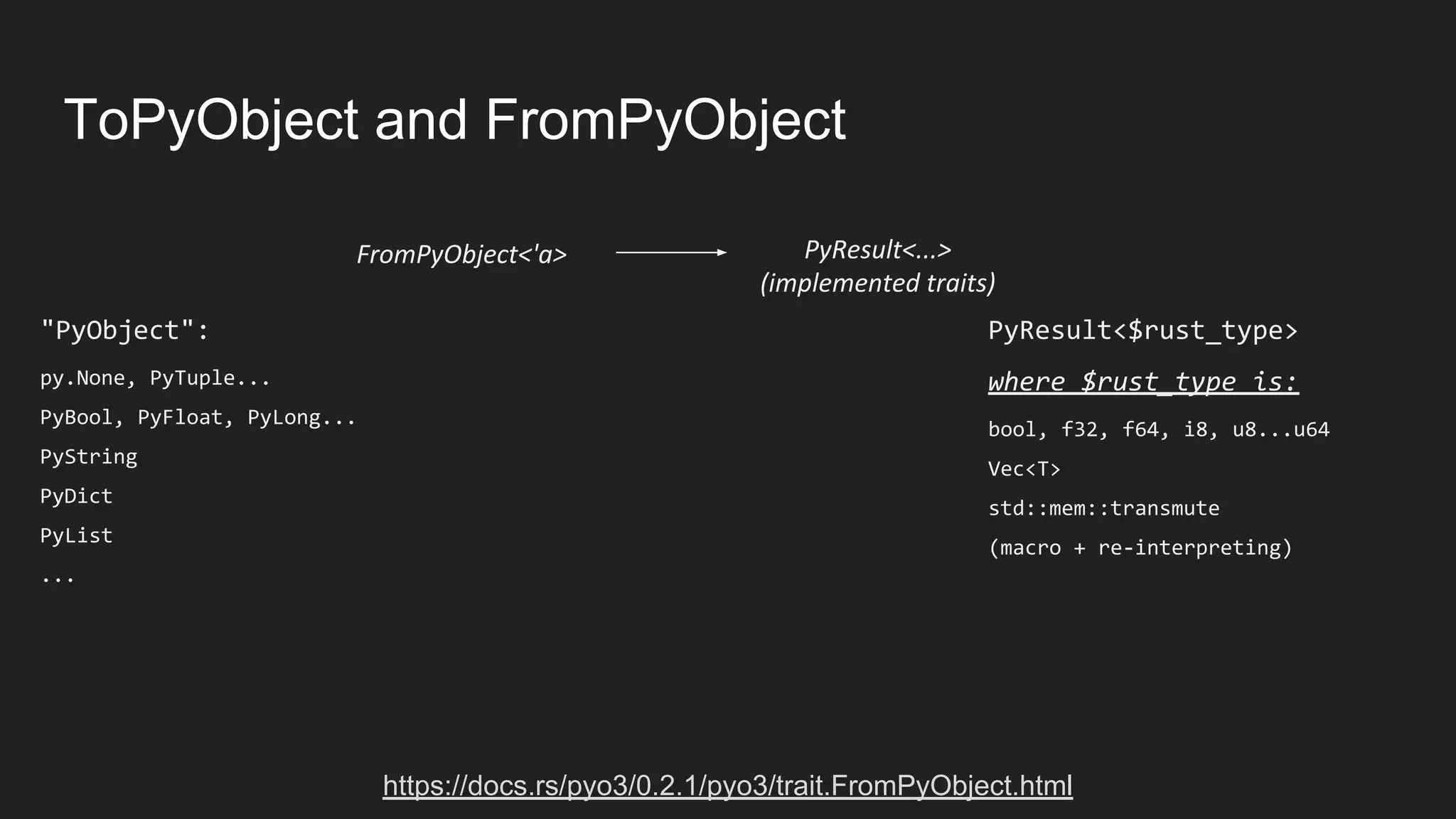
ToPyObject and FromPyObject
Option<T>
&'a/&'a mut
(),(A,)/(A,B)/(A...I)
bool, f32, f64, i8, u8...u64
&'a str, String, &'a String
HashMap<K,V,H>
BTreeMap<K,V>
Vec<T>
ToPyObject/IntoPyObject
(implemented traits)
PyObject
py.None/PyObject (delegated)
PyObject (delegated)
py.None, PyTuple...
PyBool, PyFloat, PyLong...
PyString
PyDict
PyList
https://docs.rs/pyo3/0.2.1/pyo3/trait.IntoPyObject.html
ToPyObject and FromPyObject
"PyObject":
py.None, PyTuple...
PyBool, PyFloat, PyLong...
PyString
PyDict
PyList
...
FromPyObject<'a> PyResult<...>
(implemented traits)
PyResult<$rust_type>
where $rust_type is:
bool, f32, f64, i8, u8...u64
Vec<T>
std::mem::transmute
(macro + re-interpreting)
https://docs.rs/pyo3/0.2.1/pyo3/trait.FromPyObject.html
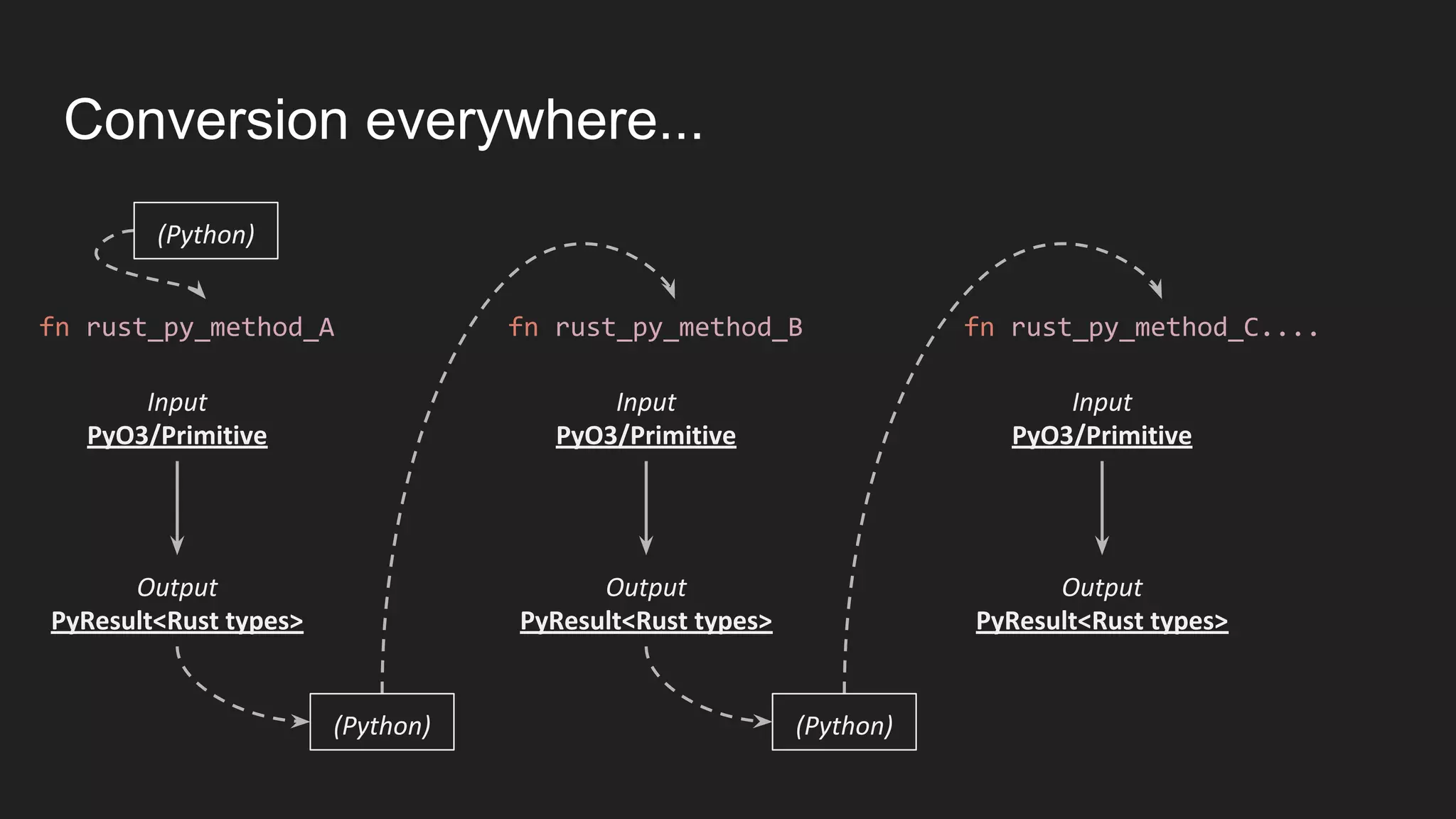
Conversion everywhere...
Input
PyO3/Primitive
Output
PyResult<Rust types>
fn rust_py_method_A fn rust_py_method_B
Input
PyO3/Primitive
Output
PyResult<Rust types>
fn rust_py_method_C....
Input
PyO3/Primitive
Output
PyResult<Rust types>
(Python) (Python)
(Python)
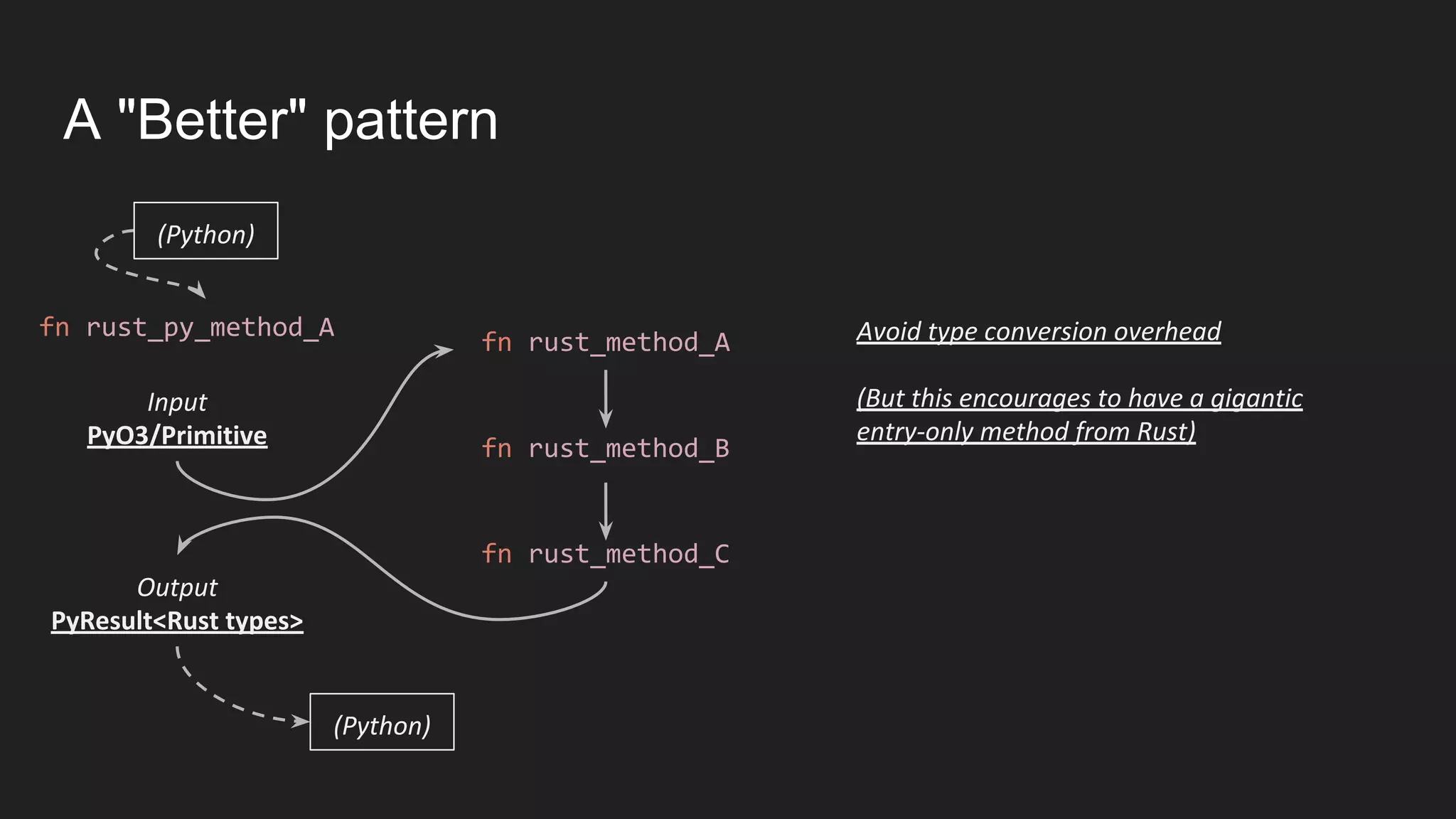
A "Better" pattern
Input
PyO3/Primitive
Output
PyResult<Rust types>
fn rust_py_method_A
(Python)
fn rust_method_A
fn rust_method_B
fn rust_method_C
(Python)
Avoid type conversion overhead
(But this encourages to have a gigantic
entry-only method from Rust)
Rust + python: lessons learnt from building a toy filesystem

Rust + python: lessons learnt from building a toy filesystem

  • 1.
    Rust + Python Lessonsfrom building a FUSE toy filesystem 2018/9/10 @GregWeng
  • 2.
    Rust + Python Rust:system programming language Easy to adapt C and keep code safe Primitive type, low-level structure Python: fast prototyping and easy to extend Easy to adapt C as native module GC, dynamic types
  • 3.
    Rust + Python Rust:system programming language Easy to adapt C and keep code safe Primitive type, low-level structure Python: fast prototyping and easy to extend Easy to adapt C as native module GC, dynamic types Rust module Python library Python programPython module ... System API
  • 4.
    RestFS Rust adapts FUSEAPI PyO3 builds this Rust as native python module Python extend the RestFS.rs to adapt real site By urllib to define what file operations to what site operations (ex: GET -> create new file) RestFS.rs YourSite.py Python programPython module ... FUSE API PyO3 urllib https://github.com/snowmantw/restfs
  • 5.
    Not really makessense File system is persistent storage, while RESTful API is designed to be stateless GET /item -> File makes sense doesn't mean GET /items -> Directory makes sense (response of an HTTP request has no definition of it is a single resource or a list)
  • 6.
    Not really makessense, but... Everything is a file! cat "hello" > pastebin.com/hello looks so right (isn't it?) C is a sharp knife with greasy handle that may cut your hand easily Python is good but it lives too high to let us know the details (sure that's why it is so nice) Therefore: Find a topic related to system programming (so file system) that I can have a look at Python native details (so PyO3) and practice Rust for fun ("摻在一起做成撒尿牛丸就好啦 ")
  • 7.
  • 8.
    PyO3 Necessary for everymethod imported and used from the Python side (ex: as class or module method)
  • 9.
    PyO3 Need to getPython instance for almost all PyO3 APIs (In Rust you borrow it from the top-level you acquire it)
  • 10.
    PyO3 You have correspondingPython data structures in Rust by PyO3, but you need to do conversion frequently
  • 11.
    PyO3 Primitive types canbe used easily (but things like Map aren't)
  • 12.
  • 13.
    Project structure Help toexport your Rust native module as a Python package
  • 14.
    Project structure Where theRust module is (/lib/src/lib.rs)
  • 15.
    Project structure Your Rustproject is actually inside a Python project The `setup.py` will help to build it (or just using pyo3-pack)
  • 16.
    Project structure From thetop of the project to run a Python file to import and use the Rust package.module
  • 17.
    Project structure Note thesetup.py will install the package as a site package in your environment (ex: pyenv)
  • 18.
    Python callable Rustclass/method Where the Rust module is (/lib/src/lib.rs)
  • 19.
    Python callable Rustclass/method To define a Python class in Rust: #pyclass - define a Python class in Rust (struct) #pymethods - define class methods #new - define __new__ (NOT __init__) for Python __new__: receive a new PyRawObject (borrowed) init it with attributes (using PyRawObject init method)
  • 20.
    Python callable Rustclass/method In Python, pass argument as init arguments
  • 21.
    Python callable Rustclass/method Output: PyResult<> with Rust types as type variables Input: primitive or PyO3 wrapped types as arguments Input PyO3/Primitive Output PyResult<Rust types>
  • 22.
    ToPyObject and FromPyObject Option<T> &'a/&'amut (),(A,)/(A,B)/(A...I) bool, f32, f64, i8, u8...u64 &'a str, String, &'a String HashMap<K,V,H> BTreeMap<K,V> Vec<T> ToPyObject/IntoPyObject (implemented traits) PyObject py.None/PyObject (delegated) PyObject (delegated) py.None, PyTuple... PyBool, PyFloat, PyLong... PyString PyDict PyList https://docs.rs/pyo3/0.2.1/pyo3/trait.IntoPyObject.html
  • 23.
    ToPyObject and FromPyObject "PyObject": py.None,PyTuple... PyBool, PyFloat, PyLong... PyString PyDict PyList ... FromPyObject<'a> PyResult<...> (implemented traits) PyResult<$rust_type> where $rust_type is: bool, f32, f64, i8, u8...u64 Vec<T> std::mem::transmute (macro + re-interpreting) https://docs.rs/pyo3/0.2.1/pyo3/trait.FromPyObject.html
  • 24.
    Conversion everywhere... Input PyO3/Primitive Output PyResult<Rust types> fnrust_py_method_A fn rust_py_method_B Input PyO3/Primitive Output PyResult<Rust types> fn rust_py_method_C.... Input PyO3/Primitive Output PyResult<Rust types> (Python) (Python) (Python)
  • 25.
    A "Better" pattern Input PyO3/Primitive Output PyResult<Rusttypes> fn rust_py_method_A (Python) fn rust_method_A fn rust_method_B fn rust_method_C (Python) Avoid type conversion overhead (But this encourages to have a gigantic entry-only method from Rust)