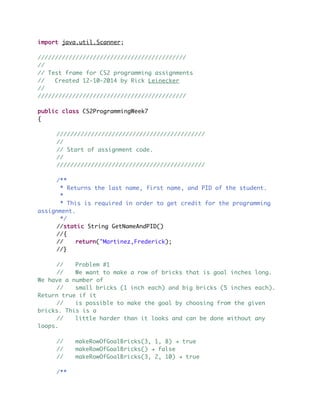
import java.util.Scanner;
///////////////////////////////////////////
//
// Test frame for CS2 programming assignments
// Created 12-10-2014 by Rick Leinecker
//
///////////////////////////////////////////
public class CS2ProgrammingWeek7
{
///////////////////////////////////////////
//
// Start of assignment code.
//
///////////////////////////////////////////
/**
* Returns the last name, first name, and PID of the student.
*
* This is required in order to get credit for the programming
assignment.
*/
//static String GetNameAndPID()
//{
// return("Martinez,Frederick);
//}
// Problem #1
// We want to make a row of bricks that is goal inches long.
We have a number of
// small bricks (1 inch each) and big bricks (5 inches each).
Return true if it
// is possible to make the goal by choosing from the given
bricks. This is a
// little harder than it looks and can be done without any
loops.
// makeRowOfGoalBricks(3, 1, 8) ! true
// makeRowOfGoalBricks() ! false
// makeRowOfGoalBricks(3, 2, 10) ! true
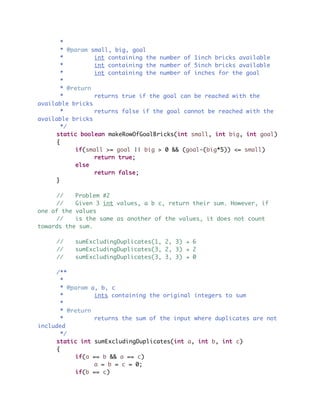
/**
*
* @param small, big, goal
* int containing the number of 1inch bricks available
* int containing the number of 5inch bricks available
* int containing the number of inches for the goal
*
* @return
* returns true if the goal can be reached with the
available bricks
* returns false if the goal cannot be reached with the
available bricks
*/
static boolean makeRowOfGoalBricks(int small, int big, int goal)
{
if(small >= goal || big > 0 && (goal-(big*5)) <= small)
return true;
else
return false;
}
// Problem #2
// Given 3 int values, a b c, return their sum. However, if
one of the values
// is the same as another of the values, it does not count
towards the sum.
// sumExcludingDuplicates(1, 2, 3) ! 6
// sumExcludingDuplicates(3, 2, 3) ! 2
// sumExcludingDuplicates(3, 3, 3) ! 0
/**
*
* @param a, b, c
* ints containing the original integers to sum
*
* @return
* returns the sum of the input where duplicates are not
included
*/
static int sumExcludingDuplicates(int a, int b, int c)
{
if(a == b && a == c)
a = b = c = 0;
if(b == c)
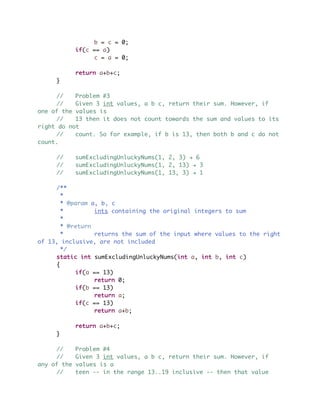
b = c = 0;
if(c == a)
c = a = 0;
return a+b+c;
}
// Problem #3
// Given 3 int values, a b c, return their sum. However, if
one of the values is
// 13 then it does not count towards the sum and values to its
right do not
// count. So for example, if b is 13, then both b and c do not
count.
// sumExcludingUnluckyNums(1, 2, 3) ! 6
// sumExcludingUnluckyNums(1, 2, 13) ! 3
// sumExcludingUnluckyNums(1, 13, 3) ! 1
/**
*
* @param a, b, c
* ints containing the original integers to sum
*
* @return
* returns the sum of the input where values to the right
of 13, inclusive, are not included
*/
static int sumExcludingUnluckyNums(int a, int b, int c)
{
if(a == 13)
return 0;
if(b == 13)
return a;
if(c == 13)
return a+b;
return a+b+c;
}
// Problem #4
// Given 3 int values, a b c, return their sum. However, if
any of the values is a
// teen -- in the range 13..19 inclusive -- then that value
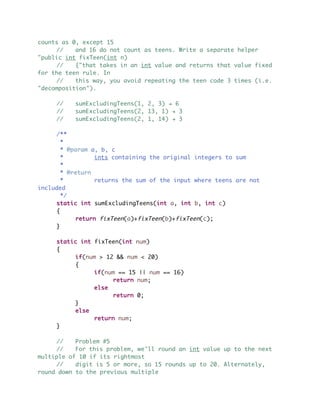
counts as 0, except 15
// and 16 do not count as teens. Write a separate helper
"public int fixTeen(int n)
// {"that takes in an int value and returns that value fixed
for the teen rule. In
// this way, you avoid repeating the teen code 3 times (i.e.
"decomposition").
// sumExcludingTeens(1, 2, 3) ! 6
// sumExcludingTeens(2, 13, 1) ! 3
// sumExcludingTeens(2, 1, 14) ! 3
/**
*
* @param a, b, c
* ints containing the original integers to sum
*
* @return
* returns the sum of the input where teens are not
included
*/
static int sumExcludingTeens(int a, int b, int c)
{
return fixTeen(a)+fixTeen(b)+fixTeen(c);
}
static int fixTeen(int num)
{
if(num > 12 && num < 20)
{
if(num == 15 || num == 16)
return num;
else
return 0;
}
else
return num;
}
// Problem #5
// For this problem, we'll round an int value up to the next
multiple of 10 if its rightmost
// digit is 5 or more, so 15 rounds up to 20. Alternately,
round down to the previous multiple
// of 10 if its rightmost digit is less than 5, so 12 rounds
down to 10. Given 3 ints,
// a b c, return the sum of their rounded values. To avoid
code repetition, write a separate
// helper "public int round10(int num) {" and call it 3 times.
Write the helper entirely below
// and at the same indent level as roundSum().
// roundedSum(16, 17, 18) ! 60
// roundedSum(12, 13, 14) ! 30
// roundedSum(6, 4, 4) ! 10
/**
*
* @param a, b, c
* ints containing the original integers to sum
*
* @return
* returns the sum of the input where each value is
rounded to the nearest tens place
*/
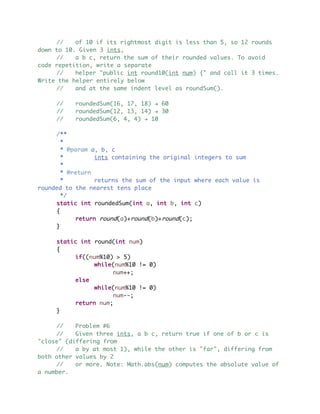
static int roundedSum(int a, int b, int c)
{
return round(a)+round(b)+round(c);
}
static int round(int num)
{
if((num%10) > 5)
while(num%10 != 0)
num++;
else
while(num%10 != 0)
num--;
return num;
}
// Problem #6
// Given three ints, a b c, return true if one of b or c is
"close" (differing from
// a by at most 1), while the other is "far", differing from
both other values by 2
// or more. Note: Math.abs(num) computes the absolute value of
a number.
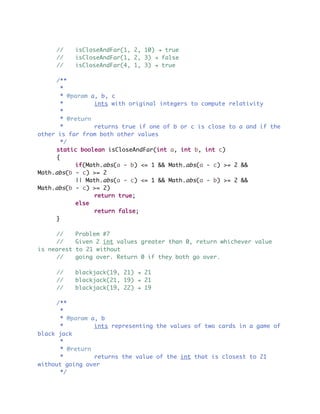
// isCloseAndFar(1, 2, 10) ! true
// isCloseAndFar(1, 2, 3) ! false
// isCloseAndFar(4, 1, 3) ! true
/**
*
* @param a, b, c
* ints with original integers to compute relativity
*
* @return
* returns true if one of b or c is close to a and if the
other is far from both other values
*/
static boolean isCloseAndFar(int a, int b, int c)
{
if(Math.abs(a - b) <= 1 && Math.abs(a - c) >= 2 &&
Math.abs(b - c) >= 2
|| Math.abs(a - c) <= 1 && Math.abs(a - b) >= 2 &&
Math.abs(b - c) >= 2)
return true;
else
return false;
}
// Problem #7
// Given 2 int values greater than 0, return whichever value
is nearest to 21 without
// going over. Return 0 if they both go over.
// blackjack(19, 21) ! 21
// blackjack(21, 19) ! 21
// blackjack(19, 22) ! 19
/**
*
* @param a, b
* ints representing the values of two cards in a game of
black jack
*
* @return
* returns the value of the int that is closest to 21
without going over
*/
static int blackjack(int a, int b)
{
if(a <= 21 && b > 21 || a > b && a <= 21)
return a;
else if(b <= 21)
return b;
else
return 0;
}
// Problem #8
// Given three ints, a b c, one of them is small, one is
medium and one is large.
// Return true if the three values are evenly spaced, so the
difference between
// small and medium is the same as the difference between
medium and large.
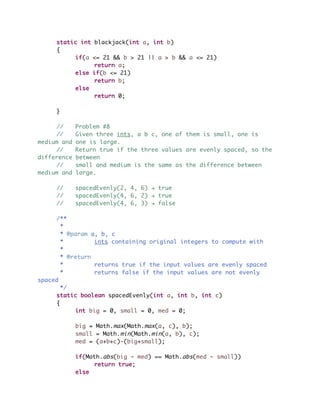
// spacedEvenly(2, 4, 6) ! true
// spacedEvenly(4, 6, 2) ! true
// spacedEvenly(4, 6, 3) ! false
/**
*
* @param a, b, c
* ints containing original integers to compute with
*
* @return
* returns true if the input values are evenly spaced
* returns false if the input values are not evenly
spaced
*/
static boolean spacedEvenly(int a, int b, int c)
{
int big = 0, small = 0, med = 0;
big = Math.max(Math.max(a, c), b);
small = Math.min(Math.min(a, b), c);
med = (a+b+c)-(big+small);
if(Math.abs(big - med) == Math.abs(med - small))
return true;
else
return false;
}
// Problem #9
// We want to make a package of goal kilos of chocolate. We
have small bars
// (1 kilo each) and big bars (5 kilos each). Return the
number of small bars
// to use, assuming we always use big bars before small bars.
Return -1
// if it can't be done.
// makeKilosOfChocolate(4, 1, 9) ! 4
// makeKilosOfChocolate(4, 1, 10) ! -1
// makeKilosOfChocolate(4, 1, 7) ! 2
/**
*
* @param small, big, goal
* int containing the number of 1kilo bars available
* int containing the number of 5kilo bars available
* int containing the number of kilos for the goal
*
* @return
* returns the value of the number of small bars needed
to meet the goal
*/
static int makeKilosOfChocolate(int small, int big, int goal)
{
if(big > 0 && ((big*5) + small) >= goal)
return (goal-(big*5));
else if(small >= goal)
return goal;
else
return -1;
}
///////////////////////////////////////////
//
// End of assignment code.
//
///////////////////////////////////////////
public static void main(String[] args)
{
}
}	
  

Java p1

  • 1.
    import java.util.Scanner; /////////////////////////////////////////// // // Testframe for CS2 programming assignments // Created 12-10-2014 by Rick Leinecker // /////////////////////////////////////////// public class CS2ProgrammingWeek7 { /////////////////////////////////////////// // // Start of assignment code. // /////////////////////////////////////////// /** * Returns the last name, first name, and PID of the student. * * This is required in order to get credit for the programming assignment. */ //static String GetNameAndPID() //{ // return("Martinez,Frederick); //} // Problem #1 // We want to make a row of bricks that is goal inches long. We have a number of // small bricks (1 inch each) and big bricks (5 inches each). Return true if it // is possible to make the goal by choosing from the given bricks. This is a // little harder than it looks and can be done without any loops. // makeRowOfGoalBricks(3, 1, 8) ! true // makeRowOfGoalBricks() ! false // makeRowOfGoalBricks(3, 2, 10) ! true /**
  • 2.
    * * @param small,big, goal * int containing the number of 1inch bricks available * int containing the number of 5inch bricks available * int containing the number of inches for the goal * * @return * returns true if the goal can be reached with the available bricks * returns false if the goal cannot be reached with the available bricks */ static boolean makeRowOfGoalBricks(int small, int big, int goal) { if(small >= goal || big > 0 && (goal-(big*5)) <= small) return true; else return false; } // Problem #2 // Given 3 int values, a b c, return their sum. However, if one of the values // is the same as another of the values, it does not count towards the sum. // sumExcludingDuplicates(1, 2, 3) ! 6 // sumExcludingDuplicates(3, 2, 3) ! 2 // sumExcludingDuplicates(3, 3, 3) ! 0 /** * * @param a, b, c * ints containing the original integers to sum * * @return * returns the sum of the input where duplicates are not included */ static int sumExcludingDuplicates(int a, int b, int c) { if(a == b && a == c) a = b = c = 0; if(b == c)
  • 3.
    b = c= 0; if(c == a) c = a = 0; return a+b+c; } // Problem #3 // Given 3 int values, a b c, return their sum. However, if one of the values is // 13 then it does not count towards the sum and values to its right do not // count. So for example, if b is 13, then both b and c do not count. // sumExcludingUnluckyNums(1, 2, 3) ! 6 // sumExcludingUnluckyNums(1, 2, 13) ! 3 // sumExcludingUnluckyNums(1, 13, 3) ! 1 /** * * @param a, b, c * ints containing the original integers to sum * * @return * returns the sum of the input where values to the right of 13, inclusive, are not included */ static int sumExcludingUnluckyNums(int a, int b, int c) { if(a == 13) return 0; if(b == 13) return a; if(c == 13) return a+b; return a+b+c; } // Problem #4 // Given 3 int values, a b c, return their sum. However, if any of the values is a // teen -- in the range 13..19 inclusive -- then that value
  • 4.
    counts as 0,except 15 // and 16 do not count as teens. Write a separate helper "public int fixTeen(int n) // {"that takes in an int value and returns that value fixed for the teen rule. In // this way, you avoid repeating the teen code 3 times (i.e. "decomposition"). // sumExcludingTeens(1, 2, 3) ! 6 // sumExcludingTeens(2, 13, 1) ! 3 // sumExcludingTeens(2, 1, 14) ! 3 /** * * @param a, b, c * ints containing the original integers to sum * * @return * returns the sum of the input where teens are not included */ static int sumExcludingTeens(int a, int b, int c) { return fixTeen(a)+fixTeen(b)+fixTeen(c); } static int fixTeen(int num) { if(num > 12 && num < 20) { if(num == 15 || num == 16) return num; else return 0; } else return num; } // Problem #5 // For this problem, we'll round an int value up to the next multiple of 10 if its rightmost // digit is 5 or more, so 15 rounds up to 20. Alternately, round down to the previous multiple
  • 5.
    // of 10if its rightmost digit is less than 5, so 12 rounds down to 10. Given 3 ints, // a b c, return the sum of their rounded values. To avoid code repetition, write a separate // helper "public int round10(int num) {" and call it 3 times. Write the helper entirely below // and at the same indent level as roundSum(). // roundedSum(16, 17, 18) ! 60 // roundedSum(12, 13, 14) ! 30 // roundedSum(6, 4, 4) ! 10 /** * * @param a, b, c * ints containing the original integers to sum * * @return * returns the sum of the input where each value is rounded to the nearest tens place */ static int roundedSum(int a, int b, int c) { return round(a)+round(b)+round(c); } static int round(int num) { if((num%10) > 5) while(num%10 != 0) num++; else while(num%10 != 0) num--; return num; } // Problem #6 // Given three ints, a b c, return true if one of b or c is "close" (differing from // a by at most 1), while the other is "far", differing from both other values by 2 // or more. Note: Math.abs(num) computes the absolute value of a number.
  • 6.
    // isCloseAndFar(1, 2,10) ! true // isCloseAndFar(1, 2, 3) ! false // isCloseAndFar(4, 1, 3) ! true /** * * @param a, b, c * ints with original integers to compute relativity * * @return * returns true if one of b or c is close to a and if the other is far from both other values */ static boolean isCloseAndFar(int a, int b, int c) { if(Math.abs(a - b) <= 1 && Math.abs(a - c) >= 2 && Math.abs(b - c) >= 2 || Math.abs(a - c) <= 1 && Math.abs(a - b) >= 2 && Math.abs(b - c) >= 2) return true; else return false; } // Problem #7 // Given 2 int values greater than 0, return whichever value is nearest to 21 without // going over. Return 0 if they both go over. // blackjack(19, 21) ! 21 // blackjack(21, 19) ! 21 // blackjack(19, 22) ! 19 /** * * @param a, b * ints representing the values of two cards in a game of black jack * * @return * returns the value of the int that is closest to 21 without going over */
  • 7.
    static int blackjack(inta, int b) { if(a <= 21 && b > 21 || a > b && a <= 21) return a; else if(b <= 21) return b; else return 0; } // Problem #8 // Given three ints, a b c, one of them is small, one is medium and one is large. // Return true if the three values are evenly spaced, so the difference between // small and medium is the same as the difference between medium and large. // spacedEvenly(2, 4, 6) ! true // spacedEvenly(4, 6, 2) ! true // spacedEvenly(4, 6, 3) ! false /** * * @param a, b, c * ints containing original integers to compute with * * @return * returns true if the input values are evenly spaced * returns false if the input values are not evenly spaced */ static boolean spacedEvenly(int a, int b, int c) { int big = 0, small = 0, med = 0; big = Math.max(Math.max(a, c), b); small = Math.min(Math.min(a, b), c); med = (a+b+c)-(big+small); if(Math.abs(big - med) == Math.abs(med - small)) return true; else
  • 8.
    return false; } // Problem#9 // We want to make a package of goal kilos of chocolate. We have small bars // (1 kilo each) and big bars (5 kilos each). Return the number of small bars // to use, assuming we always use big bars before small bars. Return -1 // if it can't be done. // makeKilosOfChocolate(4, 1, 9) ! 4 // makeKilosOfChocolate(4, 1, 10) ! -1 // makeKilosOfChocolate(4, 1, 7) ! 2 /** * * @param small, big, goal * int containing the number of 1kilo bars available * int containing the number of 5kilo bars available * int containing the number of kilos for the goal * * @return * returns the value of the number of small bars needed to meet the goal */ static int makeKilosOfChocolate(int small, int big, int goal) { if(big > 0 && ((big*5) + small) >= goal) return (goal-(big*5)); else if(small >= goal) return goal; else return -1; } /////////////////////////////////////////// // // End of assignment code. // /////////////////////////////////////////// public static void main(String[] args)
  • 9.