by Vadym Kazulkin and Rodion Alukhanov, ip.labs GmbH
Java Memory Model
for practitioners
Java Memory Model for practitioners by Vadym Kazulkin and Rodion Alukhanov, ip.labs GmbH
Topics
• Hardware Memory Model
• Java Memory Model
• Practical examples related to Java Memory Model
• JcStress Tool
• The future of the Java Memory Model
Java Memory Model for practitioners by Vadym Kazulkin and Rodion Alukhanov, ip.labs GmbH
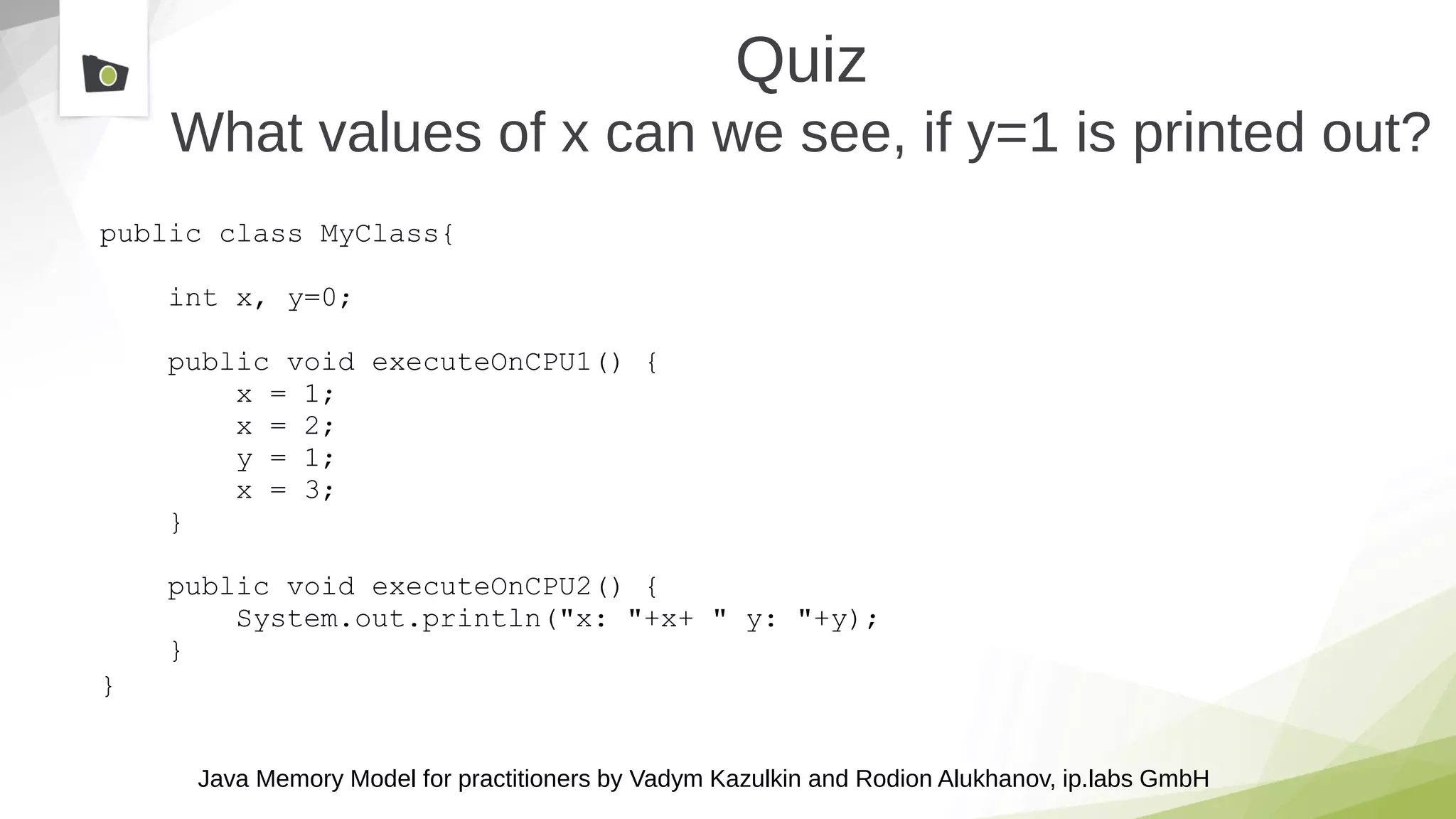
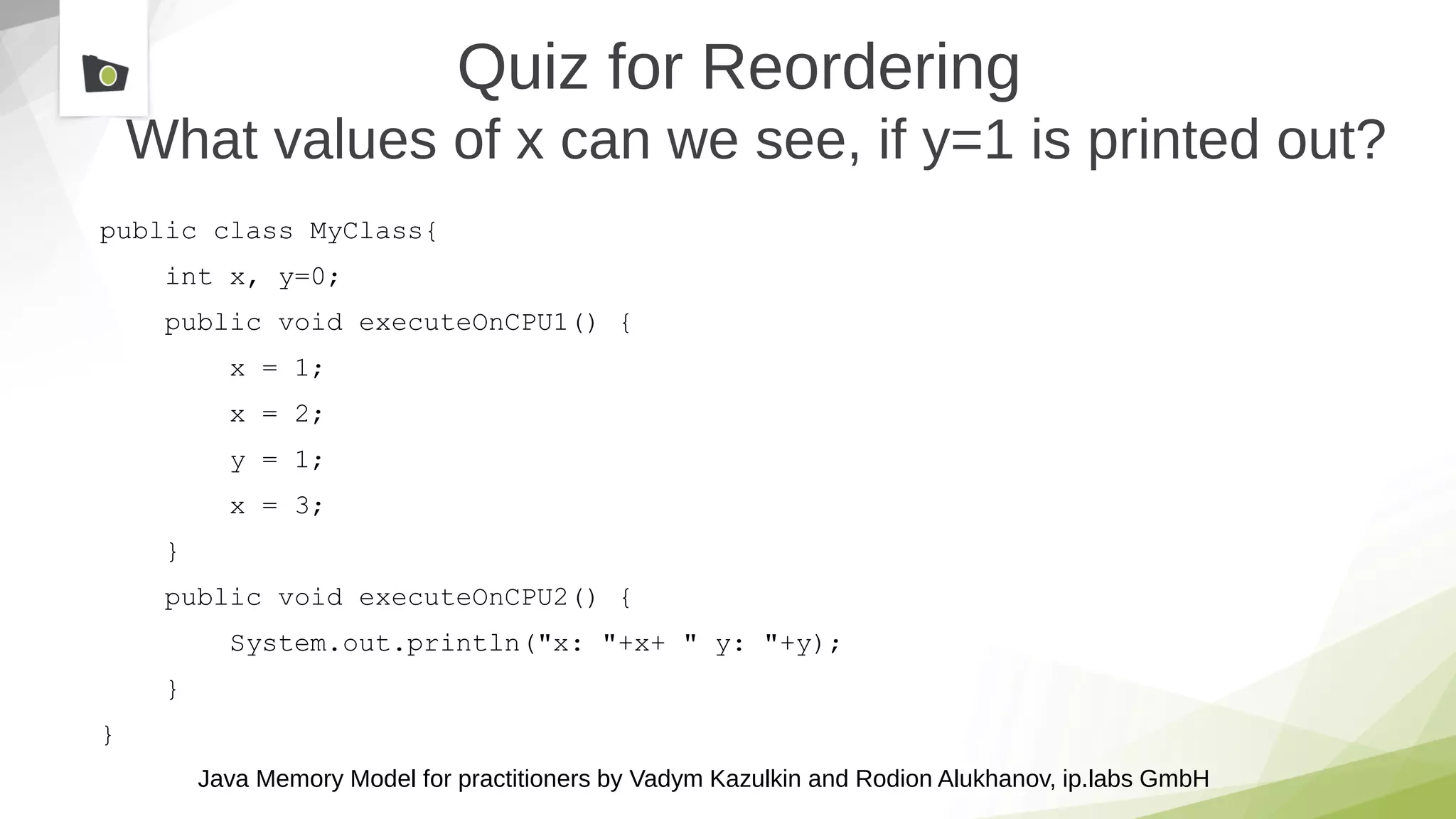
public class MyClass{
int x, y=0;
public void executeOnCPU1() {
x = 1;
x = 2;
y = 1;
x = 3;
}
public void executeOnCPU2() {
System.out.println("x: "+x+ " y: "+y);
}
}
Quiz
What values of x can we see, if y=1 is printed out?
Java Memory Model for practitioners by Vadym Kazulkin and Rodion Alukhanov, ip.labs GmbH
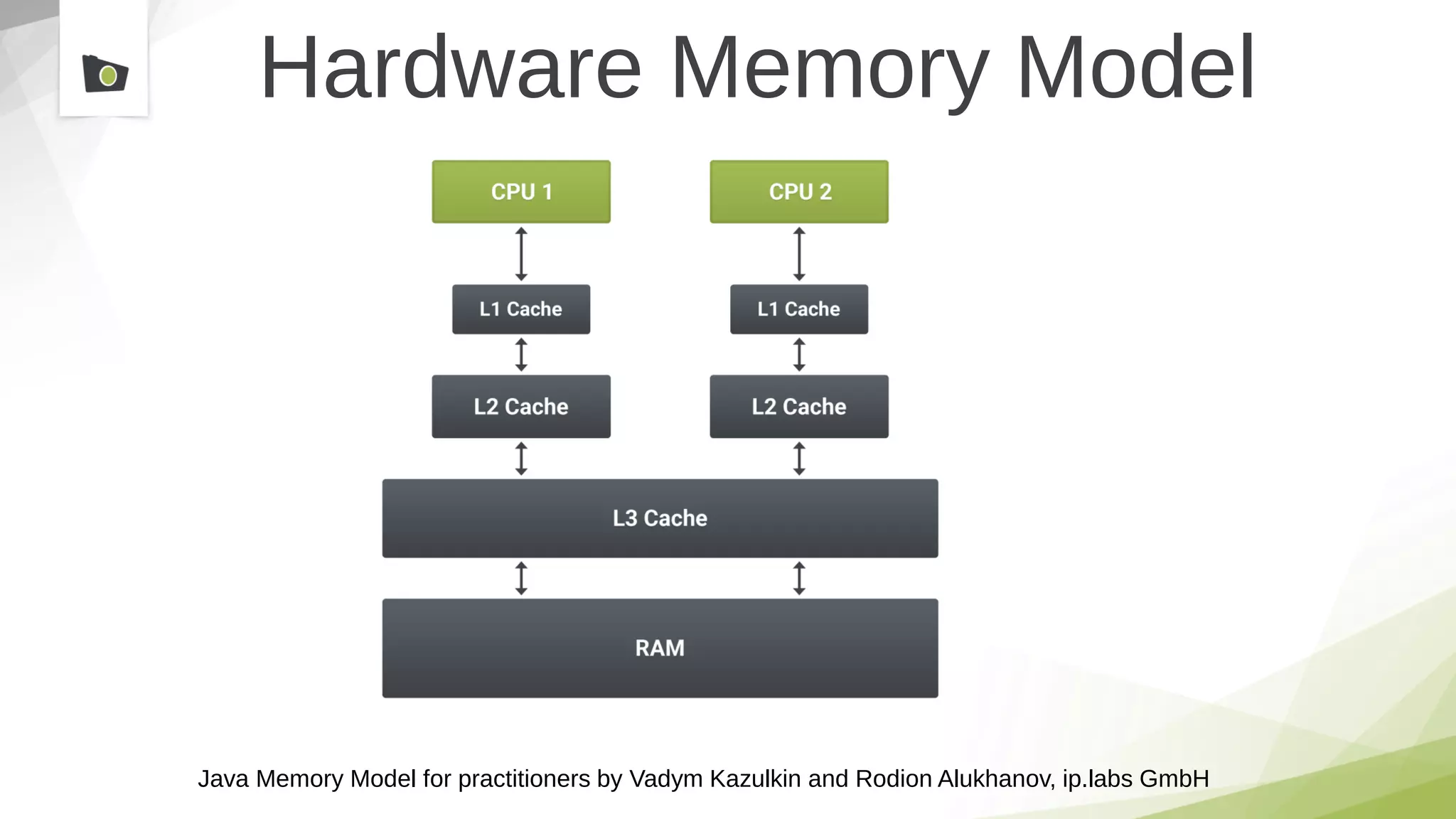
Hardware Memory Model
Java Memory Model for practitioners by Vadym Kazulkin and Rodion Alukhanov, ip.labs GmbH
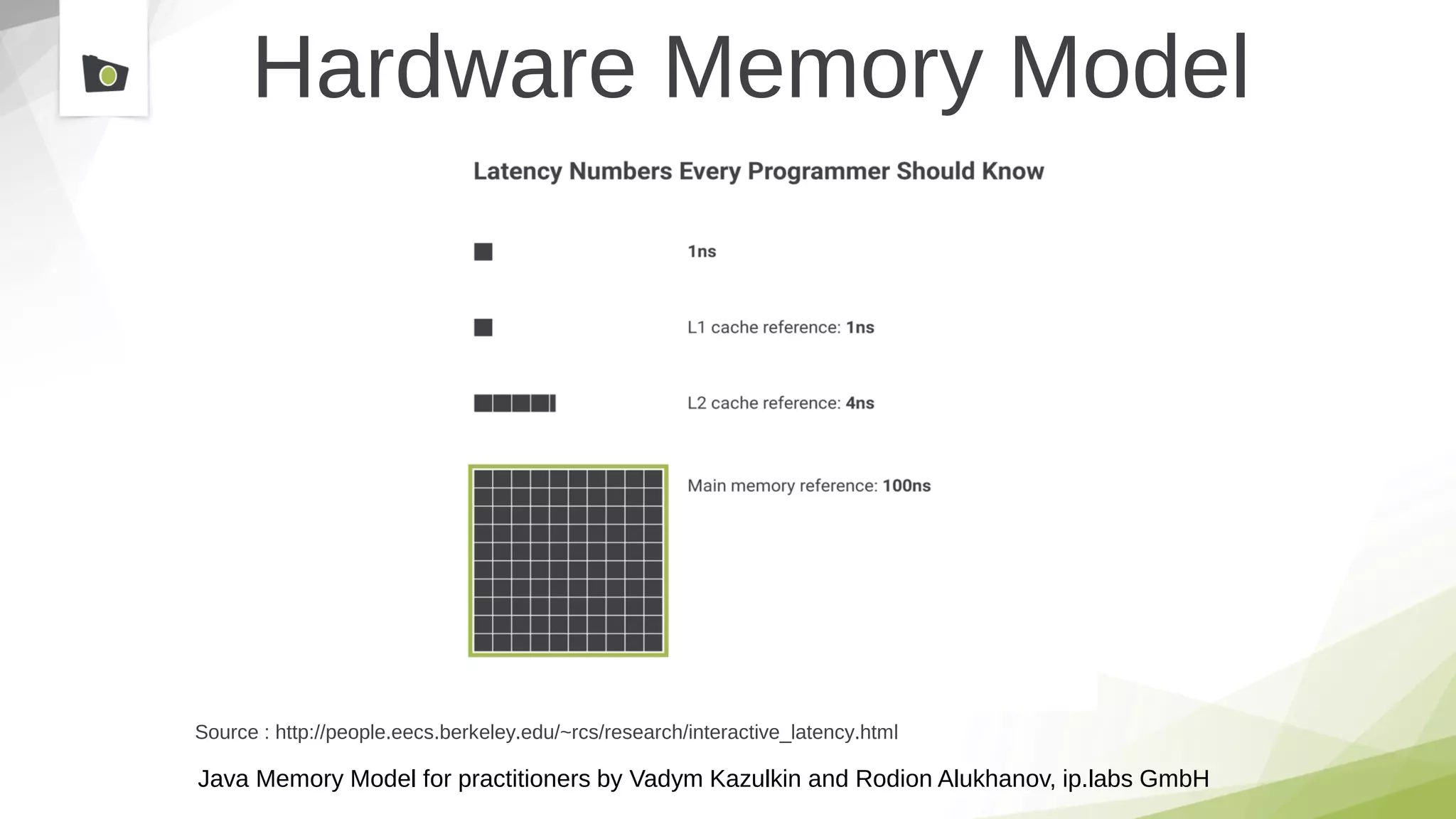
Hardware Memory Model
Source : http://people.eecs.berkeley.edu/~rcs/research/interactive_latency.html
Java Memory Model for practitioners by Vadym Kazulkin and Rodion Alukhanov, ip.labs GmbH
Hardware Memory Model
Cache Coherence
Cache coherence is the consistency of shared resource data
that ends up stored in multiple local caches.
Java Memory Model for practitioners by Vadym Kazulkin and Rodion Alukhanov, ip.labs GmbH
Hardware Memory Model
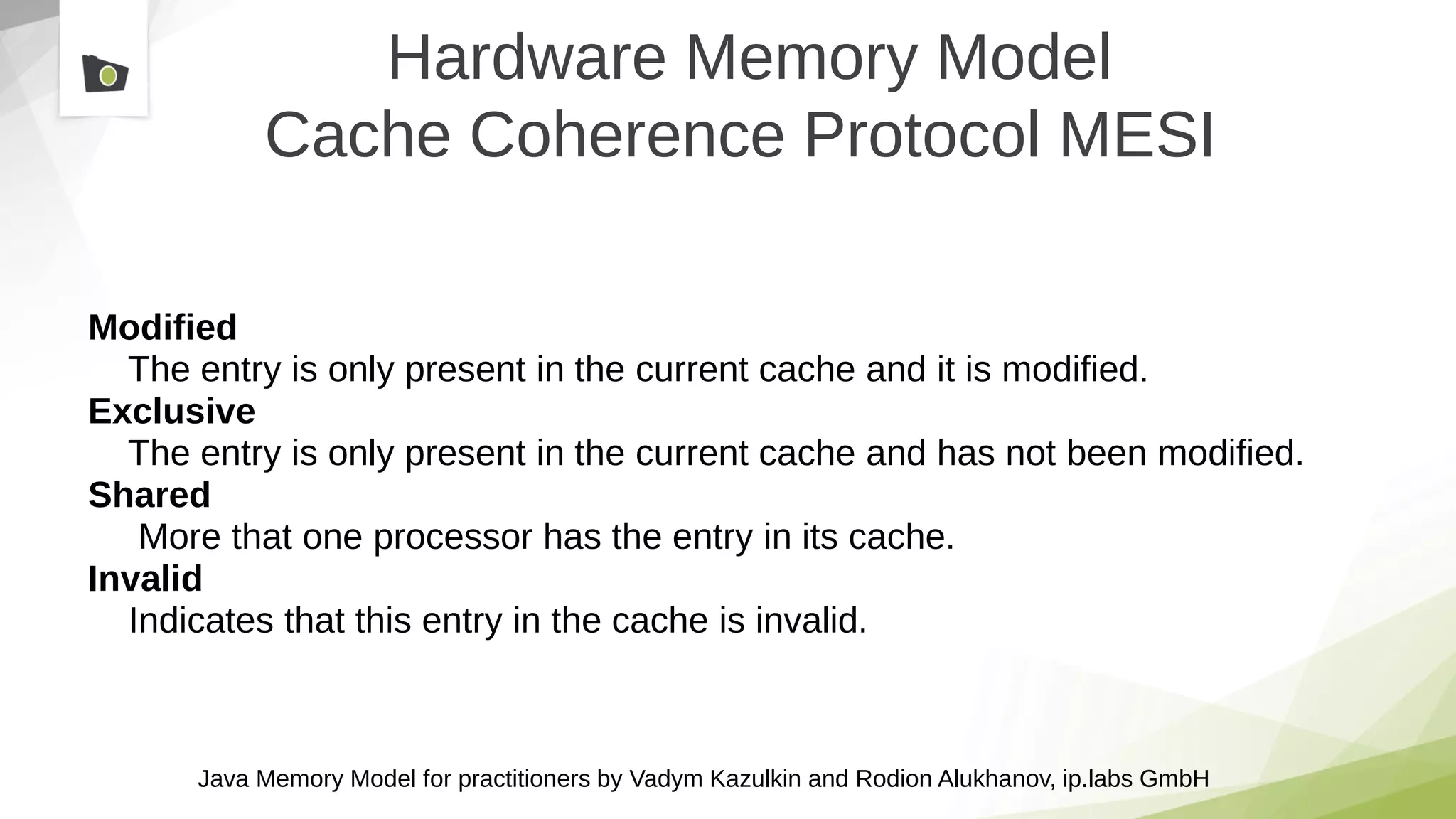
Cache Coherence Protocol MESI
Modified
The entry is only present in the current cache and it is modified.
Exclusive
The entry is only present in the current cache and has not been modified.
Shared
More that one processor has the entry in its cache.
Invalid
Indicates that this entry in the cache is invalid.
Java Memory Model for practitioners by Vadym Kazulkin and Rodion Alukhanov, ip.labs GmbH
Hardware Memory Model
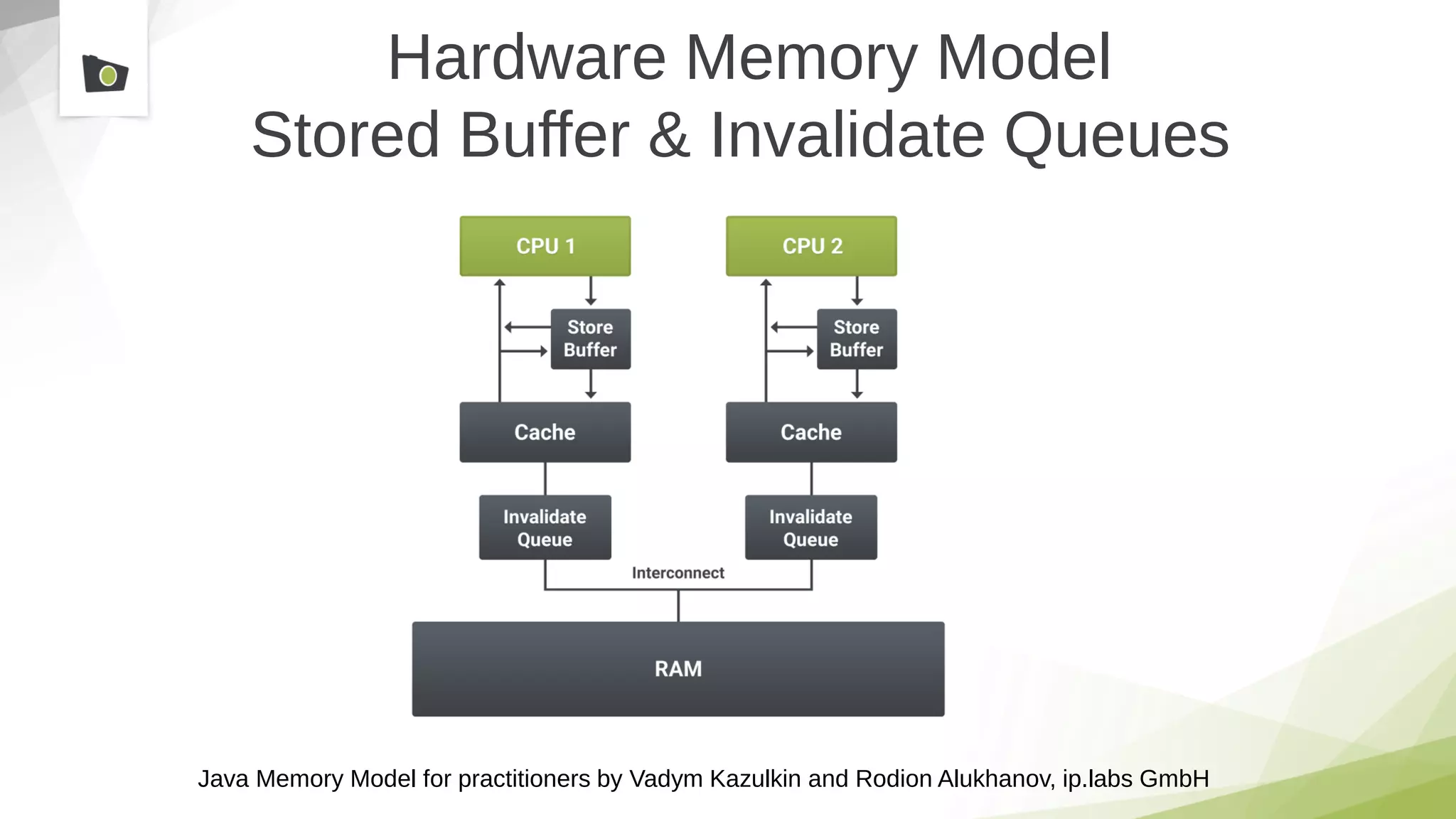
Stored Buffer & Invalidate Queues
Java Memory Model for practitioners by Vadym Kazulkin and Rodion Alukhanov, ip.labs GmbH
Hardware Memory Model
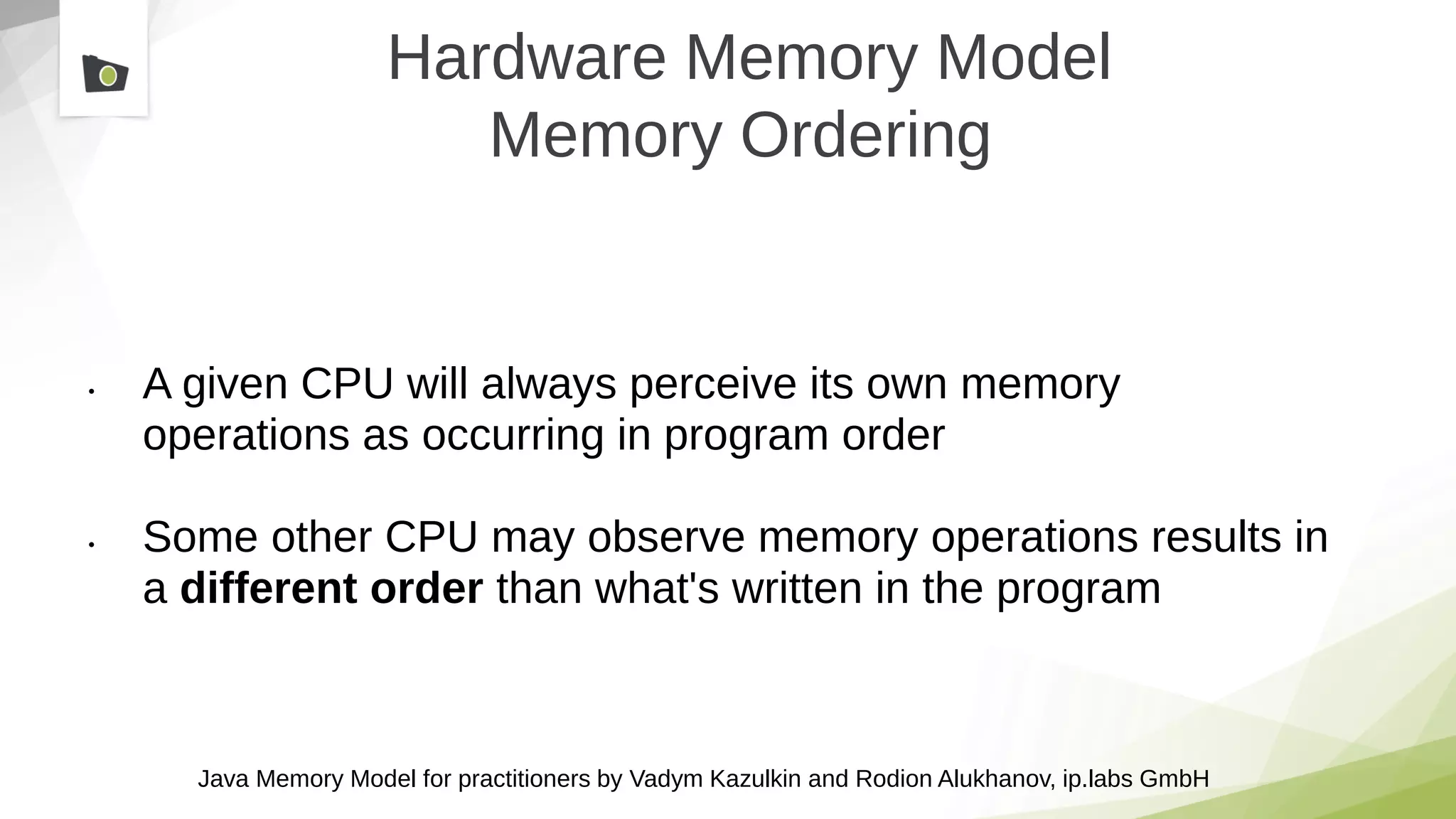
Memory Ordering
• A given CPU will always perceive its own memory
operations as occurring in program order
• Some other CPU may observe memory operations results in
a different order than what's written in the program
Java Memory Model for practitioners by Vadym Kazulkin and Rodion Alukhanov, ip.labs GmbH
Hardware Memory Model
Memory Barrier
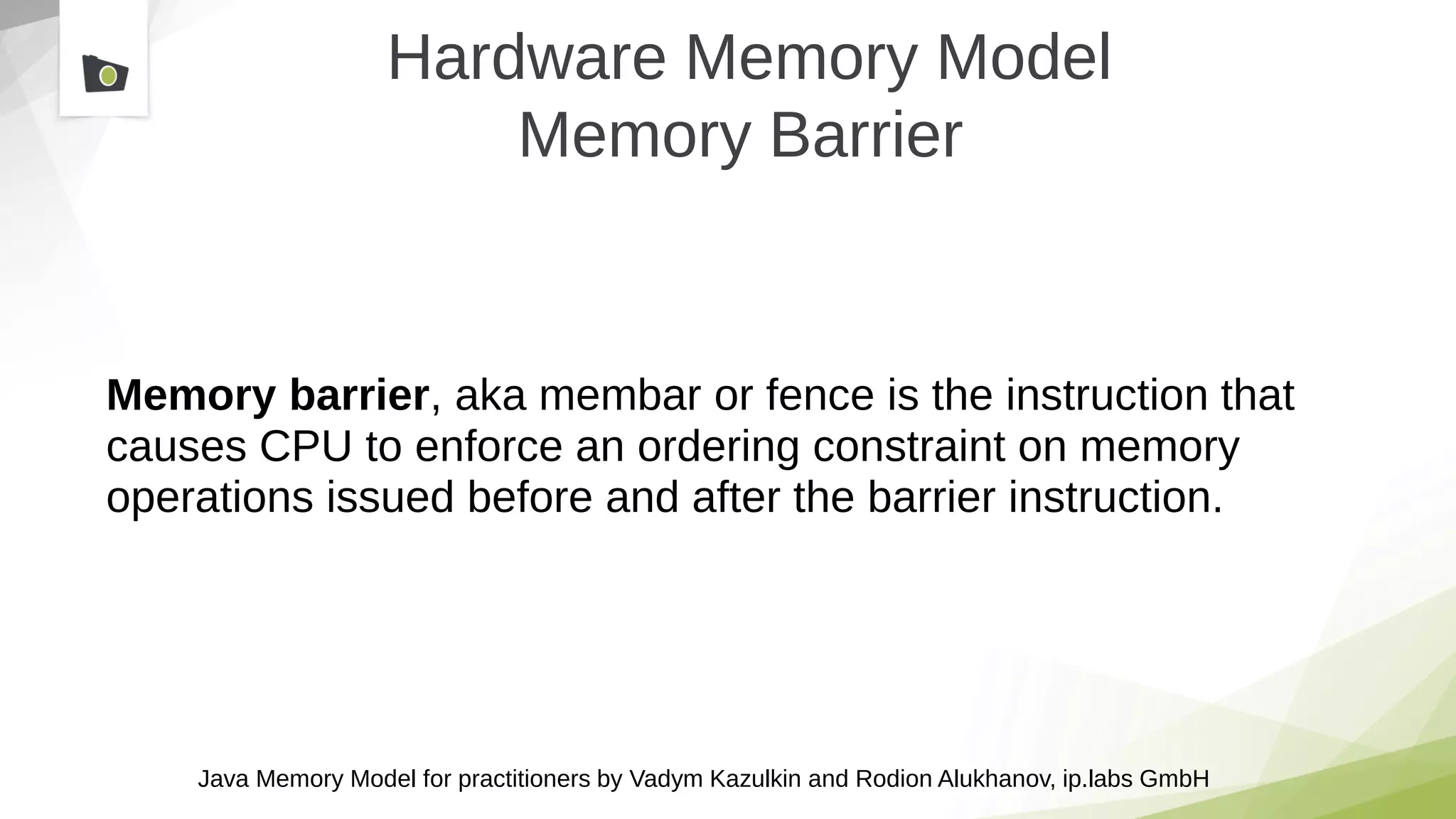
Memory barrier, aka membar or fence is the instruction that
causes CPU to enforce an ordering constraint on memory
operations issued before and after the barrier instruction.
Java Memory Model for practitioners by Vadym Kazulkin and Rodion Alukhanov, ip.labs GmbH
Hardware Memory Model
Memory Barrier
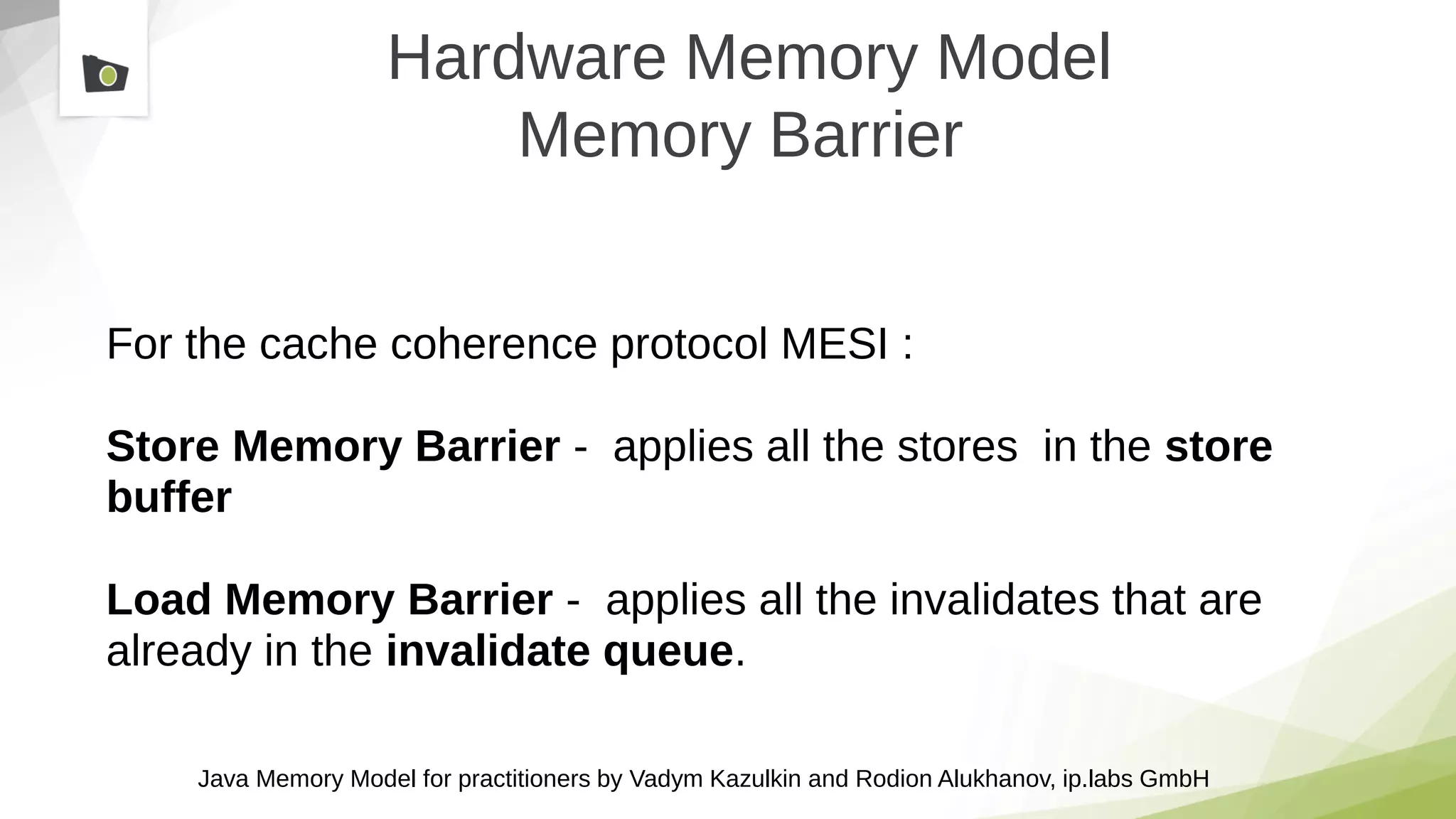
For the cache coherence protocol MESI :
Store Memory Barrier - applies all the stores in the store
buffer
Load Memory Barrier - applies all the invalidates that are
already in the invalidate queue.
Java Memory Model for practitioners by Vadym Kazulkin and Rodion Alukhanov, ip.labs GmbH
Hardware Memory Model
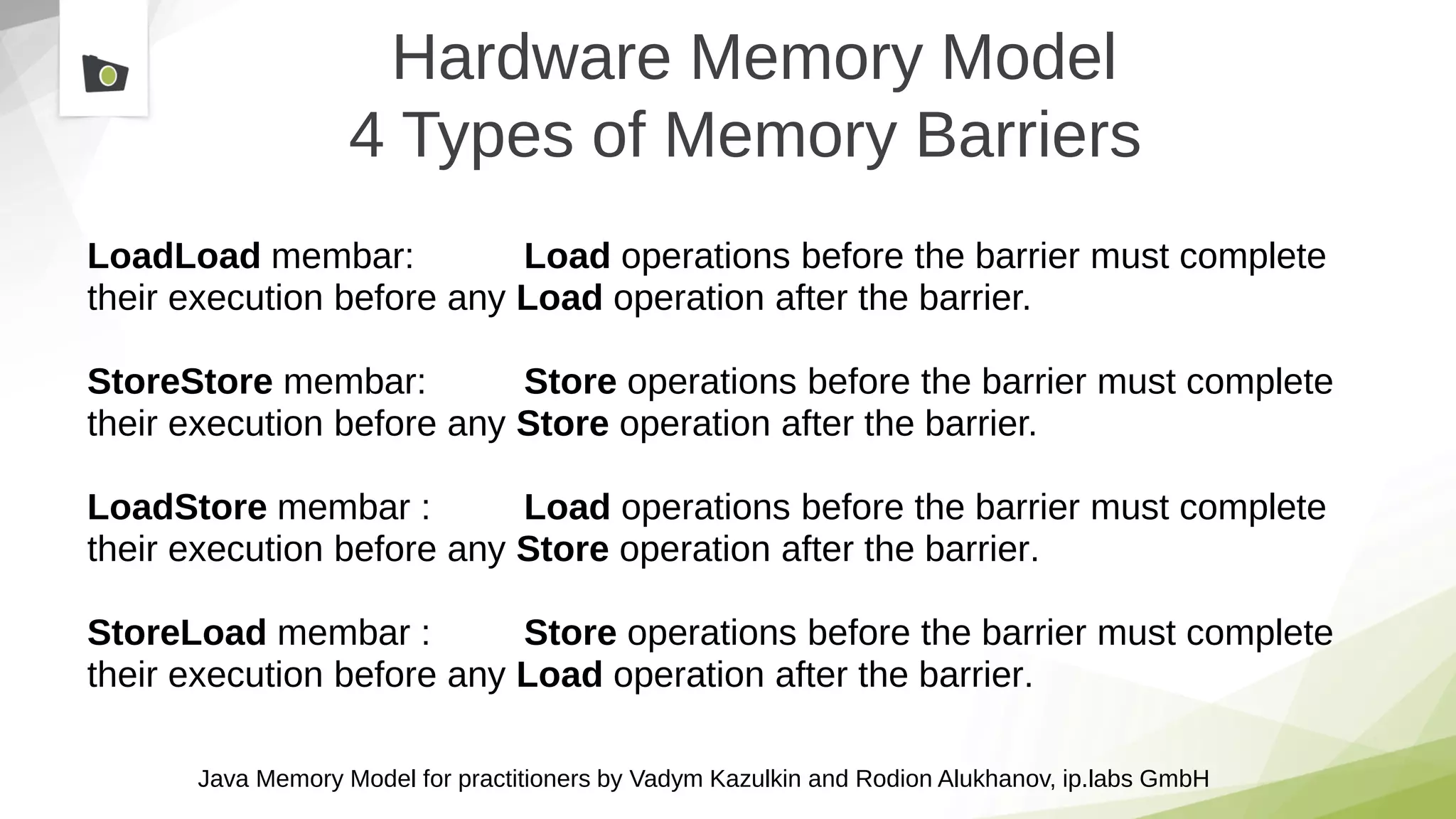
4 Types of Memory Barriers
LoadLoad membar: Load operations before the barrier must complete
their execution before any Load operation after the barrier.
StoreStore membar: Store operations before the barrier must complete
their execution before any Store operation after the barrier.
LoadStore membar : Load operations before the barrier must complete
their execution before any Store operation after the barrier.
StoreLoad membar : Store operations before the barrier must complete
their execution before any Load operation after the barrier.
Java Memory Model for practitioners by Vadym Kazulkin and Rodion Alukhanov, ip.labs GmbH
Hardware Memory Model
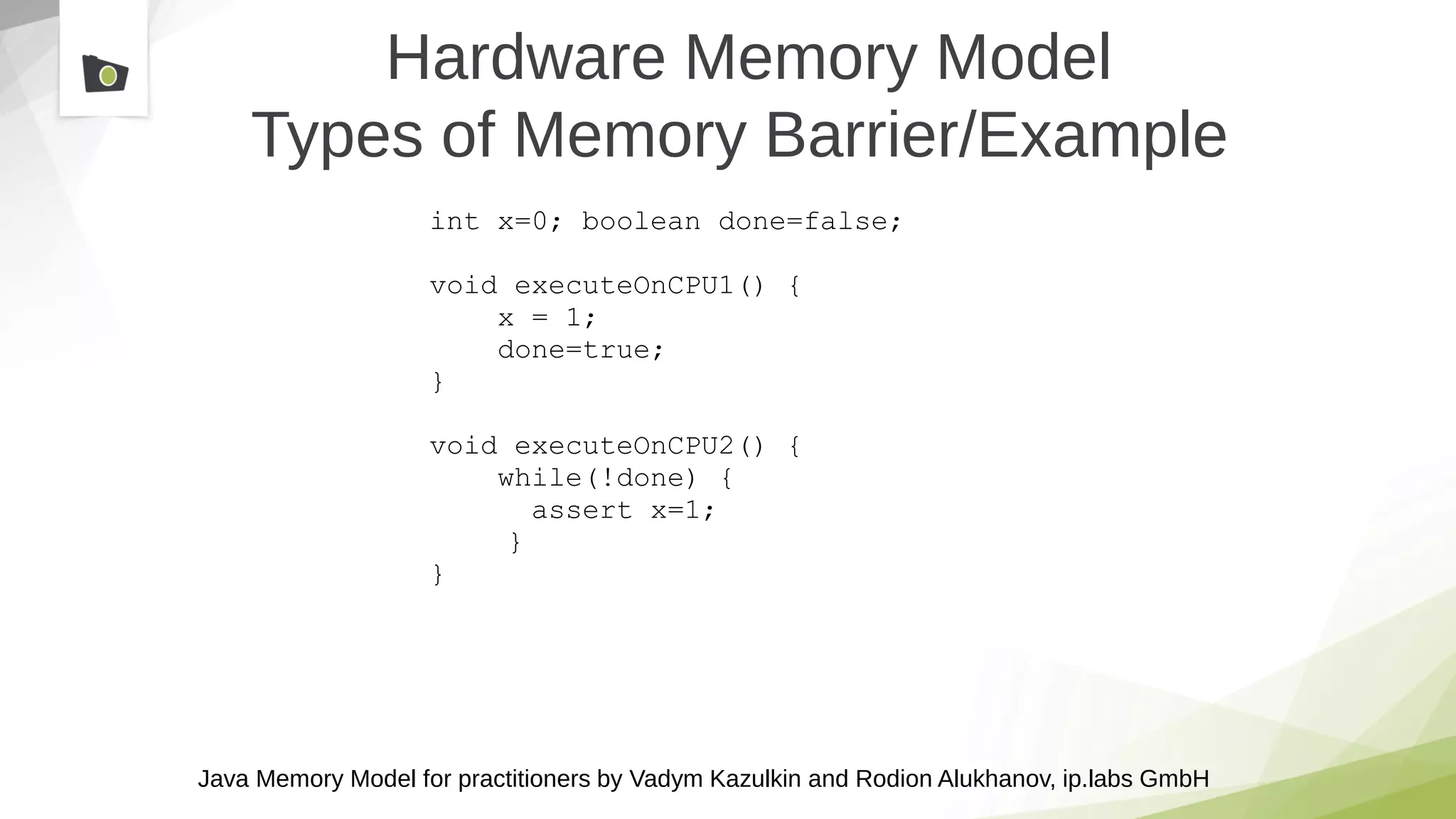
Types of Memory Barrier/Example
int x=0; boolean done=false;
void executeOnCPU1() {
x = 1;
done=true;
}
void executeOnCPU2() {
while(!done) {
assert x=1;
}
}
Java Memory Model for practitioners by Vadym Kazulkin and Rodion Alukhanov, ip.labs GmbH
Hardware Memory Model
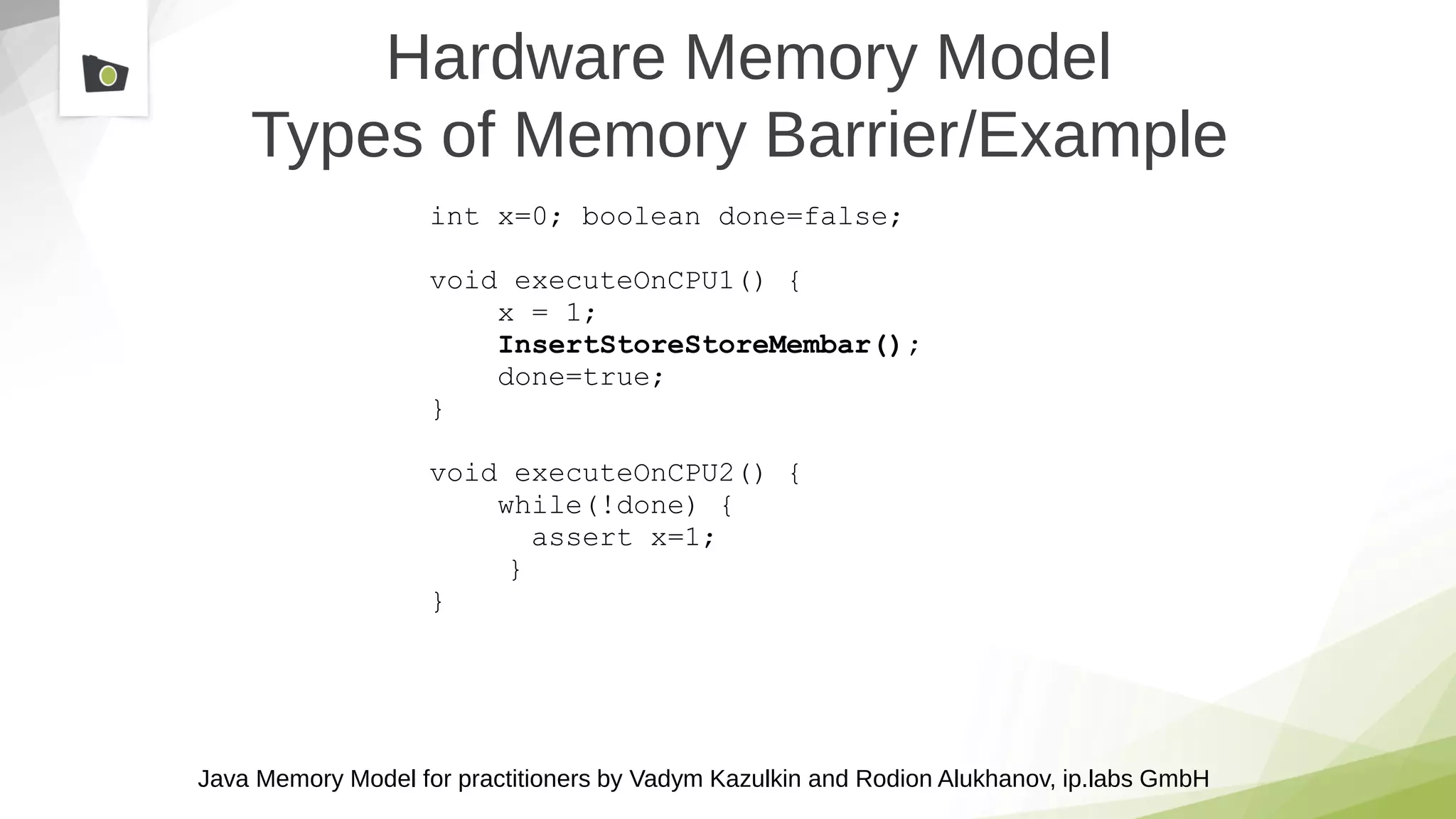
Types of Memory Barrier/Example
int x=0; boolean done=false;
void executeOnCPU1() {
x = 1;
InsertStoreStoreMembar();
done=true;
}
void executeOnCPU2() {
while(!done) {
assert x=1;
}
}
Java Memory Model for practitioners by Vadym Kazulkin and Rodion Alukhanov, ip.labs GmbH
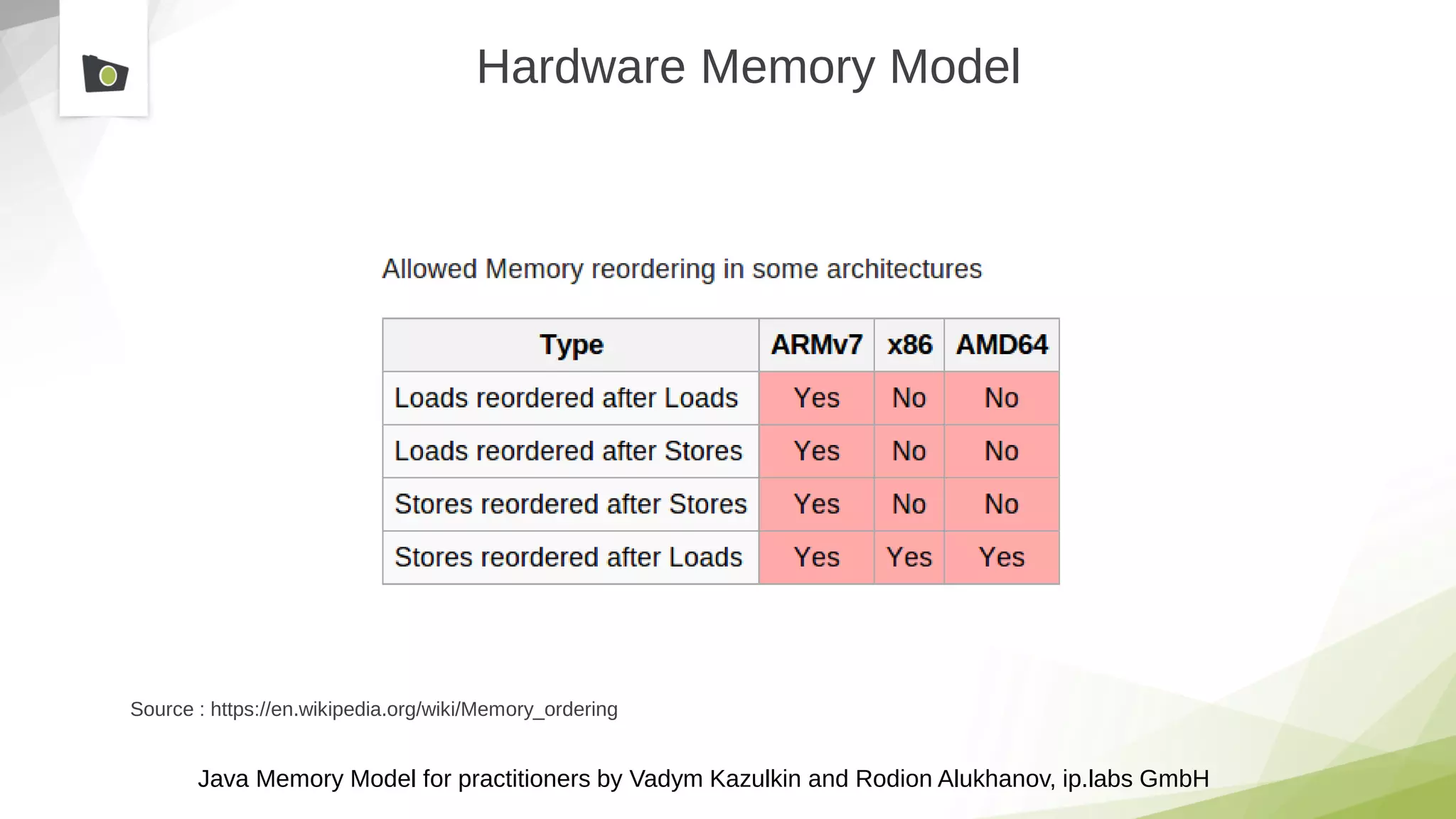
Hardware Memory Model
Source : https://en.wikipedia.org/wiki/Memory_ordering
Java Memory Model for practitioners by Vadym Kazulkin and Rodion Alukhanov, ip.labs GmbH
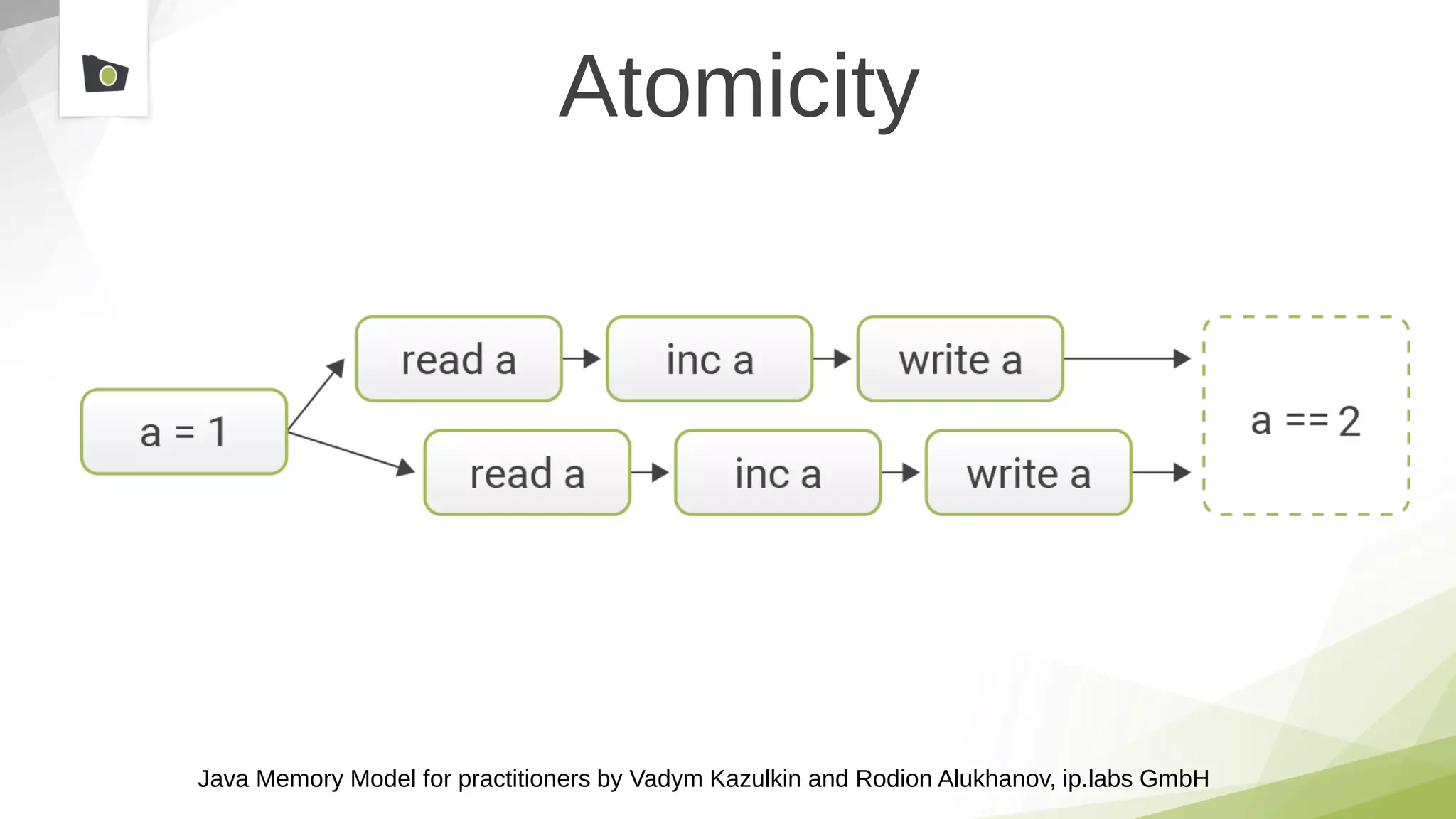
Atomicity
Java Memory Model for practitioners by Vadym Kazulkin and Rodion Alukhanov, ip.labs GmbH
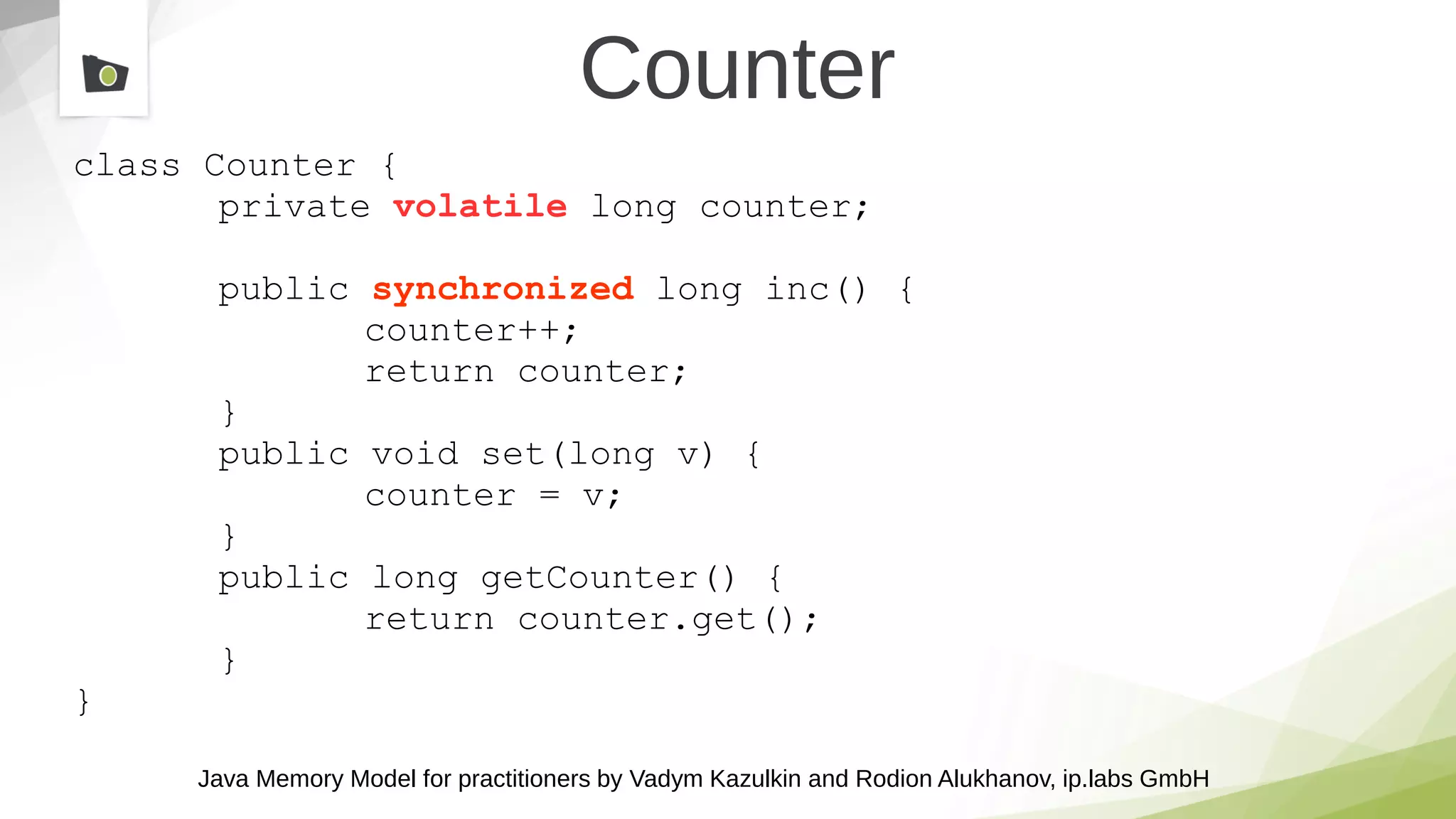
Counter
class Counter {
private volatile long counter;
public synchronized long inc() {
counter++;
return counter;
}
public void set(long v) {
counter = v;
}
public long getCounter() {
return counter.get();
}
}
Java Memory Model for practitioners by Vadym Kazulkin and Rodion Alukhanov, ip.labs GmbH
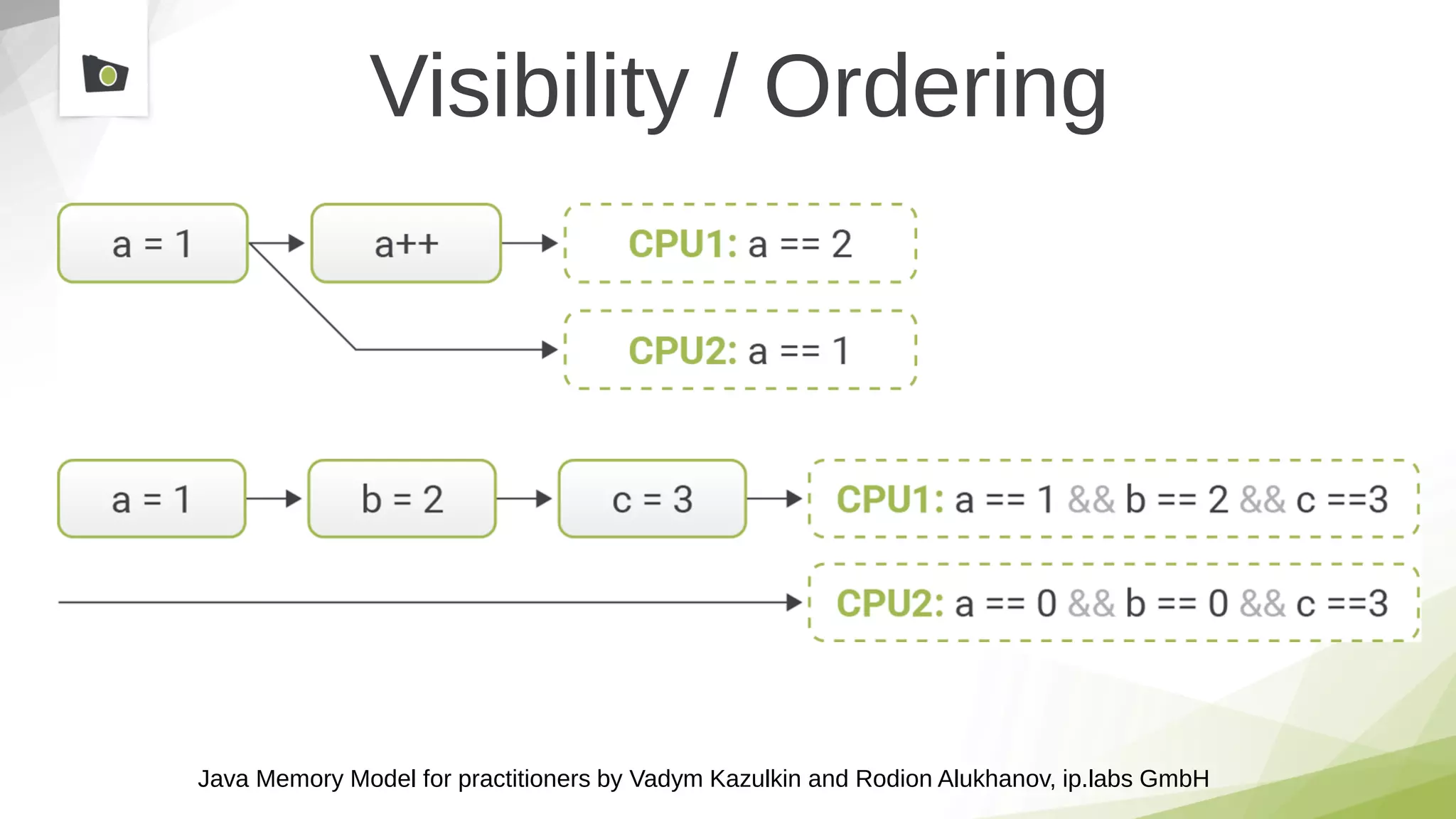
Visibility / Ordering
Java Memory Model for practitioners by Vadym Kazulkin and Rodion Alukhanov, ip.labs GmbH
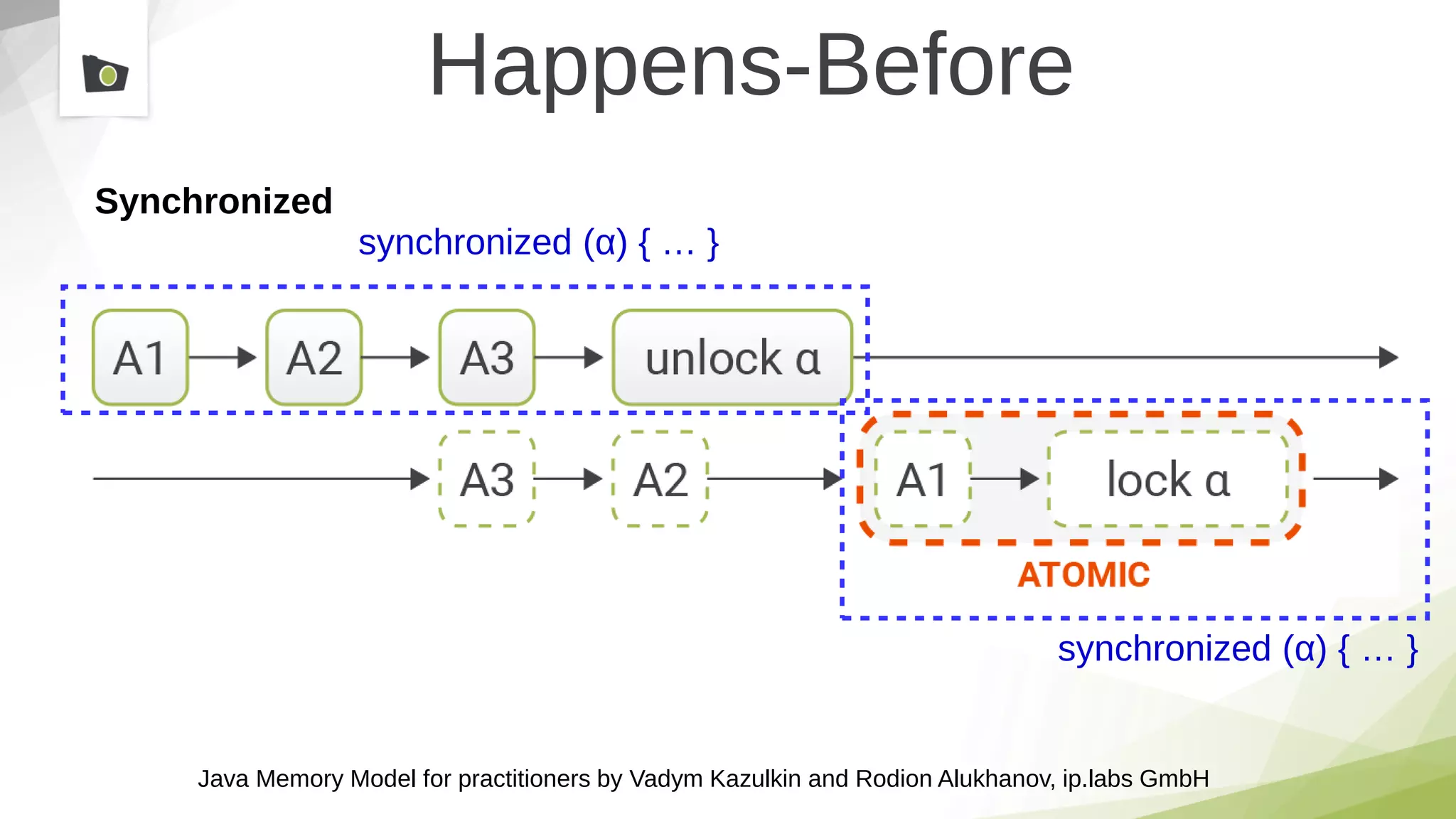
Happens-Before
Synchronized
synchronized (α) { … }
Java Memory Model for practitioners by Vadym Kazulkin and Rodion Alukhanov, ip.labs GmbH
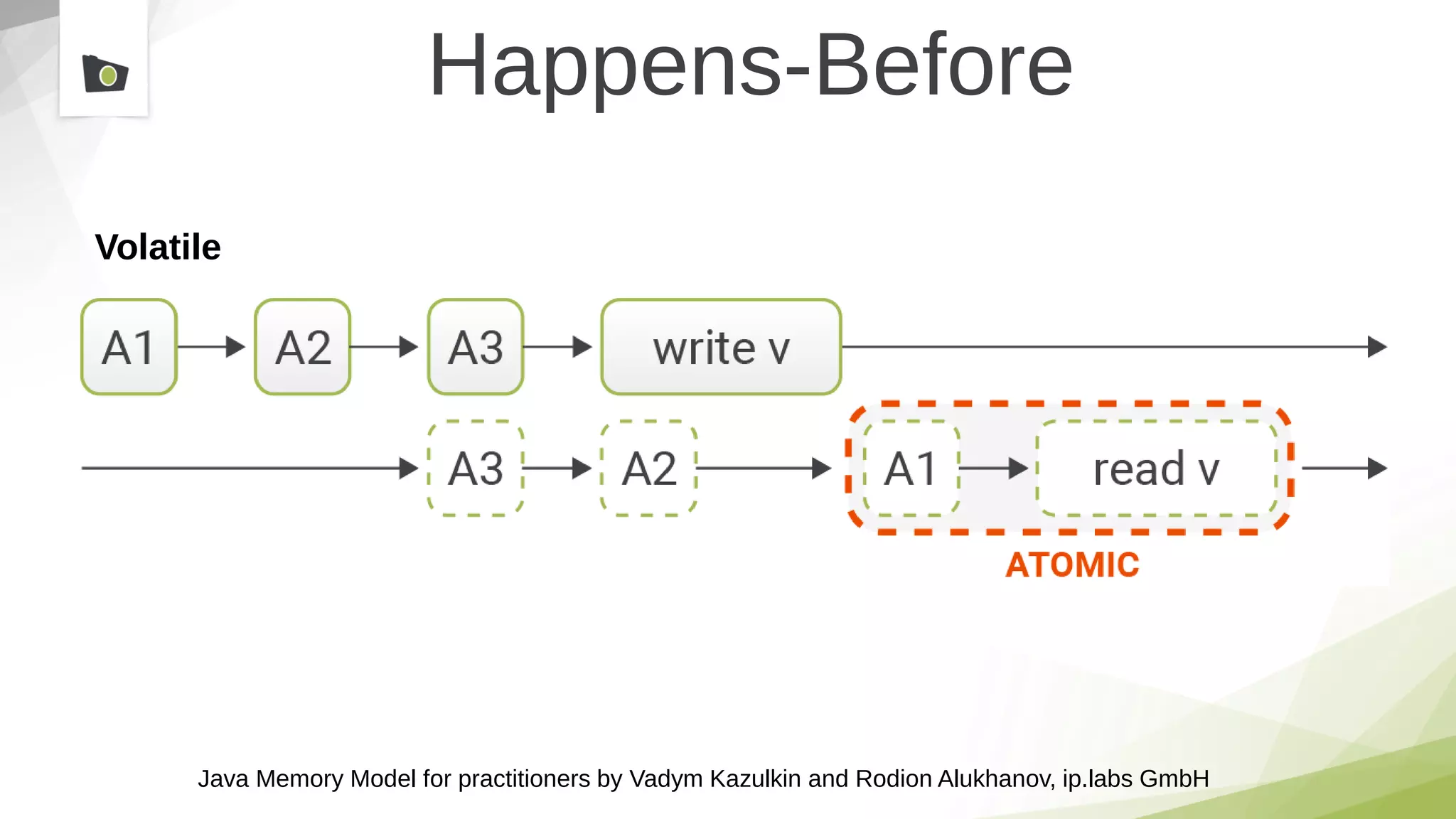
Happens-Before
Volatile
Java Memory Model for practitioners by Vadym Kazulkin and Rodion Alukhanov, ip.labs GmbH
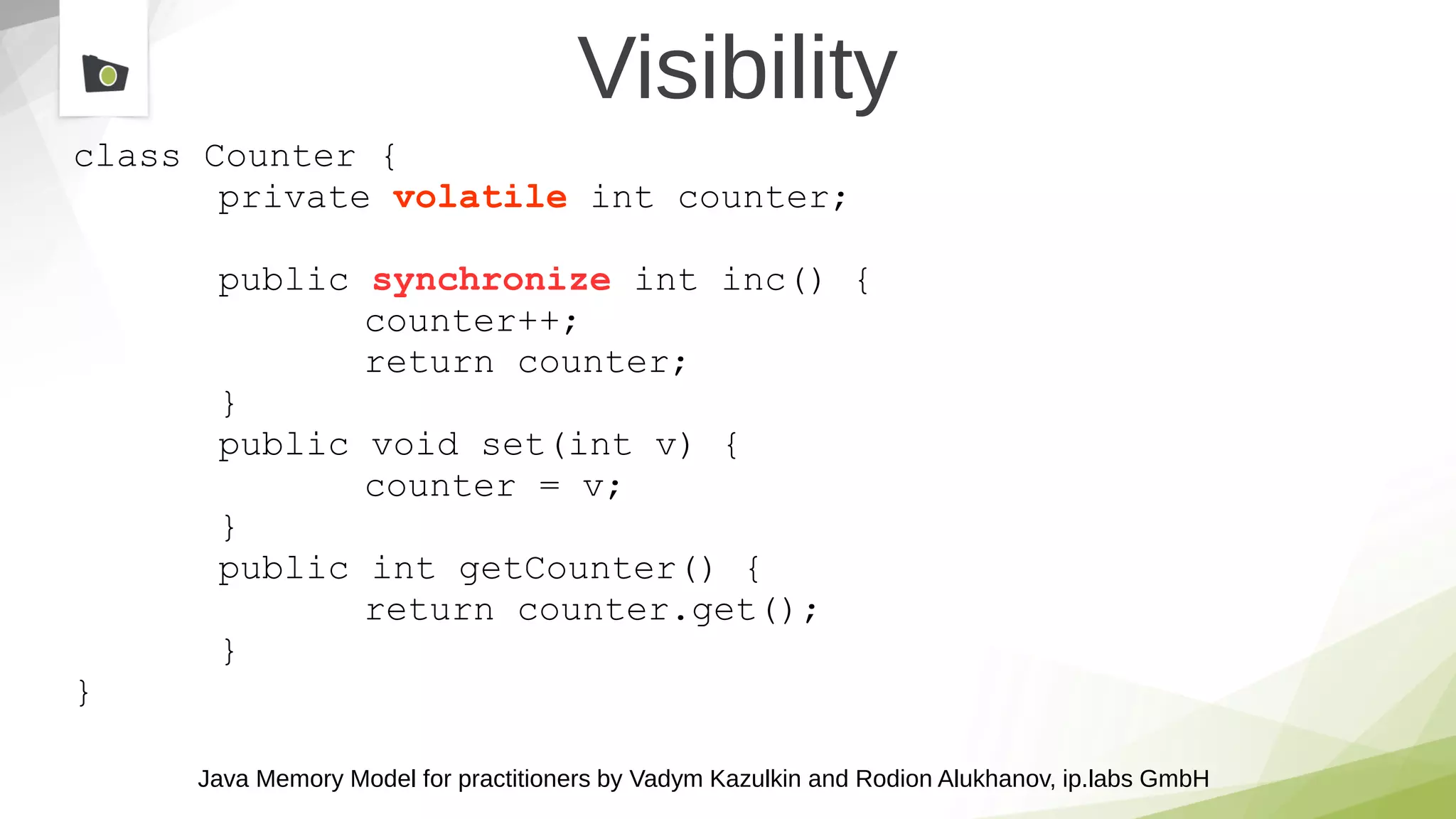
Visibility
class Counter {
private volatile int counter;
public synchronize int inc() {
counter++;
return counter;
}
public void set(int v) {
counter = v;
}
public int getCounter() {
return counter.get();
}
}
Java Memory Model for practitioners by Vadym Kazulkin and Rodion Alukhanov, ip.labs GmbH
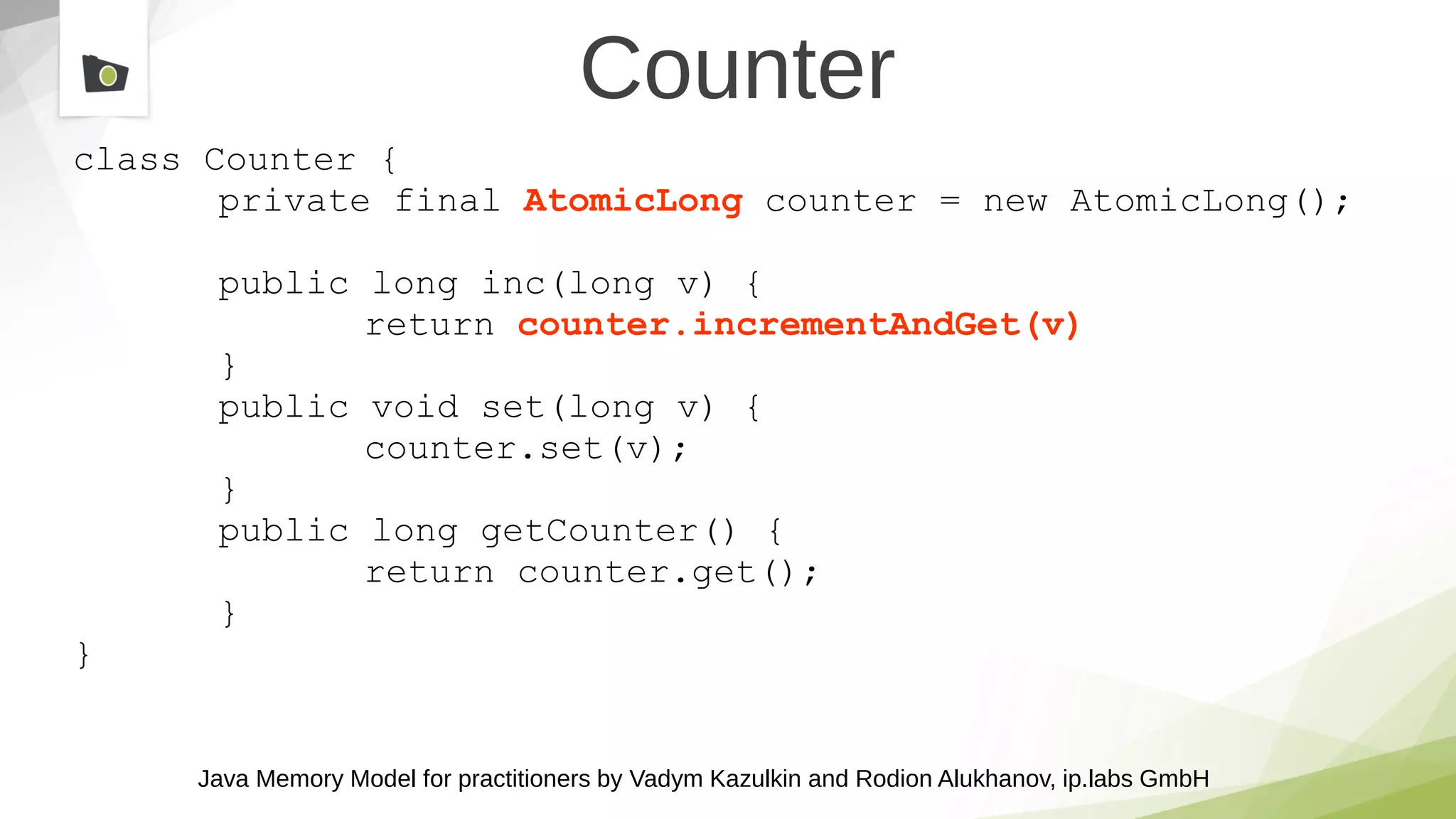
class Counter {
private final AtomicLong counter = new AtomicLong();
public long inc(long v) {
return counter.incrementAndGet(v)
}
public void set(long v) {
counter.set(v);
}
public long getCounter() {
return counter.get();
}
}
Counter
Java Memory Model for practitioners by Vadym Kazulkin and Rodion Alukhanov, ip.labs GmbH
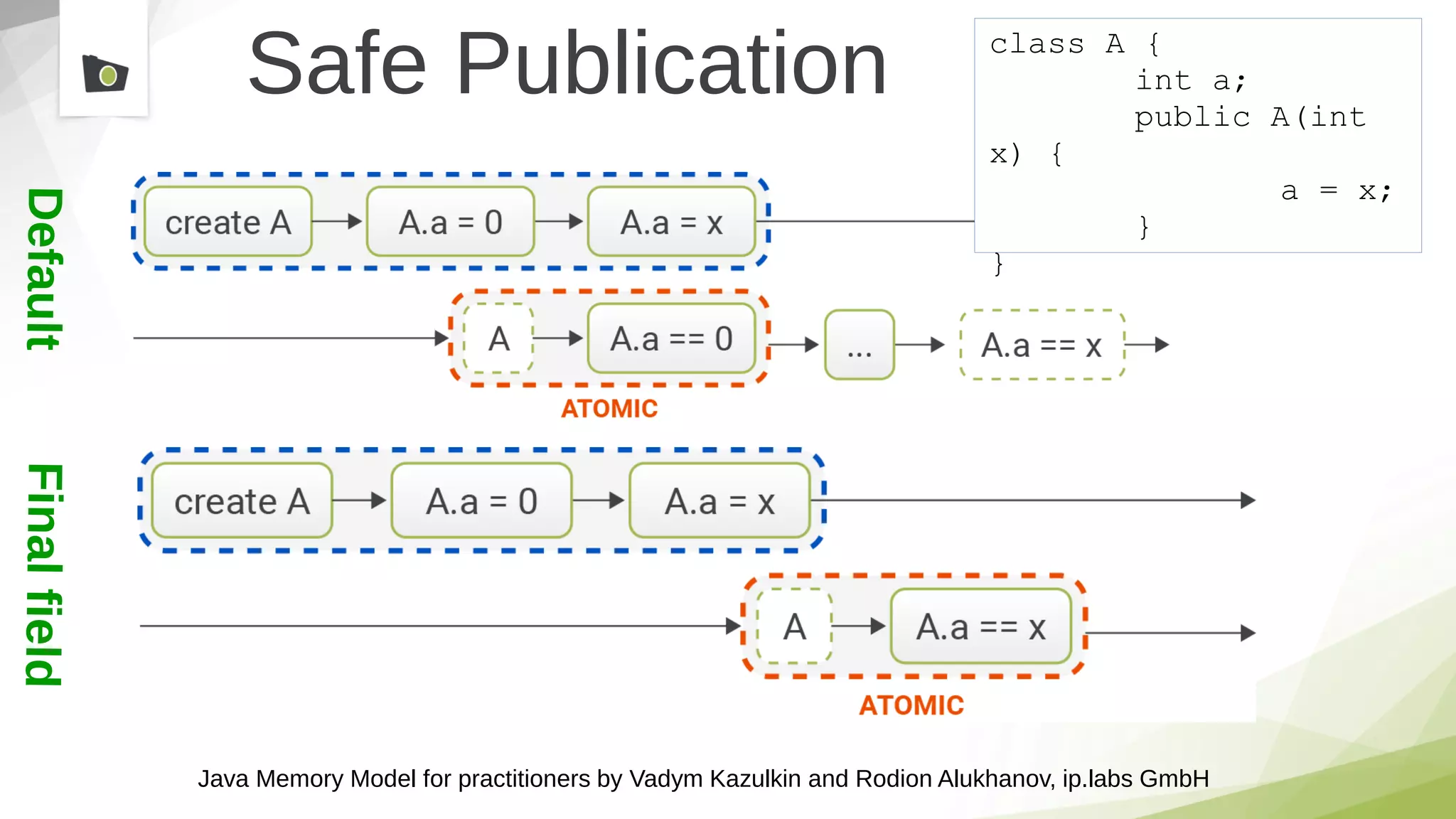
Safe Publication class A {
int a;
public A(int
x) {
a = x;
}
}
Java Memory Model for practitioners by Vadym Kazulkin and Rodion Alukhanov, ip.labs GmbH
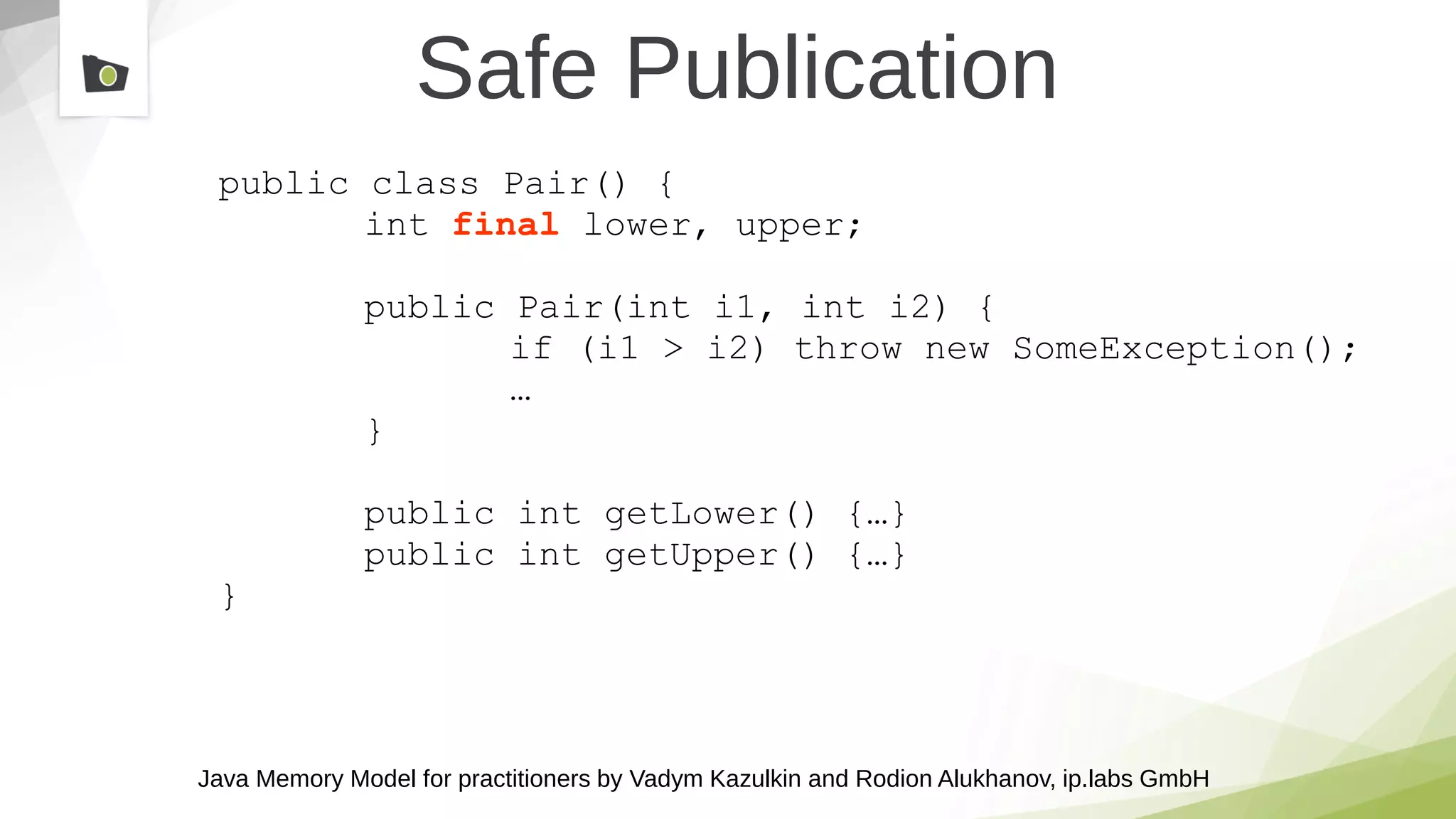
public class Pair() {
int final lower, upper;
public Pair(int i1, int i2) {
if (i1 > i2) throw new SomeException();
…
}
public int getLower() {…}
public int getUpper() {…}
}
Safe Publication
Java Memory Model for practitioners by Vadym Kazulkin and Rodion Alukhanov, ip.labs GmbH
class DoubleCheckLocking {
private volatile Resource resource;
public Resource getResource() {
if (resource == null) {
synchronized (this) {
if (resource == null) {
resource = new Resource();
}
}
}
return resource;
}
}
Double-Checked Locking
[1] https://shipilev.net/blog/2014/safe-public-construction
Java Memory Model for practitioners by Vadym Kazulkin and Rodion Alukhanov, ip.labs GmbH
class DoubleCheckLocking {
private volatile Resource resource;
public Resource getResource() {
if (resource == null) {
synchronized (this) {
if (resource == null) {
resource = new Resource();
}
}
}
return resource;
}
}
Double-Checked Locking
[1] https://shipilev.net/blog/2014/safe-public-construction
Java Memory Model for practitioners by Vadym Kazulkin and Rodion Alukhanov, ip.labs GmbH
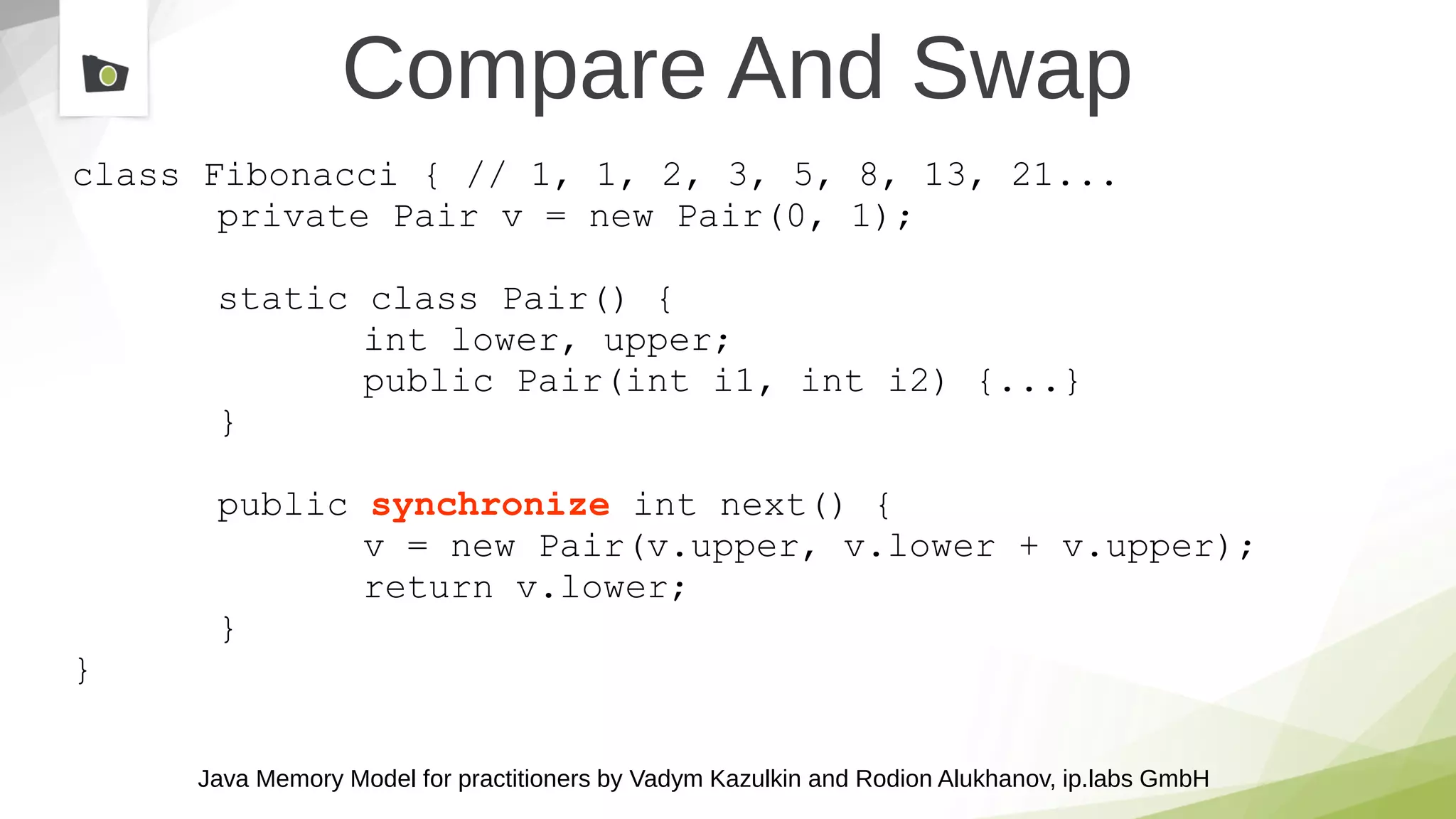
class Fibonacci { // 1, 1, 2, 3, 5, 8, 13, 21...
private Pair v = new Pair(0, 1);
static class Pair() {
int lower, upper;
public Pair(int i1, int i2) {...}
}
public synchronize int next() {
v = new Pair(v.upper, v.lower + v.upper);
return v.lower;
}
}
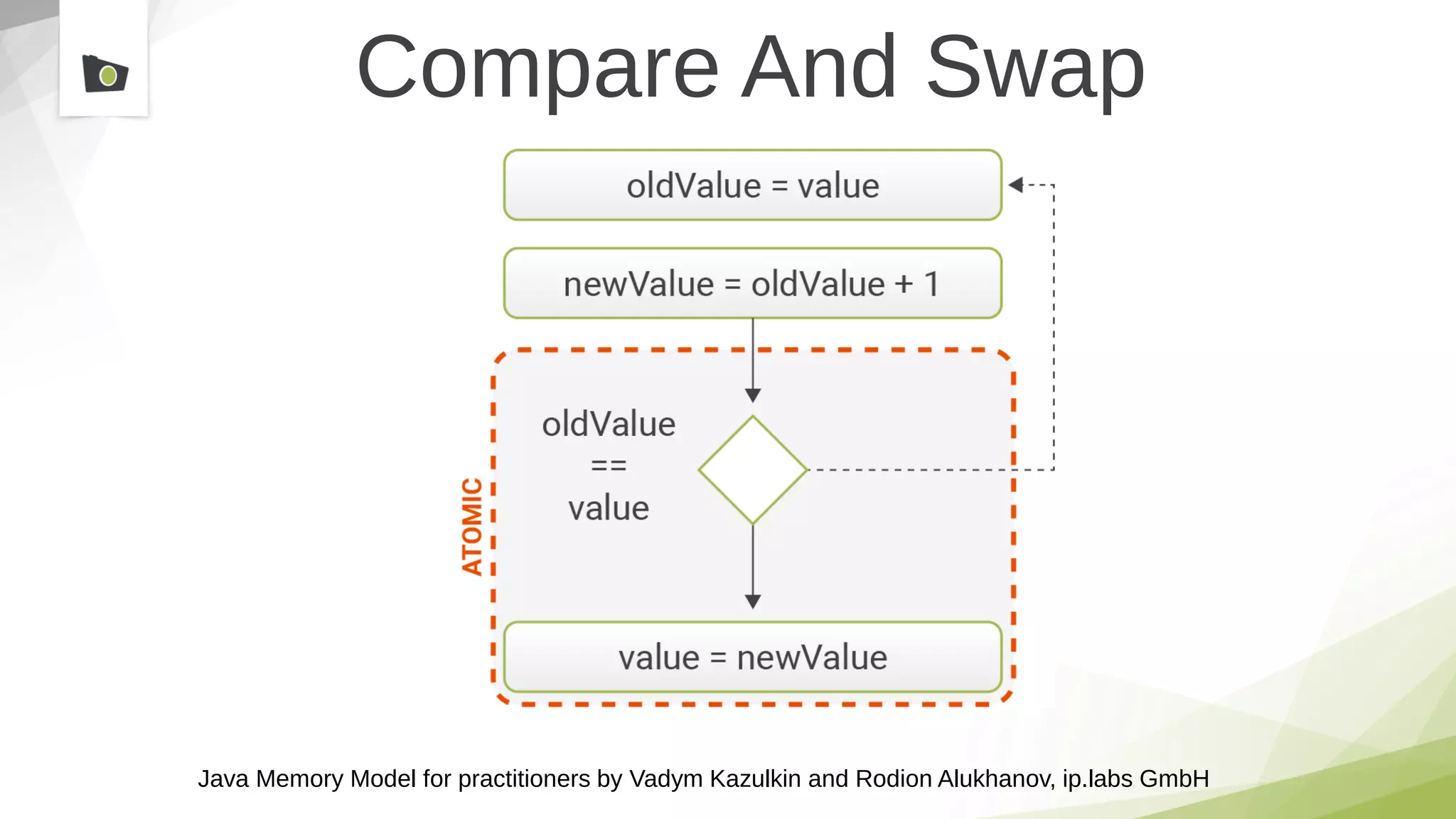
Compare And Swap
Java Memory Model for practitioners by Vadym Kazulkin and Rodion Alukhanov, ip.labs GmbH
Compare And Swap
Java Memory Model for practitioners by Vadym Kazulkin and Rodion Alukhanov, ip.labs GmbH
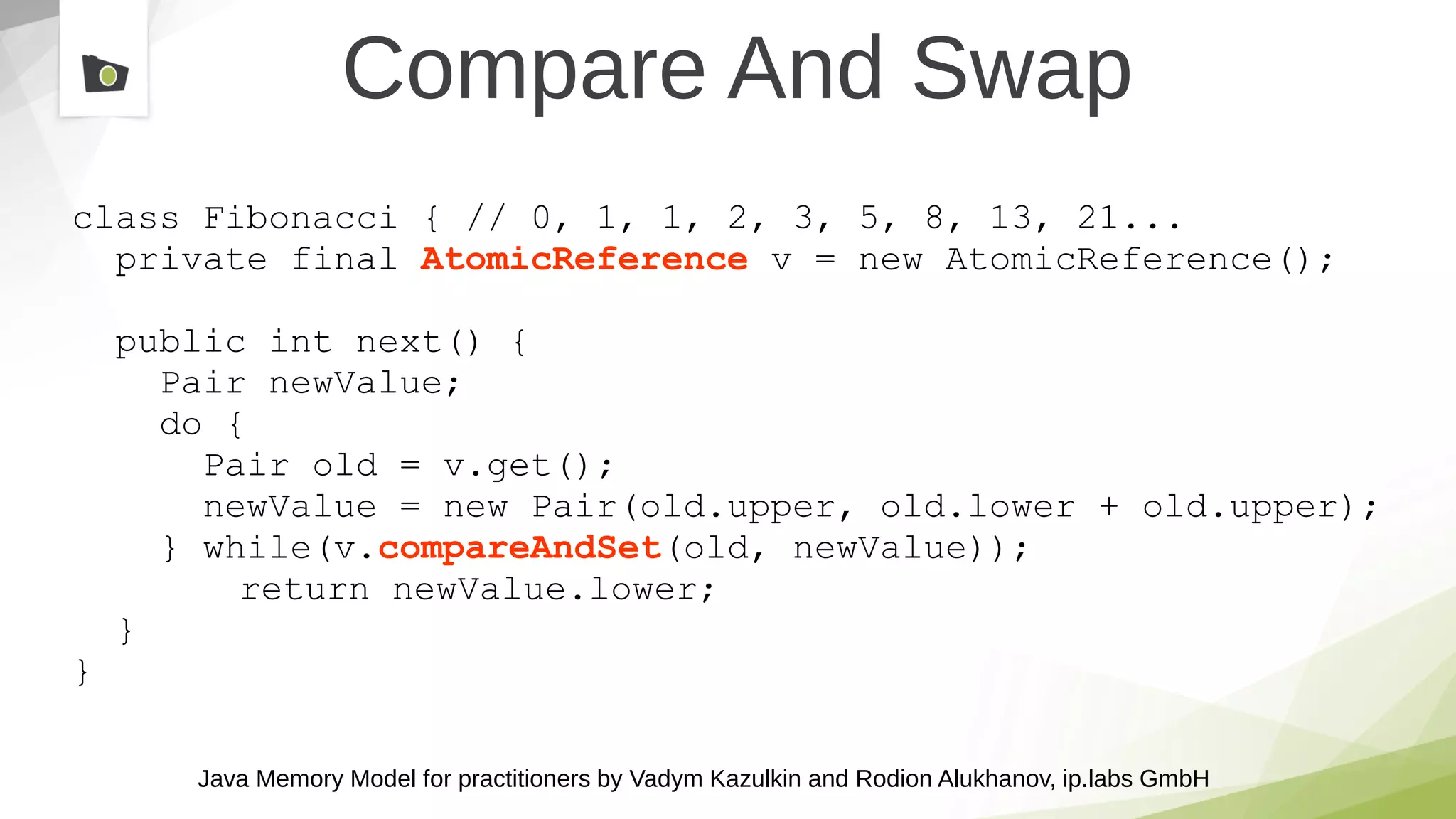
class Fibonacci { // 0, 1, 1, 2, 3, 5, 8, 13, 21...
private final AtomicReference v = new AtomicReference();
public int next() {
Pair newValue;
do {
Pair old = v.get();
newValue = new Pair(old.upper, old.lower + old.upper);
} while(v.compareAndSet(old, newValue));
return newValue.lower;
}
}
Compare And Swap
Java Memory Model for practitioners by Vadym Kazulkin and Rodion Alukhanov, ip.labs GmbH
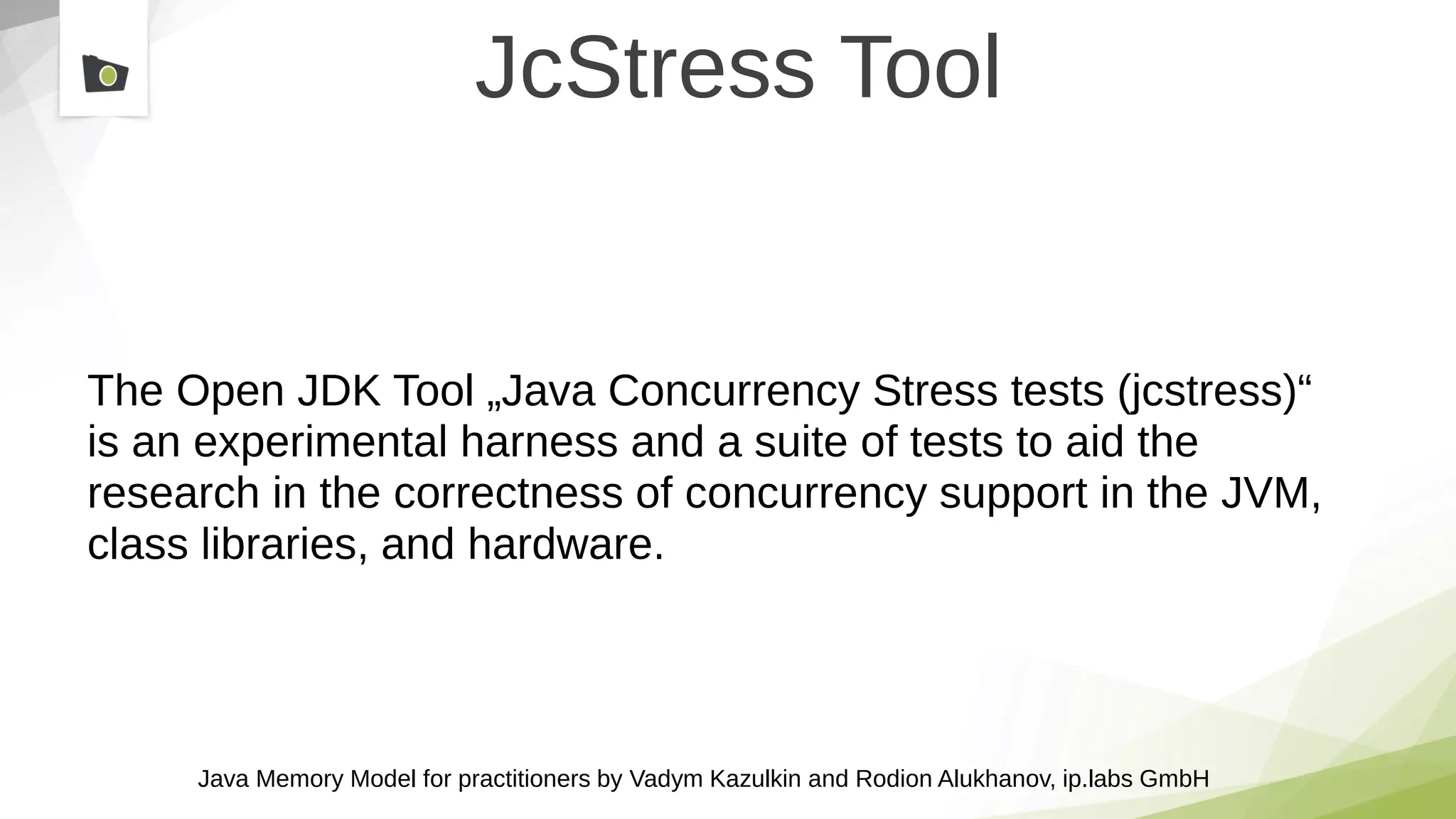
JcStress Tool
The Open JDK Tool „Java Concurrency Stress tests (jcstress)“
is an experimental harness and a suite of tests to aid the
research in the correctness of concurrency support in the JVM,
class libraries, and hardware.
Java Memory Model for practitioners by Vadym Kazulkin and Rodion Alukhanov, ip.labs GmbH
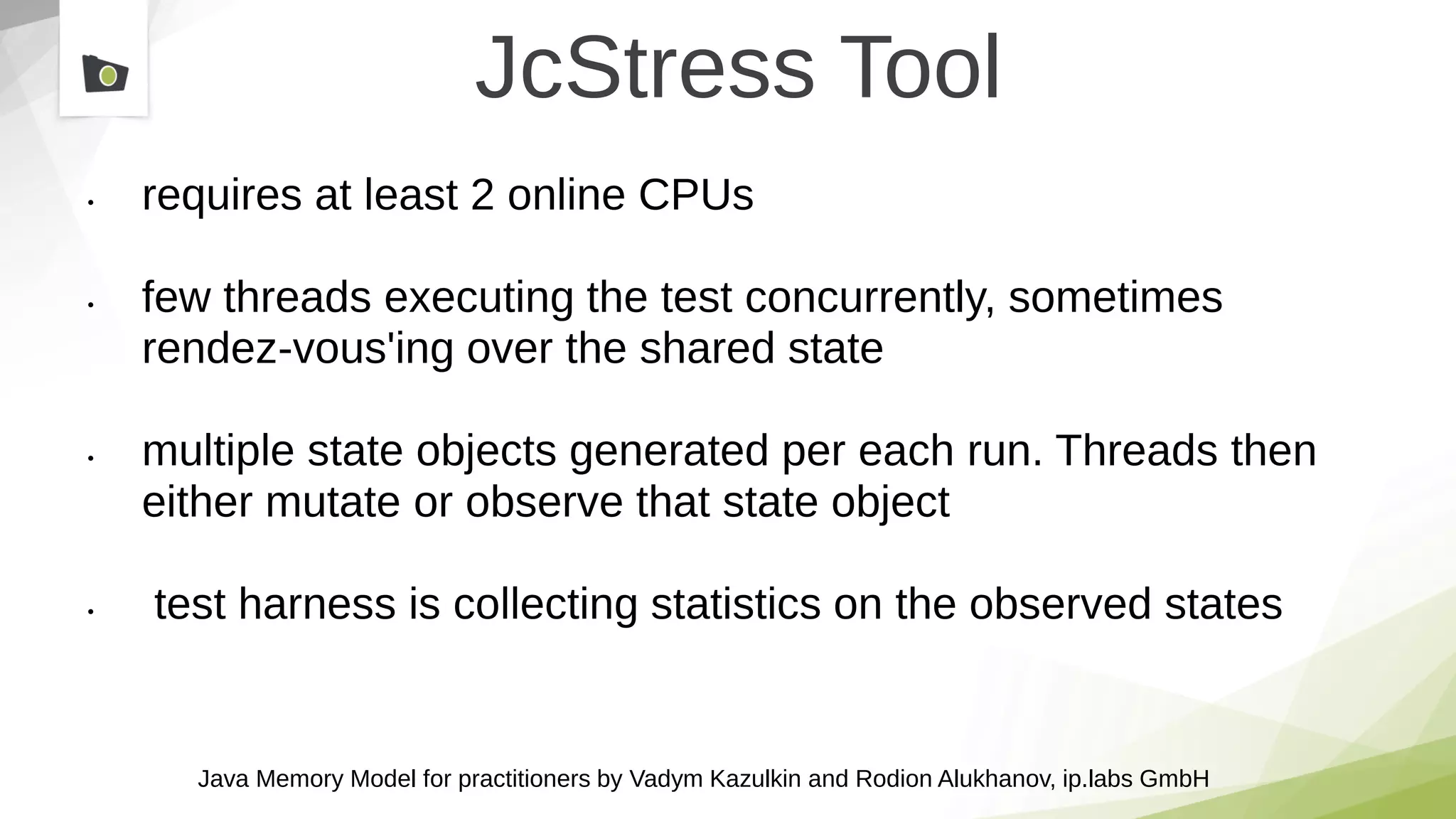
JcStress Tool
• requires at least 2 online CPUs
• few threads executing the test concurrently, sometimes
rendez-vous'ing over the shared state
• multiple state objects generated per each run. Threads then
either mutate or observe that state object
• test harness is collecting statistics on the observed states
Java Memory Model for practitioners by Vadym Kazulkin and Rodion Alukhanov, ip.labs GmbH
Quiz for Reordering
What values of x can we see, if y=1 is printed out?
public class MyClass{
int x, y=0;
public void executeOnCPU1() {
x = 1;
x = 2;
y = 1;
x = 3;
}
public void executeOnCPU2() {
System.out.println("x: "+x+ " y: "+y);
}
}
Java Memory Model for practitioners by Vadym Kazulkin and Rodion Alukhanov, ip.labs GmbH
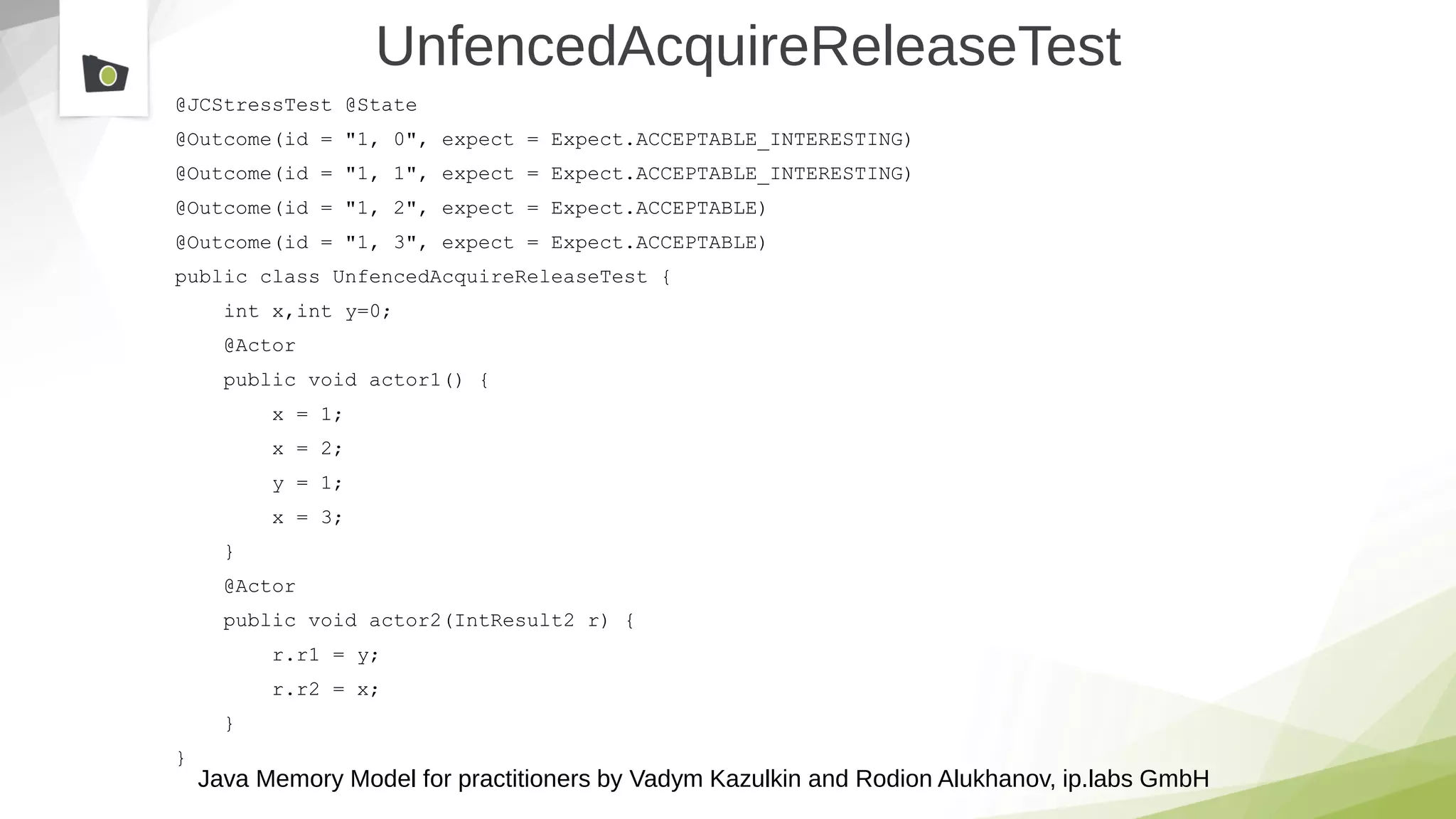
UnfencedAcquireReleaseTest
@JCStressTest @State
@Outcome(id = "1, 0", expect = Expect.ACCEPTABLE_INTERESTING)
@Outcome(id = "1, 1", expect = Expect.ACCEPTABLE_INTERESTING)
@Outcome(id = "1, 2", expect = Expect.ACCEPTABLE)
@Outcome(id = "1, 3", expect = Expect.ACCEPTABLE)
public class UnfencedAcquireReleaseTest {
int x,int y=0;
@Actor
public void actor1() {
x = 1;
x = 2;
y = 1;
x = 3;
}
@Actor
public void actor2(IntResult2 r) {
r.r1 = y;
r.r2 = x;
}
}
Java Memory Model for practitioners by Vadym Kazulkin and Rodion Alukhanov, ip.labs GmbH
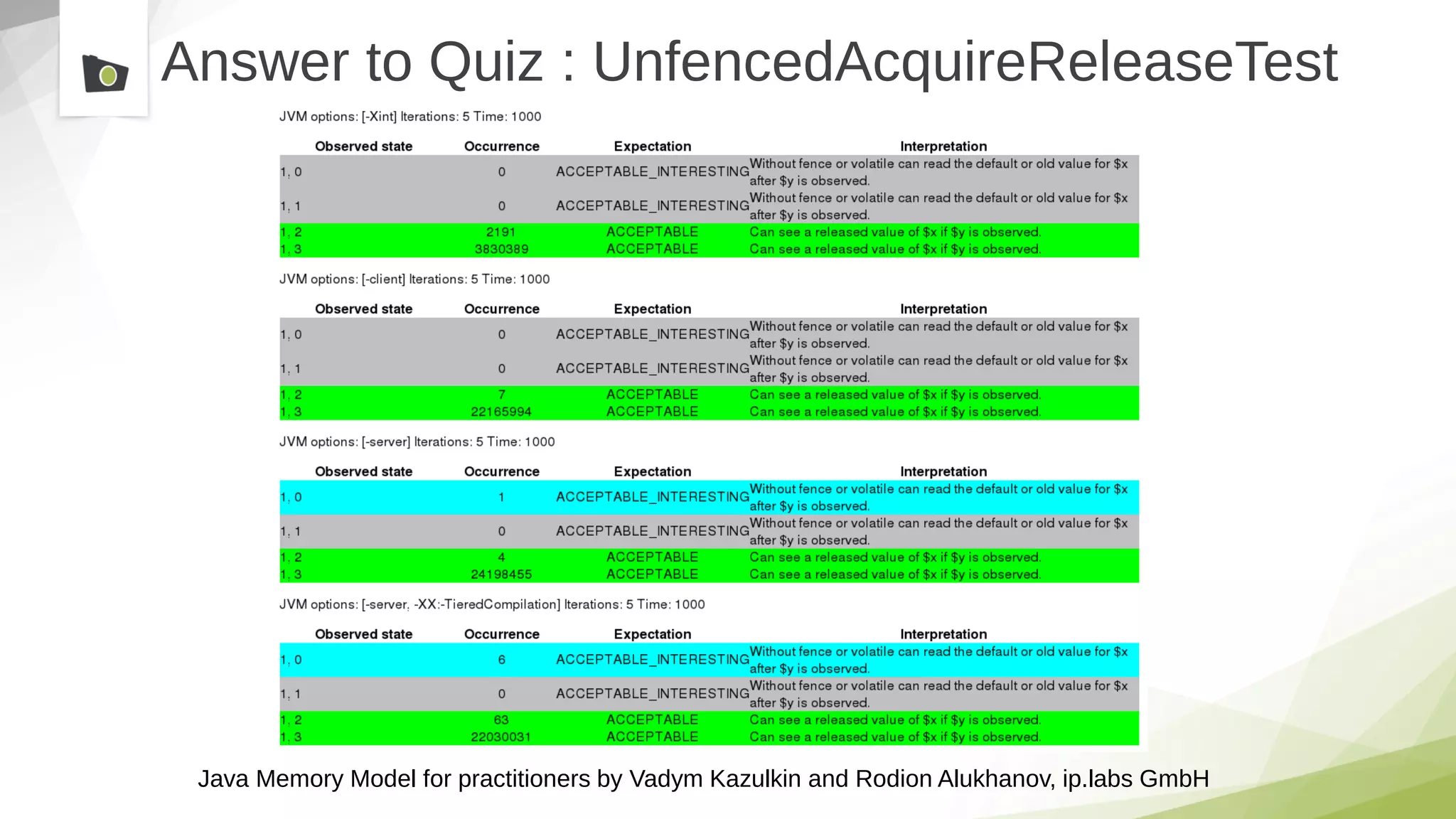
Answer to Quiz : UnfencedAcquireReleaseTest
Java Memory Model for practitioners by Vadym Kazulkin and Rodion Alukhanov, ip.labs GmbH
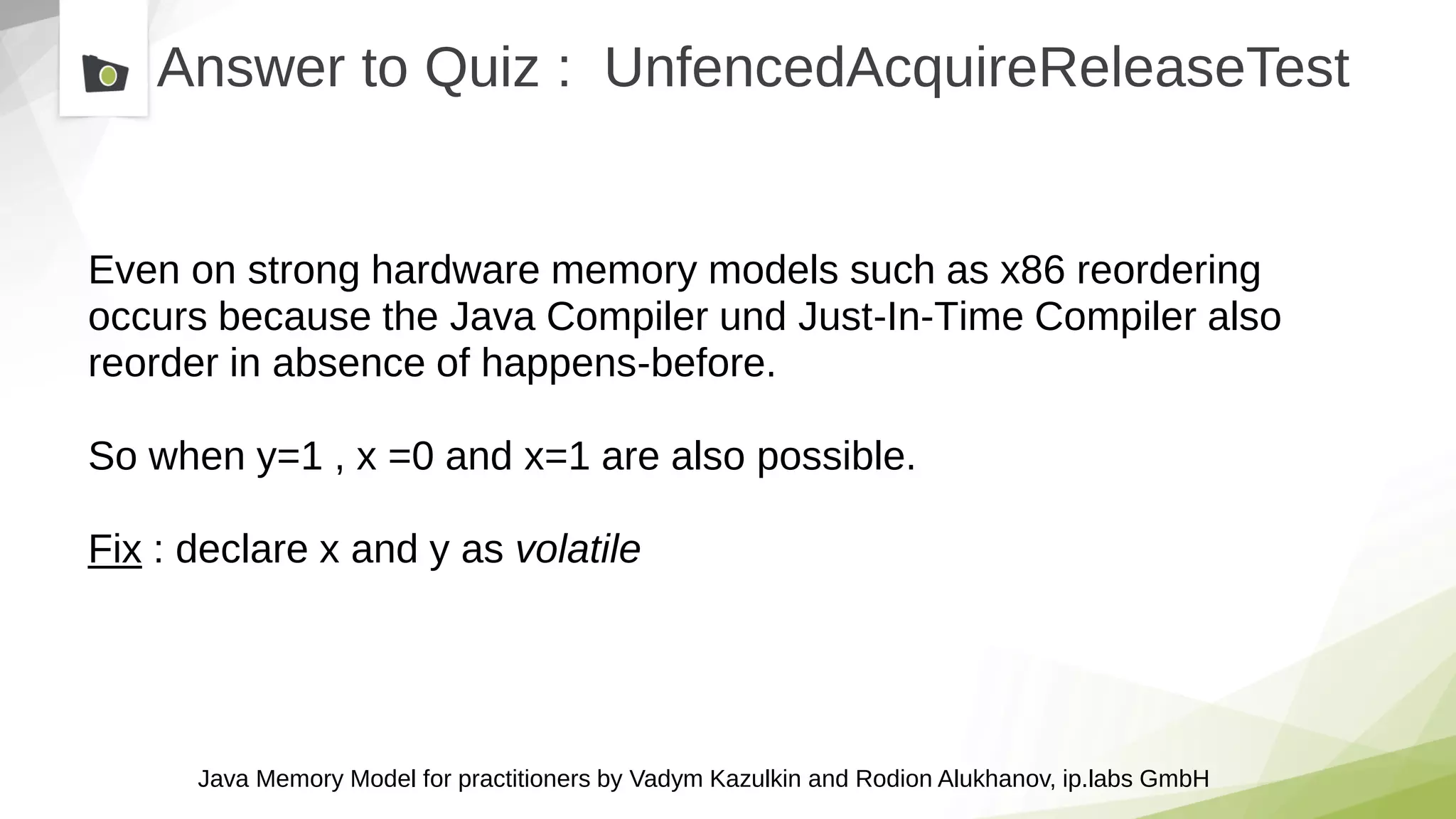
Answer to Quiz : UnfencedAcquireReleaseTest
Even on strong hardware memory models such as x86 reordering
occurs because the Java Compiler und Just-In-Time Compiler also
reorder in absence of happens-before.
So when y=1 , x =0 and x=1 are also possible.
Fix : declare x and y as volatile
Java Memory Model for practitioners by Vadym Kazulkin and Rodion Alukhanov, ip.labs GmbH
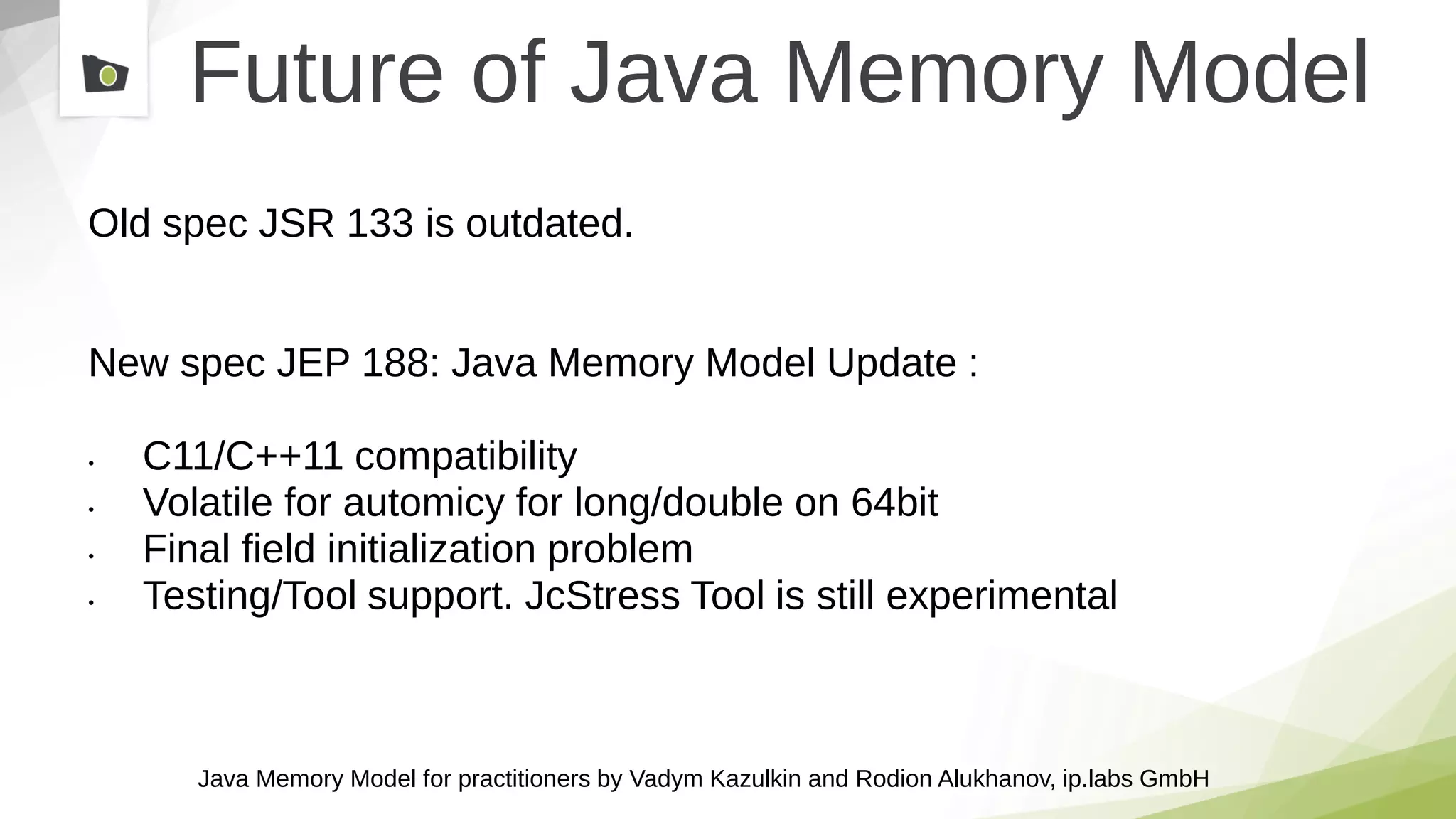
Future of Java Memory Model
Old spec JSR 133 is outdated.
New spec JEP 188: Java Memory Model Update :
• C11/C++11 compatibility
• Volatile for automicy for long/double on 64bit
• Final field initialization problem
• Testing/Tool support. JcStress Tool is still experimental
Java Memory Model for practitioners by Vadym Kazulkin and Rodion Alukhanov, ip.labs GmbH
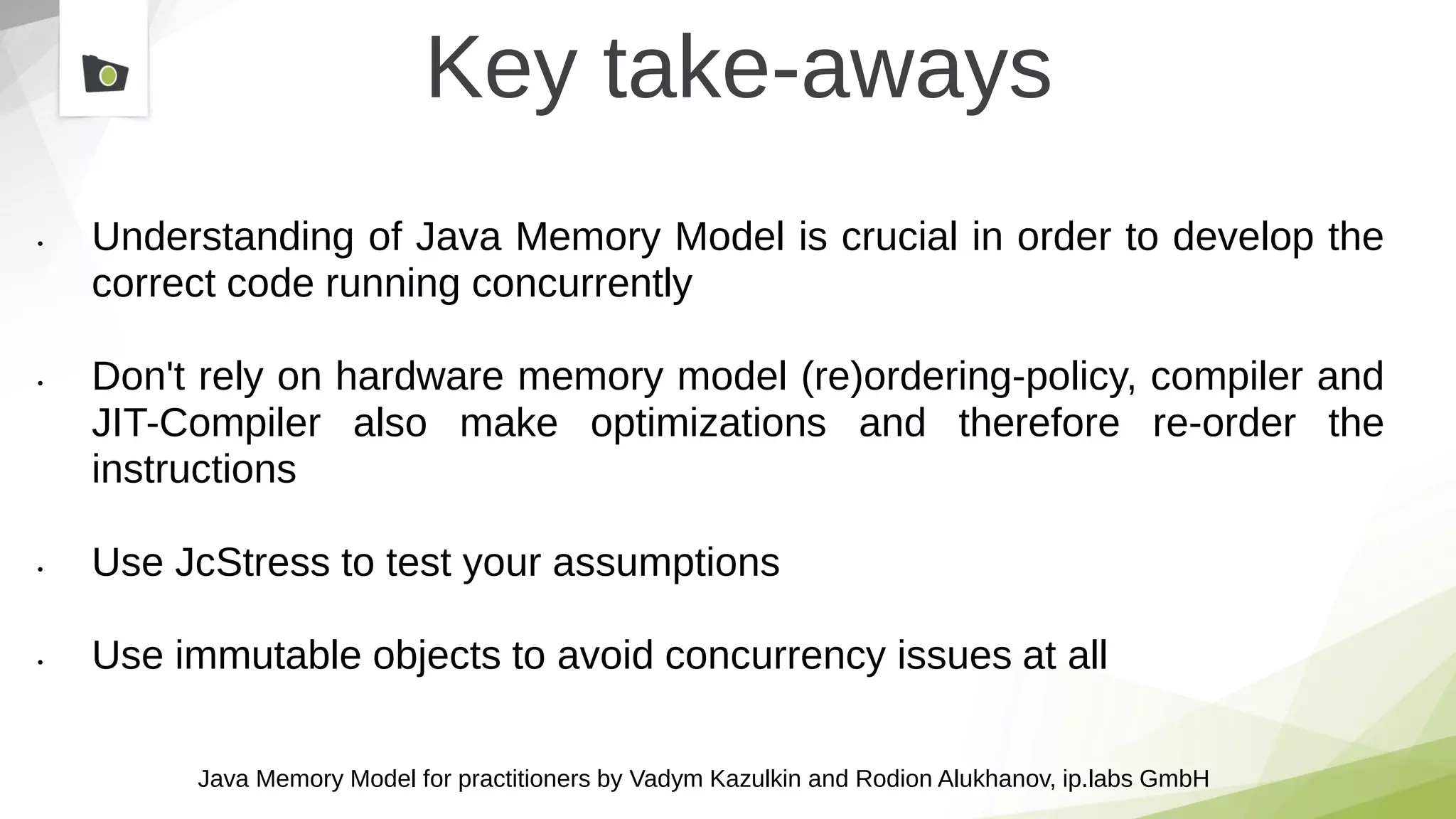
Key take-aways
• Understanding of Java Memory Model is crucial in order to develop the
correct code running concurrently
• Don't rely on hardware memory model (re)ordering-policy, compiler and
JIT-Compiler also make optimizations and therefore re-order the
instructions
• Use JcStress to test your assumptions
• Use immutable objects to avoid concurrency issues at all
Java Memory Model for practitioners by Vadym Kazulkin and Rodion Alukhanov, ip.labs GmbH
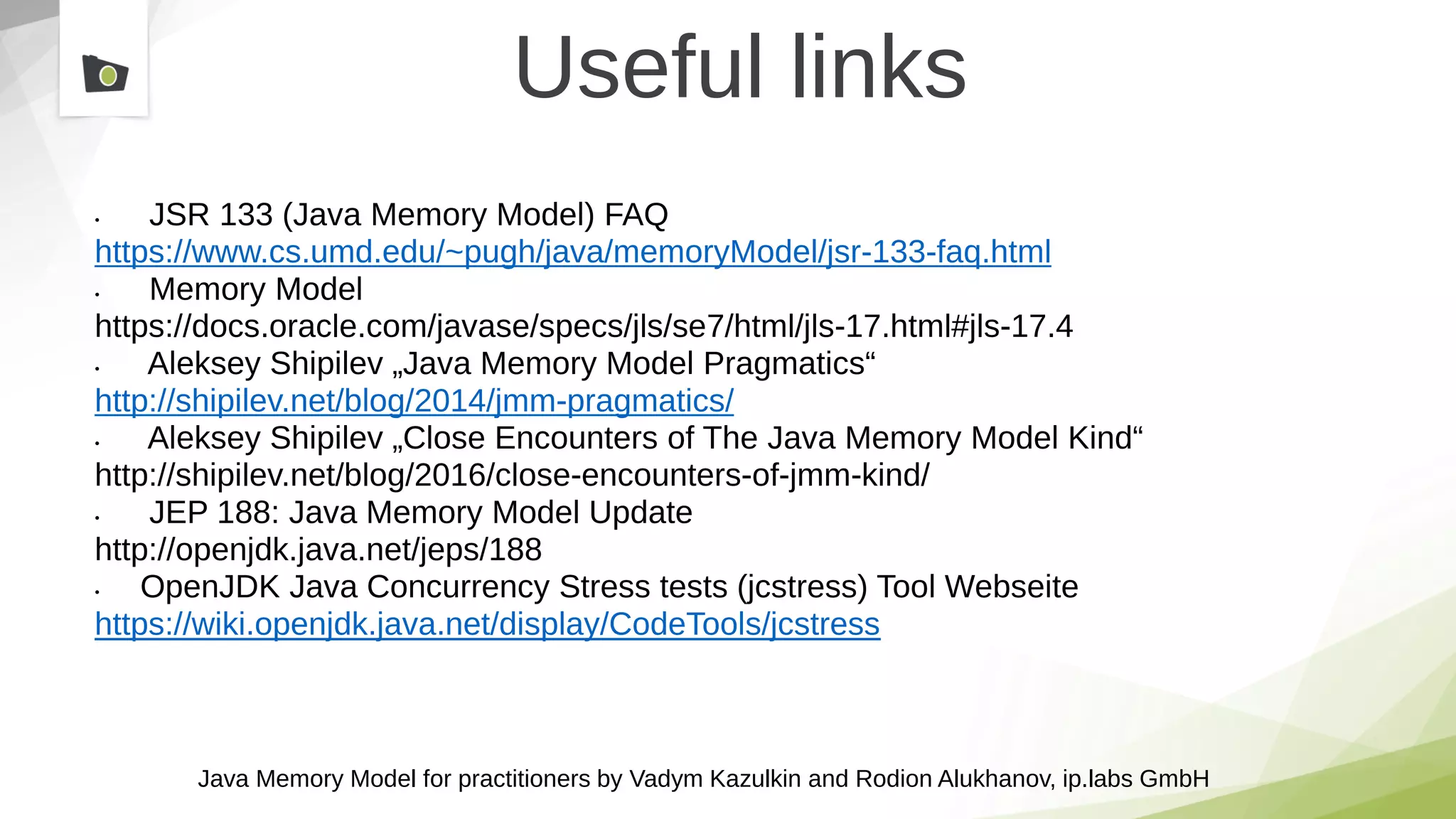
Useful links
• JSR 133 (Java Memory Model) FAQ
https://www.cs.umd.edu/~pugh/java/memoryModel/jsr-133-faq.html
• Memory Model
https://docs.oracle.com/javase/specs/jls/se7/html/jls-17.html#jls-17.4
• Aleksey Shipilev „Java Memory Model Pragmatics“
http://shipilev.net/blog/2014/jmm-pragmatics/
• Aleksey Shipilev „Close Encounters of The Java Memory Model Kind“
http://shipilev.net/blog/2016/close-encounters-of-jmm-kind/
• JEP 188: Java Memory Model Update
http://openjdk.java.net/jeps/188
• OpenJDK Java Concurrency Stress tests (jcstress) Tool Webseite
https://wiki.openjdk.java.net/display/CodeTools/jcstress
Java Memory Model for practitioners by Vadym Kazulkin and Rodion Alukhanov, ip.labs GmbH
Questions?
Java Memory Model for practitioners by Vadym Kazulkin and Rodion Alukhanov, ip.labs GmbH
Contact
Vadym Kazulkin :
Email : v.kazulkin@iplabs.de
Xing : https://www.xing.com/profile/Vadym_Kazulkin
Rodion Alukhanov :
Email : r.alukhanov@iplabs.de
Xing : https://www.xing.com/profile/Rodion_Alukhanov
Thank You!

"Java memory model for practitioners" at JavaLand 2017 by Vadym Kazulkin/Rodion Alukhanov

  • 1.
    by Vadym Kazulkinand Rodion Alukhanov, ip.labs GmbH Java Memory Model for practitioners
  • 2.
    Java Memory Modelfor practitioners by Vadym Kazulkin and Rodion Alukhanov, ip.labs GmbH Topics • Hardware Memory Model • Java Memory Model • Practical examples related to Java Memory Model • JcStress Tool • The future of the Java Memory Model
  • 3.
    Java Memory Modelfor practitioners by Vadym Kazulkin and Rodion Alukhanov, ip.labs GmbH public class MyClass{ int x, y=0; public void executeOnCPU1() { x = 1; x = 2; y = 1; x = 3; } public void executeOnCPU2() { System.out.println("x: "+x+ " y: "+y); } } Quiz What values of x can we see, if y=1 is printed out?
  • 4.
    Java Memory Modelfor practitioners by Vadym Kazulkin and Rodion Alukhanov, ip.labs GmbH Hardware Memory Model
  • 5.
    Java Memory Modelfor practitioners by Vadym Kazulkin and Rodion Alukhanov, ip.labs GmbH Hardware Memory Model Source : http://people.eecs.berkeley.edu/~rcs/research/interactive_latency.html
  • 6.
    Java Memory Modelfor practitioners by Vadym Kazulkin and Rodion Alukhanov, ip.labs GmbH Hardware Memory Model Cache Coherence Cache coherence is the consistency of shared resource data that ends up stored in multiple local caches.
  • 7.
    Java Memory Modelfor practitioners by Vadym Kazulkin and Rodion Alukhanov, ip.labs GmbH Hardware Memory Model Cache Coherence Protocol MESI Modified The entry is only present in the current cache and it is modified. Exclusive The entry is only present in the current cache and has not been modified. Shared More that one processor has the entry in its cache. Invalid Indicates that this entry in the cache is invalid.
  • 8.
    Java Memory Modelfor practitioners by Vadym Kazulkin and Rodion Alukhanov, ip.labs GmbH Hardware Memory Model Stored Buffer & Invalidate Queues
  • 9.
    Java Memory Modelfor practitioners by Vadym Kazulkin and Rodion Alukhanov, ip.labs GmbH Hardware Memory Model Memory Ordering • A given CPU will always perceive its own memory operations as occurring in program order • Some other CPU may observe memory operations results in a different order than what's written in the program
  • 10.
    Java Memory Modelfor practitioners by Vadym Kazulkin and Rodion Alukhanov, ip.labs GmbH Hardware Memory Model Memory Barrier Memory barrier, aka membar or fence is the instruction that causes CPU to enforce an ordering constraint on memory operations issued before and after the barrier instruction.
  • 11.
    Java Memory Modelfor practitioners by Vadym Kazulkin and Rodion Alukhanov, ip.labs GmbH Hardware Memory Model Memory Barrier For the cache coherence protocol MESI : Store Memory Barrier - applies all the stores in the store buffer Load Memory Barrier - applies all the invalidates that are already in the invalidate queue.
  • 12.
    Java Memory Modelfor practitioners by Vadym Kazulkin and Rodion Alukhanov, ip.labs GmbH Hardware Memory Model 4 Types of Memory Barriers LoadLoad membar: Load operations before the barrier must complete their execution before any Load operation after the barrier. StoreStore membar: Store operations before the barrier must complete their execution before any Store operation after the barrier. LoadStore membar : Load operations before the barrier must complete their execution before any Store operation after the barrier. StoreLoad membar : Store operations before the barrier must complete their execution before any Load operation after the barrier.
  • 13.
    Java Memory Modelfor practitioners by Vadym Kazulkin and Rodion Alukhanov, ip.labs GmbH Hardware Memory Model Types of Memory Barrier/Example int x=0; boolean done=false; void executeOnCPU1() { x = 1; done=true; } void executeOnCPU2() { while(!done) { assert x=1; } }
  • 14.
    Java Memory Modelfor practitioners by Vadym Kazulkin and Rodion Alukhanov, ip.labs GmbH Hardware Memory Model Types of Memory Barrier/Example int x=0; boolean done=false; void executeOnCPU1() { x = 1; InsertStoreStoreMembar(); done=true; } void executeOnCPU2() { while(!done) { assert x=1; } }
  • 15.
    Java Memory Modelfor practitioners by Vadym Kazulkin and Rodion Alukhanov, ip.labs GmbH Hardware Memory Model Source : https://en.wikipedia.org/wiki/Memory_ordering
  • 16.
    Java Memory Modelfor practitioners by Vadym Kazulkin and Rodion Alukhanov, ip.labs GmbH Atomicity
  • 17.
    Java Memory Modelfor practitioners by Vadym Kazulkin and Rodion Alukhanov, ip.labs GmbH Counter class Counter { private volatile long counter; public synchronized long inc() { counter++; return counter; } public void set(long v) { counter = v; } public long getCounter() { return counter.get(); } }
  • 18.
    Java Memory Modelfor practitioners by Vadym Kazulkin and Rodion Alukhanov, ip.labs GmbH Visibility / Ordering
  • 19.
    Java Memory Modelfor practitioners by Vadym Kazulkin and Rodion Alukhanov, ip.labs GmbH Happens-Before Synchronized synchronized (α) { … } synchronized (α) { … }
  • 20.
    Java Memory Modelfor practitioners by Vadym Kazulkin and Rodion Alukhanov, ip.labs GmbH Happens-Before Volatile
  • 21.
    Java Memory Modelfor practitioners by Vadym Kazulkin and Rodion Alukhanov, ip.labs GmbH Visibility class Counter { private volatile int counter; public synchronize int inc() { counter++; return counter; } public void set(int v) { counter = v; } public int getCounter() { return counter.get(); } }
  • 22.
    Java Memory Modelfor practitioners by Vadym Kazulkin and Rodion Alukhanov, ip.labs GmbH class Counter { private final AtomicLong counter = new AtomicLong(); public long inc(long v) { return counter.incrementAndGet(v) } public void set(long v) { counter.set(v); } public long getCounter() { return counter.get(); } } Counter
  • 23.
    Java Memory Modelfor practitioners by Vadym Kazulkin and Rodion Alukhanov, ip.labs GmbH Safe Publication class A { int a; public A(int x) { a = x; } }
  • 24.
    Java Memory Modelfor practitioners by Vadym Kazulkin and Rodion Alukhanov, ip.labs GmbH public class Pair() { int final lower, upper; public Pair(int i1, int i2) { if (i1 > i2) throw new SomeException(); … } public int getLower() {…} public int getUpper() {…} } Safe Publication
  • 25.
    Java Memory Modelfor practitioners by Vadym Kazulkin and Rodion Alukhanov, ip.labs GmbH class DoubleCheckLocking { private volatile Resource resource; public Resource getResource() { if (resource == null) { synchronized (this) { if (resource == null) { resource = new Resource(); } } } return resource; } } Double-Checked Locking [1] https://shipilev.net/blog/2014/safe-public-construction
  • 26.
    Java Memory Modelfor practitioners by Vadym Kazulkin and Rodion Alukhanov, ip.labs GmbH class DoubleCheckLocking { private volatile Resource resource; public Resource getResource() { if (resource == null) { synchronized (this) { if (resource == null) { resource = new Resource(); } } } return resource; } } Double-Checked Locking [1] https://shipilev.net/blog/2014/safe-public-construction
  • 27.
    Java Memory Modelfor practitioners by Vadym Kazulkin and Rodion Alukhanov, ip.labs GmbH class Fibonacci { // 1, 1, 2, 3, 5, 8, 13, 21... private Pair v = new Pair(0, 1); static class Pair() { int lower, upper; public Pair(int i1, int i2) {...} } public synchronize int next() { v = new Pair(v.upper, v.lower + v.upper); return v.lower; } } Compare And Swap
  • 28.
    Java Memory Modelfor practitioners by Vadym Kazulkin and Rodion Alukhanov, ip.labs GmbH Compare And Swap
  • 29.
    Java Memory Modelfor practitioners by Vadym Kazulkin and Rodion Alukhanov, ip.labs GmbH class Fibonacci { // 0, 1, 1, 2, 3, 5, 8, 13, 21... private final AtomicReference v = new AtomicReference(); public int next() { Pair newValue; do { Pair old = v.get(); newValue = new Pair(old.upper, old.lower + old.upper); } while(v.compareAndSet(old, newValue)); return newValue.lower; } } Compare And Swap
  • 30.
    Java Memory Modelfor practitioners by Vadym Kazulkin and Rodion Alukhanov, ip.labs GmbH JcStress Tool The Open JDK Tool „Java Concurrency Stress tests (jcstress)“ is an experimental harness and a suite of tests to aid the research in the correctness of concurrency support in the JVM, class libraries, and hardware.
  • 31.
    Java Memory Modelfor practitioners by Vadym Kazulkin and Rodion Alukhanov, ip.labs GmbH JcStress Tool • requires at least 2 online CPUs • few threads executing the test concurrently, sometimes rendez-vous'ing over the shared state • multiple state objects generated per each run. Threads then either mutate or observe that state object • test harness is collecting statistics on the observed states
  • 32.
    Java Memory Modelfor practitioners by Vadym Kazulkin and Rodion Alukhanov, ip.labs GmbH Quiz for Reordering What values of x can we see, if y=1 is printed out? public class MyClass{ int x, y=0; public void executeOnCPU1() { x = 1; x = 2; y = 1; x = 3; } public void executeOnCPU2() { System.out.println("x: "+x+ " y: "+y); } }
  • 33.
    Java Memory Modelfor practitioners by Vadym Kazulkin and Rodion Alukhanov, ip.labs GmbH UnfencedAcquireReleaseTest @JCStressTest @State @Outcome(id = "1, 0", expect = Expect.ACCEPTABLE_INTERESTING) @Outcome(id = "1, 1", expect = Expect.ACCEPTABLE_INTERESTING) @Outcome(id = "1, 2", expect = Expect.ACCEPTABLE) @Outcome(id = "1, 3", expect = Expect.ACCEPTABLE) public class UnfencedAcquireReleaseTest { int x,int y=0; @Actor public void actor1() { x = 1; x = 2; y = 1; x = 3; } @Actor public void actor2(IntResult2 r) { r.r1 = y; r.r2 = x; } }
  • 34.
    Java Memory Modelfor practitioners by Vadym Kazulkin and Rodion Alukhanov, ip.labs GmbH Answer to Quiz : UnfencedAcquireReleaseTest
  • 35.
    Java Memory Modelfor practitioners by Vadym Kazulkin and Rodion Alukhanov, ip.labs GmbH Answer to Quiz : UnfencedAcquireReleaseTest Even on strong hardware memory models such as x86 reordering occurs because the Java Compiler und Just-In-Time Compiler also reorder in absence of happens-before. So when y=1 , x =0 and x=1 are also possible. Fix : declare x and y as volatile
  • 36.
    Java Memory Modelfor practitioners by Vadym Kazulkin and Rodion Alukhanov, ip.labs GmbH Future of Java Memory Model Old spec JSR 133 is outdated. New spec JEP 188: Java Memory Model Update : • C11/C++11 compatibility • Volatile for automicy for long/double on 64bit • Final field initialization problem • Testing/Tool support. JcStress Tool is still experimental
  • 37.
    Java Memory Modelfor practitioners by Vadym Kazulkin and Rodion Alukhanov, ip.labs GmbH Key take-aways • Understanding of Java Memory Model is crucial in order to develop the correct code running concurrently • Don't rely on hardware memory model (re)ordering-policy, compiler and JIT-Compiler also make optimizations and therefore re-order the instructions • Use JcStress to test your assumptions • Use immutable objects to avoid concurrency issues at all
  • 38.
    Java Memory Modelfor practitioners by Vadym Kazulkin and Rodion Alukhanov, ip.labs GmbH Useful links • JSR 133 (Java Memory Model) FAQ https://www.cs.umd.edu/~pugh/java/memoryModel/jsr-133-faq.html • Memory Model https://docs.oracle.com/javase/specs/jls/se7/html/jls-17.html#jls-17.4 • Aleksey Shipilev „Java Memory Model Pragmatics“ http://shipilev.net/blog/2014/jmm-pragmatics/ • Aleksey Shipilev „Close Encounters of The Java Memory Model Kind“ http://shipilev.net/blog/2016/close-encounters-of-jmm-kind/ • JEP 188: Java Memory Model Update http://openjdk.java.net/jeps/188 • OpenJDK Java Concurrency Stress tests (jcstress) Tool Webseite https://wiki.openjdk.java.net/display/CodeTools/jcstress
  • 39.
    Java Memory Modelfor practitioners by Vadym Kazulkin and Rodion Alukhanov, ip.labs GmbH Questions?
  • 40.
    Java Memory Modelfor practitioners by Vadym Kazulkin and Rodion Alukhanov, ip.labs GmbH Contact Vadym Kazulkin : Email : v.kazulkin@iplabs.de Xing : https://www.xing.com/profile/Vadym_Kazulkin Rodion Alukhanov : Email : r.alukhanov@iplabs.de Xing : https://www.xing.com/profile/Rodion_Alukhanov
  • 41.