ATTACK & DEFENSE
                                   labs


Attacking JAVA Serialized
Communication
Manish S. Saindane
Who am I ?

• Security Researcher
      – Working as a Lead Application Security Specialist for an
        international software development and services company
      – Likes to research on security issues in software
      – Follow me @ blog.andlabs.org


                                                 ATTACK & DEFENSE
                                                              labs
Black Hat Europe 2010            2
Agenda

•   JAVA Object Serialization Basics
•   The Current Scenario & Challenges Faced
•   Suggested Solution
•   Demo


                                         ATTACK & DEFENSE
                                                      labs
Black Hat Europe 2010      3
Objectives

• Simplify the penetration testing process of thick
  clients and make it completely seamless

• Enable the pentester to edit JAVA objects in the same
  way that a developer would

• Enable all of this using the currently available tools


                                            ATTACK & DEFENSE
                                                         labs
Black Hat Europe 2010        4
JAVA Object Serialization
                                 Basics


                                               ATTACK & DEFENSE
                                                            labs
Black Hat Europe 2010               5
JAVA Object Serialization

• Protocol implemented by SUN for converting JAVA
  objects into a stream of bytes to be
      – Stored in a file
      – Transmitted across a network


• The serialized form contains sufficient information
  such that it can be restored to an identical clone of
  the original JAVA object


                                           ATTACK & DEFENSE
                                                        labs
Black Hat Europe 2010           6
JAVA Object Serialization cont’d

• Objects can be written using the writeObject()
  method provided by the ObjectOutput interface

• Objects can be retrieved using the readObject()
  method provided by the ObjectInput interface

• The ObjectOutputStream and ObjectInputStream
  classes implement the above interfaces respectively

                                         ATTACK & DEFENSE
                                                      labs
Black Hat Europe 2010     7
JAVA Object Serialization cont’d

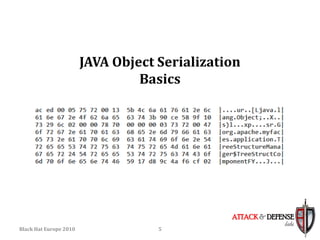
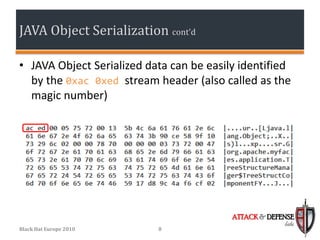
• JAVA Object Serialized data can be easily identified
  by the 0xac 0xed stream header (also called as the
  magic number)


                                          ATTACK & DEFENSE
                                                       labs
Black Hat Europe 2010      8
JAVA Object Serialization cont’d

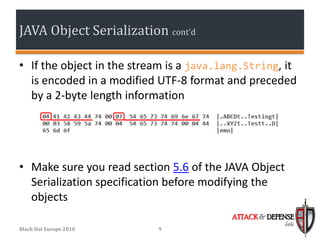
• If the object in the stream is a java.lang.String, it
  is encoded in a modified UTF-8 format and preceded
  by a 2-byte length information


• Make sure you read section 5.6 of the JAVA Object
  Serialization specification before modifying the
  objects
                                          ATTACK & DEFENSE
                                                       labs
Black Hat Europe 2010      9
The Current Scenario
                                 &
                          Challenges Faced


                                               ATTACK & DEFENSE
                                                            labs
Black Hat Europe 2010            10
So what do we have ?

• Current tools or application interception proxies
  allow very limited functionality to test such data

• Not as easy or straightforward as testing regular web
  applications sending data in request parameters

• Some work has been done in the past to improve the
  situation. Let’s have a look at some of these methods

                                           ATTACK & DEFENSE
                                                        labs
Black Hat Europe 2010       11
Modifying Raw HEX

• One of the most basic techniques is to modify the
  raw HEX data using a HEX editor

• This is very limited and can be used to modify simple
  integers or string values in the raw data

• Isn’t really practical to inspect or modify complex
  objects

                                           ATTACK & DEFENSE
                                                        labs
Black Hat Europe 2010       12
Modifying Raw HEX cont’d

• Modifying raw data may result in a corrupted
  Serialized byte stream

• Make sure to modify the length information if you
  edit some string value as discussed earlier

• Existing interception proxies usually have very basic
  HEX editors hence working with them becomes
  difficult
                                           ATTACK & DEFENSE
                                                        labs
Black Hat Europe 2010      13
Decompiling Class Files

• This can allow us to carefully study the application
  logic

• Hardcoded values, sensitive functions, crypto
  algorithms, etc. can be identified and used for
  attacks

• Decompiling may not be straight forward for
  applications making use of strong obfuscation
  techniques                             ATTACK & DEFENSE
                                                         labs
Black Hat Europe 2010       14
Decompiling Class Files cont’d

• Popular decompilers like JAD, JD, Jode and DJ Java
  Decompiler may be used for simple obfuscated
  classes

• Editing signed jars may be difficult


                                          ATTACK & DEFENSE
                                                       labs
Black Hat Europe 2010       15
Assessing JAVA Clients with BeanShell

• This was a technique developed by Stephen D’ Vires
  from Corsaire

• It made use of the BeanShell scripting language that
  was plugged into the client

• Could be handy in identifying client-side security
  controls

                                           ATTACK & DEFENSE
                                                        labs
Black Hat Europe 2010      16
Assessing JAVA Clients with BeanShell cont’d

• The pentester must be comfortable writing JAVA
  code to use this technique

• The scope of this technique is too broad for our use
  i.e. to tamper the serialized data


                                          ATTACK & DEFENSE
                                                       labs
Black Hat Europe 2010      17
Runtime Protocol Analysis (RPA)

• This was presented by Shay Chen from Hacktics at an
  OWASP Israel meet

• He spoke about creating a custom runtime protocol
  analyzer to read data from JAVA serialized objects

• The object once read, could then be analyzed and
  modified

                                        ATTACK & DEFENSE
                                                     labs
Black Hat Europe 2010     18
Runtime Protocol Analysis (RPA) cont’d

• The way this works is:
      – Sniff traffic over the network
      – Split each request/response into individual packets
      – Modify the destination URL or Host within the packet with
        a HEX editor to a local server (protocol analyzer)
      – Send it to the Protocol Analyzer using netcat


• The protocol analyzer is customized code written to
  suit the protocol used to transfer the object

                                                  ATTACK & DEFENSE
                                                               labs
Black Hat Europe 2010            19
Runtime Protocol Analysis (RPA) cont’d

• This only drawback is that it is not completely
  seamless
      – Too many steps involved
      – Takes some time to setup
      – The protocol analyzer has to be modified and compiled
        each time for different scenarios


• But this is the technique that suffices our needs to a
  certain extent

                                                 ATTACK & DEFENSE
                                                                labs
Black Hat Europe 2010            20
Suggested Solution


                                             ATTACK & DEFENSE
                                                          labs
Black Hat Europe 2010           21
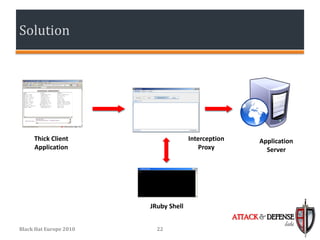
Solution


     Thick Client                     Interception          Application
     Application                          Proxy               Server


                        JRuby Shell
                                                     ATTACK & DEFENSE
                                                                    labs
Black Hat Europe 2010     22
Setup Needed

• Tools we need
      –   JRuby version 1.4.0
      –   BurpSuite version 1.2.x
      –   Buby version 1.8.x
      –   Any text editor


                                         ATTACK & DEFENSE
                                                      labs
Black Hat Europe 2010               23
Why JRuby ?

• Why not a pure Java plug-in. Why JRuby?
      –   Easier syntax, hence easy to learn
      –   Can call almost all JAVA libraries
      –   Provides an interactive shell (jirb)
      –   Dynamic Type Language


                                                 ATTACK & DEFENSE
                                                              labs
Black Hat Europe 2010                24
Advantages

• Adds the ability of modifying JAVA objects on-the-fly

• Ease of use – makes the whole process seamless

• Hooks a JAVA development environment in your
  interception proxy

• Can be used for other stuff too ….. Just be a bit
  creative ;)
                                           ATTACK & DEFENSE
                                                        labs
Black Hat Europe 2010       25
Demo


                               ATTACK & DEFENSE
                                            labs
Black Hat Europe 2010    26
References

•   Chen, S. (2008). Achilles’ heel – Hacking Through Java Protocols. OWASP Israel.
    Herzliya.

•   Monti, E. (n.d.). Buby. Retrieved from http://emonti.github.com/buby/

•   Sun Microsystems. (n.d.). Java Object Serialization Specification. Retrieved from
    sun.com:
    http://java.sun.com/javase/6/docs/platform/serialization/spec/serialTOC.html

•   Vries, S. d. (2006, June 15). Assessing JAVA Clients with the BeanShell. Retrieved
    from Corsaire: http://research.corsaire.com/whitepapers/060816-assessing-java-
    clients-with-the-beanshell.pdf


                                                                   ATTACK & DEFENSE
                                                                                   labs
Black Hat Europe 2010                      27
Big Thanks To

• For the work done that helped me build this:
      – Shay Chen
      – Eric Monti


• And of course for testing & review:
      – Lavakumar Kuppan
      – Luca Carettoni

            If I have seen further it is only by standing on the shoulders of giants.
                                                                 - Sir Isaac Newton
                                                                        ATTACK & DEFENSE
                                                                                        labs
Black Hat Europe 2010                          28
Questions ??


                                     ATTACK & DEFENSE
                                                  labs
Black Hat Europe 2010   29
Thank You

                              Contact me:
                        manish (-at-) andlabs.org


                                                    ATTACK & DEFENSE
                                                                 labs
Black Hat Europe 2010              30

Black Hat EU 2010 - Attacking Java Serialized Communication

  • 1.
    ATTACK & DEFENSE labs Attacking JAVA Serialized Communication Manish S. Saindane
  • 2.
    Who am I? • Security Researcher – Working as a Lead Application Security Specialist for an international software development and services company – Likes to research on security issues in software – Follow me @ blog.andlabs.org ATTACK & DEFENSE labs Black Hat Europe 2010 2
  • 3.
    Agenda • JAVA Object Serialization Basics • The Current Scenario & Challenges Faced • Suggested Solution • Demo ATTACK & DEFENSE labs Black Hat Europe 2010 3
  • 4.
    Objectives • Simplify thepenetration testing process of thick clients and make it completely seamless • Enable the pentester to edit JAVA objects in the same way that a developer would • Enable all of this using the currently available tools ATTACK & DEFENSE labs Black Hat Europe 2010 4
  • 5.
    JAVA Object Serialization Basics ATTACK & DEFENSE labs Black Hat Europe 2010 5
  • 6.
    JAVA Object Serialization •Protocol implemented by SUN for converting JAVA objects into a stream of bytes to be – Stored in a file – Transmitted across a network • The serialized form contains sufficient information such that it can be restored to an identical clone of the original JAVA object ATTACK & DEFENSE labs Black Hat Europe 2010 6
  • 7.
    JAVA Object Serializationcont’d • Objects can be written using the writeObject() method provided by the ObjectOutput interface • Objects can be retrieved using the readObject() method provided by the ObjectInput interface • The ObjectOutputStream and ObjectInputStream classes implement the above interfaces respectively ATTACK & DEFENSE labs Black Hat Europe 2010 7
  • 8.
    JAVA Object Serializationcont’d • JAVA Object Serialized data can be easily identified by the 0xac 0xed stream header (also called as the magic number) ATTACK & DEFENSE labs Black Hat Europe 2010 8
  • 9.
    JAVA Object Serializationcont’d • If the object in the stream is a java.lang.String, it is encoded in a modified UTF-8 format and preceded by a 2-byte length information • Make sure you read section 5.6 of the JAVA Object Serialization specification before modifying the objects ATTACK & DEFENSE labs Black Hat Europe 2010 9
  • 10.
    The Current Scenario & Challenges Faced ATTACK & DEFENSE labs Black Hat Europe 2010 10
  • 11.
    So what dowe have ? • Current tools or application interception proxies allow very limited functionality to test such data • Not as easy or straightforward as testing regular web applications sending data in request parameters • Some work has been done in the past to improve the situation. Let’s have a look at some of these methods ATTACK & DEFENSE labs Black Hat Europe 2010 11
  • 12.
    Modifying Raw HEX •One of the most basic techniques is to modify the raw HEX data using a HEX editor • This is very limited and can be used to modify simple integers or string values in the raw data • Isn’t really practical to inspect or modify complex objects ATTACK & DEFENSE labs Black Hat Europe 2010 12
  • 13.
    Modifying Raw HEXcont’d • Modifying raw data may result in a corrupted Serialized byte stream • Make sure to modify the length information if you edit some string value as discussed earlier • Existing interception proxies usually have very basic HEX editors hence working with them becomes difficult ATTACK & DEFENSE labs Black Hat Europe 2010 13
  • 14.
    Decompiling Class Files •This can allow us to carefully study the application logic • Hardcoded values, sensitive functions, crypto algorithms, etc. can be identified and used for attacks • Decompiling may not be straight forward for applications making use of strong obfuscation techniques ATTACK & DEFENSE labs Black Hat Europe 2010 14
  • 15.
    Decompiling Class Filescont’d • Popular decompilers like JAD, JD, Jode and DJ Java Decompiler may be used for simple obfuscated classes • Editing signed jars may be difficult ATTACK & DEFENSE labs Black Hat Europe 2010 15
  • 16.
    Assessing JAVA Clientswith BeanShell • This was a technique developed by Stephen D’ Vires from Corsaire • It made use of the BeanShell scripting language that was plugged into the client • Could be handy in identifying client-side security controls ATTACK & DEFENSE labs Black Hat Europe 2010 16
  • 17.
    Assessing JAVA Clientswith BeanShell cont’d • The pentester must be comfortable writing JAVA code to use this technique • The scope of this technique is too broad for our use i.e. to tamper the serialized data ATTACK & DEFENSE labs Black Hat Europe 2010 17
  • 18.
    Runtime Protocol Analysis(RPA) • This was presented by Shay Chen from Hacktics at an OWASP Israel meet • He spoke about creating a custom runtime protocol analyzer to read data from JAVA serialized objects • The object once read, could then be analyzed and modified ATTACK & DEFENSE labs Black Hat Europe 2010 18
  • 19.
    Runtime Protocol Analysis(RPA) cont’d • The way this works is: – Sniff traffic over the network – Split each request/response into individual packets – Modify the destination URL or Host within the packet with a HEX editor to a local server (protocol analyzer) – Send it to the Protocol Analyzer using netcat • The protocol analyzer is customized code written to suit the protocol used to transfer the object ATTACK & DEFENSE labs Black Hat Europe 2010 19
  • 20.
    Runtime Protocol Analysis(RPA) cont’d • This only drawback is that it is not completely seamless – Too many steps involved – Takes some time to setup – The protocol analyzer has to be modified and compiled each time for different scenarios • But this is the technique that suffices our needs to a certain extent ATTACK & DEFENSE labs Black Hat Europe 2010 20
  • 21.
    Suggested Solution ATTACK & DEFENSE labs Black Hat Europe 2010 21
  • 22.
    Solution Thick Client Interception Application Application Proxy Server JRuby Shell ATTACK & DEFENSE labs Black Hat Europe 2010 22
  • 23.
    Setup Needed • Toolswe need – JRuby version 1.4.0 – BurpSuite version 1.2.x – Buby version 1.8.x – Any text editor ATTACK & DEFENSE labs Black Hat Europe 2010 23
  • 24.
    Why JRuby ? •Why not a pure Java plug-in. Why JRuby? – Easier syntax, hence easy to learn – Can call almost all JAVA libraries – Provides an interactive shell (jirb) – Dynamic Type Language ATTACK & DEFENSE labs Black Hat Europe 2010 24
  • 25.
    Advantages • Adds theability of modifying JAVA objects on-the-fly • Ease of use – makes the whole process seamless • Hooks a JAVA development environment in your interception proxy • Can be used for other stuff too ….. Just be a bit creative ;) ATTACK & DEFENSE labs Black Hat Europe 2010 25
  • 26.
    Demo ATTACK & DEFENSE labs Black Hat Europe 2010 26
  • 27.
    References • Chen, S. (2008). Achilles’ heel – Hacking Through Java Protocols. OWASP Israel. Herzliya. • Monti, E. (n.d.). Buby. Retrieved from http://emonti.github.com/buby/ • Sun Microsystems. (n.d.). Java Object Serialization Specification. Retrieved from sun.com: http://java.sun.com/javase/6/docs/platform/serialization/spec/serialTOC.html • Vries, S. d. (2006, June 15). Assessing JAVA Clients with the BeanShell. Retrieved from Corsaire: http://research.corsaire.com/whitepapers/060816-assessing-java- clients-with-the-beanshell.pdf ATTACK & DEFENSE labs Black Hat Europe 2010 27
  • 28.
    Big Thanks To •For the work done that helped me build this: – Shay Chen – Eric Monti • And of course for testing & review: – Lavakumar Kuppan – Luca Carettoni If I have seen further it is only by standing on the shoulders of giants. - Sir Isaac Newton ATTACK & DEFENSE labs Black Hat Europe 2010 28
  • 29.
    Questions ?? ATTACK & DEFENSE labs Black Hat Europe 2010 29
  • 30.
    Thank You Contact me: manish (-at-) andlabs.org ATTACK & DEFENSE labs Black Hat Europe 2010 30