Troubleshooting and monitoring Janus:
a HEPIC journey!
Lorenzo Miniero
@elminiero
OpenSIPS Summit
2nd May 2018,
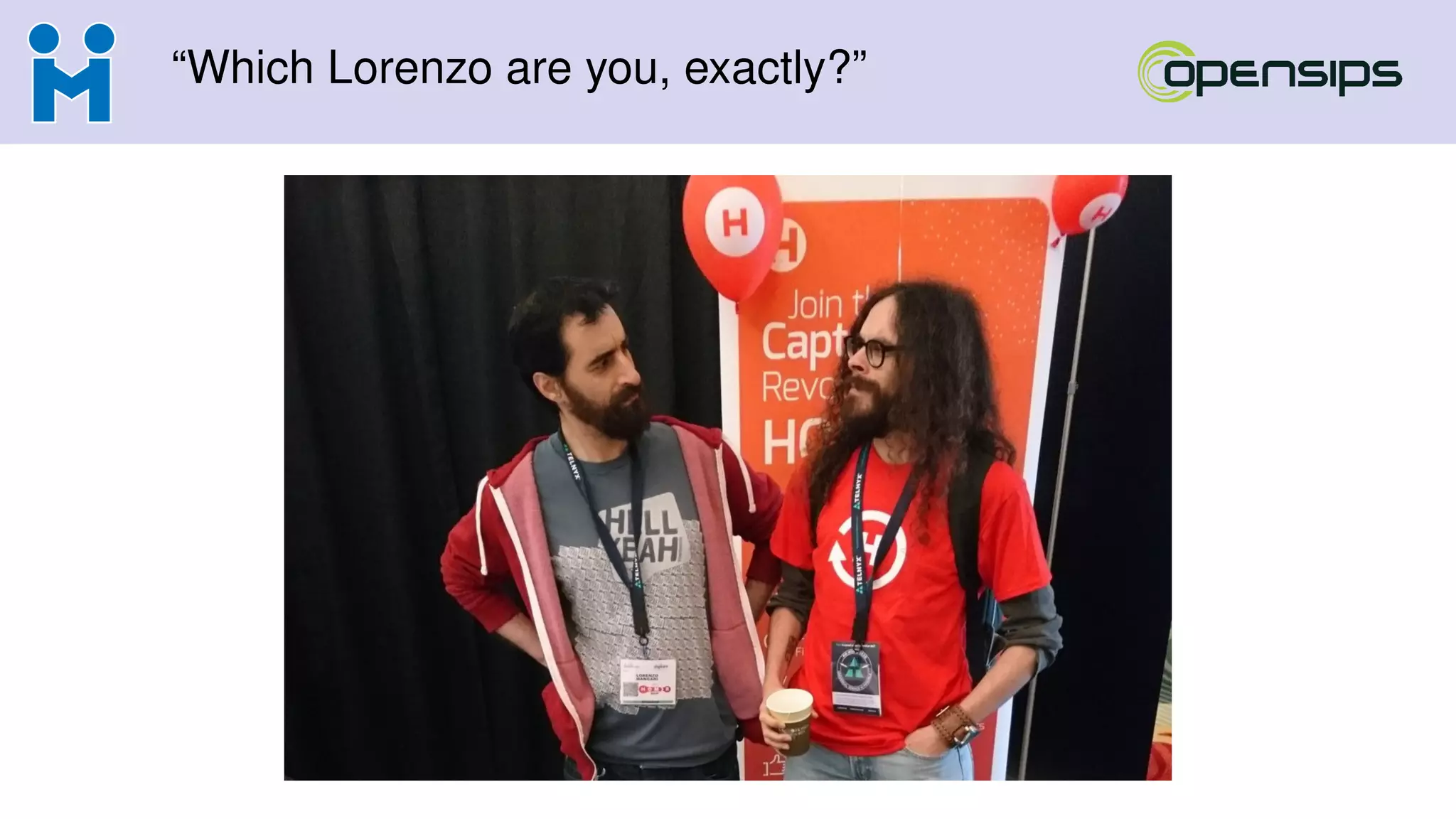
“Which Lorenzo are you, exactly?”
You may remember me from “Revenge of
the Mutant Janus Instances” (not really...)
No, seriously, remember Janus?
• General purpose, open source WebRTC server
• https://github.com/meetecho/janus-gateway
• Demos and documentation: https://janus.conf.meetecho.com
• Community: https://groups.google.com/forum/#!forum/meetecho-janus
Past OpenSIPS presentations: on Janus, SIP, and various salads
• https://www.youtube.com/watch?v=SFeWYewoL7Q
• https://www.youtube.com/watch?v=anmyMC6Ovl8&t=25112s
No, seriously, remember Janus?
• General purpose, open source WebRTC server
• https://github.com/meetecho/janus-gateway
• Demos and documentation: https://janus.conf.meetecho.com
• Community: https://groups.google.com/forum/#!forum/meetecho-janus
Past OpenSIPS presentations: on Janus, SIP, and various salads
• https://www.youtube.com/watch?v=SFeWYewoL7Q
• https://www.youtube.com/watch?v=anmyMC6Ovl8&t=25112s
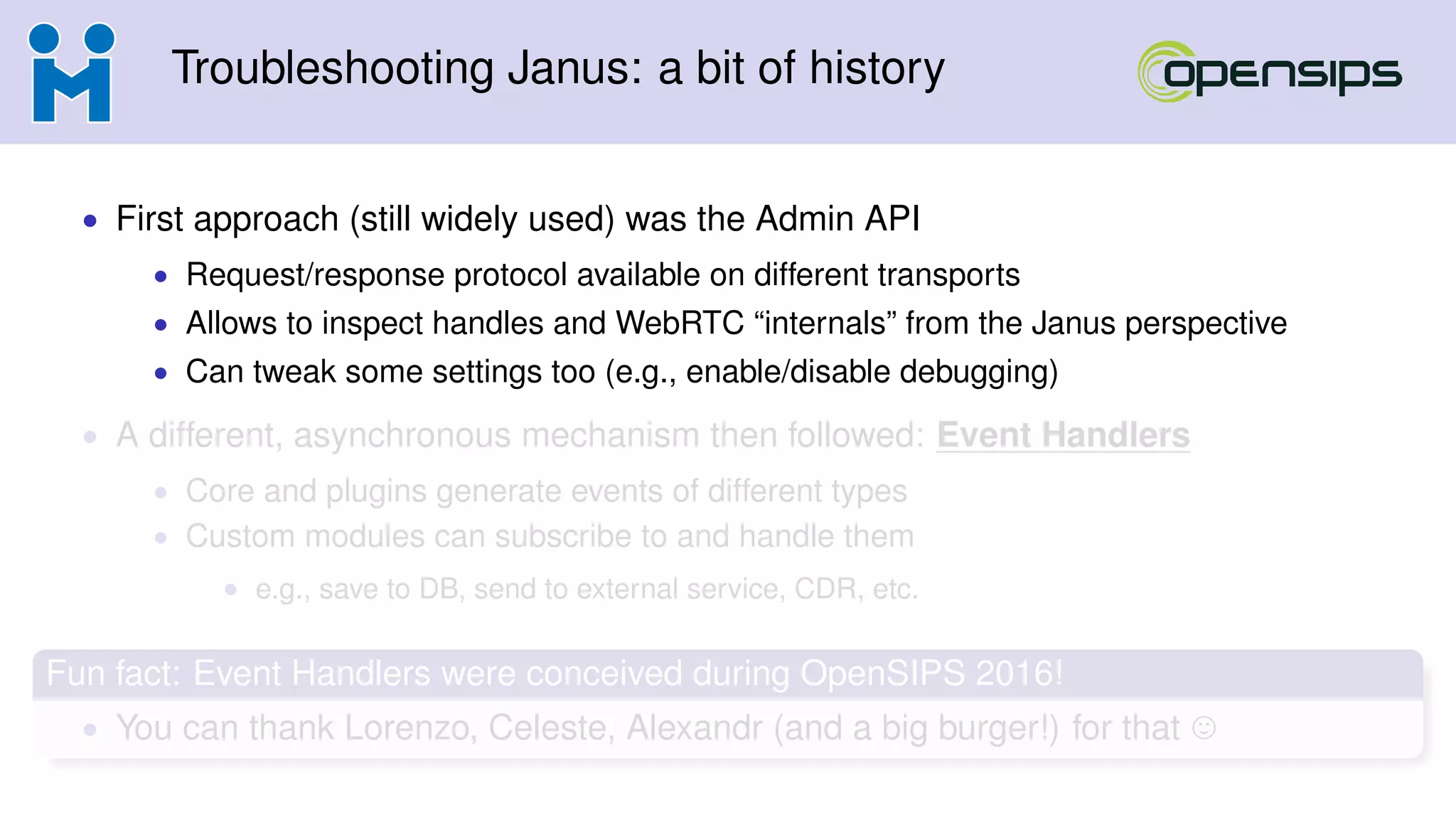
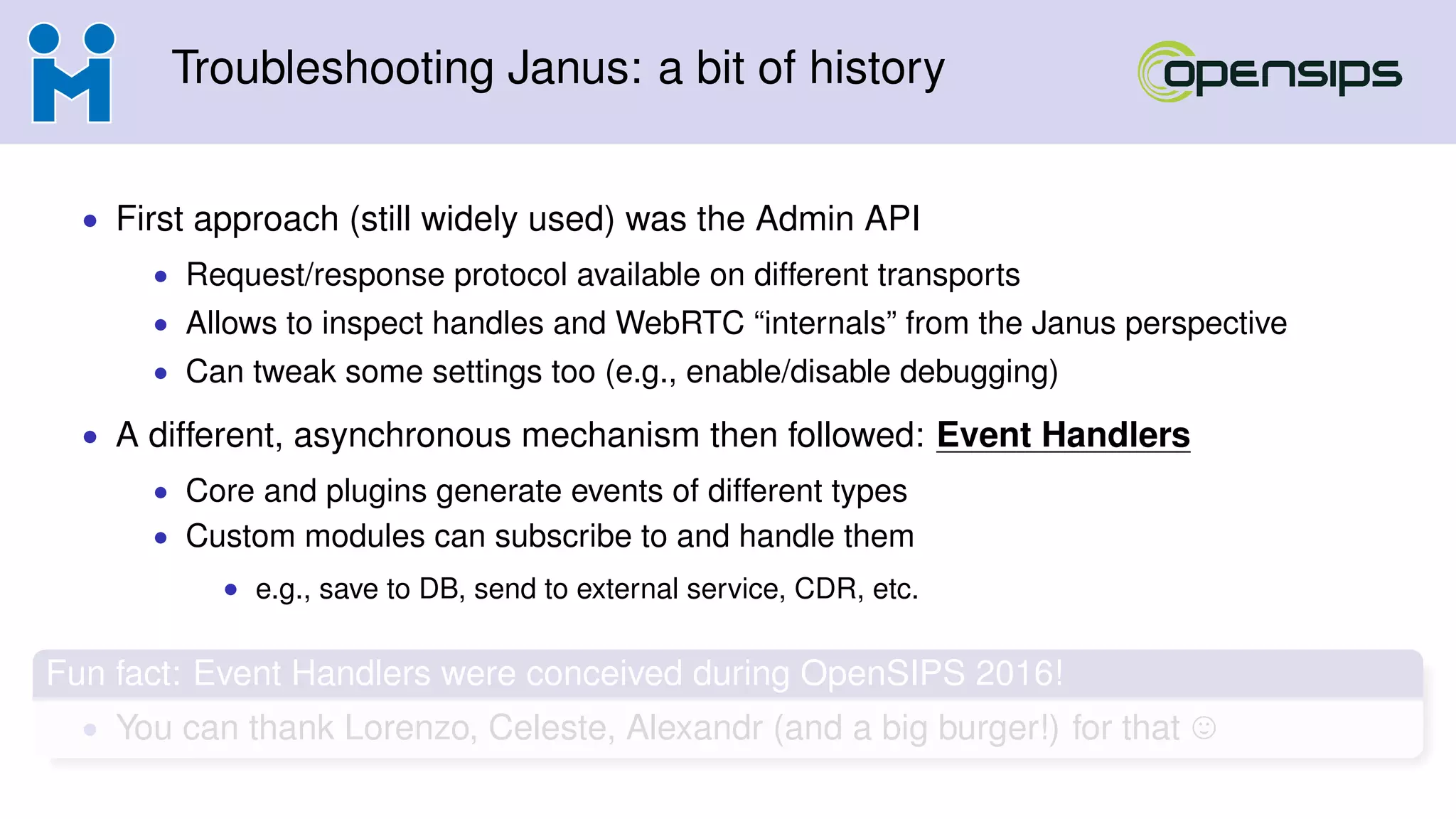
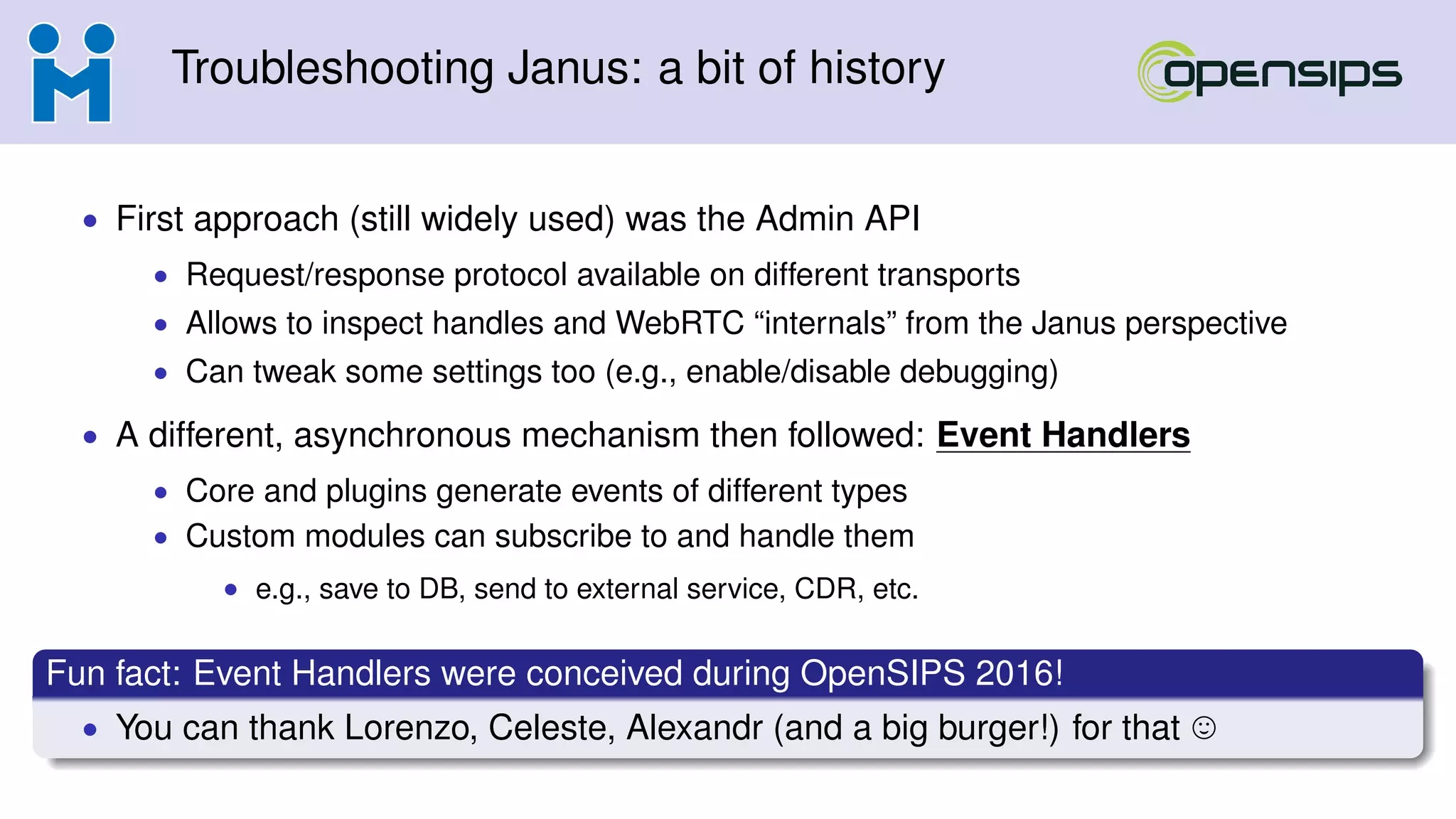
Troubleshooting Janus: a bit of history
• First approach (still widely used) was the Admin API
• Request/response protocol available on different transports
• Allows to inspect handles and WebRTC “internals” from the Janus perspective
• Can tweak some settings too (e.g., enable/disable debugging)
• A different, asynchronous mechanism then followed: Event Handlers
• Core and plugins generate events of different types
• Custom modules can subscribe to and handle them
• e.g., save to DB, send to external service, CDR, etc.
Fun fact: Event Handlers were conceived during OpenSIPS 2016!
• You can thank Lorenzo, Celeste, Alexandr (and a big burger!) for that
Troubleshooting Janus: a bit of history
• First approach (still widely used) was the Admin API
• Request/response protocol available on different transports
• Allows to inspect handles and WebRTC “internals” from the Janus perspective
• Can tweak some settings too (e.g., enable/disable debugging)
• A different, asynchronous mechanism then followed: Event Handlers
• Core and plugins generate events of different types
• Custom modules can subscribe to and handle them
• e.g., save to DB, send to external service, CDR, etc.
Fun fact: Event Handlers were conceived during OpenSIPS 2016!
• You can thank Lorenzo, Celeste, Alexandr (and a big burger!) for that
Troubleshooting Janus: a bit of history
• First approach (still widely used) was the Admin API
• Request/response protocol available on different transports
• Allows to inspect handles and WebRTC “internals” from the Janus perspective
• Can tweak some settings too (e.g., enable/disable debugging)
• A different, asynchronous mechanism then followed: Event Handlers
• Core and plugins generate events of different types
• Custom modules can subscribe to and handle them
• e.g., save to DB, send to external service, CDR, etc.
Fun fact: Event Handlers were conceived during OpenSIPS 2016!
• You can thank Lorenzo, Celeste, Alexandr (and a big burger!) for that
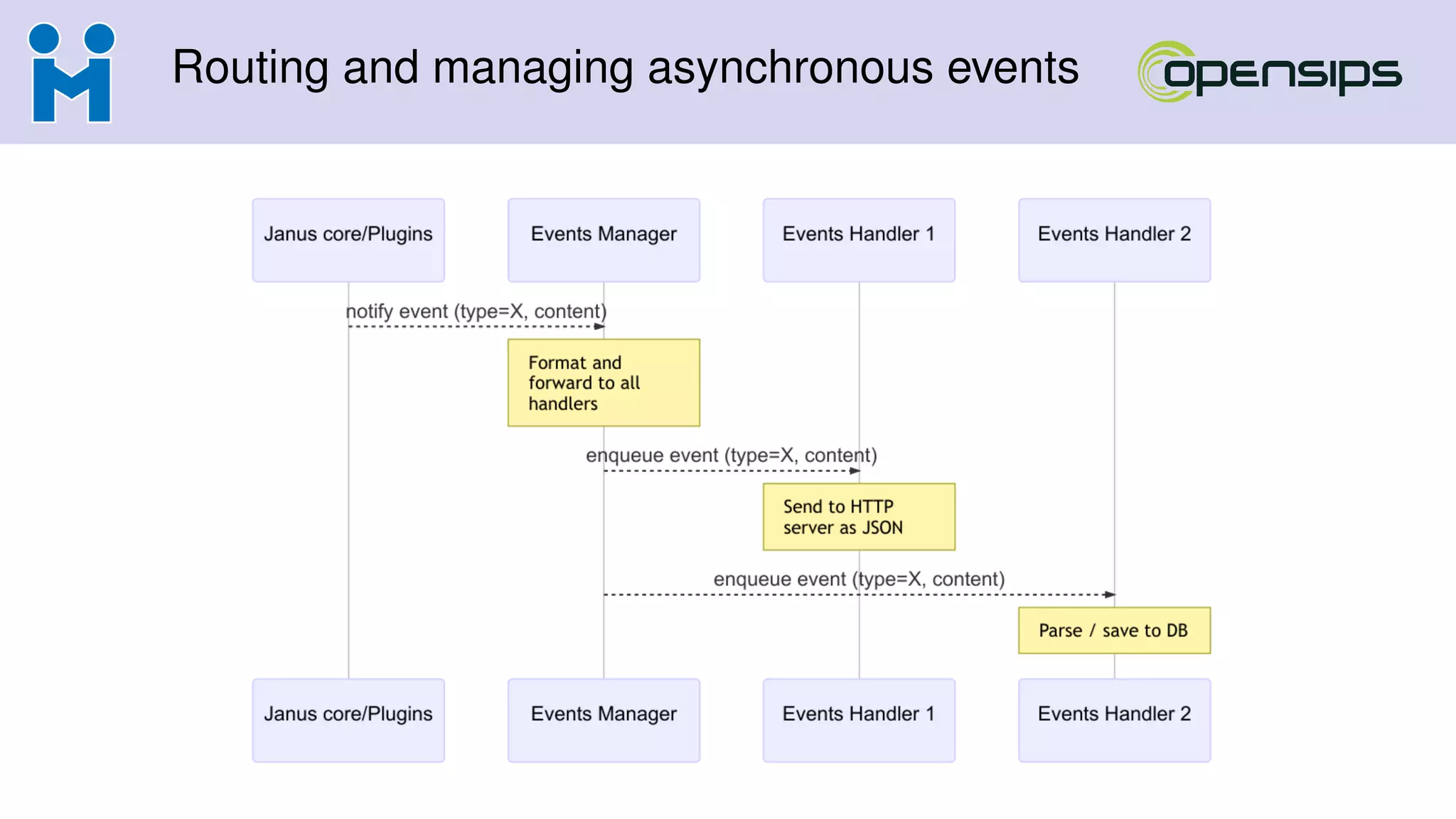
Routing and managing asynchronous events
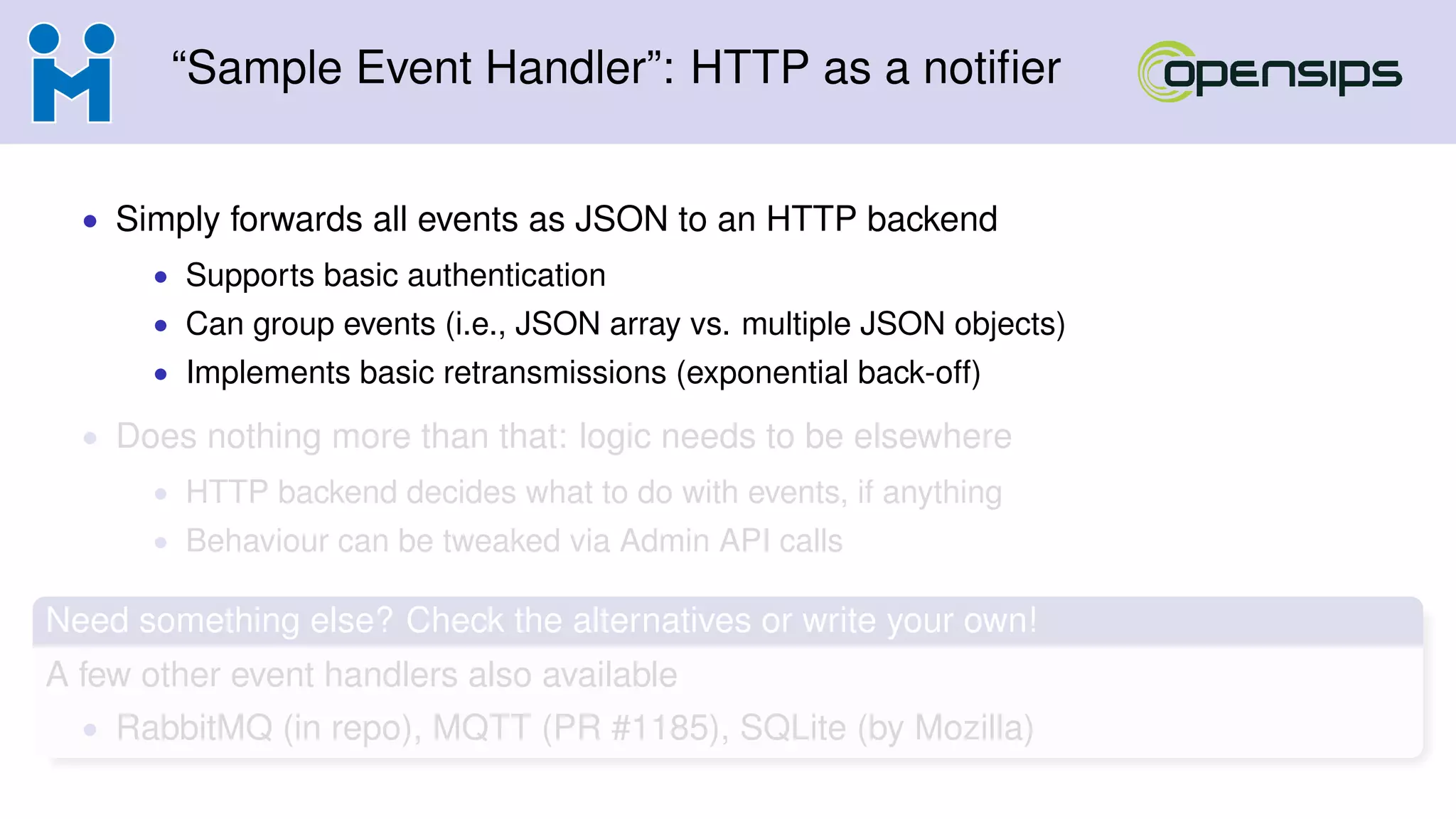
“Sample Event Handler”: HTTP as a notifier
• Simply forwards all events as JSON to an HTTP backend
• Supports basic authentication
• Can group events (i.e., JSON array vs. multiple JSON objects)
• Implements basic retransmissions (exponential back-off)
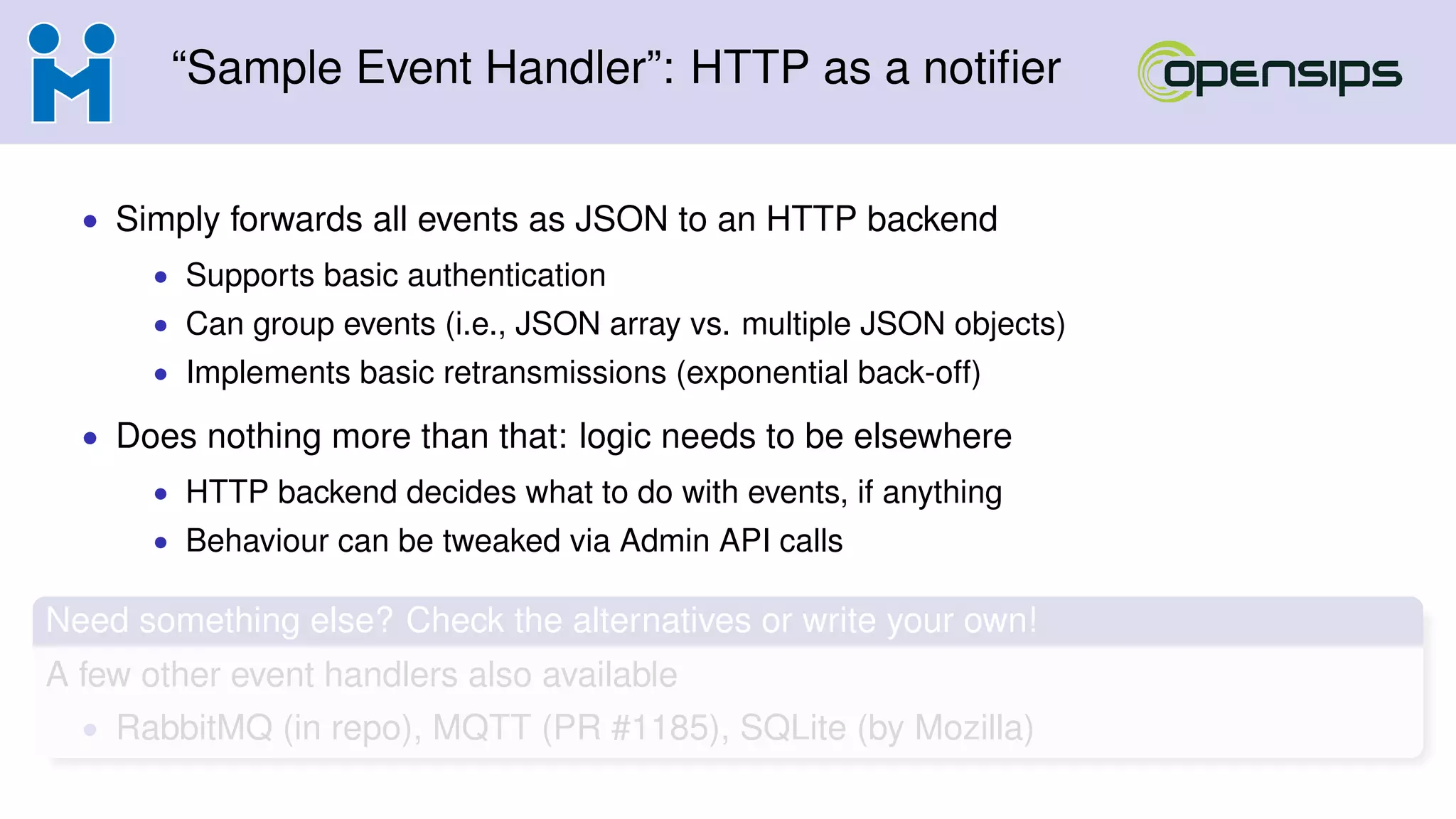
• Does nothing more than that: logic needs to be elsewhere
• HTTP backend decides what to do with events, if anything
• Behaviour can be tweaked via Admin API calls
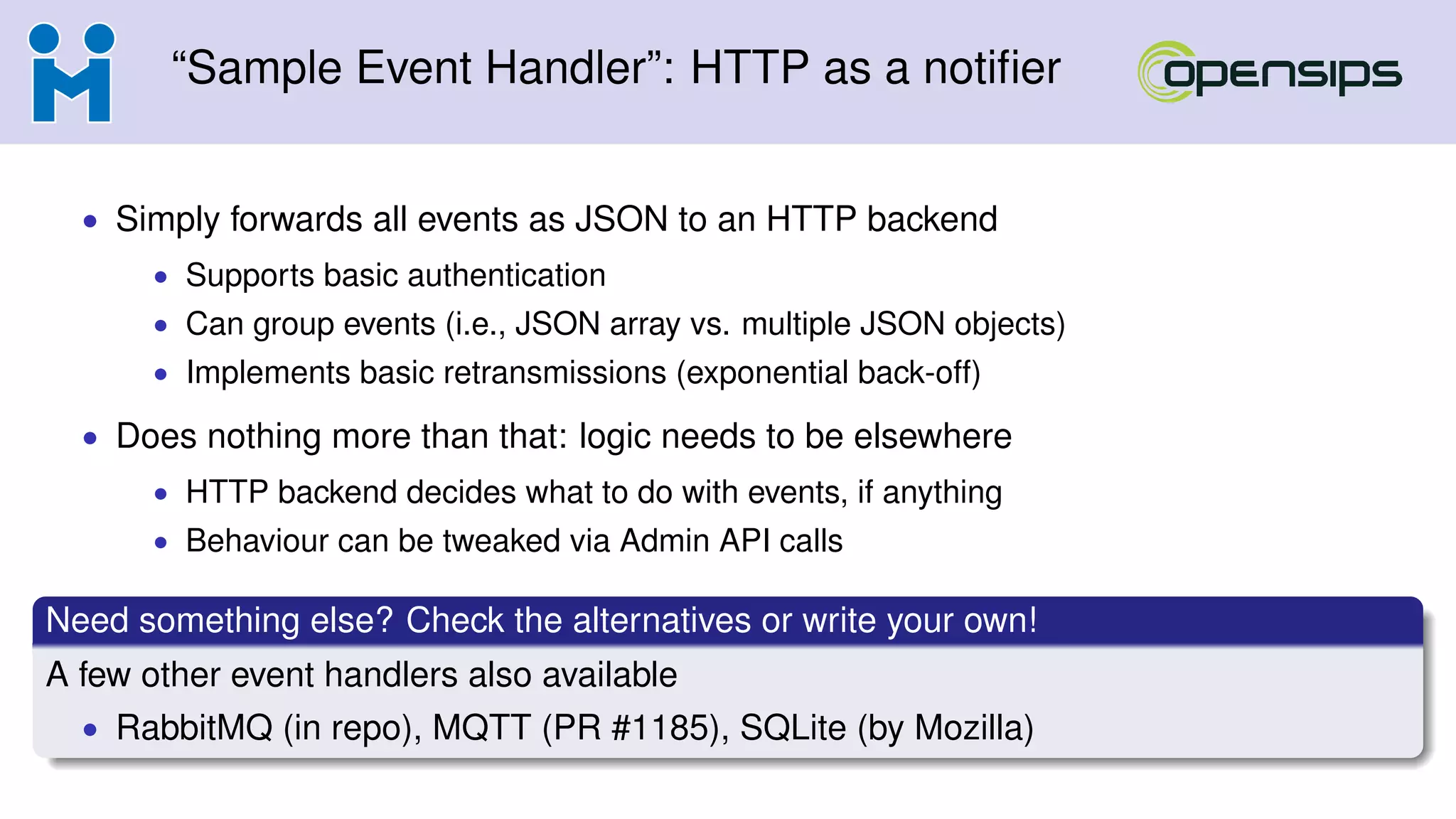
Need something else? Check the alternatives or write your own!
A few other event handlers also available
• RabbitMQ (in repo), MQTT (PR #1185), SQLite (by Mozilla)
“Sample Event Handler”: HTTP as a notifier
• Simply forwards all events as JSON to an HTTP backend
• Supports basic authentication
• Can group events (i.e., JSON array vs. multiple JSON objects)
• Implements basic retransmissions (exponential back-off)
• Does nothing more than that: logic needs to be elsewhere
• HTTP backend decides what to do with events, if anything
• Behaviour can be tweaked via Admin API calls
Need something else? Check the alternatives or write your own!
A few other event handlers also available
• RabbitMQ (in repo), MQTT (PR #1185), SQLite (by Mozilla)
“Sample Event Handler”: HTTP as a notifier
• Simply forwards all events as JSON to an HTTP backend
• Supports basic authentication
• Can group events (i.e., JSON array vs. multiple JSON objects)
• Implements basic retransmissions (exponential back-off)
• Does nothing more than that: logic needs to be elsewhere
• HTTP backend decides what to do with events, if anything
• Behaviour can be tweaked via Admin API calls
Need something else? Check the alternatives or write your own!
A few other event handlers also available
• RabbitMQ (in repo), MQTT (PR #1185), SQLite (by Mozilla)
How do we handle events, now?
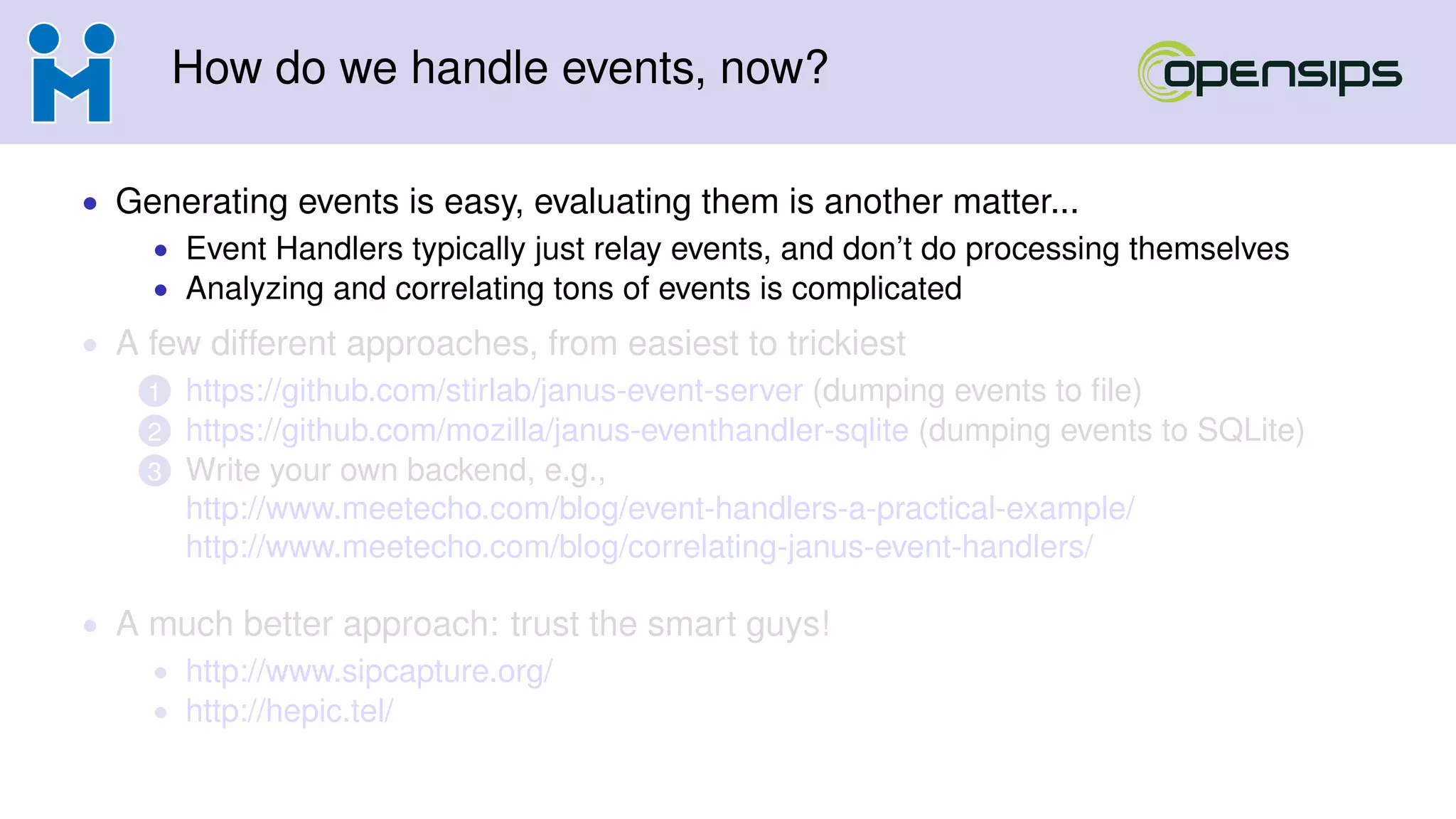
• Generating events is easy, evaluating them is another matter...
• Event Handlers typically just relay events, and don’t do processing themselves
• Analyzing and correlating tons of events is complicated
• A few different approaches, from easiest to trickiest
1 https://github.com/stirlab/janus-event-server (dumping events to file)
2 https://github.com/mozilla/janus-eventhandler-sqlite (dumping events to SQLite)
3 Write your own backend, e.g.,
http://www.meetecho.com/blog/event-handlers-a-practical-example/
http://www.meetecho.com/blog/correlating-janus-event-handlers/
• A much better approach: trust the smart guys!
• http://www.sipcapture.org/
• http://hepic.tel/
How do we handle events, now?
• Generating events is easy, evaluating them is another matter...
• Event Handlers typically just relay events, and don’t do processing themselves
• Analyzing and correlating tons of events is complicated
• A few different approaches, from easiest to trickiest
1 https://github.com/stirlab/janus-event-server (dumping events to file)
2 https://github.com/mozilla/janus-eventhandler-sqlite (dumping events to SQLite)
3 Write your own backend, e.g.,
http://www.meetecho.com/blog/event-handlers-a-practical-example/
http://www.meetecho.com/blog/correlating-janus-event-handlers/
• A much better approach: trust the smart guys!
• http://www.sipcapture.org/
• http://hepic.tel/
How do we handle events, now?
• Generating events is easy, evaluating them is another matter...
• Event Handlers typically just relay events, and don’t do processing themselves
• Analyzing and correlating tons of events is complicated
• A few different approaches, from easiest to trickiest
1 https://github.com/stirlab/janus-event-server (dumping events to file)
2 https://github.com/mozilla/janus-eventhandler-sqlite (dumping events to SQLite)
3 Write your own backend, e.g.,
http://www.meetecho.com/blog/event-handlers-a-practical-example/
http://www.meetecho.com/blog/correlating-janus-event-handlers/
• A much better approach: trust the smart guys!
• http://www.sipcapture.org/
• http://hepic.tel/
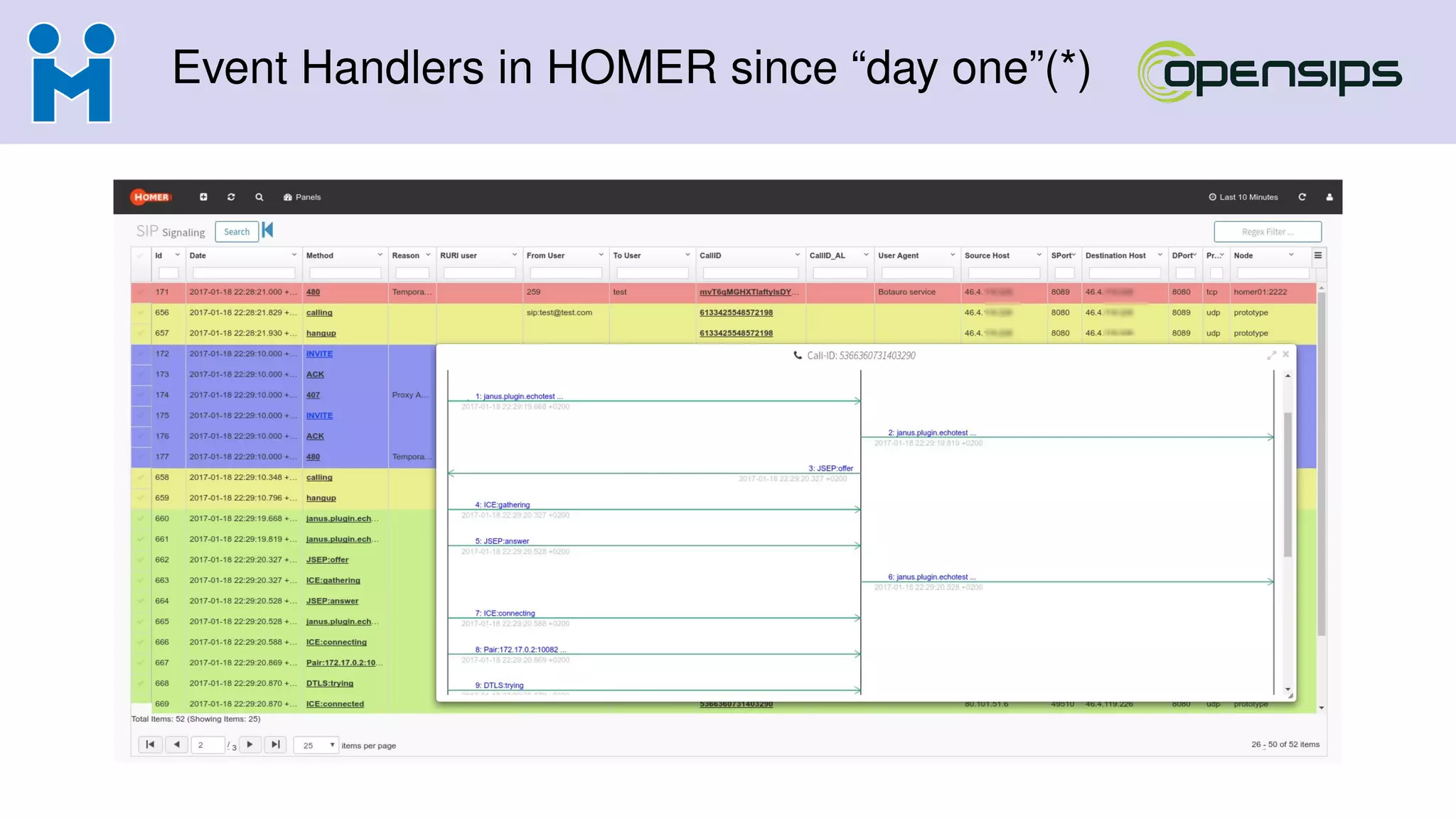
Event Handlers in HOMER since “day one”(*)
(*A trip down Memory Lane: FOSDEM 2017!)
https://archive.fosdem.org/2017/schedule/event/janus/
https://archive.fosdem.org/2017/schedule/event/homer/
From SIP to WebRTC
• As anticipated, Event Handlers were conceived in a chat with QXIP
• “How can I dump SIP messages with Sofia SIP?”
• “Which other events would be useful to have?”
• “What about a new modular approach, where HEP could be a plugin?”
• The only “caveat”: it was SIP only
• Only events coming from the SIP plugin were tracked, to follow the signalling
• Other events related to SIP handles only saved as “related info”
• Still very used and widespread, but limited to WebRTC/SIP scenarios
• Lately, big step to start tracking generic WebRTC applications instead
• How to handle users with more than one PeerConnection?
• How to relate a PeerConnection to another, for issues and more?
• How to reconstruct a session topology from the media perspective?
From SIP to WebRTC
• As anticipated, Event Handlers were conceived in a chat with QXIP
• “How can I dump SIP messages with Sofia SIP?”
• “Which other events would be useful to have?”
• “What about a new modular approach, where HEP could be a plugin?”
• The only “caveat”: it was SIP only
• Only events coming from the SIP plugin were tracked, to follow the signalling
• Other events related to SIP handles only saved as “related info”
• Still very used and widespread, but limited to WebRTC/SIP scenarios
• Lately, big step to start tracking generic WebRTC applications instead
• How to handle users with more than one PeerConnection?
• How to relate a PeerConnection to another, for issues and more?
• How to reconstruct a session topology from the media perspective?
From SIP to WebRTC
• As anticipated, Event Handlers were conceived in a chat with QXIP
• “How can I dump SIP messages with Sofia SIP?”
• “Which other events would be useful to have?”
• “What about a new modular approach, where HEP could be a plugin?”
• The only “caveat”: it was SIP only
• Only events coming from the SIP plugin were tracked, to follow the signalling
• Other events related to SIP handles only saved as “related info”
• Still very used and widespread, but limited to WebRTC/SIP scenarios
• Lately, big step to start tracking generic WebRTC applications instead
• How to handle users with more than one PeerConnection?
• How to relate a PeerConnection to another, for issues and more?
• How to reconstruct a session topology from the media perspective?
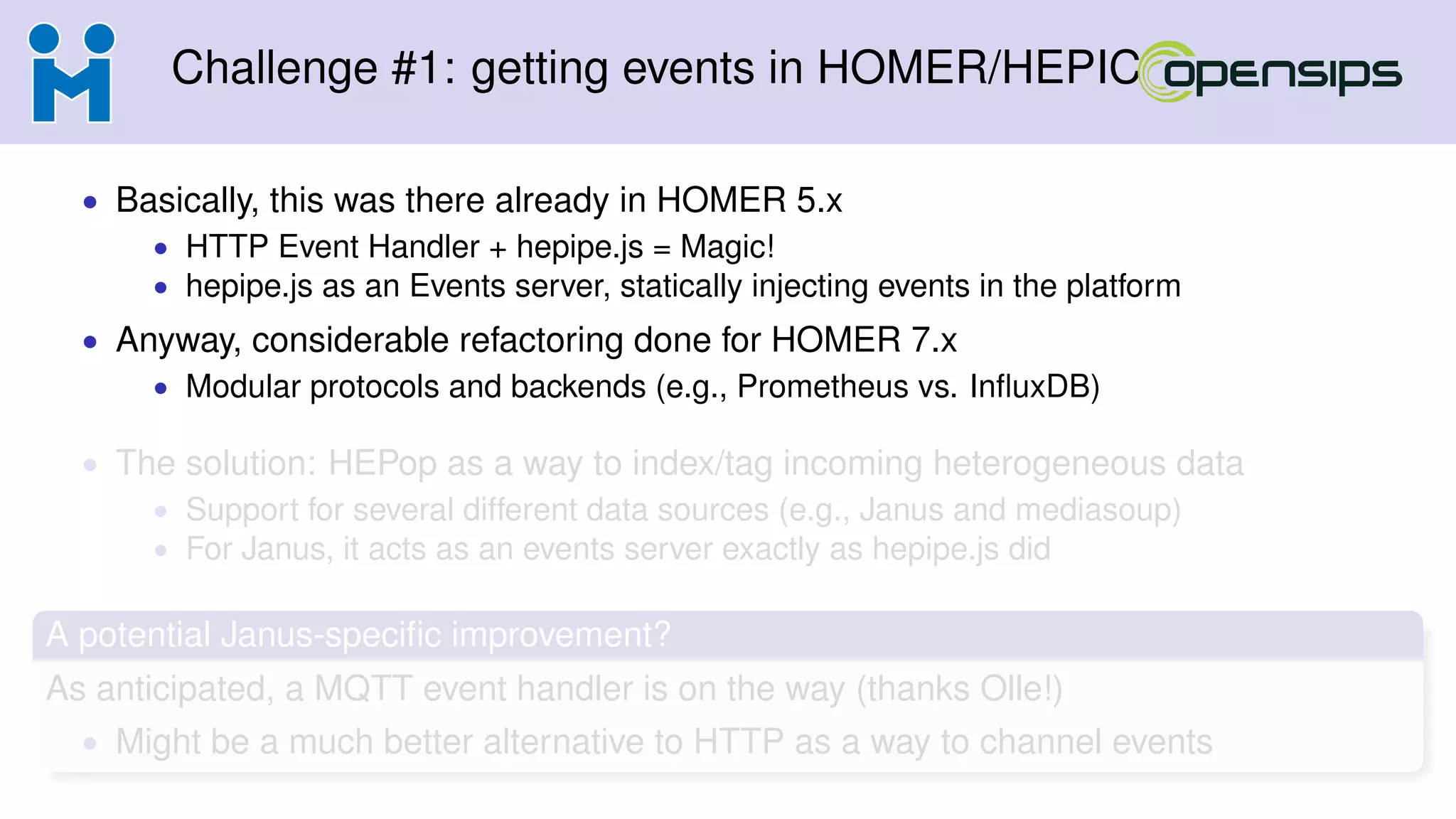
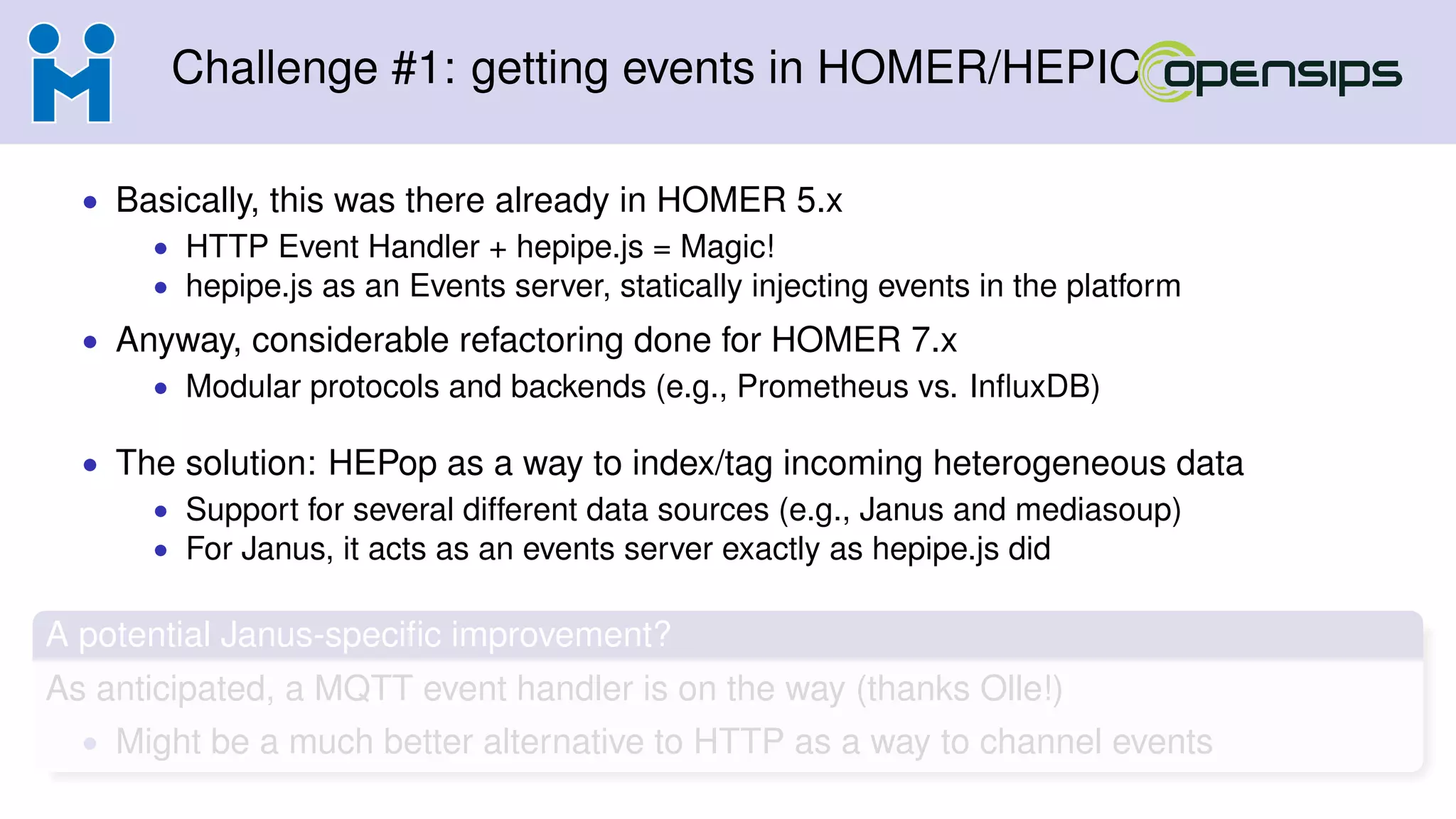
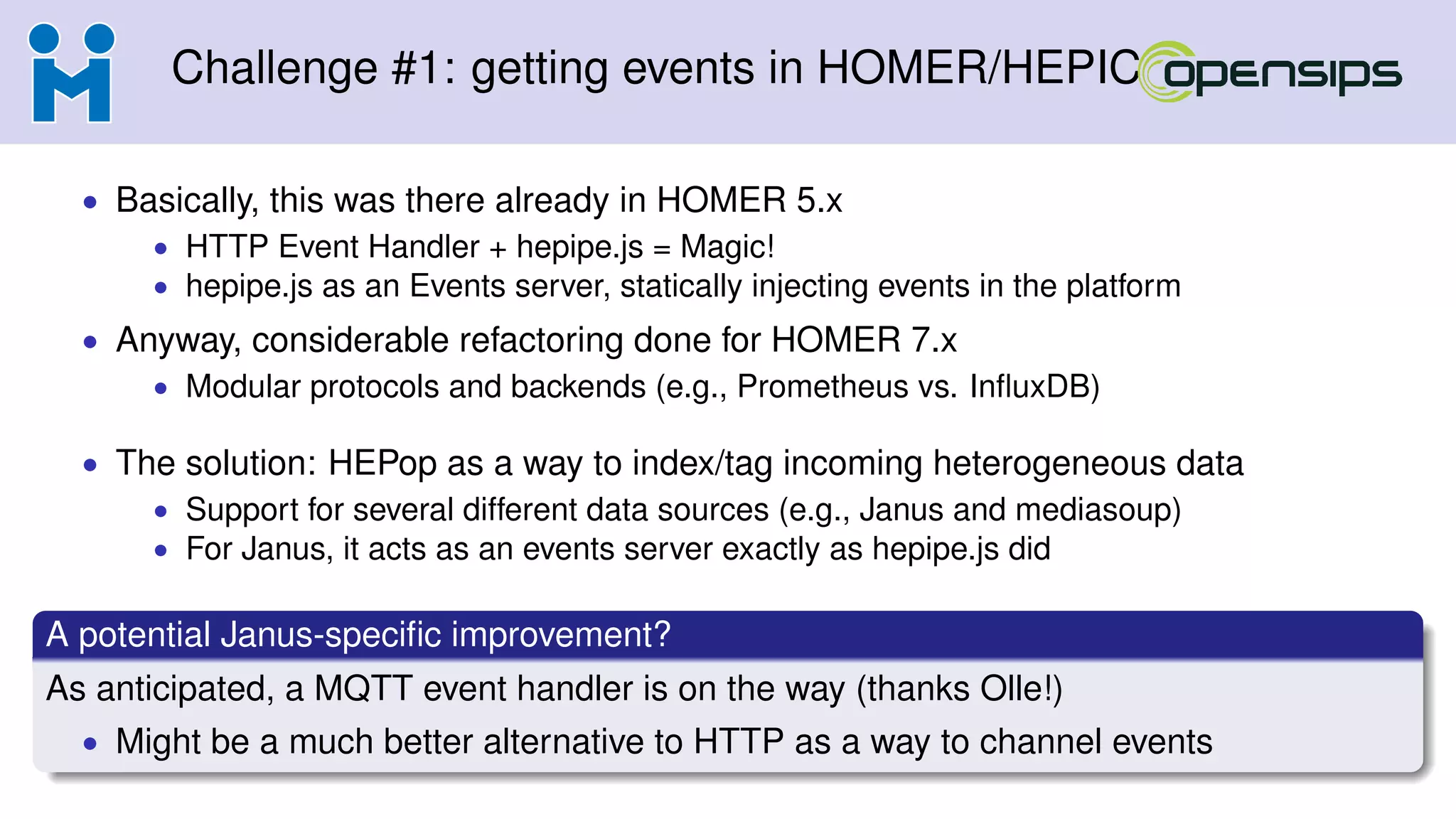
Challenge #1: getting events in HOMER/HEPIC
• Basically, this was there already in HOMER 5.x
• HTTP Event Handler + hepipe.js = Magic!
• hepipe.js as an Events server, statically injecting events in the platform
• Anyway, considerable refactoring done for HOMER 7.x
• Modular protocols and backends (e.g., Prometheus vs. InfluxDB)
• The solution: HEPop as a way to index/tag incoming heterogeneous data
• Support for several different data sources (e.g., Janus and mediasoup)
• For Janus, it acts as an events server exactly as hepipe.js did
A potential Janus-specific improvement?
As anticipated, a MQTT event handler is on the way (thanks Olle!)
• Might be a much better alternative to HTTP as a way to channel events
Challenge #1: getting events in HOMER/HEPIC
• Basically, this was there already in HOMER 5.x
• HTTP Event Handler + hepipe.js = Magic!
• hepipe.js as an Events server, statically injecting events in the platform
• Anyway, considerable refactoring done for HOMER 7.x
• Modular protocols and backends (e.g., Prometheus vs. InfluxDB)
• The solution: HEPop as a way to index/tag incoming heterogeneous data
• Support for several different data sources (e.g., Janus and mediasoup)
• For Janus, it acts as an events server exactly as hepipe.js did
A potential Janus-specific improvement?
As anticipated, a MQTT event handler is on the way (thanks Olle!)
• Might be a much better alternative to HTTP as a way to channel events
Challenge #1: getting events in HOMER/HEPIC
• Basically, this was there already in HOMER 5.x
• HTTP Event Handler + hepipe.js = Magic!
• hepipe.js as an Events server, statically injecting events in the platform
• Anyway, considerable refactoring done for HOMER 7.x
• Modular protocols and backends (e.g., Prometheus vs. InfluxDB)
• The solution: HEPop as a way to index/tag incoming heterogeneous data
• Support for several different data sources (e.g., Janus and mediasoup)
• For Janus, it acts as an events server exactly as hepipe.js did
A potential Janus-specific improvement?
As anticipated, a MQTT event handler is on the way (thanks Olle!)
• Might be a much better alternative to HTTP as a way to channel events
Challenge #1: getting events in HOMER/HEPIC
• Basically, this was there already in HOMER 5.x
• HTTP Event Handler + hepipe.js = Magic!
• hepipe.js as an Events server, statically injecting events in the platform
• Anyway, considerable refactoring done for HOMER 7.x
• Modular protocols and backends (e.g., Prometheus vs. InfluxDB)
• The solution: HEPop as a way to index/tag incoming heterogeneous data
• Support for several different data sources (e.g., Janus and mediasoup)
• For Janus, it acts as an events server exactly as hepipe.js did
A potential Janus-specific improvement?
As anticipated, a MQTT event handler is on the way (thanks Olle!)
• Might be a much better alternative to HTTP as a way to channel events
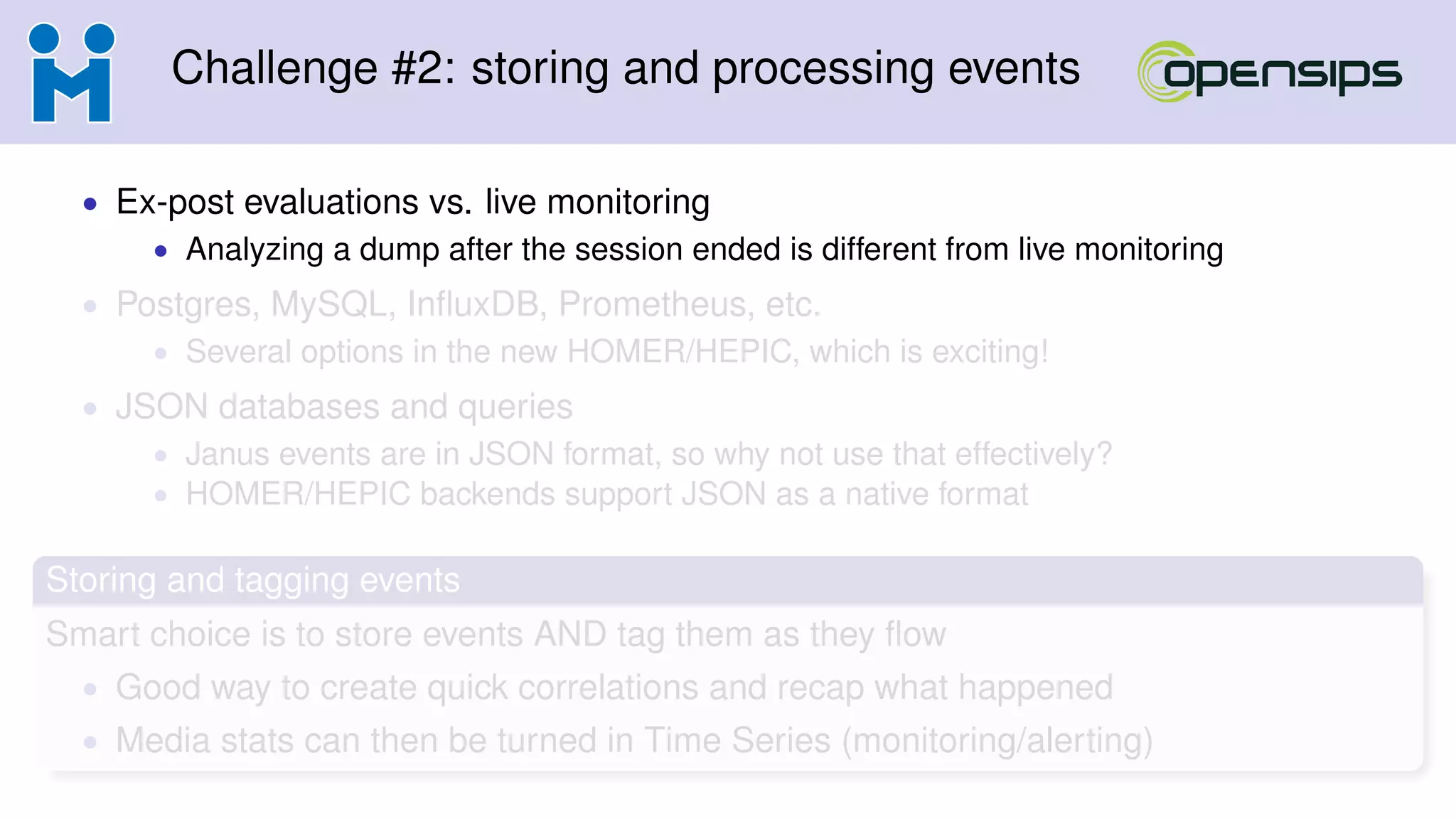
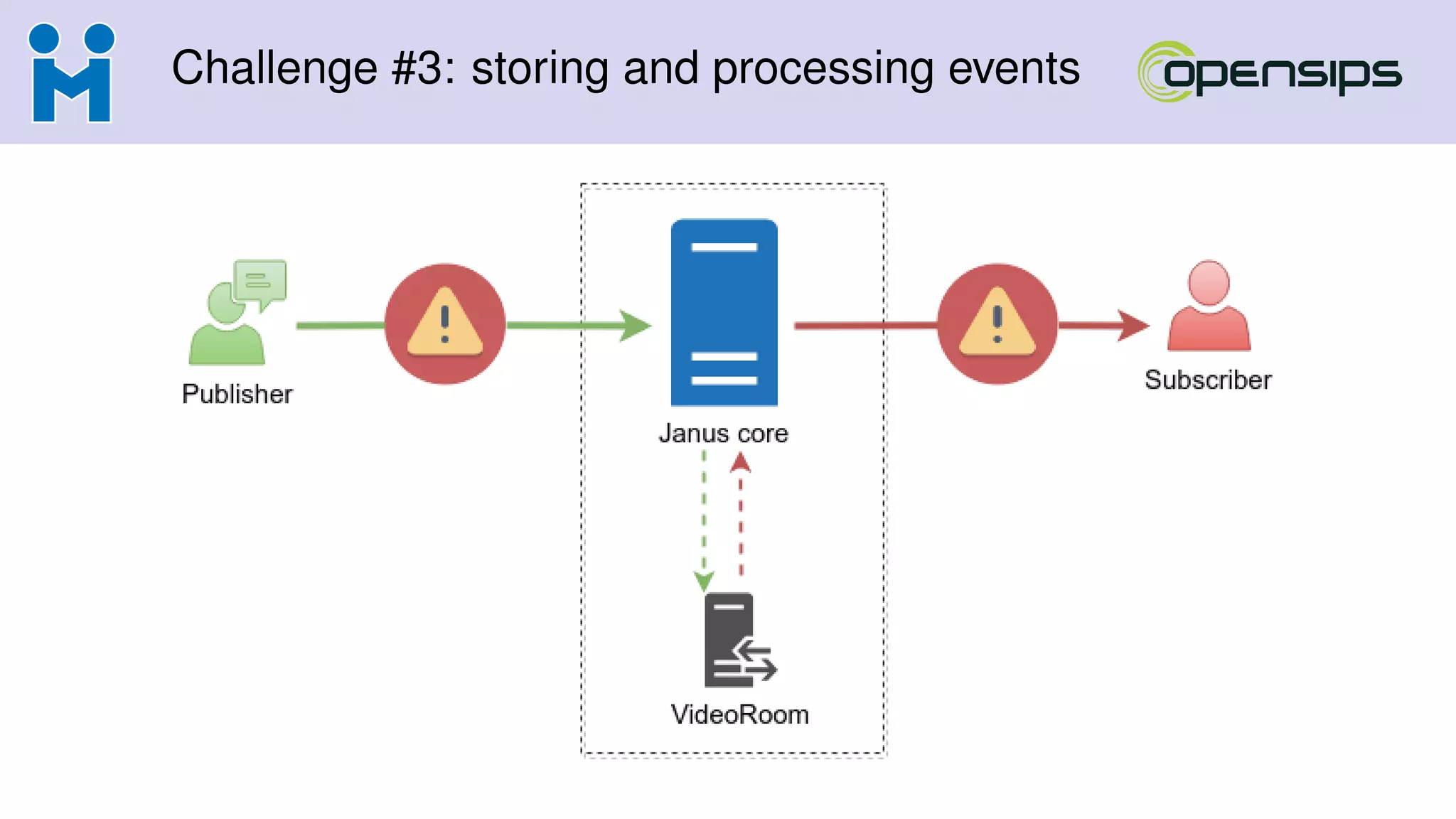
Challenge #2: storing and processing events
• Ex-post evaluations vs. live monitoring
• Analyzing a dump after the session ended is different from live monitoring
• Postgres, MySQL, InfluxDB, Prometheus, etc.
• Several options in the new HOMER/HEPIC, which is exciting!
• JSON databases and queries
• Janus events are in JSON format, so why not use that effectively?
• HOMER/HEPIC backends support JSON as a native format
Storing and tagging events
Smart choice is to store events AND tag them as they flow
• Good way to create quick correlations and recap what happened
• Media stats can then be turned in Time Series (monitoring/alerting)
Challenge #2: storing and processing events
• Ex-post evaluations vs. live monitoring
• Analyzing a dump after the session ended is different from live monitoring
• Postgres, MySQL, InfluxDB, Prometheus, etc.
• Several options in the new HOMER/HEPIC, which is exciting!
• JSON databases and queries
• Janus events are in JSON format, so why not use that effectively?
• HOMER/HEPIC backends support JSON as a native format
Storing and tagging events
Smart choice is to store events AND tag them as they flow
• Good way to create quick correlations and recap what happened
• Media stats can then be turned in Time Series (monitoring/alerting)
Challenge #2: storing and processing events
• Ex-post evaluations vs. live monitoring
• Analyzing a dump after the session ended is different from live monitoring
• Postgres, MySQL, InfluxDB, Prometheus, etc.
• Several options in the new HOMER/HEPIC, which is exciting!
• JSON databases and queries
• Janus events are in JSON format, so why not use that effectively?
• HOMER/HEPIC backends support JSON as a native format
Storing and tagging events
Smart choice is to store events AND tag them as they flow
• Good way to create quick correlations and recap what happened
• Media stats can then be turned in Time Series (monitoring/alerting)
Challenge #2: storing and processing events
• Ex-post evaluations vs. live monitoring
• Analyzing a dump after the session ended is different from live monitoring
• Postgres, MySQL, InfluxDB, Prometheus, etc.
• Several options in the new HOMER/HEPIC, which is exciting!
• JSON databases and queries
• Janus events are in JSON format, so why not use that effectively?
• HOMER/HEPIC backends support JSON as a native format
Storing and tagging events
Smart choice is to store events AND tag them as they flow
• Good way to create quick correlations and recap what happened
• Media stats can then be turned in Time Series (monitoring/alerting)
Challenge #3: correlating events
• Sessions might be used to identify users, but can’t always be “trusted”
• Works fine when users talk to Janus directly (1↔1 relationship)
• There are server-side applications with a single session for all users, though
• Enter opaque_id: a client-provided opaque identifier
• Just set the same opaque ID for all handles belonging to the same user
• The opaque ID can be whatever you want, Janus doesn’t care
• Useful for intra-plugin, but also inter-plugin, correlations
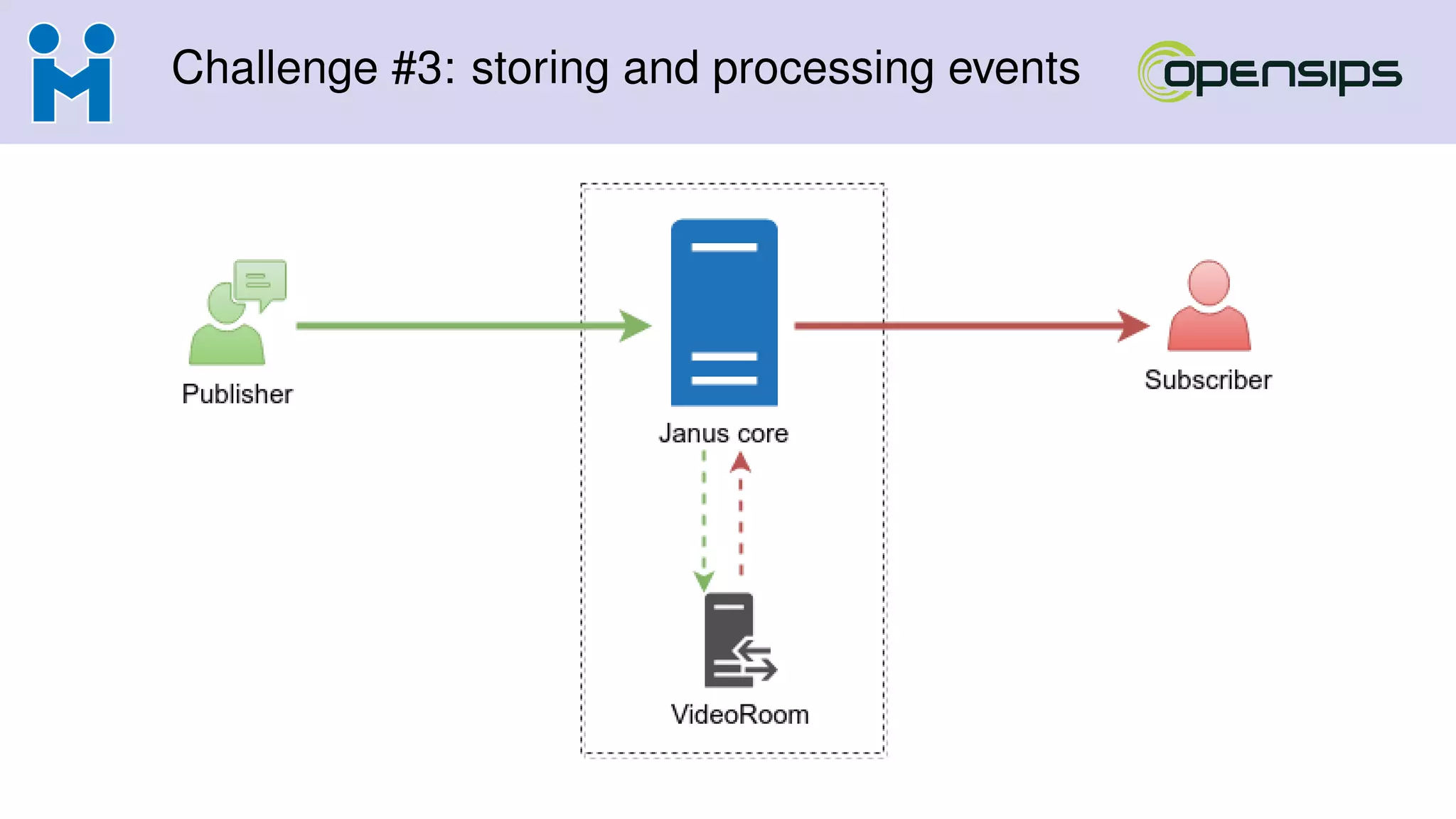
• e.g., to know a user is publishing and subscribing in a VideoRoom
• ... but also, for instance, in a SIP call in the same application
Want to learn more?
http://www.meetecho.com/blog/correlating-janus-event-handlers/
Challenge #3: correlating events
• Sessions might be used to identify users, but can’t always be “trusted”
• Works fine when users talk to Janus directly (1↔1 relationship)
• There are server-side applications with a single session for all users, though
• Enter opaque_id: a client-provided opaque identifier
• Just set the same opaque ID for all handles belonging to the same user
• The opaque ID can be whatever you want, Janus doesn’t care
• Useful for intra-plugin, but also inter-plugin, correlations
• e.g., to know a user is publishing and subscribing in a VideoRoom
• ... but also, for instance, in a SIP call in the same application
Want to learn more?
http://www.meetecho.com/blog/correlating-janus-event-handlers/
Challenge #3: correlating events
• Sessions might be used to identify users, but can’t always be “trusted”
• Works fine when users talk to Janus directly (1↔1 relationship)
• There are server-side applications with a single session for all users, though
• Enter opaque_id: a client-provided opaque identifier
• Just set the same opaque ID for all handles belonging to the same user
• The opaque ID can be whatever you want, Janus doesn’t care
• Useful for intra-plugin, but also inter-plugin, correlations
• e.g., to know a user is publishing and subscribing in a VideoRoom
• ... but also, for instance, in a SIP call in the same application
Want to learn more?
http://www.meetecho.com/blog/correlating-janus-event-handlers/
Challenge #3: correlating events
• Sessions might be used to identify users, but can’t always be “trusted”
• Works fine when users talk to Janus directly (1↔1 relationship)
• There are server-side applications with a single session for all users, though
• Enter opaque_id: a client-provided opaque identifier
• Just set the same opaque ID for all handles belonging to the same user
• The opaque ID can be whatever you want, Janus doesn’t care
• Useful for intra-plugin, but also inter-plugin, correlations
• e.g., to know a user is publishing and subscribing in a VideoRoom
• ... but also, for instance, in a SIP call in the same application
Want to learn more?
http://www.meetecho.com/blog/correlating-janus-event-handlers/
Challenge #3: storing and processing events
Challenge #4: client-side events
• All the discussion so far has been for server-side events
• Janus originates events for what happens there
• What about the client side perspective?
• In WebRTC, standard mechanism for getting statistics on a PeerConnection
• https://www.w3.org/TR/webrtc-stats/
• Calls to getStats() return useful info, but in JavaScript
• How to get it to HOMER/HEPIC, possibly via Janus/Event Handlers as well?
Solution: a new Janus plugin!
• Client attaches and sends stats on a regular basis to the plugin via Janus API
• Plugin relays stats via Event Handlers (same opaque ID as media channels)
• Note: still WIP (working demo using rtcstats), but not open source yet
Challenge #4: client-side events
• All the discussion so far has been for server-side events
• Janus originates events for what happens there
• What about the client side perspective?
• In WebRTC, standard mechanism for getting statistics on a PeerConnection
• https://www.w3.org/TR/webrtc-stats/
• Calls to getStats() return useful info, but in JavaScript
• How to get it to HOMER/HEPIC, possibly via Janus/Event Handlers as well?
Solution: a new Janus plugin!
• Client attaches and sends stats on a regular basis to the plugin via Janus API
• Plugin relays stats via Event Handlers (same opaque ID as media channels)
• Note: still WIP (working demo using rtcstats), but not open source yet
Challenge #4: client-side events
• All the discussion so far has been for server-side events
• Janus originates events for what happens there
• What about the client side perspective?
• In WebRTC, standard mechanism for getting statistics on a PeerConnection
• https://www.w3.org/TR/webrtc-stats/
• Calls to getStats() return useful info, but in JavaScript
• How to get it to HOMER/HEPIC, possibly via Janus/Event Handlers as well?
Solution: a new Janus plugin!
• Client attaches and sends stats on a regular basis to the plugin via Janus API
• Plugin relays stats via Event Handlers (same opaque ID as media channels)
• Note: still WIP (working demo using rtcstats), but not open source yet
Challenge #4: client-side events
• All the discussion so far has been for server-side events
• Janus originates events for what happens there
• What about the client side perspective?
• In WebRTC, standard mechanism for getting statistics on a PeerConnection
• https://www.w3.org/TR/webrtc-stats/
• Calls to getStats() return useful info, but in JavaScript
• How to get it to HOMER/HEPIC, possibly via Janus/Event Handlers as well?
Solution: a new Janus plugin!
• Client attaches and sends stats on a regular basis to the plugin via Janus API
• Plugin relays stats via Event Handlers (same opaque ID as media channels)
• Note: still WIP (working demo using rtcstats), but not open source yet
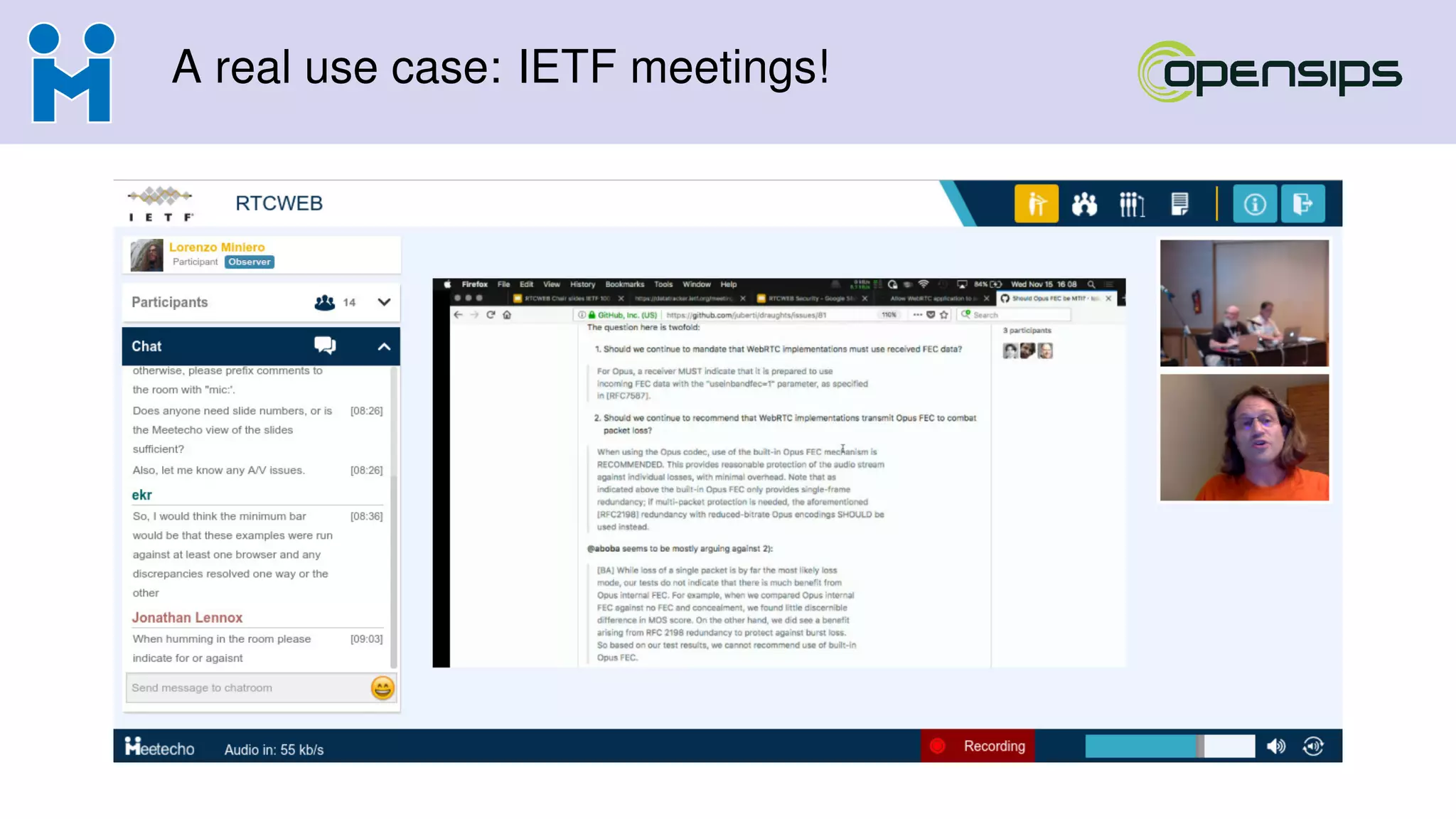
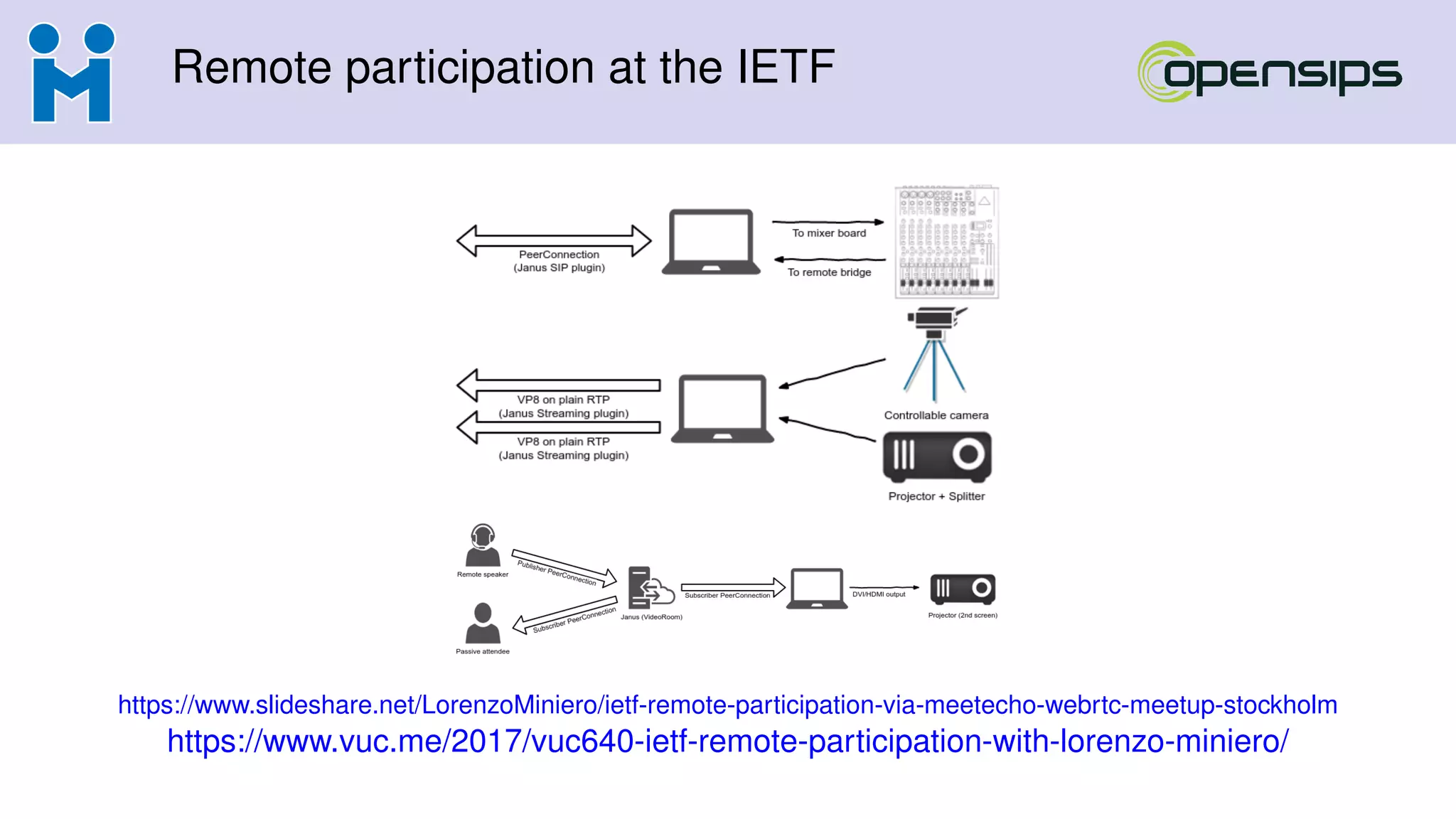
A real use case: IETF meetings!
Remote participation at the IETF
https://www.slideshare.net/LorenzoMiniero/ietf-remote-participation-via-meetecho-webrtc-meetup-stockholm
https://www.vuc.me/2017/vuc640-ietf-remote-participation-with-lorenzo-miniero/
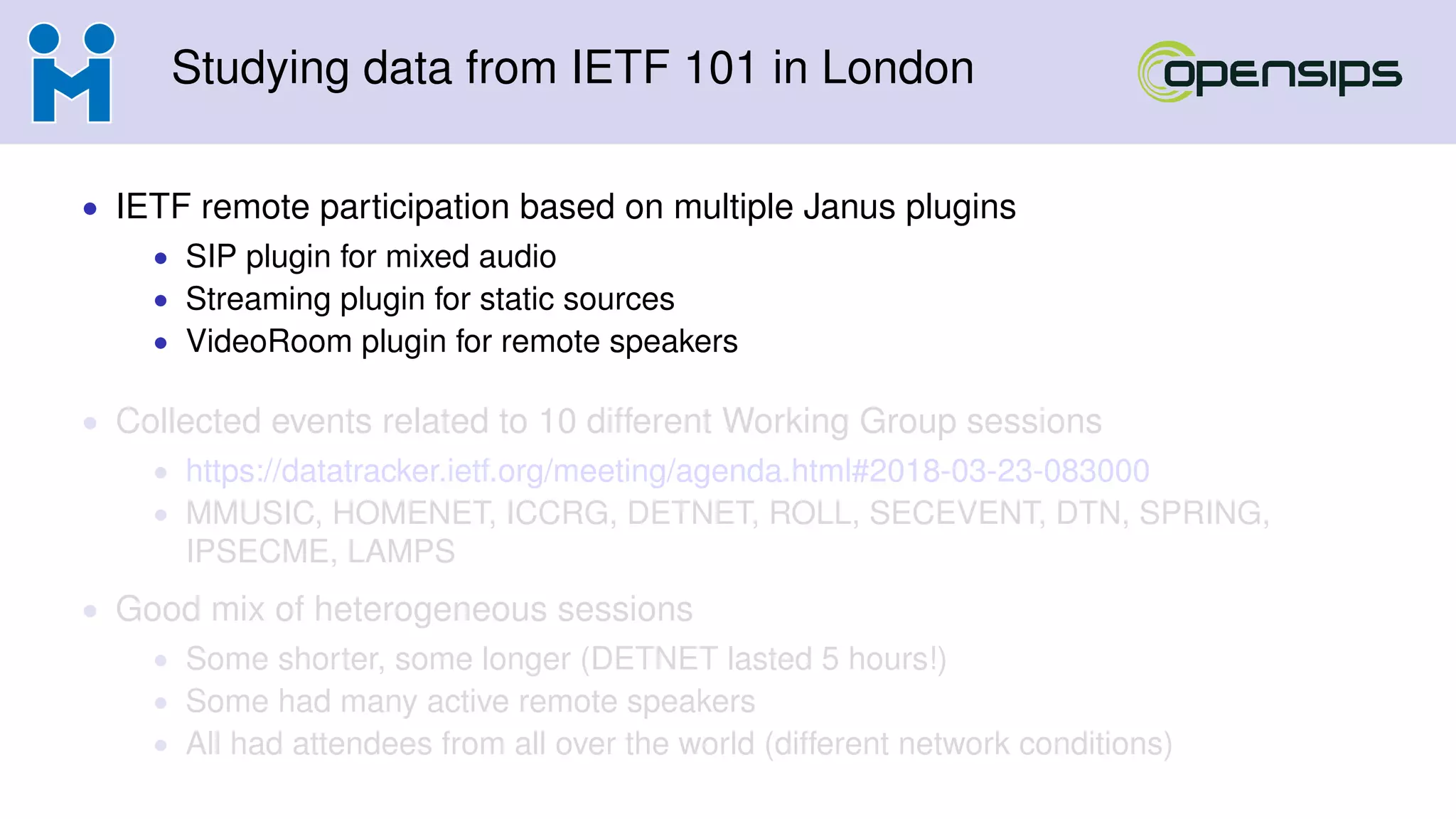
Studying data from IETF 101 in London
• IETF remote participation based on multiple Janus plugins
• SIP plugin for mixed audio
• Streaming plugin for static sources
• VideoRoom plugin for remote speakers
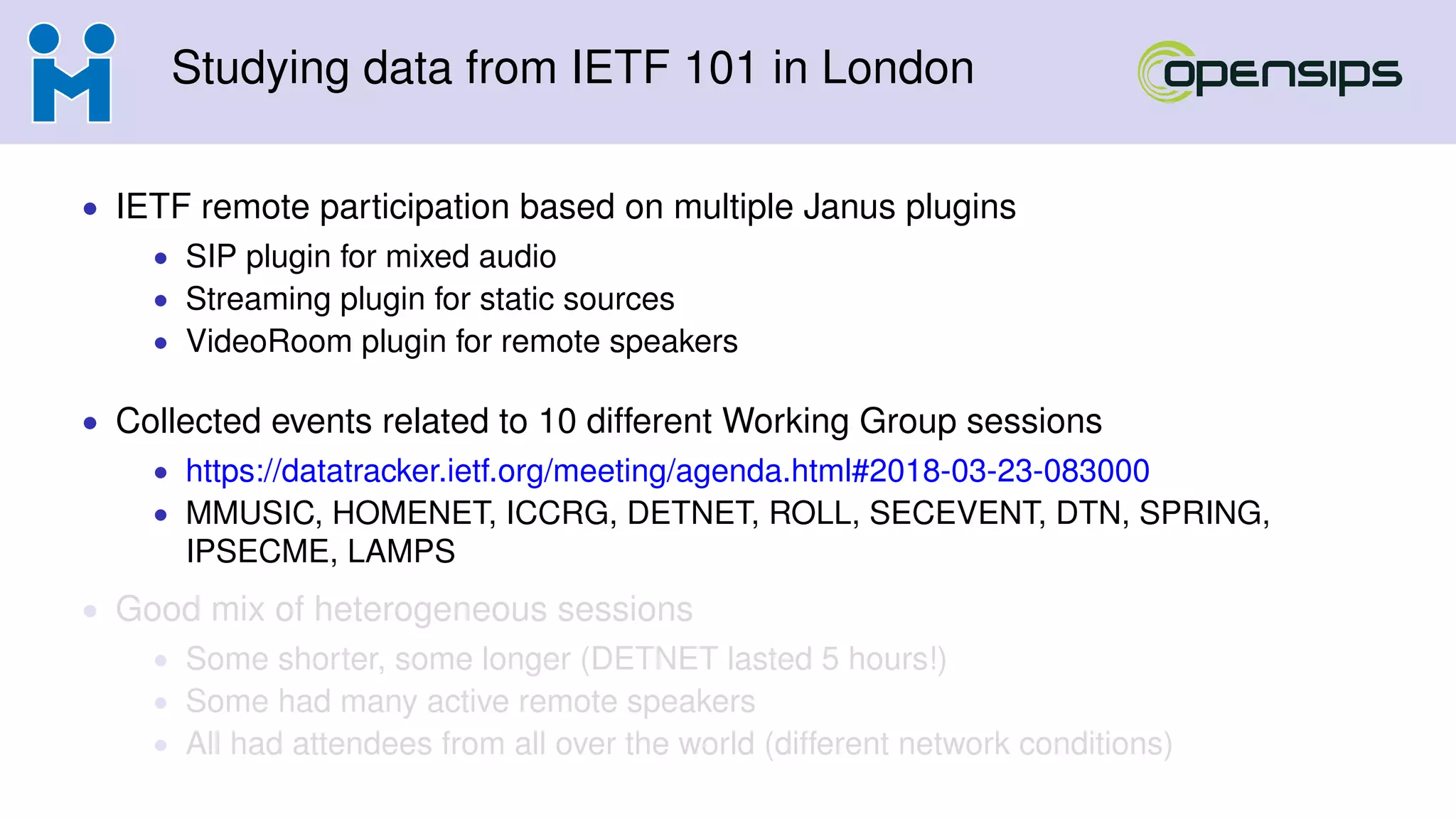
• Collected events related to 10 different Working Group sessions
• https://datatracker.ietf.org/meeting/agenda.html#2018-03-23-083000
• MMUSIC, HOMENET, ICCRG, DETNET, ROLL, SECEVENT, DTN, SPRING,
IPSECME, LAMPS
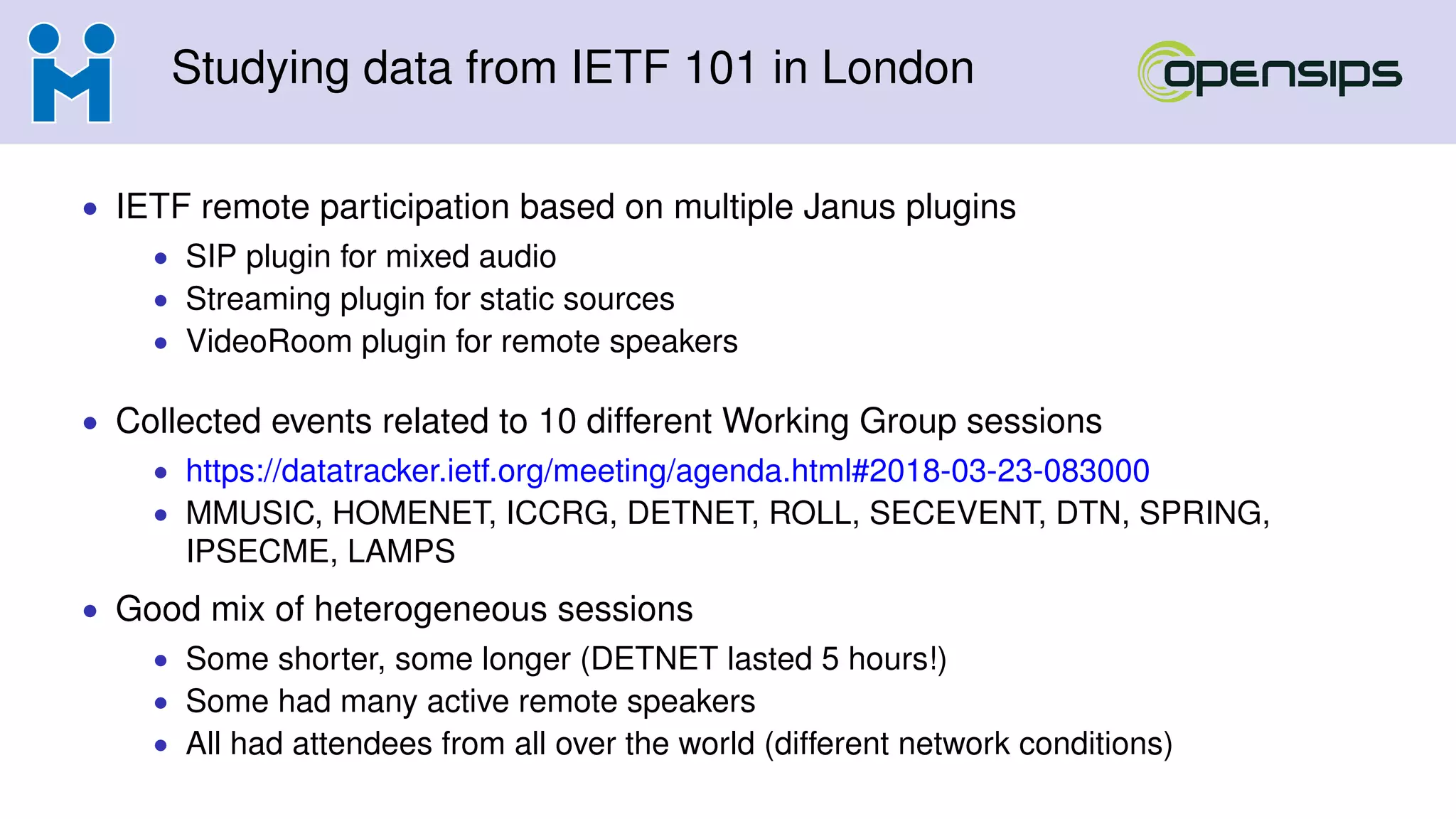
• Good mix of heterogeneous sessions
• Some shorter, some longer (DETNET lasted 5 hours!)
• Some had many active remote speakers
• All had attendees from all over the world (different network conditions)
Studying data from IETF 101 in London
• IETF remote participation based on multiple Janus plugins
• SIP plugin for mixed audio
• Streaming plugin for static sources
• VideoRoom plugin for remote speakers
• Collected events related to 10 different Working Group sessions
• https://datatracker.ietf.org/meeting/agenda.html#2018-03-23-083000
• MMUSIC, HOMENET, ICCRG, DETNET, ROLL, SECEVENT, DTN, SPRING,
IPSECME, LAMPS
• Good mix of heterogeneous sessions
• Some shorter, some longer (DETNET lasted 5 hours!)
• Some had many active remote speakers
• All had attendees from all over the world (different network conditions)
Studying data from IETF 101 in London
• IETF remote participation based on multiple Janus plugins
• SIP plugin for mixed audio
• Streaming plugin for static sources
• VideoRoom plugin for remote speakers
• Collected events related to 10 different Working Group sessions
• https://datatracker.ietf.org/meeting/agenda.html#2018-03-23-083000
• MMUSIC, HOMENET, ICCRG, DETNET, ROLL, SECEVENT, DTN, SPRING,
IPSECME, LAMPS
• Good mix of heterogeneous sessions
• Some shorter, some longer (DETNET lasted 5 hours!)
• Some had many active remote speakers
• All had attendees from all over the world (different network conditions)
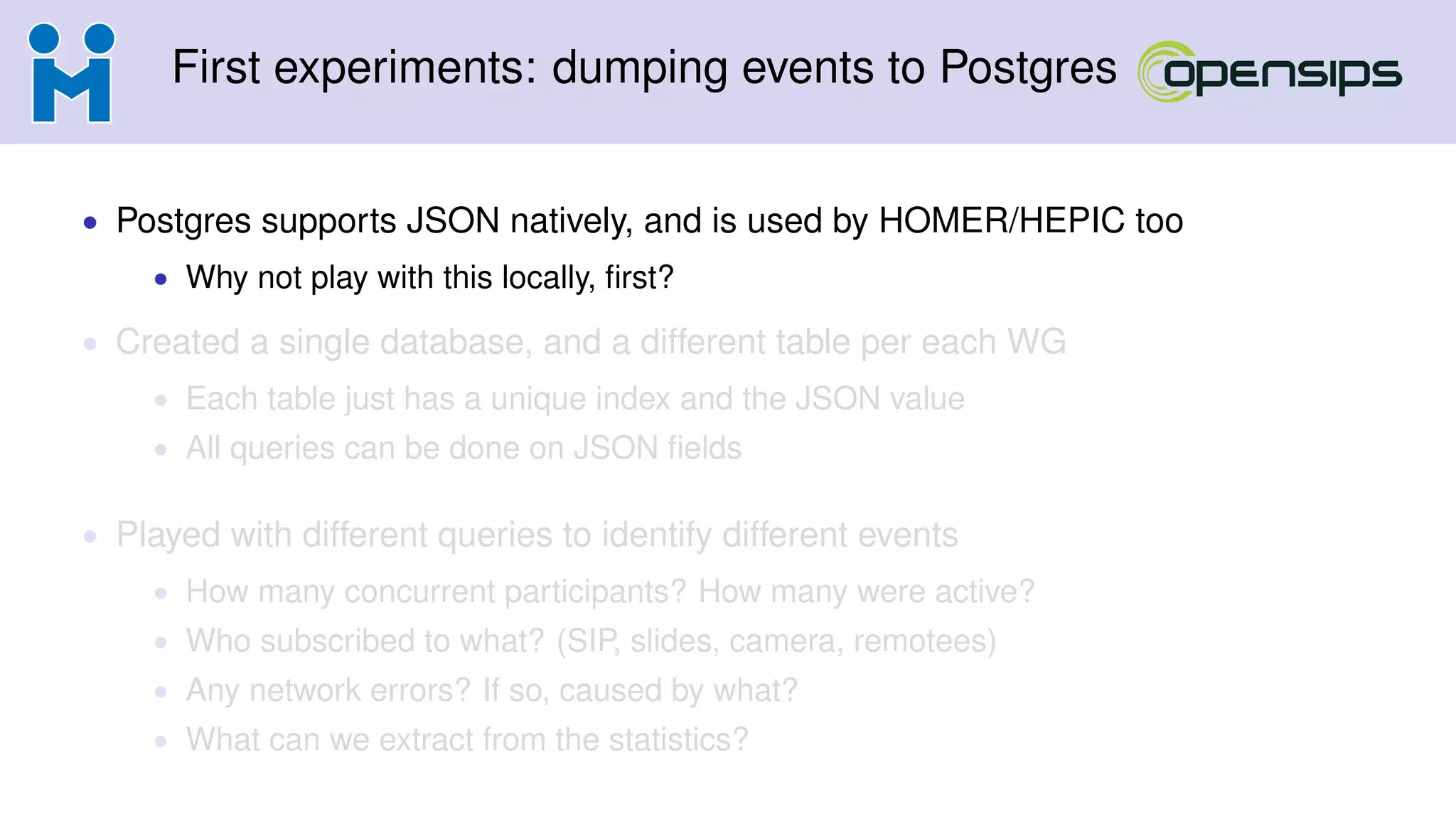
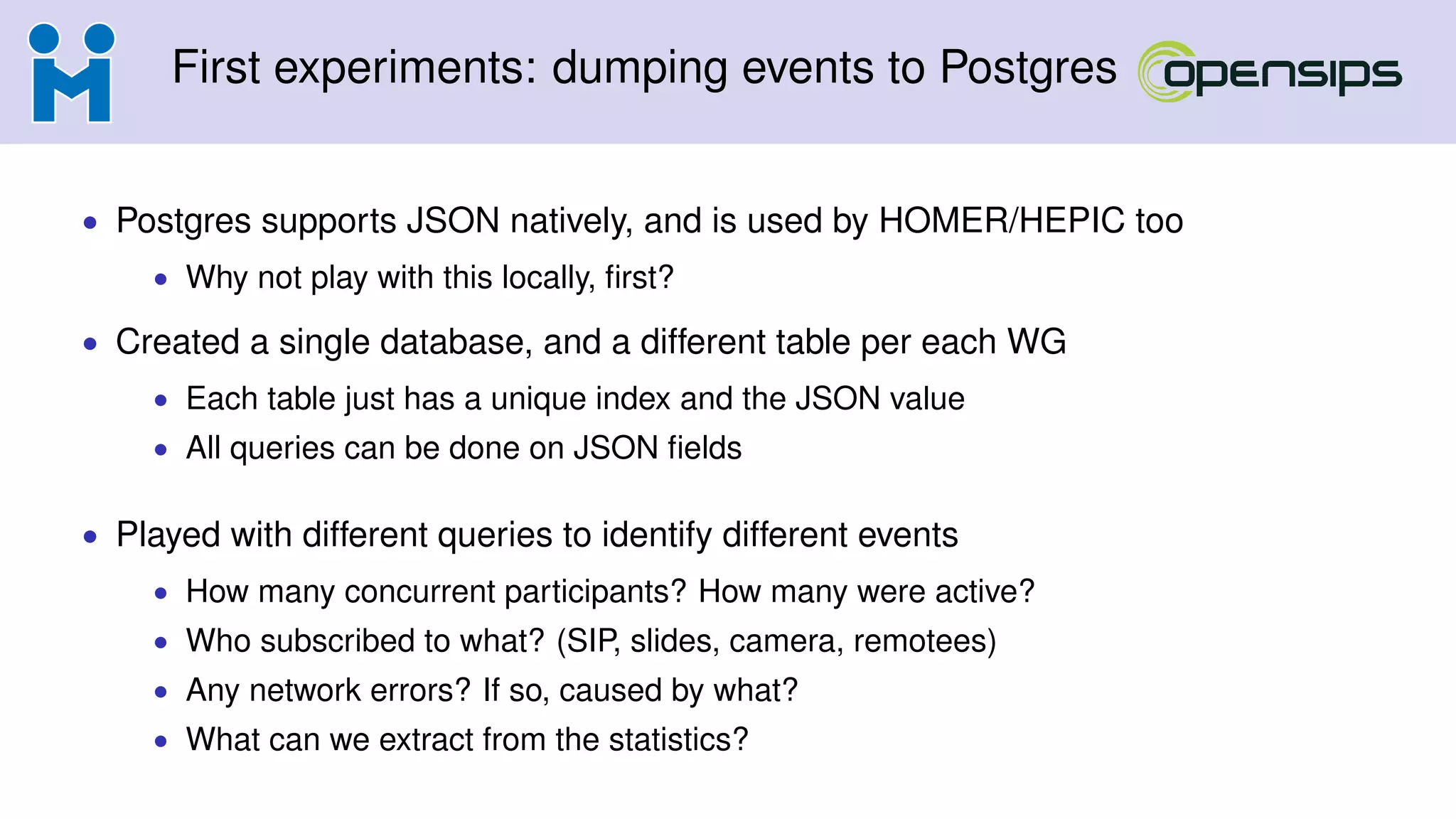
First experiments: dumping events to Postgres
• Postgres supports JSON natively, and is used by HOMER/HEPIC too
• Why not play with this locally, first?
• Created a single database, and a different table per each WG
• Each table just has a unique index and the JSON value
• All queries can be done on JSON fields
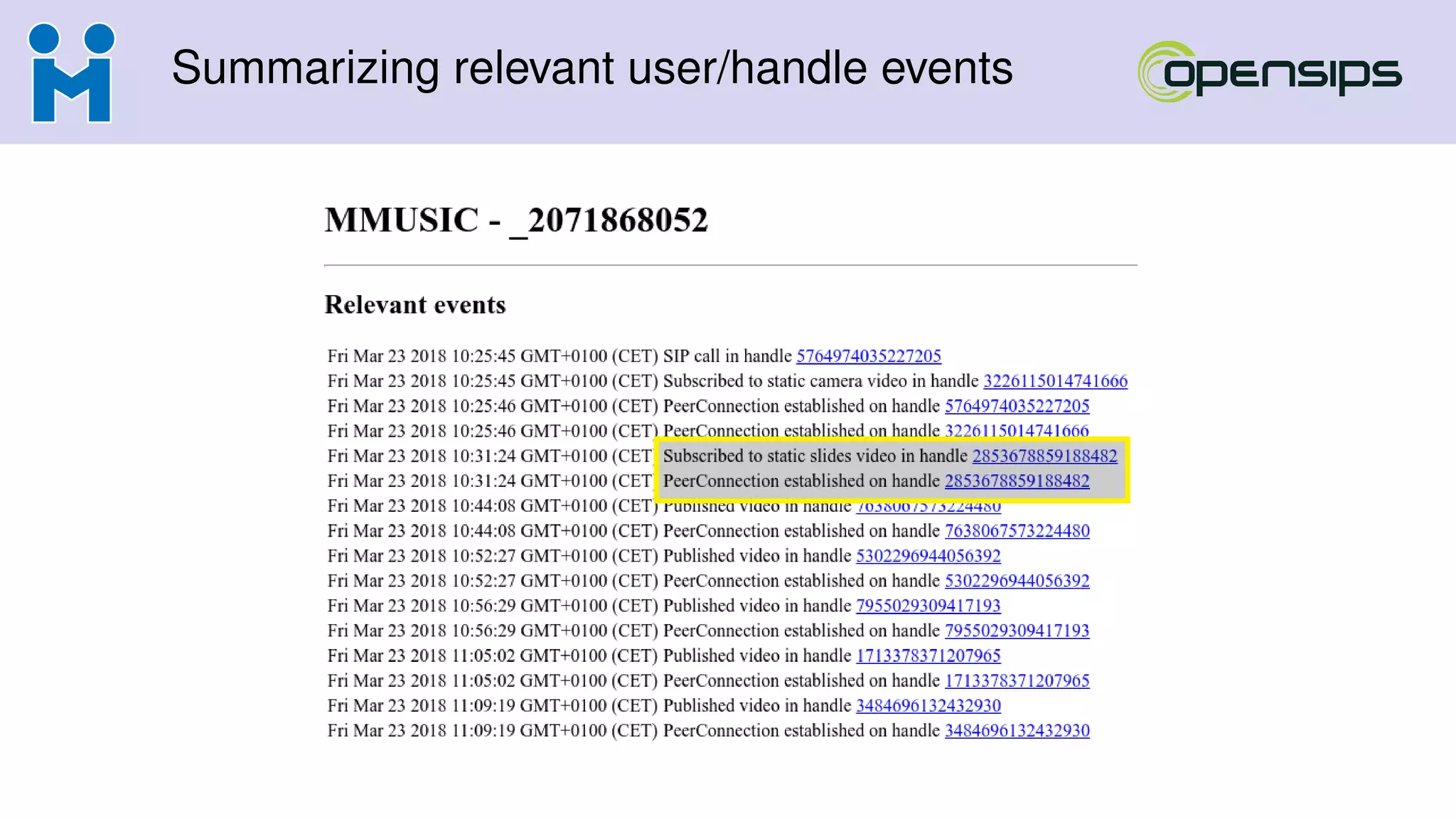
• Played with different queries to identify different events
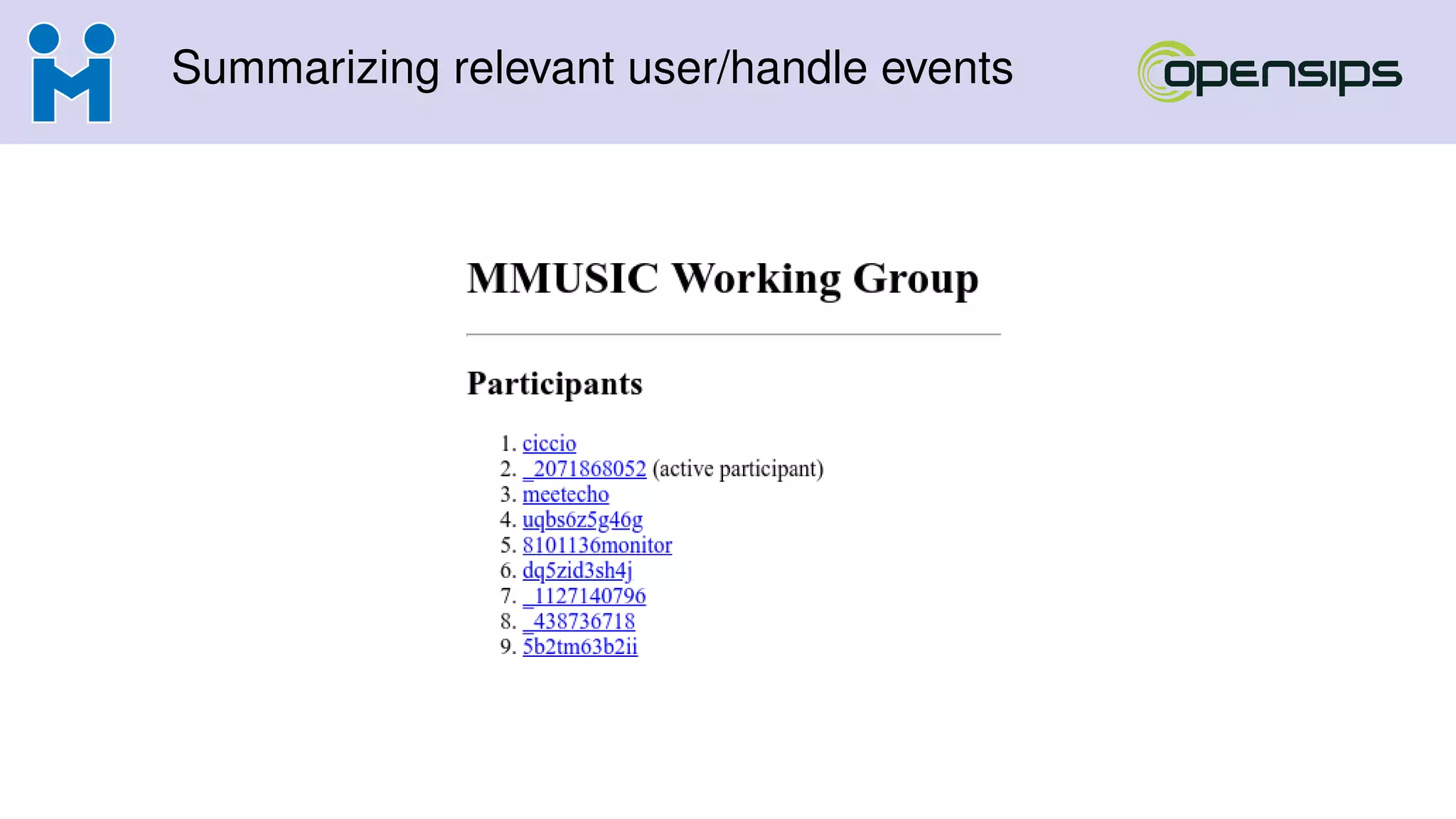
• How many concurrent participants? How many were active?
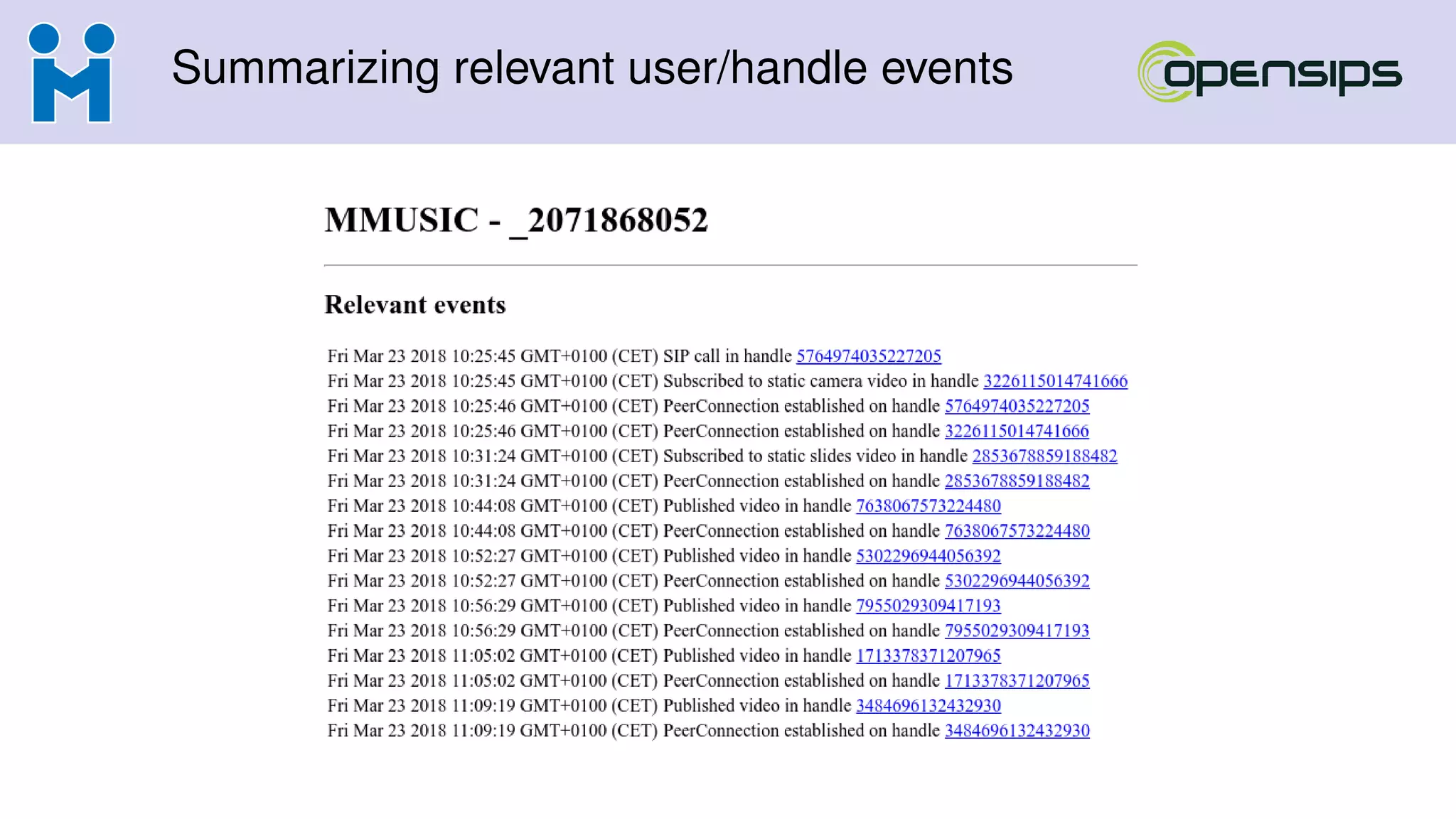
• Who subscribed to what? (SIP, slides, camera, remotees)
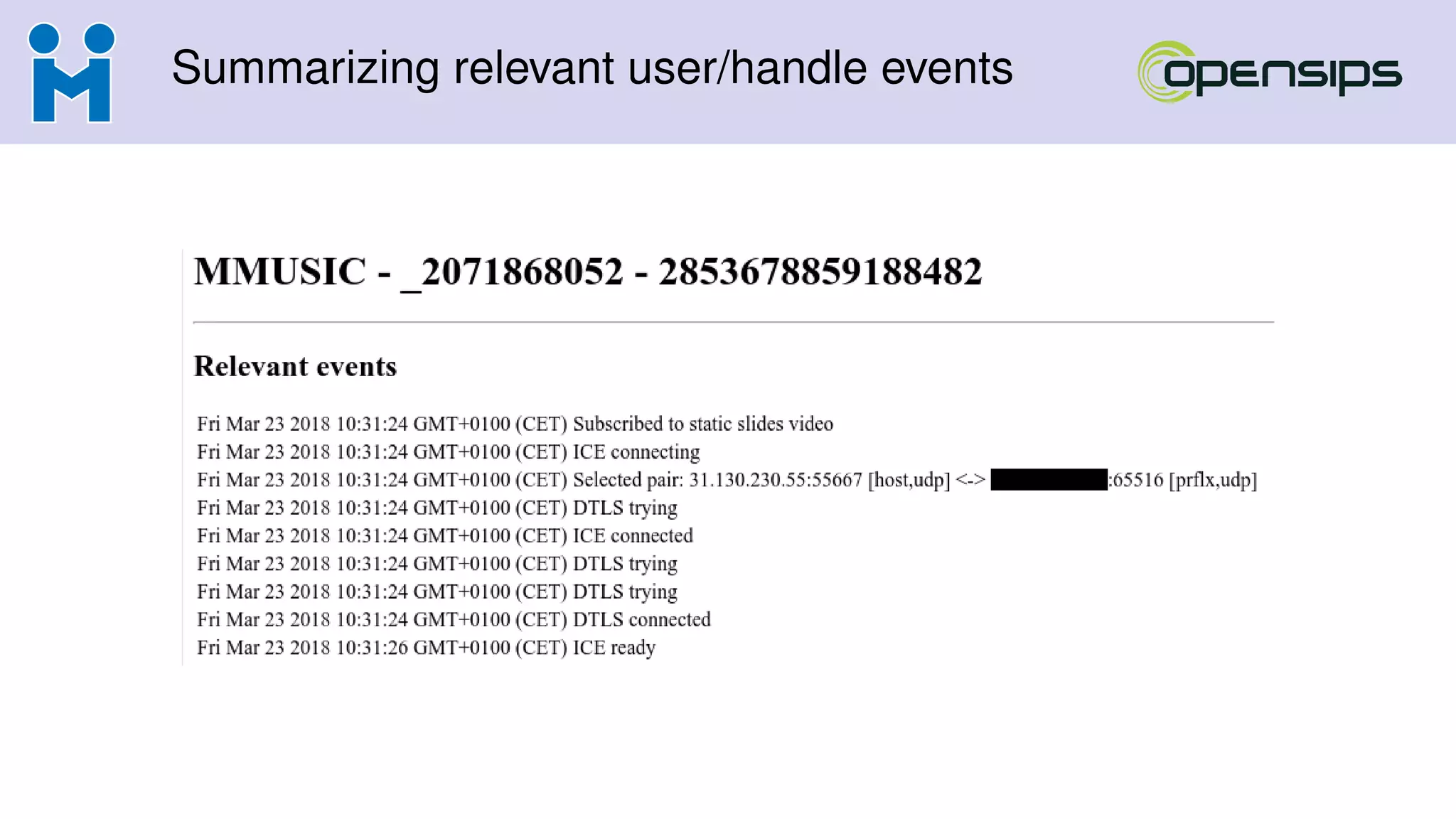
• Any network errors? If so, caused by what?
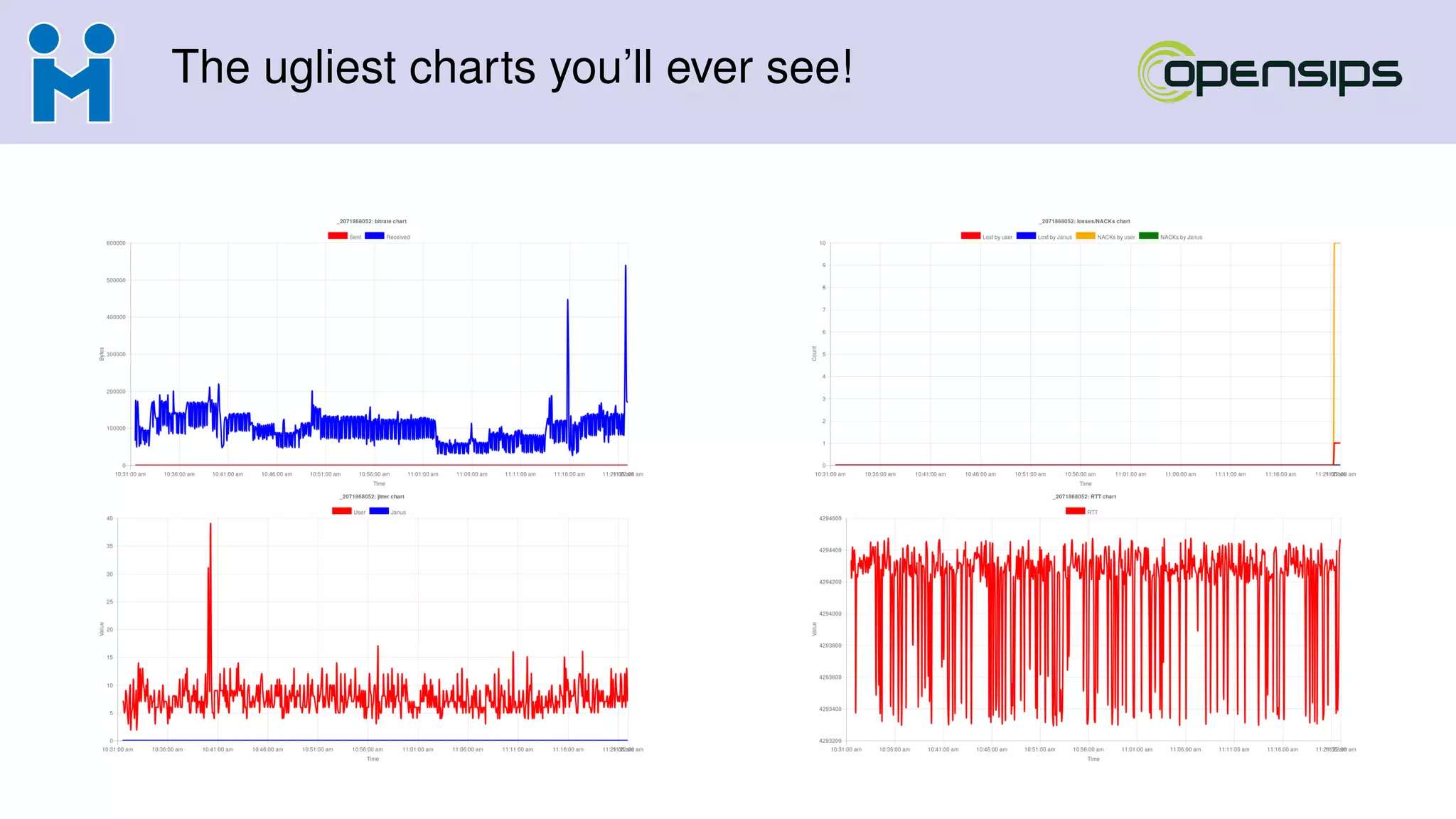
• What can we extract from the statistics?
First experiments: dumping events to Postgres
• Postgres supports JSON natively, and is used by HOMER/HEPIC too
• Why not play with this locally, first?
• Created a single database, and a different table per each WG
• Each table just has a unique index and the JSON value
• All queries can be done on JSON fields
• Played with different queries to identify different events
• How many concurrent participants? How many were active?
• Who subscribed to what? (SIP, slides, camera, remotees)
• Any network errors? If so, caused by what?
• What can we extract from the statistics?
First experiments: dumping events to Postgres
• Postgres supports JSON natively, and is used by HOMER/HEPIC too
• Why not play with this locally, first?
• Created a single database, and a different table per each WG
• Each table just has a unique index and the JSON value
• All queries can be done on JSON fields
• Played with different queries to identify different events
• How many concurrent participants? How many were active?
• Who subscribed to what? (SIP, slides, camera, remotees)
• Any network errors? If so, caused by what?
• What can we extract from the statistics?
Summarizing relevant user/handle events
The ugliest charts you’ll ever see!
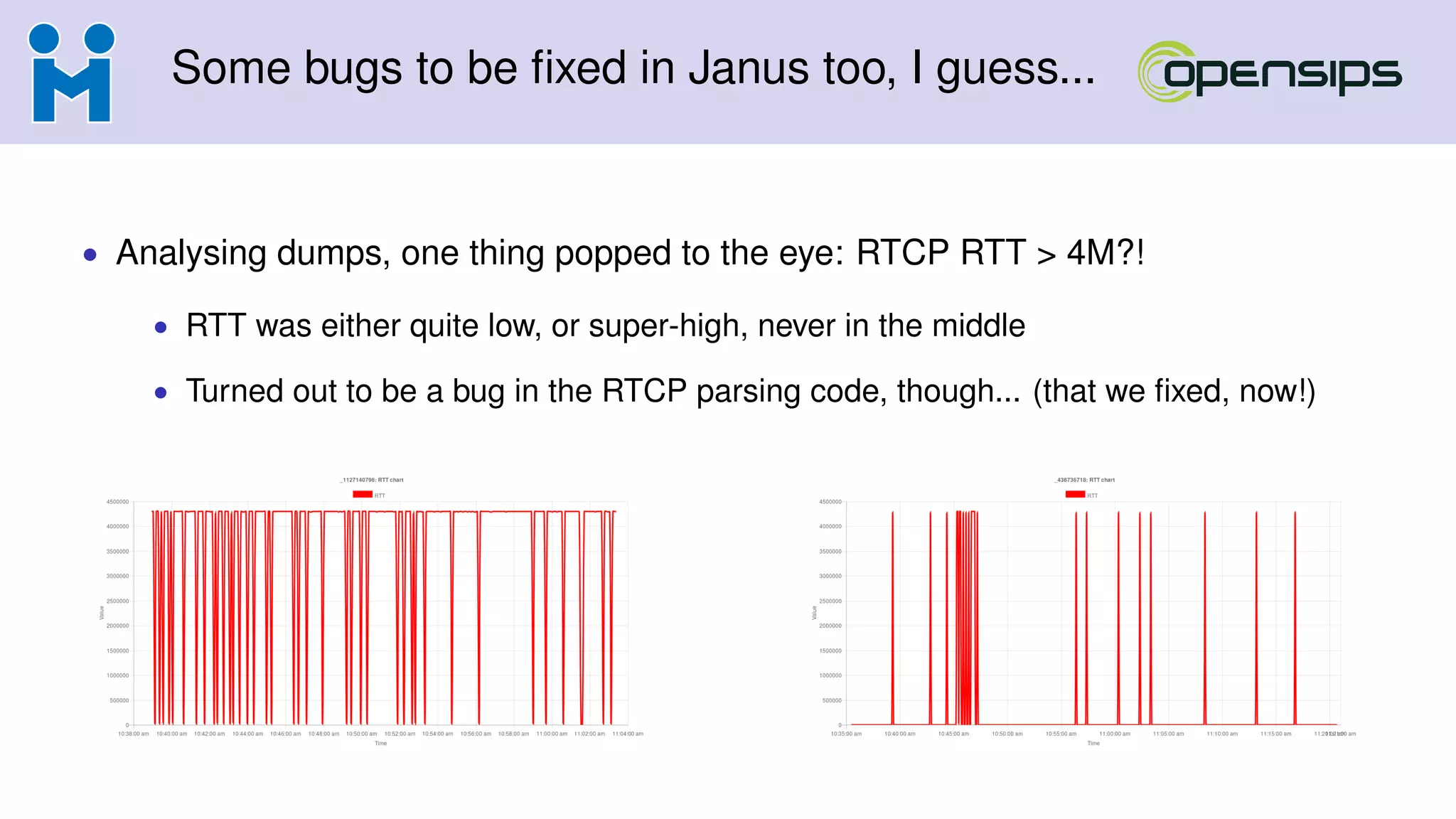
Some bugs to be fixed in Janus too, I guess...
• Analysing dumps, one thing popped to the eye: RTCP RTT > 4M?!
• RTT was either quite low, or super-high, never in the middle
• Turned out to be a bug in the RTCP parsing code, though... (that we fixed, now!)
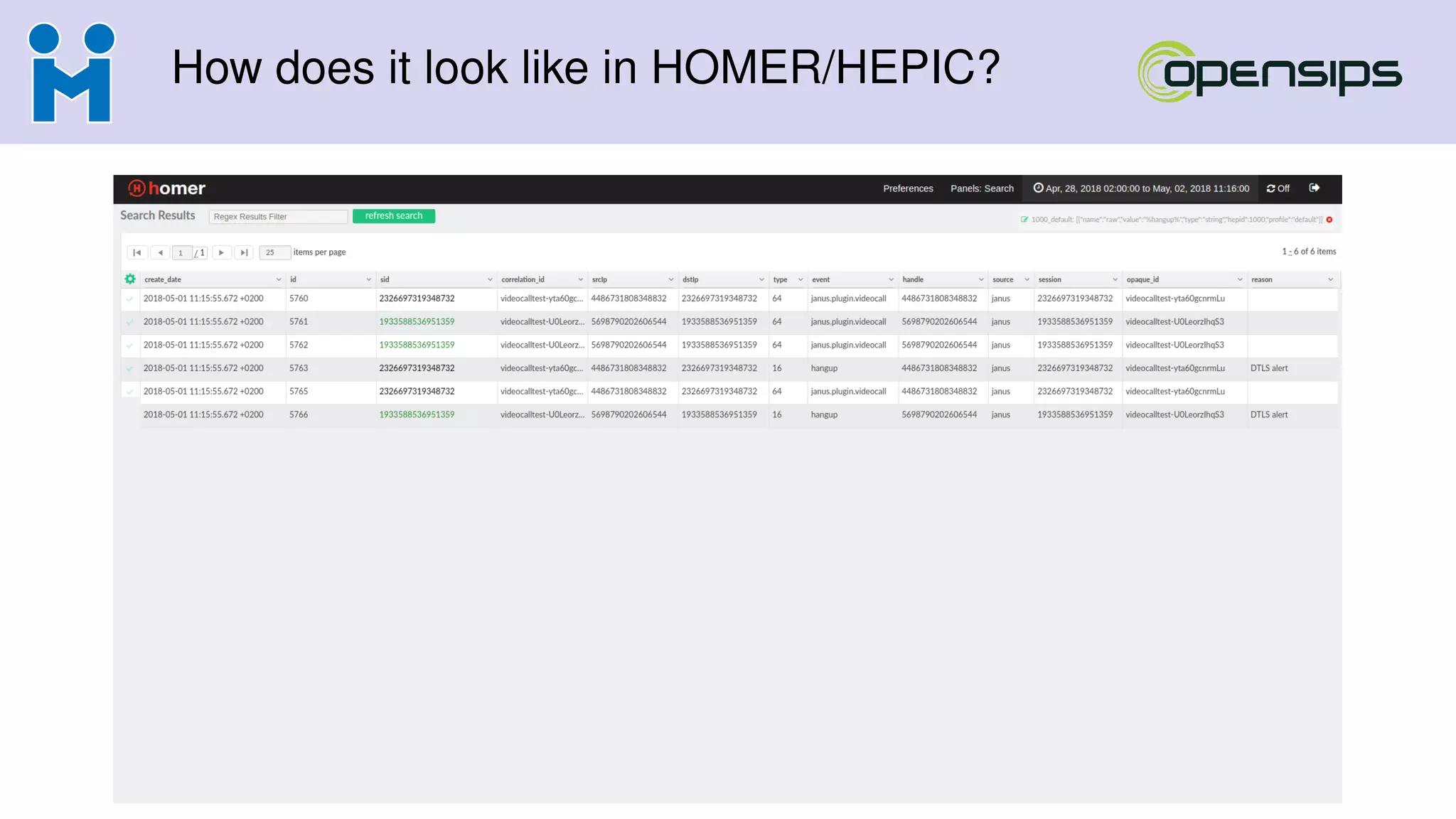
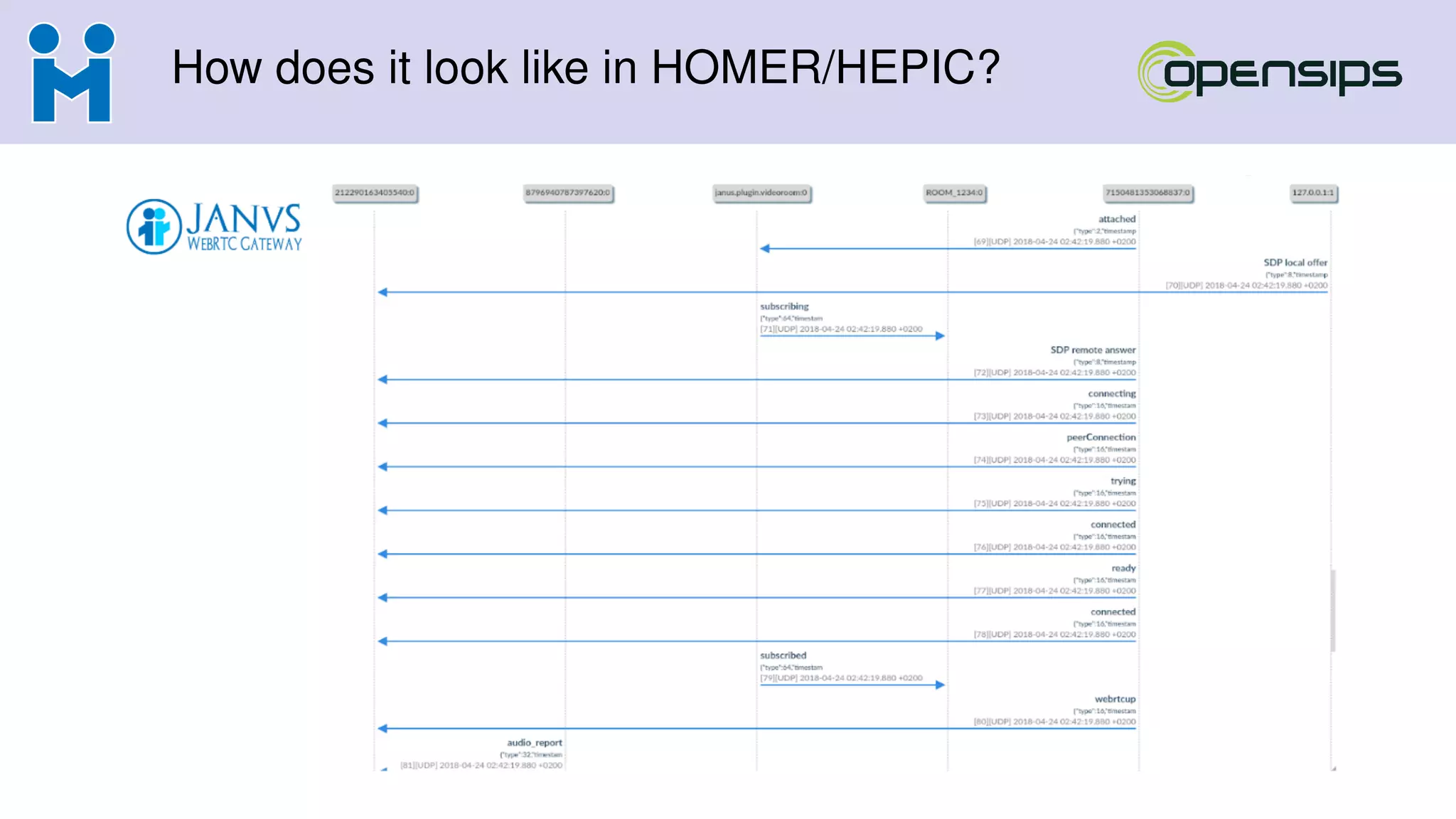
How does it look like in HOMER/HEPIC?
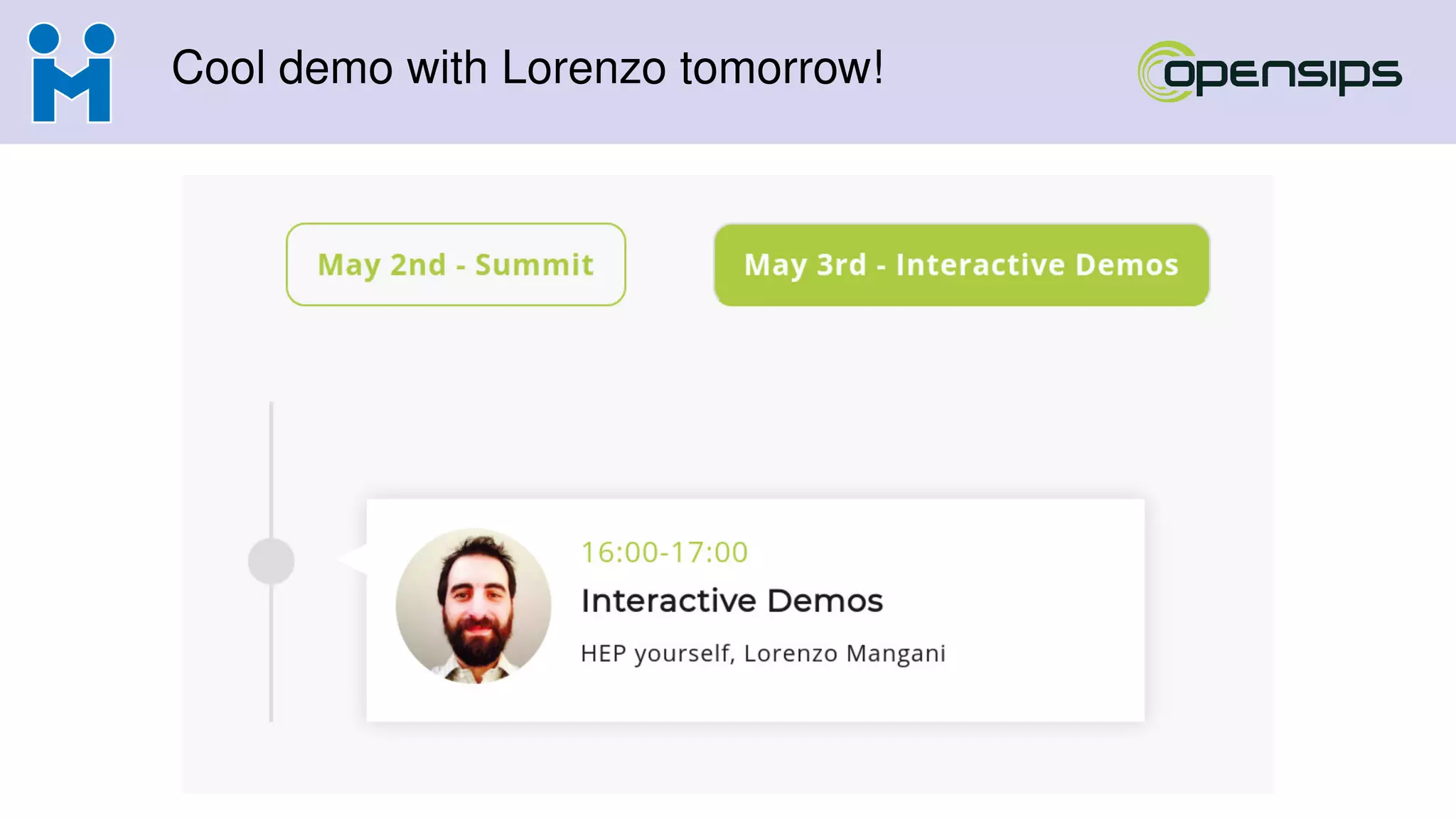
Cool demo with Lorenzo tomorrow!
Next steps
• Collecting real data and analysing it was very useful
• Helped fix a couple of bugs (I’m looking at you, RTT!)
• Showed we needed better info in some events (e.g., in selected-pair)
• Very helpful in terms of HOMER/HEPIC integration as well
• What were we looking for?
• Was the available information enough?
• Did we have all the instruments to monitor/navigate/search?
What’s next?
Not the end of the journey, just the beginning!
• Need to generalize IETF meeting considerations to other use cases
• Live monitoring and troubleshooting is definitely of interest
• Most of the analysis was done on ex-post processing
• Alerting is ready, though, so looking forward to that!
Next steps
• Collecting real data and analysing it was very useful
• Helped fix a couple of bugs (I’m looking at you, RTT!)
• Showed we needed better info in some events (e.g., in selected-pair)
• Very helpful in terms of HOMER/HEPIC integration as well
• What were we looking for?
• Was the available information enough?
• Did we have all the instruments to monitor/navigate/search?
What’s next?
Not the end of the journey, just the beginning!
• Need to generalize IETF meeting considerations to other use cases
• Live monitoring and troubleshooting is definitely of interest
• Most of the analysis was done on ex-post processing
• Alerting is ready, though, so looking forward to that!
Next steps
• Collecting real data and analysing it was very useful
• Helped fix a couple of bugs (I’m looking at you, RTT!)
• Showed we needed better info in some events (e.g., in selected-pair)
• Very helpful in terms of HOMER/HEPIC integration as well
• What were we looking for?
• Was the available information enough?
• Did we have all the instruments to monitor/navigate/search?
What’s next?
Not the end of the journey, just the beginning!
• Need to generalize IETF meeting considerations to other use cases
• Live monitoring and troubleshooting is definitely of interest
• Most of the analysis was done on ex-post processing
• Alerting is ready, though, so looking forward to that!
Next steps
• Collecting real data and analysing it was very useful
• Helped fix a couple of bugs (I’m looking at you, RTT!)
• Showed we needed better info in some events (e.g., in selected-pair)
• Very helpful in terms of HOMER/HEPIC integration as well
• What were we looking for?
• Was the available information enough?
• Did we have all the instruments to monitor/navigate/search?
What’s next?
Not the end of the journey, just the beginning!
• Need to generalize IETF meeting considerations to other use cases
• Live monitoring and troubleshooting is definitely of interest
• Most of the analysis was done on ex-post processing
• Alerting is ready, though, so looking forward to that!
Next steps
• Collecting real data and analysing it was very useful
• Helped fix a couple of bugs (I’m looking at you, RTT!)
• Showed we needed better info in some events (e.g., in selected-pair)
• Very helpful in terms of HOMER/HEPIC integration as well
• What were we looking for?
• Was the available information enough?
• Did we have all the instruments to monitor/navigate/search?
What’s next?
Not the end of the journey, just the beginning!
• Need to generalize IETF meeting considerations to other use cases
• Live monitoring and troubleshooting is definitely of interest
• Most of the analysis was done on ex-post processing
• Alerting is ready, though, so looking forward to that!
Thanks! Questions? Comments?
Get in touch!
• https://twitter.com/elminiero
• https://twitter.com/meetecho
• http://www.meetecho.com

Janus/HOMER/HEPIC @ OpenSIPS18

  • 1.
    Troubleshooting and monitoringJanus: a HEPIC journey! Lorenzo Miniero @elminiero OpenSIPS Summit 2nd May 2018,
  • 2.
    “Which Lorenzo areyou, exactly?”
  • 3.
    You may rememberme from “Revenge of the Mutant Janus Instances” (not really...)
  • 4.
    No, seriously, rememberJanus? • General purpose, open source WebRTC server • https://github.com/meetecho/janus-gateway • Demos and documentation: https://janus.conf.meetecho.com • Community: https://groups.google.com/forum/#!forum/meetecho-janus Past OpenSIPS presentations: on Janus, SIP, and various salads • https://www.youtube.com/watch?v=SFeWYewoL7Q • https://www.youtube.com/watch?v=anmyMC6Ovl8&t=25112s
  • 5.
    No, seriously, rememberJanus? • General purpose, open source WebRTC server • https://github.com/meetecho/janus-gateway • Demos and documentation: https://janus.conf.meetecho.com • Community: https://groups.google.com/forum/#!forum/meetecho-janus Past OpenSIPS presentations: on Janus, SIP, and various salads • https://www.youtube.com/watch?v=SFeWYewoL7Q • https://www.youtube.com/watch?v=anmyMC6Ovl8&t=25112s
  • 6.
    Troubleshooting Janus: abit of history • First approach (still widely used) was the Admin API • Request/response protocol available on different transports • Allows to inspect handles and WebRTC “internals” from the Janus perspective • Can tweak some settings too (e.g., enable/disable debugging) • A different, asynchronous mechanism then followed: Event Handlers • Core and plugins generate events of different types • Custom modules can subscribe to and handle them • e.g., save to DB, send to external service, CDR, etc. Fun fact: Event Handlers were conceived during OpenSIPS 2016! • You can thank Lorenzo, Celeste, Alexandr (and a big burger!) for that
  • 7.
    Troubleshooting Janus: abit of history • First approach (still widely used) was the Admin API • Request/response protocol available on different transports • Allows to inspect handles and WebRTC “internals” from the Janus perspective • Can tweak some settings too (e.g., enable/disable debugging) • A different, asynchronous mechanism then followed: Event Handlers • Core and plugins generate events of different types • Custom modules can subscribe to and handle them • e.g., save to DB, send to external service, CDR, etc. Fun fact: Event Handlers were conceived during OpenSIPS 2016! • You can thank Lorenzo, Celeste, Alexandr (and a big burger!) for that
  • 8.
    Troubleshooting Janus: abit of history • First approach (still widely used) was the Admin API • Request/response protocol available on different transports • Allows to inspect handles and WebRTC “internals” from the Janus perspective • Can tweak some settings too (e.g., enable/disable debugging) • A different, asynchronous mechanism then followed: Event Handlers • Core and plugins generate events of different types • Custom modules can subscribe to and handle them • e.g., save to DB, send to external service, CDR, etc. Fun fact: Event Handlers were conceived during OpenSIPS 2016! • You can thank Lorenzo, Celeste, Alexandr (and a big burger!) for that
  • 9.
    Routing and managingasynchronous events
  • 10.
    “Sample Event Handler”:HTTP as a notifier • Simply forwards all events as JSON to an HTTP backend • Supports basic authentication • Can group events (i.e., JSON array vs. multiple JSON objects) • Implements basic retransmissions (exponential back-off) • Does nothing more than that: logic needs to be elsewhere • HTTP backend decides what to do with events, if anything • Behaviour can be tweaked via Admin API calls Need something else? Check the alternatives or write your own! A few other event handlers also available • RabbitMQ (in repo), MQTT (PR #1185), SQLite (by Mozilla)
  • 11.
    “Sample Event Handler”:HTTP as a notifier • Simply forwards all events as JSON to an HTTP backend • Supports basic authentication • Can group events (i.e., JSON array vs. multiple JSON objects) • Implements basic retransmissions (exponential back-off) • Does nothing more than that: logic needs to be elsewhere • HTTP backend decides what to do with events, if anything • Behaviour can be tweaked via Admin API calls Need something else? Check the alternatives or write your own! A few other event handlers also available • RabbitMQ (in repo), MQTT (PR #1185), SQLite (by Mozilla)
  • 12.
    “Sample Event Handler”:HTTP as a notifier • Simply forwards all events as JSON to an HTTP backend • Supports basic authentication • Can group events (i.e., JSON array vs. multiple JSON objects) • Implements basic retransmissions (exponential back-off) • Does nothing more than that: logic needs to be elsewhere • HTTP backend decides what to do with events, if anything • Behaviour can be tweaked via Admin API calls Need something else? Check the alternatives or write your own! A few other event handlers also available • RabbitMQ (in repo), MQTT (PR #1185), SQLite (by Mozilla)
  • 13.
    How do wehandle events, now? • Generating events is easy, evaluating them is another matter... • Event Handlers typically just relay events, and don’t do processing themselves • Analyzing and correlating tons of events is complicated • A few different approaches, from easiest to trickiest 1 https://github.com/stirlab/janus-event-server (dumping events to file) 2 https://github.com/mozilla/janus-eventhandler-sqlite (dumping events to SQLite) 3 Write your own backend, e.g., http://www.meetecho.com/blog/event-handlers-a-practical-example/ http://www.meetecho.com/blog/correlating-janus-event-handlers/ • A much better approach: trust the smart guys! • http://www.sipcapture.org/ • http://hepic.tel/
  • 14.
    How do wehandle events, now? • Generating events is easy, evaluating them is another matter... • Event Handlers typically just relay events, and don’t do processing themselves • Analyzing and correlating tons of events is complicated • A few different approaches, from easiest to trickiest 1 https://github.com/stirlab/janus-event-server (dumping events to file) 2 https://github.com/mozilla/janus-eventhandler-sqlite (dumping events to SQLite) 3 Write your own backend, e.g., http://www.meetecho.com/blog/event-handlers-a-practical-example/ http://www.meetecho.com/blog/correlating-janus-event-handlers/ • A much better approach: trust the smart guys! • http://www.sipcapture.org/ • http://hepic.tel/
  • 15.
    How do wehandle events, now? • Generating events is easy, evaluating them is another matter... • Event Handlers typically just relay events, and don’t do processing themselves • Analyzing and correlating tons of events is complicated • A few different approaches, from easiest to trickiest 1 https://github.com/stirlab/janus-event-server (dumping events to file) 2 https://github.com/mozilla/janus-eventhandler-sqlite (dumping events to SQLite) 3 Write your own backend, e.g., http://www.meetecho.com/blog/event-handlers-a-practical-example/ http://www.meetecho.com/blog/correlating-janus-event-handlers/ • A much better approach: trust the smart guys! • http://www.sipcapture.org/ • http://hepic.tel/
  • 16.
    Event Handlers inHOMER since “day one”(*)
  • 17.
    (*A trip downMemory Lane: FOSDEM 2017!) https://archive.fosdem.org/2017/schedule/event/janus/ https://archive.fosdem.org/2017/schedule/event/homer/
  • 18.
    From SIP toWebRTC • As anticipated, Event Handlers were conceived in a chat with QXIP • “How can I dump SIP messages with Sofia SIP?” • “Which other events would be useful to have?” • “What about a new modular approach, where HEP could be a plugin?” • The only “caveat”: it was SIP only • Only events coming from the SIP plugin were tracked, to follow the signalling • Other events related to SIP handles only saved as “related info” • Still very used and widespread, but limited to WebRTC/SIP scenarios • Lately, big step to start tracking generic WebRTC applications instead • How to handle users with more than one PeerConnection? • How to relate a PeerConnection to another, for issues and more? • How to reconstruct a session topology from the media perspective?
  • 19.
    From SIP toWebRTC • As anticipated, Event Handlers were conceived in a chat with QXIP • “How can I dump SIP messages with Sofia SIP?” • “Which other events would be useful to have?” • “What about a new modular approach, where HEP could be a plugin?” • The only “caveat”: it was SIP only • Only events coming from the SIP plugin were tracked, to follow the signalling • Other events related to SIP handles only saved as “related info” • Still very used and widespread, but limited to WebRTC/SIP scenarios • Lately, big step to start tracking generic WebRTC applications instead • How to handle users with more than one PeerConnection? • How to relate a PeerConnection to another, for issues and more? • How to reconstruct a session topology from the media perspective?
  • 20.
    From SIP toWebRTC • As anticipated, Event Handlers were conceived in a chat with QXIP • “How can I dump SIP messages with Sofia SIP?” • “Which other events would be useful to have?” • “What about a new modular approach, where HEP could be a plugin?” • The only “caveat”: it was SIP only • Only events coming from the SIP plugin were tracked, to follow the signalling • Other events related to SIP handles only saved as “related info” • Still very used and widespread, but limited to WebRTC/SIP scenarios • Lately, big step to start tracking generic WebRTC applications instead • How to handle users with more than one PeerConnection? • How to relate a PeerConnection to another, for issues and more? • How to reconstruct a session topology from the media perspective?
  • 21.
    Challenge #1: gettingevents in HOMER/HEPIC • Basically, this was there already in HOMER 5.x • HTTP Event Handler + hepipe.js = Magic! • hepipe.js as an Events server, statically injecting events in the platform • Anyway, considerable refactoring done for HOMER 7.x • Modular protocols and backends (e.g., Prometheus vs. InfluxDB) • The solution: HEPop as a way to index/tag incoming heterogeneous data • Support for several different data sources (e.g., Janus and mediasoup) • For Janus, it acts as an events server exactly as hepipe.js did A potential Janus-specific improvement? As anticipated, a MQTT event handler is on the way (thanks Olle!) • Might be a much better alternative to HTTP as a way to channel events
  • 22.
    Challenge #1: gettingevents in HOMER/HEPIC • Basically, this was there already in HOMER 5.x • HTTP Event Handler + hepipe.js = Magic! • hepipe.js as an Events server, statically injecting events in the platform • Anyway, considerable refactoring done for HOMER 7.x • Modular protocols and backends (e.g., Prometheus vs. InfluxDB) • The solution: HEPop as a way to index/tag incoming heterogeneous data • Support for several different data sources (e.g., Janus and mediasoup) • For Janus, it acts as an events server exactly as hepipe.js did A potential Janus-specific improvement? As anticipated, a MQTT event handler is on the way (thanks Olle!) • Might be a much better alternative to HTTP as a way to channel events
  • 23.
    Challenge #1: gettingevents in HOMER/HEPIC • Basically, this was there already in HOMER 5.x • HTTP Event Handler + hepipe.js = Magic! • hepipe.js as an Events server, statically injecting events in the platform • Anyway, considerable refactoring done for HOMER 7.x • Modular protocols and backends (e.g., Prometheus vs. InfluxDB) • The solution: HEPop as a way to index/tag incoming heterogeneous data • Support for several different data sources (e.g., Janus and mediasoup) • For Janus, it acts as an events server exactly as hepipe.js did A potential Janus-specific improvement? As anticipated, a MQTT event handler is on the way (thanks Olle!) • Might be a much better alternative to HTTP as a way to channel events
  • 24.
    Challenge #1: gettingevents in HOMER/HEPIC • Basically, this was there already in HOMER 5.x • HTTP Event Handler + hepipe.js = Magic! • hepipe.js as an Events server, statically injecting events in the platform • Anyway, considerable refactoring done for HOMER 7.x • Modular protocols and backends (e.g., Prometheus vs. InfluxDB) • The solution: HEPop as a way to index/tag incoming heterogeneous data • Support for several different data sources (e.g., Janus and mediasoup) • For Janus, it acts as an events server exactly as hepipe.js did A potential Janus-specific improvement? As anticipated, a MQTT event handler is on the way (thanks Olle!) • Might be a much better alternative to HTTP as a way to channel events
  • 25.
    Challenge #2: storingand processing events • Ex-post evaluations vs. live monitoring • Analyzing a dump after the session ended is different from live monitoring • Postgres, MySQL, InfluxDB, Prometheus, etc. • Several options in the new HOMER/HEPIC, which is exciting! • JSON databases and queries • Janus events are in JSON format, so why not use that effectively? • HOMER/HEPIC backends support JSON as a native format Storing and tagging events Smart choice is to store events AND tag them as they flow • Good way to create quick correlations and recap what happened • Media stats can then be turned in Time Series (monitoring/alerting)
  • 26.
    Challenge #2: storingand processing events • Ex-post evaluations vs. live monitoring • Analyzing a dump after the session ended is different from live monitoring • Postgres, MySQL, InfluxDB, Prometheus, etc. • Several options in the new HOMER/HEPIC, which is exciting! • JSON databases and queries • Janus events are in JSON format, so why not use that effectively? • HOMER/HEPIC backends support JSON as a native format Storing and tagging events Smart choice is to store events AND tag them as they flow • Good way to create quick correlations and recap what happened • Media stats can then be turned in Time Series (monitoring/alerting)
  • 27.
    Challenge #2: storingand processing events • Ex-post evaluations vs. live monitoring • Analyzing a dump after the session ended is different from live monitoring • Postgres, MySQL, InfluxDB, Prometheus, etc. • Several options in the new HOMER/HEPIC, which is exciting! • JSON databases and queries • Janus events are in JSON format, so why not use that effectively? • HOMER/HEPIC backends support JSON as a native format Storing and tagging events Smart choice is to store events AND tag them as they flow • Good way to create quick correlations and recap what happened • Media stats can then be turned in Time Series (monitoring/alerting)
  • 28.
    Challenge #2: storingand processing events • Ex-post evaluations vs. live monitoring • Analyzing a dump after the session ended is different from live monitoring • Postgres, MySQL, InfluxDB, Prometheus, etc. • Several options in the new HOMER/HEPIC, which is exciting! • JSON databases and queries • Janus events are in JSON format, so why not use that effectively? • HOMER/HEPIC backends support JSON as a native format Storing and tagging events Smart choice is to store events AND tag them as they flow • Good way to create quick correlations and recap what happened • Media stats can then be turned in Time Series (monitoring/alerting)
  • 29.
    Challenge #3: correlatingevents • Sessions might be used to identify users, but can’t always be “trusted” • Works fine when users talk to Janus directly (1↔1 relationship) • There are server-side applications with a single session for all users, though • Enter opaque_id: a client-provided opaque identifier • Just set the same opaque ID for all handles belonging to the same user • The opaque ID can be whatever you want, Janus doesn’t care • Useful for intra-plugin, but also inter-plugin, correlations • e.g., to know a user is publishing and subscribing in a VideoRoom • ... but also, for instance, in a SIP call in the same application Want to learn more? http://www.meetecho.com/blog/correlating-janus-event-handlers/
  • 30.
    Challenge #3: correlatingevents • Sessions might be used to identify users, but can’t always be “trusted” • Works fine when users talk to Janus directly (1↔1 relationship) • There are server-side applications with a single session for all users, though • Enter opaque_id: a client-provided opaque identifier • Just set the same opaque ID for all handles belonging to the same user • The opaque ID can be whatever you want, Janus doesn’t care • Useful for intra-plugin, but also inter-plugin, correlations • e.g., to know a user is publishing and subscribing in a VideoRoom • ... but also, for instance, in a SIP call in the same application Want to learn more? http://www.meetecho.com/blog/correlating-janus-event-handlers/
  • 31.
    Challenge #3: correlatingevents • Sessions might be used to identify users, but can’t always be “trusted” • Works fine when users talk to Janus directly (1↔1 relationship) • There are server-side applications with a single session for all users, though • Enter opaque_id: a client-provided opaque identifier • Just set the same opaque ID for all handles belonging to the same user • The opaque ID can be whatever you want, Janus doesn’t care • Useful for intra-plugin, but also inter-plugin, correlations • e.g., to know a user is publishing and subscribing in a VideoRoom • ... but also, for instance, in a SIP call in the same application Want to learn more? http://www.meetecho.com/blog/correlating-janus-event-handlers/
  • 32.
    Challenge #3: correlatingevents • Sessions might be used to identify users, but can’t always be “trusted” • Works fine when users talk to Janus directly (1↔1 relationship) • There are server-side applications with a single session for all users, though • Enter opaque_id: a client-provided opaque identifier • Just set the same opaque ID for all handles belonging to the same user • The opaque ID can be whatever you want, Janus doesn’t care • Useful for intra-plugin, but also inter-plugin, correlations • e.g., to know a user is publishing and subscribing in a VideoRoom • ... but also, for instance, in a SIP call in the same application Want to learn more? http://www.meetecho.com/blog/correlating-janus-event-handlers/
  • 33.
    Challenge #3: storingand processing events
  • 34.
    Challenge #3: storingand processing events
  • 35.
    Challenge #3: storingand processing events
  • 36.
    Challenge #4: client-sideevents • All the discussion so far has been for server-side events • Janus originates events for what happens there • What about the client side perspective? • In WebRTC, standard mechanism for getting statistics on a PeerConnection • https://www.w3.org/TR/webrtc-stats/ • Calls to getStats() return useful info, but in JavaScript • How to get it to HOMER/HEPIC, possibly via Janus/Event Handlers as well? Solution: a new Janus plugin! • Client attaches and sends stats on a regular basis to the plugin via Janus API • Plugin relays stats via Event Handlers (same opaque ID as media channels) • Note: still WIP (working demo using rtcstats), but not open source yet
  • 37.
    Challenge #4: client-sideevents • All the discussion so far has been for server-side events • Janus originates events for what happens there • What about the client side perspective? • In WebRTC, standard mechanism for getting statistics on a PeerConnection • https://www.w3.org/TR/webrtc-stats/ • Calls to getStats() return useful info, but in JavaScript • How to get it to HOMER/HEPIC, possibly via Janus/Event Handlers as well? Solution: a new Janus plugin! • Client attaches and sends stats on a regular basis to the plugin via Janus API • Plugin relays stats via Event Handlers (same opaque ID as media channels) • Note: still WIP (working demo using rtcstats), but not open source yet
  • 38.
    Challenge #4: client-sideevents • All the discussion so far has been for server-side events • Janus originates events for what happens there • What about the client side perspective? • In WebRTC, standard mechanism for getting statistics on a PeerConnection • https://www.w3.org/TR/webrtc-stats/ • Calls to getStats() return useful info, but in JavaScript • How to get it to HOMER/HEPIC, possibly via Janus/Event Handlers as well? Solution: a new Janus plugin! • Client attaches and sends stats on a regular basis to the plugin via Janus API • Plugin relays stats via Event Handlers (same opaque ID as media channels) • Note: still WIP (working demo using rtcstats), but not open source yet
  • 39.
    Challenge #4: client-sideevents • All the discussion so far has been for server-side events • Janus originates events for what happens there • What about the client side perspective? • In WebRTC, standard mechanism for getting statistics on a PeerConnection • https://www.w3.org/TR/webrtc-stats/ • Calls to getStats() return useful info, but in JavaScript • How to get it to HOMER/HEPIC, possibly via Janus/Event Handlers as well? Solution: a new Janus plugin! • Client attaches and sends stats on a regular basis to the plugin via Janus API • Plugin relays stats via Event Handlers (same opaque ID as media channels) • Note: still WIP (working demo using rtcstats), but not open source yet
  • 40.
    A real usecase: IETF meetings!
  • 41.
    Remote participation atthe IETF https://www.slideshare.net/LorenzoMiniero/ietf-remote-participation-via-meetecho-webrtc-meetup-stockholm https://www.vuc.me/2017/vuc640-ietf-remote-participation-with-lorenzo-miniero/
  • 42.
    Studying data fromIETF 101 in London • IETF remote participation based on multiple Janus plugins • SIP plugin for mixed audio • Streaming plugin for static sources • VideoRoom plugin for remote speakers • Collected events related to 10 different Working Group sessions • https://datatracker.ietf.org/meeting/agenda.html#2018-03-23-083000 • MMUSIC, HOMENET, ICCRG, DETNET, ROLL, SECEVENT, DTN, SPRING, IPSECME, LAMPS • Good mix of heterogeneous sessions • Some shorter, some longer (DETNET lasted 5 hours!) • Some had many active remote speakers • All had attendees from all over the world (different network conditions)
  • 43.
    Studying data fromIETF 101 in London • IETF remote participation based on multiple Janus plugins • SIP plugin for mixed audio • Streaming plugin for static sources • VideoRoom plugin for remote speakers • Collected events related to 10 different Working Group sessions • https://datatracker.ietf.org/meeting/agenda.html#2018-03-23-083000 • MMUSIC, HOMENET, ICCRG, DETNET, ROLL, SECEVENT, DTN, SPRING, IPSECME, LAMPS • Good mix of heterogeneous sessions • Some shorter, some longer (DETNET lasted 5 hours!) • Some had many active remote speakers • All had attendees from all over the world (different network conditions)
  • 44.
    Studying data fromIETF 101 in London • IETF remote participation based on multiple Janus plugins • SIP plugin for mixed audio • Streaming plugin for static sources • VideoRoom plugin for remote speakers • Collected events related to 10 different Working Group sessions • https://datatracker.ietf.org/meeting/agenda.html#2018-03-23-083000 • MMUSIC, HOMENET, ICCRG, DETNET, ROLL, SECEVENT, DTN, SPRING, IPSECME, LAMPS • Good mix of heterogeneous sessions • Some shorter, some longer (DETNET lasted 5 hours!) • Some had many active remote speakers • All had attendees from all over the world (different network conditions)
  • 45.
    First experiments: dumpingevents to Postgres • Postgres supports JSON natively, and is used by HOMER/HEPIC too • Why not play with this locally, first? • Created a single database, and a different table per each WG • Each table just has a unique index and the JSON value • All queries can be done on JSON fields • Played with different queries to identify different events • How many concurrent participants? How many were active? • Who subscribed to what? (SIP, slides, camera, remotees) • Any network errors? If so, caused by what? • What can we extract from the statistics?
  • 46.
    First experiments: dumpingevents to Postgres • Postgres supports JSON natively, and is used by HOMER/HEPIC too • Why not play with this locally, first? • Created a single database, and a different table per each WG • Each table just has a unique index and the JSON value • All queries can be done on JSON fields • Played with different queries to identify different events • How many concurrent participants? How many were active? • Who subscribed to what? (SIP, slides, camera, remotees) • Any network errors? If so, caused by what? • What can we extract from the statistics?
  • 47.
    First experiments: dumpingevents to Postgres • Postgres supports JSON natively, and is used by HOMER/HEPIC too • Why not play with this locally, first? • Created a single database, and a different table per each WG • Each table just has a unique index and the JSON value • All queries can be done on JSON fields • Played with different queries to identify different events • How many concurrent participants? How many were active? • Who subscribed to what? (SIP, slides, camera, remotees) • Any network errors? If so, caused by what? • What can we extract from the statistics?
  • 48.
  • 49.
  • 50.
  • 51.
  • 52.
    The ugliest chartsyou’ll ever see!
  • 53.
    Some bugs tobe fixed in Janus too, I guess... • Analysing dumps, one thing popped to the eye: RTCP RTT > 4M?! • RTT was either quite low, or super-high, never in the middle • Turned out to be a bug in the RTCP parsing code, though... (that we fixed, now!)
  • 54.
    How does itlook like in HOMER/HEPIC?
  • 55.
    How does itlook like in HOMER/HEPIC?
  • 56.
    Cool demo withLorenzo tomorrow!
  • 57.
    Next steps • Collectingreal data and analysing it was very useful • Helped fix a couple of bugs (I’m looking at you, RTT!) • Showed we needed better info in some events (e.g., in selected-pair) • Very helpful in terms of HOMER/HEPIC integration as well • What were we looking for? • Was the available information enough? • Did we have all the instruments to monitor/navigate/search? What’s next? Not the end of the journey, just the beginning! • Need to generalize IETF meeting considerations to other use cases • Live monitoring and troubleshooting is definitely of interest • Most of the analysis was done on ex-post processing • Alerting is ready, though, so looking forward to that!
  • 58.
    Next steps • Collectingreal data and analysing it was very useful • Helped fix a couple of bugs (I’m looking at you, RTT!) • Showed we needed better info in some events (e.g., in selected-pair) • Very helpful in terms of HOMER/HEPIC integration as well • What were we looking for? • Was the available information enough? • Did we have all the instruments to monitor/navigate/search? What’s next? Not the end of the journey, just the beginning! • Need to generalize IETF meeting considerations to other use cases • Live monitoring and troubleshooting is definitely of interest • Most of the analysis was done on ex-post processing • Alerting is ready, though, so looking forward to that!
  • 59.
    Next steps • Collectingreal data and analysing it was very useful • Helped fix a couple of bugs (I’m looking at you, RTT!) • Showed we needed better info in some events (e.g., in selected-pair) • Very helpful in terms of HOMER/HEPIC integration as well • What were we looking for? • Was the available information enough? • Did we have all the instruments to monitor/navigate/search? What’s next? Not the end of the journey, just the beginning! • Need to generalize IETF meeting considerations to other use cases • Live monitoring and troubleshooting is definitely of interest • Most of the analysis was done on ex-post processing • Alerting is ready, though, so looking forward to that!
  • 60.
    Next steps • Collectingreal data and analysing it was very useful • Helped fix a couple of bugs (I’m looking at you, RTT!) • Showed we needed better info in some events (e.g., in selected-pair) • Very helpful in terms of HOMER/HEPIC integration as well • What were we looking for? • Was the available information enough? • Did we have all the instruments to monitor/navigate/search? What’s next? Not the end of the journey, just the beginning! • Need to generalize IETF meeting considerations to other use cases • Live monitoring and troubleshooting is definitely of interest • Most of the analysis was done on ex-post processing • Alerting is ready, though, so looking forward to that!
  • 61.
    Next steps • Collectingreal data and analysing it was very useful • Helped fix a couple of bugs (I’m looking at you, RTT!) • Showed we needed better info in some events (e.g., in selected-pair) • Very helpful in terms of HOMER/HEPIC integration as well • What were we looking for? • Was the available information enough? • Did we have all the instruments to monitor/navigate/search? What’s next? Not the end of the journey, just the beginning! • Need to generalize IETF meeting considerations to other use cases • Live monitoring and troubleshooting is definitely of interest • Most of the analysis was done on ex-post processing • Alerting is ready, though, so looking forward to that!
  • 62.
    Thanks! Questions? Comments? Getin touch! • https://twitter.com/elminiero • https://twitter.com/meetecho • http://www.meetecho.com