WebRTC broadcasting: standardization,
challenges and opportunities
Lorenzo Miniero
@lminiero@fosstodon.org
TADSummit 2023
20th October 2023, Paris
Who am I?
Lorenzo Miniero
• Ph.D @ UniNA
• Chairman @ Meetecho
• Main author of Janus
Contacts and info
• lorenzo@meetecho.com
• https://fosstodon.org/@lminiero
• https://www.slideshare.net/LorenzoMiniero
• https://lminiero.bandcamp.com
Just a few words on Meetecho
• Co-founded in 2009 as an academic spin-off
• University research efforts brought to the market
• Completely independent from the University
• Focus on real-time multimedia applications
• Strong perspective on standardization and open source
• Several activities
• Consulting services
• Commercial support and Janus licenses
• Streaming of live events (IETF, RIPE, etc.)
• Proudly brewed in sunny Napoli(*), Italy
Hello from sunny Naples, Italy!
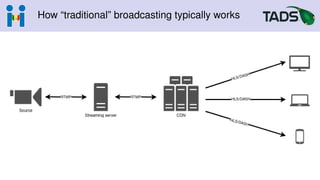
How “traditional” broadcasting typically works
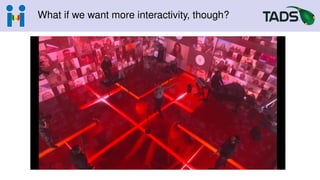
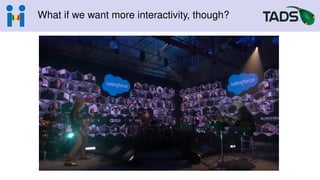
What if we want more interactivity, though?
Why not WebRTC instead?
• Traditional broadcasting efficient but higher latency
• At best (live), delay will typically be in the range of a few seconds
• Besides, different users may experience different delays (buffering)
• WebRTC natively conceived for very low latency, instead
• Born for conversational audio/video/data
• Can be (and often is) easily used for monodirectional streaming as well
• Strangely not really considered by the industry up until recently, though
• Good audio quality (Opus, RED/FEC, stereo/multiopus, etc.)
• Good video quality (multiple codecs, simulcast/SVC, etc.)
• Tooling an important aspect to foster WebRTC adoption, here
• e.g., a standard way to send media, and tools à la OBS, XSplit, or others
Why not WebRTC instead?
• Traditional broadcasting efficient but higher latency
• At best (live), delay will typically be in the range of a few seconds
• Besides, different users may experience different delays (buffering)
• WebRTC natively conceived for very low latency, instead
• Born for conversational audio/video/data
• Can be (and often is) easily used for monodirectional streaming as well
• Strangely not really considered by the industry up until recently, though
• Good audio quality (Opus, RED/FEC, stereo/multiopus, etc.)
• Good video quality (multiple codecs, simulcast/SVC, etc.)
• Tooling an important aspect to foster WebRTC adoption, here
• e.g., a standard way to send media, and tools à la OBS, XSplit, or others
Why not WebRTC instead?
• Traditional broadcasting efficient but higher latency
• At best (live), delay will typically be in the range of a few seconds
• Besides, different users may experience different delays (buffering)
• WebRTC natively conceived for very low latency, instead
• Born for conversational audio/video/data
• Can be (and often is) easily used for monodirectional streaming as well
• Strangely not really considered by the industry up until recently, though
• Good audio quality (Opus, RED/FEC, stereo/multiopus, etc.)
• Good video quality (multiple codecs, simulcast/SVC, etc.)
• Tooling an important aspect to foster WebRTC adoption, here
• e.g., a standard way to send media, and tools à la OBS, XSplit, or others
Why not WebRTC instead?
• Traditional broadcasting efficient but higher latency
• At best (live), delay will typically be in the range of a few seconds
• Besides, different users may experience different delays (buffering)
• WebRTC natively conceived for very low latency, instead
• Born for conversational audio/video/data
• Can be (and often is) easily used for monodirectional streaming as well
• Strangely not really considered by the industry up until recently, though
• Good audio quality (Opus, RED/FEC, stereo/multiopus, etc.)
• Good video quality (multiple codecs, simulcast/SVC, etc.)
• Tooling an important aspect to foster WebRTC adoption, here
• e.g., a standard way to send media, and tools à la OBS, XSplit, or others
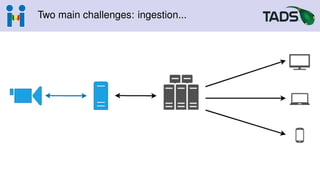
Two main challenges: ingestion...
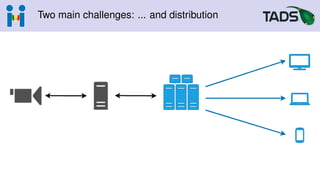
Two main challenges: ... and distribution
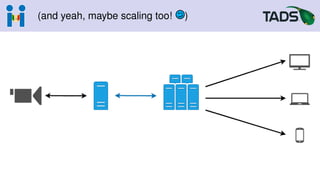
(and yeah, maybe scaling too! )
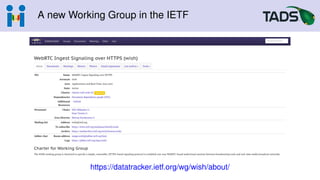
A new Working Group in the IETF
https://datatracker.ietf.org/wg/wish/about/
Making WebRTC ingestion easy: WHIP!
https://www.meetecho.com/blog/whip-janus/ (September 2020)
Making WebRTC ingestion easy: WHIP!
https://www.meetecho.com/blog/whip-janus-part-ii/
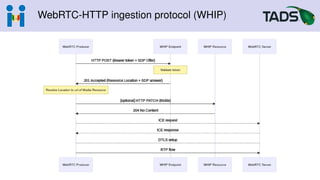
WebRTC-HTTP ingestion protocol (WHIP)
• HTTP-based signalling to create sendonly PeerConnections
• HTTP POST to send SDP offer, and get an SDP answer in the response
• Teardown of sessions using HTTP DELETE
• Authentication and authorization via Bearer tokens
• https://www.rfc-editor.org/rfc/rfc6750.html
• Trickle and ICE restart via HTTP PATCH and SDP fragments
• https://www.rfc-editor.org/rfc/rfc8840.html
• Everything else is your usual WebRTC!
• ICE, DTLS, etc.
WebRTC-HTTP ingestion protocol (WHIP)
• HTTP-based signalling to create sendonly PeerConnections
• HTTP POST to send SDP offer, and get an SDP answer in the response
• Teardown of sessions using HTTP DELETE
• Authentication and authorization via Bearer tokens
• https://www.rfc-editor.org/rfc/rfc6750.html
• Trickle and ICE restart via HTTP PATCH and SDP fragments
• https://www.rfc-editor.org/rfc/rfc8840.html
• Everything else is your usual WebRTC!
• ICE, DTLS, etc.
WebRTC-HTTP ingestion protocol (WHIP)
• HTTP-based signalling to create sendonly PeerConnections
• HTTP POST to send SDP offer, and get an SDP answer in the response
• Teardown of sessions using HTTP DELETE
• Authentication and authorization via Bearer tokens
• https://www.rfc-editor.org/rfc/rfc6750.html
• Trickle and ICE restart via HTTP PATCH and SDP fragments
• https://www.rfc-editor.org/rfc/rfc8840.html
• Everything else is your usual WebRTC!
• ICE, DTLS, etc.
WebRTC-HTTP ingestion protocol (WHIP)
• HTTP-based signalling to create sendonly PeerConnections
• HTTP POST to send SDP offer, and get an SDP answer in the response
• Teardown of sessions using HTTP DELETE
• Authentication and authorization via Bearer tokens
• https://www.rfc-editor.org/rfc/rfc6750.html
• Trickle and ICE restart via HTTP PATCH and SDP fragments
• https://www.rfc-editor.org/rfc/rfc8840.html
• Everything else is your usual WebRTC!
• ICE, DTLS, etc.
WebRTC-HTTP ingestion protocol (WHIP)
Enter the Janus WebRTC Server
Janus
General purpose, open source WebRTC server
• https://github.com/meetecho/janus-gateway
• Demos and documentation: https://janus.conf.meetecho.com
• Community: https://janus.discourse.group/
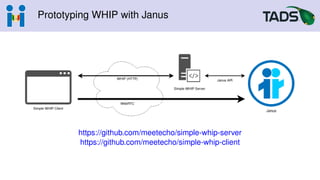
Prototyping WHIP with Janus
https://github.com/meetecho/simple-whip-server
https://github.com/meetecho/simple-whip-client
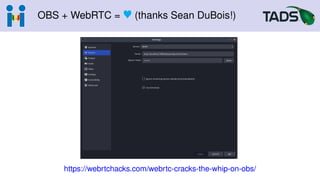
OBS + WebRTC = r (thanks Sean DuBois!)
https://webrtchacks.com/webrtc-cracks-the-whip-on-obs/
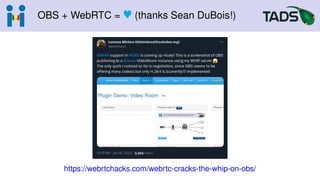
OBS + WebRTC = r (thanks Sean DuBois!)
https://webrtchacks.com/webrtc-cracks-the-whip-on-obs/
Next step: broadcasting the stream
• WHIP server allows ingestion, and it’s a good starting point
• We have a WebRTC stream in an SFU, now (e.g., Janus)
• This now needs to be distributed somehow, though
• Not a big problem per se
• It’s a “regular” 1-to-many distribution
• Most servers and services provide ways to do that
• What’s the standard way to consume this stream now, though?
• SFUs will obviously provide their own custom APIs...
• ... but a standard approach would be much better!
Enter WHEP!
https://www.ietf.org/archive/id/draft-murillo-whep-02.html
Next step: broadcasting the stream
• WHIP server allows ingestion, and it’s a good starting point
• We have a WebRTC stream in an SFU, now (e.g., Janus)
• This now needs to be distributed somehow, though
• Not a big problem per se
• It’s a “regular” 1-to-many distribution
• Most servers and services provide ways to do that
• What’s the standard way to consume this stream now, though?
• SFUs will obviously provide their own custom APIs...
• ... but a standard approach would be much better!
Enter WHEP!
https://www.ietf.org/archive/id/draft-murillo-whep-02.html
Next step: broadcasting the stream
• WHIP server allows ingestion, and it’s a good starting point
• We have a WebRTC stream in an SFU, now (e.g., Janus)
• This now needs to be distributed somehow, though
• Not a big problem per se
• It’s a “regular” 1-to-many distribution
• Most servers and services provide ways to do that
• What’s the standard way to consume this stream now, though?
• SFUs will obviously provide their own custom APIs...
• ... but a standard approach would be much better!
Enter WHEP!
https://www.ietf.org/archive/id/draft-murillo-whep-02.html
Next step: broadcasting the stream
• WHIP server allows ingestion, and it’s a good starting point
• We have a WebRTC stream in an SFU, now (e.g., Janus)
• This now needs to be distributed somehow, though
• Not a big problem per se
• It’s a “regular” 1-to-many distribution
• Most servers and services provide ways to do that
• What’s the standard way to consume this stream now, though?
• SFUs will obviously provide their own custom APIs...
• ... but a standard approach would be much better!
Enter WHEP!
https://www.ietf.org/archive/id/draft-murillo-whep-02.html
WHIP, WHEP & WHAP!
https://www.meetecho.com/blog/whip-whep/
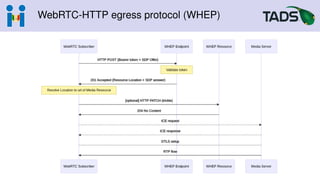
WebRTC-HTTP egress protocol (WHEP)
• Twin protocol of WHIP
• WHIP takes care of ingestion (sendonly for users)
• WHEP takes care of consuming (recvonly for users)
• Pretty much the same approach too
• HTTP-based protocol (offer/answer)
• Bearer token authentication
• HTTP PATCH and SDP fragments for trickle/restarts
• WebRTC PeerConnection as a result
• Both WHIP and WHEP expecting an offer means they can’t be chained, though...
• https://www.meetecho.com/blog/whep-qui/
• </rant>
WebRTC-HTTP egress protocol (WHEP)
• Twin protocol of WHIP
• WHIP takes care of ingestion (sendonly for users)
• WHEP takes care of consuming (recvonly for users)
• Pretty much the same approach too
• HTTP-based protocol (offer/answer)
• Bearer token authentication
• HTTP PATCH and SDP fragments for trickle/restarts
• WebRTC PeerConnection as a result
• Both WHIP and WHEP expecting an offer means they can’t be chained, though...
• https://www.meetecho.com/blog/whep-qui/
• </rant>
WebRTC-HTTP egress protocol (WHEP)
• Twin protocol of WHIP
• WHIP takes care of ingestion (sendonly for users)
• WHEP takes care of consuming (recvonly for users)
• Pretty much the same approach too
• HTTP-based protocol (offer/answer)
• Bearer token authentication
• HTTP PATCH and SDP fragments for trickle/restarts
• WebRTC PeerConnection as a result
• Both WHIP and WHEP expecting an offer means they can’t be chained, though...
• https://www.meetecho.com/blog/whep-qui/
• </rant>
WebRTC-HTTP egress protocol (WHEP)
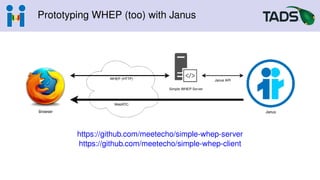
Prototyping WHEP (too) with Janus
https://github.com/meetecho/simple-whep-server
https://github.com/meetecho/simple-whep-client
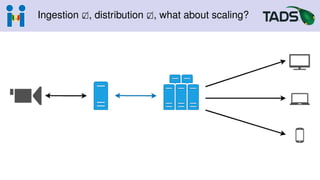
Ingestion 2
, distribution 2
, what about scaling?
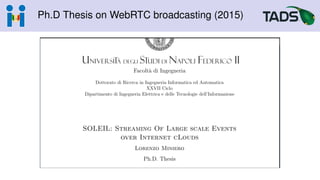
Ph.D Thesis on WebRTC broadcasting (2015)
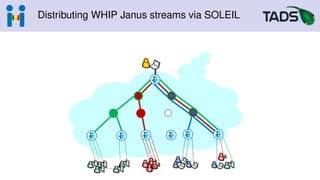
Using SOLEIL for the purpose
• “Streaming Of Large scale Events over Internet cLouds” (Ph.D Thesis)
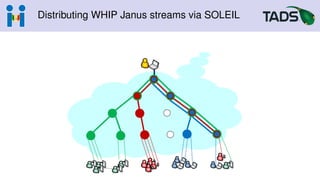
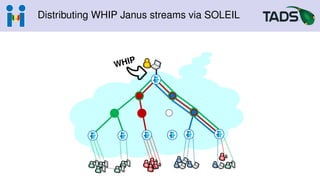
• In a nutshell, tree-based distribution of WebRTC feeds
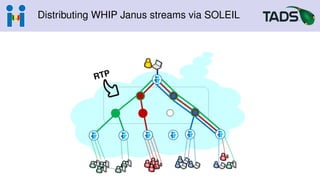
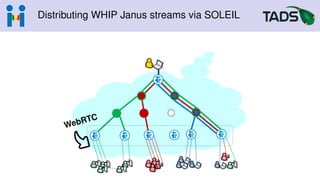
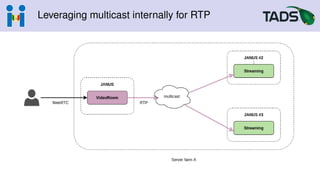
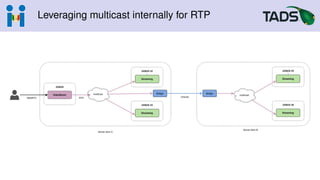
• Ingest and edges are WebRTC (Janus), everything in the middle just RTP
• Working with RTP in intermediate layers has many advantages
• No WebRTC overhead, and easier to route/manipulate by non-WebRTC tools
• You can even take advantage of multicast and/or SDNs, here
• Just needs RTP forwarding to kickstart everything
• Simple WHIP Server does support it (VideoRoom −→ RTP)
• ... and Simple WHEP Server uses Streaming plugin, which consumes RTP!
Using SOLEIL for the purpose
• “Streaming Of Large scale Events over Internet cLouds” (Ph.D Thesis)
• In a nutshell, tree-based distribution of WebRTC feeds
• Ingest and edges are WebRTC (Janus), everything in the middle just RTP
• Working with RTP in intermediate layers has many advantages
• No WebRTC overhead, and easier to route/manipulate by non-WebRTC tools
• You can even take advantage of multicast and/or SDNs, here
• Just needs RTP forwarding to kickstart everything
• Simple WHIP Server does support it (VideoRoom −→ RTP)
• ... and Simple WHEP Server uses Streaming plugin, which consumes RTP!
Using SOLEIL for the purpose
• “Streaming Of Large scale Events over Internet cLouds” (Ph.D Thesis)
• In a nutshell, tree-based distribution of WebRTC feeds
• Ingest and edges are WebRTC (Janus), everything in the middle just RTP
• Working with RTP in intermediate layers has many advantages
• No WebRTC overhead, and easier to route/manipulate by non-WebRTC tools
• You can even take advantage of multicast and/or SDNs, here
• Just needs RTP forwarding to kickstart everything
• Simple WHIP Server does support it (VideoRoom −→ RTP)
• ... and Simple WHEP Server uses Streaming plugin, which consumes RTP!
Distributing WHIP Janus streams via SOLEIL
Leveraging multicast internally for RTP
Thanks! Questions? Comments?
Contacts
• https://fosstodon.org/@lminiero
• https://twitter.com/elminiero
• https://twitter.com/meetecho
• https://www.meetecho.com/blog/
JanusCon is back, see you soon in Napoli!
April 29-30, 2024, Napoli — https://januscon.it
JanusCon is back, see you soon in Napoli!
April 29-30, 2024, Napoli — https://januscon.it

WebRTC Broadcasting @ TADSummit 2023

  • 1.
    WebRTC broadcasting: standardization, challengesand opportunities Lorenzo Miniero @lminiero@fosstodon.org TADSummit 2023 20th October 2023, Paris
  • 2.
    Who am I? LorenzoMiniero • Ph.D @ UniNA • Chairman @ Meetecho • Main author of Janus Contacts and info • lorenzo@meetecho.com • https://fosstodon.org/@lminiero • https://www.slideshare.net/LorenzoMiniero • https://lminiero.bandcamp.com
  • 3.
    Just a fewwords on Meetecho • Co-founded in 2009 as an academic spin-off • University research efforts brought to the market • Completely independent from the University • Focus on real-time multimedia applications • Strong perspective on standardization and open source • Several activities • Consulting services • Commercial support and Janus licenses • Streaming of live events (IETF, RIPE, etc.) • Proudly brewed in sunny Napoli(*), Italy
  • 4.
    Hello from sunnyNaples, Italy!
  • 5.
  • 6.
    What if wewant more interactivity, though?
  • 7.
    What if wewant more interactivity, though?
  • 8.
    What if wewant more interactivity, though?
  • 9.
    What if wewant more interactivity, though?
  • 10.
    Why not WebRTCinstead? • Traditional broadcasting efficient but higher latency • At best (live), delay will typically be in the range of a few seconds • Besides, different users may experience different delays (buffering) • WebRTC natively conceived for very low latency, instead • Born for conversational audio/video/data • Can be (and often is) easily used for monodirectional streaming as well • Strangely not really considered by the industry up until recently, though • Good audio quality (Opus, RED/FEC, stereo/multiopus, etc.) • Good video quality (multiple codecs, simulcast/SVC, etc.) • Tooling an important aspect to foster WebRTC adoption, here • e.g., a standard way to send media, and tools à la OBS, XSplit, or others
  • 11.
    Why not WebRTCinstead? • Traditional broadcasting efficient but higher latency • At best (live), delay will typically be in the range of a few seconds • Besides, different users may experience different delays (buffering) • WebRTC natively conceived for very low latency, instead • Born for conversational audio/video/data • Can be (and often is) easily used for monodirectional streaming as well • Strangely not really considered by the industry up until recently, though • Good audio quality (Opus, RED/FEC, stereo/multiopus, etc.) • Good video quality (multiple codecs, simulcast/SVC, etc.) • Tooling an important aspect to foster WebRTC adoption, here • e.g., a standard way to send media, and tools à la OBS, XSplit, or others
  • 12.
    Why not WebRTCinstead? • Traditional broadcasting efficient but higher latency • At best (live), delay will typically be in the range of a few seconds • Besides, different users may experience different delays (buffering) • WebRTC natively conceived for very low latency, instead • Born for conversational audio/video/data • Can be (and often is) easily used for monodirectional streaming as well • Strangely not really considered by the industry up until recently, though • Good audio quality (Opus, RED/FEC, stereo/multiopus, etc.) • Good video quality (multiple codecs, simulcast/SVC, etc.) • Tooling an important aspect to foster WebRTC adoption, here • e.g., a standard way to send media, and tools à la OBS, XSplit, or others
  • 13.
    Why not WebRTCinstead? • Traditional broadcasting efficient but higher latency • At best (live), delay will typically be in the range of a few seconds • Besides, different users may experience different delays (buffering) • WebRTC natively conceived for very low latency, instead • Born for conversational audio/video/data • Can be (and often is) easily used for monodirectional streaming as well • Strangely not really considered by the industry up until recently, though • Good audio quality (Opus, RED/FEC, stereo/multiopus, etc.) • Good video quality (multiple codecs, simulcast/SVC, etc.) • Tooling an important aspect to foster WebRTC adoption, here • e.g., a standard way to send media, and tools à la OBS, XSplit, or others
  • 14.
  • 15.
    Two main challenges:... and distribution
  • 16.
    (and yeah, maybescaling too! )
  • 17.
    A new WorkingGroup in the IETF https://datatracker.ietf.org/wg/wish/about/
  • 18.
    Making WebRTC ingestioneasy: WHIP! https://www.meetecho.com/blog/whip-janus/ (September 2020)
  • 19.
    Making WebRTC ingestioneasy: WHIP! https://www.meetecho.com/blog/whip-janus-part-ii/
  • 20.
    WebRTC-HTTP ingestion protocol(WHIP) • HTTP-based signalling to create sendonly PeerConnections • HTTP POST to send SDP offer, and get an SDP answer in the response • Teardown of sessions using HTTP DELETE • Authentication and authorization via Bearer tokens • https://www.rfc-editor.org/rfc/rfc6750.html • Trickle and ICE restart via HTTP PATCH and SDP fragments • https://www.rfc-editor.org/rfc/rfc8840.html • Everything else is your usual WebRTC! • ICE, DTLS, etc.
  • 21.
    WebRTC-HTTP ingestion protocol(WHIP) • HTTP-based signalling to create sendonly PeerConnections • HTTP POST to send SDP offer, and get an SDP answer in the response • Teardown of sessions using HTTP DELETE • Authentication and authorization via Bearer tokens • https://www.rfc-editor.org/rfc/rfc6750.html • Trickle and ICE restart via HTTP PATCH and SDP fragments • https://www.rfc-editor.org/rfc/rfc8840.html • Everything else is your usual WebRTC! • ICE, DTLS, etc.
  • 22.
    WebRTC-HTTP ingestion protocol(WHIP) • HTTP-based signalling to create sendonly PeerConnections • HTTP POST to send SDP offer, and get an SDP answer in the response • Teardown of sessions using HTTP DELETE • Authentication and authorization via Bearer tokens • https://www.rfc-editor.org/rfc/rfc6750.html • Trickle and ICE restart via HTTP PATCH and SDP fragments • https://www.rfc-editor.org/rfc/rfc8840.html • Everything else is your usual WebRTC! • ICE, DTLS, etc.
  • 23.
    WebRTC-HTTP ingestion protocol(WHIP) • HTTP-based signalling to create sendonly PeerConnections • HTTP POST to send SDP offer, and get an SDP answer in the response • Teardown of sessions using HTTP DELETE • Authentication and authorization via Bearer tokens • https://www.rfc-editor.org/rfc/rfc6750.html • Trickle and ICE restart via HTTP PATCH and SDP fragments • https://www.rfc-editor.org/rfc/rfc8840.html • Everything else is your usual WebRTC! • ICE, DTLS, etc.
  • 24.
  • 25.
    Enter the JanusWebRTC Server Janus General purpose, open source WebRTC server • https://github.com/meetecho/janus-gateway • Demos and documentation: https://janus.conf.meetecho.com • Community: https://janus.discourse.group/
  • 26.
    Prototyping WHIP withJanus https://github.com/meetecho/simple-whip-server https://github.com/meetecho/simple-whip-client
  • 27.
    OBS + WebRTC= r (thanks Sean DuBois!) https://webrtchacks.com/webrtc-cracks-the-whip-on-obs/
  • 28.
    OBS + WebRTC= r (thanks Sean DuBois!) https://webrtchacks.com/webrtc-cracks-the-whip-on-obs/
  • 29.
    Next step: broadcastingthe stream • WHIP server allows ingestion, and it’s a good starting point • We have a WebRTC stream in an SFU, now (e.g., Janus) • This now needs to be distributed somehow, though • Not a big problem per se • It’s a “regular” 1-to-many distribution • Most servers and services provide ways to do that • What’s the standard way to consume this stream now, though? • SFUs will obviously provide their own custom APIs... • ... but a standard approach would be much better! Enter WHEP! https://www.ietf.org/archive/id/draft-murillo-whep-02.html
  • 30.
    Next step: broadcastingthe stream • WHIP server allows ingestion, and it’s a good starting point • We have a WebRTC stream in an SFU, now (e.g., Janus) • This now needs to be distributed somehow, though • Not a big problem per se • It’s a “regular” 1-to-many distribution • Most servers and services provide ways to do that • What’s the standard way to consume this stream now, though? • SFUs will obviously provide their own custom APIs... • ... but a standard approach would be much better! Enter WHEP! https://www.ietf.org/archive/id/draft-murillo-whep-02.html
  • 31.
    Next step: broadcastingthe stream • WHIP server allows ingestion, and it’s a good starting point • We have a WebRTC stream in an SFU, now (e.g., Janus) • This now needs to be distributed somehow, though • Not a big problem per se • It’s a “regular” 1-to-many distribution • Most servers and services provide ways to do that • What’s the standard way to consume this stream now, though? • SFUs will obviously provide their own custom APIs... • ... but a standard approach would be much better! Enter WHEP! https://www.ietf.org/archive/id/draft-murillo-whep-02.html
  • 32.
    Next step: broadcastingthe stream • WHIP server allows ingestion, and it’s a good starting point • We have a WebRTC stream in an SFU, now (e.g., Janus) • This now needs to be distributed somehow, though • Not a big problem per se • It’s a “regular” 1-to-many distribution • Most servers and services provide ways to do that • What’s the standard way to consume this stream now, though? • SFUs will obviously provide their own custom APIs... • ... but a standard approach would be much better! Enter WHEP! https://www.ietf.org/archive/id/draft-murillo-whep-02.html
  • 33.
    WHIP, WHEP &WHAP! https://www.meetecho.com/blog/whip-whep/
  • 34.
    WebRTC-HTTP egress protocol(WHEP) • Twin protocol of WHIP • WHIP takes care of ingestion (sendonly for users) • WHEP takes care of consuming (recvonly for users) • Pretty much the same approach too • HTTP-based protocol (offer/answer) • Bearer token authentication • HTTP PATCH and SDP fragments for trickle/restarts • WebRTC PeerConnection as a result • Both WHIP and WHEP expecting an offer means they can’t be chained, though... • https://www.meetecho.com/blog/whep-qui/ • </rant>
  • 35.
    WebRTC-HTTP egress protocol(WHEP) • Twin protocol of WHIP • WHIP takes care of ingestion (sendonly for users) • WHEP takes care of consuming (recvonly for users) • Pretty much the same approach too • HTTP-based protocol (offer/answer) • Bearer token authentication • HTTP PATCH and SDP fragments for trickle/restarts • WebRTC PeerConnection as a result • Both WHIP and WHEP expecting an offer means they can’t be chained, though... • https://www.meetecho.com/blog/whep-qui/ • </rant>
  • 36.
    WebRTC-HTTP egress protocol(WHEP) • Twin protocol of WHIP • WHIP takes care of ingestion (sendonly for users) • WHEP takes care of consuming (recvonly for users) • Pretty much the same approach too • HTTP-based protocol (offer/answer) • Bearer token authentication • HTTP PATCH and SDP fragments for trickle/restarts • WebRTC PeerConnection as a result • Both WHIP and WHEP expecting an offer means they can’t be chained, though... • https://www.meetecho.com/blog/whep-qui/ • </rant>
  • 37.
  • 38.
    Prototyping WHEP (too)with Janus https://github.com/meetecho/simple-whep-server https://github.com/meetecho/simple-whep-client
  • 39.
    Ingestion 2 , distribution2 , what about scaling?
  • 40.
    Ph.D Thesis onWebRTC broadcasting (2015)
  • 41.
    Using SOLEIL forthe purpose • “Streaming Of Large scale Events over Internet cLouds” (Ph.D Thesis) • In a nutshell, tree-based distribution of WebRTC feeds • Ingest and edges are WebRTC (Janus), everything in the middle just RTP • Working with RTP in intermediate layers has many advantages • No WebRTC overhead, and easier to route/manipulate by non-WebRTC tools • You can even take advantage of multicast and/or SDNs, here • Just needs RTP forwarding to kickstart everything • Simple WHIP Server does support it (VideoRoom −→ RTP) • ... and Simple WHEP Server uses Streaming plugin, which consumes RTP!
  • 42.
    Using SOLEIL forthe purpose • “Streaming Of Large scale Events over Internet cLouds” (Ph.D Thesis) • In a nutshell, tree-based distribution of WebRTC feeds • Ingest and edges are WebRTC (Janus), everything in the middle just RTP • Working with RTP in intermediate layers has many advantages • No WebRTC overhead, and easier to route/manipulate by non-WebRTC tools • You can even take advantage of multicast and/or SDNs, here • Just needs RTP forwarding to kickstart everything • Simple WHIP Server does support it (VideoRoom −→ RTP) • ... and Simple WHEP Server uses Streaming plugin, which consumes RTP!
  • 43.
    Using SOLEIL forthe purpose • “Streaming Of Large scale Events over Internet cLouds” (Ph.D Thesis) • In a nutshell, tree-based distribution of WebRTC feeds • Ingest and edges are WebRTC (Janus), everything in the middle just RTP • Working with RTP in intermediate layers has many advantages • No WebRTC overhead, and easier to route/manipulate by non-WebRTC tools • You can even take advantage of multicast and/or SDNs, here • Just needs RTP forwarding to kickstart everything • Simple WHIP Server does support it (VideoRoom −→ RTP) • ... and Simple WHEP Server uses Streaming plugin, which consumes RTP!
  • 44.
    Distributing WHIP Janusstreams via SOLEIL
  • 45.
    Distributing WHIP Janusstreams via SOLEIL
  • 46.
    Distributing WHIP Janusstreams via SOLEIL
  • 47.
    Distributing WHIP Janusstreams via SOLEIL
  • 48.
    Distributing WHIP Janusstreams via SOLEIL
  • 49.
  • 50.
  • 51.
    Thanks! Questions? Comments? Contacts •https://fosstodon.org/@lminiero • https://twitter.com/elminiero • https://twitter.com/meetecho • https://www.meetecho.com/blog/
  • 52.
    JanusCon is back,see you soon in Napoli! April 29-30, 2024, Napoli — https://januscon.it
  • 53.
    JanusCon is back,see you soon in Napoli! April 29-30, 2024, Napoli — https://januscon.it