Research Alignment:
Problem, Purpose,
Statement
Agenda
TPP and ARB - milestones that matter
TPP and ARB template
TPP and ARB Student Sample
Problem Statement
Purpose Statement
Research Overview
Research Questions
Alignment
Research Questions – Research Methodology –
Research Design – intent of research study
Questions and Answers
Reviewing the TPP and ARB templates
● TPP Topic Problem Purpose
● ARB is actually your Academic Plan that must be approved by the
Academic Review Board
● Both of these documents can be found on the portal under the
doctoral student tab
● Under the documents and forms link on left hand side
● Note – this tab is being updated and hopefully soon will be renamed
the Graduate School tab
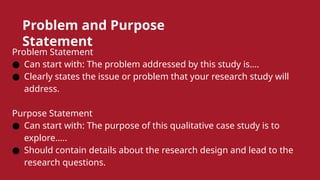
Problem and Purpose
Statement
Problem Statement
● Can start with: The problem addressed by this study is….
● Clearly states the issue or problem that your research study will
address.
Purpose Statement
● Can start with: The purpose of this qualitative case study is to
explore…..
● Should contain details about the research design and lead to the
research questions.
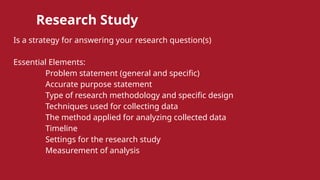
Research Study
Is a strategy for answering your research question(s)
Essential Elements:
Problem statement (general and specific)
Accurate purpose statement
Type of research methodology and specific design
Techniques used for collecting data
The method applied for analyzing collected data
Timeline
Settings for the research study
Measurement of analysis
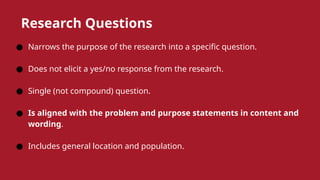
Research Questions
● Narrows the purpose of the research into a specific question.
● Does not elicit a yes/no response from the research.
● Single (not compound) question.
● Is aligned with the problem and purpose statements in content and
wording.
● Includes general location and population.
Alignment
What needs to be aligned? Part 1
Specific Problem state and research question
ex. Specific problem is that many universities, especially small
universities do not have resources to defend against phishing
attacks.
Research Questions
ex. #1. Do university employees have access to quality cyber
awareness training?
ex. #2. Can university employees recognize phishing attempts in
their work email accounts?
ex. #3. Do IT departments in universities have the ability to decide
on the brand of computer equipment for remote workers?
Alignment
What needs to be aligned? Part 2
Research Methodology statement:
In this quantitative research study on phishing attacks, an open-ended
survey will be used to ask university employees on their perceptions of their
face-to-face professional development opportunities.
OR
In this qualitative phenonmenlogical research study, an open-ended survey
and interviews will be used to ask university employees on their perceptions
of their f-2-f professional development opportunities on cyber attacks.
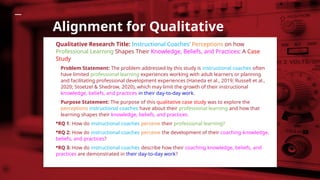
Alignment for Qualitative
Qualitative Research Title: Instructional Coaches’ Perceptions on how
Professional Learning Shapes Their Knowledge, Beliefs, and Practices: A Case
Study
Problem Statement: The problem addressed by this study is instructional coaches often
have limited professional learning experiences working with adult learners or planning
and facilitating professional development experiences (Haneda et al., 2019; Russell et al.,
2020; Stoetzel & Shedrow, 2020), which may limit the growth of their instructional
knowledge, beliefs, and practices in their day-to-day work.
Purpose Statement: The purpose of this qualitative case study was to explore the
perceptions instructional coaches have about their professional learning and how that
learning shapes their knowledge, beliefs, and practices.
RQ 1: How do instructional coaches perceive their professional learning?
RQ 2: How do instructional coaches perceive the development of their coaching knowledge,
beliefs, and practices?
RQ 3: How do instructional coaches describe how their coaching knowledge, beliefs, and
practices are demonstrated in their day-to-day work?
10
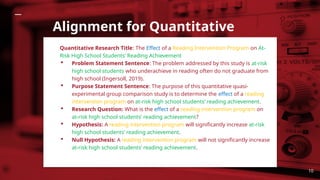
Alignment for Quantitative
Quantitative Research Title: The Effect of a Reading Intervention Program on At-
Risk High School Students’ Reading Achievement
 Problem Statement Sentence: The problem addressed by this study is at-risk
high school students who underachieve in reading often do not graduate from
high school (Ingersoll, 2019).
 Purpose Statement Sentence: The purpose of this quantitative quasi-
experimental group comparison study is to determine the effect of a reading
intervention program on at-risk high school students’ reading achievement.
 Research Question: What is the effect of a reading intervention program on
at-risk high school students’ reading achievement?
 Hypothesis: A reading intervention program will significantly increase at-risk
high school students’ reading achievement.
 Null Hypothesis: A reading intervention program will not significantly increase
at-risk high school students’ reading achievement.
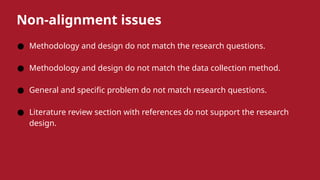
Non-alignment issues
● Methodology and design do not match the research questions.
● Methodology and design do not match the data collection method.
● General and specific problem do not match research questions.
● Literature review section with references do not support the research
design.
Questions and Answer
Session

Jan 29 webinar Research Alignment v2 TI.pptx

  • 1.
  • 2.
    Agenda TPP and ARB- milestones that matter TPP and ARB template TPP and ARB Student Sample Problem Statement Purpose Statement Research Overview Research Questions Alignment Research Questions – Research Methodology – Research Design – intent of research study Questions and Answers
  • 3.
    Reviewing the TPPand ARB templates ● TPP Topic Problem Purpose ● ARB is actually your Academic Plan that must be approved by the Academic Review Board ● Both of these documents can be found on the portal under the doctoral student tab ● Under the documents and forms link on left hand side ● Note – this tab is being updated and hopefully soon will be renamed the Graduate School tab
  • 4.
    Problem and Purpose Statement ProblemStatement ● Can start with: The problem addressed by this study is…. ● Clearly states the issue or problem that your research study will address. Purpose Statement ● Can start with: The purpose of this qualitative case study is to explore….. ● Should contain details about the research design and lead to the research questions.
  • 5.
    Research Study Is astrategy for answering your research question(s) Essential Elements: Problem statement (general and specific) Accurate purpose statement Type of research methodology and specific design Techniques used for collecting data The method applied for analyzing collected data Timeline Settings for the research study Measurement of analysis
  • 6.
    Research Questions ● Narrowsthe purpose of the research into a specific question. ● Does not elicit a yes/no response from the research. ● Single (not compound) question. ● Is aligned with the problem and purpose statements in content and wording. ● Includes general location and population.
  • 7.
    Alignment What needs tobe aligned? Part 1 Specific Problem state and research question ex. Specific problem is that many universities, especially small universities do not have resources to defend against phishing attacks. Research Questions ex. #1. Do university employees have access to quality cyber awareness training? ex. #2. Can university employees recognize phishing attempts in their work email accounts? ex. #3. Do IT departments in universities have the ability to decide on the brand of computer equipment for remote workers?
  • 8.
    Alignment What needs tobe aligned? Part 2 Research Methodology statement: In this quantitative research study on phishing attacks, an open-ended survey will be used to ask university employees on their perceptions of their face-to-face professional development opportunities. OR In this qualitative phenonmenlogical research study, an open-ended survey and interviews will be used to ask university employees on their perceptions of their f-2-f professional development opportunities on cyber attacks.
  • 9.
    Alignment for Qualitative QualitativeResearch Title: Instructional Coaches’ Perceptions on how Professional Learning Shapes Their Knowledge, Beliefs, and Practices: A Case Study Problem Statement: The problem addressed by this study is instructional coaches often have limited professional learning experiences working with adult learners or planning and facilitating professional development experiences (Haneda et al., 2019; Russell et al., 2020; Stoetzel & Shedrow, 2020), which may limit the growth of their instructional knowledge, beliefs, and practices in their day-to-day work. Purpose Statement: The purpose of this qualitative case study was to explore the perceptions instructional coaches have about their professional learning and how that learning shapes their knowledge, beliefs, and practices. RQ 1: How do instructional coaches perceive their professional learning? RQ 2: How do instructional coaches perceive the development of their coaching knowledge, beliefs, and practices? RQ 3: How do instructional coaches describe how their coaching knowledge, beliefs, and practices are demonstrated in their day-to-day work?
  • 10.
    10 Alignment for Quantitative QuantitativeResearch Title: The Effect of a Reading Intervention Program on At- Risk High School Students’ Reading Achievement  Problem Statement Sentence: The problem addressed by this study is at-risk high school students who underachieve in reading often do not graduate from high school (Ingersoll, 2019).  Purpose Statement Sentence: The purpose of this quantitative quasi- experimental group comparison study is to determine the effect of a reading intervention program on at-risk high school students’ reading achievement.  Research Question: What is the effect of a reading intervention program on at-risk high school students’ reading achievement?  Hypothesis: A reading intervention program will significantly increase at-risk high school students’ reading achievement.  Null Hypothesis: A reading intervention program will not significantly increase at-risk high school students’ reading achievement.
  • 11.
    Non-alignment issues ● Methodologyand design do not match the research questions. ● Methodology and design do not match the data collection method. ● General and specific problem do not match research questions. ● Literature review section with references do not support the research design.
  • 12.