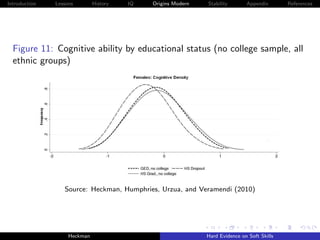
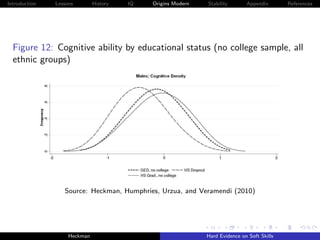
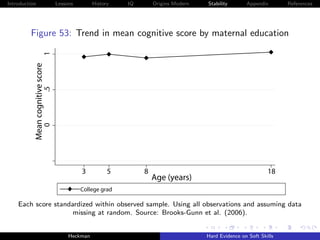
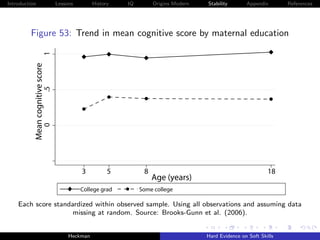
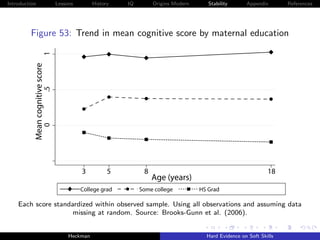
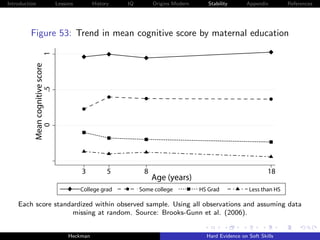
Introduction   Lessons        History   IQ   Origins Modern   Stability       Appendix       References


                         Hard Evidence on Soft Skills

                              James J. Heckman
                            University of Chicago;
                          University College Dublin;
        Director, Human Capital and Economic Opportunity Working
                 Group, Institute for New Economic Thinking


                          Noncognitive Skills: Importance and
                          the Relation with Cognitive Abilities
                                Ayrton Senna Institute
                                   Sao Paulo, Brazil
                                   October 25, 2011
                    Heckman                                   Hard Evidence on Soft Skills
Introduction   Lessons        History   IQ   Origins Modern   Stability       Appendix       References


          We live in an era of widespread testing.


                    Heckman                                   Hard Evidence on Soft Skills
Introduction   Lessons        History   IQ   Origins Modern   Stability       Appendix       References


          We live in an era of widespread testing.
          Achievement tests in particular have assumed a prominent role.


                    Heckman                                   Hard Evidence on Soft Skills
Introduction   Lessons        History   IQ   Origins Modern   Stability       Appendix       References


          We live in an era of widespread testing.
          Achievement tests in particular have assumed a prominent role.
          They are used to:


                    Heckman                                   Hard Evidence on Soft Skills
Introduction       Lessons        History   IQ   Origins Modern   Stability       Appendix       References


          We live in an era of widespread testing.
          Achievement tests in particular have assumed a prominent role.
          They are used to:
               i   Measure skills of persons (e.g., SAT, ACT, ENEM, GRE,
                   GED) and certify suitability for admission and qualifications in
                   a variety of domains of life.


                        Heckman                                   Hard Evidence on Soft Skills
Introduction        Lessons        History   IQ   Origins Modern   Stability       Appendix       References


          We live in an era of widespread testing.
          Achievement tests in particular have assumed a prominent role.
          They are used to:
               i    Measure skills of persons (e.g., SAT, ACT, ENEM, GRE,
                    GED) and certify suitability for admission and qualifications in
                    a variety of domains of life.
               ii   To measure the performance of schools and entire national
                    school systems and nations (e.g. PISA scores, NCLB)


                         Heckman                                   Hard Evidence on Soft Skills
Introduction   Lessons        History   IQ   Origins Modern   Stability       Appendix       References


          These tests are not well understood.


                    Heckman                                   Hard Evidence on Soft Skills
Introduction       Lessons        History   IQ   Origins Modern   Stability       Appendix       References


          These tests are not well understood.
               a   What do they measure?


                        Heckman                                   Hard Evidence on Soft Skills
Introduction       Lessons        History   IQ   Origins Modern   Stability       Appendix       References


          These tests are not well understood.
               a   What do they measure?
               b   How are they validated? What do they predict?


                        Heckman                                   Hard Evidence on Soft Skills
Introduction       Lessons        History   IQ   Origins Modern   Stability       Appendix       References


          These tests are not well understood.
               a   What do they measure?
               b   How are they validated? What do they predict?
               c   What do they miss?


                        Heckman                                   Hard Evidence on Soft Skills
Introduction   Lessons        History   IQ   Origins Modern   Stability       Appendix       References


          Achievement tests miss—or perhaps better—do not accurately
          capture—soft skills.


                    Heckman                                   Hard Evidence on Soft Skills
Introduction   Lessons        History   IQ   Origins Modern   Stability       Appendix       References


          Achievement tests miss—or perhaps better—do not accurately
          capture—soft skills.
          Personality traits, goals, motivations, and preferences that are
          valuable in the labor market, in school, and in many other
          domains.


                    Heckman                                   Hard Evidence on Soft Skills
Introduction   Lessons        History   IQ   Origins Modern   Stability       Appendix       References


     A    Multiple skills are useful in predicting and causing economic
          and social success but with different weights in different tasks.


                    Heckman                                   Hard Evidence on Soft Skills
Introduction       Lessons        History   IQ   Origins Modern   Stability       Appendix       References


     A    Multiple skills are useful in predicting and causing economic
          and social success but with different weights in different tasks.
               i   People differ in their endowments of these skills.


                        Heckman                                   Hard Evidence on Soft Skills
Introduction        Lessons        History   IQ   Origins Modern   Stability       Appendix       References


     A    Multiple skills are useful in predicting and causing economic
          and social success but with different weights in different tasks.
               i    People differ in their endowments of these skills.
               ii   These differences in endowments and values of endowments
                    across tasks give rise to comparative advantage and sorting in
                    the labor market.


                         Heckman                                   Hard Evidence on Soft Skills
Introduction        Lessons        History   IQ   Origins Modern   Stability       Appendix       References


     A    Multiple skills are useful in predicting and causing economic
          and social success but with different weights in different tasks.
               i    People differ in their endowments of these skills.
               ii   These differences in endowments and values of endowments
                    across tasks give rise to comparative advantage and sorting in
                    the labor market.
     B    Personality traits—“soft skills”—can be measured.


                         Heckman                                   Hard Evidence on Soft Skills
Introduction        Lessons        History   IQ   Origins Modern   Stability       Appendix       References


     A    Multiple skills are useful in predicting and causing economic
          and social success but with different weights in different tasks.
               i    People differ in their endowments of these skills.
               ii   These differences in endowments and values of endowments
                    across tasks give rise to comparative advantage and sorting in
                    the labor market.
     B    Personality traits—“soft skills”—can be measured.
               i    They are often as predictive of many life outcomes as are
                    measures of cognition.


                         Heckman                                   Hard Evidence on Soft Skills
Introduction        Lessons        History   IQ   Origins Modern   Stability       Appendix       References


     A    Multiple skills are useful in predicting and causing economic
          and social success but with different weights in different tasks.
               i    People differ in their endowments of these skills.
               ii   These differences in endowments and values of endowments
                    across tasks give rise to comparative advantage and sorting in
                    the labor market.
     B    Personality traits—“soft skills”—can be measured.
               i    They are often as predictive of many life outcomes as are
                    measures of cognition.
               ii   Personality traits have causal effects on behavioral outcomes:
                    changing traits through interventions changes life outcomes.


                         Heckman                                   Hard Evidence on Soft Skills
Introduction   Lessons        History   IQ   Origins Modern   Stability       Appendix       References


     C    Ignoring personality traits can deceive: conceals major social
          problems by using achievement test scores as the measure of
          success.


                    Heckman                                   Hard Evidence on Soft Skills
Introduction   Lessons        History   IQ   Origins Modern   Stability       Appendix       References


     C    Ignoring personality traits can deceive: conceals major social
          problems by using achievement test scores as the measure of
          success.
     D    Traits are stable across situations.


                    Heckman                                   Hard Evidence on Soft Skills
Introduction       Lessons        History   IQ   Origins Modern   Stability       Appendix       References


     C    Ignoring personality traits can deceive: conceals major social
          problems by using achievement test scores as the measure of
          success.
     D    Traits are stable across situations.
               i   Yet they can also be changed in a gradual way through
                   investment and experience.


                        Heckman                                   Hard Evidence on Soft Skills
Introduction        Lessons        History   IQ   Origins Modern   Stability       Appendix       References


     C    Ignoring personality traits can deceive: conceals major social
          problems by using achievement test scores as the measure of
          success.
     D    Traits are stable across situations.
               i    Yet they can also be changed in a gradual way through
                    investment and experience.
               ii   Enhancing these traits is an important avenue for policy.


                         Heckman                                   Hard Evidence on Soft Skills
Introduction        Lessons        History   IQ   Origins Modern   Stability       Appendix       References


     C    Ignoring personality traits can deceive: conceals major social
          problems by using achievement test scores as the measure of
          success.
     D    Traits are stable across situations.
               i    Yet they can also be changed in a gradual way through
                    investment and experience.
               ii   Enhancing these traits is an important avenue for policy.
     E    No evidence for extreme situational specificity of the sort once
          advocated by Walter Mischel (1968).


                         Heckman                                   Hard Evidence on Soft Skills
Introduction        Lessons        History   IQ   Origins Modern   Stability       Appendix       References


     C    Ignoring personality traits can deceive: conceals major social
          problems by using achievement test scores as the measure of
          success.
     D    Traits are stable across situations.
               i    Yet they can also be changed in a gradual way through
                    investment and experience.
               ii   Enhancing these traits is an important avenue for policy.
     E    No evidence for extreme situational specificity of the sort once
          advocated by Walter Mischel (1968).
      F   Situational specificity — that we are what we need to be in any
          specific situation — plays a prominent role in modern
          behavioral economics.


                         Heckman                                   Hard Evidence on Soft Skills
Introduction        Lessons        History   IQ   Origins Modern   Stability       Appendix       References


     C    Ignoring personality traits can deceive: conceals major social
          problems by using achievement test scores as the measure of
          success.
     D    Traits are stable across situations.
               i    Yet they can also be changed in a gradual way through
                    investment and experience.
               ii   Enhancing these traits is an important avenue for policy.
     E    No evidence for extreme situational specificity of the sort once
          advocated by Walter Mischel (1968).
      F   Situational specificity — that we are what we need to be in any
          specific situation — plays a prominent role in modern
          behavioral economics.
     G    There are “enduring traits” that persist and govern behavior
          across multiple domains of economic and social life.

                         Heckman                                   Hard Evidence on Soft Skills
Introduction   Lessons        History   IQ   Origins Modern   Stability       Appendix       References


          I draw on recent research on the GED, an achievement test that
          secondary school dropouts in the U.S. can take to certify that
          they are the equivalents (in cognition) of high school graduates.


                    Heckman                                   Hard Evidence on Soft Skills
Introduction   Lessons        History   IQ   Origins Modern   Stability       Appendix       References


          I draw on recent research on the GED, an achievement test that
          secondary school dropouts in the U.S. can take to certify that
          they are the equivalents (in cognition) of high school graduates.
          Brazil has a version of this test applied on a wide scale
          (ENEM).


                    Heckman                                   Hard Evidence on Soft Skills
Introduction   Lessons        History   IQ   Origins Modern   Stability       Appendix       References


  What Are the Lessons from This Research?

          Success in life requires a lot more than what is measured by
          academic achievement tests.


                    Heckman                                   Hard Evidence on Soft Skills
Introduction   Lessons        History   IQ   Origins Modern   Stability       Appendix       References


  What Are the Lessons from This Research?

          Success in life requires a lot more than what is measured by
          academic achievement tests.
          Soft skills matter.


                    Heckman                                   Hard Evidence on Soft Skills
Introduction   Lessons        History   IQ   Origins Modern   Stability       Appendix       References


  What Are the Lessons from This Research?

          Success in life requires a lot more than what is measured by
          academic achievement tests.
          Soft skills matter.
          Personality—“character” broadly defined—can be measured.


                    Heckman                                   Hard Evidence on Soft Skills
Introduction   Lessons        History   IQ   Origins Modern   Stability       Appendix       References


  What Are the Lessons from This Research?

          Success in life requires a lot more than what is measured by
          academic achievement tests.
          Soft skills matter.
          Personality—“character” broadly defined—can be measured.
          Personality can be fostered. It is an important, but neglected,
          component of what schools and families produce.


                    Heckman                                   Hard Evidence on Soft Skills
Introduction   Lessons        History   IQ   Origins Modern   Stability       Appendix       References


  What Are the Lessons from This Research?

          Success in life requires a lot more than what is measured by
          academic achievement tests.
          Soft skills matter.
          Personality—“character” broadly defined—can be measured.
          Personality can be fostered. It is an important, but neglected,
          component of what schools and families produce.
          A focus on achievement tests fostered by movements for
          “accountability” distorts the incentives of students and
          teachers.


                    Heckman                                   Hard Evidence on Soft Skills
Introduction   Lessons        History   IQ   Origins Modern   Stability       Appendix       References


  A Brief History of Testing

          Goal of developers of IQ and achievement tests: to produce
          “objective” and “comparable” measures of children and schools.


                    Heckman                                   Hard Evidence on Soft Skills
Introduction   Lessons        History   IQ   Origins Modern   Stability       Appendix       References


  A Brief History of Testing

          Goal of developers of IQ and achievement tests: to produce
          “objective” and “comparable” measures of children and schools.
          Pioneers recognize their limits.


                    Heckman                                   Hard Evidence on Soft Skills
Introduction   Lessons        History   IQ   Origins Modern   Stability       Appendix       References


  A Brief History of Testing

          Goal of developers of IQ and achievement tests: to produce
          “objective” and “comparable” measures of children and schools.
          Pioneers recognize their limits.
          They understood that schools produced more than simple
          “book learning” — academic knowledge — expressed
          frustration about how to measure it.


                    Heckman                                   Hard Evidence on Soft Skills
Introduction   Lessons        History   IQ   Origins Modern   Stability       Appendix       References


          Early educators lacked a conceptual framework for thinking
          about what exactly should be measured.


                    Heckman                                   Hard Evidence on Soft Skills
Introduction   Lessons        History   IQ   Origins Modern   Stability       Appendix       References


          Early educators lacked a conceptual framework for thinking
          about what exactly should be measured.
          They lacked the technology for implementing such tests on a
          wide spread scale.


                    Heckman                                   Hard Evidence on Soft Skills
Introduction   Lessons        History   IQ   Origins Modern   Stability       Appendix       References


  IQ

          IQ in its modern form is an early Twentieth Century invention.


                    Heckman                                   Hard Evidence on Soft Skills
Introduction   Lessons        History   IQ   Origins Modern   Stability       Appendix       References


  IQ

          IQ in its modern form is an early Twentieth Century invention.
          It was conceived as a measure of the capacity to learn.


                    Heckman                                   Hard Evidence on Soft Skills
Introduction   Lessons        History   IQ   Origins Modern   Stability       Appendix       References


  IQ

          IQ in its modern form is an early Twentieth Century invention.
          It was conceived as a measure of the capacity to learn.
          Was later broadened to a concept of ability to solve abstract
          problems.


                    Heckman                                   Hard Evidence on Soft Skills
Introduction   Lessons        History   IQ   Origins Modern   Stability       Appendix       References


  IQ

          IQ in its modern form is an early Twentieth Century invention.
          It was conceived as a measure of the capacity to learn.
          Was later broadened to a concept of ability to solve abstract
          problems.
          IQ was tested on a wide scale.


                    Heckman                                   Hard Evidence on Soft Skills
Introduction   Lessons        History   IQ   Origins Modern   Stability       Appendix       References


  IQ

          IQ in its modern form is an early Twentieth Century invention.
          It was conceived as a measure of the capacity to learn.
          Was later broadened to a concept of ability to solve abstract
          problems.
          IQ was tested on a wide scale.
          The successful application of the IQ test suggested the
          possibility of testing achievement — what was learned — not
          just the ability to learn — on a wide scale.


                    Heckman                                   Hard Evidence on Soft Skills
Introduction   Lessons        History   IQ   Origins Modern   Stability       Appendix       References


  IQ

          IQ in its modern form is an early Twentieth Century invention.
          It was conceived as a measure of the capacity to learn.
          Was later broadened to a concept of ability to solve abstract
          problems.
          IQ was tested on a wide scale.
          The successful application of the IQ test suggested the
          possibility of testing achievement — what was learned — not
          just the ability to learn — on a wide scale.
          First IQ test was designed to screen out misfits in school.


                    Heckman                                   Hard Evidence on Soft Skills
Introduction   Lessons        History   IQ   Origins Modern   Stability       Appendix       References


  IQ

          IQ in its modern form is an early Twentieth Century invention.
          It was conceived as a measure of the capacity to learn.
          Was later broadened to a concept of ability to solve abstract
          problems.
          IQ was tested on a wide scale.
          The successful application of the IQ test suggested the
          possibility of testing achievement — what was learned — not
          just the ability to learn — on a wide scale.
          First IQ test was designed to screen out misfits in school.
          Role of the test was broadened to capture “intelligence” and
          quickly became associated with “g”. (Terman and Thorndike)


                    Heckman                                   Hard Evidence on Soft Skills
Introduction   Lessons        History   IQ   Origins Modern   Stability       Appendix       References


  IQ

          IQ in its modern form is an early Twentieth Century invention.
          It was conceived as a measure of the capacity to learn.
          Was later broadened to a concept of ability to solve abstract
          problems.
          IQ was tested on a wide scale.
          The successful application of the IQ test suggested the
          possibility of testing achievement — what was learned — not
          just the ability to learn — on a wide scale.
          First IQ test was designed to screen out misfits in school.
          Role of the test was broadened to capture “intelligence” and
          quickly became associated with “g”. (Terman and Thorndike)
          But the creators of IQ tests realized their limitations.
                    Heckman                                   Hard Evidence on Soft Skills
Introduction   Lessons        History   IQ   Origins Modern   Stability       Appendix       References


  Binet:
      “[Success in school] . . .admits of other things than
      intelligence; to succeed in his studies, one must have
      qualities which depend on attention, will, and character;
      for example a certain docility, a regularity of habits, and
      especially continuity of effort. A child, even if intelligent,
      will learn little in class if he never listens, if he spends his
      time in playing tricks, in giggling, in playing truant.”

                                                                 -Binet (1916, p. 254)


                    Heckman                                   Hard Evidence on Soft Skills
Introduction   Lessons        History   IQ   Origins Modern   Stability       Appendix       References


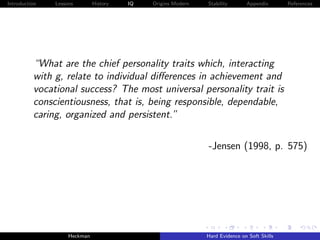
          “What are the chief personality traits which, interacting
          with g, relate to individual differences in achievement and
          vocational success? The most universal personality trait is
          conscientiousness, that is, being responsible, dependable,
          caring, organized and persistent.”

                                                              -Jensen (1998, p. 575)


                    Heckman                                   Hard Evidence on Soft Skills
Introduction   Lessons        History   IQ   Origins Modern   Stability       Appendix       References


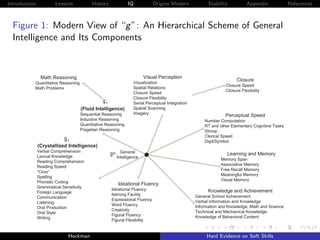
          The modern conception of intelligence has moved well beyond
          “g ” to a hierarchy of traits.


                    Heckman                                   Hard Evidence on Soft Skills
Introduction   Lessons        History   IQ   Origins Modern   Stability       Appendix       References


          The modern conception of intelligence has moved well beyond
          “g ” to a hierarchy of traits.
          But “g ” is still at the top of the hierarchy.


                    Heckman                                   Hard Evidence on Soft Skills
Introduction           Lessons           History               IQ           Origins Modern              Stability          Appendix             References


  Figure 1: Modern View of “g ”: An Hierarchical Scheme of General
  Intelligence and Its Components


                Math Reasoning                                          Visual Perception
                                                                                                                      Closure
           Quantitative Reasoning                                 Visualization
                                                                                                                Closure Speed
           Math Problems                                          Spatial Relations
                                                                                                                Closure Flexibility
                                                                  Closure Speed
                                                                  Closure Flexibility
                                               gf                 Serial Perceptual Integration
                                    (Fluid Intelligence)          Spatial Scanning
                                    Sequential Reasoning          Imagery
                                                                                                                Perceptual Speed
                                    Inductive Reasoning                                               Number Computation
                                    Quantitative Reasoning                                            RT and other Elementary Cognitive Tasks
                                    Piagetian Reasoning                                               Stroop
                                                                                                      Clerical Speed
                           gc
                           Gc                                                                         Digit/Symbol
               (Crystallized Intelligence)
               Verbal Comprehension                        General
               Lexical Knowledge
                                                    g=                                                           Learning and Memory
                                                         Intelligence
                                                                                                              Memory Span
               Reading Comprehension
                                                                                                              Associative Memory
               Reading Speed
                                                                                                              Free Recall Memory
               “Cloze”
                                                                                                              Meaningful Memory
               Spelling
                                                                                                              Visual Memory
               Phonetic Coding                           Ideational Fluency
               Grammatical Sensitivity
                                                    Ideational Fluency                                  Knowledge and Achievement
               Foreign Language
                                                    Naming Facility                               General School Achievement
               Communication
                                                    Expressional Fluency                          Verbal Information and Knowledge
               Listening
                                                    Word Fluency                                  Information and Knowledge, Math and Science
               Oral Production
                                                    Creativity                                    Technical and Mechanical Knowledge
               Oral Style
                                                    Figural Fluency                               Knowledge of Behavioral Content
               Writing
                                                    Figural Flexibility


                              Heckman                                                                  Hard Evidence on Soft Skills
Introduction   Lessons        History   IQ   Origins Modern   Stability       Appendix       References


  Operationalizing IQ


                    Heckman                                   Hard Evidence on Soft Skills
Introduction   Lessons        History   IQ   Origins Modern   Stability       Appendix       References

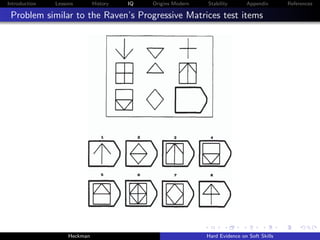
 Problem similar to the Raven’s Progressive Matrices test items


                    Heckman                                   Hard Evidence on Soft Skills
Introduction   Lessons        History    IQ   Origins Modern   Stability       Appendix       References

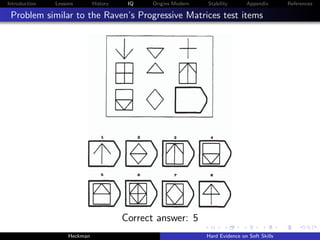
 Problem similar to the Raven’s Progressive Matrices test items


                                        Correct answer: 5
                    Heckman                                    Hard Evidence on Soft Skills
Introduction   Lessons        History   IQ   Origins Modern   Stability       Appendix       References


  Origins of the Modern Achievement Test

          Achievement tests were created in the wake of the IQ test as a
          way to capture the knowledge acquired in schools, not just the
          capacity to learn.


                    Heckman                                   Hard Evidence on Soft Skills
Introduction   Lessons        History   IQ   Origins Modern   Stability       Appendix       References


  Origins of the Modern Achievement Test

          Achievement tests were created in the wake of the IQ test as a
          way to capture the knowledge acquired in schools, not just the
          capacity to learn.
          The distinction between knowledge and the ability to acquire it
          is clear.


                    Heckman                                   Hard Evidence on Soft Skills
Introduction   Lessons        History   IQ   Origins Modern   Stability       Appendix       References


  Origins of the Modern Achievement Test

          Achievement tests were created in the wake of the IQ test as a
          way to capture the knowledge acquired in schools, not just the
          capacity to learn.
          The distinction between knowledge and the ability to acquire it
          is clear.
          How one separates these concepts empirically is not so clear,
          especially since the ability to acquire knowledge is not a fixed
          trait but can be changed.


                    Heckman                                   Hard Evidence on Soft Skills
Introduction   Lessons        History   IQ   Origins Modern   Stability       Appendix       References


  General Knowledge

          The inventors of the achievement test sought to measure
          “useful knowledge” or “general knowledge” valuable in
          functioning at work and in society, not specific knowledge of a
          course.


                    Heckman                                   Hard Evidence on Soft Skills
Introduction   Lessons        History   IQ   Origins Modern   Stability       Appendix       References


  General Knowledge

          The inventors of the achievement test sought to measure
          “useful knowledge” or “general knowledge” valuable in
          functioning at work and in society, not specific knowledge of a
          course.
          Designed to be “objective”—not depend on teacher
          assessments as captured by grades. This was perceived to be a
          way to implement meritocratic notions of education.


                    Heckman                                   Hard Evidence on Soft Skills
Introduction   Lessons        History   IQ   Origins Modern   Stability       Appendix       References


  General Knowledge

          The inventors of the achievement test sought to measure
          “useful knowledge” or “general knowledge” valuable in
          functioning at work and in society, not specific knowledge of a
          course.
          Designed to be “objective”—not depend on teacher
          assessments as captured by grades. This was perceived to be a
          way to implement meritocratic notions of education.
          Iowa tests; ACT; GED; ENEM; No Child Left Behind; NAEP;
          PISA tests are modern versions.


                    Heckman                                   Hard Evidence on Soft Skills
Introduction   Lessons        History   IQ   Origins Modern   Stability       Appendix       References


  Iowa Test of Educational Development (ITED)

          Developed in 1930s and 1940s.


                    Heckman                                   Hard Evidence on Soft Skills
Introduction   Lessons        History   IQ   Origins Modern   Stability       Appendix       References


  Iowa Test of Educational Development (ITED)

          Developed in 1930s and 1940s.
          The prototype for all achievement tests.


                    Heckman                                   Hard Evidence on Soft Skills
Introduction   Lessons        History   IQ   Origins Modern   Stability       Appendix       References


          What matters most is not how many detailed facts a
          person can quote, but how well he can make use of what
          he knows, and how straight he can think about personal
          and group problems.

          The Iowa Tests, therefore, were planned to measure the
          fundamental ideas the student has acquired permanently,
          and what he is able to do with them.

          This seemed much more important than just measuring
          the specific information he had memorized in a course,
          which he would forget after the final exam.


                    Heckman                                   Hard Evidence on Soft Skills
Introduction   Lessons        History   IQ   Origins Modern   Stability       Appendix       References


          They were planned to measure the real knowledge and
          reasoning ability a student had, no matter how he had
          acquired them . . .

                                                                          -Lindquist (1948)


                    Heckman                                   Hard Evidence on Soft Skills
Introduction   Lessons        History   IQ   Origins Modern   Stability       Appendix       References


          Achievement tests are designed to measure acquired knowledge.


                    Heckman                                   Hard Evidence on Soft Skills
Introduction   Lessons        History   IQ   Origins Modern   Stability       Appendix       References


          Achievement tests are designed to measure acquired knowledge.
          But what motivates students to acquire knowledge?


                    Heckman                                   Hard Evidence on Soft Skills
Introduction   Lessons        History   IQ   Origins Modern   Stability       Appendix       References


          Achievement tests are designed to measure acquired knowledge.
          But what motivates students to acquire knowledge?
          Cognition, personality, as well as environmental determinants,
          such as parents, teachers, and peers.


                    Heckman                                   Hard Evidence on Soft Skills
Introduction   Lessons        History   IQ   Origins Modern   Stability       Appendix       References


  What Do Schools Produce?

          Is it just the knowledge captured by standard achievement
          tests?


                    Heckman                                   Hard Evidence on Soft Skills
Introduction   Lessons        History   IQ   Origins Modern   Stability       Appendix       References


  What Do Schools Produce?

          Is it just the knowledge captured by standard achievement
          tests?
          Every creator of an achievement test thought otherwise.


                    Heckman                                   Hard Evidence on Soft Skills
Introduction   Lessons        History   IQ   Origins Modern   Stability       Appendix       References


  Mann:
     “Hence to value schools, by length instead of quality, is a
     matchless absurdity. Arithmetic, grammar, and the other
     rudiments, as they are called, comprise but a small part of
     the teachings in a school. The rudiments of feeling are
     taught not less than the rudiments of thinking. The
     sentiments and passions get more lessons than the
     intellect. Though their open recitations may be less, their
     secret rehearsals are more.”

                                                       -Horace Mann (1867, p. 420)


                    Heckman                                   Hard Evidence on Soft Skills
Introduction   Lessons        History   IQ   Origins Modern   Stability       Appendix       References


          Other mechanisms of assessment besides the objective exam
          were often suggested.


                    Heckman                                   Hard Evidence on Soft Skills
Introduction   Lessons        History   IQ   Origins Modern   Stability       Appendix       References


          “We lean heavily on written examinations, on a few types
          of objective tests, and on the subjective impressions of
          teachers. Many other appraisal devices could be used, such
          as records of activities in which pupils participate,
          questionnaires, check lists, anecdotal records and
          observational records, interviews, reports made by parents,
          products made by the pupils, and records made by
          instruments (motion pictures, eye-movement records,
          sound recordings, and the like).”


                                                                                -Tyler (1940)


                    Heckman                                   Hard Evidence on Soft Skills
Introduction   Lessons        History   IQ   Origins Modern   Stability       Appendix       References


          But time and again, the achievement test won out as a cheap
          tool of assessment.


                    Heckman                                   Hard Evidence on Soft Skills
Introduction   Lessons        History   IQ   Origins Modern   Stability       Appendix       References


          But time and again, the achievement test won out as a cheap
          tool of assessment.
          Other methods were more costly, even if they missed a lot.


                    Heckman                                   Hard Evidence on Soft Skills
Introduction   Lessons        History   IQ   Origins Modern   Stability       Appendix       References


  How are IQ and achievement tests validated?

          Usually on grades and other tests.


                    Heckman                                   Hard Evidence on Soft Skills
Introduction   Lessons        History   IQ   Origins Modern   Stability       Appendix       References


  How are IQ and achievement tests validated?

          Usually on grades and other tests.
          This is ironic in light of the fact that the achievement test was
          invented in order to avoid the “subjectivity” of grades.


                    Heckman                                   Hard Evidence on Soft Skills
Introduction        Lessons            History        IQ          Origins Modern        Stability         Appendix           References


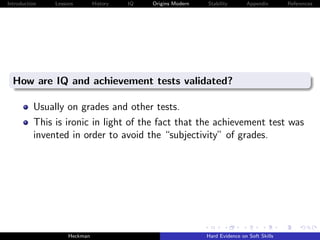
      Table 1: Predictive Validities of Standard IQ and Achievement Tests
                                                  Cognitive Achievement and IQ Tests
                 Test           Domain over           Estimated Validities               Source                 Notes
                                 which it is
                                 validated
           SAT                  First year col-    0.35 to 0.53                    Kobrin et al. (2008)
                                lege GPA

           ACT                  Grades      in     0.42                            ACT Incorporated
                                early years of                                     (2007)
                                college

           Stanford-            Correlations       0.77 to 0.87 with WISC-R        Rothlisberg (1987);
           Binet                with      other                                    Greene et al. (1990)
                                intelligence
                                tests

           WISC                 Correlations       WISC: 0.443 to 0.751            Hartlage and Steele      WRAT        =
           (Wechsler            with      aca-     with WRAT tests, 0.482          (1977)                   Wide Range
           Intelligence         demic              to 0.788 with 1st grade                                  Achievement
           Scale       for      achievement        grades, 0.462 to 0.794 with                              Test; ranges
           Children)                               2nd grade grades; WISC-R:                                are      given
                                                   0.346 to 0.760 with WRAT                                 because cor-
                                                   tests, 0.358 to 0.537 with                               relations vary
                                                   1st grade grades, 0.420                                  by academic
                                                   to 0.721 with 2nd grade                                  subject
                                                   grades

                                   Source: Almund et al. (2011).
                             Heckman                                                    Hard Evidence on Soft Skills
Introduction       Lessons            History        IQ          Origins Modern        Stability          Appendix           References


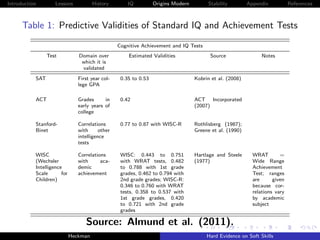
      Table 1: Predictive Validities of Standard IQ and Achievement Tests
                                                 Cognitive Achievement and IQ Tests
               Test            Domain over           Estimated Validities               Source                  Notes
                                which it is
                                validated
           WAIS (Wech-         Correlations       0.67 (median) with ver-         Feingold (1982)
           sler     Adult      with     other     bal tests, 0.61 (median)
           Intelligence        intelli-           with nonverbal tests, 0.69
           Scale)              gence tests,       with education attained,
                               achievement        0.38 to 0.43 with col-
                               tests,    and      lege grades, 0.62 with high
                               outcomes           school grades

           Raven’s             Correlations       0.74 to 0.84 with WAIS-R        O’Leary    et     al.
           Standard            with      other                                    (1991)
           Progressive         intelligence
           Matrices            tests

           GATB (Gen-          Supervisor         0.23 to 0.65                    Hunter (1986)             Large range
           eral Aptitude       rating     per-                                                              due to variety
           Test Battery)       formance                                                                     of jobs
                               in     training
                               programs
                               and in job
                               performance


                                  Source: Almund et al. (2011).
                            Heckman                                                   Hard Evidence on Soft Skills
Introduction       Lessons            History        IQ        Origins Modern         Stability           Appendix            References


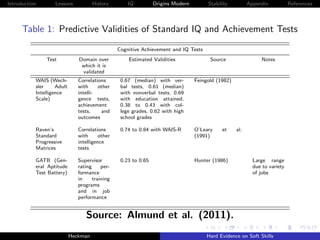
      Table 1: Predictive Validities of Standard IQ and Achievement Tests
                                                 Cognitive Achievement and IQ Tests
               Test            Domain over           Estimated Validities              Source                   Notes
                                which it is
                                validated
           ASVAB               Performance        0.37 to 0.78 for training     Schmidt      et     al.     Large range
           (Armed              in     military    (mean=0.56); -0.15 for at-    (1988) for perfor-          in    training
           Services            training           trition                       mance in training           correlations
           Vocational          programs                                         programs;       Sticht      due     to    a
           Aptitude            and military                                     et al. (1982) for           variety      of
           Battery)            attrition rates                                  attrition rates             jobs

           GED (Gen-           Test difficulty      0.33 to 0.49 for HS Senior    Technical Manual:
           eral      Ed-       is    normed       GPA                           2002 Series GED
           ucational           against grad-                                    Tests
           Develop-            uating     HS
           ment)               seniors. Test
                               scores of high
                               school seniors
                               and grades of
                               high school
                               seniors

           Other Valid-        Correlation        .75–.79 AFQT, .78 NALS,       Boesel et al. (1998)
           ity Studies of      with     other     .81 Iowa Tests
           the GED             achievement
                               tests


                                  Source: Almund et al. (2011).
                            Heckman                                                   Hard Evidence on Soft Skills
Introduction        Lessons            History       IQ         Origins Modern        Stability         Appendix            References


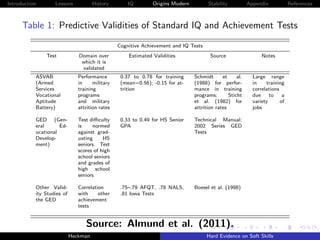
      Table 1: Predictive Validities of Standard IQ and Achievement Tests
                                                 Cognitive Achievement and IQ Tests
                Test            Domain over          Estimated Validities              Source                 Notes
                                 which it is
                                 validated
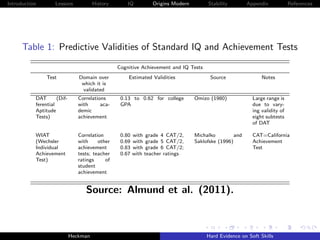
           DAT       (Dif-      Correlations      0.13 to 0.62 for college       Omizo (1980)             Large range is
           ferential            with      aca-    GPA                                                     due to vary-
           Aptitude             demic                                                                     ing validity of
           Tests)               achievement                                                               eight subtests
                                                                                                          of DAT

           WIAT                 Correlation       0.80   with grade 4 CAT/2,     Michalko         and     CAT=California
           (Wechsler            with     other    0.69   with grade 5 CAT/2,     Saklofske (1996)         Achievement
           Individual           achievement       0.83   with grade 6 CAT/2;                              Test
           Achievement          tests; teacher    0.67   with teacher ratings
           Test)                ratings     of
                                student
                                achievement


                                   Source: Almund et al. (2011).


                             Heckman                                                  Hard Evidence on Soft Skills
Introduction   Lessons        History   IQ   Origins Modern   Stability       Appendix       References


          Only recently has the validity of the tests on real world
          outcomes been established.


                    Heckman                                   Hard Evidence on Soft Skills
Introduction   Lessons        History   IQ   Origins Modern   Stability       Appendix       References


          Only recently has the validity of the tests on real world
          outcomes been established.
          They predict a bit, but they leave a lot unexplained.


                    Heckman                                   Hard Evidence on Soft Skills
Introduction   Lessons        History   IQ   Origins Modern   Stability       Appendix       References


          Only recently has the validity of the tests on real world
          outcomes been established.
          They predict a bit, but they leave a lot unexplained.
          Achievement tests and grades are usually more predictive than
          IQ.


                    Heckman                                   Hard Evidence on Soft Skills
Introduction   Lessons        History   IQ   Origins Modern   Stability       Appendix       References


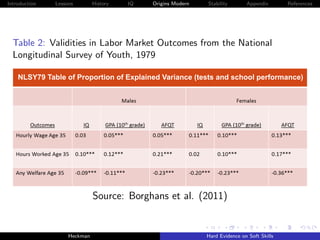
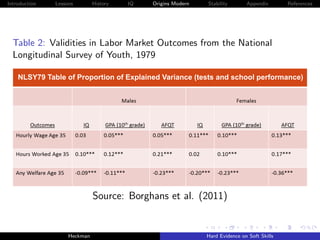
  Table 2: Validities in Labor Market Outcomes from the National
  Longitudinal Survey of Youth, 1979

    NLSY79 Table of Proportion of Explained Variance (tests and school performance)


                              Source: Borghans et al. (2011)


                    Heckman                                   Hard Evidence on Soft Skills
Introduction   Lessons        History   IQ   Origins Modern   Stability       Appendix       References


  Personality

          Personality and Motivation: missing dimensions that predict
          adult performance.


                    Heckman                                   Hard Evidence on Soft Skills
Introduction   Lessons        History   IQ   Origins Modern   Stability       Appendix       References


  Personality

          Personality and Motivation: missing dimensions that predict
          adult performance.
          Some of the missing dimensions manifest in these tables that
          explain a variety of educational and labor market outcomes.


                    Heckman                                   Hard Evidence on Soft Skills
Introduction   Lessons        History   IQ   Origins Modern   Stability       Appendix       References


  Personality

          Personality and Motivation: missing dimensions that predict
          adult performance.
          Some of the missing dimensions manifest in these tables that
          explain a variety of educational and labor market outcomes.
          Economist’s “Dark Matter” or “Dark Energy.”


                    Heckman                                   Hard Evidence on Soft Skills
Introduction   Lessons        History   IQ   Origins Modern   Stability       Appendix       References


  Personality

          Personality and Motivation: missing dimensions that predict
          adult performance.
          Some of the missing dimensions manifest in these tables that
          explain a variety of educational and labor market outcomes.
          Economist’s “Dark Matter” or “Dark Energy.”
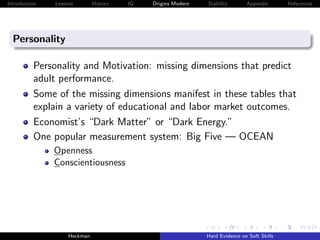
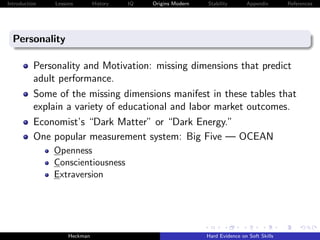
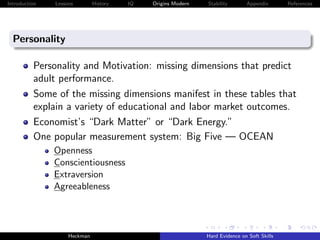
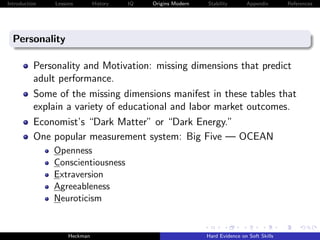
          One popular measurement system: Big Five — OCEAN


                    Heckman                                   Hard Evidence on Soft Skills
Introduction   Lessons        History   IQ   Origins Modern   Stability       Appendix       References


  Personality

          Personality and Motivation: missing dimensions that predict
          adult performance.
          Some of the missing dimensions manifest in these tables that
          explain a variety of educational and labor market outcomes.
          Economist’s “Dark Matter” or “Dark Energy.”
          One popular measurement system: Big Five — OCEAN
               Openness


                    Heckman                                   Hard Evidence on Soft Skills
Introduction   Lessons        History   IQ   Origins Modern   Stability       Appendix       References


  Personality

          Personality and Motivation: missing dimensions that predict
          adult performance.
          Some of the missing dimensions manifest in these tables that
          explain a variety of educational and labor market outcomes.
          Economist’s “Dark Matter” or “Dark Energy.”
          One popular measurement system: Big Five — OCEAN
               Openness
               Conscientiousness


                    Heckman                                   Hard Evidence on Soft Skills
Introduction   Lessons        History   IQ   Origins Modern   Stability       Appendix       References


  Personality

          Personality and Motivation: missing dimensions that predict
          adult performance.
          Some of the missing dimensions manifest in these tables that
          explain a variety of educational and labor market outcomes.
          Economist’s “Dark Matter” or “Dark Energy.”
          One popular measurement system: Big Five — OCEAN
               Openness
               Conscientiousness
               Extraversion


                    Heckman                                   Hard Evidence on Soft Skills
Introduction   Lessons        History   IQ   Origins Modern   Stability       Appendix       References


  Personality

          Personality and Motivation: missing dimensions that predict
          adult performance.
          Some of the missing dimensions manifest in these tables that
          explain a variety of educational and labor market outcomes.
          Economist’s “Dark Matter” or “Dark Energy.”
          One popular measurement system: Big Five — OCEAN
               Openness
               Conscientiousness
               Extraversion
               Agreeableness


                    Heckman                                   Hard Evidence on Soft Skills
Introduction   Lessons        History   IQ   Origins Modern   Stability       Appendix       References


  Personality

          Personality and Motivation: missing dimensions that predict
          adult performance.
          Some of the missing dimensions manifest in these tables that
          explain a variety of educational and labor market outcomes.
          Economist’s “Dark Matter” or “Dark Energy.”
          One popular measurement system: Big Five — OCEAN
               Openness
               Conscientiousness
               Extraversion
               Agreeableness
               Neuroticism


                    Heckman                                   Hard Evidence on Soft Skills
Introduction           Lessons         History          IQ          Origins Modern                Stability          Appendix              References


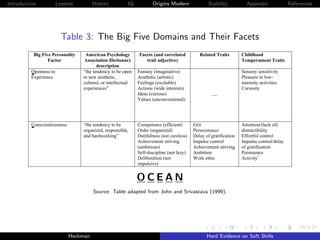
                         Table 3: The Big Five Domains and Their Facets
          Big Five Personality    American Psychology        Facets (and correlated          Related Traits        Childhood
                 Factor           Association Dictionary        trait adjective)                                   Temperament Traits
                                        description
         Openness to             “the tendency to be open    Fantasy (imaginative)                                 Sensory sensitivity
         Experience              to new aesthetic,           Aesthetic (artistic)                                  Pleasure in low-
                                 cultural, or intellectual   Feelings (excitable)                                  intensity activities
                                 experiences”                Actions (wide interests)                              Curiosity
                                                             Ideas (curious)                       —
                                                             Values (unconventional)


         Conscientiousness       “the tendency to be         Competence (efficient)       Grit                     Attention/(lack of)
                                 organized, responsible,     Order (organized)            Perseverance             distractibility
                                 and hardworking”            Dutifulness (not careless)   Delay of gratification   Effortful control
                                                             Achievement striving         Impulse control          Impulse control/delay
                                                             (ambitious)                  Achievement striving     of gratification
                                                             Self-discipline (not lazy)   Ambition                 Persistence
                                                             Deliberation (not            Work ethic               Activity*
                                                             impulsive)


                                                             OCEAN
                                       Source: Table adapted from John and Srivastava (1999).


                             Heckman                                                             Hard Evidence on Soft Skills
Introduction            Lessons          History           IQ           Origins Modern                Stability           Appendix             References

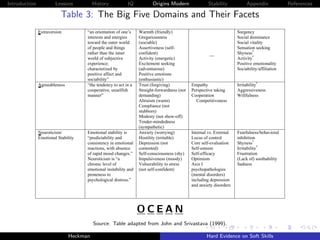
                           Table 3: The Big Five Domains and Their Facets
               Extraversion          “an orientation of one’s    Warmth (friendly)                                   Surgency
                                     interests and energies      Gregariousness                                      Social dominance
                                     toward the outer world      (sociable)                                          Social vitality
                                     of people and things        Assertiveness (self-                                Sensation seeking
                                     rather than the inner       confident)                                          Shyness*
                                                                                                      —
                                     world of subjective         Activity (energetic)                                Activity*
                                     experience;                 Excitement seeking                                  Positive emotionality
                                     characterized by            (adventurous)                                       Sociability/affiliation
                                     positive affect and         Positive emotions
                                     sociability”                (enthusiastic)
               Agreeableness         “the tendency to act in a   Trust (forgiving)           Empathy                 Irritability*
                                     cooperative, unselfish      Straight-forwardness (not   Perspective taking      Aggressiveness
                                     manner”                     demanding)                  Cooperation             Willfulness
                                                                 Altruism (warm)               Competitiveness
                                                                 Compliance (not
                                                                 stubborn)
                                                                 Modesty (not show-off)
                                                                 Tender-mindedness
                                                                 (sympathetic)
               Neuroticism/          Emotional stability is      Anxiety (worrying)          Internal vs. External   Fearfulness/behavioral
               Emotional Stability   “predictability and         Hostility (irritable)       Locus of control        inhibition
                                     consistency in emotional    Depression (not             Core self-evaluation    Shyness*
                                     reactions, with absence     contented)                  Self-esteem             Irritability*
                                     of rapid mood changes.”     Self-consciousness (shy)    Self-efficacy           Frustration
                                     Neuroticism is “a           Impulsiveness (moody)       Optimism                (Lack of) soothability
                                     chronic level of            Vulnerability to stress     Axis I                  Sadness
                                     emotional instability and   (not self-confident)        psychopathologies
                                     proneness to                                            (mental disorders)
                                     psychological distress.”                                including depression
                                                                                             and anxiety disorders


                                                                 OCEAN
                                         Source: Table adapted from John and Srivastava (1999).

                               Heckman                                                               Hard Evidence on Soft Skills
Introduction   Lessons        History   IQ   Origins Modern   Stability       Appendix       References


           Alternative measurement systems and their communalities


                    Heckman                                   Hard Evidence on Soft Skills
Introduction             Lessons           History        IQ           Origins Modern               Stability           Appendix              References

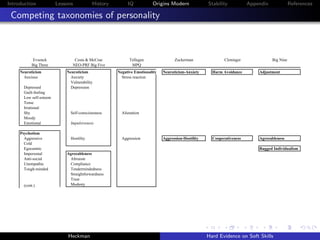
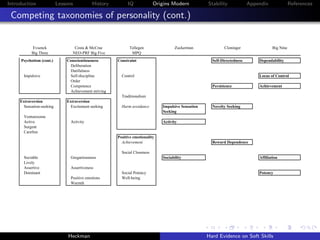
 Competing taxonomies of personality


           Evsenck               Costa & McCrae            Tellegen                Zuckerman                Cloninger              Big Nine
           Big Three            NEO-PRF Big Five            MPQ
     Neuroticism             Neuroticism             Negative Emotionality   Neuroticism-Anxiety      Harm Avoidance        Adjustment
       Anxious                 Anxiety                 Stress reaction
                               Vulnerability
       Depressed               Depression
       Guilt-feeling
       Low self-esteem
       Tense
       Irrational
       Shy                     Self-consciousness      Alienation
       Moody
       Emotional               Impulsiveness

     Psychotism
       Aggressive              Hostility               Aggression            Aggression-Hostility     Cooperativeness       Agreeableness
       Cold
       Egocentric                                                                                                           Rugged Individualism
       Impersonal            Agreeableness
       Anti-social            Altruism
       Unempathic             Compliance
       Tough-minded           Tendermindedness
                              Straightforwardness
                              Trust
       (cont.)                Modesty


                              Heckman                                                               Hard Evidence on Soft Skills
Introduction               Lessons           History        IQ              Origins Modern           Stability             Appendix              References

 Competing taxonomies of personality (cont.)


           Evsenck                 Costa & McCrae            Tellegen                 Zuckerman              Cloninger                Big Nine
           Big Three              NEO-PRF Big Five            MPQ
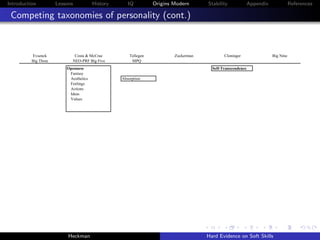
     Psychotism (cont.)        Conscientiousness       Constraint                                      Self-Directedness       Dependability
                                Deliberation
                                Dutifulness
       Impulsive                Self-discipline          Control                                                               Locus of Control
                                Order
                                Competence                                                             Persistence             Achievement
                                Achievement striving
                                                         Traditionalism
     Extraversion              Extraversion
       Sensation-seeking         Excitement seeking      Harm avoidance        Impulsive Sensation     Novelty Seeking
                                                                               Seeking
       Venturesome
       Active                    Activity                                      Activity
       Surgent
       Carefree
                                                       Positive emotionality
                                                         Achievement                                   Reward Dependence

                                                         Social Closeness
       Sociable                  Gregariousness                                Sociability                                     Affiliation
       Lively
       Assertive                 Assertiveness
       Dominant                                          Social Potency                                                        Potency
                                 Positive emotions       Well-being
                                 Warmth


                                Heckman                                                              Hard Evidence on Soft Skills
Introduction          Lessons           History      IQ          Origins Modern      Stability              Appendix              References

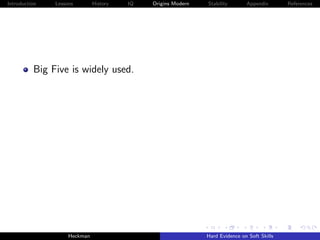
 Competing taxonomies of personality (cont.)


          Evsenck             Costa & McCrae          Tellegen           Zuckerman           Cloninger                 Big Nine
          Big Three          NEO-PRF Big Five          MPQ
                          Openness                                                     Self-Transcendence
                           Fantasy
                           Aesthetics             Absorption
                           Feelings
                           Actions
                           Ideas
                           Values


                           Heckman                                                   Hard Evidence on Soft Skills
Introduction   Lessons        History   IQ   Origins Modern   Stability       Appendix       References


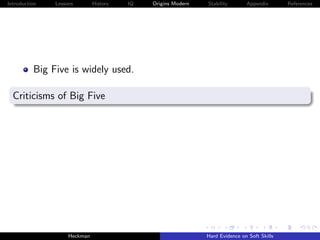
          Big Five is widely used.


                    Heckman                                   Hard Evidence on Soft Skills
Introduction   Lessons        History   IQ   Origins Modern   Stability       Appendix       References


          Big Five is widely used.

  Criticisms of Big Five


                    Heckman                                   Hard Evidence on Soft Skills
Introduction   Lessons        History   IQ   Origins Modern   Stability       Appendix       References


          Big Five is widely used.

  Criticisms of Big Five

          The five-factor model is atheoretical.


                    Heckman                                   Hard Evidence on Soft Skills
Introduction   Lessons        History   IQ   Origins Modern   Stability       Appendix       References


          Big Five is widely used.

  Criticisms of Big Five

          The five-factor model is atheoretical.
          The five-factor model is relatively silent on an important class
          of individual differences: motivation and goals.


                    Heckman                                   Hard Evidence on Soft Skills
Introduction   Lessons        History   IQ   Origins Modern   Stability       Appendix       References


  Defining non-cognitive traits for children

          Childhood temperament is the term used by developmental
          psychologists to describe the personalities of infants and
          children.


                    Heckman                                   Hard Evidence on Soft Skills
Introduction   Lessons        History   IQ   Origins Modern   Stability       Appendix       References


  Defining non-cognitive traits for children

          Childhood temperament is the term used by developmental
          psychologists to describe the personalities of infants and
          children.
          Most of the research on temperament has examined specific
          lower-order traits rather than broader, higher-level factors that
          characterize studies of adult intelligence and personality.


                    Heckman                                   Hard Evidence on Soft Skills
Introduction   Lessons        History   IQ   Origins Modern   Stability       Appendix       References


  Validities for Personality Tests

          What are the validities for personality tests?


                    Heckman                                   Hard Evidence on Soft Skills
Introduction   Lessons        History   IQ   Origins Modern   Stability       Appendix       References


  Validities for Personality Tests

          What are the validities for personality tests?
          How correlated are scores on these tests with behaviors?


                    Heckman                                   Hard Evidence on Soft Skills
Introduction   Lessons        History   IQ   Origins Modern   Stability       Appendix       References


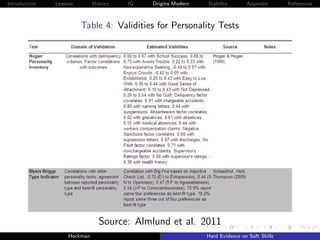
                         Table 4: Validities for Personality Tests


                                Source: Almlund et al. 2011
                    Heckman                                   Hard Evidence on Soft Skills
Introduction   Lessons        History   IQ   Origins Modern   Stability       Appendix       References


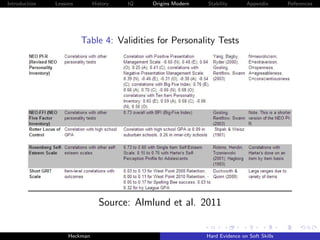
                         Table 4: Validities for Personality Tests


                                Source: Almlund et al. 2011


                    Heckman                                   Hard Evidence on Soft Skills
Introduction   Lessons        History   IQ   Origins Modern   Stability       Appendix       References


  How Predictive Are These Personality Traits?

          What do they predict?


                    Heckman                                   Hard Evidence on Soft Skills
Introduction   Lessons        History   IQ   Origins Modern   Stability       Appendix       References


  How Predictive Are These Personality Traits?

          What do they predict?
          With what strength?


                    Heckman                                   Hard Evidence on Soft Skills
Introduction         Lessons         History             IQ         Origins Modern          Stability          Appendix          References


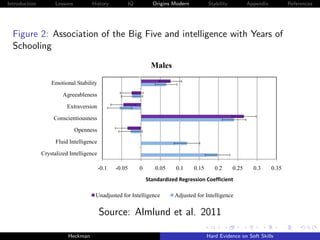
  Figure 2: Association of the Big Five and intelligence with Years of
  Schooling
                                                                    Males

                   Emotional Stability
                        Agreeableness
                          Extraversion
                    Conscientiousness

                               Openness
                     Fluid Intelligence

               Crystalized Intelligence

                                          -0.1   -0.05        0      0.05     0.1    0.15      0.2      0.25     0.3      0.35
                                                                  Standardized Regression Coefficient

                                      Unadjusted for Intelligence            Adjusted for Intelligence


                                          Source: Almlund et al. 2011

                          Heckman                                                           Hard Evidence on Soft Skills
Introduction   Lessons        History   IQ   Origins Modern   Stability       Appendix       References


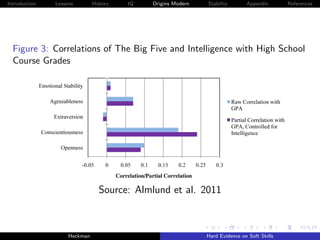
  Figure 3: Correlations of The Big Five and Intelligence with High School
  Course Grades


                                Source: Almlund et al. 2011


                    Heckman                                   Hard Evidence on Soft Skills
Introduction        Lessons             History        IQ         Origins Modern         Stability     Appendix         References

                                                                Duckworth, Heckman, Almlund, and Kautz 10/22/2010
                                                                                                              126
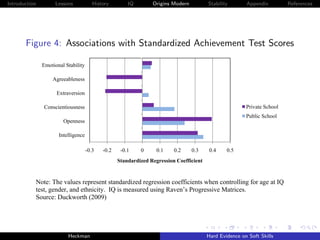
           Figure 13. Associations with Standardized Achievement Test Scores
       Figure 4: Associations with Standardized Achievement Test Scores

               Emotional Stability

                   Agreeableness

                     Extraversion

               Conscientiousness                                                                       Private School
                                                                                                       Public School
                        Openness

                      Intelligence

                                     -0.3   -0.2    -0.1    0      0.1    0.2      0.3   0.4     0.5
                                                   Standardized Regression Coefficient


           Note: The values represent standardized regression coefficients when controlling for age at IQ
           test, gender, and ethnicity. IQ is measured using Raven’s Progressive Matrices.
           Source: Duckworth (2009)


                     Martin and colleagues were among the first to demonstrate that teacheron Soft Skillsratings
                         Heckman                                             Hard Evidence and parent
Introduction         Lessons             History    IQ         Origins Modern         Stability       Appendix       References
           and the authors do not clearly delineate when the measures of personality were taken.


                           Figure 5: Associations with Job Performance
           Figure 14. Associations with Job Performance

               Emotional Stability

                   Agreeableness

                     Extraversion

               Conscientiousness

                        Openness

                      Intelligence

                                     0        0.1   0.2       0.3       0.4     0.5      0.6
                                                          Correlation


           Note. The values for personality are correlations that were corrected for sampling error, range
           restriction, and measurement error. Job performance was based on performance ratings,
           productivity data and training proficiency. The authors do report the timing of the measurements
           of personality relative to job performance. The value for IQ is a raw correlation.
           Source(s): The values reported for personality traits come from a meta-analysis conducted by
           Barrick and Mount [1991]. The value for IQ and job performance was reported in Schmidt and
           Hunter [2004].


                           Heckman                                                    Hard Evidence on Soft Skills
Introduction   Lessons        History   IQ   Origins Modern   Stability       Appendix       References


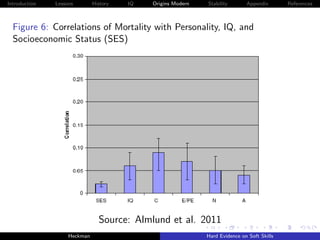
  Figure 6: Correlations of Mortality with Personality, IQ, and
  Socioeconomic Status (SES)


                                Source: Almlund et al. 2011
                    Heckman                                   Hard Evidence on Soft Skills
Introduction                       Lessons            History              IQ             Origins Modern                  Stability              Appendix              References


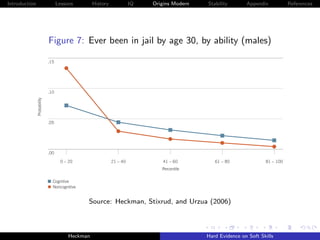
                                   Ever Been in Jail by Age 30, by Ability (Males)
                                   Figure 7: Ever been in jail by age 30, by ability (males)
zation                             .15

ment


nce                                .10
                     Probability


al and
tive
ds
                                   .05
onment
ve
ates                               .00

ation                                     0 – 20                       21 – 40                        41 – 60                       61 – 80                       81 – 100
                                                                                                     Percentile
mary
                                     Cognitive
                                     Noncognitive
                                   Note: This figure plots the probability of a given behavior associated with moving up in one ability distribution for someone after
                                   integrating out the other distribution. For example, the lines with markers show the effect of increasing noncognitive ability after
                                                          Source: Heckman, Stixrud, and Urzua (2006)
                                   integrating the cognitive ability.


                                   Source: Heckman, Stixrud, and Urzua (2006).
                                              Heckman                                                                          Hard Evidence on Soft Skills
Introduction                   Lessons             History              IQ            Origins Modern                   Stability             Appendix              References


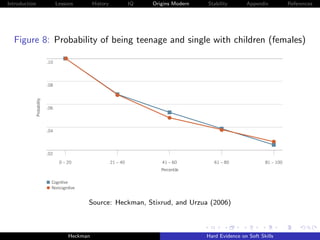
                                Probability of Being Single With Children
                                (Females)
         Figure 8: Probability of being teenage and single with children (females)
zation                          .10

ment

                                .08
nce
                  Probability


 l and
                                .06
 ive
 s

 nment                          .04

ve

ates                            .02
ation                                  0 – 20                       21 – 40                        41 – 60                       61 – 80                       81 – 100
                                                                                                  Percentile
mary
                                  Cognitive
                                  Noncognitive
                                Note: This figure plots the probability of a given behavior associated with moving up in one ability distribution for someone after
                                integrating out the other distribution. For example, the lines with markers show the effect of increasing noncognitive ability after
                                                        Source: Heckman, Stixrud, and Urzua (2006)
                                integrating the cognitive ability.


                                Source: Heckman, Stixrud, and Urzua (2006).
                                            Heckman                                                                          Hard Evidence on Soft Skills
Introduction   Lessons        History   IQ   Origins Modern   Stability       Appendix       References


  How Predictive Are Achievement Tests Compared to
  Conscientiousness for Success in Post-Secondary Education?


                    Heckman                                   Hard Evidence on Soft Skills
Introduction   Lessons        History   IQ   Origins Modern   Stability       Appendix       References


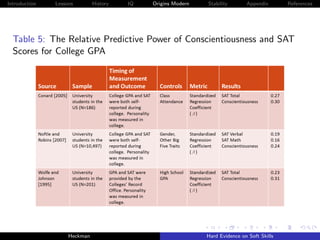
  Table 5: The Relative Predictive Power of Conscientiousness and SAT
  Scores for College GPA


                    Heckman                                   Hard Evidence on Soft Skills
Introduction   Lessons        History   IQ   Origins Modern   Stability       Appendix       References


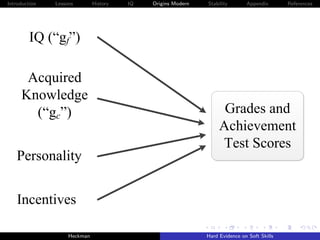
  What Do Grades and Scores on Achievement Tests
  Measure?

          How are the scores on test and grades determined?


                    Heckman                                   Hard Evidence on Soft Skills
Introduction   Lessons        History   IQ   Origins Modern   Stability       Appendix       References


                   f


               c


                    Heckman                                   Hard Evidence on Soft Skills
Introduction                  Lessons          History          IQ          Origins Modern          Stability       Appendix       References


  Figure 9: Decomposing Achievement Tests and Grades into IQ and
  Personality [NLSY79]
                           0.60
                                                Achievement                                           Grades
                           0.50         0.48
                                                         0.43
                           0.40
               R-Squared


                           0.30
                                                                                             0.23
                           0.20
                                                                                                          0.19
                                                                     0.16
                                                                                                                       0.10
                           0.10


                           0.00
                                                         AFQT                                            Grades


                                                 IQ, Rosenberg, and Rotter        IQ    Rosenberg and Rotter


                                        Source: Borghans, Golsteyn, Heckman et al. [2011].


                                   Heckman                                                          Hard Evidence on Soft Skills
Introduction   Lessons        History   IQ     Origins Modern   Stability       Appendix       References


  Figure 10: Decomposing Achievement Tests and Grades into IQ and
  Personality [Stella Maris]


                         Source: Borghans, Golsteyn, Heckman et al. [2011].


                    Heckman                                     Hard Evidence on Soft Skills
Introduction   Lessons        History   IQ   Origins Modern   Stability       Appendix       References


          This explains in part the greater predictive power of
          achievement tests and grades compared to IQ in explaining real
          world outcomes.


                    Heckman                                   Hard Evidence on Soft Skills
Introduction   Lessons        History   IQ   Origins Modern   Stability       Appendix       References


  Table 2: Validities in Labor Market Outcomes from the National
  Longitudinal Survey of Youth, 1979

    NLSY79 Table of Proportion of Explained Variance (tests and school performance)


                              Source: Borghans et al. (2011)


                    Heckman                                   Hard Evidence on Soft Skills
Introduction   Lessons        History   IQ   Origins Modern   Stability       Appendix       References


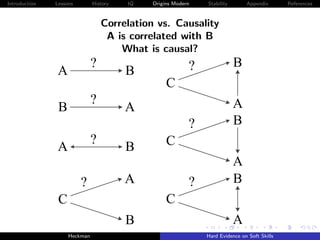
  Causal Inference

          Causality is essential in designing policy and interpreting
          evidence.


                    Heckman                                   Hard Evidence on Soft Skills
Introduction   Lessons        History   IQ   Origins Modern   Stability       Appendix       References


  Causal Inference

          Causality is essential in designing policy and interpreting
          evidence.
          Correlation is not the same as causation, although a lot of
          public policy is based only on correlations.


                    Heckman                                   Hard Evidence on Soft Skills
Introduction   Lessons        History   IQ   Origins Modern   Stability       Appendix       References


  Causal Inference

          Causality is essential in designing policy and interpreting
          evidence.
          Correlation is not the same as causation, although a lot of
          public policy is based only on correlations.
          The doctors in Russia.


                    Heckman                                   Hard Evidence on Soft Skills
Introduction   Lessons        History   IQ   Origins Modern   Stability       Appendix       References


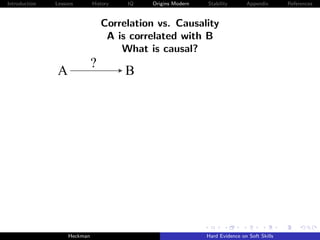
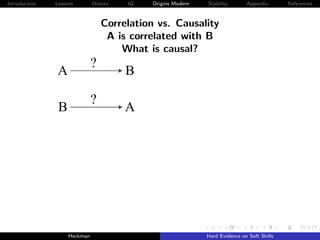
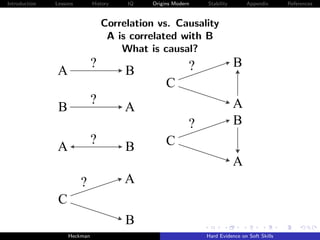
                                  Correlation vs. Causality
                                   A is correlated with B
                                      What is causal?
                              ?
               A                        B


                    Heckman                                   Hard Evidence on Soft Skills
Introduction   Lessons        History   IQ   Origins Modern   Stability       Appendix       References


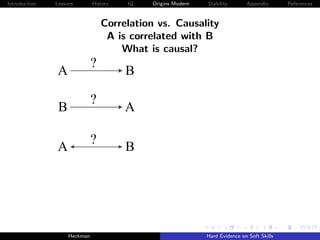
                                  Correlation vs. Causality
                                   A is correlated with B
                                      What is causal?
                              ?
               A                        B

                              ?
                B                       A


                    Heckman                                   Hard Evidence on Soft Skills
Introduction   Lessons        History   IQ   Origins Modern   Stability       Appendix       References


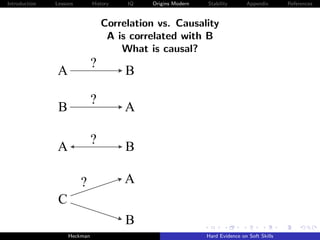
                                  Correlation vs. Causality
                                   A is correlated with B
                                      What is causal?
                              ?
               A                        B

                              ?
                B                       A

                              ?
               A                        B


                    Heckman                                   Hard Evidence on Soft Skills
Introduction   Lessons        History   IQ   Origins Modern   Stability       Appendix       References


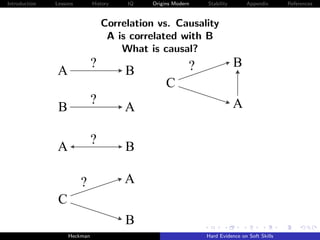
                                  Correlation vs. Causality
                                   A is correlated with B
                                      What is causal?
                              ?
               A                        B

                              ?
                B                       A

                              ?
               A                        B

                         ?              A
                C
                                        B
                    Heckman                                   Hard Evidence on Soft Skills
Introduction   Lessons        History   IQ   Origins Modern   Stability       Appendix       References


                                  Correlation vs. Causality
                                   A is correlated with B
                                      What is causal?
                              ?                           ?               B
               A                        B
                                                  C
                              ?                                           A
                B                       A

                              ?
               A                        B

                         ?              A
                C
                                        B
                    Heckman                                   Hard Evidence on Soft Skills
Introduction   Lessons        History   IQ   Origins Modern   Stability       Appendix       References


                                  Correlation vs. Causality
                                   A is correlated with B
                                      What is causal?
                              ?                           ?               B
               A                        B
                                                  C
                              ?                                           A
                B                       A
                                                          ?               B
                              ?                   C
               A                        B
                                                                          A
                         ?              A
                C
                                        B
                    Heckman                                   Hard Evidence on Soft Skills
Introduction   Lessons        History   IQ   Origins Modern   Stability       Appendix       References


                                  Correlation vs. Causality
                                   A is correlated with B
                                      What is causal?
                              ?                           ?               B
               A                        B
                                                  C
                              ?                                           A
                B                       A
                                                          ?               B
                              ?                   C
               A                        B
                                                                          A
                         ?              A                 ?               B
                C                                 C
                                        B                                 A
                    Heckman                                   Hard Evidence on Soft Skills
Introduction   Lessons        History   IQ   Origins Modern   Stability       Appendix       References


  Questions

          Are any of the predictive relationships between personality and
          cognition and outcomes causal?


                    Heckman                                   Hard Evidence on Soft Skills
Introduction   Lessons        History   IQ   Origins Modern   Stability       Appendix       References


  Questions

          Are any of the predictive relationships between personality and
          cognition and outcomes causal?
          Can we change cognition and personality and affect outcomes
          or are they fixed traits?


                    Heckman                                   Hard Evidence on Soft Skills
Introduction   Lessons        History   IQ   Origins Modern   Stability       Appendix       References


  Questions

          Are any of the predictive relationships between personality and
          cognition and outcomes causal?
          Can we change cognition and personality and affect outcomes
          or are they fixed traits?
          Is promoting cognition and personality a useful policy option?


                    Heckman                                   Hard Evidence on Soft Skills
Introduction   Lessons        History   IQ   Origins Modern   Stability       Appendix       References


  Questions

          Are any of the predictive relationships between personality and
          cognition and outcomes causal?
          Can we change cognition and personality and affect outcomes
          or are they fixed traits?
          Is promoting cognition and personality a useful policy option?
          What do we miss by ignoring soft skills?


                    Heckman                                   Hard Evidence on Soft Skills
Introduction   Lessons        History   IQ   Origins Modern   Stability       Appendix       References


  Difficulties in Establishing Causality

          Reverse causality
          (A ⇐⇒ B)


                    Heckman                                   Hard Evidence on Soft Skills
Introduction   Lessons        History   IQ   Origins Modern   Stability       Appendix       References


  Difficulties in Establishing Causality

          Reverse causality
          (A ⇐⇒ B)
          Measured traits can be caused in part by the outcomes being
          studied.


                    Heckman                                   Hard Evidence on Soft Skills
Introduction   Lessons        History   IQ   Origins Modern   Stability       Appendix       References


          All psychological measurements are calibrated on task
          performances.


                    Heckman                                   Hard Evidence on Soft Skills
Introduction   Lessons        History   IQ   Origins Modern   Stability       Appendix       References


          All psychological measurements are calibrated on task
          performances.
          A fundamental interpretive problem lies at the heart of any
          psychological measurement system for any particular trait.


                    Heckman                                   Hard Evidence on Soft Skills
Introduction   Lessons        History   IQ   Origins Modern   Stability       Appendix       References


          All psychological measurements are calibrated on task
          performances.
          A fundamental interpretive problem lies at the heart of any
          psychological measurement system for any particular trait.
          For these traits to be accurate measures of any particular trait
          or set of traits, it is necessary to standardize for incentives and
          the effects of other traits in performing a task.


                    Heckman                                   Hard Evidence on Soft Skills
Introduction   Lessons        History   IQ   Origins Modern   Stability       Appendix       References


          All psychological measurements are calibrated on task
          performances.
          A fundamental interpretive problem lies at the heart of any
          psychological measurement system for any particular trait.
          For these traits to be accurate measures of any particular trait
          or set of traits, it is necessary to standardize for incentives and
          the effects of other traits in performing a task.
          Examples: Incentivizing IQ tests.


                    Heckman                                   Hard Evidence on Soft Skills
Introduction   Lessons        History   IQ   Origins Modern   Stability       Appendix       References


          All psychological measurements are calibrated on task
          performances.
          A fundamental interpretive problem lies at the heart of any
          psychological measurement system for any particular trait.
          For these traits to be accurate measures of any particular trait
          or set of traits, it is necessary to standardize for incentives and
          the effects of other traits in performing a task.
          Examples: Incentivizing IQ tests.
          Can boost IQ by 15 points by giving candies for correct answers
          — the Black/White gap in IQ in U.S.


                    Heckman                                   Hard Evidence on Soft Skills
Introduction   Lessons        History   IQ     Origins Modern   Stability       Appendix       References


                                             Examples


  IQ and Achievement Test Scores Reflect Incentives and Efforts, and
  Capture Both Cognitive and Personality Traits


                    Heckman                                     Hard Evidence on Soft Skills
Introduction            Lessons children who
                              SES          History information. Gentle (10.6 points and SD was three distinct Appendix
                                                           IQ          Origins Modern             Stability          factors: (a)      References
                              did or did not        encouragement,         about 9.5 in this sample) formal cognitive processes;
                              attend nursery        easier items after     between scores of          (b) informational
                              school were tested
                                                                  Almlund, Duckworth, Heckman, and Kautz 12/31/2010
                                                    items were missed, children in the                achievements which reflect
                  Table 6: Incentives and Performance on Intelligence Tests
                              at the beginning      and so on.             optimized vs               the content rather than the 83
                              and end of the year                          standardconditions The     formal properties of
               Table 5. Incentives and Performance on Intelligence Tests improved cognition, and (c)
                              on Stanford-Binet                            nursery group
                 Study      Sample and Study
                              Intelligence Test       Experimental        Effectscores, but only in
                                                                           their size of incentive              Summary
                                                                                                      motivational factors which
                                    Design
                              under either                Group                 (in standard
                                                                           the standard condition.    involve a wide range of
                              optimized or                                        deviations)         personality variables. (p. 2)
               Edlund       Between subjects
                              standard             M&M candies           Experimental group          “…a carefully chosen
                                                                                                      “…the significant difference
               [1972]       study. 11 matched
                              conditions.          given for each        scored 12 points higher     consequence, candy,standard
                                                                                                      in improvement in given
                            pairs of low SES       right answer          than control group          contingent on each occurrence
                                                                                                      IQ performance found
                            children; children                           during a second testing     of correct the nursery and non-
                                                                                                      between responses to an IQ
                            were about one                               on an alternative form of test, can result inwas
                                                                                                      nursery groups a
                            standard deviation                           the Stanford Binet          significantly solely to
                                                                                                      attributable higher IQ
                            below average in                             (about 0.8 standard         score.”(p. 319)
                                                                                                      motivational factors…” (p.
                            IQ at baseline                               deviations)                  10)
               Ayllon &
                Breuning Within subjects
                              Within and           Tokens given in as 6.25 points out of aby
                                                    Incentives such        Scores increased          “…test scores often reflect of
                                                                                                      “In summary, the promise
               KellyZella study. 12 mentally
                and           between subjects     experimental
                                                    record albums,       possible17 points. Results poor academic skills, but they
                                                                           about 51 points on         individualized incentives
               [1972]
                [1978]      retarded children
                              study of 485         condition for right Metropolitan Readiness
                                                    radios (<$25) given were consistent across       may also reflect lack of in
                                                                                                      contingent on an increase
               Sample 1     (avg IQ 46.8)
                              special education    answers                 the t = 4.03
                                                    for improvement in Test. Otis-Lennon, WISC- motivation to do well (asthe
                                                                                                      IQ test performance in
                              high school          exchangeable for
                                                    test performance       R, and Lorge-Thorndike criterion test…These results,
                                                                                                      compared with pretest
                              students all took IQ prizes                  tests.                    obtained from both a in an
                                                                                                      performance) resulted
               Ayllon &     Within then were
                              tests, subjects      Tokens given in       t = 5.9                     population typically limited in
                                                                                                      approximate 17-point
               Kelly        study 34 urban
                              randomly assigned experimental                                         skills and in IQ test scores.
                                                                                                      increase ability as well as
               [1972]       fourth graders (avg condition for right
                              to control or                                                          from a group of normal
                                                                                                      These increases were equally
               Sample 2     IQ = 92.8) groups to answers
                              incentive                                                              childrenacross subtests… The
                                                                                                      spread (Experiment II),
                              retake tests.        exchangeable for                                  demonstrate that the use of
                                                                                                      incentive condition effects
                              Subjects were        prizes                                            reinforcement procedures
                                                                                                      were much less pronounced
               Ayllon &       below-average in
                            Within subjects        Six weeks of token Experimental group             applied to a behaviorpretest
                                                                                                      for students having that is
               Kelly          IQ.
                            study of 12            reinforcement for     scored 3.67 points out of tacitly regarded as “at120 and
                                                                                                      IQs between 98 and its
               [1972]       matched pairs of       good academic         possible 51 points on a     peak” can significantly alter
                                                                                                      did not occur for students
               Sample 3     mentally retarded      performance           post-test given under       the levelpretest IQs between
                                                                                                      having of performance of
                            children                                     standard conditions         that behavior.” (p. 483)
                                                                                                      121 and 140.” (p. 225)
                Holt and      Between and           Exp 1-Token          higher standard deviation
                                                                           1.06 than at baseline;     “Knowledge of results does
                Hobbs         within subjects       reinforcement for control group dropped
                                                                           difference between the     not appear to be a sufficient
          Many other studies (see ADHK).
                [1979]        study of 80
                              delinquent boys
                                                    correct responses; 2.75 points. On a second
                                                    Exp 2 – Tokens
                                                                           token reinforcement and incentive to significantly
                                                                           control groups (inferred improve test performance
                                                                         post-test with incentives,
                              randomly assigned forfeited for
                              Heckman                                      from t control groups
                                                                         exp and= 3.31 for 39 Hard among below-average I.Q.
                                                                                                       Evidence on Soft Skills
Introduction   Lessons        History   IQ   Origins Modern   Stability       Appendix       References


  Responsiveness to Incentives on IQ and Achievement Tests
  Depends on Personality

          Segal (2006) shows that introducing performance-based cash
          incentives in a low-stakes administration of a measure of IQ
          increases performance substantially among roughly one-third of
          participants.


                    Heckman                                   Hard Evidence on Soft Skills
Introduction   Lessons        History   IQ   Origins Modern   Stability       Appendix       References


  Responsiveness to Incentives on IQ and Achievement Tests
  Depends on Personality

          Segal (2006) shows that introducing performance-based cash
          incentives in a low-stakes administration of a measure of IQ
          increases performance substantially among roughly one-third of
          participants.
          Less conscientious men are particularly affected by incentives.


                    Heckman                                   Hard Evidence on Soft Skills
Introduction   Lessons        History   IQ   Origins Modern   Stability       Appendix       References


  Responsiveness to Incentives on IQ and Achievement Tests
  Depends on Personality

          Segal (2006) shows that introducing performance-based cash
          incentives in a low-stakes administration of a measure of IQ
          increases performance substantially among roughly one-third of
          participants.
          Less conscientious men are particularly affected by incentives.
          Borghans, Meijers and ter Weel (2006) show that adults spend
          substantially more time answering IQ questions when rewards
          are higher, but subjects high in emotional stability and
          conscientiousness are much less affected by these incentives.


                    Heckman                                   Hard Evidence on Soft Skills
Introduction   Lessons        History   IQ   Origins Modern   Stability       Appendix       References


          Personality traits affect IQ scores indirectly through the
          knowledge acquired by individuals who are more open to
          experience, more curious and more perseverant.


                    Heckman                                   Hard Evidence on Soft Skills
Introduction   Lessons        History   IQ   Origins Modern   Stability       Appendix       References


          Personality traits affect IQ scores indirectly through the
          knowledge acquired by individuals who are more open to
          experience, more curious and more perseverant.
          There is a correlation between cognitive and non-cognitive
          factors.


                    Heckman                                   Hard Evidence on Soft Skills
Introduction   Lessons        History   IQ   Origins Modern   Stability       Appendix       References


          Personality traits affect IQ scores indirectly through the
          knowledge acquired by individuals who are more open to
          experience, more curious and more perseverant.
          There is a correlation between cognitive and non-cognitive
          factors.
          Hansen, Heckman and Mullen (2004), Heckman, Stixrud and
          Urzua (2006), and Urzua (2007) show how schooling and other
          acquired traits substantially causally affect measured cognitive
          and non-cognitive test scores.


                    Heckman                                   Hard Evidence on Soft Skills
Introduction   Lessons        History   IQ   Origins Modern   Stability       Appendix       References


          Personality traits affect IQ scores indirectly through the
          knowledge acquired by individuals who are more open to
          experience, more curious and more perseverant.
          There is a correlation between cognitive and non-cognitive
          factors.
          Hansen, Heckman and Mullen (2004), Heckman, Stixrud and
          Urzua (2006), and Urzua (2007) show how schooling and other
          acquired traits substantially causally affect measured cognitive
          and non-cognitive test scores.
          IQ test performance reflects not only pure intelligence, but also
          intrinsic motivation, anxiety, knowledge, and reactions to
          extrinsic incentives to perform well.


                    Heckman                                   Hard Evidence on Soft Skills
Introduction   Lessons        History   IQ   Origins Modern   Stability       Appendix       References


        IQ (“gf”)


     Knowledge
       (“gc”)
                                                                   Task
                                                               Performance
     Personality


           Effort


                    Heckman                                   Hard Evidence on Soft Skills
Introduction   Lessons        History   IQ   Origins Modern   Stability       Appendix       References


        IQ (“gf”)


     Knowledge
       (“gc”)
                                                                   Task
                                                               Performance
     Personality
                              ?

           Effort


                    Heckman                                   Hard Evidence on Soft Skills
Introduction   Lessons        History   IQ   Origins Modern   Stability       Appendix       References


        IQ (“gf”)


     Knowledge
       (“gc”)
                                                                   Task
                                                               Performance
     Personality
                              ?

           Effort
                              ?


                    Heckman                                   Hard Evidence on Soft Skills
Introduction   Lessons        History   IQ   Origins Modern   Stability       Appendix       References


  Causal Evidence on the Power of Personality

          Present causal evidence on the power of soft skills in producing
          life outcomes.


                    Heckman                                   Hard Evidence on Soft Skills
Introduction   Lessons        History   IQ   Origins Modern   Stability       Appendix       References


  Causal Evidence on the Power of Personality

          Present causal evidence on the power of soft skills in producing
          life outcomes.
          Evidence that soft skills can be fostered.


                    Heckman                                   Hard Evidence on Soft Skills
Introduction   Lessons        History   IQ   Origins Modern   Stability       Appendix       References


  Causal Evidence on the Power of Personality

          Present causal evidence on the power of soft skills in producing
          life outcomes.
          Evidence that soft skills can be fostered.
          Evidence that soft skills are a mechanism of policy for reducing
          poverty, promoting productivity and enhancing social justice.


                    Heckman                                   Hard Evidence on Soft Skills
Introduction   Lessons        History   IQ   Origins Modern   Stability       Appendix       References


  Causal Evidence on the Power of Personality

          Present causal evidence on the power of soft skills in producing
          life outcomes.
          Evidence that soft skills can be fostered.
          Evidence that soft skills are a mechanism of policy for reducing
          poverty, promoting productivity and enhancing social justice.
          Sources of Evidence


                    Heckman                                   Hard Evidence on Soft Skills
Introduction       Lessons        History   IQ   Origins Modern   Stability       Appendix       References


  Causal Evidence on the Power of Personality

          Present causal evidence on the power of soft skills in producing
          life outcomes.
          Evidence that soft skills can be fostered.
          Evidence that soft skills are a mechanism of policy for reducing
          poverty, promoting productivity and enhancing social justice.
          Sources of Evidence
               i   The GED


                        Heckman                                   Hard Evidence on Soft Skills
Introduction        Lessons        History   IQ   Origins Modern   Stability       Appendix       References


  Causal Evidence on the Power of Personality

          Present causal evidence on the power of soft skills in producing
          life outcomes.
          Evidence that soft skills can be fostered.
          Evidence that soft skills are a mechanism of policy for reducing
          poverty, promoting productivity and enhancing social justice.
          Sources of Evidence
               i    The GED
               ii   Perry Intervention


                         Heckman                                   Hard Evidence on Soft Skills
Introduction         Lessons        History   IQ   Origins Modern   Stability       Appendix       References


  Causal Evidence on the Power of Personality

          Present causal evidence on the power of soft skills in producing
          life outcomes.
          Evidence that soft skills can be fostered.
          Evidence that soft skills are a mechanism of policy for reducing
          poverty, promoting productivity and enhancing social justice.
          Sources of Evidence
                i    The GED
               ii    Perry Intervention
               iii   Causal Effect of Schooling on Test Scores


                          Heckman                                   Hard Evidence on Soft Skills
Introduction   Lessons        History   IQ   Origins Modern   Stability       Appendix       References


  The GED as a case study of the power of soft skills and
  costs of neglecting them

          Draw in part on a forthcoming book.


                    Heckman                                   Hard Evidence on Soft Skills
Introduction   Lessons        History   IQ   Origins Modern   Stability       Appendix       References


  The GED as a case study of the power of soft skills and
  costs of neglecting them

          Draw in part on a forthcoming book.
          Studies Of T he GED T esting P rogram,
          University of Chicago Press, 2012.


                    Heckman                                   Hard Evidence on Soft Skills
Introduction   Lessons        History   IQ   Origins Modern   Stability       Appendix       References


  The GED as a case study of the power of soft skills and
  costs of neglecting them

          Draw in part on a forthcoming book.
          Studies Of T he GED T esting P rogram,
          University of Chicago Press, 2012.
          GED is an achievement test that secondary dropouts can take
          to certify that they are the equivalents of ordinary secondary
          school graduates.


                    Heckman                                   Hard Evidence on Soft Skills
Introduction   Lessons        History   IQ   Origins Modern   Stability       Appendix       References


  The GED as a case study of the power of soft skills and
  costs of neglecting them

          Draw in part on a forthcoming book.
          Studies Of T he GED T esting P rogram,
          University of Chicago Press, 2012.
          GED is an achievement test that secondary dropouts can take
          to certify that they are the equivalents of ordinary secondary
          school graduates.
          GED is a group of 5 achievement tests normed against national
          samples of high school graduates (70% can pass).


                    Heckman                                   Hard Evidence on Soft Skills
Introduction   Lessons        History   IQ   Origins Modern   Stability       Appendix       References


  The GED as a case study of the power of soft skills and
  costs of neglecting them

          Draw in part on a forthcoming book.
          Studies Of T he GED T esting P rogram,
          University of Chicago Press, 2012.
          GED is an achievement test that secondary dropouts can take
          to certify that they are the equivalents of ordinary secondary
          school graduates.
          GED is a group of 5 achievement tests normed against national
          samples of high school graduates (70% can pass).
          14% of all secondary school certificates issued in the U.S. are
          given to GEDs.


                    Heckman                                   Hard Evidence on Soft Skills
Introduction   Lessons        History   IQ   Origins Modern   Stability       Appendix       References


          Use multiple data sets on outcomes, backgrounds, and abilities
          for all major economic and social groups in the U.S over
          multiple periods.


                    Heckman                                   Hard Evidence on Soft Skills
Introduction   Lessons        History   IQ   Origins Modern   Stability       Appendix       References


          Use multiple data sets on outcomes, backgrounds, and abilities
          for all major economic and social groups in the U.S over
          multiple periods.
          GEDs are as smart as secondary school graduates who do not
          go on to college.


                    Heckman                                   Hard Evidence on Soft Skills
Introduction   Lessons        History   IQ   Origins Modern   Stability       Appendix       References


          Use multiple data sets on outcomes, backgrounds, and abilities
          for all major economic and social groups in the U.S over
          multiple periods.
          GEDs are as smart as secondary school graduates who do not
          go on to college.
          GEDs who go on to college and succeed are indistinguishable
          from other college graduates in terms of annual wage income
          (True for AA and BA students).


                    Heckman                                   Hard Evidence on Soft Skills
Introduction   Lessons        History   IQ   Origins Modern   Stability       Appendix       References


          However, terminal GEDs perform at a level closer to that of
          dropouts.


                    Heckman                                   Hard Evidence on Soft Skills
Introduction   Lessons        History   IQ   Origins Modern   Stability       Appendix       References


          However, terminal GEDs perform at a level closer to that of
          dropouts.
          Identical to dropouts if we control for their greater cognitive
          ability.


                    Heckman                                   Hard Evidence on Soft Skills
Introduction   Lessons        History   IQ   Origins Modern   Stability       Appendix       References


          However, terminal GEDs perform at a level closer to that of
          dropouts.
          Identical to dropouts if we control for their greater cognitive
          ability.
          We examine what essential life skills GEDs lack.


                    Heckman                                   Hard Evidence on Soft Skills
Introduction   Lessons        History   IQ   Origins Modern   Stability       Appendix       References


          However, terminal GEDs perform at a level closer to that of
          dropouts.
          Identical to dropouts if we control for their greater cognitive
          ability.
          We examine what essential life skills GEDs lack.
          Comparing GEDs to Dropouts standardizes ability (as measured
          by achievement tests) and demonstrates the importance of
          personality traits in predicting life outcomes.


                    Heckman                                   Hard Evidence on Soft Skills
Introduction   Lessons        History   IQ   Origins Modern   Stability       Appendix       References


  Figure 11: Cognitive ability by educational status (no college sample, all
  ethnic groups)


                  Source: Heckman, Humphries, Urzua, and Veramendi (2010)


                    Heckman                                   Hard Evidence on Soft Skills
Introduction   Lessons        History   IQ   Origins Modern   Stability       Appendix       References


  Figure 12: Cognitive ability by educational status (no college sample, all
  ethnic groups)


                  Source: Heckman, Humphries, Urzua, and Veramendi (2010)


                    Heckman                                   Hard Evidence on Soft Skills
Introduction   Lessons        History   IQ   Origins Modern   Stability       Appendix       References


          GEDs lack noncognitive — personality — traits measured in
          many ways: behaviors and personality test scores.


                    Heckman                                   Hard Evidence on Soft Skills
Introduction                     Lessons                            History                          IQ                 Origins Modern                                Stability                                 Appendix               References


  Figure 13: Mean Personality Measures across Education Groups -
  (All Races, All Post-Secondary Education)

                                                     (a) Males                                                                                                    (b) Females
               .2


                                                                                                                              .2
               0


                                                                                                                              0
               −.8 −.6 −.4 −.2


                                                                                                                              −.8 −.6 −.4 −.2
                                 Se


                                                       Lo


                                                                              Lo


                                                                                                     Se


                                                                                                                                                Se


                                                                                                                                                                      Lo


                                                                                                                                                                                             Lo


                                                                                                                                                                                                                    Se
                                                       cu


                                                                              cu


                                                                                                                                                                      cu


                                                                                                                                                                                             cu
                                 lf−


                                                                                                     lf C


                                                                                                                                                lf−


                                                                                                                                                                                                                    lf C
                                                         so


                                                                                 s


                                                                                                                                                                        so


                                                                                                                                                                                                s
                                     E


                                                                                                                                                    E
                                                                                                          on


                                                                                                                                                                                                                         on
                                                                                   of


                                                                                                                                                                                                  of
                                      ste


                                                                                                                                                     ste
                                                           fC


                                                                                                                                                                          fC
                                                                                                             c


                                                                                                                                                                                                                            c
                                                                                      Co


                                                                                                                                                                                                     Co
                                         em


                                                                                                                                                        em
                                                                                                            ep


                                                                                                                                                                                                                           ep
                                                            on


                                                                                                                                                                           on
                                                                                         n


                                                                                                                                                                                                        n
                                                                                                               t


                                                                                                                                                                                                                              t
                                                               tr


                                                                                       tro


                                                                                                                                                                              tr


                                                                                                                                                                                                      tro
                                            (N


                                                                                                                                                           (N
                                                                                                                 (N


                                                                                                                                                                                                                                (N
                                                                ol


                                                                                                                                                                               ol
                                              LS


                                                                                                                                                             LS
                                                                                          l (N


                                                                                                                 EL


                                                                                                                                                                                                         l (N


                                                                                                                                                                                                                                EL
                                                                (N


                                                                                                                                                                               (N
                                              Y7


                                                                                                                                                             Y7
                                                                                                                   S)


                                                                                                                                                                                                                                  S)
                                                                    LS


                                                                                             EL


                                                                                                                                                                                   LS


                                                                                                                                                                                                            EL
                                                9)


                                                                                                                                                               9)
                                                                       Y


                                                                                                S


                                                                                                                                                                                      Y


                                                                                                                                                                                                               S
                                                                      79


                                                                                                 )


                                                                                                                                                                                     79


                                                                                                                                                                                                                )
                                                                        )


                                                                                                                                                                                       )
                                         Dropout                       GED              5% Sig (GED vs.HSG)                                             Dropout                       GED              5% Sig (GED vs.HSG)
                                         High School                   S.E.             5% Sig (GED/HSG vs.Drop)                                        High School                   S.E.             5% Sig (GED/HSG vs.Drop)


     Sources: National Longitudinal Survey of Youth 1979, National Educational Longitudinal
   Survey. Notes Rosenberg is a ten measure self-confidence scale administered in 1980. Rotter
     is a 4 (two part) measure of locus of control. Locus of control is a measure of how much
   control an individual believes they have over their life. The Self Concept measure included in
          NELS measures evaluates the respondents sense of self-worth or self-confidence.


                                              Heckman                                                                                                               Hard Evidence on Soft Skills
Introduction         Lessons                                        History                                 IQ                           Origins Modern                           Stability                                      Appendix                                  References


  Figure 14: Adolescent Smoking and Drinking across Education Groups -
  (All Races, All Post-Secondary Education)

                                                (a) Males                                                                                                                 (b) Females
               .6


                                                                                                                                               .6
               .4


                                                                                                                                               .4
               .2


                                                                                                                                               .2
               0


                                                                                                                                               0
                    Sm


                                          Dr


                                                        Sm


                                                                            Dr


                                                                                              Sm


                                                                                                                 Bin


                                                                                                                                                    Sm


                                                                                                                                                                          Dr


                                                                                                                                                                                        Sm


                                                                                                                                                                                                           Dr


                                                                                                                                                                                                                             Sm


                                                                                                                                                                                                                                                Bin
                                          ink


                                                                               in


                                                                                                                                                                          ink


                                                                                                                                                                                                              in
                                                                                                                    ge


                                                                                                                                                                                                                                                   ge
                     ok


                                                             ok


                                                                                                  ok


                                                                                                                                                     ok


                                                                                                                                                                                             ok


                                                                                                                                                                                                                                 ok
                                                                                 kb


                                                                                                                                                                                                                kb
                                           sb


                                                                                                                                                                           sb
                         es


                                                                e


                                                                                                   es


                                                                                                                                                         es


                                                                                                                                                                                                e


                                                                                                                                                                                                                                  es
                                                                                                                       Dr


                                                                                                                                                                                                                                                      Dr
                                                                                    y1


                                                                                                                                                                                                                   y1
                                                               by


                                                                                                                                                                                               by
                                               y1


                                                                                                                                                                               y1
                          by


                                                                                                      8


                                                                                                                         ink


                                                                                                                                                          by


                                                                                                                                                                                                                                     8


                                                                                                                                                                                                                                                        ink
                                                                                                       th


                                                                                                                                                                                                                                      th
                                                                                      4(


                                                                                                                                                                                                                     4(
                                                                  14


                                                                                                                                                                                                  14
                                                 5(


                                                                                                                                                                                 5(
                              15


                                                                                                                                                              15
                                                                                                                            10


                                                                                                                                                                                                                                                           10
                                                                                                        Gr


                                                                                                                                                                                                                                       Gr
                                                                                      NL


                                                                                                                                                                                                                     NL
                                                                     (


                                                                                                                                                                                                     (
                                                 NL


                                                                                                                                                                                 NL
                                                                     NL


                                                                                                                                                                                                    NL
                                                                                                                               th


                                                                                                                                                                                                                                                              th
                               (N


                                                                                                                                                               (N
                                                                                                           .(


                                                                                                                                                                                                                                          .(
                                                                                        SY


                                                                                                                                                                                                                       SY
                                                  SY


                                                                                                                                                                                  SY
                                                                                                            NE


                                                                                                                                                                                                                                           NE
                                   LS


                                                                                                                               Gr


                                                                                                                                                                   LS


                                                                                                                                                                                                                                                              Gr
                                                                     SY


                                                                                                                                                                                                     SY
                                                                                           97


                                                                                                                                                                                                                          97
                                                      79


                                                                                                                                  .(


                                                                                                                                                                                      79


                                                                                                                                                                                                                                                                 .(
                                      Y


                                                                                                                                                                      Y
                                                                                                             LS


                                                                                                                                                                                                                                            LS
                                                                          97


                                                                                                                                                                                                         97
                                                                                              )


                                                                                                                                                                                                                             )
                                     79


                                                                                                                                                                     79
                                                                                                                                    NE


                                                                                                                                                                                                                                                                   NE
                                                         )


                                                                                                                                                                                         )
                                                                             )


                                                                                                                )


                                                                                                                                                                                                            )


                                                                                                                                                                                                                                               )
                                       )


                                                                                                                                                                       )
                                                                                                                                     LS


                                                                                                                                                                                                                                                                    LS
                                                                                                                                        )


                                                                                                                                                                                                                                                                       )
                               Dropout                               GED                   5% Sig (GED vs.HSG)                                                 Dropout                              GED                   5% Sig (GED vs.HSG)
                               High School                           S.E.                  5% Sig (GED/HSG vs.Drop)                                            High School                          S.E.                  5% Sig (GED/HSG vs.Drop)


  Sources: National Longitudinal Survey of Youth 1979, National Longitudinal Survey of Youth
                       1997, National Educational Longitudinal Survey.


                                      Heckman                                                                                                                                    Hard Evidence on Soft Skills
Introduction        Lessons                            History                          IQ                     Origins Modern                  Stability                                  Appendix                    References


  Figure 15: Sex and Violent Behavior across Education Groups -
  (All Races, All Post-Secondary Education)

                                    (a) Males                                                                                           (b) Females
               .5


                                                                                                                     .5
               .4


                                                                                                                     .4
               .3


                                                                                                                     .3
               .2


                                                                                                                     .2
               .1


                                                                                                                     .1
               0


                                                                                                                     0
                    Se


                                        Fig


                                                                   Ga


                                                                                        Sc


                                                                                                                           Se


                                                                                                                                               Fig


                                                                                                                                                                          Ga


                                                                                                                                                                                               Sc
                                                                                        ho


                                                                                                                                                                                               ho
                    xa


                                                                                                                           xa
                                                                     ng


                                                                                                                                                                            ng
                                           ht


                                                                                                                                                  ht
                                                                                           o


                                                                                                                                                                                                  o
                                           by


                                                                                                                                                  by
                         t1


                                                                                                                                t1
                                                                     by


                                                                                                                                                                            by
                                                                                             lF


                                                                                                                                                                                                    lF
                         5(


                                                                                                                                5(
                                                14


                                                                                                                                                       14
                                                                                             igh


                                                                                                                                                                                                    igh
                                                                          14


                                                                                                                                                                                 14
                          NL


                                                                                                                                 NL
                                                 (N


                                                                                                                                                        (N
                                                                                                  t8


                                                                                                                                                                                                         t8
                                                                             (


                                                                                                                                                                                    (
                                                                            NL


                                                                                                                                                                                   NL
                            SY


                                                                                                                                   SY
                                                     LS


                                                                                                                                                            LS
                                                                                                  th


                                                                                                                                                                                                         th
                                                                              SY


                                                                                                                                                                                     SY
                              79


                                                                                                                                     79
                                                        Y


                                                                                                   Gr


                                                                                                                                                               Y


                                                                                                                                                                                                          Gr
                                                       97


                                                                                                                                                              97
                                                                                 97


                                                                                                                                                                                        97
                                )


                                                                                                                                       )
                                                                                                      .(


                                                                                                                                                                                                             .(
                                                         )


                                                                                                                                                                )
                                                                                    )


                                                                                                       NE


                                                                                                                                                                                           )


                                                                                                                                                                                                              NE
                                                                                                        LS


                                                                                                                                                                                                               LS
                                                                                                           )


                                                                                                                                                                                                                  )
                          Dropout                           GED             5% Sig (GED vs.HSG)                                  Dropout                           GED             5% Sig (GED vs.HSG)
                          High School                       S.E.            5% Sig (GED/HSG vs.Drop)                             High School                       S.E.            5% Sig (GED/HSG vs.Drop)


  Sources: National Longitudinal Survey of Youth 1979, National Longitudinal Survey of Youth
                       1997, National Educational Longitudinal Survey.


                              Heckman                                                                                                      Hard Evidence on Soft Skills
Introduction         Lessons                                  History                                 IQ                     Origins Modern                         Stability                                   Appendix                         References


  Figure 16: Adolescent Criminal Behavior across Education Groups -
  (All Races, All Post-Secondary Education)

                                           (a) Males                                                                                                       (b) Females
               .8


                                                                                                                                   .8
               .6


                                                                                                                                   .6
               .4


                                                                                                                                   .4
               .2


                                                                                                                                   .2
               0


                                                                                                                                   0
                    Min


                                      Ma


                                                       Vio


                                                                          Ar


                                                                                           Pr


                                                                                                           Th


                                                                                                                                        Min


                                                                                                                                                          Ma


                                                                                                                                                                           Vio


                                                                                                                                                                                              Ar


                                                                                                                                                                                                               Pr


                                                                                                                                                                                                                               Th
                                                                          res


                                                                                            op


                                                                                                                                                                                              res


                                                                                                                                                                                                                op
                                                                                                           eft


                                                                                                                                                                                                                               eft
                                        jor


                                                                                                                                                            jor
                                                          len


                                                                                                                                                                              len
                     or


                                                                                                                                         or
                                                                              ted


                                                                                                 Cr


                                                                                                                                                                                                  ted


                                                                                                                                                                                                                     Cr
                                                                                                               b


                                                                                                                                                                                                                                   b
                          Cr


                                           Cr


                                                             tC


                                                                                                                                              Cr


                                                                                                                                                               Cr


                                                                                                                                                                                 tC
                                                                                                                y1


                                                                                                                                                                                                                                    y1
                                                                                                 im


                                                                                                                                                                                                                     im
                          im


                                           im


                                                                                                                                              im


                                                                                                                                                               im
                                                             rim


                                                                                by


                                                                                                                                                                                 rim


                                                                                                                                                                                                    by
                                                                                                                  4(


                                                                                                                                                                                                                                      4(
                                                                                                  eb


                                                                                                                                                                                                                      eb
                           e(


                                              e(


                                                                                                                                               e(


                                                                                                                                                                  e(
                                                                                    14


                                                                                                                                                                                                        14
                                                                  e(


                                                                                                                                                                                      e(
                                                                                                                   NL


                                                                                                                                                                                                                                       NL
                                                                                                    y1


                                                                                                                                                                                                                        y1
                               NL


                                                NL


                                                                                                                                                   NL


                                                                                                                                                                    NL
                                                                   NL


                                                                                                                                                                                       NL
                                                                                       (


                                                                                                                                                                                                           (
                                                                                                                     SY


                                                                                                                                                                                                                                         SY
                                                                                      NL


                                                                                                                                                                                                          NL
                                                                                                      4(


                                                                                                                                                                                                                          4(
                               SY


                                                SY


                                                                                                                                                   SY


                                                                                                                                                                    SY
                                                                     SY


                                                                                                                                                                                         SY
                                                                                                                       97


                                                                                                                                                                                                                                           97
                                                                                       SY


                                                                                                      NL


                                                                                                                                                                                                           SY


                                                                                                                                                                                                                          NL
                                    79


                                                     79


                                                                                                                                                        79


                                                                                                                                                                         79
                                                                       79


                                                                                                                                                                                           79
                                                                                                                         )


                                                                                                                                                                                                                                             )
                                                                                                        SY


                                                                                                                                                                                                                            SY
                                                                                          97


                                                                                                                                                                                                              97
                                       )


                                                        )


                                                                                                                                                           )


                                                                                                                                                                            )
                                                                          )


                                                                                                                                                                                              )
                                                                                             )


                                                                                                                                                                                                                 )
                                                                                                           97


                                                                                                                                                                                                                               97
                                                                                                            )


                                                                                                                                                                                                                                )
                               Dropout                             GED                5% Sig (GED vs.HSG)                                          Dropout                             GED                5% Sig (GED vs.HSG)
                               High School                         S.E.               5% Sig (GED/HSG vs.Drop)                                     High School                         S.E.               5% Sig (GED/HSG vs.Drop)


  Sources: National Longitudinal Survey of Youth 1979 and the National Longitudinal Survey of
  Youth 1997. Notes: Minor crime includes vandalism, shoplifting, petty theft, fraud, holding or
    selling stolen goods. Major crime includes auto theft, breaking/entering private property,
             grand theft. Violent crime includes fighting, assault, aggravated assault.


                                     Heckman                                                                                                                        Hard Evidence on Soft Skills
Introduction       Lessons            History                 IQ               Origins Modern                 Stability                Appendix              References


  Figure 17: Adolescent GPA across Education Groups -
  (All Races, All Post-Secondary Education )

                                   (a) Males                                                           (b) Females
               6


                                                                                     6
               4


                                                                                     4
               2


                                                                                     2
               0


                                                                                     0
                      9th


                                              9th


                                                                                                9th


                                                                                                                            9th
                        Gr


                                                Gr


                                                                                                  Gr


                                                                                                                              Gr
                            .G


                                                   .C


                                                                                                      .G


                                                                                                                                 .C
                                                     red


                                                                                                                                   red
                              PA


                                                                                                        PA
                                                        its


                                                                                                                                      its
                     Dropout           GED          5% Sig (GED vs.HSG)                         Dropout              GED          5% Sig (GED vs.HSG)
                     High School       S.E.         5% Sig (GED/HSG vs.Drop)                    High School          S.E.         5% Sig (GED/HSG vs.Drop)


                               Sources: National Longitudinal Survey of Youth 1979.


                            Heckman                                                                          Hard Evidence on Soft Skills
Introduction        Lessons                 History                            IQ              Origins Modern                      Stability                       Appendix                References


  Figure 18: Highest Grade Completed in High School across Education
  Groups - (All Races, All Post-Secondary Education)

                                     (a) Males                                                                          (b) Females
               15


                                                                                                     15
               10


                                                                                                     10
               5


                                                                                                     5
               0


                                                                                                     0
                     HG


                                           HG


                                                                        LG


                                                                                                            HG


                                                                                                                                       HG


                                                                                                                                                                    LG
                                                                          Eh


                                                                                                                                                                      Eh
                       C


                                             C


                                                                                                              C


                                                                                                                                         C
                       hig


                                             hig


                                                                                                                hig


                                                                                                                                         hig
                                                                           igh


                                                                                                                                                                       igh
                           h


                                                 hs


                                                                                                                    h


                                                                                                                                             hs
                                                                               s


                                                                                                                                                                           s
                           sc


                                                                                                                   sc
                                                                               ch


                                                                                                                                                                           ch
                                                   ch


                                                                                                                                               ch
                           ho


                                                                                                                    ho
                                                                                  o


                                                                                                                                                                              o
                                                     oo


                                                                                                                                                 oo
                                                                                   ol


                                                                                                                                                                               ol
                             ol


                                                                                                                      ol
                                                       l (N


                                                                                                                                                   l (N
                                                                                      (N


                                                                                                                                                                                  (N
                                (N


                                                                                                                        (N
                                                                                        EL


                                                                                                                                                                                    EL
                                LS


                                                         LS


                                                                                                                        LS


                                                                                                                                                     LS
                                                                                          S)


                                                                                                                                                                                      S)
                                   Y


                                                            Y


                                                                                                                           Y


                                                                                                                                                        Y
                                     79


                                                              97


                                                                                                                             79


                                                                                                                                                          97
                                       )


                                                                )


                                                                                                                               )


                                                                                                                                                            )
                       Dropout                   GED                5% Sig (GED vs.HSG)                         Dropout                      GED                5% Sig (GED vs.HSG)
                       High School               S.E.               5% Sig (GED/HSG vs.Drop)                    High School                  S.E.               5% Sig (GED/HSG vs.Drop)


  Sources: National Longitudinal Survey of Youth 1979, National Longitudinal Survey of Youth
  1997, National Educational Longitudinal Survey. Notes: HGC high school is the total number
     of years of school attended through high school. It does not include any post-secondary
                                           education.


                               Heckman                                                                                         Hard Evidence on Soft Skills
Introduction   Lessons        History   IQ   Origins Modern   Stability       Appendix       References


       Figure 19: Distribution of Non-Cognitive Skills by Education Group


  Source: Reproduced from Heckman et al. (2011). National Longitudinal Study of Youth 1979.

                    Heckman                                   Hard Evidence on Soft Skills
Introduction   Lessons        History   IQ   Origins Modern   Stability       Appendix       References


  Gaps in achievement and personality deficits emerge early.


                    Heckman                                   Hard Evidence on Soft Skills
Introduction         Lessons                         History                IQ             Origins Modern                         Stability             Appendix             References


  Figure 20: PIAT Scores across Ages and Education Groups across
  Education Groups - (All Races, All Post-Secondary Education)

                                          (a) Males                                                                    (b) Females
               .2


                                                                                                 .2
               0


                                                                                                 0
               −.2


                                                                                                 −.2
               −.4


                                                                                                 −.4
               −.6


                                                                                                 −.6
               −.8


                                                                                                 −.8
                     Ag


                                          Ag


                                                     Ag


                                                                Ag


                                                                            Ag


                                                                                                       Ag


                                                                                                                            Ag


                                                                                                                                       Ag


                                                                                                                                                  Ag


                                                                                                                                                              Ag
                     e6


                                          e8


                                                     e1


                                                                e1


                                                                              e1


                                                                                                       e6


                                                                                                                            e8


                                                                                                                                        e1


                                                                                                                                                  e1


                                                                                                                                                                e1
                                                       0P


                                                                     2P


                                                                                4P


                                                                                                                                          0P


                                                                                                                                                       2P


                                                                                                                                                                  4P
                          PIA


                                               PIA


                                                                                                            PIA


                                                                                                                                 PIA
                                                          IAT


                                                                      IAT


                                                                                 IAT


                                                                                                                                            IAT


                                                                                                                                                        IAT


                                                                                                                                                                  IAT
                           T


                                                T


                                                                                                             T


                                                                                                                                  T
                                Dropout               GED       5% Sig (GED vs.HSG)                               Dropout                GED      5% Sig (GED vs.HSG)
                                High School           S.E.      5% Sig (GED/HSG vs.Drop)                          High School            S.E.     5% Sig (GED/HSG vs.Drop)


    Source: Children of the National Longitudinal Survey of Youth 1979. Notes: The Peabody
          Individual Achievement Test (PIAT) is a widely childhood achievement test.


                                   Heckman                                                                                       Hard Evidence on Soft Skills
Introduction         Lessons               History            IQ                Origins Modern                    Stability            Appendix            References


  Figure 21: Behavioral Problems Index (BPI) across Education Groups -
  (All Races , All Post-Secondary Education )

                                     (a) Males                                                        (b) Females
               1


                                                                                      1
               .5


                                                                                      .5
               0


                                                                                      0
               −.5


                                                                                      −.5
                     Ag


                                    Ag


                                           Ag


                                                     Ag


                                                                Ag


                                                                                            Ag


                                                                                                           Ag


                                                                                                                       Ag


                                                                                                                                Ag


                                                                                                                                           Ag
                     e6


                                      e8


                                           e1


                                                       e1


                                                                  e1


                                                                                            e6


                                                                                                             e8


                                                                                                                        e1


                                                                                                                                  e1


                                                                                                                                             e1
                                                0


                                                       2


                                                                    4


                                                                                                                            0


                                                                                                                                  2


                                                                                                                                               4
                          Dropout           GED      5% Sig (GED vs.HSG)                         Dropout                 GED    5% Sig (GED vs.HSG)
                          High School       S.E.     5% Sig (GED/HSG vs.Drop)                    High School             S.E.   5% Sig (GED/HSG vs.Drop)


  Sources: Children of the National Longitudinal Survey of Youth 1979. Notes: The Behavioral
  Problems Index (BPI) is based on a 28 question survey given to parents about their child. The
                       BPI is normalized to have mean 0 and variance 1.


                             Heckman                                                                          Hard Evidence on Soft Skills
Introduction   Lessons        History   IQ   Origins Modern   Stability       Appendix       References


          The early childhood environments of both dropouts and GEDs
          are worse than those of H.S. Grads.
          (Moon, 2011; Cunha et al., 2010)


                    Heckman                                   Hard Evidence on Soft Skills
Introduction        Lessons                            History                        IQ                  Origins Modern                    Stability                               Appendix                References


  Figure 22: Broken Home Rates across Education Groups -
  (All Races, All Post-Secondary Education)

                                          (a) Males                                                                                   (b) Females
               .6


                                                                                                                .6
               .4


                                                                                                                .4
               .2


                                                                                                                .2
               0


                                                                                                                0
                    Br


                                          Br


                                                                 Br


                                                                                      Br


                                                                                                                      Br


                                                                                                                                            Br


                                                                                                                                                                   Br


                                                                                                                                                                                        Br
                    ok


                                           ok


                                                                 ok


                                                                                       ok


                                                                                                                      ok


                                                                                                                                             ok


                                                                                                                                                                   ok


                                                                                                                                                                                         ok
                     en


                                             en


                                                                    e


                                                                                        en


                                                                                                                       en


                                                                                                                                               en


                                                                                                                                                                      e


                                                                                                                                                                                          en
                                                                      na


                                                                                                                                                                        na
                         at


                                               at


                                                                                           8th


                                                                                                                           at


                                                                                                                                                 at


                                                                                                                                                                                             8th
                                                                        t1


                                                                                                                                                                          t1
                          14


                                                  2(


                                                                                                                            14


                                                                                                                                                    2(
                                                                        2(


                                                                                            Gr


                                                                                                                                                                          2(


                                                                                                                                                                                              Gr
                                                  NL


                                                                                                                                                    NL
                             (


                                                                                                                               (
                                                                                                 . (N


                                                                                                                                                                                                   . (N
                              NL


                                                                           NL


                                                                                                                                NL


                                                                                                                                                                             NL
                                                    SY


                                                                                                                                                      SY
                              SY


                                                                              S


                                                                                                                                SY


                                                                                                                                                                                S
                                                                                                     EL


                                                                                                                                                                                                       EL
                                                                              Y9


                                                                                                                                                                                Y9
                                                       97


                                                                                                                                                         97
                                   79


                                                                                                                                     79
                                                                                                     S)


                                                                                                                                                                                                       S)
                                                          )


                                                                                7)


                                                                                                                                                            )


                                                                                                                                                                                  7)
                                      )


                                                                                                                                        )
                          Dropout                         GED                5% Sig (GED vs.HSG)                            Dropout                         GED                5% Sig (GED vs.HSG)
                          High School                     S.E.               5% Sig (GED/HSG vs.Drop)                       High School                     S.E.               5% Sig (GED/HSG vs.Drop)


  Sources: National Longitudinal Survey of Youth 1979, National Longitudinal Survey of Youth
                       1997, National Educational Longitudinal Survey.


                                 Heckman                                                                                                    Hard Evidence on Soft Skills
Introduction          Lessons                                 History                                IQ                       Origins Modern                           Stability                              Appendix                             References


  Figure 23: Childhood Investment across Education Groups -
  (All Races, All Post-Secondary Education)

                                            (a) Males                                                                                                      (b) Females
               .2


                                                                                                                                    .2
               0


                                                                                                                                    0
               −.2


                                                                                                                                    −.2
               −.4


                                                                                                                                    −.4
               −.6


                                                                                                                                    −.6
               −.8


                                                                                                                                    −.8
                     Ag


                                      Ag


                                                       Ag


                                                                          Ag


                                                                                         Ag


                                                                                                            Ag


                                                                                                                                          Ag


                                                                                                                                                           Ag


                                                                                                                                                                            Ag


                                                                                                                                                                                               Ag


                                                                                                                                                                                                              Ag


                                                                                                                                                                                                                                 Ag
                     e1


                                      e4


                                                       e1


                                                                            e4


                                                                                         e1


                                                                                                              e4


                                                                                                                                          e1


                                                                                                                                                           e4


                                                                                                                                                                            e1


                                                                                                                                                                                                 e4


                                                                                                                                                                                                              e1


                                                                                                                                                                                                                                   e4
                          −3


                                           −7


                                                            −3


                                                                              −7


                                                                                              −3


                                                                                                                −7


                                                                                                                                               −3


                                                                                                                                                                −7


                                                                                                                                                                                 −3


                                                                                                                                                                                                   −7


                                                                                                                                                                                                                   −3


                                                                                                                                                                                                                                     −7
                           Ma


                                            Ma


                                                             Co


                                                                              Co


                                                                                                 E


                                                                                                                Em


                                                                                                                                                Ma


                                                                                                                                                                 Ma


                                                                                                                                                                                  Co


                                                                                                                                                                                                   Co


                                                                                                                                                                                                                      E


                                                                                                                                                                                                                                     Em
                                                                                                mo


                                                                                                                                                                                                                     mo
                                                               gn


                                                                                 gn


                                                                                                                                                                                    gn


                                                                                                                                                                                                      gn
                               ter


                                                ter


                                                                                                                                                    ter


                                                                                                                                                                     ter
                                                                                                                     oti


                                                                                                                                                                                                                                          oti
                                                                                                  tio


                                                                                                                                                                                                                       tio
                                                                 itiv


                                                                                    it


                                                                                                                                                                                      itiv


                                                                                                                                                                                                         it
                                ial


                                                 ial


                                                                                                                      on


                                                                                                                                                     ial


                                                                                                                                                                      ial


                                                                                                                                                                                                                                           on
                                                                                   ive


                                                                                                                                                                                                        ive
                                                                                                     na


                                                                                                                                                                                                                          na
                                                                      e


                                                                                                                                                                                           e
                                                                                                                         al


                                                                                                                                                                                                                                              al
                                                                                                        l


                                                                                                                                                                                                                             l
                                Dropout                           GED                5% Sig (GED vs.HSG)                                             Dropout                           GED                5% Sig (GED vs.HSG)
                                High School                       S.E.               5% Sig (GED/HSG vs.Drop)                                        High School                       S.E.               5% Sig (GED/HSG vs.Drop)


   Sources: Children of the National Longitudinal Survey of Youth 1979. Variable Definitions:
      Material resources includes the child’s access to books, toys, CD or tape player, musical
      instruments, and whether the home contains books or magazines. Cognitive stimulation
    investments include how often the children are read to, taught lessons, brought to cultural
   events, and characteristics of the home environment. Emotional support investments include
   parents verbal and physical interactions with child, disciplinary behavior, and responsibility of
   child for household chores. Moon (2010) provides a detailed description of these measures.

                                      Heckman                                                                                                                        Hard Evidence on Soft Skills
Introduction   Lessons        History   IQ   Origins Modern   Stability       Appendix       References


  Traits Predict Many Outcomes

          These traits are highly predictive of who graduates from
          secondary school and who does not.


                    Heckman                                   Hard Evidence on Soft Skills
Introduction   Lessons        History   IQ   Origins Modern   Stability       Appendix       References


  Traits Predict Many Outcomes

          These traits are highly predictive of who graduates from
          secondary school and who does not.
          Noncognitive traits do not predict GED certification.


                    Heckman                                   Hard Evidence on Soft Skills
Introduction   Lessons        History   IQ   Origins Modern   Stability       Appendix       References


  Figure 24: Probability of Graduating from Secondary School (by
  cognitive and non-cognitive skill decile)


                         Source: Reproduced from Heckman et al. (2011).


                    Heckman                                   Hard Evidence on Soft Skills
Introduction   Lessons        History   IQ   Origins Modern   Stability       Appendix       References


  Figure 25: Probability of GED Certification (conditional on dropping out,
  by cognitive and non-cognitive decile)


                         Source: Reproduced from Heckman et al. (2011).


                    Heckman                                   Hard Evidence on Soft Skills
Introduction   Lessons        History   IQ   Origins Modern   Stability       Appendix       References


          GED certificate holders attempt postsecondary education.


                    Heckman                                   Hard Evidence on Soft Skills
Introduction   Lessons        History   IQ   Origins Modern   Stability       Appendix       References


          GED certificate holders attempt postsecondary education.
          Few succeed.


                    Heckman                                   Hard Evidence on Soft Skills
Introduction   Lessons        History   IQ   Origins Modern   Stability       Appendix       References


          GED certificate holders attempt postsecondary education.
          Few succeed.
          This is a recurrent pattern.


                    Heckman                                   Hard Evidence on Soft Skills
Introduction   Lessons        History   IQ   Origins Modern   Stability       Appendix       References


          GED certificate holders attempt postsecondary education.
          Few succeed.
          This is a recurrent pattern.
          GEDs tend to drop out of everything they start (school,
          marriage, jobs, military).


                    Heckman                                   Hard Evidence on Soft Skills
Introduction              Lessons            History            IQ           Origins Modern                Stability           Appendix           References


      Figure 26: Final Educational Attainment by High School Exit Status

                                                                     Males
                         50%

                         45%

                         40%

                         35%                                         33.3%                                   32.9%                 32.3%
                   ent


                         30%
               Perce


                         25%

                         20%
                                                                             13.9%
                         15%
                               9.0%
                         10%                                                                                                7.7%
                                                                                                                     6.4%
                                      4.3%
                                      4 3%                                           4.7%
                         5%                                                                                                                2.9%
                                                                                             1.7%
                                               0.0%    0.0%   0.0%                                  0.2%
                         0%
                                             Dropout                                 GED                        High School Graduate

                                         Some Post Secondary Education                      Certificate      AA        BA          MA


                                Source: National Educational Longitudinal Survey 1988.

                               Heckman                                                                     Hard Evidence on Soft Skills
Introduction              Lessons             History            IQ           Origins Modern                Stability           Appendix           References


      Figure 27: Final Educational Attainment by High School Exit Status

                                                                      Females
                         50%

                         45%

                         40%
                                                                      36.1%                                                         35.6%
                         35%
                                                                                                              29.0%
               Percent


                         30%

                         25%

                         20%
                                                                              14.9%
                         15%
                               10.4%
                         10%                                                                                          8.8%   8.4%
                                       6.5%
                                       6 5%
                                                                                                                                            4.5%
                         5%                                                           3.6%
                                                                                              1.7%
                                                0.0%    0.0%   0.0%                                  0.0%
                         0%
                                              Dropout                                 GED                         High School Graduate
                                              Some Post Secondary Education                  Certificate     AA         BA     MA


                                Source: National Educational Longitudinal Survey 1988.

                               Heckman                                                                      Hard Evidence on Soft Skills
Introduction   Lessons        History   IQ   Origins Modern   Stability       Appendix       References


          If a GED gets a BA or a MA, he/she earns at that level.


                    Heckman                                   Hard Evidence on Soft Skills
Introduction   Lessons        History   IQ   Origins Modern   Stability       Appendix       References


          If a GED gets a BA or a MA, he/she earns at that level.
          However, there is usually delay and this has substantial costs.


                    Heckman                                   Hard Evidence on Soft Skills
Introduction   Lessons        History   IQ   Origins Modern   Stability       Appendix       References


          If a GED gets a BA or a MA, he/she earns at that level.
          However, there is usually delay and this has substantial costs.
          The present value of earnings for such people is substantially
          (20–30%) lower than if they had not dropped out of school.


                    Heckman                                   Hard Evidence on Soft Skills
Introduction   Lessons        History   IQ   Origins Modern   Stability       Appendix       References


          But GEDs who do not complete a further certificate or degree
          earn at the rate of dropouts for people with comparable
          schooling attained (at the dropout stage) and ability.


                    Heckman                                   Hard Evidence on Soft Skills
Introduction   Lessons        History   IQ   Origins Modern   Stability       Appendix       References


          But GEDs who do not complete a further certificate or degree
          earn at the rate of dropouts for people with comparable
          schooling attained (at the dropout stage) and ability.
          No benefit for males.


                    Heckman                                   Hard Evidence on Soft Skills
Introduction   Lessons        History   IQ   Origins Modern   Stability       Appendix       References


          But GEDs who do not complete a further certificate or degree
          earn at the rate of dropouts for people with comparable
          schooling attained (at the dropout stage) and ability.
          No benefit for males.
          This is robust across a variety of specifications.


                    Heckman                                   Hard Evidence on Soft Skills
Introduction             Lessons               History              IQ          Origins Modern             Stability              Appendix             References


  Figure 28: Annual Income Differences - By Age - NLSY79 -
  (Males, All Races)

    (a) All Post-Secondary Education (b) No Post-Secondary Education
         30000


                                                                                            30000
         20000


                                                                                            20000
         10000


                                                                                            10000
         0


                                                                                            0
                 Raw Abil BG    Raw Abil BG     Raw Abil BG     Raw Abil BG                         Raw Abil BG    Raw Abil BG     Raw Abil BG     Raw Abil BG
                 Age 20 to 24   Age 25 to 29    Age 30 to 34    Age 35 to 39                        Age 20 to 24   Age 25 to 29    Age 30 to 34    Age 35 to 39

                        GED            p<0.05(GED vs.HSG)                S.E.                              GED            p<0.05(GED vs.HSG)                S.E.
                        High School    p<0.05(GED/HSG vs.Dropout)                                          High School    p<0.05(GED/HSG vs.Dropout)


  Source: National Longitudinal Survey of Youth 1979. Note: Estimates for hours worked and
  hourly wages exclude non-workers. Controls: “Raw” – age and region or state of residence;
  “Abil” – AFQT adjusted for schooling at time of test; “BG” – mother’s highest grade
  completed, urban status at age 14, family income in 1979, broken home status in 1979, south
  at age 14 and AFQT. Regressions exclude those reporting earning more than $300,000 or
  working more than 4,000 hours.
                                 Heckman                                                                   Hard Evidence on Soft Skills
Introduction           Lessons               History              IQ          Origins Modern          Stability              Appendix             References


  Figure 29: Hourly Wage Differences - By Age - NLSY79 -
  (Males, All Races)

    (a) All Post-Secondary Education (b) No Post-Secondary Education
         10


                                                                                          10
         5


                                                                                          5
         0


                                                                                          0
               Raw Abil BG    Raw Abil BG     Raw Abil BG     Raw Abil BG                      Raw Abil BG    Raw Abil BG     Raw Abil BG     Raw Abil BG
               Age 20 to 24   Age 25 to 29    Age 30 to 34    Age 35 to 39                     Age 20 to 24   Age 25 to 29    Age 30 to 34    Age 35 to 39

                      GED            p<0.05(GED vs.HSG)                S.E.                           GED            p<0.05(GED vs.HSG)                S.E.
                      High School    p<0.05(GED/HSG vs.Dropout)                                       High School    p<0.05(GED/HSG vs.Dropout)


  Source: National Longitudinal Survey of Youth 1979. Note: Estimates for hours worked and
  hourly wages exclude non-workers. Controls: “Raw” – age and region or state of residence;
  “Abil” – AFQT adjusted for schooling at time of test; “BG” – mother’s highest grade
  completed, urban status at age 14, family income in 1979, broken home status in 1979, south
  at age 14 and AFQT. Regressions exclude those reporting earning more than $300,000 or
  working more than 4,000 hours.
                               Heckman                                                                Hard Evidence on Soft Skills
Introduction            Lessons               History              IQ          Origins Modern            Stability              Appendix             References


  Figure 30: Employment Differences - By Age - NLSY79 -
  (Males, All Races)

    (a) All Post-Secondary Education (b) No Post-Secondary Education
         .15


                                                                                           .15
         .1


                                                                                           .1
         .05


                                                                                           .05
         0


                                                                                           0
         −.05


                                                                                           −.05
                Raw Abil BG    Raw Abil BG     Raw Abil BG     Raw Abil BG                        Raw Abil BG    Raw Abil BG     Raw Abil BG     Raw Abil BG
                Age 20 to 24   Age 25 to 29    Age 30 to 34    Age 35 to 39                       Age 20 to 24   Age 25 to 29    Age 30 to 34    Age 35 to 39

                       GED            p<0.05(GED vs.HSG)                S.E.                             GED            p<0.05(GED vs.HSG)                S.E.
                       High School    p<0.05(GED/HSG vs.Dropout)                                         High School    p<0.05(GED/HSG vs.Dropout)


  Source: National Longitudinal Survey of Youth 1979. Note: Estimates for hours worked and
  hourly wages exclude non-workers. Controls: “Raw” – age and region or state of residence;
  “Abil” – AFQT adjusted for schooling at time of test; “BG” – mother’s highest grade
  completed, urban status at age 14, family income in 1979, broken home status in 1979, south
  at age 14 and AFQT. Regressions exclude those reporting earning more than $300,000 or
  working more than 4,000 hours.
                                Heckman                                                                  Hard Evidence on Soft Skills
Introduction            Lessons               History              IQ          Origins Modern            Stability              Appendix             References


  Figure 31: Hours Worked Differences - By Age - NLSY79 -
  (Males, All Races)

    (a) All Post-Secondary Education (b) No Post-Secondary Education
         300


                                                                                           300
         200


                                                                                           200
         100


                                                                                           100
         0


                                                                                           0
         −100


                                                                                           −100
         −200


                                                                                           −200
                Raw Abil BG    Raw Abil BG     Raw Abil BG     Raw Abil BG                        Raw Abil BG    Raw Abil BG     Raw Abil BG     Raw Abil BG
                Age 20 to 24   Age 25 to 29    Age 30 to 34    Age 35 to 39                       Age 20 to 24   Age 25 to 29    Age 30 to 34    Age 35 to 39

                       GED            p<0.05(GED vs.HSG)                S.E.                             GED            p<0.05(GED vs.HSG)                S.E.
                       High School    p<0.05(GED/HSG vs.Dropout)                                         High School    p<0.05(GED/HSG vs.Dropout)


  Source: National Longitudinal Survey of Youth 1979. Note: Estimates for hours worked and
  hourly wages exclude non-workers. Controls: “Raw” – age and region or state of residence;
  “Abil” – AFQT adjusted for schooling at time of test; “BG” – mother’s highest grade
  completed, urban status at age 14, family income in 1979, broken home status in 1979, south
  at age 14 and AFQT. Regressions exclude those reporting earning more than $300,000 or
  working more than 4,000 hours.
                                Heckman                                                                  Hard Evidence on Soft Skills
Introduction       Lessons         History        IQ        Origins Modern         Stability       Appendix         References


  Figure 32: Distribution of the Effect of the GED Certificate and High
  School Graduation on Annual Income Across Models (Males)

        (a) GED Recipients vs. High (b) High School Graduates vs.
        School Dropouts (Males)     High School Dropouts


  Sources: National Longitudinal Survey of Youth 1979. Notes: This graph plots the estimated coefficients from a series of
  linear regressions. All models control for region, age, year, and AFQT score. The models differ in other controls and
  sub-populations of the data. The set of models includes all combinations of mother’s highest grade completed, urban
  residence at age 14, family income, lives in the south at age 14, smoked at 15, has had sex by 15, has committed a major
  crime, and 9th grade GPA. The sub-populations are all combinations of race, post-secondary education (everyone, has some
  post-secondary education, no post-secondary education), and age (measured in 5-year categories from 20 to 39) for males and
  females.
                         Heckman                                                  Hard Evidence on Soft Skills
Introduction       Lessons         History        IQ        Origins Modern         Stability       Appendix         References

  Figure 33: Distribution of p-values from Tests Comparing Annual Income
  of GED Recipients and High School Graduates to High School Dropouts
  (Males)

        (a) GED Recipients vs. High (b) High School Graduates
        School Dropouts (Males)     vs. High School Dropouts
                                    (Males)


  Sources: National Longitudinal Survey of Youth 1979. Notes: This graph plots the estimated coefficients from a series of
  linear regressions. All models control for region, age, year, and AFQT score. The models differ in other controls and
  sub-populations of the data. The set of models includes all combinations of mother’s highest grade completed, urban
  residence at age 14, family income, lives in the south at age 14, smoked at 15, has had sex by 15, has committed a major
  crime, and 9th grade GPA. The sub-populations are all combinations of race, post-secondary education (everyone, has some
  post-secondary education, no post-secondary education), and age (measured in 5-year categories from 20 to 39) for males and
  females.
                           Heckman                                                   Hard Evidence on Soft Skills
Introduction       Lessons         History        IQ        Origins Modern         Stability       Appendix         References


  Figure 33: Distribution of p-values from Tests Comparing Annual Income
  of GED Recipients and High School Graduates to High School Dropouts
  (Males)

          (c) GED Recipients vs. High School Graduates (Males)


  Sources: National Longitudinal Survey of Youth 1979. Notes: This graph plots the estimated coefficients from a series of
  linear regressions. All models control for region, age, year, and AFQT score. The models differ in other controls and
  sub-populations of the data. The set of models includes all combinations of mother’s highest grade completed, urban
  residence at age 14, family income, lives in the south at age 14, smoked at 15, has had sex by 15, has committed a major
  crime, and 9th grade GPA. The sub-populations are all combinations of race, post-secondary education (everyone, has some
  post-secondary education, no post-secondary education), and age (measured in 5-year categories from 20 to 39) for males and
  females.
                         Heckman                                                  Hard Evidence on Soft Skills
Introduction   Lessons        History   IQ   Origins Modern   Stability       Appendix       References


  Women

          The early literature focused on results for males.


                    Heckman                                   Hard Evidence on Soft Skills
Introduction   Lessons        History   IQ   Origins Modern   Stability       Appendix       References


  Women

          The early literature focused on results for males.
          Simplifies the analysis: avoids statistical problems associated
          with selection into the labor force as an empirical issue. (Many
          women not working, and wages are missing for them.)


                    Heckman                                   Hard Evidence on Soft Skills
Introduction   Lessons        History   IQ   Origins Modern   Stability       Appendix       References


  Women

          The early literature focused on results for males.
          Simplifies the analysis: avoids statistical problems associated
          with selection into the labor force as an empirical issue. (Many
          women not working, and wages are missing for them.)
          But misses an important empirical phenomenon.


                    Heckman                                   Hard Evidence on Soft Skills
Introduction   Lessons        History   IQ   Origins Modern   Stability       Appendix       References


  Women

          The early literature focused on results for males.
          Simplifies the analysis: avoids statistical problems associated
          with selection into the labor force as an empirical issue. (Many
          women not working, and wages are missing for them.)
          But misses an important empirical phenomenon.
          There are GED effects for certain groups of females.


                    Heckman                                   Hard Evidence on Soft Skills
Introduction   Lessons        History   IQ   Origins Modern   Stability       Appendix       References


  Women

          The early literature focused on results for males.
          Simplifies the analysis: avoids statistical problems associated
          with selection into the labor force as an empirical issue. (Many
          women not working, and wages are missing for them.)
          But misses an important empirical phenomenon.
          There are GED effects for certain groups of females.
          But only for employment and earnings, not hourly wage rates,
          or for hours of work of the employed.


                    Heckman                                   Hard Evidence on Soft Skills
Introduction       Lessons         History        IQ        Origins Modern         Stability       Appendix         References


  Figure 34: Distribution of the Effect of the GED Certificate and High
  School Graduation on Annual Income Across Models (Females)

        (a) GED Recipients vs. High (b) High School Graduates vs.
        School Dropouts (Females)   High School Dropouts


  Sources: National Longitudinal Survey of Youth 1979. Notes: This graph plots the estimated coefficients from a series of
  linear regressions. All models control for region, age, year, and AFQT score. The models differ in other controls and
  sub-populations of the data. The set of models includes all combinations of mother’s highest grade completed, urban
  residence at age 14, family income, lives in the south at age 14, smoked at 15, has had sex by 15, has committed a major
  crime, and 9th grade GPA. The sub-populations are all combinations of race, post-secondary education (everyone, has some
  post-secondary education, no post-secondary education), and age (measured in 5-year categories from 20 to 39) for males and
  females.
                         Heckman                                                  Hard Evidence on Soft Skills
Introduction       Lessons         History        IQ        Origins Modern         Stability       Appendix         References

  Figure 35: Distribution of p-values from Tests Comparing Annual Income
  of GED Recipients and High School Graduates to High School Dropouts
  (Females)

        (a) GED Recipients vs. High (b) High School Graduates vs.
        School Dropouts (Females)   High School Dropouts (Fe-
                                    males)


  Sources: National Longitudinal Survey of Youth 1979. Notes: This graph plots the estimated coefficients from a series of
  linear regressions. All models control for region, age, year, and AFQT score. The models differ in other controls and
  sub-populations of the data. The set of models includes all combinations of mother’s highest grade completed, urban
  residence at age 14, family income, lives in the south at age 14, smoked at 15, has had sex by 15, has committed a major
  crime, and 9th grade GPA. The sub-populations are all combinations of race, post-secondary education (everyone, has some
  post-secondary education, no post-secondary education), and age (measured in 5-year categories from 20 to 39) for males and
  females.
                           Heckman                                                   Hard Evidence on Soft Skills
Introduction       Lessons         History        IQ        Origins Modern         Stability       Appendix         References


  Figure 35: Distribution of p-values from Tests Comparing Annual Income
  of GED Recipients and High School Graduates to High School Dropouts
  (Females)

               (c) GED Recipients vs. High School Graduates (Females)


  Sources: National Longitudinal Survey of Youth 1979. Notes: This graph plots the estimated coefficients from a series of
  linear regressions. All models control for region, age, year, and AFQT score. The models differ in other controls and
  sub-populations of the data. The set of models includes all combinations of mother’s highest grade completed, urban
  residence at age 14, family income, lives in the south at age 14, smoked at 15, has had sex by 15, has committed a major
  crime, and 9th grade GPA. The sub-populations are all combinations of race, post-secondary education (everyone, has some
  post-secondary education, no post-secondary education), and age (measured in 5-year categories from 20 to 39) for males and
  females.
                         Heckman                                                  Hard Evidence on Soft Skills
Introduction   Lessons        History   IQ   Origins Modern   Stability       Appendix       References


  Why Do Some Women Benefit?

          Two groups of women benefit.


                    Heckman                                   Hard Evidence on Soft Skills
Introduction   Lessons        History   IQ   Origins Modern   Stability       Appendix       References


  Why Do Some Women Benefit?

          Two groups of women benefit.
          Bright girls who drop out of school early (pregnancy) but were
          successful in school compared to other dropouts—they GED
          certify late after their children enroll in primary school.


                    Heckman                                   Hard Evidence on Soft Skills
Introduction   Lessons        History   IQ   Origins Modern   Stability       Appendix       References


  Why Do Some Women Benefit?

          Two groups of women benefit.
          Bright girls who drop out of school early (pregnancy) but were
          successful in school compared to other dropouts—they GED
          certify late after their children enroll in primary school.
          They work hard, do not invest much on the job, have little
          wage growth.


                    Heckman                                   Hard Evidence on Soft Skills
Introduction   Lessons        History   IQ   Origins Modern   Stability       Appendix       References


  Why Do Some Women Benefit?

          Two groups of women benefit.
          Bright girls who drop out of school early (pregnancy) but were
          successful in school compared to other dropouts—they GED
          certify late after their children enroll in primary school.
          They work hard, do not invest much on the job, have little
          wage growth.
          A second group is bright girls who were screw-ups in high
          school, dropped out and go to and graduate from college.


                    Heckman                                   Hard Evidence on Soft Skills
Introduction   Lessons        History   IQ   Origins Modern   Stability       Appendix       References


          This evidence points to change—either in preferences and/or
          constraints that cause some to turn around.


                    Heckman                                   Hard Evidence on Soft Skills
Introduction   Lessons        History   IQ   Origins Modern   Stability       Appendix       References


          This evidence points to change—either in preferences and/or
          constraints that cause some to turn around.
          “Desistance” in the criminology literature. (e.g., Sampson and
          Laub)


                    Heckman                                   Hard Evidence on Soft Skills
Introduction   Lessons        History   IQ   Origins Modern   Stability       Appendix       References


          This evidence points to change—either in preferences and/or
          constraints that cause some to turn around.
          “Desistance” in the criminology literature. (e.g., Sampson and
          Laub)
          The females have better non-cognitive traits than males and
          sort on those traits.


                    Heckman                                   Hard Evidence on Soft Skills
Introduction        Lessons         History           IQ          Origins Modern              Stability      Appendix       References


  Figure 36: Average Occupational Factor Scores by Final Education -
  Males
                         1

                       0.8

                       0.6

                       0.4

                       0.2

                         0

                       -0.2

                       -0.4

                       -0.6

                       -0.8
                        08

                        -1
                               Dropout         GED          High School    Some College        AA          BA
                                                             Graduate

                                              Cognitive Traits     Social Traits    Physical Traits

  Source: The American Community Survey 2009 and O-Net. Notes: All educational categories are final education at time of
  interview. Each factor is based on the following O-Net occupational importance scores: Cognitive - active learning, analytical
  thinking, complex problem solving, critical thinking, deductive reasoning, inductive reasoning, interpretation of meaning, math
  reasoning, mathematics, processing information, reading comprehension, creative thinking, updating knowledge and
  visualization. Social - communicate to outside organizations, concern for others, customer or personal service, establish
  relationships, leadership, oral expression, persuasion, social perceptiveness, speaking, writing, written expression, active
  listening, and cooperation. Physical Traits - arm and hand steadiness, control and precision, coordination, depth perception,
  explosive strength, finger dexterity, gross body coordination, gross body equilibrium, manual dexterity, multi-limb coordination,
  reaction time, spatial orientation, stamina, static strength, stress tolerance, trunk strength, and wrist and finger speed.
                          Heckman                                                            Hard Evidence on Soft Skills
Introduction        Lessons         History           IQ          Origins Modern              Stability      Appendix       References


  Figure 37: Average Occupational Factor Scores by Final Education -
  Females
                       0.6

                       0.4

                       0.2

                         0

                       -0.2

                       -0.4

                       -0.6

                       -0.8

                         1
                        -1

                       -1.2
                               Dropout         GED          High School    Some College        AA          BA
                                                             Graduate

                                              Cognitive Traits     Social Traits    Physical Traits

  Source: The American Community Survey 2009 and O-Net. Notes: All educational categories are final education at time of
  interview. Each factor is based on the following O-Net occupational importance scores: Cognitive - active learning, analytical
  thinking, complex problem solving, critical thinking, deductive reasoning, inductive reasoning, interpretation of meaning, math
  reasoning, mathematics, processing information, reading comprehension, creative thinking, updating knowledge and
  visualization. Social - communicate to outside organizations, concern for others, customer or personal service, establish
  relationships, leadership, oral expression, persuasion, social perceptiveness, speaking, writing, written expression, active
  listening, and cooperation. Physical Traits - arm and hand steadiness, control and precision, coordination, depth perception,
  explosive strength, finger dexterity, gross body coordination, gross body equilibrium, manual dexterity, multi-limb coordination,
  reaction time, spatial orientation, stamina, static strength, stress tolerance, trunk strength, and wrist and finger speed.
                          Heckman                                                            Hard Evidence on Soft Skills
Introduction   Lessons        History   IQ   Origins Modern   Stability       Appendix       References


          We have no direct measures of personality post-pregnancy, but
          we have evidence on their behaviors.


                    Heckman                                   Hard Evidence on Soft Skills
Introduction   Lessons        History   IQ   Origins Modern   Stability       Appendix       References


          We have no direct measures of personality post-pregnancy, but
          we have evidence on their behaviors.
          They are persistent in the workplace after they re-enter.


                    Heckman                                   Hard Evidence on Soft Skills
Introduction   Lessons        History   IQ   Origins Modern   Stability       Appendix       References


          Longitudinal analysis supports the cross section analysis.


                    Heckman                                   Hard Evidence on Soft Skills
Introduction   Lessons        History   IQ   Origins Modern   Stability       Appendix       References


          Longitudinal analysis supports the cross section analysis.
          Using a variety of procedures, employment gains for women.


                    Heckman                                   Hard Evidence on Soft Skills
Introduction   Lessons        History   IQ   Origins Modern   Stability       Appendix       References


          Longitudinal analysis supports the cross section analysis.
          Using a variety of procedures, employment gains for women.
          No hourly wage gains — no evidence of investment.


                    Heckman                                   Hard Evidence on Soft Skills
Introduction   Lessons        History   IQ   Origins Modern   Stability       Appendix       References


  Can People Change?

  Stability of Traits
          Are traits stable? Can people change?


                    Heckman                                   Hard Evidence on Soft Skills
Introduction   Lessons        History   IQ   Origins Modern   Stability       Appendix       References


  Can People Change?

  Stability of Traits
          Are traits stable? Can people change?
          The evidence for women suggests this might be a possibility.


                    Heckman                                   Hard Evidence on Soft Skills
Introduction   Lessons        History   IQ   Origins Modern   Stability       Appendix       References


  Can People Change?

  Stability of Traits
          Are traits stable? Can people change?
          The evidence for women suggests this might be a possibility.
          But as a group, post-GED turnover behavior is quite stable.


                    Heckman                                   Hard Evidence on Soft Skills
Introduction   Lessons        History   IQ   Origins Modern   Stability       Appendix       References


  Can People Change?

  Stability of Traits
          Are traits stable? Can people change?
          The evidence for women suggests this might be a possibility.
          But as a group, post-GED turnover behavior is quite stable.
          High quit rates for all who start (school; marriage; job;
          military).


                    Heckman                                   Hard Evidence on Soft Skills
Introduction   Lessons        History   IQ   Origins Modern   Stability       Appendix       References


        Figure 38: Probability of Leaving a Given State Within Five Years


    Source: National Longitudinal Survey of Youth of 1979 (NLSY79) nationally-representative
    cross-sectional subsample and minority oversamples. Notes: The ”Loses Employment” and
    ”Becomes Divorced” are conditional on being in an employed or married state. Individuals
                    who have ever been jailed are excluded from the calculation.


                    Heckman                                   Hard Evidence on Soft Skills
Introduction   Lessons        History   IQ   Origins Modern   Stability       Appendix       References


        Figure 39: Probability of Leaving a Given State Within Five Years


    Source: National Longitudinal Survey of Youth of 1979 (NLSY79) nationally-representative
    cross-sectional subsample and minority oversamples. Notes: The ”Loses Employment” and
    ”Becomes Divorced” are conditional on being in an employed or married state. Individuals
                    who have ever been jailed are excluded from the calculation.


                    Heckman                                   Hard Evidence on Soft Skills
Introduction   Lessons        History   IQ   Origins Modern   Stability       Appendix       References


  Are Personality Traits Ephemeral?

          Claim: People adapt fully to situations.


                    Heckman                                   Hard Evidence on Soft Skills
Introduction   Lessons        History   IQ   Origins Modern   Stability       Appendix       References


  Are Personality Traits Ephemeral?

          Claim: People adapt fully to situations.
          No such thing as a stable trait.


                    Heckman                                   Hard Evidence on Soft Skills
Introduction   Lessons        History   IQ   Origins Modern   Stability       Appendix       References


  Situational Specificity Hypothesis

          The modern origins of the situational specificity hypothe-
          sis is based on the work of the social psychologist Walter Mischel:


                    Heckman                                   Hard Evidence on Soft Skills
Introduction   Lessons        History   IQ   Origins Modern   Stability       Appendix       References


  Situational Specificity Hypothesis

          The modern origins of the situational specificity hypothe-
          sis is based on the work of the social psychologist Walter Mischel:
                     “. . . with the possible exception of intelligence, highly
                     generalized behavioral consistencies have not been
                     demonstrated, and the concept of personality traits as
                     broad dispositions is thus untenable”
                          -Mischel (1968, p. 146)


                    Heckman                                   Hard Evidence on Soft Skills
Introduction   Lessons        History   IQ   Origins Modern   Stability       Appendix       References


          Many behavioral economists hold a similar view and appeal to
          Mischel as a guiding influence.


                    Heckman                                   Hard Evidence on Soft Skills
Introduction   Lessons        History   IQ   Origins Modern   Stability       Appendix       References


          Many behavioral economists hold a similar view and appeal to
          Mischel as a guiding influence.
                   “The great contribution to psychology by Walter
                   Mischel [. . . ] is to show that there is no such thing as
                   a stable personality trait.”
                   -Thaler (2008)


                    Heckman                                   Hard Evidence on Soft Skills
Introduction   Lessons        History   IQ   Origins Modern   Stability       Appendix       References


          The stability of traits found for GEDs challenges the situational
          specificity hypothesis current in behavioral economics.


                    Heckman                                   Hard Evidence on Soft Skills
Introduction   Lessons        History   IQ   Origins Modern   Stability       Appendix       References


          The stability of traits found for GEDs challenges the situational
          specificity hypothesis current in behavioral economics.
          The evidence from the GED and much other evidence speaks
          strongly against the claims of Mischel and the behavioral
          economists. (See Almlund et al., 2011.)


                    Heckman                                   Hard Evidence on Soft Skills
Introduction   Lessons        History   IQ   Origins Modern   Stability       Appendix       References


          The stability of traits found for GEDs challenges the situational
          specificity hypothesis current in behavioral economics.
          The evidence from the GED and much other evidence speaks
          strongly against the claims of Mischel and the behavioral
          economists. (See Almlund et al., 2011.)
          There is irony in Mischel’s claim for he is most famous for his
          research on the marshmallow test.


                    Heckman                                   Hard Evidence on Soft Skills
Introduction   Lessons        History   IQ   Origins Modern   Stability       Appendix       References


          The stability of traits found for GEDs challenges the situational
          specificity hypothesis current in behavioral economics.
          The evidence from the GED and much other evidence speaks
          strongly against the claims of Mischel and the behavioral
          economists. (See Almlund et al., 2011.)
          There is irony in Mischel’s claim for he is most famous for his
          research on the marshmallow test.
          His work shows stability of traits over 20 years.


                    Heckman                                   Hard Evidence on Soft Skills
Introduction   Lessons        History   IQ   Origins Modern   Stability       Appendix       References


    Stability and Change in Personality Traits and Preferences

          Traits change over the life cycle.


                    Heckman                                   Hard Evidence on Soft Skills
Introduction        Lessons         History        IQ         Origins Modern          Stability       Appendix          References


  Figure 40: Cumulative Mean-Level Changes in Personality Across the
  Life Cycle


  Note: Social vitality and social dominance are aspects of Big Five Extraversion. Cumulative d values represent total lifetime
  change in units of standard deviations (“effect sizes”).
  Source: Figure taken from Roberts, Walton and Viechtbauer [2006] and Roberts and Mroczek [2008]. Reprinted with
  permission of the authors.

                         Heckman                                                     Hard Evidence on Soft Skills
Introduction        Lessons         History        IQ         Origins Modern          Stability       Appendix          References


  Figure 41: Cumulative Mean-Level Changes in Personality Across the
  Life Cycle


  Note: Social vitality and social dominance are aspects of Big Five Extraversion. Cumulative d values represent total lifetime
  change in units of standard deviations (“effect sizes”).
  Source: Figure taken from Roberts, Walton and Viechtbauer [2006] and Roberts and Mroczek [2008]. Reprinted with
  permission of the authors.
                         Heckman                                                     Hard Evidence on Soft Skills
Introduction        Lessons         History        IQ         Origins Modern          Stability       Appendix          References


  Figure 41: Cumulative Mean-Level Changes in Personality Across the
  Life Cycle


  Note: Social vitality and social dominance are aspects of Big Five Extraversion. Cumulative d values represent total lifetime
  change in units of standard deviations (“effect sizes”).
  Source: Figure taken from Roberts, Walton and Viechtbauer [2006] and Roberts and Mroczek [2008]. Reprinted with
  permission of the authors.
                         Heckman                                                     Hard Evidence on Soft Skills
Introduction        Lessons         History        IQ         Origins Modern          Stability       Appendix          References


  Figure 41: Cumulative Mean-Level Changes in Personality Across the
  Life Cycle


  Note: Social vitality and social dominance are aspects of Big Five Extraversion. Cumulative d values represent total lifetime
  change in units of standard deviations (“effect sizes”).
  Source: Figure taken from Roberts, Walton and Viechtbauer [2006] and Roberts and Mroczek [2008]. Reprinted with
  permission of the authors.
                         Heckman                                                     Hard Evidence on Soft Skills
Introduction        Lessons         History        IQ         Origins Modern          Stability       Appendix          References


  Figure 41: Cumulative Mean-Level Changes in Personality Across the
  Life Cycle


  Note: Social vitality and social dominance are aspects of Big Five Extraversion. Cumulative d values represent total lifetime
  change in units of standard deviations (“effect sizes”).
  Source: Figure taken from Roberts, Walton and Viechtbauer [2006] and Roberts and Mroczek [2008]. Reprinted with
  permission of the authors.
                         Heckman                                                     Hard Evidence on Soft Skills
Introduction        Lessons        History        IQ         Origins Modern         Stability       Appendix       References


                    Figure 42: Longitudinal Analysis of Cognitive Skills


  Notes: T-scores on the y-axis are standardized scores with a mean of 50 and a standard deviation of ten.
  Source: Figures taken from Schaie [1994]. Used with permission of the publisher.


                         Heckman                                                    Hard Evidence on Soft Skills
Introduction   Lessons        History   IQ   Origins Modern   Stability       Appendix       References


  Three Processes of Development Discussed in the Literature on
  Personality and Cognition

          Ontogeny (programmed developmental processes common to
          all persons) and sociogeny (shared socialization processes).


                    Heckman                                   Hard Evidence on Soft Skills
Introduction   Lessons        History   IQ   Origins Modern   Stability       Appendix       References


  Three Processes of Development Discussed in the Literature on
  Personality and Cognition

          Ontogeny (programmed developmental processes common to
          all persons) and sociogeny (shared socialization processes).
          Personality changes through external forces above and beyond
          common ontogenic and sociogenic processes that operate
          through alterations in normal biology, such as brain lesions and
          chemical interventions. (Phineas Gage is the most celebrated
          example.)


                    Heckman                                   Hard Evidence on Soft Skills
Introduction   Lessons        History   IQ   Origins Modern   Stability       Appendix       References


  Three Processes of Development Discussed in the Literature on
  Personality and Cognition

          Ontogeny (programmed developmental processes common to
          all persons) and sociogeny (shared socialization processes).
          Personality changes through external forces above and beyond
          common ontogenic and sociogenic processes that operate
          through alterations in normal biology, such as brain lesions and
          chemical interventions. (Phineas Gage is the most celebrated
          example.)
          Investment: educational interventions and parental investment
          can affect personality throughout the lifecycle.


                    Heckman                                   Hard Evidence on Soft Skills
Introduction   Lessons        History   IQ   Origins Modern   Stability       Appendix       References


  Ontogenic Processes


                    Heckman                                   Hard Evidence on Soft Skills
Introduction                               Lessons        History   IQ       Origins Modern   Stability       Appendix       References


    Figure 43: Proportion of Individuals in Each Age Group Scoring at or
    Above the Mean for 26- to 30-Year-Olds on Indices ofPersonality Psychology and
                                                         Intellectual and
    Psychosocial Maturity.
            % scoring at mean adult level


                                            55          Intellectual ability
                                                        Psychosocial maturity
                                            45

                                            35

                                            25

                                            15

                                            5
                                                 10 − 11 12 − 13 14 − 15 16 − 17 18 − 21 22 − 25 26 − 30
                                                                          Age
   Source: From Steinberg, Cauffman, Woolard et al. (2009), submitted for publication.
27 Proportion of Individuals in Each Age Group Scoring at or Above the Mean for
                                                  Heckman                                       Hard Evidence on Soft Skills
Introduction   Lessons        History   IQ   Origins Modern   Stability       Appendix       References


          These developmental processes suggest that giving secondary
          school students the option to drop out and take a GED will
          lead to decisions they may later regret.


                    Heckman                                   Hard Evidence on Soft Skills
Introduction   Lessons        History   IQ   Origins Modern   Stability       Appendix       References


  Investment


                    Heckman                                   Hard Evidence on Soft Skills
Introduction   Lessons        History   IQ   Origins Modern   Stability       Appendix       References


          Schooling boosts cognitive and noncognitive traits.


                    Heckman                                   Hard Evidence on Soft Skills
Introduction   Lessons        History   IQ   Origins Modern   Stability       Appendix       References


          Schooling boosts cognitive and noncognitive traits.
          The effect is causal.


                    Heckman                                   Hard Evidence on Soft Skills
Introduction   Lessons        History   IQ   Origins Modern   Stability       Appendix       References


          Schooling boosts cognitive and noncognitive traits.
          The effect is causal.
          This is in agreement with common sense and all of the claims
          by leading educators over the years.


                    Heckman                                   Hard Evidence on Soft Skills
Introduction   Lessons        History   IQ   Origins Modern   Stability       Appendix       References


  Figure 44: Causal Effect of Schooling on Measures on Cognition (from
  ASVAB)


  Source: Heckman et al. (2006).
                    Heckman                                   Hard Evidence on Soft Skills
Introduction   Lessons        History   IQ   Origins Modern   Stability       Appendix       References


  Figure 45: Causal Effect of Schooling on Measures on Cognition (from
  ASVAB)


  Source: Heckman et al. (2006).
                    Heckman                                   Hard Evidence on Soft Skills
Introduction   Lessons        History   IQ   Origins Modern   Stability       Appendix       References


  Figure 46: Causal Effect of Schooling on Two Measures of
  Socioemotional Skills


  Source: Heckman et al. (2006).
                    Heckman                                   Hard Evidence on Soft Skills
Introduction   Lessons        History   IQ   Origins Modern   Stability       Appendix       References


  Figure 47: Causal Effect of Schooling on Two Measures of
  Socioemotional Skills


  Source: Heckman et al. (2006).
                    Heckman                                   Hard Evidence on Soft Skills
Introduction   Lessons        History   IQ   Origins Modern   Stability       Appendix       References


  Additional Causal Evidence on the Power of Noncognitive
  Traits and Evidence that They Can Be Boosted by
  Investment

  Perry Preschool Study

          Early childhood intervention


                    Heckman                                   Hard Evidence on Soft Skills
Introduction   Lessons        History   IQ   Origins Modern   Stability       Appendix       References


  Additional Causal Evidence on the Power of Noncognitive
  Traits and Evidence that They Can Be Boosted by
  Investment

  Perry Preschool Study

          Early childhood intervention
          Perry had lasting effects on life outcomes for both boys and
          girls.


                    Heckman                                   Hard Evidence on Soft Skills
Introduction   Lessons        History   IQ   Origins Modern   Stability       Appendix       References


  Additional Causal Evidence on the Power of Noncognitive
  Traits and Evidence that They Can Be Boosted by
  Investment

  Perry Preschool Study

          Early childhood intervention
          Perry had lasting effects on life outcomes for both boys and
          girls.
          With a 7–10% annual rate of return for both
          (Heckman et al., 2010)


                    Heckman                                   Hard Evidence on Soft Skills
Introduction   Lessons        History   IQ   Origins Modern   Stability       Appendix       References


  Additional Causal Evidence on the Power of Noncognitive
  Traits and Evidence that They Can Be Boosted by
  Investment

  Perry Preschool Study

          Early childhood intervention
          Perry had lasting effects on life outcomes for both boys and
          girls.
          With a 7–10% annual rate of return for both
          (Heckman et al., 2010)
          Did not boost IQ


                    Heckman                                   Hard Evidence on Soft Skills
Introduction   Lessons        History   IQ   Origins Modern   Stability       Appendix       References


  Figure 48: Cognitive Evolution Through Time, Perry Males: Male
  Cognitive Dynamics


                    Heckman                                   Hard Evidence on Soft Skills
Introduction   Lessons        History   IQ   Origins Modern   Stability       Appendix       References


          Boosted Achievement Test Scores


                    Heckman                                   Hard Evidence on Soft Skills
Introduction   Lessons        History   IQ    Origins Modern    Stability       Appendix       References


         Figure 49: Perry Age 14 Total CAT Scores, by Treatment Group


  CAT = California Achievement Test
  Treatment: N = 49; Control: N = 46
  Statistically Significant Effect for Males and Females (p-values 0.009, 0.021 respectively)
  Source: Heckman, Malofeeva, Pinto, and Savelyev (2008).
                    Heckman                                     Hard Evidence on Soft Skills
Introduction   Lessons        History   IQ   Origins Modern   Stability       Appendix       References


          But we have already seen that a substantial component of the
          variability in achievement test scores is due to variability in
          personality traits.


                    Heckman                                   Hard Evidence on Soft Skills
Introduction   Lessons        History   IQ   Origins Modern   Stability       Appendix       References


          But we have already seen that a substantial component of the
          variability in achievement test scores is due to variability in
          personality traits.
          Perry Boosted Measured Noncognitive Traits


                    Heckman                                   Hard Evidence on Soft Skills
Introduction     Lessons        History   IQ   Origins Modern   Stability       Appendix       References


               Figure 50: Personal Behavior Index, by Treatment Group


                      Heckman                                   Hard Evidence on Soft Skills
Introduction    Lessons        History   IQ   Origins Modern   Stability       Appendix       References


               Figure 51: Socio-Emotional Index by Treatment Group

                      Control                                   Treatment


                     Heckman                                   Hard Evidence on Soft Skills
Introduction
                     Figure 1: Decompositions of Treatment Effects,
                        Lessons History IQ Origins Modern Stability Appendix                                                                                  References


                     Males
                                    Figure 52: Decomposition of Treatment Effects
n
                                                        CAT total*, age 14(+)

                                                       Employed, age 19 (+)

                                                 Monthly Income, age 27 (+)

                                                 No tobacco use, age 27 (+)

d                                                # of adult arrests, age 27 (-)

                                    Jobless for more than 2 years, age 40 (-)

                                                            Ever on welfare (-)
ent
                     Total charges of viol.crimes with victim costs, age 40, (-)

                                        Total charges of all crimes, age 40 (-)

                                         Total # of lifetime arrests, age 40 (-)

n                                          Total # of adult arrests, age 40 (-)

                                  Total # of misdemeanor arrests, age 40 (-)

                     Total charges of all crimes with victim costs, age 40 (-)

                         Any charges of a crime with victim cost, age 40 (-)

                                                                                   0      10     20        30   40     50       60      70   80   90   100%


                                                                                       Cognitive Factors        Socio-Emotional State
                                                                                       Personal Behavior        Other Factors


        Source: Heckman, Malofeeva, et al. (2008, revised 2011).
                                      Heckman                                                                          Hard Evidence on Soft Skills
Introduction   Lessons        History   IQ   Origins Modern   Stability       Appendix       References


  The Dynamics of Life Cycle Investment


                    Heckman                                   Hard Evidence on Soft Skills
Introduction   Lessons        History   IQ   Origins Modern   Stability       Appendix       References


          Gaps in cognitive and noncognitive skills open up early across
          social and economic groups.


                    Heckman                                   Hard Evidence on Soft Skills
Introduction   Lessons        History   IQ   Origins Modern   Stability       Appendix       References


          Gaps in cognitive and noncognitive skills open up early across
          social and economic groups.
          For both cognitive and socioemotional traits, ability gaps across
          socioeconomic groups open up at early ages and persist.


                    Heckman                                   Hard Evidence on Soft Skills
Introduction                      Lessons        History   IQ       Origins Modern   Stability       Appendix       References


         Figure 53: Trend in mean cognitive score by maternal education
                             1
           Mean cognitive score
                             .5
                             0


                                            3          5        8                                             18
                                                                    Age (years)
                                            College grad

    Each score standardized within observed sample. Using all observations and assuming data
                     missing at random. Source: Brooks-Gunn et al. (2006).


                                       Heckman                                       Hard Evidence on Soft Skills
Introduction                      Lessons        History   IQ        Origins Modern   Stability       Appendix       References


         Figure 53: Trend in mean cognitive score by maternal education
                             1
           Mean cognitive score
                             .5
                             0


                                            3          5         8                                             18
                                                                     Age (years)
                                            College grad        Some college

    Each score standardized within observed sample. Using all observations and assuming data
                     missing at random. Source: Brooks-Gunn et al. (2006).


                                       Heckman                                        Hard Evidence on Soft Skills
Introduction                      Lessons        History   IQ        Origins Modern      Stability      Appendix       References


         Figure 53: Trend in mean cognitive score by maternal education
                             1
           Mean cognitive score
                             .5
                             0


                                            3          5         8                                               18
                                                                     Age (years)
                                            College grad        Some college          HS Grad

    Each score standardized within observed sample. Using all observations and assuming data
                     missing at random. Source: Brooks-Gunn et al. (2006).


                                       Heckman                                          Hard Evidence on Soft Skills
Introduction                      Lessons        History   IQ        Origins Modern      Stability      Appendix        References


         Figure 53: Trend in mean cognitive score by maternal education
                             1
           Mean cognitive score
                             .5
                             0


                                            3          5         8                                               18
                                                                     Age (years)
                                            College grad        Some college          HS Grad            Less than HS

    Each score standardized within observed sample. Using all observations and assuming data
                     missing at random. Source: Brooks-Gunn et al. (2006).


                                       Heckman                                          Hard Evidence on Soft Skills
Introduction                       Lessons          History           IQ   Origins Modern   Stability       Appendix            References


                 Average Percentile Rank on Anti-Social
         Figure 54: Average percentile rank on anti-social behavior score, by
                 Behavior Score, by Income Quartile
         income quartile
                      (The higher the score, the worse are behavioral problems)
ation                                55

ent
                                     50


                                     45
                  Score Percentile


ce
                                     40
 and
ve                                   35


                                     30
nment

e                                    25

tes                                  20

tion                                       4 Yrs                     6 Yrs             8 Yrs            10 Yrs                12 Yrs
                                                                                       Age
ary
                                      Lowest Income Quartile


                                               Heckman                                             Hard Evidence on Soft Skills
Introduction                       Lessons          History           IQ   Origins Modern   Stability       Appendix            References


                 Average Percentile Rank on Anti-Social
         Figure 54: Average percentile rank on anti-social behavior score, by
                 Behavior Score, by Income Quartile
         income quartile
                      (The higher the score, the worse are behavioral problems)
ation                                55

ent
                                     50


                                     45
                  Score Percentile


ce
                                     40
 and
ve                                   35


                                     30
nment

e                                    25

tes                                  20

tion                                       4 Yrs                     6 Yrs             8 Yrs            10 Yrs                12 Yrs
                                                                                       Age
ary
                                      Lowest Income Quartile
                                      Second Income Quartile


                                               Heckman                                             Hard Evidence on Soft Skills
Introduction                       Lessons          History           IQ   Origins Modern   Stability       Appendix            References


                 Average Percentile Rank on Anti-Social
         Figure 54: Average percentile rank on anti-social behavior score, by
                 Behavior Score, by Income Quartile
         income quartile
                      (The higher the score, the worse are behavioral problems)
ation                                55

ent
                                     50


                                     45
                  Score Percentile


ce
                                     40
 and
ve                                   35


                                     30
nment

e                                    25

tes                                  20

tion                                       4 Yrs                     6 Yrs             8 Yrs            10 Yrs                12 Yrs
                                                                                       Age
ary
                                      Lowest Income Quartile
                                      Second Income Quartile
                                      Third Income Quartile


                                               Heckman                                             Hard Evidence on Soft Skills
Introduction                       Lessons           History           IQ   Origins Modern   Stability       Appendix            References


                 Average Percentile Rank on Anti-Social
         Figure 54: Average percentile rank on anti-social behavior score, by
                 Behavior Score, by Income Quartile
         income quartile
                      (The higher the score, the worse are behavioral problems)
ation                                55

ent
                                     50


                                     45
                  Score Percentile


ce
                                     40
 and
ve                                   35


                                     30
nment

e                                    25

tes                                  20

tion                                       4 Yrs                      6 Yrs             8 Yrs            10 Yrs                12 Yrs
                                                                                        Age
ary
                                      Lowest Income Quartile
                                      Second Income Quartile
                                      Third Income Quartile
                                      Highest Income Quartile


                                               Heckman                                              Hard Evidence on Soft Skills
Introduction   Lessons        History   IQ   Origins Modern   Stability       Appendix       References


          The early origins of gaps in cognitive and noncognitive skills
          may suggest a genetic basis.


                    Heckman                                   Hard Evidence on Soft Skills
Introduction   Lessons        History   IQ   Origins Modern   Stability       Appendix       References


          The early origins of gaps in cognitive and noncognitive skills
          may suggest a genetic basis.
          Cognitive and noncognitive traits are not determined solely by
          genetics but genetics plays a role.


                    Heckman                                   Hard Evidence on Soft Skills
Introduction   Lessons        History   IQ   Origins Modern   Stability       Appendix       References


          The early origins of gaps in cognitive and noncognitive skills
          may suggest a genetic basis.
          Cognitive and noncognitive traits are not determined solely by
          genetics but genetics plays a role.
          50% of variance in the traits is heritable.


                    Heckman                                   Hard Evidence on Soft Skills
Introduction   Lessons        History   IQ   Origins Modern   Stability       Appendix       References


          The early origins of gaps in cognitive and noncognitive skills
          may suggest a genetic basis.
          Cognitive and noncognitive traits are not determined solely by
          genetics but genetics plays a role.
          50% of variance in the traits is heritable.
          Family investment and early childhood programs promote both
          cognitive and noncognitive skills.


                    Heckman                                   Hard Evidence on Soft Skills
Introduction   Lessons        History   IQ   Origins Modern   Stability       Appendix       References


          IQ can be fostered in the very early years (0-3).


                    Heckman                                   Hard Evidence on Soft Skills
Introduction   Lessons        History   IQ   Origins Modern   Stability       Appendix       References


          IQ can be fostered in the very early years (0-3).
          IQ becomes rank stable by the early teenage years.


                    Heckman                                   Hard Evidence on Soft Skills
Introduction   Lessons        History   IQ   Origins Modern   Stability       Appendix       References


          IQ can be fostered in the very early years (0-3).
          IQ becomes rank stable by the early teenage years.
          Achievement (crystallized intelligence or knowledge) can be
          acquired throughout ones lifetime but not raw “fluid”
          intelligence.


                    Heckman                                   Hard Evidence on Soft Skills
Introduction   Lessons        History   IQ   Origins Modern   Stability       Appendix       References


          IQ can be fostered in the very early years (0-3).
          IQ becomes rank stable by the early teenage years.
          Achievement (crystallized intelligence or knowledge) can be
          acquired throughout ones lifetime but not raw “fluid”
          intelligence.
          Personality skills are more malleable until later ages.


                    Heckman                                   Hard Evidence on Soft Skills
Introduction   Lessons        History   IQ   Origins Modern   Stability       Appendix       References


          IQ can be fostered in the very early years (0-3).
          IQ becomes rank stable by the early teenage years.
          Achievement (crystallized intelligence or knowledge) can be
          acquired throughout ones lifetime but not raw “fluid”
          intelligence.
          Personality skills are more malleable until later ages.
          Schools and early family environments (parenting practices)
          serve to shape these skills.


                    Heckman                                   Hard Evidence on Soft Skills
Introduction           Lessons         History         IQ            Origins Modern           Stability       Appendix       References


  Figure 55: A Life Cycle Framework for Organizing Studies and
  Integrating Evidence: The Technology of Skill Formation
               Prenatal Parental                 Parental Prenatal
                                                                               Fetal Traits               PRENATAL
                Environments                        Investment


                                                                            Childhood traits
               Perinatal Parental
                                                                         (personality, cognition,
                Environments                                                                                BIRTH
                                                                              and health)

                                                   Investment:
                                                  Parenting and
                                                    Preschool                                             EARLY
                   Parental                                                       Traits
                                                                                                      CHILDHOOD 0-3
                 Environments


                                                  Parenting and
                   Parental                        Preschool                                              LATER
                 Environments                                                     Traits
                                                                                                      CHILDHOOD 3-6


                                                 Parenting and
                                                    School
                                                                              Adult Traits                ADULTHOOD


                             Heckman                                                          Hard Evidence on Soft Skills
Introduction   Lessons        History   IQ   Origins Modern    Stability       Appendix       References


                Figure 56: Synergies among Investment and Traits

       Cognition (early)                                      Cognition (later)


      Personality (early)                                     Personality (later)


      Investment (early)                                      Investment (later)


                    Heckman                                    Hard Evidence on Soft Skills
Introduction   Lessons        History   IQ   Origins Modern    Stability       Appendix       References


                Figure 56: Synergies among Investment and Traits

       Cognition (early)                                      Cognition (later)


      Personality (early)                                     Personality (later)


      Investment (early)                                      Investment (later)


                    Heckman                                    Hard Evidence on Soft Skills
Introduction   Lessons        History   IQ   Origins Modern    Stability       Appendix       References


                Figure 56: Synergies among Investment and Traits

       Cognition (early)                                      Cognition (later)


      Personality (early)                                     Personality (later)


      Investment (early)                                      Investment (later)


                    Heckman                                    Hard Evidence on Soft Skills
Introduction   Lessons        History   IQ   Origins Modern    Stability       Appendix       References


                Figure 56: Synergies among Investment and Traits

       Cognition (early)                                      Cognition (later)


      Personality (early)                                     Personality (later)


      Investment (early)                                      Investment (later)


                    Heckman                                    Hard Evidence on Soft Skills
Introduction   Lessons        History   IQ   Origins Modern    Stability       Appendix       References


                Figure 56: Synergies among Investment and Traits

       Cognition (early)                                      Cognition (later)


      Personality (early)                                     Personality (later)


      Investment (early)                                      Investment (later)


                    Heckman                                    Hard Evidence on Soft Skills
Introduction   Lessons        History   IQ   Origins Modern    Stability       Appendix       References


                Figure 56: Synergies among Investment and Traits

       Cognition (early)                                      Cognition (later)


      Personality (early)                                     Personality (later)


      Investment (early)                                      Investment (later)


                    Heckman                                    Hard Evidence on Soft Skills
Introduction   Lessons        History   IQ   Origins Modern    Stability       Appendix       References


                Figure 56: Synergies among Investment and Traits

       Cognition (early)                                      Cognition (later)


      Personality (early)                                     Personality (later)


      Investment (early)                                      Investment (later)


                    Heckman                                    Hard Evidence on Soft Skills
Introduction   Lessons        History   IQ   Origins Modern    Stability       Appendix       References


                Figure 56: Synergies among Investment and Traits

       Cognition (early)                                      Cognition (later)


      Personality (early)                                     Personality (later)


      Investment (early)                                      Investment (later)


                    Heckman                                    Hard Evidence on Soft Skills
Introduction   Lessons        History   IQ   Origins Modern    Stability       Appendix       References


                Figure 56: Synergies among Investment and Traits

       Cognition (early)                                      Cognition (later)


      Personality (early)                                     Personality (later)


      Investment (early)                                      Investment (later)


                    Heckman                                    Hard Evidence on Soft Skills
Introduction   Lessons        History   IQ   Origins Modern   Stability       Appendix       References


          Cunha, Heckman and Schennach [2010] estimate these
          relationships using longitudinal data on the development of
          children with rich measures of parental investment and child
          traits.


                    Heckman                                   Hard Evidence on Soft Skills
Introduction   Lessons        History   IQ   Origins Modern   Stability       Appendix       References


          Cunha, Heckman and Schennach [2010] estimate these
          relationships using longitudinal data on the development of
          children with rich measures of parental investment and child
          traits.
          Persistence of traits becomes stronger as children become
          older, for both cognitive and noncognitive capabilities.


                    Heckman                                   Hard Evidence on Soft Skills
Introduction   Lessons        History   IQ   Origins Modern   Stability       Appendix       References


          Cunha, Heckman and Schennach [2010] estimate these
          relationships using longitudinal data on the development of
          children with rich measures of parental investment and child
          traits.
          Persistence of traits becomes stronger as children become
          older, for both cognitive and noncognitive capabilities.
          It is more difficult to compensate for the effects of adverse
          environments on cognitive endowments at later ages than it is
          at earlier ages.


                    Heckman                                   Hard Evidence on Soft Skills
Introduction   Lessons        History   IQ   Origins Modern   Stability       Appendix       References


          Explains a large body of evidence on ineffective cognitive
          remediation strategies for disadvantaged adolescents.


                    Heckman                                   Hard Evidence on Soft Skills
Introduction   Lessons        History   IQ   Origins Modern   Stability       Appendix       References


          Explains a large body of evidence on ineffective cognitive
          remediation strategies for disadvantaged adolescents.
          Personality traits foster the development of cognition but not
          vice versa.


                    Heckman                                   Hard Evidence on Soft Skills
Introduction   Lessons        History   IQ   Origins Modern   Stability       Appendix       References


          Explains a large body of evidence on ineffective cognitive
          remediation strategies for disadvantaged adolescents.
          Personality traits foster the development of cognition but not
          vice versa.
          It is estimated to be equally easy to substitute at both stages
          for personality skills over the life cycle (Cunha, Heckman and
          Schennach [2010]).


                    Heckman                                   Hard Evidence on Soft Skills
Introduction   Lessons        History   IQ   Origins Modern   Stability       Appendix       References


          Explains a large body of evidence on ineffective cognitive
          remediation strategies for disadvantaged adolescents.
          Personality traits foster the development of cognition but not
          vice versa.
          It is estimated to be equally easy to substitute at both stages
          for personality skills over the life cycle (Cunha, Heckman and
          Schennach [2010]).
          Overall, 16% of the variation in educational attainment is
          explained by factors extracted from cognitive traits, 12% is due
          to factors extracted from personality traits, and 15% is due to
          factors extracted from measured parental investments.


                    Heckman                                   Hard Evidence on Soft Skills
Introduction   Lessons        History   IQ   Origins Modern   Stability       Appendix       References


  Prioritizing Investment

          Given the fluidity and malleability of traits while young.


                    Heckman                                   Hard Evidence on Soft Skills
Introduction   Lessons        History   IQ   Origins Modern   Stability       Appendix       References


  Prioritizing Investment

          Given the fluidity and malleability of traits while young.
          And the difficulty in changing traits the older the person.


                    Heckman                                   Hard Evidence on Soft Skills
Introduction   Lessons        History   IQ   Origins Modern   Stability       Appendix       References


  Prioritizing Investment

          Given the fluidity and malleability of traits while young.
          And the difficulty in changing traits the older the person.
          We should invest relatively more in the early-preschool years.


                    Heckman                                   Hard Evidence on Soft Skills
Introduction   Lessons        History   IQ   Origins Modern   Stability       Appendix       References


  Prioritizing Investment

          Given the fluidity and malleability of traits while young.
          And the difficulty in changing traits the older the person.
          We should invest relatively more in the early-preschool years.
          Builds the skill base that makes later-age investment more
          productive.


                    Heckman                                   Hard Evidence on Soft Skills
Introduction   Lessons        History   IQ   Origins Modern   Stability       Appendix       References


  Prioritizing Investment

          Given the fluidity and malleability of traits while young.
          And the difficulty in changing traits the older the person.
          We should invest relatively more in the early-preschool years.
          Builds the skill base that makes later-age investment more
          productive.
          Avoids costly and usually ineffective remediation.


                    Heckman                                   Hard Evidence on Soft Skills
Introduction   Lessons        History   IQ   Origins Modern   Stability       Appendix       References


                   Figure 57: Returns to a unit cruzeiro invested


                                             AGE


                    Heckman                                   Hard Evidence on Soft Skills
Introduction   Lessons        History   IQ   Origins Modern   Stability       Appendix       References


                   Figure 57: Returns to a unit cruzeiro invested


                                             AGE


                    Heckman                                   Hard Evidence on Soft Skills
Introduction   Lessons        History   IQ   Origins Modern   Stability       Appendix       References


                   Figure 57: Returns to a unit cruzeiro invested


                                             AGE


                    Heckman                                   Hard Evidence on Soft Skills
Introduction   Lessons        History   IQ   Origins Modern   Stability       Appendix       References


                   Figure 57: Returns to a unit cruzeiro invested


                                             AGE


                    Heckman                                   Hard Evidence on Soft Skills
Introduction   Lessons        History   IQ   Origins Modern   Stability       Appendix       References


          Yet society invests relatively more in the later years.


                    Heckman                                   Hard Evidence on Soft Skills
Introduction   Lessons        History   IQ   Origins Modern   Stability       Appendix       References


          Yet society invests relatively more in the later years.
          Brasil used to be terrible in this regard, especially for
          disadvantaged children.


                    Heckman                                   Hard Evidence on Soft Skills
Introduction   Lessons        History   IQ   Origins Modern   Stability       Appendix       References


          Yet society invests relatively more in the later years.
          Brasil used to be terrible in this regard, especially for
          disadvantaged children.
          Has shifted focus towards primary education.


                    Heckman                                   Hard Evidence on Soft Skills
Introduction   Lessons        History   IQ   Origins Modern   Stability       Appendix       References


          Yet society invests relatively more in the later years.
          Brasil used to be terrible in this regard, especially for
          disadvantaged children.
          Has shifted focus towards primary education.
          Should shift further toward preschool years.


                    Heckman                                   Hard Evidence on Soft Skills
Introduction   Lessons        History   IQ   Origins Modern   Stability       Appendix       References


  Costs of Neglecting Soft Skills: Lessons from the GED
  Testing Program in the U.S.

          Induces Dropping Out


                    Heckman                                   Hard Evidence on Soft Skills
Introduction   Lessons        History   IQ   Origins Modern   Stability       Appendix       References


  Costs of Neglecting Soft Skills: Lessons from the GED
  Testing Program in the U.S.

          Induces Dropping Out
          Deceptive Statistics


                    Heckman                                   Hard Evidence on Soft Skills
Introduction   Lessons        History   IQ   Origins Modern   Stability       Appendix       References


  The GED Induces Students to Drop Out

          Loss of skills acquired in high school.


                    Heckman                                   Hard Evidence on Soft Skills
Introduction   Lessons        History   IQ   Origins Modern   Stability       Appendix       References


  The GED Induces Students to Drop Out

          Loss of skills acquired in high school.
          Delay in attaining a BA even for those who get it.


                    Heckman                                   Hard Evidence on Soft Skills
Introduction   Lessons        History   IQ   Origins Modern    Stability      Appendix       References


                         Figure 58: Effect of Eliminating the GED


  Source: Heckman et al. (2008).
  a Note: The numbers in columns (1) and (2) are computed as fractions of the overall

  population.
                    Heckman                                   Hard Evidence on Soft Skills
Introduction                        Lessons                 History                IQ               Origins Modern                     Stability               Appendix                   References


  Figure 59: Graduation Rate Before and After Implementing the GED
  Program, CaliforniaRate Before andother States GED Program, California vs. All other States
          Figure 11. Graduation vs. All After Implementing the

                                                                                                                                                             DiD Estimate
                    84%                    DiD Estimate                                             DiD Estimate                                                -2.6%
                                              -3.1%                                                    -3.6%
                    82%
                                                                                                                                                                79.8%
                    80%
                                             77.9%                                                                                                   77.8%

                    78%                                                                                76.2%                                                               76.1%
                                                                                                                                                                                     75.5%
  Graduation Rate


                                  75.5%
                    76%
                                                       73.7%      73.0%                     73.3%
                    74%
                                                                                                                 71.3%     70.6%
                    72%

                    70%

                    68%

                    66%
                                                Overall                                                   Males                                                    Females


                                                U.S. (Excl. CA) Pre-74             California Pre-74           U.S. (Excl. CA) Post-74             California Post-74


                          Notes: Authors' calculations based on NCES data. The graduation rate is the number of regular public and private high school diplomas issued over the 14 year old
                          population four years previous. Population totals for the U.S. were obtained from the U.S. Census Bureau. California population estimates were obtained from the
                          California Demographic Research Unit. Huber-White robust standard errors in parentheses. State 15 year old population are used as weights. Pre-period is defined as
                          1971-1973 and Post-period as 1975-1977.


                                            Heckman                                                                                   Hard Evidence on Soft Skills
Introduction   Lessons        History   IQ   Origins Modern   Stability       Appendix       References


  Induces Dropping Out

          Immature decision makers tempted by bad choices (Steinberg,
          2009).


                    Heckman                                   Hard Evidence on Soft Skills
Introduction       Lessons        History   IQ   Origins Modern   Stability       Appendix       References


  Induces Dropping Out

          Immature decision makers tempted by bad choices (Steinberg,
          2009).
               (a) Slowly developing prefrontal cortex.


                        Heckman                                   Hard Evidence on Soft Skills
Introduction       Lessons        History   IQ   Origins Modern   Stability       Appendix       References


  Induces Dropping Out

          Immature decision makers tempted by bad choices (Steinberg,
          2009).
               (a) Slowly developing prefrontal cortex.
               (b) Youth need guidance.


                        Heckman                                   Hard Evidence on Soft Skills
Introduction       Lessons        History   IQ   Origins Modern   Stability       Appendix       References


  Induces Dropping Out

          Immature decision makers tempted by bad choices (Steinberg,
          2009).
               (a) Slowly developing prefrontal cortex.
               (b) Youth need guidance.
               (c) Giving them a GED option distorts lifetime choices.


                        Heckman                                   Hard Evidence on Soft Skills
Introduction                               Lessons        History   IQ       Origins Modern   Stability       Appendix       References


    Figure 39: Proportion of Individuals in Each Age Group Scoring at or
    Above the Mean for 26- to 30-Year-Olds on Indices ofPersonality Psychology and
                                                         Intellectual and
    Psychosocial Maturity.
            % scoring at mean adult level


                                            55          Intellectual ability
                                                        Psychosocial maturity
                                            45

                                            35

                                            25

                                            15

                                            5
                                                 10 − 11 12 − 13 14 − 15 16 − 17 18 − 21 22 − 25 26 − 30
                                                                          Age
   Source: From Steinberg, Cauffman, Woolard et al. (2009), submitted for publication.
27 Proportion of Individuals in Each Age Group Scoring at or Above the Mean for
                                                  Heckman                                       Hard Evidence on Soft Skills
Introduction   Lessons        History   IQ   Origins Modern   Stability       Appendix       References


  Costs of dropout and delay:
  (a) Delay in attainment: 10% loss in present value for each year of
      delay; delay is 2–3 years for those who attain the degree.


                    Heckman                                   Hard Evidence on Soft Skills
Introduction   Lessons        History   IQ   Origins Modern   Stability       Appendix       References


  Costs of dropout and delay:
  (a) Delay in attainment: 10% loss in present value for each year of
      delay; delay is 2–3 years for those who attain the degree.
  (b) Loss of skills acquired in high school from seat time.


                    Heckman                                   Hard Evidence on Soft Skills
Introduction   Lessons        History   IQ   Origins Modern   Stability       Appendix       References


  Distorts Statistics

          On Secondary School Dropout Rate


                    Heckman                                   Hard Evidence on Soft Skills
Introduction       Lessons         History        IQ         Origins Modern         Stability       Appendix          References

  Inflates the High School Graduation Rate
  Effects of the GED on the Measured High School Graduation Rate
                                                                                                   Reduction in
                                                                                                Graduation Rate If
                                                                                                 GEDs Excluded
         Panel A. Overall
         All Races                                                                                    -7.4%
         Whites                                                                                       -7.5%
         Blacks                                                                                       -9.5%
         Hispanics                                                                                    -5.7%
         Panel B. Males
         All Races                                                                                    -8.1%
         Whites                                                                                       -8.7%
         Blacks                                                                                      -10.3%
         Hispanics                                                                                    -5.0%
         Panel C. Females
         All Races                                                                                    -6.6%
         Whites                                                                                       -6.3%
         Blacks                                                                                       -8.7%
         Hispanics                                                                                    -6.5%
  Notes: Authors’ calculations based on Census 2000 data (IPUMS). All estimates are weighted and race categories are
  mutually exclusive. Calculations are for the 20-24 year old population. Total GED recipients are estimated from GED testing
  service data. The recent immigrant category contains only those who are in the civilian non-institutional population and who
  emigrated to the U.S. after 1990. Those still enrolled in high school are excluded from calculations. The percentage of GEDs
  who are recent immigrants is estimated from CPS October data. Estimates of GEDs who are incarcerated or in the military
  are obtained from BJS and DOD data, respectively. The bias calculations are computed sequentially so that those belonging
  to multiple groups are only counted once. The order of the categories excluded matches the column order in each table.
  Source: Heckman and LaFontaine (2010).
                         Heckman                                                   Hard Evidence on Soft Skills
Introduction         Lessons           History          IQ          Origins Modern             Stability          Appendix           References

 Overall U.S. Graduation Rate by Race, Census IPUMS 1970-2000
                            Table III. Overall U.S. Graduation Rate by Race, Census IPUMS 1970-2000
  Year of Birth Range                    1946-1950 1951-1955 1956-1960 1961-1965 1966-1970                         1971-1975     1976-1980
  Panel A. Males and Females
  All Races                                80.8%        81.0%        78.6%       77.9%     79.4%                     79.2%         77.1%
  Whites                                   83.8%        84.2%        81.7%       81.6%     82.6%                     82.8%         81.7%
  Blacks                                   63.7%        69.1%        68.0%       63.9%     69.2%                     68.9%         66.4%
  Hispanics                                58.6%        64.6%        65.2%       62.6%     64.9%                     62.3%         62.9%
  Hispanics Inc. Immigrants                56.6%        54.5%        56.8%       53.3%     54.7%                     52.0%         53.9%
  Panel B. Males
  All Races                                80.8%        80.6%        76.8%       76.2%     77.1%                     77.3%         74.1%
  Whites                                   84.0%        83.8%        80.2%       80.1%     80.8%                     81.5%         79.1%
  Blacks                                   60.9%        66.1%        62.8%       62.3%     64.6%                     65.8%         61.0%
  Hispanics                                60.0%        64.0%        62.8%       61.0%     62.9%                     61.4%         59.5%
  Hispanics Inc. Immigrants                58.1%        54.0%        54.6%       49.6%     51.1%                     48.2%         50.1%
  Panel C. Females
  All Races                                80.7%        81.4%        80.5%       79.7%     80.3%                     81.0%         80.3%
  Whites                                   83.6%        84.5%        83.2%       83.3%     83.3%                     84.1%         84.3%
  Blacks                                   66.0%        71.5%        72.6%       66.2%     71.3%                     74.5%         71.5%
  Hispanics                                57.5%        64.4%        66.6%       71.0%     68.1%                     67.3%         66.7%
  Hispanics Inc. Immigrants                55.4%        55.1%        59.0%       57.5%     58.6%                     56.3%         58.5%


  Note: Authors' calculations from Census 1970, 1980, 1990 and 2000 data. Census graduation rates are ages 20-24 or 25-29 depending on
  cohort and do not include recent immigrants. Recent immigrants are those who entered the U.S. within the last ten years for 20-24 year olds
  and within the last fifteen years for 25-29 year olds. GED recipients are estimated for each cohort using GEDTS data and are deducted
  from the Census high school completer totals. 1981-1985 estimates from 2004 ACS data. Those who report never having enrolled in school
  are excluded. All races calculations include Asians, Native Americans and other race groups not shown separately.

  Source: Heckman and LaFontaine (2010).

                           Heckman                                                            Hard Evidence on Soft Skills
Introduction   Lessons        History   IQ   Origins Modern   Stability       Appendix       References


  Distorts Statistics on Wage Differentials


                    Heckman                                   Hard Evidence on Soft Skills
Introduction   Lessons        History   IQ     Origins Modern     Stability       Appendix       References

 The Role of the GED in Explaining Rising Educational Wage Gaps, Males
 and Females, Ages 25-29, NLSY79


                                                  Annual Earnings        Weekly Wage

               Growth in College-HS Gap                  18.40                12.82
                                                         (8.26)               (6.04)
               Growth in College-Dropout Gap             23.67                13.60
                                                        (27.30)               (23.23)

  Source: Heckman and LaFontaine (2010).


                    Heckman                                       Hard Evidence on Soft Skills
Introduction   Lessons        History   IQ   Origins Modern   Stability       Appendix       References


  Summary

      1   Personality traits can be measured and have predictive power
          on par with cognitive traits.


                    Heckman                                   Hard Evidence on Soft Skills
Introduction   Lessons        History   IQ   Origins Modern   Stability       Appendix       References


  Summary

      1   Personality traits can be measured and have predictive power
          on par with cognitive traits.
      2   There is a growing body of evidence that shows the causal
          status of these traits—not just a correlation.


                    Heckman                                   Hard Evidence on Soft Skills
Introduction   Lessons        History   IQ   Origins Modern   Stability       Appendix       References


  Summary

      1   Personality traits can be measured and have predictive power
          on par with cognitive traits.
      2   There is a growing body of evidence that shows the causal
          status of these traits—not just a correlation.
      3   Both cognitive and personality traits can be enhanced by policy.


                    Heckman                                   Hard Evidence on Soft Skills
Introduction   Lessons        History   IQ   Origins Modern   Stability       Appendix       References


  Summary

      1   Personality traits can be measured and have predictive power
          on par with cognitive traits.
      2   There is a growing body of evidence that shows the causal
          status of these traits—not just a correlation.
      3   Both cognitive and personality traits can be enhanced by policy.
      4   Cognitive traits less malleable after ages 10–12.


                    Heckman                                   Hard Evidence on Soft Skills
Introduction   Lessons        History   IQ   Origins Modern   Stability       Appendix       References


  Summary

      1   Personality traits can be measured and have predictive power
          on par with cognitive traits.
      2   There is a growing body of evidence that shows the causal
          status of these traits—not just a correlation.
      3   Both cognitive and personality traits can be enhanced by policy.
      4   Cognitive traits less malleable after ages 10–12.
      5   Personality traits are more malleable until later ages and are an
          avenue of policy through the young adult years.


                    Heckman                                   Hard Evidence on Soft Skills
Introduction   Lessons        History   IQ   Origins Modern   Stability       Appendix       References


  Summary

      6   There is a dynamic to capability formation: capabilities cross
          foster each other and are self-productive.


                    Heckman                                   Hard Evidence on Soft Skills
Introduction   Lessons        History   IQ   Origins Modern   Stability       Appendix       References


  Summary

      6   There is a dynamic to capability formation: capabilities cross
          foster each other and are self-productive.
      7   It is important to lay down the foundations early when children
          are malleable.


                    Heckman                                   Hard Evidence on Soft Skills
Introduction   Lessons        History   IQ   Origins Modern   Stability       Appendix       References


  Summary

      6   There is a dynamic to capability formation: capabilities cross
          foster each other and are self-productive.
      7   It is important to lay down the foundations early when children
          are malleable.
      8   Early intervention more cost effective than later life
          remediation.


                    Heckman                                   Hard Evidence on Soft Skills
Introduction   Lessons        History   IQ   Origins Modern   Stability       Appendix       References


  Summary

      6   There is a dynamic to capability formation: capabilities cross
          foster each other and are self-productive.
      7   It is important to lay down the foundations early when children
          are malleable.
      8   Early intervention more cost effective than later life
          remediation.
      9   There are real costs to society of ignoring soft skills—


                    Heckman                                   Hard Evidence on Soft Skills
Introduction       Lessons        History   IQ   Origins Modern   Stability       Appendix       References


  Summary

      6   There is a dynamic to capability formation: capabilities cross
          foster each other and are self-productive.
      7   It is important to lay down the foundations early when children
          are malleable.
      8   Early intervention more cost effective than later life
          remediation.
      9   There are real costs to society of ignoring soft skills—
               a   produces perverse incentives for children and teachers;


                        Heckman                                   Hard Evidence on Soft Skills
Introduction       Lessons        History   IQ   Origins Modern   Stability       Appendix       References


  Summary

      6   There is a dynamic to capability formation: capabilities cross
          foster each other and are self-productive.
      7   It is important to lay down the foundations early when children
          are malleable.
      8   Early intervention more cost effective than later life
          remediation.
      9   There are real costs to society of ignoring soft skills—
               a   produces perverse incentives for children and teachers;
               b   produces distorted statistics.


                        Heckman                                   Hard Evidence on Soft Skills
Introduction   Lessons        History   IQ   Origins Modern   Stability       Appendix       References


  Appendix


                    Heckman                                   Hard Evidence on Soft Skills
Introduction             Lessons               History              IQ          Origins Modern             Stability              Appendix             References


  Figure 56: Annual Income Differences - By Age - NLSY79 -
  (Females, All Races)

    (a) All Post-Secondary Education (b) No Post-Secondary Education
         20000


                                                                                            20000
         15000


                                                                                            15000
         10000


                                                                                            10000
         5000


                                                                                            5000
         0


                                                                                            0
                 Raw Abil BG    Raw Abil BG     Raw Abil BG     Raw Abil BG                         Raw Abil BG    Raw Abil BG     Raw Abil BG     Raw Abil BG
                 Age 20 to 24   Age 25 to 29    Age 30 to 34    Age 35 to 39                        Age 20 to 24   Age 25 to 29    Age 30 to 34    Age 35 to 39

                        GED            p<0.05(GED vs.HSG)                S.E.                              GED            p<0.05(GED vs.HSG)                S.E.
                        High School    p<0.05(GED/HSG vs.Dropout)                                          High School    p<0.05(GED/HSG vs.Dropout)


  Source: National Longitudinal Survey of Youth 1979. Controls: “Raw” – age and region or
  state of residence; “Abil” – AFQT adjusted for schooling at time of test; “BG” – mother’s
  highest grade completed, urban status at age 14, family income in 1979, broken home status
  in 1979, south at age 14 and AFQT. Regressions exclude those reporting earning more than
  $300,000 or working more than 4,000 hours.
                                 Heckman                                                                   Hard Evidence on Soft Skills
Introduction           Lessons               History              IQ          Origins Modern          Stability              Appendix             References


  Figure 57: Hourly Wage Differences - By Age - NLSY79 -
  (Females, All Races)

    (a) All Post-Secondary Education (b) No Post-Secondary Education
         8


                                                                                          8
         6


                                                                                          6
         4


                                                                                          4
         2


                                                                                          2
         0


                                                                                          0
         −2


                                                                                          −2
               Raw Abil BG    Raw Abil BG     Raw Abil BG     Raw Abil BG                      Raw Abil BG    Raw Abil BG     Raw Abil BG     Raw Abil BG
               Age 20 to 24   Age 25 to 29    Age 30 to 34    Age 35 to 39                     Age 20 to 24   Age 25 to 29    Age 30 to 34    Age 35 to 39

                      GED            p<0.05(GED vs.HSG)                S.E.                           GED            p<0.05(GED vs.HSG)                S.E.
                      High School    p<0.05(GED/HSG vs.Dropout)                                       High School    p<0.05(GED/HSG vs.Dropout)


  Source: National Longitudinal Survey of Youth 1979. Controls: “Raw” – age and region or
  state of residence; “Abil” – AFQT adjusted for schooling at time of test; “BG” – mother’s
  highest grade completed, urban status at age 14, family income in 1979, broken home status
  in 1979, south at age 14 and AFQT. Regressions exclude those reporting earning more than
  $300,000 or working more than 4,000 hours.
                               Heckman                                                                Hard Evidence on Soft Skills
Introduction           Lessons               History              IQ          Origins Modern          Stability              Appendix             References


  Figure 58: Employment Differences - By Age - NLSY79 -
  (Females, All Races)

    (a) All Post-Secondary Education (b) No Post-Secondary Education
         .4


                                                                                          .4
         .3


                                                                                          .3
         .2


                                                                                          .2
         .1


                                                                                          .1
         0


                                                                                          0
               Raw Abil BG    Raw Abil BG     Raw Abil BG     Raw Abil BG                      Raw Abil BG    Raw Abil BG     Raw Abil BG     Raw Abil BG
               Age 20 to 24   Age 25 to 29    Age 30 to 34    Age 35 to 39                     Age 20 to 24   Age 25 to 29    Age 30 to 34    Age 35 to 39

                      GED            p<0.05(GED vs.HSG)                S.E.                           GED            p<0.05(GED vs.HSG)                S.E.
                      High School    p<0.05(GED/HSG vs.Dropout)                                       High School    p<0.05(GED/HSG vs.Dropout)


  Source: National Longitudinal Survey of Youth 1979. Controls: “Raw” – age and region or
  state of residence; “Abil” – AFQT adjusted for schooling at time of test; “BG” – mother’s
  highest grade completed, urban status at age 14, family income in 1979, broken home status
  in 1979, south at age 14 and AFQT. Regressions exclude those reporting earning more than
  $300,000 or working more than 4,000 hours.
                               Heckman                                                                Hard Evidence on Soft Skills
Introduction            Lessons               History              IQ          Origins Modern            Stability              Appendix             References


  Figure 59: Hours Worked Differences - By Age - NLSY79 -
  (Females, All Races)

    (a) All Post-Secondary Education (b) No Post-Secondary Education
         600


                                                                                           600
         400


                                                                                           400
         200


                                                                                           200
         0


                                                                                           0
         −200


                                                                                           −200
                Raw Abil BG    Raw Abil BG     Raw Abil BG     Raw Abil BG                        Raw Abil BG    Raw Abil BG     Raw Abil BG     Raw Abil BG
                Age 20 to 24   Age 25 to 29    Age 30 to 34    Age 35 to 39                       Age 20 to 24   Age 25 to 29    Age 30 to 34    Age 35 to 39

                       GED            p<0.05(GED vs.HSG)                S.E.                             GED            p<0.05(GED vs.HSG)                S.E.
                       High School    p<0.05(GED/HSG vs.Dropout)                                         High School    p<0.05(GED/HSG vs.Dropout)


  Source: National Longitudinal Survey of Youth 1979. Controls: “Raw” – age and region or
  state of residence; “Abil” – AFQT adjusted for schooling at time of test; “BG” – mother’s
  highest grade completed, urban status at age 14, family income in 1979, broken home status
  in 1979, south at age 14 and AFQT. Regressions exclude those reporting earning more than
  $300,000 or working more than 4,000 hours.
                                Heckman                                                                  Hard Evidence on Soft Skills
Glossary of Psychology Terms
                               Definition (American Psychological Association 2007
   Psychology Term                          Dictionary definition in quotes)                                          Example Measures
                            “Any experience of feeling or emotion, ranging from
                            suffering to elation, from the simplest to the most complex        Positive and Negative Affect Scale (PANAS; (Watson, Clark, &
 Affect
                            sensations of feeing, and from the most normal to the most         Tellegen, 1988))
                            pathological emotional reactions.”
                            “The tendency to act in a cooperative, unselfish manner,
                            construed as one end of a dimension of individual
 Big Five Agreeableness                                                                        Agreeableness domain of any Big Five questionnaire.
                            differences (agreeableness vs. disagreeableness) in the Big
                            Five personality model.”
                            “The tendency to be organized, responsible, and
 Big Five                   hardworking, construed as one end of a dimension of
                                                                                               Conscientiousness domain of any Big Five questionnaire
 Conscientiousness          individual differences (conscientiousness vs. lack of
                            direction) in the Big Five personality model.”
                            “An orientation of one’s interests and energies toward the
                            outer world of people and things rather than the inner world
                            of subjective experience. Extraversion is a broad personality
 Big Five Extraversion                                                                         Extraversion domain of any Big Five questionnaire.
                            trait and, like introversion, exists on a continuum of attitudes
                            and behaviors. Extroverts are relatively more outgoing,
                            gregarious, sociable, and openly expressive.”

 Big Five Neuroticism       “One of the dimensions of the…Big Five personality model
                            characterized by a chronic level of emotional instability and      Neuroticism domain of any Big Five questionnaire.
 (or Emotional Stability)
                            proneness to psychological distress.”

 Big Five Openness to
                                                                                               Openness domain of any Big Five questionnaire; Typical Intellectual
 Experience (or             “A dimension of the Big Five personality model that refers         Engagement (Goff & Ackerman, 1992)
 Intellect)                 to individual differences in the tendency to be open to new
                            aesthetic, cultural, or intellectual experiences.”
                            “A model of the primary dimensions of individual
 Big Five personality       differences in personality. The dimensions are usually             NEO-PI-R (Costa & McCrae, 1992);
 model                      labeled extraversion, neuroticism, agreeableness,                  Big Five Inventory (John & Srivastava, 1999)
                            conscientiousness, and openness to experience, though the
                            labels vary somewhat among researchers.”
                            A specific mental ability. The tendency to reflect before
 Cognitive reflection                                                                          Cognitive Reflection Test (Frederick, 2005)
                            taking an intuitive answer as correct.
                            “Ability to produce original work, theories, techniques or
 Creativity                 thoughts […] Related with imagination, expressiveness,             Creative Personality Scale (Gough, 1979)
                            originality.”
                            “Forgoing immediate reward in order to obtain a larger or          Preschool Delay of Gratification Task (Mischel & Metzner, 1962);
 Delay of gratification
                            more desirable reward in the future”                               Choice Delay task (Duckworth & Seligman, 2005)
Glossary of Psychology Terms (Continued)
                          “Ability to process emotional information and use it in
                          reasoning and other cognitive activities. According to Mayer
                          and Salovey 1997 model it comprises four abilities: to
                          perceive and appraise emotions accurately, to access and
 Emotional Intelligence                                                                   MSCEIT (Mayer, Salovey, & Caruso, 2002)
                          evoke emotions when they facilitate cognition, to
                          comprehend emotional language and make use of emotional
                          information, and to regulate one’s own and others’ emotions
                          to promote growth and well-being”
                          “Higher level cognitive processes that organize and order
                          behavior, including logic and reasoning, abstract thinking,
                          problem solving, planning and carrying out and terminating
                                                                                          Innumerable neuropsychology tasks (e.g., go/no-go, Stroop,
 Executive Function       goal-directed behavior” Executive function generally refers
                                                                                          Continuous Performance Task); BRIEF rating scale (Donders, 2002)
                          to the broad array of functions attributed to the frontal
                          cortex; some psychologists include general intelligence in
                          this array whereas others do not.
                          Goal: “The end state toward which a human is striving”
                                                                                          Thematic Apperception Test (McClelland, Atkinson, Clark, &
 Goals and Motives                                                                        Lowell, 1976; McClelland & Koestner, 1992); Jackson Personality
                          Motive: “Physiological or psychological state of arousal that
                                                                                          Research Form (Jackson, 1974)
                          directs an organism’s energies toward a goal”
                          Intelligence: “The ability to derive information, learn from
                          experience, adapt to the environment, understand and
                          correctly utilize thought and reason. There are many
                          different definitions of intelligence, including an operational
                          one, proposed by Edwin Boring, that intelligence is what is
                          tested by intelligence tests. There is currently much debate,
                          as there has been in the past, over the exact nature of
                          intelligence.” Intelligence is used by most psychologists
                          synonymously with cognitive ability and mental ability.

                          g or general factor: “A hypothetical source of individual
                                                                                             Weschler Intelligence Scale for Children (WISC), Weschler Adult
 Intelligence, g, IQ      differences in general ability, which represents individuals’
                                                                                             Intelligence Scale (WAIS), Raven Progressive Matrices
                          abilities to perceive relationships and to derive conclusions
                          from them. The general factor is said to be a basic ability
                          that underlies the performance of different varieties of
                          intellectual tasks, in contrast to specific abilities, which are
                          alleged each to be unique to a single task. Even theorists
                          who posit multiple mental abilities have often suggested that
                          a general factor may underlie these (correlated) mental
                          abilities”

                          IQ or intelligence quotient: “A standard measure of an
                          individual’s intelligence level based on psychological tests.”
Glossary of Psychology Terms (Continued)
                                                                                                           Self-Directed Search (http://www.self-directed-
 Interests                        “Attitude characterized by a need to give selective attention            search.com/Holland.html), Strong Interest Inventory
                                  to something that is significant to the individual”.                     (http://www.cpp.com/products/strong/index.asp)
                                  “Perception of how much control individuals have over
 Locus of control                                                                                          Internal-External Locus of Control Scale (Rotter, 1966)
                                  conditions of their lives”.
                                  “A personality test designed to classify individuals
                                  according to their expressed choices between contrasting
                                  alternatives in certain categories of traits. The categories,
 Myers-Briggs Type                based on Jungian typology, are extraversion-Introversion,
                                                                                                           MBTI (http://www.cpp.com/products/mbti/index.asp)
 Indicator (MBTI)                 Sensing-Intuition, Thinking-Feeling, and Judging-
                                  Perceiving…The test has little credibility among research
                                  psychologists but is widely used in educational counseling
                                  and human resource management…”
                                  “Patterns of behavior or thought processes that are abnormal
                                  or maladaptive”. A broad category comprising dysfunctional
                                  patterns of thought, feeling, or behavior. Most disorders are
                                  included in the Diagnostic and Statistical Manual of Mental              Beck Depression Inventory; Beck Anxiety Inventory; Minnesota
 Psychopathology                  Disorders (DSM) manual published by the American                         Multiphasic Personality Inventory (omnibus measure of multiple
                                  Psychiatric Association. Axis I disorders (e.g., depression)             disorders); Child Behavior Checklist
                                  are more intense and episodic/discreet, whereas Axis II
                                  disorders (i.e., personality disorders) are more tonic and
                                  enduring.
                                  “An individual’s capacity to act effectively to bring about              Generalized self-efficacy scales 1 . Children's Perceived Self-Efficacy
 Self-efficacy
                                  desired results, especially as perceived by the individual.”             Scales (Pastorelli et al., 2001).

 Self-esteem               “The degree to which the qualities and characteristics                          Rosenberg Self-Esteem Scale (Rosenberg, 1989)
                           contained in one’s self concept are perceived to be positive”
                           “The tendency to search out and engage in thrilling activities
                           as a method of increasing stimulation and arousal. It takes
                                                                                                           Sensation-Seeking Scale (M. Zuckerman, 1974; Marvin Zuckerman,
 Sensation Seeking         the form of engaging in highly stimulating activities
                                                                                                           2006)
                           accompanied by a perception of danger.” A facet of either
                           Big Five Conscientiousness or Extraversion
                           A dimension of Big Five Extraversion that includes facets
 Social dominance          such as dominance, independent, and self-confidence,                            NEO-PI-R Assertiveness scale; 16PF Dominance Scale
                           especially in social settings.
                           “Abilities as measured by tests of an individual in areas of
                           spatial visualization, perceptual need, number facility, verbal
 Specific mental abilities                                                                                 Subtest scores on IQ tests
                           comprehension, word fluency, memory, inductive reasoning
                           and so forth”

 1
     Bandura, originator of the concept "self-efficacy" emphasizes the importance of measuring domain-specific measures (Bandura, 1999).
Glossary of Psychology Terms (Continued)


                   A dimension of Big Five Extraversion that includes traits    California Personality Inventory (CPI)Sociability Scale; NEO-PI-R
 Social vitality
                   such as sociability, positive effect, and gregariousness.    Gregariousness and Activity Scales

                   “Basic foundation of personality, usually assumed to be      Children's Behavior Questionnaire
 Temperament
                   biologically determined and present early in life[…]         (http://www.bowdoin.edu/~sputnam/rothbart-temperament-
 (childhood)
                   Includes characteristics such as energy level, emotional     questionnaires/)
                   responsiveness, response tempo and willingness to explore”
                   Type A personality is “a personality pattern characterized by
                   chronic competitiveness, high levels of achievement
 Type A/Type B     motivation, and hostility.” Type B personality is “a          Jenkins Activity Survey (Jenkins, Zyzanski, & Rosenman, 1971)
 personality       personality pattern characterized by low levels of
                   competitiveness and frustration and a relaxed, easy going
                   approach.”
                   “A moral, social or aesthetic principle accepted by an
                                                                                 Values in Action Inventory of Strengths (Peterson & Seligman,
 Values            individual (or society) as a guide to what is good, desirable
                                                                                 2004)
                   or important.”

James Heckman_apresentação Seminário Educação para o Século 21

  • 1.
    Introduction Lessons History IQ Origins Modern Stability Appendix References Hard Evidence on Soft Skills James J. Heckman University of Chicago; University College Dublin; Director, Human Capital and Economic Opportunity Working Group, Institute for New Economic Thinking Noncognitive Skills: Importance and the Relation with Cognitive Abilities Ayrton Senna Institute Sao Paulo, Brazil October 25, 2011 Heckman Hard Evidence on Soft Skills
  • 2.
    Introduction Lessons History IQ Origins Modern Stability Appendix References We live in an era of widespread testing. Heckman Hard Evidence on Soft Skills
  • 3.
    Introduction Lessons History IQ Origins Modern Stability Appendix References We live in an era of widespread testing. Achievement tests in particular have assumed a prominent role. Heckman Hard Evidence on Soft Skills
  • 4.
    Introduction Lessons History IQ Origins Modern Stability Appendix References We live in an era of widespread testing. Achievement tests in particular have assumed a prominent role. They are used to: Heckman Hard Evidence on Soft Skills
  • 5.
    Introduction Lessons History IQ Origins Modern Stability Appendix References We live in an era of widespread testing. Achievement tests in particular have assumed a prominent role. They are used to: i Measure skills of persons (e.g., SAT, ACT, ENEM, GRE, GED) and certify suitability for admission and qualifications in a variety of domains of life. Heckman Hard Evidence on Soft Skills
  • 6.
    Introduction Lessons History IQ Origins Modern Stability Appendix References We live in an era of widespread testing. Achievement tests in particular have assumed a prominent role. They are used to: i Measure skills of persons (e.g., SAT, ACT, ENEM, GRE, GED) and certify suitability for admission and qualifications in a variety of domains of life. ii To measure the performance of schools and entire national school systems and nations (e.g. PISA scores, NCLB) Heckman Hard Evidence on Soft Skills
  • 7.
    Introduction Lessons History IQ Origins Modern Stability Appendix References These tests are not well understood. Heckman Hard Evidence on Soft Skills
  • 8.
    Introduction Lessons History IQ Origins Modern Stability Appendix References These tests are not well understood. a What do they measure? Heckman Hard Evidence on Soft Skills
  • 9.
    Introduction Lessons History IQ Origins Modern Stability Appendix References These tests are not well understood. a What do they measure? b How are they validated? What do they predict? Heckman Hard Evidence on Soft Skills
  • 10.
    Introduction Lessons History IQ Origins Modern Stability Appendix References These tests are not well understood. a What do they measure? b How are they validated? What do they predict? c What do they miss? Heckman Hard Evidence on Soft Skills
  • 11.
    Introduction Lessons History IQ Origins Modern Stability Appendix References Achievement tests miss—or perhaps better—do not accurately capture—soft skills. Heckman Hard Evidence on Soft Skills
  • 12.
    Introduction Lessons History IQ Origins Modern Stability Appendix References Achievement tests miss—or perhaps better—do not accurately capture—soft skills. Personality traits, goals, motivations, and preferences that are valuable in the labor market, in school, and in many other domains. Heckman Hard Evidence on Soft Skills
  • 13.
    Introduction Lessons History IQ Origins Modern Stability Appendix References A Multiple skills are useful in predicting and causing economic and social success but with different weights in different tasks. Heckman Hard Evidence on Soft Skills
  • 14.
    Introduction Lessons History IQ Origins Modern Stability Appendix References A Multiple skills are useful in predicting and causing economic and social success but with different weights in different tasks. i People differ in their endowments of these skills. Heckman Hard Evidence on Soft Skills
  • 15.
    Introduction Lessons History IQ Origins Modern Stability Appendix References A Multiple skills are useful in predicting and causing economic and social success but with different weights in different tasks. i People differ in their endowments of these skills. ii These differences in endowments and values of endowments across tasks give rise to comparative advantage and sorting in the labor market. Heckman Hard Evidence on Soft Skills
  • 16.
    Introduction Lessons History IQ Origins Modern Stability Appendix References A Multiple skills are useful in predicting and causing economic and social success but with different weights in different tasks. i People differ in their endowments of these skills. ii These differences in endowments and values of endowments across tasks give rise to comparative advantage and sorting in the labor market. B Personality traits—“soft skills”—can be measured. Heckman Hard Evidence on Soft Skills
  • 17.
    Introduction Lessons History IQ Origins Modern Stability Appendix References A Multiple skills are useful in predicting and causing economic and social success but with different weights in different tasks. i People differ in their endowments of these skills. ii These differences in endowments and values of endowments across tasks give rise to comparative advantage and sorting in the labor market. B Personality traits—“soft skills”—can be measured. i They are often as predictive of many life outcomes as are measures of cognition. Heckman Hard Evidence on Soft Skills
  • 18.
    Introduction Lessons History IQ Origins Modern Stability Appendix References A Multiple skills are useful in predicting and causing economic and social success but with different weights in different tasks. i People differ in their endowments of these skills. ii These differences in endowments and values of endowments across tasks give rise to comparative advantage and sorting in the labor market. B Personality traits—“soft skills”—can be measured. i They are often as predictive of many life outcomes as are measures of cognition. ii Personality traits have causal effects on behavioral outcomes: changing traits through interventions changes life outcomes. Heckman Hard Evidence on Soft Skills
  • 19.
    Introduction Lessons History IQ Origins Modern Stability Appendix References C Ignoring personality traits can deceive: conceals major social problems by using achievement test scores as the measure of success. Heckman Hard Evidence on Soft Skills
  • 20.
    Introduction Lessons History IQ Origins Modern Stability Appendix References C Ignoring personality traits can deceive: conceals major social problems by using achievement test scores as the measure of success. D Traits are stable across situations. Heckman Hard Evidence on Soft Skills
  • 21.
    Introduction Lessons History IQ Origins Modern Stability Appendix References C Ignoring personality traits can deceive: conceals major social problems by using achievement test scores as the measure of success. D Traits are stable across situations. i Yet they can also be changed in a gradual way through investment and experience. Heckman Hard Evidence on Soft Skills
  • 22.
    Introduction Lessons History IQ Origins Modern Stability Appendix References C Ignoring personality traits can deceive: conceals major social problems by using achievement test scores as the measure of success. D Traits are stable across situations. i Yet they can also be changed in a gradual way through investment and experience. ii Enhancing these traits is an important avenue for policy. Heckman Hard Evidence on Soft Skills
  • 23.
    Introduction Lessons History IQ Origins Modern Stability Appendix References C Ignoring personality traits can deceive: conceals major social problems by using achievement test scores as the measure of success. D Traits are stable across situations. i Yet they can also be changed in a gradual way through investment and experience. ii Enhancing these traits is an important avenue for policy. E No evidence for extreme situational specificity of the sort once advocated by Walter Mischel (1968). Heckman Hard Evidence on Soft Skills
  • 24.
    Introduction Lessons History IQ Origins Modern Stability Appendix References C Ignoring personality traits can deceive: conceals major social problems by using achievement test scores as the measure of success. D Traits are stable across situations. i Yet they can also be changed in a gradual way through investment and experience. ii Enhancing these traits is an important avenue for policy. E No evidence for extreme situational specificity of the sort once advocated by Walter Mischel (1968). F Situational specificity — that we are what we need to be in any specific situation — plays a prominent role in modern behavioral economics. Heckman Hard Evidence on Soft Skills
  • 25.
    Introduction Lessons History IQ Origins Modern Stability Appendix References C Ignoring personality traits can deceive: conceals major social problems by using achievement test scores as the measure of success. D Traits are stable across situations. i Yet they can also be changed in a gradual way through investment and experience. ii Enhancing these traits is an important avenue for policy. E No evidence for extreme situational specificity of the sort once advocated by Walter Mischel (1968). F Situational specificity — that we are what we need to be in any specific situation — plays a prominent role in modern behavioral economics. G There are “enduring traits” that persist and govern behavior across multiple domains of economic and social life. Heckman Hard Evidence on Soft Skills
  • 26.
    Introduction Lessons History IQ Origins Modern Stability Appendix References I draw on recent research on the GED, an achievement test that secondary school dropouts in the U.S. can take to certify that they are the equivalents (in cognition) of high school graduates. Heckman Hard Evidence on Soft Skills
  • 27.
    Introduction Lessons History IQ Origins Modern Stability Appendix References I draw on recent research on the GED, an achievement test that secondary school dropouts in the U.S. can take to certify that they are the equivalents (in cognition) of high school graduates. Brazil has a version of this test applied on a wide scale (ENEM). Heckman Hard Evidence on Soft Skills
  • 28.
    Introduction Lessons History IQ Origins Modern Stability Appendix References What Are the Lessons from This Research? Success in life requires a lot more than what is measured by academic achievement tests. Heckman Hard Evidence on Soft Skills
  • 29.
    Introduction Lessons History IQ Origins Modern Stability Appendix References What Are the Lessons from This Research? Success in life requires a lot more than what is measured by academic achievement tests. Soft skills matter. Heckman Hard Evidence on Soft Skills
  • 30.
    Introduction Lessons History IQ Origins Modern Stability Appendix References What Are the Lessons from This Research? Success in life requires a lot more than what is measured by academic achievement tests. Soft skills matter. Personality—“character” broadly defined—can be measured. Heckman Hard Evidence on Soft Skills
  • 31.
    Introduction Lessons History IQ Origins Modern Stability Appendix References What Are the Lessons from This Research? Success in life requires a lot more than what is measured by academic achievement tests. Soft skills matter. Personality—“character” broadly defined—can be measured. Personality can be fostered. It is an important, but neglected, component of what schools and families produce. Heckman Hard Evidence on Soft Skills
  • 32.
    Introduction Lessons History IQ Origins Modern Stability Appendix References What Are the Lessons from This Research? Success in life requires a lot more than what is measured by academic achievement tests. Soft skills matter. Personality—“character” broadly defined—can be measured. Personality can be fostered. It is an important, but neglected, component of what schools and families produce. A focus on achievement tests fostered by movements for “accountability” distorts the incentives of students and teachers. Heckman Hard Evidence on Soft Skills
  • 33.
    Introduction Lessons History IQ Origins Modern Stability Appendix References A Brief History of Testing Goal of developers of IQ and achievement tests: to produce “objective” and “comparable” measures of children and schools. Heckman Hard Evidence on Soft Skills
  • 34.
    Introduction Lessons History IQ Origins Modern Stability Appendix References A Brief History of Testing Goal of developers of IQ and achievement tests: to produce “objective” and “comparable” measures of children and schools. Pioneers recognize their limits. Heckman Hard Evidence on Soft Skills
  • 35.
    Introduction Lessons History IQ Origins Modern Stability Appendix References A Brief History of Testing Goal of developers of IQ and achievement tests: to produce “objective” and “comparable” measures of children and schools. Pioneers recognize their limits. They understood that schools produced more than simple “book learning” — academic knowledge — expressed frustration about how to measure it. Heckman Hard Evidence on Soft Skills
  • 36.
    Introduction Lessons History IQ Origins Modern Stability Appendix References Early educators lacked a conceptual framework for thinking about what exactly should be measured. Heckman Hard Evidence on Soft Skills
  • 37.
    Introduction Lessons History IQ Origins Modern Stability Appendix References Early educators lacked a conceptual framework for thinking about what exactly should be measured. They lacked the technology for implementing such tests on a wide spread scale. Heckman Hard Evidence on Soft Skills
  • 38.
    Introduction Lessons History IQ Origins Modern Stability Appendix References IQ IQ in its modern form is an early Twentieth Century invention. Heckman Hard Evidence on Soft Skills
  • 39.
    Introduction Lessons History IQ Origins Modern Stability Appendix References IQ IQ in its modern form is an early Twentieth Century invention. It was conceived as a measure of the capacity to learn. Heckman Hard Evidence on Soft Skills
  • 40.
    Introduction Lessons History IQ Origins Modern Stability Appendix References IQ IQ in its modern form is an early Twentieth Century invention. It was conceived as a measure of the capacity to learn. Was later broadened to a concept of ability to solve abstract problems. Heckman Hard Evidence on Soft Skills
  • 41.
    Introduction Lessons History IQ Origins Modern Stability Appendix References IQ IQ in its modern form is an early Twentieth Century invention. It was conceived as a measure of the capacity to learn. Was later broadened to a concept of ability to solve abstract problems. IQ was tested on a wide scale. Heckman Hard Evidence on Soft Skills
  • 42.
    Introduction Lessons History IQ Origins Modern Stability Appendix References IQ IQ in its modern form is an early Twentieth Century invention. It was conceived as a measure of the capacity to learn. Was later broadened to a concept of ability to solve abstract problems. IQ was tested on a wide scale. The successful application of the IQ test suggested the possibility of testing achievement — what was learned — not just the ability to learn — on a wide scale. Heckman Hard Evidence on Soft Skills
  • 43.
    Introduction Lessons History IQ Origins Modern Stability Appendix References IQ IQ in its modern form is an early Twentieth Century invention. It was conceived as a measure of the capacity to learn. Was later broadened to a concept of ability to solve abstract problems. IQ was tested on a wide scale. The successful application of the IQ test suggested the possibility of testing achievement — what was learned — not just the ability to learn — on a wide scale. First IQ test was designed to screen out misfits in school. Heckman Hard Evidence on Soft Skills
  • 44.
    Introduction Lessons History IQ Origins Modern Stability Appendix References IQ IQ in its modern form is an early Twentieth Century invention. It was conceived as a measure of the capacity to learn. Was later broadened to a concept of ability to solve abstract problems. IQ was tested on a wide scale. The successful application of the IQ test suggested the possibility of testing achievement — what was learned — not just the ability to learn — on a wide scale. First IQ test was designed to screen out misfits in school. Role of the test was broadened to capture “intelligence” and quickly became associated with “g”. (Terman and Thorndike) Heckman Hard Evidence on Soft Skills
  • 45.
    Introduction Lessons History IQ Origins Modern Stability Appendix References IQ IQ in its modern form is an early Twentieth Century invention. It was conceived as a measure of the capacity to learn. Was later broadened to a concept of ability to solve abstract problems. IQ was tested on a wide scale. The successful application of the IQ test suggested the possibility of testing achievement — what was learned — not just the ability to learn — on a wide scale. First IQ test was designed to screen out misfits in school. Role of the test was broadened to capture “intelligence” and quickly became associated with “g”. (Terman and Thorndike) But the creators of IQ tests realized their limitations. Heckman Hard Evidence on Soft Skills
  • 46.
    Introduction Lessons History IQ Origins Modern Stability Appendix References Binet: “[Success in school] . . .admits of other things than intelligence; to succeed in his studies, one must have qualities which depend on attention, will, and character; for example a certain docility, a regularity of habits, and especially continuity of effort. A child, even if intelligent, will learn little in class if he never listens, if he spends his time in playing tricks, in giggling, in playing truant.” -Binet (1916, p. 254) Heckman Hard Evidence on Soft Skills
  • 47.
    Introduction Lessons History IQ Origins Modern Stability Appendix References “What are the chief personality traits which, interacting with g, relate to individual differences in achievement and vocational success? The most universal personality trait is conscientiousness, that is, being responsible, dependable, caring, organized and persistent.” -Jensen (1998, p. 575) Heckman Hard Evidence on Soft Skills
  • 48.
    Introduction Lessons History IQ Origins Modern Stability Appendix References The modern conception of intelligence has moved well beyond “g ” to a hierarchy of traits. Heckman Hard Evidence on Soft Skills
  • 49.
    Introduction Lessons History IQ Origins Modern Stability Appendix References The modern conception of intelligence has moved well beyond “g ” to a hierarchy of traits. But “g ” is still at the top of the hierarchy. Heckman Hard Evidence on Soft Skills
  • 50.
    Introduction Lessons History IQ Origins Modern Stability Appendix References Figure 1: Modern View of “g ”: An Hierarchical Scheme of General Intelligence and Its Components Math Reasoning Visual Perception Closure Quantitative Reasoning Visualization Closure Speed Math Problems Spatial Relations Closure Flexibility Closure Speed Closure Flexibility gf Serial Perceptual Integration (Fluid Intelligence) Spatial Scanning Sequential Reasoning Imagery Perceptual Speed Inductive Reasoning Number Computation Quantitative Reasoning RT and other Elementary Cognitive Tasks Piagetian Reasoning Stroop Clerical Speed gc Gc Digit/Symbol (Crystallized Intelligence) Verbal Comprehension General Lexical Knowledge g= Learning and Memory Intelligence Memory Span Reading Comprehension Associative Memory Reading Speed Free Recall Memory “Cloze” Meaningful Memory Spelling Visual Memory Phonetic Coding Ideational Fluency Grammatical Sensitivity Ideational Fluency Knowledge and Achievement Foreign Language Naming Facility General School Achievement Communication Expressional Fluency Verbal Information and Knowledge Listening Word Fluency Information and Knowledge, Math and Science Oral Production Creativity Technical and Mechanical Knowledge Oral Style Figural Fluency Knowledge of Behavioral Content Writing Figural Flexibility Heckman Hard Evidence on Soft Skills
  • 51.
    Introduction Lessons History IQ Origins Modern Stability Appendix References Operationalizing IQ Heckman Hard Evidence on Soft Skills
  • 52.
    Introduction Lessons History IQ Origins Modern Stability Appendix References Problem similar to the Raven’s Progressive Matrices test items Heckman Hard Evidence on Soft Skills
  • 53.
    Introduction Lessons History IQ Origins Modern Stability Appendix References Problem similar to the Raven’s Progressive Matrices test items Correct answer: 5 Heckman Hard Evidence on Soft Skills
  • 54.
    Introduction Lessons History IQ Origins Modern Stability Appendix References Origins of the Modern Achievement Test Achievement tests were created in the wake of the IQ test as a way to capture the knowledge acquired in schools, not just the capacity to learn. Heckman Hard Evidence on Soft Skills
  • 55.
    Introduction Lessons History IQ Origins Modern Stability Appendix References Origins of the Modern Achievement Test Achievement tests were created in the wake of the IQ test as a way to capture the knowledge acquired in schools, not just the capacity to learn. The distinction between knowledge and the ability to acquire it is clear. Heckman Hard Evidence on Soft Skills
  • 56.
    Introduction Lessons History IQ Origins Modern Stability Appendix References Origins of the Modern Achievement Test Achievement tests were created in the wake of the IQ test as a way to capture the knowledge acquired in schools, not just the capacity to learn. The distinction between knowledge and the ability to acquire it is clear. How one separates these concepts empirically is not so clear, especially since the ability to acquire knowledge is not a fixed trait but can be changed. Heckman Hard Evidence on Soft Skills
  • 57.
    Introduction Lessons History IQ Origins Modern Stability Appendix References General Knowledge The inventors of the achievement test sought to measure “useful knowledge” or “general knowledge” valuable in functioning at work and in society, not specific knowledge of a course. Heckman Hard Evidence on Soft Skills
  • 58.
    Introduction Lessons History IQ Origins Modern Stability Appendix References General Knowledge The inventors of the achievement test sought to measure “useful knowledge” or “general knowledge” valuable in functioning at work and in society, not specific knowledge of a course. Designed to be “objective”—not depend on teacher assessments as captured by grades. This was perceived to be a way to implement meritocratic notions of education. Heckman Hard Evidence on Soft Skills
  • 59.
    Introduction Lessons History IQ Origins Modern Stability Appendix References General Knowledge The inventors of the achievement test sought to measure “useful knowledge” or “general knowledge” valuable in functioning at work and in society, not specific knowledge of a course. Designed to be “objective”—not depend on teacher assessments as captured by grades. This was perceived to be a way to implement meritocratic notions of education. Iowa tests; ACT; GED; ENEM; No Child Left Behind; NAEP; PISA tests are modern versions. Heckman Hard Evidence on Soft Skills
  • 60.
    Introduction Lessons History IQ Origins Modern Stability Appendix References Iowa Test of Educational Development (ITED) Developed in 1930s and 1940s. Heckman Hard Evidence on Soft Skills
  • 61.
    Introduction Lessons History IQ Origins Modern Stability Appendix References Iowa Test of Educational Development (ITED) Developed in 1930s and 1940s. The prototype for all achievement tests. Heckman Hard Evidence on Soft Skills
  • 62.
    Introduction Lessons History IQ Origins Modern Stability Appendix References What matters most is not how many detailed facts a person can quote, but how well he can make use of what he knows, and how straight he can think about personal and group problems. The Iowa Tests, therefore, were planned to measure the fundamental ideas the student has acquired permanently, and what he is able to do with them. This seemed much more important than just measuring the specific information he had memorized in a course, which he would forget after the final exam. Heckman Hard Evidence on Soft Skills
  • 63.
    Introduction Lessons History IQ Origins Modern Stability Appendix References They were planned to measure the real knowledge and reasoning ability a student had, no matter how he had acquired them . . . -Lindquist (1948) Heckman Hard Evidence on Soft Skills
  • 64.
    Introduction Lessons History IQ Origins Modern Stability Appendix References Achievement tests are designed to measure acquired knowledge. Heckman Hard Evidence on Soft Skills
  • 65.
    Introduction Lessons History IQ Origins Modern Stability Appendix References Achievement tests are designed to measure acquired knowledge. But what motivates students to acquire knowledge? Heckman Hard Evidence on Soft Skills
  • 66.
    Introduction Lessons History IQ Origins Modern Stability Appendix References Achievement tests are designed to measure acquired knowledge. But what motivates students to acquire knowledge? Cognition, personality, as well as environmental determinants, such as parents, teachers, and peers. Heckman Hard Evidence on Soft Skills
  • 67.
    Introduction Lessons History IQ Origins Modern Stability Appendix References What Do Schools Produce? Is it just the knowledge captured by standard achievement tests? Heckman Hard Evidence on Soft Skills
  • 68.
    Introduction Lessons History IQ Origins Modern Stability Appendix References What Do Schools Produce? Is it just the knowledge captured by standard achievement tests? Every creator of an achievement test thought otherwise. Heckman Hard Evidence on Soft Skills
  • 69.
    Introduction Lessons History IQ Origins Modern Stability Appendix References Mann: “Hence to value schools, by length instead of quality, is a matchless absurdity. Arithmetic, grammar, and the other rudiments, as they are called, comprise but a small part of the teachings in a school. The rudiments of feeling are taught not less than the rudiments of thinking. The sentiments and passions get more lessons than the intellect. Though their open recitations may be less, their secret rehearsals are more.” -Horace Mann (1867, p. 420) Heckman Hard Evidence on Soft Skills
  • 70.
    Introduction Lessons History IQ Origins Modern Stability Appendix References Other mechanisms of assessment besides the objective exam were often suggested. Heckman Hard Evidence on Soft Skills
  • 71.
    Introduction Lessons History IQ Origins Modern Stability Appendix References “We lean heavily on written examinations, on a few types of objective tests, and on the subjective impressions of teachers. Many other appraisal devices could be used, such as records of activities in which pupils participate, questionnaires, check lists, anecdotal records and observational records, interviews, reports made by parents, products made by the pupils, and records made by instruments (motion pictures, eye-movement records, sound recordings, and the like).” -Tyler (1940) Heckman Hard Evidence on Soft Skills
  • 72.
    Introduction Lessons History IQ Origins Modern Stability Appendix References But time and again, the achievement test won out as a cheap tool of assessment. Heckman Hard Evidence on Soft Skills
  • 73.
    Introduction Lessons History IQ Origins Modern Stability Appendix References But time and again, the achievement test won out as a cheap tool of assessment. Other methods were more costly, even if they missed a lot. Heckman Hard Evidence on Soft Skills
  • 74.
    Introduction Lessons History IQ Origins Modern Stability Appendix References How are IQ and achievement tests validated? Usually on grades and other tests. Heckman Hard Evidence on Soft Skills
  • 75.
    Introduction Lessons History IQ Origins Modern Stability Appendix References How are IQ and achievement tests validated? Usually on grades and other tests. This is ironic in light of the fact that the achievement test was invented in order to avoid the “subjectivity” of grades. Heckman Hard Evidence on Soft Skills
  • 76.
    Introduction Lessons History IQ Origins Modern Stability Appendix References Table 1: Predictive Validities of Standard IQ and Achievement Tests Cognitive Achievement and IQ Tests Test Domain over Estimated Validities Source Notes which it is validated SAT First year col- 0.35 to 0.53 Kobrin et al. (2008) lege GPA ACT Grades in 0.42 ACT Incorporated early years of (2007) college Stanford- Correlations 0.77 to 0.87 with WISC-R Rothlisberg (1987); Binet with other Greene et al. (1990) intelligence tests WISC Correlations WISC: 0.443 to 0.751 Hartlage and Steele WRAT = (Wechsler with aca- with WRAT tests, 0.482 (1977) Wide Range Intelligence demic to 0.788 with 1st grade Achievement Scale for achievement grades, 0.462 to 0.794 with Test; ranges Children) 2nd grade grades; WISC-R: are given 0.346 to 0.760 with WRAT because cor- tests, 0.358 to 0.537 with relations vary 1st grade grades, 0.420 by academic to 0.721 with 2nd grade subject grades Source: Almund et al. (2011). Heckman Hard Evidence on Soft Skills
  • 77.
    Introduction Lessons History IQ Origins Modern Stability Appendix References Table 1: Predictive Validities of Standard IQ and Achievement Tests Cognitive Achievement and IQ Tests Test Domain over Estimated Validities Source Notes which it is validated WAIS (Wech- Correlations 0.67 (median) with ver- Feingold (1982) sler Adult with other bal tests, 0.61 (median) Intelligence intelli- with nonverbal tests, 0.69 Scale) gence tests, with education attained, achievement 0.38 to 0.43 with col- tests, and lege grades, 0.62 with high outcomes school grades Raven’s Correlations 0.74 to 0.84 with WAIS-R O’Leary et al. Standard with other (1991) Progressive intelligence Matrices tests GATB (Gen- Supervisor 0.23 to 0.65 Hunter (1986) Large range eral Aptitude rating per- due to variety Test Battery) formance of jobs in training programs and in job performance Source: Almund et al. (2011). Heckman Hard Evidence on Soft Skills
  • 78.
    Introduction Lessons History IQ Origins Modern Stability Appendix References Table 1: Predictive Validities of Standard IQ and Achievement Tests Cognitive Achievement and IQ Tests Test Domain over Estimated Validities Source Notes which it is validated ASVAB Performance 0.37 to 0.78 for training Schmidt et al. Large range (Armed in military (mean=0.56); -0.15 for at- (1988) for perfor- in training Services training trition mance in training correlations Vocational programs programs; Sticht due to a Aptitude and military et al. (1982) for variety of Battery) attrition rates attrition rates jobs GED (Gen- Test difficulty 0.33 to 0.49 for HS Senior Technical Manual: eral Ed- is normed GPA 2002 Series GED ucational against grad- Tests Develop- uating HS ment) seniors. Test scores of high school seniors and grades of high school seniors Other Valid- Correlation .75–.79 AFQT, .78 NALS, Boesel et al. (1998) ity Studies of with other .81 Iowa Tests the GED achievement tests Source: Almund et al. (2011). Heckman Hard Evidence on Soft Skills
  • 79.
    Introduction Lessons History IQ Origins Modern Stability Appendix References Table 1: Predictive Validities of Standard IQ and Achievement Tests Cognitive Achievement and IQ Tests Test Domain over Estimated Validities Source Notes which it is validated DAT (Dif- Correlations 0.13 to 0.62 for college Omizo (1980) Large range is ferential with aca- GPA due to vary- Aptitude demic ing validity of Tests) achievement eight subtests of DAT WIAT Correlation 0.80 with grade 4 CAT/2, Michalko and CAT=California (Wechsler with other 0.69 with grade 5 CAT/2, Saklofske (1996) Achievement Individual achievement 0.83 with grade 6 CAT/2; Test Achievement tests; teacher 0.67 with teacher ratings Test) ratings of student achievement Source: Almund et al. (2011). Heckman Hard Evidence on Soft Skills
  • 80.
    Introduction Lessons History IQ Origins Modern Stability Appendix References Only recently has the validity of the tests on real world outcomes been established. Heckman Hard Evidence on Soft Skills
  • 81.
    Introduction Lessons History IQ Origins Modern Stability Appendix References Only recently has the validity of the tests on real world outcomes been established. They predict a bit, but they leave a lot unexplained. Heckman Hard Evidence on Soft Skills
  • 82.
    Introduction Lessons History IQ Origins Modern Stability Appendix References Only recently has the validity of the tests on real world outcomes been established. They predict a bit, but they leave a lot unexplained. Achievement tests and grades are usually more predictive than IQ. Heckman Hard Evidence on Soft Skills
  • 83.
    Introduction Lessons History IQ Origins Modern Stability Appendix References Table 2: Validities in Labor Market Outcomes from the National Longitudinal Survey of Youth, 1979 NLSY79 Table of Proportion of Explained Variance (tests and school performance) Source: Borghans et al. (2011) Heckman Hard Evidence on Soft Skills
  • 84.
    Introduction Lessons History IQ Origins Modern Stability Appendix References Personality Personality and Motivation: missing dimensions that predict adult performance. Heckman Hard Evidence on Soft Skills
  • 85.
    Introduction Lessons History IQ Origins Modern Stability Appendix References Personality Personality and Motivation: missing dimensions that predict adult performance. Some of the missing dimensions manifest in these tables that explain a variety of educational and labor market outcomes. Heckman Hard Evidence on Soft Skills
  • 86.
    Introduction Lessons History IQ Origins Modern Stability Appendix References Personality Personality and Motivation: missing dimensions that predict adult performance. Some of the missing dimensions manifest in these tables that explain a variety of educational and labor market outcomes. Economist’s “Dark Matter” or “Dark Energy.” Heckman Hard Evidence on Soft Skills
  • 87.
    Introduction Lessons History IQ Origins Modern Stability Appendix References Personality Personality and Motivation: missing dimensions that predict adult performance. Some of the missing dimensions manifest in these tables that explain a variety of educational and labor market outcomes. Economist’s “Dark Matter” or “Dark Energy.” One popular measurement system: Big Five — OCEAN Heckman Hard Evidence on Soft Skills
  • 88.
    Introduction Lessons History IQ Origins Modern Stability Appendix References Personality Personality and Motivation: missing dimensions that predict adult performance. Some of the missing dimensions manifest in these tables that explain a variety of educational and labor market outcomes. Economist’s “Dark Matter” or “Dark Energy.” One popular measurement system: Big Five — OCEAN Openness Heckman Hard Evidence on Soft Skills
  • 89.
    Introduction Lessons History IQ Origins Modern Stability Appendix References Personality Personality and Motivation: missing dimensions that predict adult performance. Some of the missing dimensions manifest in these tables that explain a variety of educational and labor market outcomes. Economist’s “Dark Matter” or “Dark Energy.” One popular measurement system: Big Five — OCEAN Openness Conscientiousness Heckman Hard Evidence on Soft Skills
  • 90.
    Introduction Lessons History IQ Origins Modern Stability Appendix References Personality Personality and Motivation: missing dimensions that predict adult performance. Some of the missing dimensions manifest in these tables that explain a variety of educational and labor market outcomes. Economist’s “Dark Matter” or “Dark Energy.” One popular measurement system: Big Five — OCEAN Openness Conscientiousness Extraversion Heckman Hard Evidence on Soft Skills
  • 91.
    Introduction Lessons History IQ Origins Modern Stability Appendix References Personality Personality and Motivation: missing dimensions that predict adult performance. Some of the missing dimensions manifest in these tables that explain a variety of educational and labor market outcomes. Economist’s “Dark Matter” or “Dark Energy.” One popular measurement system: Big Five — OCEAN Openness Conscientiousness Extraversion Agreeableness Heckman Hard Evidence on Soft Skills
  • 92.
    Introduction Lessons History IQ Origins Modern Stability Appendix References Personality Personality and Motivation: missing dimensions that predict adult performance. Some of the missing dimensions manifest in these tables that explain a variety of educational and labor market outcomes. Economist’s “Dark Matter” or “Dark Energy.” One popular measurement system: Big Five — OCEAN Openness Conscientiousness Extraversion Agreeableness Neuroticism Heckman Hard Evidence on Soft Skills
  • 93.
    Introduction Lessons History IQ Origins Modern Stability Appendix References Table 3: The Big Five Domains and Their Facets Big Five Personality American Psychology Facets (and correlated Related Traits Childhood Factor Association Dictionary trait adjective) Temperament Traits description Openness to “the tendency to be open Fantasy (imaginative) Sensory sensitivity Experience to new aesthetic, Aesthetic (artistic) Pleasure in low- cultural, or intellectual Feelings (excitable) intensity activities experiences” Actions (wide interests) Curiosity Ideas (curious) — Values (unconventional) Conscientiousness “the tendency to be Competence (efficient) Grit Attention/(lack of) organized, responsible, Order (organized) Perseverance distractibility and hardworking” Dutifulness (not careless) Delay of gratification Effortful control Achievement striving Impulse control Impulse control/delay (ambitious) Achievement striving of gratification Self-discipline (not lazy) Ambition Persistence Deliberation (not Work ethic Activity* impulsive) OCEAN Source: Table adapted from John and Srivastava (1999). Heckman Hard Evidence on Soft Skills
  • 94.
    Introduction Lessons History IQ Origins Modern Stability Appendix References Table 3: The Big Five Domains and Their Facets Extraversion “an orientation of one’s Warmth (friendly) Surgency interests and energies Gregariousness Social dominance toward the outer world (sociable) Social vitality of people and things Assertiveness (self- Sensation seeking rather than the inner confident) Shyness* — world of subjective Activity (energetic) Activity* experience; Excitement seeking Positive emotionality characterized by (adventurous) Sociability/affiliation positive affect and Positive emotions sociability” (enthusiastic) Agreeableness “the tendency to act in a Trust (forgiving) Empathy Irritability* cooperative, unselfish Straight-forwardness (not Perspective taking Aggressiveness manner” demanding) Cooperation Willfulness Altruism (warm) Competitiveness Compliance (not stubborn) Modesty (not show-off) Tender-mindedness (sympathetic) Neuroticism/ Emotional stability is Anxiety (worrying) Internal vs. External Fearfulness/behavioral Emotional Stability “predictability and Hostility (irritable) Locus of control inhibition consistency in emotional Depression (not Core self-evaluation Shyness* reactions, with absence contented) Self-esteem Irritability* of rapid mood changes.” Self-consciousness (shy) Self-efficacy Frustration Neuroticism is “a Impulsiveness (moody) Optimism (Lack of) soothability chronic level of Vulnerability to stress Axis I Sadness emotional instability and (not self-confident) psychopathologies proneness to (mental disorders) psychological distress.” including depression and anxiety disorders OCEAN Source: Table adapted from John and Srivastava (1999). Heckman Hard Evidence on Soft Skills
  • 95.
    Introduction Lessons History IQ Origins Modern Stability Appendix References Alternative measurement systems and their communalities Heckman Hard Evidence on Soft Skills
  • 96.
    Introduction Lessons History IQ Origins Modern Stability Appendix References Competing taxonomies of personality Evsenck Costa & McCrae Tellegen Zuckerman Cloninger Big Nine Big Three NEO-PRF Big Five MPQ Neuroticism Neuroticism Negative Emotionality Neuroticism-Anxiety Harm Avoidance Adjustment Anxious Anxiety Stress reaction Vulnerability Depressed Depression Guilt-feeling Low self-esteem Tense Irrational Shy Self-consciousness Alienation Moody Emotional Impulsiveness Psychotism Aggressive Hostility Aggression Aggression-Hostility Cooperativeness Agreeableness Cold Egocentric Rugged Individualism Impersonal Agreeableness Anti-social Altruism Unempathic Compliance Tough-minded Tendermindedness Straightforwardness Trust (cont.) Modesty Heckman Hard Evidence on Soft Skills
  • 97.
    Introduction Lessons History IQ Origins Modern Stability Appendix References Competing taxonomies of personality (cont.) Evsenck Costa & McCrae Tellegen Zuckerman Cloninger Big Nine Big Three NEO-PRF Big Five MPQ Psychotism (cont.) Conscientiousness Constraint Self-Directedness Dependability Deliberation Dutifulness Impulsive Self-discipline Control Locus of Control Order Competence Persistence Achievement Achievement striving Traditionalism Extraversion Extraversion Sensation-seeking Excitement seeking Harm avoidance Impulsive Sensation Novelty Seeking Seeking Venturesome Active Activity Activity Surgent Carefree Positive emotionality Achievement Reward Dependence Social Closeness Sociable Gregariousness Sociability Affiliation Lively Assertive Assertiveness Dominant Social Potency Potency Positive emotions Well-being Warmth Heckman Hard Evidence on Soft Skills
  • 98.
    Introduction Lessons History IQ Origins Modern Stability Appendix References Competing taxonomies of personality (cont.) Evsenck Costa & McCrae Tellegen Zuckerman Cloninger Big Nine Big Three NEO-PRF Big Five MPQ Openness Self-Transcendence Fantasy Aesthetics Absorption Feelings Actions Ideas Values Heckman Hard Evidence on Soft Skills
  • 99.
    Introduction Lessons History IQ Origins Modern Stability Appendix References Big Five is widely used. Heckman Hard Evidence on Soft Skills
  • 100.
    Introduction Lessons History IQ Origins Modern Stability Appendix References Big Five is widely used. Criticisms of Big Five Heckman Hard Evidence on Soft Skills
  • 101.
    Introduction Lessons History IQ Origins Modern Stability Appendix References Big Five is widely used. Criticisms of Big Five The five-factor model is atheoretical. Heckman Hard Evidence on Soft Skills
  • 102.
    Introduction Lessons History IQ Origins Modern Stability Appendix References Big Five is widely used. Criticisms of Big Five The five-factor model is atheoretical. The five-factor model is relatively silent on an important class of individual differences: motivation and goals. Heckman Hard Evidence on Soft Skills
  • 103.
    Introduction Lessons History IQ Origins Modern Stability Appendix References Defining non-cognitive traits for children Childhood temperament is the term used by developmental psychologists to describe the personalities of infants and children. Heckman Hard Evidence on Soft Skills
  • 104.
    Introduction Lessons History IQ Origins Modern Stability Appendix References Defining non-cognitive traits for children Childhood temperament is the term used by developmental psychologists to describe the personalities of infants and children. Most of the research on temperament has examined specific lower-order traits rather than broader, higher-level factors that characterize studies of adult intelligence and personality. Heckman Hard Evidence on Soft Skills
  • 105.
    Introduction Lessons History IQ Origins Modern Stability Appendix References Validities for Personality Tests What are the validities for personality tests? Heckman Hard Evidence on Soft Skills
  • 106.
    Introduction Lessons History IQ Origins Modern Stability Appendix References Validities for Personality Tests What are the validities for personality tests? How correlated are scores on these tests with behaviors? Heckman Hard Evidence on Soft Skills
  • 107.
    Introduction Lessons History IQ Origins Modern Stability Appendix References Table 4: Validities for Personality Tests Source: Almlund et al. 2011 Heckman Hard Evidence on Soft Skills
  • 108.
    Introduction Lessons History IQ Origins Modern Stability Appendix References Table 4: Validities for Personality Tests Source: Almlund et al. 2011 Heckman Hard Evidence on Soft Skills
  • 109.
    Introduction Lessons History IQ Origins Modern Stability Appendix References How Predictive Are These Personality Traits? What do they predict? Heckman Hard Evidence on Soft Skills
  • 110.
    Introduction Lessons History IQ Origins Modern Stability Appendix References How Predictive Are These Personality Traits? What do they predict? With what strength? Heckman Hard Evidence on Soft Skills
  • 111.
    Introduction Lessons History IQ Origins Modern Stability Appendix References Figure 2: Association of the Big Five and intelligence with Years of Schooling Males Emotional Stability Agreeableness Extraversion Conscientiousness Openness Fluid Intelligence Crystalized Intelligence -0.1 -0.05 0 0.05 0.1 0.15 0.2 0.25 0.3 0.35 Standardized Regression Coefficient Unadjusted for Intelligence Adjusted for Intelligence Source: Almlund et al. 2011 Heckman Hard Evidence on Soft Skills
  • 112.
    Introduction Lessons History IQ Origins Modern Stability Appendix References Figure 3: Correlations of The Big Five and Intelligence with High School Course Grades Source: Almlund et al. 2011 Heckman Hard Evidence on Soft Skills
  • 113.
    Introduction Lessons History IQ Origins Modern Stability Appendix References Duckworth, Heckman, Almlund, and Kautz 10/22/2010 126 Figure 13. Associations with Standardized Achievement Test Scores Figure 4: Associations with Standardized Achievement Test Scores Emotional Stability Agreeableness Extraversion Conscientiousness Private School Public School Openness Intelligence -0.3 -0.2 -0.1 0 0.1 0.2 0.3 0.4 0.5 Standardized Regression Coefficient Note: The values represent standardized regression coefficients when controlling for age at IQ test, gender, and ethnicity. IQ is measured using Raven’s Progressive Matrices. Source: Duckworth (2009) Martin and colleagues were among the first to demonstrate that teacheron Soft Skillsratings Heckman Hard Evidence and parent
  • 114.
    Introduction Lessons History IQ Origins Modern Stability Appendix References and the authors do not clearly delineate when the measures of personality were taken. Figure 5: Associations with Job Performance Figure 14. Associations with Job Performance Emotional Stability Agreeableness Extraversion Conscientiousness Openness Intelligence 0 0.1 0.2 0.3 0.4 0.5 0.6 Correlation Note. The values for personality are correlations that were corrected for sampling error, range restriction, and measurement error. Job performance was based on performance ratings, productivity data and training proficiency. The authors do report the timing of the measurements of personality relative to job performance. The value for IQ is a raw correlation. Source(s): The values reported for personality traits come from a meta-analysis conducted by Barrick and Mount [1991]. The value for IQ and job performance was reported in Schmidt and Hunter [2004]. Heckman Hard Evidence on Soft Skills
  • 115.
    Introduction Lessons History IQ Origins Modern Stability Appendix References Figure 6: Correlations of Mortality with Personality, IQ, and Socioeconomic Status (SES) Source: Almlund et al. 2011 Heckman Hard Evidence on Soft Skills
  • 116.
    Introduction Lessons History IQ Origins Modern Stability Appendix References Ever Been in Jail by Age 30, by Ability (Males) Figure 7: Ever been in jail by age 30, by ability (males) zation .15 ment nce .10 Probability al and tive ds .05 onment ve ates .00 ation 0 – 20 21 – 40 41 – 60 61 – 80 81 – 100 Percentile mary Cognitive Noncognitive Note: This figure plots the probability of a given behavior associated with moving up in one ability distribution for someone after integrating out the other distribution. For example, the lines with markers show the effect of increasing noncognitive ability after Source: Heckman, Stixrud, and Urzua (2006) integrating the cognitive ability. Source: Heckman, Stixrud, and Urzua (2006). Heckman Hard Evidence on Soft Skills
  • 117.
    Introduction Lessons History IQ Origins Modern Stability Appendix References Probability of Being Single With Children (Females) Figure 8: Probability of being teenage and single with children (females) zation .10 ment .08 nce Probability l and .06 ive s nment .04 ve ates .02 ation 0 – 20 21 – 40 41 – 60 61 – 80 81 – 100 Percentile mary Cognitive Noncognitive Note: This figure plots the probability of a given behavior associated with moving up in one ability distribution for someone after integrating out the other distribution. For example, the lines with markers show the effect of increasing noncognitive ability after Source: Heckman, Stixrud, and Urzua (2006) integrating the cognitive ability. Source: Heckman, Stixrud, and Urzua (2006). Heckman Hard Evidence on Soft Skills
  • 118.
    Introduction Lessons History IQ Origins Modern Stability Appendix References How Predictive Are Achievement Tests Compared to Conscientiousness for Success in Post-Secondary Education? Heckman Hard Evidence on Soft Skills
  • 119.
    Introduction Lessons History IQ Origins Modern Stability Appendix References Table 5: The Relative Predictive Power of Conscientiousness and SAT Scores for College GPA Heckman Hard Evidence on Soft Skills
  • 120.
    Introduction Lessons History IQ Origins Modern Stability Appendix References What Do Grades and Scores on Achievement Tests Measure? How are the scores on test and grades determined? Heckman Hard Evidence on Soft Skills
  • 121.
    Introduction Lessons History IQ Origins Modern Stability Appendix References f c Heckman Hard Evidence on Soft Skills
  • 122.
    Introduction Lessons History IQ Origins Modern Stability Appendix References Figure 9: Decomposing Achievement Tests and Grades into IQ and Personality [NLSY79] 0.60 Achievement Grades 0.50 0.48 0.43 0.40 R-Squared 0.30 0.23 0.20 0.19 0.16 0.10 0.10 0.00 AFQT Grades IQ, Rosenberg, and Rotter IQ Rosenberg and Rotter Source: Borghans, Golsteyn, Heckman et al. [2011]. Heckman Hard Evidence on Soft Skills
  • 123.
    Introduction Lessons History IQ Origins Modern Stability Appendix References Figure 10: Decomposing Achievement Tests and Grades into IQ and Personality [Stella Maris] Source: Borghans, Golsteyn, Heckman et al. [2011]. Heckman Hard Evidence on Soft Skills
  • 124.
    Introduction Lessons History IQ Origins Modern Stability Appendix References This explains in part the greater predictive power of achievement tests and grades compared to IQ in explaining real world outcomes. Heckman Hard Evidence on Soft Skills
  • 125.
    Introduction Lessons History IQ Origins Modern Stability Appendix References Table 2: Validities in Labor Market Outcomes from the National Longitudinal Survey of Youth, 1979 NLSY79 Table of Proportion of Explained Variance (tests and school performance) Source: Borghans et al. (2011) Heckman Hard Evidence on Soft Skills
  • 126.
    Introduction Lessons History IQ Origins Modern Stability Appendix References Causal Inference Causality is essential in designing policy and interpreting evidence. Heckman Hard Evidence on Soft Skills
  • 127.
    Introduction Lessons History IQ Origins Modern Stability Appendix References Causal Inference Causality is essential in designing policy and interpreting evidence. Correlation is not the same as causation, although a lot of public policy is based only on correlations. Heckman Hard Evidence on Soft Skills
  • 128.
    Introduction Lessons History IQ Origins Modern Stability Appendix References Causal Inference Causality is essential in designing policy and interpreting evidence. Correlation is not the same as causation, although a lot of public policy is based only on correlations. The doctors in Russia. Heckman Hard Evidence on Soft Skills
  • 129.
    Introduction Lessons History IQ Origins Modern Stability Appendix References Correlation vs. Causality A is correlated with B What is causal? ? A B Heckman Hard Evidence on Soft Skills
  • 130.
    Introduction Lessons History IQ Origins Modern Stability Appendix References Correlation vs. Causality A is correlated with B What is causal? ? A B ? B A Heckman Hard Evidence on Soft Skills
  • 131.
    Introduction Lessons History IQ Origins Modern Stability Appendix References Correlation vs. Causality A is correlated with B What is causal? ? A B ? B A ? A B Heckman Hard Evidence on Soft Skills
  • 132.
    Introduction Lessons History IQ Origins Modern Stability Appendix References Correlation vs. Causality A is correlated with B What is causal? ? A B ? B A ? A B ? A C B Heckman Hard Evidence on Soft Skills
  • 133.
    Introduction Lessons History IQ Origins Modern Stability Appendix References Correlation vs. Causality A is correlated with B What is causal? ? ? B A B C ? A B A ? A B ? A C B Heckman Hard Evidence on Soft Skills
  • 134.
    Introduction Lessons History IQ Origins Modern Stability Appendix References Correlation vs. Causality A is correlated with B What is causal? ? ? B A B C ? A B A ? B ? C A B A ? A C B Heckman Hard Evidence on Soft Skills
  • 135.
    Introduction Lessons History IQ Origins Modern Stability Appendix References Correlation vs. Causality A is correlated with B What is causal? ? ? B A B C ? A B A ? B ? C A B A ? A ? B C C B A Heckman Hard Evidence on Soft Skills
  • 136.
    Introduction Lessons History IQ Origins Modern Stability Appendix References Questions Are any of the predictive relationships between personality and cognition and outcomes causal? Heckman Hard Evidence on Soft Skills
  • 137.
    Introduction Lessons History IQ Origins Modern Stability Appendix References Questions Are any of the predictive relationships between personality and cognition and outcomes causal? Can we change cognition and personality and affect outcomes or are they fixed traits? Heckman Hard Evidence on Soft Skills
  • 138.
    Introduction Lessons History IQ Origins Modern Stability Appendix References Questions Are any of the predictive relationships between personality and cognition and outcomes causal? Can we change cognition and personality and affect outcomes or are they fixed traits? Is promoting cognition and personality a useful policy option? Heckman Hard Evidence on Soft Skills
  • 139.
    Introduction Lessons History IQ Origins Modern Stability Appendix References Questions Are any of the predictive relationships between personality and cognition and outcomes causal? Can we change cognition and personality and affect outcomes or are they fixed traits? Is promoting cognition and personality a useful policy option? What do we miss by ignoring soft skills? Heckman Hard Evidence on Soft Skills
  • 140.
    Introduction Lessons History IQ Origins Modern Stability Appendix References Difficulties in Establishing Causality Reverse causality (A ⇐⇒ B) Heckman Hard Evidence on Soft Skills
  • 141.
    Introduction Lessons History IQ Origins Modern Stability Appendix References Difficulties in Establishing Causality Reverse causality (A ⇐⇒ B) Measured traits can be caused in part by the outcomes being studied. Heckman Hard Evidence on Soft Skills
  • 142.
    Introduction Lessons History IQ Origins Modern Stability Appendix References All psychological measurements are calibrated on task performances. Heckman Hard Evidence on Soft Skills
  • 143.
    Introduction Lessons History IQ Origins Modern Stability Appendix References All psychological measurements are calibrated on task performances. A fundamental interpretive problem lies at the heart of any psychological measurement system for any particular trait. Heckman Hard Evidence on Soft Skills
  • 144.
    Introduction Lessons History IQ Origins Modern Stability Appendix References All psychological measurements are calibrated on task performances. A fundamental interpretive problem lies at the heart of any psychological measurement system for any particular trait. For these traits to be accurate measures of any particular trait or set of traits, it is necessary to standardize for incentives and the effects of other traits in performing a task. Heckman Hard Evidence on Soft Skills
  • 145.
    Introduction Lessons History IQ Origins Modern Stability Appendix References All psychological measurements are calibrated on task performances. A fundamental interpretive problem lies at the heart of any psychological measurement system for any particular trait. For these traits to be accurate measures of any particular trait or set of traits, it is necessary to standardize for incentives and the effects of other traits in performing a task. Examples: Incentivizing IQ tests. Heckman Hard Evidence on Soft Skills
  • 146.
    Introduction Lessons History IQ Origins Modern Stability Appendix References All psychological measurements are calibrated on task performances. A fundamental interpretive problem lies at the heart of any psychological measurement system for any particular trait. For these traits to be accurate measures of any particular trait or set of traits, it is necessary to standardize for incentives and the effects of other traits in performing a task. Examples: Incentivizing IQ tests. Can boost IQ by 15 points by giving candies for correct answers — the Black/White gap in IQ in U.S. Heckman Hard Evidence on Soft Skills
  • 147.
    Introduction Lessons History IQ Origins Modern Stability Appendix References Examples IQ and Achievement Test Scores Reflect Incentives and Efforts, and Capture Both Cognitive and Personality Traits Heckman Hard Evidence on Soft Skills
  • 148.
    Introduction Lessons children who SES History information. Gentle (10.6 points and SD was three distinct Appendix IQ Origins Modern Stability factors: (a) References did or did not encouragement, about 9.5 in this sample) formal cognitive processes; attend nursery easier items after between scores of (b) informational school were tested Almlund, Duckworth, Heckman, and Kautz 12/31/2010 items were missed, children in the achievements which reflect Table 6: Incentives and Performance on Intelligence Tests at the beginning and so on. optimized vs the content rather than the 83 and end of the year standardconditions The formal properties of Table 5. Incentives and Performance on Intelligence Tests improved cognition, and (c) on Stanford-Binet nursery group Study Sample and Study Intelligence Test Experimental Effectscores, but only in their size of incentive Summary motivational factors which Design under either Group (in standard the standard condition. involve a wide range of optimized or deviations) personality variables. (p. 2) Edlund Between subjects standard M&M candies Experimental group “…a carefully chosen “…the significant difference [1972] study. 11 matched conditions. given for each scored 12 points higher consequence, candy,standard in improvement in given pairs of low SES right answer than control group contingent on each occurrence IQ performance found children; children during a second testing of correct the nursery and non- between responses to an IQ were about one on an alternative form of test, can result inwas nursery groups a standard deviation the Stanford Binet significantly solely to attributable higher IQ below average in (about 0.8 standard score.”(p. 319) motivational factors…” (p. IQ at baseline deviations) 10) Ayllon & Breuning Within subjects Within and Tokens given in as 6.25 points out of aby Incentives such Scores increased “…test scores often reflect of “In summary, the promise KellyZella study. 12 mentally and between subjects experimental record albums, possible17 points. Results poor academic skills, but they about 51 points on individualized incentives [1972] [1978] retarded children study of 485 condition for right Metropolitan Readiness radios (<$25) given were consistent across may also reflect lack of in contingent on an increase Sample 1 (avg IQ 46.8) special education answers the t = 4.03 for improvement in Test. Otis-Lennon, WISC- motivation to do well (asthe IQ test performance in high school exchangeable for test performance R, and Lorge-Thorndike criterion test…These results, compared with pretest students all took IQ prizes tests. obtained from both a in an performance) resulted Ayllon & Within then were tests, subjects Tokens given in t = 5.9 population typically limited in approximate 17-point Kelly study 34 urban randomly assigned experimental skills and in IQ test scores. increase ability as well as [1972] fourth graders (avg condition for right to control or from a group of normal These increases were equally Sample 2 IQ = 92.8) groups to answers incentive childrenacross subtests… The spread (Experiment II), retake tests. exchangeable for demonstrate that the use of incentive condition effects Subjects were prizes reinforcement procedures were much less pronounced Ayllon & below-average in Within subjects Six weeks of token Experimental group applied to a behaviorpretest for students having that is Kelly IQ. study of 12 reinforcement for scored 3.67 points out of tacitly regarded as “at120 and IQs between 98 and its [1972] matched pairs of good academic possible 51 points on a peak” can significantly alter did not occur for students Sample 3 mentally retarded performance post-test given under the levelpretest IQs between having of performance of children standard conditions that behavior.” (p. 483) 121 and 140.” (p. 225) Holt and Between and Exp 1-Token higher standard deviation 1.06 than at baseline; “Knowledge of results does Hobbs within subjects reinforcement for control group dropped difference between the not appear to be a sufficient Many other studies (see ADHK). [1979] study of 80 delinquent boys correct responses; 2.75 points. On a second Exp 2 – Tokens token reinforcement and incentive to significantly control groups (inferred improve test performance post-test with incentives, randomly assigned forfeited for Heckman from t control groups exp and= 3.31 for 39 Hard among below-average I.Q. Evidence on Soft Skills
  • 149.
    Introduction Lessons History IQ Origins Modern Stability Appendix References Responsiveness to Incentives on IQ and Achievement Tests Depends on Personality Segal (2006) shows that introducing performance-based cash incentives in a low-stakes administration of a measure of IQ increases performance substantially among roughly one-third of participants. Heckman Hard Evidence on Soft Skills
  • 150.
    Introduction Lessons History IQ Origins Modern Stability Appendix References Responsiveness to Incentives on IQ and Achievement Tests Depends on Personality Segal (2006) shows that introducing performance-based cash incentives in a low-stakes administration of a measure of IQ increases performance substantially among roughly one-third of participants. Less conscientious men are particularly affected by incentives. Heckman Hard Evidence on Soft Skills
  • 151.
    Introduction Lessons History IQ Origins Modern Stability Appendix References Responsiveness to Incentives on IQ and Achievement Tests Depends on Personality Segal (2006) shows that introducing performance-based cash incentives in a low-stakes administration of a measure of IQ increases performance substantially among roughly one-third of participants. Less conscientious men are particularly affected by incentives. Borghans, Meijers and ter Weel (2006) show that adults spend substantially more time answering IQ questions when rewards are higher, but subjects high in emotional stability and conscientiousness are much less affected by these incentives. Heckman Hard Evidence on Soft Skills
  • 152.
    Introduction Lessons History IQ Origins Modern Stability Appendix References Personality traits affect IQ scores indirectly through the knowledge acquired by individuals who are more open to experience, more curious and more perseverant. Heckman Hard Evidence on Soft Skills
  • 153.
    Introduction Lessons History IQ Origins Modern Stability Appendix References Personality traits affect IQ scores indirectly through the knowledge acquired by individuals who are more open to experience, more curious and more perseverant. There is a correlation between cognitive and non-cognitive factors. Heckman Hard Evidence on Soft Skills
  • 154.
    Introduction Lessons History IQ Origins Modern Stability Appendix References Personality traits affect IQ scores indirectly through the knowledge acquired by individuals who are more open to experience, more curious and more perseverant. There is a correlation between cognitive and non-cognitive factors. Hansen, Heckman and Mullen (2004), Heckman, Stixrud and Urzua (2006), and Urzua (2007) show how schooling and other acquired traits substantially causally affect measured cognitive and non-cognitive test scores. Heckman Hard Evidence on Soft Skills
  • 155.
    Introduction Lessons History IQ Origins Modern Stability Appendix References Personality traits affect IQ scores indirectly through the knowledge acquired by individuals who are more open to experience, more curious and more perseverant. There is a correlation between cognitive and non-cognitive factors. Hansen, Heckman and Mullen (2004), Heckman, Stixrud and Urzua (2006), and Urzua (2007) show how schooling and other acquired traits substantially causally affect measured cognitive and non-cognitive test scores. IQ test performance reflects not only pure intelligence, but also intrinsic motivation, anxiety, knowledge, and reactions to extrinsic incentives to perform well. Heckman Hard Evidence on Soft Skills
  • 156.
    Introduction Lessons History IQ Origins Modern Stability Appendix References IQ (“gf”) Knowledge (“gc”) Task Performance Personality Effort Heckman Hard Evidence on Soft Skills
  • 157.
    Introduction Lessons History IQ Origins Modern Stability Appendix References IQ (“gf”) Knowledge (“gc”) Task Performance Personality ? Effort Heckman Hard Evidence on Soft Skills
  • 158.
    Introduction Lessons History IQ Origins Modern Stability Appendix References IQ (“gf”) Knowledge (“gc”) Task Performance Personality ? Effort ? Heckman Hard Evidence on Soft Skills
  • 159.
    Introduction Lessons History IQ Origins Modern Stability Appendix References Causal Evidence on the Power of Personality Present causal evidence on the power of soft skills in producing life outcomes. Heckman Hard Evidence on Soft Skills
  • 160.
    Introduction Lessons History IQ Origins Modern Stability Appendix References Causal Evidence on the Power of Personality Present causal evidence on the power of soft skills in producing life outcomes. Evidence that soft skills can be fostered. Heckman Hard Evidence on Soft Skills
  • 161.
    Introduction Lessons History IQ Origins Modern Stability Appendix References Causal Evidence on the Power of Personality Present causal evidence on the power of soft skills in producing life outcomes. Evidence that soft skills can be fostered. Evidence that soft skills are a mechanism of policy for reducing poverty, promoting productivity and enhancing social justice. Heckman Hard Evidence on Soft Skills
  • 162.
    Introduction Lessons History IQ Origins Modern Stability Appendix References Causal Evidence on the Power of Personality Present causal evidence on the power of soft skills in producing life outcomes. Evidence that soft skills can be fostered. Evidence that soft skills are a mechanism of policy for reducing poverty, promoting productivity and enhancing social justice. Sources of Evidence Heckman Hard Evidence on Soft Skills
  • 163.
    Introduction Lessons History IQ Origins Modern Stability Appendix References Causal Evidence on the Power of Personality Present causal evidence on the power of soft skills in producing life outcomes. Evidence that soft skills can be fostered. Evidence that soft skills are a mechanism of policy for reducing poverty, promoting productivity and enhancing social justice. Sources of Evidence i The GED Heckman Hard Evidence on Soft Skills
  • 164.
    Introduction Lessons History IQ Origins Modern Stability Appendix References Causal Evidence on the Power of Personality Present causal evidence on the power of soft skills in producing life outcomes. Evidence that soft skills can be fostered. Evidence that soft skills are a mechanism of policy for reducing poverty, promoting productivity and enhancing social justice. Sources of Evidence i The GED ii Perry Intervention Heckman Hard Evidence on Soft Skills
  • 165.
    Introduction Lessons History IQ Origins Modern Stability Appendix References Causal Evidence on the Power of Personality Present causal evidence on the power of soft skills in producing life outcomes. Evidence that soft skills can be fostered. Evidence that soft skills are a mechanism of policy for reducing poverty, promoting productivity and enhancing social justice. Sources of Evidence i The GED ii Perry Intervention iii Causal Effect of Schooling on Test Scores Heckman Hard Evidence on Soft Skills
  • 166.
    Introduction Lessons History IQ Origins Modern Stability Appendix References The GED as a case study of the power of soft skills and costs of neglecting them Draw in part on a forthcoming book. Heckman Hard Evidence on Soft Skills
  • 167.
    Introduction Lessons History IQ Origins Modern Stability Appendix References The GED as a case study of the power of soft skills and costs of neglecting them Draw in part on a forthcoming book. Studies Of T he GED T esting P rogram, University of Chicago Press, 2012. Heckman Hard Evidence on Soft Skills
  • 168.
    Introduction Lessons History IQ Origins Modern Stability Appendix References The GED as a case study of the power of soft skills and costs of neglecting them Draw in part on a forthcoming book. Studies Of T he GED T esting P rogram, University of Chicago Press, 2012. GED is an achievement test that secondary dropouts can take to certify that they are the equivalents of ordinary secondary school graduates. Heckman Hard Evidence on Soft Skills
  • 169.
    Introduction Lessons History IQ Origins Modern Stability Appendix References The GED as a case study of the power of soft skills and costs of neglecting them Draw in part on a forthcoming book. Studies Of T he GED T esting P rogram, University of Chicago Press, 2012. GED is an achievement test that secondary dropouts can take to certify that they are the equivalents of ordinary secondary school graduates. GED is a group of 5 achievement tests normed against national samples of high school graduates (70% can pass). Heckman Hard Evidence on Soft Skills
  • 170.
    Introduction Lessons History IQ Origins Modern Stability Appendix References The GED as a case study of the power of soft skills and costs of neglecting them Draw in part on a forthcoming book. Studies Of T he GED T esting P rogram, University of Chicago Press, 2012. GED is an achievement test that secondary dropouts can take to certify that they are the equivalents of ordinary secondary school graduates. GED is a group of 5 achievement tests normed against national samples of high school graduates (70% can pass). 14% of all secondary school certificates issued in the U.S. are given to GEDs. Heckman Hard Evidence on Soft Skills
  • 171.
    Introduction Lessons History IQ Origins Modern Stability Appendix References Use multiple data sets on outcomes, backgrounds, and abilities for all major economic and social groups in the U.S over multiple periods. Heckman Hard Evidence on Soft Skills
  • 172.
    Introduction Lessons History IQ Origins Modern Stability Appendix References Use multiple data sets on outcomes, backgrounds, and abilities for all major economic and social groups in the U.S over multiple periods. GEDs are as smart as secondary school graduates who do not go on to college. Heckman Hard Evidence on Soft Skills
  • 173.
    Introduction Lessons History IQ Origins Modern Stability Appendix References Use multiple data sets on outcomes, backgrounds, and abilities for all major economic and social groups in the U.S over multiple periods. GEDs are as smart as secondary school graduates who do not go on to college. GEDs who go on to college and succeed are indistinguishable from other college graduates in terms of annual wage income (True for AA and BA students). Heckman Hard Evidence on Soft Skills
  • 174.
    Introduction Lessons History IQ Origins Modern Stability Appendix References However, terminal GEDs perform at a level closer to that of dropouts. Heckman Hard Evidence on Soft Skills
  • 175.
    Introduction Lessons History IQ Origins Modern Stability Appendix References However, terminal GEDs perform at a level closer to that of dropouts. Identical to dropouts if we control for their greater cognitive ability. Heckman Hard Evidence on Soft Skills
  • 176.
    Introduction Lessons History IQ Origins Modern Stability Appendix References However, terminal GEDs perform at a level closer to that of dropouts. Identical to dropouts if we control for their greater cognitive ability. We examine what essential life skills GEDs lack. Heckman Hard Evidence on Soft Skills
  • 177.
    Introduction Lessons History IQ Origins Modern Stability Appendix References However, terminal GEDs perform at a level closer to that of dropouts. Identical to dropouts if we control for their greater cognitive ability. We examine what essential life skills GEDs lack. Comparing GEDs to Dropouts standardizes ability (as measured by achievement tests) and demonstrates the importance of personality traits in predicting life outcomes. Heckman Hard Evidence on Soft Skills
  • 178.
    Introduction Lessons History IQ Origins Modern Stability Appendix References Figure 11: Cognitive ability by educational status (no college sample, all ethnic groups) Source: Heckman, Humphries, Urzua, and Veramendi (2010) Heckman Hard Evidence on Soft Skills
  • 179.
    Introduction Lessons History IQ Origins Modern Stability Appendix References Figure 12: Cognitive ability by educational status (no college sample, all ethnic groups) Source: Heckman, Humphries, Urzua, and Veramendi (2010) Heckman Hard Evidence on Soft Skills
  • 180.
    Introduction Lessons History IQ Origins Modern Stability Appendix References GEDs lack noncognitive — personality — traits measured in many ways: behaviors and personality test scores. Heckman Hard Evidence on Soft Skills
  • 181.
    Introduction Lessons History IQ Origins Modern Stability Appendix References Figure 13: Mean Personality Measures across Education Groups - (All Races, All Post-Secondary Education) (a) Males (b) Females .2 .2 0 0 −.8 −.6 −.4 −.2 −.8 −.6 −.4 −.2 Se Lo Lo Se Se Lo Lo Se cu cu cu cu lf− lf C lf− lf C so s so s E E on on of of ste ste fC fC c c Co Co em em ep ep on on n n t t tr tro tr tro (N (N (N (N ol ol LS LS l (N EL l (N EL (N (N Y7 Y7 S) S) LS EL LS EL 9) 9) Y S Y S 79 ) 79 ) ) ) Dropout GED 5% Sig (GED vs.HSG) Dropout GED 5% Sig (GED vs.HSG) High School S.E. 5% Sig (GED/HSG vs.Drop) High School S.E. 5% Sig (GED/HSG vs.Drop) Sources: National Longitudinal Survey of Youth 1979, National Educational Longitudinal Survey. Notes Rosenberg is a ten measure self-confidence scale administered in 1980. Rotter is a 4 (two part) measure of locus of control. Locus of control is a measure of how much control an individual believes they have over their life. The Self Concept measure included in NELS measures evaluates the respondents sense of self-worth or self-confidence. Heckman Hard Evidence on Soft Skills
  • 182.
    Introduction Lessons History IQ Origins Modern Stability Appendix References Figure 14: Adolescent Smoking and Drinking across Education Groups - (All Races, All Post-Secondary Education) (a) Males (b) Females .6 .6 .4 .4 .2 .2 0 0 Sm Dr Sm Dr Sm Bin Sm Dr Sm Dr Sm Bin ink in ink in ge ge ok ok ok ok ok ok kb kb sb sb es e es es e es Dr Dr y1 y1 by by y1 y1 by 8 ink by 8 ink th th 4( 4( 14 14 5( 5( 15 15 10 10 Gr Gr NL NL ( ( NL NL NL NL th th (N (N .( .( SY SY SY SY NE NE LS Gr LS Gr SY SY 97 97 79 .( 79 .( Y Y LS LS 97 97 ) ) 79 79 NE NE ) ) ) ) ) ) ) ) LS LS ) ) Dropout GED 5% Sig (GED vs.HSG) Dropout GED 5% Sig (GED vs.HSG) High School S.E. 5% Sig (GED/HSG vs.Drop) High School S.E. 5% Sig (GED/HSG vs.Drop) Sources: National Longitudinal Survey of Youth 1979, National Longitudinal Survey of Youth 1997, National Educational Longitudinal Survey. Heckman Hard Evidence on Soft Skills
  • 183.
    Introduction Lessons History IQ Origins Modern Stability Appendix References Figure 15: Sex and Violent Behavior across Education Groups - (All Races, All Post-Secondary Education) (a) Males (b) Females .5 .5 .4 .4 .3 .3 .2 .2 .1 .1 0 0 Se Fig Ga Sc Se Fig Ga Sc ho ho xa xa ng ng ht ht o o by by t1 t1 by by lF lF 5( 5( 14 14 igh igh 14 14 NL NL (N (N t8 t8 ( ( NL NL SY SY LS LS th th SY SY 79 79 Y Gr Y Gr 97 97 97 97 ) ) .( .( ) ) ) NE ) NE LS LS ) ) Dropout GED 5% Sig (GED vs.HSG) Dropout GED 5% Sig (GED vs.HSG) High School S.E. 5% Sig (GED/HSG vs.Drop) High School S.E. 5% Sig (GED/HSG vs.Drop) Sources: National Longitudinal Survey of Youth 1979, National Longitudinal Survey of Youth 1997, National Educational Longitudinal Survey. Heckman Hard Evidence on Soft Skills
  • 184.
    Introduction Lessons History IQ Origins Modern Stability Appendix References Figure 16: Adolescent Criminal Behavior across Education Groups - (All Races, All Post-Secondary Education) (a) Males (b) Females .8 .8 .6 .6 .4 .4 .2 .2 0 0 Min Ma Vio Ar Pr Th Min Ma Vio Ar Pr Th res op res op eft eft jor jor len len or or ted Cr ted Cr b b Cr Cr tC Cr Cr tC y1 y1 im im im im im im rim by rim by 4( 4( eb eb e( e( e( e( 14 14 e( e( NL NL y1 y1 NL NL NL NL NL NL ( ( SY SY NL NL 4( 4( SY SY SY SY SY SY 97 97 SY NL SY NL 79 79 79 79 79 79 ) ) SY SY 97 97 ) ) ) ) ) ) ) ) 97 97 ) ) Dropout GED 5% Sig (GED vs.HSG) Dropout GED 5% Sig (GED vs.HSG) High School S.E. 5% Sig (GED/HSG vs.Drop) High School S.E. 5% Sig (GED/HSG vs.Drop) Sources: National Longitudinal Survey of Youth 1979 and the National Longitudinal Survey of Youth 1997. Notes: Minor crime includes vandalism, shoplifting, petty theft, fraud, holding or selling stolen goods. Major crime includes auto theft, breaking/entering private property, grand theft. Violent crime includes fighting, assault, aggravated assault. Heckman Hard Evidence on Soft Skills
  • 185.
    Introduction Lessons History IQ Origins Modern Stability Appendix References Figure 17: Adolescent GPA across Education Groups - (All Races, All Post-Secondary Education ) (a) Males (b) Females 6 6 4 4 2 2 0 0 9th 9th 9th 9th Gr Gr Gr Gr .G .C .G .C red red PA PA its its Dropout GED 5% Sig (GED vs.HSG) Dropout GED 5% Sig (GED vs.HSG) High School S.E. 5% Sig (GED/HSG vs.Drop) High School S.E. 5% Sig (GED/HSG vs.Drop) Sources: National Longitudinal Survey of Youth 1979. Heckman Hard Evidence on Soft Skills
  • 186.
    Introduction Lessons History IQ Origins Modern Stability Appendix References Figure 18: Highest Grade Completed in High School across Education Groups - (All Races, All Post-Secondary Education) (a) Males (b) Females 15 15 10 10 5 5 0 0 HG HG LG HG HG LG Eh Eh C C C C hig hig hig hig igh igh h hs h hs s s sc sc ch ch ch ch ho ho o o oo oo ol ol ol ol l (N l (N (N (N (N (N EL EL LS LS LS LS S) S) Y Y Y Y 79 97 79 97 ) ) ) ) Dropout GED 5% Sig (GED vs.HSG) Dropout GED 5% Sig (GED vs.HSG) High School S.E. 5% Sig (GED/HSG vs.Drop) High School S.E. 5% Sig (GED/HSG vs.Drop) Sources: National Longitudinal Survey of Youth 1979, National Longitudinal Survey of Youth 1997, National Educational Longitudinal Survey. Notes: HGC high school is the total number of years of school attended through high school. It does not include any post-secondary education. Heckman Hard Evidence on Soft Skills
  • 187.
    Introduction Lessons History IQ Origins Modern Stability Appendix References Figure 19: Distribution of Non-Cognitive Skills by Education Group Source: Reproduced from Heckman et al. (2011). National Longitudinal Study of Youth 1979. Heckman Hard Evidence on Soft Skills
  • 188.
    Introduction Lessons History IQ Origins Modern Stability Appendix References Gaps in achievement and personality deficits emerge early. Heckman Hard Evidence on Soft Skills
  • 189.
    Introduction Lessons History IQ Origins Modern Stability Appendix References Figure 20: PIAT Scores across Ages and Education Groups across Education Groups - (All Races, All Post-Secondary Education) (a) Males (b) Females .2 .2 0 0 −.2 −.2 −.4 −.4 −.6 −.6 −.8 −.8 Ag Ag Ag Ag Ag Ag Ag Ag Ag Ag e6 e8 e1 e1 e1 e6 e8 e1 e1 e1 0P 2P 4P 0P 2P 4P PIA PIA PIA PIA IAT IAT IAT IAT IAT IAT T T T T Dropout GED 5% Sig (GED vs.HSG) Dropout GED 5% Sig (GED vs.HSG) High School S.E. 5% Sig (GED/HSG vs.Drop) High School S.E. 5% Sig (GED/HSG vs.Drop) Source: Children of the National Longitudinal Survey of Youth 1979. Notes: The Peabody Individual Achievement Test (PIAT) is a widely childhood achievement test. Heckman Hard Evidence on Soft Skills
  • 190.
    Introduction Lessons History IQ Origins Modern Stability Appendix References Figure 21: Behavioral Problems Index (BPI) across Education Groups - (All Races , All Post-Secondary Education ) (a) Males (b) Females 1 1 .5 .5 0 0 −.5 −.5 Ag Ag Ag Ag Ag Ag Ag Ag Ag Ag e6 e8 e1 e1 e1 e6 e8 e1 e1 e1 0 2 4 0 2 4 Dropout GED 5% Sig (GED vs.HSG) Dropout GED 5% Sig (GED vs.HSG) High School S.E. 5% Sig (GED/HSG vs.Drop) High School S.E. 5% Sig (GED/HSG vs.Drop) Sources: Children of the National Longitudinal Survey of Youth 1979. Notes: The Behavioral Problems Index (BPI) is based on a 28 question survey given to parents about their child. The BPI is normalized to have mean 0 and variance 1. Heckman Hard Evidence on Soft Skills
  • 191.
    Introduction Lessons History IQ Origins Modern Stability Appendix References The early childhood environments of both dropouts and GEDs are worse than those of H.S. Grads. (Moon, 2011; Cunha et al., 2010) Heckman Hard Evidence on Soft Skills
  • 192.
    Introduction Lessons History IQ Origins Modern Stability Appendix References Figure 22: Broken Home Rates across Education Groups - (All Races, All Post-Secondary Education) (a) Males (b) Females .6 .6 .4 .4 .2 .2 0 0 Br Br Br Br Br Br Br Br ok ok ok ok ok ok ok ok en en e en en en e en na na at at 8th at at 8th t1 t1 14 2( 14 2( 2( Gr 2( Gr NL NL ( ( . (N . (N NL NL NL NL SY SY SY S SY S EL EL Y9 Y9 97 97 79 79 S) S) ) 7) ) 7) ) ) Dropout GED 5% Sig (GED vs.HSG) Dropout GED 5% Sig (GED vs.HSG) High School S.E. 5% Sig (GED/HSG vs.Drop) High School S.E. 5% Sig (GED/HSG vs.Drop) Sources: National Longitudinal Survey of Youth 1979, National Longitudinal Survey of Youth 1997, National Educational Longitudinal Survey. Heckman Hard Evidence on Soft Skills
  • 193.
    Introduction Lessons History IQ Origins Modern Stability Appendix References Figure 23: Childhood Investment across Education Groups - (All Races, All Post-Secondary Education) (a) Males (b) Females .2 .2 0 0 −.2 −.2 −.4 −.4 −.6 −.6 −.8 −.8 Ag Ag Ag Ag Ag Ag Ag Ag Ag Ag Ag Ag e1 e4 e1 e4 e1 e4 e1 e4 e1 e4 e1 e4 −3 −7 −3 −7 −3 −7 −3 −7 −3 −7 −3 −7 Ma Ma Co Co E Em Ma Ma Co Co E Em mo mo gn gn gn gn ter ter ter ter oti oti tio tio itiv it itiv it ial ial on ial ial on ive ive na na e e al al l l Dropout GED 5% Sig (GED vs.HSG) Dropout GED 5% Sig (GED vs.HSG) High School S.E. 5% Sig (GED/HSG vs.Drop) High School S.E. 5% Sig (GED/HSG vs.Drop) Sources: Children of the National Longitudinal Survey of Youth 1979. Variable Definitions: Material resources includes the child’s access to books, toys, CD or tape player, musical instruments, and whether the home contains books or magazines. Cognitive stimulation investments include how often the children are read to, taught lessons, brought to cultural events, and characteristics of the home environment. Emotional support investments include parents verbal and physical interactions with child, disciplinary behavior, and responsibility of child for household chores. Moon (2010) provides a detailed description of these measures. Heckman Hard Evidence on Soft Skills
  • 194.
    Introduction Lessons History IQ Origins Modern Stability Appendix References Traits Predict Many Outcomes These traits are highly predictive of who graduates from secondary school and who does not. Heckman Hard Evidence on Soft Skills
  • 195.
    Introduction Lessons History IQ Origins Modern Stability Appendix References Traits Predict Many Outcomes These traits are highly predictive of who graduates from secondary school and who does not. Noncognitive traits do not predict GED certification. Heckman Hard Evidence on Soft Skills
  • 196.
    Introduction Lessons History IQ Origins Modern Stability Appendix References Figure 24: Probability of Graduating from Secondary School (by cognitive and non-cognitive skill decile) Source: Reproduced from Heckman et al. (2011). Heckman Hard Evidence on Soft Skills
  • 197.
    Introduction Lessons History IQ Origins Modern Stability Appendix References Figure 25: Probability of GED Certification (conditional on dropping out, by cognitive and non-cognitive decile) Source: Reproduced from Heckman et al. (2011). Heckman Hard Evidence on Soft Skills
  • 198.
    Introduction Lessons History IQ Origins Modern Stability Appendix References GED certificate holders attempt postsecondary education. Heckman Hard Evidence on Soft Skills
  • 199.
    Introduction Lessons History IQ Origins Modern Stability Appendix References GED certificate holders attempt postsecondary education. Few succeed. Heckman Hard Evidence on Soft Skills
  • 200.
    Introduction Lessons History IQ Origins Modern Stability Appendix References GED certificate holders attempt postsecondary education. Few succeed. This is a recurrent pattern. Heckman Hard Evidence on Soft Skills
  • 201.
    Introduction Lessons History IQ Origins Modern Stability Appendix References GED certificate holders attempt postsecondary education. Few succeed. This is a recurrent pattern. GEDs tend to drop out of everything they start (school, marriage, jobs, military). Heckman Hard Evidence on Soft Skills
  • 202.
    Introduction Lessons History IQ Origins Modern Stability Appendix References Figure 26: Final Educational Attainment by High School Exit Status Males 50% 45% 40% 35% 33.3% 32.9% 32.3% ent 30% Perce 25% 20% 13.9% 15% 9.0% 10% 7.7% 6.4% 4.3% 4 3% 4.7% 5% 2.9% 1.7% 0.0% 0.0% 0.0% 0.2% 0% Dropout GED High School Graduate Some Post Secondary Education Certificate AA BA MA Source: National Educational Longitudinal Survey 1988. Heckman Hard Evidence on Soft Skills
  • 203.
    Introduction Lessons History IQ Origins Modern Stability Appendix References Figure 27: Final Educational Attainment by High School Exit Status Females 50% 45% 40% 36.1% 35.6% 35% 29.0% Percent 30% 25% 20% 14.9% 15% 10.4% 10% 8.8% 8.4% 6.5% 6 5% 4.5% 5% 3.6% 1.7% 0.0% 0.0% 0.0% 0.0% 0% Dropout GED High School Graduate Some Post Secondary Education Certificate AA BA MA Source: National Educational Longitudinal Survey 1988. Heckman Hard Evidence on Soft Skills
  • 204.
    Introduction Lessons History IQ Origins Modern Stability Appendix References If a GED gets a BA or a MA, he/she earns at that level. Heckman Hard Evidence on Soft Skills
  • 205.
    Introduction Lessons History IQ Origins Modern Stability Appendix References If a GED gets a BA or a MA, he/she earns at that level. However, there is usually delay and this has substantial costs. Heckman Hard Evidence on Soft Skills
  • 206.
    Introduction Lessons History IQ Origins Modern Stability Appendix References If a GED gets a BA or a MA, he/she earns at that level. However, there is usually delay and this has substantial costs. The present value of earnings for such people is substantially (20–30%) lower than if they had not dropped out of school. Heckman Hard Evidence on Soft Skills
  • 207.
    Introduction Lessons History IQ Origins Modern Stability Appendix References But GEDs who do not complete a further certificate or degree earn at the rate of dropouts for people with comparable schooling attained (at the dropout stage) and ability. Heckman Hard Evidence on Soft Skills
  • 208.
    Introduction Lessons History IQ Origins Modern Stability Appendix References But GEDs who do not complete a further certificate or degree earn at the rate of dropouts for people with comparable schooling attained (at the dropout stage) and ability. No benefit for males. Heckman Hard Evidence on Soft Skills
  • 209.
    Introduction Lessons History IQ Origins Modern Stability Appendix References But GEDs who do not complete a further certificate or degree earn at the rate of dropouts for people with comparable schooling attained (at the dropout stage) and ability. No benefit for males. This is robust across a variety of specifications. Heckman Hard Evidence on Soft Skills
  • 210.
    Introduction Lessons History IQ Origins Modern Stability Appendix References Figure 28: Annual Income Differences - By Age - NLSY79 - (Males, All Races) (a) All Post-Secondary Education (b) No Post-Secondary Education 30000 30000 20000 20000 10000 10000 0 0 Raw Abil BG Raw Abil BG Raw Abil BG Raw Abil BG Raw Abil BG Raw Abil BG Raw Abil BG Raw Abil BG Age 20 to 24 Age 25 to 29 Age 30 to 34 Age 35 to 39 Age 20 to 24 Age 25 to 29 Age 30 to 34 Age 35 to 39 GED p<0.05(GED vs.HSG) S.E. GED p<0.05(GED vs.HSG) S.E. High School p<0.05(GED/HSG vs.Dropout) High School p<0.05(GED/HSG vs.Dropout) Source: National Longitudinal Survey of Youth 1979. Note: Estimates for hours worked and hourly wages exclude non-workers. Controls: “Raw” – age and region or state of residence; “Abil” – AFQT adjusted for schooling at time of test; “BG” – mother’s highest grade completed, urban status at age 14, family income in 1979, broken home status in 1979, south at age 14 and AFQT. Regressions exclude those reporting earning more than $300,000 or working more than 4,000 hours. Heckman Hard Evidence on Soft Skills
  • 211.
    Introduction Lessons History IQ Origins Modern Stability Appendix References Figure 29: Hourly Wage Differences - By Age - NLSY79 - (Males, All Races) (a) All Post-Secondary Education (b) No Post-Secondary Education 10 10 5 5 0 0 Raw Abil BG Raw Abil BG Raw Abil BG Raw Abil BG Raw Abil BG Raw Abil BG Raw Abil BG Raw Abil BG Age 20 to 24 Age 25 to 29 Age 30 to 34 Age 35 to 39 Age 20 to 24 Age 25 to 29 Age 30 to 34 Age 35 to 39 GED p<0.05(GED vs.HSG) S.E. GED p<0.05(GED vs.HSG) S.E. High School p<0.05(GED/HSG vs.Dropout) High School p<0.05(GED/HSG vs.Dropout) Source: National Longitudinal Survey of Youth 1979. Note: Estimates for hours worked and hourly wages exclude non-workers. Controls: “Raw” – age and region or state of residence; “Abil” – AFQT adjusted for schooling at time of test; “BG” – mother’s highest grade completed, urban status at age 14, family income in 1979, broken home status in 1979, south at age 14 and AFQT. Regressions exclude those reporting earning more than $300,000 or working more than 4,000 hours. Heckman Hard Evidence on Soft Skills
  • 212.
    Introduction Lessons History IQ Origins Modern Stability Appendix References Figure 30: Employment Differences - By Age - NLSY79 - (Males, All Races) (a) All Post-Secondary Education (b) No Post-Secondary Education .15 .15 .1 .1 .05 .05 0 0 −.05 −.05 Raw Abil BG Raw Abil BG Raw Abil BG Raw Abil BG Raw Abil BG Raw Abil BG Raw Abil BG Raw Abil BG Age 20 to 24 Age 25 to 29 Age 30 to 34 Age 35 to 39 Age 20 to 24 Age 25 to 29 Age 30 to 34 Age 35 to 39 GED p<0.05(GED vs.HSG) S.E. GED p<0.05(GED vs.HSG) S.E. High School p<0.05(GED/HSG vs.Dropout) High School p<0.05(GED/HSG vs.Dropout) Source: National Longitudinal Survey of Youth 1979. Note: Estimates for hours worked and hourly wages exclude non-workers. Controls: “Raw” – age and region or state of residence; “Abil” – AFQT adjusted for schooling at time of test; “BG” – mother’s highest grade completed, urban status at age 14, family income in 1979, broken home status in 1979, south at age 14 and AFQT. Regressions exclude those reporting earning more than $300,000 or working more than 4,000 hours. Heckman Hard Evidence on Soft Skills
  • 213.
    Introduction Lessons History IQ Origins Modern Stability Appendix References Figure 31: Hours Worked Differences - By Age - NLSY79 - (Males, All Races) (a) All Post-Secondary Education (b) No Post-Secondary Education 300 300 200 200 100 100 0 0 −100 −100 −200 −200 Raw Abil BG Raw Abil BG Raw Abil BG Raw Abil BG Raw Abil BG Raw Abil BG Raw Abil BG Raw Abil BG Age 20 to 24 Age 25 to 29 Age 30 to 34 Age 35 to 39 Age 20 to 24 Age 25 to 29 Age 30 to 34 Age 35 to 39 GED p<0.05(GED vs.HSG) S.E. GED p<0.05(GED vs.HSG) S.E. High School p<0.05(GED/HSG vs.Dropout) High School p<0.05(GED/HSG vs.Dropout) Source: National Longitudinal Survey of Youth 1979. Note: Estimates for hours worked and hourly wages exclude non-workers. Controls: “Raw” – age and region or state of residence; “Abil” – AFQT adjusted for schooling at time of test; “BG” – mother’s highest grade completed, urban status at age 14, family income in 1979, broken home status in 1979, south at age 14 and AFQT. Regressions exclude those reporting earning more than $300,000 or working more than 4,000 hours. Heckman Hard Evidence on Soft Skills
  • 214.
    Introduction Lessons History IQ Origins Modern Stability Appendix References Figure 32: Distribution of the Effect of the GED Certificate and High School Graduation on Annual Income Across Models (Males) (a) GED Recipients vs. High (b) High School Graduates vs. School Dropouts (Males) High School Dropouts Sources: National Longitudinal Survey of Youth 1979. Notes: This graph plots the estimated coefficients from a series of linear regressions. All models control for region, age, year, and AFQT score. The models differ in other controls and sub-populations of the data. The set of models includes all combinations of mother’s highest grade completed, urban residence at age 14, family income, lives in the south at age 14, smoked at 15, has had sex by 15, has committed a major crime, and 9th grade GPA. The sub-populations are all combinations of race, post-secondary education (everyone, has some post-secondary education, no post-secondary education), and age (measured in 5-year categories from 20 to 39) for males and females. Heckman Hard Evidence on Soft Skills
  • 215.
    Introduction Lessons History IQ Origins Modern Stability Appendix References Figure 33: Distribution of p-values from Tests Comparing Annual Income of GED Recipients and High School Graduates to High School Dropouts (Males) (a) GED Recipients vs. High (b) High School Graduates School Dropouts (Males) vs. High School Dropouts (Males) Sources: National Longitudinal Survey of Youth 1979. Notes: This graph plots the estimated coefficients from a series of linear regressions. All models control for region, age, year, and AFQT score. The models differ in other controls and sub-populations of the data. The set of models includes all combinations of mother’s highest grade completed, urban residence at age 14, family income, lives in the south at age 14, smoked at 15, has had sex by 15, has committed a major crime, and 9th grade GPA. The sub-populations are all combinations of race, post-secondary education (everyone, has some post-secondary education, no post-secondary education), and age (measured in 5-year categories from 20 to 39) for males and females. Heckman Hard Evidence on Soft Skills
  • 216.
    Introduction Lessons History IQ Origins Modern Stability Appendix References Figure 33: Distribution of p-values from Tests Comparing Annual Income of GED Recipients and High School Graduates to High School Dropouts (Males) (c) GED Recipients vs. High School Graduates (Males) Sources: National Longitudinal Survey of Youth 1979. Notes: This graph plots the estimated coefficients from a series of linear regressions. All models control for region, age, year, and AFQT score. The models differ in other controls and sub-populations of the data. The set of models includes all combinations of mother’s highest grade completed, urban residence at age 14, family income, lives in the south at age 14, smoked at 15, has had sex by 15, has committed a major crime, and 9th grade GPA. The sub-populations are all combinations of race, post-secondary education (everyone, has some post-secondary education, no post-secondary education), and age (measured in 5-year categories from 20 to 39) for males and females. Heckman Hard Evidence on Soft Skills
  • 217.
    Introduction Lessons History IQ Origins Modern Stability Appendix References Women The early literature focused on results for males. Heckman Hard Evidence on Soft Skills
  • 218.
    Introduction Lessons History IQ Origins Modern Stability Appendix References Women The early literature focused on results for males. Simplifies the analysis: avoids statistical problems associated with selection into the labor force as an empirical issue. (Many women not working, and wages are missing for them.) Heckman Hard Evidence on Soft Skills
  • 219.
    Introduction Lessons History IQ Origins Modern Stability Appendix References Women The early literature focused on results for males. Simplifies the analysis: avoids statistical problems associated with selection into the labor force as an empirical issue. (Many women not working, and wages are missing for them.) But misses an important empirical phenomenon. Heckman Hard Evidence on Soft Skills
  • 220.
    Introduction Lessons History IQ Origins Modern Stability Appendix References Women The early literature focused on results for males. Simplifies the analysis: avoids statistical problems associated with selection into the labor force as an empirical issue. (Many women not working, and wages are missing for them.) But misses an important empirical phenomenon. There are GED effects for certain groups of females. Heckman Hard Evidence on Soft Skills
  • 221.
    Introduction Lessons History IQ Origins Modern Stability Appendix References Women The early literature focused on results for males. Simplifies the analysis: avoids statistical problems associated with selection into the labor force as an empirical issue. (Many women not working, and wages are missing for them.) But misses an important empirical phenomenon. There are GED effects for certain groups of females. But only for employment and earnings, not hourly wage rates, or for hours of work of the employed. Heckman Hard Evidence on Soft Skills
  • 222.
    Introduction Lessons History IQ Origins Modern Stability Appendix References Figure 34: Distribution of the Effect of the GED Certificate and High School Graduation on Annual Income Across Models (Females) (a) GED Recipients vs. High (b) High School Graduates vs. School Dropouts (Females) High School Dropouts Sources: National Longitudinal Survey of Youth 1979. Notes: This graph plots the estimated coefficients from a series of linear regressions. All models control for region, age, year, and AFQT score. The models differ in other controls and sub-populations of the data. The set of models includes all combinations of mother’s highest grade completed, urban residence at age 14, family income, lives in the south at age 14, smoked at 15, has had sex by 15, has committed a major crime, and 9th grade GPA. The sub-populations are all combinations of race, post-secondary education (everyone, has some post-secondary education, no post-secondary education), and age (measured in 5-year categories from 20 to 39) for males and females. Heckman Hard Evidence on Soft Skills
  • 223.
    Introduction Lessons History IQ Origins Modern Stability Appendix References Figure 35: Distribution of p-values from Tests Comparing Annual Income of GED Recipients and High School Graduates to High School Dropouts (Females) (a) GED Recipients vs. High (b) High School Graduates vs. School Dropouts (Females) High School Dropouts (Fe- males) Sources: National Longitudinal Survey of Youth 1979. Notes: This graph plots the estimated coefficients from a series of linear regressions. All models control for region, age, year, and AFQT score. The models differ in other controls and sub-populations of the data. The set of models includes all combinations of mother’s highest grade completed, urban residence at age 14, family income, lives in the south at age 14, smoked at 15, has had sex by 15, has committed a major crime, and 9th grade GPA. The sub-populations are all combinations of race, post-secondary education (everyone, has some post-secondary education, no post-secondary education), and age (measured in 5-year categories from 20 to 39) for males and females. Heckman Hard Evidence on Soft Skills
  • 224.
    Introduction Lessons History IQ Origins Modern Stability Appendix References Figure 35: Distribution of p-values from Tests Comparing Annual Income of GED Recipients and High School Graduates to High School Dropouts (Females) (c) GED Recipients vs. High School Graduates (Females) Sources: National Longitudinal Survey of Youth 1979. Notes: This graph plots the estimated coefficients from a series of linear regressions. All models control for region, age, year, and AFQT score. The models differ in other controls and sub-populations of the data. The set of models includes all combinations of mother’s highest grade completed, urban residence at age 14, family income, lives in the south at age 14, smoked at 15, has had sex by 15, has committed a major crime, and 9th grade GPA. The sub-populations are all combinations of race, post-secondary education (everyone, has some post-secondary education, no post-secondary education), and age (measured in 5-year categories from 20 to 39) for males and females. Heckman Hard Evidence on Soft Skills
  • 225.
    Introduction Lessons History IQ Origins Modern Stability Appendix References Why Do Some Women Benefit? Two groups of women benefit. Heckman Hard Evidence on Soft Skills
  • 226.
    Introduction Lessons History IQ Origins Modern Stability Appendix References Why Do Some Women Benefit? Two groups of women benefit. Bright girls who drop out of school early (pregnancy) but were successful in school compared to other dropouts—they GED certify late after their children enroll in primary school. Heckman Hard Evidence on Soft Skills
  • 227.
    Introduction Lessons History IQ Origins Modern Stability Appendix References Why Do Some Women Benefit? Two groups of women benefit. Bright girls who drop out of school early (pregnancy) but were successful in school compared to other dropouts—they GED certify late after their children enroll in primary school. They work hard, do not invest much on the job, have little wage growth. Heckman Hard Evidence on Soft Skills
  • 228.
    Introduction Lessons History IQ Origins Modern Stability Appendix References Why Do Some Women Benefit? Two groups of women benefit. Bright girls who drop out of school early (pregnancy) but were successful in school compared to other dropouts—they GED certify late after their children enroll in primary school. They work hard, do not invest much on the job, have little wage growth. A second group is bright girls who were screw-ups in high school, dropped out and go to and graduate from college. Heckman Hard Evidence on Soft Skills
  • 229.
    Introduction Lessons History IQ Origins Modern Stability Appendix References This evidence points to change—either in preferences and/or constraints that cause some to turn around. Heckman Hard Evidence on Soft Skills
  • 230.
    Introduction Lessons History IQ Origins Modern Stability Appendix References This evidence points to change—either in preferences and/or constraints that cause some to turn around. “Desistance” in the criminology literature. (e.g., Sampson and Laub) Heckman Hard Evidence on Soft Skills
  • 231.
    Introduction Lessons History IQ Origins Modern Stability Appendix References This evidence points to change—either in preferences and/or constraints that cause some to turn around. “Desistance” in the criminology literature. (e.g., Sampson and Laub) The females have better non-cognitive traits than males and sort on those traits. Heckman Hard Evidence on Soft Skills
  • 232.
    Introduction Lessons History IQ Origins Modern Stability Appendix References Figure 36: Average Occupational Factor Scores by Final Education - Males 1 0.8 0.6 0.4 0.2 0 -0.2 -0.4 -0.6 -0.8 08 -1 Dropout GED High School Some College AA BA Graduate Cognitive Traits Social Traits Physical Traits Source: The American Community Survey 2009 and O-Net. Notes: All educational categories are final education at time of interview. Each factor is based on the following O-Net occupational importance scores: Cognitive - active learning, analytical thinking, complex problem solving, critical thinking, deductive reasoning, inductive reasoning, interpretation of meaning, math reasoning, mathematics, processing information, reading comprehension, creative thinking, updating knowledge and visualization. Social - communicate to outside organizations, concern for others, customer or personal service, establish relationships, leadership, oral expression, persuasion, social perceptiveness, speaking, writing, written expression, active listening, and cooperation. Physical Traits - arm and hand steadiness, control and precision, coordination, depth perception, explosive strength, finger dexterity, gross body coordination, gross body equilibrium, manual dexterity, multi-limb coordination, reaction time, spatial orientation, stamina, static strength, stress tolerance, trunk strength, and wrist and finger speed. Heckman Hard Evidence on Soft Skills
  • 233.
    Introduction Lessons History IQ Origins Modern Stability Appendix References Figure 37: Average Occupational Factor Scores by Final Education - Females 0.6 0.4 0.2 0 -0.2 -0.4 -0.6 -0.8 1 -1 -1.2 Dropout GED High School Some College AA BA Graduate Cognitive Traits Social Traits Physical Traits Source: The American Community Survey 2009 and O-Net. Notes: All educational categories are final education at time of interview. Each factor is based on the following O-Net occupational importance scores: Cognitive - active learning, analytical thinking, complex problem solving, critical thinking, deductive reasoning, inductive reasoning, interpretation of meaning, math reasoning, mathematics, processing information, reading comprehension, creative thinking, updating knowledge and visualization. Social - communicate to outside organizations, concern for others, customer or personal service, establish relationships, leadership, oral expression, persuasion, social perceptiveness, speaking, writing, written expression, active listening, and cooperation. Physical Traits - arm and hand steadiness, control and precision, coordination, depth perception, explosive strength, finger dexterity, gross body coordination, gross body equilibrium, manual dexterity, multi-limb coordination, reaction time, spatial orientation, stamina, static strength, stress tolerance, trunk strength, and wrist and finger speed. Heckman Hard Evidence on Soft Skills
  • 234.
    Introduction Lessons History IQ Origins Modern Stability Appendix References We have no direct measures of personality post-pregnancy, but we have evidence on their behaviors. Heckman Hard Evidence on Soft Skills
  • 235.
    Introduction Lessons History IQ Origins Modern Stability Appendix References We have no direct measures of personality post-pregnancy, but we have evidence on their behaviors. They are persistent in the workplace after they re-enter. Heckman Hard Evidence on Soft Skills
  • 236.
    Introduction Lessons History IQ Origins Modern Stability Appendix References Longitudinal analysis supports the cross section analysis. Heckman Hard Evidence on Soft Skills
  • 237.
    Introduction Lessons History IQ Origins Modern Stability Appendix References Longitudinal analysis supports the cross section analysis. Using a variety of procedures, employment gains for women. Heckman Hard Evidence on Soft Skills
  • 238.
    Introduction Lessons History IQ Origins Modern Stability Appendix References Longitudinal analysis supports the cross section analysis. Using a variety of procedures, employment gains for women. No hourly wage gains — no evidence of investment. Heckman Hard Evidence on Soft Skills
  • 239.
    Introduction Lessons History IQ Origins Modern Stability Appendix References Can People Change? Stability of Traits Are traits stable? Can people change? Heckman Hard Evidence on Soft Skills
  • 240.
    Introduction Lessons History IQ Origins Modern Stability Appendix References Can People Change? Stability of Traits Are traits stable? Can people change? The evidence for women suggests this might be a possibility. Heckman Hard Evidence on Soft Skills
  • 241.
    Introduction Lessons History IQ Origins Modern Stability Appendix References Can People Change? Stability of Traits Are traits stable? Can people change? The evidence for women suggests this might be a possibility. But as a group, post-GED turnover behavior is quite stable. Heckman Hard Evidence on Soft Skills
  • 242.
    Introduction Lessons History IQ Origins Modern Stability Appendix References Can People Change? Stability of Traits Are traits stable? Can people change? The evidence for women suggests this might be a possibility. But as a group, post-GED turnover behavior is quite stable. High quit rates for all who start (school; marriage; job; military). Heckman Hard Evidence on Soft Skills
  • 243.
    Introduction Lessons History IQ Origins Modern Stability Appendix References Figure 38: Probability of Leaving a Given State Within Five Years Source: National Longitudinal Survey of Youth of 1979 (NLSY79) nationally-representative cross-sectional subsample and minority oversamples. Notes: The ”Loses Employment” and ”Becomes Divorced” are conditional on being in an employed or married state. Individuals who have ever been jailed are excluded from the calculation. Heckman Hard Evidence on Soft Skills
  • 244.
    Introduction Lessons History IQ Origins Modern Stability Appendix References Figure 39: Probability of Leaving a Given State Within Five Years Source: National Longitudinal Survey of Youth of 1979 (NLSY79) nationally-representative cross-sectional subsample and minority oversamples. Notes: The ”Loses Employment” and ”Becomes Divorced” are conditional on being in an employed or married state. Individuals who have ever been jailed are excluded from the calculation. Heckman Hard Evidence on Soft Skills
  • 245.
    Introduction Lessons History IQ Origins Modern Stability Appendix References Are Personality Traits Ephemeral? Claim: People adapt fully to situations. Heckman Hard Evidence on Soft Skills
  • 246.
    Introduction Lessons History IQ Origins Modern Stability Appendix References Are Personality Traits Ephemeral? Claim: People adapt fully to situations. No such thing as a stable trait. Heckman Hard Evidence on Soft Skills
  • 247.
    Introduction Lessons History IQ Origins Modern Stability Appendix References Situational Specificity Hypothesis The modern origins of the situational specificity hypothe- sis is based on the work of the social psychologist Walter Mischel: Heckman Hard Evidence on Soft Skills
  • 248.
    Introduction Lessons History IQ Origins Modern Stability Appendix References Situational Specificity Hypothesis The modern origins of the situational specificity hypothe- sis is based on the work of the social psychologist Walter Mischel: “. . . with the possible exception of intelligence, highly generalized behavioral consistencies have not been demonstrated, and the concept of personality traits as broad dispositions is thus untenable” -Mischel (1968, p. 146) Heckman Hard Evidence on Soft Skills
  • 249.
    Introduction Lessons History IQ Origins Modern Stability Appendix References Many behavioral economists hold a similar view and appeal to Mischel as a guiding influence. Heckman Hard Evidence on Soft Skills
  • 250.
    Introduction Lessons History IQ Origins Modern Stability Appendix References Many behavioral economists hold a similar view and appeal to Mischel as a guiding influence. “The great contribution to psychology by Walter Mischel [. . . ] is to show that there is no such thing as a stable personality trait.” -Thaler (2008) Heckman Hard Evidence on Soft Skills
  • 251.
    Introduction Lessons History IQ Origins Modern Stability Appendix References The stability of traits found for GEDs challenges the situational specificity hypothesis current in behavioral economics. Heckman Hard Evidence on Soft Skills
  • 252.
    Introduction Lessons History IQ Origins Modern Stability Appendix References The stability of traits found for GEDs challenges the situational specificity hypothesis current in behavioral economics. The evidence from the GED and much other evidence speaks strongly against the claims of Mischel and the behavioral economists. (See Almlund et al., 2011.) Heckman Hard Evidence on Soft Skills
  • 253.
    Introduction Lessons History IQ Origins Modern Stability Appendix References The stability of traits found for GEDs challenges the situational specificity hypothesis current in behavioral economics. The evidence from the GED and much other evidence speaks strongly against the claims of Mischel and the behavioral economists. (See Almlund et al., 2011.) There is irony in Mischel’s claim for he is most famous for his research on the marshmallow test. Heckman Hard Evidence on Soft Skills
  • 254.
    Introduction Lessons History IQ Origins Modern Stability Appendix References The stability of traits found for GEDs challenges the situational specificity hypothesis current in behavioral economics. The evidence from the GED and much other evidence speaks strongly against the claims of Mischel and the behavioral economists. (See Almlund et al., 2011.) There is irony in Mischel’s claim for he is most famous for his research on the marshmallow test. His work shows stability of traits over 20 years. Heckman Hard Evidence on Soft Skills
  • 255.
    Introduction Lessons History IQ Origins Modern Stability Appendix References Stability and Change in Personality Traits and Preferences Traits change over the life cycle. Heckman Hard Evidence on Soft Skills
  • 256.
    Introduction Lessons History IQ Origins Modern Stability Appendix References Figure 40: Cumulative Mean-Level Changes in Personality Across the Life Cycle Note: Social vitality and social dominance are aspects of Big Five Extraversion. Cumulative d values represent total lifetime change in units of standard deviations (“effect sizes”). Source: Figure taken from Roberts, Walton and Viechtbauer [2006] and Roberts and Mroczek [2008]. Reprinted with permission of the authors. Heckman Hard Evidence on Soft Skills
  • 257.
    Introduction Lessons History IQ Origins Modern Stability Appendix References Figure 41: Cumulative Mean-Level Changes in Personality Across the Life Cycle Note: Social vitality and social dominance are aspects of Big Five Extraversion. Cumulative d values represent total lifetime change in units of standard deviations (“effect sizes”). Source: Figure taken from Roberts, Walton and Viechtbauer [2006] and Roberts and Mroczek [2008]. Reprinted with permission of the authors. Heckman Hard Evidence on Soft Skills
  • 258.
    Introduction Lessons History IQ Origins Modern Stability Appendix References Figure 41: Cumulative Mean-Level Changes in Personality Across the Life Cycle Note: Social vitality and social dominance are aspects of Big Five Extraversion. Cumulative d values represent total lifetime change in units of standard deviations (“effect sizes”). Source: Figure taken from Roberts, Walton and Viechtbauer [2006] and Roberts and Mroczek [2008]. Reprinted with permission of the authors. Heckman Hard Evidence on Soft Skills
  • 259.
    Introduction Lessons History IQ Origins Modern Stability Appendix References Figure 41: Cumulative Mean-Level Changes in Personality Across the Life Cycle Note: Social vitality and social dominance are aspects of Big Five Extraversion. Cumulative d values represent total lifetime change in units of standard deviations (“effect sizes”). Source: Figure taken from Roberts, Walton and Viechtbauer [2006] and Roberts and Mroczek [2008]. Reprinted with permission of the authors. Heckman Hard Evidence on Soft Skills
  • 260.
    Introduction Lessons History IQ Origins Modern Stability Appendix References Figure 41: Cumulative Mean-Level Changes in Personality Across the Life Cycle Note: Social vitality and social dominance are aspects of Big Five Extraversion. Cumulative d values represent total lifetime change in units of standard deviations (“effect sizes”). Source: Figure taken from Roberts, Walton and Viechtbauer [2006] and Roberts and Mroczek [2008]. Reprinted with permission of the authors. Heckman Hard Evidence on Soft Skills
  • 261.
    Introduction Lessons History IQ Origins Modern Stability Appendix References Figure 42: Longitudinal Analysis of Cognitive Skills Notes: T-scores on the y-axis are standardized scores with a mean of 50 and a standard deviation of ten. Source: Figures taken from Schaie [1994]. Used with permission of the publisher. Heckman Hard Evidence on Soft Skills
  • 262.
    Introduction Lessons History IQ Origins Modern Stability Appendix References Three Processes of Development Discussed in the Literature on Personality and Cognition Ontogeny (programmed developmental processes common to all persons) and sociogeny (shared socialization processes). Heckman Hard Evidence on Soft Skills
  • 263.
    Introduction Lessons History IQ Origins Modern Stability Appendix References Three Processes of Development Discussed in the Literature on Personality and Cognition Ontogeny (programmed developmental processes common to all persons) and sociogeny (shared socialization processes). Personality changes through external forces above and beyond common ontogenic and sociogenic processes that operate through alterations in normal biology, such as brain lesions and chemical interventions. (Phineas Gage is the most celebrated example.) Heckman Hard Evidence on Soft Skills
  • 264.
    Introduction Lessons History IQ Origins Modern Stability Appendix References Three Processes of Development Discussed in the Literature on Personality and Cognition Ontogeny (programmed developmental processes common to all persons) and sociogeny (shared socialization processes). Personality changes through external forces above and beyond common ontogenic and sociogenic processes that operate through alterations in normal biology, such as brain lesions and chemical interventions. (Phineas Gage is the most celebrated example.) Investment: educational interventions and parental investment can affect personality throughout the lifecycle. Heckman Hard Evidence on Soft Skills
  • 265.
    Introduction Lessons History IQ Origins Modern Stability Appendix References Ontogenic Processes Heckman Hard Evidence on Soft Skills
  • 266.
    Introduction Lessons History IQ Origins Modern Stability Appendix References Figure 43: Proportion of Individuals in Each Age Group Scoring at or Above the Mean for 26- to 30-Year-Olds on Indices ofPersonality Psychology and Intellectual and Psychosocial Maturity. % scoring at mean adult level 55 Intellectual ability Psychosocial maturity 45 35 25 15 5 10 − 11 12 − 13 14 − 15 16 − 17 18 − 21 22 − 25 26 − 30 Age Source: From Steinberg, Cauffman, Woolard et al. (2009), submitted for publication. 27 Proportion of Individuals in Each Age Group Scoring at or Above the Mean for Heckman Hard Evidence on Soft Skills
  • 267.
    Introduction Lessons History IQ Origins Modern Stability Appendix References These developmental processes suggest that giving secondary school students the option to drop out and take a GED will lead to decisions they may later regret. Heckman Hard Evidence on Soft Skills
  • 268.
    Introduction Lessons History IQ Origins Modern Stability Appendix References Investment Heckman Hard Evidence on Soft Skills
  • 269.
    Introduction Lessons History IQ Origins Modern Stability Appendix References Schooling boosts cognitive and noncognitive traits. Heckman Hard Evidence on Soft Skills
  • 270.
    Introduction Lessons History IQ Origins Modern Stability Appendix References Schooling boosts cognitive and noncognitive traits. The effect is causal. Heckman Hard Evidence on Soft Skills
  • 271.
    Introduction Lessons History IQ Origins Modern Stability Appendix References Schooling boosts cognitive and noncognitive traits. The effect is causal. This is in agreement with common sense and all of the claims by leading educators over the years. Heckman Hard Evidence on Soft Skills
  • 272.
    Introduction Lessons History IQ Origins Modern Stability Appendix References Figure 44: Causal Effect of Schooling on Measures on Cognition (from ASVAB) Source: Heckman et al. (2006). Heckman Hard Evidence on Soft Skills
  • 273.
    Introduction Lessons History IQ Origins Modern Stability Appendix References Figure 45: Causal Effect of Schooling on Measures on Cognition (from ASVAB) Source: Heckman et al. (2006). Heckman Hard Evidence on Soft Skills
  • 274.
    Introduction Lessons History IQ Origins Modern Stability Appendix References Figure 46: Causal Effect of Schooling on Two Measures of Socioemotional Skills Source: Heckman et al. (2006). Heckman Hard Evidence on Soft Skills
  • 275.
    Introduction Lessons History IQ Origins Modern Stability Appendix References Figure 47: Causal Effect of Schooling on Two Measures of Socioemotional Skills Source: Heckman et al. (2006). Heckman Hard Evidence on Soft Skills
  • 276.
    Introduction Lessons History IQ Origins Modern Stability Appendix References Additional Causal Evidence on the Power of Noncognitive Traits and Evidence that They Can Be Boosted by Investment Perry Preschool Study Early childhood intervention Heckman Hard Evidence on Soft Skills
  • 277.
    Introduction Lessons History IQ Origins Modern Stability Appendix References Additional Causal Evidence on the Power of Noncognitive Traits and Evidence that They Can Be Boosted by Investment Perry Preschool Study Early childhood intervention Perry had lasting effects on life outcomes for both boys and girls. Heckman Hard Evidence on Soft Skills
  • 278.
    Introduction Lessons History IQ Origins Modern Stability Appendix References Additional Causal Evidence on the Power of Noncognitive Traits and Evidence that They Can Be Boosted by Investment Perry Preschool Study Early childhood intervention Perry had lasting effects on life outcomes for both boys and girls. With a 7–10% annual rate of return for both (Heckman et al., 2010) Heckman Hard Evidence on Soft Skills
  • 279.
    Introduction Lessons History IQ Origins Modern Stability Appendix References Additional Causal Evidence on the Power of Noncognitive Traits and Evidence that They Can Be Boosted by Investment Perry Preschool Study Early childhood intervention Perry had lasting effects on life outcomes for both boys and girls. With a 7–10% annual rate of return for both (Heckman et al., 2010) Did not boost IQ Heckman Hard Evidence on Soft Skills
  • 280.
    Introduction Lessons History IQ Origins Modern Stability Appendix References Figure 48: Cognitive Evolution Through Time, Perry Males: Male Cognitive Dynamics Heckman Hard Evidence on Soft Skills
  • 281.
    Introduction Lessons History IQ Origins Modern Stability Appendix References Boosted Achievement Test Scores Heckman Hard Evidence on Soft Skills
  • 282.
    Introduction Lessons History IQ Origins Modern Stability Appendix References Figure 49: Perry Age 14 Total CAT Scores, by Treatment Group CAT = California Achievement Test Treatment: N = 49; Control: N = 46 Statistically Significant Effect for Males and Females (p-values 0.009, 0.021 respectively) Source: Heckman, Malofeeva, Pinto, and Savelyev (2008). Heckman Hard Evidence on Soft Skills
  • 283.
    Introduction Lessons History IQ Origins Modern Stability Appendix References But we have already seen that a substantial component of the variability in achievement test scores is due to variability in personality traits. Heckman Hard Evidence on Soft Skills
  • 284.
    Introduction Lessons History IQ Origins Modern Stability Appendix References But we have already seen that a substantial component of the variability in achievement test scores is due to variability in personality traits. Perry Boosted Measured Noncognitive Traits Heckman Hard Evidence on Soft Skills
  • 285.
    Introduction Lessons History IQ Origins Modern Stability Appendix References Figure 50: Personal Behavior Index, by Treatment Group Heckman Hard Evidence on Soft Skills
  • 286.
    Introduction Lessons History IQ Origins Modern Stability Appendix References Figure 51: Socio-Emotional Index by Treatment Group Control Treatment Heckman Hard Evidence on Soft Skills
  • 287.
    Introduction Figure 1: Decompositions of Treatment Effects, Lessons History IQ Origins Modern Stability Appendix References Males Figure 52: Decomposition of Treatment Effects n CAT total*, age 14(+) Employed, age 19 (+) Monthly Income, age 27 (+) No tobacco use, age 27 (+) d # of adult arrests, age 27 (-) Jobless for more than 2 years, age 40 (-) Ever on welfare (-) ent Total charges of viol.crimes with victim costs, age 40, (-) Total charges of all crimes, age 40 (-) Total # of lifetime arrests, age 40 (-) n Total # of adult arrests, age 40 (-) Total # of misdemeanor arrests, age 40 (-) Total charges of all crimes with victim costs, age 40 (-) Any charges of a crime with victim cost, age 40 (-) 0 10 20 30 40 50 60 70 80 90 100% Cognitive Factors Socio-Emotional State Personal Behavior Other Factors Source: Heckman, Malofeeva, et al. (2008, revised 2011). Heckman Hard Evidence on Soft Skills
  • 288.
    Introduction Lessons History IQ Origins Modern Stability Appendix References The Dynamics of Life Cycle Investment Heckman Hard Evidence on Soft Skills
  • 289.
    Introduction Lessons History IQ Origins Modern Stability Appendix References Gaps in cognitive and noncognitive skills open up early across social and economic groups. Heckman Hard Evidence on Soft Skills
  • 290.
    Introduction Lessons History IQ Origins Modern Stability Appendix References Gaps in cognitive and noncognitive skills open up early across social and economic groups. For both cognitive and socioemotional traits, ability gaps across socioeconomic groups open up at early ages and persist. Heckman Hard Evidence on Soft Skills
  • 291.
    Introduction Lessons History IQ Origins Modern Stability Appendix References Figure 53: Trend in mean cognitive score by maternal education 1 Mean cognitive score .5 0 3 5 8 18 Age (years) College grad Each score standardized within observed sample. Using all observations and assuming data missing at random. Source: Brooks-Gunn et al. (2006). Heckman Hard Evidence on Soft Skills
  • 292.
    Introduction Lessons History IQ Origins Modern Stability Appendix References Figure 53: Trend in mean cognitive score by maternal education 1 Mean cognitive score .5 0 3 5 8 18 Age (years) College grad Some college Each score standardized within observed sample. Using all observations and assuming data missing at random. Source: Brooks-Gunn et al. (2006). Heckman Hard Evidence on Soft Skills
  • 293.
    Introduction Lessons History IQ Origins Modern Stability Appendix References Figure 53: Trend in mean cognitive score by maternal education 1 Mean cognitive score .5 0 3 5 8 18 Age (years) College grad Some college HS Grad Each score standardized within observed sample. Using all observations and assuming data missing at random. Source: Brooks-Gunn et al. (2006). Heckman Hard Evidence on Soft Skills
  • 294.
    Introduction Lessons History IQ Origins Modern Stability Appendix References Figure 53: Trend in mean cognitive score by maternal education 1 Mean cognitive score .5 0 3 5 8 18 Age (years) College grad Some college HS Grad Less than HS Each score standardized within observed sample. Using all observations and assuming data missing at random. Source: Brooks-Gunn et al. (2006). Heckman Hard Evidence on Soft Skills
  • 295.
    Introduction Lessons History IQ Origins Modern Stability Appendix References Average Percentile Rank on Anti-Social Figure 54: Average percentile rank on anti-social behavior score, by Behavior Score, by Income Quartile income quartile (The higher the score, the worse are behavioral problems) ation 55 ent 50 45 Score Percentile ce 40 and ve 35 30 nment e 25 tes 20 tion 4 Yrs 6 Yrs 8 Yrs 10 Yrs 12 Yrs Age ary Lowest Income Quartile Heckman Hard Evidence on Soft Skills
  • 296.
    Introduction Lessons History IQ Origins Modern Stability Appendix References Average Percentile Rank on Anti-Social Figure 54: Average percentile rank on anti-social behavior score, by Behavior Score, by Income Quartile income quartile (The higher the score, the worse are behavioral problems) ation 55 ent 50 45 Score Percentile ce 40 and ve 35 30 nment e 25 tes 20 tion 4 Yrs 6 Yrs 8 Yrs 10 Yrs 12 Yrs Age ary Lowest Income Quartile Second Income Quartile Heckman Hard Evidence on Soft Skills
  • 297.
    Introduction Lessons History IQ Origins Modern Stability Appendix References Average Percentile Rank on Anti-Social Figure 54: Average percentile rank on anti-social behavior score, by Behavior Score, by Income Quartile income quartile (The higher the score, the worse are behavioral problems) ation 55 ent 50 45 Score Percentile ce 40 and ve 35 30 nment e 25 tes 20 tion 4 Yrs 6 Yrs 8 Yrs 10 Yrs 12 Yrs Age ary Lowest Income Quartile Second Income Quartile Third Income Quartile Heckman Hard Evidence on Soft Skills
  • 298.
    Introduction Lessons History IQ Origins Modern Stability Appendix References Average Percentile Rank on Anti-Social Figure 54: Average percentile rank on anti-social behavior score, by Behavior Score, by Income Quartile income quartile (The higher the score, the worse are behavioral problems) ation 55 ent 50 45 Score Percentile ce 40 and ve 35 30 nment e 25 tes 20 tion 4 Yrs 6 Yrs 8 Yrs 10 Yrs 12 Yrs Age ary Lowest Income Quartile Second Income Quartile Third Income Quartile Highest Income Quartile Heckman Hard Evidence on Soft Skills
  • 299.
    Introduction Lessons History IQ Origins Modern Stability Appendix References The early origins of gaps in cognitive and noncognitive skills may suggest a genetic basis. Heckman Hard Evidence on Soft Skills
  • 300.
    Introduction Lessons History IQ Origins Modern Stability Appendix References The early origins of gaps in cognitive and noncognitive skills may suggest a genetic basis. Cognitive and noncognitive traits are not determined solely by genetics but genetics plays a role. Heckman Hard Evidence on Soft Skills
  • 301.
    Introduction Lessons History IQ Origins Modern Stability Appendix References The early origins of gaps in cognitive and noncognitive skills may suggest a genetic basis. Cognitive and noncognitive traits are not determined solely by genetics but genetics plays a role. 50% of variance in the traits is heritable. Heckman Hard Evidence on Soft Skills
  • 302.
    Introduction Lessons History IQ Origins Modern Stability Appendix References The early origins of gaps in cognitive and noncognitive skills may suggest a genetic basis. Cognitive and noncognitive traits are not determined solely by genetics but genetics plays a role. 50% of variance in the traits is heritable. Family investment and early childhood programs promote both cognitive and noncognitive skills. Heckman Hard Evidence on Soft Skills
  • 303.
    Introduction Lessons History IQ Origins Modern Stability Appendix References IQ can be fostered in the very early years (0-3). Heckman Hard Evidence on Soft Skills
  • 304.
    Introduction Lessons History IQ Origins Modern Stability Appendix References IQ can be fostered in the very early years (0-3). IQ becomes rank stable by the early teenage years. Heckman Hard Evidence on Soft Skills
  • 305.
    Introduction Lessons History IQ Origins Modern Stability Appendix References IQ can be fostered in the very early years (0-3). IQ becomes rank stable by the early teenage years. Achievement (crystallized intelligence or knowledge) can be acquired throughout ones lifetime but not raw “fluid” intelligence. Heckman Hard Evidence on Soft Skills
  • 306.
    Introduction Lessons History IQ Origins Modern Stability Appendix References IQ can be fostered in the very early years (0-3). IQ becomes rank stable by the early teenage years. Achievement (crystallized intelligence or knowledge) can be acquired throughout ones lifetime but not raw “fluid” intelligence. Personality skills are more malleable until later ages. Heckman Hard Evidence on Soft Skills
  • 307.
    Introduction Lessons History IQ Origins Modern Stability Appendix References IQ can be fostered in the very early years (0-3). IQ becomes rank stable by the early teenage years. Achievement (crystallized intelligence or knowledge) can be acquired throughout ones lifetime but not raw “fluid” intelligence. Personality skills are more malleable until later ages. Schools and early family environments (parenting practices) serve to shape these skills. Heckman Hard Evidence on Soft Skills
  • 308.
    Introduction Lessons History IQ Origins Modern Stability Appendix References Figure 55: A Life Cycle Framework for Organizing Studies and Integrating Evidence: The Technology of Skill Formation Prenatal Parental Parental Prenatal Fetal Traits PRENATAL Environments Investment Childhood traits Perinatal Parental (personality, cognition, Environments BIRTH and health) Investment: Parenting and Preschool EARLY Parental Traits CHILDHOOD 0-3 Environments Parenting and Parental Preschool LATER Environments Traits CHILDHOOD 3-6 Parenting and School Adult Traits ADULTHOOD Heckman Hard Evidence on Soft Skills
  • 309.
    Introduction Lessons History IQ Origins Modern Stability Appendix References Figure 56: Synergies among Investment and Traits Cognition (early) Cognition (later) Personality (early) Personality (later) Investment (early) Investment (later) Heckman Hard Evidence on Soft Skills
  • 310.
    Introduction Lessons History IQ Origins Modern Stability Appendix References Figure 56: Synergies among Investment and Traits Cognition (early) Cognition (later) Personality (early) Personality (later) Investment (early) Investment (later) Heckman Hard Evidence on Soft Skills
  • 311.
    Introduction Lessons History IQ Origins Modern Stability Appendix References Figure 56: Synergies among Investment and Traits Cognition (early) Cognition (later) Personality (early) Personality (later) Investment (early) Investment (later) Heckman Hard Evidence on Soft Skills
  • 312.
    Introduction Lessons History IQ Origins Modern Stability Appendix References Figure 56: Synergies among Investment and Traits Cognition (early) Cognition (later) Personality (early) Personality (later) Investment (early) Investment (later) Heckman Hard Evidence on Soft Skills
  • 313.
    Introduction Lessons History IQ Origins Modern Stability Appendix References Figure 56: Synergies among Investment and Traits Cognition (early) Cognition (later) Personality (early) Personality (later) Investment (early) Investment (later) Heckman Hard Evidence on Soft Skills
  • 314.
    Introduction Lessons History IQ Origins Modern Stability Appendix References Figure 56: Synergies among Investment and Traits Cognition (early) Cognition (later) Personality (early) Personality (later) Investment (early) Investment (later) Heckman Hard Evidence on Soft Skills
  • 315.
    Introduction Lessons History IQ Origins Modern Stability Appendix References Figure 56: Synergies among Investment and Traits Cognition (early) Cognition (later) Personality (early) Personality (later) Investment (early) Investment (later) Heckman Hard Evidence on Soft Skills
  • 316.
    Introduction Lessons History IQ Origins Modern Stability Appendix References Figure 56: Synergies among Investment and Traits Cognition (early) Cognition (later) Personality (early) Personality (later) Investment (early) Investment (later) Heckman Hard Evidence on Soft Skills
  • 317.
    Introduction Lessons History IQ Origins Modern Stability Appendix References Figure 56: Synergies among Investment and Traits Cognition (early) Cognition (later) Personality (early) Personality (later) Investment (early) Investment (later) Heckman Hard Evidence on Soft Skills
  • 318.
    Introduction Lessons History IQ Origins Modern Stability Appendix References Cunha, Heckman and Schennach [2010] estimate these relationships using longitudinal data on the development of children with rich measures of parental investment and child traits. Heckman Hard Evidence on Soft Skills
  • 319.
    Introduction Lessons History IQ Origins Modern Stability Appendix References Cunha, Heckman and Schennach [2010] estimate these relationships using longitudinal data on the development of children with rich measures of parental investment and child traits. Persistence of traits becomes stronger as children become older, for both cognitive and noncognitive capabilities. Heckman Hard Evidence on Soft Skills
  • 320.
    Introduction Lessons History IQ Origins Modern Stability Appendix References Cunha, Heckman and Schennach [2010] estimate these relationships using longitudinal data on the development of children with rich measures of parental investment and child traits. Persistence of traits becomes stronger as children become older, for both cognitive and noncognitive capabilities. It is more difficult to compensate for the effects of adverse environments on cognitive endowments at later ages than it is at earlier ages. Heckman Hard Evidence on Soft Skills
  • 321.
    Introduction Lessons History IQ Origins Modern Stability Appendix References Explains a large body of evidence on ineffective cognitive remediation strategies for disadvantaged adolescents. Heckman Hard Evidence on Soft Skills
  • 322.
    Introduction Lessons History IQ Origins Modern Stability Appendix References Explains a large body of evidence on ineffective cognitive remediation strategies for disadvantaged adolescents. Personality traits foster the development of cognition but not vice versa. Heckman Hard Evidence on Soft Skills
  • 323.
    Introduction Lessons History IQ Origins Modern Stability Appendix References Explains a large body of evidence on ineffective cognitive remediation strategies for disadvantaged adolescents. Personality traits foster the development of cognition but not vice versa. It is estimated to be equally easy to substitute at both stages for personality skills over the life cycle (Cunha, Heckman and Schennach [2010]). Heckman Hard Evidence on Soft Skills
  • 324.
    Introduction Lessons History IQ Origins Modern Stability Appendix References Explains a large body of evidence on ineffective cognitive remediation strategies for disadvantaged adolescents. Personality traits foster the development of cognition but not vice versa. It is estimated to be equally easy to substitute at both stages for personality skills over the life cycle (Cunha, Heckman and Schennach [2010]). Overall, 16% of the variation in educational attainment is explained by factors extracted from cognitive traits, 12% is due to factors extracted from personality traits, and 15% is due to factors extracted from measured parental investments. Heckman Hard Evidence on Soft Skills
  • 325.
    Introduction Lessons History IQ Origins Modern Stability Appendix References Prioritizing Investment Given the fluidity and malleability of traits while young. Heckman Hard Evidence on Soft Skills
  • 326.
    Introduction Lessons History IQ Origins Modern Stability Appendix References Prioritizing Investment Given the fluidity and malleability of traits while young. And the difficulty in changing traits the older the person. Heckman Hard Evidence on Soft Skills
  • 327.
    Introduction Lessons History IQ Origins Modern Stability Appendix References Prioritizing Investment Given the fluidity and malleability of traits while young. And the difficulty in changing traits the older the person. We should invest relatively more in the early-preschool years. Heckman Hard Evidence on Soft Skills
  • 328.
    Introduction Lessons History IQ Origins Modern Stability Appendix References Prioritizing Investment Given the fluidity and malleability of traits while young. And the difficulty in changing traits the older the person. We should invest relatively more in the early-preschool years. Builds the skill base that makes later-age investment more productive. Heckman Hard Evidence on Soft Skills
  • 329.
    Introduction Lessons History IQ Origins Modern Stability Appendix References Prioritizing Investment Given the fluidity and malleability of traits while young. And the difficulty in changing traits the older the person. We should invest relatively more in the early-preschool years. Builds the skill base that makes later-age investment more productive. Avoids costly and usually ineffective remediation. Heckman Hard Evidence on Soft Skills
  • 330.
    Introduction Lessons History IQ Origins Modern Stability Appendix References Figure 57: Returns to a unit cruzeiro invested AGE Heckman Hard Evidence on Soft Skills
  • 331.
    Introduction Lessons History IQ Origins Modern Stability Appendix References Figure 57: Returns to a unit cruzeiro invested AGE Heckman Hard Evidence on Soft Skills
  • 332.
    Introduction Lessons History IQ Origins Modern Stability Appendix References Figure 57: Returns to a unit cruzeiro invested AGE Heckman Hard Evidence on Soft Skills
  • 333.
    Introduction Lessons History IQ Origins Modern Stability Appendix References Figure 57: Returns to a unit cruzeiro invested AGE Heckman Hard Evidence on Soft Skills
  • 334.
    Introduction Lessons History IQ Origins Modern Stability Appendix References Yet society invests relatively more in the later years. Heckman Hard Evidence on Soft Skills
  • 335.
    Introduction Lessons History IQ Origins Modern Stability Appendix References Yet society invests relatively more in the later years. Brasil used to be terrible in this regard, especially for disadvantaged children. Heckman Hard Evidence on Soft Skills
  • 336.
    Introduction Lessons History IQ Origins Modern Stability Appendix References Yet society invests relatively more in the later years. Brasil used to be terrible in this regard, especially for disadvantaged children. Has shifted focus towards primary education. Heckman Hard Evidence on Soft Skills
  • 337.
    Introduction Lessons History IQ Origins Modern Stability Appendix References Yet society invests relatively more in the later years. Brasil used to be terrible in this regard, especially for disadvantaged children. Has shifted focus towards primary education. Should shift further toward preschool years. Heckman Hard Evidence on Soft Skills
  • 338.
    Introduction Lessons History IQ Origins Modern Stability Appendix References Costs of Neglecting Soft Skills: Lessons from the GED Testing Program in the U.S. Induces Dropping Out Heckman Hard Evidence on Soft Skills
  • 339.
    Introduction Lessons History IQ Origins Modern Stability Appendix References Costs of Neglecting Soft Skills: Lessons from the GED Testing Program in the U.S. Induces Dropping Out Deceptive Statistics Heckman Hard Evidence on Soft Skills
  • 340.
    Introduction Lessons History IQ Origins Modern Stability Appendix References The GED Induces Students to Drop Out Loss of skills acquired in high school. Heckman Hard Evidence on Soft Skills
  • 341.
    Introduction Lessons History IQ Origins Modern Stability Appendix References The GED Induces Students to Drop Out Loss of skills acquired in high school. Delay in attaining a BA even for those who get it. Heckman Hard Evidence on Soft Skills
  • 342.
    Introduction Lessons History IQ Origins Modern Stability Appendix References Figure 58: Effect of Eliminating the GED Source: Heckman et al. (2008). a Note: The numbers in columns (1) and (2) are computed as fractions of the overall population. Heckman Hard Evidence on Soft Skills
  • 343.
    Introduction Lessons History IQ Origins Modern Stability Appendix References Figure 59: Graduation Rate Before and After Implementing the GED Program, CaliforniaRate Before andother States GED Program, California vs. All other States Figure 11. Graduation vs. All After Implementing the DiD Estimate 84% DiD Estimate DiD Estimate -2.6% -3.1% -3.6% 82% 79.8% 80% 77.9% 77.8% 78% 76.2% 76.1% 75.5% Graduation Rate 75.5% 76% 73.7% 73.0% 73.3% 74% 71.3% 70.6% 72% 70% 68% 66% Overall Males Females U.S. (Excl. CA) Pre-74 California Pre-74 U.S. (Excl. CA) Post-74 California Post-74 Notes: Authors' calculations based on NCES data. The graduation rate is the number of regular public and private high school diplomas issued over the 14 year old population four years previous. Population totals for the U.S. were obtained from the U.S. Census Bureau. California population estimates were obtained from the California Demographic Research Unit. Huber-White robust standard errors in parentheses. State 15 year old population are used as weights. Pre-period is defined as 1971-1973 and Post-period as 1975-1977. Heckman Hard Evidence on Soft Skills
  • 344.
    Introduction Lessons History IQ Origins Modern Stability Appendix References Induces Dropping Out Immature decision makers tempted by bad choices (Steinberg, 2009). Heckman Hard Evidence on Soft Skills
  • 345.
    Introduction Lessons History IQ Origins Modern Stability Appendix References Induces Dropping Out Immature decision makers tempted by bad choices (Steinberg, 2009). (a) Slowly developing prefrontal cortex. Heckman Hard Evidence on Soft Skills
  • 346.
    Introduction Lessons History IQ Origins Modern Stability Appendix References Induces Dropping Out Immature decision makers tempted by bad choices (Steinberg, 2009). (a) Slowly developing prefrontal cortex. (b) Youth need guidance. Heckman Hard Evidence on Soft Skills
  • 347.
    Introduction Lessons History IQ Origins Modern Stability Appendix References Induces Dropping Out Immature decision makers tempted by bad choices (Steinberg, 2009). (a) Slowly developing prefrontal cortex. (b) Youth need guidance. (c) Giving them a GED option distorts lifetime choices. Heckman Hard Evidence on Soft Skills
  • 348.
    Introduction Lessons History IQ Origins Modern Stability Appendix References Figure 39: Proportion of Individuals in Each Age Group Scoring at or Above the Mean for 26- to 30-Year-Olds on Indices ofPersonality Psychology and Intellectual and Psychosocial Maturity. % scoring at mean adult level 55 Intellectual ability Psychosocial maturity 45 35 25 15 5 10 − 11 12 − 13 14 − 15 16 − 17 18 − 21 22 − 25 26 − 30 Age Source: From Steinberg, Cauffman, Woolard et al. (2009), submitted for publication. 27 Proportion of Individuals in Each Age Group Scoring at or Above the Mean for Heckman Hard Evidence on Soft Skills
  • 349.
    Introduction Lessons History IQ Origins Modern Stability Appendix References Costs of dropout and delay: (a) Delay in attainment: 10% loss in present value for each year of delay; delay is 2–3 years for those who attain the degree. Heckman Hard Evidence on Soft Skills
  • 350.
    Introduction Lessons History IQ Origins Modern Stability Appendix References Costs of dropout and delay: (a) Delay in attainment: 10% loss in present value for each year of delay; delay is 2–3 years for those who attain the degree. (b) Loss of skills acquired in high school from seat time. Heckman Hard Evidence on Soft Skills
  • 351.
    Introduction Lessons History IQ Origins Modern Stability Appendix References Distorts Statistics On Secondary School Dropout Rate Heckman Hard Evidence on Soft Skills
  • 352.
    Introduction Lessons History IQ Origins Modern Stability Appendix References Inflates the High School Graduation Rate Effects of the GED on the Measured High School Graduation Rate Reduction in Graduation Rate If GEDs Excluded Panel A. Overall All Races -7.4% Whites -7.5% Blacks -9.5% Hispanics -5.7% Panel B. Males All Races -8.1% Whites -8.7% Blacks -10.3% Hispanics -5.0% Panel C. Females All Races -6.6% Whites -6.3% Blacks -8.7% Hispanics -6.5% Notes: Authors’ calculations based on Census 2000 data (IPUMS). All estimates are weighted and race categories are mutually exclusive. Calculations are for the 20-24 year old population. Total GED recipients are estimated from GED testing service data. The recent immigrant category contains only those who are in the civilian non-institutional population and who emigrated to the U.S. after 1990. Those still enrolled in high school are excluded from calculations. The percentage of GEDs who are recent immigrants is estimated from CPS October data. Estimates of GEDs who are incarcerated or in the military are obtained from BJS and DOD data, respectively. The bias calculations are computed sequentially so that those belonging to multiple groups are only counted once. The order of the categories excluded matches the column order in each table. Source: Heckman and LaFontaine (2010). Heckman Hard Evidence on Soft Skills
  • 353.
    Introduction Lessons History IQ Origins Modern Stability Appendix References Overall U.S. Graduation Rate by Race, Census IPUMS 1970-2000 Table III. Overall U.S. Graduation Rate by Race, Census IPUMS 1970-2000 Year of Birth Range 1946-1950 1951-1955 1956-1960 1961-1965 1966-1970 1971-1975 1976-1980 Panel A. Males and Females All Races 80.8% 81.0% 78.6% 77.9% 79.4% 79.2% 77.1% Whites 83.8% 84.2% 81.7% 81.6% 82.6% 82.8% 81.7% Blacks 63.7% 69.1% 68.0% 63.9% 69.2% 68.9% 66.4% Hispanics 58.6% 64.6% 65.2% 62.6% 64.9% 62.3% 62.9% Hispanics Inc. Immigrants 56.6% 54.5% 56.8% 53.3% 54.7% 52.0% 53.9% Panel B. Males All Races 80.8% 80.6% 76.8% 76.2% 77.1% 77.3% 74.1% Whites 84.0% 83.8% 80.2% 80.1% 80.8% 81.5% 79.1% Blacks 60.9% 66.1% 62.8% 62.3% 64.6% 65.8% 61.0% Hispanics 60.0% 64.0% 62.8% 61.0% 62.9% 61.4% 59.5% Hispanics Inc. Immigrants 58.1% 54.0% 54.6% 49.6% 51.1% 48.2% 50.1% Panel C. Females All Races 80.7% 81.4% 80.5% 79.7% 80.3% 81.0% 80.3% Whites 83.6% 84.5% 83.2% 83.3% 83.3% 84.1% 84.3% Blacks 66.0% 71.5% 72.6% 66.2% 71.3% 74.5% 71.5% Hispanics 57.5% 64.4% 66.6% 71.0% 68.1% 67.3% 66.7% Hispanics Inc. Immigrants 55.4% 55.1% 59.0% 57.5% 58.6% 56.3% 58.5% Note: Authors' calculations from Census 1970, 1980, 1990 and 2000 data. Census graduation rates are ages 20-24 or 25-29 depending on cohort and do not include recent immigrants. Recent immigrants are those who entered the U.S. within the last ten years for 20-24 year olds and within the last fifteen years for 25-29 year olds. GED recipients are estimated for each cohort using GEDTS data and are deducted from the Census high school completer totals. 1981-1985 estimates from 2004 ACS data. Those who report never having enrolled in school are excluded. All races calculations include Asians, Native Americans and other race groups not shown separately. Source: Heckman and LaFontaine (2010). Heckman Hard Evidence on Soft Skills
  • 354.
    Introduction Lessons History IQ Origins Modern Stability Appendix References Distorts Statistics on Wage Differentials Heckman Hard Evidence on Soft Skills
  • 355.
    Introduction Lessons History IQ Origins Modern Stability Appendix References The Role of the GED in Explaining Rising Educational Wage Gaps, Males and Females, Ages 25-29, NLSY79 Annual Earnings Weekly Wage Growth in College-HS Gap 18.40 12.82 (8.26) (6.04) Growth in College-Dropout Gap 23.67 13.60 (27.30) (23.23) Source: Heckman and LaFontaine (2010). Heckman Hard Evidence on Soft Skills
  • 356.
    Introduction Lessons History IQ Origins Modern Stability Appendix References Summary 1 Personality traits can be measured and have predictive power on par with cognitive traits. Heckman Hard Evidence on Soft Skills
  • 357.
    Introduction Lessons History IQ Origins Modern Stability Appendix References Summary 1 Personality traits can be measured and have predictive power on par with cognitive traits. 2 There is a growing body of evidence that shows the causal status of these traits—not just a correlation. Heckman Hard Evidence on Soft Skills
  • 358.
    Introduction Lessons History IQ Origins Modern Stability Appendix References Summary 1 Personality traits can be measured and have predictive power on par with cognitive traits. 2 There is a growing body of evidence that shows the causal status of these traits—not just a correlation. 3 Both cognitive and personality traits can be enhanced by policy. Heckman Hard Evidence on Soft Skills
  • 359.
    Introduction Lessons History IQ Origins Modern Stability Appendix References Summary 1 Personality traits can be measured and have predictive power on par with cognitive traits. 2 There is a growing body of evidence that shows the causal status of these traits—not just a correlation. 3 Both cognitive and personality traits can be enhanced by policy. 4 Cognitive traits less malleable after ages 10–12. Heckman Hard Evidence on Soft Skills
  • 360.
    Introduction Lessons History IQ Origins Modern Stability Appendix References Summary 1 Personality traits can be measured and have predictive power on par with cognitive traits. 2 There is a growing body of evidence that shows the causal status of these traits—not just a correlation. 3 Both cognitive and personality traits can be enhanced by policy. 4 Cognitive traits less malleable after ages 10–12. 5 Personality traits are more malleable until later ages and are an avenue of policy through the young adult years. Heckman Hard Evidence on Soft Skills
  • 361.
    Introduction Lessons History IQ Origins Modern Stability Appendix References Summary 6 There is a dynamic to capability formation: capabilities cross foster each other and are self-productive. Heckman Hard Evidence on Soft Skills
  • 362.
    Introduction Lessons History IQ Origins Modern Stability Appendix References Summary 6 There is a dynamic to capability formation: capabilities cross foster each other and are self-productive. 7 It is important to lay down the foundations early when children are malleable. Heckman Hard Evidence on Soft Skills
  • 363.
    Introduction Lessons History IQ Origins Modern Stability Appendix References Summary 6 There is a dynamic to capability formation: capabilities cross foster each other and are self-productive. 7 It is important to lay down the foundations early when children are malleable. 8 Early intervention more cost effective than later life remediation. Heckman Hard Evidence on Soft Skills
  • 364.
    Introduction Lessons History IQ Origins Modern Stability Appendix References Summary 6 There is a dynamic to capability formation: capabilities cross foster each other and are self-productive. 7 It is important to lay down the foundations early when children are malleable. 8 Early intervention more cost effective than later life remediation. 9 There are real costs to society of ignoring soft skills— Heckman Hard Evidence on Soft Skills
  • 365.
    Introduction Lessons History IQ Origins Modern Stability Appendix References Summary 6 There is a dynamic to capability formation: capabilities cross foster each other and are self-productive. 7 It is important to lay down the foundations early when children are malleable. 8 Early intervention more cost effective than later life remediation. 9 There are real costs to society of ignoring soft skills— a produces perverse incentives for children and teachers; Heckman Hard Evidence on Soft Skills
  • 366.
    Introduction Lessons History IQ Origins Modern Stability Appendix References Summary 6 There is a dynamic to capability formation: capabilities cross foster each other and are self-productive. 7 It is important to lay down the foundations early when children are malleable. 8 Early intervention more cost effective than later life remediation. 9 There are real costs to society of ignoring soft skills— a produces perverse incentives for children and teachers; b produces distorted statistics. Heckman Hard Evidence on Soft Skills
  • 367.
    Introduction Lessons History IQ Origins Modern Stability Appendix References Appendix Heckman Hard Evidence on Soft Skills
  • 368.
    Introduction Lessons History IQ Origins Modern Stability Appendix References Figure 56: Annual Income Differences - By Age - NLSY79 - (Females, All Races) (a) All Post-Secondary Education (b) No Post-Secondary Education 20000 20000 15000 15000 10000 10000 5000 5000 0 0 Raw Abil BG Raw Abil BG Raw Abil BG Raw Abil BG Raw Abil BG Raw Abil BG Raw Abil BG Raw Abil BG Age 20 to 24 Age 25 to 29 Age 30 to 34 Age 35 to 39 Age 20 to 24 Age 25 to 29 Age 30 to 34 Age 35 to 39 GED p<0.05(GED vs.HSG) S.E. GED p<0.05(GED vs.HSG) S.E. High School p<0.05(GED/HSG vs.Dropout) High School p<0.05(GED/HSG vs.Dropout) Source: National Longitudinal Survey of Youth 1979. Controls: “Raw” – age and region or state of residence; “Abil” – AFQT adjusted for schooling at time of test; “BG” – mother’s highest grade completed, urban status at age 14, family income in 1979, broken home status in 1979, south at age 14 and AFQT. Regressions exclude those reporting earning more than $300,000 or working more than 4,000 hours. Heckman Hard Evidence on Soft Skills
  • 369.
    Introduction Lessons History IQ Origins Modern Stability Appendix References Figure 57: Hourly Wage Differences - By Age - NLSY79 - (Females, All Races) (a) All Post-Secondary Education (b) No Post-Secondary Education 8 8 6 6 4 4 2 2 0 0 −2 −2 Raw Abil BG Raw Abil BG Raw Abil BG Raw Abil BG Raw Abil BG Raw Abil BG Raw Abil BG Raw Abil BG Age 20 to 24 Age 25 to 29 Age 30 to 34 Age 35 to 39 Age 20 to 24 Age 25 to 29 Age 30 to 34 Age 35 to 39 GED p<0.05(GED vs.HSG) S.E. GED p<0.05(GED vs.HSG) S.E. High School p<0.05(GED/HSG vs.Dropout) High School p<0.05(GED/HSG vs.Dropout) Source: National Longitudinal Survey of Youth 1979. Controls: “Raw” – age and region or state of residence; “Abil” – AFQT adjusted for schooling at time of test; “BG” – mother’s highest grade completed, urban status at age 14, family income in 1979, broken home status in 1979, south at age 14 and AFQT. Regressions exclude those reporting earning more than $300,000 or working more than 4,000 hours. Heckman Hard Evidence on Soft Skills
  • 370.
    Introduction Lessons History IQ Origins Modern Stability Appendix References Figure 58: Employment Differences - By Age - NLSY79 - (Females, All Races) (a) All Post-Secondary Education (b) No Post-Secondary Education .4 .4 .3 .3 .2 .2 .1 .1 0 0 Raw Abil BG Raw Abil BG Raw Abil BG Raw Abil BG Raw Abil BG Raw Abil BG Raw Abil BG Raw Abil BG Age 20 to 24 Age 25 to 29 Age 30 to 34 Age 35 to 39 Age 20 to 24 Age 25 to 29 Age 30 to 34 Age 35 to 39 GED p<0.05(GED vs.HSG) S.E. GED p<0.05(GED vs.HSG) S.E. High School p<0.05(GED/HSG vs.Dropout) High School p<0.05(GED/HSG vs.Dropout) Source: National Longitudinal Survey of Youth 1979. Controls: “Raw” – age and region or state of residence; “Abil” – AFQT adjusted for schooling at time of test; “BG” – mother’s highest grade completed, urban status at age 14, family income in 1979, broken home status in 1979, south at age 14 and AFQT. Regressions exclude those reporting earning more than $300,000 or working more than 4,000 hours. Heckman Hard Evidence on Soft Skills
  • 371.
    Introduction Lessons History IQ Origins Modern Stability Appendix References Figure 59: Hours Worked Differences - By Age - NLSY79 - (Females, All Races) (a) All Post-Secondary Education (b) No Post-Secondary Education 600 600 400 400 200 200 0 0 −200 −200 Raw Abil BG Raw Abil BG Raw Abil BG Raw Abil BG Raw Abil BG Raw Abil BG Raw Abil BG Raw Abil BG Age 20 to 24 Age 25 to 29 Age 30 to 34 Age 35 to 39 Age 20 to 24 Age 25 to 29 Age 30 to 34 Age 35 to 39 GED p<0.05(GED vs.HSG) S.E. GED p<0.05(GED vs.HSG) S.E. High School p<0.05(GED/HSG vs.Dropout) High School p<0.05(GED/HSG vs.Dropout) Source: National Longitudinal Survey of Youth 1979. Controls: “Raw” – age and region or state of residence; “Abil” – AFQT adjusted for schooling at time of test; “BG” – mother’s highest grade completed, urban status at age 14, family income in 1979, broken home status in 1979, south at age 14 and AFQT. Regressions exclude those reporting earning more than $300,000 or working more than 4,000 hours. Heckman Hard Evidence on Soft Skills
  • 372.
    Glossary of PsychologyTerms Definition (American Psychological Association 2007 Psychology Term Dictionary definition in quotes) Example Measures “Any experience of feeling or emotion, ranging from suffering to elation, from the simplest to the most complex Positive and Negative Affect Scale (PANAS; (Watson, Clark, & Affect sensations of feeing, and from the most normal to the most Tellegen, 1988)) pathological emotional reactions.” “The tendency to act in a cooperative, unselfish manner, construed as one end of a dimension of individual Big Five Agreeableness Agreeableness domain of any Big Five questionnaire. differences (agreeableness vs. disagreeableness) in the Big Five personality model.” “The tendency to be organized, responsible, and Big Five hardworking, construed as one end of a dimension of Conscientiousness domain of any Big Five questionnaire Conscientiousness individual differences (conscientiousness vs. lack of direction) in the Big Five personality model.” “An orientation of one’s interests and energies toward the outer world of people and things rather than the inner world of subjective experience. Extraversion is a broad personality Big Five Extraversion Extraversion domain of any Big Five questionnaire. trait and, like introversion, exists on a continuum of attitudes and behaviors. Extroverts are relatively more outgoing, gregarious, sociable, and openly expressive.” Big Five Neuroticism “One of the dimensions of the…Big Five personality model characterized by a chronic level of emotional instability and Neuroticism domain of any Big Five questionnaire. (or Emotional Stability) proneness to psychological distress.” Big Five Openness to Openness domain of any Big Five questionnaire; Typical Intellectual Experience (or “A dimension of the Big Five personality model that refers Engagement (Goff & Ackerman, 1992) Intellect) to individual differences in the tendency to be open to new aesthetic, cultural, or intellectual experiences.” “A model of the primary dimensions of individual Big Five personality differences in personality. The dimensions are usually NEO-PI-R (Costa & McCrae, 1992); model labeled extraversion, neuroticism, agreeableness, Big Five Inventory (John & Srivastava, 1999) conscientiousness, and openness to experience, though the labels vary somewhat among researchers.” A specific mental ability. The tendency to reflect before Cognitive reflection Cognitive Reflection Test (Frederick, 2005) taking an intuitive answer as correct. “Ability to produce original work, theories, techniques or Creativity thoughts […] Related with imagination, expressiveness, Creative Personality Scale (Gough, 1979) originality.” “Forgoing immediate reward in order to obtain a larger or Preschool Delay of Gratification Task (Mischel & Metzner, 1962); Delay of gratification more desirable reward in the future” Choice Delay task (Duckworth & Seligman, 2005)
  • 373.
    Glossary of PsychologyTerms (Continued) “Ability to process emotional information and use it in reasoning and other cognitive activities. According to Mayer and Salovey 1997 model it comprises four abilities: to perceive and appraise emotions accurately, to access and Emotional Intelligence MSCEIT (Mayer, Salovey, & Caruso, 2002) evoke emotions when they facilitate cognition, to comprehend emotional language and make use of emotional information, and to regulate one’s own and others’ emotions to promote growth and well-being” “Higher level cognitive processes that organize and order behavior, including logic and reasoning, abstract thinking, problem solving, planning and carrying out and terminating Innumerable neuropsychology tasks (e.g., go/no-go, Stroop, Executive Function goal-directed behavior” Executive function generally refers Continuous Performance Task); BRIEF rating scale (Donders, 2002) to the broad array of functions attributed to the frontal cortex; some psychologists include general intelligence in this array whereas others do not. Goal: “The end state toward which a human is striving” Thematic Apperception Test (McClelland, Atkinson, Clark, & Goals and Motives Lowell, 1976; McClelland & Koestner, 1992); Jackson Personality Motive: “Physiological or psychological state of arousal that Research Form (Jackson, 1974) directs an organism’s energies toward a goal” Intelligence: “The ability to derive information, learn from experience, adapt to the environment, understand and correctly utilize thought and reason. There are many different definitions of intelligence, including an operational one, proposed by Edwin Boring, that intelligence is what is tested by intelligence tests. There is currently much debate, as there has been in the past, over the exact nature of intelligence.” Intelligence is used by most psychologists synonymously with cognitive ability and mental ability. g or general factor: “A hypothetical source of individual Weschler Intelligence Scale for Children (WISC), Weschler Adult Intelligence, g, IQ differences in general ability, which represents individuals’ Intelligence Scale (WAIS), Raven Progressive Matrices abilities to perceive relationships and to derive conclusions from them. The general factor is said to be a basic ability that underlies the performance of different varieties of intellectual tasks, in contrast to specific abilities, which are alleged each to be unique to a single task. Even theorists who posit multiple mental abilities have often suggested that a general factor may underlie these (correlated) mental abilities” IQ or intelligence quotient: “A standard measure of an individual’s intelligence level based on psychological tests.”
  • 374.
    Glossary of PsychologyTerms (Continued) Self-Directed Search (http://www.self-directed- Interests “Attitude characterized by a need to give selective attention search.com/Holland.html), Strong Interest Inventory to something that is significant to the individual”. (http://www.cpp.com/products/strong/index.asp) “Perception of how much control individuals have over Locus of control Internal-External Locus of Control Scale (Rotter, 1966) conditions of their lives”. “A personality test designed to classify individuals according to their expressed choices between contrasting alternatives in certain categories of traits. The categories, Myers-Briggs Type based on Jungian typology, are extraversion-Introversion, MBTI (http://www.cpp.com/products/mbti/index.asp) Indicator (MBTI) Sensing-Intuition, Thinking-Feeling, and Judging- Perceiving…The test has little credibility among research psychologists but is widely used in educational counseling and human resource management…” “Patterns of behavior or thought processes that are abnormal or maladaptive”. A broad category comprising dysfunctional patterns of thought, feeling, or behavior. Most disorders are included in the Diagnostic and Statistical Manual of Mental Beck Depression Inventory; Beck Anxiety Inventory; Minnesota Psychopathology Disorders (DSM) manual published by the American Multiphasic Personality Inventory (omnibus measure of multiple Psychiatric Association. Axis I disorders (e.g., depression) disorders); Child Behavior Checklist are more intense and episodic/discreet, whereas Axis II disorders (i.e., personality disorders) are more tonic and enduring. “An individual’s capacity to act effectively to bring about Generalized self-efficacy scales 1 . Children's Perceived Self-Efficacy Self-efficacy desired results, especially as perceived by the individual.” Scales (Pastorelli et al., 2001). Self-esteem “The degree to which the qualities and characteristics Rosenberg Self-Esteem Scale (Rosenberg, 1989) contained in one’s self concept are perceived to be positive” “The tendency to search out and engage in thrilling activities as a method of increasing stimulation and arousal. It takes Sensation-Seeking Scale (M. Zuckerman, 1974; Marvin Zuckerman, Sensation Seeking the form of engaging in highly stimulating activities 2006) accompanied by a perception of danger.” A facet of either Big Five Conscientiousness or Extraversion A dimension of Big Five Extraversion that includes facets Social dominance such as dominance, independent, and self-confidence, NEO-PI-R Assertiveness scale; 16PF Dominance Scale especially in social settings. “Abilities as measured by tests of an individual in areas of spatial visualization, perceptual need, number facility, verbal Specific mental abilities Subtest scores on IQ tests comprehension, word fluency, memory, inductive reasoning and so forth” 1 Bandura, originator of the concept "self-efficacy" emphasizes the importance of measuring domain-specific measures (Bandura, 1999).
  • 375.
    Glossary of PsychologyTerms (Continued) A dimension of Big Five Extraversion that includes traits California Personality Inventory (CPI)Sociability Scale; NEO-PI-R Social vitality such as sociability, positive effect, and gregariousness. Gregariousness and Activity Scales “Basic foundation of personality, usually assumed to be Children's Behavior Questionnaire Temperament biologically determined and present early in life[…] (http://www.bowdoin.edu/~sputnam/rothbart-temperament- (childhood) Includes characteristics such as energy level, emotional questionnaires/) responsiveness, response tempo and willingness to explore” Type A personality is “a personality pattern characterized by chronic competitiveness, high levels of achievement Type A/Type B motivation, and hostility.” Type B personality is “a Jenkins Activity Survey (Jenkins, Zyzanski, & Rosenman, 1971) personality personality pattern characterized by low levels of competitiveness and frustration and a relaxed, easy going approach.” “A moral, social or aesthetic principle accepted by an Values in Action Inventory of Strengths (Peterson & Seligman, Values individual (or society) as a guide to what is good, desirable 2004) or important.”