MODULE 1: INTRODUCTION TO
INFORMATION SYSTEMS:
ACCOUNTANT’S PERSPECTIVE
GROUP 1
A business resource that:
• needs to be appriopriately
managed
• is vital to the survival of
contemporary business
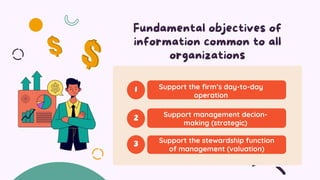
Support the firm’s day-to-day
operation
Support management decion-
making (strategic)
Support the stewardship function
of management (valuation)
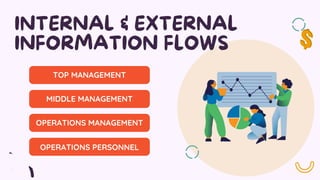
TOP MANAGEMENT
MIDDLE MANAGEMENT
OPERATIONS MANAGEMENT
OPERATIONS PERSONNEL
The set of formal procedures
by which data are collected,
processed into information, and
distributed to users.
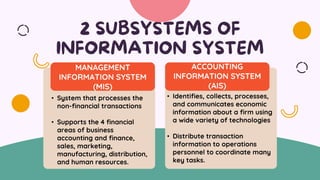
• System that processes the
non-financial transactions
• Supports the 4 financial
areas of business
accounting and finance,
sales, marketing,
manufacturing, distribution,
and human resources.
MANAGEMENT
INFORMATION SYSTEM
(MIS)
• Identifies, collects, processes,
and communicates economic
information about a firm using
a wide variety of technologies
• Distribute transaction
information to operations
personnel to coordinate many
key tasks.
ACCOUNTING
INFORMATION SYSTEM
(AIS)
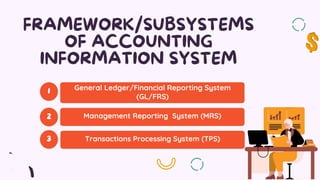
General Ledger/Financial Reporting System
(GL/FRS)
Management Reporting System (MRS)
Transactions Processing System (TPS)
• Produces financial statements and
reports
• Non-discretionary reporting is a type of
reporting in which the organization has
few or no choice in the information it
provides.
• Much of this information consists of
traditional financial statements, tax
returns and other legal documents.
• Produces special-purpose reports for
internal use
• Discretionary reporting is a type of
reporting in which the organization can
choose what information to report and
how to present it.
• Supports daily business operations
• Expenditure Cycle
*Purchase System
*Cash Disbursement System
*Payroll Processing System
*Fixed Asset System
• Conversion Cycle
*Cost Accounting System
*Production and Planning Control System
• Revenue Cycle
*Sales Processing System
*Cash Receipts System
-are specialized subset of information
system that processes:
• Financial transactions; e.g. sale of goods
• Non Financial transactions that directly
affect the processing of financial
transactions; e.g. addition of newly approved
vendor
• Transaction> Information System>
Information> User Decision
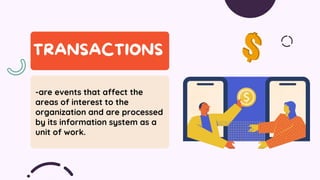
-are events that affect the
areas of interest to the
organization and are processed
by its information system as a
unit of work.
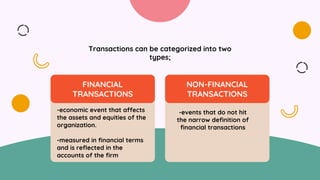
-economic event that affects
the assets and equities of the
organization.
-measured in financial terms
and is reflected in the
accounts of the firm
FINANCIAL
TRANSACTIONS
-events that do not hit
the narrow definition of
financial transactions
NON-FINANCIAL
TRANSACTIONS
Transactions can be categorized into two
types;
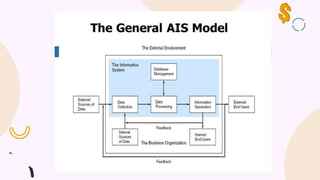
AIS is a model that describes all of the
information systems regardless of their
technological architecture.
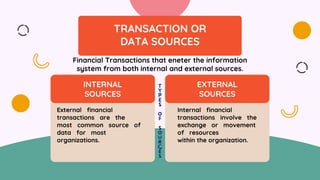
External financial
transactions are the
most common source of
data for most
organizations.
INTERNAL
SOURCES
Internal financial
transactions involve the
exchange or movement
of resources
within the organization.
EXTERNAL
SOURCES
Financial Transactions that eneter the information
system from both internal and external sources.
TRANSACTION OR
DATA SOURCES
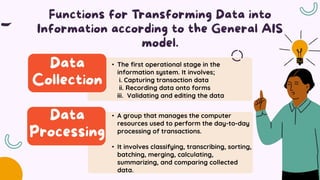
• The first operational stage in the
information system. It involves;
i. Capturing transaction data
ii. Recording data onto forms
iii. Validating and editing the data
• A group that manages the computer
resources used to perform the day-to-day
processing of transactions.
• It involves classifying, transcribing, sorting,
batching, merging, calculating,
summarizing, and comparing collected
data.
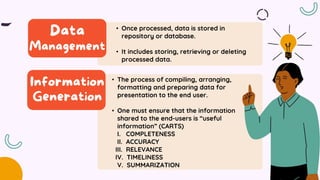
• Once processed, data is stored in
repository or database.
• It includes storing, retrieving or deleting
processed data.
• The process of compiling, arranging,
formatting and preparing data for
presentation to the end user.
• One must ensure that the information
shared to the end-users is “useful
information” (CARTS)
I. COMPLETENESS
II. ACCURACY
III. RELEVANCE
IV. TIMELINESS
V. SUMMARIZATION
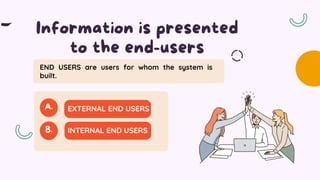
END USERS are users for whom the system is
built.
EXTERNAL END USERS
INTERNAL END USERS
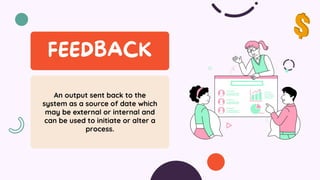
An output sent back to the
system as a source of date which
may be external or internal and
can be used to initiate or alter a
process.
• It refers to the systematic organization of data.
• It is a basic concept in data and database theory that
helps to show the relationship between smaller and
larger components in a database or data file.
• It is used to give a batter sense of understanding
about the components of data and how they are
related.
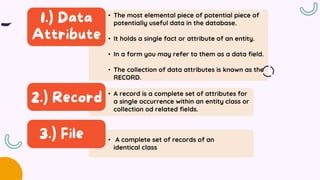
• The most elemental piece of potential piece of
potentially useful data in the database.
• It holds a single fact or attribute of an entity.
• In a form you may refer to them as a data field.
• The collection of data attributes is known as the
RECORD.
• A record is a complete set of attributes for
a single occurrence within an entity class or
collection od related fields.
• A complete set of records of an
identical class
REPORTERS:
ERWIN MAGALLANES
JERALYN FUENTES
ALIYAH ELOISA JEAN REAL

G1-IT-REPORT.pptx........,D,FM,M.........

  • 1.
    MODULE 1: INTRODUCTIONTO INFORMATION SYSTEMS: ACCOUNTANT’S PERSPECTIVE GROUP 1
  • 3.
    A business resourcethat: • needs to be appriopriately managed • is vital to the survival of contemporary business
  • 4.
    Support the firm’sday-to-day operation Support management decion- making (strategic) Support the stewardship function of management (valuation)
  • 5.
    TOP MANAGEMENT MIDDLE MANAGEMENT OPERATIONSMANAGEMENT OPERATIONS PERSONNEL
  • 7.
    The set offormal procedures by which data are collected, processed into information, and distributed to users.
  • 8.
    • System thatprocesses the non-financial transactions • Supports the 4 financial areas of business accounting and finance, sales, marketing, manufacturing, distribution, and human resources. MANAGEMENT INFORMATION SYSTEM (MIS) • Identifies, collects, processes, and communicates economic information about a firm using a wide variety of technologies • Distribute transaction information to operations personnel to coordinate many key tasks. ACCOUNTING INFORMATION SYSTEM (AIS)
  • 9.
    General Ledger/Financial ReportingSystem (GL/FRS) Management Reporting System (MRS) Transactions Processing System (TPS)
  • 10.
    • Produces financialstatements and reports • Non-discretionary reporting is a type of reporting in which the organization has few or no choice in the information it provides. • Much of this information consists of traditional financial statements, tax returns and other legal documents.
  • 11.
    • Produces special-purposereports for internal use • Discretionary reporting is a type of reporting in which the organization can choose what information to report and how to present it.
  • 12.
    • Supports dailybusiness operations • Expenditure Cycle *Purchase System *Cash Disbursement System *Payroll Processing System *Fixed Asset System • Conversion Cycle *Cost Accounting System *Production and Planning Control System • Revenue Cycle *Sales Processing System *Cash Receipts System
  • 14.
    -are specialized subsetof information system that processes: • Financial transactions; e.g. sale of goods • Non Financial transactions that directly affect the processing of financial transactions; e.g. addition of newly approved vendor • Transaction> Information System> Information> User Decision
  • 15.
    -are events thataffect the areas of interest to the organization and are processed by its information system as a unit of work.
  • 16.
    -economic event thataffects the assets and equities of the organization. -measured in financial terms and is reflected in the accounts of the firm FINANCIAL TRANSACTIONS -events that do not hit the narrow definition of financial transactions NON-FINANCIAL TRANSACTIONS Transactions can be categorized into two types;
  • 17.
    AIS is amodel that describes all of the information systems regardless of their technological architecture.
  • 18.
    External financial transactions arethe most common source of data for most organizations. INTERNAL SOURCES Internal financial transactions involve the exchange or movement of resources within the organization. EXTERNAL SOURCES Financial Transactions that eneter the information system from both internal and external sources. TRANSACTION OR DATA SOURCES
  • 22.
    • The firstoperational stage in the information system. It involves; i. Capturing transaction data ii. Recording data onto forms iii. Validating and editing the data • A group that manages the computer resources used to perform the day-to-day processing of transactions. • It involves classifying, transcribing, sorting, batching, merging, calculating, summarizing, and comparing collected data.
  • 23.
    • Once processed,data is stored in repository or database. • It includes storing, retrieving or deleting processed data. • The process of compiling, arranging, formatting and preparing data for presentation to the end user. • One must ensure that the information shared to the end-users is “useful information” (CARTS) I. COMPLETENESS II. ACCURACY III. RELEVANCE IV. TIMELINESS V. SUMMARIZATION
  • 24.
    END USERS areusers for whom the system is built. EXTERNAL END USERS INTERNAL END USERS
  • 25.
    An output sentback to the system as a source of date which may be external or internal and can be used to initiate or alter a process.
  • 26.
    • It refersto the systematic organization of data. • It is a basic concept in data and database theory that helps to show the relationship between smaller and larger components in a database or data file. • It is used to give a batter sense of understanding about the components of data and how they are related.
  • 27.
    • The mostelemental piece of potential piece of potentially useful data in the database. • It holds a single fact or attribute of an entity. • In a form you may refer to them as a data field. • The collection of data attributes is known as the RECORD. • A record is a complete set of attributes for a single occurrence within an entity class or collection od related fields. • A complete set of records of an identical class
  • 28.