Taming the law(JALIKATTU)
By Lakshmi Subramanian | February 05, 2017
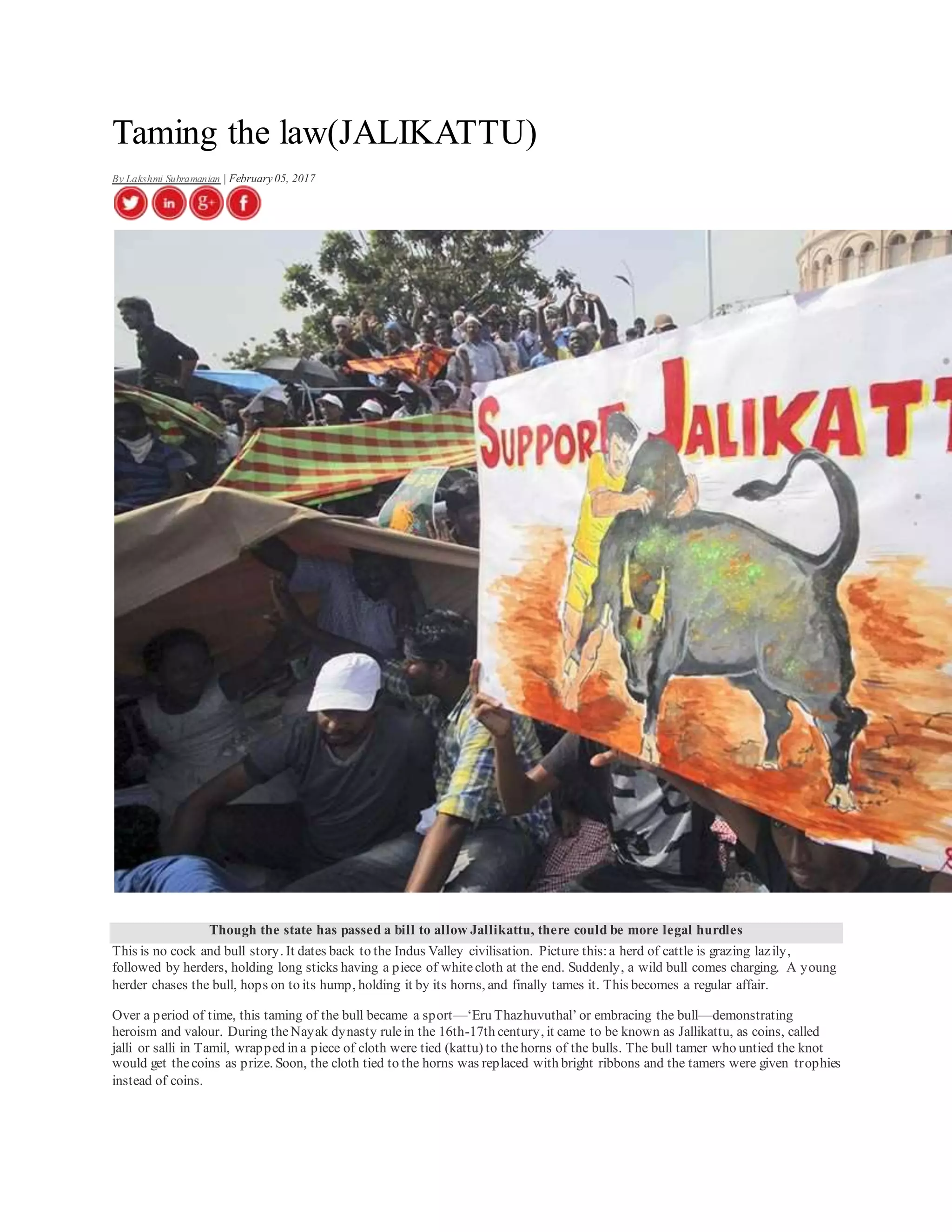
Matter of pride: A protester holdinga placard in support of Jallikattu on Marina Beach | AP
Though the state has passed a bill to allow Jallikattu, there could be more legal hurdles
This is no cock and bull story. It dates back to the Indus Valley civilisation. Picture this:a herd of cattle is grazing lazily,
followed by herders, holding long sticks having a piece of whitecloth at the end. Suddenly, a wild bull comes charging. A young
herder chases the bull, hops on to its hump, holding it by its horns, and finally tames it. This becomes a regular affair.
Over a period of time, this taming of the bull became a sport—‘Eru Thazhuvuthal’ or embracing the bull—demonstrating
heroism and valour. During theNayak dynasty rulein the 16th-17th century, it came to be known as Jallikattu, as coins, called
jalli or salli in Tamil, wrapped in a piece of cloth were tied (kattu) to thehorns of the bulls. The bull tamer who untied the knot
would get thecoins as prize. Soon, the cloth tied to the horns was replaced with bright ribbons and the tamers were given trophies
instead of coins.
As the sport became a tradition and acquired a cultural identity, villagers started rearing bulls exclusively for the sport and
equated them with gods. That is why, during the Pongal festival, when thesport is usually held, thekoyil kaalai (temple bull) is
the first bull to come through the vaadi vasal (theentrance). It would have a free run on the ground as a mark of respect to the
village and its deity.
For decades, Jallikattu had a free run in Tamil Nadu. But in thelast few years, the ancient sport has sparked a raging debate, with
one side highlighting cruelty towards animals and danger to spectators, and theother upholding culture and tradition. A few days
after Pongal this year, a few hundred peoplegathered on Chennai’s Marina Beach in support of Jallikattu and triggered a mass
movement across thestatewithin 24 hours. For nearly a week, the beach became home to protesters fromall walks of life. They
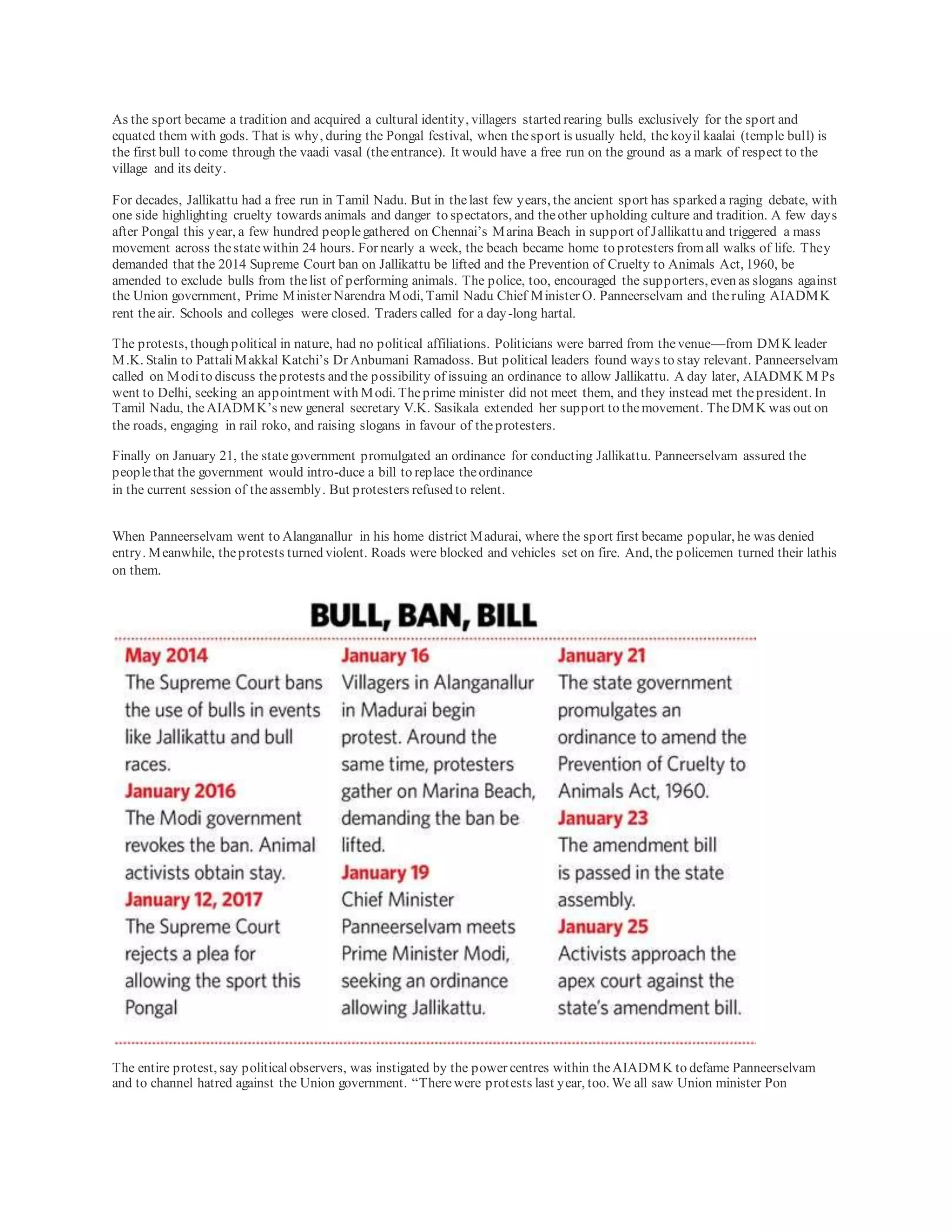
demanded that the 2014 Supreme Court ban on Jallikattu be lifted and the Prevention of Cruelty to Animals Act, 1960, be
amended to exclude bulls from thelist of performing animals. The police, too, encouraged the supporters, even as slogans against
the Union government, Prime Minister Narendra Modi, Tamil Nadu Chief Minister O. Panneerselvam and theruling AIADMK
rent theair. Schools and colleges were closed. Traders called for a day-long hartal.
The protests, though political in nature, had no political affiliations. Politicians were barred from thevenue—from DMK leader
M.K. Stalin to PattaliMakkal Katchi’s Dr Anbumani Ramadoss. But political leaders found ways to stay relevant. Panneerselvam
called on Modito discuss theprotests and the possibility of issuing an ordinance to allow Jallikattu. A day later, AIADMK M Ps
went to Delhi, seeking an appointment with Modi. Theprime minister did not meet them, and they instead met thepresident. In
Tamil Nadu, theAIADMK’s new general secretary V.K. Sasikala extended her support to themovement. TheDMK was out on
the roads, engaging in rail roko, and raising slogans in favour of theprotesters.
Finally on January 21, the stategovernment promulgated an ordinance for conducting Jallikattu. Panneerselvam assured the
peoplethat the government would intro-duce a bill to replace theordinance
in the current session of theassembly. But protesters refused to relent.
When Panneerselvam went to Alanganallur in his home district Madurai, where the sport first became popular, he was denied
entry. Meanwhile, theprotests turned violent. Roads were blocked and vehicles set on fire. And, the policemen turned their lathis
on them.
The entire protest, say politicalobservers, was instigated by the power centres within theAIADMK to defame Panneerselvam
and to channel hatred against the Union government. “Therewere protests last year, too. We all saw Union minister Pon
Radhakrishnan and others bat for Jallikattu last year. But the protests died down as usual. This time it reached a new high only
because of the indirect support fromunexpected circles,” said a senior journalist.
A lawyer saw the agitation as a tactical move by the Centre to make government enact a law. ThePCA Act is a Central law.
Since theSupreme Court had twice disallowed Jallikattu in 2014 and 2016 and owing to its adverse experience of ordinances, the
Modigovernment did not want to take a chance, the lawyer said.
On January 23, the stategovernment, with powers available under theconcurrent list, chose to introduce a bill to amend the
parent law. While tabling the bill in the assembly, Panneerselvam said, “With this bill all hurdles to Jallikattu have been
removed.” The bill will become a law once the president approves it.
“All possiblegrounds of assault found in thePCA Act have been addressed in the state’s amendment bill,” said retired High
Court Justice Hari Paranthaman. “It takes care of the list of prohibited animals part and specific exemptions for using bulls in
Jallikattu. It also says using the bulls for jallikattu doesn’t amount to cruelty.”
The statebill inserted Section 2(dd) in the Central act to define Jallikattu as “an event involving bulls conducted with a view to
follow tradition and culture”. It also added a provision to Section 3 to empower the stateto frame rules for conduct of Jallikattu.
Clause (f) inserted to section 11(3) of the act states that Jallikattu cannot cause cruelty to bulls.
The protests werecalled off. But the question is whether the bill will sustain judicial scrutiny. TheDMK regime had brought in a
Jallikattu regulation act in 2009, which was challenged by animal rights activists and later struck down by the Supreme Court in
2014. In 2016, activists challenged the court after theUnion government’s circular allowing the use of bulls in Jallikattu. The
Supreme Court stayed thenotification. On January 25, activists moved thecourt against the state’s amendment bill. Looks like
the Jallikattu controversy would rage on.

Jalikattu

  • 1.
    Taming the law(JALIKATTU) ByLakshmi Subramanian | February 05, 2017 Matter of pride: A protester holdinga placard in support of Jallikattu on Marina Beach | AP Though the state has passed a bill to allow Jallikattu, there could be more legal hurdles This is no cock and bull story. It dates back to the Indus Valley civilisation. Picture this:a herd of cattle is grazing lazily, followed by herders, holding long sticks having a piece of whitecloth at the end. Suddenly, a wild bull comes charging. A young herder chases the bull, hops on to its hump, holding it by its horns, and finally tames it. This becomes a regular affair. Over a period of time, this taming of the bull became a sport—‘Eru Thazhuvuthal’ or embracing the bull—demonstrating heroism and valour. During theNayak dynasty rulein the 16th-17th century, it came to be known as Jallikattu, as coins, called jalli or salli in Tamil, wrapped in a piece of cloth were tied (kattu) to thehorns of the bulls. The bull tamer who untied the knot would get thecoins as prize. Soon, the cloth tied to the horns was replaced with bright ribbons and the tamers were given trophies instead of coins.
  • 2.
    As the sportbecame a tradition and acquired a cultural identity, villagers started rearing bulls exclusively for the sport and equated them with gods. That is why, during the Pongal festival, when thesport is usually held, thekoyil kaalai (temple bull) is the first bull to come through the vaadi vasal (theentrance). It would have a free run on the ground as a mark of respect to the village and its deity. For decades, Jallikattu had a free run in Tamil Nadu. But in thelast few years, the ancient sport has sparked a raging debate, with one side highlighting cruelty towards animals and danger to spectators, and theother upholding culture and tradition. A few days after Pongal this year, a few hundred peoplegathered on Chennai’s Marina Beach in support of Jallikattu and triggered a mass movement across thestatewithin 24 hours. For nearly a week, the beach became home to protesters fromall walks of life. They demanded that the 2014 Supreme Court ban on Jallikattu be lifted and the Prevention of Cruelty to Animals Act, 1960, be amended to exclude bulls from thelist of performing animals. The police, too, encouraged the supporters, even as slogans against the Union government, Prime Minister Narendra Modi, Tamil Nadu Chief Minister O. Panneerselvam and theruling AIADMK rent theair. Schools and colleges were closed. Traders called for a day-long hartal. The protests, though political in nature, had no political affiliations. Politicians were barred from thevenue—from DMK leader M.K. Stalin to PattaliMakkal Katchi’s Dr Anbumani Ramadoss. But political leaders found ways to stay relevant. Panneerselvam called on Modito discuss theprotests and the possibility of issuing an ordinance to allow Jallikattu. A day later, AIADMK M Ps went to Delhi, seeking an appointment with Modi. Theprime minister did not meet them, and they instead met thepresident. In Tamil Nadu, theAIADMK’s new general secretary V.K. Sasikala extended her support to themovement. TheDMK was out on the roads, engaging in rail roko, and raising slogans in favour of theprotesters. Finally on January 21, the stategovernment promulgated an ordinance for conducting Jallikattu. Panneerselvam assured the peoplethat the government would intro-duce a bill to replace theordinance in the current session of theassembly. But protesters refused to relent. When Panneerselvam went to Alanganallur in his home district Madurai, where the sport first became popular, he was denied entry. Meanwhile, theprotests turned violent. Roads were blocked and vehicles set on fire. And, the policemen turned their lathis on them. The entire protest, say politicalobservers, was instigated by the power centres within theAIADMK to defame Panneerselvam and to channel hatred against the Union government. “Therewere protests last year, too. We all saw Union minister Pon
  • 3.
    Radhakrishnan and othersbat for Jallikattu last year. But the protests died down as usual. This time it reached a new high only because of the indirect support fromunexpected circles,” said a senior journalist. A lawyer saw the agitation as a tactical move by the Centre to make government enact a law. ThePCA Act is a Central law. Since theSupreme Court had twice disallowed Jallikattu in 2014 and 2016 and owing to its adverse experience of ordinances, the Modigovernment did not want to take a chance, the lawyer said. On January 23, the stategovernment, with powers available under theconcurrent list, chose to introduce a bill to amend the parent law. While tabling the bill in the assembly, Panneerselvam said, “With this bill all hurdles to Jallikattu have been removed.” The bill will become a law once the president approves it. “All possiblegrounds of assault found in thePCA Act have been addressed in the state’s amendment bill,” said retired High Court Justice Hari Paranthaman. “It takes care of the list of prohibited animals part and specific exemptions for using bulls in Jallikattu. It also says using the bulls for jallikattu doesn’t amount to cruelty.” The statebill inserted Section 2(dd) in the Central act to define Jallikattu as “an event involving bulls conducted with a view to follow tradition and culture”. It also added a provision to Section 3 to empower the stateto frame rules for conduct of Jallikattu. Clause (f) inserted to section 11(3) of the act states that Jallikattu cannot cause cruelty to bulls. The protests werecalled off. But the question is whether the bill will sustain judicial scrutiny. TheDMK regime had brought in a Jallikattu regulation act in 2009, which was challenged by animal rights activists and later struck down by the Supreme Court in 2014. In 2016, activists challenged the court after theUnion government’s circular allowing the use of bulls in Jallikattu. The Supreme Court stayed thenotification. On January 25, activists moved thecourt against the state’s amendment bill. Looks like the Jallikattu controversy would rage on.