Japanese Temples & Shrines 
By Jacques Averso
Japanese Temples 
(お寺=Otera) 
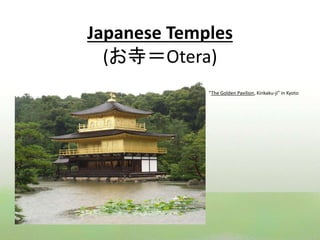
“The Golden Pavilion, Kinkaku-ji” in Kyoto
Japanese Temples 
• In Japanese, it’s usually [(Name) + (“-Ji”, or “- 
In”)] 
– ~寺 
– ~院(small temples, usually) 
• The temple grounds are open to the public to 
explore and pray, but the temple building itself 
is off limits. 
“Higashi Hongan-ji”, one of the most 
popular temples in Kyoto
Parts of a Temple 
• The Main Temple Gate 
– When entering the temple grounds, this is the first 
part that you’ll see 
– Also known as the 中門=Chuumon 
– Made of wood and has a big roof 
– Very simple structures; very plain 
– Big, popular temples may make you pay an entrance 
fee here (sometimes around $10 USD) 
– In the old days, it was fortified because warrior 
monks lived here 
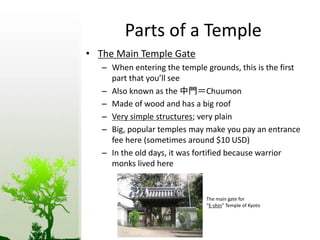
The main gate for 
“E-shin” Temple of Kyoto
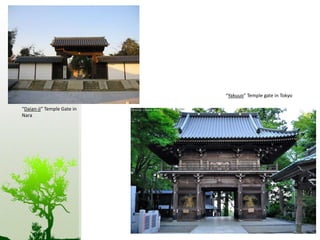
“Yakuuo” Temple gate in Tokyo 
“Daian-ji” Temple Gate in 
Nara
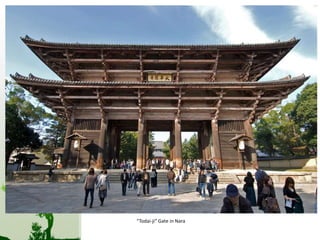
“Todai-ji” Gate in Nara
Parts of a Temple 
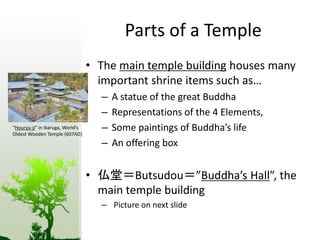
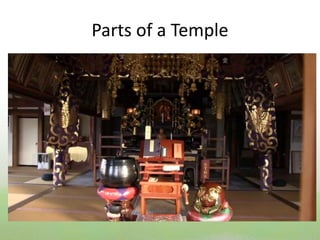
• The main temple building houses many 
important shrine items such as… 
– A statue of the great Buddha 
– Representations of the 4 Elements, 
– Some paintings of Buddha’s life 
– An offering box 
• 仏堂=Butsudou=”Buddha’s Hall”, the 
main temple building 
– Picture on next slide 
“Houryu-ji” in Ikaruga, World’s 
Oldest Wooden Temple (607AD)
Parts of a Temple
Parts of a Temple 
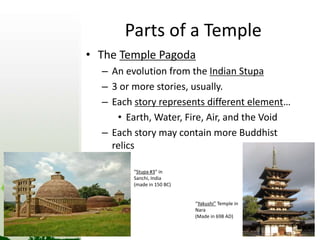
• The Temple Pagoda 
– An evolution from the Indian Stupa 
– 3 or more stories, usually. 
– Each story represents different element… 
• Earth, Water, Fire, Air, and the Void 
– Each story may contain more Buddhist 
relics 
“Stupa #3” in 
Sanchi, India 
(made in 150 BC) 
“Yakushi” Temple in 
Nara 
(Made in 698 AD)
Parts of a Temple 
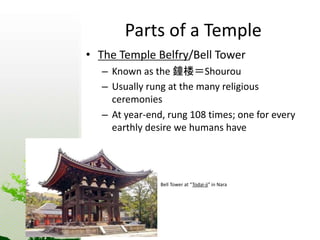
• The Temple Belfry/Bell Tower 
– Known as the 鐘楼=Shourou 
– Usually rung at the many religious 
ceremonies 
– At year-end, rung 108 times; one for every 
earthly desire we humans have 
Bell Tower at “Todai-ji” in Nara
Parts of a Temple 
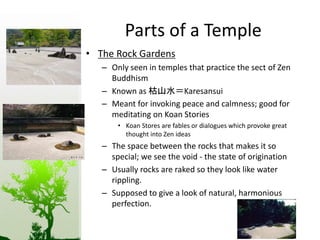
• The Rock Gardens 
– Only seen in temples that practice the sect of Zen 
Buddhism 
– Known as 枯山水=Karesansui 
– Meant for invoking peace and calmness; good for 
meditating on Koan Stories 
• Koan Stores are fables or dialogues which provoke great 
thought into Zen ideas 
– The space between the rocks that makes it so 
special; we see the void - the state of origination 
– Usually rocks are raked so they look like water 
rippling. 
– Supposed to give a look of natural, harmonious 
perfection.
Parts of a Temple 
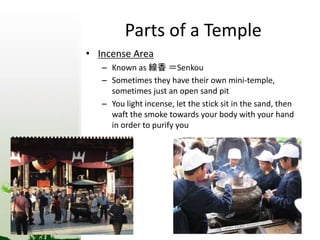
• Incense Area 
– Known as 線香=Senkou 
– Sometimes they have their own mini-temple, 
sometimes just an open sand pit 
– You light incense, let the stick sit in the sand, then 
waft the smoke towards your body with your hand 
in order to purify you
Parts of a Temple 
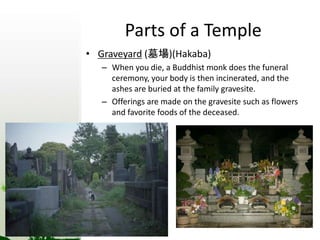
• Graveyard (墓場)(Hakaba) 
– When you die, a Buddhist monk does the funeral 
ceremony, your body is then incinerated, and the 
ashes are buried at the family gravesite. 
– Offerings are made on the gravesite such as flowers 
and favorite foods of the deceased.
Japanese Shrines 
(神社=Jinja) 
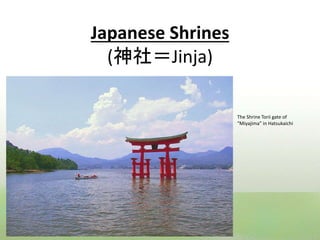
The Shrine Torii gate of 
“Miyajima” in Hatsukaichi
Parts of a Shrine 
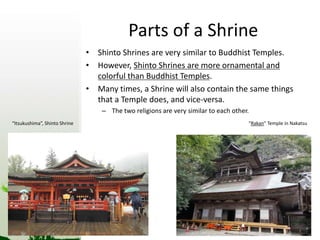
• Shinto Shrines are very similar to Buddhist Temples. 
• However, Shinto Shrines are more ornamental and 
colorful than Buddhist Temples. 
• Many times, a Shrine will also contain the same things 
that a Temple does, and vice-versa. 
– The two religions are very similar to each other. 
“Itsukushima”, Shinto Shrine “Rakan” Temple in Nakatsu
Parts of a Shrine 
• The Torii Gate 
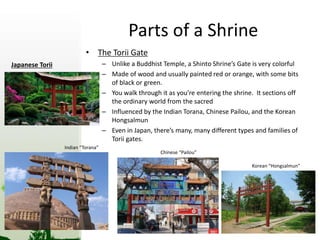
– Unlike a Buddhist Temple, a Shinto Shrine’s Gate is very colorful 
– Made of wood and usually painted red or orange, with some bits 
of black or green. 
– You walk through it as you’re entering the shrine. It sections off 
the ordinary world from the sacred 
– Influenced by the Indian Torana, Chinese Pailou, and the Korean 
Hongsalmun 
– Even in Japan, there’s many, many different types and families of 
Torii gates. 
Indian “Torana” 
Chinese “Pailou” 
Korean “Hongsalmun” 
Japanese Torii
Parts of a Shrine 
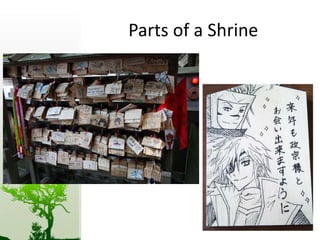
• Ema 
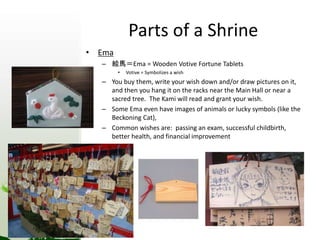
– 絵馬=Ema = Wooden Votive Fortune Tablets 
• Votive = Symbolizes a wish 
– You buy them, write your wish down and/or draw pictures on it, 
and then you hang it on the racks near the Main Hall or near a 
sacred tree. The Kami will read and grant your wish. 
– Some Ema even have images of animals or lucky symbols (like the 
Beckoning Cat), 
– Common wishes are: passing an exam, successful childbirth, 
better health, and financial improvement
Parts of a Shrine
Parts of a Shrine 
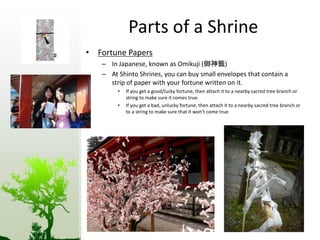
• Fortune Papers 
– In Japanese, known as Omikuji (御神籤) 
– At Shinto Shrines, you can buy small envelopes that contain a 
strip of paper with your fortune written on it. 
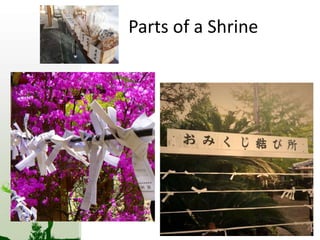
• If you get a good/lucky fortune, then attach it to a nearby sacred tree branch or 
string to make sure it comes true. 
• If you get a bad, unlucky fortune, then attach it to a nearby sacred tree branch or 
to a string to make sure that it won’t come true
Parts of a Shrine
Parts of a Shrine 
• Other Important Things at a Shrine… 
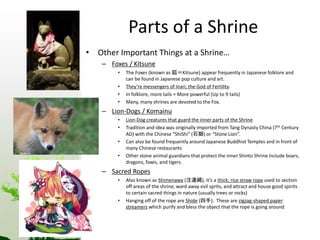
– Foxes / Kitsune 
• The Foxes (known as 狐=Kitsune) appear frequently in Japanese folklore and 
can be found in Japanese pop culture and art. 
• They’re messengers of Inari, the God of Fertility. 
• In folklore, more tails = More powerful (Up to 9 tails) 
• Many, many shrines are devoted to the Fox. 
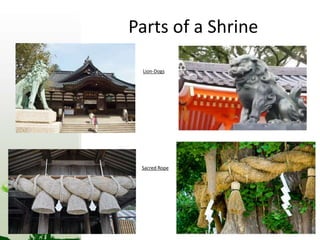
– Lion-Dogs / Komainu 
• Lion-Dog creatures that guard the inner parts of the Shrine 
• Tradition and idea was originally imported from Tang Dynasty China (7th Century 
AD) with the Chinese “ShiShi” (石獅) or “Stone Lion”. 
• Can also be found frequently around Japanese Buddhist Temples and in front of 
many Chinese restaurants 
• Other stone animal guardians that protect the inner Shinto Shrine include boars, 
dragons, foxes, and tigers. 
– Sacred Ropes 
• Also known as Shimenawa (注連縄), it’s a thick, rice straw rope used to section 
off areas of the shrine, ward away evil sprits, and attract and house good spirits 
to certain sacred things in nature (usually trees or rocks) 
• Hanging off of the rope are Shide (四手). These are zigzag-shaped paper 
streamers which purify and bless the object that the rope is going around.
Parts of a Shrine 
Lion-Dogs 
Sacred Rope
The Differences 
• Overall, Shrines and Temples usually are quite similar 
and it can be tough to tell the differences because many 
have the same things. 
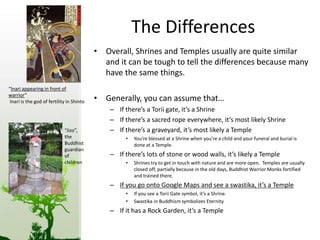
• Generally, you can assume that… 
– If there’s a Torii gate, it’s a Shrine 
– If there’s a sacred rope everywhere, it’s most likely Shrine 
– If there’s a graveyard, it’s most likely a Temple 
• You’re blessed at a Shrine when you’re a child and your funeral and burial is 
done at a Temple. 
– If there’s lots of stone or wood walls, it’s likely a Temple 
• Shrines try to get in touch with nature and are more open. Temples are usually 
closed off, partially because in the old days, Buddhist Warrior Monks fortified 
and trained there. 
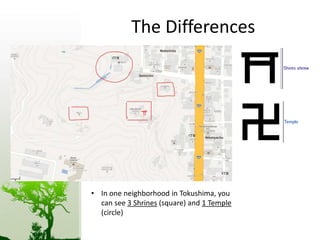
– If you go onto Google Maps and see a swastika, it’s a Temple 
• If you see a Torii Gate symbol, it’s a Shrine. 
• Swastika in Buddhism symbolizes Eternity 
– If it has a Rock Garden, it’s a Temple 
“Inari appearing in front of 
warrior” 
Inari is the god of fertility in Shinto 
“Jizo”, 
the 
Buddhist 
guardian 
of 
children
The Differences 
• In one neighborhood in Tokushima, you 
can see 3 Shrines (square) and 1 Temple 
(circle)
How to Pray at a Temple or 
Shrine 
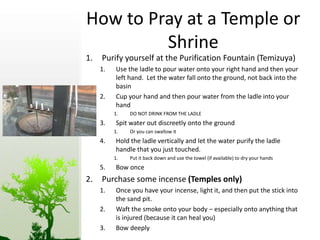
1. Purify yourself at the Purification Fountain (Temizuya) 
1. Use the ladle to pour water onto your right hand and then your 
left hand. Let the water fall onto the ground, not back into the 
basin 
2. Cup your hand and then pour water from the ladle into your 
hand 
1. DO NOT DRINK FROM THE LADLE 
3. Spit water out discreetly onto the ground 
1. Or you can swallow it 
4. Hold the ladle vertically and let the water purify the ladle 
handle that you just touched. 
1. Put it back down and use the towel (if available) to dry your hands 
5. Bow once 
2. Purchase some incense (Temples only) 
1. Once you have your incense, light it, and then put the stick into 
the sand pit. 
2. Waft the smoke onto your body – especially onto anything that 
is injured (because it can heal you) 
3. Bow deeply
How to Pray at a Temple or 
Shrine 
3. Make an offering… 
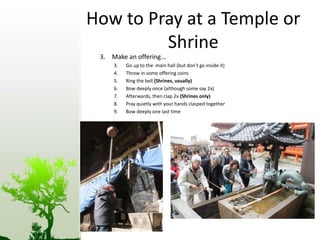
3. Go up to the main hall (but don’t go inside it) 
4. Throw in some offering coins 
5. Ring the bell (Shrines, usually) 
6. Bow deeply once (although some say 2x) 
7. Afterwards, then clap 2x (Shrines only) 
8. Pray quietly with your hands clasped together 
9. Bow deeply one last time
Temples & Shrine Video 
• http://youtu.be/chyyQ62R728 
– “Old Buddhist Temple” – JapanChannelDCom 
• >= 2:40 
• http://youtu.be/jQ9MH9gSwxc 
– First Visit to Shrine2012 ★ HATSU-MOUDE【初詣】- AidaRuna 
• <3 min 
======================================== 
Alternatives…. 
• http://youtu.be/0tyH59loTvQ 
• http://youtu.be/t6uEaEKyk5Q
Sources 
• http://answers.yahoo.com/question/index?qid=20090116094329AATLXIE 
• http://www.japanese-buddhism.com/temple-etiquette.html 
• http://www.youtube.com/watch?v=t6uEaEKyk5Q&feature=youtu.be 
• http://www.youtube.com/watch?v=chyyQ62R728 
• http://www.youtube.com/watch?v=7Qmnh7ckZ2A&list=SPC6E2387BDD531215&index=7 
• http://www.youtube.com/watch?v=0tyH59loTvQ 
• http://www.meriyatrra.com/travel-places/stupa-3.html 
• http://www.japanese-buddhism.com/temple-layout.html#pagoda 
• http://en.wikipedia.org/wiki/Buddhist_temples_in_Japan 
• http://matome.naver.jp/odai/2133367941623811801/2133368205823959103 
• http://www.sacred-destinations.com/japan/nara-yakushiji.htm 
• http://everything-everywhere.com/2009/05/23/daily-travel-photo-nara-japan-5-x/ 
• http://muza-chan.net/japan/index.php/blog/takaosan-yakuoin-yukiji-gate 
• http://www.taleofgenji.org/eshinin.html 
• http://answers.yahoo.com/question/index?qid=20080716085535AAAAWkN 
• http://en.wikipedia.org/wiki/Rock_gardens#Rock_garden 
• http://en.wikipedia.org/wiki/Koan 
• http://en.wikipedia.org/wiki/Shinto_shrine 
• http://www.japan-guide.com/e/e2057.html 
• http://en.wikipedia.org/wiki/Swastika#East_Asia 
• http://www.youtube.com/watch?feature=player_embedded&v=jQ9MH9gSwxc 
• http://en.wikipedia.org/wiki/Komainu 
• http://en.wikipedia.org/wiki/Japanese_map_symbols

お寺と神社の発表+アヴァーソー・ジャック (Jacques Averso)

  • 1.
    Japanese Temples &Shrines By Jacques Averso
  • 2.
    Japanese Temples (お寺=Otera) “The Golden Pavilion, Kinkaku-ji” in Kyoto
  • 3.
    Japanese Temples •In Japanese, it’s usually [(Name) + (“-Ji”, or “- In”)] – ~寺 – ~院(small temples, usually) • The temple grounds are open to the public to explore and pray, but the temple building itself is off limits. “Higashi Hongan-ji”, one of the most popular temples in Kyoto
  • 4.
    Parts of aTemple • The Main Temple Gate – When entering the temple grounds, this is the first part that you’ll see – Also known as the 中門=Chuumon – Made of wood and has a big roof – Very simple structures; very plain – Big, popular temples may make you pay an entrance fee here (sometimes around $10 USD) – In the old days, it was fortified because warrior monks lived here The main gate for “E-shin” Temple of Kyoto
  • 5.
    “Yakuuo” Temple gatein Tokyo “Daian-ji” Temple Gate in Nara
  • 6.
  • 7.
    Parts of aTemple • The main temple building houses many important shrine items such as… – A statue of the great Buddha – Representations of the 4 Elements, – Some paintings of Buddha’s life – An offering box • 仏堂=Butsudou=”Buddha’s Hall”, the main temple building – Picture on next slide “Houryu-ji” in Ikaruga, World’s Oldest Wooden Temple (607AD)
  • 8.
    Parts of aTemple
  • 9.
    Parts of aTemple • The Temple Pagoda – An evolution from the Indian Stupa – 3 or more stories, usually. – Each story represents different element… • Earth, Water, Fire, Air, and the Void – Each story may contain more Buddhist relics “Stupa #3” in Sanchi, India (made in 150 BC) “Yakushi” Temple in Nara (Made in 698 AD)
  • 10.
    Parts of aTemple • The Temple Belfry/Bell Tower – Known as the 鐘楼=Shourou – Usually rung at the many religious ceremonies – At year-end, rung 108 times; one for every earthly desire we humans have Bell Tower at “Todai-ji” in Nara
  • 11.
    Parts of aTemple • The Rock Gardens – Only seen in temples that practice the sect of Zen Buddhism – Known as 枯山水=Karesansui – Meant for invoking peace and calmness; good for meditating on Koan Stories • Koan Stores are fables or dialogues which provoke great thought into Zen ideas – The space between the rocks that makes it so special; we see the void - the state of origination – Usually rocks are raked so they look like water rippling. – Supposed to give a look of natural, harmonious perfection.
  • 12.
    Parts of aTemple • Incense Area – Known as 線香=Senkou – Sometimes they have their own mini-temple, sometimes just an open sand pit – You light incense, let the stick sit in the sand, then waft the smoke towards your body with your hand in order to purify you
  • 13.
    Parts of aTemple • Graveyard (墓場)(Hakaba) – When you die, a Buddhist monk does the funeral ceremony, your body is then incinerated, and the ashes are buried at the family gravesite. – Offerings are made on the gravesite such as flowers and favorite foods of the deceased.
  • 14.
    Japanese Shrines (神社=Jinja) The Shrine Torii gate of “Miyajima” in Hatsukaichi
  • 15.
    Parts of aShrine • Shinto Shrines are very similar to Buddhist Temples. • However, Shinto Shrines are more ornamental and colorful than Buddhist Temples. • Many times, a Shrine will also contain the same things that a Temple does, and vice-versa. – The two religions are very similar to each other. “Itsukushima”, Shinto Shrine “Rakan” Temple in Nakatsu
  • 16.
    Parts of aShrine • The Torii Gate – Unlike a Buddhist Temple, a Shinto Shrine’s Gate is very colorful – Made of wood and usually painted red or orange, with some bits of black or green. – You walk through it as you’re entering the shrine. It sections off the ordinary world from the sacred – Influenced by the Indian Torana, Chinese Pailou, and the Korean Hongsalmun – Even in Japan, there’s many, many different types and families of Torii gates. Indian “Torana” Chinese “Pailou” Korean “Hongsalmun” Japanese Torii
  • 17.
    Parts of aShrine • Ema – 絵馬=Ema = Wooden Votive Fortune Tablets • Votive = Symbolizes a wish – You buy them, write your wish down and/or draw pictures on it, and then you hang it on the racks near the Main Hall or near a sacred tree. The Kami will read and grant your wish. – Some Ema even have images of animals or lucky symbols (like the Beckoning Cat), – Common wishes are: passing an exam, successful childbirth, better health, and financial improvement
  • 18.
    Parts of aShrine
  • 19.
    Parts of aShrine • Fortune Papers – In Japanese, known as Omikuji (御神籤) – At Shinto Shrines, you can buy small envelopes that contain a strip of paper with your fortune written on it. • If you get a good/lucky fortune, then attach it to a nearby sacred tree branch or string to make sure it comes true. • If you get a bad, unlucky fortune, then attach it to a nearby sacred tree branch or to a string to make sure that it won’t come true
  • 20.
    Parts of aShrine
  • 21.
    Parts of aShrine • Other Important Things at a Shrine… – Foxes / Kitsune • The Foxes (known as 狐=Kitsune) appear frequently in Japanese folklore and can be found in Japanese pop culture and art. • They’re messengers of Inari, the God of Fertility. • In folklore, more tails = More powerful (Up to 9 tails) • Many, many shrines are devoted to the Fox. – Lion-Dogs / Komainu • Lion-Dog creatures that guard the inner parts of the Shrine • Tradition and idea was originally imported from Tang Dynasty China (7th Century AD) with the Chinese “ShiShi” (石獅) or “Stone Lion”. • Can also be found frequently around Japanese Buddhist Temples and in front of many Chinese restaurants • Other stone animal guardians that protect the inner Shinto Shrine include boars, dragons, foxes, and tigers. – Sacred Ropes • Also known as Shimenawa (注連縄), it’s a thick, rice straw rope used to section off areas of the shrine, ward away evil sprits, and attract and house good spirits to certain sacred things in nature (usually trees or rocks) • Hanging off of the rope are Shide (四手). These are zigzag-shaped paper streamers which purify and bless the object that the rope is going around.
  • 22.
    Parts of aShrine Lion-Dogs Sacred Rope
  • 23.
    The Differences •Overall, Shrines and Temples usually are quite similar and it can be tough to tell the differences because many have the same things. • Generally, you can assume that… – If there’s a Torii gate, it’s a Shrine – If there’s a sacred rope everywhere, it’s most likely Shrine – If there’s a graveyard, it’s most likely a Temple • You’re blessed at a Shrine when you’re a child and your funeral and burial is done at a Temple. – If there’s lots of stone or wood walls, it’s likely a Temple • Shrines try to get in touch with nature and are more open. Temples are usually closed off, partially because in the old days, Buddhist Warrior Monks fortified and trained there. – If you go onto Google Maps and see a swastika, it’s a Temple • If you see a Torii Gate symbol, it’s a Shrine. • Swastika in Buddhism symbolizes Eternity – If it has a Rock Garden, it’s a Temple “Inari appearing in front of warrior” Inari is the god of fertility in Shinto “Jizo”, the Buddhist guardian of children
  • 24.
    The Differences •In one neighborhood in Tokushima, you can see 3 Shrines (square) and 1 Temple (circle)
  • 25.
    How to Prayat a Temple or Shrine 1. Purify yourself at the Purification Fountain (Temizuya) 1. Use the ladle to pour water onto your right hand and then your left hand. Let the water fall onto the ground, not back into the basin 2. Cup your hand and then pour water from the ladle into your hand 1. DO NOT DRINK FROM THE LADLE 3. Spit water out discreetly onto the ground 1. Or you can swallow it 4. Hold the ladle vertically and let the water purify the ladle handle that you just touched. 1. Put it back down and use the towel (if available) to dry your hands 5. Bow once 2. Purchase some incense (Temples only) 1. Once you have your incense, light it, and then put the stick into the sand pit. 2. Waft the smoke onto your body – especially onto anything that is injured (because it can heal you) 3. Bow deeply
  • 26.
    How to Prayat a Temple or Shrine 3. Make an offering… 3. Go up to the main hall (but don’t go inside it) 4. Throw in some offering coins 5. Ring the bell (Shrines, usually) 6. Bow deeply once (although some say 2x) 7. Afterwards, then clap 2x (Shrines only) 8. Pray quietly with your hands clasped together 9. Bow deeply one last time
  • 27.
    Temples & ShrineVideo • http://youtu.be/chyyQ62R728 – “Old Buddhist Temple” – JapanChannelDCom • >= 2:40 • http://youtu.be/jQ9MH9gSwxc – First Visit to Shrine2012 ★ HATSU-MOUDE【初詣】- AidaRuna • <3 min ======================================== Alternatives…. • http://youtu.be/0tyH59loTvQ • http://youtu.be/t6uEaEKyk5Q
  • 28.
    Sources • http://answers.yahoo.com/question/index?qid=20090116094329AATLXIE • http://www.japanese-buddhism.com/temple-etiquette.html • http://www.youtube.com/watch?v=t6uEaEKyk5Q&feature=youtu.be • http://www.youtube.com/watch?v=chyyQ62R728 • http://www.youtube.com/watch?v=7Qmnh7ckZ2A&list=SPC6E2387BDD531215&index=7 • http://www.youtube.com/watch?v=0tyH59loTvQ • http://www.meriyatrra.com/travel-places/stupa-3.html • http://www.japanese-buddhism.com/temple-layout.html#pagoda • http://en.wikipedia.org/wiki/Buddhist_temples_in_Japan • http://matome.naver.jp/odai/2133367941623811801/2133368205823959103 • http://www.sacred-destinations.com/japan/nara-yakushiji.htm • http://everything-everywhere.com/2009/05/23/daily-travel-photo-nara-japan-5-x/ • http://muza-chan.net/japan/index.php/blog/takaosan-yakuoin-yukiji-gate • http://www.taleofgenji.org/eshinin.html • http://answers.yahoo.com/question/index?qid=20080716085535AAAAWkN • http://en.wikipedia.org/wiki/Rock_gardens#Rock_garden • http://en.wikipedia.org/wiki/Koan • http://en.wikipedia.org/wiki/Shinto_shrine • http://www.japan-guide.com/e/e2057.html • http://en.wikipedia.org/wiki/Swastika#East_Asia • http://www.youtube.com/watch?feature=player_embedded&v=jQ9MH9gSwxc • http://en.wikipedia.org/wiki/Komainu • http://en.wikipedia.org/wiki/Japanese_map_symbols

Editor's Notes

  • #15 At low tide, you can even walk out to the shrine. It was built out there.
  • #18 It’s the Year of the Snake
  • #19 Right-most picture: 来年も政宗様とお会い出来ますように=らいねんもまさむねさまとおあいできますように=I hope I can meet with Masasmune-sama. (From Sengoku Basara)
  • #20 Mid-bottom image: omikuji on a sacred tree branch, but looks like a real tree
  • #21 Far-right image there reads: おみくじ結び所=おみくじむすびとろろ=Final Place for the Omikuji