AP THORACIC SPINE
JAADA GARMS
RADS 216
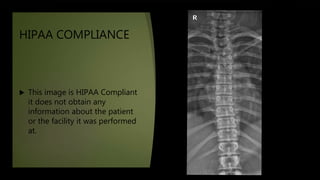
HIPAA COMPLIANCE
 This image is HIPAA Compliant
it does not obtain any
information about the patient
or the facility it was performed
at.
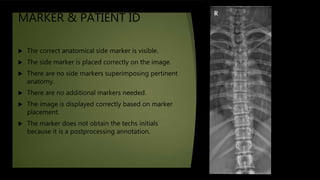
MARKER & PATIENT ID
 The correct anatomical side marker is visible.
 The side marker is placed correctly on the image.
 There are no side markers superimposing pertinent
anatomy.
 There are no additional markers needed.
 The image is displayed correctly based on marker
placement.
 The marker does not obtain the techs initials
because it is a postprocessing annotation.
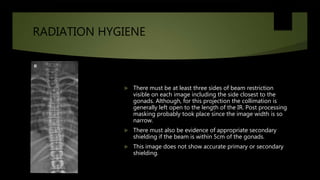
RADIATION HYGIENE
 There must be at least three sides of beam restriction
visible on each image including the side closest to the
gonads. Although, for this projection the collimation is
generally left open to the length of the IR. Post processing
masking probably took place since the image width is so
narrow.
 There must also be evidence of appropriate secondary
shielding if the beam is within 5cm of the gonads.
 This image does not show accurate primary or secondary
shielding.
Completeness of
Position/Projection
Routine images of the T-spine include:
 AP
 LATERAL
 SWIMMERS Lateral Cervicothoracic
 This image does comply with routine
positions/projections.
 All anatomical parts are not correctly
visualized.
ARTIFACT
IDENTIFICATION
 There are no preventable
artifacts .
 There are no body parts
superimposed that should not
be.
 There is no hospital paraphernal
visible.
 The patent's clothing is not
visible.
 No indwelling artifacts or
foreign bodies visible in the
image.
 There are no CR/DR artifacts on
the image.
 No excess fog degrading image
quality.
IMAGE SHARPNESS
 There is no gross voluntary motion visible and bony
trabeculae are well visualized.
 There was no quantum mottle visible because the
appropriate MAS was used.
 No evidence of previous/ghosted exposure.
 There are no grid lines/artifacts because a reciprocating
grid was used
 Size distortion does not appear greater than expected.
 There is no shape distortion due to poor CR/IR/Part
Alignment.
Accurate Part Positioning
 The part does not appear to be
adequately aligned to the image
media it appears to be some slight
rotation based on the position of the
clavicles or this can be due to the
patients scoliosis.
 The part is accurately centered to the
image media.
 The CR is centered within 1 cm of the
anatomical part which is T7.
 The CR is adequately centered with
the image media.
T7
T12
Accurate Part
Positioning
 Since there is no
collimation the CRs
alignment does not
conform to an
acceptable IR
exposure field
recognition template.
Accurate Part
Positioning
 Center IR/CR to the level of T7
 Position the upper thoracic
toward the anode end of the tube
 Shoulders and hips in the same
horizontal plane
 Align MCP parallel with the IR
Image Evaluation
Criteria
 Uniform brightness across the
entire T-spine.
 Spinous processes should be
aligned with the midline of the
vertebral bodies.
 Intervertebral disk spaces open.
 The 7th thoracic vertebrae seen
at the center of the exposure
field.
 The Part is correctly positioned
based on this criteria.
Judicious Exposure Technique
• The most radiolucent structures are the lungs
an intervertebral disk spaces.
• The most radiopaque structures are the
pedicles on the lumbar & thoracic spine as
well as the bony cortex.
• The EI value is unknown.
• Bony structures should demonstrate short
scale contrast this image appears to have
adequate contrast and we are able to
visualize bony trabeculae.
• The brightness towards the bottom of the
image appears to be slightly higher, therefore
a compensating filter should be used in
addition to the anode heel effect.
Accept/Reject Image
 This image does meet
the minimum
standards for
acceptance.
Changes to be made:
 beam restriction should be
made visible.
 A proper marker including
initials.
 Better align the shoulders to
assure they are on a horizontal
plane with the hips.
References
Gaillard, Frank. "Carpometacarpal Fracture | Radiology Case." Radiopaedia.org. N.p.,
n.d. Web. 27 Mar. 2017.
McQuillen-Martensen, Kathy. Radiographic Image Analysis. St. Louis, MO: Elsevier
Saunders, 2015. Print
"AP Thoracic Spine Breathing Technique." WikiRadiography. N.p., n.d. Web. 09 Apr.
2017.

Jaada Garms

  • 1.
  • 2.
    HIPAA COMPLIANCE  Thisimage is HIPAA Compliant it does not obtain any information about the patient or the facility it was performed at.
  • 3.
    MARKER & PATIENTID  The correct anatomical side marker is visible.  The side marker is placed correctly on the image.  There are no side markers superimposing pertinent anatomy.  There are no additional markers needed.  The image is displayed correctly based on marker placement.  The marker does not obtain the techs initials because it is a postprocessing annotation.
  • 4.
    RADIATION HYGIENE  Theremust be at least three sides of beam restriction visible on each image including the side closest to the gonads. Although, for this projection the collimation is generally left open to the length of the IR. Post processing masking probably took place since the image width is so narrow.  There must also be evidence of appropriate secondary shielding if the beam is within 5cm of the gonads.  This image does not show accurate primary or secondary shielding.
  • 5.
    Completeness of Position/Projection Routine imagesof the T-spine include:  AP  LATERAL  SWIMMERS Lateral Cervicothoracic  This image does comply with routine positions/projections.  All anatomical parts are not correctly visualized.
  • 6.
    ARTIFACT IDENTIFICATION  There areno preventable artifacts .  There are no body parts superimposed that should not be.  There is no hospital paraphernal visible.  The patent's clothing is not visible.  No indwelling artifacts or foreign bodies visible in the image.  There are no CR/DR artifacts on the image.  No excess fog degrading image quality.
  • 7.
    IMAGE SHARPNESS  Thereis no gross voluntary motion visible and bony trabeculae are well visualized.  There was no quantum mottle visible because the appropriate MAS was used.  No evidence of previous/ghosted exposure.  There are no grid lines/artifacts because a reciprocating grid was used  Size distortion does not appear greater than expected.  There is no shape distortion due to poor CR/IR/Part Alignment.
  • 8.
    Accurate Part Positioning The part does not appear to be adequately aligned to the image media it appears to be some slight rotation based on the position of the clavicles or this can be due to the patients scoliosis.  The part is accurately centered to the image media.  The CR is centered within 1 cm of the anatomical part which is T7.  The CR is adequately centered with the image media. T7 T12
  • 9.
    Accurate Part Positioning  Sincethere is no collimation the CRs alignment does not conform to an acceptable IR exposure field recognition template.
  • 10.
    Accurate Part Positioning  CenterIR/CR to the level of T7  Position the upper thoracic toward the anode end of the tube  Shoulders and hips in the same horizontal plane  Align MCP parallel with the IR
  • 11.
    Image Evaluation Criteria  Uniformbrightness across the entire T-spine.  Spinous processes should be aligned with the midline of the vertebral bodies.  Intervertebral disk spaces open.  The 7th thoracic vertebrae seen at the center of the exposure field.  The Part is correctly positioned based on this criteria.
  • 12.
    Judicious Exposure Technique •The most radiolucent structures are the lungs an intervertebral disk spaces. • The most radiopaque structures are the pedicles on the lumbar & thoracic spine as well as the bony cortex. • The EI value is unknown. • Bony structures should demonstrate short scale contrast this image appears to have adequate contrast and we are able to visualize bony trabeculae. • The brightness towards the bottom of the image appears to be slightly higher, therefore a compensating filter should be used in addition to the anode heel effect.
  • 13.
    Accept/Reject Image  Thisimage does meet the minimum standards for acceptance. Changes to be made:  beam restriction should be made visible.  A proper marker including initials.  Better align the shoulders to assure they are on a horizontal plane with the hips.
  • 14.
    References Gaillard, Frank. "CarpometacarpalFracture | Radiology Case." Radiopaedia.org. N.p., n.d. Web. 27 Mar. 2017. McQuillen-Martensen, Kathy. Radiographic Image Analysis. St. Louis, MO: Elsevier Saunders, 2015. Print "AP Thoracic Spine Breathing Technique." WikiRadiography. N.p., n.d. Web. 09 Apr. 2017.