M. Khalili, H. Arabshahi, M. H. Tayarani and M. Bazrafshan / International Journal of
Engineering Research and Applications (IJERA) ISSN: 2248-9622 www.ijera.com
Vol. 3, Issue 4, Jul-Aug 2013, pp.1636-1639
1636 | P a g e
Comparison of Electron Mobility in Zno and Sic Semiconductors
at Low Field by Solving Boltzmann Equation
1
M. Khalili, 2
H. Arabshahi, 1
M. H. Tayarani and 1
M. Bazrafshan
1
Physics Department, Higher Education of Khayyam, Mashhad,Iran
2
Physics Department, Payam Noor University, Tehran, Iran
Abstract
In this article the electron mobility’s in
ZnO and SiC Semiconductors are calculated by
solving Boltzmann equation using iteration model.
The electron mobility is calculated as a function of
temperature and ionized impurity in the ranges of
100k to 600k and 1016
to 1018
cm-3
. The theoretical
maximum motilities in ZnO, SiC at 300k are
about275 and 7.35 cm2
.v-1
s-1
. We compare the
results with experimental data and find reasonable
correlation.
Keywords-: Electron mobility; ZnO and SiC;
Iteration Model.
I. INTRODUCTION
Sic has a wide band gap of 3.2 eV and thus it
is an applied semiconductors in the fabrication of
electronic and photo electronic devices such as lasers
and detectors which work in the range of Infrared
spectrum . It is also useful in construction of
transistors. There has been a great interest in the
study of charge carrier transport of ZnO due to the
wide band gap of 3.43 eV. Therefore Zink Oxide has
become one of the most applied semiconductors in
Light Emitting Diode (LED), Liquid crystal Detector
(LCD) and Solar cells. The low -field electron
mobility is one of the most important parameters that
determine the performance of the field-effect
transistor. The purpose of the present paper is to
calculate electron mobility for various temperatures
and ionized -impurity concentrations. The
formulation itself applies only to the center of Γ
valley conduction band. We have also considered
band non-parabolicity and screening effects of free
carriers on the scattering probabilities. All the
relevant scattering mechanisms, including polar optic
phonons, deformation potential, piezoelectric,
acoustic phonons and ionized impurity Scattering The
Boltzmann equation is solved iteratively for our
purpose, jointly incorporating the effects of all the
scattering mechanisms. This paper is organized as
follows : Details of the iterative model of Boltzmann
equation is presented in section ΙΙ and the results of
iterative calculations carried out on ZnO and SiC
structures are interpreted in section ΙΙΙ.
II. MODEL DETAILS
To calculate mobility, we have to solve
Boltzmann equation to get the modified probability
distribution function under the action of a steady
electric field. Here we have adopted the iterative
technique for solving the Boltzmann transport
equation. Under the action of steady field, the
Boltzmann equation for the distribution function can
be written as
(1)
Where represents the change f distribution
function due to the electron scattering. In the steady-
state and under application of uniform electric field
the Boltzmann equation can be written as
(2)
Consider electrons in an isotropic, non-
parabolic conduction band whose equilibrium Fermi
distribution function is f0 (k) in the absence of electric
field. Note the equilibrium distribution f0 (k) is
isotropic in k space but is perturbed when an electric
field is applied. If the electric field is small, we can
treat the change from the equilibrium distribution
function as a perturbation which is first order in the
electric field. The distribution in the presence of a
sufficiently small field can be written quite generally
as
(3)
Whereθ is the angle between k and F and g(k) is an
isotropic function of k, which is proportional to the
magnitude of the electric field f(k) satisfies the
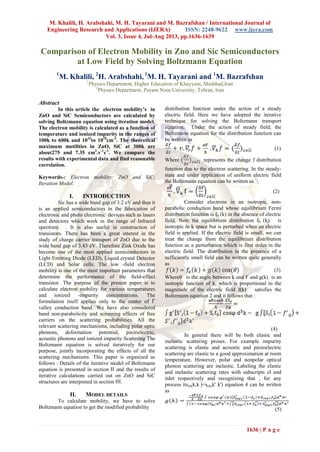
Boltzmann equation 2 and it follows that :
(4)
In general there will be both elastic and
inelastic scattering proses. For example impurity
scattering is elastic and acoustic and piezoelectric
scattering are elastic to a good approximation at room
temperature. However, polar and nonpolar optical
phonon scattering are inelastic. Labeling the elastic
and inelastic scattering rates with subscripts el and
inlet respectively and recognizing that , for any
process itseli(k,k’
)=seli(k' ,k') equation 4 can be written
as
(5)
M. Khalili, H. Arabshahi, M. H. Tayarani and M. Bazrafshan / International Journal of
Engineering Research and Applications (IJERA) ISSN: 2248-9622 www.ijera.com
Vol. 3, Issue 4, Jul-Aug 2013, pp.1636-1639
1637 | P a g e
Note the first term in the denominator is simply the
momentum relaxation rate for elastic scattering ,
equation 5 may be solved iteratively by the relation
(6)
Where is the perturbation to the
distribution function after the nth iteration. it is
interesting to note that if the initial distribution is
chosen to be the equilibrium distribution, for
which is equal to zero, we get the relaxation
time approximation result after the first iteration. We
have found that convergence can normally be
achieved after only a few iterations for small electric
fields. Once has be evaluated to the required
accuracy, it is possible to calculate quantities such as
the drift mobility which is given in terms of
spherical coordinates by
(7)
III. RESULTS
All structural and electrical parameters used
to calculate the electron mobility is given in table 1.
Figures 1 and 2 show changes the electron mobility
function in terms of temperature in bulk ZnO and SiC
at the electron concentration 1016
(cm-3
)
100 200 300 400 500 600
0
300
600
900
1200
1500
1800
ZnO Nd
=10
16
(cm
-3
)
Electronmobility
(cm
2
/v.s)
Temperature (k)
Fig 1. Changes the electron mobility function in
terms of Temperature in bulk ZnO at the electron
concentration
1016
cm-3
100 200 300 400 500 600
0
30
60
90
120
150
SiC Nd
=10
16
(cm
-3
)
Electronmobility
(cm
2
/v.s)
Temperature (k)
fig 2. Changes the electron mobility function in
terms of Temperature in bulk SiC at the electron
concentration 1016
cm-3
The electrons mobility decrease quickly by
temperature increasing from 100 to 600k in bulk
ZnO and SiC at the electron concentration of
1016
(cm-3
).because temperature increasing causes
increase of phonons energy too.so it causes a strong
interaction between electrons and these phonons that
its result is increase of electrons scattering rate and
finally decrease of electrons mobility .
By comparing two figures 1 and 2 we can see that
the electron mobility of ZnO is more than SiC.
because increasing effective mass causes the decrease
of acceleration and the time in which electrons are
under the influence of impurity centers increase and
as a result scattering would increase and mobility
will decrease. Figures 3 and 4 show changes the
electron mobility function in terms of electron
concentration in bulks ZnO and SiC at temperature
of 300k.
Figures 3 and 4 show that in both semiconductors
ZnO and SiC mobility decrease by electrons
ZnO SiC
Density (kgm-3
) 5600 3200
Longitudinal sound velocity vs
(ms-1
)
6400 1373
Low- frequency dielectric
constant εs
8.2 9.7
High-frequency dielectric
constant ε∞
3.7 6.5
Acoustic deformation potential
(ev)
14 15
Polar optical phonon energy
(ev)
0.072 0.12
- valley effective mass (m*
) 0.25 0.28
-valley nonparabolicity (ev-
1
)
0.312 0.32
M. Khalili, H. Arabshahi, M. H. Tayarani and M. Bazrafshan / International Journal of
Engineering Research and Applications (IJERA) ISSN: 2248-9622 www.ijera.com
Vol. 3, Issue 4, Jul-Aug 2013, pp.1636-1639
1638 | P a g e
concentrations increasing because electrons
increasing causes increase of ionized impurity
centers in crystals that it causes electrons to be under
the influence of the coulomb potential of these
centers more frequently ,that its result is increase of
electrons scattering rate and finally decrease of
electrons mobility .
0.0 2.0x10
17
4.0x10
17
6.0x10
17
8.0x10
17
1.0x10
18
210
220
230
240
250
260
270
280
ZnO T=300K
Electronmobility
(cm
2
/v.s)
Ionized impurity density(cm
-3
)
Fig 3. Changes the electron mobility function in
terms of electron concentration in bulk ZnO and at
temperature of 300k.
0.0 2.0x10
17
4.0x10
17
6.0x10
17
8.0x10
17
1.0x10
18
5.5
6.0
6.5
7.0
7.5
SiC T=300K
Electronmobility
(cm
2
/v.s)
Ionized impurity density(cm
-3
)
Fig 4. Changes the electron mobility function in
terms of electron concentration in bulk SiC and at
temperature of 300 K.
Figures 5 and 6 show changes the electron
mobility function in terms of temperature in bulks
ZnO and SiC at concentration of 1016
cm-3
, 1017
cm-3
,
1018
cm-3
. Figures 5 and 6 show that in both
semiconductors ZnO and SiC mobility decrease by
decrease by electrons concentration increasing from
the rate of 1016
cm-3
to 1018
cm-3
.
100 200 300 400 500 600
0
300
600
900
1200
1500
1800
ZnO Nd
=10
16
(cm
-3
)
ZnO Nd
=10
17
(cm
-3
)
ZnO Nd
=10
18
(cm
-3
)
Electronmobility
(cm
2
/v.s)
Temperature (k)
Fig 5. Changes the electron mobility function in
terms of temperature in bulk ZnO at the different
electron concentration.
100 200 300 400 500 600
0
20
40
60
80
100
120
140
SiC Nd
=10
16
(cm
-3
)
SiC Nd
=10
17
(cm
-3
)
SiC Nd
=10
18
(cm
-3
)
Electronmobility
(cm
2
/v.s)
Temperature (k)
Fig 6. Changes the electron mobility function in
terms of temperature in bulk SiC at the different
electron concentration.
Figures 7 and 8 show changes the electron
mobility function in terms of electron concentration
in bulks ZnO and SiC in bulks ZnO and SiC at the
different temperature (250k,300k,350k).
Figures 7 and 8 show that in both semiconductors
ZnO and SiC mobility decrease by temperature
increasing from 250k to 350k.
0.0 2.0x10
17
4.0x10
17
6.0x10
17
8.0x10
17
1.0x10
18
180
200
220
240
260
280
300
320
340
ZnO T=250K
ZnO T=300K
ZnO T=350K
Electronmobility
(cm
2
/v.s)
Ionized impurity density(cm
-3
)
Fig 7. Changes the electron mobility function in
terms of electron concentration in bulk ZnO at the
different temperature.
M. Khalili, H. Arabshahi, M. H. Tayarani and M. Bazrafshan / International Journal of
Engineering Research and Applications (IJERA) ISSN: 2248-9622 www.ijera.com
Vol. 3, Issue 4, Jul-Aug 2013, pp.1636-1639
1639 | P a g e
0.0 2.0x10
17
4.0x10
17
6.0x10
17
8.0x10
17
1.0x10
18
4
5
6
7
8
9
10
Electronmobility
(cm
2
/v.s)
Ionized impurity density(cm
-3
)
SiC T=250K
SiC T=300K
SiC T=350K
Fig 8. Changes the electron mobility function in
terms of electron concentration in bulk SiC at the
different temperature.
IV. CONCLUTION
Our calculation results show that the
electron mobility decrease by electrons concentration
increasing and the electron mobility decrease by
temperature increasing .electron mobility ZnO more
than SiC.
V. ACKNOWLEDGEMENT
I would like to thank A. Vatan-khahan and
M. Ghafourian for their useful comments.
REFERENCES
[1] Vatan-khahan , M. H . Tayarani, ,
A.Saderemomtaz and H.
Arabshahi, « Comparison of electron
scattering mechanisims and electron
mobility in AIN and GaN at low electric
field application », Internatinal journal of
scieence and Advanced Technology(ISSN
2221-8386),(july 2011),pp116-119.
[2] H. Arabshahi, A. Vatan- khahan and M. H.
Tayarani ,”Comparision of low field electron
transport properties in InN and GaN
semiconductors by solving Boltzmann
equation using iteration model”,Internatonal
journal of science and Advance Technology
(ISSN 2221-8386),(2011),PP 6-11.
[3] H. Arabshahi , M. Reza Rokn –Abadi and
F.Badieyan Bagh-siyahi,”Comparison of
high field electron transport propertis in
wurtzite phase of ZnO , GaN and
SiC”,Research journal of applied
science5(3):215-220,2010
[4] H. Arabshahi,A. pashaei and M. H.
Tayarani,”Comparison of low field electron
transport propertiese in compounds of group
sΙΙΙ-V semiconductors by solving Boltzmann
equation using iteration model”, Internatinal
journal of enigeering invention ,ISSN:2278-
7461,(2012)PP:56-61

Iz3416361639

  • 1.
    M. Khalili, H.Arabshahi, M. H. Tayarani and M. Bazrafshan / International Journal of Engineering Research and Applications (IJERA) ISSN: 2248-9622 www.ijera.com Vol. 3, Issue 4, Jul-Aug 2013, pp.1636-1639 1636 | P a g e Comparison of Electron Mobility in Zno and Sic Semiconductors at Low Field by Solving Boltzmann Equation 1 M. Khalili, 2 H. Arabshahi, 1 M. H. Tayarani and 1 M. Bazrafshan 1 Physics Department, Higher Education of Khayyam, Mashhad,Iran 2 Physics Department, Payam Noor University, Tehran, Iran Abstract In this article the electron mobility’s in ZnO and SiC Semiconductors are calculated by solving Boltzmann equation using iteration model. The electron mobility is calculated as a function of temperature and ionized impurity in the ranges of 100k to 600k and 1016 to 1018 cm-3 . The theoretical maximum motilities in ZnO, SiC at 300k are about275 and 7.35 cm2 .v-1 s-1 . We compare the results with experimental data and find reasonable correlation. Keywords-: Electron mobility; ZnO and SiC; Iteration Model. I. INTRODUCTION Sic has a wide band gap of 3.2 eV and thus it is an applied semiconductors in the fabrication of electronic and photo electronic devices such as lasers and detectors which work in the range of Infrared spectrum . It is also useful in construction of transistors. There has been a great interest in the study of charge carrier transport of ZnO due to the wide band gap of 3.43 eV. Therefore Zink Oxide has become one of the most applied semiconductors in Light Emitting Diode (LED), Liquid crystal Detector (LCD) and Solar cells. The low -field electron mobility is one of the most important parameters that determine the performance of the field-effect transistor. The purpose of the present paper is to calculate electron mobility for various temperatures and ionized -impurity concentrations. The formulation itself applies only to the center of Γ valley conduction band. We have also considered band non-parabolicity and screening effects of free carriers on the scattering probabilities. All the relevant scattering mechanisms, including polar optic phonons, deformation potential, piezoelectric, acoustic phonons and ionized impurity Scattering The Boltzmann equation is solved iteratively for our purpose, jointly incorporating the effects of all the scattering mechanisms. This paper is organized as follows : Details of the iterative model of Boltzmann equation is presented in section ΙΙ and the results of iterative calculations carried out on ZnO and SiC structures are interpreted in section ΙΙΙ. II. MODEL DETAILS To calculate mobility, we have to solve Boltzmann equation to get the modified probability distribution function under the action of a steady electric field. Here we have adopted the iterative technique for solving the Boltzmann transport equation. Under the action of steady field, the Boltzmann equation for the distribution function can be written as (1) Where represents the change f distribution function due to the electron scattering. In the steady- state and under application of uniform electric field the Boltzmann equation can be written as (2) Consider electrons in an isotropic, non- parabolic conduction band whose equilibrium Fermi distribution function is f0 (k) in the absence of electric field. Note the equilibrium distribution f0 (k) is isotropic in k space but is perturbed when an electric field is applied. If the electric field is small, we can treat the change from the equilibrium distribution function as a perturbation which is first order in the electric field. The distribution in the presence of a sufficiently small field can be written quite generally as (3) Whereθ is the angle between k and F and g(k) is an isotropic function of k, which is proportional to the magnitude of the electric field f(k) satisfies the Boltzmann equation 2 and it follows that : (4) In general there will be both elastic and inelastic scattering proses. For example impurity scattering is elastic and acoustic and piezoelectric scattering are elastic to a good approximation at room temperature. However, polar and nonpolar optical phonon scattering are inelastic. Labeling the elastic and inelastic scattering rates with subscripts el and inlet respectively and recognizing that , for any process itseli(k,k’ )=seli(k' ,k') equation 4 can be written as (5)
  • 2.
    M. Khalili, H.Arabshahi, M. H. Tayarani and M. Bazrafshan / International Journal of Engineering Research and Applications (IJERA) ISSN: 2248-9622 www.ijera.com Vol. 3, Issue 4, Jul-Aug 2013, pp.1636-1639 1637 | P a g e Note the first term in the denominator is simply the momentum relaxation rate for elastic scattering , equation 5 may be solved iteratively by the relation (6) Where is the perturbation to the distribution function after the nth iteration. it is interesting to note that if the initial distribution is chosen to be the equilibrium distribution, for which is equal to zero, we get the relaxation time approximation result after the first iteration. We have found that convergence can normally be achieved after only a few iterations for small electric fields. Once has be evaluated to the required accuracy, it is possible to calculate quantities such as the drift mobility which is given in terms of spherical coordinates by (7) III. RESULTS All structural and electrical parameters used to calculate the electron mobility is given in table 1. Figures 1 and 2 show changes the electron mobility function in terms of temperature in bulk ZnO and SiC at the electron concentration 1016 (cm-3 ) 100 200 300 400 500 600 0 300 600 900 1200 1500 1800 ZnO Nd =10 16 (cm -3 ) Electronmobility (cm 2 /v.s) Temperature (k) Fig 1. Changes the electron mobility function in terms of Temperature in bulk ZnO at the electron concentration 1016 cm-3 100 200 300 400 500 600 0 30 60 90 120 150 SiC Nd =10 16 (cm -3 ) Electronmobility (cm 2 /v.s) Temperature (k) fig 2. Changes the electron mobility function in terms of Temperature in bulk SiC at the electron concentration 1016 cm-3 The electrons mobility decrease quickly by temperature increasing from 100 to 600k in bulk ZnO and SiC at the electron concentration of 1016 (cm-3 ).because temperature increasing causes increase of phonons energy too.so it causes a strong interaction between electrons and these phonons that its result is increase of electrons scattering rate and finally decrease of electrons mobility . By comparing two figures 1 and 2 we can see that the electron mobility of ZnO is more than SiC. because increasing effective mass causes the decrease of acceleration and the time in which electrons are under the influence of impurity centers increase and as a result scattering would increase and mobility will decrease. Figures 3 and 4 show changes the electron mobility function in terms of electron concentration in bulks ZnO and SiC at temperature of 300k. Figures 3 and 4 show that in both semiconductors ZnO and SiC mobility decrease by electrons ZnO SiC Density (kgm-3 ) 5600 3200 Longitudinal sound velocity vs (ms-1 ) 6400 1373 Low- frequency dielectric constant εs 8.2 9.7 High-frequency dielectric constant ε∞ 3.7 6.5 Acoustic deformation potential (ev) 14 15 Polar optical phonon energy (ev) 0.072 0.12 - valley effective mass (m* ) 0.25 0.28 -valley nonparabolicity (ev- 1 ) 0.312 0.32
  • 3.
    M. Khalili, H.Arabshahi, M. H. Tayarani and M. Bazrafshan / International Journal of Engineering Research and Applications (IJERA) ISSN: 2248-9622 www.ijera.com Vol. 3, Issue 4, Jul-Aug 2013, pp.1636-1639 1638 | P a g e concentrations increasing because electrons increasing causes increase of ionized impurity centers in crystals that it causes electrons to be under the influence of the coulomb potential of these centers more frequently ,that its result is increase of electrons scattering rate and finally decrease of electrons mobility . 0.0 2.0x10 17 4.0x10 17 6.0x10 17 8.0x10 17 1.0x10 18 210 220 230 240 250 260 270 280 ZnO T=300K Electronmobility (cm 2 /v.s) Ionized impurity density(cm -3 ) Fig 3. Changes the electron mobility function in terms of electron concentration in bulk ZnO and at temperature of 300k. 0.0 2.0x10 17 4.0x10 17 6.0x10 17 8.0x10 17 1.0x10 18 5.5 6.0 6.5 7.0 7.5 SiC T=300K Electronmobility (cm 2 /v.s) Ionized impurity density(cm -3 ) Fig 4. Changes the electron mobility function in terms of electron concentration in bulk SiC and at temperature of 300 K. Figures 5 and 6 show changes the electron mobility function in terms of temperature in bulks ZnO and SiC at concentration of 1016 cm-3 , 1017 cm-3 , 1018 cm-3 . Figures 5 and 6 show that in both semiconductors ZnO and SiC mobility decrease by decrease by electrons concentration increasing from the rate of 1016 cm-3 to 1018 cm-3 . 100 200 300 400 500 600 0 300 600 900 1200 1500 1800 ZnO Nd =10 16 (cm -3 ) ZnO Nd =10 17 (cm -3 ) ZnO Nd =10 18 (cm -3 ) Electronmobility (cm 2 /v.s) Temperature (k) Fig 5. Changes the electron mobility function in terms of temperature in bulk ZnO at the different electron concentration. 100 200 300 400 500 600 0 20 40 60 80 100 120 140 SiC Nd =10 16 (cm -3 ) SiC Nd =10 17 (cm -3 ) SiC Nd =10 18 (cm -3 ) Electronmobility (cm 2 /v.s) Temperature (k) Fig 6. Changes the electron mobility function in terms of temperature in bulk SiC at the different electron concentration. Figures 7 and 8 show changes the electron mobility function in terms of electron concentration in bulks ZnO and SiC in bulks ZnO and SiC at the different temperature (250k,300k,350k). Figures 7 and 8 show that in both semiconductors ZnO and SiC mobility decrease by temperature increasing from 250k to 350k. 0.0 2.0x10 17 4.0x10 17 6.0x10 17 8.0x10 17 1.0x10 18 180 200 220 240 260 280 300 320 340 ZnO T=250K ZnO T=300K ZnO T=350K Electronmobility (cm 2 /v.s) Ionized impurity density(cm -3 ) Fig 7. Changes the electron mobility function in terms of electron concentration in bulk ZnO at the different temperature.
  • 4.
    M. Khalili, H.Arabshahi, M. H. Tayarani and M. Bazrafshan / International Journal of Engineering Research and Applications (IJERA) ISSN: 2248-9622 www.ijera.com Vol. 3, Issue 4, Jul-Aug 2013, pp.1636-1639 1639 | P a g e 0.0 2.0x10 17 4.0x10 17 6.0x10 17 8.0x10 17 1.0x10 18 4 5 6 7 8 9 10 Electronmobility (cm 2 /v.s) Ionized impurity density(cm -3 ) SiC T=250K SiC T=300K SiC T=350K Fig 8. Changes the electron mobility function in terms of electron concentration in bulk SiC at the different temperature. IV. CONCLUTION Our calculation results show that the electron mobility decrease by electrons concentration increasing and the electron mobility decrease by temperature increasing .electron mobility ZnO more than SiC. V. ACKNOWLEDGEMENT I would like to thank A. Vatan-khahan and M. Ghafourian for their useful comments. REFERENCES [1] Vatan-khahan , M. H . Tayarani, , A.Saderemomtaz and H. Arabshahi, « Comparison of electron scattering mechanisims and electron mobility in AIN and GaN at low electric field application », Internatinal journal of scieence and Advanced Technology(ISSN 2221-8386),(july 2011),pp116-119. [2] H. Arabshahi, A. Vatan- khahan and M. H. Tayarani ,”Comparision of low field electron transport properties in InN and GaN semiconductors by solving Boltzmann equation using iteration model”,Internatonal journal of science and Advance Technology (ISSN 2221-8386),(2011),PP 6-11. [3] H. Arabshahi , M. Reza Rokn –Abadi and F.Badieyan Bagh-siyahi,”Comparison of high field electron transport propertis in wurtzite phase of ZnO , GaN and SiC”,Research journal of applied science5(3):215-220,2010 [4] H. Arabshahi,A. pashaei and M. H. Tayarani,”Comparison of low field electron transport propertiese in compounds of group sΙΙΙ-V semiconductors by solving Boltzmann equation using iteration model”, Internatinal journal of enigeering invention ,ISSN:2278- 7461,(2012)PP:56-61