Why IZ works
40 Years of Success
Oregon Legislative Workgroup
April 17, 2014
Introduction
 Inclusionary zoning is a land use tool used by
local jurisdictions to ensure economic diversity
 First tested in Montgomery County, MD in 1974
 IZ helps create mixed-income developments
 IZ provides developers with economic offsets in
exchange for affordable housing set-asides
 IZ combats economic and racial segregation
 IZ creates opportunities for working families to live
in areas of growing prosperity
Place matters. A strong predictor of a person's
future health is the ZIP code in which they're
born and/or raised.
 Neighborhood supermarkets and park access are
top predictors of childhood health
 In Portland Metro, East Portland and East County
residents, especially children, are projected to have
greater health risks and lower life expectancy
Saelens, Brian E. PhD, et al. Obesogenic Neighborhood Environments, Child and Parent Obesity The
Neighborhood Impact on Kids Study. American Journal of Preventive Medicine, 2012 DOI:
10.1016/j.amepre.2012.02.008
Clapp Elizabeth and Moriah McSharry McGrath, BUILT ENVIRONMENT ATLAS: Active Living, Healthy
Eating. Multnomah County Health Department, Health Assessment & Evaluation, Office of Health &
Social Justice, June 2011: https://web.multco.us/news/how-healthy-your-neighborhood
Variety of IZ approaches
 IZ can be customized to adapt to each
community’s unique housing market
 Some programs are mandatory; others voluntary
 Some programs require on-site set-asides; others
allow for construction of AH units in other locations
 Each jurisdiction gets to determine specific unit-size
thresholds, set-aside requirements, affordability levels,
control periods and combination of economic offsets
and incentives to include
Inclusionary Zoning
Ordinances Across the US
 Montgomery County, Maryland was the
first to adopt IZ in 1974
 IZ produced over 11,000 AH units over first
30 years in suburban area of prosperity
 IZ is commonly used in areas experiencing
growth such as California, Massachusetts ,
New Jersey , Colorado , and DC
 Half of jurisdictions amended IZ ordinance
at least once since inception
 Over 100 cities in CA use a form of IZ,
producing over 34,000 AH units in 20 years
History of IZ in Oregon
 1998: Metro studied IZ as part of Housing-
Technical Advisory Committee (HTAC)
 Mandatory IZ was identified as tool to employ if
voluntary incentives did not work
 1999: Oregon Homebuilders Assn. lobbied to
amend ORS 197 to ban mandatory IZ
 Oregon joined Texas as only states in country to
prohibit jurisdictions from using mandatory IZ
 Metro Regional Affordable Housing Strategy
(RAHS) has failed to produce any real gains
 AH has become concentrated in poorer areas
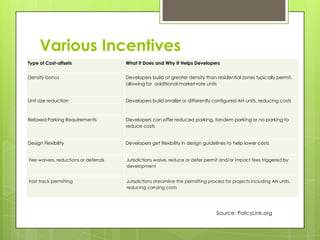
Various Incentives
Type of Cost-offsets What It Does and Why It Helps Developers
Density bonus Developers build at greater density than residential zones typically permit,
allowing for additional market-rate units
Unit size reduction Developers build smaller or differently configured AH units, reducing costs
Relaxed Parking Requirements Developers can offer reduced parking, tandem parking or no parking to
reduce costs
Design Flexibility Developers get flexibility in design guidelines to help lower costs
Fee waivers, reductions or deferrals Jurisdictions waive, reduce or defer permit and/or impact fees triggered by
development
Fast track permitting Jurisdictions streamline the permitting process for projects including AH units,
reducing carrying costs
Source: PolicyLink.org
Residential Segregation and
Economic Mobility
 Residential income segregation has
steadily increased since the 1970s
 Exacerbated by housing bubble
 Families of color face additional housing
burdens; racial segregation increasing
 Concentrated poverty is strongly
correlated with lower educational
attainment levels and lowers overall
economic mobility
Public Benefits of IZ
 IZ is part of the solution to concentrated poverty
 Areas with concentrated poverty typically have
higher crime rates and school dropout rates
 IZ expands the supply of AH while dispersing the
units across jurisdictions by linking to private
development
 Allows private developers to be a part of the
solution
 New market-rate development generates needs for
low-wage jobs and working families
 IZ works best at developing “workforce housing” for
public school teachers, janitors, civil servants and
childcare workers who earn too little to afford
market-rate housing, but are needed to support
“complete” communities
IZ and Education
 Inclusive housing gives lower income children
access to low-poverty, high-performing schools
 “Over the course of elementary school, highly
disadvantaged children with access to the
district’s lowest-poverty neighborhoods and
schools began to catch up to their non-poor, high-
performing peers, while similar disadvantaged
children without such access did not”
Schwartz, H. (2010). Housing policy is school policy: Economically integrative housing
promotes academic success in Montgomery County, Maryland. Century Foundation.
Healthy Neighborhoods and
Sustainable Development
 Concentrated poverty results in unnecessary
economic, environmental and social costs
 Income segregation results in negative health
impacts that increase health care costs
 Income segregation results in additional vehicle
miles traveled, air toxics and greenhouse gas
emissions
 Exclusive housing limits density, contributing to
energy inefficiency
Voluntary vs. Mandatory IZ
 Out of 107 local IZ policies throughout California, 101 were mandatory and
produced far more affordable units than the 6 voluntary programs
 Three of the six voluntary policies produced no units at all, and two locales, Los
Alamitos and Long Beach, “blame the voluntary nature of their programs for
stagnant production despite a market rate boom.”
 Many jurisdictions are replacing ineffective voluntary programs with
mandatory ordinances, resulting in increased AH production
 Cambridge MA, Irvine CA, Pleasanton CA and Boulder CO, among others, all
replaced voluntary programs with mandatory ones
 Orange County, CA did the opposite, replacing an effective mandatory
program with a voluntary policy in 1983
 The county produced 6,389 units in 4 years under the mandatory policy, and
produced only 952 units in the 11 years after the switch to a voluntary program.
Non-Profit Housing Association of Northern California. (2003). Inclusionary Housing in
California: 30 Years of Innovation. p. 8
Brunick, N. (2004). The Inclusionary Housing Debate: The effectiveness of mandatory
programs over voluntary programs. Zoning Practice, 9(1), 1-7.
Case Study: North Bethany,
Washington County
 Washington County was the fastest growing county in
Oregon from 2000-2010, and currently has the highest
median family income in the state.
 The North Bethany area was slated for residential
development in 2002 with the expectation that it would
include affordable housing.
 Metro and Washington Co. leaders set a target of 20% of owner-
occupied properties for families making less than 80% of the
Area Median Income, and 20% of rentals for families making less
than 60% AMI
 In 2010 the Washington County Board of Commissioners
adopted a voluntary IZ policy to reach those targets.
 The County offered a mix of incentives to developers, such as
density bonuses, tax abatements and fast-track permitting
North Bethany, Cont.’d
 County officials negotiated with West Hills
Development Co. to include affordable units in the
new Arbor Oaks development in North Bethany in
exchange for incentives
 The private developers rebuffed those offers, insisting
that they keep the incentives without having to meet
AH targets
 The developer characterized the County’s voluntary
IZ program as “coercive and disadvantageous.”
 West Hills is the largest property owner and landbanker in
the North Bethany development area, and has
continuously refused to participate in the County’s
voluntary IZ program
Our Questions:
 Could mandatory IZ be effective in
helping local jurisdictions in Oregon
address their economic, environmental
and social needs?
 How can local jurisdictions better engage
private developers to be part of the
solution?

Inclusionary Zoning Presenation

  • 1.
    Why IZ works 40Years of Success Oregon Legislative Workgroup April 17, 2014
  • 2.
    Introduction  Inclusionary zoningis a land use tool used by local jurisdictions to ensure economic diversity  First tested in Montgomery County, MD in 1974  IZ helps create mixed-income developments  IZ provides developers with economic offsets in exchange for affordable housing set-asides  IZ combats economic and racial segregation  IZ creates opportunities for working families to live in areas of growing prosperity
  • 3.
    Place matters. Astrong predictor of a person's future health is the ZIP code in which they're born and/or raised.  Neighborhood supermarkets and park access are top predictors of childhood health  In Portland Metro, East Portland and East County residents, especially children, are projected to have greater health risks and lower life expectancy Saelens, Brian E. PhD, et al. Obesogenic Neighborhood Environments, Child and Parent Obesity The Neighborhood Impact on Kids Study. American Journal of Preventive Medicine, 2012 DOI: 10.1016/j.amepre.2012.02.008 Clapp Elizabeth and Moriah McSharry McGrath, BUILT ENVIRONMENT ATLAS: Active Living, Healthy Eating. Multnomah County Health Department, Health Assessment & Evaluation, Office of Health & Social Justice, June 2011: https://web.multco.us/news/how-healthy-your-neighborhood
  • 4.
    Variety of IZapproaches  IZ can be customized to adapt to each community’s unique housing market  Some programs are mandatory; others voluntary  Some programs require on-site set-asides; others allow for construction of AH units in other locations  Each jurisdiction gets to determine specific unit-size thresholds, set-aside requirements, affordability levels, control periods and combination of economic offsets and incentives to include
  • 5.
    Inclusionary Zoning Ordinances Acrossthe US  Montgomery County, Maryland was the first to adopt IZ in 1974  IZ produced over 11,000 AH units over first 30 years in suburban area of prosperity  IZ is commonly used in areas experiencing growth such as California, Massachusetts , New Jersey , Colorado , and DC  Half of jurisdictions amended IZ ordinance at least once since inception  Over 100 cities in CA use a form of IZ, producing over 34,000 AH units in 20 years
  • 6.
    History of IZin Oregon  1998: Metro studied IZ as part of Housing- Technical Advisory Committee (HTAC)  Mandatory IZ was identified as tool to employ if voluntary incentives did not work  1999: Oregon Homebuilders Assn. lobbied to amend ORS 197 to ban mandatory IZ  Oregon joined Texas as only states in country to prohibit jurisdictions from using mandatory IZ  Metro Regional Affordable Housing Strategy (RAHS) has failed to produce any real gains  AH has become concentrated in poorer areas
  • 7.
    Various Incentives Type ofCost-offsets What It Does and Why It Helps Developers Density bonus Developers build at greater density than residential zones typically permit, allowing for additional market-rate units Unit size reduction Developers build smaller or differently configured AH units, reducing costs Relaxed Parking Requirements Developers can offer reduced parking, tandem parking or no parking to reduce costs Design Flexibility Developers get flexibility in design guidelines to help lower costs Fee waivers, reductions or deferrals Jurisdictions waive, reduce or defer permit and/or impact fees triggered by development Fast track permitting Jurisdictions streamline the permitting process for projects including AH units, reducing carrying costs Source: PolicyLink.org
  • 8.
    Residential Segregation and EconomicMobility  Residential income segregation has steadily increased since the 1970s  Exacerbated by housing bubble  Families of color face additional housing burdens; racial segregation increasing  Concentrated poverty is strongly correlated with lower educational attainment levels and lowers overall economic mobility
  • 9.
    Public Benefits ofIZ  IZ is part of the solution to concentrated poverty  Areas with concentrated poverty typically have higher crime rates and school dropout rates  IZ expands the supply of AH while dispersing the units across jurisdictions by linking to private development  Allows private developers to be a part of the solution  New market-rate development generates needs for low-wage jobs and working families  IZ works best at developing “workforce housing” for public school teachers, janitors, civil servants and childcare workers who earn too little to afford market-rate housing, but are needed to support “complete” communities
  • 10.
    IZ and Education Inclusive housing gives lower income children access to low-poverty, high-performing schools  “Over the course of elementary school, highly disadvantaged children with access to the district’s lowest-poverty neighborhoods and schools began to catch up to their non-poor, high- performing peers, while similar disadvantaged children without such access did not” Schwartz, H. (2010). Housing policy is school policy: Economically integrative housing promotes academic success in Montgomery County, Maryland. Century Foundation.
  • 11.
    Healthy Neighborhoods and SustainableDevelopment  Concentrated poverty results in unnecessary economic, environmental and social costs  Income segregation results in negative health impacts that increase health care costs  Income segregation results in additional vehicle miles traveled, air toxics and greenhouse gas emissions  Exclusive housing limits density, contributing to energy inefficiency
  • 12.
    Voluntary vs. MandatoryIZ  Out of 107 local IZ policies throughout California, 101 were mandatory and produced far more affordable units than the 6 voluntary programs  Three of the six voluntary policies produced no units at all, and two locales, Los Alamitos and Long Beach, “blame the voluntary nature of their programs for stagnant production despite a market rate boom.”  Many jurisdictions are replacing ineffective voluntary programs with mandatory ordinances, resulting in increased AH production  Cambridge MA, Irvine CA, Pleasanton CA and Boulder CO, among others, all replaced voluntary programs with mandatory ones  Orange County, CA did the opposite, replacing an effective mandatory program with a voluntary policy in 1983  The county produced 6,389 units in 4 years under the mandatory policy, and produced only 952 units in the 11 years after the switch to a voluntary program. Non-Profit Housing Association of Northern California. (2003). Inclusionary Housing in California: 30 Years of Innovation. p. 8 Brunick, N. (2004). The Inclusionary Housing Debate: The effectiveness of mandatory programs over voluntary programs. Zoning Practice, 9(1), 1-7.
  • 13.
    Case Study: NorthBethany, Washington County  Washington County was the fastest growing county in Oregon from 2000-2010, and currently has the highest median family income in the state.  The North Bethany area was slated for residential development in 2002 with the expectation that it would include affordable housing.  Metro and Washington Co. leaders set a target of 20% of owner- occupied properties for families making less than 80% of the Area Median Income, and 20% of rentals for families making less than 60% AMI  In 2010 the Washington County Board of Commissioners adopted a voluntary IZ policy to reach those targets.  The County offered a mix of incentives to developers, such as density bonuses, tax abatements and fast-track permitting
  • 14.
    North Bethany, Cont.’d County officials negotiated with West Hills Development Co. to include affordable units in the new Arbor Oaks development in North Bethany in exchange for incentives  The private developers rebuffed those offers, insisting that they keep the incentives without having to meet AH targets  The developer characterized the County’s voluntary IZ program as “coercive and disadvantageous.”  West Hills is the largest property owner and landbanker in the North Bethany development area, and has continuously refused to participate in the County’s voluntary IZ program
  • 15.
    Our Questions:  Couldmandatory IZ be effective in helping local jurisdictions in Oregon address their economic, environmental and social needs?  How can local jurisdictions better engage private developers to be part of the solution?