IV. BITUMINOUS BOUND PAVEMENT MATERIALS
General
4.1 Aggregate
4.1.1 Properties
4.1.2 Blending
4.2 Bitumen
4.2.1 Types
4.2.2 Viscosity
4.3 Asphalt Concrete
4.4 Mix Design
4.5 Surface Dressing
4.6 Laboratory Tests
A. Penetration Test
B. Ductility Test
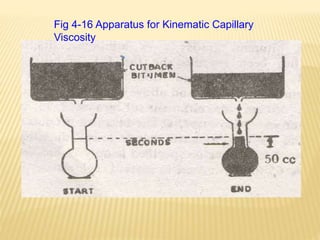
C. Viscosity Test
D. Shape Tests
IV. BITUMINOUS BOUND PAVEMENT MATERIALS
General
 Classified based on gradation
A. Asphalt concrete
B. Rolled asphalt
C. Bitumen macadam
D. Sand asphalt.
 Classified based on mix temperature
A. Hot-mix hot-laid
B. Hot mix cold laid
C. Cold mix.
The finished bitumen-bound layer must possess
the following characteristics:
1. High stiffness
2. High resistance to deformation
3. High resistance to fatigue
4. Good durability
5. Low permeability
6. Good workability
4.1 AGGREGATES
 Sources
Natural sand and gravel deposits
Crushed rock
 Slag
Artificial aggregates
 Fractions
 Fine(sand): Less than No 4 size
 Coarse aggregates: Coarser than no 4 size
 Mineral filler: Maximum nominal size of 0.30
mm.
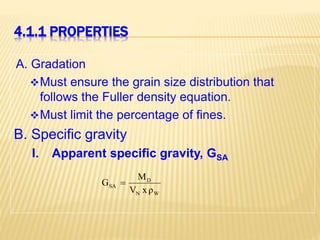
4.1.1 PROPERTIES
A. Gradation
Must ensure the grain size distribution that
follows the Fuller density equation.
Must limit the percentage of fines.
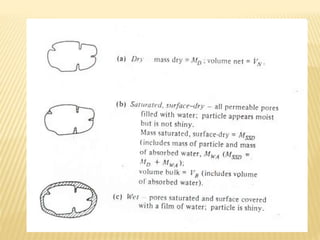
B. Specific gravity
I. Apparent specific gravity, GSA
W
N
D
SA
ρ
x
V
M
G 
4.1.1 PROPERTIES
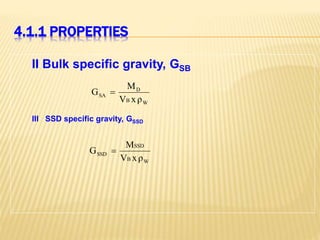
II Bulk specific gravity, GSB
W
B
D
SA
ρ
x
V
M
G 
III SSD specific gravity, GSSD
W
B
SSD
SSD
ρ
x
V
M
G 
4.1.1 PROPERTIES
C. Hardness
D. Particle shape and surface texture
E. Deleterious Substances
4.1.2 BLENDING
 Trial-and-error method
Example
Three aggregates are to be blended to
meet a specification. The aggregates,
gradations, and their specification are
given in Table 4.1
Blend the aggregates
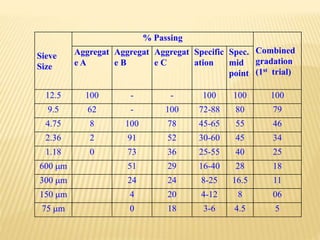
Sieve
Size
% Passing
Combined
gradation
(1st trial)
Aggregat
e A
Aggregat
e B
Aggregat
e C
Specific
ation
Spec.
mid
point
12.5 100 - - 100 100 100
9.5 62 - 100 72-88 80 79
4.75 8 100 78 45-65 55 46
2.36 2 91 52 30-60 45 34
1.18 0 73 36 25-55 40 25
600 m 51 29 16-40 28 18
300 m 24 24 8-25 16.5 11
150 m 4 20 4-12 8 06
75 m 0 18 3-6 4.5 5
SOLUTION
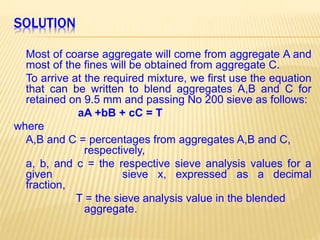
Most of coarse aggregate will come from aggregate A and
most of the fines will be obtained from aggregate C.
To arrive at the required mixture, we first use the equation
that can be written to blend aggregates A,B and C for
retained on 9.5 mm and passing No 200 sieve as follows:
aA +bB + cC = T
where
A,B and C = percentages from aggregates A,B and C,
respectively,
a, b, and c = the respective sieve analysis values for a
given sieve x, expressed as a decimal
fraction,
T = the sieve analysis value in the blended
aggregate.
SOLUTION
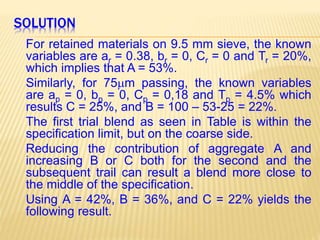
For retained materials on 9.5 mm sieve, the known
variables are ar = 0.38, br = 0, Cr = 0 and Tr = 20%,
which implies that A = 53%.
Similarly, for 75m passing, the known variables
are ap = 0, bp = 0, Cp = 0,18 and Tp = 4.5% which
results C = 25%, and B = 100 – 53-25 = 22%.
The first trial blend as seen in Table is within the
specification limit, but on the coarse side.
Reducing the contribution of aggregate A and
increasing B or C both for the second and the
subsequent trail can result a blend more close to
the middle of the specification.
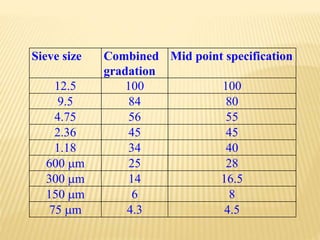
Using A = 42%, B = 36%, and C = 22% yields the
following result.
Sieve size Combined
gradation
Mid point specification
12.5 100 100
9.5 84 80
4.75 56 55
2.36 45 45
1.18 34 40
600 m 25 28
300 m 14 16.5
150 m 6 8
75 m 4.3 4.5
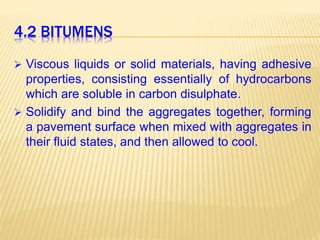
4.2 BITUMENS
 Viscous liquids or solid materials, having adhesive
properties, consisting essentially of hydrocarbons
which are soluble in carbon disulphate.
 Solidify and bind the aggregates together, forming
a pavement surface when mixed with aggregates in
their fluid states, and then allowed to cool.
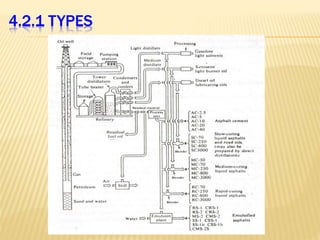
4.2.1 TYPES
Cutbacks Emulsions
Bituminous Materials
Natural Bitumen Refinery Bitumen
Lake asphalt Rock asphalt
Penetration grade
bitumen
Liquid bitumen
Slow curing
cutback
Medium
curing cutback
Rapid curing
cutback
Anionic
emulsion
Cationic
emulsion
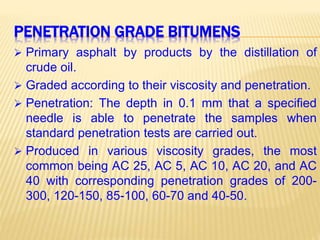
4.2.1 TYPES
PENETRATION GRADE BITUMENS
 Primary asphalt by products by the distillation of
crude oil.
 Graded according to their viscosity and penetration.
 Penetration: The depth in 0.1 mm that a specified
needle is able to penetrate the samples when
standard penetration tests are carried out.
 Produced in various viscosity grades, the most
common being AC 25, AC 5, AC 10, AC 20, and AC
40 with corresponding penetration grades of 200-
300, 120-150, 85-100, 60-70 and 40-50.
CUT BACK ASPHALTS
 Asphalt cements mixed with a solvent to reduce
their viscosity and, thus, make them easier to use at
ordinary temperatures.
 Commonly heated (if required) and then sprayed on
aggregates.
 Cure or harden and cement the aggregate particles
together upon evaporation of the solvent.
 Grouped into three types based on the type of
solvent, which governs the rates of evaporation and
curing, namely, slow curing (SC), medium curing
(MC), and rapid-curing (RC).
A. SLOW- CURING (SC) CUTBACKS
 Obtained by “cutting back” asphalt cement with a
heavy distillate such as diesel oil.
 Have lower viscosities than asphalt cement and are
very slow to harden.
 Designated as SC-70, SC-250, SC-800 or SC-3000,
where the numbers are related to the approximate
kinematics viscosity in centistokes at 600C.
 Used with dense graded aggregates and on soil-
aggregate roads in warm climates to avoid dust.
B. MEDIUM- CURING (MC) CUTBACKS
 Produced by blending asphalt cement with
kerosene or light diesel oil.
 Have good wetting properties.
 Designated as MC-30,MC-70, MC-250, MC-800 or
MC-3000.
B.1 PRIME COAT(MC-30,MC-70)
 An application of liquid bituminous material to
previously untreated base.
 Serves:
 to promote bond between base and wearing
surface
 to consolidate the surface on which the new
treatment is to be placed
 to act as a deterrent to the rise of capillary
moisture into the wearing surface
B.1 PRIME COAT
 Shall not be applied under the following adverse
conditions:
(a)during foggy or wet conditions;
(b)when rain is imminent;
(c) when wind is sufficiently strong to cause
uneven spraying;
(d) when the surface of the layer is wet, i.e. more
than damp;
(e) when at any position the moisture content of the
top 25 mm of the layer to be primed is greater
than 50% of the optimum moisture content of
the material in the layer;
B.1 PRIME COAT
(f) when the temperature of the surface
immediately prior to commencing the application
of the prime is below or, likely to fall below 100 C
after sunset.
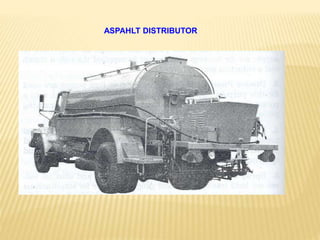
ASPAHLT DISTRIBUTOR
B.3 RAPID-CURING (RC) CUTBACKS
 Produced by blending asphalt-cement with gasoline or
naphtha that will easily evaporate
 Can be used for the construction of pavement bases,
surfaces, and surface treatments.
 Their grades dictate the amount of solvent to be added to
the residual asphalt cement. (RC-3000 requires about 15
percent of distillate whereas RC-70 requires about 40
percent).
 Have similar functions as the MC cutbacks.
 Designated as RC-70, RC-250, RC-800 or RC-3000.

C. ASPHALT EMULSION
 Mixtures of asphalt cement, emulsifier and
water.
 Contain 55-75% asphalt cement and up to 3%
emulsifying agent, with the balance being water.
 Break when spread or mixed with mineral
aggregates in a field construction process.
 Can be applied to a damp surface.
4.2.2 VISCOSITY
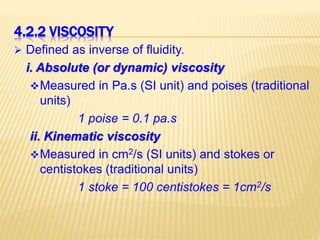
 Defined as inverse of fluidity.
i. Absolute (or dynamic) viscosity
Measured in Pa.s (SI unit) and poises (traditional
units)
1 poise = 0.1 pa.s
ii. Kinematic viscosity
Measured in cm2/s (SI units) and stokes or
centistokes (traditional units)
1 stoke = 100 centistokes = 1cm2/s
4.2.2 VISCOSITY
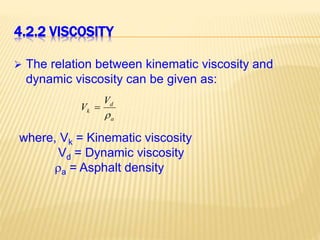
 The relation between kinematic viscosity and
dynamic viscosity can be given as:
a
d
k
V
V


where, Vk = Kinematic viscosity
Vd = Dynamic viscosity
a = Asphalt density
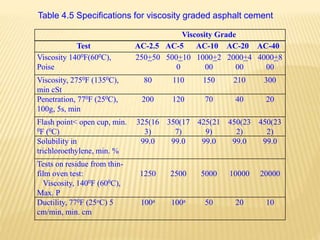
Viscosity Grade
Test AC-2.5 AC-5 AC-10 AC-20 AC-40
Viscosity 1400F(600C),
Poise
250+50 500+10
0
1000+2
00
2000+4
00
4000+8
00
Viscosity, 2750F (1350C),
min cSt
80 110 150 210 300
Penetration, 770F (250C),
100g, 5s, min
200 120 70 40 20
Flash point< open cup, min.
0F (0C)
325(16
3)
350(17
7)
425(21
9)
450(23
2)
450(23
2)
Solubility in
trichloroethylene, min. %
99.0 99.0 99.0 99.0 99.0
Tests on residue from thin-
film oven test:
Viscosity, 1400F (600C),
Max. P
1250 2500 5000 10000 20000
Ductility, 770F (25oC) 5
cm/min, min. cm
100a 100a 50 20 10
Table 4.5 Specifications for viscosity graded asphalt cement
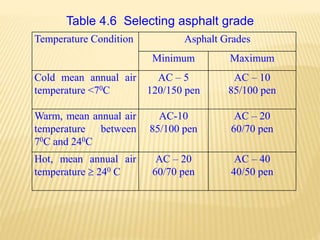
Temperature Condition Asphalt Grades
Minimum Maximum
Cold mean annual air
temperature <70C
AC – 5
120/150 pen
AC – 10
85/100 pen
Warm, mean annual air
temperature between
70C and 240C
AC-10
85/100 pen
AC – 20
60/70 pen
Hot, mean annual air
temperature  240 C
AC – 20
60/70 pen
AC – 40
40/50 pen
Table 4.6 Selecting asphalt grade
4.3 ASPHALT CONCRETE
 A high quality paving material composed of asphalt
cement, aggregates and air.
 Must be protected from any aging factors.
Quality requirements
 Temperature control : to reduce evaporation
 Percentage of air voids :to reduce permeability and
movement of air and water in the mixture
 VMA: to ensure that sufficient space is left for AC
 Polishing of the aggregates : to prevent loss of
skid- resistance of asphalt concrete surface.
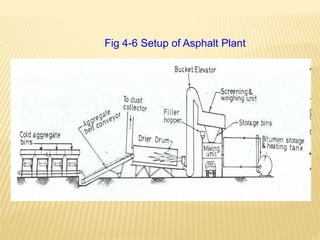
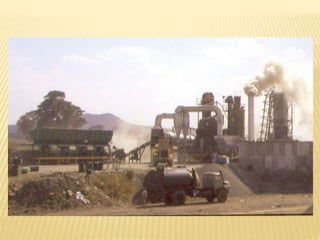
Fig 4-6 Setup of Asphalt Plant
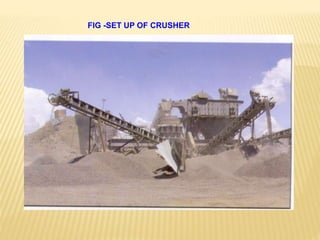
FIG -SET UP OF CRUSHER
4.4 MIX DESIGN
 The two most common methods are:
A. Marshall Method; B. Hveem Method
 The design of an AC mixture includes the
selection of the best blend of aggregates and
the optimum asphalt content to provide a
mixture that meets the required
specifications as economically as possible.
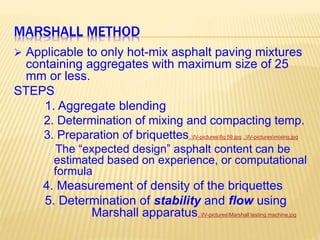
MARSHALL METHOD
 Applicable to only hot-mix asphalt paving mixtures
containing aggregates with maximum size of 25
mm or less.
STEPS
1. Aggregate blending
2. Determination of mixing and compacting temp.
3. Preparation of briquettes..IV-picturesfig 59.jpg ..IV-picturesmixing.jpg
The “expected design” asphalt content can be
estimated based on experience, or computational
formula
4. Measurement of density of the briquettes
5. Determination of stability and flow using
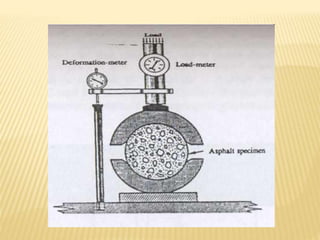
Marshall apparatus..IV-picturesMarshall testing machine.jpg
MARSHALL METHOD
Stability: Maximum load that briquettes can carry
Flow: Compression that the sample undergoes under
the maximum load in the compression test
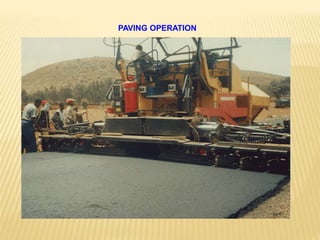
PAVING OPERATION
PAVING OPERATION
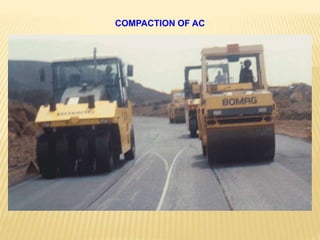
COMPACTION OF AC
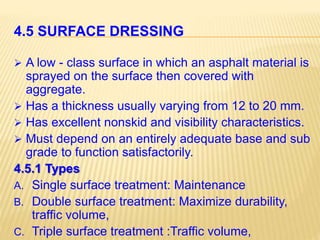
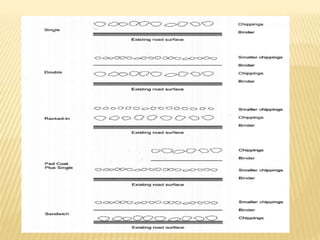
4.5 SURFACE DRESSING
 A low - class surface in which an asphalt material is
sprayed on the surface then covered with
aggregate.
 Has a thickness usually varying from 12 to 20 mm.
 Has excellent nonskid and visibility characteristics.
 Must depend on an entirely adequate base and sub
grade to function satisfactorily.
4.5.1 Types
A. Single surface treatment: Maintenance
B. Double surface treatment: Maximize durability,
traffic volume,
C. Triple surface treatment :Traffic volume,
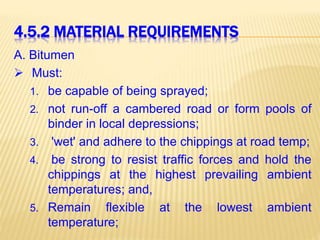
4.5.2 MATERIAL REQUIREMENTS
A. Bitumen
 Must:
1. be capable of being sprayed;
2. not run-off a cambered road or form pools of
binder in local depressions;
3. 'wet' and adhere to the chippings at road temp;
4. be strong to resist traffic forces and hold the
chippings at the highest prevailing ambient
temperatures; and,
5. Remain flexible at the lowest ambient
temperature;
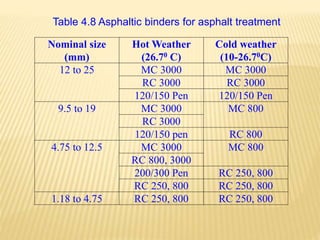
Nominal size
(mm)
Hot Weather
(26.70 C)
Cold weather
(10-26.70C)
12 to 25 MC 3000 MC 3000
RC 3000 RC 3000
120/150 Pen 120/150 Pen
9.5 to 19 MC 3000 MC 800
RC 3000
120/150 pen RC 800
4.75 to 12.5 MC 3000 MC 800
RC 800, 3000
200/300 Pen RC 250, 800
RC 250, 800 RC 250, 800
1.18 to 4.75 RC 250, 800 RC 250, 800
Table 4.8 Asphaltic binders for asphalt treatment
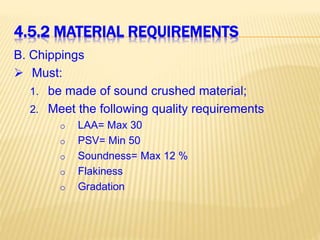
4.5.2 MATERIAL REQUIREMENTS
B. Chippings
 Must:
1. be made of sound crushed material;
2. Meet the following quality requirements
o LAA= Max 30
o PSV= Min 50
o Soundness= Max 12 %
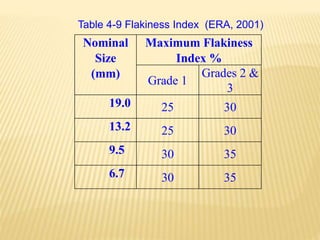
o Flakiness
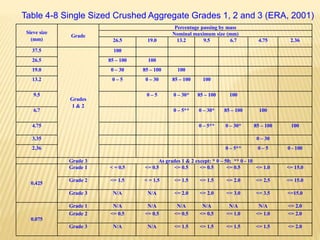
o Gradation
Nominal
Size
(mm)
Maximum Flakiness
Index %
Grade 1
Grades 2 &
3
19.0 25 30
13.2 25 30
9.5 30 35
6.7 30 35
Table 4-9 Flakiness Index (ERA, 2001)
Sieve size
(mm)
Grade
Percentage passing by mass
Nominal maximum size (mm)
26.5 19.0 13.2 9.5 6.7 4.75 2.36
37.5
Grades
1 & 2
100
26.5 85 – 100 100
19.0 0 – 30 85 – 100 100
13.2 0 – 5 0 – 30 85 – 100 100
9.5 0 – 5 0 – 30* 85 – 100 100
6.7 0 – 5** 0 – 30* 85 – 100 100
4.75 0 – 5** 0 – 30* 85 – 100 100
3.35 0 – 30
2.36 0 – 5** 0 – 5 0 - 100
Grade 3 As grades 1 & 2 except: * 0 – 50; ** 0 - 10
0.425
Grade 1 < = 0.5 <= 0.5 <= 0.5 <= 0.5 <= 0.5 <= 1.0 <= 15.0
Grade 2 <= 1.5 < = 1.5 <= 1.5 <= 1.5 <= 2.0 <= 2.5 <= 15.0
Grade 3 N/A N/A <= 2.0 <= 2.0 <= 3.0 <= 3.5 <=15.0
0.075
Grade 1 N/A N/A N/A N/A N/A N/A <= 2.0
Grade 2 <= 0.5 <= 0.5 <= 0.5 <= 0.5 <= 1.0 <= 1.0 <= 2.0
Grade 3 N/A N/A <= 1.5 <= 1.5 <= 1.5 <= 1.5 <= 2.0
Table 4-8 Single Sized Crushed Aggregate Grades 1, 2 and 3 (ERA, 2001)
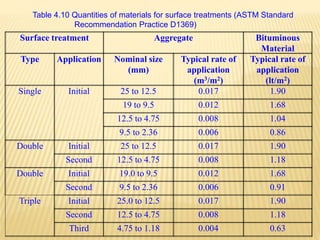
Surface treatment Aggregate Bituminous
Material
Type Application Nominal size
(mm)
Typical rate of
application
(m3/m2)
Typical rate of
application
(lt/m2)
Single Initial 25 to 12.5 0.017 1.90
19 to 9.5 0.012 1.68
12.5 to 4.75 0.008 1.04
9.5 to 2.36 0.006 0.86
Double Initial 25 to 12.5 0.017 1.90
Second 12.5 to 4.75 0.008 1.18
Double Initial 19.0 to 9.5 0.012 1.68
Second 9.5 to 2.36 0.006 0.91
Triple Initial 25.0 to 12.5 0.017 1.90
Second 12.5 to 4.75 0.008 1.18
Third 4.75 to 1.18 0.004 0.63
Table 4.10 Quantities of materials for surface treatments (ASTM Standard
Recommendation Practice D1369)
4.6 LABORATORY TESTS
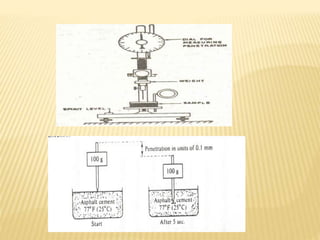
A. Penetration Tests
 Measures the consistency of bitumen
 Subject to human error
B. DUCTILITY TEST
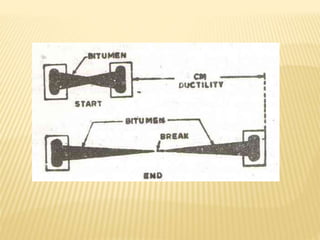
 Measures the adhesive property of bitumen
and its ability to stretch
Ductility : The distance in centimeters a standard
sample of asphaltic material will
stretch before breaking when tested
on standard test equipment on 250C.
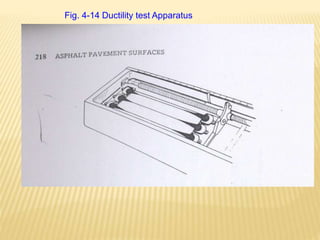
Fig. 4-14 Ductility test Apparatus
C. VISCOSITY TEST
A measure of resistance to flow
Measuring the time required for a fixed
volume of the liquid to be drawn through
specially designed capillary tube by means of
a vacuum, and multiplying the same by the
viscometer calibration factor determine
absolute viscosity of asphalt cements, in
poises.
Fig 4-16 Apparatus for Kinematic Capillary
Viscosity
D. SHAPE TESTS
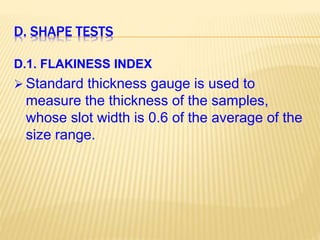
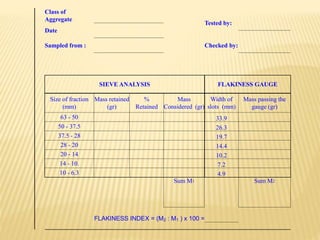
D.1. FLAKINESS INDEX
 Standard thickness gauge is used to
measure the thickness of the samples,
whose slot width is 0.6 of the average of the
size range.
Class of
Aggregate
Tested by:
Date
Sampled from : Checked by:
SIEVE ANALYSIS FLAKINESS GAUGE
Size of fraction
(mm)
Mass retained
(gr)
%
Retained
Mass
Considered (gr)
Width of
slots (mm)
Mass passing the
gauge (gr)
63 - 50 33.9
50 - 37.5 26.3
37.5 - 28 19.7
28 - 20 14.4
20 - 14 10.2
14 - 10. 7.2
10 - 6.3 4.9
Sum M1 Sum M2
FLAKINESS INDEX = (M2 : M1 ) x 100 =
D. SHAPE TESTS
D.2. ELONGATION INDEX
 It is the percentage weight of particles whose
greatest dimension or length is greater than
1.8 times their mean dimension

IV BITUMINOUS BOUND PAV MAT.pptx

  • 1.
    IV. BITUMINOUS BOUNDPAVEMENT MATERIALS General 4.1 Aggregate 4.1.1 Properties 4.1.2 Blending 4.2 Bitumen 4.2.1 Types 4.2.2 Viscosity 4.3 Asphalt Concrete 4.4 Mix Design 4.5 Surface Dressing 4.6 Laboratory Tests A. Penetration Test B. Ductility Test C. Viscosity Test D. Shape Tests
  • 2.
    IV. BITUMINOUS BOUNDPAVEMENT MATERIALS General  Classified based on gradation A. Asphalt concrete B. Rolled asphalt C. Bitumen macadam D. Sand asphalt.  Classified based on mix temperature A. Hot-mix hot-laid B. Hot mix cold laid C. Cold mix.
  • 3.
    The finished bitumen-boundlayer must possess the following characteristics: 1. High stiffness 2. High resistance to deformation 3. High resistance to fatigue 4. Good durability 5. Low permeability 6. Good workability
  • 4.
    4.1 AGGREGATES  Sources Naturalsand and gravel deposits Crushed rock  Slag Artificial aggregates  Fractions  Fine(sand): Less than No 4 size  Coarse aggregates: Coarser than no 4 size  Mineral filler: Maximum nominal size of 0.30 mm.
  • 5.
    4.1.1 PROPERTIES A. Gradation Mustensure the grain size distribution that follows the Fuller density equation. Must limit the percentage of fines. B. Specific gravity I. Apparent specific gravity, GSA W N D SA ρ x V M G 
  • 6.
    4.1.1 PROPERTIES II Bulkspecific gravity, GSB W B D SA ρ x V M G  III SSD specific gravity, GSSD W B SSD SSD ρ x V M G 
  • 8.
    4.1.1 PROPERTIES C. Hardness D.Particle shape and surface texture E. Deleterious Substances
  • 9.
    4.1.2 BLENDING  Trial-and-errormethod Example Three aggregates are to be blended to meet a specification. The aggregates, gradations, and their specification are given in Table 4.1 Blend the aggregates
  • 10.
    Sieve Size % Passing Combined gradation (1st trial) Aggregat eA Aggregat e B Aggregat e C Specific ation Spec. mid point 12.5 100 - - 100 100 100 9.5 62 - 100 72-88 80 79 4.75 8 100 78 45-65 55 46 2.36 2 91 52 30-60 45 34 1.18 0 73 36 25-55 40 25 600 m 51 29 16-40 28 18 300 m 24 24 8-25 16.5 11 150 m 4 20 4-12 8 06 75 m 0 18 3-6 4.5 5
  • 11.
    SOLUTION Most of coarseaggregate will come from aggregate A and most of the fines will be obtained from aggregate C. To arrive at the required mixture, we first use the equation that can be written to blend aggregates A,B and C for retained on 9.5 mm and passing No 200 sieve as follows: aA +bB + cC = T where A,B and C = percentages from aggregates A,B and C, respectively, a, b, and c = the respective sieve analysis values for a given sieve x, expressed as a decimal fraction, T = the sieve analysis value in the blended aggregate.
  • 12.
    SOLUTION For retained materialson 9.5 mm sieve, the known variables are ar = 0.38, br = 0, Cr = 0 and Tr = 20%, which implies that A = 53%. Similarly, for 75m passing, the known variables are ap = 0, bp = 0, Cp = 0,18 and Tp = 4.5% which results C = 25%, and B = 100 – 53-25 = 22%. The first trial blend as seen in Table is within the specification limit, but on the coarse side. Reducing the contribution of aggregate A and increasing B or C both for the second and the subsequent trail can result a blend more close to the middle of the specification. Using A = 42%, B = 36%, and C = 22% yields the following result.
  • 13.
    Sieve size Combined gradation Midpoint specification 12.5 100 100 9.5 84 80 4.75 56 55 2.36 45 45 1.18 34 40 600 m 25 28 300 m 14 16.5 150 m 6 8 75 m 4.3 4.5
  • 14.
    4.2 BITUMENS  Viscousliquids or solid materials, having adhesive properties, consisting essentially of hydrocarbons which are soluble in carbon disulphate.  Solidify and bind the aggregates together, forming a pavement surface when mixed with aggregates in their fluid states, and then allowed to cool.
  • 15.
    4.2.1 TYPES Cutbacks Emulsions BituminousMaterials Natural Bitumen Refinery Bitumen Lake asphalt Rock asphalt Penetration grade bitumen Liquid bitumen Slow curing cutback Medium curing cutback Rapid curing cutback Anionic emulsion Cationic emulsion
  • 16.
  • 17.
    PENETRATION GRADE BITUMENS Primary asphalt by products by the distillation of crude oil.  Graded according to their viscosity and penetration.  Penetration: The depth in 0.1 mm that a specified needle is able to penetrate the samples when standard penetration tests are carried out.  Produced in various viscosity grades, the most common being AC 25, AC 5, AC 10, AC 20, and AC 40 with corresponding penetration grades of 200- 300, 120-150, 85-100, 60-70 and 40-50.
  • 18.
    CUT BACK ASPHALTS Asphalt cements mixed with a solvent to reduce their viscosity and, thus, make them easier to use at ordinary temperatures.  Commonly heated (if required) and then sprayed on aggregates.  Cure or harden and cement the aggregate particles together upon evaporation of the solvent.  Grouped into three types based on the type of solvent, which governs the rates of evaporation and curing, namely, slow curing (SC), medium curing (MC), and rapid-curing (RC).
  • 19.
    A. SLOW- CURING(SC) CUTBACKS  Obtained by “cutting back” asphalt cement with a heavy distillate such as diesel oil.  Have lower viscosities than asphalt cement and are very slow to harden.  Designated as SC-70, SC-250, SC-800 or SC-3000, where the numbers are related to the approximate kinematics viscosity in centistokes at 600C.  Used with dense graded aggregates and on soil- aggregate roads in warm climates to avoid dust.
  • 20.
    B. MEDIUM- CURING(MC) CUTBACKS  Produced by blending asphalt cement with kerosene or light diesel oil.  Have good wetting properties.  Designated as MC-30,MC-70, MC-250, MC-800 or MC-3000.
  • 21.
    B.1 PRIME COAT(MC-30,MC-70) An application of liquid bituminous material to previously untreated base.  Serves:  to promote bond between base and wearing surface  to consolidate the surface on which the new treatment is to be placed  to act as a deterrent to the rise of capillary moisture into the wearing surface
  • 22.
    B.1 PRIME COAT Shall not be applied under the following adverse conditions: (a)during foggy or wet conditions; (b)when rain is imminent; (c) when wind is sufficiently strong to cause uneven spraying; (d) when the surface of the layer is wet, i.e. more than damp; (e) when at any position the moisture content of the top 25 mm of the layer to be primed is greater than 50% of the optimum moisture content of the material in the layer;
  • 23.
    B.1 PRIME COAT (f)when the temperature of the surface immediately prior to commencing the application of the prime is below or, likely to fall below 100 C after sunset.
  • 24.
  • 25.
    B.3 RAPID-CURING (RC)CUTBACKS  Produced by blending asphalt-cement with gasoline or naphtha that will easily evaporate  Can be used for the construction of pavement bases, surfaces, and surface treatments.  Their grades dictate the amount of solvent to be added to the residual asphalt cement. (RC-3000 requires about 15 percent of distillate whereas RC-70 requires about 40 percent).  Have similar functions as the MC cutbacks.  Designated as RC-70, RC-250, RC-800 or RC-3000.
  • 26.
    C. ASPHALT EMULSION Mixtures of asphalt cement, emulsifier and water.  Contain 55-75% asphalt cement and up to 3% emulsifying agent, with the balance being water.  Break when spread or mixed with mineral aggregates in a field construction process.  Can be applied to a damp surface.
  • 27.
    4.2.2 VISCOSITY  Definedas inverse of fluidity. i. Absolute (or dynamic) viscosity Measured in Pa.s (SI unit) and poises (traditional units) 1 poise = 0.1 pa.s ii. Kinematic viscosity Measured in cm2/s (SI units) and stokes or centistokes (traditional units) 1 stoke = 100 centistokes = 1cm2/s
  • 28.
    4.2.2 VISCOSITY  Therelation between kinematic viscosity and dynamic viscosity can be given as: a d k V V   where, Vk = Kinematic viscosity Vd = Dynamic viscosity a = Asphalt density
  • 29.
    Viscosity Grade Test AC-2.5AC-5 AC-10 AC-20 AC-40 Viscosity 1400F(600C), Poise 250+50 500+10 0 1000+2 00 2000+4 00 4000+8 00 Viscosity, 2750F (1350C), min cSt 80 110 150 210 300 Penetration, 770F (250C), 100g, 5s, min 200 120 70 40 20 Flash point< open cup, min. 0F (0C) 325(16 3) 350(17 7) 425(21 9) 450(23 2) 450(23 2) Solubility in trichloroethylene, min. % 99.0 99.0 99.0 99.0 99.0 Tests on residue from thin- film oven test: Viscosity, 1400F (600C), Max. P 1250 2500 5000 10000 20000 Ductility, 770F (25oC) 5 cm/min, min. cm 100a 100a 50 20 10 Table 4.5 Specifications for viscosity graded asphalt cement
  • 30.
    Temperature Condition AsphaltGrades Minimum Maximum Cold mean annual air temperature <70C AC – 5 120/150 pen AC – 10 85/100 pen Warm, mean annual air temperature between 70C and 240C AC-10 85/100 pen AC – 20 60/70 pen Hot, mean annual air temperature  240 C AC – 20 60/70 pen AC – 40 40/50 pen Table 4.6 Selecting asphalt grade
  • 31.
    4.3 ASPHALT CONCRETE A high quality paving material composed of asphalt cement, aggregates and air.  Must be protected from any aging factors. Quality requirements  Temperature control : to reduce evaporation  Percentage of air voids :to reduce permeability and movement of air and water in the mixture  VMA: to ensure that sufficient space is left for AC  Polishing of the aggregates : to prevent loss of skid- resistance of asphalt concrete surface.
  • 32.
    Fig 4-6 Setupof Asphalt Plant
  • 34.
    FIG -SET UPOF CRUSHER
  • 35.
    4.4 MIX DESIGN The two most common methods are: A. Marshall Method; B. Hveem Method  The design of an AC mixture includes the selection of the best blend of aggregates and the optimum asphalt content to provide a mixture that meets the required specifications as economically as possible.
  • 36.
    MARSHALL METHOD  Applicableto only hot-mix asphalt paving mixtures containing aggregates with maximum size of 25 mm or less. STEPS 1. Aggregate blending 2. Determination of mixing and compacting temp. 3. Preparation of briquettes..IV-picturesfig 59.jpg ..IV-picturesmixing.jpg The “expected design” asphalt content can be estimated based on experience, or computational formula 4. Measurement of density of the briquettes 5. Determination of stability and flow using Marshall apparatus..IV-picturesMarshall testing machine.jpg
  • 37.
    MARSHALL METHOD Stability: Maximumload that briquettes can carry Flow: Compression that the sample undergoes under the maximum load in the compression test
  • 39.
  • 40.
  • 41.
  • 42.
    4.5 SURFACE DRESSING A low - class surface in which an asphalt material is sprayed on the surface then covered with aggregate.  Has a thickness usually varying from 12 to 20 mm.  Has excellent nonskid and visibility characteristics.  Must depend on an entirely adequate base and sub grade to function satisfactorily. 4.5.1 Types A. Single surface treatment: Maintenance B. Double surface treatment: Maximize durability, traffic volume, C. Triple surface treatment :Traffic volume,
  • 44.
    4.5.2 MATERIAL REQUIREMENTS A.Bitumen  Must: 1. be capable of being sprayed; 2. not run-off a cambered road or form pools of binder in local depressions; 3. 'wet' and adhere to the chippings at road temp; 4. be strong to resist traffic forces and hold the chippings at the highest prevailing ambient temperatures; and, 5. Remain flexible at the lowest ambient temperature;
  • 45.
    Nominal size (mm) Hot Weather (26.70C) Cold weather (10-26.70C) 12 to 25 MC 3000 MC 3000 RC 3000 RC 3000 120/150 Pen 120/150 Pen 9.5 to 19 MC 3000 MC 800 RC 3000 120/150 pen RC 800 4.75 to 12.5 MC 3000 MC 800 RC 800, 3000 200/300 Pen RC 250, 800 RC 250, 800 RC 250, 800 1.18 to 4.75 RC 250, 800 RC 250, 800 Table 4.8 Asphaltic binders for asphalt treatment
  • 46.
    4.5.2 MATERIAL REQUIREMENTS B.Chippings  Must: 1. be made of sound crushed material; 2. Meet the following quality requirements o LAA= Max 30 o PSV= Min 50 o Soundness= Max 12 % o Flakiness o Gradation
  • 47.
    Nominal Size (mm) Maximum Flakiness Index % Grade1 Grades 2 & 3 19.0 25 30 13.2 25 30 9.5 30 35 6.7 30 35 Table 4-9 Flakiness Index (ERA, 2001)
  • 48.
    Sieve size (mm) Grade Percentage passingby mass Nominal maximum size (mm) 26.5 19.0 13.2 9.5 6.7 4.75 2.36 37.5 Grades 1 & 2 100 26.5 85 – 100 100 19.0 0 – 30 85 – 100 100 13.2 0 – 5 0 – 30 85 – 100 100 9.5 0 – 5 0 – 30* 85 – 100 100 6.7 0 – 5** 0 – 30* 85 – 100 100 4.75 0 – 5** 0 – 30* 85 – 100 100 3.35 0 – 30 2.36 0 – 5** 0 – 5 0 - 100 Grade 3 As grades 1 & 2 except: * 0 – 50; ** 0 - 10 0.425 Grade 1 < = 0.5 <= 0.5 <= 0.5 <= 0.5 <= 0.5 <= 1.0 <= 15.0 Grade 2 <= 1.5 < = 1.5 <= 1.5 <= 1.5 <= 2.0 <= 2.5 <= 15.0 Grade 3 N/A N/A <= 2.0 <= 2.0 <= 3.0 <= 3.5 <=15.0 0.075 Grade 1 N/A N/A N/A N/A N/A N/A <= 2.0 Grade 2 <= 0.5 <= 0.5 <= 0.5 <= 0.5 <= 1.0 <= 1.0 <= 2.0 Grade 3 N/A N/A <= 1.5 <= 1.5 <= 1.5 <= 1.5 <= 2.0 Table 4-8 Single Sized Crushed Aggregate Grades 1, 2 and 3 (ERA, 2001)
  • 49.
    Surface treatment AggregateBituminous Material Type Application Nominal size (mm) Typical rate of application (m3/m2) Typical rate of application (lt/m2) Single Initial 25 to 12.5 0.017 1.90 19 to 9.5 0.012 1.68 12.5 to 4.75 0.008 1.04 9.5 to 2.36 0.006 0.86 Double Initial 25 to 12.5 0.017 1.90 Second 12.5 to 4.75 0.008 1.18 Double Initial 19.0 to 9.5 0.012 1.68 Second 9.5 to 2.36 0.006 0.91 Triple Initial 25.0 to 12.5 0.017 1.90 Second 12.5 to 4.75 0.008 1.18 Third 4.75 to 1.18 0.004 0.63 Table 4.10 Quantities of materials for surface treatments (ASTM Standard Recommendation Practice D1369)
  • 50.
    4.6 LABORATORY TESTS A.Penetration Tests  Measures the consistency of bitumen  Subject to human error
  • 52.
    B. DUCTILITY TEST Measures the adhesive property of bitumen and its ability to stretch Ductility : The distance in centimeters a standard sample of asphaltic material will stretch before breaking when tested on standard test equipment on 250C.
  • 53.
    Fig. 4-14 Ductilitytest Apparatus
  • 55.
    C. VISCOSITY TEST Ameasure of resistance to flow Measuring the time required for a fixed volume of the liquid to be drawn through specially designed capillary tube by means of a vacuum, and multiplying the same by the viscometer calibration factor determine absolute viscosity of asphalt cements, in poises.
  • 56.
    Fig 4-16 Apparatusfor Kinematic Capillary Viscosity
  • 57.
    D. SHAPE TESTS D.1.FLAKINESS INDEX  Standard thickness gauge is used to measure the thickness of the samples, whose slot width is 0.6 of the average of the size range.
  • 58.
    Class of Aggregate Tested by: Date Sampledfrom : Checked by: SIEVE ANALYSIS FLAKINESS GAUGE Size of fraction (mm) Mass retained (gr) % Retained Mass Considered (gr) Width of slots (mm) Mass passing the gauge (gr) 63 - 50 33.9 50 - 37.5 26.3 37.5 - 28 19.7 28 - 20 14.4 20 - 14 10.2 14 - 10. 7.2 10 - 6.3 4.9 Sum M1 Sum M2 FLAKINESS INDEX = (M2 : M1 ) x 100 =
  • 59.
    D. SHAPE TESTS D.2.ELONGATION INDEX  It is the percentage weight of particles whose greatest dimension or length is greater than 1.8 times their mean dimension