It’s always a people problem…
…even when it’s a people
problem.
Presented at Much Ado About Agile 2016
October 24th, 2016
©2016 James Shew
Reach me at:
• (email)
jamesshew@Hotmail.com
• (twitter) @agileGroupT
It’s always a people problem…
…even when it’s a people
problem.
©2016 James Shew
A much too short list of giving credit
where credit is due
Re-inventing organizations (A book)
• I have 2 copies to give away
Brandi Shew (a person)
©2016 James Shew
Me, myself, and I
• Developer turned coach, facilitator, scrum master
• What drives me is helping people live better (work) lives
• It’s important to know what motivates people
(gasp! Is this foreshadowing?)
©2016 James Shew
My goal
Have you walk away with one thing you can use consciously:
• A saying
• An idea
• A technique you want to try
©2016 James Shew
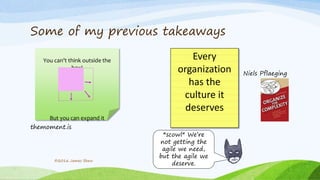
Every
organization
has the
culture it
deserves
Some of my previous takeaways
©2016 James Shew
You can’t think outside the
box!
But you can expand it
*scowl* We’re
not getting the
agile we need,
but the agile we
deserve.
Niels Pflaeging
themoment.is
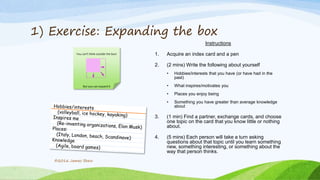
1) Exercise: Expanding the box
Instructions
1. Acquire an index card and a pen
2. (2 mins) Write the following about yourself
• Hobbies/interests that you have (or have had in the
past)
• What inspires/motivates you
• Places you enjoy being
• Something you have greater than average knowledge
about
3. (1 min) Find a partner, exchange cards, and choose
one topic on the card that you know little or nothing
about.
4. (5 mins) Each person will take a turn asking
questions about that topic until you learn something
new, something interesting, or something about the
way that person thinks.
©2016 James Shew
You can’t think outside the box!
But you can expand it
The people problem
©2016 James Shew
Agilemania! So much agile!
©2016 James Shew
What are we looking at?
Must be important!
Wow! Everyone’s
doing it!
AGILE!
No one wants to
be here!
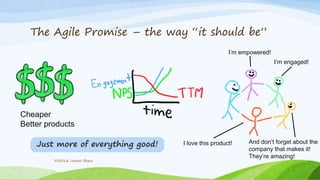
The Agile Promise – the way “it should be”
©2016 James Shew
I’m empowered!
I’m engaged!
I love this product! And don’t forget about the
company that makes it!
They’re amazing!
Cheaper
Better products
Just more of everything good!
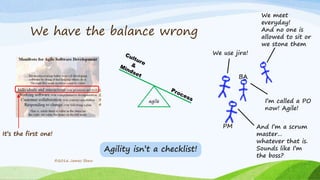
We have the balance wrong
©2016 James Shew
Agility isn’t a checklist!
agile
BA
We use jira!
I’m called a PO
now! Agile!
And I’m a scrum
master…
whatever that is.
Sounds like I’m
the boss?
PM
We meet
everyday!
And no one is
allowed to sit or
we stone them
It’s the first one!
1
2
3
4
©2016 James Shew
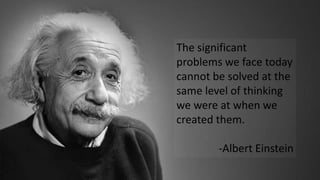
The significant
problems we face today
cannot be solved at the
same level of thinking
we were at when we
created them.
-Albert Einstein
People are the problem
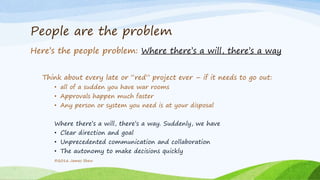
Here’s the people problem: Where there’s a will, there’s a way
Think about every late or “red” project ever – if it needs to go out:
• all of a sudden you have war rooms
• Approvals happen much faster
• Any person or system you need is at your disposal
Where there’s a will, there’s a way. Suddenly, we have
• Clear direction and goal
• Unprecedented communication and collaboration
• The autonomy to make decisions quickly
©2016 James Shew
Practical solutions caveat
©2016 James Shew
People need to know
“Why?”
Agility needs an understanding of context
and purpose
©2016 James Shew
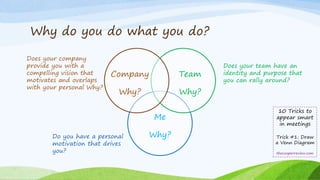
Why do you do what you do?
Me
Why?
Team
Why?
Company
Why?
10 Tricks to
appear smart
in meetings
Trick #1: Draw
a Venn Diagram
thecooperreview.com
Does your team have an
identity and purpose that
you can rally around?
Do you have a personal
motivation that drives
you?
Does your company
provide you with a
compelling vision that
motivates and overlaps
with your personal Why?
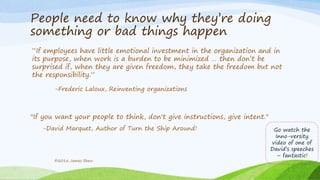
People need to know why they’re doing
something or bad things happen
“If employees have little emotional investment in the organization and in
its purpose, when work is a burden to be minimized … then don’t be
surprised if, when they are given freedom, they take the freedom but not
the responsibility.”
-Frederic Laloux, Reinventing organizations
"If you want your people to think, don't give instructions, give intent."
-David Marquet, Author of Turn the Ship Around!
©2016 James Shew
Go watch the
Inno-versity
video of one of
David’s speeches
– fantastic!
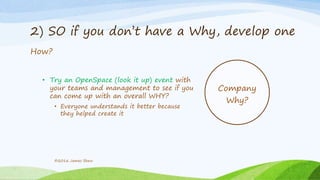
2) SO if you don’t have a Why, develop one
How?
• Try an OpenSpace (look it up) event with
your teams and management to see if you
can come up with an overall WHY?
• Everyone understands it better because
they helped create it
©2016 James Shew
Company
Why?
Build Bubbles!
Sometimes the best you can do is build a
bubble of purpose for yourself and in
your team …. that insulates you from the
rest of the organization.
“If the conditions are wrong [for having a safe
environment], we are forced to expend our own
time and energy to protect ourselves from each
other… and that inherently weakens the
organization.” – Simon Sinek, TED 2014
©2016 James Shew
Me
Why?
Team
Why?
Company
Why?
Bubbles need (at least) 2 things
1. An understanding of the team/individual “Whys”
2. Trust within the team
©2016 James Shew
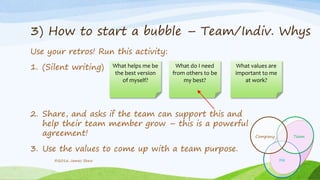
3) How to start a bubble – Team/Indiv. Whys
Use your retros! Run this activity:
1. (Silent writing)
2. Share, and asks if the team can support this and
help their team member grow – this is a powerful
agreement!
3. Use the values to come up with a team purpose.
©2016 James Shew
What helps me be
the best version
of myself?
What do I need
from others to be
my best?
What values are
important to me
at work?
Me
TeamCompany
4) How to start a bubble – Trust
Use a trust metric: team members anonymously vote on whether
they hold the following two beliefs about trust (1-5, 1 = I don’t
believe that, 5 = I absolutely believe that).
During retrospectives, ask “How can we improve our trust metrics?”
and let the team come up with ideas and actions to try.
©2016 James Shew
#1) I believe
everyone on the
team is doing the
best job they can,
with what they have,
all the time.
#2) I believe that
everyone else on the
team believes #1
about me.
Raffle time?
©2016 James Shew
Autonomy &
Complexity
(this section was not presented at Much
Ado About Agile 2016)
©2016 James Shew
©2016 James Shew
http://octavioaburto.com/cabo-pulmo
Complex Systems
• Often involves some sort of network of autonomous agents
• Animals herds
• Your team, company, sales group, customers, etc…
Complex systems have the potential to handle complex and
changing environments; they can be anti-fragile
©2016 James Shew
Some things we can try to enable good
complexity in your teams (anti-fragile)
• Don’t use best practices
• Decentralize decision-making
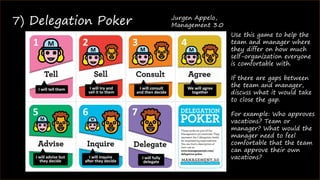
• Delegation Poker
• Enable each agent in your complex system to be able to
make think and make decisions
• Lead with curiosity / give intent
©2016 James Shew
5) Stop using “best practice(s)”
If you want your people to think, don't give instructions, give intent."
-David Marquet, Author of Turn the Ship Around!
If you don’t want them to think, give instructions/best practices
The focus instead becomes on
• Practices that are generally good
• Running experiments (sense + respond to the environment)
©2016 James Shew
6) Lead with curiosity
The next time you’re trying to get someone to do something or
teach them something, try this:
1. Give them the intent of what we’re trying to do (The Why)
2. Give no other instructions, only guide them by asking questions
This can be painful and difficult because it seems slower than
telling someone, but they will learn better when they figure
things out themselves.
©2016 James Shew
©2016 James Shew
7) Delegation Poker Jurgen Appelo,
Management 3.0
Use this game to help the
team and manager where
they differ on how much
self-organization everyone
is comfortable with.
If there are gaps between
the team and manager,
discuss what it would take
to close the gap.
For example: Who approves
vacations? Team or
manager? What would the
manager need to feel
comfortable that the team
can approve their own
vacations?
We’re almost done!
I promise
©2016 James Shew
People are the solution
People can handle complexity if the environment allows it:
• decentralizing decisions
• enable critical thinking
• create alignment (vision and purpose)
©2016 James Shew
We’re not getting the agile we need…
Remember:
There are no silver bullets!
This is significant journey for companies and people
Agile didn’t start the fire, it just installed the fire alarms!
- Me (feat. Billy Joel)
©2016 James Shew
Or are we?
Expand the box further
• Check out people like:
• Margaret Heffernen
• Brene Brown
• Simon Sinek
• David Marquet
• Read
• Re-inventing organizations
• Organize for complexity
• Watch
• my “Heart of Agile” youtube playlist
(Google “youtube heart of agile james shew”)
©2016 James Shew
If you want to connect with me,
it’s not easy, but there are some
reasonably viable options:
Connect/Msg me on LinkedIn
(I’m the James Shew labeled
as “Agile Coach and trouble-
maker”)
Email
jamesshew@hotmail.com
Twitter
@agileGroupT
Watch
my youtube playlist and
comment
Note to self…
…went too far
©2016 James Shew

It’s always a people problem (much ado2016)

  • 1.
    It’s always apeople problem… …even when it’s a people problem. Presented at Much Ado About Agile 2016 October 24th, 2016 ©2016 James Shew Reach me at: • (email) jamesshew@Hotmail.com • (twitter) @agileGroupT
  • 2.
    It’s always apeople problem… …even when it’s a people problem. ©2016 James Shew
  • 3.
    A much tooshort list of giving credit where credit is due Re-inventing organizations (A book) • I have 2 copies to give away Brandi Shew (a person) ©2016 James Shew
  • 4.
    Me, myself, andI • Developer turned coach, facilitator, scrum master • What drives me is helping people live better (work) lives • It’s important to know what motivates people (gasp! Is this foreshadowing?) ©2016 James Shew
  • 5.
    My goal Have youwalk away with one thing you can use consciously: • A saying • An idea • A technique you want to try ©2016 James Shew
  • 6.
    Every organization has the culture it deserves Someof my previous takeaways ©2016 James Shew You can’t think outside the box! But you can expand it *scowl* We’re not getting the agile we need, but the agile we deserve. Niels Pflaeging themoment.is
  • 7.
    1) Exercise: Expandingthe box Instructions 1. Acquire an index card and a pen 2. (2 mins) Write the following about yourself • Hobbies/interests that you have (or have had in the past) • What inspires/motivates you • Places you enjoy being • Something you have greater than average knowledge about 3. (1 min) Find a partner, exchange cards, and choose one topic on the card that you know little or nothing about. 4. (5 mins) Each person will take a turn asking questions about that topic until you learn something new, something interesting, or something about the way that person thinks. ©2016 James Shew You can’t think outside the box! But you can expand it
  • 8.
  • 9.
    Agilemania! So muchagile! ©2016 James Shew What are we looking at? Must be important! Wow! Everyone’s doing it! AGILE! No one wants to be here!
  • 10.
    The Agile Promise– the way “it should be” ©2016 James Shew I’m empowered! I’m engaged! I love this product! And don’t forget about the company that makes it! They’re amazing! Cheaper Better products Just more of everything good!
  • 11.
    We have thebalance wrong ©2016 James Shew Agility isn’t a checklist! agile BA We use jira! I’m called a PO now! Agile! And I’m a scrum master… whatever that is. Sounds like I’m the boss? PM We meet everyday! And no one is allowed to sit or we stone them It’s the first one! 1 2 3 4
  • 12.
    ©2016 James Shew Thesignificant problems we face today cannot be solved at the same level of thinking we were at when we created them. -Albert Einstein
  • 13.
    People are theproblem Here’s the people problem: Where there’s a will, there’s a way Think about every late or “red” project ever – if it needs to go out: • all of a sudden you have war rooms • Approvals happen much faster • Any person or system you need is at your disposal Where there’s a will, there’s a way. Suddenly, we have • Clear direction and goal • Unprecedented communication and collaboration • The autonomy to make decisions quickly ©2016 James Shew
  • 14.
  • 15.
    People need toknow “Why?” Agility needs an understanding of context and purpose ©2016 James Shew
  • 16.
    Why do youdo what you do? Me Why? Team Why? Company Why? 10 Tricks to appear smart in meetings Trick #1: Draw a Venn Diagram thecooperreview.com Does your team have an identity and purpose that you can rally around? Do you have a personal motivation that drives you? Does your company provide you with a compelling vision that motivates and overlaps with your personal Why?
  • 17.
    People need toknow why they’re doing something or bad things happen “If employees have little emotional investment in the organization and in its purpose, when work is a burden to be minimized … then don’t be surprised if, when they are given freedom, they take the freedom but not the responsibility.” -Frederic Laloux, Reinventing organizations "If you want your people to think, don't give instructions, give intent." -David Marquet, Author of Turn the Ship Around! ©2016 James Shew Go watch the Inno-versity video of one of David’s speeches – fantastic!
  • 18.
    2) SO ifyou don’t have a Why, develop one How? • Try an OpenSpace (look it up) event with your teams and management to see if you can come up with an overall WHY? • Everyone understands it better because they helped create it ©2016 James Shew Company Why?
  • 19.
    Build Bubbles! Sometimes thebest you can do is build a bubble of purpose for yourself and in your team …. that insulates you from the rest of the organization. “If the conditions are wrong [for having a safe environment], we are forced to expend our own time and energy to protect ourselves from each other… and that inherently weakens the organization.” – Simon Sinek, TED 2014 ©2016 James Shew Me Why? Team Why? Company Why?
  • 20.
    Bubbles need (atleast) 2 things 1. An understanding of the team/individual “Whys” 2. Trust within the team ©2016 James Shew
  • 21.
    3) How tostart a bubble – Team/Indiv. Whys Use your retros! Run this activity: 1. (Silent writing) 2. Share, and asks if the team can support this and help their team member grow – this is a powerful agreement! 3. Use the values to come up with a team purpose. ©2016 James Shew What helps me be the best version of myself? What do I need from others to be my best? What values are important to me at work? Me TeamCompany
  • 22.
    4) How tostart a bubble – Trust Use a trust metric: team members anonymously vote on whether they hold the following two beliefs about trust (1-5, 1 = I don’t believe that, 5 = I absolutely believe that). During retrospectives, ask “How can we improve our trust metrics?” and let the team come up with ideas and actions to try. ©2016 James Shew #1) I believe everyone on the team is doing the best job they can, with what they have, all the time. #2) I believe that everyone else on the team believes #1 about me.
  • 23.
  • 24.
    Autonomy & Complexity (this sectionwas not presented at Much Ado About Agile 2016) ©2016 James Shew
  • 25.
  • 26.
    Complex Systems • Ofteninvolves some sort of network of autonomous agents • Animals herds • Your team, company, sales group, customers, etc… Complex systems have the potential to handle complex and changing environments; they can be anti-fragile ©2016 James Shew
  • 27.
    Some things wecan try to enable good complexity in your teams (anti-fragile) • Don’t use best practices • Decentralize decision-making • Delegation Poker • Enable each agent in your complex system to be able to make think and make decisions • Lead with curiosity / give intent ©2016 James Shew
  • 28.
    5) Stop using“best practice(s)” If you want your people to think, don't give instructions, give intent." -David Marquet, Author of Turn the Ship Around! If you don’t want them to think, give instructions/best practices The focus instead becomes on • Practices that are generally good • Running experiments (sense + respond to the environment) ©2016 James Shew
  • 29.
    6) Lead withcuriosity The next time you’re trying to get someone to do something or teach them something, try this: 1. Give them the intent of what we’re trying to do (The Why) 2. Give no other instructions, only guide them by asking questions This can be painful and difficult because it seems slower than telling someone, but they will learn better when they figure things out themselves. ©2016 James Shew
  • 30.
    ©2016 James Shew 7)Delegation Poker Jurgen Appelo, Management 3.0 Use this game to help the team and manager where they differ on how much self-organization everyone is comfortable with. If there are gaps between the team and manager, discuss what it would take to close the gap. For example: Who approves vacations? Team or manager? What would the manager need to feel comfortable that the team can approve their own vacations?
  • 31.
    We’re almost done! Ipromise ©2016 James Shew
  • 32.
    People are thesolution People can handle complexity if the environment allows it: • decentralizing decisions • enable critical thinking • create alignment (vision and purpose) ©2016 James Shew
  • 33.
    We’re not gettingthe agile we need… Remember: There are no silver bullets! This is significant journey for companies and people Agile didn’t start the fire, it just installed the fire alarms! - Me (feat. Billy Joel) ©2016 James Shew Or are we?
  • 34.
    Expand the boxfurther • Check out people like: • Margaret Heffernen • Brene Brown • Simon Sinek • David Marquet • Read • Re-inventing organizations • Organize for complexity • Watch • my “Heart of Agile” youtube playlist (Google “youtube heart of agile james shew”) ©2016 James Shew If you want to connect with me, it’s not easy, but there are some reasonably viable options: Connect/Msg me on LinkedIn (I’m the James Shew labeled as “Agile Coach and trouble- maker”) Email jamesshew@hotmail.com Twitter @agileGroupT Watch my youtube playlist and comment
  • 35.
    Note to self… …wenttoo far ©2016 James Shew

Editor's Notes

  • #3 I do my own drawings!
  • #4 Re-inventing organizations: This was an inspiration while thinking about this presentation, but there aren’t many specific things listed in the slides. Brandi and I collaborate and discuss a lot of ideas and situations about agile, so many of the ideas in here could be partially attributed to her or built off of work she’s done.
  • #8 Exercises and ideas are numbered like “1)”.
  • #10 Even though agile can be a very useful mindset, it is often right now treated as a management fad that is spreading everywhere just because of a sort of mob mentality…. No one wants to be the last to “do agile”. Earth image: http://www.how-to-draw-cartoons-online.com/image-files/xcartoon_earth.gif.pagespeed.ic.FO1TTVtVFs.png Adoption curve image: https://charliekneen.files.wordpress.com/2016/07/the-classic-adoption-curve.png?w=662
  • #11 The promise of what you COULD get from agile is quite appealing from monetary and people metrics. It seems like everything just gets better, but what often isn’t understood is that agile is very hard and requires a lot of discipline to achieve those benefits.
  • #12 Part of the reason we’re not seeing a lot of those amazing benefits is that we have our people/process balance wrong. And we need a lot of attention and investment in the people side to make this work because it is about mindset (a very hard thing to change, and it takes a while). The irony is that the birth of the Agile (capital A) movement started with the Agile manifesto that has this balancing act as the very first thing it says.
  • #14 The reason this is a people problem is because this is about dedicating enough collective will to a problem – once that is in place, people will find a way to get it done and dedicate the necessary resources in a timely manner. (if that isn’t happening then there isn’t yet enough will built up)
  • #15 People problems are rarely easy to improve, even if they are practical solutions.
  • #17 There are 3 aspects to alignment and motivation: personal, team, and company. The question is how much do these three aspects exist in a clear way and mutually support each other? Not very often in most companies. Agile transformations often don’t have a clear why given to everyone.
  • #26 People are much more complex in their decisions We need alignment to help us even come close to moving in the same direction
  • #29 -this also means that you shouldn’t treat any problems as “solved” just better or worse than they were before – with each of those still being an option for which way things can go
  • #34 Is agile really not working? Maybe it just isn’t working as fast as we’d like, but is showing us what we need to know to evolve.