DATABASE
SYSTEM
PREPARED BY:
MS. DEBRA LEE DABALOS
DATABASE
A structured collection of data that
is organized and stored in a way
that allows efficient retrieval,
management, and updating of
that data. It is designed to manage
large amounts of information,
providing a systematic and
organized approach to storing and
retrieving data. It is controlled by
DBMS.
Database
vs.
Excel
TYPES
OF
DATABASES
• Relational Databases
• Object-Oriented
Databases
• Distributed Databases
• NoSQL Databases
• Graph Databases
Relational Database
Items in a relational database are organized as a set of
tables with columns and rows. Relational database
technology provides the most efficient and flexible way to
access structured information.
Object Oriented Database
Information in an object-oriented database is
represented in the form of objects, as in object-
oriented programming.
Distributed Database
A distributed database consists of two or more files
located in different sites. The database may be
stored on multiple computers, located in the same
physical location, or scattered over different
networks.
NoSQL Database
Not Only SQL, allows unstructured and
semistructured data to be stored and manipulated.
In contrast to a relational database, which defines
how all data inserted into the database must be
composed.
Graph Database
A graph database stores data in terms of entities
and the relationships between entities.
DATABASE
SOFTWARES
It is used to create, edit, and
maintain database files and
records, enabling easier file
and record creation, data
entry, data editing, updating,
and reporting. The software
also handles data storage,
backup and reporting, multi-
access control, and security.
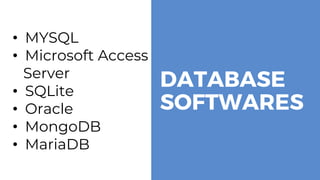
DATABASE
SOFTWARES
• MYSQL
• Microsoft Access
Server
• SQLite
• Oracle
• MongoDB
• MariaDB
MYSQL Database
an open source relational database management
system based on SQL. It was designed and
optimized for web applications and can run on any
platform. MySQL is the DBMS behind some of the
top websites and web-based applications in the
world, including Airbnb, Uber, LinkedIn, Facebook,
Twitter, and YouTube.
DATABASE
CHALLENGES
Large enterprise databases often
support very complex queries
and are expected to deliver
nearly instant responses to those
queries. Database administrators
are constantly called upon to
employ a wide variety of
methods to help improve
performance.
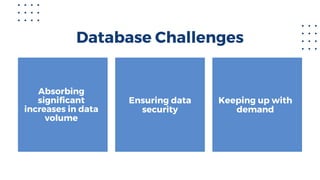
Database Challenges
Absorbing
significant
increases in data
volume
Ensuring data
security
Keeping up with
demand
Database Challenges
Managing and
maintaining
the database
and
infrastructure
THANK YOU FOR
YOUR ATTENTION
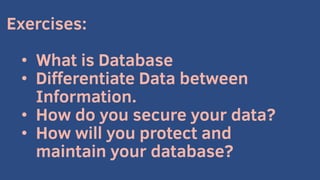
Exercises:
• What is Database
• Differentiate Data between
Information.
• How do you secure your data?
• How will you protect and
maintain your database?

ITE 221 - Information Management -Database System.pptx

  • 1.
  • 2.
    DATABASE A structured collectionof data that is organized and stored in a way that allows efficient retrieval, management, and updating of that data. It is designed to manage large amounts of information, providing a systematic and organized approach to storing and retrieving data. It is controlled by DBMS.
  • 3.
  • 4.
    TYPES OF DATABASES • Relational Databases •Object-Oriented Databases • Distributed Databases • NoSQL Databases • Graph Databases
  • 5.
    Relational Database Items ina relational database are organized as a set of tables with columns and rows. Relational database technology provides the most efficient and flexible way to access structured information.
  • 6.
    Object Oriented Database Informationin an object-oriented database is represented in the form of objects, as in object- oriented programming.
  • 7.
    Distributed Database A distributeddatabase consists of two or more files located in different sites. The database may be stored on multiple computers, located in the same physical location, or scattered over different networks.
  • 8.
    NoSQL Database Not OnlySQL, allows unstructured and semistructured data to be stored and manipulated. In contrast to a relational database, which defines how all data inserted into the database must be composed.
  • 9.
    Graph Database A graphdatabase stores data in terms of entities and the relationships between entities.
  • 10.
    DATABASE SOFTWARES It is usedto create, edit, and maintain database files and records, enabling easier file and record creation, data entry, data editing, updating, and reporting. The software also handles data storage, backup and reporting, multi- access control, and security.
  • 11.
    DATABASE SOFTWARES • MYSQL • MicrosoftAccess Server • SQLite • Oracle • MongoDB • MariaDB
  • 13.
    MYSQL Database an opensource relational database management system based on SQL. It was designed and optimized for web applications and can run on any platform. MySQL is the DBMS behind some of the top websites and web-based applications in the world, including Airbnb, Uber, LinkedIn, Facebook, Twitter, and YouTube.
  • 14.
    DATABASE CHALLENGES Large enterprise databasesoften support very complex queries and are expected to deliver nearly instant responses to those queries. Database administrators are constantly called upon to employ a wide variety of methods to help improve performance.
  • 15.
    Database Challenges Absorbing significant increases indata volume Ensuring data security Keeping up with demand
  • 16.
  • 17.
  • 18.
    Exercises: • What isDatabase • Differentiate Data between Information. • How do you secure your data? • How will you protect and maintain your database?