Submitted By: Sunil Kumar,20EBKCS118
The Ultimate MySQL
Bootcamp
 MySQL
 RDBMS
 RDBMS Terminologies
 Structured Query language
Content
 MySQL is an open source relational database.
 MySQL is cross platform which means it runs on a
number of different platforms such as Windows,
Linux, and Mac OS etc.
 Supports standard SQL (Structured Query
Language).
MYSQL
 Relational Database Management Systems (RDBMS) a
software is used to store, manage, query and retrieve
huge volume of data from a relational database.
 An interface between users, applications and database.
 This is called relational database because all the data is
stored into different tables and relations are established
using primary keys or other keys known as Foreign
Keys.
RDBMS
• Database − A database is a collection of tables, with
related data.
• Table − A table is a matrix with data. A table in a
database looks like a simple spreadsheet.
• Column − One column (attribute/data element) contains
data of one and the same kind, for example the column
postcode.
• Row − A row (= tuple, entry or record) is a group of
related data, for example the data of one subscription.
• Redundancy − Storing data twice.
RDBMS Terminology
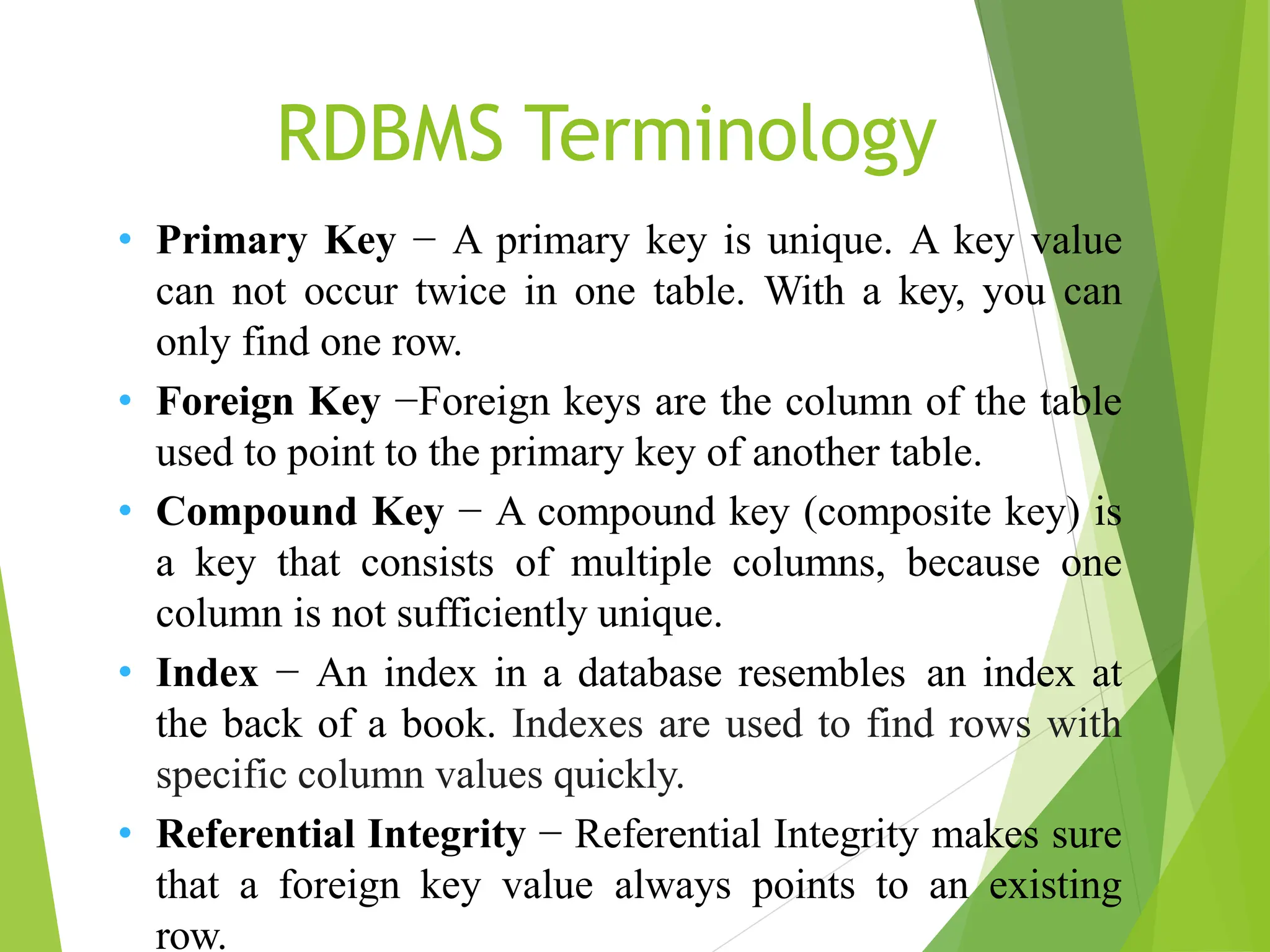
• Primary Key − A primary key is unique. A key value
can not occur twice in one table. With a key, you can
only find one row.
• Foreign Key −Foreign keys are the column of the table
used to point to the primary key of another table.
• Compound Key − A compound key (composite key) is
a key that consists of multiple columns, because one
column is not sufficiently unique.
• Index − An index in a database resembles an index at
the back of a book. Indexes are used to find rows with
specific column values quickly.
• Referential Integrity − Referential Integrity makes sure
that a foreign key value always points to an existing
row.
RDBMS Terminology
 SQL is a standard database language used to
access and manipulate data in databases. SQL
stands for Structured Query Language. SQL was
developed by IBM Computer Scientists in the
1970s.
 By executing queries SQL can create, update,
delete, and retrieve data in databases like MySQL
. Overall SQL is a query language that
communicates with databases.
Structured Query
Language
 MySQL is used for both small and large applications.
 Web applications, ecommerce
 Fast, reliable and easy to use
 High availability
 High volume of data storage
 Security
Why MySQL ?
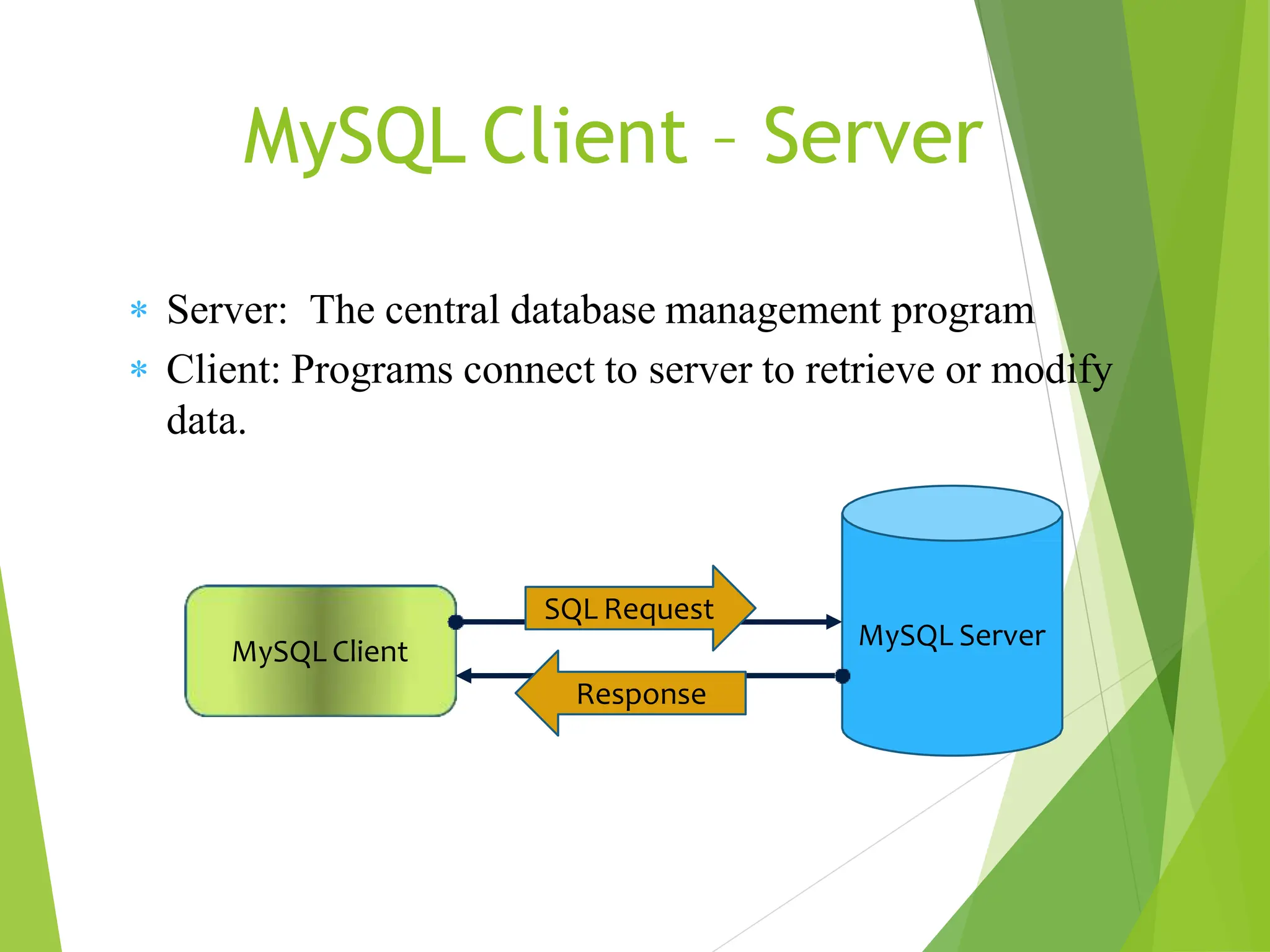
 Server: The central database management program
 Client: Programs connect to server to retrieve or modify
data.
MySQL Client – Server
MySQL Server
MySQL Client
SQL Request
Response
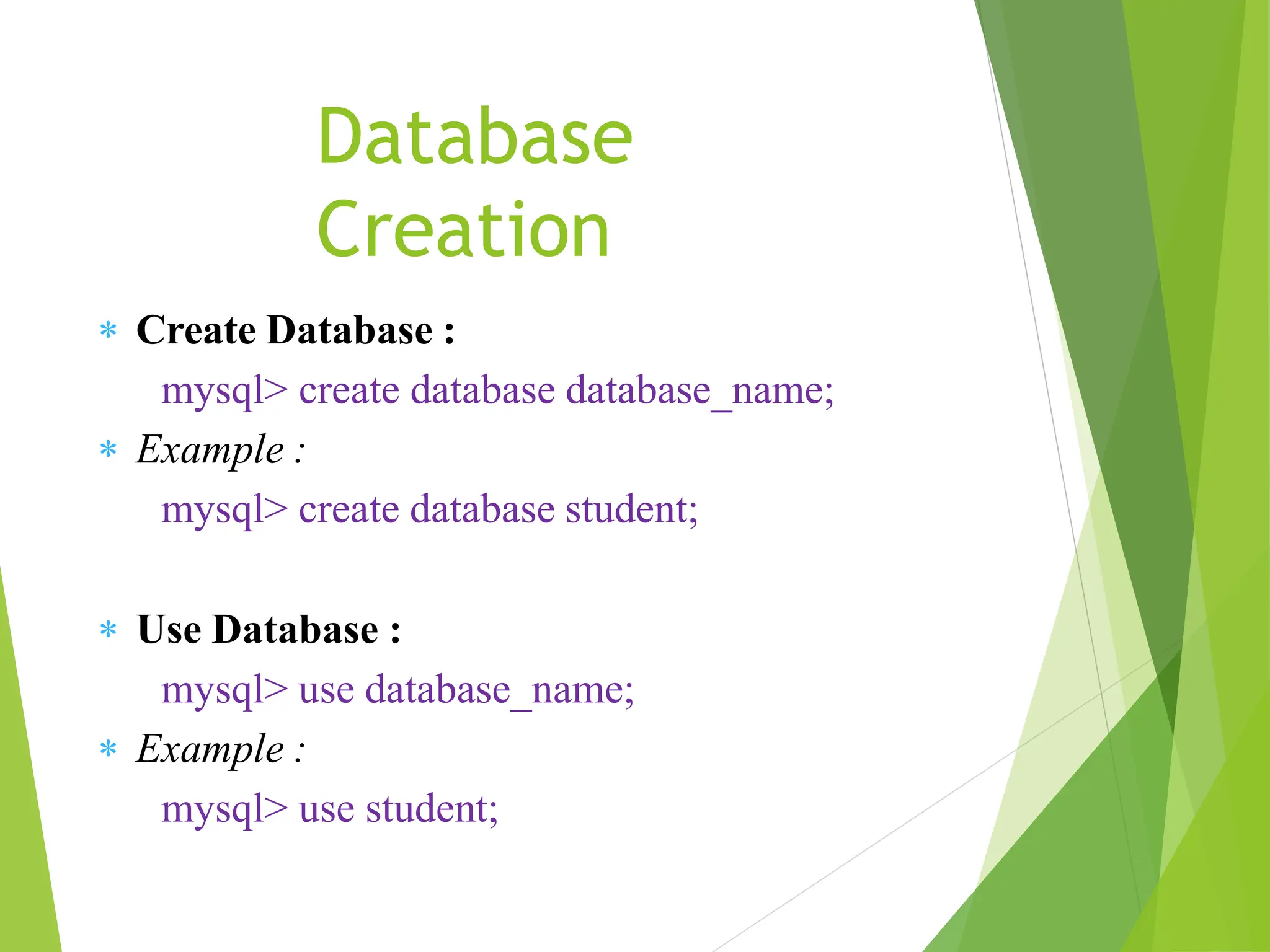
 Create Database :
mysql> create database database_name;
 Example :
mysql> create database student;
 Use Database :
mysql> use database_name;
 Example :
mysql> use student;
Database
Creation
Thank You…

industrial training ppt for btech 3rd year student

  • 1.
    Submitted By: SunilKumar,20EBKCS118
  • 2.
  • 3.
     MySQL  RDBMS RDBMS Terminologies  Structured Query language Content
  • 4.
     MySQL isan open source relational database.  MySQL is cross platform which means it runs on a number of different platforms such as Windows, Linux, and Mac OS etc.  Supports standard SQL (Structured Query Language). MYSQL
  • 5.
     Relational DatabaseManagement Systems (RDBMS) a software is used to store, manage, query and retrieve huge volume of data from a relational database.  An interface between users, applications and database.  This is called relational database because all the data is stored into different tables and relations are established using primary keys or other keys known as Foreign Keys. RDBMS
  • 6.
    • Database −A database is a collection of tables, with related data. • Table − A table is a matrix with data. A table in a database looks like a simple spreadsheet. • Column − One column (attribute/data element) contains data of one and the same kind, for example the column postcode. • Row − A row (= tuple, entry or record) is a group of related data, for example the data of one subscription. • Redundancy − Storing data twice. RDBMS Terminology
  • 7.
    • Primary Key− A primary key is unique. A key value can not occur twice in one table. With a key, you can only find one row. • Foreign Key −Foreign keys are the column of the table used to point to the primary key of another table. • Compound Key − A compound key (composite key) is a key that consists of multiple columns, because one column is not sufficiently unique. • Index − An index in a database resembles an index at the back of a book. Indexes are used to find rows with specific column values quickly. • Referential Integrity − Referential Integrity makes sure that a foreign key value always points to an existing row. RDBMS Terminology
  • 8.
     SQL isa standard database language used to access and manipulate data in databases. SQL stands for Structured Query Language. SQL was developed by IBM Computer Scientists in the 1970s.  By executing queries SQL can create, update, delete, and retrieve data in databases like MySQL . Overall SQL is a query language that communicates with databases. Structured Query Language
  • 9.
     MySQL isused for both small and large applications.  Web applications, ecommerce  Fast, reliable and easy to use  High availability  High volume of data storage  Security Why MySQL ?
  • 10.
     Server: Thecentral database management program  Client: Programs connect to server to retrieve or modify data. MySQL Client – Server MySQL Server MySQL Client SQL Request Response
  • 11.
     Create Database: mysql> create database database_name;  Example : mysql> create database student;  Use Database : mysql> use database_name;  Example : mysql> use student; Database Creation
  • 12.