E c o n o m i c & 
S o c i a l A f f a i r s 
DESA Working Paper No. 42 
ST/ESA/2007/DWP/42 
June 2007 
Modernizing the informal sector 
Victor E. Tokman 
Abstract 
Th e multiplicity of policies proposed to support the informal sector refl ects the lack of a common 
defi nition. Although they may produce positive eff ects, these are limited and fail to constitute 
a comprehensive strategic approach. Th e diff erent interpretations in the absence of a common 
defi nition as well as the strategies emerging from them are reviewed. Th e identifi cation of 
informality with illegality and labour precariousness, although conceptually related, is often 
misleading. Lastly, it explores a strategic option to regulate the informal sector, tracing the 
diff erent approaches to formalizing informal activities, to facilitate their full integration into the 
modernization process. 
JEL Classifi cation: O17; J48; D39 
Keywords: informal sector, regulation and informality 
Victor E. Tokman has a D.Phil. from Oxford University and was presidential advisor to President 
Ricardo Lagos of Chile (2001-2006), former Regional Director of the ILO for the Americas and 
Director of the Employment and Development Department of the ILO. His fi rst paper on the 
informal sector was published in 1975 and since then, he has continued to write books and papers 
on the subject. His latest paper on the informal economy entitled “Informality, insecurity and social 
cohesion in Latin America” will appear in the International Labour Review. He can be reached at: 
victok@mi.cl. 
Comments should be addressed by email to the author.
Contents 
Facts and concepts ........................................................................................................................... 1 
Interpretations and trends .................................................................................................. 1 
Alternative strategies ........................................................................................................... 3 
Formalization as a means of inclusion .............................................................................................. 4 
Informality and illegality .................................................................................................... 4 
Informality and labour precariousness ................................................................................ 5 
Options to regulate informality ....................................................................................................... 9 
From informality to economic citizenship ....................................................................................... 11 
References ....................................................................................................................................... 13 
UN/DESA Working Papers are preliminary 
documents circulated in a limited number of 
copies and posted on the DESA website at 
http://www.un.org/esa/desa/papers to stimulate 
discussion and critical comment. Th e views 
and opinions expressed herein are those of the 
author and do not necessarily refl ect those of 
the United Nations Secretariat. Th e designations 
and terminology employed may not conform to 
United Nations practice and do not imply the 
expression of any opinion whatsoever on the part 
of the Organization. 
Editor: 
Typesetter: Valerian Monteiro 
United Nations 
Department of Economic and Social Aff airs 
2 United Nations Plaza, Room DC2-1428 
New York, N.Y. 10017, USA 
Tel: (1-212) 963-4761 • Fax: (1-212) 963-4444 
e-mail: esa@un.org 
http://www.un.org/esa/desa/papers
Modernizing the informal sector 
Victor E. Tokman1 
Th ere is general agreement over the need to pay attention to the informal sector because of its importance 
to employment and poverty issues. Th ere are also an increasing number of programmes aimed at supporting 
similar informal activities in highly diverse national contexts. Th is consensus is backed through the adoption, 
at the highest level, of policy measures that are meeting with growing acceptance and, sometimes, the active 
support of social actors, in particular among entrepreneurial and trade union organizations. Such a stand 
is also based on evidence to the eff ect that policies to promote the informal sector are viable and profi table, 
even during economic downswings, and have international fi nancial support. 
Nevertheless, to the extent that it fails to embrace a shared strategic vision, this is a limited consensus 
that hinders the eff ectiveness of policies implemented in this area. While often adequate on an individual ba-sis, 
they are insuffi cient and produce limited eff ects by failing to respond to a more comprehensive approach. 
Th e lack of a shared approach is related to the absence of a common defi nition of the informal sec-tor, 
which has grown increasingly complex since it was fi rst described in a pioneering ILO report on Kenya 
in 1972. Along with the heterogeneous nature of informal economic activities, diff erent perceptions lead to 
diff erent strategies. Th ese are reviewed in the fi rst section. Too great an emphasis on the regulatory perspec-tive 
has identifi ed informality with illegality and labour precariousness. In spite of their ties to informality, 
however, the two categories are conceptually diff erent. Th e second section is devoted to these subjects and, 
particularly, to the precariousness of the employment relationship. Lastly, the third section explores strategic 
options to regulate the informal sector, tracing the features of a diff erent approach to formalizing informal 
activities, to facilitate their full integration in the modernization process. For the purpose of this paper, the 
latter concept is defi ned as the most dynamic part of the economy operating under a common regulatory 
framework. 
Facts and concepts 
Interpretations and trends 
Th e notion of the informal sector was brought forward in a 1972 ILO report on Kenya (ILO, 1972), follow-ing 
a 1971 paper (Hart, 1973). Th ey highlighted that the problem of employment in less-developed coun-tries 
is not one of unemployment but rather of employed workers who do not earn enough money to make 
a living. Th ey are ‘working poor’. Th is conceptual interpretation was based on their opposition to formality 
and their lack of access to the market and productive resources. 
Th is was followed by several contributions (see Tokman, 1978). One perspective is guided by the 
logic of survival. Informal sector activities are the result of pressure exerted by a labour surplus for jobs, when 
good jobs, usually in the modern sectors, are scarce. Th e result is that people seek low-productivity, low-income 
solutions by producing or selling anything that may provide for their survival. 
1 Th is paper builds on several earlier papers (Tokman, 2001a and 2001b). It updates the conceptual discussion and facts 
about informality.
2 D E S A W o r k i n g P a p e r N o . 4 2 
Another rationale associated with globalization and changes in the international division of labour, 
points to productive decentralization (Portes, Castells and Benton, 1989). To deal with an increasingly 
unstable demand, modern enterprises adapt to the new environment by introducing more fl exible productive 
systems and decentralizing productive and labour processes, which allow them to cut production costs and to 
externalize demand fl uctuation. 
Other research eff orts attach growing importance to the informal sector’s operation beyond the pre-vailing 
legal and institutional frameworks (de Soto, 1986). However, the issue of whether this feature is the 
cause or the consequence of informal activities has not yet been settled. An even more recent evolution in the 
concept placing the emphasis on the employment relationship has led the ILO (2002) to extend informality 
from the sector to the overall economy. 
Eff orts to explain the informal sector have shifted focus throughout the years. Th e logic of survival 
has also been, and continues to be, a major factor in the development of informal activities. Th ere is a grow-ing 
presence of new activities generated by the logic of decentralization, particularly in a context of rapid 
economic opening, and the extra-regulatory behaviour has become an important aspect for analysis and 
policy. Th e increase in precarious labour, partly promoted by labour reforms, is also a major factor in the 
ongoing discussion. 
Independent of the interpretation adopted, the characteristics of the informal sector are similar: 
small, unsophisticated technologies, low capital requirements per worker, and a distinction between micro-and 
large-sized enterprises in terms of capital requirements. Additional features include limited sharing of 
the property of the means of production, and a majority of waged workers labouring without contracts and 
protection. 
Th e importance of the informal sector as a source of new jobs is unmistakable. By 2003, this sector 
was providing about half of total urban employment2. Moreover, its share in the labour market continued to 
grow steadily. Out of every 100 new jobs created since 1980, around 60 have been informal ones. Th e cur-rent 
process of growing informality is undergoing a transformation in that micro-enterprises are showing the 
highest rate of growth. An increasing number of these enterprises are becoming a valid job-creation option 
regarding income, although they are still far from off ering acceptable conditions in terms of job stability and 
labour and social protections. 
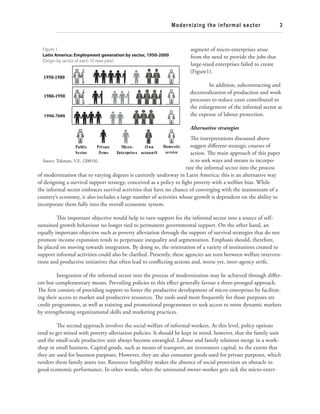
Th e growing importance of informality in the 1980s is clear and marks a break with the three 
preceding decades. Between 1950 and 1980, approximately four out of every ten new jobs were created by 
the informal sector; i.e. the equivalent of two thirds of its contribution during the adjustment. Th is behav-iour 
was determined by two factors: the withdrawal of the public sector as a net employer, and downsizing 
measures implemented by large-sized enterprises. Th e public sector conducted its own adjustment process, 
as part of policies aimed at reducing the fi scal defi cit and promoting privatization. Meanwhile, large-sized 
enterprises dealt with the economic opening by increasing productivity, basically at the expense of employ-ment. 
Public employment decreased in relative and, in some countries, even in absolute terms. During the 
1990s there was some recovery, but only 15 out of every 100 new jobs were generated by large-sized enter-prises, 
that is, one third of their contribution before the adjustment process. In fact, the rapidly expanding 
2 Th e informal sector is defi ned as including the self-employed with less than 13 years of education, unpaid family 
members, employees and employers in establishments of less than fi ve employees and domestic servants (Tokman, 
2004).
Modernizing the informal sector 3 
segment of micro-enterprises arose 
from the need to provide the jobs that 
large-sized enterprises failed to create 
(Figure1). 
In addition, subcontracting and 
decentralization of production and work 
processes to reduce costs contributed to 
the enlargement of the informal sector at 
the expense of labour protection. 
Alternative strategies 
Th e interpretations discussed above 
suggest diff erent strategic courses of 
action. Th e main approach of this paper 
is to seek ways and means to incorpo-rate 
the informal sector into the process 
Figure 1. 
Latin America: Employment generation by sector, 1950-2000 
(Origin by sector of each 10 new jobs) 
1950-1980 
1980-1990 
1990-2000 
Public 
Sector 
Private 
firms 
Source: Tokman, V.E. (2001b). 
Micro- 
Enterprises 
Own 
accountS 
Domestic 
service 
of modernization that to varying degrees is currently underway in Latin America; this is an alternative way 
of designing a survival support strategy, conceived as a policy to fi ght poverty with a welfare bias. While 
the informal sector embraces survival activities that have no chance of converging with the mainstream of a 
country’s economy, it also includes a large number of activities whose growth is dependent on the ability to 
incorporate them fully into the overall economic system. 
Th is important objective would help to turn support for the informal sector into a source of self-sustained 
growth behaviour no longer tied to permanent governmental support. On the other hand, an 
equally important objective such as poverty alleviation through the support of survival strategies that do not 
promote income expansion tends to perpetuate inequality and segmentation. Emphasis should, therefore, 
be placed on moving towards integration. By doing so, the orientation of a variety of institutions created to 
support informal activities could also be clarifi ed. Presently, these agencies are torn between welfare interven-tions 
and productive initiatives that often lead to confl icting actions and, worse yet, inter-agency strife. 
Integration of the informal sector into the process of modernization may be achieved through diff er-ent 
but complementary means. Prevailing policies to this eff ect generally favour a three-pronged approach. 
Th e fi rst consists of providing support to foster the productive development of micro-enterprises by facilitat-ing 
their access to market and productive resources. Th e tools used more frequently for those purposes are 
credit programmes, as well as training and promotional programmes to seek access to more dynamic markets 
by strengthening organizational skills and marketing practices. 
Th e second approach involves the social welfare of informal workers. At this level, policy options 
tend to get mixed with poverty-alleviation policies. It should be kept in mind, however, that the family unit 
and the small-scale productive unit always become entangled. Labour and family relations merge in a work-shop 
or small business. Capital goods, such as means of transport, are investment capital, to the extent that 
they are used for business purposes. However, they are also consumer goods used for private purposes, which 
renders them family assets too. Resource fungibility makes the absence of social protection an obstacle to 
good economic performance. In other words, when the uninsured owner-worker gets sick the micro-enter-
4 D E S A W o r k i n g P a p e r N o . 4 2 
prise collapses. Th us, mutually complementing policies implemented from a social welfare perspective have 
externalities capable of generating a positive interaction with the productive development of the poor. 
Lastly, a third course of action focuses on the regulatory framework. Informal activities are not 
caused by regulatory inadequacies but rather by the failure of the economic system to create enough produc-tive 
employment. However, the fact that regulatory improvements favour the integration of informal activi-ties 
into the modernization process cannot be ignored. Th is debate has evolved in the last few years, resulting 
in a substantial narrowing of the gap which had existed between those who argued in favour of the simplistic 
notion that legislative or procedural changes are enough to overcome the existing problems and those who 
denied the role of regulatory arrangements relating to the economic system. 
While recognizing the relevance of the fi rst two courses of action discussed above, this paper ad-dresses 
the latter. It attempts to deepen a strategy aimed at altering the regulatory framework in a manner 
conducive to the integration of the informal sector. 
Formalization as a means of inclusion 
Informality and illegality 
A generally accepted interpretation of the genesis of informal activities is rooted in their operating beyond 
the prevailing regulatory systems. In other words, these activities do not comply with legal or administrative 
requirements. A more positive view suggests that exclusion has to do with the lack of access to development 
policies, in particular to credit programmes, training and the marketplace. Th is approach to the informal sec-tor 
emphasizes lawlessness as a feature and tends to deal with it as an area devoted to underground activities. 
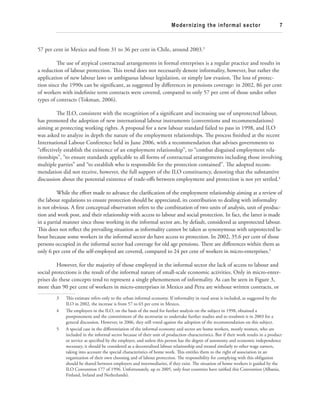
Actual conditions in the marketplace are not as unequivocal as it would appear. Th e informal sector 
is not a ‘black market’ operation, and the modern sector is not as law-abiding as could be expected—grey 
areas prevail, as it were. Informal activities were previously described as the result of limited compliance 
with legal and procedural requirements, going from complete illegality to full compliance (Tokman, 1992; 
Tokman and Klein, 1996). What prevails, however, is a middle ground where certain registration prerequi-sites 
are met, while tax obligations are 
neglected and haphazard compliance 
with labour law is commonplace. Th is 
situation is also found in modern activi-ties, 
particularly in countries where fi scal 
discipline is poor and inspection capabil-ities 
are limited. Obviously, total illegal-ity 
is non-existent, but limited legality is 
signifi cant. 
On the other hand, data on 
the informal sector around 1997 show 
that micro-enterprises making limited 
contributions to fi nance labour benefi ts 
reached 65 per cent in Peru (only 6.4 per 
cent was in full compliance, while 28.6 
Figure 2. 
Informality and illegality 
(per cent of informal units by levels of illegality) 
Underground Grey Areas Legal 
BOLIVIA CHILE ECUADOR JAMAICA MEXICO 
Source: Tokman V.E. and Klein, E. (1996) and Tokman V.E. (1992).
Modernizing the informal sector 5 
per cent failed to make any payments), 70 per cent in Brazil and 57 per cent in Chile (Tokman, 2001b ). 
Th e proportion of micro-enterprises that paid some taxes is signifi cantly higher: 94 per cent in Peru in 1996; 
in Chile, where some 70 per cent of the micro-enterprises employing fi ve or less workers, and 96 per cent 
of those employing fi ve or more workers, paid income tax and value added tax (VAT) in 1990; in Ecuador, 
where 78 per cent of small micro-enterprises and 94 per cent of larger micro-enterprises paid income tax, 
while 54 per cent and 81 per cent respectively paid VAT. Moreover, close to 80 per cent of Ecuadorian micro-enterprises 
paid some municipal taxes. However, a signifi cant proportion of the micro-enterprises operating 
in all these countries, and a majority in some of them, failed to comply fully with labour and tax laws. 
ILO research also confi rmed the high cost of formality. To bring a micro-enterprise in line with reg-ulations, 
micro-entrepreneurs must go through a number of diff erent administrative procedures: at least 11 
are required in Brazil, nine in Peru, six in Colombia, and four in Chile. Obviously, each of these procedures, 
such as applying for a licence to start a business or requesting sanitary clearance, entails a large amount of 
paperwork and bureaucracy. In addition, micro-entrepreneurs must pay at least 10 diff erent taxes and social 
insurance contributions in Brazil, seven in Colombia and eight in Peru. Th e number of procedures involved 
and weekdays devoted to them varies from country to country, depending on the number of regulations, 
the competence of the bureaucratic system and the nature of the country’s administrative and institutional 
organization. 
Given this heterogeneity of relationships to the regulation system, informality cannot be defi ned 
solely by this variable. Structural features related to the existence of surplus labour, production and work 
organization and market structures are more important determinants of the existence of informal activities 
than access costs to legality. However, they result in a certain degree of illegality. 
Informality and labour precariousness 
Labour relations have become more precarious since the mid-1980s. Th is results not only from a transfor-mation 
in the employment structure, but also from the introduction of labour reforms in search of more 
fl exible employment relationships, to gain the competitiveness required to operate in a more open national 
and world economy. Th ey were geared to gain effi ciency, without taking due account of the costs involved 
in terms of the eff ects on labour and social protection. Th ese reforms constituted a second generation in the 
economic reforms package. Th ey were justifi ed by a diagnosis of the existence of too much rigidity in the 
labour market. In addition, a decentralization process resulted in increased interrelationships between enter-prises 
of diff erent sizes. 
Th e main modality adopted by the labour reforms was the introduction of atypical labour contracts 
of a diff erent nature, but possessing more fl exibility than the indefi nite-term contract with full protection that 
constituted the predominant contract. Th is was consistent with the objective of job stability. Promotional 
labour contracts of diff erent sorts were introduced, such as fi xed-term, temporary and part-time contracts, as 
well as contracts specifi cally tailored to youths, women and unemployed head of households, among others. 
In some cases, like Peru, in addition to the introduction of these new contracts, the externalization of the 
labour process was promoted by allowing the creation of workers’ cooperatives or ‘services’ to supply labour to 
enterprises. Th ese new contractual forms provide less stability and allow for employment adjustments by fi r-ings 
in an easier and less costly manner in relation to the previous contracts. In some cases, though not in the 
majority, the atypical contracts are exempted, partially or entirely, from honouring some labour obligations.
6 D E S A W o r k i n g P a p e r N o . 4 2 
Th e scarce and fragmented data available shows the importance and expansion of workers under 
atypical contracts and those without any contract. Th e growth of these contracts is clear during the fi rst half 
of the 1990s and, although the data is not entirely comparable, it shows that the process continued in Peru, 
where workers without contracts or with atypical contracts reached 74 per cent by 2000, and in Chile, where 
the percentage reached 45 per cent. By 2002, on average for 11 countries with information from household 
surveys, workers without contracts amounted to 47 per cent, while those with contracts that are not for an 
indefi nite term reached 21 per cent, (Tokman, 2006). 
Th e legal and explicit recognition of the employment relationship is crucial because it constitutes 
a prerequisite for the recognition of the rights to labour and social protection. Recent data on coverage of 
pensions show that workers with written contracts are covered six times more than those without contracts. 
Furthermore, waged workers in micro-enterprises moving to a formal enterprise of larger size increase their 
probability of being covered by pensions from 24 to 66 per cent (Tokman, 2006). 
Th e result has been that, together with labour contracts diversifi cation, there has been an increase in 
workers without any contract. Th e latter situation does not recognize any legal obligation, while the for-mer, 
in some cases, diminishes or dilutes the level of obligation but maintains its legality. Th is is partly the 
consequence of the failures in labour legislation to adapt to new forms adopted by the labour relationship, 
and partly because of the weakness of labour inspection in most countries. It could also be the reading of 
employers of the signs of fl exibility associated with the labour reform discourse, which had underlined the 
rigidities, accompanied by permissiveness of inspection in a weak labour institutional environment. Beyond 
fl exibilization, the discourse and the reforms transmitted a message, willingly or not, of deregulation. 
Th us, undeclared and precarious work, usually associated with informality, builds up in the labour 
market. Informality, illegality and precariousness have become synonymous. Unprotected and precarious 
labour is not only found in the informal sector but also in formal enterprises or in production chains, intro-duced 
to reduce costs and gain fl exibility. Th is led the ILO to widen the informal sector concept, introduced 
at the beginning of the 1970s, incorporating a new concept: the informal economy. Th e latter includes the 
informal sector, but adds all the workers occupied, directly or indirectly, by formal enterprises. 
Th e International Conference on Labour Statistics held in 1991 agreed to defi ne the informal sector 
to identify its contribution to the GNP, usually omitted from national accounts. It was agreed that the sector 
should be defi ned according to the characteristics of the productive units that perform these activities (entre-preneurial 
approach), rather than by the characteristics of the persons involved or their occupational position 
(labour approach). Th is was consistent with the concept of the informal sector introduced by the ILO in 
1972. Th e new concept, as approved by the International Labour Conference in 2002 (ILO, 2002)—consid-ering 
that the former approach does not capture all dimensions of informal employment—recommends that 
workers should be classifi ed as formal or informal according to their labour status. It does not propose to 
eliminate the concept of the informal sector but rather to extend it to the informal economy. 
In this connection, work posts were selected as the unit of analysis and added to the unit of produc-tion 
previously considered informal. Th e main innovation is the inclusion as informal of all workers, inde-pendently 
of where they work, whose employment relationship is not subject to labour legislation standards, 
taxes, social protection and other labour benefi ts (vacations, sick leave, fi ring indemnity, etc.). Th is mostly 
means the addition to the informal sector of all unprotected labour working in enterprises of more than fi ve 
workers. Statistically, the urban informal economy implied an expansion of the informal sector from 46 to
Modernizing the informal sector 7 
57 per cent in Mexico and from 31 to 36 per cent in Chile, around 2003.3 
Th e use of atypical contractual arrangements in formal enterprises is a regular practice and results in 
a reduction of labour protection. Th is trend does not necessarily denote informality, however, but rather the 
application of new labour laws or ambiguous labour legislation, or simply law evasion. Th e loss of protec-tion 
since the 1990s can be signifi cant, as suggested by diff erences in pensions coverage: in 2002, 86 per cent 
of workers with indefi nite term contracts were covered, compared to only 57 per cent of those under other 
types of contracts (Tokman, 2006). 
Th e ILO, consistent with the recognition of a signifi cant and increasing use of unprotected labour, 
has promoted the adoption of new international labour instruments (conventions and recommendations) 
aiming at protecting working rights. A proposal for a new labour standard failed to pass in 1998, and ILO 
was asked to analyze in depth the nature of the employment relationships. Th e process fi nished at the recent 
International Labour Conference held in June 2006, with a recommendation that advises governments to 
“eff ectively establish the existence of an employment relationship”, to “combat disguised employment rela-tionships”, 
“to ensure standards applicable to all forms of contractual arrangements including those involving 
multiple parties” and “to establish who is responsible for the protection contained”. Th e adopted recom-mendation 
did not receive, however, the full support of the ILO constituency, denoting that the substantive 
discussion about the potential existence of trade-off s between employment and protection is not yet settled.4 
While the eff ort made to advance the clarifi cation of the employment relationship aiming at a review of 
the labour regulations to ensure protection should be appreciated, its contribution to dealing with informality 
is not obvious. A fi rst conceptual observation refers to the combination of two units of analysis, unit of produc-tion 
and work post, and their relationship with access to labour and social protection. In fact, the latter is made 
in a partial manner since those working in the informal sector are, by default, considered as unprotected labour. 
Th is does not refl ect the prevailing situation as informality cannot be taken as synonymous with unprotected la-bour 
because some workers in the informal sector do have access to protection. In 2002, 35.6 per cent of those 
persons occupied in the informal sector had coverage for old age pensions. Th ere are diff erences within them as 
only 6 per cent of the self-employed are covered, compared to 24 per cent of workers in micro-enterprises.5 
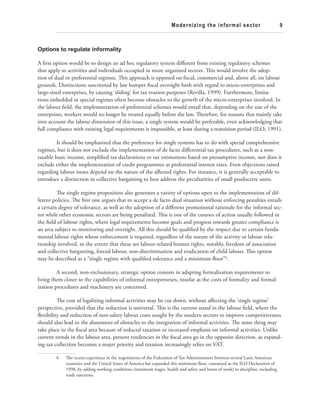
However, for the majority of those employed in the informal sector the lack of access to labour and 
social protections is the result of the informal nature of small-scale economic activities. Only in micro-enter-prises 
do these concepts tend to represent a single phenomenon of informality. As can be seen in Figure 3, 
more than 90 per cent of workers in micro-enterprises in Mexico and Peru are without written contracts, or 
3 Th is estimate refers only to the urban informal economy. If informality in rural areas is included, as suggested by the 
ILO in 2002, the increase is from 57 to 65 per cent in Mexico. 
4 Th e employers in the ILO, on the basis of the need for further analysis on the subject in 1998, obtained a 
postponement and the commitment of the secretariat to undertake further studies and to resubmit it in 2003 for a 
general discussion. However, in 2006, they still voted against the adoption of the recommendation on this subject. 
5 A special case in the diff erentiation of the informal economy and sector are home workers, mostly women, who are 
included in the informal sector because of their unit of production characteristics. But if their work results in a product 
or service as specifi ed by the employer, and unless this person has the degree of autonomy and economic independence 
necessary, it should be considered as a decentralized labour relationship and treated similarly to other wage earners, 
taking into account the special characteristics of home work. Th is entitles them to the right of association in an 
organization of their own choosing and of labour protection. Th e responsibility for complying with this obligation 
should be shared between employers and intermediaries, if they exist. Th e situation of home workers is guided by the 
ILO Convention 177 of 1996. Unfortunately, up to 2005, only four countries have ratifi ed this Convention (Albania, 
Finland, Ireland and Netherlands).
8 D E S A W o r k i n g P a p e r N o . 4 2 
are in precarious contracts; the percent-age 
is 87 per cent in Ecuador; and, even 
in a more formalized country like Chile, 
it reaches 56 per cent. Th e concentra-tion 
of self-employment, undeclared and 
precarious labour in the informal sector 
results in lower protection. Only 18 per 
cent of those employed are covered by 
social security, compared to 68 per cent 
of coverage in the formal sector. 
Th e starting point for integra-tion 
into the regulatory system is the 
inability of informal entrepreneurs to 
comply with the requirements and to 
shoulder the cost involved in becoming 
formal. A study conducted in Peru (Tok-man, 
Figure 3. 
Precarious and undeclared labour in micro-enterprises 
56.1 
86.8 
91.7 
93.4 
100 
90 
80 
70 
60 
50 
40 
30 
20 
10 
0 
Chile Ecuador Mexico Peru 
Source: Tokman V.E. and Martinez, D. (1999). 
2001b) estimated that only 35 per cent of the micro-enterprises employing fi ve or less workers and 
60 per cent of those employing between six and ten workers could comply with the whole package of social 
insurance contributions. It was also estimated that full compliance would represent over a 50 per cent cut in 
the profi ts of 75 per cent of these enterprises. Th e proportion of compliant micro-enterprises would signifi - 
cantly drop under 35 per cent, however, if the burden of complying with income and other taxes were to be 
added. For this group the trade-off is not only one of employment and protection but rather one of employ-ment 
and public welfare. 
Apart from considering the conceptual diff erences, it is also important to deepen strategic options 
to integrate the informal sector into the regulatory system as a means of achieving fuller participation in the 
modernization process. Th e starting point is recognition of the inability of informal entrepreneurs to com-ply 
with legal requirements and to shoulder the costs of becoming formal. Regardless of the various factors 
involved, this situation shows an unbalanced relationship between requirements and possibilities, and calls 
for a diff erent approach if the goal is to advance the formalization process as a tool to achieve integration in 
the modern sector. 
Given the existence of grey areas and segmentation within the informal sector, the question arises 
as to whether a diff erentiated set of regulations responding to the specifi c characteristics and capabilities of 
this economic sector and its diff erent segments should apply. Before dealing with this issue and undertaking 
the design of strategic options to regulate informality, the chances of each informal segment accomplishing a 
successful process of modernization should be assessed. 
Available empirical evidence about productivity and income in the segment of productive units that 
respond to survival strategies shows that they would accomplish very little through productive moderniza-tion. 
Most of them are family units in which regular labour relations have no place, and which operate at 
such low levels of productivity and income that compliance with administrative regulations and tax laws is 
hardly feasible. Without neglecting issues such as access to credit and training, and occupational safety and 
hygiene, the situation of these informal units would be more adequately addressed through anti-poverty in-terventions. 
Th erefore, strategic options seeking to formalize informality should concentrate their eff orts on 
productive units that show some potential in terms of achieving productive modernization.
Modernizing the informal sector 9 
Options to regulate informality 
A fi rst option would be to design an ad hoc regulatory system diff erent from existing regulatory schemes 
that apply to activities and individuals occupied in more organized sectors. Th is would involve the adop-tion 
of dual or preferential regimes. Th is approach is opposed on fi scal, commercial and, above all, on labour 
grounds. Distinctions sanctioned by law hamper fi scal oversight both with regard to micro-enterprises and 
large-sized enterprises, by causing ‘sliding’ for tax evasion purposes (Revilla, 1999). Furthermore, limita-tions 
imbedded in special regimes often become obstacles to the growth of the micro-enterprises involved. In 
the labour fi eld, the implementation of preferential schemes would entail that, depending on the size of the 
enterprises, workers would no longer be treated equally before the law. Th erefore, for reasons that mainly take 
into account the labour dimension of this issue, a single system would be preferable, even acknowledging that 
full compliance with existing legal requirements is impossible, at least during a transition period (ILO, 1991). 
It should be emphasized that the preference for single systems has to do with special comprehensive 
regimes, but it does not exclude the implementation of de facto diff erential tax procedures, such as a non-taxable 
basic income, simplifi ed tax declarations or tax estimations based on presumptive income, nor does it 
exclude either the implementation of credit programmes at preferential interest rates. Even objections raised 
regarding labour issues depend on the nature of the aff ected rights. For instance, it is generally acceptable to 
introduce a distinction in collective bargaining to best address the peculiarities of small productive units. 
Th e single regime proposition also generates a variety of options open to the implementation of dif-ferent 
policies. Th e fi rst one argues that to accept a de facto dual situation without enforcing penalties entails 
a certain degree of tolerance, as well as the adoption of a diff erent promotional rationale for the informal sec-tor 
while other economic sectors are being penalized. Th is is one of the courses of action usually followed in 
the fi eld of labour rights, where legal requirements become goals and progress towards greater compliance is 
an area subject to monitoring and oversight. All this should be qualifi ed by the respect due to certain funda-mental 
labour rights whose enforcement is required, regardless of the nature of the activity or labour rela-tionship 
involved, to the extent that these are labour-related human rights, notably, freedom of association 
and collective bargaining, forced labour, non-discrimination and eradication of child labour. Th is option 
may be described as a “single regime with qualifi ed tolerance and a minimum fl oor”6. 
A second, non-exclusionary, strategic option consists in adapting formalization requirements to 
bring them closer to the capabilities of informal entrepreneurs, insofar as the costs of formality and formal-ization 
procedures and machinery are concerned. 
Th e cost of legalizing informal activities may be cut down, without aff ecting the ‘single regime’ 
perspective, provided that the reduction is universal. Th is is the current stand in the labour fi eld, where the 
fl exibility and reduction of non-salary labour costs sought by the modern sectors to improve competitiveness 
should also lead to the abatement of obstacles to the integration of informal activities. Th e same thing may 
take place in the fi scal area because of reduced taxation or increased emphasis on informal activities. Unlike 
current trends in the labour area, present tendencies in the fi scal area go in the opposite direction, as expand-ing 
tax collection becomes a major priority and taxation increasingly relies on VAT. 
6 Th e recent experience in the negotiations of the Federation of Tax Administrators between several Latin American 
countries and the United States of America has expanded this minimum fl oor, contained in the ILO Declaration of 
1998, by adding working conditions (minimum wages, health and safety and hours of work) to discipline, including 
trade sanctions.
10 D E S A W o r k i n g P a p e r N o . 4 2 
Simplifying bureaucratic procedures is another way of bringing down access barriers. Numerous 
measures have been adopted to implement simplifi ed registration regimes, both in terms of unifying regis-tries 
and administrative steps towards compliance. Current trends point to the implementation of a single-registry, 
single-window regime. Th is approach would minimize the cost of formalization, but its feasibility 
has not yet been tried. Creating a single authority would facilitate the dissemination of information and 
avoid overlapping and contradictory regulations, administrative procedures and oversight eff orts. However, 
this fi eld is littered with obstacles, from bureaucratic vested interests to technical demands raised by oversight 
and enforcement actions. Th is situation may present the opportunity in some fi elds of combining interven-tions 
by institutions with diff erent objectives to follow a unifi ed procedure. Th e cost involved for the micro-entrepreneurs 
would be less than in the present multiple agency inspections. 
Lastly, there is room for action regarding the mechanisms for formalization. An increasingly popular 
device, fi rst suggested by de Soto (1995), is the recognition of property titles as a mechanism to have ac-cess 
to credit. Th e proposed innovation seeks to simplify the release of a legal property title and to adapt it 
to prevalent conditions of de facto ownership. Th is course entails disregarding contractual prerequisites and 
providing proof of property using alternative means of recognition, such as long-term usufruct, calling on 
witnesses (preferably neighbours when housing or land are involved) and having boundaries recognized by 
third parties when there are confl icts of interest. Th us, entitlement responds to a major obstacle to having ac-cess 
to credit, since collateral requirements, which usually involve assets, represent a further hurdle to a sector 
where ‘property’ is not formalized. 
An additional formalization tool, which could be modifi ed for the same purpose, is the recognition 
of labour relationships. In Peru, for instance, 90 per cent of labour contracts in informal activities are not 
written, although this is an indispensable prerequisite to have access to the benefi ts of employment promo-tion 
laws. Nevertheless, a verbal contract entered into by mutual agreement could be accepted as an alterna-tive, 
without having to stretch the existing regulations. A note in the employer’s monthly book may provide 
proof of the labour relationship, by calling witnesses to attest to it or to the performance of a regular work 
schedule, or by showing proof that salaries have been paid. All of this would help to ‘formalize’ the labour 
relationship, as a fi rst step to entering into regulated relations. 
Street vendors deserve special treatment through the implementation of a strategy capable of recon-ciling 
the public’s right to enjoy public spaces and the right of street vendors to have a stable, income-gener-ating 
occupation. While these activities must be regulated within a single legal, fi scal and labour framework, 
the relevant formalization and modernization strategy must also take into account the peculiarities of this 
sector. First, access to land through ownership or leasing, for the purpose of setting up commercial activities 
in compliance with municipal regulations; secondly, rendering the supply of available urban land compatible 
with the public transportation system, to provide the public with adequate access to shopping areas; thirdly, 
encouraging street vendors to organize both at the market level and also at a higher level, to improve the rate 
of return of their investment by developing economies of scale. 
Th e separation of assets between the individual and the entrepreneur (also a very important step to 
micro-entrepreneurs), is usually conducted by creating fi rms of a diverse legal nature and diverse degrees of 
complexity. Requirements associated with this simple but crucial change to the patrimonial responsibility 
of micro-entrepreneurs entail a monetary cost, as well as compliance with a series of regulations that render 
this enfranchising step towards formality a diffi cult one. Th is process could be simplifi ed by conferring legal 
status to the entrepreneur along with the business licence (Fuentes, 1997).
Modernizing the informal sector 11 
From informality to economic citizenship 
Previously discussed options lead to a diff erent vision of formalization as a tool to ease the integration of 
informal activities in the modernization process. Th e extension of formalization is not warranted from the 
point of view of the organized sectors; rather, for the benefi ts that access to formality may bring about to 
foster the development of informal activities and the people occupied in this economic sector. 
Oversight campaigns targeting informal activities are often justifi ed by the need to widen the tax 
base, cut down evasion and punish illegality. While these are important objectives per se, it is also well 
known that these campaigns usually do not yield the expected results. (According to SUNAT, every addi-tional 
sol collected in Peru entails an administrative cost of 0.75.) Actually, the importance of the integration 
of an informal activity as a tax-paying entity is that its fi rst consequence consists in meeting a basic business 
requirement, such as producing accounting information. If the entrepreneur fails to do so he is deprived of a 
key tool of modern management, a requirement to achieve full economic citizenship. 
Th e same happens with the recognition of labour contracts, an area where the goal should not be so 
much to punish illegality as to create citizens who are ready as workers to gain access to labour protection, or 
embrace the logic of business, as would be the case of micro-entrepreneurs who have to adapt to formal labour 
relationships. Having to respect certain labour rules is conducive to more modern management standards. 
A similar argument may be advanced regarding the recognition of ownership titles for the purpose of 
gaining access to credit or to a patrimonial division between the individual and the business, brought about 
by receiving the legal right to subscribe contracts. As far as street vendors are concerned, stopping police 
harassment and assuring a stable and lawful place of business reduces the cost of informality and may also 
provide access to new markets and productive resources. 
Micro-enterprises present a paradox. Large enterprises are shifting strategies to improve competitive-ness 
and increase productivity by adopting more fl exible productive systems to smooth supply-side fl uctua-tions, 
producing goods upon request and getting closer to customers before and after delivering the goods. Th is 
is the kind of approach traditionally followed by small businesses. A new opportunity is therefore opening up. 
To take advantage of it, however, micro-entrepreneurs must radically alter their behaviour by going 
through a process of cultural change. Th ey must move from individualistic ways of doing business, driven by 
the imperative of succeeding by any means in an extremely competitive environment, to a culture that seeks 
the benefi ts of pooling productive resources and associating with other producers in an eff ort to gain access 
to the marketplace. Previous ways of relating to customers should change too, and new forms of communi-cating 
with diff erent actors should be explored. From working on an individual basis and being barred from 
credit in an environment in which he or she usually entertains a personal relationship with customers, the 
entrepreneur must start producing for a market in which customers are faceless, request good quality, expect 
timely services and expect professionalism. Th e informal sector operates in fl exible ways but it is culturally 
unprepared to produce for demanding markets. 
In order to have access to credit, informal micro-entrepreneurs must undergo a cultural change that 
involves establishing and nurturing relationships within the banking system. Likewise, dealing with state 
institutions requires learning to take advantage of existing programmes designed to assist entrepreneurs, and 
not being intimated by ministerial and other public authorities. Th ey must also get acquainted with the ways
12 D E S A W o r k i n g P a p e r N o . 4 2 
and means of collective representation, when securing benefi ts and concessions is the result of social eff orts. 
Usually, micro-entrepreneurs or their workers do not join business or trade union organizations. After all, it 
was not so long ago that these organizations stopped seeing them both as disloyal competitors, and started 
to make eff orts to integrate them and accommodate their concerns, mainly as a result of a quest for greater 
representation. 
Th e present proposal is indeed addressed to the ongoing cultural change. It seeks to foster new atti-tudes 
and behaviour to favour the development of the micro-enterprises and of those who labour in them in 
an environment more conducive to success. Formalization may be the gateway to full economic citizenship 
as a prerequisite to competition in the marketplace. It entails rights as well as duties. Th e proposed views 
alter previous priorities. Rights should be emphasized over duties, because the former are tools for develop-ment 
and progress. Enfranchisement may inspire ‘virtuous circles’ leading to the expansion of the regulatory 
framework and to the creation of new conditions to allow citizens to comply with their duties, while also 
benefi ting from them. Such a context would provide incentives to turn informal businesses into the main 
force behind formalization eff orts. 
Lastly, the present strategy faces at least two limitations that it is unlikely to overcome on its own. 
Th e fi rst one is represented by a segment of survival activities that would gain very little from formalization. 
Th e second is that the eff ects of formalization will not come automatically and may become insuffi cient to 
integrate informal activities into the modernization process. Th erefore, complementary measures should be 
taken to secure the benefi ts of enfranchisement. Entitlement requires fi nancial institutions to make adjust-ments 
to acknowledge the value of property. To have access to safe places of business of their own, street 
vendors need marketplace support, credit and advice. Th e recognition of legal status as a corporate, labour 
and fi scal subject must go along with educational eff orts to learn to take advantage of administrative and 
productivity accounting books, patrimonial division and more formal labour relationships. Special machin-ery 
and fi nancing may also be necessary to facilitate the transition period.
Modernizing the informal sector 13 
References 
de Soto, Hernando (1986). El otro sendero: La revolución informal. Instituto Libertad y Democracia, Lima. 
de Soto, Hernando (1995). Por qué importa la economía informal? In V.E. Tokman (ed.). El sector informal en América Latina: 
Dos décadas de análisis. Consejo Nacional para la Cultura y las Artes, México: 275-286. 
Fuentes, S. (1997). ¿Como formalizar a los informales? In E. Chávez, A.M. Yañez, C. Luna, R. De la Flor, S. Fuentes, M. Robles 
(eds). Perú: El sector informal frente al reto de la modernización. International Labour Offi ce, Lima: 274-263. 
Hart, K. (1973). Informal income opportunities and urban employment in Ghana. Journal of Modern African Studies 11 (1): 61-89. 
ILO (1972). Employment, Income and Equality: A Strategy for Increasing Productive Employment in Kenya. International Labour Offi ce, 
Geneva. 
ILO (1991). Dilemma of the informal sector. Report of the Director-General presented at the 78th International Labour Conference, 
International Labour Offi ce, Geneva. 
ILO (2002). Decent Work and the informal economy. Report of the Director-General presented to the 90th International Labour 
Conference, International Labour Offi ce, Geneva. 
Tokman, V.E. and Martinez, D. (1999). Flexibilización en el márgen: la reforma del contrato de trabajo, in Martinez, D and Tokman, 
V.E. (eds)1999. Efectos de las reformas laborales: entre el empleo y la desprotección, Chapter 1, International Labour Offi ce, 
Lima. 
Portes, Alejandro, Manuel Castells, and L.A. Benton (1989). Th e Informal Economy: Studies in Advanced and Less Developed Countries. 
Th e Johns Hopkins University Press, Baltimore. 
Revilla, A. (1999). La modernización del sector informal y las cargas tributarias y administrativas a las empresas en el Perú. 
Documento de Trabajo 92, International Labour Offi ce, Lima. 
Tokman, V.E. (1978). An exploration into the nature of informal-formal sector relationships. World Development 6: 1065-1075. 
Tokman, V.E. (1992). Beyond Regulation: Th e Informal Sector in Latin America. Lynne Rienner Publishers, Boulder. 
Tokman, V.E. (2001a). Integrating the informal sector into the modernization process. SAIS Review 21 (1): 45-60. 
Tokman, V.E. (2001b). De la informalidad a la modernidad. International Labour Offi ce, Santiago. 
Tokman, V.E. (2004). Las dimensiones laborales de la transformación productiva con equidad. Serie Financiamiento del Desarrollo 150, 
CEPAL, Santiago. 
Tokman, V.E. (2006). Inserción laboral, mercados de trabajo y protección social. Serie Financiamiento del Desarrollo 170, CEPAL, 
Santiago. 
Tokman, V.E., and E. Klein (eds) (1996). Regulation and the Informal Economy: Micro-enterprises in Chile, Ecuador and Jamaica. 
Lynne Rienner Publishers, Boulder.

Modernizing the Informal Sector

  • 1.
    E c on o m i c & S o c i a l A f f a i r s DESA Working Paper No. 42 ST/ESA/2007/DWP/42 June 2007 Modernizing the informal sector Victor E. Tokman Abstract Th e multiplicity of policies proposed to support the informal sector refl ects the lack of a common defi nition. Although they may produce positive eff ects, these are limited and fail to constitute a comprehensive strategic approach. Th e diff erent interpretations in the absence of a common defi nition as well as the strategies emerging from them are reviewed. Th e identifi cation of informality with illegality and labour precariousness, although conceptually related, is often misleading. Lastly, it explores a strategic option to regulate the informal sector, tracing the diff erent approaches to formalizing informal activities, to facilitate their full integration into the modernization process. JEL Classifi cation: O17; J48; D39 Keywords: informal sector, regulation and informality Victor E. Tokman has a D.Phil. from Oxford University and was presidential advisor to President Ricardo Lagos of Chile (2001-2006), former Regional Director of the ILO for the Americas and Director of the Employment and Development Department of the ILO. His fi rst paper on the informal sector was published in 1975 and since then, he has continued to write books and papers on the subject. His latest paper on the informal economy entitled “Informality, insecurity and social cohesion in Latin America” will appear in the International Labour Review. He can be reached at: victok@mi.cl. Comments should be addressed by email to the author.
  • 2.
    Contents Facts andconcepts ........................................................................................................................... 1 Interpretations and trends .................................................................................................. 1 Alternative strategies ........................................................................................................... 3 Formalization as a means of inclusion .............................................................................................. 4 Informality and illegality .................................................................................................... 4 Informality and labour precariousness ................................................................................ 5 Options to regulate informality ....................................................................................................... 9 From informality to economic citizenship ....................................................................................... 11 References ....................................................................................................................................... 13 UN/DESA Working Papers are preliminary documents circulated in a limited number of copies and posted on the DESA website at http://www.un.org/esa/desa/papers to stimulate discussion and critical comment. Th e views and opinions expressed herein are those of the author and do not necessarily refl ect those of the United Nations Secretariat. Th e designations and terminology employed may not conform to United Nations practice and do not imply the expression of any opinion whatsoever on the part of the Organization. Editor: Typesetter: Valerian Monteiro United Nations Department of Economic and Social Aff airs 2 United Nations Plaza, Room DC2-1428 New York, N.Y. 10017, USA Tel: (1-212) 963-4761 • Fax: (1-212) 963-4444 e-mail: esa@un.org http://www.un.org/esa/desa/papers
  • 3.
    Modernizing the informalsector Victor E. Tokman1 Th ere is general agreement over the need to pay attention to the informal sector because of its importance to employment and poverty issues. Th ere are also an increasing number of programmes aimed at supporting similar informal activities in highly diverse national contexts. Th is consensus is backed through the adoption, at the highest level, of policy measures that are meeting with growing acceptance and, sometimes, the active support of social actors, in particular among entrepreneurial and trade union organizations. Such a stand is also based on evidence to the eff ect that policies to promote the informal sector are viable and profi table, even during economic downswings, and have international fi nancial support. Nevertheless, to the extent that it fails to embrace a shared strategic vision, this is a limited consensus that hinders the eff ectiveness of policies implemented in this area. While often adequate on an individual ba-sis, they are insuffi cient and produce limited eff ects by failing to respond to a more comprehensive approach. Th e lack of a shared approach is related to the absence of a common defi nition of the informal sec-tor, which has grown increasingly complex since it was fi rst described in a pioneering ILO report on Kenya in 1972. Along with the heterogeneous nature of informal economic activities, diff erent perceptions lead to diff erent strategies. Th ese are reviewed in the fi rst section. Too great an emphasis on the regulatory perspec-tive has identifi ed informality with illegality and labour precariousness. In spite of their ties to informality, however, the two categories are conceptually diff erent. Th e second section is devoted to these subjects and, particularly, to the precariousness of the employment relationship. Lastly, the third section explores strategic options to regulate the informal sector, tracing the features of a diff erent approach to formalizing informal activities, to facilitate their full integration in the modernization process. For the purpose of this paper, the latter concept is defi ned as the most dynamic part of the economy operating under a common regulatory framework. Facts and concepts Interpretations and trends Th e notion of the informal sector was brought forward in a 1972 ILO report on Kenya (ILO, 1972), follow-ing a 1971 paper (Hart, 1973). Th ey highlighted that the problem of employment in less-developed coun-tries is not one of unemployment but rather of employed workers who do not earn enough money to make a living. Th ey are ‘working poor’. Th is conceptual interpretation was based on their opposition to formality and their lack of access to the market and productive resources. Th is was followed by several contributions (see Tokman, 1978). One perspective is guided by the logic of survival. Informal sector activities are the result of pressure exerted by a labour surplus for jobs, when good jobs, usually in the modern sectors, are scarce. Th e result is that people seek low-productivity, low-income solutions by producing or selling anything that may provide for their survival. 1 Th is paper builds on several earlier papers (Tokman, 2001a and 2001b). It updates the conceptual discussion and facts about informality.
  • 4.
    2 D ES A W o r k i n g P a p e r N o . 4 2 Another rationale associated with globalization and changes in the international division of labour, points to productive decentralization (Portes, Castells and Benton, 1989). To deal with an increasingly unstable demand, modern enterprises adapt to the new environment by introducing more fl exible productive systems and decentralizing productive and labour processes, which allow them to cut production costs and to externalize demand fl uctuation. Other research eff orts attach growing importance to the informal sector’s operation beyond the pre-vailing legal and institutional frameworks (de Soto, 1986). However, the issue of whether this feature is the cause or the consequence of informal activities has not yet been settled. An even more recent evolution in the concept placing the emphasis on the employment relationship has led the ILO (2002) to extend informality from the sector to the overall economy. Eff orts to explain the informal sector have shifted focus throughout the years. Th e logic of survival has also been, and continues to be, a major factor in the development of informal activities. Th ere is a grow-ing presence of new activities generated by the logic of decentralization, particularly in a context of rapid economic opening, and the extra-regulatory behaviour has become an important aspect for analysis and policy. Th e increase in precarious labour, partly promoted by labour reforms, is also a major factor in the ongoing discussion. Independent of the interpretation adopted, the characteristics of the informal sector are similar: small, unsophisticated technologies, low capital requirements per worker, and a distinction between micro-and large-sized enterprises in terms of capital requirements. Additional features include limited sharing of the property of the means of production, and a majority of waged workers labouring without contracts and protection. Th e importance of the informal sector as a source of new jobs is unmistakable. By 2003, this sector was providing about half of total urban employment2. Moreover, its share in the labour market continued to grow steadily. Out of every 100 new jobs created since 1980, around 60 have been informal ones. Th e cur-rent process of growing informality is undergoing a transformation in that micro-enterprises are showing the highest rate of growth. An increasing number of these enterprises are becoming a valid job-creation option regarding income, although they are still far from off ering acceptable conditions in terms of job stability and labour and social protections. Th e growing importance of informality in the 1980s is clear and marks a break with the three preceding decades. Between 1950 and 1980, approximately four out of every ten new jobs were created by the informal sector; i.e. the equivalent of two thirds of its contribution during the adjustment. Th is behav-iour was determined by two factors: the withdrawal of the public sector as a net employer, and downsizing measures implemented by large-sized enterprises. Th e public sector conducted its own adjustment process, as part of policies aimed at reducing the fi scal defi cit and promoting privatization. Meanwhile, large-sized enterprises dealt with the economic opening by increasing productivity, basically at the expense of employ-ment. Public employment decreased in relative and, in some countries, even in absolute terms. During the 1990s there was some recovery, but only 15 out of every 100 new jobs were generated by large-sized enter-prises, that is, one third of their contribution before the adjustment process. In fact, the rapidly expanding 2 Th e informal sector is defi ned as including the self-employed with less than 13 years of education, unpaid family members, employees and employers in establishments of less than fi ve employees and domestic servants (Tokman, 2004).
  • 5.
    Modernizing the informalsector 3 segment of micro-enterprises arose from the need to provide the jobs that large-sized enterprises failed to create (Figure1). In addition, subcontracting and decentralization of production and work processes to reduce costs contributed to the enlargement of the informal sector at the expense of labour protection. Alternative strategies Th e interpretations discussed above suggest diff erent strategic courses of action. Th e main approach of this paper is to seek ways and means to incorpo-rate the informal sector into the process Figure 1. Latin America: Employment generation by sector, 1950-2000 (Origin by sector of each 10 new jobs) 1950-1980 1980-1990 1990-2000 Public Sector Private firms Source: Tokman, V.E. (2001b). Micro- Enterprises Own accountS Domestic service of modernization that to varying degrees is currently underway in Latin America; this is an alternative way of designing a survival support strategy, conceived as a policy to fi ght poverty with a welfare bias. While the informal sector embraces survival activities that have no chance of converging with the mainstream of a country’s economy, it also includes a large number of activities whose growth is dependent on the ability to incorporate them fully into the overall economic system. Th is important objective would help to turn support for the informal sector into a source of self-sustained growth behaviour no longer tied to permanent governmental support. On the other hand, an equally important objective such as poverty alleviation through the support of survival strategies that do not promote income expansion tends to perpetuate inequality and segmentation. Emphasis should, therefore, be placed on moving towards integration. By doing so, the orientation of a variety of institutions created to support informal activities could also be clarifi ed. Presently, these agencies are torn between welfare interven-tions and productive initiatives that often lead to confl icting actions and, worse yet, inter-agency strife. Integration of the informal sector into the process of modernization may be achieved through diff er-ent but complementary means. Prevailing policies to this eff ect generally favour a three-pronged approach. Th e fi rst consists of providing support to foster the productive development of micro-enterprises by facilitat-ing their access to market and productive resources. Th e tools used more frequently for those purposes are credit programmes, as well as training and promotional programmes to seek access to more dynamic markets by strengthening organizational skills and marketing practices. Th e second approach involves the social welfare of informal workers. At this level, policy options tend to get mixed with poverty-alleviation policies. It should be kept in mind, however, that the family unit and the small-scale productive unit always become entangled. Labour and family relations merge in a work-shop or small business. Capital goods, such as means of transport, are investment capital, to the extent that they are used for business purposes. However, they are also consumer goods used for private purposes, which renders them family assets too. Resource fungibility makes the absence of social protection an obstacle to good economic performance. In other words, when the uninsured owner-worker gets sick the micro-enter-
  • 6.
    4 D ES A W o r k i n g P a p e r N o . 4 2 prise collapses. Th us, mutually complementing policies implemented from a social welfare perspective have externalities capable of generating a positive interaction with the productive development of the poor. Lastly, a third course of action focuses on the regulatory framework. Informal activities are not caused by regulatory inadequacies but rather by the failure of the economic system to create enough produc-tive employment. However, the fact that regulatory improvements favour the integration of informal activi-ties into the modernization process cannot be ignored. Th is debate has evolved in the last few years, resulting in a substantial narrowing of the gap which had existed between those who argued in favour of the simplistic notion that legislative or procedural changes are enough to overcome the existing problems and those who denied the role of regulatory arrangements relating to the economic system. While recognizing the relevance of the fi rst two courses of action discussed above, this paper ad-dresses the latter. It attempts to deepen a strategy aimed at altering the regulatory framework in a manner conducive to the integration of the informal sector. Formalization as a means of inclusion Informality and illegality A generally accepted interpretation of the genesis of informal activities is rooted in their operating beyond the prevailing regulatory systems. In other words, these activities do not comply with legal or administrative requirements. A more positive view suggests that exclusion has to do with the lack of access to development policies, in particular to credit programmes, training and the marketplace. Th is approach to the informal sec-tor emphasizes lawlessness as a feature and tends to deal with it as an area devoted to underground activities. Actual conditions in the marketplace are not as unequivocal as it would appear. Th e informal sector is not a ‘black market’ operation, and the modern sector is not as law-abiding as could be expected—grey areas prevail, as it were. Informal activities were previously described as the result of limited compliance with legal and procedural requirements, going from complete illegality to full compliance (Tokman, 1992; Tokman and Klein, 1996). What prevails, however, is a middle ground where certain registration prerequi-sites are met, while tax obligations are neglected and haphazard compliance with labour law is commonplace. Th is situation is also found in modern activi-ties, particularly in countries where fi scal discipline is poor and inspection capabil-ities are limited. Obviously, total illegal-ity is non-existent, but limited legality is signifi cant. On the other hand, data on the informal sector around 1997 show that micro-enterprises making limited contributions to fi nance labour benefi ts reached 65 per cent in Peru (only 6.4 per cent was in full compliance, while 28.6 Figure 2. Informality and illegality (per cent of informal units by levels of illegality) Underground Grey Areas Legal BOLIVIA CHILE ECUADOR JAMAICA MEXICO Source: Tokman V.E. and Klein, E. (1996) and Tokman V.E. (1992).
  • 7.
    Modernizing the informalsector 5 per cent failed to make any payments), 70 per cent in Brazil and 57 per cent in Chile (Tokman, 2001b ). Th e proportion of micro-enterprises that paid some taxes is signifi cantly higher: 94 per cent in Peru in 1996; in Chile, where some 70 per cent of the micro-enterprises employing fi ve or less workers, and 96 per cent of those employing fi ve or more workers, paid income tax and value added tax (VAT) in 1990; in Ecuador, where 78 per cent of small micro-enterprises and 94 per cent of larger micro-enterprises paid income tax, while 54 per cent and 81 per cent respectively paid VAT. Moreover, close to 80 per cent of Ecuadorian micro-enterprises paid some municipal taxes. However, a signifi cant proportion of the micro-enterprises operating in all these countries, and a majority in some of them, failed to comply fully with labour and tax laws. ILO research also confi rmed the high cost of formality. To bring a micro-enterprise in line with reg-ulations, micro-entrepreneurs must go through a number of diff erent administrative procedures: at least 11 are required in Brazil, nine in Peru, six in Colombia, and four in Chile. Obviously, each of these procedures, such as applying for a licence to start a business or requesting sanitary clearance, entails a large amount of paperwork and bureaucracy. In addition, micro-entrepreneurs must pay at least 10 diff erent taxes and social insurance contributions in Brazil, seven in Colombia and eight in Peru. Th e number of procedures involved and weekdays devoted to them varies from country to country, depending on the number of regulations, the competence of the bureaucratic system and the nature of the country’s administrative and institutional organization. Given this heterogeneity of relationships to the regulation system, informality cannot be defi ned solely by this variable. Structural features related to the existence of surplus labour, production and work organization and market structures are more important determinants of the existence of informal activities than access costs to legality. However, they result in a certain degree of illegality. Informality and labour precariousness Labour relations have become more precarious since the mid-1980s. Th is results not only from a transfor-mation in the employment structure, but also from the introduction of labour reforms in search of more fl exible employment relationships, to gain the competitiveness required to operate in a more open national and world economy. Th ey were geared to gain effi ciency, without taking due account of the costs involved in terms of the eff ects on labour and social protection. Th ese reforms constituted a second generation in the economic reforms package. Th ey were justifi ed by a diagnosis of the existence of too much rigidity in the labour market. In addition, a decentralization process resulted in increased interrelationships between enter-prises of diff erent sizes. Th e main modality adopted by the labour reforms was the introduction of atypical labour contracts of a diff erent nature, but possessing more fl exibility than the indefi nite-term contract with full protection that constituted the predominant contract. Th is was consistent with the objective of job stability. Promotional labour contracts of diff erent sorts were introduced, such as fi xed-term, temporary and part-time contracts, as well as contracts specifi cally tailored to youths, women and unemployed head of households, among others. In some cases, like Peru, in addition to the introduction of these new contracts, the externalization of the labour process was promoted by allowing the creation of workers’ cooperatives or ‘services’ to supply labour to enterprises. Th ese new contractual forms provide less stability and allow for employment adjustments by fi r-ings in an easier and less costly manner in relation to the previous contracts. In some cases, though not in the majority, the atypical contracts are exempted, partially or entirely, from honouring some labour obligations.
  • 8.
    6 D ES A W o r k i n g P a p e r N o . 4 2 Th e scarce and fragmented data available shows the importance and expansion of workers under atypical contracts and those without any contract. Th e growth of these contracts is clear during the fi rst half of the 1990s and, although the data is not entirely comparable, it shows that the process continued in Peru, where workers without contracts or with atypical contracts reached 74 per cent by 2000, and in Chile, where the percentage reached 45 per cent. By 2002, on average for 11 countries with information from household surveys, workers without contracts amounted to 47 per cent, while those with contracts that are not for an indefi nite term reached 21 per cent, (Tokman, 2006). Th e legal and explicit recognition of the employment relationship is crucial because it constitutes a prerequisite for the recognition of the rights to labour and social protection. Recent data on coverage of pensions show that workers with written contracts are covered six times more than those without contracts. Furthermore, waged workers in micro-enterprises moving to a formal enterprise of larger size increase their probability of being covered by pensions from 24 to 66 per cent (Tokman, 2006). Th e result has been that, together with labour contracts diversifi cation, there has been an increase in workers without any contract. Th e latter situation does not recognize any legal obligation, while the for-mer, in some cases, diminishes or dilutes the level of obligation but maintains its legality. Th is is partly the consequence of the failures in labour legislation to adapt to new forms adopted by the labour relationship, and partly because of the weakness of labour inspection in most countries. It could also be the reading of employers of the signs of fl exibility associated with the labour reform discourse, which had underlined the rigidities, accompanied by permissiveness of inspection in a weak labour institutional environment. Beyond fl exibilization, the discourse and the reforms transmitted a message, willingly or not, of deregulation. Th us, undeclared and precarious work, usually associated with informality, builds up in the labour market. Informality, illegality and precariousness have become synonymous. Unprotected and precarious labour is not only found in the informal sector but also in formal enterprises or in production chains, intro-duced to reduce costs and gain fl exibility. Th is led the ILO to widen the informal sector concept, introduced at the beginning of the 1970s, incorporating a new concept: the informal economy. Th e latter includes the informal sector, but adds all the workers occupied, directly or indirectly, by formal enterprises. Th e International Conference on Labour Statistics held in 1991 agreed to defi ne the informal sector to identify its contribution to the GNP, usually omitted from national accounts. It was agreed that the sector should be defi ned according to the characteristics of the productive units that perform these activities (entre-preneurial approach), rather than by the characteristics of the persons involved or their occupational position (labour approach). Th is was consistent with the concept of the informal sector introduced by the ILO in 1972. Th e new concept, as approved by the International Labour Conference in 2002 (ILO, 2002)—consid-ering that the former approach does not capture all dimensions of informal employment—recommends that workers should be classifi ed as formal or informal according to their labour status. It does not propose to eliminate the concept of the informal sector but rather to extend it to the informal economy. In this connection, work posts were selected as the unit of analysis and added to the unit of produc-tion previously considered informal. Th e main innovation is the inclusion as informal of all workers, inde-pendently of where they work, whose employment relationship is not subject to labour legislation standards, taxes, social protection and other labour benefi ts (vacations, sick leave, fi ring indemnity, etc.). Th is mostly means the addition to the informal sector of all unprotected labour working in enterprises of more than fi ve workers. Statistically, the urban informal economy implied an expansion of the informal sector from 46 to
  • 9.
    Modernizing the informalsector 7 57 per cent in Mexico and from 31 to 36 per cent in Chile, around 2003.3 Th e use of atypical contractual arrangements in formal enterprises is a regular practice and results in a reduction of labour protection. Th is trend does not necessarily denote informality, however, but rather the application of new labour laws or ambiguous labour legislation, or simply law evasion. Th e loss of protec-tion since the 1990s can be signifi cant, as suggested by diff erences in pensions coverage: in 2002, 86 per cent of workers with indefi nite term contracts were covered, compared to only 57 per cent of those under other types of contracts (Tokman, 2006). Th e ILO, consistent with the recognition of a signifi cant and increasing use of unprotected labour, has promoted the adoption of new international labour instruments (conventions and recommendations) aiming at protecting working rights. A proposal for a new labour standard failed to pass in 1998, and ILO was asked to analyze in depth the nature of the employment relationships. Th e process fi nished at the recent International Labour Conference held in June 2006, with a recommendation that advises governments to “eff ectively establish the existence of an employment relationship”, to “combat disguised employment rela-tionships”, “to ensure standards applicable to all forms of contractual arrangements including those involving multiple parties” and “to establish who is responsible for the protection contained”. Th e adopted recom-mendation did not receive, however, the full support of the ILO constituency, denoting that the substantive discussion about the potential existence of trade-off s between employment and protection is not yet settled.4 While the eff ort made to advance the clarifi cation of the employment relationship aiming at a review of the labour regulations to ensure protection should be appreciated, its contribution to dealing with informality is not obvious. A fi rst conceptual observation refers to the combination of two units of analysis, unit of produc-tion and work post, and their relationship with access to labour and social protection. In fact, the latter is made in a partial manner since those working in the informal sector are, by default, considered as unprotected labour. Th is does not refl ect the prevailing situation as informality cannot be taken as synonymous with unprotected la-bour because some workers in the informal sector do have access to protection. In 2002, 35.6 per cent of those persons occupied in the informal sector had coverage for old age pensions. Th ere are diff erences within them as only 6 per cent of the self-employed are covered, compared to 24 per cent of workers in micro-enterprises.5 However, for the majority of those employed in the informal sector the lack of access to labour and social protections is the result of the informal nature of small-scale economic activities. Only in micro-enter-prises do these concepts tend to represent a single phenomenon of informality. As can be seen in Figure 3, more than 90 per cent of workers in micro-enterprises in Mexico and Peru are without written contracts, or 3 Th is estimate refers only to the urban informal economy. If informality in rural areas is included, as suggested by the ILO in 2002, the increase is from 57 to 65 per cent in Mexico. 4 Th e employers in the ILO, on the basis of the need for further analysis on the subject in 1998, obtained a postponement and the commitment of the secretariat to undertake further studies and to resubmit it in 2003 for a general discussion. However, in 2006, they still voted against the adoption of the recommendation on this subject. 5 A special case in the diff erentiation of the informal economy and sector are home workers, mostly women, who are included in the informal sector because of their unit of production characteristics. But if their work results in a product or service as specifi ed by the employer, and unless this person has the degree of autonomy and economic independence necessary, it should be considered as a decentralized labour relationship and treated similarly to other wage earners, taking into account the special characteristics of home work. Th is entitles them to the right of association in an organization of their own choosing and of labour protection. Th e responsibility for complying with this obligation should be shared between employers and intermediaries, if they exist. Th e situation of home workers is guided by the ILO Convention 177 of 1996. Unfortunately, up to 2005, only four countries have ratifi ed this Convention (Albania, Finland, Ireland and Netherlands).
  • 10.
    8 D ES A W o r k i n g P a p e r N o . 4 2 are in precarious contracts; the percent-age is 87 per cent in Ecuador; and, even in a more formalized country like Chile, it reaches 56 per cent. Th e concentra-tion of self-employment, undeclared and precarious labour in the informal sector results in lower protection. Only 18 per cent of those employed are covered by social security, compared to 68 per cent of coverage in the formal sector. Th e starting point for integra-tion into the regulatory system is the inability of informal entrepreneurs to comply with the requirements and to shoulder the cost involved in becoming formal. A study conducted in Peru (Tok-man, Figure 3. Precarious and undeclared labour in micro-enterprises 56.1 86.8 91.7 93.4 100 90 80 70 60 50 40 30 20 10 0 Chile Ecuador Mexico Peru Source: Tokman V.E. and Martinez, D. (1999). 2001b) estimated that only 35 per cent of the micro-enterprises employing fi ve or less workers and 60 per cent of those employing between six and ten workers could comply with the whole package of social insurance contributions. It was also estimated that full compliance would represent over a 50 per cent cut in the profi ts of 75 per cent of these enterprises. Th e proportion of compliant micro-enterprises would signifi - cantly drop under 35 per cent, however, if the burden of complying with income and other taxes were to be added. For this group the trade-off is not only one of employment and protection but rather one of employ-ment and public welfare. Apart from considering the conceptual diff erences, it is also important to deepen strategic options to integrate the informal sector into the regulatory system as a means of achieving fuller participation in the modernization process. Th e starting point is recognition of the inability of informal entrepreneurs to com-ply with legal requirements and to shoulder the costs of becoming formal. Regardless of the various factors involved, this situation shows an unbalanced relationship between requirements and possibilities, and calls for a diff erent approach if the goal is to advance the formalization process as a tool to achieve integration in the modern sector. Given the existence of grey areas and segmentation within the informal sector, the question arises as to whether a diff erentiated set of regulations responding to the specifi c characteristics and capabilities of this economic sector and its diff erent segments should apply. Before dealing with this issue and undertaking the design of strategic options to regulate informality, the chances of each informal segment accomplishing a successful process of modernization should be assessed. Available empirical evidence about productivity and income in the segment of productive units that respond to survival strategies shows that they would accomplish very little through productive moderniza-tion. Most of them are family units in which regular labour relations have no place, and which operate at such low levels of productivity and income that compliance with administrative regulations and tax laws is hardly feasible. Without neglecting issues such as access to credit and training, and occupational safety and hygiene, the situation of these informal units would be more adequately addressed through anti-poverty in-terventions. Th erefore, strategic options seeking to formalize informality should concentrate their eff orts on productive units that show some potential in terms of achieving productive modernization.
  • 11.
    Modernizing the informalsector 9 Options to regulate informality A fi rst option would be to design an ad hoc regulatory system diff erent from existing regulatory schemes that apply to activities and individuals occupied in more organized sectors. Th is would involve the adop-tion of dual or preferential regimes. Th is approach is opposed on fi scal, commercial and, above all, on labour grounds. Distinctions sanctioned by law hamper fi scal oversight both with regard to micro-enterprises and large-sized enterprises, by causing ‘sliding’ for tax evasion purposes (Revilla, 1999). Furthermore, limita-tions imbedded in special regimes often become obstacles to the growth of the micro-enterprises involved. In the labour fi eld, the implementation of preferential schemes would entail that, depending on the size of the enterprises, workers would no longer be treated equally before the law. Th erefore, for reasons that mainly take into account the labour dimension of this issue, a single system would be preferable, even acknowledging that full compliance with existing legal requirements is impossible, at least during a transition period (ILO, 1991). It should be emphasized that the preference for single systems has to do with special comprehensive regimes, but it does not exclude the implementation of de facto diff erential tax procedures, such as a non-taxable basic income, simplifi ed tax declarations or tax estimations based on presumptive income, nor does it exclude either the implementation of credit programmes at preferential interest rates. Even objections raised regarding labour issues depend on the nature of the aff ected rights. For instance, it is generally acceptable to introduce a distinction in collective bargaining to best address the peculiarities of small productive units. Th e single regime proposition also generates a variety of options open to the implementation of dif-ferent policies. Th e fi rst one argues that to accept a de facto dual situation without enforcing penalties entails a certain degree of tolerance, as well as the adoption of a diff erent promotional rationale for the informal sec-tor while other economic sectors are being penalized. Th is is one of the courses of action usually followed in the fi eld of labour rights, where legal requirements become goals and progress towards greater compliance is an area subject to monitoring and oversight. All this should be qualifi ed by the respect due to certain funda-mental labour rights whose enforcement is required, regardless of the nature of the activity or labour rela-tionship involved, to the extent that these are labour-related human rights, notably, freedom of association and collective bargaining, forced labour, non-discrimination and eradication of child labour. Th is option may be described as a “single regime with qualifi ed tolerance and a minimum fl oor”6. A second, non-exclusionary, strategic option consists in adapting formalization requirements to bring them closer to the capabilities of informal entrepreneurs, insofar as the costs of formality and formal-ization procedures and machinery are concerned. Th e cost of legalizing informal activities may be cut down, without aff ecting the ‘single regime’ perspective, provided that the reduction is universal. Th is is the current stand in the labour fi eld, where the fl exibility and reduction of non-salary labour costs sought by the modern sectors to improve competitiveness should also lead to the abatement of obstacles to the integration of informal activities. Th e same thing may take place in the fi scal area because of reduced taxation or increased emphasis on informal activities. Unlike current trends in the labour area, present tendencies in the fi scal area go in the opposite direction, as expand-ing tax collection becomes a major priority and taxation increasingly relies on VAT. 6 Th e recent experience in the negotiations of the Federation of Tax Administrators between several Latin American countries and the United States of America has expanded this minimum fl oor, contained in the ILO Declaration of 1998, by adding working conditions (minimum wages, health and safety and hours of work) to discipline, including trade sanctions.
  • 12.
    10 D ES A W o r k i n g P a p e r N o . 4 2 Simplifying bureaucratic procedures is another way of bringing down access barriers. Numerous measures have been adopted to implement simplifi ed registration regimes, both in terms of unifying regis-tries and administrative steps towards compliance. Current trends point to the implementation of a single-registry, single-window regime. Th is approach would minimize the cost of formalization, but its feasibility has not yet been tried. Creating a single authority would facilitate the dissemination of information and avoid overlapping and contradictory regulations, administrative procedures and oversight eff orts. However, this fi eld is littered with obstacles, from bureaucratic vested interests to technical demands raised by oversight and enforcement actions. Th is situation may present the opportunity in some fi elds of combining interven-tions by institutions with diff erent objectives to follow a unifi ed procedure. Th e cost involved for the micro-entrepreneurs would be less than in the present multiple agency inspections. Lastly, there is room for action regarding the mechanisms for formalization. An increasingly popular device, fi rst suggested by de Soto (1995), is the recognition of property titles as a mechanism to have ac-cess to credit. Th e proposed innovation seeks to simplify the release of a legal property title and to adapt it to prevalent conditions of de facto ownership. Th is course entails disregarding contractual prerequisites and providing proof of property using alternative means of recognition, such as long-term usufruct, calling on witnesses (preferably neighbours when housing or land are involved) and having boundaries recognized by third parties when there are confl icts of interest. Th us, entitlement responds to a major obstacle to having ac-cess to credit, since collateral requirements, which usually involve assets, represent a further hurdle to a sector where ‘property’ is not formalized. An additional formalization tool, which could be modifi ed for the same purpose, is the recognition of labour relationships. In Peru, for instance, 90 per cent of labour contracts in informal activities are not written, although this is an indispensable prerequisite to have access to the benefi ts of employment promo-tion laws. Nevertheless, a verbal contract entered into by mutual agreement could be accepted as an alterna-tive, without having to stretch the existing regulations. A note in the employer’s monthly book may provide proof of the labour relationship, by calling witnesses to attest to it or to the performance of a regular work schedule, or by showing proof that salaries have been paid. All of this would help to ‘formalize’ the labour relationship, as a fi rst step to entering into regulated relations. Street vendors deserve special treatment through the implementation of a strategy capable of recon-ciling the public’s right to enjoy public spaces and the right of street vendors to have a stable, income-gener-ating occupation. While these activities must be regulated within a single legal, fi scal and labour framework, the relevant formalization and modernization strategy must also take into account the peculiarities of this sector. First, access to land through ownership or leasing, for the purpose of setting up commercial activities in compliance with municipal regulations; secondly, rendering the supply of available urban land compatible with the public transportation system, to provide the public with adequate access to shopping areas; thirdly, encouraging street vendors to organize both at the market level and also at a higher level, to improve the rate of return of their investment by developing economies of scale. Th e separation of assets between the individual and the entrepreneur (also a very important step to micro-entrepreneurs), is usually conducted by creating fi rms of a diverse legal nature and diverse degrees of complexity. Requirements associated with this simple but crucial change to the patrimonial responsibility of micro-entrepreneurs entail a monetary cost, as well as compliance with a series of regulations that render this enfranchising step towards formality a diffi cult one. Th is process could be simplifi ed by conferring legal status to the entrepreneur along with the business licence (Fuentes, 1997).
  • 13.
    Modernizing the informalsector 11 From informality to economic citizenship Previously discussed options lead to a diff erent vision of formalization as a tool to ease the integration of informal activities in the modernization process. Th e extension of formalization is not warranted from the point of view of the organized sectors; rather, for the benefi ts that access to formality may bring about to foster the development of informal activities and the people occupied in this economic sector. Oversight campaigns targeting informal activities are often justifi ed by the need to widen the tax base, cut down evasion and punish illegality. While these are important objectives per se, it is also well known that these campaigns usually do not yield the expected results. (According to SUNAT, every addi-tional sol collected in Peru entails an administrative cost of 0.75.) Actually, the importance of the integration of an informal activity as a tax-paying entity is that its fi rst consequence consists in meeting a basic business requirement, such as producing accounting information. If the entrepreneur fails to do so he is deprived of a key tool of modern management, a requirement to achieve full economic citizenship. Th e same happens with the recognition of labour contracts, an area where the goal should not be so much to punish illegality as to create citizens who are ready as workers to gain access to labour protection, or embrace the logic of business, as would be the case of micro-entrepreneurs who have to adapt to formal labour relationships. Having to respect certain labour rules is conducive to more modern management standards. A similar argument may be advanced regarding the recognition of ownership titles for the purpose of gaining access to credit or to a patrimonial division between the individual and the business, brought about by receiving the legal right to subscribe contracts. As far as street vendors are concerned, stopping police harassment and assuring a stable and lawful place of business reduces the cost of informality and may also provide access to new markets and productive resources. Micro-enterprises present a paradox. Large enterprises are shifting strategies to improve competitive-ness and increase productivity by adopting more fl exible productive systems to smooth supply-side fl uctua-tions, producing goods upon request and getting closer to customers before and after delivering the goods. Th is is the kind of approach traditionally followed by small businesses. A new opportunity is therefore opening up. To take advantage of it, however, micro-entrepreneurs must radically alter their behaviour by going through a process of cultural change. Th ey must move from individualistic ways of doing business, driven by the imperative of succeeding by any means in an extremely competitive environment, to a culture that seeks the benefi ts of pooling productive resources and associating with other producers in an eff ort to gain access to the marketplace. Previous ways of relating to customers should change too, and new forms of communi-cating with diff erent actors should be explored. From working on an individual basis and being barred from credit in an environment in which he or she usually entertains a personal relationship with customers, the entrepreneur must start producing for a market in which customers are faceless, request good quality, expect timely services and expect professionalism. Th e informal sector operates in fl exible ways but it is culturally unprepared to produce for demanding markets. In order to have access to credit, informal micro-entrepreneurs must undergo a cultural change that involves establishing and nurturing relationships within the banking system. Likewise, dealing with state institutions requires learning to take advantage of existing programmes designed to assist entrepreneurs, and not being intimated by ministerial and other public authorities. Th ey must also get acquainted with the ways
  • 14.
    12 D ES A W o r k i n g P a p e r N o . 4 2 and means of collective representation, when securing benefi ts and concessions is the result of social eff orts. Usually, micro-entrepreneurs or their workers do not join business or trade union organizations. After all, it was not so long ago that these organizations stopped seeing them both as disloyal competitors, and started to make eff orts to integrate them and accommodate their concerns, mainly as a result of a quest for greater representation. Th e present proposal is indeed addressed to the ongoing cultural change. It seeks to foster new atti-tudes and behaviour to favour the development of the micro-enterprises and of those who labour in them in an environment more conducive to success. Formalization may be the gateway to full economic citizenship as a prerequisite to competition in the marketplace. It entails rights as well as duties. Th e proposed views alter previous priorities. Rights should be emphasized over duties, because the former are tools for develop-ment and progress. Enfranchisement may inspire ‘virtuous circles’ leading to the expansion of the regulatory framework and to the creation of new conditions to allow citizens to comply with their duties, while also benefi ting from them. Such a context would provide incentives to turn informal businesses into the main force behind formalization eff orts. Lastly, the present strategy faces at least two limitations that it is unlikely to overcome on its own. Th e fi rst one is represented by a segment of survival activities that would gain very little from formalization. Th e second is that the eff ects of formalization will not come automatically and may become insuffi cient to integrate informal activities into the modernization process. Th erefore, complementary measures should be taken to secure the benefi ts of enfranchisement. Entitlement requires fi nancial institutions to make adjust-ments to acknowledge the value of property. To have access to safe places of business of their own, street vendors need marketplace support, credit and advice. Th e recognition of legal status as a corporate, labour and fi scal subject must go along with educational eff orts to learn to take advantage of administrative and productivity accounting books, patrimonial division and more formal labour relationships. Special machin-ery and fi nancing may also be necessary to facilitate the transition period.
  • 15.
    Modernizing the informalsector 13 References de Soto, Hernando (1986). El otro sendero: La revolución informal. Instituto Libertad y Democracia, Lima. de Soto, Hernando (1995). Por qué importa la economía informal? In V.E. Tokman (ed.). El sector informal en América Latina: Dos décadas de análisis. Consejo Nacional para la Cultura y las Artes, México: 275-286. Fuentes, S. (1997). ¿Como formalizar a los informales? In E. Chávez, A.M. Yañez, C. Luna, R. De la Flor, S. Fuentes, M. Robles (eds). Perú: El sector informal frente al reto de la modernización. International Labour Offi ce, Lima: 274-263. Hart, K. (1973). Informal income opportunities and urban employment in Ghana. Journal of Modern African Studies 11 (1): 61-89. ILO (1972). Employment, Income and Equality: A Strategy for Increasing Productive Employment in Kenya. International Labour Offi ce, Geneva. ILO (1991). Dilemma of the informal sector. Report of the Director-General presented at the 78th International Labour Conference, International Labour Offi ce, Geneva. ILO (2002). Decent Work and the informal economy. Report of the Director-General presented to the 90th International Labour Conference, International Labour Offi ce, Geneva. Tokman, V.E. and Martinez, D. (1999). Flexibilización en el márgen: la reforma del contrato de trabajo, in Martinez, D and Tokman, V.E. (eds)1999. Efectos de las reformas laborales: entre el empleo y la desprotección, Chapter 1, International Labour Offi ce, Lima. Portes, Alejandro, Manuel Castells, and L.A. Benton (1989). Th e Informal Economy: Studies in Advanced and Less Developed Countries. Th e Johns Hopkins University Press, Baltimore. Revilla, A. (1999). La modernización del sector informal y las cargas tributarias y administrativas a las empresas en el Perú. Documento de Trabajo 92, International Labour Offi ce, Lima. Tokman, V.E. (1978). An exploration into the nature of informal-formal sector relationships. World Development 6: 1065-1075. Tokman, V.E. (1992). Beyond Regulation: Th e Informal Sector in Latin America. Lynne Rienner Publishers, Boulder. Tokman, V.E. (2001a). Integrating the informal sector into the modernization process. SAIS Review 21 (1): 45-60. Tokman, V.E. (2001b). De la informalidad a la modernidad. International Labour Offi ce, Santiago. Tokman, V.E. (2004). Las dimensiones laborales de la transformación productiva con equidad. Serie Financiamiento del Desarrollo 150, CEPAL, Santiago. Tokman, V.E. (2006). Inserción laboral, mercados de trabajo y protección social. Serie Financiamiento del Desarrollo 170, CEPAL, Santiago. Tokman, V.E., and E. Klein (eds) (1996). Regulation and the Informal Economy: Micro-enterprises in Chile, Ecuador and Jamaica. Lynne Rienner Publishers, Boulder.