Italian Folk Dance has been an
integral part of Italian culture for
centuries. Dance has been a
continuous thread in Italian life
from Dante through the
Renaissance.
In Italy there are a lot of type of Folk Dance in
every region, in fact each place has its traditional
and tipical dance.
For example:
 Puglia is famous for the Tarantella
 Saltarello was born in Napoli but developed in
Abruzzo, Molise, Lazio and Marche
 In Sardegna the typical dance is the Ballu Tundu
 The traditional dance of Romagna is Sciucaren
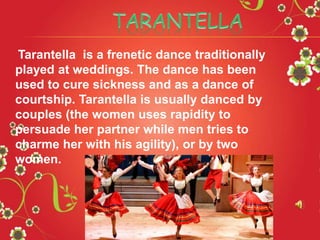
Tarantella is a frenetic dance traditionally
played at weddings. The dance has been
used to cure sickness and as a dance of
courtship. Tarantella is usually danced by
couples (the women uses rapidity to
persuade her partner while men tries to
charme her with his agility), or by two
women.
This dance has a long history, in fact we have
three possible origins:
1. The first originates with the bite of the
Tarantula, Arania or Apulcian Spider.
2. The second origin lies in the religious story of
the St. Vitus Dance which is commonly
referred to the outbreak of dancing in the
Middle Ages.
3. The third origin is related to the villages of
Toranto and Tarantum.
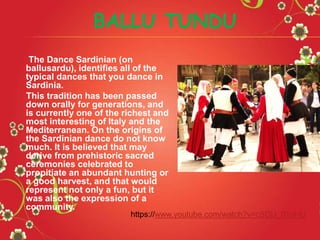
The Dance Sardinian (on
ballusardu), identifies all of the
typical dances that you dance in
Sardinia.
This tradition has been passed
down orally for generations, and
is currently one of the richest and
most interesting of Italy and the
Mediterranean. On the origins of
the Sardinian dance do not know
much. It is believed that may
derive from prehistoric sacred
ceremonies celebrated to
propitiate an abundant hunting or
a good harvest, and that would
represent not only a fun, but it
was also the expression of a
community.
BALLU TUNDU
https://www.youtube.com/watch?v=cSDjJ_0YaHU
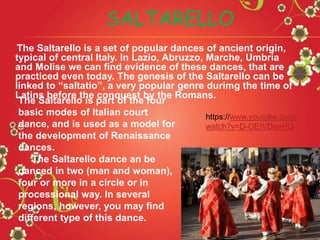
The Saltarello is a set of popular dances of ancient origin,
typical of central Italy. In Lazio, Abruzzo, Marche, Umbria
and Molise we can find evidence of these dances, that are
practiced even today. The genesis of the Saltarello can be
linked to “saltatio”, a very popular genre durimg the time of
Latins before the conquest by the Romans.
SALTARELLO
The Saltarello is part of the four
basic modes of Italian court
dance, and is used as a model for
the development of Renaissance
dances.
The Saltarello dance an be
danced in two (man and woman),
four or more in a circle or in
processional way. In several
regions, however, you may find
different type of this dance.
https://www.youtube.com/
watch?v=D-OEIVDeeHQ
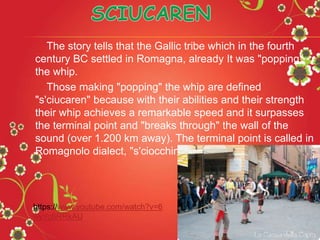
The story tells that the Gallic tribe which in the fourth
century BC settled in Romagna, already It was "popping"
the whip.
Those making "popping" the whip are defined
"s'ciucaren" because with their abilities and their strength
their whip achieves a remarkable speed and it surpasses
the terminal point and "breaks through" the wall of the
sound (over 1.200 km away). The terminal point is called in
Romagnolo dialect, "s'ciocchino".
https://www.youtube.com/watch?v=6
wyYq6RRkAU
ROMAGNA MIA
 Romagna Mia is an italian song, written by
Secondo Casadei, and recorded in Milan, in
1954. The rythm is that of the waltz, and the
text tells about a man longing for his
homeland, Romagna. Become the Romagna
a 'national anthem', over time it has sold over
4 million copies
https://www.youtube.com/watch?v=5dBOHzCDdgw

ITALIAN FOLK DANCE

  • 1.
    Italian Folk Dancehas been an integral part of Italian culture for centuries. Dance has been a continuous thread in Italian life from Dante through the Renaissance.
  • 2.
    In Italy thereare a lot of type of Folk Dance in every region, in fact each place has its traditional and tipical dance. For example:  Puglia is famous for the Tarantella  Saltarello was born in Napoli but developed in Abruzzo, Molise, Lazio and Marche  In Sardegna the typical dance is the Ballu Tundu  The traditional dance of Romagna is Sciucaren
  • 3.
    Tarantella is afrenetic dance traditionally played at weddings. The dance has been used to cure sickness and as a dance of courtship. Tarantella is usually danced by couples (the women uses rapidity to persuade her partner while men tries to charme her with his agility), or by two women.
  • 4.
    This dance hasa long history, in fact we have three possible origins: 1. The first originates with the bite of the Tarantula, Arania or Apulcian Spider. 2. The second origin lies in the religious story of the St. Vitus Dance which is commonly referred to the outbreak of dancing in the Middle Ages. 3. The third origin is related to the villages of Toranto and Tarantum.
  • 5.
    The Dance Sardinian(on ballusardu), identifies all of the typical dances that you dance in Sardinia. This tradition has been passed down orally for generations, and is currently one of the richest and most interesting of Italy and the Mediterranean. On the origins of the Sardinian dance do not know much. It is believed that may derive from prehistoric sacred ceremonies celebrated to propitiate an abundant hunting or a good harvest, and that would represent not only a fun, but it was also the expression of a community. BALLU TUNDU https://www.youtube.com/watch?v=cSDjJ_0YaHU
  • 6.
    The Saltarello isa set of popular dances of ancient origin, typical of central Italy. In Lazio, Abruzzo, Marche, Umbria and Molise we can find evidence of these dances, that are practiced even today. The genesis of the Saltarello can be linked to “saltatio”, a very popular genre durimg the time of Latins before the conquest by the Romans. SALTARELLO The Saltarello is part of the four basic modes of Italian court dance, and is used as a model for the development of Renaissance dances. The Saltarello dance an be danced in two (man and woman), four or more in a circle or in processional way. In several regions, however, you may find different type of this dance. https://www.youtube.com/ watch?v=D-OEIVDeeHQ
  • 7.
    The story tellsthat the Gallic tribe which in the fourth century BC settled in Romagna, already It was "popping" the whip. Those making "popping" the whip are defined "s'ciucaren" because with their abilities and their strength their whip achieves a remarkable speed and it surpasses the terminal point and "breaks through" the wall of the sound (over 1.200 km away). The terminal point is called in Romagnolo dialect, "s'ciocchino". https://www.youtube.com/watch?v=6 wyYq6RRkAU
  • 8.
    ROMAGNA MIA  RomagnaMia is an italian song, written by Secondo Casadei, and recorded in Milan, in 1954. The rythm is that of the waltz, and the text tells about a man longing for his homeland, Romagna. Become the Romagna a 'national anthem', over time it has sold over 4 million copies https://www.youtube.com/watch?v=5dBOHzCDdgw