“An Exploration of the Effectiveness
of the use of Communication Apps
through Mobile Devices on children
with Autism Spectrum Disorders
(ASD)”
Ms. Miriam O’ Sullivan
Institute of Technology Tralee
Principal Supervisor: Dr. Tom Farrelly (Institute of Technology Tralee)
Co-Supervisor: Mr. Peter Given (Institute of Technology Tralee)
NANO NAGLE SCHOOL
LISTOWEL
Context- Glossary of terms:
• Autism Spectrum Disorder (ASD):
• Complex neurological disorder (Bluestone, 2005).
• Effects social, communication and behaviour skills.
• Heterogeneous condition.
• Picture Exchange Communication System (P.E.C.S.) (Frost and Bondy, 2012).
• Mobile devices:
• Smartphones, Tablets, iPad, iPod, iPhone.
• Communication Apps:
• Seven categories
• Examples include: Proloquo2go, Grace, LetMeTalk, Voice4u, etc.
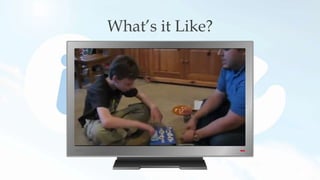
What’s it Like?
Research Questions
Do the children show preference to using the mobile device as
opposed to the folder?
Is the child independent in managing the vocabulary library?
What effects has the use of the Communication App and mobile
device had on a child’s life in relation to home, school and the
community?
There’s already an App for that-
Reinventing the wheel!
The Literature Review: When and How?
• Current research:
• Availability (Stokes, 2011; De Leo et al., 2010; Winograd, 2010).
• Sources.
• Design methodology.
• Development of Communication Apps that are currently available:
• Software developers (McEwen, 2014).
• Parents of children with ASD.
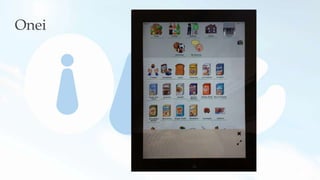
• Onei was developed by a Social Care Professional in partnership with a school
for children with Special Needs (Nano Nagle School Listowel) – an emphasis on
empirical evidence.
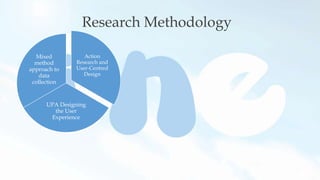
Research Methodology
Action
Research and
User-Centred
Design
UPA Designing
the User
Experience
Mixed
method
approach to
data
collection
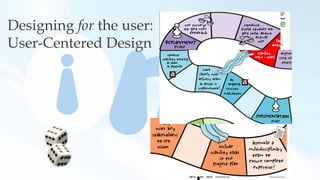
Designing for the user:
User-Centered Design
Technical and Procedural Aspects of Data
Collection & Analysis
• Participant Profile
• Interviews
• Staff (Classroom teachers and Speech and Language Therapists)
• Parents
• Observations
• Informal
• Formal- Autism Treatment Evaluation Checklist (Autism Research Institute)
• Focus Group
• Questionnaires
• Staff
• Parents
Results/Findings to date:
• User requirements:
• Sensory processing (Hatch-Rasmussen, 2015; Sensory Processing Disorder
Foundation, 2015).
• Motor skills (Hayes et al., 2010).
• App features.
• Current use of mobile devices:
• Availability of mobile devices in Ireland (Eircom Household Sentiment Survey,
2013).
• Effects of using Apps and mobile devices on children with ASD (Quillen, 2011;
Bradshaw, 2013; De Leo et al., 2010; McEwen, 2014).
• Initial findings from field research are encouraging.
• Development of frameworks for building with children with ASD
as opposed to for children with ASD.
Onei
Next Steps
• Presentation of findings to stakeholders (Thursday 17th December 2015).
• Completion of data analysis (January 2016).
• Collaborations with the Department of Educational Technology in Trinity
College Dublin Completion and submitting of dissertation (May 2016).
• Potential collaboration with Fanshawe College, Ontario, Canada-
International dimension to the research. Possible implementation with
adults with ASD.
• Presentation at Social Care Ireland Conference.
• Journal article for the Irish Journal of Social Care.
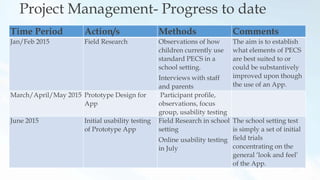
Project Management- Progress to date
Time Period Action/s Methods Comments
Jan/Feb 2015 Field Research Observations of how
children currently use
standard PECS in a
school setting.
Interviews with staff
and parents
The aim is to establish
what elements of PECS
are best suited to or
could be substantively
improved upon though
the use of an App.
March/April/May 2015 Prototype Design for
App
Participant profile,
observations, focus
group, usability testing
June 2015 Initial usability testing
of Prototype App
Field Research in school
setting
Online usability testing
in July
The school setting test
is simply a set of initial
field trials
concentrating on the
general ‘look and feel’
of the App.
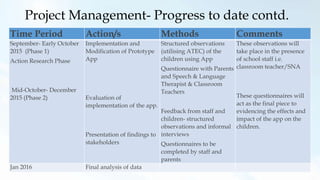
Project Management- Progress to date contd.
Time Period Action/s Methods Comments
September- Early October
2015 (Phase 1)
Action Research Phase
Mid-October- December
2015 (Phase 2)
Implementation and
Modification of Prototype
App
Evaluation of
implementation of the app.
Presentation of findings to
stakeholders
Structured observations
(utilising ATEC) of the
children using App
Questionnaire with Parents
and Speech & Language
Therapist & Classroom
Teachers
Feedback from staff and
children- structured
observations and informal
interviews
Questionnaires to be
completed by staff and
parents
These observations will
take place in the presence
of school staff i.e.
classroom teacher/SNA
These questionnaires will
act as the final piece to
evidencing the effects and
impact of the app on the
children.
Jan 2016 Final analysis of data
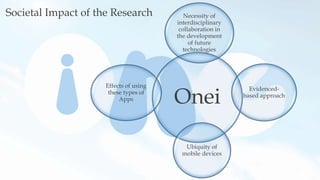
Onei
Necessity of
interdisciplinary
collaboration in
the development
of future
technologies
Evidenced-
based approach
Ubiquity of
mobile devices
Effects of using
these types of
Apps
Societal Impact of the Research
Bríd-Ann O’ Connor,
Reflexologist,
086-1018513
Mr. Ted Kenny,
Scartaglen
Millstreet Motor FactorsVincent Murphy Sports, Castleisland

IT Tralee Colloquium presentation

  • 1.
    “An Exploration ofthe Effectiveness of the use of Communication Apps through Mobile Devices on children with Autism Spectrum Disorders (ASD)” Ms. Miriam O’ Sullivan Institute of Technology Tralee Principal Supervisor: Dr. Tom Farrelly (Institute of Technology Tralee) Co-Supervisor: Mr. Peter Given (Institute of Technology Tralee) NANO NAGLE SCHOOL LISTOWEL
  • 2.
    Context- Glossary ofterms: • Autism Spectrum Disorder (ASD): • Complex neurological disorder (Bluestone, 2005). • Effects social, communication and behaviour skills. • Heterogeneous condition. • Picture Exchange Communication System (P.E.C.S.) (Frost and Bondy, 2012). • Mobile devices: • Smartphones, Tablets, iPad, iPod, iPhone. • Communication Apps: • Seven categories • Examples include: Proloquo2go, Grace, LetMeTalk, Voice4u, etc.
  • 3.
  • 4.
    Research Questions Do thechildren show preference to using the mobile device as opposed to the folder? Is the child independent in managing the vocabulary library? What effects has the use of the Communication App and mobile device had on a child’s life in relation to home, school and the community?
  • 5.
    There’s already anApp for that- Reinventing the wheel!
  • 6.
    The Literature Review:When and How? • Current research: • Availability (Stokes, 2011; De Leo et al., 2010; Winograd, 2010). • Sources. • Design methodology. • Development of Communication Apps that are currently available: • Software developers (McEwen, 2014). • Parents of children with ASD. • Onei was developed by a Social Care Professional in partnership with a school for children with Special Needs (Nano Nagle School Listowel) – an emphasis on empirical evidence.
  • 7.
    Research Methodology Action Research and User-Centred Design UPADesigning the User Experience Mixed method approach to data collection
  • 8.
    Designing for theuser: User-Centered Design
  • 9.
    Technical and ProceduralAspects of Data Collection & Analysis • Participant Profile • Interviews • Staff (Classroom teachers and Speech and Language Therapists) • Parents • Observations • Informal • Formal- Autism Treatment Evaluation Checklist (Autism Research Institute) • Focus Group • Questionnaires • Staff • Parents
  • 10.
    Results/Findings to date: •User requirements: • Sensory processing (Hatch-Rasmussen, 2015; Sensory Processing Disorder Foundation, 2015). • Motor skills (Hayes et al., 2010). • App features. • Current use of mobile devices: • Availability of mobile devices in Ireland (Eircom Household Sentiment Survey, 2013). • Effects of using Apps and mobile devices on children with ASD (Quillen, 2011; Bradshaw, 2013; De Leo et al., 2010; McEwen, 2014). • Initial findings from field research are encouraging. • Development of frameworks for building with children with ASD as opposed to for children with ASD.
  • 11.
  • 12.
    Next Steps • Presentationof findings to stakeholders (Thursday 17th December 2015). • Completion of data analysis (January 2016). • Collaborations with the Department of Educational Technology in Trinity College Dublin Completion and submitting of dissertation (May 2016). • Potential collaboration with Fanshawe College, Ontario, Canada- International dimension to the research. Possible implementation with adults with ASD. • Presentation at Social Care Ireland Conference. • Journal article for the Irish Journal of Social Care.
  • 13.
    Project Management- Progressto date Time Period Action/s Methods Comments Jan/Feb 2015 Field Research Observations of how children currently use standard PECS in a school setting. Interviews with staff and parents The aim is to establish what elements of PECS are best suited to or could be substantively improved upon though the use of an App. March/April/May 2015 Prototype Design for App Participant profile, observations, focus group, usability testing June 2015 Initial usability testing of Prototype App Field Research in school setting Online usability testing in July The school setting test is simply a set of initial field trials concentrating on the general ‘look and feel’ of the App.
  • 14.
    Project Management- Progressto date contd. Time Period Action/s Methods Comments September- Early October 2015 (Phase 1) Action Research Phase Mid-October- December 2015 (Phase 2) Implementation and Modification of Prototype App Evaluation of implementation of the app. Presentation of findings to stakeholders Structured observations (utilising ATEC) of the children using App Questionnaire with Parents and Speech & Language Therapist & Classroom Teachers Feedback from staff and children- structured observations and informal interviews Questionnaires to be completed by staff and parents These observations will take place in the presence of school staff i.e. classroom teacher/SNA These questionnaires will act as the final piece to evidencing the effects and impact of the app on the children. Jan 2016 Final analysis of data
  • 15.
    Onei Necessity of interdisciplinary collaboration in thedevelopment of future technologies Evidenced- based approach Ubiquity of mobile devices Effects of using these types of Apps Societal Impact of the Research
  • 16.
    Bríd-Ann O’ Connor, Reflexologist, 086-1018513 Mr.Ted Kenny, Scartaglen Millstreet Motor FactorsVincent Murphy Sports, Castleisland

Editor's Notes

  • #4 https://www.youtube.com/watch?v=OKQdMH7Wiok
  • #7 Availability: small scale research (6 participants is the largest study I have found). Sources: America and Australia. Design Methodology: advertises participatory research; however, participants are not the instigators of the research and parents and professionals are used as proxy’s to represent participants.
  • #8 Different disciplines hold different preference for methodologies. Cohen states “not method bound”- this research is open and considers methods from different disciplines.
  • #9 Magain (2013) states that “experimenting with new techniques and tweaking old favourites is part of the fun of being a UX Designer”
  • #10 Focus on observations and focus groups.