Arjun Park
New Delhi-110043
NAME: NITIN JHA
CLASS: 10th
ROLL NO. 10101
SEC. A SUBMITTED TO: ROHIT SIR
SUBJECT: I.T
U
N
I
T
COMMUNICATION
SKILLS
Session 1
Methods and Types of Communication
Session 2
Feedback in Communication
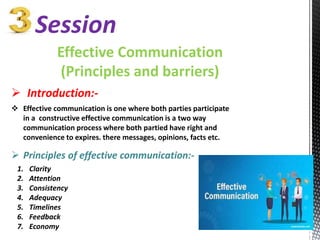
Session 3
Effective Communication
Session
Methods and Types of
Communication
Communication:-
Communication means being able to tell others people what you want to say
and this can be done in many ways
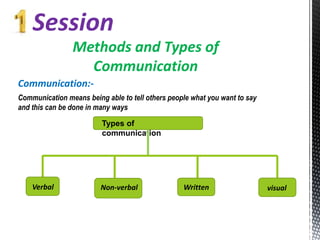
Types of
communication
Verbal Written
Non-verbal visual
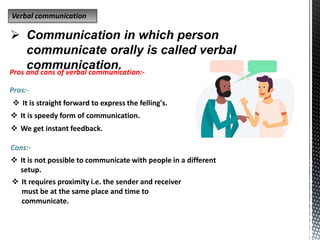
Verbal communication
 Communication in which person
communicate orally is called verbal
communication.
Pros and cons of verbal communication:-
Pros:-
 It is straight forward to express the felling's.
 It is speedy form of communication.
 We get instant feedback.
Cons:-
 It is not possible to communicate with people in a different
setup.
 It requires proximity i.e. the sender and receiver
must be at the same place and time to
communicate.
Non-verbal communication
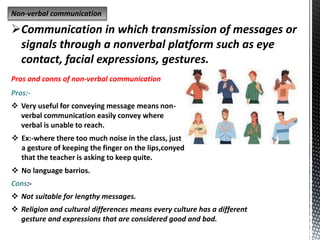
Communication in which transmission of messages or
signals through a nonverbal platform such as eye
contact, facial expressions, gestures.
Pros and conns of non-verbal communication
 Very useful for conveying message means non-
verbal communication easily convey where
verbal is unable to reach.
Pros:-
 Ex:-where there too much noise in the class, just
a gesture of keeping the finger on the lips,conyed
that the teacher is asking to keep quite.
 No language barrios.
Cons:-
 Not suitable for lengthy messages.
 Religion and cultural differences means every culture has a different
gesture and expressions that are considered good and bad.
Written communication
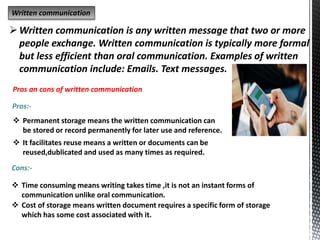
Written communication is any written message that two or more
people exchange. Written communication is typically more formal
but less efficient than oral communication. Examples of written
communication include: Emails. Text messages.
Pros an cons of written communication
Pros:-
 Permanent storage means the written communication can
be stored or record permanently for later use and reference.
 It facilitates reuse means a written or documents can be
reused,dublicated and used as many times as required.
Cons:-
 Time consuming means writing takes time ,it is not an instant forms of
communication unlike oral communication.
 Cost of storage means written document requires a specific form of storage
which has some cost associated with it.
Visual communication
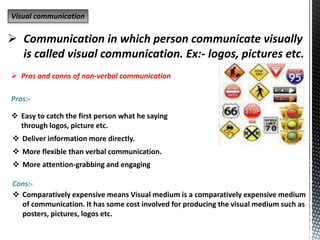
 Communication in which person communicate visually
is called visual communication. Ex:- logos, pictures etc.
 Pros and conns of non-verbal communication
Pros:-
Cons:-
 Easy to catch the first person what he saying
through logos, picture etc.
 Deliver information more directly.
 More flexible than verbal communication.
 More attention-grabbing and engaging
 Comparatively expensive means Visual medium is a comparatively expensive medium
of communication. It has some cost involved for producing the visual medium such as
posters, pictures, logos etc.
Session
Feedback in
Communication
 Feedback:-
 Information or comments about something that you have done which tells you
how good or bad it is
Types of feedback
Formal feedback Informal feedback Descriptive feedback
Non-Descriptive
feedback
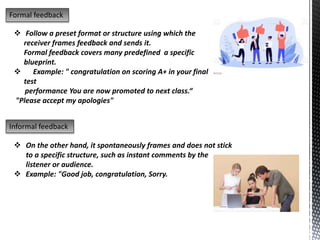
Formal feedback
 Follow a preset format or structure using which the
receiver frames feedback and sends it.
Formal feedback covers many predefined a specific
blueprint.
 Example: " congratulation on scoring A+ in your final
test
performance You are now promoted to next class.“
"Please accept my apologies"
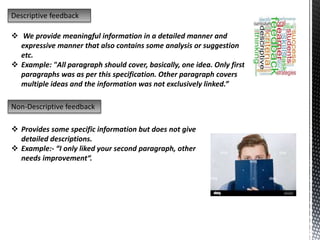
Informal feedback
 On the other hand, it spontaneously frames and does not stick
to a specific structure, such as instant comments by the
listener or audience.
 Example: "Good job, congratulation, Sorry.
Descriptive feedback
 We provide meaningful information in a detailed manner and
expressive manner that also contains some analysis or suggestion
etc.
 Example: "All paragraph should cover, basically, one idea. Only first
paragraphs was as per this specification. Other paragraph covers
multiple ideas and the information was not exclusively linked.”
Non-Descriptive feedback
 Provides some specific information but does not give
detailed descriptions.
 Example:- “I only liked your second paragraph, other
needs improvement“.
 Characteristics of feedback:-
1. Specific. Feedback must be concrete and relate to a specific,
measurable performance goal.
2. Timely.
3. Appropriate.
4. Focus on behavior, not personality.
5. Proactive.
6. Given using descriptive language.
7. Not given using judgmental language.
8. Based on accurate and credible information.
 Meaning and importance of feedback
 Communication has the following elements:-
1. A sender or massager / the communication starter or initiator.
2. Message/information being sent / information/messages being conveyed or
transferred.
3. Encode (format or structure of messenger) spoken words/pictures/test etc.
4. Communication channel medium of communication.
5. Decoding:- Understanding the meaning of the message received through a
certain medium.
6. Feedback:- Intimation about successful delivery of message.
Feedback is very important in communication as it ensures that the message
has been successfully conveyed and the communication effectively successful.
Session
Effective Communication
(Principles and barriers)
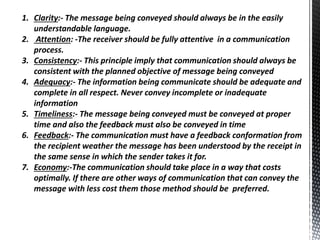
 Effective communication is one where both parties participate
in a constructive effective communication is a two way
communication process where both partied have right and
convenience to expires. there messages, opinions, facts etc.
 Introduction:-
 Principles of effective communication:-
1. Clarity
2. Attention
3. Consistency
4. Adequacy
5. Timelines
6. Feedback
7. Economy
1. Clarity:- The message being conveyed should always be in the easily
understandable language.
2. Attention: -The receiver should be fully attentive in a communication
process.
3. Consistency:- This principle imply that communication should always be
consistent with the planned objective of message being conveyed
4. Adequacy:- The information being communicate should be adequate and
complete in all respect. Never convey incomplete or inadequate
information
5. Timeliness:- The message being conveyed must be conveyed at proper
time and also the feedback must also be conveyed in time
6. Feedback:- The communication must have a feedback conformation from
the recipient weather the message has been understood by the receipt in
the same sense in which the sender takes it for.
7. Economy:-The communication should take place in a way that costs
optimally. If there are other ways of communication that can convey the
message with less cost them those method should be preferred.
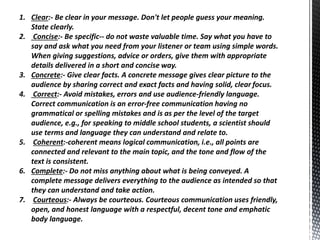
7C’s of Effective communication:-
1. Clear:- Be clear in your message. Don't let people guess your meaning.
State clearly.
2. Concise:- Be specific-- do not waste valuable time. Say what you have to
say and ask what you need from your listener or team using simple words.
When giving suggestions, advice or orders, give them with appropriate
details delivered in a short and concise way.
3. Concrete:- Give clear facts. A concrete message gives clear picture to the
audience by sharing correct and exact facts and having solid, clear focus.
4. Correct:- Avoid mistakes, errors and use audience-friendly language.
Correct communication is an error-free communication having no
grammatical or spelling mistakes and is as per the level of the target
audience, e.g., for speaking to middle school students, a scientist should
use terms and language they can understand and relate to.
5. Coherent:-coherent means logical communication, i.e., all points are
connected and relevant to the main topic, and the tone and flow of the
text is consistent.
6. Complete:- Do not miss anything about what is being conveyed. A
complete message delivers everything to the audience as intended so that
they can understand and take action.
7. Courteous:- Always be courteous. Courteous communication uses friendly,
open, and honest language with a respectful, decent tone and emphatic
body language.
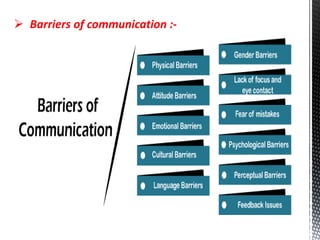
 Barriers of communication :-
1. Linguistic Barrier (Lingual factors):- Language can be a barrier to effective
responsible For example, a Spanish man who only speaks and understands
Spanish, would not be able to interact with an Indian woman who is
only familiar with Hindi.
2. Physical Barrier (Environmental Distractions):- If your surroundings do not
support proper communication, it can also act as a barrier to appropriate
interaction. You would not be able to understand what your friend is saying
if we both are at a rock concert due to the noise coming from the
surrounding.
3. Cultural barrier:- sometimes, our cultural differences hinder us from
communicatigon properly. For instance, in North America, it is okay to touch
children on their heads while in Asia, it is considered highly inappropriate
and is not accepted to all.
4. Interpersonal barrier:-it refers to the situations when the intended message
is received incorrectly because of many personal reasons such as.
IT project class 10

IT project class 10

  • 1.
    Arjun Park New Delhi-110043 NAME:NITIN JHA CLASS: 10th ROLL NO. 10101 SEC. A SUBMITTED TO: ROHIT SIR SUBJECT: I.T
  • 2.
    U N I T COMMUNICATION SKILLS Session 1 Methods andTypes of Communication Session 2 Feedback in Communication Session 3 Effective Communication
  • 3.
    Session Methods and Typesof Communication Communication:- Communication means being able to tell others people what you want to say and this can be done in many ways Types of communication Verbal Written Non-verbal visual
  • 4.
    Verbal communication  Communicationin which person communicate orally is called verbal communication. Pros and cons of verbal communication:- Pros:-  It is straight forward to express the felling's.  It is speedy form of communication.  We get instant feedback. Cons:-  It is not possible to communicate with people in a different setup.  It requires proximity i.e. the sender and receiver must be at the same place and time to communicate.
  • 5.
    Non-verbal communication Communication inwhich transmission of messages or signals through a nonverbal platform such as eye contact, facial expressions, gestures. Pros and conns of non-verbal communication  Very useful for conveying message means non- verbal communication easily convey where verbal is unable to reach. Pros:-  Ex:-where there too much noise in the class, just a gesture of keeping the finger on the lips,conyed that the teacher is asking to keep quite.  No language barrios. Cons:-  Not suitable for lengthy messages.  Religion and cultural differences means every culture has a different gesture and expressions that are considered good and bad.
  • 6.
    Written communication Written communicationis any written message that two or more people exchange. Written communication is typically more formal but less efficient than oral communication. Examples of written communication include: Emails. Text messages. Pros an cons of written communication Pros:-  Permanent storage means the written communication can be stored or record permanently for later use and reference.  It facilitates reuse means a written or documents can be reused,dublicated and used as many times as required. Cons:-  Time consuming means writing takes time ,it is not an instant forms of communication unlike oral communication.  Cost of storage means written document requires a specific form of storage which has some cost associated with it.
  • 7.
    Visual communication  Communicationin which person communicate visually is called visual communication. Ex:- logos, pictures etc.  Pros and conns of non-verbal communication Pros:- Cons:-  Easy to catch the first person what he saying through logos, picture etc.  Deliver information more directly.  More flexible than verbal communication.  More attention-grabbing and engaging  Comparatively expensive means Visual medium is a comparatively expensive medium of communication. It has some cost involved for producing the visual medium such as posters, pictures, logos etc.
  • 8.
    Session Feedback in Communication  Feedback:- Information or comments about something that you have done which tells you how good or bad it is Types of feedback Formal feedback Informal feedback Descriptive feedback Non-Descriptive feedback
  • 9.
    Formal feedback  Followa preset format or structure using which the receiver frames feedback and sends it. Formal feedback covers many predefined a specific blueprint.  Example: " congratulation on scoring A+ in your final test performance You are now promoted to next class.“ "Please accept my apologies" Informal feedback  On the other hand, it spontaneously frames and does not stick to a specific structure, such as instant comments by the listener or audience.  Example: "Good job, congratulation, Sorry.
  • 10.
    Descriptive feedback  Weprovide meaningful information in a detailed manner and expressive manner that also contains some analysis or suggestion etc.  Example: "All paragraph should cover, basically, one idea. Only first paragraphs was as per this specification. Other paragraph covers multiple ideas and the information was not exclusively linked.” Non-Descriptive feedback  Provides some specific information but does not give detailed descriptions.  Example:- “I only liked your second paragraph, other needs improvement“.
  • 11.
     Characteristics offeedback:- 1. Specific. Feedback must be concrete and relate to a specific, measurable performance goal. 2. Timely. 3. Appropriate. 4. Focus on behavior, not personality. 5. Proactive. 6. Given using descriptive language. 7. Not given using judgmental language. 8. Based on accurate and credible information.
  • 12.
     Meaning andimportance of feedback  Communication has the following elements:- 1. A sender or massager / the communication starter or initiator. 2. Message/information being sent / information/messages being conveyed or transferred. 3. Encode (format or structure of messenger) spoken words/pictures/test etc. 4. Communication channel medium of communication. 5. Decoding:- Understanding the meaning of the message received through a certain medium. 6. Feedback:- Intimation about successful delivery of message. Feedback is very important in communication as it ensures that the message has been successfully conveyed and the communication effectively successful.
  • 13.
    Session Effective Communication (Principles andbarriers)  Effective communication is one where both parties participate in a constructive effective communication is a two way communication process where both partied have right and convenience to expires. there messages, opinions, facts etc.  Introduction:-  Principles of effective communication:- 1. Clarity 2. Attention 3. Consistency 4. Adequacy 5. Timelines 6. Feedback 7. Economy
  • 14.
    1. Clarity:- Themessage being conveyed should always be in the easily understandable language. 2. Attention: -The receiver should be fully attentive in a communication process. 3. Consistency:- This principle imply that communication should always be consistent with the planned objective of message being conveyed 4. Adequacy:- The information being communicate should be adequate and complete in all respect. Never convey incomplete or inadequate information 5. Timeliness:- The message being conveyed must be conveyed at proper time and also the feedback must also be conveyed in time 6. Feedback:- The communication must have a feedback conformation from the recipient weather the message has been understood by the receipt in the same sense in which the sender takes it for. 7. Economy:-The communication should take place in a way that costs optimally. If there are other ways of communication that can convey the message with less cost them those method should be preferred.
  • 15.
    7C’s of Effectivecommunication:-
  • 16.
    1. Clear:- Beclear in your message. Don't let people guess your meaning. State clearly. 2. Concise:- Be specific-- do not waste valuable time. Say what you have to say and ask what you need from your listener or team using simple words. When giving suggestions, advice or orders, give them with appropriate details delivered in a short and concise way. 3. Concrete:- Give clear facts. A concrete message gives clear picture to the audience by sharing correct and exact facts and having solid, clear focus. 4. Correct:- Avoid mistakes, errors and use audience-friendly language. Correct communication is an error-free communication having no grammatical or spelling mistakes and is as per the level of the target audience, e.g., for speaking to middle school students, a scientist should use terms and language they can understand and relate to. 5. Coherent:-coherent means logical communication, i.e., all points are connected and relevant to the main topic, and the tone and flow of the text is consistent. 6. Complete:- Do not miss anything about what is being conveyed. A complete message delivers everything to the audience as intended so that they can understand and take action. 7. Courteous:- Always be courteous. Courteous communication uses friendly, open, and honest language with a respectful, decent tone and emphatic body language.
  • 17.
     Barriers ofcommunication :-
  • 18.
    1. Linguistic Barrier(Lingual factors):- Language can be a barrier to effective responsible For example, a Spanish man who only speaks and understands Spanish, would not be able to interact with an Indian woman who is only familiar with Hindi. 2. Physical Barrier (Environmental Distractions):- If your surroundings do not support proper communication, it can also act as a barrier to appropriate interaction. You would not be able to understand what your friend is saying if we both are at a rock concert due to the noise coming from the surrounding. 3. Cultural barrier:- sometimes, our cultural differences hinder us from communicatigon properly. For instance, in North America, it is okay to touch children on their heads while in Asia, it is considered highly inappropriate and is not accepted to all. 4. Interpersonal barrier:-it refers to the situations when the intended message is received incorrectly because of many personal reasons such as.