Communication Skills-II
Communication- Itis the process of sharing thoughts and ideas or the process of sending and receiving messages
through different means such as speaking, writing, body language, signs or symbols, etc.
Methods/ Types of Communication-
1. Verbal Communication- Communication where words are involved. Ex. Spoken or written form of communication.
2. Non-verbal Communication- Body language, Gestures, and tone and pitch of voice.
3. Visual Communication- Logos, maps, charts, graphs, etc.
Verbal Communication
It is the sharing of ideas, thoughts, or information using spoken or written words. There are two types of verbal
communication-
1. Oral Communication- It is the process of expressing ideas or information through spoken words, either face-
to-face or through devices.
2. Written Communication- It is the sharing of information using written words, like letters, emails, or messages.
Advantages of Verbal Communication-
1. It saves time.
2. A more reliable method of communication.
3. It expresses emotion.
Disadvantages of Verbal Communication-
1. Spoken words are not saved, so important details may be forgotten.
2. In noisy places or over long distances, it may not work well.
3. Tone or words may be unclear, leading to confusion.
Non-Verbal Communication
Non-verbal communication is the way people share messages without speaking, using body language, facial
expressions, gestures, or eye contact.
Example: Nodding your head to say "yes" or smiling to show happiness.
Advantages of Non-Verbal Communication-
1. Quick Understanding of messages.
2. People from different languages can understand signs like smiles or hand signals.
Disadvantages of Non-Verbal Communication-
1. Can Be Misunderstood.
2. It cannot explain complex ideas.
Visual Communication
It is the sharing of information using images, symbols, charts, or presentations instead of words.
Example: Traffic signs, emojis, and graphs that explain data.
Advantages of Visual Communication-
1. It is easy to understand.
2. It grabs attention and makes information more interesting.
Disadvantages of Visual Communication-
1. It cannot provide information in detail.
2. Drawing pictures, graph, etc. require technique and are expensive.
2.
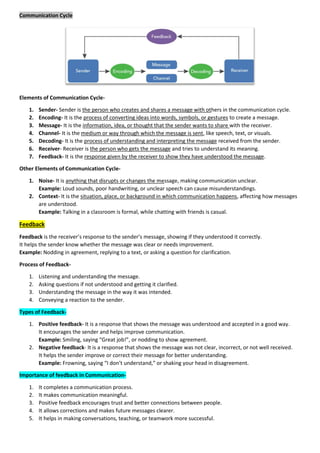
Communication Cycle
Elements ofCommunication Cycle-
1. Sender- Sender is the person who creates and shares a message with others in the communication cycle.
2. Encoding- It is the process of converting ideas into words, symbols, or gestures to create a message.
3. Message- It is the information, idea, or thought that the sender wants to share with the receiver.
4. Channel- It is the medium or way through which the message is sent, like speech, text, or visuals.
5. Decoding- It is the process of understanding and interpreting the message received from the sender.
6. Receiver- Receiver is the person who gets the message and tries to understand its meaning.
7. Feedback- It is the response given by the receiver to show they have understood the message.
Other Elements of Communication Cycle-
1. Noise- It is anything that disrupts or changes the message, making communication unclear.
Example: Loud sounds, poor handwriting, or unclear speech can cause misunderstandings.
2. Context- It is the situation, place, or background in which communication happens, affecting how messages
are understood.
Example: Talking in a classroom is formal, while chatting with friends is casual.
Feedback
Feedback is the receiver’s response to the sender’s message, showing if they understood it correctly.
It helps the sender know whether the message was clear or needs improvement.
Example: Nodding in agreement, replying to a text, or asking a question for clarification.
Process of Feedback-
1. Listening and understanding the message.
2. Asking questions if not understood and getting it clarified.
3. Understanding the message in the way it was intended.
4. Conveying a reaction to the sender.
Types of Feedback-
1. Positive feedback- It is a response that shows the message was understood and accepted in a good way.
It encourages the sender and helps improve communication.
Example: Smiling, saying “Great job!”, or nodding to show agreement.
2. Negative feedback- It is a response that shows the message was not clear, incorrect, or not well received.
It helps the sender improve or correct their message for better understanding.
Example: Frowning, saying “I don’t understand,” or shaking your head in disagreement.
Importance of feedback in Communication-
1. It completes a communication process.
2. It makes communication meaningful.
3. Positive feedback encourages trust and better connections between people.
4. It allows corrections and makes future messages clearer.
5. It helps in making conversations, teaching, or teamwork more successful.
3.
Communication Barriers
It isanything that blocks or distorts a message, making it hard to understand.
Example: Noise, different languages, or unclear words can cause misunderstandings.
Types of Communication Barriers-
1. Physical Barrier – Obstacles like noise, distance, or poor internet that block communication.
2. Language Barrier – Differences in language or unclear words that make understanding difficult.
3. Emotional Barrier – Feelings like fear, anger, or stress that affect how messages are received.
4. Gender Barrier – Differences in communication styles between men and women that may lead to
misunderstandings
5. Attitudinal Barrier – A person’s mindset, like arrogance or lack of interest, that affects clear communication
Measures to Overcome Communication Barriers-
1. Remove Distractions – Reduce noise, interruptions, or technical issues while communicating.
2. Use Simple Language – Speak or write in clear and easy-to-understand words.
3. Active Listening – Pay full attention and respond to show understanding.
4. Be Open-Minded – Respect different opinions, cultures, and emotions for better understanding.
Principles of Effective Communication-
Effective communication is the clear and accurate sharing of ideas, thoughts, or information so the receiver fully
understands the message. It includes speaking, listening, and using the right words, tone, and body language.
Seven Principles of Effective Communication-
1. Principle of Clarity – Use simple and clear words so the message is easy to understand.
2. Principle of Objective- It means the message should have a clear purpose and goal to achieve the desired
result.
3. Principle of Understanding – The message should be clear so the receiver understands it easily.
4. Principle of Consistency- It means the message should match previous statements, beliefs, and actions to
avoid confusion.
5. Principle of Completeness – Provide all necessary details so the receiver gets the full message.
6. Principle of Feedback – The sender should check if the receiver understood the message correctly.
7. Principle of Time- Messages should be sent at the right time for effective impact.
Seven C’s of Effective Communication-
1. Clear – Use simple and clear words so the message is easily understood.
2. Concise– Keep the message short and to the point, avoiding unnecessary details.
3. Concrete – Use specific facts, examples, or visuals to make the message strong and clear.
4. Correct – Ensure the message is free from errors in grammar, facts, or spelling.
5. Coherent- Keep the communication simple so it is easy for the receiver to understand.
6. Complete – Provide all necessary details so the receiver fully understands the message.
7. Courteous – Be polite and respectful while communicating with others.
Four S’s of Effective Communication-
1. Shortness – Keep the message brief and to the point.
2. Simplicity – Use easy and clear words for better understanding.
3. Strength – Make the message strong with facts and confidence.
4. Sincerity – Be honest and genuine while communicating.



![[ACHETER UNE CARTE CLONE] ((Télégramme……+1(720)593–8347))](https://cdn.slidesharecdn.com/ss_thumbnails/businessanddevelopmentcommunicationnotes1updatedforbsc3credit-241021005846-086696e5-thumbnail.jpg?width=640&height=640&fit=bounds)


![[米国通貨売り出し中] ((Telegram......+1(720)593-8347))](https://cdn.slidesharecdn.com/ss_thumbnails/businessanddevelopmentcommunicationnotes1updatedforbsc3credit-240912003309-ee2d66d8-thumbnail.jpg?width=640&height=640&fit=bounds)


