IT AREAS
IT TRENDS
ROLES, TECHNOLOGIES AND TOOLS
IT FUNDAMENTALS
Ricardo Trujillo Rodríguez
IT Consultant and Scrum Master
SPEAKER
ricardo.trujillorodriguez@amaris.com
3
CONTENT
INTRODUCTION
IT AREAS
IT TRENDS
DIGITAL TRANSFORMATION
USER EXPERIENCE
IT DELIVERY
CLOUD COMPUTING
INFORMATION AND COMMUNICATION
CONSUMERIZATION OF IT
DATA
INTERNET OF THINGS
SMART CITIES
4
1 INTRODUCTION
This presentation aims to give an overview of the “big picture” of :
Current IT trends, explaining with some detail each one, to give a high level
approach to the present.
Where the future of IT is going, and where the major opportunities and
challenges are.
Professional IT Roles demanded by each of the areas / trends.
Technologies, processes and tools used and applied in the day to day of each
role.
5
2 IT AREAS
6
3 IT AREAS – SOFTWARE DEVELOPMENT
Is the process of requirements analysis, design, computer programming,
documenting, testing, and bug fixing involved in creating and maintaining
applications and frameworks involved in a software release life cycle and
resulting in a software product.
7
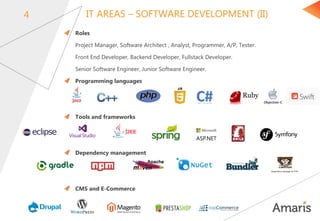
4 IT AREAS – SOFTWARE DEVELOPMENT (II)
Roles
Project Manager, Software Architect , Analyst, Programmer, A/P, Tester.
Front End Developer, Backend Developer, Fullstack Developer.
Senior Software Engineer, Junior Software Engineer.
Programming languages
Tools and frameworks
Dependency management
CMS and E-Commerce
8
5 IT AREAS – SYSTEMS ADMINISTRATION
Field of work in which someone manages one or more systems, be they
software, hardware, servers, workstations or appliances. Its goal is ensuring
the systems are running efficiently and effectively.
Roles
Systems Engineer, Systems administrator, Database administrator, Network
administrator, Security administrator, Communications administrator.
Operating Systems
Application and Web Servers
Databases
Networks and Communications
9
6 IT AREAS – PROJECT MANAGEMENT
Create and manage prioritized project portfolios in collaboration with
Sponsors, IT Architects, their partners in IT and business colleagues.
Roles
Project Sponsor, Program Manager, Project Manager
Tools
10
7 IT AREAS – BUSINESS INTELLIGENCE
Set of techniques and tools for the acquisition and transformation of raw
data into meaningful and useful information for business analysis purposes.
Roles
Tools (Suites)
11
8 IT AREAS – ARCHITECTURE
Composed of software experts who makes high-level design choices and
dictates technical standards, including software coding standards, tools, and
platforms.
Roles
Software Architect, Systems Architect, Enterprise Architect, Cloud Architect,
Solutions Architect.
Tools
12
9 IT AREAS – QUALITY ASSURANCE
Area that manages a way of preventing mistakes or defects in manufactured
products and avoiding problems when delivering solutions or services to
customers.
Roles
Software tester, Software test automator, Test lead, QA Engineer
Tools
13
10 IT AREAS – SECURITY
Area that ensures the defense of computers against intrusion and
unauthorized use of resources. Could use defensive and offensive security
capabilities.
Roles
Security Architect, Security Engineer, / Administrator, Security auditor, Ethical
Hacker, Security Software Developer.
Tools
SIEM : Network Security Monitoring , Security Information and Event
Management:
Patch management, data backup, and full disk encryption:
14
11 IT TRENDS
15
12 DIGITAL TRANSFORMATION
The digital challenge we face every day pushes companies to develop new
digital skills to survive and evolve in the market ahead of its competitors
and customers, and reduce costs and improve productivity internally.
Take advantage of digital opportunities requires companies applying models
more effective, rapid and agile management, ultimately function in a similar
way to a startup.
This improvement is achieved through the application of lean startup,
Government and Scaled Agile, address to Customer Development Portfolio
solutions.
Establishing a culture and environment where building, testing, and releasing
software, can happen rapidly, frequently, and more reliably.
16
13 DIGITAL TRANSFORMATION - ROLES
Users and Stakeholders
Agile coach
Scrum master
Product owner
Team members – UX / UI Designers, Software architects, Developers and Test
engineers with agile mindset
DevOps
17
14 DIGITAL TRANSFORMATION - TECHS
Agile reporting and metrics ,communication and project assessment tools
Tools and techs for continuous integration, delivery and deployment
18
15 DIGITAL TRANSFORMATION – CONSECUENCES (I)
From this
19
16 DIGITAL TRANSFORMATION – CONSECUENCES (II)
To this
20
17 USER EXPERIENCE
Mobile users and mobile usage are growing constantly. With more users doing
more on mobile, the spotlight is on how to improve the individual elements
that together create the mobile user experience.
To architect the experiences of tomorrow, you must first design the
interactions of today.
2015 was the year that UX disciples the world over proved themselves to be
the singular champions of free thought in design. (Slack example)
21
18 USER EXPERIENCE - ROLES
UX Evangelist / Researcher
UX Designer
UI Designer
Front End Developer / Mobile developer
Front End Architect / Mobile Architect
22
19 USER EXPERIENCE - TECHS
Mind maps, flow charts and sitemaps
Wireframes and prototypes
Programming languages
23
20 USER EXPERIENCE – TECHS (II)
Development frameworks
Development Tools
Mobile platforms, frameworks and tools
24
21 IT DELIVERY – VIRTUALIZATION
Virtualization refers to the act of creating a virtual (rather than physical) 
version of something, including virtual computer, hardware 
platforms, operating systems , storage devices, and computer network 
resources.
25
22 IT DELIVERY – CONTAINERIZATION
Automates the deployment of applications inside software containers.
Docker containers wrap up a piece of software in a complete filesystem that
contains everything it needs to run: code, runtime, system tools, system
libraries.
This guarantees that it will always run the same, regardless of the environment
it is running in.
26
23 IT DELIVERY – CLOUD COMPUTING
It’s the best example of the “Democratization of technology”
It’s  a  model  for  enabling  ubiquitous, on-demand access to a shared pool of
configurable computing resources (e.g., networks, servers, storage, applications 
and services)
Cloud  computing  comes  in  three  forms.  Depending  on  the  type  of  data  you're 
working with, you'll want to compare public, private, and hybrid clouds in terms of 
the different levels of security and management required.
27
24 CLOUD COMPUTING – DEPLOYMENT MODEL
Public cloud : The services and infrastructure are provided off-site over the
Internet. 
• Greatest level of efficiency in shared resources , more vulnerable.
Private cloud : one in which the services and infrastructure are maintained
on a private network. 
• Greatest level of security and control, require the company to still purchase 
and maintain all the software and infrastructure.
• Hybrid cloud  :  includes  a  variety  of  public  and  private  options  with  multiple 
providers.
Keep  each  aspect  at  your  business  in  the  most  efficient  environment 
possible.
28
25 CLOUD COMPUTING – SERVICE MODELS
Infrastructure as a service (IaaS): providers offering computing infrastructure 
– virtual machines and other resources – as a service to subscribers.
Platform as a service (PaaS): PaaS vendors offer a development environment 
to application developers. 
Software as a service (SaaS):  users gain access to application software and 
databases, cloud providers manage the infrastructure and platforms that run the 
applications.
Cloud Architecture example
29
26 CLOUD- ROLES
Cloud Solutions Engineer, Architect
Cloud developer
Cloud administrator
Cloud Support Analyst
Cloud Security
30
27 CLOUD- TECHS
IAAS Providers
PAAS Providers
SAAS Providers
Virtualization technologies
Programming Languages
31
28 INFORMATION AND COMMUNICATION
Mobile phones  technically  have  a  broader  reach  than  any  communications 
device,  social media has already surpassed that  workhorse  of  the  modern 
enterprise, e-mail.
The world is using social networks and other social media-based services to 
stay in touch, communicate, and collaborate.
The  higher  order  aspects  of  social  media  including  product development, 
customer care,  and  marketing  require  deeper  rethinking  of  business 
processes.
32
29 SOCIAL MEDIA - ROLES
Social Media Manager.
Community Manager.
Copywriter.
SEO Specialist (Search engine Optimization)
Online Marketer.
33
30 SOCIAL MEDIA - TECHS
Social Media Networks
CRM Software
Social Media management tools
SEO and Analytics Tools
34
31 CONSUMERIZATION OF IT
Cycle of information technology (IT) emerging in the consumer market, then
spreading to business and government organizations, largely because
employees are using the popular "consumer market" technologies and devices
at home and then introducing them in the workplace.
35
32 CONSUMERIZATION OF IT - APPLICATIONS
BYOD : Bring your own device
CYOD : Choose your own device
Tools
• MDM : Mobile Device management
• MAM : Mobile Application Management
• Enterprise App Stores
36
33 DATA
Businesses are drowning in data more than ever before, yet have surprisingly
little access to it. (Volume, Variety, Velocity)
Business cycles are growing shorter and shorter, making it necessary to "see"
the stream of new and existing business data and process it quickly enough
to make critical decisions
Big data = new technologies and techniques that can handle an order of magnitude or two more data
than enterprises are today, something existing RDBMS ( BI ) technology can't do it in a scalable manner or
cost-effectively.
Big data offers the promise of better ROI on valuable enterprise datasets while being able to tackle entirely
new business problems that were previously impossible to solve with existing technique.
37
34 BIG DATA – PIPELINE
38
35 BIG DATA – ROLES
Solutions architect: deals with setting up of the whole Hadoop architecture according to the needs of
the Company.
Systems Engineer: Similar to a systems administrator with some database administrator skill set and
strong skills managing a Hadoop (or appropriate framework) toolset. Must also have good scripting
capabilities.
Developer: Programming M/R algorithms with Java, Scala, Python, R, Prolog.
Data Scientist / Analyst: Extract knowledge or insights from data in various forms, either structured or
unstructured, which is a continuation of some of the data analysis fields such as statistics, data mining,
and predictive analytics, similar to Knowledge Discovery in Databases (KDD).
Business Analyst: is probably the least technical profile. However, compensates for this lack of technical
knowhow with a profound understanding of the various business processes that are in place.
39
36 BIG DATA – TECHS, INFRASTRUTURE AND APPS
40
37 BIG DATA – EXAMPLE
41
38 BIG DATA - AS A SERVICE
42
39 INTERNET OF THINGS
Network of physical devices, vehicles, buildings and other items—
embedded with electronics, software, sensors, and network connectivity that
enables these objects to collect and exchange data.
The IoT allows objects to be sensed and controlled remotely across existing
network infrastructure, creating opportunities for more direct integration of
the physical world into computer-based systems.
43
40 SMART CITIES
A smart city is an urban development vision to integrate multiple information and
communication technology (ICT) solutions in a secure fashion to manage a city’s assets.
The goal of building a smart city is to improve quality of life by using technology to
improve the efficiency of services and meet residents’ needs.
.
44
THANK YOU!

IT Fundamentals

  • 1.
    IT AREAS IT TRENDS ROLES,TECHNOLOGIES AND TOOLS IT FUNDAMENTALS
  • 2.
    Ricardo Trujillo Rodríguez ITConsultant and Scrum Master SPEAKER ricardo.trujillorodriguez@amaris.com
  • 3.
    3 CONTENT INTRODUCTION IT AREAS IT TRENDS DIGITALTRANSFORMATION USER EXPERIENCE IT DELIVERY CLOUD COMPUTING INFORMATION AND COMMUNICATION CONSUMERIZATION OF IT DATA INTERNET OF THINGS SMART CITIES
  • 4.
    4 1 INTRODUCTION This presentationaims to give an overview of the “big picture” of : Current IT trends, explaining with some detail each one, to give a high level approach to the present. Where the future of IT is going, and where the major opportunities and challenges are. Professional IT Roles demanded by each of the areas / trends. Technologies, processes and tools used and applied in the day to day of each role.
  • 5.
  • 6.
    6 3 IT AREAS– SOFTWARE DEVELOPMENT Is the process of requirements analysis, design, computer programming, documenting, testing, and bug fixing involved in creating and maintaining applications and frameworks involved in a software release life cycle and resulting in a software product.
  • 7.
    7 4 IT AREAS– SOFTWARE DEVELOPMENT (II) Roles Project Manager, Software Architect , Analyst, Programmer, A/P, Tester. Front End Developer, Backend Developer, Fullstack Developer. Senior Software Engineer, Junior Software Engineer. Programming languages Tools and frameworks Dependency management CMS and E-Commerce
  • 8.
    8 5 IT AREAS– SYSTEMS ADMINISTRATION Field of work in which someone manages one or more systems, be they software, hardware, servers, workstations or appliances. Its goal is ensuring the systems are running efficiently and effectively. Roles Systems Engineer, Systems administrator, Database administrator, Network administrator, Security administrator, Communications administrator. Operating Systems Application and Web Servers Databases Networks and Communications
  • 9.
    9 6 IT AREAS– PROJECT MANAGEMENT Create and manage prioritized project portfolios in collaboration with Sponsors, IT Architects, their partners in IT and business colleagues. Roles Project Sponsor, Program Manager, Project Manager Tools
  • 10.
    10 7 IT AREAS– BUSINESS INTELLIGENCE Set of techniques and tools for the acquisition and transformation of raw data into meaningful and useful information for business analysis purposes. Roles Tools (Suites)
  • 11.
    11 8 IT AREAS– ARCHITECTURE Composed of software experts who makes high-level design choices and dictates technical standards, including software coding standards, tools, and platforms. Roles Software Architect, Systems Architect, Enterprise Architect, Cloud Architect, Solutions Architect. Tools
  • 12.
    12 9 IT AREAS– QUALITY ASSURANCE Area that manages a way of preventing mistakes or defects in manufactured products and avoiding problems when delivering solutions or services to customers. Roles Software tester, Software test automator, Test lead, QA Engineer Tools
  • 13.
    13 10 IT AREAS– SECURITY Area that ensures the defense of computers against intrusion and unauthorized use of resources. Could use defensive and offensive security capabilities. Roles Security Architect, Security Engineer, / Administrator, Security auditor, Ethical Hacker, Security Software Developer. Tools SIEM : Network Security Monitoring , Security Information and Event Management: Patch management, data backup, and full disk encryption:
  • 14.
  • 15.
    15 12 DIGITAL TRANSFORMATION Thedigital challenge we face every day pushes companies to develop new digital skills to survive and evolve in the market ahead of its competitors and customers, and reduce costs and improve productivity internally. Take advantage of digital opportunities requires companies applying models more effective, rapid and agile management, ultimately function in a similar way to a startup. This improvement is achieved through the application of lean startup, Government and Scaled Agile, address to Customer Development Portfolio solutions. Establishing a culture and environment where building, testing, and releasing software, can happen rapidly, frequently, and more reliably.
  • 16.
    16 13 DIGITAL TRANSFORMATION- ROLES Users and Stakeholders Agile coach Scrum master Product owner Team members – UX / UI Designers, Software architects, Developers and Test engineers with agile mindset DevOps
  • 17.
    17 14 DIGITAL TRANSFORMATION- TECHS Agile reporting and metrics ,communication and project assessment tools Tools and techs for continuous integration, delivery and deployment
  • 18.
    18 15 DIGITAL TRANSFORMATION– CONSECUENCES (I) From this
  • 19.
    19 16 DIGITAL TRANSFORMATION– CONSECUENCES (II) To this
  • 20.
    20 17 USER EXPERIENCE Mobileusers and mobile usage are growing constantly. With more users doing more on mobile, the spotlight is on how to improve the individual elements that together create the mobile user experience. To architect the experiences of tomorrow, you must first design the interactions of today. 2015 was the year that UX disciples the world over proved themselves to be the singular champions of free thought in design. (Slack example)
  • 21.
    21 18 USER EXPERIENCE- ROLES UX Evangelist / Researcher UX Designer UI Designer Front End Developer / Mobile developer Front End Architect / Mobile Architect
  • 22.
    22 19 USER EXPERIENCE- TECHS Mind maps, flow charts and sitemaps Wireframes and prototypes Programming languages
  • 23.
    23 20 USER EXPERIENCE– TECHS (II) Development frameworks Development Tools Mobile platforms, frameworks and tools
  • 24.
    24 21 IT DELIVERY– VIRTUALIZATION Virtualization refers to the act of creating a virtual (rather than physical)  version of something, including virtual computer, hardware  platforms, operating systems , storage devices, and computer network  resources.
  • 25.
    25 22 IT DELIVERY– CONTAINERIZATION Automates the deployment of applications inside software containers. Docker containers wrap up a piece of software in a complete filesystem that contains everything it needs to run: code, runtime, system tools, system libraries. This guarantees that it will always run the same, regardless of the environment it is running in.
  • 26.
    26 23 IT DELIVERY– CLOUD COMPUTING It’s the best example of the “Democratization of technology” It’s  a  model  for  enabling  ubiquitous, on-demand access to a shared pool of configurable computing resources (e.g., networks, servers, storage, applications  and services) Cloud  computing  comes  in  three  forms.  Depending  on  the  type  of  data  you're  working with, you'll want to compare public, private, and hybrid clouds in terms of  the different levels of security and management required.
  • 27.
    27 24 CLOUD COMPUTING– DEPLOYMENT MODEL Public cloud : The services and infrastructure are provided off-site over the Internet.  • Greatest level of efficiency in shared resources , more vulnerable. Private cloud : one in which the services and infrastructure are maintained on a private network.  • Greatest level of security and control, require the company to still purchase  and maintain all the software and infrastructure. • Hybrid cloud  :  includes  a  variety  of  public  and  private  options  with  multiple  providers. Keep  each  aspect  at  your  business  in  the  most  efficient  environment  possible.
  • 28.
    28 25 CLOUD COMPUTING– SERVICE MODELS Infrastructure as a service (IaaS): providers offering computing infrastructure  – virtual machines and other resources – as a service to subscribers. Platform as a service (PaaS): PaaS vendors offer a development environment  to application developers.  Software as a service (SaaS):  users gain access to application software and  databases, cloud providers manage the infrastructure and platforms that run the  applications. Cloud Architecture example
  • 29.
    29 26 CLOUD- ROLES CloudSolutions Engineer, Architect Cloud developer Cloud administrator Cloud Support Analyst Cloud Security
  • 30.
    30 27 CLOUD- TECHS IAASProviders PAAS Providers SAAS Providers Virtualization technologies Programming Languages
  • 31.
    31 28 INFORMATION ANDCOMMUNICATION Mobile phones  technically  have  a  broader  reach  than  any  communications  device,  social media has already surpassed that  workhorse  of  the  modern  enterprise, e-mail. The world is using social networks and other social media-based services to  stay in touch, communicate, and collaborate. The  higher  order  aspects  of  social  media  including  product development,  customer care,  and  marketing  require  deeper  rethinking  of  business  processes.
  • 32.
    32 29 SOCIAL MEDIA- ROLES Social Media Manager. Community Manager. Copywriter. SEO Specialist (Search engine Optimization) Online Marketer.
  • 33.
    33 30 SOCIAL MEDIA- TECHS Social Media Networks CRM Software Social Media management tools SEO and Analytics Tools
  • 34.
    34 31 CONSUMERIZATION OFIT Cycle of information technology (IT) emerging in the consumer market, then spreading to business and government organizations, largely because employees are using the popular "consumer market" technologies and devices at home and then introducing them in the workplace.
  • 35.
    35 32 CONSUMERIZATION OFIT - APPLICATIONS BYOD : Bring your own device CYOD : Choose your own device Tools • MDM : Mobile Device management • MAM : Mobile Application Management • Enterprise App Stores
  • 36.
    36 33 DATA Businesses aredrowning in data more than ever before, yet have surprisingly little access to it. (Volume, Variety, Velocity) Business cycles are growing shorter and shorter, making it necessary to "see" the stream of new and existing business data and process it quickly enough to make critical decisions Big data = new technologies and techniques that can handle an order of magnitude or two more data than enterprises are today, something existing RDBMS ( BI ) technology can't do it in a scalable manner or cost-effectively. Big data offers the promise of better ROI on valuable enterprise datasets while being able to tackle entirely new business problems that were previously impossible to solve with existing technique.
  • 37.
    37 34 BIG DATA– PIPELINE
  • 38.
    38 35 BIG DATA– ROLES Solutions architect: deals with setting up of the whole Hadoop architecture according to the needs of the Company. Systems Engineer: Similar to a systems administrator with some database administrator skill set and strong skills managing a Hadoop (or appropriate framework) toolset. Must also have good scripting capabilities. Developer: Programming M/R algorithms with Java, Scala, Python, R, Prolog. Data Scientist / Analyst: Extract knowledge or insights from data in various forms, either structured or unstructured, which is a continuation of some of the data analysis fields such as statistics, data mining, and predictive analytics, similar to Knowledge Discovery in Databases (KDD). Business Analyst: is probably the least technical profile. However, compensates for this lack of technical knowhow with a profound understanding of the various business processes that are in place.
  • 39.
    39 36 BIG DATA– TECHS, INFRASTRUTURE AND APPS
  • 40.
    40 37 BIG DATA– EXAMPLE
  • 41.
    41 38 BIG DATA- AS A SERVICE
  • 42.
    42 39 INTERNET OFTHINGS Network of physical devices, vehicles, buildings and other items— embedded with electronics, software, sensors, and network connectivity that enables these objects to collect and exchange data. The IoT allows objects to be sensed and controlled remotely across existing network infrastructure, creating opportunities for more direct integration of the physical world into computer-based systems.
  • 43.
    43 40 SMART CITIES Asmart city is an urban development vision to integrate multiple information and communication technology (ICT) solutions in a secure fashion to manage a city’s assets. The goal of building a smart city is to improve quality of life by using technology to improve the efficiency of services and meet residents’ needs. .
  • 44.