The purpose of
punishment is to stop a
child from doing what
you don't want by using a
painful or unpleasant
method to stop him.
What is Corporal Punishment?
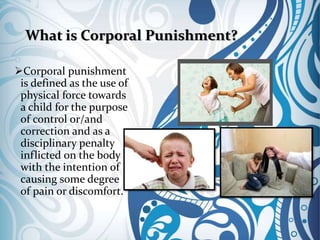
Corporal punishment
is defined as the use of
physical force towards
a child for the purpose
of control or/and
correction and as a
disciplinary penalty
inflicted on the body
with the intention of
causing some degree
of pain or discomfort.
World Report on Violence and
Health in 2002 confirmed these
findings.
75% of Filipino children said that
they had been spanked
82% of Filipino mothers admitted
to having shouted at their children
48% said that they have
threatened their children with
abandonment
Study on corporal punishment in the
Philippines conducted by Save the children
UK in 2005.
85% that punishment is most commonly
experienced by children inside the home
65% most common type of punishment is
spanking
82% also reported that they had been hit on
different parts of their bodies
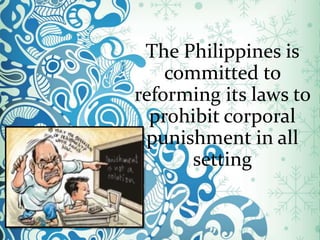
The Philippines is
committed to
reforming its laws to
prohibit corporal
punishment in all
setting
House Bill 4907
"An Act Promoting Positive and Nonviolent
Discipline of Children and Appropriating
Funds Therefor“
“Corporal punishment of children is hereby
prohibited in homes, schools, institutions,
alternative care systems, workplaces, the
juvenile welfare system, places of religious
worship and in all other setting.

Issues of punishment

  • 2.
    The purpose of punishmentis to stop a child from doing what you don't want by using a painful or unpleasant method to stop him.
  • 4.
    What is CorporalPunishment? Corporal punishment is defined as the use of physical force towards a child for the purpose of control or/and correction and as a disciplinary penalty inflicted on the body with the intention of causing some degree of pain or discomfort.
  • 5.
    World Report onViolence and Health in 2002 confirmed these findings. 75% of Filipino children said that they had been spanked 82% of Filipino mothers admitted to having shouted at their children 48% said that they have threatened their children with abandonment
  • 6.
    Study on corporalpunishment in the Philippines conducted by Save the children UK in 2005. 85% that punishment is most commonly experienced by children inside the home 65% most common type of punishment is spanking 82% also reported that they had been hit on different parts of their bodies
  • 7.
    The Philippines is committedto reforming its laws to prohibit corporal punishment in all setting
  • 8.
    House Bill 4907 "AnAct Promoting Positive and Nonviolent Discipline of Children and Appropriating Funds Therefor“ “Corporal punishment of children is hereby prohibited in homes, schools, institutions, alternative care systems, workplaces, the juvenile welfare system, places of religious worship and in all other setting.